Floating Island Dessert (Île Flottante)
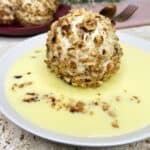
This floating island dessert (île flottante) is a French classic made of soft, airy meringue floating on chilled vanilla crème anglaise and finished with caramelized hazelnuts. The meringue is baked in half-sphere molds, and the dessert is naturally gluten-free and serves 6.
- Total Time: 50 minutes
- Yield: 6 1x
- Category: Gluten-free
- Method: Baking
- Cuisine: French
- Diet: Gluten Free
Ingredients
Scale
For meringue:
- 1/3 cup + 1 teaspoon (80 g) caster sugar
- 2/3 cup + 1 tablespoon (180 g) egg whites, room temperature (see note #1)
For crème anglaise:
- 2 cups + 2 tablespoons (500 ml) whole milk
- 6 large egg yolks, room temperature
- 1/3 cup (75 g) granulated sugar
- 1 vanilla bean (or 1 sachet of vanilla sugar)
For caramelized nuts:
- 1/3 cup + 2 tablespoons (100 g) granulated sugar
- 5 teaspoons (25 g) water
- 7 oz. (200 g) roasted hazelnuts
- 2 teaspoons (10 g) unsalted butter
- 1 small pinch of salt
* If needed, please refer to Baking Conversion Charts.
Instructions
- To make crème anglaise, split the vanilla bean lengthwise and scrape the seeds. Mix the egg yolks with the vanilla seeds (or vanilla sugar) and sugar with a hand whisk.
- Place milk in a small saucepan and bring to a boil. Pour the hot milk into the egg yolk mixture, stirring constantly.
- Return everything to the saucepan and cook over low to medium heat for about 7 to 10 minutes, stirring and tracing an "8" with a wooden spatula. Stop cooking just before boiling (using a cooking thermometer, check the temperature, which has to be between 179-183°F (82-84°C). Don't exceed the custard's temperature of 185°F (85°C)!
- Pass through a fine-mesh sieve or chinois strainer into another bowl set over a larger container with ice cubes to stop the cooking. Cover with plastic film in contact and refrigerate until serving.
- To make the meringue, preheat the oven to 355°F (180°C). Using a stand or electric mixer, beat egg whites on medium speed, then increase the speed and continue until soft peaks form. Gradually add the caster sugar and whisk to get the glossy meringue with stiff peaks.
- Using a brush, lightly oil the cavities of the half-sphere molds. Using a pastry bag fitted with Ateco plain pastry tip 809 or simply a spoon, place the meringue into half-spheres and even top with a bent spatula. Bake for 3 minutes on the middle rack (no baking sheet required).
- Remove the mold from the oven, and let it stand for a few minutes. Turn out the mold onto parchment paper and slightly press each half-sphere to release the baked meringue. Refrigerate until ready to assemble.
- To caramelize nuts, roast hazelnuts at 355°F (180°C) for 12 minutes. Place water and sugar in a saucepan and cook till the temperature is 239°F (115°C). Add the toasted nuts and caramelize them while constantly stirring with a spatula. At first, hazelnuts will be covered with the sugar syrup; then, they will get coated with sugar. Finally, the sugar will start melting and caramelizing, coating the nuts. At this point, add butter and salt, stirring constantly.
- Transfer caramelized hazelnuts to parchment paper and let cool. Crush lightly using a food processor and keep in an airtight plastic box.
- To serve the dessert, assemble two half-spheres and roll them in crushed caramelized nuts. Pour crème anglaise into a serving plate and arrange a meringue sphere over the custard sauce.
Notes
- 180 g egg whites, approximately equal to 5 1/2 raw fresh egg whites from large-sized chicken eggs.
- While making crème anglaise, stir the custard evenly with a wooden spatula. Do not let the custard boil! Once the white foam has disappeared and the custard coats the back of a spatula well and holds a trace when you draw your finger across it, crème anglaise is ready. Use this test if you do not have a cooking thermometer.
- To prevent crème anglaise from overcooking, use a container with ice cubes or a cold water bath to cool the custard as quickly as possible.
- If the custard has boiled and got overcooked (the eggs coagulate and form lumps), strain it through a fine-mesh sieve and give it a few mixer strokes to remove all the lumps. Your custard will become smooth again.
- Use grapeseed oil or vegetable oil to brush silicone half-spheres before baking.
- Make-ahead option: Make crème anglaise, cover with plastic in contact, and store in the fridge for up to 2 days. Make caramelized nuts and keep them in an airtight container. Bake the meringue half-spheres, turn them out onto parchment, and store them in an airtight container in the refrigerator for up to 4 hours.
Nutrition
- Serving Size: 1 meringue sphere
- Calories: 501
- Sugar: 48.7 g
- Sodium: 82 mg
- Fat: 28.9 g
- Saturated Fat: 5.6 g
- Carbohydrates: 52.7 g
- Fiber: 3.2 g
- Protein: 13.7 g
- Cholesterol: 222 mg