Japanese Strawberry Shortcake (Japanese Christmas Cake)
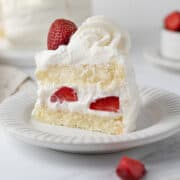
Japanese strawberry shortcake, also known as Japanese Christmas cake or Kurisumasu Keki, is made with soft, fluffy sponge cake layers, sweetened whipped cream, and juicy, fresh strawberries.
- Prep Time: 30 minutes
- Cook Time: 30 minutes
- Total Time: 1 hour
- Yield: 6 1x
- Category: Cakes
- Method: Baking
- Cuisine: Asian, Japanese, Korean
Ingredients
Scale
For the sponge cake:
- 140 g eggs, room temperature (see note #1)
- 1/3 cup (70 g) granulated sugar
- 2 teaspoons (14 g) honey
- 1/2 cup (60 g) all-purpose flour
- 1 1/2 tablespoons (14 g) cornstarch
- 1/2 tablespoon (8 g) unsalted butter
- 2 1/2 teaspoons (13 g) whole milk
- 1/4 teaspoon vanilla extract
For sugar syrup:
- 1/5 cup (50 ml) water
- 1 tablespoon (15 g) granulated sugar
- 1 teaspoon vanilla extract
For fresh whipped cream:
- 1 2/3 cups + 4 tablespoons (450 g) cold heavy cream, 30% fat
- 6 1/2 tablespoons (50 g) icing sugar
For filling and decoration:
- 12.5 oz. (350 g) fresh strawberries
Instructions
- To make the sponge cake, preheat the oven to 330°F (165°C). Line the bottom of a 6-inch (15 cm) cake pan with a piece of round parchment paper. Line the sides with parchment strips. In a large bowl, sift the flour with cornstarch, then set aside.
- Place butter and milk in a small bowl over a container with hot water and let the butter melt. Mix and check the mixture temperature with a cooking thermometer - it must be 140°F (60°C). Pro tip: You can use the microwave to heat the butter and milk in 30-second increments. Make sure to use a microwave-safe bowl.
- Place eggs, sugar, and honey in a heat-resistant bowl and beat with a hand whisk for 1 minute. Place the bowl over a water bath and continue mixing with a whisk. Once the mixture reaches 104°F (40°C), remove the bowl from the hot water bath.
- Using a hand mixer, start whisking the egg mixture on low speed for 1 minute. Then switch the mixer to high speed and beat for 10 minutes. Return the hand mixer to low speed and beat in slow circular motions for 1-2 minutes. Once you lift the beaters of the hand mixer, the batter should leave a ribbon-like mark that will remain for 3-4 seconds.
- Sift 1/2 of the dry ingredients over the bowl and gently mix with a rubber spatula, working from the bottom of the bowl as you rotate it, little by little. Add the remaining dry ingredients and mix in the same way. Rotate the bowl and mix until the flour disappears. Add 2 tablespoons of the batter to the milk and butter mixture, then whisk with a mini whisk. Pour this mixture into the principal preparation and gently mix the batter.
- Pour the batter into the prepared pan, then tap the mold from 4 inches (10 cm) to remove air bubbles. Bake in the preheated oven for 30 minutes. The cake is ready when the gap between the pan and the cake appears, and a toothpick or bamboo skewer is inserted into the center of the cake and comes out clean.
- Remove the baked cake from the oven and tap the mold from 6 inches (15 cm) to prevent cake shrinkage. Let it cool in the pan for 10 minutes. Flip it over and let the cake slip from the mold on a wire rack. Allow the cake to cool for 10 minutes. Then turn it over and let it cool completely.
- To make the sugar syrup, put granulated sugar and water in a small saucepan and bring to a boil. When the sugar melts, remove from the heat and add vanilla extract. Let the syrup cool down.
- To make the fresh whipped cream, pour cold heavy cream into a chilled bowl, then whisk with a hand whisk for 6 minutes. 6-minute cream falls in a thin line when you lift the whisk. Stop whisking the cream at 6 minutes.
- To assemble the cake, use a serrated knife or a cake leveler to cut the bottom and the top of the cake at 1/5 inch (0.5 cm) thickness (you won't use them). Cut the remaining cake in half to get two round sponge layers. Wash and pat dry strawberries. Hull them, leaving 6 for decoration. Cut the rest in half lengthwise.
- Place the sponge cake layer on a turntable. Soak it with the syrup using a pastry brush. Divide the cream into two halves. Make an 8-minute stand (see note #2) with half the cream amount, and apply half to the sponge with an offset spatula. Arrange strawberry halves by lightly pressing them. Apply the other half of the 8-minute stand cream and smooth it with the spatula. Place the second cake layer on top, and press lightly.
- Whip the remaining half of the cream to reach a 7-minute stand (see note #3). Apply plenty of the cream on top of the cake, and smooth it with the spatula while rotating the turntable. Let the cream protrude so that it drips down the sides.
- Fix the spatula at the 9 o'clock position and cover the sides with the cream that overflows. If it is not enough, add cream at any time.
- Smooth the rise of the edge of the top surface toward the center using a spatula. Wipe off the cream with a paper towel after each time you smooth it with a spatula, and always use a clean spatula.
- Transfer the cake from the turntable to a cake board or a serving plate. Insert the spatula between the turntable and the cake, lift the cake, put it on the plate from the back, and quickly pull out the pallet to the front. Alternatively, use a cake lifter to help transfer the cake with the spatula.
- Place the remaining cream into a piping bag fitted with Ateco pastry tip 829. Squeeze a bit of cream from the inside of the cake rim, and when the cream reaches the rim, gently pull it toward the center. Continue to decorate the top of the cake.
- Refrigerate the cake for 2-3 hours. Place halved or whole strawberries in the center of the cake before serving.
Notes
- 140 g eggs approximately equal 2.50 whole extra-large chicken eggs (egg shells removed), or about 1/2 US cup of whole eggs.
- Cream at an 8-minute stand is about to stay on the whisk and then drop off. It is the right cream state for sandwiching the cake layers.
- Cream at a 7-minute stand is quite loose and is just enough to stay on the whisk.
- Use a kitchen scale for precise ingredient measurements.
- Sift dry ingredients twice to avoid lumps: first over a clean bowl, then over the beaten eggs.
- Don't overmix the cake batter.
- Avoid overbaking: the longer you bake, the harder the cake becomes.
- Do not work near hot appliances or in a heated room when working with heavy cream. Make sure to chill the mixer's beaters and the bowl or whisk the cream over the ice bath.
- For the best results, opt for a hand whisk instead of an electric mixer. Avoid using a stand mixer to prevent overwhipping the cream.
- Make sure strawberries are thoroughly dried before adding them as a cake layer to prevent sogginess and prevent juices from releasing into the whipped cream.
- Make-ahead option: Make the Japanese Christmas cake a half day in advance and refrigerate; the cream, sponge, and strawberries will blend beautifully. Decorate the top of the cake with plump strawberries before serving.
Nutrition
- Serving Size: 1 slice
- Calories: 461
- Sugar: 27.6 g
- Sodium: 63 mg
- Fat: 31.5 g
- Saturated Fat: 18.7 g
- Carbohydrates: 41.1 g
- Fiber: 1.5 g
- Protein: 6 g
- Cholesterol: 193 mg
Find it online: https://www.bakinglikeachef.com/japanese-strawberry-shortcake/