


French hazelnut praline paste (pâte pralinée) is a delicious gluten-free and dairy-free breakfast spread and a basic ingredient in numerous French pastries. It is an easy recipe with a 100% guaranteed result.
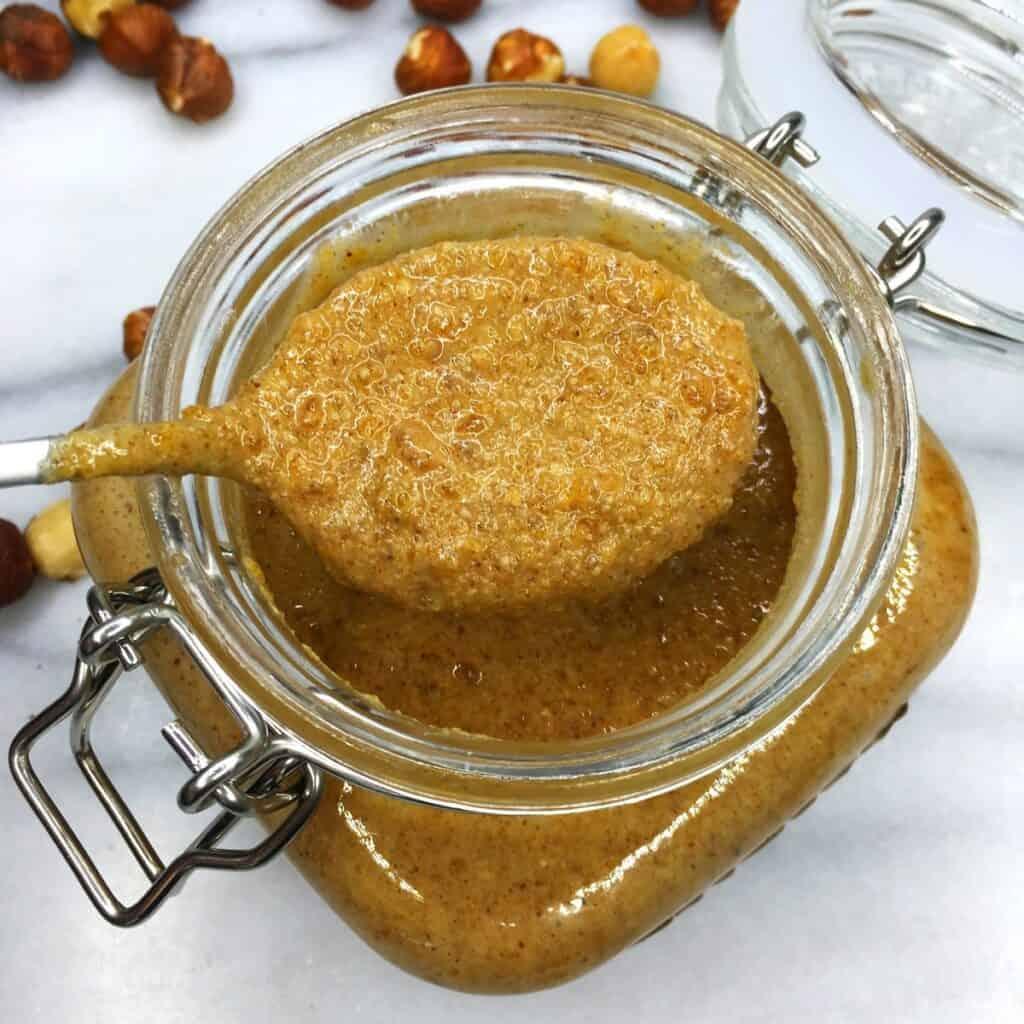
What is hazlenut praline paste?
Hazelnut praline paste is a popular French spread made from caramelized nuts, often hazelnuts, almonds, or both, and caramel. These are crushed until they release essential oils to make a paste with a smooth texture resembling peanut butter.
So, what is hazelnut paste? It is a praline paste made with toasted hazelnuts. If you see 'French praline paste' as a recipe ingredient, this means it is made out of toasted hazelnuts.
Hazelnut praline paste recipe
- Simple & Inexpensive: Only three ingredients (hazelnuts, sugar, salt) create a delicious, homemade spread.
- Deliciously Sweet: The perfect balance of sweetness in a smooth, creamy hazelnut paste.
- Aromatic & Homemade: Making it fills your kitchen with a beautiful nutty aroma, and it is a great alternative to store-bought praline spreads.
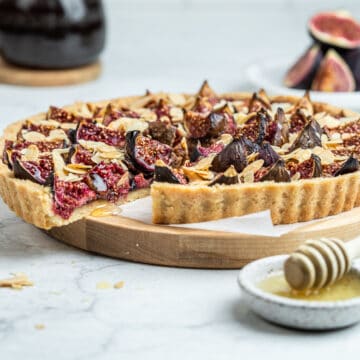
- Versatile Use: Perfect as a praline filling for crepes, pancakes, or French desserts like Paris-Brest or Fig Tart With Praline.
Ingredients
For ingredients and detailed instructions, refer to the recipe card below.
- Hazelnuts: Use high-quality, finest hazelnuts. Toast raw hazelnuts yourself or use store-bought toasted hazelnuts. Feel free to experiment with other nuts: almonds, a mix of hazelnuts and almonds, pecans, pistachios, etc.
- Sugar: Use granulated white sugar or caster sugar. Replace it with organic cane sugar, but avoid brown sugar.
- Salt: Ideally, use fleur de sel, but you can replace it with any coarse salt or sea salt. Don't use iodized table salt because the taste would be too strong.
How to make hazelnut praline paste
- Roast & Prepare Hazelnuts: Preheat oven to 300°F (150°C). Spread hazelnuts on a baking sheet and roast for 15 minutes. Once roasted, wrap hazelnuts in a kitchen towel and rub to remove skins. It is fine if some skin remains. Place hazelnuts in a single layer on a lined sheet pan (photo 1).
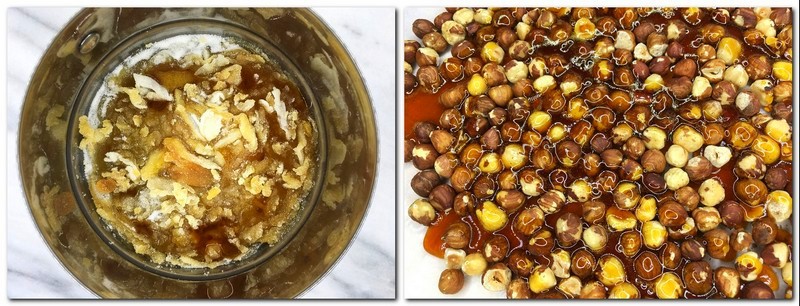
- Make the Caramel: Heat a stainless steel pan over medium-high heat for a few seconds. Add one-third of the granulated sugar and cook over medium heat, swirling the pan (photo 2).
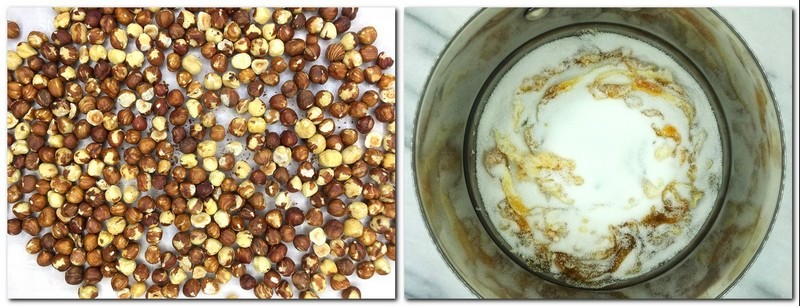
- Add Sugar Gradually: Once the sugar starts melting, add the second third of the sugar. Continue swirling the pan without stirring. Add the final third of sugar and let it dissolve. The caramel might look lumpy and grainy with sugar granules (photo 3), but it will eventually melt. Cook until the caramel reaches a golden color. Add a pinch of salt at the end.
Pro tip: The key is swirling the pan while cooking and watching for the color of the caramel. Don't burn it: the darker it gets, the bitter and more potent it becomes.
- Cool & Process the Caramel: Pour the caramel over the toasted hazelnuts in a thin layer and let it cool for about 20 minutes (photo 4).
Break the cooled caramel into pieces and place them in a food processor. Start at low speed to make praline powder (photos 5-6).
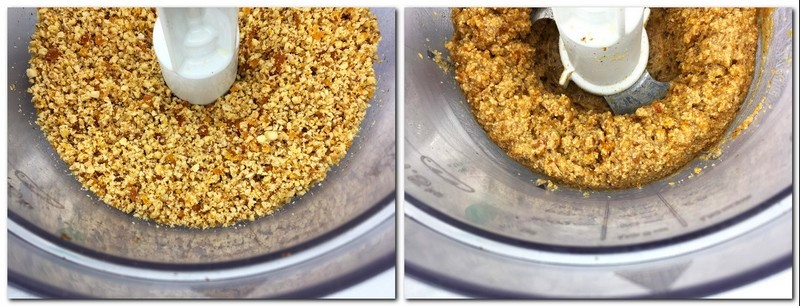
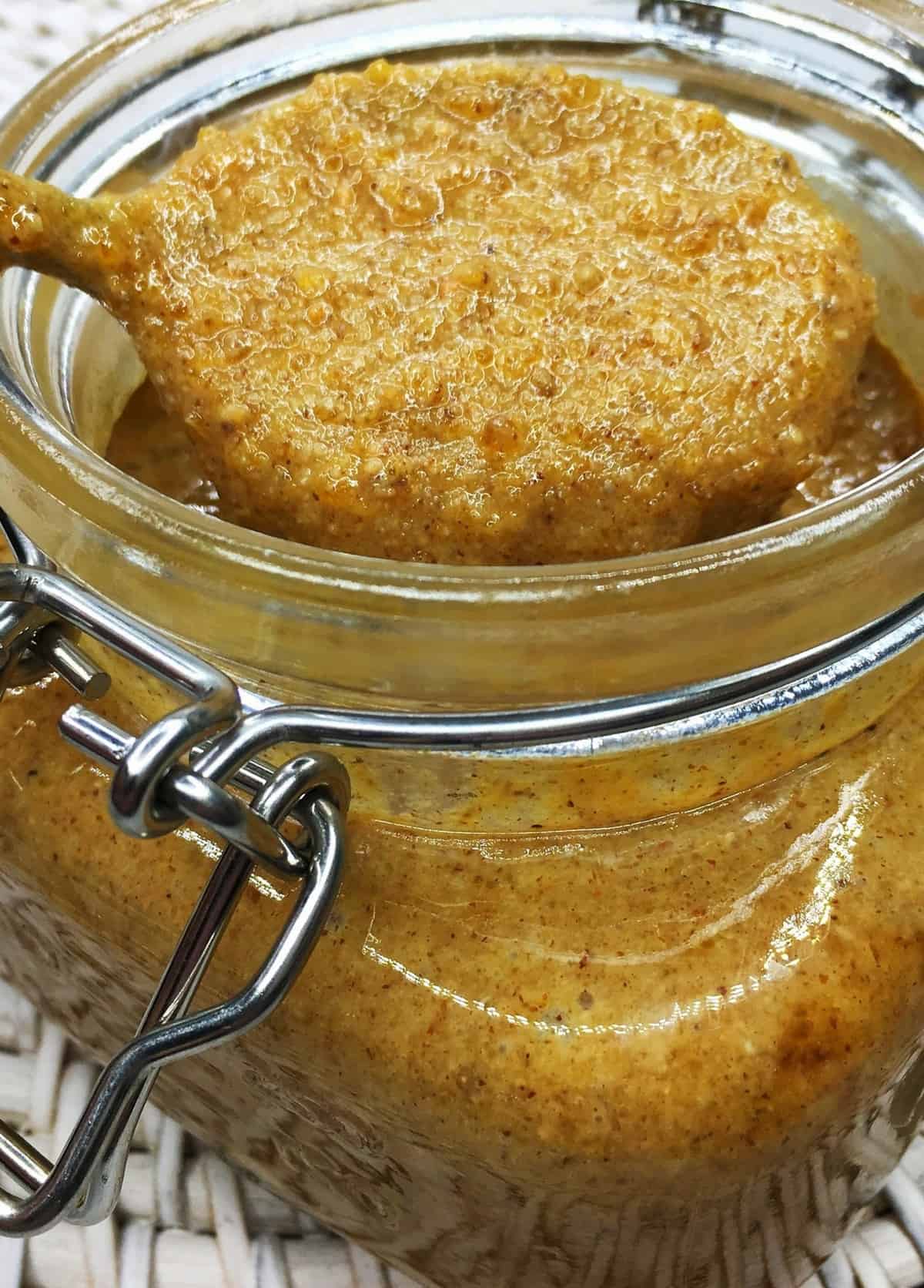
Then increase speed and process for 5-10 minutes until the mixture becomes a smooth, creamy praline paste (photos 7-8).

Pro tip: Reduce toasted and caramelized nuts to smooth golden paste several times in small steps to prevent the food processor or blender from overheating.
Expert Tips
- Please DO NOT touch the pot or caramel while it is still hot, or you may get burned. Use oven mitts.
- Depending on your taste, mix your praline spread for a longer or shorter time. It usually takes about 15 minutes to make a smooth praline paste.
- Do not overheat the praline paste and your device while mixing: stop the food processor or blender several times.
Recipe variations
- Almond Praline: Replace hazelnuts with blanched almonds for a spread or gluten-free dessert like Fig and Cinnamon Pavlova.
- Hazelnut & Almond Blend: A mix of almonds and hazelnuts rivals Valrhona's hazelnut-almond praline spread.
- Other Nut Variations:
- Pistachios: For a snack, use pistachio praline paste with nutty chocolate.
- Pecans: A great alternative for a sandwich spread.
- Walnuts: Rich walnut praline paste, perfect for fruit desserts.
- Other Nuts: Try cashews, macadamia nuts, peanuts, or pine nuts as substitutes.
How to serve praline paste
- Enjoy on its own: Great with ice cream, crepes, pancakes, or brioche.
- Make Hazelnut Chocolate Spread: Mix 3.5 oz. (100 g) melted chocolate with 6.4 oz. (180 g) Praline paste for a Nutella-like spread.
- Use in frosting: Add praline to sugar-free whipped cream for cupcakes or sponge cake.
Storing & Freezing
Store praline paste in an air-tight container, like a mason jar, at room temperature, away from light, for up to one week, or in the fridge for one month. If stored in a sterilized glass jar, it can last a few weeks in the fridge.
Stir occasionally (once a week) to prevent oil separation and maintain its smooth texture.
For longer storage, you can freeze praline paste for up to 6 months. To thaw, leave it at room temperature for a few hours.
Recipe FAQ
Your praline may taste bitter if hazelnuts turn dark brown while toasting in the oven. Other causes could be unshelled hazelnuts and overcooked caramel (too dark caramel).
Praline is a hazelnut powder obtained during the first step of grinding caramelized hazelnuts. Praline paste is the next step of mixing this powder when the nut oil is extracted to get a smooth, thick paste.
Pralines, also known as Pink Praline, are almonds coated in caramelized pink sugar.
No, they are not the same. Pralinoise is a praline paste mixed with milk chocolate and a little bit of vanilla. French and Belgian chocolatiers use it to fill candies and other chocolates.
Love praline desserts? Try these next!
Print

Recipe card
Hazelnut Praline Paste
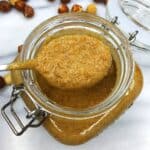
French hazelnut praline paste is a delicious gluten-free and dairy-free breakfast spread and a basic ingredient for many French pastries. It is an easy recipe with a 100% guaranteed result.
- Total Time: 50 minutes
- Yield: (10.6 oz. ) 300 g
- Category: No-bake desserts
- Method: No baking
- Cuisine: French
Ingredients
- 7 oz. (200 g) raw hazelnuts
- ½ cup + 4 teaspoons (130 g) granulated sugar
- 1 pinch of fleur de sel
* If needed, please refer to Baking Conversion Charts.
Instructions
-
To roast hazelnuts, preheat the oven to 300°F (150°C). Spread whole raw hazelnuts in a single layer on a baking sheet and toast for 15 minutes.
-
Remove skins by wrapping warm hazelnuts in a clean kitchen towel (rub vigorously!) and let them sit for 5 to 10 minutes. It is unnecessary to remove all the skin; if there are any pieces of skin left, it is okay.
-
Place roasted hazelnuts as a single layer on a sheet pan, a baking tray lined with parchment paper, or a silicone baking mat.
-
To make the caramel, first, heat a stainless steel pan with a heavy bottom over medium-high heat for a few seconds and pour one-third of the granulated sugar. Cook over medium heat, swirling and shaking the pan over your stove.
-
Once the sugar starts melting, add another third of the sugar and continue to swirl the pan. Do not mix the caramel (when the sugar dissolves) with a spoon or spatula! Add the last third of the sugar and continue to cook. The caramel might look lumpy and grainy with sugar granules, but it will melt at some point.
-
Lower the heat and cook until the sugar melts and the caramel gets a golden color while you feel a caramel flavor. The key is swirling the pan while cooking! Add a pinch of salt at the last moment of cooking. Pour the caramel over the toasted hazelnuts in a single thin layer and cool completely for about 20 minutes.
-
Break the caramel plate into smaller pieces and place it in the bowl of a food processor. Turn on low speed and get a praline powder first. Then switch to a higher speed and process more until paste forms and turns into the creamy paste, nut praline.
Notes
- Use store-bought toasted unsalted hazelnuts to save time.
- Please DO NOT touch the pot or the caramel while it is still hot, or you may get burned.
- Replace fleur de sel with any coarse salt or sea salt; however, don't use iodized table salt because the taste would be too strong.
- Mix your praline for a longer or shorter time, depending on your taste.
- Do not overheat the praline paste and your device while mixing: stop the food processor or blender several times.
- Store praline paste in a mason glass jar at room temperature for up to one week in the fridge for up to one month. Remember to stir it once a week, so the oil does not separate, and the mixture keeps all its smoothness.
- Freeze praline paste for up to 6 months.
Nutrition
- Serving Size: (1 oz.) 30 g
- Calories: 174
- Sugar: 13.9 g
- Sodium: 16 mg
- Fat: 12.2 g
- Saturated Fat: 0.9 g
- Carbohydrates: 16.3 g
- Fiber: 1.9 g
- Protein: 3 g
- Cholesterol: 0 mg
The nutritional information has been calculated using an online recipe nutrition calculator such as Verywellfit.com and is intended for informational purposes only. These figures should be used as a general guideline and not be construed as a guarantee.
The recipe was originally published on September 08, 2020. It has been revised to include improved content and photos.
Leave a Reply