


Quick Summary: How many grams in a teaspoon? There are about 5 grams in a teaspoon of water or granulated sugar. Because grams measure weight and teaspoons measure volume, the exact amount depends on the ingredient: 1 US teaspoon holds roughly 4.9 g water, 4.2 g sugar, 2.6 g flour, 4.7 g butter, and 6 g salt. See the ingredient chart below for the grams in a teaspoon of your ingredient.
I created a few handy teaspoons-to-grams conversion charts for most dry ingredients.
Jump to:
- How many grams are in a teaspoon?
- Why is there no single answer?
- Teaspoons to grams conversions
- Teaspoons to grams conversion table
- Sugar
- Flour
- Sweeteners
- Fats
- Liquids
- Nuts and seeds
- Leaveners and small-measure ingredients
- How to convert teaspoons to grams
- When should you convert teaspoons to grams?
- What is a gram?
- What is a teaspoon?
- Which teaspoon should you use?
- Tips for measuring teaspoons accurately
- FAQ
- Related conversions
- Information sources
- Comments
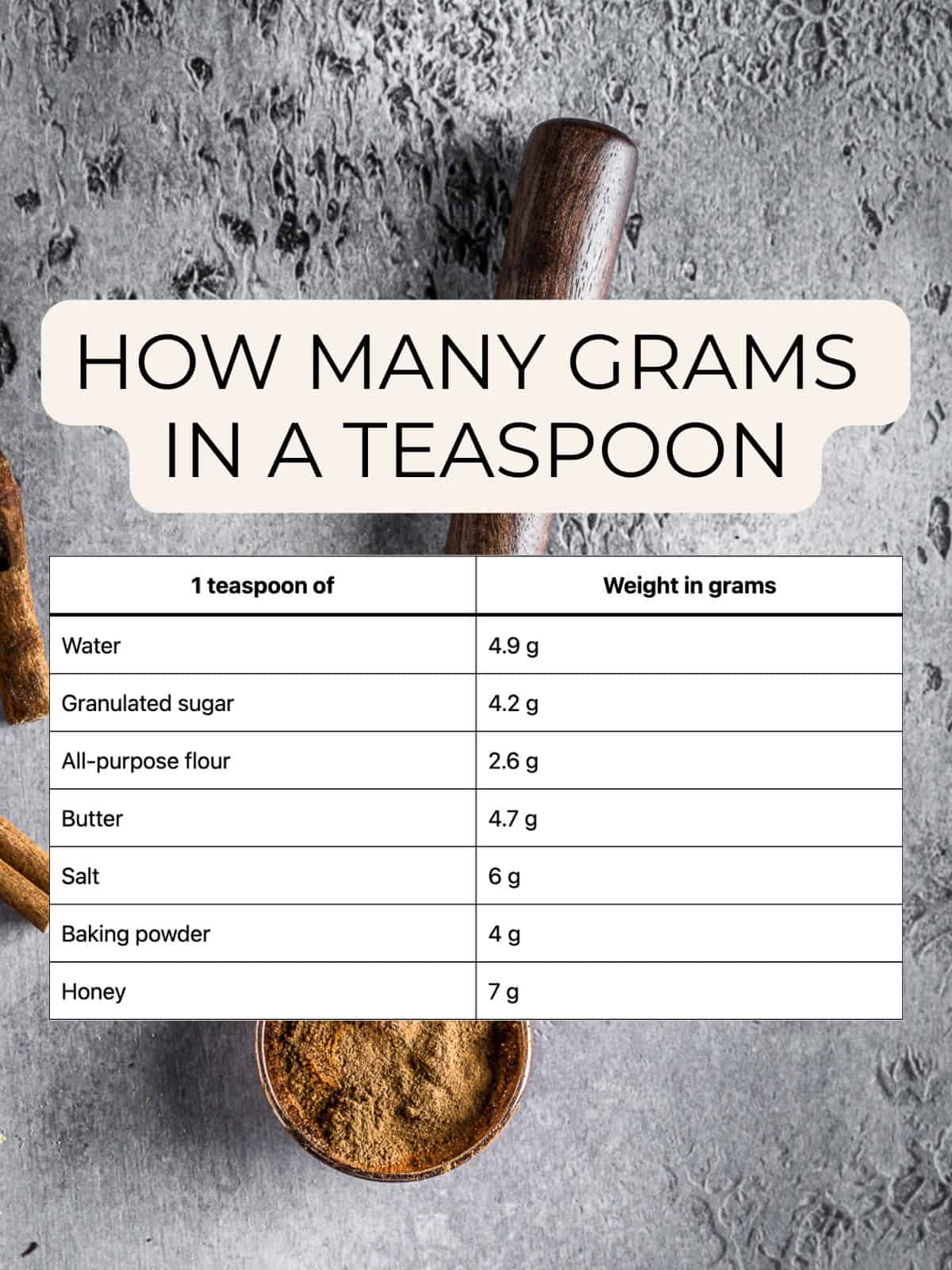
How many grams are in a teaspoon?
| 1 teaspoon of | Weight in grams |
|---|---|
| Water | 4.9 g |
| Granulated sugar | 4.2 g |
| All-purpose flour | 2.6 g |
| Butter | 4.7 g |
| Salt | 6 g |
| Baking powder | 4 g |
| Honey | 7 g |
A teaspoon is a measurement of volume, and a gram is a measure of mass.
- One US teaspoon of water weighs 4.92892 grams. That means 1 g of water is about ⅕ teaspoon.
- One imperial teaspoon of water weighs 3.55 grams.
Why is there no single answer?
A teaspoon measures volume (the space an ingredient takes up), while a gram measures weight. Because every ingredient has a different density, the same teaspoon holds a different weight depending on what it contains.
One teaspoon of flour is light and airy at about 2.6 grams, while one teaspoon of honey is dense and heavy at about 7 grams. That is why there is no single number of grams in a teaspoon, and why the charts below are split by ingredient.
Teaspoons to grams conversions
Converting from a teaspoon to a gram can be difficult, as a single unit of weight and volume. I created a list of common cooking and baking ingredients and their tablespoon to gram conversion tables.
Note: Measurements are given for level teaspoons (not heaped teaspoons).
Teaspoons to grams conversion table
Need to scale up? Use this quick reference for water, granulated sugar, and all-purpose flour. Since a teaspoon measures volume, the gram weight depends on the ingredient, so the same number of teaspoons weighs a different amount for each one.
| Teaspoons | Water | Granulated sugar | All-purpose flour |
|---|---|---|---|
| ¼ teaspoon | 1.2 g | 1.1 g | 0.7 g |
| ½ teaspoon | 2.5 g | 2.1 g | 1.3 g |
| 1 teaspoon | 4.9 g | 4.2 g | 2.6 g |
| 2 teaspoons | 9.8 g | 8.4 g | 5.2 g |
| 3 teaspoons | 14.7 g | 12.6 g | 7.8 g |
| 4 teaspoons | 19.6 g | 16.8 g | 10.4 g |
Sugar
| Ingredient | 1 teaspoon (tsp) |
|---|---|
| Granulated sugar | 4.2 g |
| Caster sugar | 4.7 g |
| Icing sugar | 2.6 g |
| Brown sugar | 4.2 g |
Flour
| Ingredient | 1 teaspoon (tsp) |
|---|---|
| All-purpose flour | 2.6 g |
| 00 flour | 2.7 g |
| Almond flour | 2 g |
| Bread flour | 2.7 g |
| Buckwheat flour | 2.5 g |
| Cake flour | 2.1 g |
| Chestnut flour | 1.9 g |
| Coconut flour | 2.3 g |
| Cornflour | 3.1 g |
| Gluten-free flour | 2.5 g |
| Oat flour | 1.9 g |
| Pastry flour | 2.3 g |
| Rye flour | 2.1 g |
| Self-rising flour | 2.6 g |
| Semolina flour | 3.5 g |
| Tapioca flour | 2.5 g |
| Whole wheat flour | 2.7 g |
Sweeteners
| Ingredient | 1 teaspoon (tsp) |
|---|---|
| Golden syrup | 6.9 g |
| Honey | 7.1 g |
| Light corn syrup | 6.8 g |
| Molasses | 7.2 g |
| Maple syrup | 6.6 g |
| Treacle syrup | 6.9 g |
Fats
| Ingredient | 1 teaspoon (tsp) |
|---|---|
| Butter | 4.7 g |
| Ghee | 4.6 g |
| Margarine | 4.5 g |
| Avocado oil | 4.5 g |
| Coconut oil | 4.5 g |
| Grapeseed oil | 4.5 g |
| Macadamia oil | 4.5 g |
| Sesame oil | 4.5 g |
| Sunflower oil | 4.6 g |
| Peanut oil | 4.6 g |
| Peanut butter, creamy | 5.3 g |
| Virgin olive oil | 4.6 g |
| Vegetable oil | 4.7 g |
Liquids
| Ingredient | 1 teaspoon (tsp) |
|---|---|
| Water | 4.9 g |
| Buttermilk | 5.1 g |
| Condensed milk, sweetened | 6.4 g |
| Goat milk | 5.1 g |
| Whole milk | 5.1 g |
| Whipping cream | 4.8 g |
Nuts and seeds
| Ingredient | 1 teaspoon (tsp) |
|---|---|
| Chia seeds | 3.4 g |
| Coconut shredded | 1.9 g |
| Hazelnut meals | 2.4 g |
| Pecans chopped | 2.3 g |
| Poppy seeds | 2.9 g |
| Walnuts chopped | 2.4 g |
Leaveners and small-measure ingredients
| Ingredient | 1 teaspoon (tsp) |
|---|---|
| Baking powder | 4.6 g |
| Baking soda | 4.6 g |
| Cocoa powder | 2.5 g |
| Cream of tartar | 3.4 g |
| Gelatin, powdered | 3.1 g |
| Pink salt | 5.5 g |
| Salt, table | 5.7 g |
| Vanilla extract | 4.2 g |
| Yeast, active dry | 2.8 g |
| Yeast, instant | 2.8 g |
| Yeast, fresh | 3.1 g |
How to convert teaspoons to grams
To convert one teaspoon to grams, use the following formula. Multiply the volume by the density of the ingredient, where the density is given in grams per teaspoon (g/tsp).
If the density is expressed in grams per milliliter (g/mL), multiply it by 4.9289 to convert to grams per tablespoon (g/tsp).
Here is a simple formula for 1 teaspoon to g calculation: 1 teaspoon x 4.9289 x density
When should you convert teaspoons to grams?
Converting teaspoons to grams matters most in baking, where small differences in flour, sugar, or leaveners change the result. Grams give you precise, repeatable measurements, so use them when a recipe lists weights, when you scale a recipe up or down, or when you want consistent results every time. For casual cooking, teaspoons are usually accurate enough.
What is a gram?
The gram is the SI unit of mass, commonly used in the metric system. The official definition states that it is one-thousandth of the International System of Units (SI) base unit for weight.
The abbreviation used for a gram is 'g'. For example, 1 gram is the same as 1 g.
What is a teaspoon?
A teaspoon is a unit of volume, most commonly in baking and cooking recipes. It's also known as ⅓rd of a tablespoon.
The abbreviation used for a teaspoon is 'tsp.' For example, one teaspoon is the same as 1 tsp.
Which teaspoon should you use?
There are two principal teaspoon sizes currently in use worldwide, but they differ slightly (1.5%).
- US Teaspoon - used for recipes in the US, measures 4.9289 mL.
- Metric Teaspoon - used in the UK, Australia, and the Commonwealth, measures 5 mL.
If you cook and bake American recipes, use a set of measuring spoons and cups.
But I would highly recommend investing in a digital scale for the accurate conversion between grams and tablespoons. It is the most effective way to achieve precise measurements in baking and cooking applications.
Tips for measuring teaspoons accurately
- Use level teaspoons, not heaped ones. Scoop the ingredient, then swipe the back of a knife across the top to level it off.
- Fluff up flour before measuring, since packed flour weighs more per teaspoon.
- For the most accurate results, weigh ingredients on a digital kitchen scale instead of measuring by volume.
- Remember that a teaspoon of a dense ingredient, like honey or salt, weighs more than a teaspoon of a light one, like cocoa powder.
FAQ
Is 5 grams a teaspoon?
Roughly, yes for water or granulated sugar. One teaspoon of water weighs about 4.9 grams, and sugar about 4.2 grams, so 5 grams is close to one level teaspoon of those ingredients.
Is 1 teaspoon 10 grams?
No. For most common ingredients, one teaspoon weighs 3 to 7 grams, not 10. Only very dense ingredients would reach 10 grams per teaspoon.
Is 20 grams 1 teaspoon?
No. 20 grams is about 4 teaspoons of water or sugar, since one teaspoon of these weighs around 5 grams.
How many grams is a teaspoon of powder?
It depends on the powder. A teaspoon of baking powder is about 4 grams, baking soda about 4.6 grams, and cocoa powder about 2.5 grams.
How do you convert teaspoons to grams?
Multiply the number of teaspoons by 4.9289 and then by the ingredient density in grams per milliliter. For water (density 1), 1 teaspoon equals about 4.9 grams.
Related conversions
Please check out other baking conversion charts on the website. Also, you will find individual converters from tablespoons to grams, grams to teaspoons, grams to cups, and cups to grams helpful.
Download my FREE butter measurement conversion chart now. It is the most requested conversion on the website.
Information sources
- Culinary Measurement Tips from the National Institute of Standards & Technology
- Guidance for Industry: Guidelines for Determining Metric Equivalents of Household Measures from the U.S. Food & Drug Administration
- Cooking amounts converters from the Traditional Oven
- Online calculator tools from Convert-to.com
Comments
No Comments