


Quick Summary: This oven temperature conversion guide shows that the most common setting, 350°F, equals 180°C or gas mark 4. To convert, use °C = (°F − 32) × 5/9 and °F = (°C × 9/5) + 32. For a fan (convection) oven, reduce the conventional temperature by about 25°F, or 20°C, or one gas mark.
I created a free cheat sheet to help you precisely convert between Fahrenheit, Celsius, and gas mark. Download and print it below.
Jump to:
- Oven temperature conversion chart: Fahrenheit, Celsius, and Gas Mark
- Fahrenheit to Celsius to Gas Mark
- Celsius to Fahrenheit to Gas Mark
- Gas Mark to Fahrenheit to Celsius
- From Verbal to Fahrenheit, Celsius, and Gas Mark
- Convection oven conversion chart (fan oven)
- How to convert Fahrenheit to Celsius
- How to convert Celsius to Fahrenheit
- How to convert Celsius to Gas Mark
- How to convert Fahrenheit to Gas Mark
- How to convert Gas Mark to Celsius
- How to convert Gas Mark to Fahrenheit
- Oven temperature conversion chart printable
- Conclusion
- FAQ
- Comments
Oven temperature conversion chart: Fahrenheit, Celsius, and Gas Mark
Conventional ovens (traditional ovens) have been the most popular oven type since the 1950s. They come in different sizes with either gas or electric options. Conventional electric ovens have electric heating elements on the top and bottom, while gas ovens rely on a gas flame.
Here are temperature conversion charts for a conventional oven to help convert your recipes into the temperature units of your preference.
Note: the conversions below aren't rounded up or down. You can round the number to the nearest degree. It will make very little difference in your recipe's results.
Fahrenheit to Celsius to Gas Mark
| Fahrenheit | Celsius | Gas Mark | Terminology |
|---|---|---|---|
| 225°F | 107°C | ¼ | |
| 250°F | 121°C | ½ | Very Cool or Very Slow |
| 275°F | 135°C | 1 | Very Cool or Very Slow |
| 300°F | 149°C | 2 | Warm or Slow Cook |
| 325°F | 162°C | 3 | Warm |
| 350°F | 176°C | 4 | Moderate |
| 375°F | 190°C | 5 | Moderate |
| 400°F | 204°C | 6 | Moderately Hot |
| 425°F | 218°C | 7 | Hot |
| 450°F | 232°C | 8 | Very hot |
| 475°F | 246°C | 9 | Extremely hot |
| 500°F | 260°C | 10 |
Celsius to Fahrenheit to Gas Mark
| Celsius | Fahrenheit | Gas Mark |
|---|---|---|
| 100°C | 212°F | - |
| 110°C | 230°F | ¼ |
| 120°C | 248°F | ½ |
| 130°C | 266°F | 1 |
| 140°C | 284°F | 1 |
| 150°C | 302°F | 2 |
| 160°C | 320°F | 3 |
| 170°C | 338°F | 4 |
| 180°C | 356°F | 4 |
| 190°C | 374°F | 5 |
| 200°C | 392°F | 6 |
| 210°C | 410°F | 6 |
| 220°C | 428°F | 7 |
| 230°C | 446°F | 8 |
| 240°C | 464°F | 9 |
| 250°C | 482°F | 9 |
| 260°C | 500°F | 10 |
Gas Mark to Fahrenheit to Celsius
| Gas Mark | Fahrenheit | Celsius |
|---|---|---|
| ¼ | 225°F | 107°C |
| ½ | 250°F | 121°C |
| 1 | 275°F | 135°C |
| 2 | 300°F | 149°C |
| 3 | 325°F | 162°C |
| 4 | 350°F | 176°C |
| 5 | 375°F | 190°C |
| 6 | 400°F | 204°C |
| 7 | 425°F | 218°C |
| 8 | 450°F | 232°C |
| 9 | 475°F | 246°C |
| 10 | 500°F | 260°C |
From Verbal to Fahrenheit, Celsius, and Gas Mark
Some recipes use "slow" or "hot" to describe oven temperatures. Here is a table for approximate temperatures for these terms.
| Verbal | Fahrenheit | Celsius | Gas mark |
|---|---|---|---|
| Cool/Very Slow Cook | 250°F | 121°C | ½ |
| Warm/Slow Cook | 300°F | 148°C | 2 |
| Moderate | 350°F | 176°C | 4 |
| Moderately hot | 400°F | 204°C | 6 |
| Hot | 425°F | 218°C | 7 |
| Very hot | 450°F | 232°C | 8 |
| Extremely hot | 475°F | 246°C | 9 |
Convection oven conversion chart (fan oven)
Convection ovens (aka fan ovens) differ from conventional ovens: they have fans. The fan circulation of hot air throughout the chamber helps to ensure fast and even cooking of the food.
Interestingly, European convection ovens use a third heating element located behind the fan.
Convection ovens can be gas or electric and are sold as an option in stoves, wall ovens, and countertop ovens.
So, how do you adapt a recipe written for a regular oven to work for a convection oven?
- The general rule is to reduce the temperature by 25°F or reduce the cooking time by 25%.
- If you use a fan-assisted gas oven, reduce the gas mark by 1.
- If you use an electric fan oven, you should reduce the temperature by 20°C.
Here is a table to convert the oven temperature (in Fahrenheit) between a conventional oven and a convection one.
| Conventional oven | Convection oven |
|---|---|
| 225°F | 200°F |
| 250°F | 225°F |
| 275°F | 250°F |
| 300°F | 275°F |
| 325°F | 300°F |
| 350°F | 325°F |
| 375°F | 350°F |
| 400°F | 375°F |
| 425°F | 400°F |
| 450°F | 425°F |
| 475°F | 450°F |
| 500°F | 475°F |
And here is another table to convert the oven temperature (in Celsius) between a conventional oven (aka regular oven) and a convection one (aka fan oven).
| Conventional oven | Convection oven |
|---|---|
| 120°C | 100°C |
| 130°C | 110°C |
| 140°C | 120°C |
| 150°C | 130°C |
| 160°C | 140°C |
| 170°C | 150°C |
| 180°C | 160°C |
| 190°C | 170°C |
| 200°C | 180°C |
| 210°C | 190°C |
| 220°C | 200°C |
| 230°C | 210°C |
| 240°C | 220°C |
| 250°C | 230°C |
The best way to succeed in cooking and baking using a convection oven is to check the recommended temperature from the manufacturer's handbook or website. Also, investing in an oven thermometer is a good idea.
Always remember that baked goods may quickly turn golden brown due to the fan-assisted circulation of hot air.
However, your bakes may not be thoroughly cooked. So make sure to check the doneness of your baking goods.
How to convert Fahrenheit to Celsius
Here is a question: How do we convert the oven temperature from Fahrenheit to Celsius, which is not included in the above charts? There is no problem since there is the equation:
°C = (°F - 32) x 5/9, or °C = (°F - 32) x 0.5556
For example, how to convert 325 Fahrenheit to Celsius:
(325°F - 32) x 0.5556 = 162.7908°C, or to round it down, 160°C.
How to convert Celsius to Fahrenheit
Here is a formula:
°F = °C (9/5) + 32, or °F = (°C x 1.8) + 32
For example, what is 220 Celsius to Fahrenheit?
(220°C x 1.8) + 32 = 428°F, or to round it up 430°F.
How to convert Celsius to Gas Mark
Please use the following formula:
Gas mark = (°C - 121) x 9/125, or Gas mark = (°C - 121) x 0.072
For example, what gas mark is 180 °C?
(180°C - 121) x 0.072 = 4,248, or simply 4.
Note: the equations only work for gas mark settings as one or higher. For gas marks below 1, it moves down to ½ instead of 0 and ¼ instead of -1.
How to convert Fahrenheit to Gas Mark
Gas mark = (°F - 250) x 1/25, or Gas mark = (°F - 250) x 0.04
For example, what is 300°F in the gas mark?
(300°F - 250) x 0.04 = 2.
How to convert Gas Mark to Celsius
°C = (Gas Mark x 125/9) + 121, or °C = (Gas Mark x 13.88) + 121
For example, how do you convert the gas mark 3 to Celsius?
(3 x 13.88) + 121 = 162.64, or to round it down, 160°C.
How to convert Gas Mark to Fahrenheit
°F = (Gas mark x 25) + 250
For example, what is gas mark 3 in Fahrenheit?
(3 x 25) +250 = 325°F
Oven temperature conversion chart printable
I thought creating a PDF oven temperature conversion chart for an electric, fan, or gas oven would be helpful.
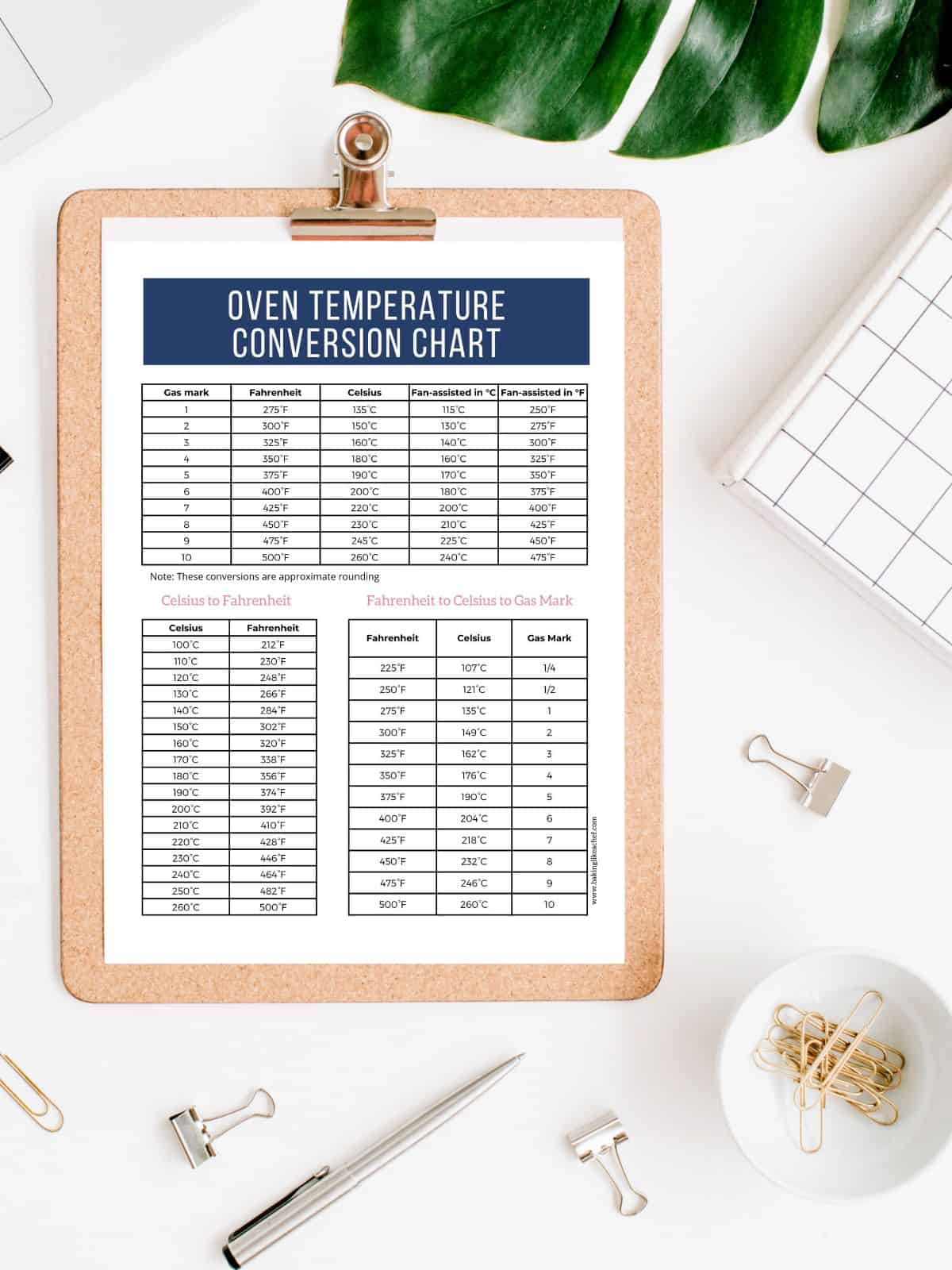
Download and print out this Oven Temperature Conversion Chart >>
Use the chart as a whole or cut the necessary conversion. Laminate it with a thermal laminator, and put it inside your kitchen cabinet or on the side of the fridge.
Conclusion
Nothing is complicated about converting the oven temperature from one unit to another: Celsius to Fahrenheit to gas mark, and vice versa.
This article converts the different temperatures between Fahrenheit, Celsius, and gas marks.
It also provides a fan oven temperature conversion table and guidelines for adapting recipes that call for a regular oven to use a convection one.
If you enjoyed this handy oven temperature conversion guide, see more helpful guides like this one:
- How Many Grams In A Cup
- How Many Cups In A Gram
- How Many Grams Is In A Teaspoon
- How Many Milliliters In A Teaspoon
- How Many Ounces In A Cup
FAQ
What are the most common oven temperatures?
The most common oven temperatures are 325°F, 350°F, 375°F, 400°F, 425°F, 450°F, and 475°F.
What is the difference between Celsius and Fahrenheit?
Celsius and Fahrenheit are two common ways to measure heat. Celsius scales the temperature from zero, while the Fahrenheit scale starts from a much higher temperature.
What is 350°F in gas mark?
350°F equals gas mark 4, which is also 180°C. This is the most common baking temperature.
What is 180°C in Fahrenheit?
180°C equals 350°F, or gas mark 4.
What is 425°F in a fan oven?
425°F is about 220°C in a conventional oven. In a fan (convection) oven, reduce it by about 20°C to roughly 200°C.
Is 325°F convection the same as 350°F bake?
Yes. Because a fan oven runs hotter, 325°F on convection is about the same as 350°F in a conventional oven (a 25°F reduction).
What temperature is 400°F in a convection oven?
Set a convection oven to about 375°F, since you reduce the conventional 400°F by roughly 25°F.
Lilli says
You have brought up a very fantastic details, thanks for the post.