
• Skip to primary navigation
  • Skip to main content
  • Skip to primary sidebar

Baking Like a Chef logo

  • ABOUT
  • RECIPES
  • CLUB
  • SHOP
menu icon
go to homepage
  • Recipes
  • Basics
  • Printables
  • Subscribe
  • About
search icon
Homepage link
  • Recipes
  • Basics
  • Printables
  • Subscribe
  • About
×

Want to learn sourdough?

START

Home » Recipe Index

Easy Fresh Peach Clafoutis

Sep 23, 2022 · Leave a Comment

Peach clafoutis slice on a red dessert plate.

Quick Summary: Peach clafoutis is a classic French dessert of fresh peaches baked in a rich, custardy batter. This easy recipe comes together in one bowl, bakes in about 40 minutes, and can be served warm or cold.

Peach clafoutis slice on a red dessert plate

What is peach clafoutis?

Peach clafoutis (pronounced kla-foo-TEE) is a rustic French dessert made by baking whole or sliced fruit in a thick, flan-like custard batter. The classic version from the Limousin region uses black cherries, but peaches make a summery variation with the same soft, custardy center and lightly set edges.

Baked peach clafoutis in a baking dish

Why you'll love this recipe

  • Beginner-friendly: the one-bowl batter comes together with a whisk, so even a first-time baker can make it.
  • Few simple ingredients: you only need flour, milk, eggs, sugar, and fresh peaches.
  • A summer dessert: it makes the most of seasonal stone fruit for a BBQ, picnic, or dinner party.
  • Quick to prepare: the batter needs no resting, so this fruity dessert is ready in about 40 minutes.
  • Served warm or cold: enjoy it fresh from the oven or chilled from the fridge.

Please note that you don't need to rest the clafoutis batter, unlike when making French crepes.

Ingredients

Peach clafoutis ingredients

For ingredients and detailed instructions, refer to the recipe card below.

  • Flour: the recipe calls for all-purpose flour. You can replace half the flour with cornstarch or use Bob's Red Mill gluten-free flour. I haven't tried to replace it with another type of flour.
  • Sugar: use granulated sugar or caster sugar. You can reduce the amount of sugar by partially replacing it with agave syrup.
  • Salt enhances the dessert's flavors.
  • Eggs: the recipe calls for 2 large eggs at room temperature.
  • Milk: Use whole milk, or lighten the clafoutis recipe with low-fat milk if desired. You can also use your favorite alternative milk, such as oat milk, rice milk, almond milk, etc.
  • Heavy cream brings creaminess to the custard, but you can replace it with milk if preferred.
  • Vanilla extract brings a warm flavor to the dessert. If serving the dessert to adults, replace the vanilla extract with Calvados, dark rum, or bourbon.
  • Butter: use unsalted butter to caramelize nuts and grease the baking pan.
  • Pistachios: use raw or toasted pistachios, coarsely chopped. You can replace pistachios with chopped slivered almonds.
  • Honey caramelizes the pistachios; instead of honey, feel free to try maple syrup.
  • Vanilla sugar: use a single sachet (9 g) to caramelize the pistachios.
  • Fresh peaches are the star of the peach clafoutis recipe. Choose ripe peaches for the best results. You can use frozen peaches: thaw and drain the peach slices, but don't overcook them. Avoid canned peaches for this recipe: they will turn soft and lose their shape while heating up.
  • Sprinkle powdered sugar (or icing sugar) on top of the dessert before serving.

Equipment

Here is what you need to make peach clafoutis:

  • Mixing bowl
  • Hand whisk
  • Flour sifter
  • Paring knife
  • Slotted spoon
  • Medium skillet
  • Pie tin or baking dish

How to make peach clafoutis

Step 1. Peel fresh peaches. Plunge whole peaches for about 30 seconds in boiling water. Remove them with a slotted spoon and place them in a large bowl with ice-cold water (aka ice bath).

Step 2. Let the peaches cool for a few minutes, then peel the skin using a small, sharp paring knife. Cut peeled peaches into quarters by pitting them. Put them aside.

Step 3. Prepare for baking. Preheat the oven to 390°F (200°C). With a knob of butter, grease a pie tin.

Step 4. Make the clafoutis batter. Sift all-purpose flour in a mixing bowl. Add sugar and a pinch of salt, and make a well in the center of the dry ingredients. Break eggs into the well and gently mix with a hand whisk (photo 1).

Step 5. Dilute the batter by pouring the milk and cream gradually, stirring with the whisk to avoid forming lumps. Add vanilla extract and mix. (photo 2). The batter will resemble a German pancake batter but a little bit thicker. Set the batter aside.

Pro tip: Unlike many beliefs that batter needs a resting period, you can proceed with the dessert.

Photo 1: Egg mixture in a metal bowl Photo 2: Batter in a mixing bowl
PHOTO 1 PHOTO 2

Step 6. Melt butter in a medium-sized skillet (or another fireproof baking dish) and fry pistachios over medium heat for 2-3 minutes, stirring. Add honey and vanilla sugar and cook until caramelized (photo 3).

Step 7. Add the prepared peach quarters and coat them evenly with caramel and nuts over the heat, but don't cook them (photo 4).

Photo 3: Pistachios in a skillet Photo 4: Pistachio and peach in a frying pan
PHOTO 3 PHOTO 4

Step 8. Transfer the peach mixture to the bottom of the prepared pan. Place the peaches evenly, cut side down, in a single layer (photo 5). Pour mixture over the peaches (photo 6).

Photo 5: Peaches in a glass pie tin Photo 6: Batter poured over peaches
PHOTO 5 PHOTO 6

Step 9. Bake your clafoutis. Bring the clafoutis to the oven and bake for about 35-40 minutes. The surface of the clafoutis should be blond or slightly golden (photo 7).

Step 10. Serve warm or let it cool, then sprinkle with icing (powdered) sugar (photo 8).

Photo 7: Baked clafoutis in a pan Photo 8: peach clafoutis dusted with icing sugar
PHOTO 7 PHOTO 8

Expert tips

  • Pass the clafoutis batter through a fine-mesh sieve if there are lumps. Or use a blender, electric mixer, or food processor to get a smooth mixture.
  • To avoid a mess, use an oven protector mat to catch possible batter spills. Don't use aluminum foil, as it can cause the food to overcook.
  • Serve clafoutis in the same baking dish it was baked in. Slice and accompany it with a dollop of whipped cream or a scoop of vanilla ice cream.
  • Use ripe but firm peaches, so they hold their shape and do not turn watery during baking.
  • Arrange the peaches cut side down in a single layer so each slice sets into the custard.
  • Do not overbake: pull the clafoutis once the center is just set, or the texture turns rubbery.
  • For a golden top, dust the surface with a little sugar before baking, so it caramelizes.

Recipe variations

Despite the classic cherry clafoutis, you can also fill the thick French custard base with other fruits of your choice.

  • Other fruits: swap in pears, apples, grapes, apricots, nectarines, or berries; a pear or apple version is called flognarde.
  • Mixed berries: replace half of the peaches with cherries or blueberries for a peach and berry clafoutis.
  • Extra flavor: increase the vanilla, add a pinch of cinnamon, or use mint-infused milk.
  • Nutty top: replace the pistachios with slivered almonds, or scatter flaked almonds over the batter.
  • Cast iron: bake it in a buttered cast iron skillet for crisp, caramelized edges.
  • Individual portions: bake mini clafoutis in ramekins or small tart pans.
Assembled peach clafoutis custard in a glass pan

Storing & freezing

The clafoutis is best served the day it's made. Store the leftover clafoutis in an airtight container or covered with plastic film in the fridge for up to 24 hours. Reheat in the microwave in 15-second intervals until heated through.

Freezing clafoutis is not recommended because it can change the custard's texture. If you still want to freeze your dessert, don't keep it in the freezer for longer than one week.

Troubleshooting tips

A few common clafoutis problems are easy to fix. Here is how to solve them:

Why is my clafoutis full of lumps?

To prevent lumps, whisk half of the milk into the flour first, then add the rest. For an extra-smooth batter, blitz everything in a blender or food processor.

Why did my clafoutis collapse?

A clafoutis flattens when you beat too much air into the batter. Mix gently, only until the ingredients come together.

Why is my clafoutis heavy?

For a lighter clafoutis, swap some of the flour for cornstarch and use low-fat milk instead of whole milk.

Why is my clafoutis rubbery?

Overbaking is the usual cause of a rubbery texture. Reduce the baking time by 5 to 10 minutes, or lower the oven temperature slightly.

The center should still have a soft, custardy wobble when you take it out of the oven; it firms up as it cools.

Stick to the number of eggs in the recipe, since too many eggs make the batter dense and rubbery.

Why is my clafoutis too pale?

To brown a pale clafoutis, dust the top with granulated sugar about 10 minutes before the end of baking so it caramelizes.

Why does my clafoutis stick to the pan?

Butter the pan well and dust it with granulated or brown sugar before pouring in the batter, so the clafoutis releases cleanly.

Why does the fruit sink to the bottom?

To keep the fruit from sinking, add it to the batter after the first 10 to 15 minutes of baking. This is the same method used for cherry clafoutis.

Recipe FAQ

Do you need to peel the peaches for clafoutis?
Peeling is optional but recommended. Blanching and peeling the peaches gives a smoother texture, but you can leave the skin on for a more rustic result.

Can you use canned or frozen peaches?
Fresh, ripe peaches work best. Canned peaches turn soft and watery, and frozen peaches release extra liquid, so drain and pat them dry if you use them.

Can you use almond milk in clafoutis?
Yes. Replace the whole milk with almond milk to make the clafoutis dairy-free and suitable for those who are lactose intolerant.

Is clafoutis served hot or cold?
Serve peach clafoutis warm, at room temperature, or cold. It is easy to slice into portions once it has cooled slightly.

Can you make peach clafoutis ahead of time?
You can bake it a few hours ahead and keep it in the refrigerator for up to 24 hours. Serve it cold or briefly reheat it in the microwave.

How many calories are in peach clafoutis?
Each slice of peach clafoutis has about 239 calories, though this varies by ingredients and portion size.

Love peach desserts? Try these next!

  • Caramelized Skillet Peaches
  • Puff Pastry Peach Galette
  • Peach Compote
  • Peach And Blueberry Galette

Want more delicious and beautiful recipes? Subscribe to my newsletter and follow me on Facebook, Pinterest, and Instagram for my latest updates. If you make this recipe, please leave a star rating on the recipe card and comment below!

Print

Recipe card

Easy Fresh Peach Clafoutis

Peach clafoutis slice on a red dessert plate.
Print Recipe
Save Recipe Recipe Saved

5 Stars 4 Stars 3 Stars 2 Stars 1 Star

No reviews

Peach clafoutis is an easy classic French dessert of fresh peaches baked in a rich custard. Serve it warm or cold, dusted with powdered sugar.

  • Author: Irina Totterman
  • Prep Time: 25 minutes
  • Cook Time: 35 minutes
  • Total Time: 1 hour
  • Yield: 8 slices 1x
  • Category: Custards
  • Method: Baking
  • Cuisine: French

Ingredients

Scale
  • â…” cup (80 g) all-purpose flour
  • â…“ cup (65 g) granulated sugar
  • 1 pinch of salt
  • 2 large eggs, room temperature
  • ½ cup (120 ml) whole milk, room temperature
  • â…“ cup (80 ml) heavy cream, room temperature
  • ¼ teaspoon vanilla extract
  • 1 ½ tablespoons (20 g) unsalted butter
  • ½ cup (60 g) pistachios, chopped
  • 2 tablespoons honey
  • 1 sachet (9 g) vanilla sugar
  • 4 fresh peaches
  • 1 tablespoon icing (powdered) sugar, optional

*Don't you have the correct baking pan on hand right now? Try this simple Cake Pan Converter!

** If needed, please refer to Baking Conversion Charts.

Instructions

  1. To peel peaches, plunge whole peaches into boiling water for about 30 seconds.  Remove them with a slotted spoon and place them in a large bowl with ice-cold water (an ice bath). Let the peaches cool for a few minutes, then peel them with a small, sharp paring knife. Cut peeled peaches into quarters by pitting them. Put them aside.
  2. Preheat the oven to 390°F (200°C). With a knob of butter, grease a pie tin.
  3. To make the clafoutis batter, sift all-purpose flour in a mixing bowl. Add sugar and a pinch of salt, and make a well in the center. Break the eggs into the well and gently whisk. Dilute the batter by pouring the milk and cream gradually, stirring with the whisk to avoid forming lumps. Add vanilla extract and mix. The batter will resemble a pancake-like batter, a little bit thicker than the pancake batter. Set aside.
  4. Melt butter in a medium-sized skillet and fry pistachios over medium heat for 2-3 minutes, stirring. Add honey and vanilla sugar and cook until caramelized. Add the prepared peach quarters and coat them evenly with caramel and nuts over the heat, but don't cook them.
  5. Transfer the peach mixture to the bottom of the prepared pan. Place peaches beautifully, arranging them cut side down in a single layer. Pour the batter over the peaches and bake for about 35-40 minutes. The surface of the clafoutis should be blond or slightly golden.
  6. Serve warm or let it cool down and sprinkle with icing (powdered) sugar.

Notes

  1. Pass the clafoutis batter through a fine-mesh sieve if there are lumps. Or use a blender, electric mixer, or food processor to make a smooth mixture.
  2. To avoid a mess, use an oven protector mat to catch any spills. Don't use aluminum foil, as it can cause the food to overcook.
  3. Serve clafoutis in the same baking dish it was baked in. Slice and accompany it with a dollop of whipped cream or a scoop of vanilla ice cream.

Nutrition

  • Serving Size: 1 slice
  • Calories: 239
  • Sugar: 21.9 g
  • Sodium: 51 mg
  • Fat: 10.8 g
  • Saturated Fat: 4.6 g
  • Carbohydrates: 31.3 g
  • Fiber: 2.1 g
  • Protein: 5.5 g
  • Cholesterol: 67 mg

Thank you for following me on Pinterest, Facebook, and Instagram. Hashtag #bakinglikeachef so I can see your creations.

The nutritional information has been calculated using an online recipe nutrition calculator such as Verywellfit.com and is intended for informational purposes only. These figures should be used as a general guideline and not be construed as a guarantee.

Clafoutis Aux Cerises (French Clafoutis)

Aug 25, 2021 · 47 Comments

Ready cherry French dessert clafoutis served in individual dishes on a striped kitchen towel.

Quick Summary: Clafoutis aux cerises is a classic French cherry dessert made by baking fresh cherries in a thick, custard-like batter. This easy recipe comes together in one bowl and bakes in under 45 minutes, ready to serve warm or cold.

Ready cherry French dessert clafoutis served in individual dishes on a striped kitchen towel

What is clafoutis?

Clafoutis (pronounced [kla-foo-TEE]) is a rustic French dessert made by baking fresh fruit, most often cherries, in a thick, custard-like batter that resembles crêpe batter. As it bakes, the eggy batter sets around the fruit into a dense, pudding-like texture, halfway between a flan and a cake.

The classic version uses cherries, but the same batter made with other fruit is called flognarde. Clafoutis aux cerises (cerise means cherry in French) is a specialty of the Limousin region, where it is traditionally made with local sour griottes or morello cherries.

Regional names vary: in the Auvergne it is called millard or billion when made with black cherries, while cacou from Burgundy is a close cousin. Depending on where you are, you may also hear it called cherry custard pie, cherry pudding cake, cherry flan, or (incorrectly) clafoutis cerise.

Fresh vs. frozen cherries

Fresh cherries give the fullest flavor and are the traditional choice, but frozen cherries work well too, which makes this dessert easy to bake year-round. Watch for extra juice, which can bleed into the batter and tint it after baking.

To avoid that, thaw the frozen cherries fully, drain them, and pat them dry before folding them into the clafoutis batter.

Cherry clafoutis served in two individual dishes, cherries and dusting wand on a towel and board

Clafoutis: with or without pits?

Traditional clafoutis aux cerises is made with unpitted cherries, and there are a few good reasons for it:

  • Flavor: cherry pits release a subtle almond note into the batter as it bakes, the same aroma you get from almond extract.
  • Texture: leaving the pits in helps the cherries hold their shape and keeps their juices from running.
  • Tradition: in the Limousin, the pits are considered part of what makes the dish authentic.

One caution: if you bake with unpitted cherries, tell your guests so no one bites down on a pit by mistake.

Pitted cherries are the safer choice for children and easier for everyone to eat. The flavor is a little milder without the pits, and the cherries release more juice, which can tint the dessert. In the end, whether you reach for a cherry pitter is down to your preference.

A square piece of French cherry dessert with cherries on a grey plate

Why you'll love this recipe

  • Quick and easy: the one-bowl batter is hard to get wrong, even for a first-time baker.
  • Made for a crowd: one dish serves a whole party or family gathering.
  • Seasonal cherries: it puts summer stone fruit from the farmers market to good use.
  • Simple ingredients: you need only a few pantry staples plus fresh cherries.
  • No sinking fruit: baking the custard base first keeps the cherries suspended, not sunk to the bottom.
  • Rich texture: the custard base is soft, creamy, and full of flavor.
  • Authentic: it is the traditional version made with unpitted cherries.

Ingredients

Cherry clafoutis ingredients in pictures

For ingredients and detailed instructions, refer to the recipe card below.

  • Cherries: fresh cherries are the best to make this summer dessert. Traditionally, it is made with black cherries or Bigarreau Cherries. Living in North America, you can use tart cherries like Montmorency or sweet Bing Cherries.
  • Eggs: the recipe calls for whole large eggs.
  • Flour: Use all-purpose flour, or switch to gluten-free flour or almond flour for a gluten-free clafoutis.
  • Granulated sugar: it works for the recipe.
  • Heavy cream: regular heavy cream works perfectly.
  • Milk: use whole milk for this recipe. Replace it with almond milk if preferred.
  • Vanilla sugar: make it yourself or use a store-bought version.
  • Salt: a little pinch brings the flavors together in this dessert.
  • Rum: use dark rum or replace it with Kirsch, a cherry brandy, for a cherry flavor; use another fruit brandy, or vanilla extract if you serve the dish to kids.

Equipment

Here is what you need to make clafoutis aux cerises:

  • Mixing bowl
  • Hand whisk
  • Cherry pitter (optional)
  • Pyrex or glass baking dish
  • Fine-mesh sieve

How to make cherry clafoutis

Step 1. Preheat the oven to 420°F (215°C).

Step 2. To make the batter, place eggs, salt, vanilla sugar, granulated sugar, and flour in a large mixing bowl (photo 1). Whisk wet ingredients for 5 minutes using a hand whisk (photo 2).

Photo 1: Eggs and dry ingredients in a bowl Photo 2: Whisked mixture in a bowl
PHOTO 1 PHOTO 2

Step 3. Add rum, whole milk, and heavy cream, and mix everything for a few minutes (photo 3). The mixture will look like a custard-like batter.

Step 4. Pour the batter into the bottom of a Pyrex glass baking dish (no need to grease it) up to 1 to 2 cm (photo 4) and bake in the preheated oven for 15 minutes.

Read more about how to bake in a glass pan in general and in Pyrex glass in particular.

Photo 3: Ready batter in a bowl Photo 4: Batter in a baking dish
PHOTO 3 PHOTO 4

Step 5. Take the dish from the oven and place it in the freezer for 5 minutes (photo 5).

Assemble clafoutis

Step 6. Use the rest of the batter to add a new layer on top of the custard. Arrange unpitted cherries (with shortened tails) in a single layer (photo 6). Bake in the hot oven for 10 to 15 minutes, watching closely.

Photo 5: Half-baked  clafoutis in a dish Photo 6: Batter and arranged cherries in a dish
PHOTO 5 PHOTO 6

Step 7. Decorate ready clafoutis (photo 7) with extra fresh cherries dipped in a cherry jam. Sprinkle with a little bit of powdered sugar (photo 8).

Photo 7: Baked clafoutis in a dish Photo 8: Ready cherry clafoutis dusted with icing sugar
PHOTO 7 PHOTO 8

Expert tips

  1. Make your clafoutis in a cast iron skillet, tart dish, springform pan, gratin dish, pie dish, or individual square ramekins.
  2. Replace rum with kirsch (cherry brandy), other fruit brandy, or vanilla extract if you serve the dish to kids.
  3. Pit cherries if you want, primarily if you serve the dish to small kids. However, keep in mind that the color of pitted cherries will bleed into the custard.
  4. Rest the batter in the fridge for at least 30 to 60 minutes, preferably overnight. This step allows the protein in the flour to chill out and relax, although it's optional.

Recipe variations

A classic cherry clafoutis is a joy on its own, but you can vary the flavors and presentation:

  • Almond: add a splash of Kirsch or a few drops of almond extract; scatter flaked almonds on top before baking.
  • Chocolate: stir chopped dark chocolate into the batter for a chocolate cherry clafoutis.
  • Matcha or coconut: whisk in a little matcha powder or toasted shredded coconut.
  • Pistachio crumble: add a pistachio crumble layer for a cherry pistachio clafoutis.
  • Other fruits: swap the cherries for apricots, plums, pears, or berries when they are in season.
  • Individual portions: bake the batter in round or square ramekins for single servings.

How to serve it

Serve the baked French dessert in a traditional way: cold, at room temperature, or warm in a dish it was baked. It does not need to be served on a serving pie plate.

  • Sprinkle it with powdered (icing) or vanilla sugar to enhance the flavor.
  • Garnish the ready dessert with toasted almonds or coarsely crushed sugared almonds, as per Christophe Michalak.
  • Traditionally, cherry clafoutis is served on its own, but feel free to serve it with a scoop of vanilla ice cream or a dollop of whipped cream.
  • To highlight the cherries' gourmet side, pair cherry clafoutis with a slightly sweet sparkling wine, preferably with red-fruit aromas.

Storing & freezing

Store clafoutis in an airtight container or tightly covered with plastic wrap in the fridge for up to 24 hours. Then, if desired, reheat it in the microwave in 15-second intervals until warm. 

It is not recommended to freeze clafoutis since it will change the texture. If you still decide to freeze the dessert, freeze it for up to 1 week.

Recipe FAQ

What is clafoutis aux cerises?
Clafoutis aux cerises is the classic French version of clafoutis, made by baking whole cherries in a thick, custard-like batter until set. It is also called a cherry flan or, regionally, millard or cacou.

Why are the cherries left unpitted?
Traditionally, the cherry pits are left in because they release a subtle almond flavor during baking and keep the fruit from bleeding. Pit the cherries if you are serving children, and warn guests either way.

Can you make cherry clafoutis with frozen cherries?
Yes. Frozen cherries work well; thaw them, then drain and pat them dry so the extra liquid does not thin the batter.

Can you use a blender for the batter?
Yes. A blender or electric mixer makes quick work of the batter and gives a smooth, lump-free result.

Is clafoutis served warm or cold?
Serve clafoutis warm, at room temperature, or cold. It is good with a dusting of powdered sugar or a spoonful of vanilla chantilly.

How many calories are in cherry clafoutis?
Each serving of cherry clafoutis has about 345 calories, though this varies with portion size and exact ingredients.

Love custards? Try these next!

  • Easy Fresh Peach Clafoutis
  • Easy Strawberry Clafoutis (Clafoutis aux Fraises)
  • Flan de Coco (Coconut Flan)
  • French Prune Custard Cake (Far Breton)
  • Browse all the Custard Recipes

Want more delicious and beautiful recipes? Subscribe to my newsletter and follow me on Facebook, Pinterest, and Instagram for my latest updates. If you make this recipe, please leave a star rating on the recipe card and comment below!

Print

Recipe card

Clafoutis Aux Cerises (French Clafoutis)

Ready cherry French dessert clafoutis served in individual dishes on a striped kitchen towel.
Print Recipe
Save Recipe Recipe Saved

5 Stars 4 Stars 3 Stars 2 Stars 1 Star

5 from 23 reviews

Clafoutis aux cerises is an easy classic French cherry dessert. Fresh cherries are baked in a rich custard batter, ready in under 45 minutes and served warm or cold.

  • Author: Irina Totterman
  • Prep Time: 15 minutes
  • Cook Time: 30 minutes
  • Total Time: 45 minutes
  • Yield: 10 1x
  • Category: Custards
  • Method: Baking
  • Cuisine: French

Ingredients

Scale

For the batter:

  • 15.8 oz. (450 g) cherries
  •  4 eggs
  •  ⅔ cup + 10 teaspoons (110 g) flour
  •  ⅓ cup + 1 tablespoons (90 g) granulated sugar
  •  2 cups + 5 ½ teaspoons (500 ml) heavy cream
  •  ½ cup + 2 tablespoons (150 ml ) whole milk
  •  1 tablespoon vanilla sugar
  •  1 pinch of salt
  •  2 tablespoons rum

For the decoration:

  • powdered (icing) sugar
  • cherry jam

*Don't you have the correct baking pan on hand right now? Try this simple Cake Pan Converter!

** If needed, please refer to Baking Conversion Charts.

Instructions

  1. Preheat the oven to 420°F (215°C). To make the batter, place the eggs, salt, vanilla sugar, granulated sugar, and flour in a bowl and whisk for 5 minutes with a hand whisk. Add rum, whole milk, and heavy cream, and mix everything for a few minutes. Pour the batter into the bottom of a Pyrex glass baking dish (no need to grease it) up to 1 to 2 cm and bake for 15 minutes.
  2. Take the dish out of the oven and refrigerate for 5 minutes. Add a new layer of the remaining batter and arrange unpitted cherries with shortened tails. Bake for 10 to 15 minutes, watching closely.
  3. Decorate ready clafoutis with fresh cherries dipped in a cherry jam. Sprinkle with powdered (icing) sugar.

Notes

  1. Make the clafoutis in an iron skillet, fluted pie dish, or individual square ramekins.
  2. Replace rum with kirsch (cherry brandy), other fruit brandy, or vanilla extract if you serve the dish to kids.
  3. Pit cherries if you want, primarily if you serve the dish to small kids. However, keep in mind that the color of pitted cherries will bleed into the custard.
  4. Rest the batter for at least 30 to 60 minutes, preferably overnight, in the fridge. This step allows the protein in the flour to chill out and relax, although it's optional.

Nutrition

  • Calories: 345
  • Sugar: 10.9 g
  • Sodium: 74 mg
  • Fat: 21.2 g
  • Saturated Fat: 12.5 g
  • Carbohydrates: 33.1 g
  • Fiber: 0.6 g
  • Protein: 5.1 g
  • Cholesterol: 136 mg

Thank you for following me on Pinterest, Facebook, and Instagram. Hashtag #bakinglikeachef so I can see your creations.

The nutritional information has been calculated using an online recipe nutrition calculator such as Verywellfit.com and is intended for informational purposes only. These figures should be used as a general guideline and not be construed as a guarantee.

The recipe was adapted from https://www.femmeactuelle.fr/. It was originally published on July 2, 2018. The recipe has been revised to include improved content and photos.

Easy Strawberry Clafoutis (Clafoutis aux Fraises)

Apr 19, 2021 · 26 Comments

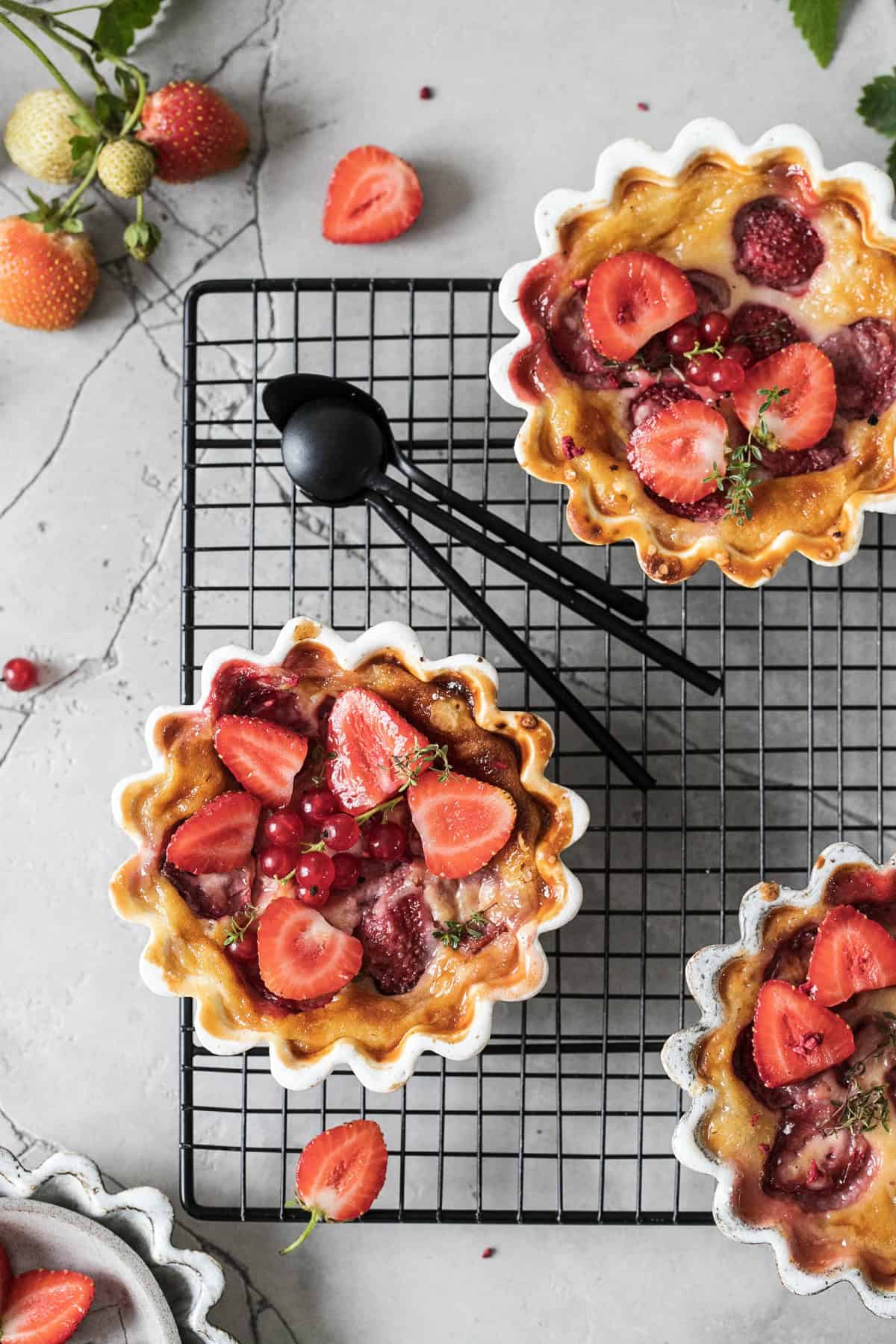
Warm strawberry clafoutis desserts resting on a wire rack after baking.

Quick Summary: Strawberry clafoutis is a light French custard made by baking fresh strawberries in a crepe-like batter until golden and set. This version is naturally gluten-free, takes about 15 minutes of hands-on time, and can be served warm or chilled.

Freshly baked strawberry clafoutis in white ramekins cooling on a wire rack.

What is strawberry clafoutis?

Clafoutis is a classic French dessert from the Limousin region, traditionally made by baking black cherries in a thick, crepe-like batter until set. Strawberry clafoutis swaps the cherries for fresh berries, so you get the same soft, custardy texture with a sweeter, summery flavor.

You may see it spelled "clafouti," but the correct French spelling is "clafoutis," pronounced klah-foo-TEE with a silent "s." Made with any fruit other than cherries, it is technically called a flaugnarde.

According to NPR, clafoutis is "the epitome of the French grandmotherly dessert: unpretentious, easy to make, and comforting." Its name comes from a word meaning "to fill" or "brimming over."

This custardy dessert is made by pouring a crepe-like batter over fruit, then baking until golden and set. It can be served warm or cold, and both work well.

Why you'll love this recipe

  • Quick and easy: the batter blends in minutes, with no fancy technique needed.
  • Naturally gluten-free: it is thickened with cornstarch instead of flour, so everyone at the table can enjoy it.
  • Light and custardy: soft, eggy, and just sweet enough, it sits somewhere between a flan and a baked pancake.
  • Flexible fruit: works with strawberries, peaches, apricots, or any ripe seasonal fruit.
  • Any time of day: serve it for breakfast, brunch, or as an after-dinner dessert.

Ingredients

For ingredients and detailed instructions, refer to the recipe card below.

  • Strawberries: Fresh, seasonal strawberries, especially from a local farm or market, are ideal. But frozen ones work too (no need to thaw), or swap in any ripe seasonal fruit.
  • Sugar: Use granulated or caster sugar.
  • Eggs: Use large eggs at room temperature. An egg separator makes separating yolks easier.
  • Milk: Whole milk is recommended.
  • Heavy cream: You can replace it with whole milk if needed.
  • Cornstarch: Used to thicken the custard, no flour needed.

Equipment

You need only a few basic tools to make strawberry clafoutis:

  • Porcelain ramekins or a baking dish
  • Mixing bowls
  • Hand whisk or blender
  • Strawberry huller
  • Fine-mesh sieve for dusting powdered sugar

How to make strawberry clafoutis

Step 1. Preheat the oven to 390°F (200°C). Butter two 12-oz. porcelain ramekins, or one large ramekin, and sprinkle the insides with sugar.

Step 2. Wash and drain the strawberries, then hull them with a strawberry huller. Cut them into halves or quarters (photo 1).

Step 3. Arrange the cut strawberries in a single layer over the bottom of the ramekins.

Step 4. In a bowl, whisk together the cornstarch, sugar, and salt. Add the whole egg and the beaten yolk, and mix with a hand whisk.

Step 5. Pour in the milk and cream, and whisk until the batter is smooth (photo 2).

Step 6. Pour the batter over the berries.

Step 7. Bake for 35 to 40 minutes, until the clafoutis is puffed and golden (photo 3).

Step 8. Serve warm or chilled, straight from the ramekins, and dust with powdered sugar before serving.

Strawberry clafoutis baked in ramekins.

Expert tips

  • Macerate juicy berries: if your strawberries are very ripe, toss them with a little sugar and let them sit, then pat them dry so the custard does not turn watery.
  • Blend for a smooth batter: a quick whirl in the blender gives a lump-free batter in seconds.
  • Add flavor: stir in ½ teaspoon of vanilla extract or a little rose water for extra depth.
  • Do not overbake: pull the clafoutis once the center is just set and the top is golden, so it stays soft and custardy.
  • Serve dressed up: top with fresh berries, whipped cream, mascarpone, or a scoop of vanilla ice cream.

Recipe variations

Clafoutis is easy to adapt. Here are a few ways to change it up:

  • Other fruit: swap the strawberries for cherries, peaches, apricots, plums, or raspberries (peel thicker-skinned fruit first).
  • Mixed berries: combine strawberries with raspberries or blueberries for a berry clafoutis.
  • Almond or pistachio: stir in a little ground almond or pistachio for a gluten-free, nutty twist.
  • Citrus or coconut: add lemon or orange zest, or ½ teaspoon of shredded coconut, to the batter.
  • One large dish: bake in a single buttered baking dish instead of ramekins, adding a few minutes to the time.

Storing & freezing

Store leftover strawberry clafoutis in an airtight container in the fridge for up to 3 days. It is best within a day or two, while the custard is still soft. Serve it chilled, or warm it gently before serving.

Freezing is not ideal. Like most baked custards, clafoutis loses its creamy texture once thawed and can turn watery, so it is best made fresh and eaten within a few days.

Recipe FAQ

What is strawberry clafoutis?
It is a French baked custard made by pouring a crepe-like batter over fresh strawberries and baking until golden. It is soft and eggy, somewhere between a flan and a baked pancake.

Is clafoutis supposed to be eggy or custardy?
Yes. Clafoutis has a soft, custardy, slightly eggy texture once set. It is not meant to rise like a cake or be firm like a tart.

Can I use frozen strawberries?
Yes. Add frozen berries straight to the batter without thawing. They release more liquid so that the clafoutis may be a little softer.

How do I keep clafoutis from being watery?
Pat very juicy or thawed berries dry before adding the batter, and do not overbake. Macerating ripe berries in a little sugar first also helps draw out excess liquid.

Can I make it gluten-free?
This recipe is naturally gluten-free because it is thickened with cornstarch instead of flour.

What fruit can I use instead of strawberries?
Cherries, peaches, apricots, plums, raspberries, or blueberries all work well. Peel thicker-skinned fruit first.

How many calories are in strawberry clafoutis?
Each serving of this strawberry clafoutis has about 560 calories.

Love custards? Try these next!

  • Coconut Flan (Flan de Coco Dominicano)
  • Clafoutis Aux Cerises (French Cherry Clafoutis)
  • French Prune Custard Cake (Far Breton)
  • Easy Fresh Peach Clafoutis

Want more delicious and beautiful recipes? Subscribe to my newsletter and follow me on Facebook, Pinterest, and Instagram for my latest updates. If you make this recipe, please leave a star rating on the recipe card and comment below!

Print

Recipe card

Strawberry Clafoutis (Clafoutis aux Fraises)

Warm strawberry clafoutis desserts resting on a wire rack after baking.
Print Recipe
Save Recipe Recipe Saved

5 Stars 4 Stars 3 Stars 2 Stars 1 Star

5 from 10 reviews

This easy strawberry clafoutis is a light French custard made with fresh or frozen strawberries. Naturally gluten-free and ready in under an hour, it works for breakfast, brunch, or dessert.

  • Author: Irina Totterman
  • Prep Time: 15 minutes
  • Cook Time: 40 minutes
  • Total Time: 55 minutes
  • Yield: 2 1x
  • Category: Custards
  • Method: Baking
  • Cuisine: French
  • Diet: Gluten Free

Ingredients

Scale
  • 7 oz. (200 g) fresh strawberries
  • 1 whole large egg
  • 1 large egg yolk
  • ½ cup + 1 tablespoon (130 ml) whole milk
  • ½ cup + 1 tablespoon (130 ml) heavy cream
  • â…“ cup (75 g) granulated sugar
  • ½ pinch of salt
  • 3 â…“ tablespoons (30 g) cornstarch
  • 1 tablespoon icing (powdered) sugar (optional)

*Don't you have the correct baking pan on hand right now? Try this simple Cake Pan Converter!

** If needed, please refer to Baking Conversion Charts.

Instructions

  1. Preheat the oven to 390°F (200°C). Grease two 12-oz. porcelain ramekins or one large ramekin with butter and sprinkle with granulated sugar. Wash strawberries under cool water, drain in a colander, and hull them using a strawberry huller. Cut berries into halves or quarters lengthwise and place them in the bottom of the prepared mold(s). 
  2. In a mixing bowl, combine cornstarch, sugar, and salt. Add the whole egg and the beaten yolk and mix with a hand whisk. Add milk and heavy cream, and mix until you obtain a smooth batter. Pour the preparation over the strawberries.
  3. Bake for 35 to 40 minutes until puffy and golden brown. Serve warm or cold from ramekins or a baking dish. Dust with icing (powdered) sugar.

Notes

  1. Watch the video on how to hull strawberries with a strawberry huller.
  2. Use a blender to make the batter if desired.
  3. To flavor your clafoutis, add ½ teaspoon of vanilla extract or rose water.
  4. For a more exotic flavor, stir in ½ teaspoon of shredded coconut. 
  5. If your strawberries are not sweet enough, sprinkle berries with a bit of sugar before adding the batter, and serve your clafoutis sprinkled with icing sugar.

Nutrition

  • Serving Size: 12 oz. ramekin
  • Calories: 560
  • Sugar: 47.5 g
  • Sodium: 128 mg
  • Fat: 31.4 g
  • Saturated Fat: 18 g
  • Carbohydrates: 65.8 g
  • Fiber: 2 g
  • Protein: 8.5 g
  • Cholesterol: 295 mg

Thank you for following me on Pinterest, Facebook, and Instagram. Hashtag #bakinglikeachef so I can see your creations.

The nutritional information has been calculated using an online recipe nutrition calculator such as Verywellfit.com and is intended for informational purposes only. These figures should be used as a general guideline and not be construed as a guarantee.

Coconut Flan Recipe (Flan de Coco Dominicano)

Oct 4, 2020 · 12 Comments

Coconut flan decorated with coconut chips and served on a white plate.

Quick Summary: Coconut flan (flan de coco Dominicano) is a creamy baked custard made with sweetened condensed milk, coconut, and eggs, set over a simple caramel. It bakes in a water bath, then flips to reveal a coconut layer under a caramel top. Plan: it needs about 2 hours to chill and set before serving.

A slice of coconut flan with a plate in the background: Close up

What is flan?

Flan is a baked custard dessert with a smooth, tender texture and a layer of caramel sauce on top. It is also known as "crème caramel" in French, caramel custard, or caramel pudding, and it has been made in one form or another since the Middle Ages.

Coconut flan is the tropical version, flavored with coconut milk, cream of coconut, or shredded coconut. It has roots in Latin America and the Caribbean, where it is a favorite for holidays and celebrations. In the Dominican Republic, a close cousin is known as quesillo dominicano, and this recipe follows the French-Caribbean style from the French Antilles.

Flan topped with caramel and tea box, tea bags and a cup in the background

Why you'll love this recipe

  • Quick to make: it takes about an hour of hands-on work from start to finish.
  • Simple ingredients: the recipe calls for just a handful of pantry staples.
  • Made ahead: it needs to chill and set, so it is a stress-free choice for parties, birthdays, or a BBQ.
  • Naturally gluten-free: flan de coco (flan de coco receta in Spanish) has no flour, so it works for gluten-free guests.
  • Two textures in one: a biscuit-like coconut layer sits under a creamy custard and a caramel top.

Ingredients

Flan de coco ingredients in pictures

For ingredients and detailed instructions, refer to the recipe card below.

  • Evaporated milk: You will need a bit less than one can of evaporated milk.
  • Sweetened condensed milk: You will need about one can of store-bought sweetened condensed milk; I used the Carnation one by Nestlé. You can also make condensed milk at home.
  • Brown sugar: Use golden brown sugar or replace it with dark brown sugar.
  • Eggs: The recipe calls for large eggs. Bring them to room temperature 30-60 minutes before you start.
  • Water: Use cold water to make the flan.
  • Coconut: The recipe calls for shredded coconut.
  • Sugar: Use regular granulated sugar or caster sugar to make the caramel.

Equipment

You need only a few basic tools to make this coconut flan:

  • 9-inch (23 cm) pie pan, round cake pan, or flan mold
  • Heavy-bottomed small saucepan for the caramel
  • Large roasting pan or deep baking dish for the water bath
  • Mixing bowls
  • Hand whisk
  • Rubber spatula
  • Sharp knife

How to make coconut flan

Step 1. Heat oven to 390°F (200°C). Prepare a 9-inch/23 cm pie pan or pie plate to pour caramel right away.

Make wet caramel

Step 2. To make the caramel, pour water into a small, heavy-bottomed saucepan, add white sugar, and bring to a boil over medium-high heat (photo 1). Heat the sugar until the caramel turns golden (photo 2).

Expert tip: Watch for your caramel to avoid overcooking. Once it turns golden brown, remove it from the heat!

Photo 1: Boiling sugar syrup in a saucepan Photo 2: Boiling caramel in a saucepan
PHOTO 1 PHOTO 2

Step 3. Pour the caramel into the bottom of the prepared pan (photo 3) and let it cool down.

Make custard

Step 4. To make the custard, add whole eggs and brown sugar to a separate bowl and whisk with a hand whisk. Add evaporated milk and combine (photo 4).

Photo 3: Hot caramel in a pie pan Photo 4: Egg mixture in a metal bowl
PHOTO 3 PHOTO 4

Step 5. Add sweetened condensed milk and cold water, and whisk again. Finally, add coconut and mix (photo 5). Pour the preparation into the pie tin over the caramel (photo 6).

Photo 5: Ready custard mixture in a bowl Photo 6: A poured mixture in a tin
PHOTO 5 PHOTO 6

Pro tip: A water bath (bain marie) is crucial while baking flan: slow baking prevents getting a scrambled egg-textured custard. It is the same technique used to make cheesecakes.

Step 6. To prepare a flan water bath, place a flan pan in the center of the large roasting pan, baking dish, or frying pan. Remove the oven rack (no baking sheet) and place the pan with the flan inside the empty frying pan.

Step 7. Carefully pour the warm water around the flan dish until the water level reaches halfway up the edges of the dish.

Step 8. Push the oven rack back in the preheated oven and bake the flan for 50-60 minutes (photos 7-8).

Photo 7: Mold with flan into the water bath Photo 8: Flan into the water bath
PHOTO 7 PHOTO 8

Step 9. When the flan is baked, use oven mitts to carefully remove the pan from the oven without spilling the hot water.

Step 10. Let the flan cool to room temperature in the water bath. Then remove the flan pan from the large container.

Step 11. Once the flan has cooled, slide a sharp knife between the custard and the sides of the pan. Next, invert the serving plate onto the flan tin and flip the pan and plate with a quick movement. If it doesn't slide out immediately, let it sit inverted for a minute or two: it will finally slide out.

Step 12. Lift the flan pan. The flan will be covered with caramel topping, while the coconut forms a biscuit-like base.

Step 13. Using a rubber spatula, scrape the remaining caramel from the bottom of the dish onto the flan. The hardened caramel will remain in the pan, which is fine.

Step 14. Decorate the top of the flan with roasted coconut flakes or coconut chips. Let the flan set for 2 hours.

Sliced flan topped with caramel and decorated with coconut chips

Expert tips

  1. Make sure a heavy-duty pan is ready to pour the caramel in. Once the caramel turns golden, pour it right away until it hardens.
  2. While cooking the caramel, either stir it constantly or rotate the pan on the stove without a spoon. It is essential to catch the right color of ready caramel!
  3. Tilt the pan in every direction to get a nice coating of caramel in the pan. Then let it harden.
  4. Keep the flan (still in the pan) in the fridge until ready to serve. Before serving, bring it to the oven at 355°F (180°C) for a few minutes to liquefy the caramel. Then flip it over and serve.
  5. For an easier caramel, you can melt the sugar with a splash of water directly in a stovetop-safe metal mold, then tilt it to coat the base and sides. Use heat-proof gloves, as the mold gets very hot.
  6. When storing, keep the flan in its pan and cover it, or transfer it to an airtight container, so the edges do not dry out in the cold fridge air.

Recipe variations

Flan is one of the most adaptable custards, and coconut flan has many regional versions. Here are ways to change it up:

  • With condensed milk: this recipe uses sweetened condensed milk for a rich, slightly denser custard.
  • With coconut milk: swap in coconut milk (Spanish-style flan de coco) for a lighter, softer set.
  • Dominican quesillo: flan de coco is close to quesillo dominicano, often blended and baked until very smooth.
  • Puerto Rican flan de coco: made with evaporated and whole milk, eggs, and sugar.
  • Mexican coconut flan: flavor the custard with coffee, chocolate, pumpkin, pineapple, or orange.
  • Dairy-free: use full-fat coconut milk and coconut cream in place of dairy for a coconut-forward, dairy-free flan.
  • Individual flans: divide the custard among ramekins and bake in a water bath, keeping them nestled close so they do not slide.
  • Different pans: a glass or nonstick pie pan, a savarin mold, or a bundt pan all work, but do not confuse a flan pan for German fruit flan with the mold for this custard.

How to serve coconut flan

Serve coconut flan chilled, flipped onto a plate so the caramel runs down the sides. Spoon the extra caramel from the pan over each slice, and top with roasted coconut flakes or chips for crunch.

It pairs well with a cup of strong coffee and a few slices of fresh pineapple, mango, or berries. For a party, it makes a good finish to a Caribbean or Latin American meal, or serve it alongside other coconut desserts for coconut lovers.

Storing & freezing

Store the coconut flan in an airtight container in the fridge for up to 3 days.

Freezing is not recommended. Because coconut flan is a custard, its smooth texture breaks down once it thaws, so it is best enjoyed fresh from the fridge.

Recipe FAQ

What is the difference between flan and crème brûlée?
Flan and crème brûlée are both smooth baked custards. The main difference is that flan has a denser texture and is topped with a soft, pourable caramel sauce, while crème brûlée is lighter and topped with a layer of hard, torched caramelized sugar. Flan comes from Latin American cuisine, while crème brûlée is French.

What is coconut flan made of?
Coconut flan is made of eggs, sweetened condensed milk, evaporated milk, sugar, water, and coconut, set over a simple caramel of sugar and water.

Where does flan de coco come from?
Flan itself dates back to the Middle Ages, but coconut flan (flan de coco) is a Latin American and Caribbean favorite. This version has a French-Caribbean touch from the Antilles, which is why it is also called flan au coco antillais.

Does flan have gelatin?
No. Flan, or crème caramel, is an egg-based custard set only by baking. It contains no gelatin.

Do you need to cover flan with foil while baking?
No. You do not need to cover the flan with aluminum foil while it bakes.

Can you make coconut flan ahead of time?
Yes. Make it at least 2 hours ahead so it has time to chill and set, and it keeps well in the fridge for up to 3 days.

What is the difference between flan de coco and quesillo?
They are very close. In the Dominican Republic, coconut flan is often called quesillo de coco. Many cooks say a quesillo is made with whole eggs (which give a slightly spongier, bubbly texture), while flan uses more yolks for a smoother, denser custard. Both share the same condensed-milk base and caramel top.

How many calories are in coconut flan?
One serving of this coconut flan has about 340 calories.

Want more delicious and beautiful recipes? Subscribe to my newsletter and follow me on Facebook, Pinterest, and Instagram for my latest updates. If you make this recipe, please leave a star rating on the recipe card and comment below!

Print

Recipe card

Coconut Flan (Flan de Coco Dominicano)

Coconut flan decorated with coconut chips and served on a white plate.
Print Recipe
Save Recipe Recipe Saved

5 Stars 4 Stars 3 Stars 2 Stars 1 Star

5 from 5 reviews

Coconut flan (flan de coco Dominicano) is an easy, gluten-free baked custard made with sweetened condensed milk, coconut, and eggs, set over a simple caramel. It flips out to show a coconut layer under a golden caramel top.

  • Author: Irina Totterman
  • Prep Time: 15 minutes
  • Cook Time: 1 hour
  • Total Time: 1 hour, 15 minutes (plus resting time)
  • Yield: 8 1x
  • Category: Custards
  • Method: Baking
  • Cuisine: Spanish
  • Diet: Gluten Free

Ingredients

Scale

For custard:

  • 1 cup (255 g) evaporated milk
  • â…” cup + 2 tablespoons (245 g) sweetened condensed milk
  • 1 tablespoon (12 g) brown sugar
  • 4 large eggs
  • ½ cup + 1 ½ teaspoons (125 ml) cold water
  • â…” cup + 3 tablespoons (80 g) shredded coconut

For caramel:

  • â…” cup + 3 ½ tablespoons (200 g) granulated sugar
  • 10 teaspoons (50 ml) water

For decoration: 

  • 0.3 oz (10 g) roasted coconut chips

*Don't you have the correct baking pan on hand right now? Try this simple Cake Pan Converter!

** If needed, please refer to Baking Conversion Charts.

Instructions

  1. Preheat oven to 390°F (200°C). Prepare a 9-inch (23 cm) pie pan or pie plate to pour caramel right away. 
  2. To make the caramel, in a heavy-bottomed saucepan, add water and white sugar, then bring to a boil. Once the caramel turns golden, pour it into the bottom of the prepared pan and let it cool down.
  3. To make the custard, add whole eggs and brown sugar to a separate bowl and whisk with a hand whisk. Add evaporated milk and combine. Add sweetened condensed milk and cold water, and whisk again. Finally, add coconut and mix.
  4. Pour the preparation into the pie tin over the caramel. Place the tin inside a large frying pan, bring it to the oven rack, and carefully add warm water. The water level should reach about halfway up the flan tin. Bake the flan for 50-60 minutes.
  5. Using oven mitts, remove the pan from the oven and set it aside to cool at room temperature in the water bath. Then remove the flan pan.
  6. Once the flan is cool, slide a sharp knife between the custard and the mold. Then place a serving plate on top of the mold and flip the flan quickly using a sharp move. The flan will be covered with caramel on top, while the coconut forms a biscuit-like base.
  7. Decorate the flan with coconut flakes or coconut chips. Let the flan set for 2 hours.

Notes

  1. Make sure your pie pan is ready to pour in the caramel. Once the caramel gets golden, pour it right away until it hardens.
  2. While cooking the caramel, stir it constantly or rotate the pan on top of the stove without using a spoon. It is essential to catch the right color of ready caramel!
  3. Tilt the pan in every direction to get a nice coating of caramel in the pan. Then let it harden.
  4. Keep the flan (still in the pan) in the fridge until ready to serve. Before serving, bring it to the oven at 355°F (180°C) for a few minutes to liquefy the caramel. Then flip it over and serve.

Nutrition

  • Serving Size: 1 slice
  • Calories: 340
  • Sugar: 47.2 g
  • Sodium: 107 mg
  • Fat: 13.7 g
  • Saturated Fat: 9.5 g
  • Carbohydrates: 49 g
  • Fiber: 1.8 g
  • Protein: 8.1 g
  • Cholesterol: 102 mg

Thank you for following me on Pinterest, Facebook, and Instagram. Hashtag #bakinglikeachef so I can see your creations.

The nutritional information has been calculated using an online recipe nutrition calculator such as Verywellfit.com and is intended for informational purposes only. These figures should be used as a general guideline and not be construed as a guarantee.

The recipe was adapted from https://www.meilleurduchef.com. It was originally published on February 23, 2018. The recipe has been revised to include improved content and photos. 

French Prune Custard Cake (Far Breton)

Feb 7, 2018 · 15 Comments

A slice of Far Breton on top of the prune custard.

Quick Summary: French prune custard cake, or Far Breton, is a classic dessert from Brittany that bakes rum-soaked prunes into a rich, dense, flan-like custard. It needs only about 20 minutes of hands-on time and makes 8 generous servings, and the prunes and batter can be prepped a day ahead.

A slice of prune cake on a white plate with plates and flatware in the background

If you have never made French Far Breton (Far Breton aux pruneaux in French), a signature dessert from the Brittany region, it is a good one to start with. This easy prune custard cake is simple to put together yet always a crowd-pleaser.

With just a few ingredients and little effort, it makes a reliable everyday cake for any occasion. The batter is much like crepe batter, so if you can make crepes, you will manage Far Breton with no trouble.

The texture is so creamy that it is a pleasure to spoon the cake straight from the baking dish, especially when a piece is full of prunes.

Far Breton in a baking dish with a green towel, plates, and flatware in the background

What is Far Breton?

Far Breton, also called Breton Far, is a dense, flan-like custard cake from the Brittany region of France. Its name comes from the Latin far, meaning porridge or gruel, a nod to its humble origins.

The dish dates to the 18th century, when it was a savory preparation made with buckwheat flour. The sweet version, baked with prunes and known in French as far breton aux pruneaux, took hold in the 19th century and became the classic we know today.

Modern Far Breton is made with a simple batter of flour, eggs, milk, and sugar, close to crepe batter, then studded with rum-soaked prunes. Cooks often flavor it with vanilla sugar, dark rum, or plum liqueur.

What is custard?

Custard is a family of preparations made from milk or cream, sugar, and eggs, sometimes thickened further with flour, cornstarch, or gelatin. Eggs give custard its smooth, creamy set.

It ranges widely in texture, from a thin pouring sauce like crème anglaise, to a thicker pastry cream (crème pâtissière), to the dense, sliceable custards of clafoutis, Far Breton, and savory quiche.

Far Breton vs. clafoutis

Far Breton and clafoutis are both baked, fruit-studded custards, so they look similar at a glance and share a crepe-like batter.

The difference is in texture and fruit. Far Breton is dense and flan-like, traditionally made with rum-soaked prunes from Brittany. Clafoutis is lighter and more tender, and classically baked with black cherries.

When clafoutis is made with any fruit other than cherries, such as plums, pears, peaches, or apples, it is technically called a flaugnarde.

Why you'll love this recipe

  • Easy to make: the batter comes together like crepe batter, with only about 20 minutes of hands-on time.
  • Make-ahead friendly: soak the prunes and mix the batter a day before, then bake the next day in minutes.
  • Budget-friendly: it uses a handful of simple, low-cost ingredients and yields 8 generous servings.
  • Any time of day: serve it for breakfast, as an after-dinner dessert, or pack it for a picnic.
  • Rum-soaked prunes: the soaked prunes add deep flavor, and you can leave out the alcohol for a kid-friendly cake.

Ingredients

For ingredients and detailed instructions, refer to the recipe card below.

  • Rum: use dark rum or replace it with calvados or plum liqueur to vary the taste. Omit alcohol to make the custard cake kid-friendly.
  • Tea: the recipe calls for two black tea bags.
  • Prunes: use stoned prunes or replace them with raisins if desired.
  • Flour: the recipe calls for all-purpose flour.
  • Sugar: use granulated white sugar or caster sugar to make Far Breton.
  • Salt: one pinch of salt makes a difference. It enhances the dessert's flavors.
  • Eggs: use whole large-sized eggs at room temperature.
  • Butter: use unsalted, melted butter for this recipe.
  • Milk: whole milk is preferred, but you can replace it with low-fat milk.

Equipment

You need only a few basic tools to make Far Breton:

  • Square ceramic baking dish or cake pan
  • Mixing bowls
  • Hand whisk
  • Small saucepan or bowl for soaking the prunes
  • Colander
  • Fine-mesh sieve for dusting powdered sugar

How to make French prune cake Far Breton

Step 1. Steep the tea bags in warm water, then add the rum and pitted prunes. Let the prunes soak for two hours (photo 1).

Step 2. Drain the prunes in a colander and set them aside.

Step 3. Preheat the oven to 395°F (200°C).

Step 4. Butter a square ceramic baking dish and arrange the drained prunes over the bottom.

Step 5. To make the batter, place the eggs, sugar, and salt in a bowl and mix with a hand whisk (photo 2).

Photo 1: Prunes soaked in tea in a bowl Photo 2: Eggs/sugar in a bowl
PHOTO 1 PHOTO 2

Step 6. Add the flour and mix to combine. Then add the melted butter, cold milk, and rum, and whisk until the batter is smooth (photo 3).

Photo 3: Eggs mixture in a bowl Photo 4: Ready batter in a glass bowl
PHOTO 3 PHOTO 4

Step 7. Pour the batter over the prunes (photo 5).

Step 8. Bake at 395°F (200°C) for 10 minutes, then reduce the temperature to 345°F (170°C) and bake for one hour longer (photo 6).

Photo 5: Batter over prunes in a baking dish Photo 6: Cake in a baking pan
PHOTO 5 PHOTO 6

Expert tips

  • Soak the prunes for 2 hours, or overnight, a day ahead. Drain them, cover, and keep at room temperature or in the fridge.
  • Make the batter a day in advance too, and store it covered in the fridge so you only need a few minutes the next day.
  • Use good, plump prunes, since they carry the cake's flavor. Soaking them in rum, Armagnac, or plum liqueur deepens the taste.
  • To make the prunes float higher in the cake, toss them in a little flour and stir them into the poured batter instead of lining the dish.
  • Do not open the oven while the cake bakes, or it may deflate before it is set.
  • Far Breton naturally sinks a little as it cools, which is normal for this custard cake.

Recipe variations

Far Breton is easy to adapt. Here are a few ways to change it up:

  • Different spirits: swap the rum for Armagnac, Cognac, calvados, or plum liqueur, or leave out the alcohol for a kid-friendly cake.
  • Other dried fruit: use raisins instead of prunes, or soak both together for a two-fruit Far Breton.
  • Vanilla or citrus: add vanilla sugar, a split vanilla bean, or a little orange or lemon zest to the batter.
  • Individual servings: bake the batter in buttered ramekins to reduce baking time.
  • Savory and traditional: the original 18th-century Far was a savory dish made with buckwheat flour, a nod to its Breton roots.

How to serve Far Breton

Serve Far Breton warm or cold in a baking dish. The dessert tends to deflate as it cools. To serve Far dessert out of the baking pan, butter and line the pan's bottom with parchment paper.

After baking, run a knife around the custard in the dish to loosen it. Invert the baking pan onto parchment, sprinkled with icing sugar. Remove the pan, peel off the paper, and quickly invert onto the serving plate. Sprinkle the top of the custard with icing (powdered) sugar.

Storing & freezing

Store Far Breton in an airtight container in the fridge for up to 3 days. It actually improves after a day, as the flavors settle and the custard firms up. Bring it back to room temperature, or warm it gently, before serving.

Freezing is not recommended. Like most baked custards, Far Breton loses its creamy texture once thawed and can turn watery, so it is best enjoyed within a few days.

Recipe FAQ

What is French prune custard cake?
It is Far Breton, a classic dessert from Brittany made by baking prunes into a rich, dense, flan-like custard. The batter is close to crepe batter, and the prunes are usually soaked in tea and rum first.

What is the difference between Far Breton and clafoutis?
Both are baked custards, but Far Breton is denser and more flan-like, traditionally made with prunes from Brittany. Clafoutis is lighter and more tender, and it is classically made with black cherries.

Why do you use prunes and custard together?
Soaked prunes add deep, sweet flavor and moisture that balances the plain, eggy custard. They are the signature fruit of the traditional recipe, though raisins work too.

Why did my Far Breton sink or deflate?
A little sinking as it cools is normal for this custard cake. To limit it, don't open the oven during baking, and let the cake cool gradually.

Can you make Far Breton ahead of time?
Yes. Soak the prunes and mix the batter a day ahead, then bake the next day. The baked cake also keeps well in the fridge for up to 3 days and tastes even better the second day.

Can you make it without alcohol?
Yes. Leave out the rum and soak the prunes in tea alone for a kid-friendly version.

How many calories are in French prune custard cake?
One serving has about 305 calories.

Love custards? Try these next!

  • Cherry Clafoutis
  • Easy Fresh Peach Clafoutis
  • Coconut Flan (Flan de Coco)
  • Crème Anglaise (Vanilla Custard Sauce)
  • Browse all the Custard Recipes

Want more delicious and beautiful recipes? Subscribe to my newsletter and follow me on Facebook, Pinterest, and Instagram for my latest updates. If you make this recipe, please leave a star rating on the recipe card and comment below!

Print

Recipe card

French Prune Custard Cake (Far Breton)

A slice of Far Breton on top of the prune custard.
Print Recipe
Save Recipe Recipe Saved

5 Stars 4 Stars 3 Stars 2 Stars 1 Star

5 from 6 reviews

French prune custard cake, or Far Breton, is a classic dessert from Brittany that bakes rum-soaked prunes into a rich, dense, flan-like custard. It takes about 20 minutes of hands-on time, makes 8 servings, and can be prepped a day ahead.

  • Author: Irina Totterman
  • Prep Time: 20 minutes
  • Cook Time: 1 hour 10 minutes
  • Total Time: 1 hour, 30 minutes (plus resting time)
  • Yield: 8 1x
  • Category: Custards
  • Method: Baking
  • Cuisine: French

Ingredients

Scale

For soaking prunes:

  • 2 cups + 5 ½ teaspoons (500 ml) warm water
  • 3 ½ tablespoons (50 ml) rum
  • 2 tea bags

For the batter:

  • 20 stoned prunes
  • â…” cup + 4 ½ tablespoons (120 g) flour
  • ½ cup + 3 ½ teaspoons (130 g) sugar
  • 1 pinch of salt
  • 4 eggs
  • 1.7 oz (50 g) butter
  • 2 cups + 5 ½ teaspoons (500 ml) milk
  • 1 tablespoon (15 ml) rum

*Don't you have the correct baking pan on hand right now? Try this simple Cake Pan Converter!

** If needed, please refer to Baking Conversion Charts.

Instructions

  1. To soak prunes, place tea bags into warm water to infuse. Add rum, pitted prunes, and let it rest for two hours. Drain the prunes in a colander and set aside.
  2. Preheat oven to 395°F (200°C). Butter a square ceramic baking dish and place the drained prunes on the bottom.
  3. To make the custard, place eggs, sugar, and salt in a bowl and mix with a hand whisk. Add flour and mix to combine. Add the melted butter, cold milk, and rum, and whisk till the mixture becomes homogeneous. Pour the batter over the prunes and bake at 395°F (200°C) for 10 minutes. Then reduce the oven temperature to 345°F (170°C) and bake for one hour longer.

Notes

  1. Soak prunes for 2 hours one day ahead. Drain them, cover them, and let them stand at room temperature or in the fridge. You can soak prunes overnight as well.
  2. Make the batter a day in advance, then keep it in the fridge.
  3. Replace rum with calvados or plum liqueur to vary the taste or omit alcohol to make the custard cake kid-friendly.
  4. Toss prunes in flour and add them into the poured batter (instead of arranging them on the bottom of the dish); they will float higher in the cake.
  5. Soak some raisins with prunes to make Far Breton with two kinds of fruit if you prefer.
  6. Don't open the oven during baking to prevent the cake from deflating before it is ready! 
  7. Store Far Breton in the fridge for up to one to two days; its flavors and textures will mature, and it will become firmer. 

Nutrition

  • Serving Size: 1 slice
  • Calories: 305
  • Sugar: 27.5 g
  • Sodium: 120 mg
  • Fat: 8.7 g
  • Saturated Fat: 4.7 g
  • Carbohydrates: 47.3 g
  • Fiber: 1.7 g
  • Protein: 7.1 g
  • Cholesterol: 101 mg

Thank you for following me on Pinterest, Facebook, and Instagram. Hashtag #bakinglikeachef so I can see your creations.

The nutritional information has been calculated using an online recipe nutrition calculator such as Verywellfit.com and is intended for informational purposes only. These figures should be used as a general guideline and not be construed as a guarantee.

The recipe was adapted from https://www.meilleurduchef.com. It was originally published in February 2018. The recipe has been revised to include improved content and photos.

Primary Sidebar

Personal photo of the website's author

Hi, I am Irina!

A home baker with over 30 years of experience, sharing baking recipes with step-by-step instructions, helpful tips, and tricks. Get baking, and let the fun begin!

About • Start Here • Contact

Summer Desserts

  • Fig tiramisu cups in a serving board.
    Fig Tiramisu (Easy No-Bake Dessert)
  • Louise cake on a cake stand.
    Ottolenghi Louise Cake With Plum And Coconut
  • Apple and blueberry crumble in a white ceramic dish with ice cream and two spoons.
    Apple and Blueberry Crumble Recipe (With or Without Oats)
  • Sliced JordgubbstÃ¥rta on a cake board.
    Jordgubbstårta (Swedish Strawberry Cake)

More Summer Desserts →

Readers’ Favorites

  • Sliced Sans Rival cake on a cake board.
    Sans Rival Cake (Filipino Cashew Meringue Cake)
  • A batch of baked madeleines in a baking mold.
    Classic French Madeleines Recipe (Madeleine Cookies)
  • Italian sponge cake on a marble board.
    3-Ingredient Italian Sponge Cake (Pan di Spagna)
  • Halved muffin loaded with blueberries with the rest of the cakes in the background.
    To Die For Blueberry Muffins With Crumb Topping
  • French financiers with almonds on a wooden board lined with parchment.
    Classic French Financiers (Authentic Recipe)
  • Stack of banana bread slices on a serving board.
    Banana Bread Without Baking Soda (Easy Recipe with Baking Powder)

More Cake Recipes →

Footer

Featured in banner with logos.

BAKING LIKE A CHEF

  • Home
  • About
  • Recipe Index
  • Baking 101
  • Cake Pan Converter
  • Contact
  • Log In

SOCIAL

  • Facebook
  • Pinterest
  • Instagram
  • Twitter

LEGAL

  • Privacy Policy
  • Disclaimer
  • Terms & Conditions
  • Accessibility Statement

Copyright © 2025 Baking Like a Chef • Baking Like a Chef is a participant in the Amazon Services LLC Associates Program, an affiliate advertising program designed to provide a means for sites to earn advertising fees by advertising and linking to Amazon.com. As an Amazon Associate, I earn a commission – at no cost to you –  from qualifying purchases.