
• Skip to primary navigation
  • Skip to main content
  • Skip to primary sidebar

Baking Like a Chef logo

  • ABOUT
  • RECIPES
  • CLUB
  • SHOP
menu icon
go to homepage
  • Recipes
  • Basics
  • Printables
  • Subscribe
  • About
search icon
Homepage link
  • Recipes
  • Basics
  • Printables
  • Subscribe
  • About
×

Want to learn sourdough?

START

Home » Recipe Index

Merveilleux Cake (French Meringue Cake)

May 7, 2020 · 22 Comments

French Meringue Cake Merveilleux on a cake round with chocolate shavings and a cup on background.

Quick Summary: A merveilleux cake is a large French meringue cake made of two crisp meringue layers sandwiched and coated with mascarpone whipped cream, then covered all over in dark chocolate shavings. This merveilleux cake recipe turns the individual pastry into one sliceable layer cake that serves a crowd.

Sliced French Meringue Cake Merveilleux with a cup and spoons on background

What is Merveilleux cake?

A Merveilleux is a traditional French and Belgian meringue dessert. While the classic version is made as small individual pastries, the Merveilleux cake scales the same idea into one large layer cake. Two disc-shaped meringue layers replace the little shells, and mascarpone whipped cream stabilizes the filling so the cake holds its shape when sliced.

The cake has an impressive height, an airy texture, and a rich chocolate-and-coffee flavor in every bite.

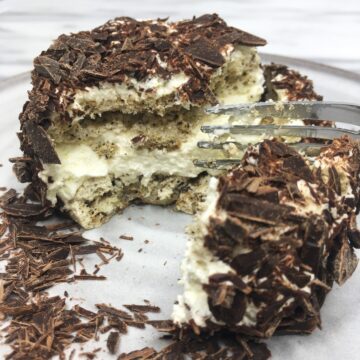
French Meringue Cake Merveilleux covered with chocolate shavings: Close up

Why you'll love this recipe

  • Gluten-free: the cake contains no flour, so it pleases guests with gluten restrictions.
  • Make-ahead friendly: the meringue layers can be baked one day in advance, which makes assembly quick.
  • Coffee flavor: the coffee mascarpone whipped cream pleases coffee lovers.
  • Easy to decorate: no special skills are required, since imperfect meringue spirals and cream are dusted with powdered sugar and cocoa powder, hiding any flaws.
  • Great for celebrations: this merveilleux cake is perfect for birthday parties and special occasions.

Ingredients

For ingredients and detailed instructions, refer to the recipe card below.

  • Egg whites: Use large whole eggs. Take chilled eggs out of the fridge, separate the egg yolks from the egg whites, and let the egg whites come to room temperature for about 30-45 minutes.
  • Sugar: Use a caster or baker's sugar to make the meringue. Or use a food processor to pulse granulated sugar for a few seconds to get superfine sugar. And if you need icing sugar, use a coffee grinder at home.
  • Dark chocolate: Use a top-quality 70% dark chocolate, like Valrhona.
  • Heavy cream: Opt for heavy or heavy whipping cream with at least 30% fat content.
  • Mascarpone cheese: It brings a tangy flavor and stabilizes the whipped cream so the cake holds its shape.
  • Instant coffee: Use powdered instant coffee, which is much more effective in making coffee-flavored whipped cream.
  • Cocoa powder: Opt for unsweetened cocoa powder to dust the cake.

Equipment

  • Stand mixer or electric hand mixer
  • Two 7-inch cake pans or a stainless steel ring (to shape the meringue discs)
  • Baking sheet and parchment paper
  • Pastry bag with a plain or star tip
  • Bent (offset) spatula
  • Vegetable peeler (for the chocolate shavings)
  • Fine sieve (for dusting cocoa powder)
A slice of the cake Merveilleux with a fork up and a cup on background

How to make meringue cake

Step 1. To make the meringue, preheat the oven to 210°F (100°C). Use a stainless steel circle or a plate 7 inches (18 cm) in diameter as a template, and draw two discs on two sheets of parchment paper. Turn them over and place them on two baking sheets.

Step 2. In a large bowl, add the egg whites and a good pinch of salt. Beat with an electric mixer at medium-high speed for 3-4 minutes.

Step 3. Switch the mixer to high and gradually add the caster sugar, about 2 tablespoons at a time. Whisk until sugar dissolves and stiff peaks form (photo 1). 

Step 4. Add the sifted powdered (icing) sugar and gently mix with a rubber spatula (photo 2).

Photo 1: Beaten egg whites with sugar in a metal bowl Photo 2: Ready meringue in a bowl
PHOTO 1 PHOTO 2

Step 5. Place the meringue in a pastry bag with the cut end or Ateco plain pastry tip 809. Draw two spiral meringue disks on the parchment paper, starting from the center of each circle (photo 3).

Pro tip: Alternatively, divide the meringue evenly between two 7-inch (18 cm) circles drawn on the prepared baking sheets. Use a spatula to spread it out.

Step 6. Bake the meringue cake layers for about 2 hours. Let them cool completely (photo 4).

Photo 3: Piped meringue spiral on the parchment paper Photo 4: Baked meringue disk on parchment
PHOTO 3 PHOTO 4

Step 7. To make mascarpone whipped cream, place cold heavy cream, cold mascarpone, icing (powdered) sugar, and powdered instant coffee in the chilled bowl of a stand mixer with a whisk attachment. Whisk the cream until stiff peaks (photo 5).

Pro tip: Consult the mascarpone frosting recipe for step-by-step photographed explanations, helpful tips, and tricks.

Step 8. Transfer the cream to a piping bag with the end cut about ½ inch (1 cm) or fitted with Ateco tip 809.

Step 9. To make chocolate shavings, use a vegetable peeler to scrape across a chocolate bar and create medium-sized, delicate curls. For large chocolate shavings, scrape the chocolate with a knife, if desired.

Step 10. To assemble the cake, place the first meringue layer on a cake board or a serving plate and pipe the mascarpone whipped cream in a spiral. Place the second meringue disk top-down, and spread a thin layer of the cream.

Step 11. Smooth the surface evenly with a bent spatula, and smooth the sides of the cake. Push the cream to make balls over the entire surface of the cake (photo 6).

Photo 5: Ready coffee whipped cream in a metal bowl Photo 6: Piped cream balls on top of the assembled dessert
PHOTO 5 PHOTO 6

Step 12. Cover the surface and sides of the cake with chocolate shavings and sprinkle the entire cake with confectioners' sugar and cocoa powder (photos 7-8). Refrigerate it for at least 4 hours before serving.

Photo 7: Cake generously sprinkled with icing sugar and cocoa powder on parchment Photo 8: Ready cake on the parchment paper
PHOTO 7 PHOTO 8

Expert Tips

  1. Create cute meringue kisses by piping the remaining meringue into circles.
  2. Don't open the oven door during baking.
  3. Make-ahead option: Bake the meringue in advance and store it airtight, but assemble and serve the cake the same day; mascarpone whipped cream tends to dry out.

Recipe variations

  • Layers of meringue: Add unsweetened cocoa powder to the meringue mixture to create a chocolate meringue cake.
  • Flavorings: Replace instant coffee with cocoa powder. Or add Biscoff cookie spread to make Biscoff whipped cream.
  • Add-ins: Elevate the meringue cake further by adding juicy slices of fresh strawberries or other fresh fruit between cake layers. For a simple yet satisfying filling, go with plain mascarpone frosting.
  • Decoration: Swap dark chocolate for milk or white chocolate. Or cover the entire cake with Lotus Biscoff crumble to create the iconic Biscoff cake.

Storing & freezing

Store the meringue cake under a cake dome in the refrigerator for 24 hours.

Can you freeze it? You can not freeze the assembled meringue cake, but you can freeze the meringue layers. Freeze each layer for 3 hours or more. Then, place them in a freezer-safe bag with parchment paper between each layer. Seal, label, and freeze for up to 3 months.

To thaw, bring the meringue to the kitchen counter for 2 to 3 hours. Then make the cream and assemble the cake.

Recipe FAQ

What is a Merveilleux cake?
Merveilleux cake is a large French meringue cake made of two crisp meringue layers filled and coated with mascarpone whipped cream, then covered in dark chocolate shavings. It is the layer-cake version of the classic individual merveilleux pastry.

What is the difference between a Merveilleux and a Merveilleux cake?
The classic Merveilleux is served as small individual pastries, while the Merveilleux cake bakes the meringue into two large discs and assembles them as one sliceable French meringue cake that serves a crowd.

Where does Merveilleux cake come from?
The Merveilleux is a traditional French and Belgian meringue dessert. This Merveilleux gateau adapts that heritage into a modern layer cake with mascarpone cream.

How long do you bake the meringue?
Bake the meringue layers at a low oven temperature, around 195°F to 230°F (90°C to 110°C), for up to 2 hours, until crisp and dry.

Can you make the meringue in advance?
Yes. Bake the meringue layers, then store them tightly wrapped in plastic or an airtight container for several days. Avoid humid days for storage.

How long can you store meringues?
Store meringues, like Pavlova meringue shells, at room temperature for up to 3 weeks, or freeze them for up to 1 month.

Does meringue need to be refrigerated?
No. Meringue does not need to be refrigerated. Store it at room temperature or in a cool place for up to 3 weeks in an airtight container, placing parchment paper between layers.

Love classic cakes? Try these next!

  • Individual Merveilleux (French meringue dessert)
  • Cake Sans Rival
  • Ottolenghi Carrot Cake
  • Coconut Dacquoise Cake
  • Strawberry Chantilly Cake
  • Or browse all the cake recipes

Want more delicious and beautiful recipes? Subscribe to my newsletter and follow me on Facebook, Pinterest, and Instagram for my latest updates. If you make this recipe, please leave a star rating on the recipe card and comment below!

Print

Recipe card

Merveilleux Cake (French Meringue Cake)

Sliced French Meringue Cake Merveilleux with a cup and spoons on background.
Print Recipe
Save Recipe Recipe Saved

5 Stars 4 Stars 3 Stars 2 Stars 1 Star

5 from 8 reviews

This Merveilleux cake recipe recreates the French meringue cake with two crisp meringue layers, mascarpone whipped cream, and dark chocolate shavings. It makes one large, sliceable meringue cake that serves a crowd, using just a few simple ingredients.

  • Author: Irina Totterman
  • Prep Time: 30 minutes
  • Cook Time: 2 hours
  • Total Time: 2 hours, 30 minutes (plus cooling time)
  • Yield: 8 1x
  • Category: Cakes
  • Method: Baking
  • Cuisine: French

Ingredients

Scale

For the meringue:

  • ½ cup + ½ tablespoon (130 g) egg whites (see note #1)
  • ½ cup + 1 ½ tablespoons (130 g) caster sugar
  • 1 cup + 2 teaspoons (130 g) powdered (icing) sugar
  • 1 pinch of salt

For the mascarpone whipped cream:

  • 2 cups + 2 tablespoons (500 ml) heavy cream, 30% fat
  • 3 ½ oz (100 g) mascarpone cheese
  • 2 tablespoons (30 g) icing (powdered) sugar
  • 5 teaspoons (10 g) powdered instant coffee

For the decoration:

  • 4 tablespoons (20 g) cocoa powder
  • 2 ½ tablespoons (20 g) confectioners' sugar
  • 3 ½ oz (100 g) dark chocolate

* If needed, please refer to Baking Conversion Charts.

** Don't you have the correct baking pan on hand right now? Try this simple Cake Pan Converter!

Instructions

  1. To make the meringue, preheat the oven to 210°F (100°C). Use a stainless steel circle or a plate 7 inches (18 cm) in diameter as a template, and draw two discs on two sheets of parchment paper. Turn them over and place them on two baking sheets.
  2. In a large bowl, add the egg whites and a good pinch of salt. Beat with an electric mixer at medium-high speed for 3-4 minutes. Switch the mixer to high and gradually add the caster sugar, about 2 tablespoons at a time. Whisk until sugar dissolves and stiff peaks form. Add the sifted powdered (icing) sugar and gently mix with a rubber spatula.
  3. Place the meringue in a pastry bag with the cut end or Ateco plain pastry tip 809. Draw two spiral meringue disks on the parchment paper, starting from the center of each circle. Alternatively, divide the meringue evenly between two 7-inch (18 cm) circles drawn on the prepared baking sheets. Use a spatula to spread it out. Bake the meringue layers for about 2 hours. Let them cool completely.
  4. To make mascarpone whipped cream, place cold heavy cream, cold mascarpone, icing (powdered) sugar, and powdered instant coffee in the chilled bowl of a stand mixer with a whisk attachment. Whisk the cream until stiff peaks form. Transfer the cream to a piping bag with the end cut about ½ inch (1 cm) or fitted with Ateco tip 809.
  5. To make chocolate shavings, use a vegetable peeler to scrape a chocolate bar into medium-sized, delicate curls. For large chocolate shavings, scrape the chocolate with a knife, if desired.
  6. To assemble the cake, place the first meringue layer on a cake board or a serving plate and pipe the mascarpone whipped cream in a spiral. Place the second meringue disk top-down, and spread a thin layer of the cream. Smooth the surface evenly with a bent spatula, and smooth the sides of the cake. Push the cream, making balls over the entire surface of the cake.
  7. Cover the surface and sides of the cake with chocolate shavings and sprinkle the entire cake with confectioners' sugar and cocoa powder. Refrigerate it for at least 4 hours before serving.

Notes

  1. 130 g egg whites, approximately equal to 4 fresh egg whites from large-sized chicken eggs.
  2. Create cute meringue kisses by piping the remaining meringue into circles.
  3. Don't open the oven door during baking.
  4. Make-ahead option: Bake the meringue in advance and store it airtight, but assemble and serve the cake the same day; mascarpone whipped cream tends to dry out.

Nutrition

  • Serving Size: 1 slice
  • Calories: 456
  • Sugar: 50 g
  • Sodium: 81 mg
  • Fat: 25.3 g
  • Saturated Fat: 16.1 g
  • Carbohydrates: 54.9 g
  • Fiber: 1.2 g
  • Protein: 6.3 g
  • Cholesterol: 80 mg

Thank you for following me on Pinterest, Facebook, and Instagram. Hashtag #bakinglikeachef so I can see your creations.

The nutritional information has been calculated using an online recipe nutrition calculator such as Verywellfit.com and is intended for informational purposes only. These figures should be used as a general guideline and not be construed as a guarantee.

The recipe was adapted from https://www.femmeactuelle.fr. It was originally published on February 22, 2019. The recipe has been revised to include improved content and photos.

Lychee Cake With Pink Biscuits

Apr 27, 2020 · 10 Comments

A slice of lychee cake on a white dessert plate.

Quick Summary: Lychee cake (also called litchi cake) is a French charlotte-style dessert made with pink Champagne biscuits, a light Italian sponge, and a lychee Bavarian cream. Canned lychees make it easy to prepare year-round, and their pink color suits birthdays, Mother's Day, and Valentine's Day. This recipe walks you through the sponge, the mousse mold assembly, and the lychee cream step by step.

A slice of lychee cake on a white dessert plate: Close up

What is lychee cake?

Lychee cake, also spelled litchi cake, is a French dessert built like a charlotte. It combines a ring of pink Champagne biscuits, a layer of Italian sponge soaked in lychee syrup, and a light lychee Bavarian cream in the center.

A charlotte is a molded dessert lined with biscuits or sponge and filled with cream, so this cake sits in that family. The lychee gives it a floral, tropical flavor, while the pink biscuits give it its signature color and gentle crunch.

What are pink biscuits?

Pink biscuits, Champagne biscuits, or Biscuit rose de Reims in French, are traditional French biscuits. They were created in 1960 in Reims, which is the biggest city in the Champagne region in France.

The French enjoy pink biscuits dunked in Champagne. Today, pink biscuits accompany a simple teacup. Now you might get an idea to purchase a bottle of Champagne with pink biscuits as a gift for a Champagne lover. 

Lychee cake tied with a baker's twine with glasses, a Champagne bottle, and flowers

What is Bavarian cream?

Bavarian cream, or crème bavaroise in French, is a dessert made with milk thickened with eggs and gelatin, then combined with whipped cream. It could be served in molds, unmolded, or used to make charlottes.

A slice of cake, a fork, and whole lychee on a white plate: Close up

Why you'll love this recipe

  1. Lychee cake is an all-year-round dessert because canned lychees, one of Charlotte's main ingredients, are available year-round.
  2. A pink-colored dessert is perfect for girls' birthday parties, Mother's Day, and Valentine's Day.
  3. This fruit dessert is full of tropical flavor from lychee. 
  4. The cake, filled with Bavarian cream, is light enough even for those on a diet. 

Ingredients

For ingredients and detailed instructions, refer to the recipe card below.

  • Pink Champagne biscuits: These traditional French biscuits (Biscuit rose de Reims) line the cake and give it its signature pink color.
  • Pink-colored Italian sponge cake: Follow the sponge cake recipe and tint the batter with a few drops of red food coloring.
  • Lychee in syrup: Canned lychee works best here and is easy to find year-round; save the syrup to soak the sponge.
  • Gelatin sheets: Use gold-strength sheet gelatin, or substitute powdered gelatin following this conversion guide.
  • Shredded coconut: Adds texture to the cream; desiccated coconut works just as well.
  • Granulated sugar: Sweetens the lychee puree and the Bavarian cream.
  • Whipping cream: Whip it to soft peaks to lighten the Bavarian cream.

Equipment

  • Mousse cake ring or mold: a 7-inch (17 to 18 cm) ring shapes the charlotte.
  • Acetate cake collar: lines the ring, allowing the cake to release cleanly.
  • Serrated knife: trims the biscuits and splits the sponge into layers.
  • Stand or hand mixer: whips the cream for the Bavarian filling.
  • Blender or food processor: purees the lychees.
  • Fine-mesh strainer: drains the lychees and smooths the puree.

How to make lychee cake

Step 1. To make the sponge, follow the Italian Sponge Cake Recipe. Add about 5 drops of red food color to the ready batter and bake as directed (photo 1).

Step 2. Check the biscuit's readiness with a toothpick: once you remove the clean toothpick from the sponge, the biscuit is ready (photo 2).

Photo 1: Batter in a cake pan Photo 2: baked biscuit in a pan
PHOTO 1 PHOTO 2

Step 3. Adjust a mousse cake mold to 7 inches (17 to 18 cm) in diameter, line it with the acetate cake collar, and place it on parchment paper.

Step 4. Cut one end of the pink biscuits with a serrated knife and arrange them around the ring (photo 3).

Step 5. Cut the sponge Genoise in two halves crosswise using a serrated knife or a cake lever. Set one half aside and cut a biscuit disc from the other half.

Step 6. The disk must be large enough to fit at the bottom of the mousse ring lined with biscuits (photo 4). 

Photo 3: Mousse mold with pink biscuits Photo 4: Sponge in the bottom of the mold
PHOTO 3 PHOTO 4

Step 7. Drain lychees and keep the syrup. Soak the biscuit base of the cake with the lychee syrup.

Step 8. To make the Bavarian cream, soak gelatin sheets in cold water for 5 to 10 minutes.

Step 9. Crush the drained lychee (do not forget to keep one whole lychee for the decoration) in a food processor (photo 5). You will get 1 ¾ cups (400 ml) of the lychee puree.

Step 10. Heat the lychee puree with sugar in a saucepan till the sugar is completely dissolved.

Step 11. Remove the pan from heat, add drained gelatin sheets, and mix with a hand whisk (photo 6).

Step 12. Cover the mixture with plastic film in contact and refrigerate until it cools down.

Photo 5: Lychee puree in a bowl Photo 6: Puree mixture in a saucepan
PHOTO 5 PHOTO 6

Step 13. Whisk the whipping cream until whipped (photo 7).

Step 14. Once the lychee preparation is cold, add the whipped cream and mix with a hand whisk. Add shredded coconut and mix to combine (photo 8).

Photo 7: Whipped cream in a metal bowl Photo 8: Ready Bavarian cream in a bowl
PHOTO 7 PHOTO 8

Step 15. Pour the Bavarian cream into the mousse mold (photo 9) and refrigerate the charlotte for at least two hours, preferably overnight.

Step 16. Remove the mousse mold with the acetate film. Make pink crumbs from the remaining half of the pink sponge genoise, using a fork or your hands.

Step 17. Decorate the top of the cake with crumbs and arrange the whole lychee on top (photo 10).

Photo 9: Bavarian cream into the mold Photo 10: Cake topped with biscuit crumbs and lychee
PHOTO 9 PHOTO 10

Expert tips

  1. Flavor the sponge with a few drops of rose water while making the cake batter, if you prefer.
  2. Make the sponge cake one day in advance, wrap it in plastic film, and refrigerate.
  3. Strain the lychee puree through a mesh strainer to obtain lychee juice, then follow the same recipe to make the Bavarian cream. The cream will be smoother than the one with lychee puree.
  4. Decorate the top of the cake with fresh raspberries or mini marshmallows if you prefer.

Recipe variations

  • Lychee and raspberry: fold a handful of fresh raspberries into the Bavarian cream for a pink fruit contrast.
  • Lychee and rose: add a few drops of rose water to the cream to echo the floral note of lychee.
  • Lychee and coconut: increase the shredded coconut and soak the sponge in coconut milk for a tropical twist.
  • Individual charlottes: assemble the cake in small rings to make single-serving desserts.
  • Lychee ice cream cake: freeze the lychee Bavarian cream layer for a semi-frozen version.

Storing & freezing

Store the lychee cake in the refrigerator for up to 24 hours. You can freeze the assembled charlotte for up to one month. Thaw it in the refrigerator overnight before serving.

Recipe FAQ

What is lychee cake?
Lychee cake, also called litchi cake, is a French charlotte-style dessert made with pink Champagne biscuits, an Italian sponge, and a light lychee Bavarian cream.

Is litchi the same as lychee?
Yes. Litchi and lychee are two spellings of the same tropical fruit, so litchi cake and lychee cake refer to the same dessert.

Can I use fresh lychees instead of canned?
Yes, but canned lychees in syrup are more convenient and give a consistent result year-round. If you use fresh lychees, add a little sugar syrup to soak the sponge.

Can I make a lychee ice cream cake version?
Yes. Freeze the lychee Bavarian cream layer instead of refrigerating it to get a semi-frozen lychee ice cream cake.

What are pink biscuits made of?
Pink biscuits, or Biscuit rose de Reims, are light French sponge biscuits colored pink. They are traditionally enjoyed dunked in Champagne.

How long does lychee cake keep?
Store the assembled cake in the refrigerator and enjoy it within two to three days for the best texture.

Can I freeze lychee cake?
You can freeze the assembled charlotte for up to one month. Thaw it in the refrigerator overnight before serving.

Love charlotte cakes? Try these next!

  • Charlotte Royale Cake
  • Chocolate Charlotte Cake
  • Strawberry Charlotte Cake
  • Pear Charlotte Cake
  • Fresh Fruit Charlotte Cake
  • Browse all the Cake Recipes

Want more delicious and beautiful recipes? Subscribe to my newsletter and follow me on Facebook, Pinterest, and Instagram for my latest updates. If you make this recipe, please leave a star rating on the recipe card and comment below!

Print

Recipe card

Lychee Cake With Pink Biscuits

A slice of lychee cake on a white dessert plate.
Print Recipe
Save Recipe Recipe Saved

5 Stars 4 Stars 3 Stars 2 Stars 1 Star

5 from 5 reviews

This lychee cake (litchi cake) is a French charlotte made with pink Champagne biscuits, an Italian sponge, and a light lychee Bavarian cream. Canned lychees make this lychee cake recipe easy to prepare all year, and the pink color suits birthdays, Mother's Day, and Valentine's Day.

  • Author: Irina Totterman
  • Prep Time: 2 hours 40 minutes
  • Cook Time: 20 minutes
  • Total Time: 3 hours
  • Yield: 7 1x
  • Category: Cakes
  • Method: Baking
  • Cuisine: French

Ingredients

Scale

For charlotte:

  • 14 pink Champagne biscuits
  • 1 Italian Sponge cake

For the Bavarian cream:

  • 500 g canned lychee (2 cans of lychee in syrup)
  • â…“ cup + 1 ½ tablespoons (100 g) sugar
  • 4 gelatin sheets
  • 1 cup + 4 teaspoons (250 g) whipping cream
  • 0.5 oz (15 g) shredded coconut

For the decoration:

  • 1 drained lychee

*Don't you have the correct baking pan on hand right now? Try this simple Cake Pan Converter!

** If needed, please refer to Baking Conversion Charts.

Instructions

  1. To make the sponge, follow the Italian Sponge Cake Recipe. Add about 5 drops of red food color to the ready batter and bake as directed. Check the biscuit's readiness with a toothpick: once you remove the clean toothpick from the sponge, the biscuit is ready.
  2. Adjust a mousse cake mold to 7 inches/17-18 cm in diameter, line it with the acetate cake collar, and place it on parchment paper. Cut one of the ends of the pink biscuits with a serrated knife and arrange them all around the ring.
  3. Cut the sponge Genoise in two halves crosswise using a serrated knife or a cake lever. Place one half aside and cut a biscuit disk from the other half. The disk must be large enough to fit at the bottom of the mousse ring lined with biscuits.
  4. Drain lychees and keep the syrup. Soak the cake's biscuit base in the lychee syrup.
  5. To make the Bavarian cream, soak gelatin sheets in cold water for 5 to 10 minutes. Crush the drained lychee (do not forget to keep one whole lychee for the decoration) in a food processor. You will get 1 ¾ cups (400 ml) of the lychee puree.
  6. Heat the lychee puree with sugar in a saucepan till the sugar is completely dissolved. Remove the pan from the heat, add the drained gelatin sheets, and mix with a hand whisk. Cover the mixture with plastic wrap and refrigerate until it cools.
  7. Whisk the whipping cream until it forms whipped cream. Once the lychee preparation is cold, add the whipped cream and whisk to combine. Add shredded coconut and mix to combine. Pour the Bavarian cream into the mousse mold and refrigerate the charlotte for at least two hours, preferably overnight.
  8. Remove the mousse mold and peel off the acetate film. Make pink crumbs from the remaining half of the pink sponge genoise, using a fork or your hands. Decorate the top of the cake with crumbs and arrange the whole lychee on top. 

Notes

  1. If you prefer, flavor the sponge with a few drops of rose water while making the cake batter.
  2. Make the sponge cake the day before, wrap it in plastic wrap, and refrigerate.
  3. Drain the lychee puree through a mesh strainer to obtain lychee juice, then follow the same recipe to make the Bavarian cream. The cream will be smoother without the lychee puree.
  4. Decorate the top of the cake with fresh raspberries or mini-marshmallows if you prefer.

Nutrition

  • Serving Size: 1 slice
  • Calories: 338
  • Sugar: 37.9 g
  • Sodium: 26 mg
  • Fat: 13.4 g
  • Saturated Fat: 7.9 g
  • Carbohydrates: 49.8 g
  • Fiber: 0.7 g
  • Protein: 7.1 g
  • Cholesterol: 75 mg

Thank you for following me on Pinterest, Facebook, and Instagram. Hashtag #bakinglikeachef so I can see your creations.

The nutritional information has been calculated using an online recipe nutrition calculator such as Verywellfit.com and is intended for informational purposes only. These figures should be used as a general guideline and not be construed as a guarantee.

The recipe was adapted from https://www.meilleurduchef.com/. It was originally published on February 07, 2019. The recipe has been revised to include improved content and photos. 

Raspberry Lava Cake (Mi-cuit au Chocolat)

Apr 15, 2020 · 10 Comments

Chocolate raspberry lava cake dusted with icing sugar on a white dessert plate: Close up.

Quick Summary: Raspberry lava cake, or mi-cuit au chocolat, is a small dark chocolate cake baked just until the edges set while the center stays warm and molten. This five-ingredient version bakes in individual ramekins at 425°F (218°C) for 12 minutes, is served with a quick raspberry sauce, and comes together from start to finish in about 30 minutes.

Chocolate molten lava cake with the poured raspberry sauce on top served on a dessert plate

What is lava cake?

Lava cake (aka molten chocolate cake) is a popular dessert with a warm, flowing chocolate center. In French, it's called mi-cuit au chocolat, meaning "half-cooked chocolate" in English.

The lava cake batter resembles brownie batter, which is why it's sometimes called brownie lava cake or lava brownies.

Lava cake history

It is believed that American chef Jean-Georges Vongerichten invented the lava cake in 1987. However, the French chef Jacques Torres argues that the lava cake (mi-cuit au chocolat in French) already existed in France.

Yes, once again (after Tarte Tatin on my blog), the great dessert came to life as a baking mistake.

Chef Vongerichten was making a chocolate sponge cake. He took the cake out of the oven before it was ready and found that the center was still runny. However, it was warm and had an incredible texture. So, the lava cake, or lava brownie, was born.

Dar chocolate lava cakes served in ramekins
Raspberry lava cake dusted with icing sugar on a white plate with a wine bottle, glasses

Why you'll love this recipe

  • It is quick and easy. The five-ingredient batter comes together and bakes in under 30 minutes.
  • It is perfect for special occasions. This dark chocolate lava cake is a favorite for Valentine's Day and an easy choice for parties.
  • It is make-ahead friendly. You can prepare and even freeze the batter in advance, so there is less to do before serving.
  • There is no chilling time. Serve the cakes warm, straight from the oven, with the molten center still flowing.

Ingredients

For ingredients and detailed instructions, refer to the recipe card below.

  • Butter: the recipe calls for unsalted butter.
  • Dark chocolate: use high-quality dark chocolate such as Scharffen Berger dark chocolate, Valrhona dark chocolate, or Lindt Excellence dark chocolate. Do not use chocolate chips.
  • Eggs: use large, whole eggs at room temperature.
  • Sugar: use granulated white sugar.
  • Flour: a bit of all-purpose flour is needed for this recipe.
  • Raspberries: Use fresh or frozen berries interchangeably to make the raspberry sauce, and let it cool while the lava cakes bake.
  • Pistachios: Chopped, toasted pistachios bring color, texture, and taste to the dessert.

Equipment

Here are the main tools you need to make this raspberry lava cake:

  • Three individual ramekins, to bake and shape the cakes.
  • Small saucepan, to cook the raspberry sauce.
  • Heatproof bowl set over a pan (bain-marie) to gently melt the chocolate and butter.
  • An electric mixer, to whip the eggs and sugar until pale.
  • Rubber spatula, to fold the batter together.
  • Dessert plates, to flip and unmold each cake.

How to make raspberry lava cake

Step 1. Preheat oven to 425°F (218°C). Butter and flour three individual ramekins and set aside.

Step 2. To make the raspberry sauce, pour water and sugar into a saucepan, add raspberries, and cook over medium heat for 1 to 2 minutes.

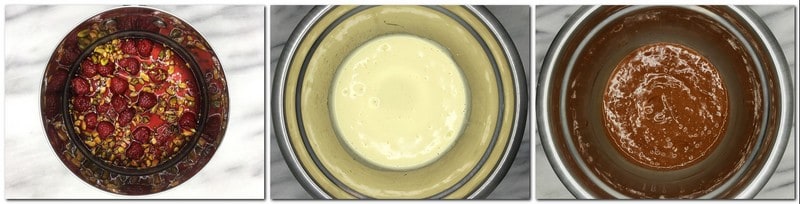
Step 3. Add chopped pistachios at the last moment, then remove from the heat. Let it cool down (photo 1).

Step 4. To make the cake batter, melt the chocolate and butter in a bain-marie (water bath).

Step 5. Using an electric mixer, whip eggs and sugar until the mixture whitens (photo 2).

Step 6. Add flour and melted chocolate with butter, and mix with a rubber spatula (photo 3).

Photo 1: Sauce in a saucepan Photo 2: Eggs mixture Photo 3: Batter in a bowl
PHOTOS 1-3

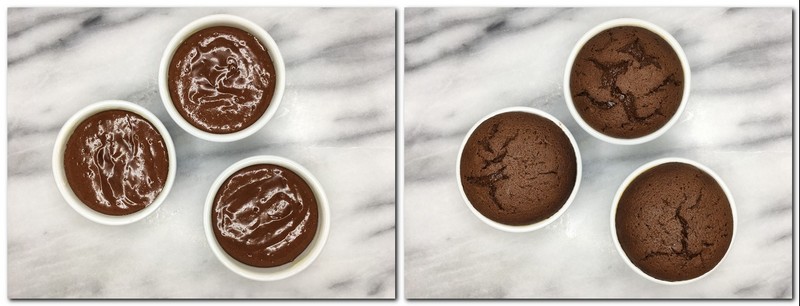
Step 7. Fill the ramekins halfway with the batter, then place a piece of chocolate in the center. Finish filling the molds (photo 4).

Step 8. Bake for 12 minutes. Remove lava cakes from the oven and let cool for 2 minutes (photo 5).

Photo 4: Ramekins filled with the batter Photo 5: Baked desserts in ramekins
PHOTO 4 PHOTO 5

Step 9. Place a dessert plate on top of the ramekin. Flip the dish and ramekin together to remove the cake from the mold.

Step 10. Sprinkle with powdered (icing) sugar, pour raspberry sauce over each cake, and serve immediately.

Expert tips

  1. Use fresh or frozen berries to make the raspberry sauce, and let it cool while the lava cakes bake.
  2. Use high-quality dark chocolate, such as Scharffen Berger, Valrhona, or Lindt Excellence. Do not use chocolate chips.
  3. Read how to melt chocolate before you begin.
  4. Add a pinch of salt, or use salted butter, to intensify the chocolate's flavor.
  5. Baking time is key to making this dessert. You may need to use a toothpick to test the centers of the cakes to make sure they are not overbaked.
  6. To release cakes, use a knife to loosen them from the edges. Then let the ramekin sit upside down for a few seconds after flipping.

How to serve lava cake

  • Accompany it with a scoop of ice cream, custard, or whipped cream.
  • Sprinkle the dark chocolate lava cake with toasted nuts (hazelnuts, almonds, pistachios) or shredded coconut.
  • Serve the dessert with pomegranate seeds, fresh raspberries, or cherries to add a tangy note.
  • Sprinkle the cakes with fleur de sel before serving to bring out the chocolate's flavor.
  • Dust lava cakes with powdered sugar or cocoa powder, and serve them in ramekins if you prefer not to flip them.
  • Bake cakes in ovenproof cups, filling them up to half instead of traditional ramekins. Sprinkle with some toasted nuts, pipe the whipped cream, and sprinkle with cocoa powder.

Lava cake variations

Experiment with lava cake ingredients to make the dessert original and personal.

  • Try the milk chocolate version for a sweeter flavor.
  • Add ground cinnamon and chili powder to the cake batter for a Mexican chocolate twist: Mexican "Hot" Chocolate Molten Lava Cakes.
  • Top each lava cake with peanut butter before baking and make Peanut Butter Chocolate Lava Cakes.
  • To enjoy a runny dulce de leche center, follow the recipe for Molten Caramel Cakes.
  • Make Chocolate-Espresso Lava Cakes if you are a coffee-lover.
  • Add Grand Marnier and orange zest to make these unique Grand Marnier Molten Chocolate Cakes.
  • Add red food coloring to the batter and enjoy Red Velvet Molten Chocolate Lava Cakes.
  • Add your favorite liquor to make Molten Chocolate Liquor Cakes.
  • Surprise your guests with Molten Chocolate Cakes with Matcha Tea and Black Sesame Seeds Filling.
  • Flourless Chocolate Lava Cakes will please those on a gluten-free diet.

Recipe FAQ

What does mi-cuit au chocolat mean?
Mi-cuit au chocolat is French for "half-cooked chocolate." It refers to a small chocolate cake baked just until the edges set, while the center stays warm and molten, which is exactly what an English speaker calls a lava cake.

Is it safe to eat a lava cake?
Yes. The cake is baked through, and the flowing center is melted chocolate placed in the middle before baking, not raw batter. Even the egg-containing versions are safe because eggs baked at 425°F (218°C) for 12 minutes reach a safe temperature. This dessert is fine to eat during pregnancy.

Can you bake lava cakes in a muffin pan?
Yes. If you don't have ramekins, butter and flour muffin pan cups, fill them with the chocolate batter and bake at 425°F (218°C) for 8 to 10 minutes. Use a spoon to release the cakes from the mold.

How do you make a gluten-free lava cake?
Replace the wheat flour with cornstarch or a gluten-free flour blend. The texture stays soft, and the center still flows.

How do you make a vegan lava cake?
Remove the eggs and butter and replace them with a mix of applesauce and almond puree. Use a dairy-free dark chocolate to keep it fully plant-based.

Can you make lava cakes in advance?
Yes. Make the batter one day ahead, pour it into prepared ramekins, cover with plastic film, and refrigerate; the next day, uncover and bake as directed. You can also freeze the filled ramekins for up to 3 months and add a couple of extra minutes to the baking time.

What wine pairs with a lava cake?
A naturally sweet dessert wine works well and stands up to the dark chocolate.

Love chocolate desserts? Try these next!

  • French Chocolate Cake
  • Chocolate Ganache Cake
  • French Chocolate Mousse
  • Chocolate Fondant
  • French Chocolate Fondant Cake
  • Royal Chocolate Cake Trianon
  • French Chocolate Crepes

Want more delicious and beautiful recipes? Subscribe to my newsletter and follow me on Facebook, Pinterest, and Instagram for my latest updates. If you make this recipe, please leave a star rating on the recipe card and comment below!

Print

Recipe card

Raspberry Lava Cake (Mi-cuit au Chocolat)

Chocolate raspberry lava cake dusted with icing sugar on a white dessert plate: Close up.
Print Recipe
Save Recipe Recipe Saved

5 Stars 4 Stars 3 Stars 2 Stars 1 Star

5 from 5 reviews

This raspberry lava cake (mi-cuit au chocolat) is a rich molten chocolate cake with a warm, flowing center. It takes only 30 minutes to make the five-ingredient batter and serve the cakes fresh from the oven, topped with a quick raspberry sauce.

  • Author: Irina Totterman
  • Prep Time: 18 minutes
  • Cook Time: 12 minutes
  • Total Time: 30 minutes
  • Yield: 3 1x
  • Category: Cakes
  • Method: Baking
  • Cuisine: American

Ingredients

Scale

For the cake batter:

  • 1.4 oz. (40 g) butter
  • 2.7 oz. (75 g) dark chocolate + 3 pieces of dark chocolate
  • 2 eggs
  • 9 ½ teaspoons (45 g) sugar
  • 1 tablespoon flour

For the raspberry sauce:

  • 3 tablespoons sugar
  • 3 tablespoons water
  • 1.7 oz. (50 g) fresh raspberries
  • 0.7 oz. (20 g) pistachios, chopped

Instructions

  1. Preheat oven to 425°F (218°C). Butter and flour three small, individual ramekins, then set aside.
  2. To make the raspberry sauce, pour water and sugar into a saucepan, add raspberries, and cook over medium heat for 1 to 2 minutes. Add chopped pistachios at the last moment, then remove from the heat. Let it cool down. 
  3. To make the cake batter, melt the chocolate and butter in a bain-marie (water bath). Using an electric mixer, whip the eggs and sugar until the mixture is pale. Add the flour and melted chocolate mixture, and fold in with a rubber spatula. Fill the ramekins halfway, then place a piece of chocolate in the center. Finish filling the molds. Bake for 12 minutes.
  4. Remove lava cakes from the oven and let cool for 2 minutes. Place a dessert plate on top of the ramekin. Flip the dish and ramekin together to remove the cake from the mold. Sprinkle with powdered (icing) sugar, pour raspberry sauce over each cake, and serve immediately.

Notes

  1. Use fresh or frozen berries to make the raspberry sauce, and let it cool while the lava cakes bake.
  2. Use high-quality dark chocolate, such as Scharffen Berger, Valrhona, or Lindt Excellence. Please do not use chocolate chips.
  3. Read how to melt chocolate before you begin.
  4. Add a pinch of salt, or use salted butter, to intensify the chocolate's flavor.
  5. Baking time is key to making this dessert. You may need to use a toothpick to test the centers of the cakes to make sure they are not overbaked.
  6. To release cakes, use a knife to loosen them from the edges. Then let the ramekin sit upside down for a few seconds after flipping. 

Nutrition

  • Calories: 435
  • Sugar: 45.2 g
  • Sodium: 174 mg
  • Fat: 24.3 g
  • Saturated Fat: 13.3 g
  • Carbohydrates: 51.1 g
  • Fiber: 2.7 g
  • Protein: 7.4 g
  • Cholesterol: 144 mg

Thank you for following me on Pinterest, Facebook, and Instagram. Hashtag #bakinglikeachef so I can see your creations.

The nutritional information has been calculated using an online recipe nutrition calculator such as Verywellfit.com and is intended for informational purposes only. These figures should be used as a general guideline and not be construed as a guarantee.

The recipe was adapted from http://gourmand.viepratique.fr/. It was originally published on June 15, 2018. The recipe has been revised to include improved content and photos. All posted pictures are mine.

Coconut Dacquoise (Dacquoise De Coco)

Apr 12, 2020 · 27 Comments

Coconut dacquoise on a cake board.

Quick Summary: Coconut dacquoise, or Dacquoise de Coco, is a French dessert made of crisp, chewy coconut-almond meringue layers filled with light diplomat cream and fresh red fruit. It needs no chilling and comes together in just over an hour.

Coconut dacquoise on a cake board.

What is a dacquoise?

Dacquoise is a French cake made with layers of nut meringue (primarily almond and hazelnut) and whipped cream or buttercream. The dessert takes its name from the French word dacquois, meaning 'of Dax', which is a town in southwestern France.

According to food historians, dacquoise originated in the 17th century, when the dessert was created as a sumptuous cake for French royalty. Over the years, the recipe became popular in England when some French chefs moved there to serve the upper class.

Why you'll love this recipe

  • Full of summer flavor: loaded with red fruit for a fresh, fruity taste.
  • Showstopping look: bright berries give the cake a colorful presentation.
  • Nutty coconut flavor: almond and coconut flour give the meringue layers a rich, nutty taste.
  • Easy to customize: swap in mango, pineapple, or other fruit combinations.
  • No chilling needed: made in just over an hour and ready to serve right away.
Coconut Dacquoise Cake with a cutting board and fruit on background: Overhead view

Ingredients

For ingredients and detailed instructions, refer to the recipe card below.

  • Almond flour: Gives the dacquoise its nutty flavor and chewy texture.
  • Coconut flour: Adds coconut flavor and helps give the meringue layers their chewy texture.
  • Powdered (icing) sugar: Sweetens the dacquoise batter and helps it stay tender.
  • All-purpose flour: Just a small amount to give the layers structure.
  • Egg whites: Whip them to stiff peaks so the meringue is light and airy. Use room-temperature whites.
  • Granulated sugar: Stabilizes the meringue and sweetens the diplomat cream.
  • Salt: A pinch to balance the sweetness.
  • Milk: The base of the diplomat cream. Whole milk gives the richest result.
  • Egg yolks: Thicken the pastry cream that forms the diplomat cream.
  • Cornstarch: Thickens the cream, so it holds its shape.
  • Whipping cream: Folded into the pastry cream to make it light. Use cold cream.
  • Fresh berries: Strawberries, raspberries, and blackberries for a fresh, fruity topping.
  • Apricot preserves: Brushed over the fruit for a glossy finish.
  • Shredded coconut: Sprinkled on top to echo the coconut flavor.

Equipment

  • Stand mixer or hand mixer
  • Mixing bowls
  • 8-inch (20 cm) round cake ring
  • Pastry bags and plain round piping tips
  • Saucepan (for the diplomat cream)
  • Silicone brush
  • Fine-mesh sieve

How to make coconut dacquoise cake

Step 1. To make the coconut dacquoise, preheat the oven to 345°F (175°C). Using an electric mixer, whisk the egg whites with 1 pinch of salt, then gradually add granulated sugar until the meringue is firm and glossy (photo 1).

Step 2. Mix almond flour, coconut flour, sifted icing sugar, and all-purpose flour in a separate bowl. Add dry ingredients to the beaten whites and combine with a rubber spatula (photo 2).

Photo 1: Ready meringue in a metal bowl Photo 2: Ready dacquoise preparation in a bowl
PHOTO 1 PHOTO 2

Step 3. Butter an 8-inch/20 cm round cake ring and place it on the parchment paper.

Step 4. Transfer the mixture to a pastry bag fitted with Ateco plain pastry tip 809 and pipe a spiral at the bottom of the cake ring.

Step 5. Begin piping in the center and end at the edges of the ring. Pipe large balls in the direction towards the center (photo 3). Bake for about 20 to 25 minutes until slightly browned (photo 4).

Photo 3: Piped preparation inside a cake ring Photo 4: Baked cake in a ring
PHOTO 3 PHOTO 4

Step 6. To make the diplomat cream, mix the egg yolks with the sugar and cornstarch using a hand whisk (photo 5). Bring the milk to a boil in a saucepan, then add the boiling liquid to the egg yolk mixture, stirring constantly.

Step 7. Return the mixture to the pan and cook over medium heat, whisking continuously until the cream thickens (photo 6). Pour the cream onto a shallow plate, cover it with plastic film in contact, and let it cool.

Photo 5: Egg yolks/sugar, corn starch mixture in a bowl Photo 6: Ready pastry cream in a saucepan
PHOTO 5 PHOTO 6

Step 8. Whisk the whipping cream (photo 7) and mix it with the cooled cream (photo 8).

Photo 7: Whipped cream in a metal bowl Photo 8: Ready diplomat cream in a bowl
PHOTO 7 PHOTO 8

Step 9. To assemble the coconut dacquoise, sprinkle the cake with powdered (icing) sugar. Using a pastry bag with the same plain tip, push the diplomat cream in a spiral on top of the dacquoise (photo 9).

Step 10. Arrange red fruit on top of the cream (photo 10) and sprinkle with powdered (icing) sugar.

Step 11. With a silicone brush, apply the apricot preserves all around the cake base and sprinkle with the shredded coconut.

Photo 9: Diplomat cream in a spiral on top of the cake Photo 10: Ready decorated cake topped with red fruit
PHOTO 9 PHOTO 10

Expert tips

  1. To make the cake gluten-free, substitute all-purpose flour as 1:1 with almond flour, but NOT with coconut flour.
  2. Sprinkle red fruit with powdered (icing) sugar right before serving the cake.
  3. Mix red fruits with one can of raspberry jam and place the fruit mixture on top of the cake if you prefer. Omit the powdered sugar sprinkled over the fruit in this case.

Recipe variations

  • Different nuts: swap the coconut for a classic almond or hazelnut dacquoise.
  • Tropical fruit: replace the red berries with mango, pineapple, or passion fruit.
  • Chocolate layer: add a thin layer of chocolate ganache between the meringue and cream.
  • Toasted coconut: toast the shredded coconut for a deeper, nuttier flavor on top.

Recipe FAQ

What is a dacquoise made of?
A dacquoise is made of a meringue batter with whipped egg whites, sugar, and ground nuts such as almond or coconut, baked into crisp, chewy layers.

Is a dacquoise the same as a sponge?
No. A dacquoise sponge is a nut-based meringue layer, so it is lighter and chewier than a classic butter or genoise sponge.

Is coconut dacquoise gluten-free?
No. This recipe uses a small amount of all-purpose flour, so it is not gluten-free as written. To make it gluten-free, replace the all-purpose flour 1:1 with almond flour (not coconut flour).

What is diplomat cream?
Diplomat cream is pastry cream lightened with whipped cream. It stays soft and holds its shape between the dacquoise layers.

Can I make the dacquoise layers ahead?
Yes. Bake the coconut dacquoise layers a day ahead and store them in an airtight container, then assemble the cake with cream and fruit before serving.

How do I store coconut dacquoise cake?
Keep the assembled cake in the fridge and eat it within 2 days, as the fresh fruit and cream do not keep long.

Why is it called dacquoise?
The dessert takes its name from Dax, a town in southwest France where this nut meringue cake originates.

More delicious cake recipes you will love

  • Caramel Carrot Cake With Pecans
  • Layer Cashew Cake Sans Rival
  • French Meringue Dessert Merveilleux
  • Browse all the Cake Recipes

Want more delicious and beautiful recipes? Subscribe to my newsletter and follow me on Facebook, Pinterest, and Instagram for my latest updates. If you make this recipe, please leave a star rating on the recipe card and comment below!

Print

Recipe card

Coconut Dacquoise (Dacquoise De Coco)

Coconut dacquoise on a cake board.
Print Recipe
Save Recipe Recipe Saved

5 Stars 4 Stars 3 Stars 2 Stars 1 Star

5 from 10 reviews

This coconut dacquoise cake layers crisp, chewy coconut-almond meringue with light diplomat cream and fresh red berries. Made in just over an hour with no chilling, this easy coconut dacquoise recipe is a fruity French summer dessert.

  • Author: Irina Totterman
  • Prep Time: 50 minutes
  • Cook Time: 25 minutes
  • Total Time: 1 hour, 15 minutes
  • Yield: 8 1x
  • Category: Cakes
  • Method: Baking
  • Cuisine: French

Ingredients

Scale

For the coconut dacquoise:

  • â…” cup + 4 tablespoons (88 g) almond flour
  • â…” cup + 2 tablespoons (88 g) coconut flour
  • â…” cup + ½ tablespoon (88 g) powdered (icing) sugar
  • 3 ½ tablespoons (28 g) all-purpose flour
  • 8 large egg whites
  • â…” cup + 2 tablespoons (175 g) granulated sugar
  • 1 pinch of salt

For the diplomat cream: 

  • â…” cup + 2 ½ tablespoons (200 g) milk
  • 2 large egg yolks
  • 2 tablespoons (30 g) granulated sugar
  • 8 teaspoons (20 g) corn starch
  • ½ cup + 2 teaspoons (125 g) whipping cream

For the decoration:

  • powdered (icing) sugar
  • 14 oz (400 g) fresh berries (strawberries, raspberries, blackberries, blueberries)
  • 30 g apricot preserves
  • shredded coconut

*Don't you have the correct baking pan on hand right now? Try this simple Cake Pan Converter!

** If needed, please refer to Baking Conversion Charts.

Instructions

  1. To make the coconut dacquoise, preheat the oven to 345°F (175°C). Using an electric mixer, whisk the egg whites with 1 pinch of salt, then gradually add granulated sugar until the meringue is firm and glossy. Mix almond flour, coconut flour, sifted powdered (icing) sugar, and all-purpose flour in a separate bowl. Add dry ingredients to the beaten whites and combine with a rubber spatula.
  2. Butter an 8-inch/20 cm round cake ring and place it on the parchment paper. Transfer the mixture to a pastry bag with Ateco plain pastry tip 809 and make a spiral at the bottom of the cake ring. Begin piping in the center and end at the edges of the ring. Pipe large balls in the direction towards the center. Bake for about 20 to 25 minutes until slightly browned.
  3. To make the diplomat cream, whisk together egg yolks, sugar, and cornstarch with a hand whisk. Bring the milk to a boil in a saucepan, then add the boiling liquid to the egg yolk mixture, stirring continuously. Return the mixture to the pan and cook over medium heat, whisking continuously until the cream thickens.
  4. Pour the cream onto a shallow plate, cover it with a plastic film in contact with the cream, and let it cool. Whisk the whipping cream and mix it with the cooled cream.
  5. To assemble the coconut dacquoise, sprinkle the cake with powdered (icing) sugar. Using a pastry bag with the same plain tip, push the diplomat cream in a spiral on top of the dacquoise. Arrange red fruit on top of the cream and sprinkle with powdered (icing) sugar. With a silicone brush, apply apricot preserves all around the cake base, then sprinkle with shredded coconut.

Notes

  1. To make the cake gluten-free, substitute all-purpose flour 1:1 for almond flour, but NOT coconut flour.
  2. Sprinkle red fruit with powdered (icing) sugar right before serving.
  3. Mix red fruits with one can of raspberry jam and place the fruit mixture on top of the cake, if you prefer. In this case, omit the powdered sugar sprinkled over the fruit.

Nutrition

  • Serving Size: 1 slice
  • Calories: 341
  • Sugar: 41.3 g
  • Sodium: 76 mg
  • Fat: 12.5 g
  • Saturated Fat: 4.4 g
  • Carbohydrates: 52.3 g
  • Fiber: 3.8 g
  • Protein: 8.8 g
  • Cholesterol: 72 mg

Thank you for following me on Pinterest, Facebook, and Instagram. Hashtag #bakinglikeachef so I can see your creations.

The nutritional information has been calculated using an online recipe nutrition calculator such as Verywellfit.com and is intended for informational purposes only. These figures should be used as a general guideline and not be construed as a guarantee.

The recipe was adapted from http://avenuedesdelices.over-blog.com/. It was originally published on July 24, 2018. The recipe has been revised to include improved content and photos. All posted pictures are mine.

Easter Bundt Cake Recipe (French Easter Cake)

Apr 7, 2020 · 12 Comments

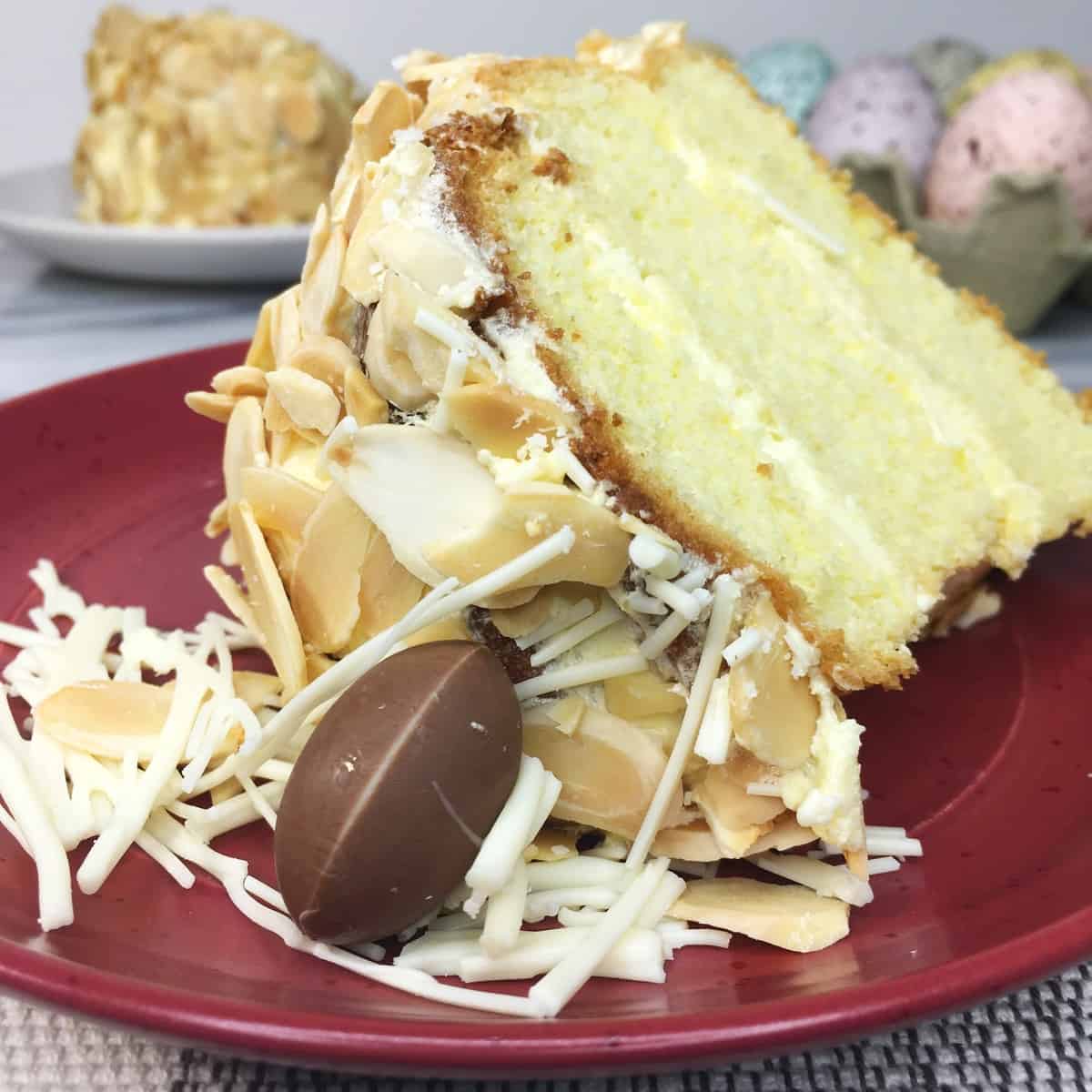
A slice of Easter bundt cake on a red plate.

Quick Summary: Easter bundt cake is a traditional French Easter cake (gâteau bundt de Pâques) shaped like a bird's nest. It is built from three layers of airy sponge cake, baked in a bundt (fluted) pan, filled with mousseline cream, then covered with toasted, sliced almonds and topped with small chocolate or candy eggs.

A slice of Easter bundt cake on a red plate: Close up

What is a French Easter cake?

A French Easter cake, or gâteau de Pâques, is a festive springtime dessert served at the Easter table in France. Unlike a heavy fruitcake, this version is light and airy: it is built on a delicate sponge (Génoise cake or Savoy sponge) baked in a fluted bundt pan, so the finished cake resembles a bird's nest.

The layers are filled with mousseline cream, coated with toasted sliced almonds for a straw-like nest texture, and crowned with small chocolate or candy eggs. It is a traditional yet playful centerpiece that celebrates spring and renewal, the themes at the heart of Easter.

Why you'll love this recipe

  • It is a real showstopper. The bird's nest design, made with toasted almonds and white chocolate strands, turns a humble bundt cake into a festive Easter centerpiece.
  • The texture is light and airy. Three layers of tender sponge are filled with silky mousseline cream, so every slice feels delicate rather than heavy.
  • It is easier than it looks. You bake one sponge, fill and stack the layers, then decorate, so the wow factor comes from assembly rather than complicated technique.
  • It is a tested family tradition. I have baked this bird nest cake every Easter since 2018, and it has never let me down.

Ingredients

For ingredients and detailed instructions, refer to the recipe card below.

  • Cornstarch lowers gluten formation in the all-purpose flour by softening the flour proteins.
  • Eggs: Use large eggs at room temperature.
  • Baking powder is one of the leavening agents used in the recipe.
  • Vanilla extract: Use pure vanilla extract, or replace it with lemon or coconut extract and some lime or lemon zest. Or substitute vanilla extract for 1 tablespoon of Kirsch (cherry brandy) or another fruit-based brandy.
  • Milk: Use whole milk or substitute low-fat milk.
  • Butter: Use unsalted, softened butter. Take it out of the fridge 1 to 2 hours before you start.
  • Flaked almonds: Use store-bought toasted flaked almonds or toast raw sliced almonds in the oven at 300°F (150°C) for 10 to 15 minutes.
  • White chocolate: Use Lindt white chocolate or Callebaut white chocolate interchangeably when making filaments.
  • Edible decorations: Top the cake with small chocolate eggs, jelly beans, or your favorite Easter candy.

How to make Easter bundt cake

Step 1. To make cake batter, preheat the oven to 355°F (180°C). Use a flour sifter to sift flour, cornstarch, and baking powder.

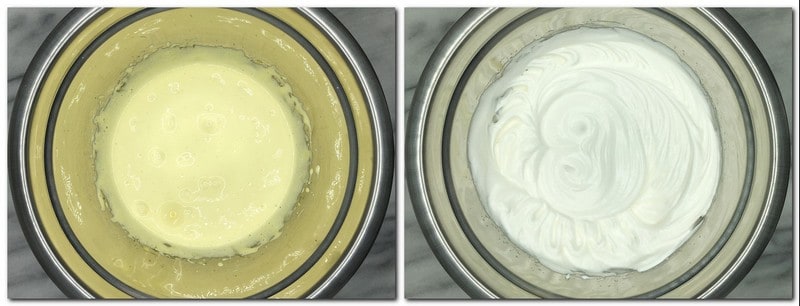
Step 2. Break the eggs and separate the egg yolks from the whites. Whisk the egg yolks with 50 g granulated sugar until they become pale yellow (photo 1).

Step 3. In a separate large bowl, whisk the egg whites with an electric mixer until they are foamy. Gradually pour in the remaining sugar (100g) and whisk until the egg whites are firm and glossy. Add the vanilla extract and beat for a few seconds (photo 2).

Photo 1. Egg yolks/sugar in a bowl Photo 2: Whisked egg whites in a bowl
PHOTO 1 PHOTO 2

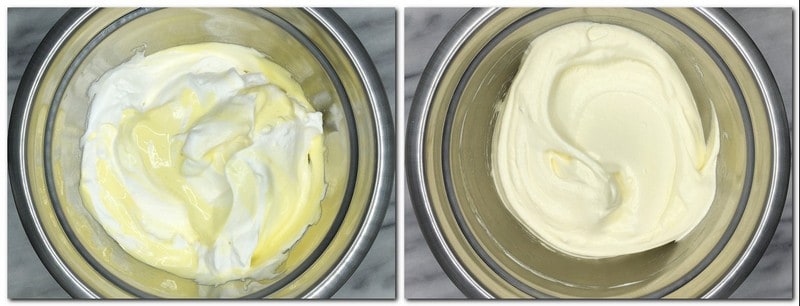
Step 4. Use a rubber spatula to gently mix the egg whites with the yolks/sugar mixture (photos 3-4).

Photo 3: Egg whites/yolks mixture in a bowl Photo 4: Eggs mixture in a bowl
PHOTO 3 PHOTO 4

Step 5. Add the sifted dry ingredients and gently mix (photo 5). Butter and flour a fluted cake pan and pour the batter into the mold (photo 6).

Photo 5: Cake batter in a bowl Photo 6: Cake butter in a fluted cake pan
PHOTO 5 PHOTO 6

Step 6. Bake the cake for 25 to 30 minutes. Test its readiness with a knife: a sharp tip should come out dry (photo 7). Let the cake cool on a cooling rack.

Step 7. To make the sugar syrup, heat water, sugar, and vanilla extract in a saucepan until the sugar dissolves. Let it cool, then set aside.

Step 8. To make the pastry cream, mix egg yolks, 50g of milk, sugar, flour, and cornstarch (photo 8).

Photo 7: Baked cake in a cake mold Photo 8: Pastry cream mixture in a bowl
PHOTO 7 PHOTO 8

Step 9. Bring 150 ml of milk to a boil. Pour in the hot milk and bring the mixture back to a boil, stirring constantly. Once the cream thickens (photo 9), pour it onto a shallow plate and cover with plastic wrap in contact. Cool the pastry cream at room temperature.

Step 10. To make the extra buttercream, heat sugar and water in a saucepan to 250°F (120°C).

Step 11. Break the egg into a bowl and pour the syrup over the egg, whisking constantly. Continue whisking for about 10 minutes, until the mixture becomes whitish (photo 10).

Photo 9: Pastry cream in a saucepan Photo 10: Whisked eggs/sugar syrup in a bowl
PHOTO 9 PHOTO 10

Step 12. Add the softened butter and vanilla extract, and beat the cream with an electric mixer for 10 to 15 minutes to aerate as much as possible (photo 11).

Step 13. Heat it slightly if it is too thick, or cool it if it is too soft. The cream should be smooth and homogeneous.

Step 14. To make the vanilla mousseline cream, add the pastry cream to the extra buttercream little by little, whisking as you go (photo 12). Place aside.

Photo 11: Ready extra buttercream in a bowl Photo 12: Ready mousseline cream in a bowl
PHOTO 11 PHOTO 12

Step 15. To assemble the Easter cake, cut the cooled biscuit into three equal and regular parts with a serrated knife.

Step 16. Using a silicone brush, soak each biscuit slice in the sugar syrup.

Step 17. Spread the vanilla mousseline cream in the center of the first biscuit, then smooth it with a bent spatula. Cover with the second biscuit layer, soak again in the syrup, and cover with the cream.

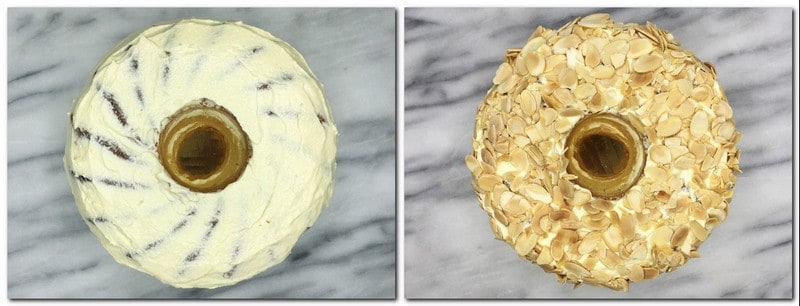
Step 18. Spread the remaining mousseline cream with the bent spatula. Smooth the edges of the biscuit as you turn the spatula around the cake (photo 13). Apply the toasted flaked almonds over the entire cake (photo 14).

Photo 13: Cake with cream on a board Photo 14: Cake with almonds on a board
PHOTO 13 PHOTO 14

Step 19. To make chocolate filaments, melt white chocolate in a bain-marie (water bath) or in the microwave, taking care not to overheat it (it should reach a maximum of 104°F (40°C) or be warm to the touch).

Step 20. Stir it to bring the temperature down to 85°F (30°C). You should not feel any temperature difference when you touch it. Place the chocolate in a pastry bag and cut the end.

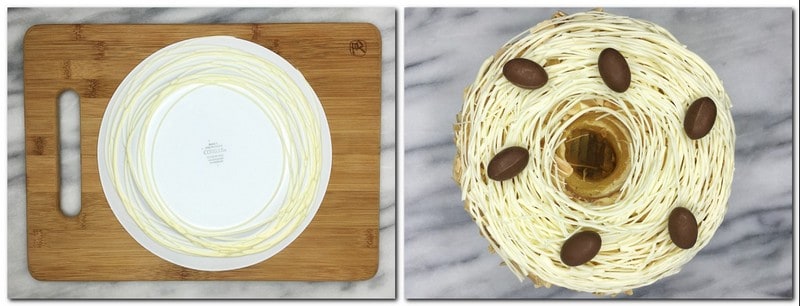
Step 21. Freeze the plate and take it out of the freezer. Place the plate upside down on the work surface. Holding the pastry bag, make a few round trips on the back of the plate. Let the chocolate freeze for a few seconds over the plate (photo 15).

Step 22. Peel off one side using a bent spatula or a knife. Arrange chocolate filaments on top of the cake.

Photo 15: White chocolate spiraled over a plate Photo 16: Cake with chocolate eggs on top
PHOTO 15 PHOTO 16

Step 23. Repeat the process as often as you like, using a very cold plate each time. Stick a few eggs with the remaining melted chocolate (photo 16).

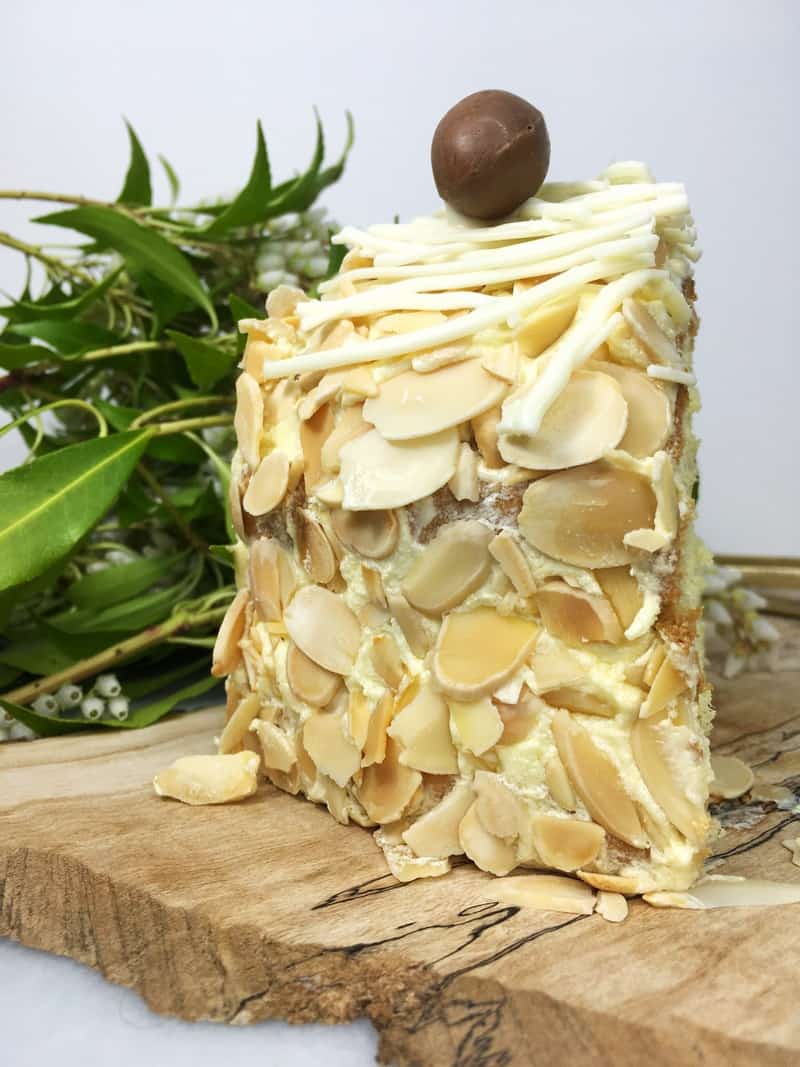
A single slice of Easter nest cake on a board with a plant in the background

Expert Tips

  1. Make the biscuit one day in advance, cool it, wrap it in plastic film, and refrigerate it. Finish the cake the next day.
  2. Bake the cake in a tall, fluted cake pan (aka a kouglof mold) or in your favorite bundt pan.
  3. To toast flaked almonds, bake them at 355°F (180°C) for 10 to 15 minutes. If you use store-bought toasted flaked almonds, toast them at 300°F (150°C) for 5 to 7 minutes to achieve a deeper color.
  4. Replace white chocolate with milk or dark chocolate to make chocolate filaments.

Recipe variations

This Easter egg cake is made from scratch, but if you are a novice baker, you can use a cake mix to prepare a bundt cake.

While mousseline cream is a wonderful cream to fill many pastries, including Paris-Brest to fruity Strawberry Pistachio Tart, if making it scares you, there is a simple solution. Whip Chantilly cream or cream cheese frosting and fill your bundt cake.

How to decorate an Easter bundt cake (bird's nest design)

The bird's-nest look is what makes this cake an Easter showstopping centerpiece, and it comes together in three simple steps.

First, spread a thin coat of mousseline cream over the outside of the assembled cake so the almonds have something to cling to. Next, gently press toasted sliced almonds all over the surface, letting them lie in overlapping strands that mimic the straw of a real nest. Work from the bottom up and don't worry about a perfectly even layer, since a little texture looks more natural.

Finally, cluster a few small chocolate or candy eggs in the center hole of the bundt so they sit like eggs resting in the nest. For an extra touch, add a sugar bird, a sprig of edible greenery, or a dusting of powdered sugar around the rim.

Want to try a different nest? Here are a few creative ways to top the cake:

  • Cover the whole cake with flaked almonds, coconut flakes, or other chopped nuts for a classic straw-nest texture.
  • Use tempered chocolate to make a chocolate nest. Or follow another interesting technique for making chocolate bird nests offered by St. Croix Chocolate Company. Or use caramel to make a fancy-looking caramel nest. Finally, create a chocolate bird's nest by watching a Carma Chocolate video.
  • Finish the center with a cluster of chocolate or candy eggs.

How to keep a bundt cake from sticking to the pan

A bundt pan has deep flutes and a central tube, so releasing the cake cleanly depends on preparing the pan properly. Brush every groove and the center tube with softened butter or a neutral oil, reaching into the detailed corners with a pastry brush, then dust with flour and tap out the excess so a thin coating clings to the greased surface.

Fill the pan no more than two-thirds full, so the batter rises evenly without overflowing the design. After baking, let the cake rest for about 10 to 15 minutes: unmolding too soon can tear a warm, fragile crumb, while waiting too long lets the sugars set and glue the cake to the pan.

When the time is right, place a wire rack over the pan, invert, and lift the pan straight up so the cake slides out with its fluted shape intact.

Storing & freezing

Store this bundt cake with mousseline cream in the refrigerator for up to 48 hours.

Can you freeze it? I don't recommend freezing cakes with mousseline cream, but you can freeze the undecorated bundt cake.

Let it cool completely and wrap it in plastic. Freeze the cake for up to 3 months. To thaw, refrigerate the wrapped cake for at least 8 hours.

Recipe FAQ

What is mousseline cream?
Mousseline cream is a pastry cream enriched with softened butter. With a typical pastry cream-to-butter ratio of 2:1, mousseline cream is used the same way as buttercream: to layer and finish cakes and to pipe choux pastry.

What's the difference between a bundt cake and a regular cake?
Bundt cake has a fluted edge with a hole in the center, unlike a regular cake baked in a standard round or rectangular pan. Also, the donut shape of a bundt pan exposes more of the cake to high oven heat than a regular cake.

Love Easter desserts? Try these next!

  • Ottolenghi's Carrot Cake
  • The Best Savoy Cake
  • Apple Tarte Tatin
  • Browse all the Easter Dessert Recipes

Want more delicious and beautiful recipes? Subscribe to my newsletter and follow me on Facebook, Pinterest, and Instagram for my latest updates. If you make this recipe, please leave a star rating on the recipe card and comment below!

Print

Recipe card

Easter Bundt Cake Recipe (French Easter Cake)

A slice of Easter bundt cake on a red plate.
Print Recipe
Save Recipe Recipe Saved

5 Stars 4 Stars 3 Stars 2 Stars 1 Star

5 from 5 reviews

This Easter bundt cake is a traditional French Easter cake, a masterpiece for the Easter holiday table. It has three layers of airy sponge cake, mousseline cream, and toasted almonds sprinkled on top.

  • Author: Irina Totterman
  • Prep Time: 1 hour 30 minutes
  • Cook Time: 30 minutes
  • Total Time: 2 hours
  • Yield: 10 1x
  • Category: Cakes
  • Method: Baking
  • Cuisine: French

Ingredients

Scale

For the biscuit:

  • â…” cup + 3 ½ tablespoons (110 g) all-purpose flour
  • â…” cup (150 g) granulated sugar
  • 3 tablespoons (30 g) corn starch
  • 5 large eggs, room temperature
  • 1 teaspoon (5 g) baking powder
  • 1 tablespoon vanilla extract

For the sugar syrup: 

  • ½ cup (120 g) water
  • â…“ cup (75 g) granulated sugar
  • 1 teaspoon vanilla extract

For the pastry cream: 

  • â…” cup + 2 ½ tablespoons (200 g) whole milk
  • 2 large egg yolks, room temperature
  • 9 ½ teaspoons (45 g) granulated sugar
  • 1 ½ tablespoons (15 g) cornstarch
  • 2 teaspoons (5 g) flour

For the extra buttercream:

  • 1 large egg, room temperature
  • ½ cup (112 g) granulated sugar
  • 10 teaspoons (50 g) water
  • 1 teaspoon vanilla extract
  • 4.4 oz (125 g) butter

For the decoration:

  • 4.6 oz (130 g) flaked almonds
  • 4.4 oz (125 g) white chocolate
  • small decoration eggs

*Don't you have the correct baking pan on hand right now? Try this simple Cake Pan Converter!

** If needed, please refer to Baking Conversion Charts.

Instructions

  1. Preheat the oven to 355°F (180°C). To make cake batter, use a flour sifter to sift flour, cornstarch, and baking powder. Break the eggs and separate the yolks from the whites. Whisk the egg yolks with 50g of granulated sugar until the mixture becomes pale yellow.
  2. In a separate bowl, whisk egg whites with an electric mixer until they are mounted. Gradually pour the remaining sugar (100g) and whisk until the egg whites are firm and glossy. Add vanilla extract and beat for a few seconds. Gently mix the egg whites into the yolk/sugar mixture with a rubber spatula. Add the sifted dry ingredients and gently mix.
  3. Butter and flour a fluted cake pan, then pour the batter into the mold. Bake for 25 to 30 minutes. Test the cake's readiness with a knife: a sharp knife tip should come out dry. Let it cool on a rack.
  4. To make the sugar syrup, heat water, sugar, and vanilla extract until the sugar dissolves. Let it cool, then set it aside.
  5. To make the pastry cream, mix egg yolks, 50g of milk, sugar, flour, and cornstarch. Bring 150 ml of milk to a boil. Pour in the hot milk and bring the mixture back to a boil, stirring constantly. Once the cream thickens, pour it onto a shallow plate and cover it with plastic film. Cool the pastry cream at room temperature.
  6. To make the extra buttercream, heat sugar and water in a saucepan to 250°F (120°C). Break the egg into a bowl and pour the syrup over the egg, whisking constantly. Continue whisking for about 10 minutes, until the mixture becomes whitish. Add the softened butter and vanilla extract, and beat the cream with an electric mixer for 10 to 15 minutes to aerate as much as possible. Heat it a little if it is too compact, or cool it if it is too soft. The cream should be smooth and homogeneous.
  7. To make the vanilla mousseline cream, add the pastry cream to the extra buttercream, a little at a time, whisking as you go. Set aside.
  8. To assemble the Easter cake, cut the cooled biscuit into three equal and regular parts with a serrated knife. Using a silicone brush, soak each biscuit slice in the sugar syrup. Spread the vanilla mousseline cream in the center of the first biscuit, then smooth it with a bent spatula. Cover with the second biscuit layer, soak again in the syrup, and cover with the cream. Spread the remaining mousseline cream with the bent spatula. Smooth the edges of the biscuit as you turn the spatula around the Easter cake. Top with the toasted flaked almonds.
  9. To make chocolate filaments, melt white chocolate in a bain-marie (or in the microwave), taking care not to overheat it (it should reach a maximum of 104°F (40°C) or feel warm to the touch). Stir it to bring the temperature down to 85°F (30°C). You should not feel any temperature difference when you touch it. Place the chocolate in a pastry bag and cut the end.
  10. Freeze a plate and take it out of the freezer. Place the plate upside down on the work surface and make a few round trips on the back of the plate, holding the pastry bag. Let the chocolate freeze for a few seconds over the plate. Using a bent spatula or a knife, peel off one side. Arrange chocolate filaments on top of the cake. Repeat as many times as you like, using a very cold plate each time.  Stick a few eggs with the remaining melted chocolate.

Notes

  1. Make the biscuit one day in advance, cool it, wrap it in plastic film, and refrigerate. Finish the cake the next day.
  2. Bake the biscuit in a tall, fluted cake pan (aka kouglof mold) or use your favorite bundt cake pan.
  3. To toast flaked almonds, bake them at 355°F (180°C) for 10 to 15 minutes. If you use store-bought toasted flaked almonds, toast them again at 300°F (150°C) for 5 to 7 minutes to achieve a deeper color.
  4. Replace white chocolate with milk or dark chocolate to make chocolate filaments.

Nutrition

  • Serving Size: 1 slice
  • Calories: 504
  • Sugar: 46 g
  • Sodium: 131 mg
  • Fat: 25.7 g
  • Saturated Fat: 11 g
  • Carbohydrates: 59.4 g
  • Fiber: 1.3 g
  • Protein: 9.9 g
  • Cholesterol: 172 g

Thank you for following me on Pinterest, Facebook, and Instagram. Hashtag #bakinglikeachef so I can see your creations.

The nutritional information has been calculated using an online recipe nutrition calculator such as Verywellfit.com and is intended for informational purposes only. These figures should be used as a general guideline and not be construed as a guarantee.

The recipe was adapted from http://www.elle.fr and was originally published on March 29, 2019. It has been revised to include improved content and photos.

Savoy Cake (Traditional Victorian Savoy Sponge Cake)

Apr 3, 2020 · 36 Comments

Sliced Savoy cake on a cake serving board.

Quick Summary: Savoy cake, also called biscuit de Savoie, is a light, fatless French sponge cake dating to the 14th century. This traditional Victorian favorite uses whipped whole eggs for lift, contains no butter or oil, and bakes in about 45 minutes for an airy crumb and a delicate sugar crust.

Sliced Savoy cake on a cake serving board.

What is Savoy cake?

Savoy cake is a fatless sponge cake traditionally baked in a copper mold and sprinkled with icing sugar. The cake was invented in the 14th century and named for the Savoy region of France. It is believed to be one of the oldest Western pastries enjoyed today.

This Savoy sponge cake, also known in French as biscuit de Savoie, rises entirely on whipped eggs, with no butter, oil, or chemical leavening in the traditional version.

The Savoy region is actually shared between France, Italy, and Switzerland. So it is tough to claim a country of origin for the cake, although the Savoy cake, or Gâteau de Savoie, is more often considered a French dessert.

It used to be baked in copper molds, but nowadays it is baked in metal Bundt pans and Kougloff molds. I have made the cake in different Bundt cake molds, but I have never used silicone molds. Unfortunately, they do not work for this type of cake.

What is a Victorian Savoy cake?

A Victorian Savoy cake is the elegant, fatless sponge that became a centerpiece of grand tables in 19th-century Britain, where the older French Gâteau de Savoie was embraced and elaborately molded.

Victorian-era cooks prized it for its towering height, feather-light crumb, and dramatic decorative shapes, achieved by beating whole eggs to a foam and folding in flour and starch without any butter or oil.

The result is a pale, delicate cake with a crisp sugared crust, often served plain with fruit or a dusting of powdered (icing) sugar.

The history of Savoy cake

The history of Savoy cake dates back to the 14th century, when it is said to have been created for the House of Savoy, the ruling family of the Alpine Savoy region, which is shared today by France, Italy, and Switzerland.

It is often cited as one of the oldest sponge cakes in Western baking, predating many butter-rich cakes because it relied on whipped eggs rather than chemical leaveners.

Over the centuries, the recipe traveled across Europe, gaining popularity in Britain during the Victorian period, where it was baked in tall fluted molds and served at celebrations. Its enduring appeal comes from a short ingredient list and an airy texture that has changed remarkably little over 700 years.

You'll love this recipe

  • As a light, fat-free cake, it is perfect for kids and adults.
  • Savoy cake recipe is easy and quick: it takes about 25 minutes of hands-on time.
  • The cake doesn't require decoration: sprinkle it with powdered (icing) sugar and serve.
  • Different Bundt cake pans let you customize and personalize the cake for birthdays and any holiday.

Ingredients

Savoy cake ingredients.

For ingredients and detailed instructions, refer to the recipe card below.

  • Eggs: The recipe calls for large eggs. Use an egg separator to separate the egg whites from the yolks while the eggs are chilled. Then, bring them to room temperature.
  • Sugar: Use caster or superfine baker's sugar. If unavailable, use granulated sugar instead.
  • Flour: The recipe calls for regular all-purpose flour.
  • Corn and potato starch: Adding starches to the recipe facilitates gluten development and creates the most tender cake texture.
  • Baking powder: Use fresh aluminum-free baking powder.
  • Vanilla beans: Use top-quality Madagascar vanilla beans for the most flavorful results.
  • Oranges: Opt for organic, untreated oranges, and use a zester grater to make fresh zest. Replace orange zest with lemon zest, a common flavoring for Savoy cake.
  • Salt brings out the cake's flavors.
  • Cream of tartar helps stabilize egg whites. Replace ¼ teaspoon of cream of tartar with ½ teaspoon of lemon juice.
A single slice of savoy cake on a dessert plate.

Equipment

  • Metal Bundt pan, tube pan, or Kougloff mold
  • Pastry brush
  • Mixing bowls
  • Egg separator
  • Flour sifter
  • Stand mixer or electric hand mixer
  • Rubber spatula
  • Zester grater

How to make Savoy cake

Step 1: Preheat the oven to 430°F (220°C). To prepare the mold, use a pastry brush and well-softened unsalted butter to grease a Bundt pan (a decorative fluted tube pan).

  • Pro tip: Make sure to grease the sides of the pan with its intricate patterns (little nooks and crannies) and the central funnel.
Savoy pan greased with butter and sprinkled with sugar.

Step 2: Swirl the baking pan with granulated sugar to coat it. Shake off the excess sugar. Refrigerate the mold until ready to use.

Beaten egg yolks on mix beaters over the bowl.

Step 3: To make the cake batter, sift plain flour, cornstarch, potato starch, and baking powder into a large bowl, then mix with a hand whisk. Place egg yolks and ½ cup + ½ tablespoon (120 g) of granulated sugar in the bowl of a stand mixer or a mixer bowl. Using a stand or an electric mixer, beat until the mixture whitens and leaves a ribbon-like trail once lifted.

Step 4: Add the sifted dry ingredients to the egg yolk mixture and mix on low speed. Add the scraped vanilla bean seeds and orange zest, and mix again.

Meringue in a metal bowl with a hand whisk.

Step 5: In a separate bowl, whisk room-temperature egg whites with a pinch of salt and cream of tartar until soft peaks. Gradually add the remaining sugar (60 g) and whisk until stiff peaks form in the firm, glossy meringue.

Cake batter in a bowl.

Step 6: Gently fold the beaten egg whites into the main preparation with a rubber spatula.

Cake batter in a bundt pan.

Step 7: Pour the cake batter into the prepared tin, filling it to two-thirds full. Tap it on the table a few times to release large air bubbles and fill the mold's decorative pattern.

Baked Savoy cake in a mold.

Step 8: Place the pan in the oven and immediately reduce the temperature to 320°F (160°C). Bake for 20 to 25 minutes, until well risen and golden brown. Check for doneness with the blade of a knife or a cake tester: if it comes out dry, the cake is ready.

Step 9: Let the cake rest in the pan for a few minutes, then unmold it onto a wire rack to cool.

To serve, sprinkle the cooled Savoy cake with powdered (icing) sugar.

French Savoy cake on a platter with slices on smaller plates.

Expert tips

  • Choose a metal Bundt cake pan and make sure it is well prepared. This will result in an impeccable sugar crust.
  • Grease the cake mold with clarified butter, which contains no milk solids. This will provide an even, biscuit-like crust while baking.
  • Make the baking time adjustments as needed. It may vary based on your oven and the quality of the mold.
  • If the cake turns brown quickly, cover it with buttered parchment or foil during baking.
  • Do not open the oven door during baking; otherwise, the cake will collapse.
  • This recipe is for a 10-cup Bundt cake mold, which fits in a 9-inch (23 cm) springform pan.

Recipe variations

  • Flavorings: Replace orange zest with other citrus zests (lemon, lime, grapefruit) or add vanilla extract, rose water, or orange blossom water to the batter.
  • Fillings: Cut the cake into two layers and fill with French pastry cream, mascarpone frosting, jam, chocolate ganache, or Chantilly cream with fresh fruit.

How to serve it

  • Sprinkle Savoy cake with icing sugar, or serve it with creme Anglaise, French pastry cream, jam, hazelnut praline paste, or your favorite spread.
  • Fill the center of the cake with Chantilly cream and decorate with fresh berries. Then enjoy a slice of cake, surrounded by airy light cream, and half a strawberry or other red fruit on the side.
  • Cut the Savoy cake in half and spread your favorite fruit jam and Chantilly cream. Arrange halved strawberries, and place the second half of the cake on top.

Storing & freezing

The cake is best eaten the day it's baked. Store Savoy cake, covered with plastic wrap or aluminum foil, at room temperature for 1-2 days. To store longer, refrigerate for up to 4-5 days.

Refrigerate the Savoy cake immediately if it is garnished with cream filling.

Can you freeze it? You can freeze the whole Savoy cake or individual slices. Wrap the cake or slices in plastic wrap, then aluminum foil, and freeze for 3 months.

Recipe FAQ

What is a Savoy cake?
A Savoy cake is a light, fatless French sponge cake made by whisking whole eggs to a foam, then folding in flour and starch, with no butter or oil. It bakes into an airy, tender crumb with a delicate sugar crust.

What is a Victorian Savoy cake?
A Victorian Savoy cake is the same classic sponge as it was served in 19th-century Britain, baked tall in fluted decorative molds and dusted with powdered (icing) sugar. It was prized for its height, its feather-light texture, and its elegant presentation.

Is Savoy cake the same as Angel food cake?
No. Savoy cake uses whole eggs, while Angel food cake uses only egg whites. This gives the Savoy sponge a slightly richer color and flavor, though both are fatless and rely on whipped eggs for their rise.

What is a characteristic of the Savoy cake?
Savoy cake is a fat-free molded sponge cake with an airy, light texture and a beautiful sugar crust. It contains no butter or oil, so all of its lift comes from well-beaten eggs.

Can you bake Savoy cake in a silicone mold?
If you do not have a metal mold, you can use a Kougloff-style silicone mold instead. Keep in mind that the crust may not be as crisp or as perfectly formed as it would be in a metal or copper pan.

Why is it called a Savoy cake?
It is named for the Savoy region and the House of Savoy, where the cake is said to have originated in the 14th century. In French, it is known as Gâteau de Savoie or biscuit de Savoie.

Love cakes? Try these next!

  • Banana bread with streusel
  • Apple sponge cake
  • Quatre-quarts (French pound cake)
  • French yogurt cake
  • Or browse all the cake recipes

Want more delicious and beautiful recipes? Subscribe to my newsletter and follow me on Facebook, Pinterest, and Instagram for my latest updates. If you make this recipe, please leave a star rating on the recipe card and comment below!

Print

Recipe card

Savoy Cake (Victorian Savoy Sponge Cake)

Sliced Savoy cake on a cake serving board.
Print Recipe
Save Recipe Recipe Saved

5 Stars 4 Stars 3 Stars 2 Stars 1 Star

5 from 17 reviews

Savoy cake is an easy and quick French sponge cake. An absolute delight, this soft, airy light cake takes 45 minutes to make. 

  • Author: Irina Totterman
  • Prep Time: 25 minutes
  • Cook Time: 20 minutes
  • Total Time: 45 minutes
  • Yield: 8 1x
  • Category: Cakes
  • Method: Baking
  • Cuisine: French

Ingredients

Scale
  • â…“ cup + 1 ½ tablespoon (100 g) egg yolks (see note #1)
  • â…” cup + 3 tablespoon (210 g) egg whites (see note #2)
  • â…” cup + 2 tablespoon (180 g) granulated sugar
  • â…“ cup + 5 teaspoon (55 g) all-purpose flour
  • â…“ cup (50 g) corn starch
  • ¼ cup + 1 tablespoon (50 g) potato starch
  • 1 teaspoon baking powder
  • 2 vanilla beans
  • 3 oranges
  • 1 pinch of salt
  • ¼ teaspoon cream of tartar

* Don't you have the correct baking pan on hand right now? Try this simple Cake Pan Converter!

** If needed, please refer to Baking Conversion Charts.

Instructions

  1. Preheat the oven to 430°F (220°C). To prepare the mold, use a pastry brush and well-softened unsalted butter to grease a Bundt pan (a decorative fluted tube pan). Grease the sides of the pan with its intricate patterns (little nooks and crannies), as well as the central funnel.
  2. Sprinkle the baking pan with granulated sugar, swirling to coat. Shake off the excess sugar. Refrigerate the mold until ready to use.
  3. To make the cake batter, sift plain flour, cornstarch, potato starch, and baking powder into a large bowl, then whisk with a hand whisk.
  4. Place egg yolks and ½ cup + ½ tablespoon (120 g) of granulated sugar in the bowl of a stand mixer or a mixer bowl. Using a stand or an electric mixer, beat until the mixture whitens and leaves a ribbon-like trail once lifted.
  5. Add the sifted dry ingredients to the egg yolk mixture and mix on low speed. Add the scraped vanilla bean seeds and orange zest, and mix again.
  6. In a separate bowl, whisk room-temperature egg whites with a pinch of salt and cream of tartar until soft peaks. Gradually add the remaining sugar (60 g) and whisk until the meringue is firm and glossy.  Gently fold the beaten egg whites into the main preparation with a rubber spatula. 
  7. Pour the cake batter into the prepared tin, filling it up to two-thirds. Tap it on the table a few times to release large air bubbles and fill the mold's decorative pattern. 
  8. Place the pan in the oven and immediately reduce the temperature to 320°F (160°C). Bake for 20 to 25 minutes, until well risen and golden brown. Check for doneness with the blade of a knife or a cake tester: if it comes out dry, the cake is ready. 
  9. Let the cake rest in the pan for a few minutes, then unmold it onto a wire rack to cool. To serve, sprinkle the cooled Savoy cake with powdered (icing) sugar. 

Notes

  1. 100 g of egg yolks is approximately equal to 6 raw fresh egg yolks from large-sized chicken eggs.
  2. 210 g egg whites is approximately equal to 5 ½ raw fresh egg whites from extra-large-size chicken eggs.
  3. Choose a metal Bundt cake mold and make sure it is well prepared. This will result in an impeccable sugar crust.
  4. Grease the cake mold with clarified butter, which contains no milk solids. It will create an even, biscuit-like crust while the cake bakes.
  5. Make the baking time adjustments as needed. It may vary based on your oven and the quality of the mold.
  6. If the cake turns brown quickly, cover it with buttered parchment or foil during baking.
  7. Don't open the oven door during baking; otherwise, the cake will collapse.
  8. The recipe is created for a 10-cup Bundt cake mold. It will fit into a 9-inch (23 cm) springform pan.

Nutrition

  • Serving Size: 1 slice
  • Calories: 211
  • Sugar: 22.8 g
  • Sodium: 54 mg
  • Fat: 3.4 g
  • Saturated Fat: 1.2 g
  • Carbohydrates: 40.1 g
  • Fiber: 0.3 g
  • Protein: 5.6 g
  • Cholesterol: 154 mg

Thank you for following me on Pinterest, Facebook, and Instagram. Hashtag #bakinglikeachef so I can see your creations.

The nutritional information has been calculated using an online recipe nutrition calculator such as Verywellfit.com and is intended for informational purposes only. These figures should be used as a general guideline and not be construed as a guarantee.

The recipe was adapted from Femme Actuelle and originally published on April 15, 2019. It has been revised to include improved content and photos.

Ottolenghi Carrot Cake Recipe With Cream Cheese Frosting

Mar 29, 2020 · 68 Comments

Sliced Ottolenghi carrot cake on a serving plate.

Quick Summary: This Ottolenghi carrot cake is a layered twist on Yotam Ottolenghi's popular carrot and walnut cake. It is a moist, spiced sponge packed with grated carrots, walnuts, and warming spices like cinnamon and ginger, then filled and covered with tangy cream cheese frosting.

If you have been looking for the best carrot cake recipe, here is the answer. This carrot cake is dried fruit-free, not overspiced, and incredibly moist.

But if you want to try something new and interesting while still holding on to your taste for comfort cake, this Italian carrot cake is another option. It is warm-spice-free and captures all the simplicity and Italian authenticity of carrot cake.

Sliced Ottolenghi carrot cake on a serving plate

What is carrot cake?

Carrot cake is a moist cake filled with grated carrots, warm spices, and cream cheese frosting. Its first recipe was probably published in 1827. The cake came to the States in the 1960s and became one of the most famous classic American desserts.

National Carrot Cake Day is celebrated annually on February 3 in the United States. Carrot lovers worldwide celebrate International Carrot Day annually on April 4th.

Who invented carrot cake? A short history

No single person is credited with inventing carrot cake, but its roots reach back to the Middle Ages. When sugar and other sweeteners were scarce and expensive in medieval Europe, cooks used carrots, one of the sweetest vegetables available, to sweeten puddings and cakes. These carrot puddings were the earliest ancestors of the cake we know today.

Carrot cake saw a major revival in Britain during World War II, when sugar was rationed, and the government promoted carrots as a natural sweetener.

The modern American carrot cake, tall and layered with cream cheese frosting, became hugely popular in the United States from the 1960s and 1970s onward.

So while we cannot name who invented carrot cake, we can trace a clear path from a medieval carrot pudding to the spiced, frosted layer cake enjoyed around the world now.

Ottolenghi carrot cake recipe

  • This walnut and carrot cake is so simple that you will want to make it for your birthday, as an afternoon snack, or anytime.
  • It is super moist thanks to the sunflower oil and grated carrots, which keep the cake moist. Read more about how to make cakes moist.
  • The cake has a make-ahead option, and its flavors are at their best the next day.
  • It is incredibly easy and doesn't require any special skills.
A single slice of carrot cake on a dessert plate with a fork

What makes Ottolenghi's carrot and walnut cake different?

Yotam Ottolenghi's version, officially called carrot and walnut cake, stands apart from a standard American carrot cake in a few key ways. It leans on toasted walnuts for a deep, nutty flavor and a little crunch in every bite, and it uses oil rather than butter, which keeps the crumb exceptionally moist for days.

His spicing is generous and layered, so the cake tastes warm and aromatic rather than one-note. The result is a sponge that is lighter and more fragrant than most, finished with a tangy cream cheese frosting that balances the sweetness.

This recipe is a layered twist on that idea, keeping the walnut-and-spice character Ottolenghi is known for.

Ingredients

For ingredients and detailed instructions, refer to the recipe card below.

For cake batter:

  • Flour: Use all-purpose flour.
  • Leavening agents: Baking powder and baking soda help the cake rise.
  • Spices: Use a mix of ground cinnamon and ground cloves.
  • Eggs: Use chilled eggs and an egg separator to separate the yolks from the whites. Then bring the eggs to room temperature, as the recipe calls for.
  • Sunflower oil brings moisture to the cake. Replace it with flavorless grapeseed oil if desired.
  • Sugar: The recipe calls for granulated or caster sugar.
  • Nuts: Use raw walnuts or pecans interchangeably.
  • Coconut: Use shredded coconut or replace it with the same amount of raisins.
  • Carrots: Grate carrots finely using a small grater or the fine shredding attachment on a food processor. Avoid store-bought shredded carrots, as they tend to be thick and dry. Keep grated carrots in the fridge until you are ready to use them. You can make this step yourself a day in advance.
  • Salt brings out the cake's flavors.

For cream cheese frosting:

  • Icing sugar: Make it yourself with a coffee grinder, or use store-bought powdered sugar.
  • Cream cheese: Use cream cheese (not cream cheese spread) at room temperature.
  • Butter: Use unsalted butter at room temperature. Take it out of the fridge 1 hour before you start.
  • Honey: Use any honey you prefer, excluding buckwheat honey, for its intense flavor. Opt for acacia honey, which is known for its neutrality. Read on how to liquefy honey.
Sliced layered carrot cake with cream cheese frosting on a plate

How to make carrot cake

Step 1. Preheat oven to 340°F (170°C). Grease and line the bottom and sides of an 8-inch (20-cm) round cake pan with parchment paper.

Step 2. To make cake batter, sift the dry ingredients (flour, baking powder, baking soda, and spices) into a large bowl and set aside.

Step 3. Whisk the whole egg with 1 egg yolk in a small, separate bowl. Place sunflower oil and granulated sugar in a stand mixer or a mixing bowl, and beat with an electric mixer until combined. Beat for one minute at medium speed (photo 1).

Step 4. Decrease the speed and add beaten eggs. Add chopped walnuts, desiccated coconut, grated carrots, and sifted dry ingredients, and combine (photo 2).

Photo 1: Oil and sugar mixture in a bowl Photo 2: Halfway ready batter in a bowl
PHOTO 1 PHOTO 2

Step 5. Using an electric mixer, beat egg whites with salt until firm (photo 3). Carefully add the whites to the main preparation in three additions, mixing with a rubber spatula after each addition (photo 4).

Photo 3: Beaten egg whites in a bowl Photo 4: Ready cake batter in a bowl
PHOTO 3 PHOTO 4

Step 6. Pour the cake batter into the prepared pan (photo 5) and bake for about 1 hour.

Step 7. Check the cake's doneness with a toothpick or a cake tester: it is ready if it comes out dry. Remove the cake from the oven and let it cool (photo 6).

Photo 5: Cake batter in a cake pan Photo 6: Baked carrot cake in the pan
PHOTO 5 PHOTO 6

Step 8. To make a cream cheese frosting, place room-temperature cream cheese in a bowl and beat with an electric mixer.

Step 9. Whisk softened butter, icing (powdered) sugar, and honey in a separate bowl. Add this mixture to the cream cheese and whisk again (photo 7).

Step 10. To assemble the cake, remove the cooled cake from the pan and cut it horizontally with a serrated knife or a cake leveler.

Step 11. Place the first cake layer on a cake board or a serving plate. Spread half of the cream cheese frosting.

Step 12. Place the second cake layer and cover the remaining frosting, making waves on top. Sprinkle with chopped walnuts (photo 18).

Photo 7: Cream cheese frosting in a bowl Photo 8: Cake topped with frosting and nuts
PHOTO 7 PHOTO 8

Expert Tips

  1. Use this simple cake pan calculator to recalculate the ingredients for a different pan size.
  2. Cover the top of the cake with foil if it starts getting dark during baking.
  3. Make sure the cream cheese (not cream cheese spread) is at room temperature.
  4. Make-ahead option: Bake the cake one day in advance, wrap it in plastic film, and refrigerate. The next day, assemble the cake and let it chill for 2 to 3 hours before serving.

Recipe variations

A single layer of carrot cake with classic cream cheese frosting is a traditional carrot cake. But how can you make a carrot cake without cream cheese?

  • Try sugar-free whipped cream or crème Chantilly as a cream cheese frosting alternative.
  • Choose vanilla buttercream if whipped cream isn't your thing.
  • Experiment with creating a carrot cake with chocolate frosting.
  • Make your lemon glaze for a lighter taste. Mix 1 cup plus 3 tablespoons (150 g) of icing sugar with 2-3 tablespoons of water.
  • Finally, dust your carrot cake with a veil of powdered sugar and arrange candied carrots on top.

Storing &freezing

Store unfrosted carrot cake in an airtight container at room temperature for 1-2 days. If refrigerated, enjoy it longer, up to 7 days. Store frosted cake under a glass dome in the fridge for about a week.

Can you freeze carrot cake? It isn't recommended to freeze frosted cake, but you can freeze an unfrosted one for up to 2-3 months.

Cover the cake with double plastic wrap and place it in a freezer bag or an airtight container. To thaw, leave the cake in the refrigerator overnight.

Recipe FAQ

Who invented carrot cake?
The exact inventor of the modern American carrot cake remains mysterious, but a carrot pudding cooked in a Medieval palace began the history of carrot cake. Several stories explain how this pudding became a cream cheese-filled American favorite.

What does carrot cake taste like?
Carrot cake tastes like a spice nut cake, a blend of flavors topped with cream cheese frosting. Its flavors come mainly from carrots and warming spices like cinnamon, cloves, ginger, and nutmeg.

Love carrot desserts? Try these next!

  • Italian Carrot Cake
  • Pineapple Carrot Bread

Want more delicious and beautiful recipes? Subscribe to my newsletter and follow me on Facebook, Pinterest, and Instagram for my latest updates. If you make this recipe, please leave a star rating on the recipe card and comment below!

Print

Recipe card

Ottolenghi Carrot Cake Recipe With Cream Cheese Frosting

Sliced Ottolenghi carrot cake on a serving plate.
Print Recipe
Save Recipe Recipe Saved

5 Stars 4 Stars 3 Stars 2 Stars 1 Star

5 from 22 reviews

Here is the best carrot layer cake, with a twist on the Yotam Ottolenghi carrot cake recipe. It is beautifully moist and filled with carrots, walnuts, warm spices, and a delicious cream cheese frosting. 

  • Author: Irina Totterman
  • Prep Time: 1 hour
  • Cook Time: 1 hour
  • Total Time: 2 hours
  • Yield: 12 1x
  • Category: Cakes
  • Method: Baking
  • Cuisine: British

Ingredients

Scale

For a cake batter:

  • 1 cup + 4 ½ tablespoons (160 g) all-purpose flour
  • ½ teaspoon baking powder
  • ½ teaspoon baking soda
  • 1 teaspoon ground cinnamon
  • ¼ teaspoon ground cloves
  • 1 large egg, room temperature
  • 1 egg yolk, room temperature
  • â…” cup +3 ½ tablespoons ( 200 g) sunflower oil
  • 1 cup + 3 tablespoons (270 g) granulated sugar
  • 1.7 oz (50 g) raw walnuts
  • 1.7 oz (50 g) shredded coconut
  • 4.7 oz (135 g) carrots
  • 2 egg whites, room temperature
  • 1 pinch of salt

For a cream cheese frosting:

  • 12.3 oz (350 g) cream cheese, room temperature
  • 5 oz (140 g) unsalted butter, softened
  • ½ cup + 1 tablespoon (70 g) powdered (icing) sugar
  • 2 ½ tablespoons (50 g) liquid honey

*Don't you have the correct baking pan on hand right now? Try this simple Cake Pan Converter!

** If needed, please refer to Baking Conversion Charts.

Instructions

  1. Preheat oven to 340°F (170°C). Grease and line the bottom and sides of an 8-inch (20 cm) round cake pan with parchment paper.
  2. To make a cake batter, sift dry ingredients: flour, baking powder, baking soda, and spices in a large bowl and set aside.
  3. Whisk the whole egg with 1 egg yolk in a small, separate bowl. Place sunflower oil and granulated sugar in the bowl of a stand mixer or a mixing bowl, and use an electric mixer. Beat for one minute at medium speed.
  4. Decrease the speed and add beaten eggs. Add chopped walnuts, desiccated coconut, grated carrots, sifted dry ingredients, and mix just to combine.
  5. Using an electric mixer, beat egg whites with salt until firm. Carefully add the whites to the main preparation in 3 additions, mixing with a rubber spatula after each addition.
  6. Pour the cake batter into the prepared pan and bake for about 1 hour. Check the cake's doneness with a toothpick or cake tester. It is ready when it comes out dry. Remove the cake from the oven and let it cool.
  7. To make a cream cheese frosting, place room-temperature cream cheese in a bowl and beat with an electric mixer. In a separate bowl, whisk together the softened butter, icing (powdered) sugar, and honey. Add this mixture to the cream cheese and whisk again.
  8. To assemble the cake, remove the cooled cake from the pan and cut it horizontally with a serrated knife or a cake leveler. Place the first cake layer on a cake board or a serving plate. Spread half of the cream cheese frosting.
  9. Place the second cake layer and cover it with the remaining cream cheese frosting, with waves on top. Sprinkle with the remaining chopped walnuts.

Notes

  1. Use this simple cake pan calculator to recalculate the ingredients for a different pan size.
  2. Cover the top of the cake with foil if it starts getting dark during baking.
  3. Make sure the cream cheese (not cream cheese spread) is at room temperature.
  4. Make-ahead option: Bake the cake one day in advance, wrap it in plastic film, and refrigerate. The next day, assemble the cake and let it chill for 2 to 3 hours before serving.   

Nutrition

  • Serving Size: 1 slice
  • Calories: 551
  • Sugar: 29.9 g
  • Sodium: 172 mg
  • Fat: 41.3 g
  • Saturated Fat: 15.6 g
  • Carbohydrates: 42.5 g
  • Fiber: 1.5 g
  • Protein: 5.8 g
  • Cholesterol: 90 mg

Thank you for following me on Pinterest, Facebook, and Instagram. Hashtag #bakinglikeachef so I can see your creations.

The nutritional information has been calculated using an online recipe nutrition calculator such as Verywellfit.com and is intended for informational purposes only. These figures should be used as a general guideline and not be construed as a guarantee.

The recipe was adapted from https://ottolenghi.co.uk/. It was originally published on November 10, 2019. This recipe has been updated and may differ from what was initially published.

Rosace à l'Orange (French Orange Genoise Cake)

Mar 25, 2020 · 15 Comments

Rosace a l'orange served on a black plate.

Quick Summary: Rosace à l'orange is a French orange Genoise cake created by pastry chef Gaston Lenôtre. It layers a light Genoise sponge soaked in orange syrup with silky diplomat cream, topped with a crown of candied orange slices. Bake the Genoise at 392°F (200°C) for about 20 minutes, and chill the assembled cake for at least two hours before serving.

Orange cake served on a black plate: Side view

History of Rosace à l'Orange

This French orange upside-down cake is called "Rosace à l'Orange", which means "Rosette with orange" in English. It was created by the French chef Gaston Lenôtre, who presented the cake on the program "La grande cocotte" in 1977.

The cake recipe was published in the pastry book "La pâtisserie/ Grands Classiques et créations" of the house Lenôtre.

Cake covered with candied oranges on a black plate: Close up

Why you'll love this recipe

  • A showstopper: the ring of caramelized orange slices gives the cake a striking, elegant look once you flip it onto a serving plate.
  • Bright citrus flavor: the orange syrup, candied oranges, and a hint of Grand Marnier fill every bite with fresh, mood-lifting citrus.
  • Light and creamy: a soft Genoise sponge paired with silky diplomat cream keeps the cake tender, not heavy.
  • Year-round dessert: since citrus is available in almost every season, you can make this French orange cake whenever a craving strikes.
  • Perfect for celebrations: it looks impressive enough for birthdays, dinner parties, or any occasion that calls for a special cake.

Ingredients

  • Oranges: use fresh, thin-skinned oranges to make the candied slices and the orange syrup. Organic ones are best since you use the peel.
  • Granulated sugar: it sweetens the candied oranges, the Genoise, and the diplomat cream, and helps caramelize the orange slices.
  • Eggs: whole eggs give the Genoise its light, airy structure, while extra yolks enrich and thicken the diplomat cream.
  • Powdered and vanilla sugar: powdered (icing) sugar keeps the sponge tender, and vanilla sugar adds a warm, aromatic note.
  • Butter and flour: a little melted butter and all-purpose flour give the Genoise structure without making it heavy.
  • Milk: it forms the base of the pastry cream that becomes the diplomat cream.
  • Whipping cream: whipped and folded into the pastry cream, it makes the diplomat cream light and silky.
  • Grand Marnier: this orange liqueur deepens the citrus flavor. Leave it out for a kid-friendly cake.
  • Vanilla extract: it rounds out the flavor of the diplomat cream.
A slice of orange upside-down cake on a board with the rest of the cake on background

Equipment

To make Rosace à l'Orange at home, gather these basic baking tools before you start:

  • electric mixer
  • saucepan
  • mixing bowl
  • fine-mesh sieve
  • rubber spatula
  • hand whisk
  • 7-inch round cake pan
  • 8-inch round cake pan
  • serrated knife

How to make Rosace à l'Orange

Step 1. To make candied oranges, cut the oranges into thin slices. Place them in a saucepan and add granulated sugar (photo 1).

Step 2. Bring it to a low simmer, cover the pan, and cook for 1.5 to 2 hours (photo 2). Drain the candied oranges through a fine-mesh sieve to get the orange syrup. Add one tablespoon of Grand Marnier to the syrup and set aside. Cool the orange slices down.

Photo 1: Orange slices with sugar in a saucepan Photo 2: Candied oranges in a pan
PHOTO 1 PHOTO 2

Step 3. To make the Genoise biscuit, preheat the oven to 392°F (200°C). Using an electric mixer, whisk eggs and powdered (icing) sugar in a bowl, and add the vanilla sugar (photo 3).

Step 3. Bring the mix to a warm (not hot) bain-marie (water bath) to warm the preparation, and continue whisking.

Step 4. Once the egg and sugar mixture reaches 113°F (45°C) (warm to the touch), remove the saucepan from the bain-marie (water bath) and beat until the mixture doubles in size and cools (photo 4).

Photo 3: Eggs/sugar mixture in a metal bowl Photo 4: Whisked eggs/sugar mixture in a bowl
PHOTO 3 PHOTO 4

Step 5. Pour about 3 tablespoons of the cream-like mixture into a separate bowl with the melted butter, then mix (photo 5).

Step 6. Add the sifted flour to the main mix and gently mix with a rubber spatula. Add the buttered mixture to the main preparation and combine with a spatula (photo 6).

Photo 5: Battered mixture in a glass bowl Photo 6: Ready cake batter in a metal bowl
PHOTO 5 PHOTO 6

Step 7. Butter and flour a 7-inch (18 cm) cake pan. Pour the batter into the pan (photo 7) and bake for 20 minutes. Check the biscuit's readiness with a knife: if it comes out dry, the biscuit is ready. Let cool on a wire rack or parchment paper (photo 8).

Photo 7: Cake batter in a pan Photo 8: Baked biscuit on parchment paper
PHOTO 7 PHOTO 8

Step 8. To make the diplomat cream, bring milk to a boil. In a separate bowl, whisk egg yolks with granulated sugar until the mixture becomes whitish. Add the sifted flour and mix (photo 9).

Step 9. Pour the boiling milk into the egg mixture and stir. Return to the saucepan and cook for 1 to 2 minutes, whisking constantly until the cream thickens.

Step 10. Transfer the ready pastry cream to another bowl and beat with a hand whisk to cool down (photo 10). Add the Grand Marnier and vanilla extract.

Photo 9: Egg yolks/sugar/flour mixture in a bowl Photo 10: Pastry cream in a bowl
PHOTO 9 PHOTO 10

Step 11. Butter a round cake pan 8 inches (20 cm) in diameter. Sprinkle the bottom and sides of the pan with granulated sugar. Line the pan with orange slices, going in a circle and overlapping them in half (photo 11). Refrigerate.

Step 12. Cut the remaining candied oranges into small pieces (photo 12)...

Photo 11: Cake pan lined with candied orange slices Photo 12: Chopped candied oranges on a wooden board
PHOTO 11 PHOTO 12

and add them to the cooled pastry cream, then mix with a spatula (photo 13). Cover the cream with a plastic film in contact and refrigerate.

Step 13. Whisk the whipping cream until it's whipped. Add whipped cream to the cooled pastry cream and gently mix with the spatula (photo 14).

Photo 13: Pastry cream with added chopped candied oranges in a bowl Photo 14: Ready diplomat cream in a bowl
PHOTO 13 PHOTO 14

Step 14. To assemble the cake, fill an 8-inch (20 cm) pan layered with the orange slices with half of the diplomat cream (photo 15).

Step 15. Cut the Genoise sponge in half along its thickness with a serrated knife. Place a biscuit disk on top of the cream (photo 16) and soak it with the orange syrup.

Photo 15: Cream on top of candied oranges in a pan Photo 16: Biscuit on top of the cream in a cake pan
PHOTO 15 PHOTO 16

Step 16. Cover with the remaining diplomat cream. Soak another biscuit disk in the orange syrup and cover the cream with it, soaked side down (photo 17). Refrigerate the cake for at least two hours.

Step 17. To unmold, place the pan with the cake over medium heat for a few minutes. Place a serving plate on top of the cake, then flip it over quickly (photo 18).

Photo 17: The second half of the biscuit on top of the cream in a cake pan Photo 18: Flipped orange cake on a black plate
PHOTO 17 PHOTO 18

Expert tips

  1. Make the Genoise biscuit in an 8-inch (20 cm) pan and cut it to fit (if necessary) as you assemble the cake.
  2. Bake the biscuit one day in advance, wrap it, and refrigerate. It will be easier to slice the sponge the next day.
  3. Make the biscuit in an 8-inch (20 cm) pan and cut it to fit (if necessary) as you assemble the cake.
  4. Use whatever oranges you have, whether navel oranges, Valencia oranges, or even blood oranges, but buy organic, if possible.
  5. Experiment with mixing Navel and blood oranges for the prettiest cake effect.
  6. Omit Grand Marnier to make the cake kid-friendly.
  7. Serve the cake immediately or enjoy it within the next 48 hours.

FAQ

What is rosace à l'orange?
Rosace à l'orange means "orange rosette" in French. It is a French orange cake by pastry chef Gaston Lenôtre, made of a Genoise sponge soaked in orange syrup, layered with diplomat cream, and topped with a rosette of candied orange slices.

What is diplomat cream?
Diplomat cream is a combination of pastry cream with whipped cream. Sometimes gelatin is added to stabilize the cream. The standard ratio of pastry cream to whipped cream is usually 1:1, although ratios such as 2:1 to 3:1 also exist. Diplomat cream is used to fill choux pastries, tarts, and mille-feuilles.

Can I make this orange cake ahead of time?
Yes. The assembled cake needs at least 2 hours in the fridge to set, making it a great make-ahead dessert. You can also bake the Genoise a day in advance, wrap it, and refrigerate it until you are ready to assemble.

Can I make the cake without alcohol?
Yes. Leave out the Grand Marnier in both the syrup and the diplomat cream to make a kid-friendly version. The orange syrup and candied oranges still give the cake plenty of flavor.

More cake recipes you will love

  • Layer Cake Sans Rival
  • French Meringue Dessert Merveilleux
  • Browse all the Cake Recipes

Want more delicious and beautiful recipes? Subscribe to my newsletter and follow me on Facebook, Pinterest, and Instagram for my latest updates. If you make this recipe, please leave a star rating on the recipe card and comment below!

Print

Recipe card

Rosace à l'Orange (French Orange Genoise Cake)

Orange upside-down cake served on a black plate.
Print Recipe
Save Recipe Recipe Saved

5 Stars 4 Stars 3 Stars 2 Stars 1 Star

5 from 6 reviews

Rosace à l'Orange (French Orange Genoise Cake) is an elegant French dessert. This Orange upside-down cake pairs a sponge Genoise soaked in orange syrup with a hint of Grand Marnier, silky diplomat cream, and a generous layer of candied oranges. It is orange intense!

  • Author: Irina Totterman
  • Prep Time: 45 minutes
  • Cook Time: 2 hours
  • Total Time: 2 hours, 45 minutes
  • Yield: 8 1x
  • Category: Cakes
  • Method: Baking
  • Cuisine: French

Ingredients

Scale

For candied oranges:

  • 3 medium-sized oranges
  • â…” cup (150 g) granulated sugar

For the biscuit Genoise:

  • 2 ½ large eggs
  • ½ cup + 1 ½ tablespoons (75 g) powdered (icing) sugar
  • ½ tablespoon vanilla sugar
  • 1.3 oz (35 g) butter
  • ½ cup (62 g) flour

For the diplomat cream:

  • 1 cup + 1 tablespoon (250 ml) milk
  • 3 egg yolks
  • â…“ cup (75 g) granulated sugar
  • 6 ½ teaspoons (17 g) flour
  • ½ tablespoon Grand Marnier
  • â…“ cup (75 g) whipping cream
  • ½ teaspoon vanilla extract

*Don't you have the correct baking pan on hand right now? Try this simple Cake Pan Converter!

** If needed, please refer to Baking Conversion Charts.

Instructions

  1. To make candied oranges, cut the oranges into thin slices. Place them in a saucepan and add granulated sugar. Bring it to a low simmer, cover the pan, and cook for 1.5 to 2 hours. Drain the candied oranges through a fine-mesh sieve to get the orange syrup. Add one tablespoon of Grand Marnier to the syrup and set aside. Cool the orange slices down.
  2. To make the Genoise biscuit, preheat the oven to 392°F (200°C). Using an electric mixer, whisk eggs and powdered (icing) sugar in a bowl, and add the vanilla sugar. Bring the mix to a warm (not hot) bain-marie/water bath to warm the preparation, and continue whisking. Once the egg/sugar mixture reaches 113°F (45°C) (warm to the touch), remove the saucepan from the bain-marie/water bath and beat until the mixture doubles in volume and cools.
  3. Pour about 3 tablespoons of the cream-like mixture into a separate bowl with the melted butter, then mix. Add the sifted flour to the main mix and gently mix with a rubber spatula. Add the buttered mixture to the main preparation and combine with a spatula.
  4. Butter and flour a 7-inch/18 cm cake pan. Pour the batter into the pan and bake for 20 minutes. Check the biscuit's readiness with a knife: if it comes out dry, the biscuit is ready. Let cool on a wire rack.
  5. To make the diplomat cream, bring milk to a boil. In a separate bowl, whisk egg yolks with granulated sugar until the mixture becomes whitish. Add the sifted flour and mix. Pour the boiling milk into the egg mixture and stir. Return to the saucepan and cook for 1 to 2 minutes, whisking continuously until the cream thickens. Transfer the pastry cream to another bowl and beat with a hand whisk to cool. Add the Grand Marnier and vanilla extract.
  6. Butter a round cake pan 8 inches/20 cm in diameter. Sprinkle the bottom and sides of the pan with granulated sugar. Line the pan with orange slices, going in a circle and overlapping them in half. Refrigerate.
  7. Cut the remaining candied oranges into small pieces and add them to the cooled pastry cream, mixing with a spatula. Cover the cream with plastic film in contact and refrigerate.
  8. Whisk the whipping cream until it's whipped. Add whipped cream to the cooled pastry cream and gently mix with the spatula. The diplomat cream is ready.
  9. To assemble the cake, fill an 8-inch/20 cm pan layered with the orange slices with half of the diplomat cream. Cut the Genoise sponge in half along its thickness with a serrated knife. Place a biscuit disk on top of the cream and soak it with the orange syrup. Cover with the remaining diplomat cream. Soak another biscuit disk in the orange syrup, then cover the cream with the soaked surface down. Refrigerate the cake for at least two hours.
  10. To unmold, place the pan with the cake over medium heat for a few minutes. Place a serving plate on top of the cake, then flip it over quickly. Serve immediately or enjoy within the next 48 hours.

Notes

  1. Make the Genoise biscuit in an 8 inches (20 cm) pan and cut it to fit (if necessary) while assembling the cake.
  2. Bake the biscuit one day in advance, wrap it, and refrigerate. It will be easier to slice the sponge the next day.
  3. Make the biscuit in an 8 inches/20 cm pan and cut it to fit (if necessary) while assembling the cake.
  4. Use whatever oranges you have, whether navel oranges, Valencia oranges, or even blood oranges, but buy organic, if possible.
  5. Experiment with mixing Navel and Blood oranges for the prettiest cake effect.
  6. Omit Grand Marnier to make the cake kid-friendly.
  7. Serve the cake immediately or enjoy it within the next 48 hours.

Nutrition

  • Serving Size: 1 slice
  • Calories: 322
  • Sugar: 43.5 g
  • Sodium: 69 mg
  • Fat: 10.5 g
  • Saturated Fat: 5.6 g
  • Carbohydrates: 53.9 g
  • Fiber: 1.4 g
  • Protein: 5.8 g
  • Cholesterol: 159 mg

Thank you for following me on Pinterest, Facebook, and Instagram. Hashtag #bakinglikeachef so I can see your creations.

The nutritional information has been calculated using an online recipe nutrition calculator such as Verywellfit.com and is intended for informational purposes only. These figures should be used as a general guideline and not be construed as a guarantee.

This recipe was taken and adapted from Gaston Lenôtre's video master class. It was originally published on October 18, 2018. The recipe has been revised to include improved content and photos.

Merveilleux (French Meringue Dessert Recipe)

Jan 28, 2020 · 63 Comments

French meringue dessert Merveilleux with a fork on a dessert plate.

Quick Summary: A merveilleux is a French meringue dessert made of two crisp meringue shells sandwiched with whipped cream, then coated all over in more whipped cream and chocolate shavings. This merveilleux recipe recreates the famous Aux Merveilleux de Fred pastry at home with just a few ingredients.

French meringue dessert Merveilleux with a fork on a dessert plate.

What is a merveilleux?

A merveilleux (plural: merveilleux, or sometimes merveilleuxes) is a classic meringue pastry that originated in Belgium and the Flanders region of northern France. It is made from two light meringue discs joined with whipped cream, then coated in more whipped cream and rolled in chocolate shavings, so every bite is crisp meringue and soft cream at once.

What does merveilleux mean? In French, the word "merveilleux" means "marvelous" or "wonderful," which is how the dessert got its name. It is pronounced "mair-vay-uh" (roughly mer-vuh-yuh).

While the merveilleux is an old Belgian dessert with no single inventor, French chef Frederic Vaucamps made it famous from 1985 through his Aux Merveilleux de Fred boutiques, adding flavors well beyond the traditional chocolate version. The Belgian master chocolatier Pierre Marcolini is also known for his own refined version of the pastry.

Aux Merveilleux de Fred

The first impression of Aux Merveilleux de Fred visitors tasting Merveilleux, a "delicious fusion of meringue and cream," is that it is to die for. As per the customers,  it is a "totally addictive meringue cake. You start, and the only way to stop is when it is all gone."

This meringue dessert typically doesn't survive beyond 10 minutes after it's purchased. It is usually eaten inside the pastry shop or a few steps outside of the bakery.

This traditional flourless meringue pastry is from Belgium's Flanders region and dates back to the 18th and 19th centuries. In 1985, the French confectioner and chocolatier Frederic Vaucamps revived the old classic and, through his Aux Merveilleux de Fred shops, turned it into a modern favorite with a wide range of flavors.

Since 1997, the chef has opened a few sweet boutiques in Paris, as well as all over France, in London, Brussels, Berlin, Geneva, and New York. Some of his locations have an open floor plan where customers can see each step of making these meringues.

How this merveilleux recipe was developed

I made a few attempts to find Frederic Vaucamps' original recipe, but it remains a well-kept secret to this day.

I was lucky enough to find another version of the recipe, created by the Belgian chocolatier and World Champion Pâtissier (1995), Pierre Marcolini. He describes his Merveilleux as "a very modern cake, the marriage of crispness and mellowness..."

I made some changes to the recipe to make it work in a home kitchen. I increased the amount of ingredients for the whipped cream while omitting 25 ml of cold coffee Ristretto as per Mr. Marcolini.

Actually, I found that adding liquid coffee to the cream makes it harder to assemble the meringues since the cream becomes more liquid. 

Moreover, I replaced the chef's recommended Pacari Ecuadorian chocolate Los Rios with Trader Joe's dark chocolate. You'll need many more chocolate chips to wrap the meringues than the original recipe recommends.

Merveilleux cut into bite pieces with a fork and a dried rose on a grey plate

Why you'll love this recipe

  • Simple ingredients: this easy meringue-based recipe turns a handful of pantry staples into a light dessert.
  • Perfect for a crowd: the recipe makes numerous individual pastries, so it is a great birthday party idea.
  • Endless decorations: roll the meringues in white chocolate chips, pink chocolate curls, or chopped pink praline for Valentine's Day, Mother's Day, a baby shower, or a wedding.
  • Bakery quality at home: you recreate the famous Aux Merveilleux de Fred pastry without a trip to the patisserie.
Merveilleux - French Sandwich Meringue

Equipment

  • Stand or electric mixer: to whip the meringue and the cream
  • Pastry bags and plain round tips: to pipe the meringue discs and the cream
  • Baking sheets and parchment paper: for piping and baking the meringue
  • Small offset spatula: to coat the pastries evenly with cream
  • Vegetable peeler or knife: to make the chocolate shavings for coating

How to make Merveilleux

Step 1. Preheat oven to 195°F (90°C). Draw circles 2.5 inches (6 cm) on parchment paper. Flip the paper over so the circles face down.

Step 2. To make the meringue, open a capsule of Ristretto and place ground coffee aside. Using an electric or stand mixer, beat the egg whites (at room temperature) until soft peaks form, then gradually add granulated sugar and whisk until the meringue becomes glossy (photo 1).

Step 3. Once the egg whites are set, add the powdered (icing) sugar and ground coffee, and mix with a rubber spatula (photo 2).

Photo 1: Meringue in a bowl Photo 2: Meringue mixed with icing sugar and ground coffee in a bowl
PHOTO 1 PHOTO 2

Step 4. Place the meringue in a pastry bag with Ateco plain pastry tip 806 and pipe small spirals/rosettes onto drawn circles (photo 3). Bake meringues for 2 hours. Turn off the oven and leave the meringues in the oven with the door closed for another hour (photo 4).

Photo 3: Meringue spirals on parchment paper Photo 4: Baked meringues on parchment
PHOTO 3 PHOTO 4

Step 5. To make the sweetened whipped cream, whisk cold heavy cream, gradually adding granulated sugar. Use an electric mixer to whip the cream until stiff (photo 5).

Pro tip: Refer to the French Chantilly cream recipe for step-by-step photographed explanations, helpful tips, and tricks.

Step 6. To assemble sandwich meringues, pipe the whipped cream on the meringue rosette. Finish with another meringue on top, placing it upside down (photo 6).

Photo 5: Ready Chantilly cream in a bowl Photo 6: Meringues sandwiched with the cream held in hand
PHOTO 5 PHOTO 6

Step 7. Garnish the edges (photo 7) and cover the top (photo 8) of sandwiched meringues with the cream. Smooth their sides and top using a bent spatula. Place meringues in the freezer for about 10 minutes before rolling them in chocolate chips.

Photo 7: Meringue with smoothed edges on a marble board Photo 8: Meringues covered with the cream on a wooden board
PHOTO 7 PHOTO 8

Step 8. To make chocolate chips, scrape a chocolate bar with a large knife or vegetable peeler, or use a mandoline slicer. Place chocolate chips in a large dish. Roll each meringue sandwich in chocolate chips (photo 9), except the bottom (photo 10). Refrigerate.

Photo 9: Chocolate chips with the meringue in a glass dish Photo 10: Meringues Two Sandwich Meringue Merveilleux on a marble board covered with chocolate chips on a wooden board
PHOTO 9 PHOTO 10

Expert Tips

  • Process granulated sugar in a food processor for a few seconds to make superfine sugar. It dissolves more quickly and easily while whisking.
  • Prepare meringue rosettes one day in advance and store them in an airtight container at room temperature.
  • Make about 12.3 oz. (350 g) of medium-sized chocolate chips to make rolling the meringues easier.
  • Serve the dessert right away to keep the meringues crisp, since the longer you keep the assembled cakes, the softer the meringues become.

Recipe variations

Once you master the basic merveilleux recipe, try these easy variations:

  • Coffee flavor: replace 1 capsule of coffee Ristretto with 1 ½ teaspoon (5 g) of your favorite ground coffee.
  • Different coatings: roll meringues in white chocolate chips, pink chocolate curls, crumbled speculoos, crispy crepes gavottes, chopped Pink Praline, or nuts to play with tastes and flavors.
  • Fruity twist: hide a raspberry inside each dessert while assembling the meringues for a tangy note.
  • Cream topping: whisk 1 cup (230 g) of heavy cream with 1 ½ tablespoon (23 g) of granulated sugar to medium peaks, then pipe a swirl on top of each meringue cake using an open star pastry tip.

Storing & freezing

To store: Merveilleux are best eaten the day they are made, while the meringue is still crisp. Keep leftovers in an airtight container in the fridge for up to 2 days, though the meringue will soften over time.

To freeze: You can freeze the assembled merveilleux for up to 1 month. Thaw them in the fridge, and note the meringue texture will be softer after freezing.

Recipe FAQ

What does merveilleux mean?
"Merveilleux" is French for "marvelous" or "wonderful." The dessert was named for how good it tastes, and the plural is also spelled merveilleux (or merveilleuxes).

How do you pronounce merveilleux?
It is pronounced roughly "mair-vay-uh" (mer-vuh-yuh), with a soft ending and no hard "x" sound.

Where did the merveilleux come from?
The merveilleux is an old dessert from northern France and Belgium. It was revived and made popular by French chef Frederic Vaucamps through his Aux Merveilleux de Fred pastry shops.

What is a merveilleux made of?
Two crisp meringue shells are sandwiched with whipped cream, then the whole pastry is coated in more whipped cream and rolled in chocolate shavings.

Can I make merveilleux without a coffee flavor?
Yes. The coffee is optional. Leave it out for a plain vanilla version, or swap in cocoa, praline, or speculoos for different flavors.

Why is my meringue not crisp?
Meringue needs a low oven and a long, slow bake to dry out. Humidity is the enemy, so avoid making it on very damp days and store the baked shells airtight.

How far ahead can I make merveilleux?
Bake the meringue shells up to a few days ahead and store them airtight. Assemble with whipped cream only a few hours before serving to keep them crisp.

Love meringue desserts? Try these next!

  • Vanilla Meringue Cake (Cipriani Cake)
  • Christmas Meringue Spheres
  • Lotus Biscoff Cake (Meringue Layer Cake)
  • Cake Sans Rival
  • Pistachio Sans Rival
  • Concorde Cake (Gateau Concorde)
  • Fig and Cinnamon Pavlova
  • Or browse all the cake recipes

Want more delicious and beautiful recipes? Subscribe to my newsletter and follow me on Facebook, Pinterest, and Instagram for my latest updates. If you make this recipe, please leave a star rating on the recipe card and comment below!

Print

Recipe card

Merveilleux (French Meringue Dessert Recipe)

French meringue dessert Merveilleux with a fork on a dessert plate.
Print Recipe
Save Recipe Recipe Saved

5 Stars 4 Stars 3 Stars 2 Stars 1 Star

5 from 26 reviews

This merveilleux recipe recreates the French meringue dessert of two crisp meringue shells sandwiched with whipped cream, then coated in more whipped cream and chocolate shavings. 

  • Author: Irina Totterman
  • Prep Time: 30 minutes
  • Cook Time: 3 hours
  • Total Time: 3 hours 30 minutes
  • Yield: 20 1x
  • Category: Cakes
  • Method: Baking
  • Cuisine: French

Ingredients

Scale

For the coffee meringue:

  • â…” cup + 2 ½ tablespoon (200 g) egg whites
  • â…” cup + 3 ½ tablespoon (200 g) granulated sugar (see note #1)
  • 1 ½ cups + 5 teaspoon (200 g) powdered (icing) sugar
  • 1 capsule of coffee Ristretto (see note #2)

For the sweetened whipped cream:

  • 3 cups + 4 tablespoon (750 g) heavy cream, 30% fat
  • â…“ cup (75 g) granulated (caster) sugar

For the decoration:

  • 5.3 oz (150 g) Trader Joe's dark chocolate (see notes)

* If needed, please refer to Baking Conversion Charts.

Instructions

  1. Preheat oven to 195°F (90°C). Draw circles 2.5 inch/6 cm on parchment paper. Turn the paper over so the drawing faces down.
  2. To make the meringue, open a capsule of Ristretto and place the ground coffee aside. Using an electric or stand mixer, beat the egg whites (at room temperature) until soft peaks form. Gradually add granulated sugar, whisking until the meringue becomes glossy. Once egg whites are set, add powdered (icing) sugar and ground coffee, and mix with a rubber spatula. Place the meringue in a pastry bag with Ateco plain pastry tip 806 and pipe small spirals/rosettes onto drawn circles. Bake meringues for 2 hours. Turn off the oven and leave the meringues in the oven with the door closed for another hour.
  3. To make the sweetened whipped cream, whisk cold heavy cream, gradually adding granulated sugar. Use an electric mixer to whip the cream until stiff.
  4. To assemble sandwich meringues, pipe the whipped cream on the meringue rosette. Finish with another meringue on top, placing it upside down (flat side up). Garnish the edges, then top the sandwiched meringues with cream. Smooth their sides and top using a bent spatula. Place the meringues on a board and cover the top of each meringue with the cream. Place meringues in the freezer for about 10 minutes before rolling them in chocolate chips.
  5. To make chocolate chips, scrape a chocolate bar with a large knife or a vegetable peeler, or use a mandoline slicer. Place chocolate chips in a large dish. Roll each sandwiched meringue in chocolate chips, leaving the bottom uncoated. Refrigerate.

Notes

  1. Process granulated sugar in a food processor for a few seconds to make superfine sugar. It dissolves more quickly and easily while whisking.
  2. Prepare meringue rosettes one day ahead and store them in an airtight container at room temperature.
  3. Make about 12.3 oz. (350 g) of medium-sized chocolate chips to make rolling the meringues easier.
  4. Serve the dessert right away to keep the meringues crisp, since the longer you keep the assembled cakes, the softer the meringues become.

Nutrition

  • Calories: 245
  • Sugar: 27.5 g
  • Sodium: 29 mg
  • Fat: 13.8 g
  • Saturated Fat: 8.8 g
  • Carbohydrates: 29.4 g
  • Fiber: 0.3 g
  • Protein: 2.5 g
  • Cholesterol: 43 mg

Thank you for following me on Pinterest, Facebook, and Instagram. Hashtag #bakinglikeachef so I can see your creations.

The nutritional information has been calculated using an online recipe nutrition calculator such as Verywellfit.com and is intended for informational purposes only. These figures should be used as a general guideline and not be construed as a guarantee.

The recipe was adapted from https://www.femmeactuelle.fr. It was originally published in May 2018. The recipe has been revised to include improved content and photos.

Chocolate Brownie Birthday Cake (Fudgy & Easy)

Jan 20, 2020 · 69 Comments

A slice of decorated brownie cake with blackberries on a white plate.

Quick Summary: A chocolate brownie birthday cake is a single fudgy chocolate brownie baked in a cake pan, then topped with white chocolate whipped cream and fresh red fruit. This brownie birthday cake recipe gives you a rich, sliceable chocolate dessert that works for birthdays and celebrations, with no layer-cake assembly.

A slice of decorated brownie cake with blackberries on a white plate

What is a chocolate brownie birthday cake?

A chocolate brownie birthday cake is a chocolate brownie baked in a round or square pan and served as a celebration cake instead of a classic layered sponge. It keeps the dense, fudgy texture of a homemade brownie, but it is decorated like a cake, here with white chocolate whipped cream and fresh red fruit.

Because there is only one brownie layer to bake, it is far easier to make than a traditional birthday cake while still feeling special.

Why you'll love this recipe

  • Simple ingredients: this brownie cake recipe is quick and easy, using pantry staples you likely have on hand.
  • Festive topping: white chocolate whipped cream and fresh red fruit make it perfect for a birthday party, Christmas, Valentine's Day, or any special occasion.
  • Rich and fudgy: sliced into squares or triangles, these homemade birthday brownies stay dense and fudgy for true chocolate lovers.
  • No layer-cake fuss: you bake one brownie and decorate the top, so there is no stacking or crumb coat required.
A couple of brownies decorated with cream and fresh fruits on a marble board

Ingredients

For ingredients and detailed instructions, refer to the recipe card below.

  • Heavy cream: Opt for heavy cream or heavy whipping cream with at least 30% fat content.
  • Red fruit tea: Use loose fruit leaf tea or replace it with tea bags, but calculate how many bags you need to infuse whipping cream.
  • White chocolate: Use Lindt white chocolate or Callebaut white chocolate. Try to avoid chocolate chips for making chocolate whipped cream.
  • Butter: The recipe calls for unsalted butter for the best results, but you can substitute canola oil, rapeseed oil, or other vegetable oils.
  • Dark chocolate: This brownie recipe is made with real chocolate, not unsweetened cocoa powder. Top-quality dark chocolate is the key to making chocolate brownies. Use 70% dark cacao chocolate: Scharffen Berger dark chocolate, Valrhona dark chocolate, or Lindt Excellence dark chocolate. You can replace half of the dark chocolate with milk chocolate if desired.
  • Dark brown sugar brings a rich caramel taste and flavor, but you can replace it with light brown muscovado sugar or even more powerful dark brown muscovado sugar.
  • Eggs: The recipe calls for whole large-sized eggs at room temperature.
  • Flour: Use all-purpose flour, the same as plain flour in the UK.
  • Cacao powder: Use unsweetened cocoa powder for this recipe.
  • Salt: A pinch of salt enhances the flavors of this brownie cake.
  • Icing sugar is used to decorate the cake. Use homemade icing sugar made with a coffee grinder or purchase powdered sugar.
  • Fresh berries: Use only fresh red fruit like raspberries, blackberries, and strawberries. Try to avoid frozen fruits. Instead, decorate the cake with chocolate vermicelli sprinkles, duo chocolate curls, or chocolate thins.
  • Red fruit preserves are optional, but even a few drops on top of the cake bring the perfect finishing touch.

Equipment

  • Stand mixer or electric hand mixer
  • 8-inch or 9-inch cake pan
  • Mixing bowls
  • Heatproof bowl (to melt the chocolate)
  • Hand whisk and rubber spatula
  • Two pastry bags with plain and star tips
  • Fruit baller or mini teaspoon (for the cream balls)
  • Fine sieve (for dusting icing sugar)

How to make chocolate brownie birthday cake

Step 1. To make chocolate whipped cream, pour heavy cream into a small saucepan and bring it to a boil, then remove it from the heat.

Step 2. Place loose-leaf fruit tea in a tea mesh strainer and infuse heavy cream for 3 minutes (photo 1).

Step 3. Meanwhile, break the white chocolate into small pieces. Pass the whipping cream through a mini-sieve and discard tea leaves. Pour warm cream over white chocolate and mix with a hand whisk (photo 2).

Step 4. Cover the preparation with plastic film in contact and refrigerate overnight.

Photo 1: Tea strainer in a bowl with cream Photo 2: Cream mixture in a bowl
PHOTO 1 PHOTO 2

Step 5. To make the brownie batter, preheat the oven to 340°F (170°C). Place butter and dark chocolate broken into pieces in a large microwave-safe bowl and melt it in a microwave for a few seconds.

Step 6. Place brown sugar and eggs in the bowl of a stand mixer and whisk for 2 minutes (photo 3). You can use an electric mixer instead.

Step 7. Continue to beat and add the melted butter and chocolate mixture with dry ingredients (flour, cacao powder, salt), and mix (photo 4).

Photo 3: Eggs/brown sugar mixture in a bowl Photo 4: Brownie preparation in a bowl
PHOTO 3 PHOTO 4

Step 8. Pour batter into a greased (use softened butter or a non-stick spray) rectangular tart pan (photo 5) and bake for 20 minutes.

Step 9. Take the ready brownie out of the oven, let it cool for 30 minutes (photo 6), then remove it from the pan to a wire rack to cool completely.

Photo 5: Brownie preparation in a tart pan Photo 6: Baked brownie in a tart pan
PHOTO 5 PHOTO 6

Step 10. To decorate the brownie cake, whisk the cream preparation to get chocolate whipped cream. Then, dust the top of the cooled cake with powdered (icing) sugar (photo 7).

Step 11. Place one part of the ready cream in a pastry bag fitted with Ateco plain pastry tip 809 and pipe large balls along the cake's centerline.

Step 12. Place another part of the cream in a pastry bag fitted with Ateco plain pastry tip 806 and pipe small balls on both sides of the central line.

Step 13. Warm a watermelon or melon fruit baller spoon or a mini teaspoon in a bowl with hot water and gently press on top of large cream balls.

Step 14. Drop raspberry jam or preserves into each second large ball (into their cavity) and decorate the brownie cake with fresh berries (photo 8). Store in the refrigerator. Happy birthday!

Photo 7: Cake with icing sugar on a board Photo 8: Served brownies with cream, berries
PHOTO 7 PHOTO 8

Expert Tips

  1. Use tea bags instead of loose-leaf tea, but calculate how many bags you need to infuse the cream.
  2. Omit drops of raspberry jam or preserves while decorating the cake. Arrange more fresh berries on top of the dessert.
  3. Cut brownie cake into small squares or triangles using a regular knife, wiping it down after every cut.
  4. Make-ahead option: Bake the cake one day in advance and decorate it the next day.

Recipe variations

  • Quick shortcut: short on time during a busy week? Whip up a boxed brownie mix to make this brownie birthday cake.
  • Fun toppings: no fresh fruit on hand? Add color to your creation with rainbow sprinkles.
  • Chocolate glaze: not a fan of whipped cream? Skip it and cover your brownie cake with a chocolate glaze, then serve it with your favorite ice cream or creme Anglaise.
A single brownie slice topped with Chantilly cream and fresh red fruit on a dessert plate

Storing & freezing

The decorated brownie birthday cake is best eaten on the day of making. Store leftover cake in an airtight container in the refrigerator for up to 24 hours.

Can you freeze a brownie cake? You can freeze an undecorated brownie cake for up to three months. Let it cool completely, wrap it with plastic, then with foil, and freeze.

To thaw, unwrap the brownie cake and let it come to room temperature on the countertop, then decorate it.

Recipe FAQ

What is the difference between a chocolate cake and a brownie?
Brownies use less flour and more cocoa than chocolate cake, which gives a richer, more intense chocolate flavor. A chocolate cake usually needs baking powder or baking soda to rise, while brownies skip those leaveners for a dense, fudgy texture.

What pan size should I use for a brownie birthday cake?
Bake this brownie birthday cake in an 8-inch or 9-inch round or square pan. A smaller pan gives a thicker, fudgier cake, while a larger pan gives a thinner one, so adjust the baking time accordingly.

How do you know when the brownie cake is baked through?
The brownie cake is ready when the edges are set, and a toothpick inserted near the center comes out with a few moist crumbs, not wet batter. Avoid overbaking, or the cake will lose its fudgy texture.

Can you make a brownie birthday cake ahead of time?
Yes. Bake the brownie cake one day in advance and keep it wrapped at room temperature. Add the white chocolate whipped cream and fresh fruit on the day you serve it so the topping stays fresh.

Can I make this brownie cake gluten-free?
Yes. Replace the all-purpose flour with a 1-to-1 gluten-free flour blend. The brownie cake is already low in flour, so it adapts well to gluten-free baking.

How do you decorate a brownie birthday cake?
Pipe white chocolate whipped cream into swirls and small balls over the cooled brownie, tuck fresh red berries between them, add a little raspberry preserve for a tangy note, and finish with a dusting of icing sugar.

How long does a brownie birthday cake last?
The decorated cake is best eaten the day it is made. Undecorated, the brownie base keeps for a few days at room temperature or can be frozen for up to 1 month.

Love chocolate cakes? Try these next!

Satisfy your sweet tooth with our delicious selection of the best chocolate cakes on the web, from rich chocolate cake to elaborate chocolate Charlotte.

  • French Chocolate Cake
  • Black Forest Cake
  • Moelleux au Chocolat
  • Chocolate Fondant Cake
  • Browse all the Cake Recipes

Want more delicious and beautiful recipes? Subscribe to my newsletter and follow me on Facebook, Pinterest, and Instagram for my latest updates. If you make this recipe, please leave a star rating on the recipe card and comment below!

Print

Recipe card

Chocolate Brownie Birthday Cake (Fudgy & Easy)

A slice of decorated brownie cake with blackberries on a white plate.
Print Recipe
Save Recipe Recipe Saved

5 Stars 4 Stars 3 Stars 2 Stars 1 Star

5 from 33 reviews

This brownie birthday cake recipe bakes a rich, fudgy chocolate brownie in a cake pan, then tops it with white chocolate whipped cream and fresh red fruit. It makes an easy, sliceable chocolate cake for birthdays and celebrations.

  • Author: Irina Totterman
  • Prep Time: 35 minutes
  • Cook Time: 25 minutes
  • Total Time: 1 hour (plus resting time)
  • Yield: 10 1x
  • Category: Brownies
  • Method: Baking
  • Cuisine: American

Ingredients

Scale

For white chocolate whipped cream:

  • 1 â…“ cups + 1 tablespoon (320 g) heavy cream, 30% fat
  • 0.2 oz. (6 g) red fruit tea
  • 5.6 oz. (160 g) white chocolate

For the brownie:

  • 5 oz. (140 g) butter
  • 2.8 oz. (80 g) dark chocolate 
  • â…” cup + 3 tablespoon (170 g) dark brown sugar
  • ½ cup (120 g) eggs
  • ½ cup + 1 teaspoon (65 g) flour
  • 1 tablespoon (8 g) cacao powder
  • 1 pinch of salt

For the decoration:

  • powdered (icing) sugar
  • fresh berries: raspberries, blackberries
  • raspberry preserves

*Don't you have the correct baking pan on hand right now? Try this simple Cake Pan Converter!

** If needed, please refer to Baking Conversion Charts.

Instructions

  1. To make white chocolate whipped cream, bring whipping cream to a boil, then remove from the heat. Place loose-leaf fruit tea in a tea mesh strainer and infuse whipping cream for 3 minutes. Meanwhile, break the white chocolate into pieces.
  2. Pass the whipping cream through a mini-sieve, then discard the tea leaves. Pour warm cream over white chocolate and whisk with a hand whisk until smooth. Cover the preparation with a plastic film on contact and refrigerate overnight.
  3. To make the brownie batter, preheat the oven to 340°F (170°C). Place butter and broken dark chocolate in a large microwave-safe bowl, and microwave for a few seconds until melted. Place brown sugar and eggs in the bowl of a stand mixer and whisk for 2 minutes. Continue beating and add the butter/chocolate mixture, flour, cocoa powder, and salt, mixing until smooth.
  4. Pour the brownie preparation into a greased rectangular tart pan (use softened butter or a nonstick spray) and bake for 20 minutes. Take the ready brownie out of the oven, let it cool for 30 minutes, then remove it from the pan to a wire rack to cool completely.
  5. To decorate the cake, whisk the cream until it forms whipped cream. Dust the top of the cooled cake with powdered (icing) sugar. Place one part of the ready cream in a pastry bag fitted with Ateco plain pastry tip 809 and pipe large balls along the cake's centerline. Place the remaining cream in a pastry bag fitted with an Ateco plain pastry tip 806, and pipe small balls on both sides of the central line.
  6. Warm a watermelon/melon fruit baller spoon or a mini teaspoon in a bowl of hot water, then gently press it onto the large cream balls. Drop raspberry jam/preserves into each second large ball (into their cavity) and decorate the brownie cake with fresh berries. Store in the refrigerator.

Notes

  1. Use teabags instead of loose-leaf tea, but calculate how many bags you need to infuse whipping cream.
  2. Omit drops of raspberry jam/preserves while decorating the cake. Arrange more fresh berries on top of the dessert.
  3. Cut the brownie cake into small squares or triangles using a regular knife, wiping it down after every cut. 
  4. Make-ahead option: Bake the brownie cake one day in advance and decorate it the next day.

Nutrition

  • Serving Size: 1 slice
  • Calories: 432
  • Sugar: 26.1 g
  • Sodium: 162 mg
  • Fat: 31.4 g
  • Saturated Fat: 19.2 g
  • Carbohydrates: 35 g
  • Fiber: 2.7 g
  • Protein: 4.5 g
  • Cholesterol: 114 mg

Thank you for following me on Pinterest, Facebook, and Instagram. Hashtag #bakinglikeachef so I can see your creations.

The nutritional information has been calculated using an online recipe nutrition calculator such as Verywellfit.com and is intended for informational purposes only. These figures should be used as a general guideline and not be construed as a guarantee.

The recipe was adapted from http://madame.lefigaro.fr/. It was originally published in May 2019. The recipe has been revised to include improved content and photos. All posted pictures are mine.

Pistachio Swiss Roll (Raspberry Pistachio Roulade)

Dec 21, 2018 · 40 Comments

Sliced pistachio Swiss roll on a white cake board.

Quick Summary: This pistachio Swiss roll (also called a pistachio roulade or pistachio roll cake) is a light ground-pistachio sponge rolled around a white chocolate cream and fresh raspberries. It is the home baker's take on the classic Ottolenghi pistachio roulade, made in about 1 hour and serving 10. You bake a thin sponge for 15 to 18 minutes, roll it warm to prevent cracking, fill it with white chocolate cream and raspberries, then chill before serving.

Sliced pistachio Swiss roll on a white cake board

Why you'll love this recipe

Here is why this pistachio roll cake is worth baking:

  • Bakery-worthy flavor: Ground pistachios and fresh raspberries with white chocolate cream give it a pistachio Swiss roll taste that rivals a patisserie.
  • Quick to make: It comes together in about one hour and yields ten generous servings.
  • Naturally pretty: The ground pistachios tint the sponge a soft green, so the roll looks elegant with almost no decorating skill.
  • An Ottolenghi-style classic: It is the home baker's version of the famous raspberry and pistachio roulade, simplified for a regular kitchen.
  • Perfect for the holidays: It makes a delicious pistachio log cake for Christmas and celebrations.

Ingredients

Pistachio roulade ingredients

For ingredients and detailed instructions, refer to the recipe card below.

  • Pistachios are the stars of this roulade. Use raw pistachios to grind them in a food processor.
  • Eggs: Use chilled eggs and separate the whites from the yolks with an egg separator. Afterward, let them come to room temperature.
  • Sugar: Use granulated or caster sugar.
  • Flour: Choose between store-bought self-rising flour or homemade. For homemade, just add two teaspoons of baking powder and ½ teaspoon of salt for every 1 cup (125 g) of plain or all-purpose flour. Sift together in a bowl before using.
  • Salt enhances the cake's flavors.
  • Almond extract adds an extra nutty flavor, but you can omit it if unavailable.
  • Icing sugar: Make it yourself with a coffee grinder or use store-bought.
  • Raspberries: Use fresh raspberries in the roulade recipe, or replace them with sliced fresh strawberries if desired. Please, avoid frozen red fruit.
  • White chocolate: Use Lindt white chocolate or Callebaut white chocolate callets.
  • Butter: The recipe calls for unsalted, softened butter. Make sure to bring it to room temperature 1-2 hours before you start.
  • Cream cheese is used to make white chocolate cream. It is essential to bring cream cheese to room temperature.
  • Heavy cream: Use your favorite brand of heavy or heavy whipping cream (30% fat content).
A slice of pistachio roll cake on a white dessert plate

Equipment

A few basic tools help this pistachio roulade come together smoothly:

  • Food processor: Grinds the raw pistachios into a fine meal for the sponge.
  • Baking sheet: A flat, 12 x 16-inch (30 x 40 cm) rimmed pan or non-spill baking sheet gives the sponge an even thickness.
  • Parchment paper or a silicone baking mat: Keeps the thin sponge from sticking, so it releases cleanly.
  • Electric mixer: Whips the eggs and the white chocolate cream to the right volume.
  • Offset spatula: Spreads the batter and the cream in an even layer.
  • Kitchen or tea towel: Used to roll the warm sponge so it holds its shape without cracking.
Sliced pistachio roll cake on a white serving platter

How to make raspberry pistachio roulade

Step 1. Preheat oven to 390°F (200°C). To make the cake batter, grind the pistachios in a food processor until fine, then set aside.

Step 2. Place egg yolks and sugar in a bowl and beat with an electric mixer for about 4 minutes until the mixture becomes whitish.

Step 3. Pour the hot water along the sides of the bowl, add ground pistachios, and gently mix with a rubber spatula.

Step 4. In a separate bowl, sift the flour with salt, then add it to the egg yolk preparation and combine with a spatula (photo 1).

Step 5. In a clean bowl, beat the egg whites until soft peaks form. Add the beaten egg whites to the pistachio mixture in a few additions, mixing after each. Add almond extract and mix again (photo 2).

Photo 1: Egg yolk pistachio mixture in a bowl Photo 2: Cake batter in a bowl
PHOTO 1 PHOTO 2

Step 6. Pour the batter onto a non-spill baking sheet or a baking tray lined with parchment paper.

Pro tip: If using a large baking sheet, give the batter the shape of a rectangle about 12 x 16 inches or 30 x 40 cm.

Step 7. Bake for 15 to 18 minutes. Remove the cake from the oven and let it cool for 5 minutes.

Step 8. To roll the cake, sprinkle the top of the baked cake with 2 teaspoons (10 g) of powdered (icing) sugar and cover with a kitchen towel.

Step 9. Flip the cake over so the towel is now down on the table. Next, peel away the silicone baking sheet or parchment. Dust the cake surface with the remaining powdered (icing) sugar (photo 3).

Step 10. Take the short end of the cake and roll it up with the kitchen towel inside (photo 4). Cool the biscuit down for 10 minutes, being rolled up.

Photo 3: Baked cake on parchment paper Photo 4: Cake rolled in a towel .
PHOTO 3 PHOTO 4

Step 11. Unroll the sponge and let it rest at room temperature. The sponge might have curly ends or surface cracks, which are acceptable.

Pro tip: Read more about how to make roll cakes.

Step 12. To make the cream frosting, cut the white chocolate into pieces, melt it in a bain-marie or double boiler, and set it aside to cool.

Step 13. Meanwhile, beat the softened butter with an electric mixer for 30 seconds, then add the cream cheese at room temperature and whisk until smooth (photo 5).

Step 14. Add the melted white chocolate and continue whisking until creamy. Finally, add the cold heavy cream and almond extract, and whisk on medium-high speed until soft peaks (photo 6).

Photo 7: Butter cheese mixture in a bowl Photo 8: White chocolate cream in a bowl
PHOTO 5 PHOTO 6

Step 15. To assemble the cake, spread two-thirds of the white chocolate cream over the unrolled cake and smooth it with the bent spatula.

Pro tip: Include a 1-inch (2.5 cm) gap on one end of the sponge. When rolling the cake, this area will be filled with cream.

Step 16. Arrange fresh raspberries (leave about 15 raspberries for the decoration) over the cream (photo 7). Roll the cake from the bottom up, starting at the short end, and cover it with the cream.

Step 17. Cover the cake with the cream, then spoon it with the back of a tablespoon or the end of a bent spatula (photo 8).

Photo 7: Raspberries over the cream and sponge Photo 8: Roll cake covered with cream
PHOTO 7 PHOTO 8

Step 18. Sprinkle the top of the cake with chopped pistachios and arrange 15 fresh raspberries. Transfer the rolled cake to a serving platter. Refrigerate.

Assembled pistachio roulade on a white cake board with raspberries in the background

Expert Tips

  1. Refer to the post about how to make a cake roll to learn all the tips and tricks for rolling cakes.
  2. Make-ahead option: Prepare the white chocolate cream one day in advance and keep it covered with plastic wrap in the fridge. Take it out 30 minutes before use.
  3. Take the cake out of the refrigerator 30 minutes before serving so the cream softens.

Recipe variations

This simple pistachio roll cake recipe is a great starting point for customization, with options to add other fresh fruit or different types of nuts.

  • Replace raspberries with fresh strawberries, cut into quarters, and leave the rest of the recipe unchanged.
  • Pair raspberries with milk or dark chocolate, switching the white chocolate in the cream recipe for the chocolate of your choice.
  • Replace pistachios with almonds. Then, decorate the cake with roasted flaked almonds and fresh berries.
  • Finally, raspberry and hazelnut are other possible combinations. Download a complimentary 10-page fruit flavor pairing chart and learn to create your own unexpected and delicious flavor combinations.

Storing & freezing

Store the assembled pistachio roll cake in the refrigerator for up to one day. Freezing the assembled cake is not recommended, since the fresh raspberries and cream soften and weep after thawing. If you want to prepare ahead, freeze the plain, rolled sponge without filling, wrap it tightly, then thaw it in the fridge and fill it before serving.

How to serve it

Serve the pistachio roll cake chilled, cut into thick slices so each one shows the spiral of white chocolate cream and raspberries. It pairs well with a cup of espresso or tea, and a few extra fresh raspberries and chopped pistachios on the plate make it look elegant. For a holiday table, dust it lightly with icing sugar just before serving to read as a festive pistachio log cake.

Recipe FAQ

What is a pistachio roulade?
A pistachio roulade, also called a pistachio Swiss roll or pistachio roll cake, is a thin ground-pistachio sponge spread with cream and rolled into a spiral. This version fills it with white chocolate cream and fresh raspberries.

Is this the Ottolenghi pistachio roulade?
This is a home baker's take on the classic raspberry and pistachio roulade, made famous by Yotam Ottolenghi and Nigella Lawson. It keeps the pistachio sponge, white chocolate, and raspberry pairing but simplifies the method for a regular kitchen. If you want the closer adaptation, see the linked Ottolenghi pistachio roulade recipe.

How do I keep the roulade from cracking?
Roll the sponge while it is still warm and flexible, using a towel dusted with icing sugar, and let it cool in that rolled shape. Do not overbake the thin sponge, and roll gently but firmly. A few small surface cracks or curly ends are normal and disappear once the cake is filled and covered with cream.

Can I use frozen raspberries?
Fresh raspberries work best because they hold their shape and do not release excess liquid. Frozen berries thaw into a watery filling that can make the sponge soggy, so they are not recommended for this recipe.

What kind of pistachios should I use?
Use raw, unsalted pistachios and grind them to a fine powder in a food processor for the sponge. Save a few chopped pistachios for decorating the top of the roll.

Can I make the pistachio roll cake ahead of time?
Yes. You can prepare the white chocolate cream up to 1 day in advance and keep it covered in the fridge. The assembled cake is best made the day of serving, then chilled, since the fresh raspberries are at their best fresh.

Can I freeze pistachio roulade?
The assembled cake does not freeze well, as the raspberries and cream soften after thawing. If needed, freeze the plain rolled sponge without filling, then thaw it in the fridge and fill it before serving.

How long does it keep?
Store the assembled roulade in the refrigerator for up to one day. Take it out about 30 minutes before serving so the cream softens slightly.

Why did my sponge turn out dry or tough?
Overbaking or overmixing the batter after folding in the egg whites can make the sponge dry and tough. Bake for only 15 to 18 minutes and fold the whites in gently so the batter stays airy.

Love roll cakes? Try these next!

  • Nutella Cake Roll (aka Nutella Swiss Roll)
  • Rosewater Meringue Roulade
  • Chocolate Raspberry Swiss Roll
  • Ottolenghi Pistachio Roulade
  • Or browse all the cake recipes

Want more delicious and beautiful recipes? Subscribe to my newsletter and follow me on Facebook, Pinterest, and Instagram for my latest updates. If you make this recipe, please leave a star rating on the recipe card and comment below!

Print

Recipe card

Pistachio Swiss Roll (Raspberry Pistachio Roulade)

Sliced pistachio Swiss roll on a white cake board.
Print Recipe
Save Recipe Recipe Saved

5 Stars 4 Stars 3 Stars 2 Stars 1 Star

5 from 11 reviews

This pistachio Swiss roll, also known as a pistachio roulade, is a light pistachio sponge rolled with white chocolate cream and fresh raspberries. Easy to make in about an hour, it is an elegant pistachio roll cake for coffee breaks and holidays.

  • Author: Irina Totterman
  • Prep Time: 42 minutes
  • Cook Time: 18 minutes
  • Total Time: 1 hour
  • Yield: 10 1x
  • Category: Cakes
  • Method: Baking
  • Cuisine: French

Ingredients

Scale

For the roulade:

  • 2.5 oz. (70 g) raw pistachios
  • 4 eggs whites, room temperature
  • 4 egg yolks, room temperature
  • ½ cup (130 g) granulated sugar
  • 2 tablespoons hot water
  • 10 tablespoons (80 g) self-raising flour (see note #1)
  • 1 pinch of salt
  • â…› teaspoon almond extract (optional)
  • 2 ½ tablespoons (20 g) powdered (icing) sugar
  • 10.5 oz. (300 g) fresh raspberries

For the white chocolate cream:

  • 7 oz. (200 g) white chocolate
  • 2.6 oz. (75 g) unsalted  butter, softened
  • 9.8 oz. (280 g) cream cheese, room temperature
  • 9.1 fl. oz. (270 ml) heavy cream, 30% fat
  • â…› teaspoon almond extract (optional)

For the decoration:

  • 15 fresh raspberries
  • 0.5 oz. (15 g) pistachios

*Don't you have the correct baking pan on hand right now? Try this simple Cake Pan Converter!

** If needed, please refer to Baking Conversion Charts.

Instructions

  1. To make a cake batter, preheat the oven to 390°F (200°C). Grind the pistachios in a food processor until fine, and set aside.
  2. Place egg yolks and sugar in a bowl and beat with an electric mixer for about 4 minutes until the mixture becomes whitish. Pour the hot water along the sides of the bowl, add ground pistachios, and gently mix with a rubber spatula.
  3. In a separate bowl, sift the flour with the salt, then add it to the egg yolk preparation and combine with a spatula. In a clean bowl, place the egg whites and beat until soft peaks form. Add the beaten egg whites to the pistachio mix in a few additions, mixing after each addition. Add almond extract and mix again.
  4. Pour the batter into a non-spill baking sheet or a baking tray lined with parchment paper. If using a large baking sheet, shape the batter into a rectangle about 12 x 16 inches (30 x 40 cm). Bake for 15 to 18 minutes. Remove the cake from the oven and let it cool for 5 minutes.
  5. To roll the cake, sprinkle the top of the baked cake with 2 teaspoons (10 g) of powdered (icing) sugar and cover with a kitchen towel. Flip the cake over so the towel is now down on the table. Next, peel away the silicone baking sheet or parchment and dust the cake's surface with the remaining powdered (icing) sugar.
  6. Take the short end of the cake and roll it up with the kitchen towel inside. Cool the biscuit down for 10 minutes, being rolled up. Unroll the sponge and let it rest at room temperature. The sponge might have curly ends or surface cracks: it is acceptable.
  7. To make the chocolate cream, melt white chocolate cut into pieces in a bain-marie or double boiler, then set aside to cool. Meanwhile, beat the softened butter with an electric mixer for 30 seconds, then add the cream cheese at room temperature, and whisk until smooth.
  8. Add the melted white chocolate and continue whisking until creamy. Finally, add the cold heavy cream and almond extract, and whisk on medium-high speed until soft peaks.
  9. To assemble the cake, spread two-thirds of the white chocolate cream over the unrolled cake and smooth it with the bent spatula. Include a 1-inch (2.5 cm) gap on one end of the sponge. When rolling the cake, this area will be filled with cream.
  10. Arrange fresh raspberries (reserve about 15 for decoration) over the cream. Roll the cake from bottom to top, starting at the short end, and cover it with the cream.
  11. Cover the cake with the cream, then spoon it out with the back of a tablespoon or the end of a bent spatula. Sprinkle the top of the cake with chopped pistachios and arrange 15 fresh raspberries. Transfer the rolled cake to a serving platter. Refrigerate.

Notes

  1. Use store-bought self-rising flour, or make it by adding 2 teaspoons of baking powder and ½ teaspoon of salt to 1 cup (125 g) of plain or all-purpose flour. Sift dry ingredients together in a bowl before using. 
  2. Refer to the post about how to make a cake roll to learn all the tips and tricks for rolling cakes.
  3. Make-ahead option: Prepare the white chocolate cream one day in advance and keep it covered with plastic wrap in the fridge. Take it out 30 minutes before use.
  4. Take the cake out of the refrigerator 30 minutes before serving so the cream softens.

Nutrition

  • Serving Size: 1 slice
  • Calories: 511
  • Sugar: 28.9 g
  • Sodium: 224 mg
  • Fat: 36.7 g
  • Saturated Fat: 20.2
  • Carbohydrates: 40.5 g
  • Fiber: 3.1 g
  • Protein: 9 g
  • Cholesterol: 147 mg

Thank you for following me on Pinterest, Facebook, and Instagram. Hashtag #bakinglikeachef so I can see your creations.

The nutritional information has been calculated using an online recipe nutrition calculator such as Verywellfit.com and is intended for informational purposes only. These figures should be used as a general guideline and not be construed as a guarantee.

The recipe was adapted from https://www.nigella.com. It was originally published in December 2018. The recipe has been revised to include improved content and photos.
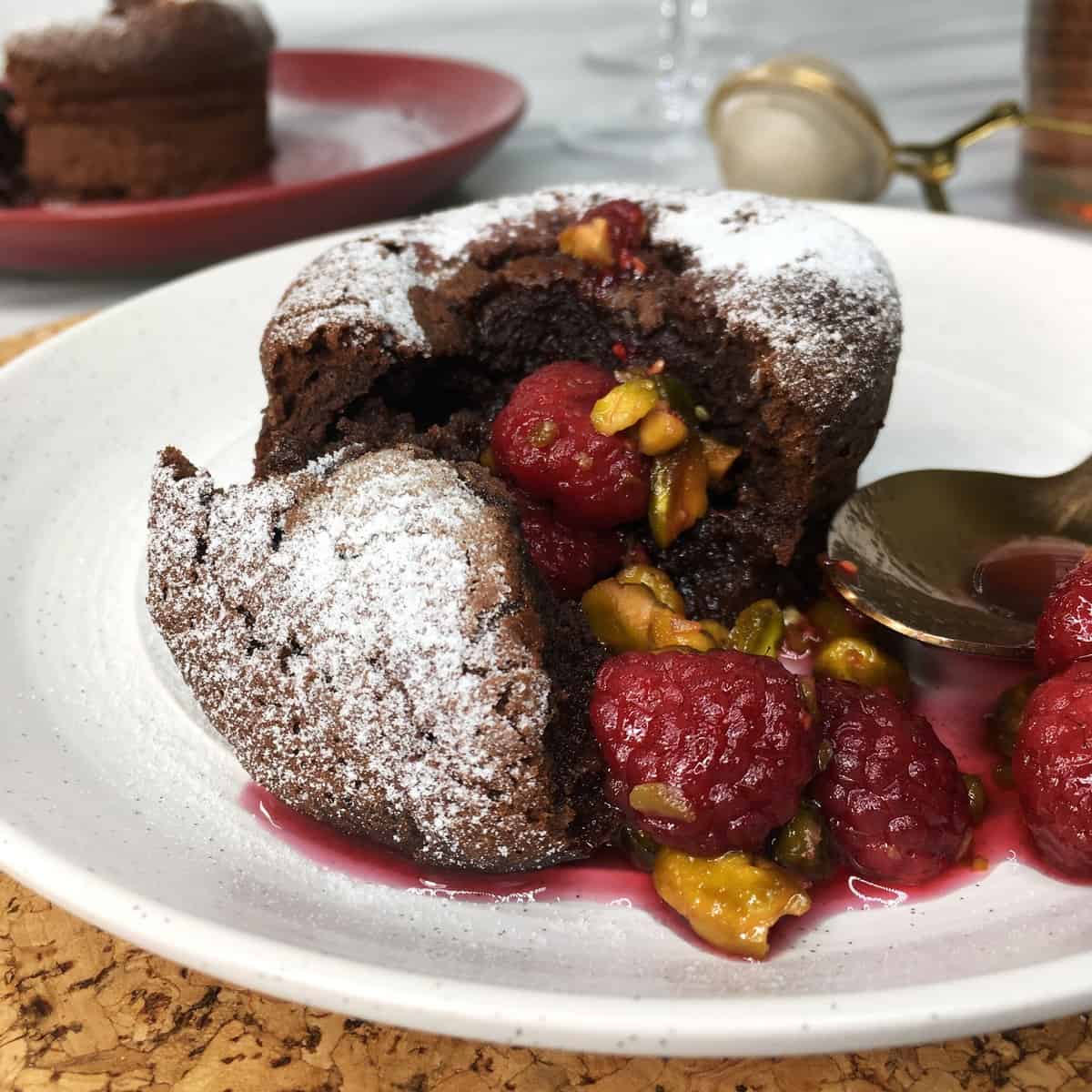
Nutella Swiss Roll Cake (Nutella Roulade)

Nov 24, 2018 · 42 Comments

Slices of Nutella Swiss roll on a wooden board lined with parchment.

Quick Summary: Nutella Swiss roll (also called Nutella roulade or Nutella roll cake) is a light chiffon sponge baked in a jelly roll pan, cooled, spread with a thin layer of Nutella, and rolled into a spiral. You bake the sponge at 355°F (180°C), roll it while warm, chill it briefly to set the shape, then slice. It takes about 45 minutes plus chilling and serves 8.

Slices of Nutella Swiss roll on a wooden board lined with parchment.

What is Nutella Swiss roll?

Nutella Swiss roll is a vanilla or chocolate sponge cake rolled and filled with chocolate Nutella. It is made with pure Nutella but can also feature Nutella-based creams and chopped hazelnuts.

Nutella is a world-renowned chocolate spread that has been known since 1964. Its lovers live in 160 countries, but the French seem to consume the most Nutella.

And how many Nutella desserts have been created over the last few decades: cookies with Nutella filling, banana Nutella crepes, bars, doughnuts, etc.?

Nutella-based cakes include layered cakes, cheesecakes, cake squares, and roll cakes. But what is the easiest Nutella dessert, then? The answer is this chocolate Nutella cake roll.

Why you'll love this recipe

  • Just a handful of ingredients: a simple chiffon sponge and a jar of Nutella are all you need for the filling.
  • Quick to make: the cake bakes in about 20 minutes, and the whole roll comes together in roughly 45 minutes plus a short chill.
  • Light and moist: the chiffon method keeps the sponge soft and flexible, so it rolls without cracking.
  • Fully customizable: swap Nutella for another spread, or add whipped cream, sprinkles, or fresh fruit.
  • A crowd-pleaser: the chocolate-hazelnut spiral looks impressive yet is easy enough for beginners.

Ingredients

For ingredients and detailed instructions, refer to the recipe card below.

  • Eggs: The recipe calls for separated egg whites and yolks. Use an egg separator to separate the chilled eggs. Bring the yolks to room temperature and refrigerate the egg whites until ready to use.
  • Sugar: Use granulated and caster sugar to make the cake batter.
  • Salt: A pinch brings out the cake's flavors.
  • Vanilla extract: Use a high-quality vanilla extract for a rich flavor, or replace it with vanilla bean paste in a 1:1 ratio.
  • Oil: Opt for neutral oil such as grapeseed or vegetable oil. Avoid olive, peanut, and other flavorful fats.
  • Milk: Use whole milk at room temperature.
  • Flour: The recipe calls for cake flour: store-bought or homemade. To make it, remove 2 tablespoons of all-purpose flour from 1 cup and replace it with 2 tablespoons of cornstarch. Alternatively, mix 15 grams of cornstarch with 110 grams of all-purpose flour (aka plain flour).
  • Baking powder helps the chiffon cake roll rise.
  • Cocoa powder: Use unsweetened cocoa powder to make chocolate cake batter.
  • Nutella hazelnut spread: Use store-bought Nutella, homemade, or another chocolate spread of your choice.

Equipment

  • 15 x 10-inch (25 x 38 cm) jelly roll pan (a light-colored rimmed baking sheet)
  • Parchment paper for lining the pan and rolling the cake
  • An electric hand mixer for whipping the meringue
  • Flour sifter for the dry ingredients
  • Silicone spatula for folding the batter
  • Piping bag for the zig-zag light-colored batter (optional)
Two slices of Nutella cake roll on a dessert plate.

How to make Nutella Swiss roll

Step 1. Prepare a classic jelly roll pan, a light-colored 15 x 10 inches (25 x 38 cm) rimmed baking sheet. Line it with parchment paper using this tutorial on lining a Swiss roll tin. For easy cake removal, extend the baking paper at least 1 inch (2.5 cm) beyond the edges of the pan.

Step 2. To make the cake batter, separate the egg whites from the egg yolks with an egg separator. Chill the egg whites until ready to use. Make sure the egg yolks are at room temperature.

Step 3. Preheat the oven to 355°F (180°C). Using a flour sifter, sift all-purpose flour, cornstarch, and baking powder into a large bowl, then set aside.

Step 4. In a mixing bowl, whisk egg yolks, 1 ½ tablespoons (20 g) of sugar, and salt a few times with a hand whisk (photo 1). But avoid whisking until the mixture becomes whitish.

Step 5. Add oil to the egg yolk mixture and mix. Pour milk and whisk until combined. Sift the flour mixture over the bowl and gently mix with a hand whisk.

Step 6. Make the meringue in a separate clean bowl. Whisk chilled egg whites with an electric hand mixer until foamy.

Step 7. Gradually add the sugar to the beaten egg whites in three additions. Beat the meringue until soft peaks (photo 2), but avoid stiff peaks.

Egg yolk mixture with a spatula in a bowl.

PHOTO 1

Beaten egg whites with mixer beaters in a bowl.

PHOTO 2

Step 8. Mix the egg yolk mixture once, and add one-third of the meringue. Gently mix with a rubber spatula. Repeat with another third of the meringue. Finally, add the mixture to the remaining meringue and carefully fold (photo 3).

Step 9. To make a chocolate batter, transfer 2 cups (218 g) of the cake batter to a medium bowl. In a small separate bowl, whisk cocoa powder into room-temperature milk.

Step 10. Add two spoonfuls of the batter to the cocoa powder mixture and mix with a spatula. Pour it back into the light-colored batter and gently mix (photo 4).

Cake batter with a spatula in a bowl.

PHOTO 3

Chocolate cake batter in a bowl.

PHOTO 4

Step 11. Pour the chocolate batter into the prepared jelly roll pan and spread it into an even layer with a long spatula or a dough scraper (photo 5). Gently tap the pan on the table to remove air bubbles.

Step 12. Transfer the light-colored cake batter to a piping bag and cut the end to about 12 mm in diameter. Hold the bag at an angle to prevent any batter from leaking.

Step 13. Squeeze the batter in a zig-zag pattern over the chocolate batter layer, going from one long side of the pan to the other (photo 6). Smooth the batter with a dough scraper.

Chocolate cake batter in a baking tray lined with parchment.

PHOTO 5

White cake batter over chocolate batter in a baking tray.

PHOTO 6

Step 14. Bring the baking tray to the center of the oven and lower the temperature to 340°F (170°C). Bake for 20-23 minutes until golden brown (photo 7). Check for doneness with a toothpick: the cake is done if it comes out dry.

Step 15. Prepare a long sheet of parchment paper and lightly grease it with neutral oil. Remove the pan from the oven and lightly tap it on the table to prevent shrinkage.

Step 16. Immediately turn it over onto the oiled parchment paper. Peel off the bottom layer of parchment paper.

Step 17. Using a long serrated knife, cut the edges of the cake on both long sides. Cut both short sides diagonally about ½ inch (1.5 cm) from the cake (photo 8). Allow the cake to cool to room temperature.

Baked cake in a Swiss roll tin.

PHOTO 7

Cake with a cut angle on the shorter side.

PHOTO 8

Step 18. To assemble the cake roll, spread a thin layer of Nutella onto the cake, including the angled cut. Leave the opposite-angle cut empty (photo 9).

Pro tip: For easy spreading Nutella, warm it up in the microwave for 20-30 seconds.

Step 19. Use the parchment paper to start rolling the cake from the short end, covered with Nutella. Make the cake's core, then lift the paper and continue rolling. Finish with the cake seam side down.

Step 20. Tighten the roll with a metal baking sheet, a long offset spatula, or a ruler: watch a video on how to wrap a cake roll tightly.

Step 21. Cover the rolled cake in parchment paper, with the roll's edge at the bottom (photo 10). Wrap the cake ends with parchment like candy.

Cake with Nutella on top.

PHOTO 9

Nutella cake rolled in parchment paper.

PHOTO 10

Step 22. Refrigerate for 1-2 hours. Gently remove the paper from the cake. Using a sharp, warm knife, make a clean cut at both ends of the roll. Transfer it to a serving tray.

To serve, sprinkle with a little powdered sugar if desired.

Nutella roll cake with a slice on a serving board.

Expert tips

  • To get a neatly rolled cake, squeeze it as tightly as possible.
  • For the best results, after rolling the cake, wrap it tightly in parchment paper and refrigerate for 1 to 2 hours.
  • Decorate the top of the cake in the way you desire.
  • Warm up the knife and wipe it with a cloth or paper towel while cutting the cake to make the slices neat.

Recipe variations

  • Filling: Use Nutella or another chocolate spread from your favorite brand. To make your roll cake more exciting, try different toppings, for example, sweetened whipped cream, maple cream cheese filling, or buttercream.
  • Decoration: Cover the roll with more Nutella and spoon it out with the back of a tablespoon. Decorate your cake roll with dark chocolate crisps, chocolate shavings, nougatine pieces, various sprinkles, fresh strawberries, or other fruit.

Storing & freezing

Store Nutella Swiss roll in an airtight container in the refrigerator for up to 2 days.

Can you freeze the Nutella Swiss roll? Freezing Nutella roll is theoretically possible, but let's find out. The chiffon cake roll freezes well, and Nutella freezes well as a spread. But freezing a Nutella-filled roll cake seems more complicated.

When thawing, Nutella's texture changes considerably. The nut oils tend to separate from the chocolate solids, making the spread watery. It will result in a soggy pastry.

The solution is to make a Swiss roll with Nutella up to 2 days in advance, but without freezing.

Recipe FAQ

What is the difference between a Nutella Swiss roll and a Nutella roulade?
They are the same cake. Swiss roll and roulade are two names for a thin sponge that is spread with filling and rolled into a spiral. This one is filled with Nutella.

Why does my Nutella roll cake crack when rolling?
Cracking usually happens when the sponge is overbaked or rolled too late. Roll the cake while it is still warm and flexible, and do not bake past the point where a toothpick comes out dry.

Can you make Nutella roll cake ahead of time?
Yes. You can make this Nutella Swiss roll up to 2 days in advance and keep it in an airtight container in the refrigerator.

Can you freeze a Nutella Swiss roll?
It is not recommended. The sponge freezes well, but Nutella's texture changes when thawed, the oils separate, and the filling turns watery, leaving a soggy roll.

Can you use a different filling instead of Nutella?
Yes. Swap Nutella for another chocolate spread, sweetened whipped cream, cream cheese filling, or buttercream to make your own version.

Should Nutella be refrigerated after opening?
No. There is no need to refrigerate Nutella after opening, as refrigeration makes it hard and difficult to spread.

Love cake rolls? Try these next!

  • Vanilla Swiss roll
  • Coffee Swiss roll
  • Pavlova roll cake
  • Pistachio roulade
  • Or browse all the cake recipes

Want more delicious and beautiful recipes? Subscribe to my newsletter and follow me on Facebook, Pinterest, and Instagram for my latest updates. If you make this recipe, please leave a star rating on the recipe card and comment below!

Print

Recipe card

Nutella Swiss Roll (Nutella Roulade)

Slices of Nutella Swiss roll on a wooden board lined with parchment.
Print Recipe
Save Recipe Recipe Saved

5 Stars 4 Stars 3 Stars 2 Stars 1 Star

5 from 20 reviews

Nutella Swiss roll, or Nutella roulade, is an easy cake roll filled with chocolate Nutella and is fully customizable. Perfect for birthdays and other celebrations.

  • Author: Irina Totterman
  • Prep Time: 25 minutes
  • Cook Time: 20 minutes
  • Total Time: 45 minutes
  • Yield: 8 1x
  • Category: Cakes
  • Method: Baking
  • Cuisine: American

Ingredients

Scale

For the light-colored cake batter:

  • 5 large egg yolks, room temperature
  • 1 ½ tablespoons (20 g) granulated sugar
  • 1 pinch of salt
  • 1 ¼ teaspoons (5 g) vanilla extract
  • 3 tablespoons (40 g) grapeseed oil (or vegetable oil)
  • ¼ cup (60 g) whole milk, room temperature
  • 1 cup minus 2 ½ tablespoons (85 g) cake flour
  • ½ teaspoon baking powder

For the meringue:

  • 5 large egg whites, room temperature
  • 1 cup minus 2 ½ teaspoons (90 g) caster sugar

For the chocolate cake batter:

  • 1 tablespoon (7 g) unsweetened cocoa powder
  • 1 tablespoon (15 g) whole milk, room temperature

For the filling: 

  •  6.4 oz. (180 g) Nutella hazelnut spread

*Don't you have the correct baking pan on hand right now? Try this simple Cake Pan Converter!

** If needed, please refer to Baking Conversion Charts.

Instructions

  1. Prepare a classic jelly roll pan, a light-colored 15 x 10 inches (25 x 38 cm) rimmed baking sheet. Line it with parchment paper using this tutorial on how to line a Swiss roll tin. Extend the baking paper for at least 1 inch (2.5 cm) beyond the pan's edges for easy cake removal.
  2. To make the cake batter, separate the egg whites from the egg yolks with an egg separator. Chill the egg whites until ready to use. Make sure the egg yolks are at room temperature.
  3. Preheat the oven to 355°F (180°C). Using a flour sifter, sift all-purpose flour, cornstarch, and baking powder into a large bowl, then set aside.
  4. In a mixing bowl, whisk egg yolks, 1 ½ tablespoons (20 g) of sugar, and salt a few times with a hand whisk (do not whisk until the mixture becomes whitish).
  5. Add oil to the egg yolk mixture and mix. Pour milk and whisk until combined. Sift the flour mixture over the bowl and gently mix with a hand whisk.
  6. In a separate clean bowl, make the meringue. Whisk chilled egg whites with an electric hand mixer until foamy. Gradually add the sugar to the beaten egg whites in three additions. Beat the meringue until soft peaks, but avoid stiff peaks.
  7. Mix the egg yolk mixture once, and add one-third of the meringue. Gently mix with a rubber spatula. Repeat with another third of the meringue. Finally, add the mixture to the remaining meringue and carefully fold.
  8. To make a chocolate batter, transfer 2 cups (218 g) of the cake batter to a medium bowl. In a small separate bowl, whisk cocoa powder into room-temperature milk.
  9. Add two spoonfuls of the batter to the cocoa powder mixture and mix with a spatula. Pour it back into the light-colored batter and gently mix.
  10. Pour the chocolate batter into the prepared jelly roll pan and spread it into an even layer with a long spatula or a dough scraper. Gently tap the pan on the table to remove air bubbles.
  11. Transfer the light-colored cake batter to a piping bag and cut the end to about 12 mm in diameter. Hold the bag at an angle to prevent any batter from leaking.
  12. Squeeze the batter in a zig-zag pattern over the chocolate batter layer, going from one long side of the pan to the other. Smooth the batter with a dough scraper.
  13. Bring the baking tray to the center of the oven and lower the temperature to 340°F (170°C). Bake for 20-23 minutes until golden brown. Check for doneness with a toothpick: if it comes out dry, the cake is done.
  14. Prepare a long sheet of parchment paper and lightly grease it with neutral oil. Remove the pan from the oven and lightly tap it on the table to prevent shrinkage.
  15. Immediately turn it over onto the oiled parchment paper. Peel off the bottom layer of parchment paper.
  16. Using a long serrated knife, cut the edges of the cake on both long sides. Cut both short sides diagonally about ½ inch (1.5 cm) from the cake. Allow the cake to cool to room temperature.
  17. To assemble the cake roll, spread a thin layer of Nutella onto the cake, including the angled cut. For easy spreading, warm Nutella in the microwave for 20-30 seconds. Leave the opposite-angle cut empty. 
  18. Use the parchment paper to start rolling the cake from the short end, covered with Nutella. Make the cake's core, then lift the paper and continue rolling. Finish with the cake seam side down.
  19. Tighten the roll with a metal baking sheet, a long offset spatula, or a ruler: watch a video on how to tightly wrap a cake roll.
  20. Cover the rolled cake in parchment paper with the roll's edge at the bottom. Wrap the cake ends with parchment like candy.
  21. Refrigerate for 1-2 hours. Gently remove the paper from the cake. Make a clean cut at both ends of the roll using a sharp, warm knife. Transfer it to a serving tray. Sprinkle with a little powdered sugar if desired.

Notes

  1. To get a neatly rolled cake, squeeze it as tightly as possible.
  2. For the best results, after rolling the cake, wrap it tightly in parchment paper and refrigerate for 1 to 2 hours.
  3. Decorate the top of the cake in the way you desire.
  4. Warm up the knife and wipe it with a cloth or paper towel while cutting the cake to make the slices neat. 

Nutrition

  • Serving Size: 1 slice
  • Calories: 306
  • Sugar: 26.4 g
  • Sodium: 68 mg
  • Fat: 15.5 g
  • Saturated Fat: 8.7 g
  • Carbohydrates: 36.1 g
  • Fiber: 2 g
  • Protein: 6.6 g
  • Cholesterol: 120 mg

Thank you for following me on Pinterest, Facebook, and Instagram. Hashtag #bakinglikeachef so I can see your creations.

The nutritional information has been calculated using an online recipe nutrition calculator such as Verywellfit.com and is intended for informational purposes only. These figures should be used as a general guideline and not be construed as a guarantee.

The recipe was originally published on November 24, 2018. It has been updated and may differ from the original publication.

Ottolenghi Louise Cake With Plum And Coconut

Sep 6, 2018 · 33 Comments

Louise cake on a cake stand.

Quick Summary: Ottolenghi Louise cake with plum and coconut is a New Zealand-inspired layer bake with a coconut biscuit base, a layer of fresh red plums, and a crisp almond meringue topping. You cream the biscuit batter and bake it, arrange plum segments on top, cover with almond meringue, and bake again at 355°F (180°C) until the meringue turns golden. It takes about 2 hours total and serves 10.

Louise cake on a cake stand.

What is Louise cake?

Louise cake, or Louise slice, is a popular New Zealand cake made with raspberry or plum jam and a thin layer of coconut meringue topping. The cake was named after Queen Victoria's daughter, Princess Louise of England, and brought to New Zealand by British settlers.

Is Louise cake the same as Louise slice? They are the same, baked under two names, and ranked sixth in the "Top 10 favorite Kiwi recipes."

In New Zealand, it is traditionally cut into squares and served as a slice, while a round, layered version like this one is called a cake. Either way, the base, jam or fruit, and coconut meringue stay the same.

This Helen Goh and Ottolenghi version swaps the usual raspberry jam for fresh plums and adds toasted almonds to the meringue.

Why you'll love this recipe

  • Three textures in one slice: a tender coconut biscuit, juicy roasted plums, and a crisp almond meringue.
  • A famous Ottolenghi recipe: this Helen Goh and Yotam Ottolenghi cake puts an elegant spin on the classic New Zealand Louise slice.
  • Straightforward to make: there is no resting or chilling between steps, so the cake comes together in one session.
  • Made for celebrations: it is elegant enough for birthdays and special occasions, yet simple enough for a weekend bake.
  • Flexible with fruit: swap red plums for apricots, peaches, nectarines, or cherries, or use jam to bake it year-round.

Ingredients

Louise cake ingredients.

For ingredients and detailed instructions, refer to the recipe card below.

  • Butter: I always choose European-style unsalted butter. Bring it to the kitchen counter to soften for an hour before you start.
  • Sugar: Use granulated sugar or replace it with caster sugar.
  • Lemon zest: Opt for organic, untreated lemon and zest it with a Microplane.
  • Eggs: Use large eggs at room temperature. Use an egg separator to separate the egg whites from the yolk.
  • Flour: The recipe calls for all-purpose flour, the same as plain flour.
  • Baking powder: Use fresh aluminum-free baking powder.
  • Salt brings out the dessert's flavors.
  • Shredded coconut adds texture and flavor to the cake. If desired, you can replace it with desiccated coconut.
  • Milk: I prefer whole milk, but you can also use low-fat milk.
  • Vanilla extract: Choose the most flavorful Madagascar Bourbon pure vanilla extract, or use an alcohol-free vanilla flavor.
  • Red plums: Use seasonal, dark red plums that are ripe but not too soft. Replace fresh plums with the best stone fruits, such as apricots, peaches, nectarines, or cherries. However, avoid fresh berries such as strawberries, raspberries, and blackberries since they are too watery for this cake.
  • Almonds: Use store-bought toasted flaked or sliced almonds or toast nuts in the oven at 300°F (150°C) for 10 to 15 minutes.
  • White wine vinegar and cornflour make a stable meringue.

Equipment

  • 9-inch (23 cm) springform pan with a removable base for easy unmolding
  • Stand mixer with paddle and whisk attachments (or a hand mixer)
  • Flour sifter for the dry ingredients
  • Microplane or fine zester for the lemon zest
  • Silicone spatula for folding and swirling the meringue
  • Skewer or thin knife to test the biscuit for doneness
A single slice of Louise cake on a cake board.

How to make Louise cake step-by-step

Step 1. Preheat the oven to 365°F (185°C). Butter and line the bottom and sides of a round 9-inch (23 cm) springform pan (with a removable base) with parchment paper.

Step 2. In a large bowl, sift the flour, baking powder, and salt, then set aside. In a small, separate bowl, mix the vanilla extract with milk.

Butter mixture in a bowl.

Step 3. To make the biscuit, place softened butter, sugar, and lemon zest in the bowl of a stand mixer fitted with a paddle attachment. Cream butter and sugar at medium-high speed until smooth and homogeneous.

Cake batter in a bowl.

Step 4. Add large egg yolks, one at a time, and mix until combined. Add shredded coconut and mix well. Lower the mixer speed and gradually add the dry ingredients to the main mixture, alternating with the milk and vanilla mixture.

Cake batter in a baking mold.

Step 5. Pour the cake batter into the prepared tin and smooth the top with a rubber spoon.

Baked biscuit in a mold.

Step 6. Bake the cake for 25 minutes. Check for doneness with a skewer or knife blade: the cake base is ready if the skewer or knife blade inserted into the center comes out clean. Let the biscuit cool in a pan.

Step 7. Wash and dry plums. Cut each plum vertically in half and remove the stones. Slice each half into four parts, eight segments per plum and 40 segments in total.

Step 8. Increase the oven heat to 390°F (200°C).

Plum slices over the cake base in a mold.

Step 9. Arrange plum segments on the biscuit base with the cut side down in a circular pattern. Don't overlap the fruit; otherwise, it will make the cake's buttery base watery.

Meringue with flaked almonds in a bowl.

Step 10. To make the meringue, use a stand mixer with a whisk attachment to beat the egg whites and salt at medium-high speed until soft peaks form. Gradually add the sugar and whisk on high speed until stiff peaks form, and the meringue becomes glossy. Add vanilla extract, vinegar, and cornflour to the meringue mixture and whisk again. Finally, add toasted flaked almonds and gently mix with a silicone spatula.

Meringue on top of the cake in a mold.

Step 11. Spoon the meringue over the plums. Use a spatula to swirl the meringue to get rough waves, curls, and peaks.

Baked cake in a mold.

Step 12. Bring the cake to the middle rack of the oven. Immediately reduce the oven temperature to 355°F (180°C) and bake for 35 minutes, until the meringue forms a slightly golden brown crust.

Step 13. Remove the cake from the oven and let it cool, still in the cake pan, for at least 30 minutes.

Step 14. Unmold the cake and peel off the paper from the sides. Let the cake cool down completely before serving.

Sliced Louise cake on a serving board.

Expert tips

  1. For the best results, use a springform cake tin with a removable bottom to make cake removal easier. Alternatively, use an adjustable cake ring.
  2. If you use small plums, cherries, or other smaller stone fruit, quarter each fruit.
  3. Watch out for the color of the meringue crust while baking.

Recipe variations

  • Biscuit: To make a chocolate-coconut biscuit, replace 2 ½ tablespoons (20 g) of all-purpose flour with the same amount of cocoa powder.
  • Fruits: Use frozen or fresh unpitted fruits. Or choose raspberry jam filling instead of fruit to make the cake year-round.
  • Flavorings: Switch flaked almonds for shredded coconut while making the meringue topping.

Storing & freezing

Store the Louise cake in an airtight container in the refrigerator for 3 to 5 days. However, the meringue top may start softening after the first day.

Can you freeze Louise cake? You can freeze the Louise cake for up to one month, but the meringue layer on top will lose its texture.

Recipe FAQ

What is Ottolenghi Louise cake?
It is Yotam Ottolenghi and Helen Goh's take on the classic New Zealand Louise slice, made with a coconut biscuit base, fresh plums, and an almond meringue topping instead of the traditional raspberry jam and plain coconut meringue.

Who is Louise cake named after?
Louise cake was named after Princess Louise, one of Queen Victoria's daughters, and the recipe was brought to New Zealand by British settlers.

Can you use jam instead of fresh plums?
Yes. Swap the fresh plums for raspberry or plum jam to make this Louise cake all year round when stone fruit is out of season.

What plums are best for Louise cake?
Use seasonal dark red plums that are ripe but still firm. You can also use apricots, peaches, nectarines, or cherries, but avoid watery berries like strawberries and raspberries.

Can you make Louise cake in advance?
Yes. Store it in an airtight container in the refrigerator for 3 to 5 days, though the meringue top softens after the first day, so it is best enjoyed fresh.

Can you omit coconut in the recipe?
Yes, omit the coconut if you are not a fan; the biscuit base will still hold together.

Can you make this cake gluten-free?
Yes. Substitute the all-purpose flour with a 1:1 gluten-free flour blend to make a gluten-free Louise cake.

Love plum desserts? Try these next!

  • Fresh Fruit Cake
  • Plum Frangipane Tart
  • Spiced Plum Pavlova
  • Or browse all the cake recipes

Want more delicious and beautiful recipes? Subscribe to my newsletter and follow me on Facebook, Pinterest, and Instagram for my latest updates. If you make this recipe, please leave a star rating on the recipe card and comment below!

Print

Recipe card

Louise Cake With Plum And Coconut

Louise cake on a cake stand.
Print Recipe
Save Recipe Recipe Saved

5 Stars 4 Stars 3 Stars 2 Stars 1 Star

4.8 from 13 reviews

Ottolenghi Louise cake with plum and coconut is a twist on the New Zealand Louise slice, made with a coconut biscuit base, juicy red plums, and an almond meringue topping. It is easy to make and perfect for birthdays and special occasions.

  • Author: Irina Totterman
  • Prep Time: 1 hour
  • Cook Time: 1 hour
  • Total Time: 2 hours
  • Yield: 10 1x
  • Category: Cakes
  • Method: Baking
  • Cuisine: New Zealand

Ingredients

Scale

For the cake:

  • 4.4 oz (125 g) softened unsalted butter
  • â…“ cup + 2 tablespoons (100 g) granulated sugar
  • 1 teaspoon lemon zest
  • 3 large egg yolks, room temperature
  • 1 cup (125 g) all-purpose flour
  • 1 ½ teaspoons baking powder
  • 1 pinch of salt
  • 3 ½ tablespoons (20 g) shredded coconut
  • â…“ cup (80 ml) whole milk, room temperature
  • 1 teaspoon vanilla extract
  • 5-6 medium red plums

For the meringue:

  • 2.8 oz (80 g) toasted flaked almonds
  • â…” cup + 1 tablespoon (180 g) egg whites, room temperature (see note #1)
  • 1 pinch of salt
  • 1 cup + 1 ½ tablespoons (245 g) granulated sugar
  • 1 teaspoon vanilla extract
  • 1 â…“ teaspoons white wine vinegar
  • 1 â…“ teaspoons cornflour

*Don't you have the correct baking pan on hand right now? Try this simple Cake Pan Converter!

** If needed, please refer to Baking Conversion Charts.

Instructions

  1. Preheat the oven to 365°F (185°C). Butter and line the bottom and sides of a 9-inch (23 cm) round springform pan with parchment paper.
  2. In a large bowl, sift the flour, baking powder, and salt, then set aside. In a small, separate bowl, whisk together the vanilla extract and milk. 
  3. To make the biscuit, place softened butter, sugar, and lemon zest in the bowl of a stand mixer. Beat at medium-high speed until the sugar and butter mixture is smooth.
  4. Add egg yolks, one at a time, and mix until combined. Add shredded coconut and mix well. Lower the mixer speed and gradually add the dry ingredients to the principal preparation, alternating with the milk and vanilla mixture.
  5. Pour the cake batter into the prepared cake pan and smooth the top with a spoon. Bake for 25 minutes. Check for doneness with a skewer or knife blade: the cake is ready if the skewer or the knife blade inserted into the center comes out clean. Let the cake cool in the pan.
  6. Wash and dry plums. Divide each plum vertically into halves. Discard stones and then slice plum halves into four parts. You will get 8 segments per plum, for a total of 40. 
  7. Increase oven heat to 390°F (200°C). Arrange plum pieces on top of the biscuit, close together, cut side down. Don't overlap the fruit; otherwise, the middle layer of the cake will become watery.
  8. To make the meringue, whisk the egg whites and salt on medium-high speed for one minute, until soft peaks form. Gradually add the sugar, whisking at high speed until the meringue becomes stiff and glossy.
  9. Add vanilla, vinegar, and cornflour and whisk again. Add toasted flaked almonds and gently mix with a rubber spatula.
  10. Distribute the meringue over the plums. Use a spatula to swirl the meringue to get rough waves, curls, and peaks.
  11. Bring the cake to the oven. Immediately lower the oven temperature to 355°F (180°C) and bake for 35 minutes until the meringue gets a slightly brown, hard crust.
  12. Remove the cake from the oven and let it cool, still in the cake pan, for at least 30 minutes. Unmold the cake and peel off the paper from the sides. Let the cake cool down completely before slicing.

Notes

  1. 180 g egg whites are approximately equal to 3 ½ whole large chicken eggs (eggshell removed).
  2. For the best results, use a springform pan with a removable bottom to make removing the baked cake easier. Or use an adjustable cake ring.
  3. Watch out for the color of the meringue crust while baking. 

Nutrition

  • Serving Size: 1 slice
  • Calories: 374
  • Sugar: 39.1 g
  • Sodium: 157 mg
  • Fat: 17.2 g
  • Saturated Fat: 8 g
  • Carbohydrates: 51.2 g
  • Fiber: 1.7 g
  • Protein: 6.8 g
  • Cholesterol: 91 mg

Thank you for following me on Pinterest, Facebook, and Instagram. Hashtag #bakinglikeachef so I can see your creations.

The nutritional information has been calculated using an online recipe nutrition calculator such as Verywellfit.com and is intended for informational purposes only. These figures should be used as a general guideline and not be construed as a guarantee.

The recipe was adapted from Ottolenghi. It was originally published on September 06, 2018. The recipe has been revised to include improved content and photos.
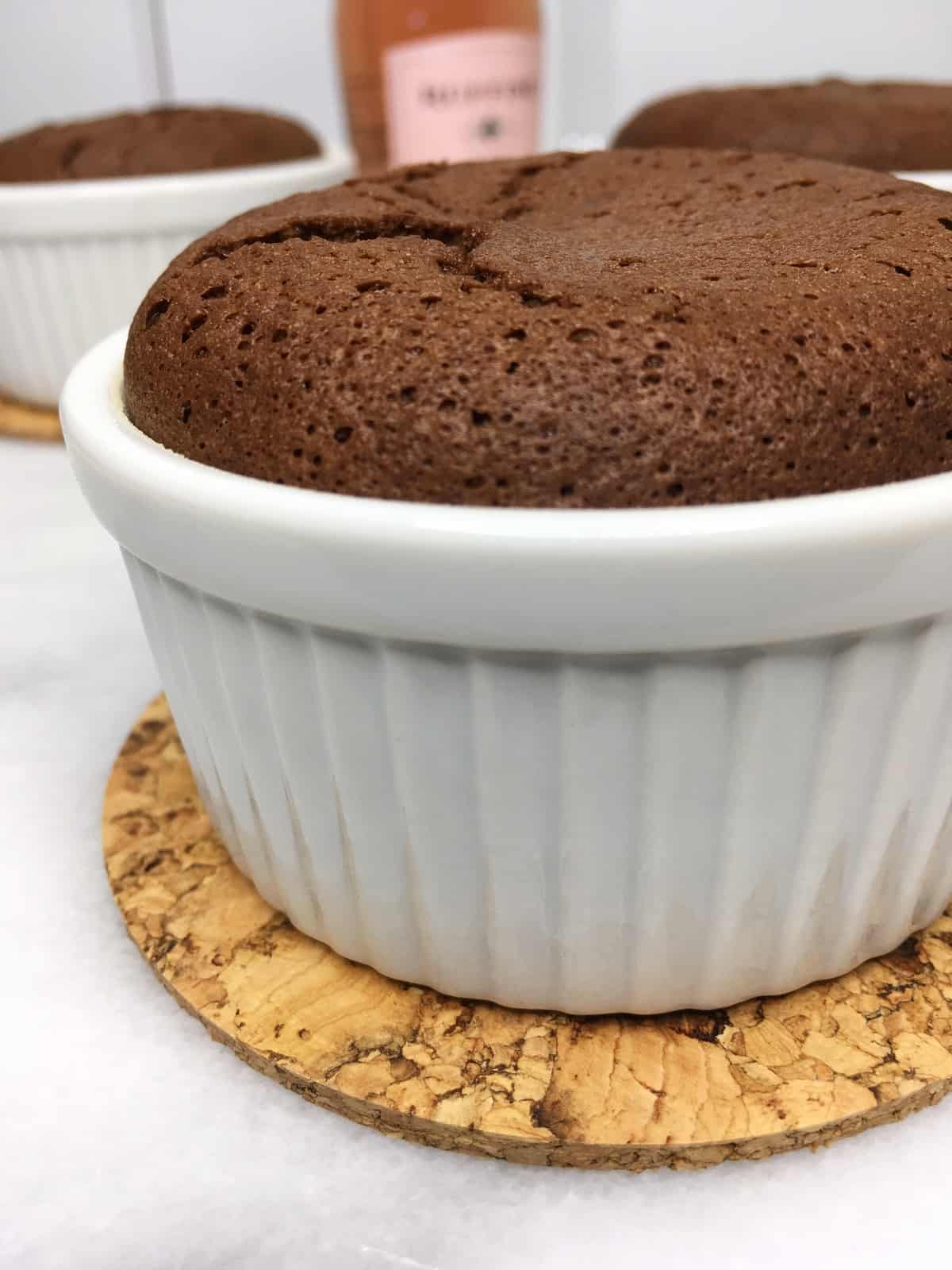
Maraschino Cherry Cake (Easy One-Layer Recipe)

Jul 30, 2018 · 30 Comments

Maraschino cherry cake on a serving plate.

Quick Summary: Maraschino cherry cake is a simple one-layer almond cake studded with sweet maraschino cherries and finished with crushed yogurt-covered almonds and cherries on top. It bakes low and slow, travels well, and needs no frosting.

Maraschino cherry cake on a serving plate.

What is a maraschino cherry cake?

A maraschino cherry cake is a French-style travel cake, meaning a sturdy loaf-type cake that keeps well at room temperature and holds up to transport. While many popular versions rely on a boxed cake mix, this one is made from scratch with an almond batter, so you control the ingredients and get a fresher, more tender crumb. The sweet maraschino cherries and yogurt-covered almonds on top do the rest.

The first idea for making Maraschino cherry cake came up when I saw that cake on Nicolas Bernardé's site. I could not resist trying it. I altered the chef's recipe in several ways.

First, he uses cherries in alcohol to fold into the cake batter, but I replaced them with canned maraschino cherries to make the cake kid-friendly. I replaced clarified butter with grapeseed oil and trimoline (inverted sugar syrup) with honey.

Moreover, I replaced hard Jordan almonds (dragees) with yogurt-covered almonds that are easy to chew. As a final touch, I decorated the cake with stemmed maraschino cherries instead of fresh ones to make the cake a year-round dessert.

Sliced Maraschino Cherry cake on a dessert plate with flatware on background

Why you'll love this recipe

  • Moist crumb: grape seed oil keeps the cake tender and moist.
  • Sweet cherry flavor: maraschino cherries fold through every slice.
  • Cherries stay put: a thick batter holds the whole cherries in place instead of letting them sink.
  • Crunchy finish: chopped yogurt-covered almonds add a sweet, crunchy topping.
  • No frosting needed: bright cherries on top make it a showstopper with zero fuss.

Ingredients

For ingredients and detailed instructions, refer to the recipe card below.

  • Flour: Use all-purpose flour, spooned and leveled, so the cake isn't dense.
  • Baking powder: Check that it is fresh so the cake rises well.
  • Granulated sugar: Use white granulated sugar to sweeten the batter.
  • Honey: Adds moisture and keeps the crumb soft. Use a mild honey so it does not overpower the cherries.
  • Eggs: Use whole large eggs at room temperature so they blend smoothly into the batter.
  • Grapeseed oil: Keeps the cake moist and tender. You can swap it for another neutral oil.
  • Salt: Just a pinch to balance the sweetness.
  • Chopped almonds: Add a nutty flavor and texture to the batter.
  • Maraschino cherries: Drain and pat dry before folding in so they don't sink.
  • Apricot jam: Brushed over the cake so the topping sticks. Warm it slightly for easy spreading.
  • Yogurt-covered almonds: Crushed for a sweet, crunchy coating in place of hard almond dragees.
  • Powdered (icing) sugar: Dusted over the top to finish.
  • Maraschino cherries with stems: Placed on top to decorate the cake.

Equipment

  • Stand mixer or hand mixer
  • Mixing bowls
  • Round cake pan (7-inch)
  • Food processor (to crush the yogurt-covered almonds)
  • Fine-mesh sieve (for dusting with powdered sugar)
  • Wire cooling rack

How to make Maraschino cherry cake

Step 1. Preheat oven to 295°F (145°C). To make the cake batter, place flour, baking powder, sugar, honey, and eggs in the bowl of a stand mixer (photo 1) and mix well. Slowly drizzle in grapeseed oil mixed with salt until emulsified (photo 2).

Photo 1: Flour, baking powder, sugar, honey and eggs in the bowl of a stand mixer Photo 2: Yellow-colored mixture in the bowl of a stand mixer
PHOTO 1 PHOTO 2

Step 2. Add chopped almonds and pitted, drained maraschino cherries (photo 3), and gently fold to keep the cherries whole. Pour the batter into a buttered and floured cake pan, 7 inches/18 cm in diameter (photo 4).

Photo 3: Cherries and chopped almonds on top of the cake preparation in the bowl of a stand mixer Photo 4: Cake batter in a cake pan
PHOTO 3 PHOTO 4

Step 3. Bake the cake for 40 minutes (photo 5). Remove the cake from the pan, flip it upside down, and let it cool (photo 6).

Photo 5: Baked cake in a pan Photo 6: Cake flipped upside down on a plate
PHOTO 5 PHOTO 6

Step 4. To decorate, crush yogurt-covered almonds in a food processor (photo 7). Cover the cake all over with the heated apricot jam.

Step 5. Generously sprinkle with crushed yogurt-covered almonds. Dust the top of the cake with powdered (icing) sugar and arrange maraschino cherries with stems (photo 8). 

Photo 7: Crushed yogurt covered almonds Photo 8: Cake sprinkled with crushed yogurt covered almonds with cherries on top and served on a plate
PHOTO 7 PHOTO 8

Expert Tips

  1. Add a few drops of almond extract to add almond flavor, or add a few drops of cherry extract to enhance the sweet cherry flavor of the cake.
  2. Replace maraschino cherries with morello cherries in brandy if you do not serve the cake to kids.
  3. Chop yogurt-covered almonds with a knife or use a food processor.
  4. In the summer, decorate the cake with fresh cherries coated with apricot jam.
  5. If you love two- or three-layer cakes, double or triple the recipe. Spread your favorite cream between layers and decorate the cake.

Recipe FAQ

What is a maraschino cherry cake?
A maraschino cherry cake is a single-layer almond cake made with sweet maraschino cherries folded into the batter and topped with crushed yogurt-covered almonds.

Can I use fresh cherries instead of maraschino cherries?
Maraschino cherries give this cake its signature sweetness and color. Fresh cherries hold more moisture and less sugar, so the flavor and texture will change if you swap them.

How do I keep maraschino cherries from sinking?
Drain and pat the cherries dry, then fold them into a thick batter. The thick batter holds the whole cherries in place as the cake bakes.

What can I use instead of almond dragees?
This recipe uses crushed yogurt-covered almonds in place of hard almond dragees for an easier, softer crunch on top.

Why is the cake baked at a low temperature?
Baking at 295°F (145°C) for 40 minutes keeps the crumb moist and prevents the top from browning too fast.

Can I make this cake ahead of time?
Yes. Bake the cake a day ahead, store it well wrapped at room temperature, and add the crushed almonds and cherries on top before serving.

How do I store maraschino cherry cake?
Keep it in an airtight container at room temperature for up to 3 days, or refrigerate to extend its shelf life.

More delicious fruit cake recipes you will love

  • Best Canned Pear Pound Cake
  • Raspberry Almond Cake Ispahan
  • German Black Forest Cake Recipe
  • Browse all the Cake Recipes

Want more delicious and beautiful recipes? Subscribe to my newsletter and follow me on Facebook, Pinterest, and Instagram for my latest updates. If you make this recipe, please leave a star rating on the recipe card and comment below!

Print

Recipe card

Maraschino Cherry Cake (Easy One-Layer Recipe)

Maraschino cherry cake on a serving plate.
Print Recipe
Save Recipe Recipe Saved

5 Stars 4 Stars 3 Stars 2 Stars 1 Star

5 from 15 reviews

This easy maraschino cherry cake is a moist one-layer almond cake studded with sweet maraschino cherries and finished with crushed yogurt-covered almonds and cherries on top.

  • Author: Irina Totterman
  • Prep Time: 10 minutes
  • Cook Time: 40 minutes
  • Total Time: 50 minutes
  • Yield: 6 1x
  • Category: Cakes
  • Method: Baking
  • Cuisine: French

Ingredients

Scale

For the cake batter:

  • â…” cup + 2 ½ teaspoons (95 g) flour
  • 1 teaspoon baking powder
  • ¼ cup + 2 teaspoons (65 g) granulated sugar
  • 1 teaspoon (8 g) honey
  • â…“ cup (80 g) eggs (see note #1)
  • â…“ cup (70 g) grapeseed oil
  • 1 pinch of salt
  • 2.5 oz (70 g) chopped almonds 
  • 2.5 oz (70 g) pitted maraschino cherries 

For the decoration:

  • 3.5 oz (100 g) apricot jam
  • 3.5 oz (100 g) yogurt covered almonds 
  • powdered (icing) sugar
  • 5 maraschino cherries with stems 

*Don't you have the correct baking pan on hand right now? Try this simple Cake Pan Converter!

** If needed, please refer to Baking Conversion Charts.

Instructions

  1. Preheat oven to 295°F (145°C). To make the cake batter, place the flour, baking powder, sugar, honey, and eggs in the bowl of a stand mixer and mix until well combined. Slowly drizzle in grapeseed oil mixed with salt until emulsified.
  2. Add chopped almonds, pitted and drained maraschino cherries (without cherry syrup), and slightly combine to keep the cherries whole. Pour the batter into a buttered and floured 7-inch (18cm) cake pan and bake for 40 minutes. Remove the cake from the pan, flip it upside down, and let it cool.
  3. To decorate, crush yogurt-covered almonds in a food processor. Cover the cake all over with the heated apricot jam. Generously sprinkle with chopped yogurt-covered almonds. Dust the top of the cake with powdered (icing) sugar and arrange maraschino cherries with stems.

Notes

  1. 80 g whole eggs are approximately equal to 1 ½ whole extra-large chicken eggs (eggshell removed).
  2. Add a few drops of almond extract to add almond flavor, or add a few drops of cherry extract to enhance the sweet cherry flavor of the cake.
  3. Replace maraschino cherries with morello cherries in brandy if you do not serve the cake to kids.
  4. Chop yogurt-covered almonds with a knife or use a food processor.
  5. In the summer, decorate the cake with fresh cherries coated with apricot jam.
  6. If you are in love with two- or three-layered cakes, double or triple the recipe. Spread your favorite cream between layers and decorate the cake.

Nutrition

  • Calories: 341
  • Sugar: 30 g
  • Sodium: 87 mg
  • Fat: 14.4 g
  • Saturated Fat: 4.6 g
  • Carbohydrates: 48.7 g
  • Fiber: 2.3 g
  • Protein: 7 g
  • Cholesterol: 50 mg

Thank you for following me on Pinterest, Facebook, and Instagram. Hashtag #bakinglikeachef so I can see your creations.

The nutritional information has been calculated using an online recipe nutrition calculator such as Verywellfit.com and is intended for informational purposes only. These figures should be used as a general guideline and not be construed as a guarantee.

The recipe was adapted from http://nicolas-bernarde.com/. It was originally published in July 2018. The recipe has been re-tested and revised to include improved content and photos.
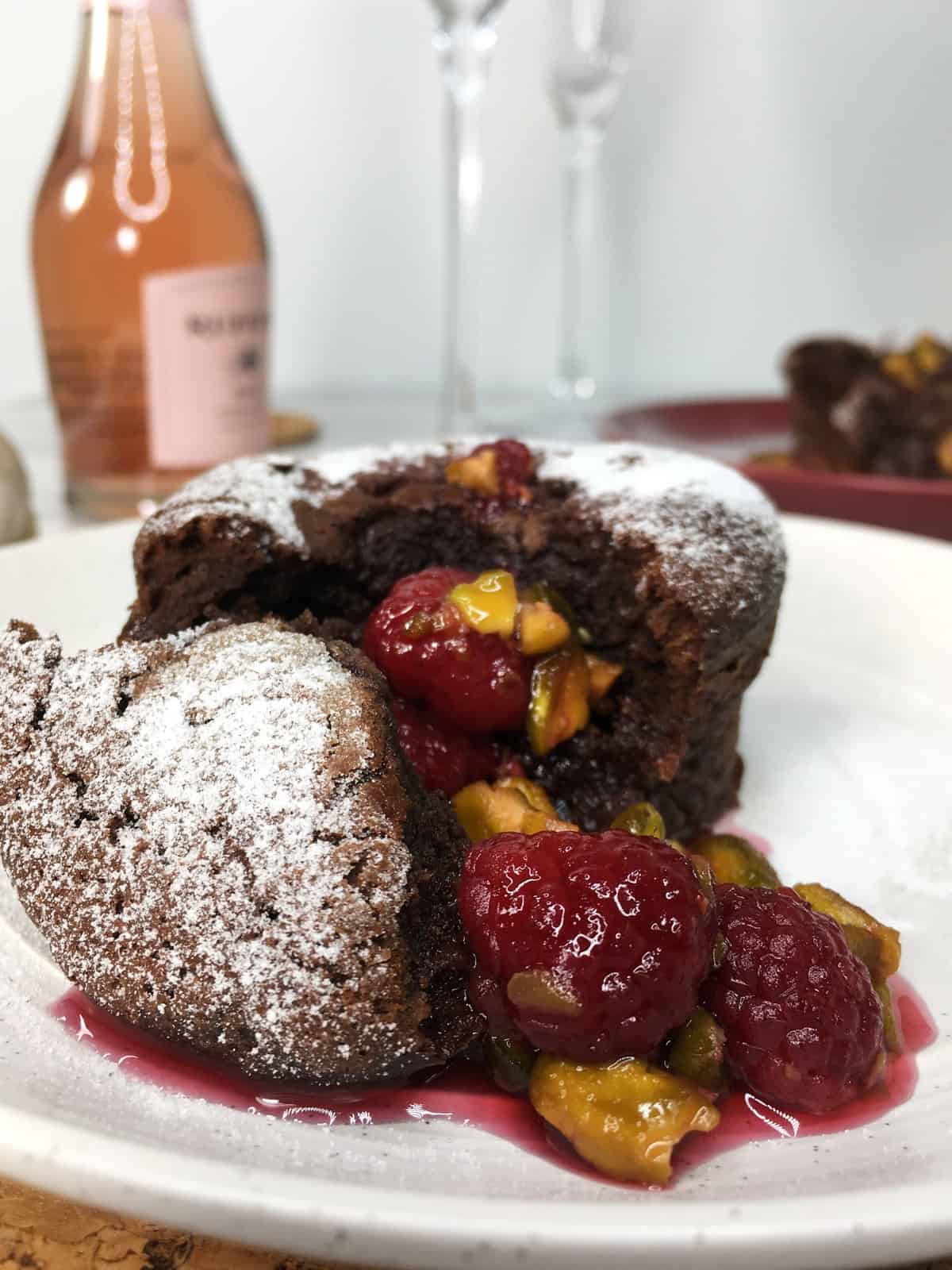
  • « Go to Previous Page
  • Page 1
  • Page 2
  • Page 3

Primary Sidebar

Personal photo of the website's author

Hi, I am Irina!

A home baker with over 30 years of experience, sharing baking recipes with step-by-step instructions, helpful tips, and tricks. Get baking, and let the fun begin!

About • Start Here • Contact

Summer Desserts

  • Fig tiramisu cups in a serving board.
    Fig Tiramisu (Easy No-Bake Dessert)
  • Louise cake on a cake stand.
    Ottolenghi Louise Cake With Plum And Coconut
  • Apple and blueberry crumble in a white ceramic dish with ice cream and two spoons.
    Apple and Blueberry Crumble Recipe (With or Without Oats)
  • Sliced JordgubbstÃ¥rta on a cake board.
    Jordgubbstårta (Swedish Strawberry Cake)

More Summer Desserts →

Readers’ Favorites

  • Sliced Sans Rival cake on a cake board.
    Sans Rival Cake (Filipino Cashew Meringue Cake)
  • A batch of baked madeleines in a baking mold.
    Classic French Madeleines Recipe (Madeleine Cookies)
  • Italian sponge cake on a marble board.
    3-Ingredient Italian Sponge Cake (Pan di Spagna)
  • Halved muffin loaded with blueberries with the rest of the cakes in the background.
    To Die For Blueberry Muffins With Crumb Topping
  • French financiers with almonds on a wooden board lined with parchment.
    Classic French Financiers (Authentic Recipe)
  • Stack of banana bread slices on a serving board.
    Banana Bread Without Baking Soda (Easy Recipe with Baking Powder)

More Cake Recipes →

Footer

Featured in banner with logos.
BAKING LIKE A CHEF

  • Home
  • About
  • Recipe Index
  • Baking 101
  • Cake Pan Converter
  • Contact
  • Log In

SOCIAL

  • Facebook
  • Pinterest
  • Instagram
  • Twitter

LEGAL

  • Privacy Policy
  • Disclaimer
  • Terms & Conditions
  • Accessibility Statement

Copyright © 2025 Baking Like a Chef • Baking Like a Chef is a participant in the Amazon Services LLC Associates Program, an affiliate advertising program designed to provide a means for sites to earn advertising fees by advertising and linking to Amazon.com. As an Amazon Associate, I earn a commission – at no cost to you –  from qualifying purchases.