
• Skip to primary navigation
  • Skip to main content
  • Skip to primary sidebar

Baking Like a Chef logo

  • ABOUT
  • RECIPES
  • CLUB
  • SHOP
menu icon
go to homepage
  • Recipes
  • Basics
  • Printables
  • Subscribe
  • About
search icon
Homepage link
  • Recipes
  • Basics
  • Printables
  • Subscribe
  • About
×

Want to learn sourdough?

START

Home » Recipe Index

5-Ingredient Oil Sponge Cake (With Olive Oil)

Apr 5, 2022 · 7 Comments

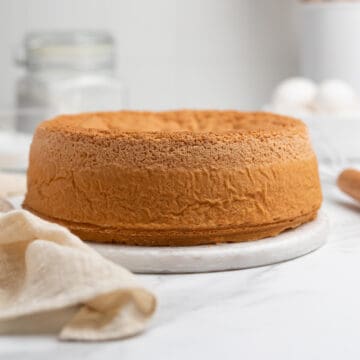
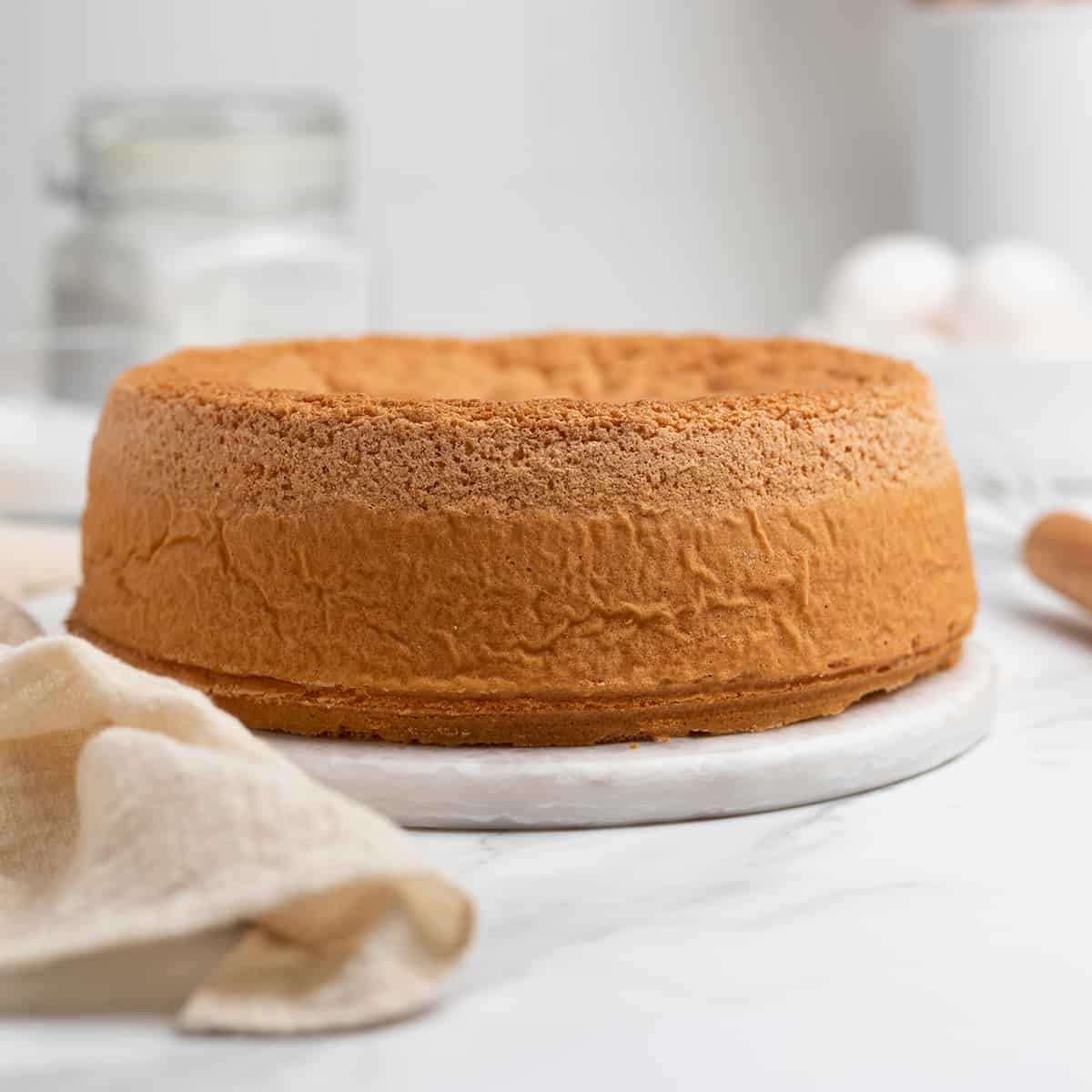
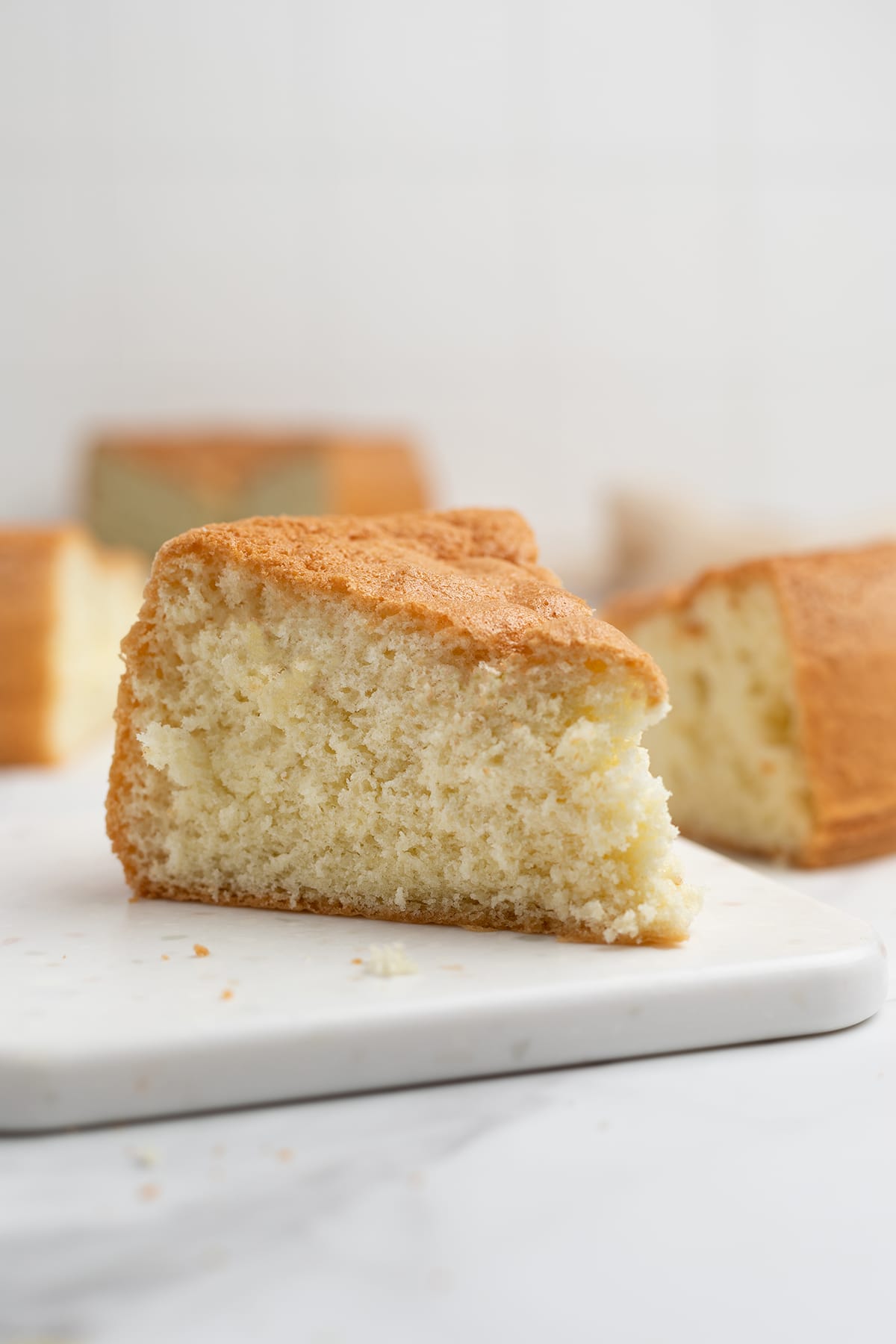
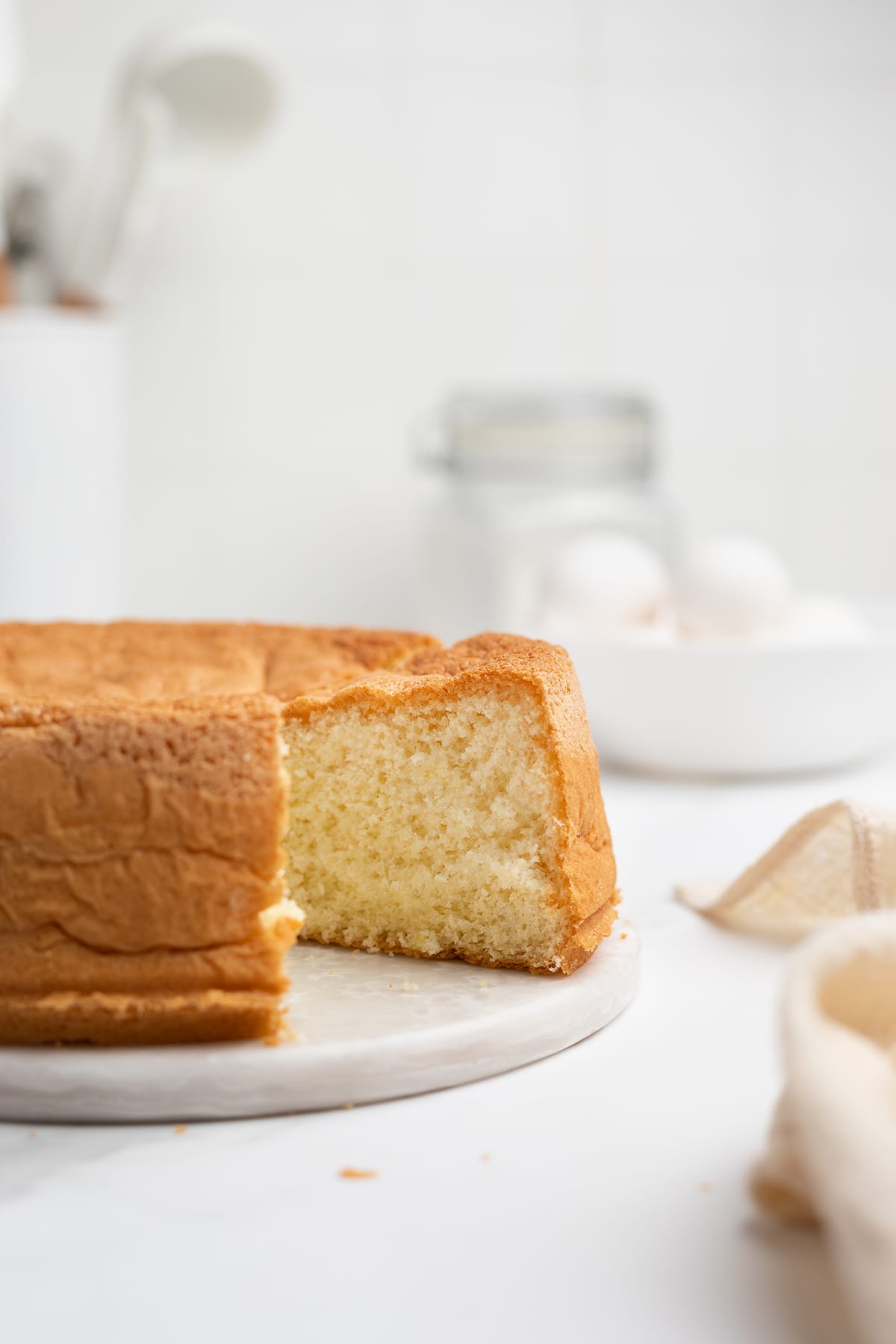
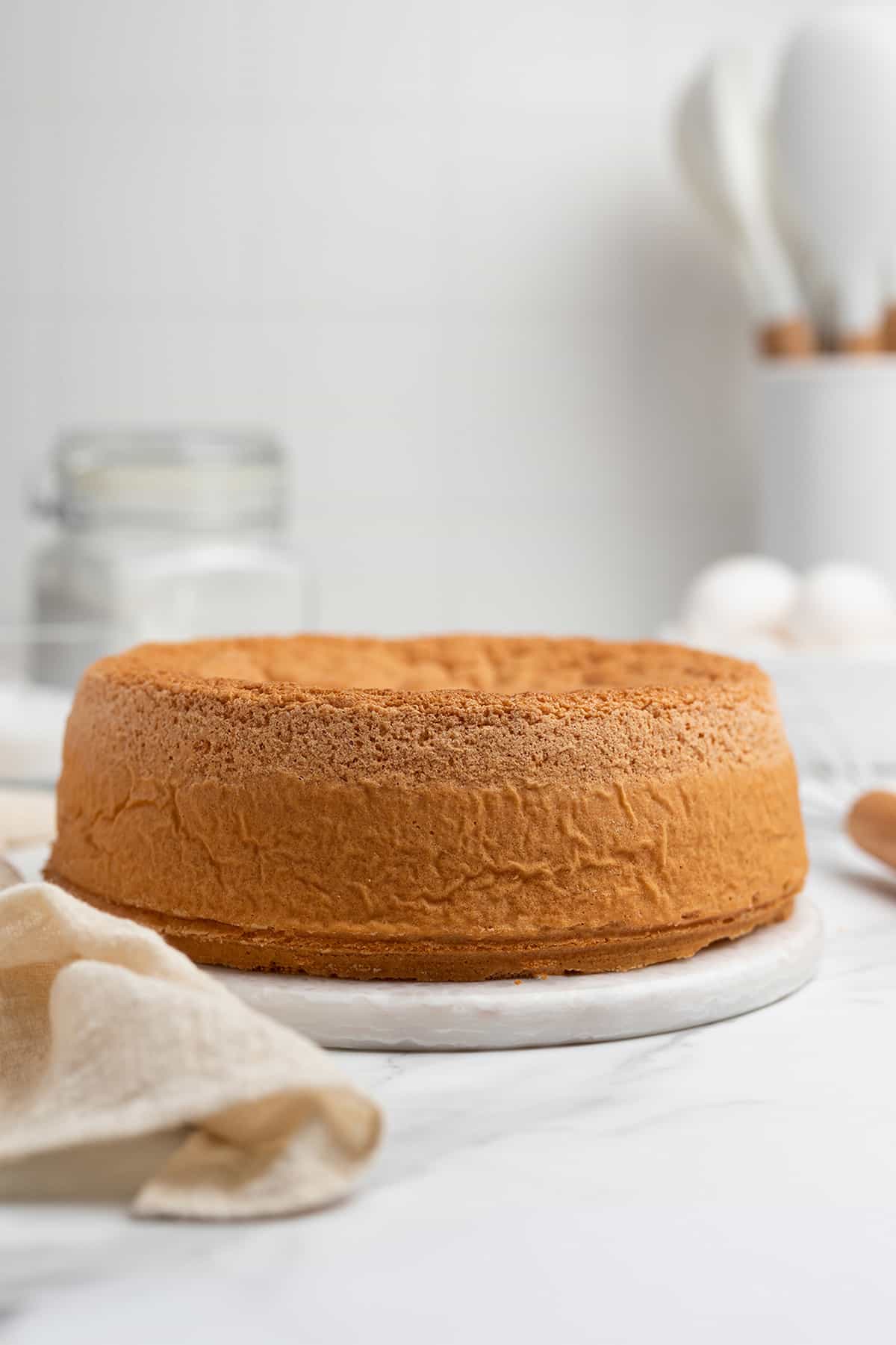
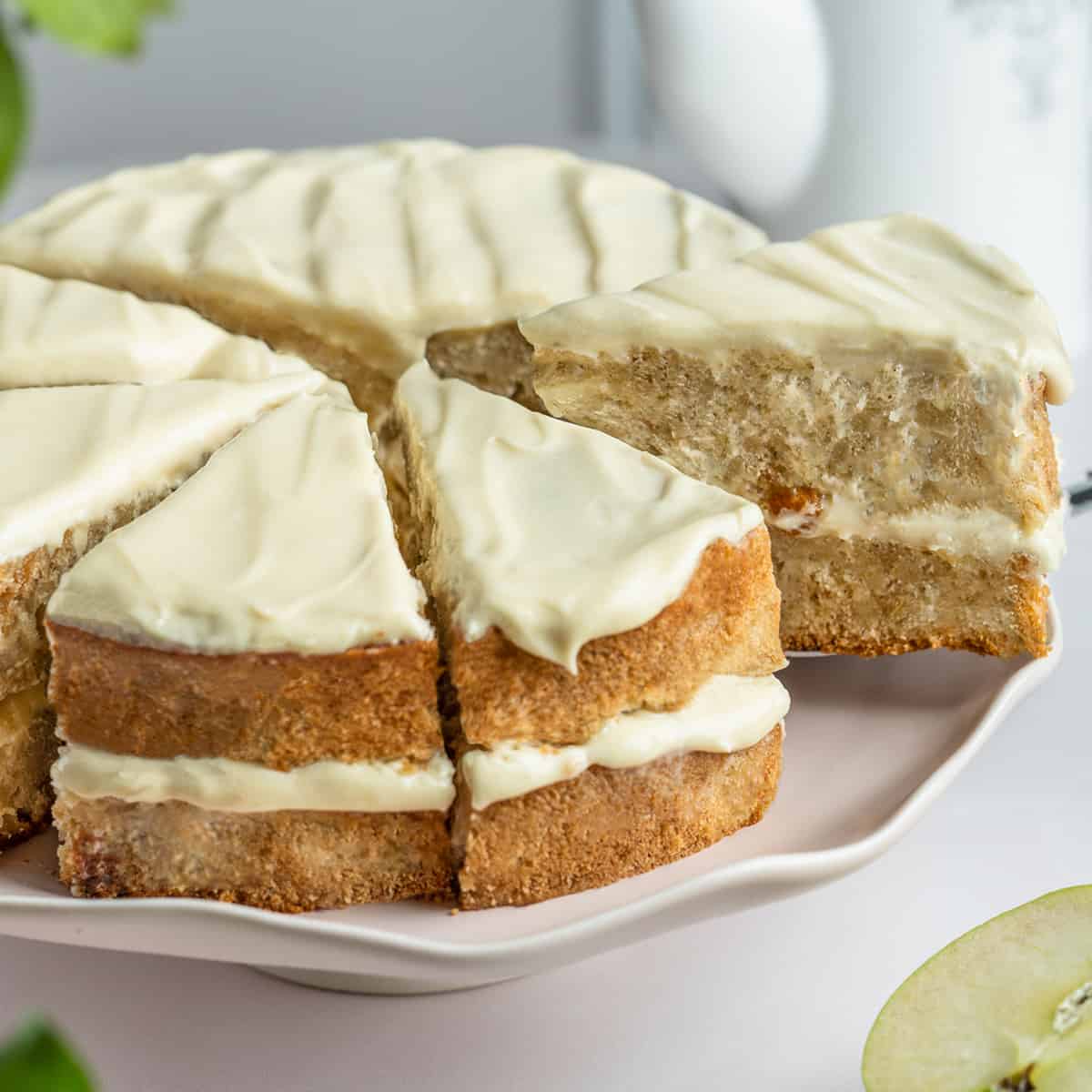
Sliced oil sponge cake with a slice on a cake server.

Quick Summary: Oil sponge cake is a light, moist, butter-free sponge made with olive oil instead of butter. It uses just 5 simple ingredients (eggs, sugar, olive oil, milk, and flour), rises on whipped eggs with no baking powder, and bakes in about 30 minutes for an easy, dairy-light everyday cake.

Sliced oil sponge cake with a slice on a cake server.

What is oil sponge cake?

Oil sponge cake is a sponge cake made with oil, usually olive oil, in place of the butter used in a classic sponge. The oil keeps the crumb soft and moist for days and stays liquid when chilled, so the cake does not dry out or firm up in the fridge the way a butter cake can.

This version leans on well-whipped eggs for lift, which is why it needs no baking powder, and its light olive oil flavor makes it a good base for layered cakes.

Why you'll love this recipe

  • Just 5 ingredients: Eggs, sugar, olive oil, milk, and flour are all you need.
  • Butter-free and dairy-light: A good option if you skip or limit butter.
  • Stays moist for days: Oil keeps the crumb soft, even after time in the fridge.
  • No baking powder: The cake rises on whipped eggs alone for a clean, airy crumb.
  • Perfect layer-cake base: Sturdy yet light, it holds up well when filled and stacked.

Ingredients

Oil sponge cake ingredients.

For ingredients and detailed instructions, refer to the recipe card below.

  • Eggs: The recipe calls for large eggs. Ensure they are at room temperature before you start: bring them to the countertop an hour before. You will need to whisk the eggs with sugar over a bain-marie/water bath to aerate the mixture and incorporate air bubbles during whisking.

Pro tip: Alternatively, you can use a trick I always use: place whole eggs in a bowl of warm water for a few minutes. 

  • Sugar: Use granulated or caster sugar in the recipe.
  • Olive oil adds aroma, moisture, and softness to the cake and prolongs its shelf life. You can replace extra virgin olive oil with sunflower oil, vegetable oil, or rapeseed oil.

Pro tip: If you want to learn more about how to make a cake moist, please, read my guide.

  • Milk: The recipe calls for whole milk at room temperature.
  • Flour: Use all-purpose flour (aka plain flour).
A single slice of the oil sponge cake on a dessert plate.

Equipment

You need only a few basic tools to make this oil sponge cake:

  • Round cake pan (8-inch (20 cm))
  • Parchment paper
  • Flour sifter
  • Large mixing bowl
  • Stand mixer with whisk attachment
  • Hand whisk and rubber spatula
  • Wire cooling rack

How to make olive oil sponge cake

Step 1. With cooking spray, grease an 8-inch (20 cm) round cake pan, then place a parchment paper circle at the bottom of the pan.

Step 2. Using a flour sifter, sift all-purpose flour into a large mixing bowl and set aside.

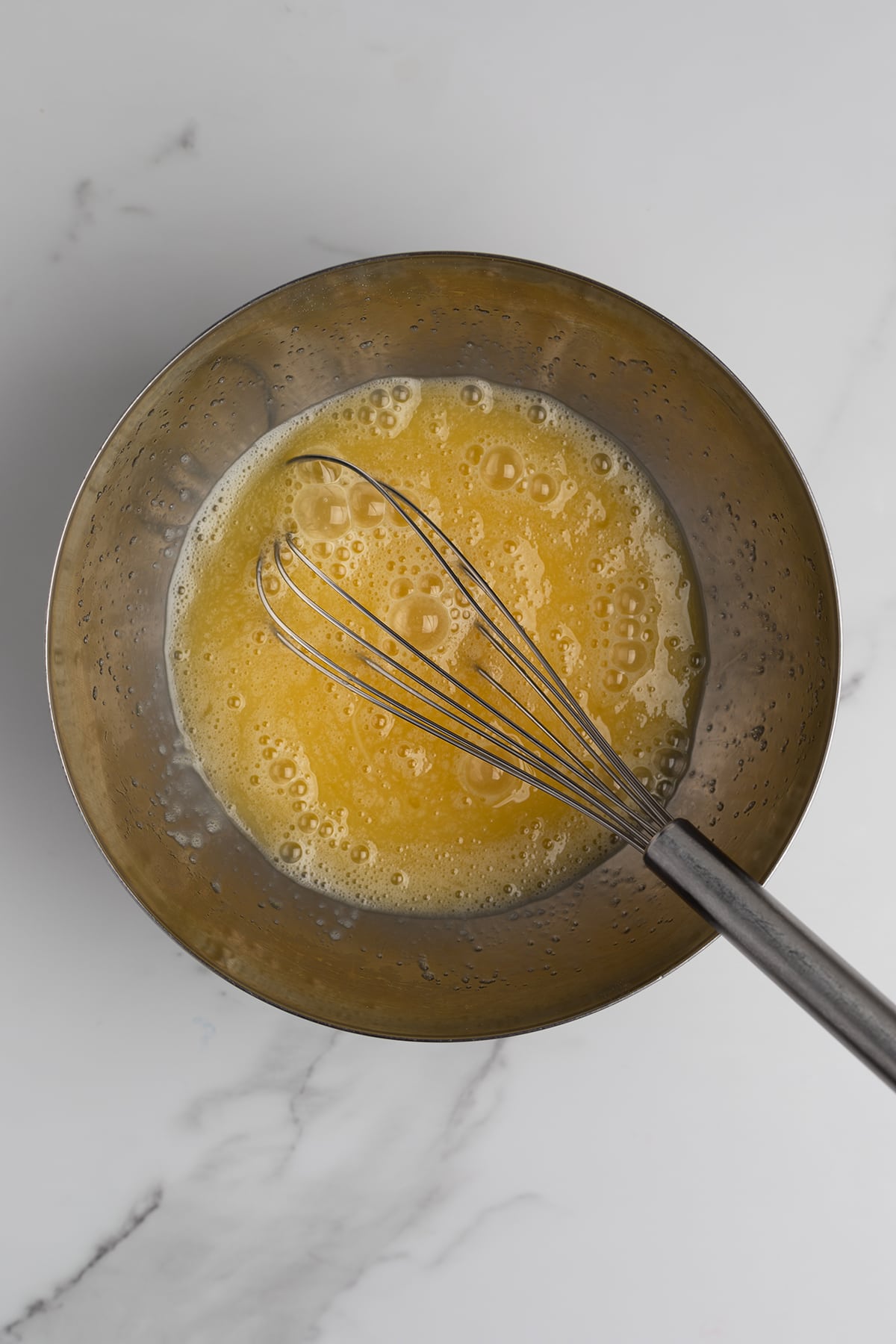
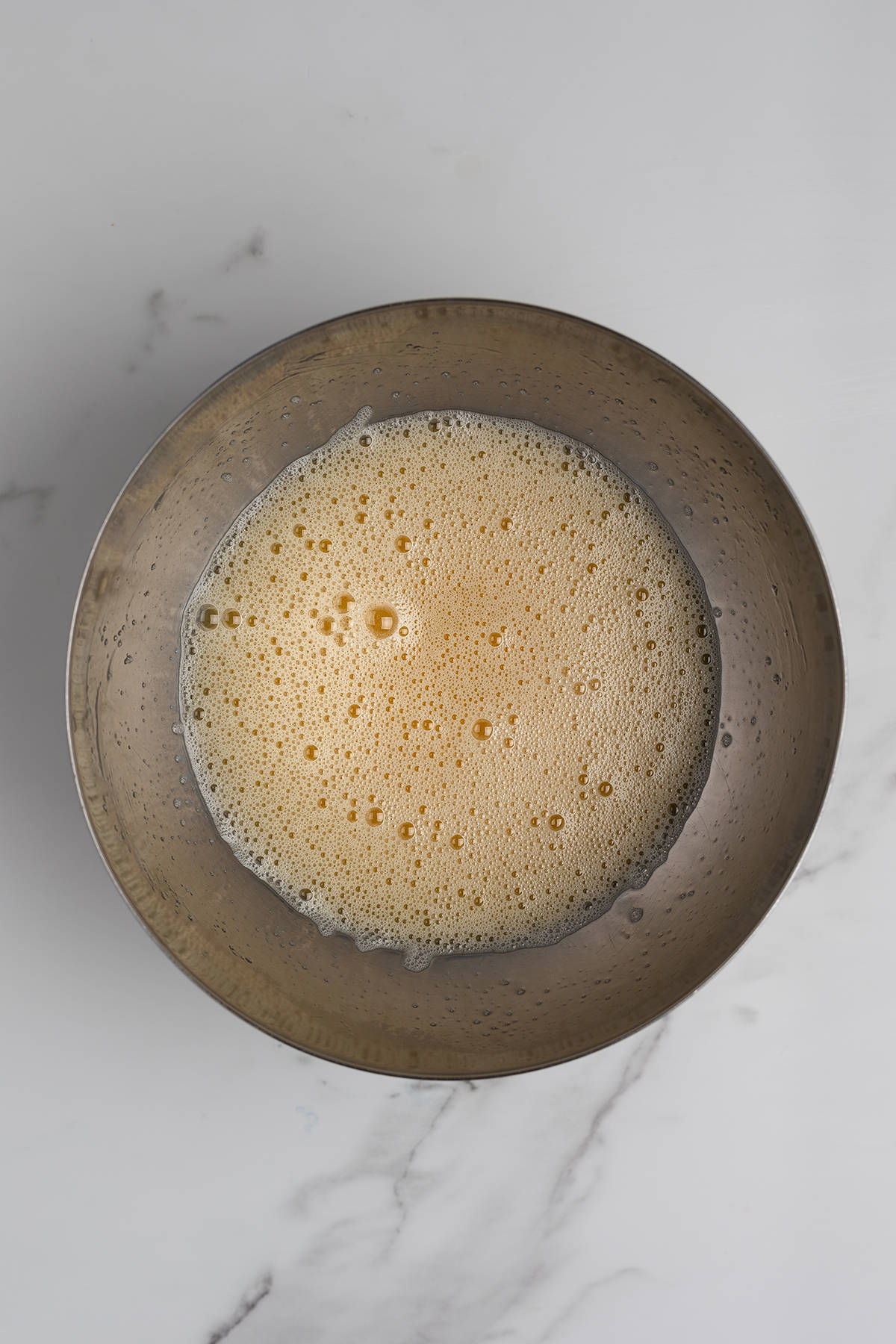
Step 3. Preheat the oven to 350°F (175°C). Place eggs and sugar in the bowl of a stand mixer and lightly beat with a hand whisk.

Step 4. Place the bowl over a bain-marie/water bath and heat the mixture to 104°F (40°C) or until warm to the touch, whisking constantly.

Step 5. Remove the bowl from the water bath. Attach the whisk attachment to your stand mixer.

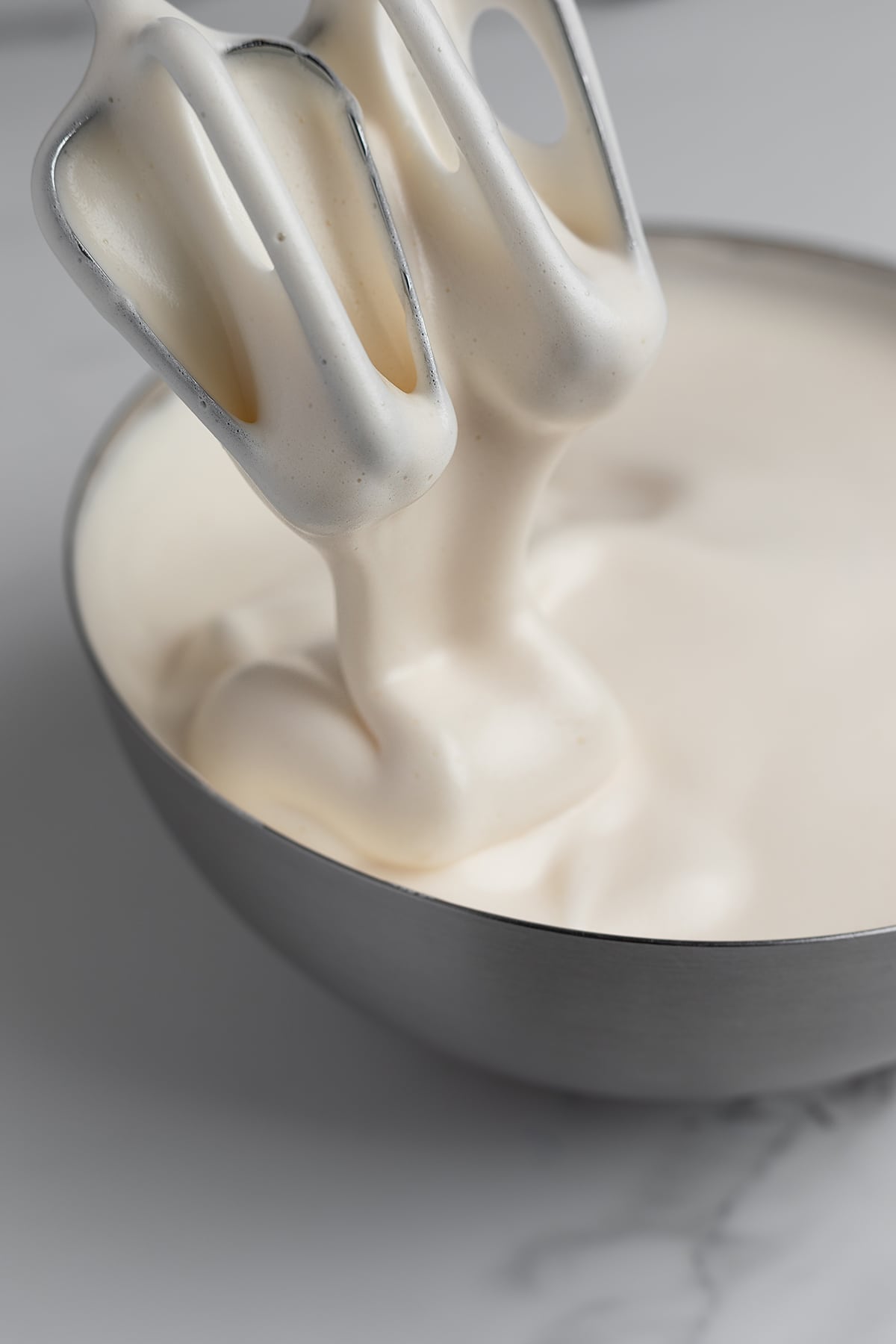
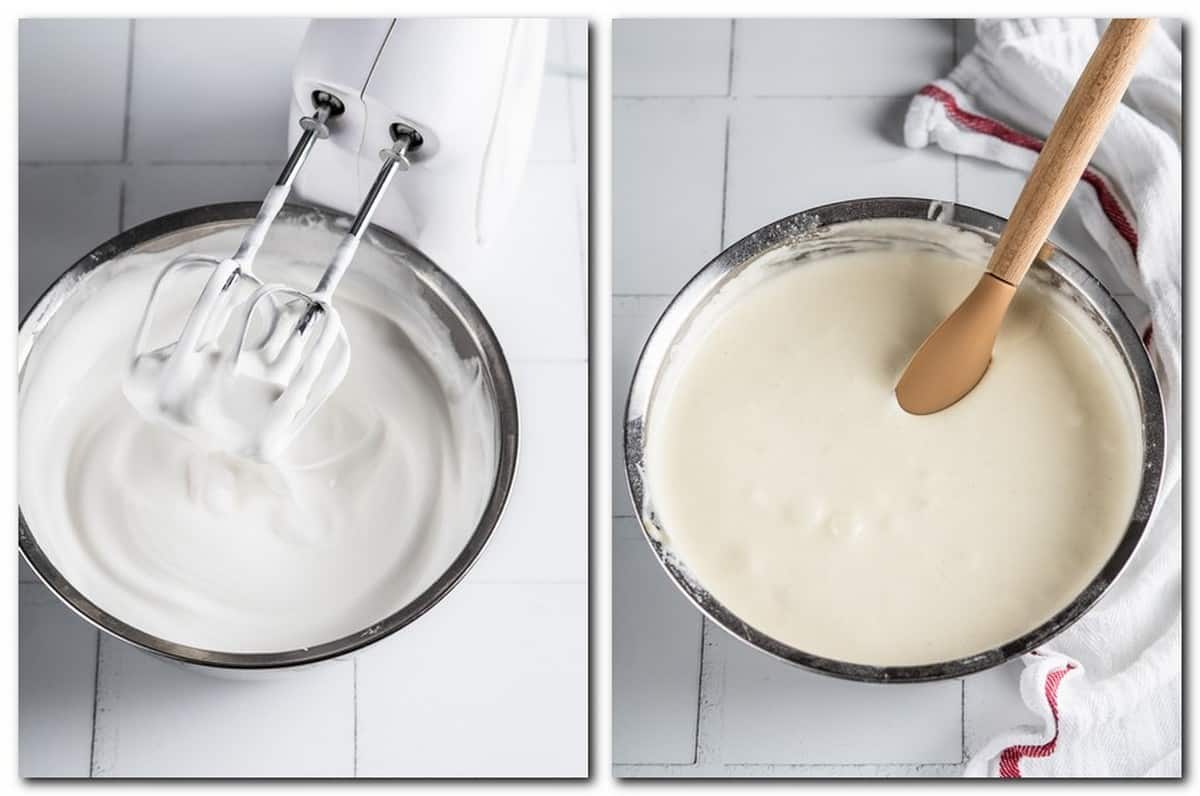
Step 6. Beat the egg mixture for 5 minutes at high speed, then 10 to 15 minutes at medium speed, until the ribbon stage (photo 1).

Step 7. Sift one-third of the flour over the surface of the mixture. Mix with a rubber spatula, moving from the center to the edge and folding gently.

Pro tip: Fold in the flour slowly and carefully. Also, rotate the bowl with the other hand while mixing the batter.

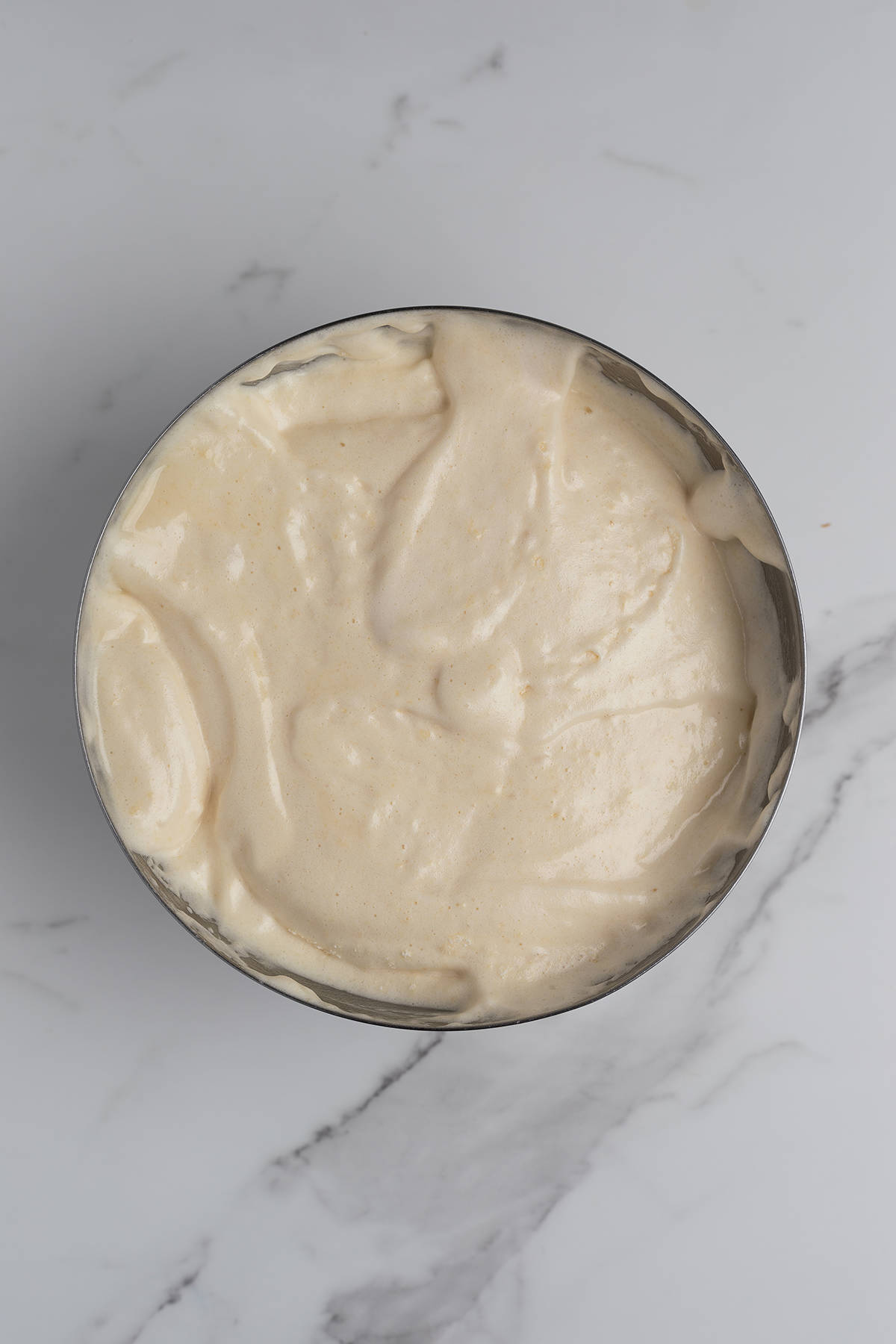
Step 8. Whisk the oil and milk with a fork. Pour â…“ of the mixture into the batter and gently mix (photo 2). Alternate dry and liquid ingredients until the batter is creamy and homogeneous.

Beaten egg mixture in a bowl with a ribbon stage on mixer beaters.

PHOTO 1

Cake batter in a bowl.

PHOTO 2

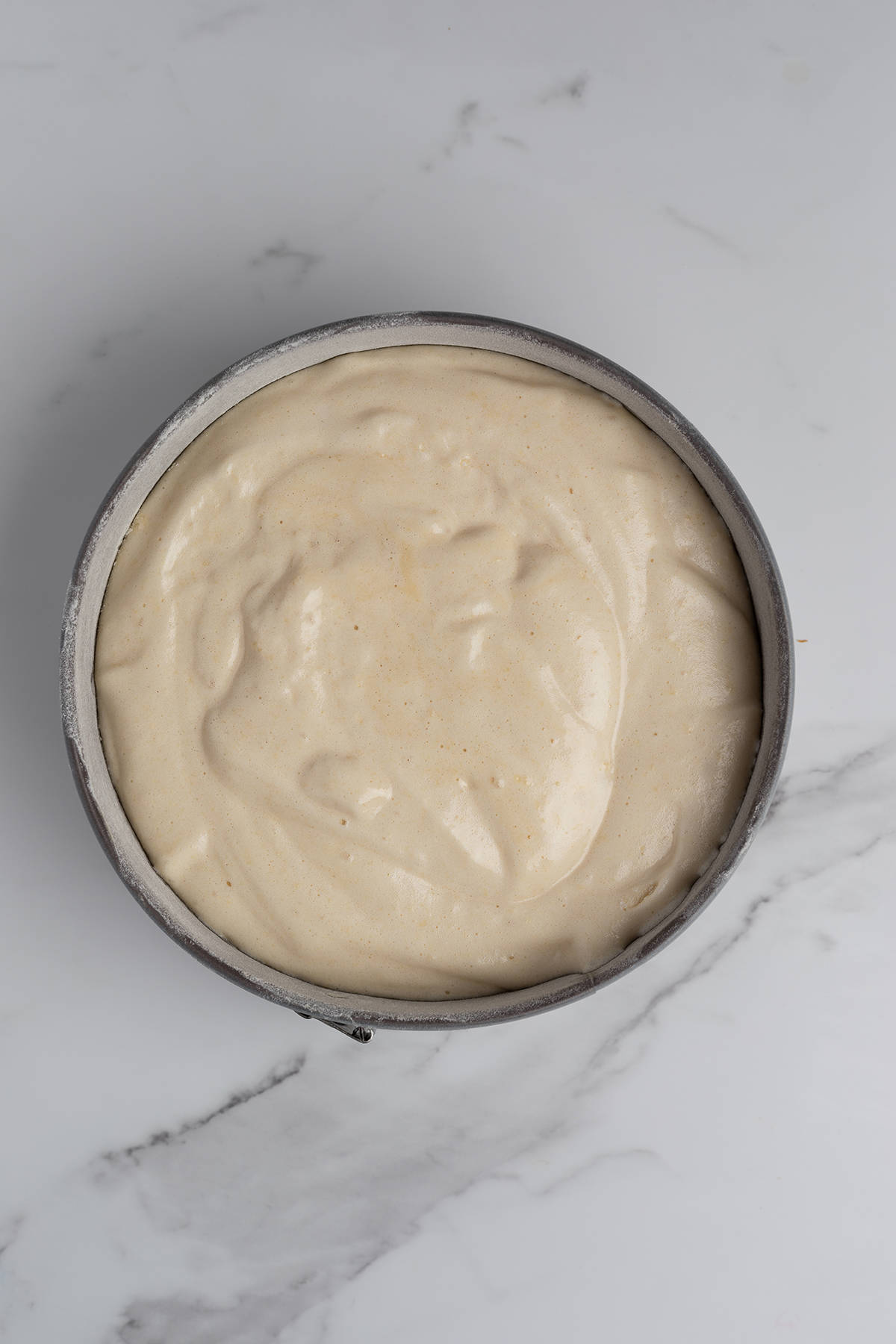
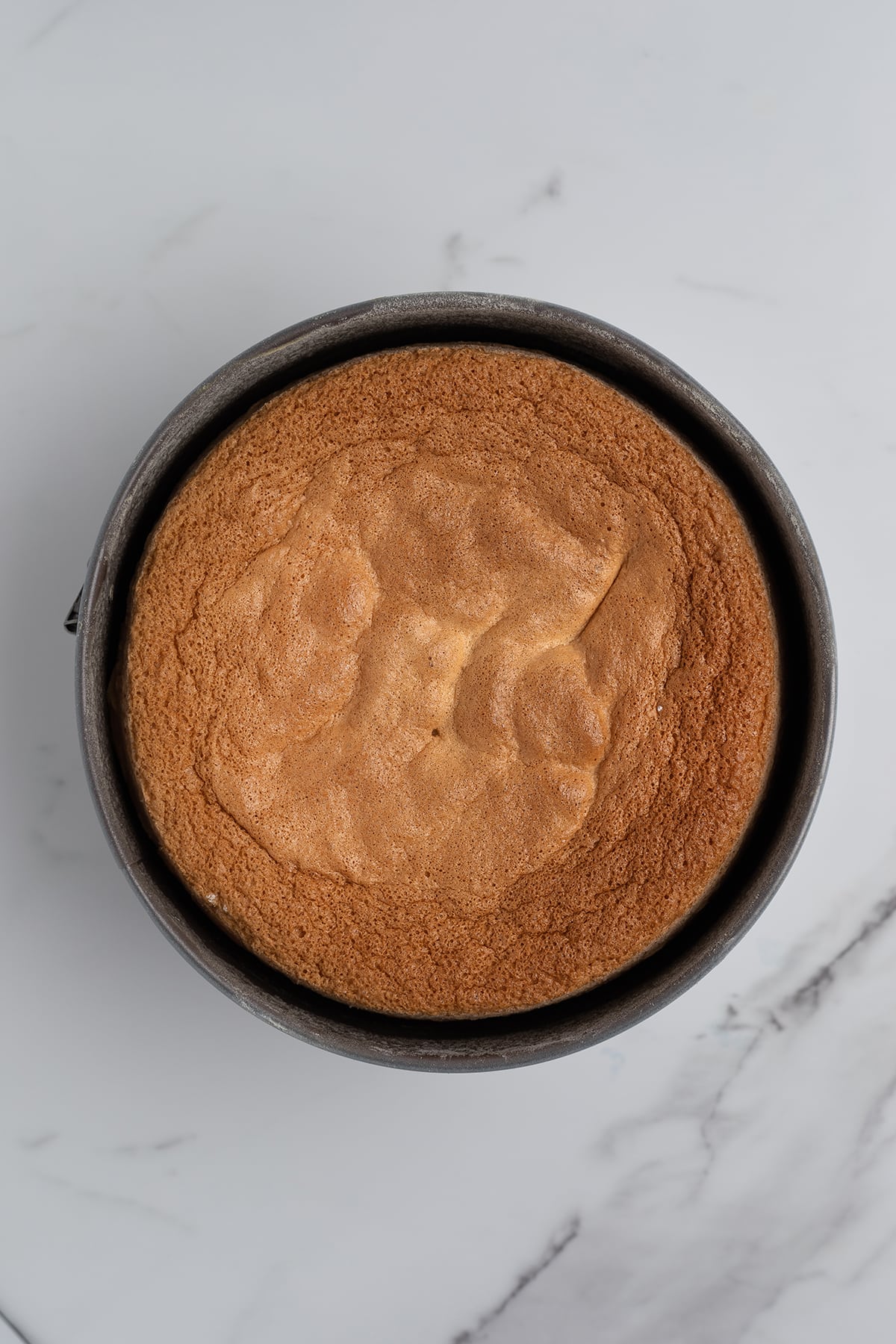
Step 9. Pour the batter into the prepared tin (photo 3).

Step 10. Bake for 30 to 35 minutes (photo 4).

Pro tip: Check the doneness of the cake with a cake tester or a toothpick. If it is inserted in the center of the cake and comes out clean or with a few crumbs, the cake is ready.

Cake batter in a springform pan.

PHOTO 3

Baked cake with olive oil in a pan.

PHOTO 4

Step 11. Remove the cake from the oven and let it cool in the mold for 5 to 10 minutes. It should shrink slightly around the edges of the mold.

Step 12. Unmold the cake by turning the baking pan upside down. Next, remove the parchment paper and invert it again, placing it on a serving platter.

To serve, dust the cake with icing sugar.

Sliced olive oil sponge cake on a serving plate.

Expert Tips

  1. Don't skip or decrease the time necessary to whip the egg and sugar mixture. To maintain the cake's fluffy texture, it is essential to beat plenty of air into the batter.
  2. Add dry and wet ingredients to the preparation slowly and gently.
  3. Bring the cake batter to the preheated oven once poured into the cake pan.
  4. Don't open the oven door during the first 30 minutes of baking.
  5. Unmold the cake from the pan for 5 to 10 minutes after removing it from the oven to prevent it from falling apart.
  6. Let it cool completely on a wire rack so the cake cools more evenly, keeping its texture light and airy.

Recipe variations

This is a basic cake recipe with oil, so it takes well to a few easy twists:

  • Vanilla: Whisk 1 teaspoon of vanilla extract into the batter for an oil-based vanilla cake.
  • Citrus: Add orange or lemon zest for a brighter flavor.
  • Boozy: Stir in a splash of dark rum for a grown-up version.
  • Chocolate: Replace 1 oz (30 g) of flour with cocoa powder.
  • Layer cake: Fill with whipped cream and lemon curd, or with chocolate-dipped strawberries.

What to serve with oil sponge cake

This plain, moist sponge is a blank canvas that pairs with almost anything:

  • Fresh fruit and cream: Serve slices with whipped cream and berries.
  • Dusted with icing sugar: The simplest finish for an everyday treat.
  • Fruit curd or jam: Spread with lemon curd or your favorite jam.
  • Coffee or tea: Its light crumb makes it a natural afternoon cake.
  • As a layer cake: Split and fill with buttercream, ganache, or fruit.

Storing & freezing

Store the cake, well wrapped, at room temperature for about a week. If you need to keep the cake longer, you should freeze it.

Can you freeze an oil sponge cake? Yes, you can. To freeze your cake, make sure it is completely cooled. Then, cover it with double plastic wrap and aluminum foil. Place it in the freezer at -13°F (-25°C) and store it there for up to 3 months. 

To thaw the sponge cake, bring it to room temperature for a couple of hours, or refrigerate it overnight. If you are short on time, you can place the cake in the oven at a low temperature for at least 15 minutes.

Also, read more

  • about whether you can refrigerate the cake batter and
  • if you can freeze the cake batter.
Olive oil sponge cake with a slice on a cake server.

Troubleshooting tips

Why is my cake too dense

Reason: A dense cake is often caused by excessive liquid, excessive sugar, or insufficient leavening agent.
How to prevent it: Measure ingredients correctly using a kitchen scale or other measuring tools. Also, make sure to use fresh leavening agents (if required) and check the oven temperature.

Why does my cake have holes?

Reason: The holes in a cake are often caused by over-beating the cake batter.
How to prevent it: Use the mixing method specified in the recipe. If it requires using a hand whisk, avoid electric or stand mixers, as they can lead to overbeating the batter. Ensure all ingredients are at room temperature to achieve the best results when combining.

Why is my cake dry

Reason: The cake is usually dry due to incorrect ingredient measurements or overbaking. So, it can be caused by too much moisture being absorbed by the flour, cocoa powder, etc.
How to prevent it: Ensure to measure flour, cocoa powder, and other dry ingredients correctly. To avoid overbaking the cake, check it for doneness with a cake tester, a toothpick, or the tip of a knife. Also, the cake is ready when it pulls away from the sides of the pan and snaps back with light finger pressure.

Why is my cake hard

Reason: The hard cake results from over-beating the batter or using the wrong type of flour.
How to prevent it: Using the right flour is key to achieving the desired cake texture. It is also essential to follow the ingredient order and mix the batter using the proper method and the required time.

Why is my cake falling apart?

Reason: The most common cause of a cake falling apart when removing it from the pan is not allowing for enough time to cool after baking.
How to prevent it: To ensure a successful and easy cake removal, line the bottom of your pan with parchment paper. Always let it rest for at least 10-15 minutes before unmolding. Then, run a knife between the pan wall and carefully remove the cake.

Why is my cake sinking in the middle

Reason: Cake sinking in the middle is usually due to underbaking, using too much leavening agent, or opening the oven while baking.
How to prevent it: The first step is to ensure the oven temperature and baking time are correct. Check the cake's doneness with a toothpick or cake tester. Measurements of the leavening agents should also be accurate; don't replace baking powder with baking soda, or vice versa. And one more baking rule: never open the oven door during baking time.

Recipe FAQ

Is sponge cake better with oil or butter?
Both add moisture, but oil yields a softer, more open crumb, while butter yields a finer, richer one. Oil also stays liquid when chilled, so an oil sponge cake keeps its soft texture right out of the fridge.

Can you use olive oil instead of vegetable oil in sponge cake?
Yes. Swap it one-to-one. Olive oil adds a light, distinct flavor, so use a mild or virgin oil if you want it subtle.

Why does this oil sponge cake have no baking powder?
It rises in the air, whipped into the eggs and sugar over a warm water bath, so no chemical leavener is needed. Whip the eggs fully to the ribbon stage for the best lift.

Can you freeze an oil sponge cake?
Yes. Cool it completely, wrap it in a double layer of plastic wrap and foil, and freeze for up to 3 months. Thaw at room temperature or overnight in the fridge.

What oil is best for oil sponge cake?
Virgin olive oil gives a light, characteristic flavor. For a neutral taste, use sunflower, vegetable, or rapeseed oil in equal amounts.

How many calories are in an oil sponge cake?
One slice has about 303 calories, based on 8 servings per cake.

Love sponge cakes? Try these next!

  • Genoise Sponge Cake
  • Apple Sponge Cake
  • Japanese Sponge Cake
  • Chocolate Sponge Cake
  • Or browse all the basic recipes

Want more delicious and beautiful recipes? Subscribe to my newsletter and follow me on Facebook, Pinterest, and Instagram for my latest updates. If you make this recipe, please leave a star rating on the recipe card and comment below!

Print

Recipe card

Oil Sponge Cake (With Olive Oil)

Sliced oil sponge cake with a slice on a cake server.
Print Recipe
Save Recipe Recipe Saved

5 Stars 4 Stars 3 Stars 2 Stars 1 Star

5 from 1 review

This oil sponge cake is a light, moist, butter-free cake made with olive oil and just 5 ingredients. This easy olive oil sponge cake recipe uses no baking powder, rises on whipped eggs, and makes a great layer-cake base.

  • Author: Irina Totterman
  • Prep Time: 25 minutes
  • Cook Time: 35 minutes
  • Total Time: 60 minutes
  • Yield: 8 1x
  • Category: Cakes
  • Method: Baking
  • Cuisine: French

Ingredients

Scale
  • 4 large eggs (190 g), room temperature
  • ¾ cup (150 g) granulated sugar
  • ½ cup + 1 tablespoon (135 ml) virgin olive oil
  • â…“ cup + 1 ½ tablespoon (100 ml) whole milk, room temperature
  • ¾ cup + 2 ½ tablespoons (115 g) all-purpose flour

*Don't you have the correct baking pan on hand right now? Try this simple Cake Pan Converter!

** If needed, please refer to Baking Conversion Charts.

Instructions

  1. Spray an 8-inch (20 cm) round cake pan with cooking spray, then place a parchment paper circle at the bottom of the pan. Using a flour sifter, sift all-purpose flour into a medium bowl and set aside. Preheat the oven to 350°F (175°C).
  2. To make the batter, place eggs and sugar in the bowl of a stand mixer and lightly beat with a hand whisk. Place the bowl over a bain-marie (water bath) and heat the mixture to 104°F (40°C) or until warm to the touch, whisking constantly.
  3. Remove the bowl from the water bath. Then, using a stand mixer fitted with a whisk attachment, beat the preparation for 5 minutes at high speed and 10 to 15 minutes at medium speed. 
  4. Sift one-third of the flour over the surface of the mixture. Mix with a rubber spatula, moving from the center to the edge and folding gently. Fold in the flour slowly and carefully. Also, rotate the bowl with the other hand while mixing the batter. 
  5. Whisk the oil and milk with a fork. Pour ⅓ of the mixture into the batter and gently mix. Alternate dry and liquid ingredients until the batter is creamy and homogeneous. 
  6. Pour the batter into the prepared mold and bake for 30 to 35 minutes. Check the cake's doneness with a cake tester or a toothpick. If it is inserted in the center of the cake and comes out clean or with a few crumbs, the cake is ready. 
  7. Remove the cake from the oven and let it cool in the mold for 5 to 10 minutes. It should shrink slightly around the edges of the mold.
  8. Unmold the cake by turning the baking pan upside down. Next, remove the parchment paper and invert it again, placing it on a serving platter. Once the cake is cooled, dust it with icing sugar if desired.

Notes

  1. Don't skip or decrease the time necessary to whip the egg and sugar mixture. To maintain the cake's fluffy texture, it is essential to beat plenty of air into the batter.
  2. Add dry and wet ingredients to the preparation slowly and gently.
  3. Bring the cake batter to the preheated oven once poured into the cake pan.
  4. Don't open the oven door during the first 30 minutes of baking.
  5. Unmold the cake from the pan 5 to 10 minutes after removing it from the oven to prevent it from falling apart.
  6. Let it cool completely on a wire rack so it cools more evenly, keeping its texture light and airy.

Nutrition

  • Serving Size: 1 slice
  • Calories: 303
  • Sugar: 19.7 g
  • Sodium: 60 mg
  • Fat: 19 g
  • Saturated Fat: 3.3 g
  • Carbohydrates: 30.5 g
  • Fiber: 0.4 g
  • Protein: 5.1 g
  • Cholesterol: 94 mg

Thank you for following me on Pinterest, Facebook, and Instagram. Hashtag #bakinglikeachef so I can see your creations.

The nutritional information has been calculated using an online recipe nutrition calculator such as Verywellfit.com and is intended for informational purposes only. These figures should be used as a general guideline and not be construed as a guarantee.

The recipe was originally published on April 5, 20. It has been updated and may differ from what was originally published.

Apple Sponge Cake (Easy and Quick Recipe)

Apr 3, 2022 · 1 Comment

Sliced apple sponge cake on a dessert plate.

Quick Summary: Apple sponge cake is a soft, fluffy one-layer cake topped with fresh apple slices. It is made with simple pantry ingredients (eggs, sugar, flour, and butter), needs only about 10 minutes of prep, and bakes into an easy, everyday dessert similar to Russian Sharlotka.

Sliced apple sponge cake on a dessert plate.

What is apple sponge cake?

Apple sponge cake is a soft, fluffy cake topped with juicy apples or evenly distributed thin slices. It is usually made with simple ingredients like sugar, eggs, and flour, with oil or sour cream added.

This sponge apple cake resembles the Russian apple cake, Sharlotka (Polish Szarlotka is another apple dessert), but it has its own unique twist.

The cake has a very different ratio of sponge to apples. It is more like a sponge cake with apples than an apple cake.

A single slice of apple sponge cake on a dessert plate.

Why you'll love this recipe

Here is why this apple sponge cake earns a spot in your regular baking:

  • Quick to make: the batter takes only about 10 minutes of hands-on time before it goes in the oven.
  • Simple ingredients: it uses everyday pantry staples like eggs, sugar, flour, butter, and fresh apples.
  • Pretty finish: the apple slices are arranged on top, so the cake looks neat with no frosting needed.
  • Year-round dessert: serve it for any occasion, from a weekday snack to a weekend get-together.
  • Kid-friendly: the soft sponge and mild apple flavor make it an easy favorite with children.

Ingredients

Apple sponge cake ingredients.

For ingredients and detailed instructions, refer to the recipe card below.

  • Eggs: Use large eggs. Separate the egg whites from the egg yolks using an egg separator. Then, bring the whites and yolks to room temperature.
  • Sugar: The recipe calls for granulated or caster sugar.
  • Oil: Use any oil you desire, from vegetable to olive oil. I usually choose grapeseed oil since it is flavorless.
  • Flour: Use all-purpose flour.
  • Baking powder: Use fresh aluminum-free baking powder.
  • Salt: A pinch is necessary to bring out the cake's flavors.
  • Apples: One large or two medium apples are enough for this cake. Choose tart apples to balance out the sweetness of your cake. This variety of apples works best for the recipe:
    • Granny Smith apples,
    • Bramley apples,
    • Gala,
    • Pink Lady,
    • Cortland,
    • Honeycrisp,
    • Fuji.
  • Powdered sugar is used for dusting the top of the cake. Feel free to omit this ingredient.
Apple sponge cake with a slice on a cake server.

Equipment

Here are the main tools you need to make this apple sponge cake:

  • A round cake pan or a Le Creuset springform pan to bake the cake.
  • Parchment paper to line the pan so the cake releases cleanly.
  • A mixing bowl and an electric mixer to whip the eggs and sugar until light and fluffy.
  • An egg separator to separate the whites from the yolks.
  • A vegetable peeler to peel the apples.
  • A wire rack to cool the cake evenly.

How to make apple sponge cake

Step 1. Preheat the oven to 355°F (180°C). Using an egg separator, separate the egg whites from the yolks. Sift the flour with the baking powder, then set aside.

Step 2. Butter an 8-inch (20 cm) round cake pan and line it with parchment paper (you can also use a Le Creuset springform pan of the same diameter).

Step 3. To make the sponge batter, place egg whites with a pinch of salt in a large mixing bowl and beat with an electric mixer until foamy. Add sugar in 3 batches, beating until stiff and glossy (photo 1).

Step 4. Reduce the hand mixer speed, then mix in the egg yolks, oil, and sifted dry ingredients (photo 2). Mix until combined; avoid overmixing the sponge mixture.

Meringue in a bowl and mixer beaters.

PHOTO 1

Cake batter in a bowl.

PHOTO 2

Step 5. Pour the batter into the prepared pan. Use a vegetable peeler and an apple corer to peel, core, and slice the apple into ½-inch (1.3 cm) slices.

Step 6. Place the apple slices on top of the batter, pressing them down slightly (photo 3).

Step 7. Bake the cake for 40 to 45 minutes, until a toothpick inserted into the center comes out clean (photo 4).

Cake batter with apple slices in a baking pan.

PHOTO 3

Baked apple sponge cake in a baking mold.

PHOTO 4

Step 8. Remove the cake from the oven and let it rest in the pan for 10 minutes.

Step 9. Remove the cake from the baking dish, unpeel the parchment paper from the sides, and let it cool on a wire rack.

Step 10. To serve, transfer the cake to a serving plate and sprinkle it with powdered sugar.

Sliced sponge apple cake on a serving platter.

Expert tips

  1. You can peel apples or leave them unpeeled.
  2. Use chopped apples to arrange them as a top layer of the cake if desired.

Recipe variations

It is a classic apple sponge cake made with a sponge cake recipe and apples. If you aren't a fan of the classic, try something new and see how it turns out.

  • Apples: Experiment with different varieties and with sliced or grated apples. Using stewed apples opens up another cake variation.
  • Other fruits: Try this sponge with other fresh fruit, for example, strawberries, plums, etc. Just remember that some fruit may sink more than others.
  • Flavorings: Add vanilla extract, lemon juice or zest, or a pinch of cinnamon to your cake batter for extra flavor.
  • Sheet apple sponge cake: Make the cake in a rectangular shape, or even as a sheet sponge cake (baking time may vary). To recalculate ingredients, use this simple cake pan converter.

What to serve with apple sponge cake

This cake is good on its own, but a few simple additions make it feel more finished:

  • A dusting: sprinkle powdered sugar, or mix ground cinnamon with confectioners' sugar for a warm cinnamon-sugar top.
  • Something creamy: add a spoonful of vanilla custard, whipped cream, crème fraîche, or a scoop of vanilla ice cream.
  • A tangy note: a little lemon curd on the side balances the apples' sweetness.
  • A hot drink: serve a slice with coffee or tea for an afternoon snack.

Storing and freezing

Store sponge cake with apples in an airtight container in the fridge for 3 to 4 days.

Can you freeze apple sponge cake? You can freeze the cake, tightly wrapped in plastic wrap and aluminum foil, for up to 3 months. Thaw overnight in the fridge or for a couple of hours on the countertop.

Recipe FAQ

What are the best apples for apple sponge cake?
Use apples that hold their shape when baked, such as Granny Smith, Bramley, Gala, Pink Lady, Cortland, Honeycrisp, or Fuji. Tart apples pair best with the sponge's sweetness.

Do you need to peel the apples?
Peeling gives the softest result, but if you are short on time, you can leave the skins on, and the cake will still taste good.

Do you have to cook the apples first?
No. You don't need to pre-cook the apples. Just peel and slice fresh apples and place them straight onto the batter.

Can you cut the apples in advance?
It is best not to. Cut apples brown quickly once exposed to air, so peel and slice them right before you assemble the cake.

Is apple sponge cake the same as Sharlotka?
They are close cousins. Sharlotka is a Russian apple sponge cake made with a light, egg-based batter and fresh apples. This recipe uses the same idea with apple slices arranged on top.

How many calories are in an apple sponge cake?
One slice has about 198 calories.

Love apple recipes? Try these next!

  • Apple crumble bread
  • Apple juice reduction
  • Apple mousse cake
  • Caramelized apples

Browse all the Cake Recipes

Want more delicious and beautiful recipes? Subscribe to my newsletter and follow me on Facebook, Pinterest, and Instagram for my latest updates. If you make this recipe, please leave a star rating on the recipe card and comment below!

Print

Recipe card

Easy Apple Sponge Cake

Sliced apple sponge cake on a dessert plate.
Print Recipe
Save Recipe Recipe Saved

5 Stars 4 Stars 3 Stars 2 Stars 1 Star

5 from 1 review

This easy apple sponge cake is a soft, fluffy one-layer cake topped with fresh apple slices. Made with simple pantry ingredients, this quick apple sponge cake recipe needs only about 10 minutes of prep and works for any occasion.

  • Author: Irina Totterman
  • Prep Time: 15 minutes
  • Cook Time: 40 minutes
  • Total Time: 55 minutes
  • Yield: 8 1x
  • Category: Cakes
  • Method: Baking
  • Cuisine: Italian

Ingredients

Scale

For the cake batter:

  • 4 large eggs, room temperature
  • ½ cup + 2 tablespoons (125 g) granulated sugar
  • 2 ½ tablespoons vegetable oil
  • ¾ cup + 1 ½ tablespoon (105 g) all-purpose flour
  • ½ teaspoon baking powder
  • 1 pinch of salt
  • 1 large apple

For greasing pan:

  • 1 tablespoon softened unsalted butter 

For decoration:

  • 1-2 tablespoons powdered sugar

*Don't you have the correct baking pan on hand right now? Try this simple Cake Pan Converter!

** If needed, please refer to Baking Conversion Charts.

Instructions

  1. Preheat the oven to 355°F (180°C). Using an egg separator, separate the egg whites from the yolks. Sift the flour with the baking powder, then set aside.
  2. Butter an 8-inch (20 cm) round cake pan and line it with parchment paper (you can also use a Le Creuset springform pan of the same diameter).
  3. To make the cake batter, place egg whites with a pinch of salt in a large mixing bowl and beat with an electric mixer until foamy. Add sugar in 3 batches, beating until stiff and glossy.
  4. Reduce the hand mixer speed, then mix in the yolks, oil, and sifted dry ingredients. Mix until combined; avoid overmixing. Pour the batter into the prepared pan.
  5. With a vegetable peeler and an apple corer, peel, core, and slice the apple into ½ inch (1.3 cm) slices. Top the batter with the apple slices, pressing them down slightly.
  6. Bake the cake for 40-45 minutes, until a toothpick inserted into the center comes out clean.
  7. Remove the cake from the oven and let it rest in the pan for 10 minutes. Remove the cake from the mold, unpeel the parchment paper from the sides, and let it cool on a wire rack.
  8.  Once cooled, transfer it to a serving plate and sprinkle with powdered sugar. 

Notes

  1. You can peel the apples or leave them unpeeled.
  2. If desired, use chopped apples to arrange as a top layer of the cake.

Nutrition

  • Serving Size: 1 slice
  • Calories: 198
  • Sugar: 19.7 g
  • Sodium: 55 mg
  • Fat: 6.9 g
  • Saturated Fat: 1.4 g
  • Carbohydrates: 30.8 g
  • Fiber: 1 g
  • Protein: 4.6 g
  • Cholesterol: 93 mg

Thank you for following me on Pinterest, Facebook, and Instagram. Hashtag #bakinglikeachef so I can see your creations.

The nutritional information has been calculated using an online recipe nutrition calculator such as Verywellfit.com and is intended for informational purposes only. These figures should be used as a general guideline and not be construed as a guarantee.

Kinder Paradiso Cake (Torta Kinder Paradiso)

Apr 1, 2022 · 2 Comments

Sliced Torta Kinder Paradiso on a black serving plate.

Quick Summary: Kinder Paradiso cake (torta Kinder Paradiso) is an Italian sponge cake filled with a smooth milk cream, inspired by the Ferrero Kinder Paradiso snack. It uses a soft torta Paradiso base and a cream made with whipping cream and condensed milk, and comes together in about 45 minutes.

Sliced Torta Kinder Paradiso on a black serving plate

What is Kinder Paradiso cake?

The name comes from Kinder Paradiso, a packaged snack by the Italian brand Ferrero: a small sponge cake with a milk-cream filling. This homemade version turns that snack into a full-size cake, pairing a classic torta Paradiso sponge with a light milk cream so you get the same soft, milky bite at a larger scale.

Don't confuse it with plain torta Paradiso, the lemon-scented Italian sponge from Pavia. Kinder Paradiso cake builds on that sponge but adds the signature cream layer, giving it a richer, dessert-like character.

Kinder Paradise cake sliced into multiple slices

Why you'll love this recipe

  • Two recipes in one: soft torta Paradiso sponge meets a smooth Italian milk cream, just like the Ferrero snack.
  • Light and fluffy: the delicate sponge and airy cream feel soft on the palate, never heavy.
  • Simple ingredients: made with pantry staples like butter, eggs, flour, and condensed milk.
  • Great any time: serve it for a birthday, at a buffet, or with a glass of milk for breakfast.
  • Make-ahead friendly: the sponge and cream can be prepared in advance and assembled when needed.

Ingredients

For ingredients and detailed instructions, refer to the recipe card below.

All the cake ingredients must be at room temperature.

  • Butter: unsalted butter adds buttery flavor to the sponge. Use high-quality European-style butter if available.
  • Sugar: use granulated sugar or caster sugar. It adds sweetness and provides structure to the cake.
  • Vanilla bean is the perfect ingredient for adding a warm, rich flavor to your cake.
  • Eggs: Use large eggs. They are a key binding ingredient and help hold the cake. There is no need to separate the egg whites from the egg yolks.
  • Flour: the original recipe calls for Italian 00 flour; you can substitute all-purpose flour. Flour provides the structure to the cake.
  • Potato starch: the recipe calls for potato starch, not corn starch. The former makes the cake tender and more delicate.
  • Baking powder: use fresh aluminum-free baking powder.
  • Salt: a pinch of salt brings out the cake's flavor and deepens the crust's color.
  • Whipping cream: choose one with at least 30% fat content. To make the milk cream even richer, use heavy whipping cream with 36% fat.
  • Sweetened condensed milk adds sweetness and a delicate flavor to the cream. If you don't have it at home, you can make it yourself (here is the recipe for homemade sweetened condensed milk) or replace it with mascarpone cheese to make the cream less sweet.
  • Honey: the recipe calls for wildflower honey or acacia honey. Try to avoid the buckwheat honey. Unfortunately, it is too intense for this delicate cake.
  • Icing sugar: make it yourself with granulated sugar and a coffee grinder, or use store-bought powdered sugar.

Equipment

Here are the main tools you need to make this cake:

  • A stand mixer or a hand mixer to whip the batter and the cream.
  • Two mixing bowls, one for the sponge batter and one for the milk cream.
  • Parchment paper to line the baking pan.
  • A rubber spatula to fold and spread the batter and cream.
  • A cake leveler to trim the sponge into even layers.
  • An adjustable cake ring and an acetate cake collar are used to assemble and hold the layers neatly.

How to make Kinder Paradiso cake

Step 1. Make the soft sponge base following the step-by-step recipe to prepare a perfect Paradise cake.

Step 2. Use freshly grated lemon zest to add an extra layer of lemon flavor to the cake batter, or omit it.

Step 3. Once the sponge is out of the oven, let it cool for a few minutes in the pan.

Baked Paradiso sponge cake in a pan

Step 4. Then turn it out of the mold and place it on a parchment-lined cutting board.

Step 5. Let the cake rest for 10 to 15 minutes, then turn it back onto a flat surface lined with parchment.

Step 6. This step gives you a perfectly flat cake top. Finally, let the cake cool completely (about 2 hours).

Step 7. Using a cake leveler, a cold knife with a long blade (keep it in the freezer for a few minutes), or a simple serrated knife, cut the sponge cake horizontally into two layers.

Step 8. To make the cream, place the cold whipping cream, sweetened condensed milk (from the fridge), and honey (at room temperature) in a stand mixer bowl. Whip the cream until firm (about 2 minutes).

Milk cream in a bowl

Step 9. Place the first cake layer on a serving plate, and spread the cream with a rubber spatula.

Step 10. Gently place another layer of Paradise cake on top of the cream. Sprinkle the cake with plenty of powdered sugar.

Assembled Kinder Paradiso cake on parchment paper

Step 11. Refrigerate the cake for at least 10 minutes, preferably 2 hours.

Step 12. Take it out of the fridge about 10 to 20 minutes before serving. The cake tastes best at room temperature.

Sponge cake dusted with icing sugar and sliced

Expert tips

  1. Place a mixer's bowl in the freezer for about an hour. It helps to whip the cream.
  2. To keep the cake's edges neat, assemble it in an adjustable cake ring lined with an acetate cake collar.
  3. Make the cake in a round or rectangular mold, or even make it as a giant snack to be cut into slices. To recalculate ingredients, use this simple cake pan converter.
  4. Clean the knife's blade between each cut to avoid smearing the sponge layers and get a cleaner cut.
  5. Make-ahead option: bake the butter sponge cake one day in advance and keep it at room temperature under a glass dome cake stand. Then, the next day, whip the cream and assemble the dessert.

Recipe variations

  • Chocolate version: replace 3 tablespoons of potato starch with cocoa powder, then fold in chocolate chips.
  • Three-layer cake: increase all the ingredients or use a taller Italian sponge cake so you can add an extra cream layer.
  • Citrus twist: add lemon or orange zest to the sponge batter for a brighter flavor.
  • Different fillings: swap the milk cream for pastry cream, jam and fruit, chocolate whipped cream, Nutella, or chocolate ganache.
  • Simple finish: dust the top with confectioners' sugar, using a stencil for a decorative pattern if you want.

What to serve with Kinder Paradiso cake

This cake is soft and mildly sweet, so it pairs well with simple drinks and light toppings:

  • A hot drink: serve a slice with espresso, cappuccino, or tea, the way it is often eaten in Italy.
  • A glass of milk: a classic match for breakfast or an afternoon snack, especially for kids.
  • Fresh fruit: add fresh berries or citrus segments on the side to balance the sweetness of the milk cream.
  • A light dusting: finish each slice with confectioners' sugar, or add a small spoon of jam or lemon curd.
  • A chilled dessert spread: serve it alongside other cold treats like tiramisu or panna cotta for a party table.

Storing & freezing

Kinder Paradise sponge cake should be stored in an airtight container in the fridge for up to 2 days. Freezing the assembled cake (with cream) is not recommended, but you can freeze the sponge base for up to 1 month.

Recipe FAQ

What is Kinder Paradiso cake?
It is an Italian sponge cake filled with a light milk cream, inspired by the Ferrero Kinder Paradiso snack. It pairs a torta Paradiso base with a cream made from whipping cream and condensed milk.

What is the difference between Kinder Paradiso and torta Paradiso?
Torta Paradiso is a plain, lemon-scented Italian sponge cake. Kinder Paradiso cake uses that sponge but adds a milk-cream filling, which makes it richer and more like a dessert.

Can you make a sponge cake without butter?
Yes. To make the cake butter-free, replace the butter with oil: for 100 g of butter, use 80 g of oil.

Can I make Kinder Paradiso cake ahead of time?
Yes. You can bake the sponge and prepare the cream in advance, then assemble the cake and chill it. Serve it within 2 days for the best texture.

How do you store it?
Keep the assembled cake in an airtight container in the fridge for up to 2 days. Freezing the assembled cake is not recommended, but you can freeze the plain sponge base.

How many calories are in Kinder Paradiso cake?
One slice has about 441 calories.

Love easy cakes? Try these next!

  • Torta Paradiso
  • Italian Carrot Cake
  • Italian Cream Puffs
  • Mascarpone Frosting
  • Madeleine Cake

Browse all the Cake Recipes

Want more delicious and beautiful recipes? Subscribe to my newsletter and follow me on Facebook, Pinterest, and Instagram for my latest updates. If you make this recipe, please leave a star rating on the recipe card and comment below!

Print

Recipe card

Kinder Paradiso Cake (Torta Kinder Paradiso)

Sliced Torta Kinder Paradiso on a black serving plate.
Print Recipe
Save Recipe Recipe Saved

5 Stars 4 Stars 3 Stars 2 Stars 1 Star

5 from 2 reviews

Kinder paradiso cake (torta Kinder paradiso) is an Italian sponge cake filled with a light milk cream, inspired by the Ferrero Kinder Paradiso snack. The soft torta Paradiso base pairs with a smooth cream made from whipping cream and condensed milk. This homemade kinder paradiso cake recipe is easy to make and ready in about 45 minutes.

  • Author: Irina Totterman
  • Prep Time: 15 minutes
  • Cook Time: 30 minutes
  • Total Time: 45 minutes
  • Yield: 8 1x
  • Category: Cakes
  • Method: Baking
  • Cuisine: Italian

Ingredients

Scale

For the cake batter:

  • 5.3 oz. (150 g) unsalted butter softened
  • ¾ cup (150 g) granulated sugar
  • 1 vanilla bean
  • 3 large eggs (150 g), room temperature
  • ½ cup + 1 ½ tablespoon (75 g) all-purpose flour
  • â…“ cup + 2 tablespoons (75 g) potato starch
  • ½ teaspoon baking powder
  • 1 pinch of salt

For the milk cream:

  • 250 g whipping cream
  • 65 g sweetened condensed milk
  • 30 g wildflower honey

For the decoration:

  • 1-2 tablespoons powdered sugar

*Don't you have the correct baking pan on hand right now? Try this simple Cake Pan Converter!

** If needed, please refer to Baking Conversion Charts.

Instructions

  1. Make the soft sponge base following the step-by-step recipe to prepare a perfect Paradise cake. Use freshly grated lemon zest to add an extra layer of lemon flavor to the cake batter, or omit it. Once the sponge is removed from the oven, let it cool for a few minutes on a baking pan. 
  2. Then turn it out of the mold and place it on a cutting board lined with parchment paper. Let the cake rest for 10-15 minutes, then turn it back onto a flat surface lined with parchment. This step ensures a perfectly flat top. Finally, let the cake cool completely (about 2 hours). Then, using a cake leveler, a cold knife with a long blade (keep it in the freezer for a few minutes), or a simple serrated knife, cut the sponge cake horizontally into two layers.
  3. To make the cream, place the cold whipping cream, sweetened condensed milk (from the fridge), and honey (at room temperature) in a stand mixer bowl. Whip the cream until firm (about 2 minutes). 
  4. Place the first cake layer on a serving plate, and spread the cream with a rubber spatula. Gently place another layer of Paradise cake on top of the cream. Sprinkle the cake with plenty of powdered sugar.
  5. Refrigerate the cake for at least 10 minutes, preferably 2 hours. Take it out of the fridge about 10 to 20 minutes before serving. The cake tastes best at room temperature.  

Notes

  1. Place a mixer's bowl in the freezer for about an hour. It helps to whip the cream.
  2. To keep the cake's edges neat, assemble the cake in an adjustable cake ring lined with an acetate cake collar.
  3. Make the cake in a round or rectangular mold, or even make it as a giant snack to be cut into slices. To recalculate ingredients, use this simple cake pan converter.
  4. Clean the knife's blade between each cut to avoid "dirtying" the sponge layers and get a more thorough job.
  5. Make-ahead option: bake the butter sponge cake one day in advance and keep it at room temperature under a glass dome cake stand. Then, the next day, whip up the cream and assemble the dessert.

Nutrition

  • Serving Size: 1 slice
  • Calories: 441
  • Sugar: 30.5 g
  • Sodium: 70 mg
  • Fat: 27.3 g
  • Saturated Fat: 16.9 g
  • Carbohydrates: 46.3 g
  • Fiber: 0.4 g
  • Protein: 4.1 g
  • Cholesterol: 154 mg

Thank you for following me on Pinterest, Facebook, and Instagram. Hashtag #bakinglikeachef so I can see your creations.

The nutritional information has been calculated using an online recipe nutrition calculator such as Verywellfit.com and is intended for informational purposes only. These figures should be used as a general guideline and not be construed as a guarantee.

Italian Carrot Cake (Torta di Carote)

Mar 23, 2022 · 1 Comment

Sliced Italian carrot cake on parchment.

Quick Summary: Torta di carote is a moist Italian carrot cake made with pureed carrots, oil, sugar, eggs, flour, and orange zest, with no butter or spices. It has a soft, light crumb and bakes in about 45 minutes, finished with a dusting of powdered sugar.

A single slice of Italian carrot cake

What is Italian carrot cake?

Italian carrot cake, or torta di carote, is a homestyle cake found across northern Italy, sometimes made in a dome shape and called Torta Camilla. Unlike the spiced, frosted American version, it leans on carrots and orange for a fresh, light flavor and is often enjoyed plain at breakfast.

Also known as torta carote, the cake has a tiny twist on Brazilian carrot cake (Bolo de Cenoura in Portuguese), which blends carrots with oil. This gives the cake its bright yellow-orange coloring.

Italian carrot cake with candied carrots and icing sugar

Why you'll love this recipe

  • Lighter than American carrot cake: No butter, milk, or heavy spices, just carrots, oil, and orange.
  • Soft and moist: Pureed carrots keep the crumb tender and naturally sweet.
  • Easy for beginners: A simple one-bowl style batter with no tricky steps.
  • Great any time: Perfect for breakfast, a snack on the go, or dessert with a little frosting.
  • Family-friendly: An easy treat to pack in a lunchbox or bring to a school break.

Ingredients

Italian carrot cake ingredients in pictures

For ingredients and detailed instructions, refer to the recipe card below.

  • Carrots are the main ingredient of the cake. Choose fresh, firm, and bright-colored vegetables; it is always better to buy them with their green tops attached.
  • Flour: Use all-purpose flour or replace â…“ of the flour with almond flour.
  • Oil: The recipe calls for sunflower oil, but you can replace it with peanut oil, olive oil, or flavorless grapeseed oil. To make the cake lighter, replace the oil with the same amount of plain yogurt.
  • Sugar: Use granulated sugar or caster sugar if desired. You can experiment with adding brown sugar, too.
  • Eggs: The recipe calls for large eggs at room temperature.
  • Orange zest: Make it fresh from an untreated medium orange using a zester grater or replace it with lemon zest.
  • Baking powder: Fresh aluminum-free baking powder is the best for baking.
  • Powdered sugar is used to dust the top of the cake.

Equipment

Here are the main tools you need to make this torta di carote:

  • zester grater
  • vegetable peeler
  • food processor
  • flour sifter
  • round cake pan
  • stand mixer
  • rubber spatula
  • Le Creuset springform pan

How to make Italian carrot cake

Step 1. Wash and peel medium carrots with a vegetable peeler. Cut them into slices. Transfer carrots to a food processor and chop them finely.

Step 2. Add the sunflower oil and continue blending until the mixture becomes a carrot cream (photo 1).

Step 3. Using a flour sifter, sift all-purpose flour with baking powder a few times in a separate bowl; set aside.

Step 4. Preheat the oven to 350°F (175°C). Brush an 8-inch (20 cm) round cake pan with softened butter and flour it.

Step 5. Place sugar and eggs in the bowl of a stand mixer and beat for 1 to 2 minutes (photo 2).

Photo 1: Carrot mixture in a bowl Photo 2: Egg and sugar mixture in a metal bowl
PHOTO 1 PHOTO 2

Step 6. Add the orange zest (photo 3) and the creamy pureed carrot mixture, and beat again.

Step 7. Add the dry ingredients a little at a time, mixing gently with a rubber spatula, moving from top to bottom (photo 4).

Photo 3: Citrus-scented mixture in a mixing bowl Photo 4: Cake batter in a bowl
PHOTO 3 PHOTO 4

Step 8. Pour the cake batter into the prepared pan and smooth the surface (photo 5).

Step 9. Bake the cake in the preheated oven for 35 to 45 minutes, until golden brown (photo 6).

Photo 5: Cake batter in a baking pan Photo 6: Baked carrot cake in a mold
PHOTO 5 PHOTO 6

Step 10. Check the cake with a toothpick test: it's ready if it comes out with a few moist crumbs.

Step 11. Let it cool for a couple of minutes before unmolding it to prevent the cake from breaking.

Step 12. Pro tip: If you bake the cake in a Le Creuset springform pan, you can remove the cake immediately.

Step 13. Once completely cooled, dust the cake with plenty of powdered sugar and decorate it with candied carrots.

Sliced Torta di Carote on parchment paper

Expert tips

  1. Blend the carrots with oil longer (up to 5-6 minutes) if desired. In this case, they will be blended perfectly with the batter.
  2. Use a hand mixer to make the cake batter if preferred.
  3. You can also grate carrots very finely if you don't have a food processor.
  4. Using a silicone mold doesn't need to be buttered and floured before adding the batter. Read more about how to bake with silicone molds.
  5. If you use almond flour, toast it lightly in a dry pan first for a deeper, nuttier flavor.

Recipe variations

This Italian carrot cake is a versatile treat that you can twist into countless shapes and flavors.

  • Frosting: Top the cake with a simple cream cheese frosting. Or garnish it with chocolate ganache and serve it as dessert at the end of your meal or for a birthday party.
  • Almonds: Replace â…“ of the all-purpose flour with almond flour or almond meal to add a rustic touch to the batter. Or add 1.4 oz. (40 g) of chopped almonds to the batter to give your dessert an extra boost with their crunchiness.
  • Flavorings: Add 1 tablespoon of Arancello orange liqueur for a fresh new take on an old classic. Or use vanilla extract or orange juice to add additional flavor.
  • Add-ins: Enrich with 1 oz. (30 g) unsweetened cocoa powder and some chocolate chips or chopped dark chocolate.
  • Make muffins: Divide the batter between muffin cups to bake single-portioned easy carrot cake muffins called Le Camille in Italian.
  • Create a dome-shaped cake: Use a hemisphere pan to make a carrot-flavored cake resembling a classic Camilla cake (Torta Camilla in Italian).

Storing & freezing

Italian carrot cake tastes even better the next day, when the flavors have settled. The cake should be stored at room temperature on a glass cake dome, in an airtight container, or covered with plastic wrap for 3 to 4 days. It will remain soft and moist.

Can you freeze it? Freezing carrot torte is not recommended.

What to serve with Italian carrot cake

This torta di carote is delicious on its own, but a few simple additions make it feel special:

  • Mascarpone cream: A spoonful of sweetened mascarpone cream turns it into a dessert.
  • Cream cheese frosting: Spread a light layer on top for a nod to the American classic.
  • Powdered sugar: A simple dusting is the traditional finish for breakfast or a snack.
  • Hot drinks: Serve it with morning coffee, an espresso, or black tea.
  • Fresh fruit: Orange segments or berries echo the cake's citrus notes.

Recipe FAQ

What is Italian carrot cake?
It is a moist, lighter carrot cake made with pureed carrots, oil, and orange zest, without the butter, spices, or cream cheese frosting of the American version.

What is the trick to a moist carrot cake?
The blend of pureed carrots and oil keeps this cake moist. Using room-temperature ingredients and not overbaking also helps.

Can I use olive oil instead of vegetable oil?
Yes. Light or mild extra-virgin olive oil works and gives a very moist cake.

Can I make it gluten-free?
Replace part or all of the all-purpose flour with almond flour or a gluten-free flour blend.

Can I freeze torta di carote?
Freezing is not recommended, as the texture is best fresh. It keeps at room temperature for 3 to 4 days.

Why is it also called Torta Camilla?
When baked in a dome-shaped hemisphere pan, this carrot cake is known in Italy as Torta Camilla.

How many calories are in a slice?
One slice has about 301 calories.

Love Italian desserts? Try these next!

  • Torta Paradiso (Traditional Italian Paradise Cake)
  • Torta Mimosa (Italian Mimosa Cake)
  • Kinder Paradiso Cake (Torta Kinder Paradiso)
  • Cucidati (Italian Fig Cookies)
  • Crema Pasticcera (Italian Pastry Cream)
  • Browse all the Cake Recipes

Want more delicious and beautiful recipes? Subscribe to my newsletter and follow me on Facebook, Pinterest, and Instagram for my latest updates. If you make this recipe, please leave a star rating on the recipe card and comment below!

Print

Recipe card

Torta di Carote (Italian Carrot Cake)

Sliced Italian carrot cake on parchment.
Print Recipe
Save Recipe Recipe Saved

5 Stars 4 Stars 3 Stars 2 Stars 1 Star

5 from 1 review

This Italian carrot cake, or torta di carote, is a moist, light cake made with pureed carrots, oil, sugar, eggs, and orange zest, with no butter or spices. It is perfect for breakfast, a snack, or dessert.

  • Author: Irina Totterman
  • Prep Time: 15 minutes
  • Cook Time: 30 minutes
  • Total Time: 45 minutes
  • Yield: 8 1x
  • Category: Cakes
  • Method: Baking
  • Cuisine: Italian

Ingredients

Scale

For the batter:

  • 6.5 oz. (185 g) carrots
  • 1 â…“ cup (165 g) all-purpose flour
  • 2 teaspoons baking powder
  • ½ cup (110 g) sunflower oil
  • ¾ cup (150 g) granulated sugar
  • 2 large eggs, room temperature
  • ½ orange, zest
  • 1 tablespoon unsalted butter for greasing 

For decoration:

  • 2 tablespoons powdered sugar
  • candied carrots

*Don't you have the correct baking pan on hand right now? Try this simple Cake Pan Converter!

** If needed, please refer to Baking Conversion Charts.

Instructions

  1. Wash and peel carrots with a vegetable peeler. Cut them into slices. Transfer carrots to a food processor and chop finely. Add the sunflower oil and continue blending until the mixture turns into a carrot cream. Using a flour sifter, sift all-purpose flour with baking powder a few times in a separate bowl; set aside.
  2. Preheat the oven to 350°F (175°C). Brush an 8-inch (20 cm) round cake pan with softened butter and flour it. Place sugar and eggs in the bowl of a stand mixer and beat for 1 to 2 minutes. Add the orange zest and the creamy pureed carrot mixture, and beat again.
  3. Add the flour mixture a little at a time, mixing gently with a rubber spatula in a top-to-bottom motion. Pour the cake batter into the prepared tin and smooth the surface.
  4. Bake the cake in the preheated oven for 35 to 45 minutes, until golden brown. Check the cake with a toothpick test: it's ready if it comes out with a few moist crumbs. Let it cool for a couple of minutes before unmolding it to prevent the cake from breaking. If you bake the cake in a Le Creuset springform pan, you can remove the cake immediately.
  5. Once completely cooled, dust the cake with plenty of powdered sugar and decorate it with candied carrots.

Notes

  1. Blend the carrots with oil longer (up to 5-6 minutes) if desired. In this case, they will be blended perfectly with the batter.
  2. Use a hand mixer to make the cake batter if preferred.
  3. You can also grate carrots very finely if you don't have a food processor.
  4. Using a silicone mold doesn't need to be buttered and floured before adding the batter.

Nutrition

  • Serving Size: 1 slice
  • Calories: 301
  • Sugar: 21.1 g
  • Sodium: 35 mg
  • Fat: 15.2 g
  • Saturated Fat: 1.8 g
  • Carbohydrates: 38.8 g
  • Fiber: 1.4 g
  • Protein: 4 g
  • Cholesterol: 47 mg

Thank you for following me on Pinterest, Facebook, and Instagram. Hashtag #bakinglikeachef so I can see your creations.

The nutritional information has been calculated using an online recipe nutrition calculator such as Verywellfit.com and is intended for informational purposes only. These figures should be used as a general guideline and not be construed as a guarantee.

The recipe was adapted from www.chiarapassion.com.

Torta Paradiso (Traditional Italian Paradise Cake)

Mar 17, 2022 · 8 Comments

Sliced Torta Paradiso on a black plate.

Quick Summary: Torta Paradiso is a classic Italian sponge cake from Pavia, made with butter, sugar, eggs, flour, and potato starch, scented with lemon and vanilla. It has a perfect, pillowy-soft texture, so fluffy that it is also called Heaven Cake. It bakes in about 45 minutes, then gets dusted with powdered sugar.

Sliced Torta Paradiso on a black plate

What is Paradiso cake?

The name "Paradiso" means paradise, and the cake earned it: after one taste, a noblewoman is said to have called it a "cake of paradise." It is a traditional butter sponge from Pavia, in the Lombardy region of northern Italy.

The cake has Lombard origins and was probably first made by an herbalist monk at the Certosa di Pavia monastery. In 1878, the Pavia pastry chef Enrico Vigoni recreated the recipe at the invitation of the Marquis Cusani Visconti.

The cake went on to win a prize in Rome in 1888 and had great success at the 1906 Milan International Exhibition, becoming a symbol of Pavia, now enjoyed all over Italy and beyond.

Baked Paradise cake in a baking pan

Why you'll love this recipe

  • A true Italian classic: The traditional Paradise cake from Pavia, made with just a handful of simple ingredients.
  • Soft and fluffy: A tender, melt-in-your-mouth sponge with a light lemon and vanilla scent.
  • Quick and easy: Ready in about 45 minutes, with no fancy decoration needed beyond powdered sugar.
  • Perfect any time: Great for breakfast, an afternoon snack, or served with tea, coffee, or milk.
  • Versatile base: Slice and fill it with cream or jam to turn it into a birthday or party cake.

Ingredients

For ingredients and detailed instructions, refer to the recipe card below.

Make sure all the ingredients are at the same temperature.

  • Butter: Use high-quality, European-style butter with a high fat content, softened at room temperature for 1 to 2 hours so it is soft but not melted. You can substitute 80 g of oil for every 100 g of butter.
  • Sugar: Use granulated sugar as the original recipe calls for, or replace it with powdered or homemade icing sugar.
  • Eggs: Use large eggs at room temperature, lightly beaten with a fork before adding to the batter.
  • Flour: The authentic Italian recipe calls for 00 flour, but you can substitute all-purpose flour or rice flour to make the cake gluten-free.
  • Starch: Torta Paradiso calls for potato starch, which gives the cake its tender, delicate crumb. Cornstarch works in a pinch, though the crumb will be slightly less delicate.
  • Lemon: Make fresh zest from an untreated lemon for the best scent and flavor, using a zester or grater. You can swap it for orange or mandarin zest, or a little vanilla, to change the scent.
  • Vanilla bean: Use a fragrant Madagascar vanilla bean for the classic flavor.
  • Baking powder: This leavening agent is optional; add ½ teaspoon for a little extra rise.
  • Salt: A pinch of salt brings out the cake's flavor.

Equipment

Here are the main tools you need to make this torta Paradiso:

  • stand mixer
  • zester grater
  • cake pan
  • parchment paper round
  • flour sifter
  • rubber spatula
  • wire rack
  • cake tester

How to make torta Paradiso

Step 1. Preheat the oven to 355°F (180°C). Butter and flour an 8-inch (20 cm) cake pan and line the bottom with a parchment paper round.

Step 2. Beat the eggs (at room temperature) lightly with a fork, then set aside.

Step 3. Using a flour sifter, sift flour, salt, and baking powder (if used) twice into a medium bowl.

Step 4. To make the cake batter, place the softened butter, sugar, lemon zest, and scraped seeds of the vanilla pod in a large bowl or the bowl of a stand mixer.

Step 5. Using an electric or stand mixer fitted with a whisk attachment, whip it for about 15 minutes until the mixture reaches a white, velvety consistency.

Sugar and Butter mixture in a bowl

Step 6. Reduce the speed to low and continue whisking. Add the egg mixture one tablespoon at a time, incorporating each spoonful until fully combined. Continue until the eggs are used up.

Step 7. Remove the mixer bowl and add the sifted flour mixture a little at a time (1 tablespoon), incorporating it with large movements using a rubber spatula.

Step 8. Wait for the flour to be fully absorbed; then add the next spoonful. Continue until the dry ingredients are mixed into a creamy mixture.

Cake batter in a bowl

Step 9. Pour the batter into the prepared cake pan and smooth it with a rubber spatula.

Cake batter in a cake tin

Step 10. Bake it in the preheated oven for 30 to 40 minutes. Check the cake's doneness with a toothpick: it must come out dry.

Baked cake in a mold

Step 11. Remove the cake from the oven and, while it is hot, invert it on a flat serving platter lined with parchment.

Step 12. Let it rest for about 15 minutes, no longer, to prevent condensation on the paper.

Step 13. Then, using a plate or a cutting board, turn it over again. This little trick helps obtain a perfectly flat top.

Step 14. Let the cake cool completely on a wire rack (it may take up to an hour). Sprinkle generously with powdered sugar.

Recipe variations

Torta Paradiso is a light, versatile cake, so you can vary it in a few simple ways:

  • Add citrus or liqueur: Stir in a tablespoon of lemon juice, Grand Marnier, or Limoncello for extra scent.
  • Fill it: Slice it in half and add whipped cream, chocolate cream, jam, Italian custard, or Nutella.
  • Make it a birthday cake: Top it with fresh fruit and mint leaves for a simple celebration cake.
  • Kinder Paradiso: Fill it with rich milk cream (crema al latte) to make a Kinder Paradiso cake.
  • Chocolate version: Replace â…“ cup (40 g) of the flour with cocoa powder.

What to serve with torta Paradiso

The cake is great on its own with a dusting of powdered sugar, but it also pairs well with a few simple additions:

  • Hot drinks: Serve a slice with tea, coffee, or a glass of milk for breakfast or an afternoon snack.
  • Cream and custard: Add whipped cream, mascarpone cream, or crema pasticcera on the side.
  • Fresh fruit: Fresh berries or citrus segments balance the buttery crumb.
  • Jam or Nutella: Spread a little jam or chocolate-hazelnut spread over each slice.
  • A sweet wine: A small glass of Moscato or Vin Santo makes it feel like a proper Italian dessert.

Storing & freezing

The Paradise sponge cake is best served the day it's baked, but it stays soft, fragrant, and flavorful for a couple of days.

Store it under a bell jar or a glass dome cake stand at room temperature. If the cake is made with cream, refrigerate it for no more than 2 days.

You can freeze it plain, without icing sugar, cream, or another frosting. Cover your cake with plastic wrap and freeze for 1 month.

To thaw, refrigerate overnight or leave on the counter for a few hours.

Expert tips

  1. Use ingredients at room temperature.
  2. Don't decrease the time necessary to whip the batter at each step.
  3. Add the egg and flour mixtures one spoonful at a time.
  4. Bake the cake in a static oven and don't open the oven door during the first 30 minutes.
  5. The baking time can vary, so test the cake with a toothpick or a cake tester.
  6. Keep the flat bottom of the cake as a top if desired.

Recipe FAQ

What is torta?
Torta means "cake" in Italian and Spanish, though the word means different things across languages, from flatbread in Spain to a type of sandwich in Mexico.

What is paradise in Italian?
Paradise is paradiso in Italian, a single word, while English uses two words: paradise and heaven.

Where does torta Paradiso come from?
It comes from Pavia in the Lombardy region of Italy and was popularized in 1878 by pastry chef Enrico Vigoni.

Are torta Paradiso and torta Margherita the same?
No. Torta Paradiso is made by beating butter and sugar first, then adding the eggs, while Torta Margherita starts by beating the eggs and sugar together.

How do I make torta Paradiso gluten-free?
Substitute the 00 flour with the same amount of rice flour.

How many calories are in a slice?
One slice has about 302 calories.

How should I store it?
Keep it under a cake dome at room temperature for a couple of days, or freeze it plain (without sugar or cream), wrapped in plastic, for up to 1 month.

Love Italian desserts? Try these next!

  • Kinder Paradiso Cake (Torta Kinder Paradiso)
  • Torta Mimosa (Italian Mimosa Cake)
  • Cucidati (Italian Fig Cookies)
  • Cantucci (Italian Almond Biscotti)
  • Crema Pasticcera (Italian Pastry Cream)
  • Browse all the Cake Recipes

Want more delicious and beautiful recipes? Subscribe to my newsletter and follow me on Facebook, Pinterest, and Instagram for my latest updates. If you make this recipe, please leave a star rating on the recipe card and comment below!

Print

Recipe card

Torta Paradiso (Traditional Italian Paradise Cake)

Sliced Torta Paradiso on a black plate.
Print Recipe
Save Recipe Recipe Saved

5 Stars 4 Stars 3 Stars 2 Stars 1 Star

4.7 from 3 reviews

Torta Paradiso is a traditional Italian Paradise cake from Pavia, also called Heaven cake. Made with butter, sugar, eggs, flour, and potato starch and scented with lemon and vanilla, it has a soft, fluffy crumb and bakes in about 45 minutes.

  • Author: Irina Totterman
  • Prep Time: 15 minutes
  • Cook Time: 30 minutes
  • Total Time: 45 minutes
  • Yield: 8 1x
  • Category: Cakes
  • Method: Baking
  • Cuisine: Italian

Ingredients

Scale
  • 5.3 oz. (150 g) unsalted butter, softened
  • ¾ cup (150 g) granulated sugar
  • ½ lemon, zest
  • ½ vanilla bean
  • 3 large eggs (150 g), room temperature
  • ½ cup + 1 ½ tablespoon (75 g) 00 flour (or all-purpose flour)
  • â…“ cup + 2 tablespoons (75 g) potato starch
  • ½ teaspoon baking powder
  • 1 pinch of salt
  • 1 tablespoon powdered sugar (for decoration)

*Don't you have the correct baking pan on hand right now? Try this simple Cake Pan Converter!

** If needed, please refer to Baking Conversion Charts.

Instructions

  1. Preheat the oven to 355°F (180°C). Butter and flour an 8-inch (20 cm) cake pan and line the bottom with a parchment paper round. Beat the eggs (at room temperature) lightly with a fork and set aside. Using a flour sifter, sift flour, salt, and baking powder (if used) twice into a medium bowl.
  2. To make the cake batter, place the softened butter, sugar, lemon zest, and scraped seeds of the vanilla pod in a large bowl or the bowl of a stand mixer. Using an electric or stand mixer fitted with a whisk attachment, whip it for about 15 minutes until the mixture reaches a white, velvety consistency.
  3. Reduce the speed to low and continue whisking. Add the egg mixture one tablespoon at a time, incorporating each spoonful until it's fully incorporated. Continue this way until the eggs are used up. Remove the mixer bowl and add the sifted flour mixture a little at a time (1 tablespoon), incorporating it with large movements using a rubber spatula. Wait for the flour to be absorbed entirely; then add the next spoonful. Continue until the dry ingredients are mixed into a creamy mixture.
  4. Pour the batter into the prepared cake pan and smooth it with a rubber spatula. Bake it in the preheated oven for 30 to 40 minutes. Check the cake's doneness with a toothpick: it must come out dry.
  5. Remove the cake from the oven and, while it is hot, invert it on a flat serving platter lined with parchment. Let it rest for about 15 minutes, no longer, to prevent condensation on the paper. Then, using a plate or a cutting board, turn it over again. This little trick helps obtain a perfectly flat top. Let the cake cool completely on a wire rack (it may take up to an hour). Sprinkle generously with powdered sugar.

Notes

  1. Use ingredients at room temperature.
  2. Don't decrease the time necessary to whip the batter at each step.
  3. Add the egg and flour mixtures one spoonful at a time.
  4. Bake the cake in a static oven and don't open the oven door during the first 30 minutes.
  5. Baking time can vary, so test the cake with a toothpick or cake tester.
  6. Keep the flat bottom of the cake as the top if desired.

Nutrition

  • Serving Size: 1 slice
  • Calories: 302
  • Sugar: 18.9 g
  • Sodium: 49 mg
  • Fat: 17.2 g
  • Saturated Fat: 10.2 g
  • Carbohydrates: 34.8 g
  • Fiber: 0.4 g
  • Protein: 3.5 g
  • Cholesterol: 110 mg

Thank you for following me on Pinterest, Facebook, and Instagram. Hashtag #bakinglikeachef so I can see your creations.

The nutritional information has been calculated using an online recipe nutrition calculator such as Verywellfit.com and is intended for informational purposes only. These figures should be used as a general guideline and not be construed as a guarantee.

Gâteau au Yaourt (Easy French Yogurt Cake)

Mar 13, 2022 · 11 Comments

Sliced gateau au yaourt on a serving plate.

Quick Summary: Gâteau au yaourt is a classic French yogurt cake made with plain yogurt, eggs, sugar, flour, oil, and a little baking powder. Use the empty yogurt pot to measure the other ingredients, so no scale is needed. It bakes into a light, moist, tender cake in about 30 to 40 minutes and works as an everyday snack or a simple dessert.

French children know this classic yogurt cake recipe by heart. Long before primary school, they learn the cake's "1, 2, 3" counts (1 pot of oil, 2 pots of sugar, 3 pots of flour, etc.). That is why French people often call this simple cake a 1-2-3 cake, where the ingredients determine its name.

Sliced gateau au yaourt on a serving plate.

What is French yogurt cake?

French yogurt cake, or gâteau au yaourt, is a classic French pound cake made with natural yogurt (yaourt nature), where all the ingredients are measured using an empty yogurt container (pot de yaourt) or jar.

It is a no-measure cake made without traditional measuring ingredients with a kitchen scale or measuring cups. All you need to do is fill a yogurt container to the desired level. The ratio of each ingredient remains constant, regardless of what size yogurt cup you use.

The French translation for yogurt cake is gâteau au yaourt, where gâteau means cake, and yaourt means yogurt.

You may find recipes for cake au yogurt or cake de yogurt, which means French yogurt cake; they mix up English words with the French "au" or "de."

Interestingly, this cake has different spellings depending on the country. In the United Kingdom, it is spelled yogurt cake, while in the United States, it is spelled yogurt cake. When I lived in Canada, I spelled it as yogourt cake.

Why you'll love this recipe

  • No scale needed. The empty yogurt pot measures every ingredient, so it is easy to make anywhere.
  • One bowl, few steps. Whisk everything together, then pour it into the pan.
  • Pantry staples. Yogurt, eggs, sugar, flour, and oil are all you need.
  • Soft and moist. The yogurt keeps the crumb tender for days.
  • Kid-friendly. It is the first cake many French children learn to bake.
  • Endlessly adaptable. Add lemon, vanilla, chocolate, or fruit to change the flavor.

Ingredients

French yogurt cake ingredients.

For ingredients and detailed instructions, refer to the recipe card below.

Please note that a yogurt container serves as a measure here. Keep your yogurt cup empty to measure your ingredients.

  • Yogurt: just plain yogurt, but feel free to replace it with Greek yogurt or cottage cheese for a softer cake. You can also add a tablespoon of crème fraîche to the batter. You can use sheep's or goat's milk yogurt, too. In fact, buttermilk or sour cream works for this recipe, too. 
  • Large eggs at room temperature.
  • Sugar: just granulated sugar, but you can replace two yogurt containers with one container of honey. You can also adapt the recipe by using one pot of sugar. If desired, replace granulated sugar with brown sugar, muscovado sugar, or vergeoise sugar to add more flavor to the cake. You will also need 1 envelope, or sachet de sucre vanillé, to bring the vanilla flavor to the cake.
  • Flour: all-purpose flour, or replace half of the AP flour with cornstarch. You can also replace part of the flour with ground almonds or hazelnut flour.
  • Baking powder (levure chimique) is an essential leavening agent. You can replace half of the baking powder with baking soda to make the cake even softer.
  • Oil brings moisture to the cake. Use olive oil, sunflower oil, walnut oil, vegetable oil, or peanut oil interchangeably. Mild olive oil is the best choice due to its intense, fluffy flavor. The worst option is rapeseed oil, since it loses most of its properties above 300°F (150°C) and tends to give an unpleasant bitter taste. Experiment with melted coconut oil or melted butter.
  • Lemon zest (zeste de citron) gives the cake a little tangy touch. You can replace it with orange or grapefruit zest.

Equipment

Here are the main tools you need to make this French yogurt cake:

  • Springform pan to bake and unmold the cake cleanly (see the sizes below).
  • Empty yogurt container, used to measure the ingredients the traditional French way.
  • Mixing bowl and hand whisk to blend the batter.
  • Rubber spatula to scrape down the bowl and fold everything together.

How to make gâteau au yaourt

Step 1. Preheat the oven to 355°F (180°C). Using a pastry brush and softened butter, grease an 8-inch (20 cm) round cake pan and dust it with flour.

Step 2. Mix flour and baking powder in a medium bowl. Pour the yogurt into a separate large bowl. Clean the jar to use as a measuring cup.

Step 3. Add eggs, granulated sugar, and vanilla sugar to the yogurt and beat with a hand whisk for a few seconds (photo 1).

Step 4. Add the oil and quickly mix. At this stage, add citrus zest or fruits, apples, pears, lemon zest, etc.

Step 5. Fold in the dry ingredients and vanilla sugar, and gently mix to combine (photo 2). Please don't overwork the batter!

Egg sugar mixture in a glass bowl with a hand whisk.

PHOTO 1

Yogurt cake batter in a glass mixing bowl.

PHOTO 2

Step 6. Pour the batter into the prepared pan (photo 3).

Step 7. Bake on the middle rack of the oven for 30 to 40 minutes, until golden brown (photo 4).

Pro tip: A cake tester or the tip of a knife inserted in the center of the cake should come clean or with a few moist crumbs.

Cake batter in a baking pan.

PHOTO 3

Baked yogurt cake in a cake mold.

PHOTO 4

Step 8. Let the cake cool for 5 to 10 minutes before unmolding, then transfer it to a wire rack to cool completely. Dust with icing sugar if desired. Bon appétit!

Two slices of French yogurt cake on dessert plates.

Expert tips

  1. Don't use an electric mixer or a stand mixer; mix the ingredients only with a hand whisk.
  2. Don't overmix the cake batter: whisk for 5-10 seconds at every step until just combined. Never stir the batter more than necessary.
  3. Cover it with aluminum foil halfway through baking to prevent your cake from burning.
  4. To prevent the cake from drying out, slice it once, not in advance. The cake retains moisture when it remains whole.
  5. If you double the recipe and use 2 pots of yogurt, bake the cake at the lower temperature of 320°F (160°C) for about 1 hour to 1 hour and 20 minutes. Check for doneness with a sharp knife or a toothpick.
  6. Serve the cake with mint or Earl Grey tea or with a glass of champagne or sparkling Vouvray wine.

Recipe variations

It is the original recipe for French yogurt cake, but you can customize your plain cake however you like, using what you have on hand.

  • Add-ins: Add semi-sweet chocolate chips, candied orange, lemon, or orange zest, diced apples or pears, raspberries, speculoos crumble, or a tablespoon of orange blossom water. Mix your favorite add-in into the batter after the oil has been incorporated, then gently combine.
  • Flavors: Add a teaspoon of vanilla extract or 1 to 2 tablespoons of dark rum.
  • Fruits: Add canned or fresh fruit; for example, arrange six pineapple slices in syrup at the bottom of the mold. Then, place one candied cherry in the center of each piece. Pour into the prepared pan and bake as directed in the recipe. Then, unmold the cake upside down to reveal the pineapples. Or cut fresh strawberries in two lengthwise and place them at the bottom of a pan, flat side outwards. Pour the cake batter and bake.
  • Chocolate: Divide the cake batter into two parts and replace 1 oz. (30 g) of flour with cocoa powder in one part. Then arrange the light and dark batter in a checkerboard pattern in a cake pan, swirl, and bake.
  • Spices: Add a tablespoon of ground cinnamon and about 3.5 oz. (100 g) candied fruit cut into pieces to the cake batter.
  • Decoration: Top your cake with confectioner's sugar, royal icing, caramel sauce, red fruit coulis, flaked or slivered almonds, apricot jam, or candied lemon slices, or soak with rum-flavored sugar syrup.
  • Layer the yogurt cake: Slice it horizontally into two layers and garnish with your favorite cream or jam.
  • Rainbow yogurt cake: Divide your batter into five equal portions. Then, add several drops of food coloring to obtain vivid colors. Gently pour the first dough into the center of the pan, then the second, still in the center, and continue.
  • Mini yogurt cakes: Instead of using a round cake pan or loaf pan, experiment by making muffin-style yogurt cakes. Pour the batter halfway up into buttered muffin cavities, add 1 tablespoon of Nutella and chopped unsalted peanuts to each, then cover with the rest of the batter. Bake for 25 minutes.

What to serve with French yogurt cake

Gâteau au yaourt is simple and lightly tangy, so it pairs well with almost anything. Serve it plain with a cup of coffee or tea for an afternoon snack, or dress it up for dessert with a dusting of powdered sugar and a handful of fresh berries.

For a more special presentation, add a spoonful of whipped cream or crème fraîche, a drizzle of fruit coulis or honey, or a scoop of vanilla ice cream. A little lemon or orange glaze also works beautifully with the yogurt in the batter.

Storing & freezing

The yogurt cake tastes better the next day. A little waiting lets the cake absorb all the aromas of the ingredients.

To store the cake, wrap it in aluminum foil or plastic wrap or place it in an airtight container. Keep it for 1 to 2 days at room temperature and up to a week in a cool, dry place.

Refrigerate yogurt cake immediately if it is made with frosting, cream, dairy, or egg-based toppings, and store it for only a couple of days.

To freeze, wrap the plain yogurt cake in plastic wrap or aluminum foil, or place it in a freezer-safe bag, and freeze for up to 4 to 6 months.

To defrost, refrigerate the cake overnight or leave it on the counter for a few hours.

Baking pan for making gâteau au yaourt

This French yogurt cake uses a yogurt container to measure ingredients. Since yogurt containers have different capacities, it makes sense to use different sizes of baking pans:

  • 8-inch (20 cm) Le Creuset springform pan, or
  • 9-inch (23 cm) springform pan, or
  • 10-inch (25 cm) Wilton springform pan, or
  • 11-inch (27 cm) Ballarini springform pan, or
  • 12-inch (30 cm) extra-large springform pan.

For the yogurt cake in the picture, I used an 8-inch (20 cm) Fat Daddio's round cake pan and a 4 oz. (113 g) plain yogurt container.

Here is a simple table that converts a yogurt container into a cake pan for making yogurt cake. It treats the yogurt container as a measuring cup. If your baking pan is a different size or shape, use this cake pan calculator.

Measurements in ounces and inches

Yogurt capacityCake pan size
4 oz.8 inches
4.4 oz.9 inches
5 oz. 10 inches
5.3 oz.11 inch
6 oz.12 inch
Please adjust the baking time accordingly if you use a different size pan.

Measurements in grams and centimeters

Yogurt capacityCake pan size
113 g20 cm
125 g23 cm
141 g 25 cm
150 g27 cm
170 g30 cm
Please adjust the baking time if you use a different-size pan.

Recipe FAQ

How to make lactose-free yogurt cake?
To make a lactose-free yogurt cake, use soy milk yogurt without changing the recipe quantities.

How to make vegan yogurt cake?
Omit the eggs from the lactose-free yogurt recipe and replace them with flaxseed eggs.

How to make a yogurt cake without eggs?
Remove the eggs from the basic recipe and add one more container of yogurt.

How to make gluten-free yogurt cake?
Replace all-purpose flour with cornstarch or potato starch (2 yogurt cups of starch for 1 cup of yogurt), or with a gluten-free flour mixture containing cornstarch.

Love easy cakes? Try these next!

  • Madeleine Cake
  • Fruit Flan (Obsttorte)
  • 3-Ingredient Italian Sponge Cake
  • Ottolenghi Fig and Almond Cake

Want more delicious and beautiful recipes? Subscribe to my newsletter and follow me on Facebook, Pinterest, and Instagram for my latest updates. If you make this recipe, please leave a star rating on the recipe card and comment below!

Print

Recipe card

Gâteau au Yaourt (Easy French Yogurt Cake)

Sliced gateau au yaourt on a serving plate.
Print Recipe
Save Recipe Recipe Saved

5 Stars 4 Stars 3 Stars 2 Stars 1 Star

5 from 6 reviews

This French yogurt cake, or gâteau au yaourt, is fluffy, moist, and full of flavors. Loved by kids and adults, it is an easy no-measure cake perfect for any occasion.

  • Author: Irina Totterman
  • Prep Time: 15 minutes
  • Cook Time: 35 minutes
  • Total Time: 50 minutes
  • Yield: 6 1x
  • Category: Cakes
  • Method: Baking
  • Cuisine: French

Ingredients

Scale

1 measure = 1 pot = 1 yogurt container (4 oz. or 113 g)

  • 1 plain yogurt (keep the container)
  • 3 large eggs
  • 2 containers granulated sugar
  • 1 sachet (15 g) vanilla sugar
  • 1 container olive oil
  • 3 containers all-purpose flour
  • 1 teaspoon baking powder
  • ½ lemon, zest
  • 1 teaspoon butter for greasing

*Don't you have the correct baking pan on hand right now? Try this simple Cake Pan Converter!

** If needed, please refer to Baking Conversion Charts.

Instructions

  1. Preheat the oven to 355°F (180°C). Using a pastry brush and softened butter, butter and flour an 8-inch (20 cm) round cake pan.
  2. To make the cake batter, mix flour and baking powder in a medium bowl. Pour the yogurt into a separate large bowl, then clean the jar to use as a measuring cup. Add the eggs, granulated sugar, and vanilla sugar to the yogurt and beat with a hand whisk for a few seconds. Add the oil and quickly mix.
  3. Fold in the dry ingredients and vanilla sugar, and gently mix just until combined. Do not overwork the batter. At this stage, you can add citrus zest or fruit, such as apples, pears, or lemon zest.
  4. Pour the batter into the prepared pan and bake on the middle rack for 30 to 40 minutes. A cake tester or the tip of a knife inserted in the center should come out clean or with a few moist crumbs.
  5. Let the cake cool for 5 to 10 minutes before unmolding, then transfer to a wire rack to cool completely. Dust with icing (powdered) sugar if desired.

Notes

  1. Don't use an electric mixer or stand mixer: only use a hand whisk.
  2. Don't overmix the cake batter: whisk for 5-10 seconds at each step, just until combined. Never stir the batter more than necessary.
  3. Cover it with aluminum foil halfway through baking to prevent your cake from burning.
  4. To prevent the cake from drying out, slice it once serving it, not in advance. The cake retains moisture when it remains whole. 
  5. If you double the recipe and use 2 pots of yogurt, bake the cake at the lower temperature, 320°F (160°C), for about 1 hour to 1 hour 20 minutes. Check for doneness with a sharp knife or a toothpick.

Nutrition

  • Serving Size: 1 slice
  • Calories: 555
  • Sugar: 42 g
  • Sodium: 52 mg
  • Fat: 20.9 g
  • Saturated Fat: 3.6 g
  • Carbohydrates: 83.3 g
  • Fiber: 1.9 g
  • Protein: 9.8 g
  • Cholesterol: 94 mg

Thank you for following me on Pinterest, Facebook, and Instagram. Hashtag #bakinglikeachef so I can see your creations.

The nutritional information has been calculated using an online recipe nutrition calculator such as Verywellfit.com and is intended for informational purposes only. These figures should be used as a general guideline and not be construed as a guarantee.

Madeleine Cake

Feb 27, 2022 · 3 Comments

Sliced Madeleine cake on parchment paper and mesh ribbon.

Quick summary: Madeleine cake, or gâteau Madeleine, is a sharing-size version of the classic French madeleine, baked as one round cake instead of individual shell-shaped cookies. It has the same buttery, lemony sponge, takes about 45 minutes with no special madeleine pan, and serves 8 to 10.

Sliced Madeleine cake on parchment paper and mesh ribbon

What is Madeleine cake?

Madeleine cake, or gâteau Madeleine in French, is the cake-format version of the beloved French madeleine. Instead of baking the batter in a shell-shaped madeleine pan to make small individual cakes, you pour it into one round pan and bake a single, taller cake.

The flavor is the same as the classic cookie-sized treat: a soft, buttery sponge scented with lemon and a hint of vanilla. Many people search for "madeleine cake" or "madeleine sponge cake" when they want this shareable format rather than the traditional shell-shaped madeleines, which are technically small cakes often mistaken for cookies.

The name traces back to the small French cakes made famous by writer Marcel Proust. This larger version keeps the nostalgia and taste while skipping the special pan and the batter-chilling step.

Sliced French cake Madeleine: Close up

Why you'll love this recipe

  • Easy to make: One simple batter bakes into a single cake, no shell molds or fussy steps.
  • Buttery and tender: The classic madeleine crumb, soft and lightly lemony in every slice.
  • Quick: Ready in about 45 minutes, perfect for last-minute guests or an afternoon treat.
  • Great with tea or coffee: A simple sponge that pairs with your favorite hot drink.
  • Versatile: Change up the flavor with citrus zest, vanilla, or honey to make it your own.

Ingredients

For ingredients and detailed instructions, refer to the recipe card below.

  • Eggs: The recipe calls for large eggs at room temperature. Bring them to the counter 1 hour before you start.
  • Sugar: Use golden brown sugar, or replace it with light brown muscovado sugar if desired.
  • Butter: Use unsalted butter with a pinch of salt, or semi-salted butter if available.
  • Oil: Grapeseed oil is the most neutral choice for baking. If you don't mind the scent and taste, use olive oil or another oil of your choice.
  • Lemon juice: Freshly squeezed lemon juice brings out the cake's citrus flavor. Replace it with orange juice, orange blossom water, vanilla extract, or dark rum if desired.
  • Lemon zest: Use only organic lemons to make fresh lemon zest. Substitute it with lime or orange zest if preferred.
  • Flour: The recipe calls for all-purpose flour or French T55 type flour.
  • Baking powder: Use fresh aluminum-free baking powder, not baking soda.

Also, read more about madeleine ingredients.

Equipment

Here are the key tools you'll need to make this madeleine cake:

  • stand mixer or a hand mixer to whisk the eggs and sugar until pale and fluffy.
  • mixing bowl to combine the batter ingredients.
  • flour sifter to sift the flour and baking powder for a smooth crumb.
  • rubber spatula to gently fold the dry ingredients into the batter.
  • round cake pan 8-inch (20 cm), or a charlotte mold to bake the cake.
  • wire rack to cool the cake completely before serving.
Two pieces of the Madeleine cake with a fork

How to make Madeleine cake

Step 1. Preheat the oven to 355°F (180°C). Using a pastry brush and softened butter, brush an 8-inch (20 cm) round cake pan or charlotte mold.

Step 2. Sift flour, baking powder, and salt into a bowl using a flour sifter. In a microwave-safe bowl, melt butter and let it cool.

Step 3. To make the batter, whisk eggs and brown sugar at high speed with an electric or stand mixer fitted with the whisk attachment for about 5 minutes (photo 1).

Step 4. Add the warm, melted butter, oil, lemon zest, and lemon juice to the egg mixture, then combine.

Step 5. Add the dry ingredients, then gently smooth the mixture with a rubber spatula (photo 2).

Egg and sugar mixture in a bowl

Photo 1

Madeleine batter in a large mixing bowl

Photo 2

Step 6. Pour the batter into the prepared cake pan and bake in the hot oven for 30 minutes (photo 3).

Step 7. Check the cake's doneness with a toothpick or a sharp knife: the cake is ready if the toothpick or knife comes out clean (photo 4).

Cake batter in a baking mold

Photo 3

baked cake in a cake tin

Photo 4

Step 8. Let the cake cool for a few minutes, then remove it from the mold and cool it on a wire rack for 15 minutes. Dust the cake with confectioners' sugar if desired.

Expert tips

  1. Whisk the egg and sugar mixture for at least 5 minutes to aerate the mixture.
  2. Make sure the melted butter cools down.

Recipe variations

Like classic French madeleines, this madeleine cake welcomes plenty of variations:

  • Simple dusting: Dust the cooled cake with confectioners' sugar for a classic finish.
  • Chocolate chip: Fold semi-sweet chocolate chips into the batter for a chocolate twist.
  • Citrus swap: Replace the lemon with an orange or another citrus, and use its zest and juice.
  • Nutty topping: Sprinkle chopped pistachios, almonds, or pecans over the surface before baking.
  • Vanilla version: Add scraped vanilla bean seeds and vanilla extract, and swap the brown sugar for granulated.
  • Adult treat: Add a splash of dark rum to the batter for a grown-up flavor.

What else? You can play with cake pans: from an 8-inch (20 cm) round cake pan and a Charlotte mold to a honeycomb pan and a fluted cake mold. But pay attention to the capacity of your baking dish; some are designed for more than others.

The Charlotte mold holds 3 cups of batter, the honeycomb pan holds 10 cups, and the fluted cake mold holds 6 cups. Adjust the bake time accordingly.

Check out this simple cake pan converter if you ever need to recalculate your baking pan size.

Storing & freezing

This Madeleine cake will stay fresh for 2 to 4 days if stored in an airtight container at room temperature.

Can you freeze it? Yes, you can cover it with plastic wrap and freeze it at -13°F (-25°C) for up to 3 months. Also, read how to store and freeze madeleines.

Recipe FAQ

Is a madeleine a cake or a cookie?
A madeleine is technically a small cake, not a cookie, even though its size and shell shape make many people think of it as a cookie. This recipe bakes the same batter as one larger cake.

What is the difference between madeleines and madeleine cake?
Traditional madeleines are small, shell-shaped individual cakes baked in a special madeleine pan. Madeleine cake uses the same buttery, lemony batter but bakes it as a single round cake, with no special pan needed.

What does Madeleine cake taste like?
It has a soft, moist, buttery sponge with a gentle lemon and vanilla flavor, just like the classic French madeleine cookies.

Do you need a madeleine pan for this cake?
No. That is the point of this recipe. You bake it in a standard round cake pan or a charlotte mold instead of a shell-shaped madeleine pan.

Can you make a Madeleine cake with cake flour?
Most French bakers use T55 flour, which is close to American all-purpose flour. You can use all-purpose flour here; cake flour will give a slightly softer, more tender crumb.

How do you store madeleine cake?
Keep it in an airtight container at room temperature for 2 to 3 days, or wrap it well and freeze it for up to 3 months.

How many calories are in a madeleine cake?
One serving has about 398 calories, based on the recipe divided into the listed number of servings.

Love madeleine recipes? Try these next!

If you love the flavor of madeleines, try these next:

  • Classic French Madeleines (Madeleine Cookies)
  • Christmas Gingerbread Madeleines
  • Raspberry Madeleines (Ispahan)
  • Lemon Poppy Seed Madeleines
  • Browse all the Cake Recipes

Want more delicious and beautiful recipes? Subscribe to my newsletter and follow me on Facebook, Pinterest, and Instagram for my latest updates. If you make this recipe, please leave a star rating on the recipe card and comment below!

Print

Recipe card

Madeleine Cake

Sliced Madeleine cake on parchment paper and mesh ribbon.
Print Recipe
Save Recipe Recipe Saved

5 Stars 4 Stars 3 Stars 2 Stars 1 Star

5 from 1 review

Madeleine cake is a sharing-size version of the classic French madeleine, baked as a single round cake rather than shell-shaped cookies. It has the same buttery, lemony sponge, comes together in 45 minutes, and needs no special madeleine pan.

  • Author: Irina Totterman
  • Prep Time: 15 minutes
  • Cook Time: 30 minutes
  • Total Time: 45 minutes
  • Yield: 6 1x
  • Category: Cakes
  • Method: Baking
  • Cuisine: French

Ingredients

Scale
  • 3 large eggs, room temperature
  • ¾ cup (150 g) brown sugar
  • 1 stick + 1 ½ teaspoons (120 g) unsalted butter, melted
  • 2 tablespoons grapeseed oil
  • 1 tablespoon lemon juice
  • 2 lemons, zest
  • 1 cup + 2 teaspoons (130 g) all-purpose flour
  • ½ teaspoon baking powder
  • 1 pinch of salt

*Don't you have the correct baking pan on hand right now? Try this simple Cake Pan Converter!

** If needed, please refer to Baking Conversion Charts.

Instructions

  1. Preheat the oven to 355°F (180°C). Using a pastry brush and softened butter, brush an 8-inch (20 cm) round cake pan or charlotte mold. Sift flour, baking powder, and salt into a bowl using a flour sifter. In a microwave-safe bowl, melt butter and let it cool.
  2. To make the batter, whisk eggs and brown sugar at high speed with an electric or stand mixer fitted with the whisk attachment for about 5 minutes. Add warm melted butter, oil, lemon zest, and lemon juice to the egg mixture and combine. Add the dry ingredients, then gently smooth the mixture with a rubber spatula.
  3. Pour the batter into the prepared cake pan and bake in the hot oven for 30 minutes. Check the cake's doneness with a toothpick or a sharp knife: the cake is ready if the toothpick or knife comes out clean. Let the cake cool for a few minutes, then remove it from the mold and cool it on a wire rack for 15 minutes. Dust the cake with confectioners' sugar if desired.

Notes

  1. Whisk the egg and sugar mixture for at least 5 minutes to aerate the mixture.
  2. Make sure the melted butter cools down.

Nutrition

  • Serving Size: 1 slice
  • Calories: 398
  • Sugar: 24.6 g
  • Sodium: 73 mg
  • Fat: 23.9 g
  • Saturated Fat: 11.6 g
  • Carbohydrates: 41.5 g
  • Fiber: 0.6 g
  • Protein: 5.6 g
  • Cholesterol: 136 mg

Thank you for following me on Pinterest, Facebook, and Instagram. Hashtag #bakinglikeachef so I can see your creations.

The nutritional information has been calculated using an online recipe nutrition calculator such as Verywellfit.com and is intended for informational purposes only. These figures should be used as a general guideline and not be construed as a guarantee.

The recipe was adapted from www.mercotte.fr.

Cipriani Cake (Vanilla Meringue Cake)

Jan 17, 2022 · 2 Comments

Cipriani vanilla meringue cake on a cake stand.

Quick Summary: Cipriani cake is a vanilla meringue layer cake made of Italian sponge, vanilla pastry cream folded with whipped cream, and a French meringue topping browned with a torch. This copycat of the famous Cipriani dessert takes about 1 hour of active work plus chilling, serves 8 to 10, and comes together with everyday ingredients.

Cipriani vanilla meringue cake on a cake stand

What is Cipriani cake?

The cake takes its name from Cipriani, the Venetian family behind the world-famous Harry's Bar. Their vanilla meringue cake became a signature dessert, and this recipe is a home baker's take on that classic.

What sets it apart is the contrast of textures: an airy sponge, a cloud of vanilla cream, and a torched meringue shell that shatters as you cut into it.

This vanilla sponge meringue cake is light and delicious. It is a must-make for anyone who wants to serve something special to family and friends.

Sliced Cipriani meringue cake on a cake stand

Why you'll love this recipe

  • This vanilla meringue cake is made with simple ingredients available at grocery stores. It is made with the readers' favorite sponge cake and a meringue topping.
  • The Cipriani meringue cake is always a crowd-pleasing treat. It is light and sweet, perfect for any occasion, whether to enjoy on Christmas morning or after dinner during Thanksgiving Eve festivities.
  • The cake has a make-ahead option: a sponge cake can be prepared in advance and assembled on the day of serving.

Ingredients

For ingredients and detailed instructions, refer to the recipe card below.

  • Italian sponge cake: Follow the Pan di Spagna recipe to make an 8-inch (20 cm) cake.
  • Milk: The recipe calls for whole milk. Replace it with low-fat milk if desired.
  • Vanilla bean: Scraped seeds from a real vanilla bean make a difference in the cake's flavor. You can substitute it with one teaspoon of vanilla extract if desired. It is not the same as using a real vanilla bean, but it works.
  • Eggs: Use large eggs at room temperature. For easier separation, separate the whites from the yolks while the eggs are still chilled, then let the separated eggs come to room temperature. If you are making the French meringue frosting, use only pasteurized eggs or pasteurized egg whites. Raw or lightly cooked egg whites can carry a risk of Salmonella, so pasteurized eggs are the safer choice for a meringue that will not be fully cooked. Alternatively, you can make Italian meringue by pouring hot sugar syrup into the whipped egg whites.
  • Sugar: Use granulated or caster sugar to make the cake.
  • Corn starch is used as a thickener to make the pastry cream.
  • Flour: Use all-purpose flour to make the sponge cake and pastry cream.
  • Butter: The recipe calls for unsalted butter, still chilled in the fridge, and cut into cubes.
  • Heavy cream: Use at least 30% fat content of heavy or heavy whipping cream. You can replace it with double cream with 48% fat content.
  • Lemon juice: You will need freshly-squeezed lemon juice to make the meringue.
A slice of vanilla meringue cake on a dessert plate

Equipment

Here are the key tools you'll need to make this vanilla meringue cake:

  • stand mixer or an electric mixer to whip the meringue and cream to stiff peaks.
  • hand whisk for tempering the eggs when making the pastry cream.
  • saucepan to heat the milk and cook the pastry cream.
  • cake leveler to slice the sponge into even layers.
  • egg separator to cleanly separate the whites from the yolks.
  • dough scraper to smooth the cream and meringue over the cake.
  • wire rack to cool the sponge completely before assembling.
  • blow torch to brown the meringue and create the signature peaks.
Toasted meringue cake on a cake stand

How to make vanilla meringue cake

Step 1. Follow the sponge cake recipe to make an 8-inch (20 cm) sponge cake.

Step 2. Remove it from the baking pan and let it cool completely on a wire rack. Then, using a cake leveler or a large serrated knife, cut the cake into three layers crosswise.

Step 3. To make the vanilla cream, first prepare the pastry cream (crème pâtissière in French).

  • Pro tip: Consult the Italian pastry cream recipe for step-by-step, photographed explanations, helpful tips, and tricks.

Step 4. Use a small, sharp knife to split the vanilla bean in half lengthwise. Then, with the tip of the blade, scrape out the seeds.

Step 5. Bring milk and vanilla seeds to a boil in a small saucepan. In a separate bowl, whisk the egg yolks, sugar, all-purpose flour, and cornstarch with a hand whisk.

Step 6. Pour the hot milk into the egg mixture while whisking. Bring the milk mixture back to the saucepan and cook over medium-low heat for a few minutes (constantly whisking) until the cream thickens.

Step 7. Add cold butter, cut into cubes, and mix. Transfer the pastry cream to a shallow dish, cover it with plastic film in contact, and let it cool at room temperature (no need to chill it!).

Step 8. Pour whipped cream into the chilled bowl of a stand mixer or, using a hand mixer, whip cream until soft peaks form.

  • Pro tip: Consult the sugar-free whipped cream recipe for step-by-step, photographed explanations, helpful tips, and tricks.

Step 9. Slowly add the pastry cream to the whipped cream, 1 tablespoon at a time, and beat until firm (photo 1).

Step 10. To assemble the cake, place the first sponge layer on a serving plate and top with half of the vanilla cream (photo 2).

Photo 1: Vanilla cream in a bowl Photo 2: Cream on top of the cake layer in a mild
PHOTO 1 PHOTO 2

Step 11. Then add the second cake layer (photo 3), spread the remaining cream, and gently press down. Finally, finish the cake with the third sponge layer.

Step 12. To make the meringue, place room-temperature egg whites, granulated sugar, and lemon juice in the clean mixer bowl of a stand mixer fitted with a whisk attachment. Or place ingredients in a large bowl and use an electric mixer.

Step 13. Whisk the meringue at medium-high speed (mixer speed) until the sugar dissolves and stiff, glossy peaks form (photo 4).

Photo 3: Vanilla cake layer in a mold Photo 4: Stiff meringue on a whisk
PHOTO 3 PHOTO 4

Step 14. Cover the entire cake (top and sides) with meringue using a dough scraper, an offset spatula, or the back of a spoon. Pick up the meringue on top of the cake to create little peaks (photo 5).

Step 15. Torch the top and edges of the cake with a blow torch (photo 6). Serve right away.

Photo 5: Sponge cake with meringue topping Photo 6: Toasted meringue cake on a cake board
PHOTO 5 PHOTO 6

Pro tip: If making it ahead, chill the cake. Cover it with the meringue and torch it just before serving.

Cipriani cake on cake stand with a fork and a tea towel

Expert Tips

  1. Use ONLY pasteurized eggs to make the French meringue frosting. If you desire, you can make Italian meringue made with heated sugar syrup, which is considered safe to eat.
  2. The meringue icing should be spread over the cake no longer than one hour before serving.
  3. If you don't have a kitchen torch, brown the meringue in the oven. Place the oven shelf in the upper position, one below the top, and preheat the broiler. Bring the cake to the oven, broil the meringue until browned, 30 seconds to 1 minute. Attention: watch out closely to avoid burning!
  4. Don't discard the empty vanilla pod: place it in a container with white sugar to flavor it.
  5. Make-ahead option: Make the sponge cake 1 day in advance, cover it with plastic wrap, and refrigerate. The next day, slice the sponge into layers and finish the cake.

Recipe variations

This vanilla meringue cake is already so good. But what if you want to make it more flavorful?

  • Add a teaspoon of vanilla extract or ½ teaspoon of fresh lemon zest to the sponge cake batter. It makes it taste just delicious.
  • Increase the amount of meringue by 0.3-0.5 to make the meringue decoration richer and thicker. Well, can you ever have too much meringue icing?!
  • Make the Cipriani signature meringue peaks (watch the video) or form swirly-looking waves in the meringue with the back of a spoon.
  • Finally, transform this cake into a lemon meringue cake. To do so, slice the sponge into two layers. Omit the vanilla cream. Spread the lemon curd over the first cake layer, then top with the second layer. Then cover the cake with the meringue and brown it with a kitchen torch.

Storing & freezing

Store the vanilla meringue cake without the meringue layer in the refrigerator for up to 24 hours. Make the meringue, and decorate the cake with the meringue icing when ready to serve.

But you can keep a baked and cooled sponge cake well wrapped in the fridge for a couple of days or freeze it for up to one month. 

Can you freeze Cipriani meringue cake? It isn't recommended to freeze the cake. The meringue would lose its shape and texture when thawed.

Recipe FAQ

What is Cipriani cake?
Cipriani cake is a vanilla meringue layer cake inspired by the signature dessert from Harry's Bar in Venice. It combines Italian sponge, vanilla cream, and a torched French meringue topping.

Is it safe to eat a cake with a meringue topping?
If the cake is topped with French meringue (uncooked), there is a risk of salmonella, so it is best to use only pasteurized eggs. It is considered safe when topped with Italian or Swiss meringue, which is made with heated sugar syrup.

Can you top this cake with Italian meringue?
Yes. Italian meringue is cooked, safe to eat, and more stable than French meringue, so it holds its shape well.

What if you don't have a kitchen torch?
Place the meringue-topped cake under the broiler for 1 to 2 minutes instead. Watch it closely, as the meringue can brown and burn quickly.

Can you make Cipriani cake ahead of time?
Yes. Bake the sponge in advance, then assemble and add the meringue on the day of serving for the best texture.

How do you store vanilla meringue cake?
Store the cake without the meringue layer in the refrigerator for up to 2 days. Add the meringue no more than one hour before serving.

How many calories are in a slice of Cipriani cake?
One slice has about 427 calories, based on the recipe divided into the listed number of servings.

Love meringues? Try these next!

  • Sans Rival Cake (Filipino Cashew Meringue Cake)
  • Pistachio Sans Rival
  • Kyiv Cake (Classic Ukrainian Cake)
  • 12 Pavlova Tips
  • Korean Fresh Cream Cake
  • Browse all the Cake Recipes

Want more delicious and beautiful recipes? Subscribe to my newsletter and follow me on Facebook, Pinterest, and Instagram for my latest updates. If you make this recipe, please leave a star rating on the recipe card and comment below!

Print

Recipe card

Cipriani Cake (Vanilla Meringue Cake)

Cipriani vanilla meringue cake on a cake stand.
Print Recipe
Save Recipe Recipe Saved

5 Stars 4 Stars 3 Stars 2 Stars 1 Star

5 from 2 reviews

Cipriani cake, also known as vanilla meringue cake, is an Italian layer cake made with soft sponge, vanilla cream, and a torched meringue topping. This copycat recipe is simple to make and perfect for any celebration.

  • Author: Irina Totterman
  • Prep Time: 1 hour 30 minutes
  • Cook Time: 30 minutes
  • Total Time: 2 hours
  • Yield: 8 1x
  • Category: Cakes
  • Method: Baking
  • Cuisine: Italian

Ingredients

Scale
  • 8-inch/20 cm sponge cake

For the vanilla cream:

  • ½ cup + 1 teaspoon (125 g) whole milk
  • 1 vanilla bean
  • 1 large egg yolk 
  • 1 ½ tablespoon (20 g) granulated sugar
  • 2 teaspoons (6 g) cornstarch
  • 2 teaspoons (5 g) all-purpose flour
  • 2 teaspoons (10 g) cold unsalted butter 
  • 1 ½ cups (345 g) heavy cream, 30% fat

For the meringue:

  • 4 large egg whites, room temperature
  • 1 cup (225 g) granulated sugar
  • 1 teaspoon lemon juice

*Don't you have the correct baking pan on hand right now? Try this simple Cake Pan Converter!

** If needed, please refer to Baking Conversion Charts.

Instructions

  1. Follow the sponge cake recipe to make an 8-inch (20 cm) sponge cake. Remove it from the baking pan and let it cool completely on a wire rack. Then using a cake leveler, cut the cake into three layers crossways.

  2. To make the vanilla cream, first prepare the pastry cream (crème pâtissière in French). Use a small, sharp knife to split the vanilla bean in half lengthwise. Then, with the tip of the blade, scrape out the seeds. Bring milk and vanilla seeds to a boil in a small saucepan.

  3. In a separate bowl, whisk egg yolks, sugar, all-purpose flour, and cornstarch with a hand whisk. Pour the hot milk into the egg mixture while whisking. Bring the mixture back to the saucepan and cook over medium-low heat for a few minutes (constantly whisking) until the cream thickens.
  4. Add cold butter, cut into cubes, and mix. Transfer the pastry cream to a shallow dish, cover it with plastic film in contact, and let it cool at room temperature (no need to chill it!).
  5. Pour heavy cream into the chilled bowl of a stand mixer and whip cream until soft peaks. Slowly add the pastry cream to the whipped cream, 1 tablespoon at a time, and beat until firm.
  6. To assemble the cake, place the first sponge layer on a serving plate and top with half of the vanilla cream. Then add the second cake layer, spread the remaining cream, and gently press down. Finally, finish the cake with the third sponge layer.
  7. To make the meringue, place egg whites (at room temperature), granulated sugar, and lemon juice in a clean mixer bowl of a stand mixer fitted with a whisk attachment. Or place ingredients in a large bowl and use an electric mixer. Whisk the meringue at medium-high speed (mixer speed) until sugar dissolves and stiff peaks form. Next, cover the entire cake (top and sides) with meringue using a dough scraper, an offset spatula, or the back of a spoon. Pick up the meringue on top of the cake to create little peaks.
  8. Torch the top and edges of the cake with a blow torch. Serve right away. If making it ahead of time, chill the cake. Cover it with the meringue and torch it just before serving.

Notes

  1. Use ONLY pasteurized eggs to make the French meringue frosting. If you desire, you can make Italian meringue made with heated sugar syrup, which is considered safe to eat.
  2. The meringue icing should be spread over the cake no longer than one hour before serving.
  3. If you don't have a kitchen torch, brown the meringue in the oven. Place the oven shelf in the upper position, one below the top, and preheat the broiler. Bring the cake to the oven, broil the meringue until browned, 30 seconds to 1 minute. Attention: watch out closely to avoid burning!
  4. Don't discard the empty vanilla pod: place it in a container with white sugar to flavor it.
  5. Make-ahead option: Make the sponge cake one day in advance, cover it with plastic wrap, and refrigerate. The next day, slice the sponge into layers and finish the cake.

Nutrition

  • Serving Size: 1 slice
  • Calories: 427
  • Sugar: 46.9 g
  • Sodium: 74 mg
  • Fat: 18.2 g
  • Saturated Fat: 10.3 g
  • Carbohydrates: 60.6 g
  • Fiber: 0.4 g
  • Protein: 8.4 g
  • Cholesterol: 176 mg

Thank you for following me on Pinterest, Facebook, and Instagram. Hashtag #bakinglikeachef so I can see your creations.

The nutritional information has been calculated using an online recipe nutrition calculator such as Verywellfit.com and is intended for informational purposes only. These figures should be used as a general guideline and not be construed as a guarantee.

Fruit Flan (Obsttorte)

Nov 5, 2021 · 10 Comments

Sliced German fruit flan topped with strawberries and peaches on a serving plate.

Quick Summary: Fruit flan (German Obsttorte) is a light sponge base with a raised rim, filled with vanilla custard and topped with fresh fruit set under a clear glaze (Tortenguss). It is baked in a special flan tin, comes together in about 45 minutes, and is a lighter alternative to a fruit tart.

Obsttorte or Obstboden is a German fruit flan filled with vanilla pudding and topped with fruits. This sweet treat will surely please a crowd, making 12-14 servings at once. 

Sliced German fruit flan topped with strawberries and peaches on a serving plate.

What is fruit flan?

Fruit flan is a traditional German dessert made of a soft sponge base with a raised rim, filled with vanilla custard and topped with fresh fruit under a clear glaze. In German, it is called Obsttorte (fruit cake) or Obstboden (fruit base).

This is the all-purpose version of the cake: you can top it with any mix of fruit, such as strawberries, peaches, kiwi, or berries. When it is made only with strawberries, it is known as Erdbeerboden (German strawberry cake), so think of this recipe as the flexible, mixed-fruit original.

Fruit flan vs. fruit tart

Fruit flan and fruit tart look similar, but they are built differently:

  • The base: a fruit flan sits on a soft sponge (or shortcrust) base baked in a rimmed flan tin. A fruit tart uses a crisp, sweet pastry crust (pâte sucrée) baked in a fluted, flat-bottomed tart pan.
  • The filling: a flan holds a light vanilla custard or pudding in its raised center, while a classic tart is filled with richer pastry cream (crème pâtissière).
  • The texture: a flan is lighter and cake-like; a tart is firmer and more like a pastry.
  • The fruit: both are topped with fresh fruit in neat circles and sealed with a glaze, but a flan also takes canned or frozen fruit well.
  • The origin: the fruit flan (Obsttorte) is a German classic, while the fruit tart is most associated with French patisserie.

Why you'll love this recipe

Here is why this German fruit flan deserves a spot on your table:

  • Feeds a crowd: one flan serves a large group, so it is ideal for birthdays, baby showers, and buffets.
  • Beginner-friendly: the sponge base and custard filling are simple enough for a first-time baker.
  • Year-round dessert: use summer berries when in season, or canned and frozen fruit any other time.
  • Easy to customize: pick your favorite fruits and arrange them however you like for your own version.
  • Light and fresh: the airy base and fruit topping make it far lighter than a rich fruit tart.

Ingredients

German fruit flan ingredients in pictures

For ingredients and detailed instructions, refer to the recipe card below.

  • Butter: Use top-quality unsalted butter softened at room temperature. You will need a bit more for greasing a flan pan.
  • Sugar: The recipe calls for white sugar (granulated or caster sugar).
  • Vanilla sugar: You will need 1 sachet.
  • Salt enhances the fruit base's flavors
  • Eggs: Use large eggs at room temperature.
  • Baking powder, as a leavening agent, helps raise the flan base while baking.
  • Flour: The recipe calls for all-purpose flour.
  • Bread crumbs: Use fine plain bread crumbs to sprinkle the buttered pan. Replace bread crumbs with flour if desired.
  • Vanilla pudding powder: Use store-bought Dr. Oetker vanilla pudding, or make your own.
  • Milk: The recipe calls for whole milk. Substitute it for low-fat milk if preferred.
  • Chocolate: Melted dark chocolate is used to prevent the pastry case (flan base) from soaking up moisture. Replace it with milk or white chocolate if desired.
  • Fruits: Use fresh berries and seasonal fruit as the traditional filling for German flan. You can also use canned or even frozen fruit to make this simple fruit flan recipe. Please check the expert tips below.
  • Potato starch is used as a thickener to make a clear glaze. Replace it with corn starch if desired. Or use a store-bought clear glaze Tortenguss.

Equipment

Here are the main tools you need to make this fruit flan:

  • A flan pan with a raised center, which gives the flan its signature dip for holding the fruit and glaze.
  • A stand mixer or electric mixer to whip the eggs and sugar until light and airy.
  • A mixing bowl and a flour sifter to prepare and sift the dry ingredients.
  • A wire rack to cool the sponge base evenly.
  • A pastry brush or silicone brush to spread the fruit glaze (Tortenguss) over the top.

How to make a fruit flan

Step 1. To make the fruit base, using a pastry brush and softened butter, brush an 11-inch (28 cm) fruit flan pan and sprinkle with bread crumbs (photo 1). With a flour sifter, sift the flour and baking powder into a mixing bowl and set aside.

Step 2. Preheat oven to 355°F (180°C). Place butter, granulated sugar, salt, and vanilla sugar in the bowl of a stand mixer or a large bowl.

Step 3. Beat the butter and sugar mixture until the sugar crystals are almost dissolved using a stand or electric mixer (photo 2).

Step 4. Stir in eggs, one at a time, each for about 30 seconds (photo 3). Add the dry ingredients and mix with a hand mixer to combine (photo 4).

Step 5. Pour into the prepared tin, smooth out (photo 5), and bake in the hot oven for 20 minutes, until golden (photo 6).

Step 6. Let it cool for about 5 minutes on a wire rack and turn it down. Let it be completely (photo 7).

Step 7. Transfer the baked base to a serving plate, upside down. Cut each strawberry into 4 pieces, and slice the canned peaches into ½-inch (1.5 cm) wedges.

Step 8. Melt dark chocolate in a double boiler (or a water bath), then brush the cooled flan base with chocolate using a silicone or pastry brush (photo 8). Let the chocolate set for about 30 minutes.

Step 9. To make the vanilla pudding, follow the instructions on the instant vanilla pudding pack, but use the amounts of ingredients provided in the recipe card below (photo 9).

Step 10. Pour it into a shallow dish, cover it with plastic wrap, and let it cool. Cover the base with a layer of vanilla pudding.

Step 11. Arrange the prepared fruit in a circular pattern, with fruit slices slightly overlapping. Start your design at the outer edge of the flan and work inward toward the center.

Step 12. To make the clear cake glaze, stir potato starch into ¼ cup (60 ml) of water until dissolved. Bring ¾ cup (175 ml) of water with sugar to a simmer.

Step 13. Stir in the starch mixture, then bring to a boil while stirring. Let the glaze cool a bit, and brush the fruit thinly using a silicone brush (photo 10). Refrigerate for at least 1 hour before serving.

Assembled German flan with the glazed mixed fruit on top with a cup and a towel.

Expert Tips

  1. While baking the fruit base, add 3 to 5 minutes if you like the fruit crust crisp.
  2. Omit the chocolate layer or pudding layer if desired. Just make one of them to protect the base from soaking (you can use both layers if preferred).
  3. Use the juice from canned peaches to make your own glaze (omit the water and sugar from the glaze recipe) or purchase store-bought clear glaze (Tortenguss).
  4. Brush the top of the fruit with the glaze while it is hot enough, or use a spoon to spread it over the fruit on the fruit base from the center (you will use a few spoons of the glaze).
  5. The shiny fruit glaze takes about 1 hour to set.  While chilling, it goes a little faster. So, plan your baking accordingly.
  6. If you decorate your fruit flan with exotic fruits such as pineapple, kiwi, or mango, don't use the glaze. These fruits contain an enzyme that prevents them from setting.
  7. If you use frozen strawberries, arrange them on the base while they are still frozen, then immediately cover them with the hot glaze. In this way, the juice will stay in the strawberries.
  8. Make-ahead option: Bake the cake base the day before. Then wrap it in plastic film to prevent it from drying out and refrigerate it. Assemble the dessert the next day. If you are short on time but need to make a quick dessert, keep store-bought Obsttortenboden sponge cake on hand.

Recipe variations

There are many ways to change up this fruit flan:

  • Different base: swap the sponge for shortcrust pastry or a vanilla base for a new texture.
  • Add crunch: sprinkle the buttered flan tin with bread crumbs, flour, or flaked almonds before baking.
  • Seasonal fruit: use fresh strawberries, blueberries, raspberries, apricots, or peaches in summer.
  • Themed toppings: go all red-fruit, or make it tropical with pineapple, kiwi, and mango.
  • Out of season: use canned or frozen fruit, and serve each slice with a dollop of whipped cream.
  • Make it your own: arrange your favorite single fruit in a flower or ring pattern for a custom look.

What to serve with fruit flan

Fruit flan is light and fresh, so it pairs well with simple accompaniments:

  • Whipped cream: a dollop of lightly sweetened whipped cream on the side balances the fruit.
  • Coffee or tea: serve a slice with coffee or tea for a classic German Kaffee und Kuchen afternoon.
  • Ice cream: a scoop of vanilla ice cream turns it into a fuller dessert.
  • Extra fruit or sauce: add a spoonful of fresh berries or a drizzle of fruit coulis for more color.
  • A dessert spread: pair it with other light treats like panna cotta or a fruit salad for a party table.

Storing & freezing

The assembled fruit flan is best served on the day it is made. You can store it covered in the refrigerator for up to 2-3 days.

Can you freeze fruit flan? It is not recommended to freeze the assembled fruit flan. When frozen, the chemical structures of both fruit glaze and berries change, resulting in a soggy mess when thawed.

But you can freeze the fruit base. Let it cool, cover it with plastic wrap, and freeze it for 4 to 6 months. Then thaw it in the fridge overnight.

How to prevent the fruit base from soaking

Juicy fruit can make the sponge soggy as it releases moisture. Add a thin barrier layer on the cooled base before the fruit, then seal the top with glaze:

  • Melted chocolate: brush the cooled base with melted chocolate and let it set for about 30 minutes. It forms a waterproof layer.
  • Jam: spread 2 to 3 tablespoons of strawberry jam over the base.
  • Breadcrumbs or ground nuts: sprinkle breadcrumbs, ground almonds, or other nuts to soak up any leaking juice.
  • Vanilla pudding: spread a layer of vanilla pudding (from powder or homemade) as both a filling and a barrier.
  • Dry the fruit: drain canned fruit well and pat fresh, juicy fruit dry with paper towels before arranging it.

Finally, seal the fruit with a clear glaze (store-bought Tortenguss klar, red Tortenguss rot, or the homemade version in the recipe card). The glaze locks in moisture and keeps the fruit from drying out or browning.

For more flavor, replace the water and sugar in the glaze with fruit juice, or brush on warmed, strained apricot jam instead.

Recipe FAQ

Is German fruit flan a fruit tart or fruit cake?
Obsttorte refers to a German fruit cake made with a pre-baked base and topped with fresh or canned fruit. Because the base can also be made with shortcrust pastry, it sits somewhere between a tart and a cake.

Is German flan the same as Spanish flan?
No. German flan is a fruit cake baked in a special rimmed pan and topped with fruit. Spanish or Mexican flan is a creamy baked custard, a completely different dessert.

What is a fruit flan pan?
A flan tin is a baking pan with fluted sides and a raised center. When the baked base is turned out, the center forms a lip that holds the custard and fruit in place.

Can you make a fruit flan in a regular tart pan?
Yes. You can bake the base in a 9-inch (23 cm) tart tin with a removable bottom, then flip it over and assemble the flan on top.

Can you use pastry cream for German fruit flan?
Yes. You can make a classic pastry cream and use it in place of the vanilla pudding filling.

How many calories are in fruit flan?
One slice has about 304 calories.

Love fruit desserts? Try these next!

  • German Strawberry Cake (Erdbeerboden)
  • Triple Berry Cake
  • Strawberry Swiss Roll Cake
  • Fruit Glaze (Apricot Glaze for Fruit Tarts)

Browse all the Cake Recipes

Want more delicious and beautiful recipes? Subscribe to my newsletter and follow me on Facebook, Pinterest, and Instagram for my latest updates. If you make this recipe, please leave a star rating on the recipe card and comment below!

Print

Recipe card

German Fruit Flan (Obsttorte)

Sliced German fruit flan topped with strawberries and peaches on a serving plate.
Print Recipe
Save Recipe Recipe Saved

5 Stars 4 Stars 3 Stars 2 Stars 1 Star

5 from 5 reviews

German fruit flan, or Obsttorte, is a classic German dessert made with a light sponge base, vanilla custard, and fresh fruit set under a clear glaze. This easy fruit flan recipe (also called Obstboden) serves 12 to 14 and is a lighter alternative to a fruit tart.

  • Author: Irina Totterman
  • Prep Time: 45 minutes
  • Cook Time: 30 minutes
  • Total Time: 1 hour 15 minutes (plus setting time)
  • Yield: 12 1x
  • Category: Cakes
  • Method: Baking
  • Cuisine: German

Ingredients

Scale

For the fruit base:

  • 4.4 oz. (125 g) unsalted butter, softened + little for greasing
  • â…” cup + 2 tablespoons (180 g) granulated sugar
  • 1 sachet (9 g) vanilla sugar
  • 1 pinch of salt
  • 3 large eggs
  • ½ teaspoon baking powder
  • 1 â…“ cups + 1 ½ tablespoons (180 g) all-purpose flour
  • 1 tablespoon bread crumbs 

For the vanilla pudding:

  • 1 pack of vanilla pudding powder
  • 1 â…” cups + 1 tablespoon (400 ml) milk
  • 1 tablespoon granulated sugar

For decoration:

  • 1.8 oz. (50 g) dark chocolate
  • 7 oz. (200 g) fresh strawberries
  • 17.6 oz. (500 g) canned peaches, drained

For the glaze:

  • 2 tablespoons granulated sugar
  • 1 tablespoon potato starch
  • â…” cup + 3 tablespoons (200 ml) water

*Don't you have the correct baking pan on hand right now? Try this simple Cake Pan Converter!

** If needed, please refer to Baking Conversion Charts.

Instructions

  1. To make the fruit base, using a pastry brush and softened butter, brush an 11-inch (28 cm) fruit flan pan and sprinkle with bread crumbs. Then, using a flour sifter, sift the flour and baking powder into a mixing bowl and set aside.
  2. Preheat oven to 355°F (180°C). Place butter, granulated sugar, salt, and vanilla sugar in the bowl of a stand mixer or a large bowl. Beat the butter and sugar mixture until the sugar crystals are almost dissolved using a stand or electric mixer.
  3. Stir in eggs, one at a time, each for about 30 seconds. Add the dry ingredients and mix with a hand mixer until just combined.
  4. Pour into the prepared tin, smooth out, and bake in the hot oven for 20 minutes, until golden. Let it cool for about 5 minutes on a wire rack and turn it down. Let it be completely.
  5. To make the vanilla pudding, follow the instructions on the instant vanilla pudding pack. Then, pour it into a shallow dish, cover it with plastic wrap, and let it cool.
  6. To assemble the fruit flan, transfer the baked base to a serving plate, upside down. Cut each strawberry into 4 pieces, and slice the canned peaches into ½-inch/1.5 cm wedges.
  7. Melt dark chocolate in a double boiler (or a water bath), then brush the cooled flan base with chocolate using a silicone or pastry brush. Let the chocolate set for about 30 minutes.
  8. Cover the base with a layer of vanilla pudding, and arrange the prepared fruit in a circular pattern, slightly overlapping fruit slices. Start your design at the outer edge of the flan and work inward toward the center.
  9. To make the cake glaze, stir potato starch into ¼ cup (60 ml) water until dissolved. Bring ¾ cup (175 ml) of water with sugar to a simmer. Stir in the starch mixture, then bring to a boil while stirring. Let the glaze cool a bit, and brush the fruit thinly using a silicone brush. Refrigerate for at least 1 hour before serving.

Notes

  1. While baking the fruit base, add 3 to 5 minutes if you like the fruit crust crisp.
  2. Omit the chocolate layer or pudding layer if desired. Just make one of them to protect the base from soaking (I used both layers; it is my personal preference).
  3. Use the juice from canned peaches to make your own glaze (omit the water and sugar from the glaze recipe) or purchase store-bought clear glaze (Tortenguss).
  4. Brush the top of the fruit with the glaze while it is hot enough, or use a spoon to spread it over the fruit on the fruit base from the center (you will use a few spoons of the glaze).
  5. The shiny fruit glaze takes about 1 hour to set.  While chilling, it goes a little faster. So, plan your baking accordingly.
  6. If you decorate your fruit flan with exotic fruits such as pineapple, kiwi, or mango, don't use a cake glaze. These fruits contain an enzyme that prevents them from setting.
  7. If you use frozen strawberries, arrange them on the base while they're still frozen, then immediately cover them with a hot cake glaze. In this way, the juice will stay in the strawberries.
  8. Make-ahead option: Bake the cake base the day before. Then wrap it in plastic film to prevent it from drying out and refrigerate. Assemble the dessert the next day.

Nutrition

  • Serving Size: 1 slice
  • Calories: 304
  • Sugar: 30.4 g
  • Sodium: 56 mg
  • Fat: 12 g
  • Saturated Fat: 7.1 g
  • Carbohydrates: 45.8 g
  • Fiber: 1.9 g
  • Protein: 5.4 g
  • Cholesterol: 73 mg

Thank you for following me on Pinterest, Facebook, and Instagram. Hashtag #bakinglikeachef so I can see your creations.

The nutritional information has been calculated using an online recipe nutrition calculator such as Verywellfit.com and is intended for informational purposes only. These figures should be used as a general guideline and not be construed as a guarantee.

Mille Feuille Cake Recipe (French Napoleon Pastry)

Sep 13, 2021 · 20 Comments

French Mille Feuille cake topped with red fruit and flowers.

Quick Summary: Mille feuille cake is a French pastry made of crisp, caramelized puff pastry layered with silky vanilla pastry cream. This single-layer version uses one sheet of store-bought puff pastry, piped vanilla-mascarpone cream, and fresh red fruit on top, making it far easier than the classic three-layer dessert and allowing it to come together with make-ahead components.

French Mille Feuille cake topped with red fruit and flowers: Close up

What is mille feuille cake?

Mille-feuille cake is a classic French pastry made with three layers of buttery puff pastry, filled with rich custard pastry cream, and sprinkled with icing sugar.

The term mille-feuille is also French and means "one thousand petals" or "one thousand sheets," referring to the layered pastry in the dessert. The word mille-feuille is pronounced meel-foy.

The first recipe for a millefeuille was published in François Pierre La Varenne's cookbook in 1651. The cake was decorated with fondant and a chocolate spiderweb design on top.

Cake decorated with fresh red fruit and edible flowers: Close up

Why you'll love this recipe

  • It is a fun project to share. Kids can pipe the cream balls and decorate this cake with fresh fruit and edible flowers.
  • It is quick with store-bought pastry. Using a ready-made puff pastry saves you time on the crust.
  • It is make-ahead friendly. Prepare the vanilla cream and crust a day in advance, then assemble the dessert in minutes the next day.
  • It is easy to eat. The single-layer version is not excessively tall, so it slices and serves neatly.
  • It has a faster shortcut. Swap the vanilla cream for mascarpone whipped cream and serve within an hour.

Ingredients

For ingredients and detailed instructions, refer to the recipe card below.

  • Frozen puff pastry: this mille-feuille recipe calls for a store-bought puff pastry. Make sure to purchase square or rectangular puff pastry sheets. Choose a butter-based pastry rather than a shortening-based one to avoid an unpleasant aftertaste, or use homemade puff pastry if you prefer.
  • Icing sugar: either make it yourself with a coffee grinder or use store-bought powdered sugar.
  • Milk: the recipe calls for whole milk.
  • Whipping cream: use heavy whipping cream of your favorite brand.
  • Egg yolks: use yolks from large whole eggs.
  • Gelatin: use gelatin sheets with a strength of 200 bloom. To substitute sheet gelatin, use 8 g of powdered gelatin and ¼ cup (60 ml) of cold water. Please keep in mind that 1 teaspoon contains 3.08 grams of powdered gelatin.
  • Mascarpone: it is added to stabilize the whipped cream. The only downside of mascarpone-based whipped cream is that it dries out quickly, so you need to serve the dessert after assembling it.
  • Vanilla pod: for the best vanilla flavor in the dessert, use these Madagascar vanilla beans.
  • Red fruits: use fresh strawberries, raspberries, blueberries, or blackberries. Do not use frozen berries to decorate the cake.
  • Cornstarch, brown sugar.

Equipment

Here are the main tools you need to make this mille feuille cake:

  • Rolling pin, to roll out the puff pastry sheet.
  • Two baking trays and parchment paper to bake the pastry flat (a perforated tray on top helps prevent it from puffing too much).
  • A ruler and a sharp serrated knife, to cut a clean rectangular strip.
  • A piping bag fitted with an Ateco plain pastry tube, to pipe the cream dollops.
  • An electric mixer, to whip the cream mixture until it is aerated.

How to make mille feuille cake

Step 1. To make the vanilla cream, start one day before. First, soak gelatin in cold water for 10 minutes.

Step 2. Whisk the remaining cream ingredients and the vanilla bean seeds in a medium pot. Bring the cream to a boil, continually stirring with a hand whisk.

Step 3. Remove the pan from the heat as soon as the cream thickens. Mix in the drained gelatin (photo 1).

Step 4. Pour the cream into a shallow dish, cover it with plastic wrap in contact with the cream, and chill for 24 hours (photo 2).

Photo 1: Vanilla cream in a bowl Photo 2: Cream with plastic film on a dish
PHOTO 1 PHOTO 2

Step 5. To make the crust, preheat the oven to 355°F (180°C). Thaw a sheet of puff pastry. Using a rolling pin, roll it out on a lightly floured work surface, then prick it with a fork. Cut out a large rectangle (photo 3).

Step 6. Transfer the dough onto a lined baking tray between two sheets of parchment paper. Then cover it with a baking sheet or baking tray (not too heavy and, if possible, perforated).

Step 7. Bake for about 30 minutes, rotating the pan halfway through. Make sure that the dough gets a beautiful gold color (photo 4).

Photo 3: Pricked puff pastry on parchment paper Photo 4: Baked puff pastry on the parchment
PHOTO 3 PHOTO 4

Step 8. To caramelize the puff pastry, remove it from the oven. Remove the second baking sheet and the sheet of parchment paper from the top of the pastry. Sprinkle with icing sugar.

Step 9. Broil the pastry: bring the baking tray under the oven grill for a few minutes to caramelize the sugar until it turns a deep golden brown. It takes about 2 to 3 minutes; watch it closely to prevent the pastry from burning (photo 5).

Step 10. Remove from the oven and cool completely. With a ruler and a sharp serrated knife, cut a rectangular strip 4'' x 10'' (10 x 27 cm) (photo 6). Let it cool to room temperature, then transfer it to a serving platter.

Photo 5: Caramelized puff pastry on parchment paper Photo 6: Cut crust on a serving board
PHOTO 5 PHOTO 6

Step 11. To assemble the cake, whip the cream mixture with an electric mixer to aerate (photo 7). Transfer the pastry cream to a piping bag fitted with the Ateco plain pastry tube. Pipe dollops (the size of regular walnuts) onto a caramelized puff rectangle (photo 8).

Photo 7: Cream in a glass bowl Photo 8: Pipped cream balls over the puff pastry
PHOTO 7 PHOTO 8

Step 12. Decorate the top of the cake with halves of fresh strawberries (photo 9), raspberries, blueberries, or other fresh fruit of your choice. Arrange edible flowers and mint leaves between fruits and serve immediately (photo 10).

Photo 9: Strawberries on top of cream balls Photo 10: Decorated cake on a wooden board
PHOTO 9 PHOTO 10

Expert tips

  1. Cover the vanilla cream with plastic wrap in contact with the surface to prevent a crust from forming while refrigerating.
  2. Cover the puff pastry with a baking sheet on top of the parchment to prevent excessive puffing while baking.
  3. Do not burn the pastry while caramelizing. Two to three minutes is enough for a beautiful result.
  4. Cut the end of a pastry bag and decorate the cake with cream balls if you don't have a special tip; it works.

Recipe variations

  • Traditional millefeuille: three flaky layers of puff pastry with two layers of pastry cream, topped with chocolate and vanilla glaze. You can also cover the top with royal icing, chocolate ganache, or dust it with powdered sugar.
  • Modern single-layer version: nowadays, many French chefs make the dessert with a single layer of puff pastry, dusted with icing sugar, caramelized, then covered with a layer of cream and decorated with seasonal fruit.
  • Savory mille-feuille: there is also a savory version made with cheese and spinach.

Storing & freezing

The mille-feuille dessert should be served after being assembled because:

  • The mascarpone-based whipped cream tends to dry out quickly;
  • The puff pastry layer absorbs the cream's liquid and loses crispiness.

I would not recommend storing the cake until the next day, even if refrigerated.

To freeze the mille-feuille, set the freezer to -13°F (-25°C) 8 hours before freezing the dessert. Place the cooled cake (no fruit on the top) on a cooling rack and bring it to the freezer.

Once it is frozen to the core, place the dessert in a Ziploc freezer bag and store it in a freezer set at -13°F (-25°C) for 2 months.

Thaw the mille-feuille in the refrigerator overnight. Decorate with fresh fruit if desired.

Recipe FAQ

Are mille-feuille and Napoleon the same?
While both pastries use three layers of puff pastry, the main difference is the cream used. Mille-feuille is filled with vanilla pastry cream, while Napoleon cake is usually made with almond cream. Mille-feuille can have sweet and savory fillings, while Napoleon is always sweet.

How do you make mille feuille cake as one big pastry?
Double or triple the cream recipe, cut a larger puff pastry layer, and make one big dessert. Cut it into pieces with a serrated knife and serve.

Can you make mille-feuille in advance?
Make the vanilla cream as directed one day ahead, and prepare the puff pastry crust one day in advance. The next day, whisk the cream and decorate the mille-feuille. This cake has to be served right after making it.

How do you cut mille feuille pastry?
Chill a classic three-layer mille-feuille cake for a few hours, or freeze it for 20 to 30 minutes, then cut it with a sharp serrated knife. This one-layered dessert can be cut right after making it with the same knife, without squashing it.

How do you eat mille feuille cake?
This dessert is best eaten with a fork and knife, but you can bite into it if it is made with a single layer of puff pastry, as in this cake.

Why is it called mille feuille?
Mille-feuille is French for "one thousand sheets" (or "one thousand petals"), a nod to the many thin, flaky layers created when puff pastry bakes and rises. The name is also written millefeuille (one word) or mille-feuille (hyphenated), and the pastry is known as millefoglie in Italy.

What is the difference between mille feuille and a Napoleon cake?
They are often used interchangeably, but a mille feuille traditionally uses vanilla pastry cream between crisp puff pastry layers. In contrast, many Napoleon cakes use a richer almond or buttercream filling and can be assembled in a taller, softer style.

Love cakes? Try these next!

  • Napoleon Roll Cake
  • Sans Rival Cake (Filipino Cashew Meringue Cake)
  • Nutella Puff Pastry Twists

Browse all the Cake Recipes

Want more delicious and beautiful recipes? Subscribe to my newsletter and follow me on Facebook, Pinterest, and Instagram for my latest updates. If you make this recipe, please leave a star rating on the recipe card and comment below!

Print

Recipe card

Mille Feuille Cake

French Mille Feuille cake topped with red fruit and flowers.
Print Recipe
Save Recipe Recipe Saved

5 Stars 4 Stars 3 Stars 2 Stars 1 Star

5 from 10 reviews

This mille feuille cake is a French dessert made with crisp, caramelized puff pastry and vanilla-mascarpone cream. This easy single-layer version is topped with fresh red fruit and edible flowers, and it is much simpler to make than the classic three-layer pastry.

  • Author: Irina Totterman
  • Prep Time: 1 hour
  • Cook Time: 30 minutes
  • Total Time: 1 hour 30 minutes
  • Yield: 6 1x
  • Category: Cakes
  • Method: Baking
  • Cuisine: French

Ingredients

Scale

For the crust:

  • 8.8 oz. (250 g) puff pastry 
  • 100 g icing (powdered) sugar

For the vanilla cream:

  • â…” cup + 3 tablespoons (200 ml) of milk
  • ½ cup + 1 teaspoon (120 ml) whipping cream 
  • 3 large egg yolks
  • 1 ½ sheet of gelatin
  • 6 oz. (170 g) mascarpone
  • 1 ½ tablespoons (15 g) corn starch
  • 9 ½ teaspoons (40 g) brown sugar
  • 1 vanilla bean

For the decoration:

  • fresh red fruit, edible flowers, fresh mint leaves

*Don't you have the correct baking pan on hand right now? Try this simple Cake Pan Converter!

** If needed, please refer to Baking Conversion Charts.

Instructions

  1. To make the pastry vanilla cream, start one day before. Soak gelatin in cold water for 10 minutes. Whisk the remaining cream ingredients in a medium pot. Bring the cream to a boil, continually stirring with a hand whisk. Remove the pot from the heat as soon as the cream thickens. Mix in the drained gelatin. Pour the cream into a shallow dish, wrap it with plastic film in contact, and chill for 24 hours.
  2. To make the crust, preheat the oven to 355°F (180°C). Thaw the puff pastry dough, roll it on a lightly floured work surface, and prick with a fork. Cut out a large rectangle. Put the dough on the baking sheet between two sheets of parchment paper and cover it with a baking sheet or baking tray (not too heavy and, if possible, perforated). Bake for about 30 minutes, rotating the pan halfway through. Make sure that the dough gets a beautiful caramel brown color.
  3. To caramelize the puff pastry, remove it from the oven. Remove the second baking sheet and the sheet of parchment paper from the top of the pastry. Sprinkle with icing sugar. Bring the baking sheet with the pastry under the oven grill for a few minutes to caramelize the sugar. It takes about two to three minutes; watch it carefully to prevent the pastry from burning. Remove from the oven, cool completely, and cut a rectangular strip 4'' x 10 '' (10 x 27 cm) with a ruler and a sharp serrated knife. Let it cool to room temperature.
  4. To assemble the cake, whip the cream to aerate. Place the cream in a pastry bag fitted with the Ateco plain pastry tip and pipe dollops (the size of regular walnuts) on a caramelized puff rectangle. Decorate the top of the cake with halves of fresh strawberries, raspberries, blueberries, or other fruits of your choice. Arrange edible flowers and mint leaves between fruits and serve immediately.

Notes

  1. Cover the vanilla cream with plastic wrap, pressing it onto the surface to prevent a crust from forming while refrigerating.
  2. Cover the puff pastry with a baking sheet on top of the parchment to prevent extensive puffing while baking.
  3. Do not burn the pastry while caramelizing. Two to three minutes is enough for a beautiful result.
  4. Cut the end of the pastry bag and decorate the cake with cream balls if you do not have a special tip. It works.

Nutrition

  • Serving Size: 1 slice
  • Calories: 485
  • Sugar: 24.8 g
  • Sodium: 157 mg
  • Fat: 28.8 g
  • Saturated Fat: 11.5 g
  • Carbohydrates: 47.6 g
  • Fiber: 0.6 g
  • Protein: 10.4 g
  • Cholesterol: 145 mg

Thank you for following me on Pinterest, Facebook, and Instagram. Hashtag #bakinglikeachef so I can see your creations.

The nutritional information has been calculated using an online recipe nutrition calculator such as Verywellfit.com and is intended for informational purposes only. These figures should be used as a general guideline and not be construed as a guarantee.

The recipe was adapted from Gourmandises cie. It was originally published on July 07, 2018. The recipe has been revised to include improved content and photos.

Ispahan Cake (Raspberry Loaf Cake)

Aug 29, 2021 · 33 Comments

Sliced raspberry loaf cake Ispahan on a white serving board.

Quick Summary: Ispahan cake is a French raspberry loaf cake created by pastry chef Pierre Hermé, flavored with rose and studded with fresh raspberries. Made with almond flour for a dense, moist crumb, this 9x5-inch loaf serves 12 and takes about 2 hours to make.

Sliced raspberry loaf cake Ispahan on a white serving board

What is Ispahan cake?

Ispahan cake is a raspberry loaf cake with a rose twist, named after the renowned Damask rose. Made with almond flour and fresh raspberries, this dense and moist cake features an eye-catching berry arrangement.

This cake is one of 42 sweet treats under the family desserts called Ispahan, created by the French pastry chef Pierre Hermé: tart, choux, mille-feuille, croissant, Ispahan madeleines, Ispahan macarons, sablé, tea, jam, nougat, caramel, etc.

They are all famous for their unique Ispahan flavor, a combination of rose sweetness, the power of raspberry, and the floral note of fresh lychee.

Once a year, in Pierre Hermé's boutiques, there is a Fetish Ispahan season, which is a reason to overeat rose, lychee, and raspberry creations. So, if you plan a trip to Paris, experience all variations of Ispahan desserts in the City of Light.

Ispahan cake topped with fresh raspberries on a white serving platter

Why you'll love this recipe

Here is why you will love this raspberry loaf cake Ispahan:

  • Beginner-friendly: this raspberry loaf cake recipe is simple enough for a beginner baker.
  • Soft and moist: the cake is soft, buttery, and moist. Read more about how to make a cake moist.
  • Full of fresh raspberries: thanks to their juiciness, they make a great summer fruit dessert, and the batter holds the berries so they do not sink to the bottom.
  • Romantic rose flavor: it adds a romantic touch, perfect for Valentine's Day, thanks to the rosewater.
  • Perfect anytime: this easy loaf cake suits celebrations, dinners, and picnics, or enjoy it with a cup of coffee or tea.

Equipment

Here are the tools you need to make this Ispahan cake:

  • 9 x 5-inch (23 x 13 cm) loaf pan, light-colored or nonstick
  • Electric hand mixer or stand mixer with paddle attachment
  • Flour sifter
  • Egg separator
  • Mixing bowls
  • Rubber spatula
  • Piping bag (optional, for the batter)
  • Wire cooling rack

Ingredients

Raspberry loaf cake ingredients in pictures

For ingredients and detailed instructions, refer to the recipe card below.

  • Butter: Use unsalted, softened butter. Take it out of the fridge one to two hours before you start.
  • Icing sugar: Make it yourself with a coffee grinder or use store-bought powdered sugar.
  • Almond flour: Use blanched, finely ground almond flour to make the cake. Please do not substitute it for coarse almond meal. Instead, follow one important tip: gently spoon it from a container into a measuring cup while measuring almond flour. 
  • Eggs: Use large eggs for egg whites and egg yolks. Use an egg separator to easily separate egg whites from yolks while the eggs are chilled.
  • Sugar: Use granulated or caster sugar.
  • Milk: The recipe calls for whole milk.
  • Rose water: Use top-quality rosewater to flavor the dessert. If you aren't a fan, omit this ingredient, or replace it with vanilla or almond extract.
  • Flour: Use all-purpose flour to make the recipe.

How to make a raspberry loaf cake

Step 1. Preheat oven to 355°F (180°C). Sift dry ingredients (almond flour and icing sugar) into a large bowl and set aside. Sift all-purpose flour into a separate bowl.

Step 2. To make the cake batter, place the softened butter and almond mixture in a large mixing bowl and beat for 3 minutes using an electric mixer (photo 1). Alternatively, use a stand mixer with a paddle attachment.

Step 3. Add the whole egg, including the egg yolks, to the butter mixture and whisk for 2 minutes. Then add milk mixed with rosewater and beat for 1 minute (photo 2).

Photo 1: Butter almond mixture in a bowl Photo 2: Egg yolk mixture in a bowl
PHOTO 1 PHOTO 2

Step 4. In a separate small bowl, beat egg whites, gradually adding sugar until soft peaks form (photo 3).

Step 5. Gently fold the fluffy egg whites into the cake batter as you add the flour.

Step 6. Gently stir the mixture with a rubber spatula, starting from the center and working outward (photo 4). Be careful not to over-mix! It is best to under-mix than over-mix.

Step 7. Transfer the cake batter to a piping bag.

Photo 3: Beaten egg whites in a bowl Photo 4: Cake batter with a spatula
PHOTO 3 PHOTO 4

Step 8. Butter a 9 x 5-inch loaf pan (opt for a nonstick or a light-colored aluminum pan) and dust it with flour.

Alternatively, use nonstick spray to spray the bottom and sides of the baking pan. Next, line the pan with parchment paper, ensuring that it extends beyond the long sides of the pan.

Pro tip: If using a silicone baking pan, read about baking with silicone molds.

Step 9. Spread â…“ of the cake batter evenly in the prepared loaf pan. Place a layer of raspberries on top, leaving some space around the edges (photo 5). Top the raspberries with another â…“ of the batter.

Step 10. Cover the raspberries with another â…“ of the batter. Add more berries, again avoiding the edges of the tin. Pour the remaining batter over the fresh raspberries.

Step 11. Lower the oven temperature to 300°F (150°C) and bake for 1 hour 30 minutes until golden brown (photo 6). A knife inserted into the center of the cake should leave no streaks of batter.

Photo 5: Raspberries over the batter in a mold Photo 6: Baked cake in a pan
PHOTO 5 PHOTO 6

Step 12. Remove the cake from the mold immediately after baking. Let it cool on a wire rack to room temperature.

Raspberry loaf cake sliced on a white serving board

Expert Tips

  1. Make sure to use room temperature ingredients.
  2. When breaking eggs, be careful to avoid yolk and shell fragments in the egg whites. Gently beat the whites until they are not too firm.
  3. Add a few drops of red food coloring to the batter to achieve a slightly rose cake color, if desired.
  4. Only use fresh berries for the cake; frozen ones will make it too watery.
  5. Divide the cake batter into three equal parts to make layers of batter and raspberries.
  6. Using a pastry bag is optional: you can spoon the batter into a cake tin.
  7. Don't open the oven door during baking.

Recipe variations

Here are a few ways to add your own touch while staying in the spirit of Ispahan:

  • Decorate the cake with crystallized rose petals and crushed Pink Praline (red-colored candied almonds) to give the dessert extra crunch.
  • Finish the cake with a white chocolate and freeze-dried raspberry glaze or a lemon icing (adding fresh lemon zest to the batter is also a nice option).
  • Sprinkle the top of the cake with rose icing sugar and decorate it with fresh raspberries and rose petals. To make rose icing sugar, blend equal parts of edible rose buds or dried rose petals and caster sugar in a blender or food processor.
  • Add lychee for the classic Ispahan trio: the authentic Ispahan flavor pairs rose and raspberry with lychee. Fold a few chopped, well-drained canned lychees into the batter or tuck them between the raspberry layers for the true rose-raspberry-lychee combination.

To flavor the cake even more, use this downloadable 11-page guide, a complete fruit flavor pairing chart.

Storing & freezing

Store the cake in an airtight container in the refrigerator for up to 10 days.

Can you freeze the Ispahan cake? Cover the entire cooled cake, or individual slices, with plastic wrap, then aluminum foil. Or use a freezer bag and freeze the cake for up to 2 months. To thaw, place it in the fridge overnight or on the kitchen counter for 3 to 4 hours.

Recipe FAQ

What is Ispahan cake?
Ispahan cake is a French raspberry loaf cake flavored with rose, made with almond flour and fresh raspberries. It takes its name from the Ispahan flavor combination of rose, raspberry, and lychee created by pastry chef Pierre Hermé.

Who created the Ispahan cake?
The Ispahan flavor was made famous by French pastry chef Pierre Hermé. He built a whole family of Ispahan desserts, from macarons and croissants to tarts and this loaf cake, all based on rose, raspberry, and lychee.

What does Ispahan mean?
Ispahan, also known as rose d'Ispahan, is a pink Damask rose. The name is sometimes spelled Isfahan or Isphahan, after the Iranian city of Isfahan.

What are the flavors in an Ispahan dessert?
The signature Ispahan flavor combines the sweetness of rose, the tartness of raspberry, and the floral note of lychee. This loaf cake focuses on the rose and raspberry, and you can add lychee for the full trio.

Can you make this cake gluten-free?
Follow the recipe precisely to achieve an authentic result, as it relies on a specific ratio of almonds to all-purpose flour.

Can you substitute or omit rosewater?
If you do not like rosewater, omit it or use vanilla extract instead. Keep in mind that rosewater gives the cake its signature Ispahan character.

Can you make the cake with frozen raspberries?
Use only fresh raspberries when baking the cake. Frozen berries release excess juice and will not give the raspberry loaf cake its clean layers and neat look.

Love loaf cakes? Try these next!

Enjoy a collection of loaf cakes on the website, from quick bread to Pain d'epices and Leopard milk bread.

  • Easy Banana Bread Without Baking Soda
  • Carrot Pineapple Bread
  • Apple Crumble Bread
  • Sugar Free Banana Bread With Natural Ingredients

Want more delicious and beautiful recipes? Subscribe to my newsletter and follow me on Facebook, Pinterest, and Instagram for my latest updates. If you make this recipe, please leave a star rating on the recipe card and comment below!

Print

Recipe card

Raspberry Loaf Cake Ispahan

Sliced raspberry loaf cake Ispahan on a white serving board.
Print Recipe
Save Recipe Recipe Saved

5 Stars 4 Stars 3 Stars 2 Stars 1 Star

5 from 14 reviews

This raspberry loaf cake Ispahan is a moist and fragrant cake made with fresh raspberries and a hint of rose. Created by Pierre Hermé, this Ispahan cake looks sophisticated but is easy to make.

  • Author: Irina Totterman
  • Prep Time: 30 minutes
  • Cook Time: 1 hour 30 minutes
  • Total Time: 2 hours
  • Yield: 12 1x
  • Category: Cakes
  • Method: Baking
  • Cuisine: French

Ingredients

Scale
  • 4.2 oz. (120 g) fresh raspberries

For the cake batter: 

  • 5.6 oz (160 g) unsalted butter, softened
  • â…” cup + 3 ½ tablespoons (110 g) icing (powdered) sugar
  • 1 ½ cups + 4 ½ tablespoons (170 g) almond flour
  • 3 large egg yolks, room temperature
  • 1 whole large egg, room temperature
  • ½ cup + 2 ½ tablespoons (80 g) all-purpose flour
  • 3 large egg whites, room temperature
  • 2 ½ tablespoons (35 g) granulated sugar
  • 5 teaspoons (25 g) whole milk
  • 1 tablespoon rosewater

For decoration (optional):

  • icing (powdered) sugar
  • fresh raspberry
  • red rose petals

*Don't you have the correct baking pan on hand right now? Try this simple Cake Pan Converter!

** If needed, please refer to Baking Conversion Charts.

Instructions

  1. Preheat oven to 355°F (180°C). Sift dry ingredients (almond flour and icing sugar) into a large bowl and set aside. Sift all-purpose flour into a separate bowl.
  2. To make the cake batter, place the softened butter and almond mixture in a large mixing bowl and beat for 3 minutes using an electric mixer. Alternatively, use a stand mixer with a paddle attachment.
  3. Add the whole egg, including the egg yolks, to the butter mixture and whisk for 2 minutes. Then add milk mixed with rosewater and beat for 1 minute.
  4. In a separate small bowl, beat egg whites, gradually adding sugar until soft peaks form (photo 3). Gently fold the fluffy egg whites into the cake batter as you add the flour.
  5. Gently stir the mixture with a rubber spatula, starting from the center and working outward. Be careful not to over-mix! It is best to under-mix than over-mix. Transfer the cake batter to a piping bag.
  6. Butter a 9 x 5-inch loaf pan (opt for a nonstick or a light-colored aluminum pan) and dust it with flour. Alternatively, use nonstick spray to spray the bottom and sides of the baking pan. Next, line the pan with parchment paper, ensuring that it extends beyond the long sides of the pan.
  7. Spread â…“ of the cake batter evenly in the prepared loaf pan. Place a layer of raspberries on top, leaving some space around the edges. Top the raspberries with another â…“ of the batter. Next, cover the raspberries with another â…“ of the batter. Add more berries, again avoiding the edges of the tin. Finally, pour the remaining batter over the fresh raspberries.
  8. Lower the oven temperature to 300°F (150°C) and bake for 1 hour and 30 minutes until golden brown (photo 6). A knife inserted into the center of the cake should leave no streaks of batter.
  9. Remove the cake from the mold immediately after baking. Let it cool on a wire rack to room temperature.


Notes

  1. Make sure to use room-temperature ingredients.
  2. If using a silicone baking pan, read about baking with silicone molds.
  3. When breaking eggs, be cautious to avoid egg yolk and eggshells in the egg whites. Gently beat the whites until they are not too firm.
  4. Add a few drops of red food coloring to the batter to achieve a slightly rose cake color, if desired.
  5. Only use fresh berries for the cake; frozen ones will make it too watery.
  6. Divide the cake batter into three equal parts to make layers of batter and raspberries.
  7. Using a pastry bag is optional: you can spoon the batter into a cake tin.
  8. Don't open the oven door during baking.

Nutrition

  • Serving Size: 1 slice
  • Calories: 277
  • Sugar: 13.1 g
  • Sodium: 19 mg
  • Fat: 19.6 g
  • Saturated Fat: 7.9 g
  • Carbohydrates: 21.7 g
  • Fiber: 2.3 g
  • Protein: 6.1 g
  • Cholesterol: 97 mg

Thank you for following me on Pinterest, Facebook, and Instagram. Hashtag #bakinglikeachef so I can see your creations.

The nutritional information has been calculated using an online recipe nutrition calculator such as Verywellfit.com and is intended for informational purposes only. These figures should be used as a general guideline and not be construed as a guarantee.

The recipe was adapted from niksya.ru. It was originally published on February 19, 2018. It has been updated and may differ from what was originally published

Ottolenghi Fig and Cinnamon Pavlova

Aug 26, 2021 · 34 Comments

Fig and cinnamon Pavlova on a cake stand lined with parchment paper.

Quick Summary: Fig and cinnamon Pavlova is an Ottolenghi-inspired dessert made of a crisp cinnamon meringue shell, hazelnut praline cream, and fresh figs finished with honey and pistachios. It bakes low and slow for about 3 hours, serves 8 to 10, and is best assembled just before serving.

Fig and cinnamon Pavlova on a cake stand lined with parchment paper.

What is Pavlova?

Pavlova is a white meringue dessert with a gooey, almost toffee-like center topped with traditional whipped cream and fresh fruit. Pavlova dessert is usually served as a whole cake, but mini Pavlovas are another variation.

The origin of Pavlova is considered to be Australia or maybe New Zealand. It depends on who you ask. Australians and New Zealanders are proud of being the first to create the dessert.

However, there is no doubt that the Pavlova cake was named after the Russian ballerina Anna Pavlova.

Why you'll love this recipe

  • Seasonal and festive: Brown sugar and cinnamon give the meringue a warm fall flavor, while fresh figs make it feel special.
  • Ottolenghi-inspired: Adapted from Yotam Ottolenghi's famous cinnamon Pavlova, with a praline cream twist.
  • Easy and straightforward: The steps are simple, and most of the time, it's hands-off baking.
  • Perfect for celebrations: It suits birthdays, anniversaries, dinner parties, and holiday tables.
  • Make-ahead friendly: The meringue shell can be baked a day ahead and assembled before serving.

Ingredients

Fig and cinnamon Pavlova ingredients.

For ingredients and detailed instructions, refer to the recipe card below.

  • Egg whites: The recipe calls for large egg whites at room temperature. It is easy to separate egg whites from egg yolks with an egg separator while the eggs are still cold from the fridge. Then let the egg whites warm to room temperature for 30 to 60 minutes before you start making the meringue.

Pro tip: If you want to use up your egg yolks, don't miss my Italian pastry cream, Bavarian cream, or crème anglaise recipes.

  • Sugar: Use regular granulated or caster sugar. Process granulated sugar in a food processor for a few seconds to make superfine sugar, which helps the meringue whisk.
  • Brown sugar: Use golden brown sugar or replace it with dark brown muscovado sugar.
  • Ground cinnamon: Use Ceylon ground cinnamon; for a stronger flavor, try Saigon cinnamon.
  • Hazelnut praline: Make your own hazelnut praline paste, or use store-bought.
  • Heavy cream: Choose heavy or heavy whipping cream with at least 30% fat content. Whisk the cold cream in a chilled metal bowl for the best results. Keep the empty container in the freezer for about 15 minutes before you start.
  • Pistachios: Use either raw or toasted unsalted pistachios.
  • Figs: Fresh seasonal figs are the stars of this Pavlova.
  • Honey: Use your favorite brand of honey as a topping. Please read my comprehensive guide if you want to learn how to liquify honey.
  • Mascarpone: Use your favorite brand to stabilize whipped cream.

Equipment

Here are the key tools you'll need to make this fig and cinnamon Pavlova:

  • stand mixer fitted with a whisk attachment, beating the meringue to stiff, glossy peaks.
  • food processor to grind the hazelnut praline into a smooth paste.
  • hand whisk to whip the praline cream, then combine with the mascarpone.
  • egg separator to cleanly separate the whites from the yolks.
  • large baking sheet to bake the pavlova shell.
  • parchment paper to line the baking sheet and draw the meringue circle.
A single slice of fig Pavlova on a dessert plate.

How to make fig and cinnamon Pavlova

Step 1. Heat oven to 250°F (120°C). Prepare a large baking tray lined with parchment paper. Draw a 9-inch (23 cm) circle with a pencil, then turn the baking paper so the drawn circle faces down.

Step 2. To make the meringue, prepare a bain-marie (water bath). In a large bowl, whisk together the egg whites, superfine white sugar, and brown sugar with a hand whisk.

Step 3. Place the bowl over a water bath and beat the egg whites for 4 minutes using the hand whisk (photo 1). Ensure the water in the bath is not boiling; it should be simmering.

Step 4. Once the sugar has melted, remove the bowl from the water bath. Transfer the meringue mixture to the bowl of a stand mixer fitted with a whisk attachment.

Step 5. Whisk on high speed for 5 minutes, until stiff peaks form. Add ground cinnamon and whisk for 20-30 seconds (photo 2).

Sugar and egg white mixture in a metal bowl.

PHOTO 1

Meringue stiff peaks on mixer beaters over the bowl.

PHOTO 2

Step 6. Spoon meringue into the center of the circle on a lined baking sheet. Shape the nest using a palette knife or the back of a spoon. Try to lift the edges of the meringue nest (photo 3).

Step 7. Bake in the preheated oven for 3 hours.

Step 8. Once the meringue is ready, turn off the oven but do not remove it. Let it cool with the closed oven door for 2 hours (photo 4). 

Shaped meringue shell on parchment paper.

PHOTO 3

Baked meringue shell on parchment paper.

PHOTO 4

Step 9. To make the praline cream, place cold heavy cream, cold mascarpone cheese, and hazelnut praline in the bowl of a stand mixer and whip for 1 minute. Refrigerate it till assembly (photo 5).

Step 10. To assemble the Pavlova, cut figs into 1 cm-thick rings. Place the cooled Pavlova meringue on a serving dish.

Step 11. Garnish the Pavlova center with the praline cream and arrange fresh figs (photo 6).

Praline mascarpone cream on a bowl.

PHOTO 5

Pavlova topped with cream and fig rounds on a parchment paper.

PHOTO 6

Step 12. Warm the honey in a water bath, then add the raw pistachios. Pour the honey-and-nut mixture over the Pavlova. Serve immediately.

Fresh fig and Cinnamon Pavlova on a serving plate.

Expert Tips

  1. Ensure a metal bowl is clean and dry before whisking egg whites. Any residual moisture or grease traces prevent egg whites from whisking.
  2. Opt for homemade or store-bought superfine Baker's sugar.
  3. Don't open the oven door during baking.
  4. Avoid over-whisking the praline cream to prevent its splitting. If the cream begins to split, add some cold heavy cream and whisk again.
  5. Refrigerate the praline cream until assembling the dessert. Once you fill the meringue shell with cream and fresh figs, serve immediately.

Recipe variations

The original fig Pavlova recipe, a creation of Yotam Ottolenghi and Helen Goh, uses dark brown muscovado sugar and is flavored with cinnamon, but you can experiment with other flavors.

  • Pavlova shell: Use different types of sugar, from golden brown sugar to cane sugar or white sugar.
  • Filling cream: Replace hazelnut praline paste with almond praline. Or replace praline cream with sugar-free whipped cream or French Chantilly cream.
  • Flavorings: Flavor the whipped cream with rose water, vanilla extract, or orange blossom water.
  • Fruits: Swap seasonal figs with other fresh fruit. If you want to learn about the different fruit flavor combinations and how to use them in baking, please download my fruit flavor pairing chart.

Storing & freezing

Once the Pavlova is assembled, serve it right away. Store leftovers in the refrigerator for no longer than 24 hours.

Can you freeze fig and cinnamon Pavlova? Unfortunately, you cannot freeze the assembled Pavlova. But you can store the meringue shell in the freezer for up to 3 months.

To do so, transfer the cooled Pavlova meringue to a parchment-lined baking sheet and freeze for at least 3 hours. Then, place it in a freezer bag, remove as much air as possible, seal and label the bag, and freeze for up to 3 months.

To thaw, bring the meringue back to room temperature and let it sit for 2 to 3 hours before assembling.

Recipe FAQ

Is this an Ottolenghi pavlova recipe?
Yes. This fig and cinnamon pavlova is adapted from Yotam Ottolenghi's cinnamon pavlova, with a hazelnut praline cream and fresh figs added on top.

What is a bain-marie?
A bain-marie is the French term for a hot water bath. It gently heats the egg whites and sugar, so the meringue whips up smoothly and stably.

How do you make a bain-marie?
Pour about 3 inches (7.5 cm) of water into a saucepan, then set a heatproof bowl on top so it fits snugly without touching the water, and bring the water to a gentle simmer.

Why does the meringue crack?
Some cracking is normal for pavlova and adds to its charm. To limit it, cool the meringue slowly in the turned-off oven and avoid sudden temperature changes.

Can you make fig and cinnamon pavlova ahead of time?
Yes. Bake the meringue shell up to a day ahead and store it airtight, then add the praline cream and figs just before serving to keep it crisp.

How do you store pavlova?
Store the unassembled meringue shell in an airtight container at room temperature for up to 2 days. Once assembled, keep it in the fridge and eat it the same day for the best texture.

How many calories are in fig and cinnamon pavlova?
One serving has about 391 calories, based on the recipe divided into the listed number of servings.

Love Pavlova desserts? Try these next!

  • Festive Christmas Pavlova Wreath
  • Mandarin and Gingerbread Pavlova
  • Sans Rival Cake (Meringue Cake)
  • Browse all the Cake Recipes

Want more delicious and beautiful recipes? Subscribe to my newsletter and follow me on Facebook, Pinterest, and Instagram for my latest updates. If you make this recipe, please leave a star rating on the recipe card and comment below!

Print

Recipe card

Ottolenghi Fig and Cinnamon Pavlova

Fig and cinnamon Pavlova on a cake stand lined with parchment paper.
Print Recipe
Save Recipe Recipe Saved

5 Stars 4 Stars 3 Stars 2 Stars 1 Star

5 from 14 reviews

Fig and cinnamon Pavlova is an Ottolenghi-inspired dessert with a crisp cinnamon meringue shell, hazelnut praline cream, and fresh figs finished with honey and pistachios. It is a summer twist on the classic Pavlova, perfect for any celebration.

  • Author: Irina Totterman
  • Prep Time: 1 hour 15 minutes
  • Cook Time: 3 hours
  • Total Time: 4 hours, 15 minutes (plus resting time)
  • Yield: 12 1x
  • Category: Cakes
  • Method: Baking
  • Cuisine: Australian
  • Diet: Gluten Free

Ingredients

Scale

For the meringue:

  • ½ cup (122 g) egg whites, room temperature
  • ½ cup + 1 tablespoon (125 g) caster sugar 
  • ½ cup (100 g) brown sugar
  • 1 ½ teaspoons ground cinnamon

For the praline cream:

  • 1 tablespoon hazelnut praline
  • â…” cup + 3 tablespoons (200 g) cold heavy cream, 30% fat
  • 1 ½ cups (360 g) cold mascarpone cheese

For assembling:

  • 1 oz. (30 g) raw pistachios 
  • 1 lb. (454 g) fresh figs
  • 3 tablespoons honey

*Don't you have the correct baking pan on hand right now? Try this simple Cake Pan Converter!

** If needed, please refer to Baking Conversion Charts.

Instructions

  1. Preheat oven to 250°F (120°C). Prepare a baking sheet covered with parchment paper.  Draw a 9-inch (23 cm) circle with a pencil, then turn the paper so the ring faces down.
  2. To make the meringue, prepare a water bath. In a large heatproof bowl, whisk together the egg whites, caster sugar, and brown sugar with a hand whisk.
  3. Bring the pot to the water bath and beat for 4 minutes with the hand whisk. Make sure the water in the bain-marie (water bath) is not boiling; it should be simmering.
  4. Once the sugar is melted, remove the bowl from the water bath and whisk on high speed for 5 minutes, until the meringue becomes stiff and glossy. Add ground cinnamon and whisk for 20-30 seconds.
  5. Spoon the meringue into the center of the circle, then shape the nest with a bent spatula or a metal spoon. Try to lift the edges of the meringue nest.
  6. Bake for 3 hours. Once the meringue is ready, do not remove it from the oven. Let the meringue cool in the switched-off oven for 2 hours. 
  7. To make the praline cream, place cold heavy cream, cold mascarpone, and hazelnut praline in a bowl of the stand mixer and whisk for 1 minute. Refrigerate it till assembly.
  8. To assemble the Pavlova, garnish the center of the dessert with the praline cream and arrange fresh figs cut into 1 cm thick rings. Warm the honey in a water bath, then add the raw pistachios. Pour the honey-and-nut mixture over the figs. Serve immediately.

Notes

  1. Make sure the metal bowl is clean and dry before whisking the egg whites. Any residual moisture or grease traces prevent egg whites from whisking.
  2. Opt for homemade or store-bought superfine baker's sugar.
  3. Don't open the oven door during baking.
  4. Avoid over-whisking the praline cream to prevent its splitting. If the cream begins to split, add some cold heavy cream and whisk again.
  5. Refrigerate the praline cream until assembling the dessert. Once you fill the meringue shell with cream and fresh figs, serve immediately.  

Nutrition

  • Serving Size: 1 slice
  • Calories: 391
  • Sugar: 41.2 g
  • Sodium: 53 mg
  • Fat: 21.6 g
  • Saturated Fat: 11.5 g
  • Carbohydrates: 49.4 g
  • Fiber: 4 g
  • Protein: 5.4 g
  • Cholesterol: 61 mg

Thank you for following me on Pinterest, Facebook, and Instagram. Hashtag #bakinglikeachef so I can see your creations.

The nutritional information has been calculated using an online recipe nutrition calculator such as Verywellfit.com and is intended for informational purposes only. These figures should be used as a general guideline and not be construed as a guarantee.

The recipe was adapted from https://ottolenghi.co.uk/. It was originally published on September 14, 2018. The recipe has been updated and may differ from what was initially published.

Authentic German Black Forest Cake (Schwarzwälder Kirschtorte)

Aug 13, 2021 · 21 Comments

Sliced Black Forest cake on a white cake stand.

Quick Summary: Black Forest cake (Schwarzwälder Kirschtorte) is a classic German dessert of chocolate sponge layers soaked in Kirsch syrup, filled with whipped cream and cherries, and topped with dark chocolate shavings. This authentic German 7-inch layer cake serves 8 and takes about 2 hours to make.

Sliced Black Forest cake on a white cake stand.

What is Black Forest cake?

Black Forest cake is a multi-layered chocolate cake in which rich chocolate cake layers are soaked in Kirsch-flavored syrup, filled with whipped cream, and topped with tart whole cherries.

The cake has different names, from traditional Schwarzwälder Kirschtorte in German to Black Forest cake or Black Forest gateau in the US and the United Kingdom.

Black Forest cake, also known as Schwarzwald cake, originated in the Black Forest Region (Der Schwarzwald) in Southwestern Germany. It was invented in 1934 and became the most famous German cake.

It is still debated who invented the original recipe for Black Forest cake: a confectioner, Josef Keller, or a pastry chef, Erwin Hildenbrand.

Why you'll love this recipe

Here is why you will love this authentic Black Forest cake:

  • Quick to make: this Black Forest cake recipe is easy and comes together in about 2 hours.
  • For chocolate lovers: it is a rich yet easy chocolate cake.
  • A German classic: this cake is among the most popular and traditional in Germany.
  • Perfect for any occasion: serve it at a birthday party, wedding celebration, anniversary, and more.

Equipment

Here are the tools you need to make this Black Forest cake:

  • 7-inch (18 cm) round cake pan
  • Stand mixer or electric hand mixer
  • Heat-proof bowl and cooking thermometer
  • Flour sifter
  • Rubber spatula
  • Serrated knife (for splitting the layers)
  • Cake board and offset spatula or cake scraper
  • Vegetable peeler (for chocolate shavings)
  • Piping bag with an open star tip

Ingredients

Black Forest cake ingredients.

For ingredients and detailed instructions, refer to the recipe card below.

  • Eggs: The recipe calls for large eggs at room temperature.
  • Sugar: Use granulated or caster sugar.
  • Flour: The recipe calls for all-purpose flour.
  • Cocoa powder: Use unsweetened cocoa powder to make the cake.
  • Butter: Use unsalted butter to make chocolate Genoise.
  • Heavy cream: Use your favorite brand of heavy or heavy whipping cream with at least 30% fat content.
  • Vanilla sugar: The recipe calls for 2 sachets. You can replace it with regular sugar as well.
  • Cherries: Use maraschino cherries year-round, or Morello cherries when in season. You will need a few cherries with stems to decorate the cake.

Pro tip: Traditional Black Forest cake is made with sour cherries (Morello cherries) or red tart cherries. I replaced them with maraschino cherries to make the cake all year round. You can also use black cherries or sweet cherries in syrup.

  • Dark chocolate: Use top-quality dark chocolate, such as Valrhona dark chocolate, to make chocolate shavings. Keep them in the fridge until ready to use. Alternatively, you can use store-bought or homemade chocolate curls.
  • Kirsch: Use authentic cherry liqueur Kirsch, make it yourself using a cherry brandy essence, or replace it with fruit-based brandy or rum (about 40% alcohol). If I serve the cake to kids, I replace the alcohol with fruit juice, for example, cherry juice, or omit it altogether.
Three slices of Black Forest gateau on white dessert plates.
A single slice of Black Forest cake on a white dessert place.

How to make Black Forest cake

Making traditional Black Forest cake involves a few steps: preparing a chocolate sponge cake, making Kirsch-flavored syrup and whipped cream, and assembling the cake.

Step 1. To make a chocolate sponge cake, preheat the oven to 355°F (180°C).

Step 2. Butter a 7-inch (18 cm) cake pan and line its bottom and sides with parchment paper. Using a flour sifter, sift the flour with cocoa powder, then set aside.

Pro tip: Consult the chocolate sponge cake recipe for step-by-step photographed explanations, helpful tips, and tricks.

Step 3. Place room-temperature eggs and granulated sugar in a large bowl and lightly beat with a hand whisk. 

Step 4. Bring the bowl over a bain-marie (water bath) and continue whisking. Warm the egg mixture up to 104°F (40°C) or warm to the touch.

Step 5. Remove the bowl from the water bath and beat with an electric mixer until the volume is doubled, almost tripled, for 8-10 minutes.

Step 6. Decrease the mixer speed and beat for another 2 minutes to adjust the batter's texture. Add the sifted dry ingredients in a few additions, gently mixing with a rubber spatula. 

Step 7. Melt butter in the microwave at 20-30 second intervals. It should be at 140°F (60°C), measured with a cooking thermometer.

Step 8. Mix two spoonfuls of batter with melted butter using a spatula. Gradually pour the butter mixture into the remaining batter, mixing gently.

Step 9. Pour the cake batter into the prepared pan and bake the cake in the preheated oven for 30-35 minutes. Check the cake's doneness with a toothpick or a cake tester: it is ready once it comes out clean from the sponge.

Step 10. Remove the sponge cake from the oven, and let it cool in the pan for 5-10 minutes. Then remove it from the pan by flipping it upside down and cool it on a cooling rack for 5- 10 minutes. Turn the cake over and allow it to cool completely.

Step 11. To make the whipped cream frosting, place heavy cream with vanilla sugar in the bowl of a stand mixer fitted with a whisk attachment and beat until stiff peaks form. Refrigerate.

Pro tip: Consult the sweetened whipped cream recipe for step-by-step photographed explanations, helpful tips, and tricks.

Step 12. To make Kirsch syrup, pour water and sugar into a small saucepan and bring to a boil. Remove it from the heat once the sugar is fully dissolved, then add a few drops of Kirsch.

Step 13. To assemble the cake, use a serrated knife and cut the baked cake crosswise into 3 identical layers. If the top of the cake is domed, then the cake's surface is domed.

Step 14. Place the first cake layer on a cake board and, using a silicone or pastry brush, soak it with the kirsch-flavored syrup.

Pro tip: For a neat appearance, assemble the cake using a mousse cake mold with an acetate cake collar.

Step 15. Spread the first layer of the whipped cream. Place the drained cherries on the cream (photo 1), then spread more cream to cover them (set a few cherries aside for decoration).

Step 16. Cover with the second cake layer (photo 2) and soak with kirsch syrup. Cover with the whipped cream again.

Cherries on top of the cream.

PHOTO 1

Chocolate cake layer over the cream.

PHOTO 2

Step 17. Arrange cherries on top, and spread the whipped cream again. Place the top biscuit layer and soak it with the syrup.

Step 18. Use a vegetable peeler to shave a chocolate bar, or make chocolate shards from melted chocolate (photo 3).

Step 19. Cover the surface and sides of the cake with the remaining whipped cream, and then with the chocolate shards over the cream.

Step 20. Decorate the top of the cake with several swirls of whipped cream using an open star tip (photo 4).

Chocolate shards on parchment paper.

PHOTO 3

Decorated cake on a cake platter.

PHOTO 4

Step 21. Place a cherry on top of each swirl and sprinkle with more chocolate shards. Refrigerate the cake for 2 to 3 hours before serving.

Assembled Black Forest cake on a serving platter.

Expert Tips

  1. To make Kirsch yourself, use a cherry brandy essence (0.65 fl. oz. (20 ml). Pour the whole bottle's content with 1-¼ cups (280 g) granulated sugar into an empty 33 fl. oz. (one-liter) glass bottle. Add 26 fl. oz. (770 ml) neutral vodka, shake very well until the sugar dissolves completely, and use.
  2. Drain maraschino cherries well using a paper towel.
  3. Make-ahead option: Bake the sponge cake the day before, cover it with plastic wrap, and refrigerate overnight. The next day, finish the cake.

Recipe variations

  • Black Forest cake with alcohol: the cake is authentically made with alcohol, a cherry brandy, Kirsch. It cannot legally be sold under the Schwarzwälder Kirschtorte name in Germany if the liquor is not used in making the cake.
  • Black Forest cake without alcohol: This version is widely used in the United States to make the cake kid-friendly.
  • Black Forest cake with cherry filling: For the most authentic flavor, make a homemade filling from pitted sour cherries (Morello or Amarena) simmered with sugar and a little cornstarch until thick, then stir in a splash of Kirsch. The tart cherries balance the sweet cream far better than sweet cherries. You can also use cherry pie filling or cherry compote in a pinch.
  • White Forest cake, a fresh take on the traditional German dessert, with dark chocolate swapped for white.
  • Sliced almonds on the sides: for a traditional German finish, press toasted sliced almonds around the sides of the cake before adding the chocolate shavings on top.
  • Almond sponge: replace 2 to 3 tablespoons of the flour with ground almonds and add ½ teaspoon almond extract to the batter for a nuttier, moister cake, a common touch in traditional German versions.
  • Mascarpone whipped cream: fold 4 ounces (115 g) of mascarpone into the heavy cream before whipping. It stabilizes the frosting so the cake holds its shape longer and slices cleanly.

Storing & freezing

Store Black Forest cake under a cake dome in the refrigerator for 2 to 3 days. It is not recommended to freeze the assembled Black Forest cake, as it contains whipped cream. However, you can wrap the sponge cake in plastic and freeze it for 3 months.

Recipe FAQ

Why is it called Black Forest cake?
The Black Forest cake takes its name from the Black Forest (Schwarzwald) mountain range in southwest Germany, or from the Schwarzwälder Kirsch(Wasser) cherry liquor popular in that region.

What is Black Forest cake called in German?
In German, it is called Schwarzwälder Kirschtorte, which means Black Forest cherry cake. It is sometimes written as Schwarzwald cake or spelled Schwarzwalder Kirschtorte.

When is National Black Forest Cake Day?
National Black Forest Cake Day is celebrated on March 28 in the United States, a good excuse to bake this classic German cake.

Does Black Forest cake have alcohol?
Authentic German Black Forest cake gets its flavor from Kirsch, a cherry alcohol that legally defines its authenticity in Germany. In the United States, alcohol-free versions are common.

Can you make Black Forest cake without alcohol?
Yes. Replace the Kirsch with cherry juice, or make a simple sugar syrup to soak the cake. This also makes it kid-friendly.

What can I use instead of Kirsch in Black Forest cake?
If Kirsch is unavailable, substitute it with fruit brandy or rum. To serve the cake to children, use fruit juice instead.

Can you make Black Forest cake with a chocolate cake mix?
Authentic Black Forest cake is made from scratch, but you can bake the sponge from a chocolate cake mix when short on time for a quicker, simplified version.

Can Black Forest cake be frozen?
Freezing the assembled cake is not recommended because of the whipped cream. You can freeze the plain sponge, wrapped in plastic, for up to 3 months.

Is it safe to eat Black Forest cake during pregnancy?
Black Forest cake is safe during pregnancy. The baked sponge poses no risk from its eggs. For the frosting, use pasteurized whipping cream and skip the alcohol during assembly.

What kind of cherries are used in authentic Black Forest cake?
Traditional Schwarzwälder Kirschtorte uses sour Morello cherries (Sauerkirschen), often preserved in syrup or as Amarena cherries. Their tartness offsets the sweetness of the whipped cream and chocolate. Maraschino cherries are a common substitute in the United States.

Do you put almonds in Black Forest cake?
Some bakers add ground almonds to the chocolate sponge for a moister crumb. Toasted sliced almonds are also sometimes pressed around the sides for extra texture and decoration, but the classic Black Forest cake is defined by its chocolate sponge, whipped cream, cherries, Kirsch, and chocolate shavings.

Love cakes? Try these next!

Here are more delicious cake recipes that await you. Give them a try now. Or browse all the cake recipes.

  • Royal chocolate cake Trianon
  • Concorde cake
  • Italian almond cake
  • French meringue cake Merveilleux

Want more delicious and beautiful recipes? Subscribe to my newsletter and follow me on Facebook, Pinterest, and Instagram for my latest updates. If you make this recipe, please leave a star rating on the recipe card and comment below!

Print

Recipe card

Authentic German Black Forest Cake (Schwarzwälder Kirschtorte)

Sliced Black Forest cake on a white cake stand.
Print Recipe
Save Recipe Recipe Saved

5 Stars 4 Stars 3 Stars 2 Stars 1 Star

5 from 6 reviews

Authentic German Black Forest cake (Schwarzwälder Kirschtorte) is a classic chocolate cake soaked with Kirsch and layered with cherries and sweetened whipped cream. This traditional black forest cake is topped with dark chocolate shavings and cherries.

  • Author: Irina Totterman
  • Prep Time: 1 hour 30 minutes
  • Cook Time: 30 minutes
  • Total Time: 2 hours
  • Yield: 8 1x
  • Category: Cakes
  • Method: Baking
  • Cuisine: German

Ingredients

Scale

For the chocolate sponge cake:

  • 3 large eggs, room temperature
  • ½ cup minus 2 teaspoons (92 g) granulated sugar 
  • ½ cup + 3 ½ teaspoons (72 g) all-purpose flour
  • 2 ½ tablespoons (20 g) unsweetened cocoa powder
  • 1 ½ tablespoons (22 g) unsalted butter

For the whipped cream frosting:

  • 2 ½ cups + 2 tablespoons (600 g) cold heavy cream, 30% fat
  • 4 teaspoons (18 g) vanilla sugar

For the filling:

  • 8 oz. (230 g) maraschino cherries, drained

For assembling:

  • 3.5 oz. (100 g) dark chocolate 

For sugar syrup:

  • 4 tablespoons (60 g) granulated sugar
  • 3 tablespoons (45 ml) water
  • few drops of Kirsch (see note #1)

* If needed, please refer to Baking Conversion Charts.

**Don't you have the correct baking pan on hand right now? Try this simple Cake Pan Converter!


Instructions

  1. To make the chocolate sponge cake, preheat the oven to 355°F (180°C). Butter a 7-inch (18 cm) cake pan and line its bottom and sides with parchment paper. Using a flour sifter, sift the flour with cocoa powder, then set aside. 
  2. Place room-temperature eggs and granulated sugar in a large bowl and lightly beat with a hand whisk. Bring the bowl over a bain-marie (water bath) and continue whisking. Warm the egg mixture up to 104°F (40°C) or warm to the touch. 
  3. Remove the bowl from the water bath and beat with an electric mixer until the volume is doubled, almost tripled, for 8-10 minutes. Decrease the mixer speed and beat for another 2 minutes to adjust the batter's texture. Add the sifted dry ingredients in a few additions, gently mixing with a rubber spatula.  
  4. Melt butter in the microwave at 20-30 second intervals. It should be at 140°F (60°C), measured with a cooking thermometer. Mix two spoonfuls of batter with melted butter using a spatula. Gradually pour the butter mixture into the remaining batter, mixing gently. 
  5. Pour the batter into the prepared pan and bake the cake in the preheated oven for 30-35 minutes. Check the cake's doneness with a toothpick or a cake tester: it is ready once it comes out clean from the sponge.
  6. Remove the sponge cake from the oven, and let it cool in the pan for 5-10 minutes. Then remove it from the pan by flipping it upside down and cool it on a cooling rack for 5- 10 minutes. Turn the cake over and allow it to cool completely.
  7. To make dark chocolate shavings, use a vegetable peeler to shave the chocolate bar. Keep chocolate shavings in the fridge until you assemble the cake. Alternatively, make chocolate shards out of the melted chocolate.
  8. To make the whipped cream, beat cold heavy cream with vanilla sugar until stiff peaks. Refrigerate.
  9. To make Kirsch syrup, bring sugar and water to a boil. Remove it from the heat once the sugar is fully dissolved, then add a few drops of Kirsch.
  10. To assemble the cake, use a serrated knife and cut the baked cake crosswise into 3 identical layers. If the top of the cake is domed, even the surface.
  11. Place the first cake layer on a cake board and, using a silicone brush, soak it with the kirsch-flavored syrup. Next, spread the first layer of whipped cream. Finally, place the drained cherries on the cream and spread more cream to cover the cherries.
  12. Cover with the second cake layer and soak with kirsch syrup. Cover with the whipped cream again, arrange cherries on top, and spread the whipped cream again. Place the top biscuit layer and soak it with the syrup. Cover the surface and the cake's edges with the whipped cream, then sprinkle with chocolate shavings or shards.
  13. Decorate the top of the cake with several swirls of whipped cream, using an open star tip. Place a cherry on top of each swirl and sprinkle with more chocolate shavings or shards. Refrigerate the cake for 2 to 3 hours before serving.

Notes

  1. To make Kirsch yourself, use a cherry brandy essence (0.65 fl. oz. (20 ml). Pour the whole bottle's content with 1-¼ cups (280 g) granulated sugar into an empty 33 fl. oz. (one-liter) glass bottle. Add 26 fl. oz. (770 ml) neutral vodka, shake very well until the sugar has completely dissolved, and use.
  2. Drain maraschino cherries well using a paper towel.
  3. Keep chocolate shavings or shards in the fridge until ready to assemble the cake.
  4. Make-ahead option: bake the sponge cake the day before, cover it with plastic wrap, and refrigerate overnight. The next day, finish the cake.

Nutrition

  • Serving Size: 1 slice
  • Calories: 494
  • Sugar: 30.3 g
  • Sodium: 58 mg
  • Fat: 34.3 g
  • Saturated Fat: 20.8 g
  • Carbohydrates: 44.7 g
  • Fiber: 2 g
  • Protein: 6.2 g
  • Cholesterol: 173 mg

Thank you for following me on Pinterest, Facebook, and Instagram. Hashtag #bakinglikeachef so I can see your creations.

The nutritional information has been calculated using an online recipe nutrition calculator such as Verywellfit.com and is intended for informational purposes only. These figures should be used as a general guideline and not be construed as a guarantee.

The recipe was originally published on April 04, 2019. It has been has been updated and may differ from what was originally published. 

French Chocolate Cake (Suzy Cake)

Aug 13, 2021 · 85 Comments

Two slices of Suzy French chocolate cake on a grey plate with other plates on background.

Quick Summary: French chocolate cake, also known as Parisian chocolate cake or Suzy cake (gâteau au chocolat Suzy), is a rich, moist single-layer cake made with just 5 ingredients: dark chocolate, butter, sugar, eggs, and flour. You cream the butter and sugar, beat in the eggs, fold in melted chocolate and flour, then bake at 355°F (180°C) for 25 to 30 minutes. It comes together in about an hour and serves 8.

Two slices of French chocolate cake on a grey plate

What is French chocolate cake?

French chocolate cake is the English name for gâteau au chocolat, a family of rich, chocolate-forward cakes from France. Unlike lighter American layer cakes, these cakes are typically low, dense, and intensely chocolatey, made with a high proportion of chocolate and butter and little to no leavening.

This moist chocolate cake resembles French chocolate fondant cake, Moelleux au Chocolat, and slightly less moist Fondant au Chocolat.

The main difference is that a moelleux or fondant is built around a soft, melting center, while French chocolate cake bakes evenly into a dense, uniformly fudgy crumb from edge to edge. It also uses a touch of flour, so it holds its shape better than a true flourless fondant while staying just as rich.

Sliced French chocolate cake revealing moist texture

What is Suzy cake?

Suzy cake (gâteau Suzy) is a rich French chocolate cake named after Suzy Palatin, a cookbook author and friend of pastry chef Pierre Hermé. Its full French name is gâteau au chocolat Suzy, and it is made with just a few basic ingredients: dark chocolate, butter, sugar, eggs, and flour.

What sets it apart is its texture. The cake bakes with a soft, almost fudgy center and a thin, crackly top, so it tastes like a cross between a chocolate cake and a fondant. Because there is no leavening or fancy technique involved, it stays flat and dense, which is exactly what gives Suzy cake its signature moist crumb.

Parisian chef Pierre Hermé, who popularized the recipe, describes it as "the best chocolate cake in the world" and "extraordinarily good and very simple to make."

Why you'll love this recipe

Here is why this French chocolate cake is worth making:

  • Just 5 ingredients: dark chocolate, butter, sugar, eggs, and flour are all you need.
  • A famous recipe: the celebrated Suzy cake, which Pierre Hermé called the best chocolate cake in the world.
  • Rich and moist: the small amount of flour gives it a soft, almost fondant-like texture.
  • Quick to make: the cake comes together in about an hour, easy enough for a weeknight.
  • Naturally elegant: a simple, unfrosted French cake that looks and tastes impressive with almost no effort.

Equipment

Here are the main tools you need to make this French chocolate cake:

  • 9-inch (23 cm) pie pan or springform pan (a fluted tart pan or glass-bottom springform also works)
  • Parchment paper to line the base for easy removal
  • An electric hand mixer or a stand mixer for creaming the butter and sugar
  • Microwave or double boiler to melt the chocolate
  • Silicone spatula for folding and smoothing the batter
  • A wire rack for cooling the cake

Ingredients

For ingredients and detailed instructions, refer to the recipe card below.

  • Dark chocolate: Use top-quality dark chocolate with 70% cacao (not chocolate chips). Avoid Dutch dark chocolate and other dark chocolate brands that contain trans fat, milk, artificial flavorings, and high amounts of sugar. Also, avoid chocolate chips, which contain stabilizers and do not melt as smoothly as a chopped baking bar.
  • Butter: Opt for unsalted butter, softened at room temperature.
  • Sugar: Use granulated white or caster sugar.
  • Eggs: Use large eggs at room temperature.
  • Flour: Stick to all-purpose flour.

How to make French chocolate cake

Step 1. Preheat the oven to 355°F (180°C). Butter a 9-inch (23-cm) pie pan, cover the bottom with parchment paper, butter the paper, and set aside (photo 1).

Step 2. Melt chocolate in the microwave or over a double boiler, set aside, and let it cool. The chocolate should be slightly warm to the touch.

Step 3. In a mixing bowl, cream butter with sugar using an electric or stand mixer until creamy and the sugar is fully incorporated.  (photo 2).

Photo 1: A  prepared cake pan Photo 2: Butter and sugar mixture in a bowl
PHOTO 1 PHOTO 2

Step 4. Add eggs (at room temperature) one at a time, beating for about 1 minute each. The mixture will become granular, which is all right (photo 3).

Step 5. Reduce the speed to the minimum, pour the cooled, melted chocolate into the egg mixture, and mix until incorporated. 

Step 6. Keep the same low speed, add flour to the chocolate mixture, and mix until it disappears from the dough, but do not overmix. (photo 4)

Photo 3: Butter mixture on a bowl Photo 4: Ready batter in a bowl
PHOTO 3 PHOTO 4

Step 7. Pour batter into the prepared baking pan, smooth the top with a rubber spatula (photo 5), and bake in the preheated oven for about 25 to 30 minutes (photo 6).

Pro tip: It may happen that the top of the cake will become cracked, and the cake will not look cooked entirely in the center, which is all right.

Step 8. Check the cake's readiness: when you insert a knife into the center of the cake, some stained dough and moist crumbs will appear on the blade.

Photo 5: Chocolate batter in a pan Photo 6: Baked chocolate cake in a pan
PHOTO 5 PHOTO 6

Step 9. Remove the cake from the oven, place it (still in the cake tin) on a wire rack, and let it cool.

Step 10. Once the cake has cooled to room temperature, refrigerate it for 1 to 2 hours to facilitate removal.

Step 11. Turn the cake over, remove the parchment paper, and place the cake on a plate. Let the cake come to room temperature before cutting and serving.

Two slices of French chocolate cake on a grey plate: Close up

Expert Tips

  1. Use high-quality dark chocolate, 70% cacao.
  2. To facilitate removing the cake, bake it in a 9-inch (23-cm) springform pan. The best pans are fluted tart pans or glass-bottom springform pans. You can also use your favorite pan and precut circle cake pan liners.
  3. Cut the cake, wiping the knife off before each cut.

How to serve it

Serve the cake to your taste: at room temperature or completely cold. If you plan to serve it cold, leave it in the refrigerator for a few hours. However, remember to bring it to room temperature one hour before serving.

Serve it on its own, drizzle it with chocolate sauce, or accompany it with sugar-free whipped cream or ice cream.

Storing & freezing

Store your chocolate cake at room temperature for two or three days. Keep it out of sunlight and cover it with a clean tea towel, like bread.

You can freeze it well wrapped in plastic wrap, then in aluminum foil, for up to two months.

Recipe FAQ

What is French chocolate cake called?
French chocolate cake is called gâteau au chocolat. This particular version is known as Suzy cake, or gâteau au chocolat Suzy, and is sometimes called Parisian chocolate cake.

What is Suzy cake?
Suzy cake is a rich, moist French chocolate cake created by Suzy Palatin, a friend of pastry chef Pierre Hermé, who called it the best chocolate cake in the world. It uses only 5 ingredients.

Who created gateau Suzy?
Gateau Suzy was created by Suzy Palatin and popularized by the Parisian pastry chef Pierre Hermé.

Is French chocolate cake the same as fondant au chocolat?
They are similar but not identical. This cake is close to moelleux au chocolat and fondant au chocolat, though it holds its shape as a sliceable cake rather than a molten dessert.

Can you freeze French chocolate cake?
Yes. Wrap it well in plastic wrap, then aluminum foil, and freeze it for up to 2 months.

How do you unmold this chocolate cake?
Because it is made with little flour, the cake is fragile. Line the buttered pan with precut parchment circles before baking, then chill the cake for 1 to 2 hours to help it release cleanly.

Why is my Suzy cake dense?
A dense, fudgy texture is normal and intended. Suzy cake has no baking powder or baking soda, so it does not rise like a sponge cake. If it feels heavy or wet in the middle, it likely needs a few more minutes in the oven, but keep the center slightly soft for the best result.

Love French chocolate desserts! Try these next!

  • Moelleux au Chocolat
  • Royal Chocolate Cake Trianon
  • French Chocolate Fondant Cake
  • Chocolate Ganache Cake
  • Chocolate Charlotte Cake

Want more delicious and beautiful recipes? Subscribe to my newsletter and follow me on Facebook, Pinterest, and Instagram for my latest updates. If you make this recipe, please leave a star rating on the recipe card and comment below!

Print

Recipe card

French Chocolate Cake (Suzy Cake)

Two slices of Suzy French chocolate cake on a grey plate with other plates on background.
Print Recipe
Save Recipe Recipe Saved

5 Stars 4 Stars 3 Stars 2 Stars 1 Star

5 from 30 reviews

French chocolate cake, known as Suzy cake by Pierre Herme, is a rich, soft and fluffy, and super-moist 5 ingredient chocolate cake made in one hour.

  • Author: Irina Totterman
  • Prep Time: 30 minutes
  • Cook Time: 30 minutes
  • Total Time: 1 hour
  • Yield: 8 1x
  • Category: Cakes
  • Method: Baking
  • Cuisine: French

Ingredients

Scale
  • 8.8 oz. (250 g) dark chocolate 70%
  • 1 cup + 1 ½ tablespoons (250 g) softened unsalted butter
  • 1 cup (200 g) granulated sugar
  • 4 large eggs, room temperature
  • ½ cup + 1 tablespoons (70 g) all-purpose flour

*Don't you have the correct baking pan on hand right now? Try this simple Cake Pan Converter!

** If needed, please refer to Baking Conversion Charts.

Instructions

  1. Heat oven to 355°F (180°C). Butter a 9-inch/23 cm pie pan, cover the bottom with parchment paper, butter the paper, and set aside.
  2. Melt the dark chocolate in the microwave or in a water bath, then set it aside to cool. The chocolate should be slightly warm to the touch.
  3. In a bowl, whisk butter and sugar with an electric or stand mixer until creamy and the sugar is fully incorporated. Add eggs (at room temperature) one at a time, beating for about 1 minute each. The mixture will become granular: it is all right.
  4. Reduce the speed to the minimum, pour in the cooled, melted chocolate, and mix until incorporated.  Keep the same low speed, add flour to the chocolate mixture, and mix until it disappears from the dough, but do not overmix! 
  5. Pour the batter into the pan, smooth the top with a rubber spatula, and bake in the preheated oven for about 25 to 30 minutes. It may happen that the top cracks, and the cake will not look entirely cooked in the center, which is all right. Check the cake's readiness: when you insert a knife into the center of the cake, some stained dough and moist crumbs will appear on the blade.
  6. Take the cake out of the oven, place it (still in the cake tin) on a wire rack, and let it cool. Once the cake has cooled to room temperature, refrigerate it for 1-2 hours to facilitate removal.
  7. Next, turn the cake over, remove the parchment paper, and place it on a plate. Let the cake come to room temperature before cutting and serving.

Notes

  1. Use high-quality dark chocolate, 70% cacao.
  2. To facilitate removing the cake, bake it in a 9-inch (23 cm) springform pan, a fluted tart pan, or a glass bottom springform pan. Or use your favorite pan and precut circle cake pan liners.
  3. Serve the cake in a pan without chilling if preferred.
  4. Cut the cake, wiping the knife off before each cut.

Nutrition

  • Serving Size: 1 slice
  • Calories: 559
  • Sugar: 27 g
  • Sodium: 215 mg
  • Fat: 41.8 g
  • Saturated Fat: 25.5 g
  • Carbohydrates: 44 g
  • Fiber: 8.9 g
  • Protein: 6.1 g
  • Cholesterol: 160 mg

Thank you for following me on Pinterest, Facebook, and Instagram. Hashtag #bakinglikeachef so I can see your creations.

The nutritional information has been calculated using an online recipe nutrition calculator such as Verywellfit.com and is intended for informational purposes only. These figures should be used as a general guideline and not be construed as a guarantee.

The recipe was adapted from the original recipe for Le gâteau mi-cuit au chocolat de Suzy Palatin from https://perleensucre.com/. It was initially published on February 24, 2019. The recipe has been revised to include improved content and photos.

Ottolenghi Fig and Almond Cake (Fresh Fig Cake)

Aug 12, 2021 · 52 Comments

Fig and almond cake on a serving platter.

Quick Summary: This Ottolenghi-inspired fig and almond cake is an easy one-bowl dessert made with fresh figs, almond flour, and a hint of star anise. You beat the batter, arrange fig wedges on top in circles, and bake until golden. Serve with Greek yogurt and warm red wine-poached figs, or simply dust with powdered sugar.

If you are a fig fan, start with the spiced fig and cinnamon Pavlova topped with fresh figs and pistachios. Then try fig tart with hazelnut praline paste, and finally make the cutest fig tiramisu, another adorable summer treat.

Fig and almond cake on a serving platter.

What is Ottolenghi's fig and almond cake?

This fig and almond cake is a delicious summer dessert made with fresh seasonal figs flavored with star anise and arranged in a beautiful pattern. Created by Israeli-British chef Yotam Ottolenghi, it combines simple ingredients with rich, memorable flavors. The fig sauce, made with red wine and caramel, adds a warm, sweet finish.

A single slice of fig and almond cake on a dessert plate.

Why you'll love this recipe

Here is why you will love this fig and almond cake:

  • One bowl and easy: the batter comes together quickly with almond flour and pantry staples.
  • Moist and tender: almond flour keeps the crumb soft, while fresh figs add natural sweetness.
  • Ottolenghi-inspired: the red wine-poached fig sauce, adapted from Yotam Ottolenghi, turns a simple cake into a dessert.
  • Rustic and pretty: fig wedges arranged in circles bake into a naturally elegant top, no decorating skills needed.
  • Perfect for fig season: a great way to use ripe summer figs for afternoon tea or a celebration.

Ingredients

Fresh fig and almond cake ingredients.

For ingredients and detailed instructions, refer to the recipe card below.

  • Butter: Use softened unsalted butter (not melted butter) to make the dessert. Take it out of the fridge one to two hours before you start.
  • Brown sugar: Use golden brown or dark brown sugar. You can replace it with light brown muscovado or turbinado sugar.
  • Honey: Your favorite brand will work perfectly for the recipe. Read more about how to liquify honey if needed.
  • Almond flour: Use fine-ground Anthony's almond flour or coarse almond meal; either will yield the same tasty result. Alternatively, make ground almonds yourself: process natural raw almonds, for example, Marcona almonds, in a food processor.
  • Vanilla extract: Use one of the best Madagascar Bourbon vanilla extracts, as it is the most full-flavored among other vanilla extracts. Or use alcohol-free vanilla flavor instead.
  • Ground star anise: Use a store-bought ground star anise or make it yourself. Just grind the whole star anise (both seed and pod) in a spice grinder or mortar and pestle. Replace ground star anise with ground cinnamon if you prefer.
  • Baking powder: Use aluminum-free baking powder. Baking powder loses effectiveness after about half a year, so use it fresh.
  • Fresh figs: The seasonal ripe figs are the best. Use Black Mission figs or combine them with other varieties of figs. 
  • Red wine: Use your favorite brand of red wine.
  • Greek yogurt: Use plain Greek yogurt to accompany the dessert. You can substitute plain Greek yogurt for sour cream or homemade whipped cream while serving the dessert.
  • Eggs: Use large eggs at room temperature.
  • Flour: The recipe calls for all-purpose flour.
Slices of fig and almond cake with plain yogurt and fig sauce on plates.

Equipment

Here are the tools you need to make this fig and almond cake:

  • 8-inch (20 cm) springform or round cake pan
  • Parchment paper
  • Stand mixer or electric hand mixer
  • Mixing bowls and a rubber spatula
  • Small saucepan (for the red wine fig sauce)
  • Wire cooling rack

How to make fig and almond cake

Step 1. Heat oven to 350°F (175°C). Butter and line the bottom and sides of an 8-inch (20 cm) Le Creuset springform pan with parchment paper.

Step 2. To make the cake batter, place butter, honey, and brown sugar in the bowl of a stand mixer and beat on medium speed until smooth (photo 1).

Step 3. Run the mixer at low speed and gradually add the eggs, mixing until the egg mixture is homogeneous.

Step 4. In a separate mixing bowl, weigh and mix almond flour, all-purpose flour, salt, baking powder, and ground anise.

Step 5. With the mixer on low speed, slowly add the almond flour mixture to the batter, mixing until combined. Add the vanilla extract and mix briefly (photo 2).

Butter and brown sugar mixture in a bowl.

PHOTO 1

Cake batter in a bowl.

PHOTO 2

Step 6. Pour the batter into the prepared, lined tin and level the top with a spoon or rubber spatula (photo 3).

Step 7. Cut each fig vertically into four long wedges. Arrange figs on top of the cake, cut sides up, going in concentric circles (photo 4).

Pro tip: Make sure to slightly immerse figs into the almond batter but not to overlap.

Cake batter in a baking mold.

PHOTO 3

Fig quarters over the cake batter in a mold.

PHOTO 4

Step 8. Bake for about 40 to 50 minutes. Check the cake's readiness by inserting a toothpick into it: it's done if it comes out clean (photo 5).

Step 9. Remove the cake from the oven, and cool it down before removing it from the cake tin. Place on a wire rack, then transfer to a cake stand.

Step 10. To make the fig sauce, place the white sugar in a saucepan and heat until it starts to caramelize.

Step 11. Remove the pot from the heat and carefully add red wine (be careful, as it might splash).

Step 12. Bring the pan to medium heat again and let the caramel dissolve in the wine. Finally, add the fig quarters and toss to warm through (photo 6).

Baked fig cake in baking mold.

PHOTO 5

Red wine sauce with poached figs.

PHOTO 6

To serve, slice the cake. Spoon a generous dollop of Greek yogurt over or alongside each cake slice, then pour the fig sauce on top. Or dust the cake with powdered (icing) sugar.

Sliced fresh fig and almond cake on a serving platter.

Expert Tips

  1. Beat the cake batter with an electric mixer or a hand whisk if you do not have a stand mixer.
  2. Use a regular 8-inch (20 cm) round cake pan instead of a springform pan, and precut circle cake pan liners to make removal easier.
  3. While making the fig sauce, do not use a wooden spoon or spatula. Instead, swirl the saucepan over the stove.

Recipe variations

  • Fruits: Replace fresh figs with stone fruit such as plums, peaches, and apricots. Pears or apples also work in this recipe.
  • Flavorings: Replace vanilla extract with dark rum, a ¼-1/2 teaspoon of almond extract, lemon, or orange zest.
  • Poached figs in red wine: If you don't have time for a red wine fig sauce, dust the cake with icing sugar or finish with a drizzle of honey or maple syrup.
  • Serving: Substitute plain Greek yogurt for sour cream or homemade whipped cream while serving the dessert.

Storing and freezing

Store the fig and almond cake in an airtight container or cover it with plastic wrap in the refrigerator for a couple of days.

Can you freeze it? The cake is best fresh, but it freezes well. Wrap it well, freeze for up to 1 month, then thaw and gently warm before serving. Add the fig sauce and yogurt after thawing.

Recipe FAQ

Is this an Ottolenghi fig and almond cake?
This recipe is inspired by Yotam Ottolenghi's fig, yogurt, and almond cake. The red wine-poached fig sauce is adapted from his version, with a few tweaks to the cake.

How do you use fresh figs in baking?
Do not peel or cook fresh figs before baking. Just wash and dry them, then cut them into quarters or slice them lengthwise. They soften and caramelize as the cake bakes.

Do you peel figs for baking?
No. Fig skin is thin and edible, so there is no need to peel them. Wash, dry, and slice the figs, then arrange them on the batter.

Can you substitute dried figs for fresh ones?
This recipe is designed for fresh, ripe figs, which give the cake its moist texture. It has not been tested with dried figs, so use fresh figs for the best result.

How do I make an old-fashioned or simple fig and almond cake?
For a simple version, skip the red wine fig sauce and dust the baked cake with powdered sugar or drizzle it with honey. The one-bowl almond batter with fresh figs on top is already a classic rustic cake.

What can I use instead of star anise?
Replace the ground star anise with the same amount of ground cinnamon for a warmer, more familiar flavor.

Can you freeze fig and almond cake?
The cake is best on the day it is made, but it can be frozen. Wrap it well, freeze for up to 1 month, then thaw and gently warm before serving. Add the fresh fig sauce and yogurt after thawing.

Love fruit cakes? Try these next!

  • Plum Pavlova
  • Fresh fruit cake
  • German fruit flan
  • Ottolenghi Louise cake
  • Or browse all the fruit recipes.

Want more delicious and beautiful recipes? Subscribe to my newsletter and follow me on Facebook, Pinterest, and Instagram for my latest updates. If you make this recipe, please leave a star rating on the recipe card and comment below!

Print

Recipe card

Ottolenghi Fig and Almond Cake

Fig and almond cake on a serving platter.
Print Recipe
Save Recipe Recipe Saved

5 Stars 4 Stars 3 Stars 2 Stars 1 Star

5 from 23 reviews

Ottolenghi fig and almond cake is an easy one-bowl dessert made with fresh figs, served with a dollop of Greek yogurt and poached figs in red wine. It is a moist summer cake perfect for afternoon tea and any celebration.

  • Author: Irina Totterman
  • Prep Time: 20 minutes
  • Cook Time: 1 hour
  • Total Time: 1 hour, 20 minutes
  • Yield: 8 1x
  • Category: Cakes
  • Method: Baking
  • Cuisine: British

Ingredients

Scale

For the cake:

  • 3.5 oz (100 g) butter
  • â…” cup + 5 teaspoons (155 g) brown sugar
  • 1 tablespoon liquid honey
  • ¼ cup (60 g) eggs, room temperature - see note #1
  • 1 cup + 2 teaspoons (100 g) almond flour
  • 1 cup + 2 teaspoons (130 g) all-purpose flour
  • 1 pinch of salt
  • 1 teaspoon vanilla extract  
  • 1 teaspoon ground star anise
  • 1 teaspoon baking powder
  • 10 fresh figs

For the poached figs: 

  • 3 tablespoons granulated sugar
  • 6 tablespoons red wine
  • 6 fresh figs

For serving:

  • 5.3 oz (150 g) Greek yogurt
  • powdered (icing) sugar

* If needed, please refer to Baking Conversion Charts.

**Don't you have the correct baking pan on hand right now? Try this simple Cake Pan Converter!

Instructions

  1. Preheat oven to 350°F (175 °C). Butter and line the bottom and sides of an 8-inch (20 cm) springform pan with parchment paper.
  2. To make the cake batter, place softened butter, honey, and brown sugar in the bowl of a stand mixer and beat until smooth. Run the mixer at low speed and gradually add the eggs, mixing until homogeneous.
  3. In a separate bowl, weigh and mix almond flour, all-purpose flour, salt, baking powder, and ground anise.
  4. With the mixer on low speed, slowly add the almond flour mixture to the batter, mixing until combined. Add vanilla extract and slightly mix.
  5. Pour batter into the prepared pan and level the top with a spoon or a rubber spatula.
  6. Cut each fig vertically into four long wedges. Arrange figs on top of the cake, cut sides up, going in concentric circles. Make sure the figs are slightly immersed in the batter, but don't overlap.
  7. Bake for about 40 to 50 minutes. Check the cake's readiness by inserting a toothpick into the cake: it's done if it comes out clean.
  8. Remove the cake from the oven and cool it before unmolding. 
  9. To make the poached figs, place the sugar in a small saucepan and heat until it starts to caramelize.
  10. Remove the pot from the heat and carefully add red wine (be careful, as it might splash).
  11. Bring the pan to medium heat again and let the caramel dissolve in the wine. Add the fig quarters and toss to warm them through.
  12. To serve, slice the cake. Spoon a generous dollop of Greek yogurt over or alongside each cake slice, and pour the poached fig sauce on top. Or dust the cake with powdered (icing) sugar.

Notes

  1. 60 g of eggs are approximately equal to 1 whole extra-large chicken egg (eggshell removed).
  2. Beat the cake batter with an electric mixer or a hand whisk if you do not have a stand mixer.
  3. To make ground star anise, grind the whole star anise (both seed and pod) in a spice grinder or mortar and pestle. Replace ground star anise with ground cinnamon.
  4. Use a regular can pan and pre-cut circle cake pan liners to make removal easier.
  5. While making the fig sauce, do not use a spoon or spatula. Instead, swirl the saucepan over the stove. 
  6. The cake is best eaten on the day it is made. Store leftover cake, covered with plastic wrap, in the refrigerator for 2 days. 

Nutrition

  • Serving Size: 1 slice
  • Calories: 429
  • Sugar: 42.9 g
  • Sodium: 113 mg
  • Fat: 17.6 g
  • Saturated Fat: 7.2 g
  • Carbohydrates: 64.3 g
  • Fiber: 5.5 g
  • Protein: 6.7 g
  • Cholesterol: 55 mg

Thank you for following me on Pinterest, Facebook, and Instagram. Hashtag #bakinglikeachef so I can see your creations.

The nutritional information has been calculated using an online recipe nutrition calculator such as Verywellfit.com and is intended for informational purposes only. These figures should be used as a general guideline and not be construed as a guarantee.

The figgy sauce recipe was adapted from https://ottolenghi.co.uk/. The cake recipe was originally published on September 01, 2018. It has been updated with new photos, new content, and recipe changes to make it even better.

3-Ingredient Italian Sponge Cake (Pan di Spagna)

Aug 9, 2021 · 98 Comments

Italian sponge cake on a marble board.

Quick Summary: This 3-ingredient Italian sponge cake, or Pan di Spagna (Italian for "bread of Spain"), is made with just eggs, sugar, and flour, with no baking powder, butter, or oil. Air is whipped into warm eggs and sugar until the mixture reaches the ribbon stage, then flour is folded in, and the batter is baked at 355°F (180°C) for 25 to 30 minutes.

Use it plain or as a cake base for making Italian pastry, such as cassata, zuccotto, and Zuppa Inglese. Alternatively, slice and fill it with your favorite jam, homemade whipped cream, vanilla pudding, Italian pastry cream, creme Chantilly, chocolate ganache, or other cream fillings.

Italian sponge cake on a marble board.

What is Italian sponge cake?

Italian sponge cake (Pan di Spagna) is a simple sponge cake with three basic ingredients: eggs, sugar, and flour. It is made without yeast or any rising agents (baking powder or baking soda), and air and fluffiness are achieved through extended whisking of eggs with sugar.

The key to the perfect sponge cake is to incorporate and develop as much air as possible to prevent the cake from deflating during baking. Make sure to read all my tips to succeed in baking your Pan di Spagna.

Slices of Pan di Spagna on a serving board.

Why you'll love this recipe

  • It is a classic Italian sponge cake recipe for beginners and experienced bakers: it works every time, and everyone will succeed in making the perfect cake.
  • Pan di Spagna is a very light cake with a unique, soft, and airy texture. It is a homemade sponge cake made without baking powder or butter.
  • The basic sponge cake recipe can be altered and personalized as you desire: color it, flavor it, or make it gluten-free.
  • It is perfect for making cream- or jam-filled and layered birthday cakes.

Ingredients

For ingredients and detailed instructions, refer to the recipe card below.

  • Eggs: Use large eggs at room temperature. Take them out of the fridge 45-60 minutes before you start. If you are short on time, soak whole eggs in a bowl of warm water for a few minutes. There is no need to separate egg whites from egg yolks: the recipe uses whole eggs.
  • Sugar: The recipe calls for granulated white sugar. You can replace it with superfine caster sugar if desired.
  • Flour: Use all-purpose flour, aka plain flour, in the UK. If you have store-bought cake flour, go for it: it contains less gluten, so you will get a very soft, fluffy cake crumb. But try to avoid self-raising flour.

I haven't tested the Pan di Spagna recipe with a 1:1 gluten-free flour blend, but you can make gluten-free Pan di Spagna using cornstarch or a mix of heat-treated rice flour and rice starch.

Equipment

You only need a few basic tools to make Pan di Spagna:

  • Stand mixer or hand mixer with a whisk attachment to beat the eggs and sugar to the ribbon stage
  • Large heatproof bowl that fits over a saucepan for the bain-marie (water bath)
  • Hand whisk to warm the eggs and sugar over the water bath
  • Flour sifter or fine sieve to sift the flour and keep the batter light
  • Rubber or silicone spatula for gently folding in the flour
  • 8-inch (20 cm) round cake pan or springform pan
  • Cooling rack and a toothpick or cake tester

Recipe variations

  • Flavoring: Add ½ teaspoon of almond, coconut, or vanilla extract. Add some orange flower water and lemon zest for a subtly citrusy taste. Alternatively, give your cake a romantic twist with rose water, creating a treat perfect for Valentine's Day.
  • Coloring: Add a few drops of gel food coloring to the cake batter (at 5-7 minutes of beating) until you reach the desired color. Easily customize your cake's color to match any occasion. For a pretty pink hue, take inspiration from the Lychee Cake recipe.
  • Chocolate sponge cake: Replace â…• cup (25 g) of plain flour with cocoa powder to make a chocolate variation of Pan di Spagna.
  • Gluten-free sponge cake: Replace the AP flour with cornstarch or a blend of heat-treated rice flour and rice starch in a 4:1 ratio.
  • Substitutions: Swap all-purpose flour for Italian 00 flour for a finer crumb, or replace part of the flour with cornstarch or potato starch for extra tenderness. Use vanilla, lemon zest, or orange zest to change the flavor.
Sliced Italian sponge cake on a serving board.

How to make Italian sponge cake

Step 1. Preheat the oven to 355°F (180°C). Generously butter and flour an 8-inch (20 cm) round cake pan and set aside. Using a flour sifter, sift the flour into a large bowl and put it aside.

Pro tip: Another way to prepare the pan is to brush some softened butter on the bottom and sides of the pan and line them with parchment paper.

Step 2. Place the eggs and granulated sugar in a large mixing bowl or the bowl of a stand mixer, and lightly beat with a hand whisk (photo 1).

Step 3. Continue whisking and place the bowl over a bain-marie or water bath to warm the mixture to 104°F (40°C) or until warm to the touch (photo 2).

Pro tip: Whisk the egg and sugar mixture the entire time. Do not overheat the mixture; otherwise, beating air into the mix will make it impossible.

Beaten eggs and sugar in a metal bowl with a hand whisk.

PHOTO 1

Whisked egg mixture in a metal bowl.

PHOTO 2

Step 4. Remove the bowl from the bain-marie or water bath. Beat the egg and sugar mixture with an electric or stand mixer fitted with a whisk attachment for 12-15 minutes, until the volume doubles and the ribbon stage is reached.

Step 5. Perform the ribbon stage test to determine if the cake batter has reached the right consistency. Simply lift a small amount of batter with your whisk and create a figure-eight pattern using the batter that drips off (photo 3).

If the figure maintains its shape for at least 3-4 seconds, you have achieved the desired texture. However, additional beating is necessary if the figure-eight pattern sinks into the batter swiftly.

Step 6. Add half of the sifted flour and gently mix with a rubber spatula, making movements from top to bottom. Then add the remaining flour and gently fold it until combined (photo 4).

Pro tip: You can sift the flour over the egg mixture, little by little, and gently fold it with the spatula. Work in a circular pattern, going over and under, slightly rotating the bowl.

Batter falling down from the mixer beaters into a bowl.

PHOTO 3

Cake batter in a bowl.

PHOTO 4

Step 7. Pour the batter into the prepared tin (photo 5) and smooth the top with a silicone or offset spatula. Bake in the preheated oven until golden brown for 25-30 minutes (photo 6).

Pro tip: Check the readiness of the cake with a toothpick, a cake tester, or a wooden skewer: once it comes out clean out of the center of the cake, it is ready.

Cake batter in a baking mold.

PHOTO 5

Baked sponge cake in a baking pan.

PHOTO 6

Step 8. Let it cool for 10 minutes in the switched-off oven (keep the door slightly open with a wooden spoon) to prevent the sponge cake from deflating.

Step 9. Remove the sponge from the oven, and let it cool for another ten minutes. Then remove it from the pan by flipping it upside down and cool it on a cooling rack (also called a wire rack).

Step 10. Turn it over in 10 minutes, and let it cool completely. Dust the top of the cake with icing (powdered) sugar if desired.

Pan di Spagna on a serving plate.

Expert Tips

  1. Weigh the flour with a kitchen scale, or use the spoon-and-level method.
  2. Add a pinch of salt to the flour to enhance the cake's flavor and mask the egg flavor.
  3. Do not overbeat the egg and sugar mixture: beat for 12-15 minutes. Otherwise, the sponge cake will crumble while cutting.
  4. Opt for an 8-inch (20cm) round pan or springform pan. If you choose a cake ring wrapped in aluminum foil, you will need to adjust the baking time. To recalculate the ingredients for a different-sized baking pan, use this simple cake pan calculator.
  5. Keep the oven door closed until the baking is complete. The rule of thumb is not to open the oven door for at least the first 30 minutes of baking. Otherwise, the cake will deflate.
  6. Adjust the baking time if the cake is too dark on the outside but still undercooked inside.
  7. Slice the sponge cake with a long serrated knife, a nylon thread, or a cake leveler.
  8. Make-ahead option: Make the cake one to two days in advance if you plan to cut and decorate it. Wrap it in plastic film (aka cling film) and refrigerate it.

Storing and freezing

Store Italian sponge cake covered in plastic wrap or in an airtight container at room temperature for a couple of days.

Can you freeze Italian sponge cake? You can freeze Pan di Spagna for up to 1 month. Wrap the cake in plastic wrap, then in a freezer bag, and freeze it for up to a month. Thaw the cake in the refrigerator overnight or at room temperature for a few hours.

What to make with a sponge cake

The airy Italian sponge cake is a light dessert with a unique, fluffy texture. That sets it apart from other cakes that use butter, oil, or other ingredients to make them moist.

However, this dry, textured feature allows it to absorb any liquid you choose to infuse, from simple sugar syrup to alcohol and coffee. Even the subtle sweetness of orange juice or milk complements the cake well.

Enjoy some tasty cakes inspired by the Pan di Spagna recipe:

  • Italian Mimosa cake
  • Vanilla meringue cake
  • Lychee cake
  • Uruguayan cake Torta Chaja
  • White Forest cake
  • Or browse all the cake recipes

Recipe FAQ

What does Pan di Spagna mean in English?
Pan di Spagna means "bread of Spain" in Italian, where "pan" means bread and "Spagna" means Spain. In English, it is simply called Italian sponge cake.

What is a traditional Italian sponge cake?
A traditional Italian sponge cake is Pan di Spagna, a light cake made with only three ingredients: eggs, sugar, and flour. It uses no yeast, baking powder, butter, or oil, and rises only from air whisked into the eggs and sugar.

Is Pan di Spagna really a 3-ingredient cake?
Yes. A classic 3-ingredient Italian sponge cake needs only eggs, sugar, and flour. A pinch of salt or a little vanilla is optional, but no leavening or fat is required.

What is the difference between sponge and Genoise cake?
An authentic sponge cake is made with only three ingredients: eggs, sugar, and flour. Genoise cake uses the same ingredients but adds melted butter to enrich the batter.

What pan is best for a sponge cake?
Sponge cakes bake best in round, square, or tube pans without a nonstick surface, buttered and floured or lined with parchment paper.

Why did my sponge cake deflate?
A sponge cake usually deflates because the eggs and sugar were underbeaten, the flour was overmixed, or the oven door was opened too early. Beat to the ribbon stage, fold gently, and keep the door closed for at least the first 30 minutes.

How do you make gluten-free sponge cake?
To make gluten-free sponge cake, replace all-purpose flour with an equal amount of a gluten-free flour blend, cornstarch, or rice flour. You can also use half rice flour and half cornstarch, or half rice flour and half potato starch.

How do you know when the batter reaches the ribbon stage?
The batter reaches the ribbon stage when the whipped eggs and sugar turn pale, thick, and tripled in volume. Lift the whisk and let the batter fall back onto the surface: if it forms a ribbon that holds its shape for 3-4 seconds before sinking in, it is ready. This step is essential because the air beaten in is the only thing that makes the cake rise.

Can you make Italian sponge cake ahead of time?
Yes. Bake the sponge a day ahead, let it cool completely, then wrap it tightly in plastic wrap and keep it at room temperature. You can also freeze it for up to 3 months and thaw it before filling or assembling your cake.

Want more delicious and beautiful recipes? Subscribe to my newsletter and follow me on Facebook, Pinterest, and Instagram for my latest updates. If you make this recipe, please leave a star rating on the recipe card and comment below!

Print

Recipe card

3-Ingredient Italian Sponge Cake (Pan di Spagna)

Italian sponge cake on a marble board.
Print Recipe
Save Recipe Recipe Saved

5 Stars 4 Stars 3 Stars 2 Stars 1 Star

5 from 37 reviews

This fat and dairy-free 3-ingredient Italian sponge cake, or Pan di Spagna, is a light, airy, and delicious cake made with just eggs, sugar, and flour. It is perfect plain with a cup of tea or coffee, or as a base for a celebration cake.

  • Author: Irina Totterman
  • Prep Time: 15 minutes
  • Cook Time: 30 minutes
  • Total Time: 45 minutes
  • Yield: 8 1x
  • Category: Cake
  • Method: Baking
  • Cuisine: Italian

Ingredients

Scale
  • 4 large eggs, room temperature
  • ½ cup + 1 ½ tablespoon (120 g) granulated sugar
  • â…” cup + 4 ½ tablespoons (120 g) all-purpose flour

* If needed, please refer to Baking Conversion Charts.

**Don't you have the correct baking pan on hand right now? Try this simple Cake Pan Converter!


Instructions

  1. Preheat the oven to 355°F (180°C). Generously butter and flour an 8-inch/20 cm round cake pan and set aside.
  2. Place eggs and granulated sugar in a large bowl and lightly beat with a hand whisk. Continue whisking and transfer the bowl to a bain-marie/water bath to warm the mixture to 104°F (40°C) (warm to the touch).
  3. Remove the bowl from the bain-marie/water bath and beat the eggs/sugar mixture with an electric mixer until the volume is doubled for about 12 to 15 minutes. Add sifted flour and mix with a rubber spatula.
  4. Pour the batter into the prepared pan and bake in the preheated oven for 25 to 30 minutes. Check the cake's readiness with a toothpick or cake tester: once it comes out clean from the sponge, it is ready.
  5. Let it cool for 10 minutes in the switched-off oven (keep the door slightly open with a wooden spoon) to prevent the sponge cake from deflating.
  6. Remove the sponge from the oven, and let it cool for another 10 minutes. Then remove it from the pan by flipping it upside down and cool it on a cooling rack for 10 minutes. Turn the cake over, and allow it to cool completely.

Notes

  1. Weigh the flour with a kitchen scale, or use a spoon-and-level method.
  2. Do not overbeat the egg and sugar mixture: beat for 12-15 minutes. Otherwise, the sponge cake will crumble while cutting.
  3. Opt for an 8-inch (20cm) round pan or springform pan. If you choose a cake ring wrapped in aluminum foil, you will need to adjust the baking time. To recalculate the ingredients for a different-sized baking pan, use this simple cake pan calculator.
  4. Keep the oven door closed until the baking is complete. The rule of thumb is not to open the oven door for at least the first 30 minutes of baking. Otherwise, the cake will deflate.
  5. Adjust the baking time if the cake is too dark on the outside but still not fully cooked inside.
  6. Slice the sponge cake with a long serrated knife, a nylon thread, or a cake leveler.
  7. Make-ahead option: Make the cake one to two days in advance if you plan to cut and decorate it. Wrap it in plastic film (aka cling film) and refrigerate it.

Nutrition

  • Serving Size: 1 slice
  • Calories: 142
  • Sugar: 15.2 g
  • Sodium: 31 mg
  • Fat: 2.3 g
  • Saturated Fat: 0.7 g
  • Carbohydrates: 26.6 g
  • Fiber: 0.4 g
  • Protein: 4.3 g
  • Cholesterol: 82 mg

Thank you for following me on Pinterest, Facebook, and Instagram. Hashtag #bakinglikeachef so I can see your creations.

The nutritional information has been calculated using an online recipe nutrition calculator such as Verywellfit.com and is intended for informational purposes only. These figures should be used as a general guideline and not be construed as a guarantee.

The recipe was originally published on February 04, 2019. It has been revised to include improved content and photos. 

Plum Pavlova Recipe with Poached Plums

Aug 7, 2021 · 48 Comments

Plum Pavlova topped with spiced plums chocolate shavings.

Quick Summary: This plum Pavlova recipe is a crisp meringue with a marshmallow-soft center, topped with cinnamon whipped cream, plums poached in a spiced red wine sauce, and dark chocolate shavings. It is a make-ahead autumn dessert that turns ripe plums into a showstopping centerpiece.

Plum Pavlova topped with spiced plums chocolate shavings.

What is plum Pavlova?

A Pavlova is a meringue-based dessert named after the Russian ballerina Anna Pavlova, created in the 1920s in either Australia or New Zealand (both countries still claim it).

Unlike a plain, uniformly crisp meringue, a Pavlova bakes at a low temperature so it forms a delicate crust on the outside while staying soft and marshmallow-like inside.

A plum Pavlova simply crowns that base with plums instead of the usual berries, pairing the sweet meringue with the fruit's natural tartness for balance. In 2021, with Pavlova aux prunes, I won the monthly Le Journal des Femmes Cuisine competition.

A slice of plum pavlova on a white dessert plate.

Why you'll love this recipe

  • A foolproof meringue: the recipe has been tested many times to deliver a crisp shell and a soft marshmallow center.
  • A grown-up flavor: ripe plums poached in a spiced red wine sauce add a sweet, slightly boozy contrast to the sweet meringue.
  • Make-ahead friendly: bake the meringue shell in advance and assemble just before serving.
  • Naturally gluten-free: the meringue base is made from egg whites, sugar, and cornstarch, so everyone can enjoy it.
  • Works year-round: swap fresh plums for frozen ones, or use cherries when plums are out of season.

Ingredients

Plum Pavlova ingredients.

For ingredients and detailed instructions, refer to the recipe card below.

  • Egg whites: The recipe calls for large eggs. Separate egg whites from egg yolks while the eggs are chilled. Then, let egg whites come to room temperature.
  • Sugar: Use superfine caster or baker's sugar or process granulated sugar in a food processor for a few seconds to make it superfine. It helps to whisk the meringue.
  • White wine vinegar is added to help stabilize the whisked egg whites while making the meringue. You can replace it with the same quantity of lemon juice if desired.
  • Corn starch is a necessary ingredient to create a soft marshmallow center, which is a signature of Pavlova dessert.
  • Red wine: Use your favorite red wine to make a red wine sauce.
  • Spices: Use a cinnamon stick, ground star anise and cinnamon, and a few cardamom pods to poach plums.
  • Plums: The recipe calls for ripe plums. The fresh fruits have to be ripe but not soft. Replace fresh plums with frozen ones or other fruit, for example, cherries.
  • Heavy cream: Opt for heavy or heavy whipping cream with at least 30% fat content. Whisk the cold cream in a chilled metal bowl for the best result. Keep the container in the freezer for 10-15 minutes before you start making the cream.
  • Dark chocolate: Choose a top-quality 70% dark cocoa chocolate such as Valrhona dark chocolate.
Plum Pavlova on a serving platter with a slice on a dessert plate.

Equipment

  • Stand mixer or electric hand mixer: to whip the egg whites and the cream.
  • Baking sheet and parchment paper: to shape and bake the meringue.
  • Rubber or offset spatula: to spread the meringue into a dome.
  • Small saucepan: to caramelize the sugar and poach the plums in red wine.
  • Slotted spoon or colander: to drain the poached plums from the sauce.
  • Oven thermometer: to keep the low baking temperature accurate and prevent browning.

How to make plum Pavlova

Step 1. Preheat the oven to 230°F (110°C). Line a baking sheet with parchment paper and draw a circle 8 inches (20 cm) in diameter. Turn the baking paper over so that the pencil line is facing down.

Step 2. To make the meringue, use an electric mixer or a stand mixer fitted with the whisk attachment. Beat egg whites and salt at high speed until soft peaks form.

Step 3. Reduce the speed and add sugar, 1 tablespoon at a time. Beat egg whites until the sugar dissolves and stiff peaks form (photo 1).

Step 4. Add cornflour and white wine vinegar, and whisk until just combined, about 30 seconds.

Pro tip: Rub the ready meringue between your fingers to ensure that sugar has been incorporated and dissolved.

Step 5. Use a large metal spoon to scoop the meringue mixture onto the lined baking tray into the drown circle (photo 2).

Meringue in a bowl with a stiff peak on a whisk.

PHOTO 1

Scooped meringue mixture on parchment paper.

PHOTO 2

Step 6. Spread out the meringue with a rubber or bent spatula to shape a meringue dome (photo 3).

Step 7. Bring the meringue to the center of the oven and bake at 230°F (110°C) for 20 minutes. Then reduce the oven temperature to 210°F (100°C) and bake for a further 1 hour 15 minutes (photo 4).

Step 8. Turn off the oven and leave the meringue in the oven, with the door closed, for 3 to 4 hours until cooled completely.

Shaped meringue on parchment paper.

PHOTO 3

Baked Pavlova shell on parchment paper.

PHOTO 4

Step 9. To make the red wine sauce, place granulated sugar in a small saucepan and heat until sugar starts to caramelize (do not use a spoon; just swirl the pan over the stove).

Step 10. Take the saucepan out of the heat, and carefully add warm red wine (warm it up in the microwave for 10 seconds). Please be careful since the mixture might splash.

Step 11. Bring the pan to medium heat again and let the caramel dissolve in the wine.

Step 12. Add spices with plum quarters and poach plums, cooking for 5 minutes (photo 5). Drain plum slices and spices with a colander or use a slotted spoon, but keep the sauce.

Step 13. Bring the red wine sauce over low heat. Let it simmer and cook for 10 minutes until thickened. Remove from heat, and set aside to cool.

Step 14. To make whipped cream, place cold heavy cream with ground cinnamon (if used) in a chilled bowl of a stand mixer and whip to medium-stiff peaks.

Pro tip: Consult the sugar-free whipped cream recipe for step-by-step photographed explanations, helpful tips, and tricks.

Step 15. To assemble plum Pavlova, peel off the paper and place the meringue base on a serving platter or a cake stand. Top with whipped cream and poached plums. Drizzle with the plum syrup and sprinkle with dark chocolate shavings (photo 6).

PHOTO 5

Plum Pavlova with red whine sauce poured from a glass sauce pourer.

PHOTO 6

Serve the Pavlova immediately.

Poached plum Pavlova on a serving plate.

Expert Tips

  1. Make sure that a large bowl is clean and dry before whisking egg whites. Any residual moisture or traces of grease on a mixing bowl prevents egg whites from whisking.
  2. Process granulated sugar in a food processor for a few seconds to obtain superfine sugar. It helps dissolve the sugar more easily while making the meringue.
  3. Add sugar one spoon at a time. Whisk for about 10 seconds before adding the next spoon.
  4. Do not open the oven door during baking since any moisture in the air can soften the meringue shell. 
  5. Turn off the oven (do not open the door) and let the meringue cool completely for three to four hours; better overnight.
  6. To make large chocolate shavings, scrape chocolate with a knife or simply grate a chocolate bar.

Recipe variations

Pavlova is endlessly adaptable, so use this recipe as a base and change the toppings to suit the season:

  • Different fruits: swap the plums for boozy cherries, fresh berries with raspberry sauce, peaches, passion fruit pulp, or a mix of tropical fruits.
  • Spice pairings: match the fruit with warm spices, such as banana with pumpkin spice or a pinch of ground star anise.
  • Crunchy add-ins: scatter crushed chocolate cookies or graham crackers over the cream for extra texture.
  • A layered dessert: combine several elements in one bowl, like strawberry mousse, candied citrus peel, and white chocolate chips.
  • Extra chocolate: top the Pavlova with dark chocolate cream and chocolate curls for a richer finish.

Storing & freezing

Pavlova is best enjoyed right after it is assembled. Store leftovers of the dessert in the refrigerator and consume within 24 hours.

Can you freeze Pavlova? You can not freeze the assembled Pavlova, but you can freeze the meringue shell. First, place the cooled Pavlova meringue on a tray lined with parchment and freeze for 3 hours or longer. Then place it in a freezer-safe bag, press out as much air as possible, seal and label the bag, and freeze for up to 3 months.

To thaw, bring the Pavlova shell to a counter 2 to 3 hours before serving. Cover the meringue shell with a paper towel while defrosting. Then top it with whipped cream and fruit.

Recipe FAQ

How do you poach plums in red wine?
Caramelize sugar in a small saucepan without stirring, then carefully add warm red wine and let the caramel dissolve. Add a cinnamon stick, cardamom, and star anise with the quartered plums, and poach for about 5 minutes. Then drain the plums and reduce the sauce until it thickens.

Can you make the Pavlova shell in advance?
Yes. Make the meringue in the evening and leave it in the turned-off oven overnight. By morning, the crisp shell with its marshmallow center is ready to assemble.

Can you replace the plums with another fruit?
This Pavlova is built for autumn plums, but it also works well with cherries. You can also use frozen plums when fresh ones are out of season.

Can you use double cream instead of whipping cream?
Yes. Double cream has a higher fat content and is actually more stable once whipped than whipping cream.

What kind of red wine is best for poaching plums?
Use a red wine you enjoy drinking, such as a fruity Merlot or a medium-bodied red. The wine reduces into a spiced syrup, so avoid anything too tannic or harsh.

Why did my Pavlova crack or weep?
Pavlova cracks from rapid temperature changes, so cool it slowly in the turned-off oven. Weeping comes from undissolved sugar or humidity, so add the sugar gradually and beat until stiff and glossy.

How do you store a plum Pavlova?
Pavlova is best right after assembling. Store leftovers in the refrigerator and enjoy within 24 hours; keep an unassembled meringue shell in an airtight container to keep it crisp.

Can you freeze plum Pavlova?
Do not freeze an assembled Pavlova, but you can freeze the plain meringue shell for up to 3 months. Thaw it at room temperature before topping with cream and plums.

Love meringue desserts? Try these next!

  • Large meringue dessert
  • Vanilla meringue cake
  • Pavlova roll
  • Gingerbread Pavlova
  • French meringue cake Merveilleux
  • Or browse all the cake recipes

Want more delicious and beautiful recipes? Subscribe to my newsletter and follow me on Facebook, Pinterest, and Instagram for my latest updates. If you make this recipe, please leave a star rating on the recipe card and comment below!

Print

Recipe card

Plum Pavlova Recipe with Poached Plums

Print Recipe
Save Recipe Recipe Saved

5 Stars 4 Stars 3 Stars 2 Stars 1 Star

5 from 22 reviews

This plum Pavlova recipe pairs a crisp plum meringue base with cinnamon whipped cream, plums poached in a spiced red wine sauce, and dark chocolate shavings. It is an easy, make-ahead poached plum Pavlova for autumn gatherings.

  • Author: Irina Totterman
  • Prep Time: 25 minutes
  • Cook Time: 1 hour 35 minutes
  • Total Time: 2 hours (plus resting time)
  • Yield: 6-8 1x
  • Category: Cakes
  • Method: Baking
  • Cuisine: Australian

Ingredients

Scale

For the meringue:

  • 6 egg whites, room temperature
  • 1 â…“ cups + 2 tablespoons (330 g) caster sugar
  • 1 tablespoon white wine vinegar
  • 2 tablespoons corn starch
  • 1 pinch of salt

For the red wine sauce:

  • â…“ cup + 5 ½ teaspoons (100 g) granulated sugar
  • â…“ cup + 1 ½ tablespoon (100 ml) red wine
  • 1 cinnamon stick
  • 3-4 cardamom pods, lightly crushed
  • 1 pinch of ground star anise
  • 6 plums, stoned and quartered

For whipped cream:

  • 1 cup + 1 ½ tablespoons (250 ml) cold heavy cream, 30% fat
  • 1 pinch of ground cinnamon (optional)

To decorate:

  • 0.4 oz. (10 g) dark chocolate shavings

*Don't you have the correct baking pan on hand right now? Try this simple Cake Pan Converter!

** If needed, please refer to Baking Conversion Charts.

Instructions

  1. Preheat the oven to 230°F (110°C). Line a baking sheet with parchment paper and draw a circle 8 inches (20 cm) in diameter. Turn the baking paper over so the pencil line faces down.
  2. To make the meringue, use a stand mixer or an electric mixer fitted with a whisk attachment to beat egg whites and salt at high speed until soft peaks form.
  3. Reduce the speed and add sugar, 1 tablespoon at a time. Beat egg whites until the sugar dissolves and stiff peaks form. Add corn flour and white wine vinegar, and whisk until just combined, about 30 seconds.
  4. Use a large metal spoon to scoop the meringue mixture into the drawn circle on the lined baking sheet. Then spread the meringue with a rubber spatula or a bent spatula, or create a meringue dome. Bring the meringue base to the center of the oven and bake at 230°F (110°C) for 20 minutes. Then reduce the oven temperature to 210°F (100°C) and bake for a further 1 hour 15 minutes.
  5. Turn off the oven and leave the meringue in the oven with the door closed for 3 to 4 hours, until completely cooled.
  6. To make the red wine sauce, place granulated sugar in a small saucepan and heat until it starts to caramelize (do not stir; just swirl the pan over the stove). Take the saucepan off the heat and carefully add warm red wine (microwave it for 10 seconds). Please be careful since the mixture might splash.
  7. Bring the pan to medium heat again and let the caramel dissolve in the wine. Add spices and plum quarters and cook for 5 minutes. Drain plum slices and spices with a colander or use a slotted spoon, but keep the sauce.
  8. Bring the red wine sauce to a simmer and cook for 10 minutes until thickened. Remove from heat and set aside to cool.
  9. To make whipped cream, place cold heavy cream (with ground cinnamon, if used) in a chilled bowl of a stand mixer and whip until medium-stiff peaks form.
  10. To assemble plum Pavlova, place the meringue dome on a serving platter or a cake stand. Top with the whipped cream and poached plums. Drizzle with the sauce and sprinkle with dark chocolate shavings. Serve the Pavlova immediately.

Notes

  1. Make sure the large bowl is clean and dry before whisking the egg whites. Any residual moisture and traces of grease prevent egg whites from whisking.
  2. Process granulated sugar in a food processor for a few seconds to obtain superfine sugar. It helps dissolve more easily while making the meringue. 
  3. Add sugar one spoon at a time. Whisk for about 10 seconds before adding the next spoonful.
  4. Rub the ready meringue between your fingers to ensure that the sugar has been incorporated and dissolved.
  5. Do not open the oven door during baking since any moisture in the air can soften the meringue shell. 
  6. Turn off the oven (do not open the door) and let the meringue cool completely for three to four hours; better overnight.
  7. To make large chocolate shavings, scrape the chocolate with a knife or simply grate the chocolate bar.
  8. Pavlova is best enjoyed right after it is assembled.

Nutrition

  • Serving Size: 1 slice
  • Calories: 451
  • Sugar: 76.4 g
  • Sodium: 77 mg
  • Fat: 13.7 g
  • Saturated Fat: 8.5 g
  • Carbohydrates: 79.6 g
  • Fiber: 0.5 g
  • Protein: 4.9 g
  • Cholesterol: 47 mg

Thank you for following me on Pinterest, Facebook, and Instagram. Hashtag #bakinglikeachef so I can see your creations.

The nutritional information has been calculated using an online recipe nutrition calculator such as Verywellfit.com and is intended for informational purposes only. These figures should be used as a general guideline and not be construed as a guarantee.

The recipe was originally published on September 16, 2019. It has been revised to include improved content and photos and may differ from what was originally published.

Medovik Cake (Russian Honey Cake / Tort Medovik)

May 14, 2021 · 30 Comments

Sliced tort Medovik on a serving board.

Quick Summary: Medovik, or tort Medovik, is a Russian honey cake made of thin honey sponge layers stacked with a tangy sour cream frosting, then coated in cake crumbs. This easy version bakes the honey dough as a single sheet rather than separate layers, so you get the classic soft, melt-in-your-mouth texture with far less work.

Sliced tort Medovik on a serving board.

What is tort Medovik?

Honey cake Medovik, also known as tort Medovik, is a Russian layer cake whose main ingredient is honey, written in Russian as мёд [mʲot].

For many Russians and people from the former Soviet Union, Medovik tort is a childhood dream cake, perfect for birthday parties, weddings, and other special occasions. The recipe can be made in different variations using a regular oven or an ancient Russian oven/stove.

The cake traditionally consists of 4 to 8 thin layers, sometimes 10 to 15. But the number of layers depends on your preference: the thinner the layers, the more layers you will get out of the cake batter.

But let me show you how to make the easiest Medovik cake without struggling over the layers. It uses a simple sponge-cake technique (an express Medovik cake) for a delicious result.

A single slice of the Russian honey cake Medovik on a serving plate

Why you'll love this recipe

  • Less work than the classic: you bake the honey dough as a single sheet rather than rolling and baking multiple layers.
  • Soft, tender crumb: the sugar syrup and sour cream frosting soak the sponge, making it melt-in-your-mouth soft.
  • Real honey flavor: cooked honey gives the cake its signature color and deep, warm taste.
  • Make-ahead friendly: Medovik tastes even better after a night in the fridge, so it is perfect to prepare in advance.

Ingredients

For ingredients and detailed instructions, refer to the recipe card below.

  • Unsalted butter: Cut it into cubes; good-quality margarine can be used instead.
  • Honey: Choose buckwheat honey or your preferred honey; liquid or crystallized both work and will not affect the taste.
  • Baking soda (sodium bicarbonate): Make sure it is fresh so the layers rise well.
  • Large eggs: Bring them to room temperature before using.
  • All-purpose flour: Sift it to keep the dough smooth.
  • Sugar: Use granulated white or caster sugar.
  • Heavy cream: Use cream with at least 30% fat so the frosting whips properly.
  • Sour cream: Use sour cream with at least 20% fat, ideally 25%.
  • Icing sugar: Grind granulated sugar in a coffee grinder, or use store-bought powdered sugar.

Equipment

To make this Medovik cake, you will need a few tools:

  • jelly roll pan
  • parchment paper
  • saucepan
  • stand mixer
  • double boiler
  • glass dome

How to make tort Medovik

Step 1. Preheat the oven to 355°F (180°C). Line a 10 x 15-inch (25 x 38 cm) jelly roll pan with parchment paper.

Step 2. To make the cake, place the butter and honey in a large saucepan and heat over low heat. Cook the mixture for 2-4 minutes, stirring regularly, until the butter is melted.

Step 3. Add baking soda and continue cooking, stirring constantly. When the honey reacts with the baking soda and begins to foam, cook the mixture for a few seconds, remove it from the heat, and let it cool.

Step 4. Meanwhile, beat eggs with sugar in a separate bowl with an electric mixer for 2-3 minutes.

Step 5. Add sifted flour to the honey mixture and mix with a rubber spatula. Pour the eggs and mix. The dough should be smooth, lump-free, and resemble thick sour cream.

Step 6. Pour the dough into the prepared baking pan and bake for 18 minutes. The baking time may vary; use your oven as a guide. Check the doneness with a toothpick: the cake is ready if it comes out dry.

Step 7. Remove the pan from the oven and flip the cake onto a large sheet of parchment paper. Peel the parchment from the bottom of the cake and leave it to cool completely.

Step 8. Using a plate as a template, cut a circle of 7 inches (18 cm) in diameter and two half-disks. Cut the cake into round, half-disks lengthwise with a long serrated knife, forming two layers.

Step 9. Crumble the rest of the cake with your hands. This crumb will be sprinkled on the cake.

Step 10. To make the sugar syrup, combine the water and sugar in a saucepan and stir until the sugar dissolves. Bring to a boil, then cool.

Step 11. To make the sour cream frosting, whip cold heavy cream with powdered sugar until medium peaks with an electric or stand mixer. Add cold sour cream and mix at low mixer speed. Adjust the cream consistency with your mixer, but don't overwhip.

Step 12. To assemble the cake, place the first cake layer on a serving board. Soak it in sugar syrup. Spread ¼ of the cream. Place two half-disks to make a round cake layer, soak, and spread another ¼ of the cream.

Step 13. Continue the same way, finishing with a whole cake layer (circle), and spread the remaining cream over the entire cake (don't soak the top cake layer).

Step 14. Sprinkle the top and sides of the cake with the prepared biscuit crumbs. Transfer the cake to a serving plate and refrigerate for at least 5-6 hours; better overnight.

Expert tips

  • To make a larger cake, cut the baked cake into two rectangles instead of the round and half-circles, then each into two cake layers. Use the edges of the baked cake to make crumbles. Multiply the cream ingredients by 1.5.
  • If you ever need to recalculate the cake recipe ingredients for another size, use this simple cake pan calculator.
  • Decorate the cake with a honeycomb stencil and dust it with icing sugar, or arrange a few bee icing decorations.
  • Use leftover cake to make cake pops.

Recipe variations

There are many ways to make Medovik your own. Here are a few popular variations:

  • Frosting swaps: the original uses sour cream, but you can use sweetened condensed milk, dulce de leche, cream cheese, or crème fraîche instead.
  • Sour cream and whipping cream: for the best results, whip cold heavy cream into the sour cream frosting; it spreads evenly and gives a clean look once the cake is sliced.
  • With or without alcohol: some versions add a splash of vodka to the dough, while others leave it out entirely.
  • Double boiler or direct heat: you can cook the honey mixture over a double boiler for gentle, even heating, or directly in a saucepan.
  • Add texture: scatter chopped roasted walnuts or dried prunes between the layers for extra flavor and crunch.

Storing & freezing

Store Medovik cake under a glass dome and refrigerate until serving. Leftovers can be kept in the fridge for one to two days.

Can you freeze Medovik? It isn't recommended to freeze the finished cake, but you can freeze the honey cake layers for up to one to two months. Cut cake layers, cover each with plastic wrap (aka cling film), and freeze.

To thaw, refrigerate cake layers overnight or leave on the kitchen counter for a few hours.

Recipe FAQ

What does Medovik mean?
Medovik comes from мёд (myod), the Russian word for honey. It simply means "honey cake," named after the honey that flavors the layers.

Is Medovik Russian or Ukrainian?
Medovik is a classic dessert across the former Soviet region and is popular in both Russia and Ukraine. It is most often described as a Russian honey cake.

How many layers does a Medovik cake have?
A traditional Medovik has 4 to 8 thin layers, and sometimes 10 to 15. This easy version bakes one sponge sheet that is split and layered instead.

Why is my Medovik cake dry?
Medovik needs time to rest. The sour cream frosting and sugar syrup soften the layers, so chill the assembled cake overnight before serving for a moist, tender crumb.

Can you make Medovik cake in advance?
Yes, and it is better that way. Assemble it one day ahead and refrigerate overnight so the layers absorb the frosting, then serve the next day.

Can you freeze Medovik?
It is best not to freeze the finished cake, but you can freeze the plain honey layers for up to one to two months. Wrap each layer in plastic wrap and thaw in the fridge overnight before assembling.

How many calories are in a slice of Medovik?
One slice has about 483 calories, based on the recipe as written.

Love cakes? Try these next!

If you love a good layer cake, try these next:

  • Napoleon Roll Cake
  • Sans Rival Cake (Filipino Cashew Meringue Cake)
  • Japanese Strawberry Shortcake
  • Strawberry Swiss Roll Cake
  • Gâteau de Savoie (French Savoy Cake)
  • Browse all the Cake Recipes

Want more delicious and beautiful recipes? Subscribe to my newsletter and follow me on Facebook, Pinterest, and Instagram for my latest updates. If you make this recipe, please leave a star rating on the recipe card and comment below!

Print

Recipe card

Medovik Cake (Russian Honey Cake / Tort Medovik)

Sliced tort Medovik on a serving board.
Print Recipe
Save Recipe Recipe Saved

5 Stars 4 Stars 3 Stars 2 Stars 1 Star

5 from 14 reviews

Medovik, or tort Medovik, is a traditional Russian honey cake made of thin honey sponge layers and a tangy sour cream frosting, coated in soft cake crumbs. This easy Medovik cake recipe bakes the honey dough as one sheet instead of separate layers.

  • Author: Irina Totterman
  • Prep Time: 1 hour 15 minutes
  • Cook Time: 15 minutes
  • Total Time: 1 hour 30 minutes (plus chilling time)
  • Yield: 10 slices 1x
  • Category: Cakes
  • Method: Baking
  • Cuisine: Russian

Ingredients

Scale

For the cake:

  • â…” cup (150 g) unsalted butter
  • â…“ cup (135 g) buckwheat honey
  • 1 ½ teaspoons baking soda
  • 3 large eggs, room temperature
  • 150 g granulated sugar 
  • 1 ¾ cups + 2 ½teaspoons (225 g) all-purpose flour

For sugar syrup:

  • ½ cup (115 g) water
  • 4 tablespoons granulated sugar

For the sour cream frosting:

  • 1 cup (238 g) heavy cream (30% fat, cold)
  • 1 ½ cups (350 g) sour cream (20-25% fat, cold)
  • ¾ cup (100 g) icing (powdered) sugar

*Don't you have the correct baking pan on hand right now? Try this simple Cake Pan Converter!

** If needed, please refer to Baking Conversion Charts.

Instructions

  1. Preheat the oven to 355°F (180°C). Line a 10 x 15-inch (25 x 38 cm) jelly roll pan with parchment paper.
  2. Place butter and honey in a large saucepan and bring to a low heat. Cook the mixture for 2-4 minutes, stirring regularly, until the butter is melted.
  3. Add baking soda and continue cooking, stirring constantly. When the honey reacts with the baking soda and begins to foam, cook the mixture for a few seconds, remove it from the heat, and let it cool.
  4. Meanwhile, beat eggs with sugar in a separate bowl with an electric mixer for 2-3 minutes.
  5. Add sifted flour to the honey mixture and mix with a rubber spatula. Pour the eggs and mix. The dough should be smooth, lump-free, and resemble thick sour cream.
  6. Pour the dough into the prepared baking pan and bake for 18 minutes. The baking time may vary; use your oven as a guide. Check the doneness with a toothpick: the cake is ready if it comes out dry.
  7. Remove the pan from the oven and flip the cake onto a large sheet of parchment paper. Peel the parchment from the bottom of the cake and leave it to cool completely.
  8. Using a plate as a template, cut a circle of 7 inches (18 cm) in diameter and two half-disks. Cut the cake into round, half-disks lengthwise with a long serrated knife, forming two layers. Crumble the rest of the cake with your hands. This crumb will be used for sprinkling the cake.
  9. To make the sugar syrup, combine the water and sugar in a saucepan and stir until dissolved. Bring to a boil, then cool.
  10. To make the sour cream frosting, whip cold heavy cream with powdered sugar until medium peaks with an electric or stand mixer. Add cold sour cream and mix at low mixer speed. Adjust the cream consistency with your mixer, but don't overwhip.
  11. To assemble the cake, place the first cake layer on a serving board. Soak it in sugar syrup. Spread ¼ of the cream. Place two half-disks to make a round cake layer, soak, and spread another ¼ of the cream. Continue the same way, finishing with a whole cake layer (circle), and spread the remaining cream over the entire cake (don't soak the top cake layer).
  12. Sprinkle the top and sides of the cake with the prepared biscuit crumbs.

Notes

  1. To make a larger cake, cut the baked cake into two rectangles instead of the round and half-circles, then each into two cake layers. Use the edges of the baked cake to make crumbles. Multiply the cream ingredients by 1.5.
  2. If you ever need to recalculate the cake recipe ingredients for another size, use this simple cake pan calculator.
  3. Decorate the cake with a honeycomb stencil and dust with icing sugar, or arrange a few bee icing decorations.
  4. Use leftover cake to make cake pops.

Nutrition

  • Serving Size: 1 slice
  • Calories: 483
  • Sugar: 28.2 g
  • Sodium: 289 mg
  • Fat: 24.6 g
  • Saturated Fat: 14.9 g
  • Carbohydrates: 60.7 g
  • Fiber: 1.2 g
  • Protein: 6.8 g
  • Cholesterol: 105 mg

Thank you for following me on Pinterest, Facebook, and Instagram. Hashtag #bakinglikeachef so I can see your creations.

The nutritional information has been calculated using an online recipe nutrition calculator such as Verywellfit.com and is intended for informational purposes only. These figures should be used as a general guideline and not be construed as a guarantee.

The recipe was originally published on June 09, 2018. It has been updated and may differ from what was originally published. It was revised to include improved content and photos. 

Apple Mousse Cake Pomme d'Eve

May 5, 2021 · 3 Comments

A single slice of apple mousse cake on a red dessert plate with a tea set.

Quick Summary: Apple mousse cake, or pomme d'Eve, is a Japanese layered dessert made with chocolate sponge, green apple mousse, caramel mousse, and caramelized apple slices, all set with gelatin and finished with a clear glaze. It takes time but uses simple techniques, making the original Hidemi Sugino cake easier to bake at home.

A single slice of apple mousse cake on a red dessert plate with a tea set

What is apple mousse cake?

The name pomme d'Eve means "Eve's apple," and it points to the cake's signature look. Slices of apple are set inside the mousse so that when the cake is cut, the fruit forms a cross-section that resembles a whole apple hidden in the center. That reveal is what makes this dessert so recognizable and what gives it its name.

The cake was created by the acclaimed Japanese pastry chef Hidemi Sugino, known for his refined, precise entremets. This version adapts his original recipe with more accessible ingredients and steps so you can recreate it in a home kitchen without professional equipment.

Sliced apple cake featuring caramelized apples on top of the mousse and a chocolate biscuit

What is apple mousse?

Apple mousse is a light, airy dessert made by folding whipped cream into a sweetened green apple puree, then setting it with gelatin to hold its shape. In this cake, it forms one of the two mousse layers, giving a fresh, tart contrast to the caramel mousse.

Because the apple layer around the fruit is thickened with gelatin, some people search for this dessert as an "apple gelatin cake." The gelatin keeps the caramelized apple slices suspended in the cake and keeps each layer clean when you slice the cake.

Why you'll love this recipe

  • A showstopping cut: the apple slices set into the mousse create a striking cross-section when sliced.
  • Balanced flavor: tart green apple and warm caramel are layered, keeping the cake from being oversweetened.
  • Simplified from the original: this version adapts Hidemi Sugino's recipe to be more affordable and easier to make at home.
  • Make-ahead friendly: it needs chilling time, so you can build it in stages ahead of serving.

Ingredients

For ingredients and detailed instructions, refer to the recipe card below.

  • Eggs: Separate chilled egg whites from the yolks with an egg separator, then bring both to room temperature.
  • Sugar: Use granulated white or caster sugar.
  • Flour: Use all-purpose flour.
  • Cocoa powder: Use unsweetened cocoa powder for the chocolate sponge.
  • Grapeseed oil: This flavorless oil keeps the sponge tender; sunflower oil can be used as a substitute.
  • Milk: Use whole or low-fat milk for the batter.
  • Apples: Use green apples such as Granny Smith for the best tart flavor.
  • Butter: Use unsalted butter.
  • Ground cinnamon: Adds a warm, spicy note that pairs well with apples.
  • Grand Marnier or rum: Either adds a pleasant alcoholic note to the caramelized apples.
  • Gelatin: Use unflavored gelatin powder such as Knox; add it as directed, with no need to bloom it first.
  • Whipping cream: Keep it cold so it whips properly.
  • Lemon juice: Use fresh juice from an untreated lemon.
Two slices of apple mousse cake on a red dessert plate with teacups and saucers

Equipment

To make this apple mousse cake, you will need a few tools:

  • stand mixer
  • silicone baking mat
  • frying pan
  • food processor
  • cake ring
  • acetate cake collar
  • cooking thermometer
  • fine-mesh sieve
  • cake board

How to make an apple mousse cake

Step 1. To make the chocolate biscuit, preheat the oven to 355°F (180°C). Using an electric or a stand mixer, beat egg yolks with sugar for 10 minutes in a bowl. Add grapeseed oil and beat again (photo 1).

Step 2. Once the mixture becomes homogeneous, delicately add the sifted flour and cocoa powder. Gradually add milk (photo 2).

Photo 1: Egg yolks/sugar mixture in a bowl Photo 2: Chocolate mixture in a bowl
PHOTO 1 PHOTO 2

Step 3. In a separate bowl, beat the egg whites (photo 3), then fold them into the main mixture with a rubber spatula (photo 4).

Photo 3: Beaten egg whites in a bowl Photo 4: Ready chocolate batter in a bowl
PHOTO 3 PHOTO 4

Step 4. Spread the dough to a thickness of 1 cm on a silicone baking mat or a parchment-lined baking sheet. Bake for 10 minutes.

Step 5. Remove the biscuit from the oven and let it cool. Cut two 7-inch (18 cm) disks (photo 5).

Step 6. To caramelize apples, cut unpeeled apples into slices about ½ inch (1.3 cm) thick (photo 6).

Photo 5: Two biscuit disks on parchment paper Photo 6: Apple slices on a wooden board
PHOTO 5 PHOTO 6

Step 7. Heat a nonstick frying pan with sugar over medium heat until it makes caramel. Do not use any utensils; shake the pan over your stove.

Step 8. Add butter and ground cinnamon, and mix. Add apple slices and cook, stirring with a wooden spatula, for 6 to 8 minutes until the apples are soft (photo 7).

Step 9. Add Grand Marnier, mix, and take from the heat. Drain apples through a colander and let them cool down (photo 8).

Photo 7: Caramelized apples in a pan Photo 8: Apple slices in a white colander
PHOTO 7 PHOTO 8

Step 10. To make the green apple mousse, peel and core apples, and cut them into small cubes. Place them in the bowl of a food processor.

Step 11. Add lemon juice, sugar, and rum and process to make apple puree (photo 9).

Step 12. Transfer the puree to a saucepan and heat to 140°F (60°C) (do not boil!). Add the gelatin and mix until dissolved (photo 10).

Photo 9: Apple puree in a bowl Photo 10: Apple puree in a saucepan
PHOTO 9 PHOTO 10

Step 13. Place apple puree in a shallow dish and let it cool to room temperature.

Step 14. In a separate, clean bowl, whip the cold whipping cream until soft peaks (photo 11), then add to the cooled apple puree. Mix well with the spatula (photo 12).

Photo 11: Whipped cream in a bowl Photo 12: Apple mousse in a metal bowl
PHOTO 11 PHOTO 12

Step 15. To assemble the cake, cover the bottom of the mousse cake ring, adjusted to 7 inches (18 cm) in diameter, with plastic wrap.

Step 16. Line the sides of the ring with an acetate cake collar. Arrange caramelized apples in a circular pattern on the bottom, placing them directly on the plastic (photo 13).

Step 17. Cover apples with the green apple mousse (photo 14).

Photo 13: Apples at the bottom of the ring Photo 14: Apple mousse in a ring
PHOTO 13 PHOTO 14

Step 18. Place the first chocolate disk (photo 15) and refrigerate until the next step.

Step 19. To make caramel, mix sugar and water in a saucepan, then heat over medium heat until golden. Remove from the heat and carefully add hot cream (photo 16).

Photo 15: Chocolate biscuit in a cake ring Photo 16: Golden colored caramel with added cream
PHOOT 15 PHOTO 16

Step 20. Bring caramel over low heat and stir until homogeneous. Remove it from the heat, add ground cinnamon, and mix (photo 17).

Step 21. To make the caramel mousse, whisk the eggs with sugar in another saucepan using a hand whisk.

Step 22. Slowly pour the caramel into the eggs/sugar mixture, stirring constantly.

Step 23. Bring the mixture to a low to medium heat and cook until the cooking thermometer shows 181°F (83°C). Stir constantly while cooking (photo 18).

Photo 17: Caramel in a saucepan Photo 18: Caramel pastry cream in a saucepan
PHOTO 17 PHOTO 18

Step 24. Transfer the preparation to a shallow plate, cover it with plastic wrap, and let it cool to 140°F (60°C).

Step 25. Once it reaches 140°F (60°C), add gelatin and mix. Let it cool to 77°F (25°C), then whisk with an electric mixer to aerate.

Step 26. Whip the cream in a clean bowl until soft peaks form. Add whipped cream to the cooled caramel mixture and mix with the spatula (photo 19).

Step 27. To finish assembling the cake, remove it from the refrigerator and pour the caramel mousse over the chocolate biscuit. Spread it with a small offset spatula (photo 20).

Photo 19: Caramel mousse in a bowl Photo 20: Caramel mousse in a cake ring
PHOTO 19 PHOTO 20

Step 28. Place the second chocolate disk (photo 21) on top, cover with plastic wrap, and refrigerate the cake for 12 hours.

Step 29. To make the neutral glaze, mix the sugar and water in a small saucepan, bring to a boil over medium heat, and cook for 2 to 3 minutes.

Step 30. Remove from the heat and let it cool to 140°F (60°C). Add the gelatin and mix until dissolved.

Step 31. If there are lumps, pass them through a fine-mesh sieve. Add the lemon juice, mix, and cook until it reaches 77°F (25°C).

Step 32. Take the cake out of the fridge and turn it. Carefully remove the ring and place the cake on a wire rack over a baking sheet.

Step 33. Pour the glaze over the cake (photo 22). Using a cake lifter, transfer it to a cake board and refrigerate for at least one hour.

Photo 21: Biscuit in a cake ring Photo 22: Cake over cake lifter and wire rack
PHOTO 21 PHOTO 22

Expert tips

  1. Use unpeeled apples to caramelize or peel apples with a vegetable peeler if preferred.
  2. Cut apple slices thicker (if desired) and arrange them at the bottom of the cake ring in a pattern you like.
  3. Use gelatin powder to make this mousse cake (no need to dissolve in water). You can also replace 10 g of powdered gelatin with 4 gelatin sheets soaked in cold water for 10 minutes and drained before use.
  4. Use a cooking thermometer to check the required temperature while making the cake.

Recipe variations

  • Different apples: swap Granny Smith for another firm, tart apple, such as Bramley, to change the flavor while keeping the structure.
  • Spice it up: add a pinch of nutmeg or a little vanilla to the caramelized apples for a warmer, spiced note.
  • Alcohol-free: leave out the Grand Marnier and rum, or replace them with a splash of apple juice.
  • Nutty crunch: sprinkle toasted almonds or hazelnuts over the caramelized apple layer for extra texture.

Storing & freezing

Store apple mousse cake in the refrigerator, loosely covered, for up to 3 days. Because it is a mousse-based cake set with gelatin, keep it chilled until shortly before serving to keep the layers firm.

To freeze, assemble the cake, cover it with plastic wrap, and freeze it in the ring for up to 1 month. To serve, unwrap and turn it over. Warm the ring in your hands to release it, then thaw it in the refrigerator for a few hours. Apply the neutral glaze about 1 hour before serving, and chill for at least 1 hour.

Recipe FAQ

What is an apple gelatin cake?
It is another name people use for this apple mousse cake. The layer of caramelized apples is set with gelatin so the fruit stays suspended inside the cake and each slice keeps a clean, layered cross-section.

What apples are best for apple mousse cake?
Tart green apples such as Granny Smith work best. They hold their shape when caramelized, giving the mousse a fresh, tangy flavor that balances the caramel.

How do you make green apple mousse?
Peel, core, and puree green apples with lemon juice and sugar. Heat the puree, dissolve the gelatin, cool, then fold in cold whipped cream. The gelatin sets the mousse so it holds its shape in the cake.

Can you make this apple mousse cake in advance?
Yes. Assemble the cake and refrigerate it overnight. The next day, make a neutral glaze, pour it over the cake, and chill it for at least 1 hour before serving.

Can you freeze this mousse cake?
Yes. Assemble the cake, cover it with plastic wrap, and freeze it in the ring for up to one month. To serve, unwrap and turn it over. Warm the ring in your hands to release it, then thaw it in the refrigerator for a few hours. Add the glaze 1 hour before serving, and chill for at least 1 hour.

How many calories are in a slice of apple mousse cake?
One slice has about 533 calories, based on the recipe as written.

Love apple desserts? Try these next!

If you love baking with apples, try these next:

  • Tarte Tatin aux Pommes (Apple Tarte Tatin)
  • Modern French Caramel Apple Tart
  • Apple and Blueberry Crumble
  • Sponge Apple Cake
  • Apple Crumble Bread
  • French Apple Fritters
  • Apple and Olive Oil Cake
  • Easy Caramelized Apples
  • Browse all the Cake Recipes

Want more delicious and beautiful recipes? Subscribe to my newsletter and follow me on Facebook, Pinterest, and Instagram for my latest updates. If you make this recipe, please leave a star rating on the recipe card and comment below!

Print

Recipe card

Apple Mousse Cake Pomme d'Eve

A single slice of apple mousse cake on a red dessert plate with a tea set.
Print Recipe
Save Recipe Recipe Saved

5 Stars 4 Stars 3 Stars 2 Stars 1 Star

5 from 2 reviews

Apple mousse cake, or pomme d'Eve, is a Japanese layered dessert made with chocolate sponge, green apple mousse, caramel mousse, and caramelized apple slices set in a gelatin apple layer. This apple mousse cake recipe adapts Hidemi Sugino's classic to be easier to bake at home.

  • Author: Irina Totterman
  • Prep Time: 2 hours 30 minutes
  • Cook Time: 30 minutes
  • Total Time: 3 hours (plus chilling time)
  • Yield: 8 1x
  • Category: Cakes
  • Method: Baking
  • Cuisine: Japanese

Ingredients

Scale

For the chocolate biscuit:

  • 4 large eggs (4 egg yolks + 4 egg whites)
  • ¼ cup + ½ tablespoon (65 g) granulated sugar
  • â…“ cup + 1 tablespoon (50 g) all-purpose flour
  • 2 tablespoons (15 g) cocoa powder
  • 2 â…“ tablespoons (30 g) grapeseed oil
  • 7 teaspoons (35 g) milk

For caramelized apples:

  • 2 green apples (medium size)
  • 3 ½ tablespoons (50 g) granulated sugar 
  • 1 oz. (30 g) unsalted butter
  • 1 teaspoon ground cinnamon
  • 1 tablespoon liquor Grand Marnier

For the green apple mousse:

  • 2 green apples (medium size)
  • 1 tablespoon rum
  • 1 ½ envelops (10 g) gelatin powder
  • â…” cup + 3 tablespoons (200 g) whipping cream
  • 1 teaspoon lemon juice
  • 2 tablespoons (28 g) granulated sugar 

For the caramel:

  • â…“ cup + 1 ½ tablespoons (100 g) granulated sugar 
  • 7 teaspoons (35 ml) water
  • â…“ cup + 1 ½ tablespoon (100 g) whipping cream 

For caramel mousse:

  • 3 large egg yolks
  • 2 teaspoon (10 g) granulated sugar 
  • 1 teaspoon ground cinnamon
  • 1 ½ envelops (10 g) gelatin powder
  • â…“ cup + 1 ½ tablespoon (100 g) whipping cream 

For the neutral glaze:

  • â…“ cup + 1 ½ tablespoon (100 g) granulated sugar
  • â…” cup + 5 tablespoons (230 ml) water
  • 1 tablespoon gelatin powder
  • 1 teaspoon lemon juice

*Don't you have the correct baking pan on hand right now? Try this simple Cake Pan Converter!

** If needed, please refer to Baking Conversion Charts.

Instructions

  1. To make the chocolate biscuit, preheat the oven to 355°F (180°C). Using an electric or a stand mixer, beat egg yolks with sugar for 10 minutes in a bowl. Add grapeseed oil and beat again. Once the mixture becomes homogeneous, delicately add the sifted flour and cocoa powder. Gradually add milk. In a separate bowl, beat the egg whites, then fold them into the main mixture with a rubber spatula.
  2. Spread the dough to a thickness of 1 cm on a silicone baking mat or a parchment-lined baking sheet. Bake for 10 minutes. Remove the biscuit from the oven and let it cool. Cut two 7-inch (18-cm) disks.
  3. To caramelize apples, cut unpeeled apples into slices about ½ inch (1.3cm) thick. Heat a nonstick frying pan with sugar over medium heat until caramelizing. Do not use any utensils; just shake the pan over your stove. Add butter and ground cinnamon, and mix. Add apple slices and cook, stirring with a wooden spatula, for 6 to 8 minutes until the apples are soft. Add Grand Marnier, mix, and take from the heat. Drain the apples through a colander and let them cool.
  4. To make the green apple mousse, peel and core apples, and cut them into small cubes. Place them in the bowl of a food processor. Add lemon juice, sugar, and rum, and process to make apple puree. Transfer the puree to a saucepan and heat to 140°F (60°C) (do not boil!). Add the gelatin and mix until dissolved. Place apple puree in a shallow dish and let it cool to room temperature.
  5. In a separate, clean bowl, whip the cold whipping cream until soft peaks form, then add it to the cooled apple puree. Mix well with the spatula.
  6. To assemble the cake, cover the bottom of the mousse cake ring, adjusted to 7-inch (18 cm) in diameter, with plastic wrap. Line the sides of the ring with an acetate cake collar. Arrange the caramelized apples in a circle on the bottom, placing them directly on the plastic. Cover apples with the green apple mousse. Place the first chocolate disk in the refrigerator until the next step.
  7. To make caramel, mix sugar and water in a saucepan, then heat over medium heat until golden. Remove from the heat and carefully add hot cream. Bring caramel over low heat and stir until homogeneous. Remove from the heat, add ground cinnamon, and mix.
  8. To make the caramel mousse, whisk the eggs and sugar in another saucepan with a hand whisk. Slowly pour the caramel into the eggs/sugar mixture, stirring constantly. Bring the mixture to a low to medium heat and cook until the cooking thermometer shows 181°F (83°C). Stir constantly while cooking. Transfer to a shallow plate, cover with plastic wrap, and let cool to 140°F (60°C). Once it reaches 140°F (60°C), add gelatin and mix. Let it cool to 77°F (25°C), then whisk with an electric mixer to aerate.
  9. In a clean bowl, whip the cream until soft peaks form. Add whipped cream to the cooled caramel mixture, then mix with a spatula.
  10. To finish assembling the cake, remove it from the refrigerator and pour the caramel mousse over the chocolate biscuit. Spread it with a small offset spatula. Place the second chocolate disk on top, cover with plastic wrap, and refrigerate the cake for 12 hours.
  11. To make the neutral glaze, mix sugar and water in a small saucepan, bring to a boil over medium heat, and cook for 2 to 3 minutes. Remove from the heat and let it cool to 140°F (60°C). Add the gelatin and mix until dissolved. If there are lumps, pass them through a fine-mesh sieve. Add the lemon juice, mix, and cook to 77°F (25°C).
  12. Take the cake out of the fridge and turn it. Carefully remove the ring and place the cake on a wire rack over a baking sheet. Pour the glaze over the cake. Using a cake lifter, transfer it to a cake board and refrigerate for at least one hour. 

Notes

  1. Use unpeeled apples to caramelize or peel apples with a vegetable peeler if preferred.
  2. Cut apple slices thicker (if desired) and arrange them at the bottom of the cake ring in a pattern you like.
  3. Use gelatin powder to make this mousse cake (no need to dissolve in water). You can also replace 10 g of powdered gelatin with 4 gelatin sheets soaked in cold water for 10 minutes and drained before use.
  4. Use a cooking thermometer to check the required temperature while making the cake.

Nutrition

  • Serving Size: 1 slice
  • Calories: 533
  • Sugar: 56.3 g
  • Sodium: 84 mg
  • Fat: 26.6 g
  • Saturated Fat: 13.3 g
  • Carbohydrates: 68 mg
  • Fiber: 3.8 g
  • Protein: 10 g
  • Cholesterol: 234 mg

Thank you for following me on Pinterest, Facebook, and Instagram. Hashtag #bakinglikeachef so I can see your creations.

The nutritional information has been calculated using an online recipe nutrition calculator such as Verywellfit.com and is intended for informational purposes only. These figures should be used as a general guideline and not be construed as a guarantee.

The recipe was adapted from https://katelig.livejournal.com/. It was originally published on September 16, 2018. The recipe has been revised to include improved content and photos.

Paris-Brest With Praline Mousseline Cream

Mar 29, 2021 · 40 Comments

Paris-Brest dessert filled with praline mousseline cream and dusted with icing sugar.

Quick Summary: Paris-Brest is a classic French dessert made of a crown of choux pastry, filled with praline mousseline cream (crème praliné, a hazelnut praline pastry cream blended with butter), and topped with roasted almonds and icing sugar. The main ingredients are butter, flour, water, eggs, milk, sugar, and hazelnut praline.

This recipe follows Philippe Conticini's version with a crisp craquelin topping, and takes about 3 hours from start to finish.

Assembled Paris-Brest dessert on a wooden and marble board

What is Paris-Brest?

Paris-Brest is a signature French dessert made with choux pastry (pâte à choux in French), filled with praline mousseline cream (praline crème mousseline in French), and sprinkled with roasted almond slices and icing sugar.

Its secret ingredient is Paris-Brest praliné, the nutty paste that sets it apart from every other dessert. And yes, the name reads Paris-Brest, not Paris-Breast: it is pronounced "pah-ree-brest" and comes from a bicycle race, not from anatomy.

Most versions make one large ring of choux pastry, split in half and filled with cream, though some pastry chefs pipe individual-sized circles for a mini Paris-Brest.

French chef Philippe Conticini gave the classic his own twist, building a circle of cream puffs with a crisp craquelin topping. His Paris-Brest is recognized and loved worldwide, and the recipe below is his version.

The family-run pâtisserie Durand still maintains the authentic recipe (Paris-Brest recette in French), which tried to file a patent in 1930, only for the request to be rejected because the dessert had already spread so widely.

Paris-Brest history

Paris-Brest was created in 1910 by French pastry chef Louis Durand to celebrate the famous bicycle race Paris-Brest-Paris. Pierre Giffard, editor-in-chief of Le Petit Journal, asked Mr. Durand to design a dessert to promote the 745-mile (1,200 km) race and boost sales for his Parisian newspaper.

As a result, the cake took on a circular shape representing a bicycle wheel. Square, rectangular, and S-shaped versions also exist, keeping the same taste and flavor but not the round shape.

Over the years, it has become a famous French dessert found in pastry shops all over France and is now made worldwide. If you wonder where to taste it and what the best Paris-Brest patisserie is, here is a list of 11 top pâtisseries in the world, most of them in the French capital.

Choux buns with piped praline mousseline cream on a marble board: Close up

What is praline mousseline cream?

Praline mousseline cream is the classic Paris-Brest filling. It is a hazelnut praline pastry cream (crème pâtissière) beaten with softened butter until it turns light, fluffy, and stable enough to pipe. The praline paste gives it a deep, toasty hazelnut flavor, while the butter keeps it firm enough to hold its shape when you slice the crown.

Hazelnut praline paste is the flavor backbone of this dessert. It is made from hazelnuts and caramelized sugar blended until smooth. You can use a good store-bought hazelnut praline or make it from scratch at home.

Crown of choux buns making Paris-Brest dessert on a marble board

Why you'll love this recipe

  • A showstopping centerpiece: also known as a Paris Brest cake, this classic French dessert makes an impressive table centerpiece.
  • Easy choux pastry: pâte à choux (choux pastry in English) is quick to make. You need only 15 minutes to prepare it before baking.
  • Nutty praline filling: the praline mousseline cream, a combination of hazelnut praline pastry cream (crème pâtissière in French) and butter, will please every hazelnut lover.

Ingredients

Paris-Brest ingredients in pictures

For ingredients and detailed instructions, refer to the recipe card below.

  • Butter: The recipe calls for unsalted butter, preferably with 82% fat content. Use butter straight from the fridge for the choux pastry, and softened butter for the craquelin and mousseline cream. So take the butter out of the refrigerator 1-2 hours before you start.
  • Sugar: You will need golden or dark brown sugar to make the craquelin and granulated white sugar for the rest of the dessert.
  • Flour: The recipe calls for wheat flour, or all-purpose flour (plain flour in the UK).
  • Salt is a surprising ingredient in desserts. A pinch of salt enhances their flavor and improves texture.
  • Water: Use cold water to make the choux pastry. You can experiment with a 50-50 milk-water ratio, but using only water gives the best baking results.
  • Eggs: Use chilled eggs to separate egg yolks from egg whites. Then bring egg yolks and whole eggs to room temperature.
  • Milk: Use whole or low-fat milk, as preferred.
  • Vanilla bean: Use Madagascar vanilla beans.
  • Corn starch is used as a thickening agent when making pastry cream.
  • Praline: Nutty praline paste is essential to making the authentic Paris-Brest dessert. You can make French praline paste yourself or use store-bought hazelnut praline.
  • Whipping cream with 30% fat content is best for the recipe. You can use heavy whipping cream with 35% fat content or higher, if desired.
  • Icing (powdered) sugar: make it at home with a coffee grinder or use store-bought powdered sugar.

Equipment

  • Medium saucepan
  • Stand mixer with paddle and whisk attachments
  • Two or three piping bags with a plain round tip Ateco 809, and an open star tip
  • Baking sheet and parchment paper
  • Rolling pin and a round cookie cutter
  • Serrated knife

How to make Paris-Brest

Step 1: To make craquelin, mix the flour, brown sugar, and salt in a large mixing bowl. Add the softened butter and knead with your hands for a few minutes to obtain a smooth paste (photo 1).

Step 2: Using a rolling pin, roll the dough to about ⅙ inch (4 mm) thick between two sheets of parchment paper. Make sure it fits 8 disks, ⅕ inch (5 cm) in diameter (photo 2). Freeze the dough.

hoto 1: Craquelin dough in a bowl Photo 2: Rolled dough with circle traces
PHOTO 1 PHOTO 2

Step 3: Remove the dough from the freezer and let it stand at room temperature for a few minutes. Using a round cookie cutter, cut out 8 disks â…• inches (5 cm) in diameter (photo 3). Freeze again until ready to use.

Step 4: To make a choux pastry, preheat the oven to 355°F (180°C). Take a parchment sheet and, using a pencil or a permanent marker, trace a crown pattern made of 8 circles of about ⅕ inch (4 to 5 cm) in diameter. Turn the paper over and put it on a baking sheet.

Step 5: Place the water, salt, sugar, and butter pieces in a medium saucepan and bring to a boil.

Step 6: Remove from the heat and add the sifted flour all at once, then mix well with a wooden spoon.

Step 7: Return the dough to the heat for 1 to 2 minutes to dry it; it will start to stick to the bottom of the pan (photo 4).

Photo 3: Dough disks on parchment paper Photo 4: "Dried" choux pastry dough in a saucepan
PHOTO 3 PHOTO 4

Step 8: Remove the pâte à choux (choux pastry in English) from the heat and transfer it to the bowl of a stand mixer fitted with a paddle attachment. Let the dough cool for a few minutes.

Step 9: Beat the eggs for an omelet in a small bowl, then add them to the dough gradually while mixing slowly. Add just enough egg to reach the right consistency: the dough should be neither too thick nor too liquid and must form a ribbon (photo 5). It is ready when it slowly falls from the paddle or spoon in a V shape and does not run off too quickly.

The test for the right choux dough: the furrow made by a finger-drawn line in the dough must close.

Step 10: Place the choux pastry in a piping bag fitted with Ateco plain pastry tip 809. For a clean crown, pipe 8 touching mounds along the traced circle so they fuse into one ring as they bake. For a smoother, continuous ring, pipe two concentric circles that touch, then pipe a third ring on top, nestled in the groove between them.

Step 11: Arrange 8 choux buns about â…• inch (4 to 5 cm) in diameter on the baking sheet lined with the prepared parchment template (photo 6). Take the craquelin disks from the freezer and place them on each choux mound (photo 7).

Photo 5: Choux pastry in a bowl Photo 6: Choux buns as a crown on parchment
PHOTO 5 PHOTO 6

Step 12: Chill before baking: refrigerate the piped choux for 15 to 20 minutes (or briefly freeze it) before baking. Chilled dough holds its shape and rises evenly, so the crown is far less likely to crack.

Step 13: Bake the round pastry for 35-40 min without opening the oven (photo 8). Remove from the oven and let cool on a wire rack.

Photo 7: Craquelin on top of each bun Photo 8: Baked choux crown on parchment paper
PHOTO 7 PHOTO 8

Step 14: To make hazelnut praline paste, roast raw hazelnuts at 300°F (150°C) for 15 minutes, then rub off the skins in a clean towel.

Step 15: Melt granulated sugar in a heavy stainless steel pan over medium heat, adding it in thirds and swirling (never stirring) until it turns a golden caramel, and stir in a pinch of fleur de sel. Pour the caramel over the hazelnuts in a thin layer and cool for about 20 minutes.

Step 16: Break it into pieces and blend in a food processor, first to a powder and then to a smooth, creamy paste. See the full hazelnut praline recipe for details.

Step 17: To make praline mousseline cream, sift flour and cornstarch. In a separate bowl, whisk together the sugar and egg yolks, then add the flour and cornstarch, and whisk until smooth (photo 9).

Step 18: In a medium, thick-bottomed saucepan, bring the milk with the vanilla bean seeds to a boil. Pour hot milk into the yolk/flour mixture and continue mixing.

Step 19: Pour this preparation back into the pot and bring it to a boil over medium heat again. Whisk constantly until the cream thickens (photo 10).

Photo 9: Sugar/yolks/flour mixture in a bowl Photo 10: Pastry cream in a saucepan
PHOTO 9 PHOTO 10

Step 20: Pour the pastry cream into a bowl and cover with plastic film, pressing it onto the cream. Let it cool at room temperature.

Step 21: In the bowl of a stand mixer fitted with a whisk attachment, place the softened butter and whip until smooth. Add the praline and mix it (photo 11). Gradually add the smoothed pastry cream and whisk until homogeneous (photo 12).

Photo 11: Butter/praline mixture in a bowl Photo 12: Mousseline cream in a bowl
PHOTO 11 PHOTO 12

Step 22: To make the praline whipped cream, add cold whipping cream to the praline in three batches and whisk with a hand or stand mixer (photo 13). Place the praline whipped cream in a large pastry bag with a medium pastry tip and refrigerate.

Step 23: To assemble the Paris-Brest. First, cut the crown in half horizontally with a serrated knife (photo 14) and gently invert the top onto parchment paper.

Photo 13: Praline whipping cream cream 14: Choux ring cut into thickness on parchment paper
PHOTO 13 PHOTO 14

Step 24: Transfer the praline mousseline cream to a pastry bag fitted with an open star pastry tip, and pipe it onto the base of each of the 8 cavities.

Step 25: Poach on the praline insert (photo 15), then finish with a second layer of praline mousseline cream. Cover with the crown cap and dust with icing (powdered) sugar (photo 16). Refrigerate for at least 1 hour.

Photo 15: Cream, praline insert over choux buns Photo 16: Assembled dessert on a marble board
PHOTO 15 PHOTO 16

Expert Tips

  • Add flour all at once to the water and butter mixture while making the choux pastry dough.
  • Add eggs gradually, beating the mixture with a hand whisk, a wooden spoon, or a stand mixer until smooth.
  • Don't open the oven door while baking choux buns.
  • Cool the pastry cream at room temperature (please, don't refrigerate).
  • Take the dessert from the refrigerator 20-30 minutes before serving.
  • Make-ahead option: You can prepare praline paste a few days in advance, also craquelin, and keep it in the freezer. For mousseline cream, you make it the day before and refrigerate it. Take it from the fridge and let it reach room temperature for about 1 hour before assembling the dessert. Whip it and pipe.

Recipe variations

Over the years, chefs worldwide created their cake interpretations and modern takes on the classic recipe.

  • French chefs Pierre Hermé and Cyril Lignac, and American chef Daniel Skurnick, lighten the cream to make crème légère.
  • Sébastien Bouillet adds hazelnut nougatine to the dessert, while Ludo Lefebvre sprinkles his Paris-Brest with chopped hazelnut nougatine.
  • Pastry chef Michelle Palazzo fills her dessert with pistachio buttercream, while another chef, Julie Elkind, uses caramel mousseline cream.
  • Gabriel Rucker, the owner of Le Pigeon in the USA, created his unique strawberry-coconut version of the famous Paris-Brest. He adds coconut flavor to the cream and sprinkles the dessert with freeze-dried strawberries.
  • James Beard Award-winning chef Gabriel Rucker finally brought a roasted-peach version of Paris-Brest.

International inspirations for Paris-Brest

Paris-Brest became the first dessert as a gourmet symbol of the cycling race between the two French cities.

  • American chef Thomas Keller created his Paris-New York dessert, which he flavored with peanuts instead of hazelnuts.
  • Another Paris-New York pastry was created by Noémie Tessier, executive pastry chef of Angelina Paris, USA, who added pecan flavor to the classic mousseline cream.
  • Chef Eunji Lee, born in South Korea and trained in Paris, invented his New York-Seoul dessert while working in New York City, USA. He topped his dessert with brown rice craquelin and filled it with hazelnut-pecan praline and brown-rice cream.
  • Michelin-star pastry chef Guillaume Godin created the Paris-Londres cake, a dessert shaped like a bridge "to represent unity and as a nod to famous bridges in London and Paris." But he went beyond choux pastry, combining pâte sucrée with mousse, apple tatin, and Chantilly cream.
  • French chef Eric Frechon, inspired by a bicycle ride from Paris to Deauville, created his pudding cake, Paris-Deauville. He kept the round shape from Paris-Brest but ultimately changed the recipe.

Storing & freezing

Store Paris-Brest pastry in an airtight container in the fridge for up to 48 hours.

Can you freeze it? While some may say 'yes' to the freezing of Paris-Brest, it is best to avoid it. However, you can freeze craquelin and choux pastry dough for up to 3 months. To thaw, refrigerate the choux dough overnight.

You can also freeze the unfilled baked choux ring or crown. Wrap it with plastic film and freeze it for up to 1 week. Thaw at room temperature, then crisp in the oven at 350°F (175°C) for about 10 to 15 minutes. Let the pastry cool before assembling.

Troubleshooting Tips

The choux dough is too runny to pipe.
You most likely added too much egg or mixed the flour in too slowly. Add eggs gradually next time and stop at the ribbon stage. You cannot fix it by adding flour, so start the dough again.

The choux ring deflated after baking.
It was probably underbaked, or the oven was not hot enough. Bake longer and do not open the oven door during the first 30 minutes.

The mousseline cream is too runny.
The butter and pastry cream were likely at different temperatures, or the cream was overwhipped. Bring both to room temperature, and stop whipping as soon as they are fluffy and pipeable.

Recipe FAQ

Why is it called a Paris-Brest?
The Paris-Brest dessert was named after the Paris-Brest-Paris cycling race, and its round crown shape represents a bicycle wheel.

How do you pronounce Paris-Brest?
It is pronounced "pah-ree-brest." It has nothing to do with the English word it looks like; the name comes from the bicycle race.

What are the main Paris-Brest ingredients?
The core Paris-Brest ingredients are butter, all-purpose flour, water, eggs, milk, sugar, salt, a vanilla bean, cornstarch, hazelnut praline, whipping cream, and icing sugar. Craquelin adds brown sugar to the choux topping.

What is praline mousseline cream?
Praline mousseline cream is a hazelnut praline pastry cream (crème pâtissière) beaten with softened butter until light and pipeable. It is the classic filling that gives Paris-Brest its nutty flavor.

What is another name for Paris-Brest?
Paris-Brest is also called pâte à choux with praline crème mousseline, Paris-Brest pastry, choux ring cake, and Paris-Brest cake.

What is the difference between a Paris-Brest and an éclair?
Both use choux pastry, but a Paris-Brest is a round crown filled with praline mousseline cream, while an éclair is a long, straight shape usually filled with vanilla or chocolate pastry cream and glazed on top.

Can you make Paris-Brest in advance?
Yes. For the best results, bake the choux crown up to 4 hours in advance, keep it unsliced at room temperature, and assemble the Paris-Brest about 2 hours before serving.

How do you serve Paris-Brest?
Take the Paris-Brest from the fridge 20 to 30 minutes before serving so the mousseline cream softens and the choux stays tender.

Love choux pastry? Try these next!

  • Chouquettes (French Sugar Puffs)
  • Cream Puffs Dessert
  • Gruyère Cheese Puffs (Gougères)
  • Browse all the Choux Pastry Recipes

Want more delicious and beautiful recipes? Subscribe to my newsletter and follow me on Facebook, Pinterest, and Instagram for my latest updates. If you make this recipe, please leave a star rating on the recipe card and comment below!

Print

Recipe card

Paris-Brest With Praline Mousseline Cream

Paris-Brest dessert filled with praline mousseline cream and dusted with icing sugar.
Print Recipe
Save Recipe Recipe Saved

5 Stars 4 Stars 3 Stars 2 Stars 1 Star

5 from 19 reviews

Paris-Brest is a classic French dessert made of choux pastry and a traditional hazelnut filling: praline mousseline cream. Its round shape has its own story and makes this signature French treat stand out. Take a bite!

  • Author: Irina Totterman
  • Prep Time: 2 hours 20 minutes
  • Cook Time: 40 minutes
  • Total Time: 3 hours
  • Yield: 8 1x
  • Category: Choux pastry
  • Method: Baking
  • Cuisine: French

Ingredients

Scale

For hazelnut praline (optional, or use store-bought):

  • 7 oz. (200 g) raw hazelnuts
  • ½ cup + 4 teaspoons (130 g) granulated sugar
  • 1 pinch of fleur de sel

For craquelin:

  • 1.4 oz. (40 g) unsalted butter, softened
  • 4 tablespoons (50 g) brown sugar
  • â…“ cup + 1 tablespoon (50 g) all-purpose flour
  • 1 pinch of salt

For the choux pastry:

  • ½ cup + ½ tablespoon (125 g) water
  • 1 pinch of salt
  • 1 pinch of sugar
  • 2 oz. (60 g) unsalted butter
  • â…” cup (80 g) all-purpose flour
  • ½ cup (125 g) eggs (see note #1)

For praline mousseline cream:

  • 1 ½ cups + 5 ½ teaspoons (375 ml) whole milk
  • ½ vanilla bean
  • â…“ cup (75 g) granulated sugar
  • 3 large egg yolks
  • 2 tablespoons (15 g) all-purpose flour
  • 1 ½ tablespoons (15 g) corn starch
  • 8 oz. (225 g) unsalted butter, softened
  • 4 oz. (115 g) hazelnut praline

For praline insert:

  • 3.5 oz. (100 g) hazelnut praline
  • 2 ½ tablespoons (35 g) whipping cream

For decoration:

  • 1 tablespoon icing (powdered) sugar

* If needed, please refer to Baking Conversion Charts.

Instructions

  1. To make craquelin, mix the flour, brown sugar, and salt in a bowl. Add the softened butter and knead by hand for a few minutes, until smooth. Using a rolling pin, roll the dough about â…™ inch (4 mm) thick between two sheets of parchment paper. Freeze the dough. Take the dough from the freezer and let it stand at room temperature for a few minutes. Using a round cookie cutter, cut out 8 disks â…• inch (5 cm) in diameter. Freeze again until ready to use.
  2. To make a choux pastry, preheat the oven to 355°F (180°C). Take a parchment sheet and, using a pencil, trace a crown pattern made of 8 circles of about ⅕ inch (4 to 5 cm) in diameter. Turn the paper over and put it on a baking sheet. Place water, salt, sugar, and butter cut into pieces in a medium saucepan and bring to a boil. Remove from the heat, add the sifted flour all at once, and mix well with a wooden spoon. Bring the dough back to room temperature for about 1 to 2 minutes to dry the dough (it will start sticking to the bottom of the pan). Remove the choux pastry dough from the heat and place it in a bowl. Let it cool for a few minutes.
  3. Beat eggs for an omelet in a small bowl. Start adding the eggs gradually. The dough must be neither too thick nor too liquid; it must form a ribbon. The test for the right choux dough: the furrow made by a finger-drawn line in the dough must close.
  4. Place the choux pastry in a pastry bag fitted with Ateco plain pastry tip 809. Arrange 8 choux buns about â…• inch (4 to 5 cm) in diameter on the baking sheet lined with the prepared parchment template. Take the craquelin disks from the freezer and place them on each choux mound.
  5. Bake the round pastry for 35-40 min without opening the oven. Remove from the oven and let cool on a wire rack.
  6. To make hazelnut praline paste (optional), roast raw hazelnuts at 300°F (150°C) for 15 minutes and rub off the skins. Melt granulated sugar in a heavy pan over medium heat, adding it in thirds and swirling until golden, then stir in a pinch of fleur de sel. Pour the caramel over the hazelnuts, cool for 20 minutes, break into pieces, and blend in a food processor until smooth. Or use store-bought hazelnut praline.
  7. To make praline mousseline cream, sift flour and cornstarch. In a separate bowl, whisk together the sugar and egg yolks, then add the flour and cornstarch and whisk until smooth. In a large saucepan, bring the milk with the vanilla bean seeds to a boil. Pour hot milk into the yolk/flour mixture and continue mixing. Pour this preparation back into the pot and bring it to a boil over medium heat again. Whisk constantly until the cream thickens. Pour the pastry cream into a bowl and cover with plastic film, pressing it onto the cream (in contact). Let it cool at room temperature.
  8. In the bowl of a stand mixer, beat the butter. Add the praline and mix it. Gradually add the smoothed pastry cream and whisk until homogeneous.
  9. To make the praline insert (whipped cream), add cold whipping cream to the praline in three batches and whisk with a hand or stand mixer. Place the ready insert in a pastry bag fitted with a medium pastry tip, then refrigerate.
  10. To assemble the Paris-Brest, cut the crown in half horizontally with a serrated knife and gently invert the top onto parchment paper. Transfer the praline mousseline cream to a pastry bag fitted with an open star tip and pipe it into each of the 8 cavities. Poach on the praline insert, then finish with a second layer of praline mousseline cream. Cover with the crown cap and dust with icing (powdered) sugar. Refrigerate for at least 1 hour.

Notes

  1. 125 g whole eggs approximately equal to 2.50 whole large chicken eggs (eggshell removed).
  2. Add flour all at once to the water-butter mixture while making the choux pastry dough.
  3. Add eggs gradually, beating the mixture with a hand whisk, a wooden spoon, or a stand mixer until smooth.
  4. Don't open the oven door while baking choux buns.
  5. Cool the pastry cream at room temperature (please, don't refrigerate).
  6. Take the dessert from the refrigerator 30 minutes before serving.
  7. Make-ahead option: You can prepare praline paste a few days in advance, also craquelin, and keep it in the freezer. For mousseline cream, you make it the day before and refrigerate it. Take it from the fridge and let it reach room temperature for about 1 hour before assembling the dessert. Whip it and pipe.

Nutrition

  • Serving Size: 1 choux bun
  • Calories: 664
  • Sugar: 29.1 g
  • Sodium: 282 mg
  • Fat: 51 g
  • Saturated Fat: 24.6 g
  • Carbohydrates: 46.4 g
  • Fiber: 2.3 g
  • Protein: 9.5 g
  • Cholesterol: 234 mg

Thank you for following me on Pinterest, Facebook, and Instagram. Hashtag #bakinglikeachef so I can see your creations.

The nutritional information has been calculated using an online recipe nutrition calculator such as Verywellfit.com and is intended for informational purposes only. These figures should be used as a general guideline and not be construed as a guarantee.

The recipe was adapted from cuisine.journaldesfemmes.fr. It was originally published on April 23, 2018. The recipe has been revised to include improved content and photos.

Nougatine Cake Recipe (Gluten-Free)

Mar 20, 2021 · 10 Comments

A slice of almond nougatine cake dusted with icing sugar on a red dessert plate.

Quick Summary: This French nougatine cake, also called Saint-Louis or Succès, is a gluten-free cake made of two almond dacquoise layers filled with French buttercream and topped with crushed almond nougatine. Nougatine is caramelized sugar mixed with almonds. The cake uses just 6 ingredients and comes together in about an hour.

A slice of almond nougatine cake dusted with icing sugar on a red dessert plate

What is a nougatine cake?

This cake recipe is a twist on French nougatine cake Saint-Louis (Le Saint-Louis in French). Pastry chef Xavier Dalisson created it to celebrate the twentieth anniversary of the consecration of the Basilica Saint-Epvre in Nancy, France.

In 1907, the cake "Saint-Epvre®" became a registered trademark and was named after a pastry shop of the same name, "Saint-Louis." The cake recipe was kept secret for many generations of pastry chefs.

In the 1960s, French chef Gaston Lenôtre created his own version of the nougatine cake and called it "Succès," meaning "success" in English.

Almond dacquoise cake decorated with buttercream, nougatine and dusted with icing sugar on a wooden board

What is nougatine?

Nougatine is a French confection made by melting sugar into caramel, stirring in chopped or slivered almonds, then rolling the mixture into thin sheets and letting it set hard. Once cooled, it is crushed or cut into pieces.

In pastry, nougatine adds a crunchy, caramel-almond layer to cakes and desserts. The word comes from nougat, and nougatine refers to the thin, crisp, caramelized-nut version used for decoration and texture.

Why you'll love this recipe

  1. Quick and simple: This nougatine cake recipe uses only 6 ingredients.
  2. Naturally gluten-free: The dacquoise, buttercream, and nougatine contain no flour, making it suitable for guests with gluten intolerance.
  3. Soft meets crunchy: Tender almond dacquoise and smooth buttercream contrast with the crisp caramel-almond nougatine.
  4. A French classic: It is based on the famous Saint-Louis / Saint-Épvre cake, so you get a patisserie-style dessert at home.

Ingredients

For ingredients and detailed instructions, refer to the recipe card below.

  • Eggs: Use an egg separator to facilitate the separation of egg whites from the yolks while the eggs are still chilled. Then bring whole eggs and egg whites to room temperature.
  • Sugar: Use caster sugar or superfine baker's sugar to make the dacquoise. To make superfine sugar from granulated sugar, process it in a food processor for a few seconds.
  • Almond flour: The recipe calls for blanched, finely ground almond flour, not coarse almond meal. Spoon it from a container to measure almond flour. Do not pack/press it down into a measuring cup.
  • Butter: The recipe calls for unsalted, softened butter. Use top-quality butter if possible.
  • Slivered almonds: Use store-bought toasted slivered almonds, or toast them yourself by placing almonds in the oven at 300°F (150°C) for 15 minutes. You can replace slivered almonds with sliced almonds if desired.
  • Water is used to make sugar syrup when making buttercream.
Sliced nougatine cake featuring two dacquoise disks, buttercream, and almond nougatine on a golden cake base

Equipment

To make this nougatine cake, you will need a few tools:

  • food processor to grind the almond flour and sugar
  • stand mixer or an electric mixer to whip the meringue and beat the buttercream
  • two cake rings (8 inches, 20 cm) to shape the dacquoise disks
  • pastry bag with an Ateco plain pastry tip 809 for the dacquoise and a piping tip Wilton 6B for the buttercream rosettes
  • baking sheets lined with parchment paper to bake and to set the nougatine
  • saucepan to make the caramel and sugar syrup, and a rubber spatula to fold the batter
  • rolling pin to roll out and crush the nougatine

How to make nougatine cake

Step 1. Preheat the oven to 335°F (180°C). To make the dacquoise, place almond flour and half of the caster sugar in a food processor and process for a few minutes.

Step 2. Place egg whites and the remaining half of the sugar in the bowl of a stand mixer and beat until the meringue becomes glossy (photo 1).

Step 3. Add the almond flour/sugar mixture to the meringue in two to three batches and gently mix with a rubber spatula (photo 2).

Photo 1: Meringue in a bowl Photo 2: Dacquoise mixture in a bowl
PHOTO 1 PHOTO 2

Step 4. Prepare two baking sheets lined with parchment paper. Place two 8-inch (20 cm) cake ring/s on parchment.

Step 5. Transfer the meringue mixture to a pastry bag fitted with Ateco plain pastry tip 809 and pipe two spiral dacquoise disks within cake rings (photo 3).

Step 6. Bake for 13 to 15 minutes until slightly golden. Remove dacquoise disks from the oven and let cool (photo 4).

Photo 3: Dacquoise spiral into a cake ring Photo 4: baked dacquoise disk in a ring
PHOTO 3 PHOTO 4

Step 7. Gently run a knife around the edges of the cake ring to help release dacquoise from the mold.

Step 8. To make nougatine, place the sugar in a saucepan and heat it over medium heat until melted.

Step 9. Rotate the saucepan to stir the sugar. When the caramel turns amber, remove it from the heat and add lightly toasted slivered almonds.

Step 10. Mix them quickly, then pour the mixture on parchment paper (photo 5).

Step 11. Cover with another sheet of parchment and roll it out with a rolling pin (photo 6). Let it cool completely.

Photo 5: Almonds mixed with caramel on parchment paper Photo 6: Nougatine rolled between parchment sheets
PHOTO 5 PHOTO 6

Step 12. Crush the nougatine between sheets of parchment paper with a rolling pin (photo 7).

Step 13. To make the buttercream, combine the sugar and water in a saucepan and heat the mixture to 250°F (121°C).

Step 14. In a separate bowl, beat the eggs with an electric mixer while pouring the syrup along the inside of the bowl. Whisk until the mixture becomes whitish and cools down (photo 8).

Photo 7: Crushed nougatine on parchment Photo 8: Beaten eggs/sugar syrup mixture in a bowl
PHOTO 7 PHOTO 8

Step 15. Gradually add the softened butter, cut into cubes, and mix until smooth and shiny (photo 9).

Step 16. To assemble the cake, place the buttercream in a pastry bag fitted with a Wilton 6B piping tip and pipe rosettes on the first dacquoise disk (photo 10).

Photo 9: Buttercream in a bowl Photo 10: Cream rosettes piped over dacquoise disk
PHOTO 9 OHOTO 10

Step 17. Distribute the crushed nougatine pieces (photo 11). Cover with the second dacquoise disk.

Step 18. Sprinkle the cake with icing (powdered) sugar. Decorate with a few rosettes of the cream and some pieces of nougatine (photo 12).

Photo 11: Crushed nougatine over cream rosettes Photo 12: Assembled and decorated nougatine cake
PHOTO 11 PHOTO 12

Expert tips

  1. If you do not have cake rings, draw two 8-inch (20 cm) circles on parchment and flip the paper. Pipe dacquoise disks into a spiral within the circle's marks, then bake.
  2. Refrigerate the nougatine cake for several hours before tasting. Serve the cake at room temperature, taking it out of the fridge 30 minutes before serving.

Recipe variations

  • Hazelnut nougatine cake: Replace the almonds with hazelnuts in both the dacquoise and the nougatine for a deeper, nuttier flavor.
  • Other nuts: Try pistachios, pecans, or a mix, keeping the same weights.
  • Coffee buttercream: Add a teaspoon of instant coffee or espresso powder to the buttercream for a mocha note.
  • Chocolate touch: Fold a little cocoa into the buttercream or drizzle melted dark chocolate between the layers.

Storing and freezing

Store nougatine cake in an airtight container in the refrigerator for up to 3 days. Let it sit at room temperature for about 30 minutes before serving so the buttercream softens. Keep in mind that the crunchy nougatine topping absorbs moisture and softens over time, so it is best to add the crushed nougatine shortly before serving.

You can freeze the assembled dacquoise and buttercream layers, well wrapped, for up to 1 month. Thaw overnight in the refrigerator. Freeze the nougatine separately in an airtight container, as freezing and refrigeration cause it to lose its crunch.

Recipe FAQ

What does nougatine mean?
Nougatine means a thin, crisp confection of caramelized sugar mixed with almonds. It comes from the word nougat, and in French pastry, it refers to the hard, glossy caramel-nut sheet that is crushed over cakes and desserts.

What is the difference between nougat and nougatine?
Nougat is a soft or chewy candy made with whipped egg whites, sugar or honey, and nuts. Nougatine is the hard, caramelized version, made by melting sugar to the caramel stage, stirring in nuts, then rolling it thin and letting it set crisp.

What is almond nougatine?
Almond nougatine is nougatine made specifically with almonds, either slivered or chopped. It is the crunchy topping used in this French nougatine cake.

What is a Saint-Épvre or Saint-Louis cake?
It is the classic French nougatine cake this recipe is based on. Created in Nancy, France, it pairs almond dacquoise with buttercream and nougatine. Gaston Lenotre later made a version he called Succes.

Is nougatine cake gluten-free?
Yes. This cake is made with almond dacquoise, French buttercream, and almond nougatine, with no wheat flour, so it is naturally gluten-free.

Can you make nougatine cake in advance?
Yes. It is well-suited to making one day ahead. It tastes best after resting several hours in the fridge, so make it ahead and bring it to room temperature about 30 minutes before serving.

How many calories are in nougatine cake?
One slice has about 634 calories, based on the nutrition estimate for this recipe.

Love dacquoise cakes? Try these next!

  • Torta Elvezia (Almond Dacquoise Cake)
  • Pistachio Dacquoise (Montebello Cake)
  • Coconut Dacquoise (Dacquoise De Coco)
  • Sans Rival Cake (Filipino Cashew Dacquoise Cake)
  • Pistachio Sans Rival
  • Browse all the Cake Recipes

Want more delicious and beautiful recipes? Subscribe to my newsletter and follow me on Facebook, Pinterest, and Instagram for my latest updates. If you make this recipe, please leave a star rating on the recipe card and comment below!

Print

Recipe card

Nougatine Cake Recipe (Gluten-Free)

A slice of almond nougatine cake dusted with icing sugar on a red dessert plate.
Print Recipe
Save Recipe Recipe Saved

5 Stars 4 Stars 3 Stars 2 Stars 1 Star

5 from 5 reviews

This gluten-free nougatine cake recipe layers crisp almond dacquoise with vanilla buttercream and a topping of crunchy almond nougatine. Made with just 6 ingredients, this French nougatine cake is a lighter twist on the classic Saint-Epvre and Saint-Louis pastry.

  • Author: Irina Totterman
  • Prep Time: 1 hour, 10 minutes
  • Cook Time: 15 minutes
  • Total Time: 1 hour, 25 minutes
  • Yield: 8 1x
  • Category: Cakes
  • Method: Baking
  • Cuisine: French
  • Diet: Gluten Free

Ingredients

Scale

For almond dacquoise:

  • â…” cup + 1 tablespoon (180 g) egg whites (see note #1)
  • 1 cup + 1 tablespoon (240 g) caster sugar
  • 2 cups + 3 tablespoons (210 g) almond flour

For buttercream:

  • 9 oz. (260 g) butter softened
  • ¼ cup (65 ml) water
  • ¼ cup (65 g) whole eggs (see note #2)
  • â…” cup + 2 teaspoons (160 g) granulated sugar

For nougatine:

  • 4 tablespoons (60 g) granulated sugar
  • 1 oz. (30 g) slivered almonds

For decoration:

  • 1 tablespoon icing (powdered) sugar

*Don't you have the correct baking pan on hand right now? Try this simple Cake Pan Converter!

** If needed, please refer to Baking Conversion Charts.

Instructions

  1. Preheat the oven to 335°F (180°C). To make the dacquoise, place almond flour and half of the caster sugar in a food processor and process for a few minutes. Place egg whites and the remaining half of the sugar in the bowl of a stand mixer and beat until the meringue becomes glossy. Add the almond flour/sugar mixture to the meringue in two to three batches and gently mix with a rubber spatula.
  2. Prepare two baking sheets lined with parchment paper. Place two 8-inch/20 cm cake rings on parchment. Transfer the meringue mixture to a pastry bag fitted with Ateco plain pastry tip 809 and pipe two spiral dacquoise disks within the cake rings. Bake for 13 to 15 minutes, until slightly golden. Remove dacquoise disks from the oven and let cool. Gently run a knife around the edges of the cake ring to help release the dacquoise from the mold.
  3. To make nougatine, place the sugar in a saucepan and melt over medium heat. Rotate the saucepan over your stove to stir the sugar. When the caramel turns amber, add lightly toasted slivered almonds. Mix, then pour onto parchment paper. Cover with another sheet of parchment and roll it out with a rolling pin. Let it cool completely. Crush the nougatine between sheets of parchment paper with a rolling pin.
  4. To make the buttercream, place the sugar and water in a saucepan and heat the sugar syrup to 250°F (121°C). In a separate bowl, beat the eggs with an electric mixer while pouring the syrup along the inside of the bowl. Whisk until the mixture becomes whitish and cools down. Gradually add the softened butter, cut into cubes, and mix until smooth and shiny.
  5. To assemble the cake, place the buttercream in a pastry bag fitted with a Wilton 6B piping tip, and pipe rosettes on the first dacquoise disk. Distribute the pieces of crushed nougatine. Cover with the second dacquoise disk. Sprinkle the cake with icing (powdered) sugar. Decorate with a few rosettes of the cream and some pieces of nougatine.

Notes

  1. 180 g egg whites, approximately equal to 5 ½ raw fresh egg whites from large-sized chicken eggs.
  2. 65 g eggs, approximately equal to 1 whole extra-large chicken egg (eggshell removed).
  3. If you do not have cake rings, draw two 8-inch (20 cm) circles on parchment and flip the paper. Pipe dacquoise disks in a spiral within the circle's marks, then bake.
  4. Refrigerate the nougatine cake for several hours before tasting. Serve the cake at room temperature, taking it out of the fridge 30 minutes before serving.

Nutrition

  • Serving Size: 1 slice
  • Calories: 634
  • Sugar: 57.5 g
  • Sodium: 38 mg
  • Fat: 41.8 g
  • Saturated Fat: 18 g
  • Carbohydrates: 62.7 g
  • Fiber: 3.2 g
  • Protein: 10 g
  • Cholesterol: 100 mg

Thank you for following me on Pinterest, Facebook, and Instagram. Hashtag #bakinglikeachef so I can see your creations.

The nutritional information has been calculated using an online recipe nutrition calculator such as Verywellfit.com and is intended for informational purposes only. These figures should be used as a general guideline and not be construed as a guarantee.

The recipe was adapted from https://www.femmeactuelle.fr. It was originally published on March 08, 2018. The recipe has been revised to include improved content and photos.

Torta Elvezia (Almond Dacquoise Cake)

Mar 2, 2021 · 18 Comments

Sliced almond cake covered with flaked almonds on a white platter.

Quick Summary: Torta Elvezia, an Italian almond dacquoise cake, is a gluten-free Mantuan layer cake made with three almond dacquoise (meringue) layers filled with buttercream and topped with toasted flaked almonds. This adapted Elvezia recipe serves up to 12 and needs about 2 hours to make.

Sliced almond cake covered with flaked almonds on a white platter

What is Torta Elvezia?

Torta Elvezia, or torta Elvezia, is a traditional almond dacquoise cake from the Italian city of Mantua. Although its name sounds Italian, "Elvezia" comes from Helvetia, the Latin name for Switzerland.

The cake was created in the late 1700s by the Swiss confectioner Samson Putscher and his family after they moved from Switzerland to Mantua. It beautifully combines Swiss pastry techniques with Italian ingredients, making it a true fusion dessert. As Giallo Zafferano describes it, torta Elvezia has "a Swiss heart but was born in Italy."

If you have enjoyed my other dacquoise recipes, such as cashew dacquoise cake Sans Rival, Pistachio Sans Rival, coconut dacquoise, and pistachio dacquoise, this classic Italian version is another one worth trying.

Almond dacquoise cake topped with sliced almonds with a cup in the background

Why you'll love this recipe

  • Exceptional flavor and texture: The Italian almond layer cake is exceptional in every bite. It consists of three almond dacquoise layers sandwiched with the buttercream and generously sprinkled with sliced almonds.
  • A standout Italian classic: It is one of the best Italian almond cake recipes, along with almond ricotta cake.
  • Naturally gluten-free: The cake made with almond flour is gluten-free (no wheat flour is added). It serves 12, including those with gluten intolerance.
  • Perfect any time of day: The cake is perfect for a morning cup of coffee, an afternoon cup of tea, and any time of day.

Ingredients

For ingredients and detailed instructions, refer to the recipe card below.

  • Eggs: Use an egg separator to separate the egg whites from the yolks while the eggs are chilled. Then bring both to room temperature.
  • Sugar: Use caster sugar, or process granulated sugar in a food processor for a few seconds to make it superfine.
  • Almond flour: Use blanched, finely ground almond flour, not coarse almond meal. You can also make your own by processing blanched almonds until they reach a fine, sandy texture, being careful not to overprocess them into almond butter. To measure, lightly spoon the almond flour into a measuring cup without packing it.
  • Rice flour: Use white rice flour.
  • Acacia honey is the most neutral of the honeys. Replace it with glucose if desired.
  • Butter: Use unsalted, softened butter. Take it out of the fridge 1 to 2 hours before you start.
  • Vanilla bean brings a warm flavor to the buttercream. Use Madagascar vanilla beans. You can replace it with vanilla or almond extract for a more prominent nutty almond flavor.
  • Sliced almonds: Use store-bought toasted sliced almonds or toast nuts yourself in the oven at 300°F (150°C) for 10 to 15 minutes.
  • Icing sugar: Make it yourself in a coffee grinder, or use store-bought powdered sugar to dust the cake.

Equipment

To make torta Elvezia, you will need a few basic tools:

  • Stand mixer or electric hand mixer
  • Food processor
  • Candy thermometer
  • Piping bag with Ateco plain pastry tip 809
  • Offset spatula
  • Three baking sheets and parchment paper
  • Wire rack

Recipe variations

Authentic Elvezia cake combines almond dacquoise, zabaglione, and a cocoa buttercream. 

The Italian almond layer cake recipe below is an adaptation of the Elvezia cake created by Italian pastry chef Luca Montersino.

Nowadays, different versions enriched with hazelnut flour, whipped cream, and chocolate chips also exist. So, you are free to experiment.

A slice of almond cake on a wooden dessert plate with flowers in the background

How to make Italian almond cake

Step 1. Preheat the oven to 355°F (180°C). Prepare three sheets of parchment paper and draw three 8.5-inch/22 cm diameter discs. Flip these paper sheets so the drawn circles face down.  

Step 2. To make the almond dacquoise, place egg whites and ¾ cup plus 1 tablespoon (185 g) caster sugar in a saucepan and beat with a hand whisk. Continue whisking and bring the mixture over low heat to warm up (photo 1).

Step 3. Remove the egg whites/sugar mixture from the heat and beat slowly with an electric hand mixer or stand mixer.

Step 4. Gradually increase to medium speed and whisk for about 5-7 minutes, then finish the meringue at high speed (photo 2).

Photo 1: Whisked egg whites in a bowl Photo 2: Meringue in a bowl
PHOTO 1 PHOTO 2

Step 5. Place almond flour, ¾ cup + 2 ½ tablespoons (205 g) caster sugar, and rice flour in a bowl of the food processor, and crush the dry ingredients until homogeneous.

Step 6. Add the flour mixture to the meringue in two to three additions and gently mix with a rubber spatula (photo 3).

Step 7. Transfer the preparation to a pastry bag fitted with Ateco plain pastry tip 809 and pipe three dacquoise disks in a spiral shape within the pencil marks (photo 4). Alternatively, spread the meringue mixture with an offset spatula instead of piping a spiral with a pastry bag and tip.

Photo 3: Meringue preparation in a bowl Photo 4: Meringue-based spiral on parchment paper
PHOTO 3 PHOTO 4

Step 8. Bake in the middle position of the oven for 12 to 15 minutes. Then, remove the dacquoise disks from the oven and let them cool on a wire rack (photo 5). Do not try to peel off the biscuit when it is hot: it breaks easily.

Step 9. To make the buttercream, place the egg yolks and scraped vanilla seeds in a stand mixer bowl and whisk.

Step 10. In a saucepan, place water, honey (microwave for a few seconds in advance), and granulated sugar, and bring to a boil.

Step 11. Once the syrup reaches 250°F (121°C), measured with a candy thermometer, pour the sugar syrup into the egg yolks while whisking. Continue whisking until the mixture cools and becomes whitish (photo 6).

Photo 5: Baked dacquoise disk on parchment Photo 6: Egg yolks/sugar mixture in a bowl
PHOTO 5 PHOTO 6

Step 12. Add the softened butter cubes, one at a time, and continue whisking till the cream becomes smooth and homogeneous (photo 7). 

Assemble the cake

Step 13. To assemble the cake, trim the edges of the dacquoise disks with a knife to create perfect circles. Cover the first dacquoise disk with the buttercream, and sprinkle with toasted almonds. Place the second disk and repeat the operation (photo 8). Finally, place the third disk on the cake and cover the top and edges with buttercream.

Photo 7: Buttercream in a bowl Photo 8: Cream topped with sliced almonds
PHOTO 7 PHOTO 8

Step 14. Sprinkle the cake with the flaked almonds (photos 9-10). Dust the top of the cake with icing (powdered) sugar. Refrigerate for at least 2 hours.

Photo 9: Top of the cake covered with almonds Photo 10: Cakes' edges covered with almonds
PHOTO 9 PHOTO 10

Expert Tips

  1. Don't overmix the dacquoise mixture: it must remain airy before baking.
  2. Roast flaked almonds in the oven at 300°F (150°C) for 15 minutes.
  3. Serve the cake at room temperature: take it out of the fridge 30 minutes before serving.
  4. Make-ahead option: Bake dacquoise disks in the evening and keep them in a cool place. Assemble the cake the next day.

Storing & freezing

Store the cake in an airtight container in the refrigerator for up to 2-3 days. You can freeze the cake or individual slices covered with plastic wrap, then aluminum foil, for up to 1 week. To thaw, refrigerate the cake overnight. To serve, let it stay at room temperature for 30 minutes.

Recipe FAQ

What is Italian almond cake made of?
Italian almond cake, or torta Elvezia, is made of three almond dacquoise (meringue) layers filled with buttercream and covered with toasted flaked almonds. It contains no wheat flour, so it is naturally gluten-free.

What is torta Elvezia?
Torta Elvezia is a traditional almond layer cake from Mantua, Italy, created by Swiss confectioners in the late 1700s. Its name comes from "Helvetia," the Latin name for Switzerland, so it is often called a "cake with a Swiss heart born in Italy."

What is almond dacquoise?
Almond dacquoise is a light meringue made with whipped egg whites, sugar, and almond flour, then baked into crisp, nutty layers. In torta Elvezia, three almond dacquoise disks are stacked with buttercream.

Is torta Elvezia the same as an almond meringue cake?
Yes. Torta Elvezia is an almond meringue cake because its layers are made from baked almond meringue (dacquoise). The buttercream filling and toasted almond coating set it apart from a plain meringue cake.

Is this Italian almond cake gluten-free?
Yes. This Elvezia cake uses almond flour and rice flour instead of wheat flour, so it is gluten-free. It serves 12, including those with gluten intolerance.

What buttercream is used in the original torta Elvezia?
The authentic torta Elvezia ricetta originale combines almond dacquoise with zabaglione and cocoa buttercream. This adapted version by pastry chef Luca Montersino uses a smooth vanilla buttercream.

Can you make torta Elvezia ahead of time?
Yes. Bake the almond dacquoise disks the evening before and keep them in a cool place, then assemble the cake the next day. The finished cake keeps in the refrigerator for 2 to 3 days.

Love Italian desserts? Try these next!

If you like this Italian almond cake, you may love other Italian desserts on the website.

  • Italian Carrot Cake
  • Italian Sponge Cake
  • Authentic Italian Tiramisu
  • Torta Paradiso
  • Browse all the cake recipes

Want more delicious and beautiful recipes? Subscribe to my newsletter and follow me on Facebook, Pinterest, and Instagram for my latest updates. If you make this recipe, please leave a star rating on the recipe card and comment below!

Print

Recipe card

Torta Elvezia (Almond Dacquoise Cake)

Sliced almond cake covered with flaked almonds on a white platter.
Print Recipe
Save Recipe Recipe Saved

5 Stars 4 Stars 3 Stars 2 Stars 1 Star

5 from 5 reviews

This Italian almond cake, torta Elvezia, is made with almond-meringue layers (almond dacquoise) alternated with buttercream and sliced almonds. Serving up to 12 people, the cake makes a perfect celebration. What's more? It is gluten-free!

  • Author: Irina Totterman
  • Prep Time: 1 hour 45 minutes
  • Cook Time: 15 minutes
  • Total Time: 2 hours
  • Yield: 12-13 1x
  • Category: Cakes
  • Method: Baking
  • Cuisine: Italian
  • Diet: Gluten Free

Ingredients

Scale
For the dacquoise:
  • 1 cup + 3 ½ tablespoons (300 g) egg whites (see note #1)
  • â…” cup + 2 ½ tablespoons (185 g) caster sugar
  • 2 â…” cups + 4 tablespoons (280 g) almond flour
  • â…” cup + 4 tablespoons (205 g) caster sugar
  • 7 ½ tablespoons (75 g) rice flour
For the buttercream:
  • â…” cup + 3 ½ tablespoons (200 g) granulated sugar
  • 6 ½ large (112 g) egg yolks (see note #2)
  • 4 tablespoons (60 g) water
  • ½ tablespoon (10 g) acacia honey
  • 14.1 oz. (400 g) butter, softened
  • ½ vanilla bean
For the decoration:
  • 7 oz. (200 g) toasted flaked almonds
  • 1 tablespoon icing sugar

*Don't you have the correct baking pan on hand right now? Try this simple Cake Pan Converter!

** If needed, please refer to Baking Conversion Charts.

Instructions

  1. Preheat the oven to 355°F (180°C). To make the almond dacquoise, place egg whites and ¾ cup plus 1 tablespoon (185 g) caster sugar in a saucepan and beat with a hand whisk. Continue whisking and bring the mixture to low heat to warm.
  2. Remove the egg whites/sugar mixture from the heat and beat with an electric or stand mixer on low speed. Gradually increase to medium speed and whisk for 5-7 minutes, then finish at high speed to achieve a glossy meringue.
  3. Place almond flour, ¾ cup + 2 ½ tablespoons (205 g) caster sugar, and rice flour in a food processor bowl, and crush the dry mixture until homogeneous. Add this mixture to the meringue in 2 to 3 additions and mix with a rubber spatula.
  4. Prepare three parchment paper sheets and draw three discs with a diameter of 8.5 inches (22 cm). Flip these paper sheets so the drawn circles face down.
  5. Transfer the preparation to a pastry bag fitted with Ateco plain pastry tip 809 and pipe three dacquoise disks in a spiral shape within the pencil marks. Bake for 12 to 15 minutes. Remove the ready dacquoise disks from the oven and let them cool.
  6. To make the buttercream, place the egg yolks and scraped vanilla seeds in a stand mixer bowl and whisk. In a saucepan, place water, honey (microwave for a few seconds in advance), and granulated sugar, and bring to a boil.
  7. Once the syrup reaches 250°F (121°C), pour it into the egg yolks while whisking. Once the mixture cools and turns whitish, add the softened butter cubes one at a time, whisking until the cream is smooth and homogeneous. 
  8. To assemble the cake, trim the edges of the dacquoise disks with a knife to create perfect circles. Cover the first dacquoise disk with the buttercream, and sprinkle with toasted almonds.
  9. Place the second disk and repeat. Finally, place the third disk on the cake and cover the top and edges with buttercream. Sprinkle the cake all over with flaked almonds. Dust the top of the cake with icing (powdered) sugar. Refrigerate for at least 2 hours.

Notes

  1. 300 g egg whites, approximately equal to 9 raw fresh egg whites from large-sized chicken eggs.
  2. 112 g egg yolks, approximately equal to 6.5 raw fresh egg yolks from large-sized chicken eggs.
  3. Don't overmix the dacquoise mixture: it must remain airy before baking.
  4. Spread the meringue mixture with an offset spatula rather than making a spiral with a pastry bag and tip.
  5. Roast sliced almonds in the oven at 300°F (150°C) for 15 minutes.
  6. Serve the cake at room temperature: take it out of the fridge 30 minutes before serving.
  7. Make-ahead option: Bake dacquoise disks in the evening and keep them in a cool place. Assemble the cake the next day.

Nutrition

  • Serving Size: 1 slice
  • Calories: 664
  • Sugar: 47.6 g
  • Sodium: 205 mg
  • Fat: 45.7 g
  • Saturated Fat: 18 g
  • Carbohydrates: 59 g
  • Fiber: 4.3 g
  • Protein: 12.3 g
  • Cholesterol: 173 mg

Thank you for following me on Pinterest, Facebook, and Instagram. Hashtag #bakinglikeachef so I can see your creations.

The nutritional information has been calculated using an online recipe nutrition calculator such as Verywellfit.com and is intended for informational purposes only. These figures should be used as a general guideline and not be construed as a guarantee.

The recipe was originally published on November 8, 2018. It has been revised to include improved content and photos. 

No-Bake Raspberry Oreo Cheesecake

Feb 8, 2021 · 36 Comments

A slice of raspberry cheesecake with Oreo cookie crust, a fork, raspberries on a white plate.

Quick Summary: This no-bake raspberry Oreo cheesecake pairs a crushed Oreo cookie crust with a creamy raspberry cheesecake filling, set with gelatin and finished with meringue and fresh berries. No oven is required, and it sets in the fridge for a few hours.

A slice of raspberry cheesecake with Oreo cookie crust, a fork, raspberries on a white plate

What is raspberry Oreo cheesecake?

Raspberry Oreo cheesecake is a chilled dessert built on a crushed Oreo cookie base instead of the usual graham cracker crust, topped with a smooth cheesecake layer flavored and colored with raspberries.

Unlike a baked New York-style cheesecake, this no-bake version is set with gelatin in the refrigerator, so it stays light and mousse-like rather than dense. The sweet chocolate cookies balance the tart berries, which is what makes the Oreo and raspberry pairing work so well for occasions like Valentine's Day or a birthday.

A slice of no-bake raspberry Oreo cheesecake topped with meringues on a white dessert plate

Why you'll love this recipe

  1. This easy and quick no-bake Oreo dessert is made and polished off in an hour.
  2. Oreo raspberry cheesecake is perfect year-round, thanks to fresh or frozen raspberries.
  3. Great contrast: sweet Oreo cookies play off tangy raspberries for a balanced flavor and a striking pink color.
  4. Party-ready: even a simple decoration is enough to wow your guests when you serve the slices.

Ingredients

For ingredients and detailed instructions, refer to the recipe card below.

  • Oreo cookies: the star of this no-bake Oreo dessert.
  • Heavy cream: use your favorite brand, but make sure it has at least 36% fat content.
  • Raspberry puree: make this berry puree using fresh or frozen raspberries. Switch raspberries with other fruit to create your own cheesecake. Or replace the raspberry puree with the same amount of heavy cream to make a classic no-bake Oreo cheesecake.
  • Sugar: Use caster sugar or granulated sugar, ground to a superfine consistency. Process granulated sugar in a food processor for a few seconds.
  • Gelatin: Use gelatin sheets with a strength of 200 bloom.
  • Vanilla extract: Use Madagascar Bourbon Pure Vanilla Extract or replace it with an alcohol-free vanilla flavor.
  • Whipping cream: it must be at least 30% fat.
  • Cream cheese: use Philadelphia cream cheese or any other brand.
  • Red food color: optional, but it helps achieve the desired cheesecake color.
  • Egg whites: use large, chilled eggs and separate the whites from the yolks using an egg separator. Then bring egg whites to room temperature.
  • Icing sugar: make it with a coffee grinder from granulated sugar, or use store-bought powdered sugar.
  • Freeze-dried raspberries and fresh raspberries: optional, for decorating this cheesecake.

Equipment

Here are the key tools you need to make this no-bake raspberry Oreo cheesecake:

  • Adjustable cake ring or springform pan: to shape and hold the cheesecake
  • Food processor: to crush the Oreo cookies into fine crumbs
  • Electric or stand mixer: to whip the cream and beat the filling
  • Fine-mesh strainer: to strain the raspberry puree and remove seeds
  • Piping bag: to pipe the meringue stripes on top

How to make Oreo raspberry cheesecake

Step 1. To make the Oreo crust, remove the cream from the center of the Oreo cookies (photo 1).

 Photo 1: Oreo haves and cream on a board Photo 2: Oreo crumbs in a bowl
PHOTO 1 PHOTO 2

Step 2. Pulse cookie halves in a food processor to make fine crumbs (photo 2). Add the heavy cream and combine by hand (photo 3).

Step 3. Place a 6 to 7 inch (16 cm) adjustable cake ring on parchment paper, line with an acetate cake collar, and press the mixture into the bottom with your hands and/or a tablespoon (photo 4). Place in the freezer.

Photo 1: Crust dough into a cake ring Photo 4: Pressed crust in the cake ring
PHOTO 3 PHOTO 4

Step 4. To make cheesecake, soak gelatin sheets in cold water for about 10 minutes.

Step 5. Chop whole Oreo cookies into large pieces (photo 5), remove crumbs, and set them aside.

Step 6. In a separate bowl, beat cold whipping cream and vanilla extract until soft peaks form (photo 6), then refrigerate.

Photo 5: Pieces of Oreo cookies on a board Photo 6: Whipped cream in a bowl
PHOTO 5 PHOTO 6

Step 7. Place a fine-mesh strainer over a large bowl and press the fresh raspberries with the back of a spoon to make the raspberry puree. Discard the seeds.

Step 8. Bring a saucepan with the raspberry puree and sugar to medium heat and cook until the sugar dissolves. Remove the saucepan from heat, add drained gelatin, and mix. Set aside (photo 7).

Step 9. In a large bowl, add the room-temperature cream cheese. Add the raspberry, sugar, and gelatin mixture, 5 to 7 drops of red food color, and whisk with an electric mixer until smooth and creamy, but do not overmix (photo 8).

Photo 7: A raspberry mixture in a saucepan Photo 8: Pink cream mixture in a bowl
PHOTO 7 PHOTO 8

Step 10. Using a rubber spatula, gently stir the chopped cookies into the filling (photo 9). Fold in the whipped cream evenly with the spatula (photo 10).

Photo 9: Pink mixture with cookies in a bowl Photo 10: Cheesecake filling in a bowl
PHOTO 9 PHOTO 10

Step 11. Pour the cheesecake filling over the frozen cookie crust (photo 11). Refrigerate for 5 to 6 hours or overnight.

Step 12. To make the meringue, whisk egg whites at room temperature with an electric mixer. Gradually add the granulated sugar and continue whisking until firm peaks form. Add sifted powdered (icing) sugar and gently mix with the rubber spatula.

Step 13. Pipe the meringue into strips, using Ateco plain pastry tip 806. Use a serrated knife to cut the baked meringue strips into 1-inch (2.5 cm) lengths.

Step 14. To decorate the cheesecake, remove it from the ring and acetate sheet, and place it on a serving plate. Crush freeze-dried raspberries with a food processor and make the powder using a mini strainer.

Place a circle of parchment in the center of the cake and sprinkle the rest of the surface with raspberry powder. Arrange fresh raspberries with meringue strips on top of the cake and sprinkle with raspberry powder (photo 12).

Photo 11: Cheesecake filling over cookie crust Photo 12: A decorated cake with meringues and raspberries :
PHOTO 11 PHOTO 12

Expert tips

  1. Add red food color to the cheesecake filling to obtain the desired color.
  2. Use frozen raspberries instead of fresh berries.
  3. Switch fresh raspberries with other fruit to create your own cheesecake.
  4. Replace the raspberry puree with the same amount of heavy cream to make a classic no-bake Oreo cheesecake.
  5. To make the meringue, process granulated sugar in a food processor for 30 seconds to make superfine sugar. It dissolves more quickly and easily while whisking.
  6. Decorate the cheesecake any way you like: use halves of Oreo cookies cut with a serrated knife, mini marshmallows, chocolate chips, store-bought meringues, or sprinkle the cake with Oreo crumbs.

Storing & freezing

To store, keep the no-bake raspberry Oreo cheesecake covered in the refrigerator for up to 3 days. Add the meringue and fresh raspberries close to serving.

To freeze, wrap the undecorated cheesecake tightly and freeze it for up to 1 month. Thaw it overnight in the fridge before decorating and serving.

Recipe FAQ

Is this a no-bake raspberry Oreo cheesecake?
Yes. The crust and filling are both no-bake, set in the fridge with gelatin, so you never turn on the oven. Only the optional meringue topping is briefly whisked over the heat.

Can I make raspberry Oreo cheesecake without gelatin?
Gelatin is what holds the no-bake filling together, so leaving it out will make the cheesecake too soft to slice. If you avoid gelatin, use agar-agar and follow the package ratio instead.

Which Oreos should I use for the crust?
Regular Oreo cookies work best. Keep the cream filling in for a sweeter crust, or scrape it out for a firmer, less sweet base.

Can I use frozen raspberries?
Yes. Thaw and drain frozen raspberries before making the puree so the filling isn't too wet. Fresh raspberries are best saved for decorating.

How long does raspberry Oreo cheesecake need to set?
Chill it for at least 4 to 6 hours, or overnight, until the filling is firm enough to unmold and slice cleanly.

Do I need red food coloring?
No. The food coloring is optional and only deepens the pink shade. The raspberries alone give the filling a natural rose color.

Love cakes? Try these next!

  • Layer Cashew Cake Sans Rival
  • Apple And Olive Oil Cake
  • Maraschino Cherry Cake
  • Browse all the Cake Recipes

Want more delicious and beautiful recipes? Subscribe to my newsletter and follow me on Facebook, Pinterest, and Instagram for my latest updates. If you make this recipe, please leave a star rating on the recipe card and comment below!

Print

Recipe card

No-Bake Raspberry Oreo Cheesecake

A slice of raspberry cheesecake with Oreo cookie crust, a fork, raspberries on a white plate.
Print Recipe
Save Recipe Recipe Saved

5 Stars 4 Stars 3 Stars 2 Stars 1 Star

5 from 16 reviews

This no-bake raspberry Oreo cheesecake pairs a crushed Oreo cookie crust with a creamy raspberry cheesecake filling, finished with meringue and fresh berries. This raspberry Oreo cheesecake recipe needs no oven and sets in the fridge, ready in about an hour of hands-on work.

  • Author: Irina Totterman
  • Prep Time: 1 hour
  • Cook Time: 0 minutes
  • Total Time: 1 hour (plus chilling time)
  • Yield: 8 1x
  • Category: Cake
  • Method: No baking
  • Cuisine: American

Ingredients

Scale

For the Oreo crust:

  • 12 Oreo cookies
  • 2 tbsp (30 g) heavy cream

For the cheesecake filling:

  • 1.9 oz (55 g) raspberry puree 
  • â…” cup (150 g) granulated sugar
  • 4 gelatin sheets
  • 1 tsp vanilla extract
  • 1 cup (250 g) whipping cream
  • 15.5 oz (440 g) cream cheese
  • 14 Oreo cookies
  • 5-7 drops of red food color (optional)

For the meringue:

  • 2 large egg whites
  • 4 ½ tbsp (60 g) granulated sugar
  • 7 ½ tbsp (60 g) powdered (icing) sugar

For the decoration:

  • freeze-dried raspberries
  • fresh raspberries

*Don't you have the correct baking pan on hand right now? Try this simple Cake Pan Converter!

** If needed, please refer to Baking Conversion Charts.

Instructions

  1. To make the Oreo crust, remove the cream from the center of the Oreo cookies. Pulse the cookie halves in a food processor until they form fine crumbs. Add heavy cream and combine it with your hands. Place a 6-7 inch/16 cm adjustable cake ring on parchment paper, line with an acetate cake collar, and press the mixture into the bottom with hands and/or a tablespoon. Place in the freezer.
  2. To make cheesecake, soak gelatin sheets in cold water for about 10 minutes. Chop whole Oreo cookies into large pieces, remove crumbs, and set aside. In a separate bowl, beat cold whipping cream and vanilla extract until soft peaks form, then refrigerate.
  3. Place a fine-mesh strainer over a large bowl and press the raspberries with the back of a spoon to extract the puree. Discard the seeds. Bring a saucepan with the raspberry puree and sugar to medium heat and cook until the sugar dissolves. Remove the saucepan from the heat, add the drained gelatin, and stir to combine. Set aside.
  4. In a large bowl, let the cream cheese come to room temperature. Add the raspberry/sugar/gelatin mixture and 5 to 7 drops of red food color, and whisk with an electric mixer until smooth and creamy. Using a rubber spatula, gently stir the chopped cookies into the filling. Fold in the whipped cream evenly. Pour the cheesecake filling over the frozen cookie crust. Refrigerate for 5 to 6 hours or overnight.
  5. To make the meringue, whisk egg whites at room temperature with an electric mixer. Gradually add granulated sugar, whisking until firm peaks form. Add sifted powdered (icing) sugar and gently mix with the rubber spatula. Pipe the meringue into strips, using Ateco plain pastry tip 806. Use a serrated knife to cut the baked meringue strips into 1-inch/2.5 cm lengths.
  6. To decorate the cheesecake, remove it from the ring and acetate sheet, and place it on a serving plate. Crush the freeze-dried raspberries in a food processor to make a powder, using a mini strainer. Place a circle of parchment in the center of the cake, then sprinkle the remaining surface with raspberry powder. Arrange fresh raspberries on the cake, top with meringue strips, and sprinkle with raspberry powder.

Notes

  1. Add red food coloring to the cheesecake filling to obtain the desired color. 
  2. Use frozen raspberries instead of fresh berries.
  3. Substitute other fruit for fresh raspberries to create your own cheesecake. 
  4. Replace the raspberry puree with the same amount of heavy cream, then make a classic no-bake Oreo cheesecake.
  5. To make the meringue, process granulated sugar in a food processor for 30 seconds to make superfine sugar. It dissolves more quickly and easily while whisking.
  6. Decorate cheesecake: use Oreo halves, mini marshmallows, chocolate chips, store-bought meringues, or sprinkle it with Oreo crumbs.

Nutrition

  • Serving Size: 1 slice
  • Calories: 537
  • Sugar: 32.6 g
  • Sodium: 340 mg
  • Fat: 36.5 g
  • Saturated Fat: 20.2 g
  • Carbohydrates: 45.7 g
  • Fiber: 1.5 g
  • Protein: 10.1 g
  • Cholesterol: 100 mg

Thank you for following me on Pinterest, Facebook, and Instagram. Hashtag #bakinglikeachef so I can see your creations.

The nutritional information has been calculated using an online recipe nutrition calculator such as Verywellfit.com and is intended for informational purposes only. These figures should be used as a general guideline and not be construed as a guarantee.

The recipe was adapted from https://andychef.ru/. It was originally published on January 17, 2020. It has been revised to include improved content and photos.

French Pink Praline Souffle Recipe

Feb 7, 2021 · 36 Comments

French souffle with a teaspoon into the ramekin and pink praline in the background.

Quick Summary: This French pink praline soufflé is a sweet dessert baked in ramekins, made with a praline-flavored egg yolk base folded with whipped egg whites. It bakes in about 10 minutes, rises tall in a hot oven, and is served straight away with powdered sugar before it deflates. Pink praline give it its color and nutty crunch.

French souffle with a teaspoon into the ramekin and pink praline in the background

What is a soufflé?

Soufflé (soufflé spelled in French) is a French baked dish made of egg yolks and beaten egg whites. The word soufflé is derived from the French verb souffler, which means
"to breathe" or "to blow".

The first appearance of a soufflé goes back to the 18th century and is attributed to French cook Vincent de la Chapelle.

The dessert was not popularized in France until the 19th century, when the chef Marie-Antoine Carême included the soufflé recipe in one of his cookbooks. Later, in the 20th century, Julia Child introduced the soufflé to the American continent.

Souffles can be classified into savory souffles made with herbs, cheese, or vegetables, and soufflé desserts made with bananas, chocolate, berries, etc.

Soufflés are usually baked in individual baking vessels, such as ramekins, that are buttered and sprinkled with sugar before the soufflé mixture is added.

French souffle into a ramekin with candied almonds - pink praline: Oblique view

Perfect French souffle: tips and tricks

A soufflé has an egg yolk base: pastry cream and beaten eggs. What keeps a soufflé risen is the air bubbles from the beaten egg whites that expand in the well-heated oven, giving that famous rise to the sosoufflé So, preparing egg whites is essential to making this dessert.

Tips for working with egg whites

  • Use fresh eggs at room temperature. Take them out of the fridge 1 to 2 hours before making a soufflé. It helps egg whites expand more quickly and easily.
  • Carefully separate egg whites from egg yolks; do not let any yolk enter the egg whites, as it will prevent the egg whites from mounting correctly. Use an egg separator to make this step easier.
  • Use a clean and grease-free metal bowl. According to Jeff Potter, author of "Cooking for Geeks," the best bowl for whisking egg whites is a copper bowl, as copper interacts with the proteins in egg whites, helping stabilize the foam.
  • Add ½ teaspoon white wine vinegar, ½ teaspoon cream of tartar, or ½ teaspoon lemon juice while beating the egg whites. This step is essential for stabilizing egg whites.
  • Beat egg whites with a hand whisk! According to Jeff Potter, "...electric beaters won't work in as much air before the foam is set." If this step seems tiring, use an electric mixer on low to medium speed. If you whip egg whites too quickly, you won't incorporate air bubbles into the meringue.
  • Keep beating the egg whites until a soft peak forms (called bec d'oiseau in French, meaning "bird beak" in English). Once you stop whisking, you should see a curve of beaten egg whites resembling a bird beak; do not over-beat the egg whites to make them too thick!

Other tips for making the perfect French soufflé

  • Prepare all the equipment and measure ingredients before you start making a soufflé.
  • Butter ramekins with a silicone brush, making upward strokes to help the soufflé surface detach more easily from the dish. Then coat the sides and bottom of ramekins with a sugar layer, knocking out the excess to make a nice crust while baking.
  • Refrigerate the prepared dishes while making the batter.
  • Make the egg yolk base first, then beat the egg whites. This allows the base to cool after cooking. Second, incorporate the beaten egg whites, full of air bubbles, as soon as they are beaten.
  • Combine the egg whites with the egg yolk base right away, folding them in two stages. Add a third of the egg whites and mix with a rubber or wooden spatula: slide the spatula under the preparation, along the bottom of the bowl, folding up and over. Add this mixture to the remaining egg whites and mix until fully incorporated. The mixture might look barely blended with streaks of white, which is fine.
  • Once you spoon the mixture into ramekins, run your thumb around the inside rim of each dish to create a trench to help the soufflé rise. Tap the ramekins well before baking.
  • Preheat the oven thoroughly, then bake the soufflé in a very hot oven. Place the ramekins on the lowest rack, where heat expansion is greatest. This arrangement will raise the soufflé to the max. However, it also means the soufflé will deflate more quickly once taken out of the oven. So, hurry up with serving!
  • Never open the oven while baking the soufflé. Any sudden change in the oven temperature can cause the soufflé to collapse.
A single ramekin with pink souffle and crushed nuts in the background

Why you'll love this recipe

  1. Showstopper dessert: Freshly baked and served straight from the oven, this soufflé rises tall and makes a memorable end to a meal.
  2. Perfect for celebrations: The pink color suits Valentine's Day, Mother's Day, a girl's birthday party, or a baby shower.
  3. Easier than it looks: Once you read through the tips in this post, the French soufflé recipe is straightforward to make.
  4. Nutty praline flavor: Pink praline gives the soufflé its color and a light crunch you will not find in a plain vanilla version.

Ingredients

For ingredients and detailed instructions, refer to the recipe card below.

  • Pink Praline: It is the star of this pink-colored, nutty soufflé. Make it yourself at home or use store-bought crushed pink praline.
  • Heavy cream: use heavy cream with at least 36% fat content.
  • Eggs: separate egg whites from the yolks carefully. To make this step easier, use an egg separator and chilled eggs.
  • Flour: use all-purpose flour.
  • Sugar: use white granulated or caster sugar.
  • White wine vinegar helps stabilize egg whites while whisking.

Equipment

To make this French pink praline soufflé, you will need a few tools:

  • ramekins or individual soufflé dishes to bake and serve each portion
  • silicone brush to butter the ramekins with upward strokes
  • egg separator to separate the whites from the yolks cleanly
  • glass bowl that is clean and grease-free for whisking the egg whites
  • hand whisk or an electric mixer to beat the egg whites
  • wooden spatula or a rubber spatula to fold the egg whites into the base
  • food processor to crush the pink praline, and a saucepan to cook the praline cream base

How to make French soufflé

Step 1. Preheat the oven to 355°F (180°C). Butter the ramekins with a silicone brush, then sprinkle with sugar. Chill ramekins while making the batter.

Step 2. Place pink praline in a food processor and crush until fine (photo 1).

Step 3. Bring the heavy cream and ¾ of the crushed pink praline to a simmer in a saucepan over low heat, stirring (photo 2).

Photo 1: Crushed pink praline in a bowl Photo 2: Pink cream mixture in a saucepan
PHOTO 1 PHOTO 2

Step 4. In a separate bowl, whisk egg yolks, flour, and half of the sugar (photo 3).

Step 5. Pour the cream/praline mixture over the egg/sugar/flour mixture and mix (photo 4).

Photo 3: Yolks/flour/sugar mixture in a bowl Photo 4: Praline mixture in a bowl
PHOTO 3 PHOTO 4

Step 6. Pour the mixture back into the saucepan, bring to a boil, and stir without stopping.

Step 7. Once it thickens, pour it into another bowl, add the remaining crushed pink praline (photo 5), mix, and let it cool.

Step 8. In a clean, grease-free bowl, beat the egg whites with a hand whisk.

Step 9. Add the vinegar and the remaining sugar, and continue whisking until combined (photo 6).

Photo 5: Praline mixture in a bowl Photo 6: Hand whisk with the beaten egg whites
PHOTO 5 PHOTO 6

Step 10. Add a few tablespoons of egg whites to the pink praline preparation and gently mix with a rubber spatula.

Step 11. Then add the remaining egg whites to the main preparation and gently combine.

Step 12. The preparation will be pink/white, not entirely homogeneous, which is fine (photo 7).

Step 13. Pour the preparation into prepared ramekins (photo 8).

Photo 7: Souffle preparation in a bowl Photo 8: Preparation into four ramekins
PHOTO 7 PHOTO 8

Step 14. Run a thumb around the inside of the dishes and tap the ramekins well (photo 9).

Step 15. Bake on the lowest rack for 10 to 11 minutes. Do not open the oven door while baking!

Step 16. Sprinkle the top of the soufflé with powdered (icing) sugar and serve immediately (photo 10).

Photo 9: Souffle in a ramekin; ramekins on background Photo 10: Ready baked souffle with nuts
PHOTO 9 PHOTO 10

Expert tips

  1. Crush pink praline into medium-sized pieces to make a crunchy soufflé. However, it might limit the soufflé's lift.
  2. Read the above-listed tips

Recipe variations

  • Grand Marnier soufflé: Replace the pink praline with 2 to 3 tablespoons of Grand Marnier and a little orange zest for a classic French orange-liqueur version.
  • Chocolate soufflé: Melt 3.5 oz (100 g) of dark chocolate into the warm base instead of the praline for a rich chocolate soufflé.
  • Vanilla soufflé: Skip the praline and add the seeds of 1 vanilla bean, or 1 teaspoon of vanilla extract, to the base.
  • Berry soufflé: Fold in a few tablespoons of thick raspberry or passion fruit puree for a fruity soufflé.
  • Coffee soufflé: Dissolve a teaspoon of instant coffee or espresso powder into the warm cream for a mocha note.

How to serve a soufflé

There is a saying that guests can wait for a soufflé, but a soufflé cannot wait for guests!

Mr. Idoux's daughter, who seems to have inherited the "perfect-souffle-making" gene, says, "You have two to three minutes max to get it to the table before it slumps."

As per another pastry chef, Laurent Jeannin, "It has to be made to order and then consumed immediately. That's part of its legend."

To maintain the soufflé's height for as long as possible, place ramekins on a plate heated in a microwave. Sprinkle the top of the soufflé with powdered (icing) sugar. To appreciate the contrast between hot and cold, serve the soufflé with ice cream on top or to the side.

Storing & freezing

A soufflé is best straight from the oven, so it is not meant to be stored. It begins to deflate within a few minutes of leaving the oven, and the texture does not hold up once cooled.

To get ahead, you can prepare parts of the recipe in advance. Butter and sugar the ramekins and keep them in the fridge, and make the praline egg yolk base up to a day ahead. Fold in the beaten egg whites and bake only when you are ready to serve.

Freezing a baked soufflé is not recommended, as the air bubbles that give it height collapse and will not rise again. If you have leftovers, keep them covered in the fridge for up to a day and enjoy them cold, knowing the risen shape will be gone.

Recipe FAQ

Is soufflé French?
Yes. The soufflé is a French baked dish, and its name comes from the French verb souffler, meaning to breathe or to blow. It first appeared in France in the 18th century.

What is a pink praline soufflé?
It is a sweet French soufflé flavored and colored with pink praline, which are candied almonds coated in pink sugar. The praline gives the soufflé its rosy color and a nutty crunch.

Why does my soufflé deflate?
A soufflé falls as the hot air bubbles inside cool and contract. This is normal. To keep it tall as long as possible, bake in a very hot oven, never open the door while baking, and serve right away.

What size ramekin do you use for soufflé?
Individual souffles are usually baked in 4- to 6-oz (about 150 ml) buttered ramekins coated with sugar. This recipe makes six individual souffles.

Can you make a soufflé in advance?
You can prepare the buttered, sugared ramekins and the egg yolk base ahead, but fold in the egg whites and bake just before serving, since the batter loses its air over time.

Can you make a Grand Marnier soufflé with this recipe?
Yes. Swap the pink praline for 2 to 3 tablespoons of Grand Marnier and a little orange zest to make the classic orange-liqueur soufflé.

How many calories are in this soufflé?
One ramekin has about 201 calories, based on the nutrition estimate for this recipe.

Love Valentine's Day desserts? Try these next!

  • French Chocolate Tart
  • Blackberry Friands
  • Raspberry Oreo Cheesecake
  • Browse all Valentine's Day Recipes

Want more delicious and beautiful recipes? Subscribe to my newsletter and follow me on Facebook, Pinterest, and Instagram for my latest updates. If you make this recipe, please leave a star rating on the recipe card and comment below!

Print

Recipe card

French Pink Praline Souffle Recipe

Pink-colored French souffle with pink praline in the background.
Print Recipe
Save Recipe Recipe Saved

5 Stars 4 Stars 3 Stars 2 Stars 1 Star

5 from 16 reviews

This French pink praline soufflé recipe makes a light, sweet dessert baked in ramekins and served straight from the oven. It is ready in about 30 minutes and rises tall with a nutty praline flavor.

  • Author: Irina Totterman
  • Prep Time: 20 minutes
  • Cook Time: 10 minutes
  • Total Time: 30 minutes
  • Yield: 6 1x
  • Category: Cakes
  • Method: Baking
  • Cuisine: French

Ingredients

Scale
  • 3.5 oz (100 g) pink praline
  • â…“ cup + 5 teaspoon (100 ml) heavy cream
  • 2 egg yolks
  • 3 ½ tsp (10 g) flour
  • 3 ½ tbsp (50 g) sugar 
  • ½ cup + 2 tablespoon (150 g) egg whites (see note #1)
  • ½ tsp white wine vinegar

* If needed, please refer to Baking Conversion Charts.

    Instructions

    1. Preheat the oven to 355°F (180°C). Butter the ramekins with a silicone brush, then sprinkle with sugar. Chill ramekins while making the batter.
    2. Place pink praline in a food processor and crush until fine. Bring heavy cream and ¾ of crushed pink praline to a boil in a saucepan over low heat, stirring. In a separate bowl, whisk egg yolks, flour, and half of the sugar. Pour the cream/praline mixture over the egg/sugar/flour mixture and mix. Pour the mixture back into the saucepan, bring to a boil, and stir without stopping. Once it thickens, pour it into another bowl, add the remaining crushed pink praline, mix, and let it cool.
    3. In a clean, grease-free bowl, beat the egg whites with a hand whisk. Add the vinegar and remaining sugar, and continue whisking until the egg whites are mounted. Add a few tablespoons of egg whites to the pink praline preparation and gently mix with a rubber spatula. Then add the remaining egg whites to the main preparation, and gently combine. The preparation will be pink/white, not entirely homogeneous, which is fine.
    4. Pour the preparation into prepared ramekins, run a thumb around the inside of the dishes, and tap the ramekins well. Bake on the lowest rack for 10-11 minutes. Do not open the oven door while baking! Sprinkle the top of the soufflé with powdered (icing) sugar and serve immediately.

    Notes

    1. 150 g egg whites, approximately equal to 4 raw fresh egg whites from extra-large-size chicken eggs.
    2. Make pink praline yourself or use store-bought pink crushed pralines. 
    3. Crush pink praline into medium-sized pieces to make a crunchy soufflé. However, it might limit the soufflé's lift. 

    Nutrition

    • Serving Size: 1 ramekin
    • Calories: 201
    • Sugar: 18.5 g
    • Sodium: 34 mg
    • Fat: 10.7 g
    • Saturated Fat: 4.6 g
    • Carbohydrates: 22.5 g
    • Fiber: 0.8 g
    • Protein: 5.4 g
    • Cholesterol: 93 mg

    Thank you for following me on Pinterest, Facebook, and Instagram. Hashtag #bakinglikeachef so I can see your creations.

    The nutritional information has been calculated using an online recipe nutrition calculator such as Verywellfit.com and is intended for informational purposes only. These figures should be used as a general guideline and not be construed as a guarantee.

    The recipe was adapted from https://www.750g.com/. It was originally published on April 10, 2019. The recipe has been revised to include improved content and photos.

    Mont Blanc Cake (French Chestnut Cream Cake)

    Jan 13, 2021 · 12 Comments

    Mont Blanc cake covered with chestnut vermicelli with a cup, a candle, glasses on a table.

    Quick Summary: Mont Blanc cake is a French chestnut dessert built from crisp meringue disks, whipped cream, and sweetened chestnut cream piped into thin vermicelli strands. It is named after the snow-capped Mont Blanc mountain. This recipe walks you through baking the meringue, whipping the cream, and piping the chestnut vermicelli for the classic look.

    Mont Blanc cake covered with chestnut vermicelli with a cup, a candle, glasses on a table

    What is a Mont Blanc cake?

    Mont Blanc cake is a chestnut puree dessert made with whipped cream and meringue that originated in Italy but became famous in France in the 17th century.

    Mont Blanc cake, or Mont-Blanc gateau in French, has been a signature dessert served at the Parisian tea shop Angelina since 1903. Later, in the 2010s, many French chefs created different variations of this dessert.

    It is the most popular French dessert in Japan, where pumpkin, squash, and other purees are used instead of chestnut.

    It is named after the highest mountain in the Alps, Le Mont Blanc, meaning "white mountain" in French. Sprinkled with icing (powdered) sugar, it really resembles a snow-capped mountain.

    Cake topped with chestnut cream like vermicelli with glasses in the background

    What is chestnut cream?

    Chestnut cream or crème de marrons in French has been a specialty of the French Ardèche since 1885. It is made from broken candied chestnuts, sugar, and vanilla. The French use it as a spread on morning toast or add it to yogurt and cottage cheese instead of white sugar.

    Chestnut cream is also used to make the famous French Mont Blanc dessert, the French Saint-Honoré, or the Italian tiramisu. It pairs well with sweet red wine. According to Cuisine et Vins de France, "The chestnut cream goes with everything and brings out the best in the simplest preparations."

    Why you'll love this recipe

    1. It is gluten-free: the Mont Blanc recipe uses no flour, so it is perfect for serving to everyone.
    2. It combines three textures: this classic French pastry pairs crunchy meringue with smooth whipped cream and sweet, nutty chestnut vermicelli.
    3. It has the right balance of sweetness: none of the layers is too sugary on its own.
    4. It is fun to make: the recipe is easy and enjoyable, especially with kids who love to help decorate.
    5. It suits celebrations: the cake is a nice choice for a birthday party or a bridal shower.

    Ingredients

    For ingredients and detailed instructions, refer to the recipe card below.

    • Egg whites: Separate them from the yolks while the eggs are chilled, using an egg separator, then let them come to room temperature.
    • Sugar: Use caster sugar or superfine baker's sugar. To make superfine sugar, process granulated sugar in a food processor for a few seconds.
    • Icing sugar: Make it at home in a coffee grinder, or use store-bought powdered sugar.
    • Chestnut puree: Use unsweetened chestnut puree. It is one of the stars of the cake and cannot be replaced with another puree.
    • Chestnut cream: This is a sweetened French chestnut spread (crème de marrons) used for the vermicelli topping.
    • Dark rum: Replace it with cognac if you prefer.
    • Whipping cream: Use your favorite brand with at least 30% fat content.

    Equipment

    To make this Mont Blanc cake, you will need a few tools:

    • stand mixer or an electric mixer to whip the meringue and cream
    • pastry bag with an Ateco plain pastry tip 806 to pipe the disks and cream
    • a vermicelli tip (or a Wilton tip 3 / Ateco tip 2) to pipe the chestnut vermicelli
    • parchment paper on baking sheets to bake the meringue disks
    • rubber spatula and a bent spatula to spread and smooth the cream
    • a fine-mesh sieve to pass the chestnut cream, and a cake board to assemble on
    A single slice of the cake with the rest of Mont Blanc in the background

    How to make Mont Blanc cake

    Step 1. Preheat the oven to 185°F (85°C). Use a pencil and draw five circles (6-inch/16 cm, 5-inch (13 cm), 4-inch (10 cm), 3-inch (7 cm), and 2-inch (5 cm) in diameter) on two sheets of parchment paper. Turn them over and place them on two baking sheets.

    Step 2. To make the meringue, whisk the egg whites with an electric or stand mixer until stiff.

    Step 3. Gradually add the caster sugar, beating until glossy (photo 1). Finally, add icing (powdered) sugar and gently mix with a rubber spatula (photo 2).

    Photo 1: Beaten egg whites with caster sugar Photo 2: Ready meringue in a bowl
    PHOTO 1 PHOTO 2

    Step 4. Place the meringue in a pastry bag with Ateco plain pastry tip 806. Pipe 4 meringue dots in the corners of a baking sheet and place parchment on top to hold them in place.

    Step 5. Pipe five meringue disks as spirals over the drawn circles on parchment paper (photos 3 and 4). Bake for 2 hours and then let cool.

    Photos 3-4: Meringue disks of different diameter piped on the parchment paper
    PHOTOS 3-4

    Step 6. To make whipped cream, whisk whipping cream with icing (powdered) sugar until firm (photo 5). Place â…” of the cream in a pastry bag with Ateco plain pastry tip 806.

    Step 7. To assemble the cake, place the largest cooled meringue disk on a cake board or a serving plate.

    Step 8. Push whipped cream in a spiral using a pastry bag with Ateco plain pastry tip 806 (photo 6).

    Photo 5: Whipped cream in a bowl Photo 6: Piped cream on top of meringue disk
    PHOTO 5 PHOTO 6

    Step 9. Place the second disk (5-inch/13 cm in diameter), and garnish it with whipped cream. Repeat for the last three disks (photo 7).

    Step 10. Use the rubber spatula and cover the cake with the remaining whipped cream. With a bent spatula, smooth the cream from bottom to top.

    Step 11. To make chestnut cream, use a mixer to combine chestnut puree, chestnut cream, and dark rum until homogeneous (photo 8). Pass the cream through a fine-mesh sieve.

    Photo 7: Meringue disks alternated with whipped cream Photo 8: Chestnut cream in a bowl
    PHOTO 7 PHOTO 8

    Step 12. Transfer the cream to a pastry bag fitted with a vermicelli tip or a bird nest pastry tip (photo 9).

    Step 13. Pipe the chestnut vermicelli in overlapping circles to cover the cake's entire surface (photo 10).

    Step 14. Decorate with gold sugar pearls. Refrigerate for 2 hours. Right before serving, sprinkle the cake with icing (powdered) sugar.

    Expert tips

    1. 100 g egg whites, approximately equal to 3 raw fresh egg whites from large-size chicken eggs.
    2. Replace caster sugar with superfine sugar. Process granulated sugar in a food processor for a few seconds to make it superfine.
    3. Pipe meringue kisses with the remaining meringue, placing them around the meringue disks.
    4. Use Wilton tip 3, Alteco tip 2, or even larger Alteco piping tips 4 to 8 instead of the vermicelli tip if you cannot find that special tip. Ideally, use a 2- to 3-mm plain round tip.
    5. Do not over-pipe the cake with chestnut cream (you might not use all the cream) to prevent vermicelli from sliding down.
    6. Decorate the top of the Mont Blanc cake with a candied chestnut if desired.
    7. The Mont Blanc dessert is best served within a few hours, as the chestnut cream tends to dry out on top of the cake.
    8. Serve the cake with sweet wines, such as French Rivesaltes or Banyuls.

    Recipe FAQ

    Can you make Mont Blanc cake in advance?
    You can make the meringue disks up to 1 day ahead, but assemble the cake on the day you serve it. The chestnut cream piped as vermicelli tends to dry out over time.

    Can you freeze Mont Blanc cake?
    Yes. Once the cake is covered in whipped cream, wrap it (with the cake board) in plastic film and freeze overnight. The next day, unwrap it, let it sit about 5 minutes, pipe the chestnut vermicelli, and chill for 2 hours to thaw.

    What is chestnut vermicelli?
    Chestnut vermicelli is the thin, spaghetti-like strands of sweetened chestnut cream piped over the top of the cake. They give Mont Blanc its signature look.

    How do you store Mont Blanc cake?
    Keep it in the fridge and serve within a few hours of piping the chestnut cream, since the vermicelli dries out on top over time.

    Is Mont Blanc cake gluten-free?
    Yes. It is made with meringue, whipped cream, and chestnut cream, with no flour, making it naturally gluten-free.

    How many calories are in a Mont Blanc cake?
    One slice has about 469 calories, based on 6 servings. The exact amount depends on the cream and chestnut products you use.

    What can you use instead of a vermicelli tip?
    If you cannot find a vermicelli tip, use a Wilton tip 3, an Alteco tip 2, or a 2 to 3 mm plain round tip to pipe the chestnut strands.

    Love meringue cakes? Try these next!

    • Merveilleux Cake (French Meringue Cake)
    • Concorde Cake (Gateau Concorde)
    • Pavlova Roll (Meringue Roulade)
    • Sans Rival Cake (Filipino Cashew Meringue Cake)
    • Pistachio Sans Rival
    • Browse all the Cake Recipes

    Want more delicious and beautiful recipes? Subscribe to my newsletter and follow me on Facebook, Pinterest, and Instagram for my latest updates. If you make this recipe, please leave a star rating on the recipe card and comment below!

    Print

    Recipe card

    Mont Blanc Cake (French Chestnut Cream Cake)

    Mont Blanc cake covered with chestnut vermicelli with a cup, a candle, glasses on a table.
    Print Recipe
    Save Recipe Recipe Saved

    5 Stars 4 Stars 3 Stars 2 Stars 1 Star

    5 from 6 reviews

    Mont Blanc cake (French chestnut cream cake) is a signature French dessert made with crunchy meringue, whipped cream, and piped chestnut vermicelli. This gluten-free meringue cake is a treat in every bite.

    • Author: Irina Totterman
    • Prep Time: 1 hour
    • Cook Time: 2 hours
    • Total Time: 3 hours
    • Yield: 6 1x
    • Category: Cakes
    • Method: Baking
    • Cuisine: French
    • Diet: Gluten Free

    Ingredients

    Scale

    For French meringue:

    • 100 g egg whites (see note #1)
    • â…“ cup + 2 tablespoons (100 g) caster sugar (see note #2)
    • â…” cup  + 2 tablespoons (100 g) icing (powdered) sugar

    For chestnut cream:

    • 7 oz. (200 g) unsweetened chestnut puree
    • 3.5 oz. (100 g) chestnut cream
    • â…” teaspoon dark rum

    For the whipped cream:

    • 2 cups (460 g) whipping cream
    • â…“ cup (40 g) icing sugar

    *Don't you have the correct baking pan on hand right now? Try this simple Cake Pan Converter!

    ** If needed, please refer to Baking Conversion Charts.

    Instructions

    1. Preheat the oven to 185°F (85°C). Use a pencil and draw five circles (6-inch/16 cm, 5-inch/13 cm, 4-inch/10 cm, 3-inch/7 cm, and 2-inch/5 cm in diameter) on two sheets of parchment paper. Turn them over and place them on two baking sheets.
    2. To make the meringue, whisk the egg whites with an electric or stand mixer until stiff. Gradually add the caster sugar, beating until glossy. Finally, add icing (powdered) sugar and gently mix with a rubber spatula.
    3. Place the meringue in a pastry bag with Ateco plain pastry tip 806. Pipe 4 meringue dots in the corners of a baking sheet and place parchment on top to hold them in place. Pipe five disks as spirals over the drawn circles on parchment paper. Bake for 2 hours and then let cool.
    4. To make whipped cream, whisk whipping cream with icing (powdered) sugar until firm. Place â…” of the cream in a pastry bag with Ateco plain pastry tip 806.
    5. To assemble the cake, place the largest cooled meringue disk on a cake board or a serving plate. Push whipped cream into a spiral using a pastry bag with a 10 mm tip. Place the second disk (5-inch/13 cm in diameter), and garnish it with whipped cream. Repeat for the last three disks.
    6. Use the rubber spatula and cover the cake with the remaining whipped cream. With a bent spatula, smooth the cream from bottom to top.
    7. To make chestnut cream, mix chestnut puree, chestnut cream, and dark rum in a mixer until homogeneous. Pass the cream through a fine-mesh sieve. Transfer the cream to a pastry bag fitted with a vermicelli or bird's-nest pastry tip.  
    8. Pipe the chestnut vermicelli in overlapping circles to cover the entire surface of the cake. Decorate with gold sugar pearls. Refrigerate for 2 hours. Right before serving, sprinkle the cake with icing (powdered) sugar.

    Notes

    1. 100 g egg whites, approximately equal to 3 raw fresh egg whites from large-sized chicken eggs.
    2. Replace caster sugar with superfine sugar. Process granulated sugar in a food processor for a few seconds to make it superfine.
    3. Pipe meringue kisses with the remaining meringue, placing them around the meringue disks.
    4. Use Wilton tip 3, Alteco tip 2, or larger Alteco piping tips (4 to 8) instead of the vermicelli tip if you cannot find that special tip. Ideally, use a 2- to 3-mm plain round tip.
    5. Do not over-pipe the cake with chestnut cream (you might not use all the cream) to prevent vermicelli from sliding down.
    6. Decorate the top of the Mont Blanc cake with a candied chestnut if desired.
    7. The Mont Blanc dessert is best served within a few hours, as the chestnut cream tends to dry out on top of the cake.
    8. Serve the cake with sweet wines, such as French Rivesaltes or Banyuls.

    Nutrition

    • Serving Size: 1 slice
    • Calories: 469
    • Sugar: 49 g
    • Sodium: 43 mg
    • Fat: 23.8 g
    • Saturated Fat: 14.8 g
    • Carbohydrates: 59.9 g
    • Fiber: 1.7 g
    • Protein: 3.5 g
    • Cholesterol: 85 mg

    Thank you for following me on Pinterest, Facebook, and Instagram. Hashtag #bakinglikeachef so I can see your creations.

    The nutritional information has been calculated using an online recipe nutrition calculator such as Verywellfit.com and is intended for informational purposes only. These figures should be used as a general guideline and not be construed as a guarantee.

    The recipe was adapted from http://www.marieclaire.fr and https://www.cuisineactuelle.fr. It was originally published on March 03, 2018. The recipe has been revised to include improved content and photos. 

    Salted Caramel Bûche de Noël (French Yule Log)

    Dec 23, 2020 · 20 Comments

    A slice of caramel Buche de Noel on a black dessert plate.

    Quick Summary: This salted caramel Bûche de Noël is a French yule log made of a chocolate sponge, a salted caramel chocolate mousse, and a glossy caramel glaze, finished with caramel decorations. It is a traditional French and French-Canadian holiday dessert adapted from pastry chef Arnaud Larher. The recipe takes time and involves working with dry caramel, but the steps below break it into a chocolate biscuit, a caramel mousse, a mirror glaze, and optional spun-sugar decorations.

    Glazed Buche de Noel with caramel decorations on top and black tableware in the background

    What is a Bûche de Noël?

    A Bûche de Noël, or yule log, is a traditional French Christmas dessert shaped to look like a log for the fire. It is usually a thin sponge cake rolled around a cream or mousse filling, then coated and decorated to resemble tree bark. The cake is a holiday classic in France and in French Canada, where it appears on many Christmas tables.

    This version is a caramel Bûche de Noël: a chocolate sponge rolled with salted caramel chocolate mousse, covered in a shiny caramel glaze, and finished with caramel decorations. It swaps the usual buttercream for a lighter mousse and a mirror-style glaze, giving a modern take on the classic Christmas log.

    Salted caramel Buche de Noel recipe

    This Salted Caramel Bûche de Noël is adapted from the original recipe by French pastry chef Arnaud Larher. I have simplified several steps to make it easier for home bakers while keeping its elegant flavor and texture.

    The most challenging step is making the dry caramel. Before you begin, I recommend learning what dry caramel is, how to make it, and how to know when the caramel is ready.

    Chef Larher decorated his Bûche de Noël with spun sugar, but you can keep it simple by making caramel threads or skipping the caramel decorations altogether. If you use caramel threads, place them on the cake only after the glaze has fully set.

    For more decorating ideas, browse different Bûche de Noël designs or top your cake with homemade meringue mushrooms. They are easy to attach while the glaze is still fresh.

    A single slice of caramel Buche de Noel on a black dessert plate: Close up

    Why you'll love this recipe

    • Salted caramel and chocolate: The mousse pairs rich dark chocolate with salted caramel, a classic combination that is not too sweet.
    • A real showstopper: The glossy caramel glaze and spun-sugar decorations make it a centerpiece once it hits the table.
    • A traditional French dessert: It is a classic French and French-Canadian Christmas log, adapted from pastry chef Arnaud Larher.
    • Make-ahead friendly: The components can be prepared in stages, so you can spread the work over a day or two.
    • Impressive but doable: The steps are broken down so a home baker can tackle the sponge, mousse, glaze, and decorations one at a time.

    Ingredients

    Caramel Buche de Noel ingredients

    For ingredients and detailed instructions, refer to the recipe card below.

    • Eggs: the recipe calls for large eggs. Separate egg whites from the yolks while the eggs are chilled. Use an egg separator to make this step easier.
    • Sugar: use granulated or caster sugar to make the caramel. Use superfine baker's sugar to make the meringue. To make superfine sugar at home, process granulated sugar for a few seconds in a food processor.
    • Flour: use all-purpose flour to make the cake.
    • Cocoa powder: use unsweetened cocoa powder.
    • Whipping cream: use your favorite brand of whipping cream with at least 30% fat content.
    • Heavy cream has a higher fat content (at least 36%) than whipping cream. You can replace it with whipping cream if desired.
    • Butter: use unsalted butter, better in the softened form.
    • Dark chocolate: use top-quality dark chocolate such as Scharffen Berger dark chocolate, Valrhona dark chocolate, or Lindt Excellence dark chocolate.
    • Salt: it enhances the flavor of the cake. Replace it with fleur de sel if you desire.
    • Hazelnuts: use store-bought roasted hazelnuts or roast nuts in the oven at 355°F (180°C) for 12 minutes. Replace hazelnuts with toasted almonds or a mix of hazelnuts and almonds.
    • Glucose is a thick, colorless, and odorless syrup with a lower sweetening power than sugar. It prevents sugar from crystallizing while making caramel. Ensure that the glucose is near the sides of a saucepan to help "melt" the glucose syrup.  Replace glucose with honey (2.5 oz./70 g honey for 4.6 oz./130 g glucose) or inverted sugar syrup (2.5 oz./70 g inverted sugar for 4.2 oz./120 g glucose). Be careful: honey can give the cake a distinct taste.
    • White chocolate: use Lindt or Callebaut white chocolate.
    • Gelatin: use gelatin sheets with a strength of 200 bloom.
    A sliced Christmas Yule log on a wooden tray with tableware in the background

    Equipment

    • Stand mixer or electric hand mixer: Whips the meringue for the sponge and the cream for the mousse.
    • Baking sheet and parchment or a silicone mat: Bake the thin chocolate sponge in an even layer.
    • Heavy-bottom saucepan: Needed for the dry caramel, the caramel glaze, and the sugar decorations.
    • Cooking thermometer: Reads the glaze temperature (82 to 86°F / 28 to 30°C) and the sugar for decorations (320°F / 160°C).
    • Immersion blender: Smooths the glaze and removes bubbles for a glossy finish.
    • Wire rack and bent spatula: Holds the log while glazing and helps spread the mousse evenly.

    How to make Caramel Buche de Noel

    Step 1. To make the chocolate biscuit, preheat the oven to 340°F (170°C). Sift all-purpose flour and cocoa powder three times using a flour sifter, and set aside. 

    Step 2. Whisk the egg whites with an electric or stand mixer until firm. Add a couple of tablespoons of sugar and continue beating.

    Step 3. Gradually add the remaining sugar, 1 spoon at a time, until the meringue becomes glossy (photo 1). Incorporate egg yolks with a rubber spatula.

    Step 4. Then add the sifted dry ingredients, and using the spatula, mix, lifting the mass from the center outwards. You might find it easier to turn the bowl to facilitate this step (photo 2).

    Photo 1: Beaten egg whites in a bowl
Photo 2: Ready biscuit dough in a bowl
    PHOTO 1 PHOTO 2

    Step 5. Spread the biscuit dough on a parchment paper sheet or a silicone non-spill baking sheet to a thickness of 25/64 inch (1 cm) (photo 3). Bake for 12 minutes. Let it cool before taking off the biscuit.

    Step 6. To make the chocolate-caramel mousse, chop dark chocolate with a serrated knife. Place the sugar in a saucepan and heat over medium.

    Step 7. Once the sugar starts to caramelize, lower the heat (photo 4). The caramel must get a gold color, but not burn!

    Photo 3: Biscuit dough on a baking sheet Photo 4: Caramel in a saucepan
    PHOTO 3 PHOTO 4

    Step 8. Remove the saucepan from the heat and gradually pour 120 g of very hot heavy cream (photo 5). Be careful: it might splash! Add the salt, then the butter (photo 6).

    Photo 5: Boiling caramel in a saucepan Photo 6: Salted caramel in a pan
    PHOTO 5 PHOTO 6

    Step 9. Mix the caramel well and pour it over the chopped dark chocolate (use a metal bowl to keep the heat). Stir gently until the ganache becomes smooth and shiny (photo 7).

    Step 10. In a separate bowl, whisk 300 g of whipping cream until soft peaks form.

    Step 11. Add â…“ of the whipped cream to the chocolate-caramel ganache and mix well with a hand whisk.

    Step 12. Then add the remaining whipped cream and incorporate it with the whisk, starting from the center and working towards the edge (photo 8).

    Photo 7: Chocolate mixture in a metal bowl Photo 8: Chocolate caramel mousse in a bowl
    PHOTO 7 PHOTO 8

    Step 13. To assemble the cake, peel the biscuit from the parchment paper or baking mat and cut it into an 11 x 11-inch/28 x 28 cm rectangle with sharp edges.

    Step 14. Cover the biscuit with the chocolate-caramel mousse, and even it with a bent spatula. Sprinkle with toasted chopped hazelnuts (photo 9).

    Step 15. Roll the log tightly, starting from the top end, with the help of parchment. The biscuit's end can break; it does not matter.

    Step 16. Squeeze the rolled log (photo 10) covered by paper, pushing it with a grid or baking sheet. Refrigerate it wrapped in parchment for at least 2 hours.

    Photo 9: Biscuit with the mousse and hazelnuts on top Photo 10: Rolled log on parchment
    PHOTO 9 PHOTO 10

    Step 17. To make the caramel glaze, soak gelatin sheets in cold water for 10 minutes. Chop dark and white chocolate and set aside.

    Step 18. Place the sugar and glucose in a saucepan and cook over medium heat until the mixture turns a nice color.

    Step 19. Add hot, whipping heavy cream (watch for splashing), and then pour over the mixture of chopped white and dark chocolate.

    Step 20. Mix with the spatula to homogenize. Add the drained gelatin sheets and mix again (photo 11).

    Step 21. This glaze is ready when the temperature reaches 82 to 86°F (28 to 30°C). If the glaze has bubbles, it can be homogenized using a hand immersion blender.

    Step 22. To glaze the cake, place the rolled log on a wire rack and cover it with the caramel glaze (photo 12). It takes a few minutes for the glaze to settle.

    Photo 11: Caramel glaze in a bowl Photo 12: Glazed roll cake on a wire rack
    PHOTO 11 PHOTO 12

    Step 23. To make caramel decorations, place sugar and glucose in a saucepan. Heat the mixture to 320°F (160°C) (use a cooking thermometer), swirling the pan on top of the cooker.

    Step 24. Once the temperature is reached, take two forks in one hand (close to each other), dip them in sugar, and shake them over the parchment.

    Step 25. Collect the sugar with a small offset spatula and arrange it on top of the cake. The rolled log can be served immediately or refrigerated until serving.

    Expert tips

    1. Read more about dry caramel in the post for hazelnut praline paste.
    2. To roast hazelnuts, place them in the oven at 355°F (180°C) for 12 minutes.
    3. Read about how to master rolling a cake log and watch this short video about tightening a Christmas log.

    Storing and serving

    Keep the assembled caramel Bûche de Noël refrigerated and serve it within 2 days. The chocolate sponge and salted caramel mousse hold up well when chilled, so you can glaze and refrigerate the log a day ahead.

    Take the cake out of the fridge about 20 to 30 minutes before serving so the mousse softens slightly and the flavors come through. Add the caramel decorations just before serving, as spun sugar and caramel threads soften in the refrigerator's humidity. Slice the log with a warm, dry knife for clean pieces.

    Recipe FAQ

    What is a caramel Bûche de Noël?
    A caramel Bûche de Noël is a French Christmas yule log made with a chocolate sponge, salted caramel chocolate mousse, and a shiny caramel glaze. It is a traditional French and French-Canadian holiday dessert shaped to look like a log.

    How do I make the caramel decorations for this dessert?
    Cook sugar and glucose to 320°F (160°C), then dip two forks into the hot syrup and flick the syrup over parchment to create fine caramel threads and shapes. Let them set, lift them with a small offset spatula, and arrange them on top of the glazed cake. These caramel decorations are optional, so decorate the log however you like.

    What is the hardest part of the recipe?
    Working with dry caramel is the trickiest step. The sugar must reach a deep gold color without burning, so watch it closely and lower the heat once it starts to caramelize. It helps to read up on how to make dry caramel before you start.

    What is the difference between caramel and dulce de leche?
    Caramel is made by cooking sugar, with or without water. Dulce de leche is made by slowly cooking cow milk and sugar together, so the two have different flavors and textures.

    Can I replace the caramel with dulce de leche?
    No. You cannot swap caramel for dulce de leche in this caramel Bûche de Noël, as their preparation and consistency differ.

    Can I use store-bought caramel?
    No, store-bought caramel is not a good substitute. Caramel sauce has a thinner consistency, and the recipe relies on the homemade caramel for the right texture and flavor.

    Can I make the yule log ahead of time?
    Yes. The components can be made in stages: bake the sponge, prepare the mousse, and even roll and chill the log a day ahead. Add the caramel glaze and decorations closer to serving so they stay glossy and crisp.

    How do I keep the sponge from cracking?
    Bake the thin sponge just until set, about 12 minutes, and roll it while it is still flexible. A little cracking at the ends is normal and will be hidden once the log is glazed and decorated.

    How should I store the caramel Bûche de Noël?
    Keep the assembled log refrigerated and serve it within a couple of days. Take it out about 20 to 30 minutes before serving so the mousse softens slightly. Add spun-sugar decorations only just before serving, as they soften in the fridge.

    Is this a traditional French or French-Canadian dessert?
    The Bûche de Noël is a classic Christmas dessert in both France and French Canada. This caramel version is a modern take on the traditional log, adapted from French pastry chef Arnaud Larher.

    Love Christmas desserts? Try these next!

    • Christmas Banana Bread
    • Chocolate Raspberry Yule Log
    • Mini Gingerbread Men Cookies
    • French Gingerbread Cake
    • Bûche de Noël
    • Rolled Bûche de Noël

    Or browse all the Christmas recipes.

    Want more delicious and beautiful recipes? Subscribe to my newsletter and follow me on Facebook, Pinterest, and Instagram for my latest updates. If you make this recipe, please leave a star rating on the recipe card and comment below!

    Print

    Recipe card

    Salted Caramel Bûche de Noël (French Yule Log)

    A slice of caramel Buche de Noel on a black dessert plate.
    Print Recipe
    Save Recipe Recipe Saved

    5 Stars 4 Stars 3 Stars 2 Stars 1 Star

    5 from 6 reviews

    This salted caramel Bûche de Noël (French yule log) is made with a chocolate sponge, salted caramel chocolate mousse, and a glossy caramel glaze. It is a traditional French and French-Canadian holiday dessert finished with caramel decorations.

    • Author: Irina Totterman
    • Prep Time: 3 hours 48 minutes
    • Cook Time: 12 minutes
    • Total Time: 4 hours
    • Yield: 8 - 10 1x
    • Category: Cakes
    • Method: Baking
    • Cuisine: French

    Ingredients

    Scale

    For the chocolate biscuit:

    • 5 egg whites
    • ½ cup + 2 ½ teaspoons (125 g) granulated sugar
    • 4 egg yolks
    • â…” cup (85 g) all-purpose flour
    • 3 ½ tablespoons (25 g) cocoa powder

    For the chocolate-caramel mousse:

    • ¼ cup + 2 ½ tablespoons (90 g) granulated sugar 
    • 4 tablespoons (60 g) heavy cream
    • 1 oz. (30 g) butter
    • 2.7 oz. (75 g) dark chocolate
    • â…” cup (150 g) whipping cream
    • 1 pinch salt
    • 1.8 oz. (50 g) roasted hazelnuts

    For the caramel glaze:

    • â…” cup + 2 teaspoons (160g) granulated sugar
    • 0.7 oz. (20 g) glucose
    • â…” cup + 4 ½ tablespoons (220 g) heavy cream
    • 2.5 oz. (70 g) white chocolate
    • 2.5 oz. (70 g) dark chocolate
    • 3 gelatin sheets

    For caramel decorations:

    • â…“ cup + 5 â…“ teaspoons (100 g) granulated sugar 
    • 0.9 oz. (25 g) glucose

    *Don't you have the correct baking pan on hand right now? Try this simple Cake Pan Converter!

    ** If needed, please refer to Baking Conversion Charts.

    Instructions

    1. To make the chocolate biscuit, preheat the oven to 340°F (170°C). Sift all-purpose flour and cocoa powder three times using a flour sifter, and set aside. Whisk egg whites with an electric or a stand mixer until firm. Add a couple of tablespoons of sugar and continue beating. Gradually add the remaining sugar, 1 spoon at a time, until the meringue becomes glossy. Incorporate egg yolks with a rubber spatula.
    2. Then add the sifted dry ingredients, and using the spatula, mix, lifting the mass from the center outwards. You might find that it is easier to turn the bowl to facilitate this step. Spread the biscuit dough onto a parchment paper sheet or a silicone non-spill baking sheet to a thickness of 25/64 inch (1 cm). Bake for 12 minutes. Let it cool before taking off the biscuit.
    3. To make the chocolate-caramel mousse, chop dark chocolate with a serrated knife. Place the sugar in a saucepan and heat over medium. Once the sugar starts to caramelize, lower the heat. The caramel must get a gold color, but not burn! Remove the saucepan from the heat and gradually pour 120 g of very hot heavy cream. Be careful: it might splash!
    4. Add salt and then butter. Mix the caramel well and pour it over the chopped dark chocolate (use a metal bowl to keep the heat). Stir gently until the ganache becomes smooth and shiny.
    5. In a separate bowl, whisk 300 g of whipping cream until soft peaks form. Add â…“ of the whipped cream to the chocolate-caramel ganache and mix well with a hand whisk. Then add the remaining whipped cream and incorporate it with the whisk, starting from the center and working towards the edge.
    6. To assemble the cake, peel the biscuit from the parchment paper or baking mat and cut it into an 11 x 11-inch/28 x 28 cm rectangle with sharp edges. Cover the biscuit with the chocolate-caramel mousse, and even it with a bent spatula. Sprinkle with toasted chopped hazelnuts. Roll the log tightly from the top end, using parchment (the end of the biscuit can break; it does not matter). Squeeze the rolled log covered by paper, pushing it with a grid or baking sheet. Refrigerate it wrapped in parchment for at least 2 hours.
    7. To make the caramel glaze, soak gelatin sheets in cold water for 10 minutes. Chop dark and white chocolate and set aside. Place the sugar and glucose in a saucepan and cook over medium heat until a nice color develops. Add hot whipping heavy cream (watch for splashing), and then pour over the mixture of chopped white and dark chocolate. Mix with the spatula to homogenize. Add the drained gelatin sheets and mix again. This glaze is ready when the temperature reaches 82 to 86°F (28 to 30°C). If the glaze has bubbles, it can be homogenized using a hand immersion blender.
    8. To glaze the cake, place the rolled log on a wire rack and cover it with the caramel glaze. It takes a few minutes for the glaze to settle. 
    9. To make caramel decorations, place sugar and glucose in a saucepan. Heat the mixture to 320°F (160°C) (use a cooking thermometer), swirling the pan on top of the cooker. Once the temperature is reached, take two forks in one hand (close to each other), dip them in sugar, and shake them over the parchment. Collect the sugar with a small offset spatula and arrange it on top of the cake. The rolled log can be served immediately or refrigerated until serving.

    Notes

    1. Read more about dry caramel in the post for hazelnut praline paste.
    2. To roast hazelnuts, place them in the oven at 355°F (180°C) for 12 minutes.
    3. Read about how to master rolling a cake log and watch this short video about tightening a Christmas log.

    Nutrition

    • Serving Size: 1 slice
    • Calories: 599
    • Sugar: 56.8 g
    • Sodium: 81 mg
    • Fat: 33.8 g
    • Saturated Fat: 18.7 g
    • Carbohydrates: 70.5 g
    • Fiber: 2.5 g
    • Protein: 9.2 g
    • Cholesterol: 186 mg

    Thank you for following me on Pinterest, Facebook, and Instagram. Hashtag #bakinglikeachef so I can see your creations.

    The nutritional information has been calculated using an online recipe nutrition calculator such as Verywellfit.com and is intended for informational purposes only. These figures should be used as a general guideline and not be construed as a guarantee.

    The recipe was adapted from https://cuisine.journaldesfemmes.fr/ and http://www.cookismo.fr/. It was originally published on November 12, 2018. The recipe has been revised to include improved content and photos. All posted pictures are mine.

    Ottolenghi Apple and Olive Oil Cake With Maple Icing

    Dec 13, 2020 · 15 Comments

    Sliced apple cake with olive oil on a serving plate.

    Quick Summary: This is Yotam Ottolenghi's apple and olive oil cake, a moist two-layer cake made with fresh apples, extra-virgin olive oil, cinnamon, and sultana raisins, then filled and topped with a maple cream cheese icing. It bakes in an 8-inch pan at 375°F (190°C) for about 90 minutes and is a standout fall dessert.

    Sliced apple cake with olive oil on a serving plate

    What is Ottolenghi apple and olive oil cake?

    The cake recipe was created by the British-Israeli chef Yotam Ottolenghi and appeared in the famous "Ottolenghi: The Cookbook."

    It is an apple olive oil cake made with fresh apples, extra-virgin olive oil, a hint of cinnamon, and a delicious maple frosting. Customers at the Ottolenghi shop rave about it, with many admitting to ordering the cake just for the maple icing.

    Why you'll love this recipe

    Here is why this apple and olive oil cake is worth making:

    • Easy and straightforward: Ottolenghi's apple and olive oil cake recipe comes together without any fussy steps.
    • Moist and full of fall flavor: tart apples and sultana raisins add texture, while cinnamon, vanilla, and olive oil keep it moist and warmly spiced.
    • That famous maple icing: made with maple syrup and cream cheese, it is a frosting you can also use on other layer cakes and cupcakes.

    Equipment

    Here are the tools you need to make this apple olive oil cake:

    • 8-inch (20 cm) springform cake pan
    • Electric hand mixer or stand mixer
    • Flour sifter
    • Large mixing bowls
    • Rubber spatula
    • Serrated knife (for splitting the layers)
    • Wire cooling rack

    Ingredients

    Apple olive oil cake ingredients in pictures

    For ingredients and detailed instructions, refer to the recipe card below.

    • Sultana raisins are one of the stars of the cake. Replace them with regular raisins if you desire.
    • Flour: the recipe calls for all-purpose flour. But you can switch some parts of all-purpose flour for whole wheat flour or even buckwheat flour, and the flavor of buckwheat pairs well with apples.
    • Ground cinnamon: the original recipe calls for ½ teaspoon, but you can increase it to 1 teaspoon.
    • Salt enhances the cake's flavors.
    • Leavening agents: baking powder and baking soda help raise the cake.
    • Olive oil: Ottolenghi's recipe calls for a good extra-virgin olive oil to add moisture to the cake. Feel free to replace it with flavorless grapeseed or vegetable oil if preferred. Read more about how to make a cake moist.
    • Sugar: use granulated white or caster sugar interchangeably.
    • Vanilla: Mr. Ottolenghi uses scraped seeds from ½ vanilla bean. Use ½ teaspoon of pure vanilla extract or alcohol-free vanilla flavor instead if desired.
    • Eggs: the recipe calls for whole large eggs and large egg whites. Use chilled eggs and an egg separator to separate egg whites from the yolks.
    • Lemon zest: Use 1 untreated lemon to get 1 teaspoon of lemon zest with a zester.
    • Apples: Ottolenghi's recipe calls for Bramley apples, but you can easily substitute Granny Smiths. Please, always use medium-sized apples: you will need about 1 lb 12 oz. (800 g). Indeed, you can experiment with Pink Lady apples, Honey Crisp, Gala apples, or other types of apples.
    • Butter: use unsalted butter. Take it out of the fridge 2 hours before making the icing.
    • Brown sugar: use golden or dark brown sugar. To increase the molasses component, use light brown muscovado sugar instead.
    • Maple syrup is the star of maple icing that is so delicious that you will never want to replace this ingredient.
    • Cream cheese is an essential ingredient. Make sure to bring it to room temperature before you start.

    Recipe variations

    The original Ottolenghi apple cake is a layered cake sandwiched with delicious maple icing.

    • Feel free to make a single-layer cake and use half of the icing on top.
    • Add a fancy touch by decorating the top of the cake with caramelized apples and a couple of cinnamon sticks. Or simply dust the cake with icing sugar.
    A single slice of apple olive oil cake on a dessert plate

    How to make apple olive oil cake

    Step 1. Preheat oven to 375°F (190°C). Butter an 8-inch (20 cm) Le Creuset springform pan and line its bottom and sides with parchment paper.

    Step 2. Using a flour sifter, sift dry ingredients (flour, ground cinnamon, salt, baking powder, and baking soda) in a large bowl.

    Step 3. Place sultana raisins and water in a saucepan and simmer over low heat until the dry fruit completely absorbs the water. Set aside.

    Step 4. Peel fresh apples with a vegetable peeler, remove the cores and seeds, and cut them into â…“-inch (1 cm) cubes.

    Pro tip: Use shredded apples instead of apple chunks for a tender cake texture.

    Step 5. To make the cake, place olive oil, sugar, and vanilla extract in the bowl of an electric mixer and beat.

    Pro tip: Alternatively, you can use a stand, hand mixer, or balloon whisk.

    Step 6. Gradually add lightly beaten whole eggs, continuing to mix until the mixture becomes smooth (photo 1).

    Step 7. Then add apple cubes, sultana raisins, and lemon zest, grated with a zester, and combine with a large spatula (photo 2).

    Photo 1: Oil and egg mixture in a bowl Photo 2: Apple mixture in a bowl
    PHOTO 1 PHOTO 2

    Step 8. Add the sifted flour mixture and mix (photo 3). In a clean bowl, beat egg whites with a stand mixer or an electric mixer until soft peaks form.

    Step 9. Add the beaten egg whites to the main preparation in two additions, gently combining them with the spatula (photo 4).

    Photo 3: Half-way ready cake batter in a bowl Photo 4: Cake batter in a bowl
    PHOTO 3 PHOTO 4

    Step 10. Pour the batter into the prepared cake tin, smooth the surface with a rubber spatula or a spoon (photo 5), and bake for 90 minutes, until golden brown.

    Pro tip: Check doneness with a skewer: if it comes out dry from the center of the cake, the bake is ready.

    Step 11. Remove it from the oven, place it on a wire rack, and let the cake cool in the pan (photo 6).

    Photo 5: Cake batter in a baking pan Photo 6: Baked cake in a mold
    PHOTO 5 PHOTO 6

    Step 12. To make the maple icing, place softened butter, brown sugar, and maple syrup in a bowl and beat until smooth and creamy (photo 7).

    Step 13. Add cream cheese at room temperature and beat till the cream becomes thick and homogeneous.

    Step 14. To assemble the cake, remove the well-cooled cake from the pan and cut it horizontally using a serrated knife. Cut the top to even the surface if the cake is domed after baking.

    Step 15. Place the bottom of the cake on a serving platter and spread half of the maple icing (photo 8).

    Photo 7: Maple syrup buttered mixture in a bowl Photo 8: Cake covered with maple icing
    PHOTO 7 PHOTO 8

    Step 16. Place the top half of the cake on the cream layer and cover it with the remaining icing. Even the cake's surface can be smoothed with a bent spatula or by creating waves.

    Assembled apple and olive oil cake on a serving plate

    Expert Tips

    1. Bring butter and cream cheese to room temperature about an hour before you start.
    2. Use an 8-inch (20 cm) round cake pan, buttered and lined with parchment, and precut circle cake pan liners. A springform pan makes cake removal easier, but a regular cake pan works as well.
    3. Every oven is different: adjust your oven settings to 375°F, 190°C, 170°C fan, or gas mark 5.
    4. Use this simple cake pan converter to recalculate ingredient amounts for different cake pan sizes. Modify the baking time accordingly: for a 7-inch (18 cm) cake, decrease the baking time by 10 minutes; for a 6-inch (15 cm) cake, reduce the baking time by 15 to 20 minutes.
    5. Make-ahead option: Bake the cake in advance, wrap it in plastic wrap, and refrigerate it for up to 1 week. Slice and assemble the cake with maple icing the next day or on the day of serving.

    Storing & freezing

    Store this olive oil apple cake under a glass dome in the refrigerator for up to three days. To freeze, wrap the unfrosted cake tightly in plastic wrap and store for up to 1 month; thaw, then add the maple icing before serving.

    Recipe FAQ

    What is Ottolenghi's apple and olive oil cake?
    It is a moist apple cake from Yotam Ottolenghi, made with fresh apples, extra-virgin olive oil, cinnamon, and sultana raisins, then filled and topped with a maple cream cheese icing. It first appeared in Ottolenghi: The Cookbook.

    What apples are best for this olive oil cake?
    Ottolenghi's recipe calls for Bramley apples, but Granny Smith apples work just as well. Any firm, tart, medium-sized apple, such as Pink Lady, Honeycrisp, or Gala, also works.

    What is special about olive oil cake?
    Olive oil brings moisture and a subtle fruity flavor that complements the other cake flavors. It also keeps the cake soft and tender, whether served at room temperature or from the refrigerator.

    Can I make a cake with olive oil instead of butter?
    You can substitute olive oil for about 80% of the butter. Keep in mind that olive oil has a stronger taste, so use a mild grapeseed oil instead if you want a neutral flavor.

    Does oil make a cake more moist than butter?
    Both add moisture, but oil stays liquid at room temperature while butter solidifies, so oil-based cakes have a noticeably moist texture compared to butter cakes.

    Can I make it as a single-layer cake?
    Yes. Bake the cake as directed, leave it whole instead of splitting it, and use about half of the maple icing on top. It is an easy way to simplify the recipe.

    Love apple recipes? Try these next!

    Try out some other apple desserts from the website if you liked this apple cake recipe.

    • Apple Crumble Bread
    • Apple Mousse Cake
    • Apple Tarte Tatin
    • French Apple Fritters
    • Apple And Blueberry Crumble

    Want more delicious and beautiful recipes? Subscribe to my newsletter and follow me on Facebook, Pinterest, and Instagram for my latest updates. If you make this recipe, please leave a star rating on the recipe card and comment below!

    Print

    Recipe card

    Ottolenghi Apple Olive Oil Cake Recipe

    Sliced apple cake with olive oil on a serving plate.
    Print Recipe
    Save Recipe Recipe Saved

    5 Stars 4 Stars 3 Stars 2 Stars 1 Star

    5 from 6 reviews

    This Ottolenghi apple and olive oil cake is a moist fall dessert loaded with apple chunks, flavored with cinnamon, and topped with a maple cream cheese icing. It is an easy two-layer cake made with extra-virgin olive oil and fresh apples.

    • Author: Irina Totterman
    • Prep Time: 30 minutes
    • Cook Time: 1 hour, 30 minutes
    • Total Time: 2 hours
    • Yield: 10 1x
    • Category: Cakes
    • Method: Baking
    • Cuisine: British

    Ingredients

    Scale

    For the cake:

    • 2.8 oz (80 g) sultana raisins
    • ¼ cup (60 ml) water
    • 2 ¼ cups (280 g) all-purpose flour
    • ½ teaspoon ground cinnamon
    • 1 pinch of salt
    • ½ teaspoon baking powder
    • ½ teaspoon baking soda
    • ½ cup (120 ml) olive oil
    • ½ cup + ½ tablespoon (160 g) granulated sugar
    • 1 teaspoon vanilla extract
    • 2 whole eggs, room temperature
    • 2 egg whites, room temperature
    • 1 teaspoon lemon zest
    • 3 medium-sized Granny Smith apples

    For the maple icing:

    • 3.5 oz (100 g) unsalted butter, softened
    • ½ cup (100 g) golden brown sugar 
    • â…“ cup (85 ml) maple syrup
    • 7.7 oz (220 g) cream cheese, room temperature

    * If needed, please refer to Baking Conversion Charts.

    **Don't you have the correct baking pan on hand right now? Try this simple Cake Pan Converter!


    Instructions

    1. Preheat oven to 375°F (190°C). Butter an 8-inch (20 cm) springform pan and line its bottom and sides with parchment paper.
    2. Place the sultana raisins and water in a saucepan and simmer over low heat until the water is completely absorbed by the raisins. Set aside. Peel apples with a vegetable peeler, remove the cores and seeds, and cut into about â…“-inch (1 cm) cubes.
    3. To make the cake, place olive oil, sugar, and vanilla extract in the bowl of a stand mixer and beat until combined. Gradually add lightly beaten whole eggs, continuing to mix until the mixture becomes smooth. Then add apple cubes, sultana raisins, and grated lemon zest, and combine with a rubber spatula. Finally, add the sifted dry ingredients (flour, ground cinnamon, salt, baking powder, and baking soda) and mix.
    4. In a clean bowl, beat egg whites with a stand mixer or an electric mixer until soft peaks. Add it to the main preparation in two additions, then gently combine it with the spatula. Pour the batter into a cake pan, even the surface with a spoon, and bake for 90 minutes. Check the cake's readiness with a skewer: if it comes out dry, the cake is ready. Remove the cake from the oven and let it cool in the pan.
    5. To make the maple icing, place softened butter, brown sugar, and maple syrup in a bowl and beat until smooth. Add cream cheese at room temperature and beat until the cream becomes homogeneous.
    6. To assemble the cake, remove the cold cake from the pan and cut it horizontally using a serrated knife. If the cake is domed after baking, cut the top to even the surface. Place the bottom of the cake on a serving platter and spread half of the maple icing. Place the top half of the cake on the cream layer and cover it with the remaining icing. Even the cake's surface can be smoothed with a bent spatula or by creating waves.

    Notes

    1. Bring butter and cream cheese to room temperature about an hour before you start.
    2. Use an 8-inch (20 cm) round cake pan, buttered and lined with parchment and precut circle cake pan liners. A springform pan makes cake removal easier, but a regular cake pan works as well.
    3. Every oven is different: adjust your oven settings to 375°F, 190°C, 170°C fan, or gas mark 5.
    4. Use this simple cake pan converter to recalculate ingredient amounts for different cake pan sizes. Modify the baking time accordingly: for a 7-inch (18 cm) cake, decrease the baking time by 10 minutes; to make a 6-inch (15 cm) cake, reduce the baking time by 15 to 20 minutes.
    5. Make-ahead option: Bake the cake in advance, wrap it in plastic wrap, and refrigerate it for up to 1 week. Slice and assemble the cake with maple icing on the day of serving.

    Nutrition

    • Serving Size: 1 slice
    • Calories: 491
    • Sugar: 49 g
    • Sodium: 211 mg
    • Fat: 20.3 g
    • Saturated Fat: 6.8 g
    • Carbohydrates: 74.5 g
    • Fiber: 2.5 g
    • Protein: 6.6 g
    • Cholesterol: 57 mg

    Thank you for following me on Pinterest, Facebook, and Instagram. Hashtag #bakinglikeachef so I can see your creations.

    The nutritional information has been calculated using an online recipe nutrition calculator such as Verywellfit.com and is intended for informational purposes only. These figures should be used as a general guideline and not be construed as a guarantee.

    The recipe was adapted from https://thehappyfoodie.co.uk/. It was originally published on November 21, 2018. The recipe has been revised to include improved content and photos.

    Coffee Swiss Roll (Coffee Roulade)

    Nov 23, 2020 · 16 Comments

    Coffee Swiss roll cake with a slice on a serving board.

    Quick Summary: This coffee Swiss roll (coffee roulade) is a light almond biscuit Joconde sponge rolled around a rich coffee mascarpone cream. You bake the thin sponge for 10-15 minutes, roll it warm in a towel to prevent cracking, fill it with espresso-flavored mascarpone whipped cream, and chill before serving. It is an elegant coffee sponge roll for coffee lovers, ready in about an hour.

    Coffee Swiss roll cake with a slice on a serving board

    After making several rich chocolate cakes like Royal chocolate cake, French chocolate cake, and Fondant au chocolat, it is time to please a coffee lover like you and me with a new coffee-flavored dessert.

    Why you'll love this recipe

    Here is why this coffee roulade earns a spot in your baking rotation:

    • Coffee-forward flavor: Both espresso and instant coffee are used in the mascarpone cream, so every bite tastes like a proper coffee sponge roll.
    • Light almond sponge: The biscuit Joconde stays soft and flexible, which makes it easy to roll without cracking.
    • Simple and quick: The batter and cream come together fast, with only about 20 minutes of hands-on work.
    • Make-ahead friendly: You can bake and roll the sponge a day in advance, then decorate before serving.
    • Elegant for occasions: It is delicious for birthday parties or dressed up as a Christmas Yule log.

    Ingredients

    For ingredients and detailed instructions, refer to the recipe card below.

    • Almonds: Use blanched almonds to grind in a food processor, or use store-bought almond meal.
    • Sugar: Use superfine caster sugar, or process granulated sugar in a food processor until superfine. Make your own icing sugar in a coffee grinder, or use store-bought powdered sugar.
    • Flour: The recipe calls for all-purpose flour.
    • Butter: Use unsalted butter, melted and cooled to room temperature.
    • Eggs: Use whole large eggs and large egg whites. To separate egg whites from egg yolks, use an egg separator.
    • Hazelnuts: Use store-bought roasted hazelnuts or learn how to roast hazelnuts at home.
    • Mascarpone is added to stabilize the whipped cream. Take the mascarpone out of the fridge for 15 minutes (at maximum!) before you start making the cream.
    • Heavy cream: Use heavy or heavy whipping cream with at least 30% fat content.
    • Espresso coffee is the star of the coffee roll cake.
    • Instant coffee powder: Choose your preferred brand. To make instant coffee granules powdered, use either a coffee grinder or a mortar and pestle.

    Equipment

    • Baking sheet: A flat, rimmed 12 x 16 inch (30 x 40 cm) pan or non-spill baking sheet gives the sponge an even thickness.
    • Silicone baking mat or parchment paper: Prevents the thin sponge from sticking, so it releases cleanly.
    • Stand mixer: Whips the eggs and the mascarpone cream to the right volume.
    • Electric mixer: Handy for beating the egg whites to stiff peaks in a separate bowl.
    • Bent spatula: Spreads the batter and the cream in an even layer.
    • Kitchen or tea towel: Used to roll the warm sponge so it holds its shape without cracking.
    Sliced coffee cake roll on a serving board

    How to make coffee Swiss roll

    Step 1. Preheat the oven to 390°F (200°C) and prepare a non-spill baking sheet (no need to grease it).

    Pro tip: Alternatively, use a silicone baking mat or a 12 x 16 inches (30 x 40 cm) baking sheet lined with parchment paper. Grease the baking tray, then add the parchment paper and lightly grease it.

    Step 2. To make the cake batter, whisk ground almonds, all-purpose flour, and icing sugar together in a mixing bowl.

    Pro tip: Consult the biscuit Joconde recipe for step-by-step photographed explanations, helpful tips, and tricks.

    Step 3. Melt the butter in the microwave in 20-second increments, then let it cool.

    Step 4. Place whole eggs in the bowl of a stand mixer with a whisk attachment and whip for a few seconds.

    Step 5. Add the dry ingredients to the egg mixture and mix at medium speed for 3 minutes until creamy and homogeneous. Pour the cooled melted butter and gently mix with a rubber spatula.

    Step 6. In a separate clean bowl, whip egg whites at high speed with an electric hand mixer. Once foamy, gradually add caster sugar and beat until stiff peaks.

    Step 7. Gently fold the beaten egg whites into the almond mixture in two or three batches, then carefully mix with a spatula.

    Step 8. Pour batter onto the prepared cake pan, smooth the surface with a long offset spatula, and bake for 10-15 minutes. If baking a silicone mold, place it on the oven rack. The sponge should be slightly golden and spring back when touched.

    Step 9. Remove the cake from the oven. Turn it into a kitchen or tea towel generously sprinkled with icing sugar. Gently peel the baking mat (photo 1) or the top layer of parchment paper (it was the bottom during baking).

    Step 10. Sprinkle the sponge with icing sugar, roll the cake into the towel, and let it rest for 10 minutes (photo 2). Then, unroll it and let it cool to room temperature.

    Sponge cake on a towel with the peeled silicone baking sheet

    PHOTO 1

    Cake rolled in a kitchen towel

    PHOTO 2

    Step 11. To make the coffee mascarpone cream, place the prepared mascarpone (see the tips below) in the bowl of a stand mixer fitted with a whisk attachment. Whip the cheese for a few seconds.

    Step 12. Add cold heavy cream, icing sugar, espresso coffee, and instant coffee powder to the bowl. Mix with a hand whisk to homogenize everything. Then whisk with the stand mixer until medium peaks form.

    Step 13. To roll the cake, spread â…” of the cream filling in an even layer and smooth the surface with a bent spatula. Sprinkle with the chopped roasted hazelnuts (photo 3).

    Step 14. Roll the biscuit from the short end, using the kitchen towel to help. Make sure the end of the roll is facing down (photo 4). Roll it as tightly as possible.

    Cake with coffee cream and toasted hazelnuts

    PHOTO 3

    Cake with cream wrapped in a kitchen towel

    PHOTO 4

    Step 15. Refrigerate it, still in the towel, for 4 hours. Wrap the bowl with the remaining cream with plastic film and refrigerate.

    Step 16. To decorate the cake, use a sharp knife to trim the ends for a neat appearance (photo 5). Spread coffee cream over the top of the cake (photo 6).

    Rolled cake with a sliced end on parchment paper

    PHOTO 5

    PHOTO 6

    Leave it plain or decorate it as you wish.

    Sliced coffee cake roll with a fork on a serving board

    Expert Tips

    • If using a smaller Swiss roll pan, read how to line a Swiss roll tin, and recalculate ingredients using a cake pan converter.
    • For the best mascarpone cream, use chilled mascarpone that is slightly softened. Remove it from the fridge 15 minutes before making the cream.
    • If the cream starts curdling, gently heat it in a water bath while whisking. Once the lumps disappear, stop heating. Allow the cream to cool to room temperature, then whip it briefly for a few seconds.
    • Keep the cake wrapped in a towel until you are ready to assemble it. Because mascarpone cream can dry out rapidly, it is recommended to assemble the cake 1-2 hours before serving and refrigerate it until ready to serve.
    • Make-ahead option: Bake the biscuit, roll it in â…” of the cream, and wrap it in a kitchen towel 1 day ahead. Store the rolled cake, covered with cling film and cream, in the fridge. The next day, one hour before serving, decorate the cake with cream, nuts, or chocolate crisps, and keep it in the refrigerator until serving.

    Recipe variations

    • Add one tablespoon of white rum or Grand Marnier to the mascarpone cream if serving the cake to adults.
    • Replace roasted hazelnuts with candied nuts (walnuts, almonds, chestnuts, etc. ).
    • Decorate the cake with meringue mushrooms, nougatine pieces, or other Christmas decorations to serve it as a Yule Log.

    Storing & freezing

    To keep the cake fresh, apply the coffee mascarpone cream 1-2 hours before serving; the mascarpone-based cream dries out quickly. Keep the cake, wrapped in a towel, in the refrigerator until you are ready to finish it.

    Store leftover cake in the fridge for up to 24 hours. Freezing the assembled cake is not recommended, since the mascarpone cream can weep after thawing. If needed, freeze the plain rolled sponge without cream, then fill and decorate once it thaws in the fridge.

    Recipe FAQ

    What is a coffee Swiss roll?
    A coffee Swiss roll, also called a coffee roulade or coffee sponge roll, is a thin sponge cake spread with coffee-flavored cream, then rolled into a spiral. This version uses a light almond biscuit, Joconde, and a coffee mascarpone whipped cream.

    What is biscuit Joconde?
    Biscuit Joconde is a light sponge cake made with ground almonds, eggs, all-purpose flour, sugar, and butter. It takes its name from the French La Joconde, meaning Mona Lisa.

    How do I keep the coffee roll from cracking?
    Roll the sponge while it is still warm and flexible, using a towel dusted with icing sugar, and let it cool in that rolled shape. Do not overbake the thin sponge, and roll gently but firmly. Cooling it rolled trains the cake to hold the spiral so it will not crack when you add the cream.

    How strong should the coffee be?
    Use freshly brewed, cooled espresso plus instant coffee powder for a bold flavor. For a stronger coffee sponge roll, add a little more instant coffee powder; for a milder taste, reduce it. Dissolve the instant coffee so no gritty specks remain in the cream.

    Can I make this a mocha or cappuccino roll?
    Yes. For a mocha version, add one to two tablespoons of unsweetened cocoa powder or melted dark chocolate to the mascarpone cream. For a cappuccino flavor, add a pinch of cinnamon and a little extra cream to lighten the filling.

    Can I make the coffee roulade ahead of time?
    Yes. Bake the biscuit, roll it in about two-thirds of the cream, and wrap it in a kitchen towel the day before. Store it covered in the fridge, then decorate it with the remaining cream and nuts about an hour before serving.

    Can I freeze coffee Swiss roll?
    The assembled cake is best eaten fresh, as the mascarpone cream can weep after thawing. If you want to freeze it, freeze the plain rolled sponge (without cream), wrap it tightly, thaw it in the fridge, then fill and decorate before serving.

    How should I store the coffee roll cake?
    Store leftover cake in an airtight container in the fridge for up to 24 hours. Because the mascarpone cream dries out quickly, keep it chilled until you are ready to serve.

    Why is my sponge dry or tough?
    Overbaking or overmixing the batter after folding in the egg whites can make the sponge dry and tough. Bake for only 10 to 15 minutes until just golden, and fold the whites in gently so the batter stays airy.

    Love French cakes? Try these next!

    If you enjoyed this coffee roulade, here are more French cakes to bake next:

    • Tiramisu torte
    • Biscuit Joconde sponge cake
    • Strawberry Swiss roll cake
    • French madeleines
    • Royal chocolate cake

    Want more delicious and beautiful recipes? Subscribe to my newsletter and follow me on Facebook, Pinterest, and Instagram for my latest updates. If you make this recipe, please leave a star rating on the recipe card and comment below!

    Print

    Recipe card

    Coffee Swiss Roll (Coffee Roulade)

    Coffee Swiss roll cake with a slice on a serving board.
    Print Recipe
    Save Recipe Recipe Saved

    5 Stars 4 Stars 3 Stars 2 Stars 1 Star

    5 from 6 reviews

    This coffee Swiss roll or coffee roulade is a simple dessert made with a biscuit Joconde and generously filled and covered with coffee mascarpone cream. Perfect for coffee lovers.

    • Author: Irina Totterman
    • Prep Time: 1 hour
    • Cook Time: 15 minutes
    • Total Time: 1 hour, 15 minutes (plus chilling time)
    • Yield: 8 1x
    • Category: Cakes
    • Method: Baking
    • Cuisine: French

    Ingredients

    Scale

    For the biscuit Joconde:

    • â…” cup + 2 tablespoons (100 g) icing (powdered) sugar
    • 1 cup (100 g) ground almonds (almond meal)
    • 2 ½ large whole eggs (125 g), room temperature (note #1)
    • 1 ½ tablespoons (20 g) unsalted butter, melted
    • 3 tablespoons (25 g) all-purpose flour
    • 5 small egg whites (125 g), room temperature (note #2)
    • 3 tablespoons (40 g) caster sugar

    For the mascarpone cream:

    • ½ cup + 1 ½ tablespoons (140 g) mascarpone cheese, slightly softened (note #4)
    • 1 cup minus 2 tablespoons (300 g) cold heavy cream, 30% fat
    • ½ cup (65 g) icing (powdered) sugar
    • 1 ½ tablespoons of cold espresso coffee
    • ¾ tablespoon instant coffee powder

    For assembling:

    • 1.2 oz. (35 g) roasted hazelnuts

    *Don't you have the correct baking pan on hand right now? Try this simple Cake Pan Converter!

    ** If needed, please refer to Baking Conversion Charts.

    Notes

    1. 125 g whole eggs are approximately equal to ½ cup.
    2. 125 g egg whites are approximately equal to ½ cup.
    3. If using a smaller Swiss roll pan, read how to line a Swiss roll tin and recalculate ingredients with a cake pan converter.
    4. For the best mascarpone cream, use chilled mascarpone that is slightly softened. Remove it from the fridge 15 minutes before making the cream.
    5. If the cream starts curding, gently heat it in a water bath while whisking. Once the lumps disappear, stop heating. Allow the cream to cool to room temperature, then whip it briefly for a few seconds.
    6. Keep the cake wrapped in a towel until you're ready to assemble it. Because the mascarpone cream can dry out rapidly, it's recommended to assemble the cake 1-2 hours before serving and keep it refrigerated until ready to serve.
    7. Make ahead option: Bake the biscuit, roll it with ⅔ of the cream, and wrap it with a kitchen towel one day ahead. Store the rolled cake and cream covered with cling film in the fridge. Next day, one hour before serving, decorate the cake with cream, nuts, or chocolate crisps, and keep it in the refrigerator until serving. 

    Nutrition

    • Serving Size: 1 slice
    • Calories: 478
    • Sugar: 26.3 g
    • Sodium: 63 mg
    • Fat: 34.5 g
    • Saturated Fat: 16.7 g
    • Carbohydrates: 33.5 g
    • Fiber: 1.7 g
    • Protein: 8.9 g
    • Cholesterol: 137 mg

    Thank you for following me on Pinterest, Facebook, and Instagram. Hashtag #bakinglikeachef so I can see your creations.

    The nutritional information has been calculated using an online recipe nutrition calculator such as Verywellfit.com and is intended for informational purposes only. These figures should be used as a general guideline and not be construed as a guarantee.

    The recipe was adapted from Femme Actuelle. It was originally published on December 17, 2018. It has been revised to include the improved recipe and photos. 

    Mandarin and Gingerbread Pavlova

    Nov 19, 2020 · 50 Comments

    Mandarin Gingerbread pavlova on a serving plate.

    Quick Summary: Mandarin and gingerbread pavlova is a festive twist on the classic Pavlova: a spiced meringue shell baked low and slow at 230°F (110°C), then cooled in the oven, topped with mascarpone whipped cream, fresh mandarin segments, and a warm citrus sticky sauce.

    The warm gingerbread spices and bright mandarins make it a popular Christmas and Chinese New Year dessert. You can bake the meringue a day ahead and assemble it just before serving.

    Mandarin Gingerbread pavlova on a serving plate.

    What is Pavlova?

    Pavlova is a meringue-based dessert with a crisp outer shell and a soft, marshmallow-like center, traditionally topped with whipped cream and fresh fruit. Named after the Russian ballerina Anna Pavlova, it is a classic Christmas dessert in Australia and New Zealand.

    In this festive version, the meringue is spiced with gingerbread flavors and crowned with mandarins, a fruit long tied to luck and prosperity in Chinese culture. In Chinese, pavlova is written as 帕芳洛娃 (Pàfúluòwá).

    Mandarin and gingerbread Pavlova recipe

    As a traditional Australian Christmas dessert, Pavlova is made year-round. Interestingly, winter Pavlova is a great alternative to holiday gingerbread desserts worldwide: Pain d'epices, Gingerbread madeleines, or mini Gingerbread men cookies.

    The scents of gingerbread and a Christmas tree are the best indicators of the festive season each year. Warm spices bring an unbeatable flavor and holiday spirit.

    What about mandarins? Mandarins are treated with special care in Chinese culture. The Chinese word for "mandarin," Kam, sounds similar to the word for "gold." Having mandarins in your home at the New Year is considered to bring riches into your life.

    So why not team up gingerbread and mandarins to create a Christmas Pavlova to celebrate the New Year holiday? It is also a bonus that it makes your house smell amazing.

    A single slice of Gingerbread Pavlova on a dessert plate.

    Why you'll love this recipe

    • It is a festive showstopper: the snowy meringue, mascarpone cream, and bright mandarins make a striking holiday centerpiece.
    • Warm gingerbread spice: cinnamon, clove, nutmeg, and ginger give the meringue a cozy Christmas flavor.
    • Light yet creamy: the crisp-and-marshmallowy meringue pairs with airy mascarpone whipped cream instead of heavy frosting.
    • Naturally gluten-free: the meringue base contains no flour, so it suits gluten-free guests.
    • Perfect for celebrations: mandarins symbolize luck, making it a fitting dessert for both Christmas and the Chinese New Year.
    • Make-ahead friendly: bake the meringue a day early and assemble just before serving.

    Ingredients

    Mandarin and Gingerbread Pavlova ingredients.

    For ingredients and detailed instructions, refer to the recipe card below.

    • Egg whites: Use large egg whites at room temperature to help them reach their maximum volume. To facilitate separating egg whites from the yolks, use chilled eggs and an egg separator.
    • Granulated sugar: I usually process granulated sugar in a food processor for a few seconds to obtain superfine sugar or use caster sugar. It dissolves more easily while making the meringue.
    • White wine vinegar stabilizes the whisked egg whites as you make the meringue. Replace it with the same amount of lemon juice or cream of tartar.
    • Cornstarch is an essential ingredient for creating a soft marshmallow center in the Pavlova. Replace it with potato starch if preferred.
    • Spices: Use ground spices such as cinnamon, clove, nutmeg, and ginger.
    • Heavy cream: Choose heavy or heavy whipping cream with at least 30% fat content.
    • Mascarpone is added to stabilize the whipped cream.
    • Mandarins: Use organic, untreated mandarins.
    • Citrus juice: Use a citrus squeezer to make lemon and orange juice.
    • Maple syrup: Replace it with golden syrup or light corn syrup if desired.

    Equipment

    • A stand mixer or electric mixer to whip the egg whites and mascarpone.
    • Baking sheet and parchment paper for baking the meringue dome.
    • Flour sifter, to dust the spices evenly over the meringue.
    • Rubber or bent spatula, to shape the meringue into a dome.
    • Small saucepan to reduce the citrus-sticky sauce.
    • Citrus squeezer, to juice the lemon and orange.
    Gingerbread Pavlova with mandarin on a serving platter.

    How to make mandarin and gingerbread Pavlova

    Step 1. Preheat the oven to 230°F (110°C). Line a baking sheet with parchment paper and draw an 8-inch (20 cm) circle with a pencil. Turn the parchment over so the pencil line faces down.

    Step 2. To make the meringue, whisk egg whites and salt together with an electric or stand mixer until soft peaks form.

    Whisked egg whites in a bowl.

    Step 3. Whisk in the sugar (one spoonful at a time) until the meringue is stiff and glossy. Add white wine vinegar and cornstarch, and beat for a few more seconds.

    Meringue on parchment paper.

    Step 4. Use a large metal spoon to mound the meringue on a baking sheet.

    Unbaked meringue shell on parchment paper.

    Step 5. With a flour sifter, sprinkle the spices over the meringue, then create a meringue dome using a rubber or bent spatula.

    Baked meringue shell on parchment paper.

    Step 6. Bake at 230°F (110°C) for 20 minutes, then reduce the heat to 210°F (100°C) and bake for an additional 1 hour and 15 minutes.

    Step 7. Turn off the oven and leave the meringue in the oven with the door closed for 3 to 4 hours (better overnight) until completely cooled.

    Step 8. To make the mascarpone whipped cream, beat cold heavy cream with an electric mixer. While whisking, add mascarpone and sugar, whisking until medium peaks form.

    Pro tip: Consult the mascarpone frosting recipe for step-by-step photographed explanations, helpful tips, and tricks.

    Step 9. To prepare mandarins, peel mandarins, divide them into segments, cut each segment in half (if desired), and discard pips.

    Step 10. To make the sticky sauce, peel 3 strips of mandarin zest.

    Sticky sauce in a saucepan.

    Step 11. In a saucepan, combine the zest strips, cinnamon sticks, juices, and syrup, and bring to a boil for about 6 minutes, or until the syrup is reduced to â…“ cup (about 80 ml). Remove and discard zest strips and cinnamon. Set aside to cool.

    A mandarin wedge in hand above the assembled meringue.

    Step 12. To assemble the Pavlova, place the meringue on a serving platter or a cake stand. Generously garnish it with mascarpone frosting and top it with mandarins.

    Step 13. Pour the sticky sauce all over.

    Assembled Gingerbread Pavlova on a serving plate.

    Expert tips

    • Top the meringue with mascarpone frosting and mandarin slices shortly before serving; otherwise, the meringue will soften and break down due to the mascarpone whipped cream and the syrupy fruit's moisture.
    • Make-ahead option: Bake the meringue dome a day in advance, leave it in the closed oven, and decorate it the next day.

    Recipe variations

    • Flavorings: Experiment with spices in the meringue recipe, increasing each by up to 1 teaspoon.
    • Toppings: Replace mandarin wedges with other citrus fruits (oranges or grapefruit). Learn here how to supreme oranges.
    • Decoration: Make gingerbread snowflake cookies by following a recipe for Gingerbread cookie ornaments and caramel tree decorations. Or decorate your Pavlova with store-bought gingerbread cookies, crumbling cookies if desired.

    Storing & freezing

    Gingerbread Pavlova is best enjoyed right after it is assembled. Store leftovers in the refrigerator and eat within 24 hours.

    Can you freeze Pavlova? Unfortunately, you can not freeze the assembled Pavlova, but you can freeze the meringue dome.

    Place the cooled meringue on a baking sheet lined with parchment and freeze for at least 3 hours or longer. Place it in a freezer-friendly bag, press out as much air as possible, seal and label the bag, and freeze for up to three months.

    To thaw, bring the Pavlova meringue to the kitchen counter 2 to 3 hours before serving. Cover the meringue shell with a paper towel while defrosting. Then decorate it with cream and fruit.

    Recipe FAQ

    Can you make gingerbread Pavlova in advance?
    Yes. Bake the meringue dome a day ahead, then leave it in a closed oven; add the mascarpone cream and mandarins shortly before serving to keep the meringue crisp.

    Why is Pavlova a Chinese New Year dessert?
    Mandarins symbolize luck and wealth in Chinese culture, since the word for mandarin sounds like the word for gold. A mandarin-topped pavlova makes a fitting sweet centerpiece for the New Year celebration.

    How do you say pavlova in Chinese?
    Pavlova is usually written as 帕芙洛娃 (pà fú luò wá), a phonetic transliteration of the name. It is named after the Russian ballerina Anna Pavlova.

    Is mandarin and gingerbread Pavlova gluten-free?
    Yes. The meringue base is made only from egg whites, sugar, vinegar, cornstarch, and spices, so the dessert is naturally gluten-free.

    Why did my Pavlova crack or weep?
    Some cracking is normal as the meringue cools. Weeping usually comes from undissolved sugar or humidity, so add the sugar slowly, avoid baking on damp days, and cool the meringue fully in the oven.

    Can you freeze Pavlova?
    You cannot freeze an assembled pavlova, but you can freeze the plain meringue dome for up to three months. Thaw it at room temperature, then decorate with cream and fruit.

    Love holiday desserts? Try these next!

    • French Gingerbread Loaf
    • Oatmeal Craisin Cookies
    • Christmas meringue spheres
    • Bredele (Alsatian Christmas Cookies)
    • Or browse all the Christmas recipes

    Want more delicious and beautiful recipes? Subscribe to my newsletter and follow me on Facebook, Pinterest, and Instagram for my latest updates. If you make this recipe, please leave a star rating on the recipe card and comment below!

    Print

    Recipe card

    Mandarin and Gingerbread Pavlova

    Mandarin Gingerbread pavlova on a serving plate.
    Print Recipe
    Save Recipe Recipe Saved

    5 Stars 4 Stars 3 Stars 2 Stars 1 Star

    5 from 23 reviews

    Mandarin and gingerbread Pavlova is a festive twist on the classic pavlova. It is made with a spiced meringue shell, fluffy mascarpone whipped cream, fresh mandarins, and a warm, sticky citrus sauce, perfect for Christmas and Chinese New Year.

    • Author: Irina Totterman
    • Prep Time: 1 hour 55 minutes
    • Cook Time: 1 hour 35 minutes
    • Total Time: 3 hours, 30 minutes (plus resting time)
    • Yield: 8 1x
    • Category: Cakes
    • Method: Baking
    • Cuisine: Australian

    Ingredients

    Scale

    For the meringue:

    • 6 egg whites, room temperature
    • 1 ½ cups (330 g) granulated sugar 
    • 1 tablespoon white wine vinegar
    • 2 teaspoons corn starch
    • 1 pinch of salt
    • ½ teaspoon ground cinnamon
    • ¼ teaspoon ground clove
    • ½ teaspoon ground nutmeg
    • ½ teaspoon ground ginger

    For the mascarpone whipped cream:

    • 1 cup + 4 tablespoons (300 g) cold heavy cream, 30% fat
    • 3 ½ tablespoons (50 g) cold mascarpone cheese
    • 2 tablespoons (15 g) icing sugar

    For the topping:

    • 6 mandarins

    For the sticky sauce:

    • 3 mandarin zest strips
    • 1 cinnamon stick
    • ½ cup (125 ml) orange juice
    • 1 tablespoon lemon juice
    • 2 tablespoons maple syrup

    *Don't you have the correct baking pan on hand right now? Try this simple Cake Pan Converter!

    ** If needed, please refer to Baking Conversion Charts.

    Instructions

    1. Preheat oven to 230°F (110°C). Line a baking sheet with parchment paper and draw an 8-inch (20 cm) circle with a pencil. Turn the parchment over so the pencil line faces down.
    2. To make the meringue, whisk egg whites and salt together until soft peaks form with an electric or a stand mixer. Whisk in the sugar a spoonful at a time until the meringue is stiff and glossy. Add white wine vinegar and cornstarch, and beat for a few more seconds. 
    3. Use a large metal spoon to mound the meringue on a baking sheet. With a flour sifter, sprinkle spices over the meringue and form a dome using a bent or rubber spatula.
    4. Bake the meringue shell at 230°F (110°C) for 20 minutes, then reduce the heat to 210°F (100°C). Bake for an additional 1 hour 15 minutes.
    5. Turn off the oven and leave the meringue in the oven with the door closed for 3 to 4 hours (better overnight) until completely cooled.
    6. To prepare mandarins, peel mandarins, divide into segments, cut each segment in half (if desired), and discard pips.
    7. To make the sticky sauce, peel 3 strips of mandarin zest. In a saucepan, combine the zest strips, cinnamon stick, juices, and syrup, and bring to a boil for about 6 minutes, or until the syrup reduces to ⅓ cup. Remove and discard zest strips and cinnamon. Set aside to cool.
    8. To make the mascarpone whipped cream, beat cold heavy cream with an electric mixer. While whisking, add mascarpone and sugar, whisking until medium peaks form. 
    9. To assemble the cake, place the meringue on a serving platter or a cake stand. Generously garnish it with mascarpone frosting, top with mandarins, and pour with the sticky sauce.

    Notes

    1. Process granulated sugar in a food processor for a few seconds to obtain superfine sugar, or use caster sugar. This helps it dissolve more easily when making the meringue.  
    2. Top the meringue with the mascarpone frosting and mandarin slices shortly before serving; otherwise, the meringue will soften and break down from the moisture in the whipped cream and syrupy fruit.
    3. Make-ahead option: Bake the meringue dome a day in advance, leave it in the closed oven, and decorate it the next day.

    Nutrition

    • Serving Size: 1 slice
    • Calories: 385
    • Sugar: 54.2 g
    • Sodium: 63 mg
    • Fat: 16.8 g
    • Saturated Fat: 10.5 g
    • Carbohydrates: 58 g
    • Fiber: 1 g
    • Protein: 4.5 g
    • Cholesterol: 58 mg

    Thank you for following me on Pinterest, Facebook, and Instagram. Hashtag #bakinglikeachef so I can see your creations.

    The nutritional information has been calculated using an online recipe nutrition calculator such as Verywellfit.com and is intended for informational purposes only. These figures should be used as a general guideline and not be construed as a guarantee.

    The recipe was originally published on January 01, 2020. It has been updated and may differ from the original publication.

    Original recipe note

    For reference, if you have made this recipe previously and want to replicate it, the original recipe called for caramel tree decorations made with â…“ cup (75 g) granulated sugar and 2 tablespoons (30 ml) water.

    To make caramel tree decorations, prepare parchment paper. Bring sugar and water to a saucepan over low to medium heat and cook, without stirring, for 12 to 13 minutes or until golden.

    Set aside for 2 minutes or until the caramel begins to thicken slightly. Use a spoon to carefully drizzle the caramel to form tree shapes on the parchment. Set aside to cool and set.

    Festive Christmas Pavlova Wreath

    Nov 12, 2020 · Leave a Comment

    Christmas Pavlova wreath on a serving plate.

    Quick Summary: This festive Christmas Pavlova wreath is a meringue wreath with a marshmallow-soft center and a crisp shell, baked into a ring and topped with sweetened whipped cream, fresh berries, pomegranate, and pistachios. It is a gluten-free, make-ahead holiday dessert that works as a showstopping Christmas centerpiece.

    Christmas Pavlova wreath on a serving plate.

    What is a Christmas Pavlova wreath?

    A Christmas Pavlova wreath is a festive version of the classic Pavlova, a meringue-based dessert with a crisp outer shell and a soft, marshmallow-like center. Instead of a single round, the meringue is piped or spooned into individual dollops arranged in a ring, so it bakes into a wreath shape.

    Once baked and cooled, top the wreath with sweetened whipped cream and decorate with holiday colors, such as red berries, pomegranate seeds, and green pistachios or mint, to resemble a Christmas wreath. Pavlova is a classic in Australia and New Zealand, and the wreath shape makes it a popular festive centerpiece.

    A single slice of Pavlova wreath on a dessert plate.

    Why you'll love this recipe

    • A showstopping centerpiece: the wreath shape makes a decorative Christmas sign, perfect for a snowy winter table.
    • Last-minute friendly: it is a simple, make-ahead holiday dessert you can assemble right before serving.
    • A festive twist: it is a fun, seasonal take on classic Pavlova.
    • Naturally gluten-free: this dessert is great for guests with dietary restrictions.
    • Fully customizable: create your own Pavlova using fruit preserves and fresh fruits of your choice.

    Ingredients

    For ingredients and detailed instructions, refer to the recipe card below.

    • Sugar: The recipe calls for superfine white sugar, also known as caster sugar. To make the meringue easier to whisk, process the granulated sugar in a food processor for a few seconds until superfine.
    • White vinegar helps stabilize the whisked egg whites as you make the meringue. Replace it with the same amount of lemon juice or cream of tartar.
    • Cornstarch is essential to creating a soft marshmallow center, a Pavlova dessert's signature. You can replace it with potato starch.
    • Heavy cream: Opt for cold heavy or heavy whipping cream with at least 30% fat content.
    • Icing sugar: Make it yourself with a coffee grinder or use store-bought powdered sugar.
    • Vanilla extract: Use Madagascar Bourbon pure vanilla extract or replace it with an alcohol-free vanilla flavor if preferred.
    • Fresh fruits: Use a combination of fresh red berries (fresh strawberries, raspberries, etc.) or fruits of your choice.
    Meringue wreath with red fruit on top on a serving plate.

    Equipment

    • Stand mixer or electric hand mixer: to whip the egg whites and cream to the right consistency.
    • Large mixing bowls: clean and grease-free for the meringue.
    • Baking sheet and parchment paper for shaping and baking the wreath.
    • Large metal spoon or offset spatula: to spoon and shape the meringue dollops.
    • Oven thermometer: to maintain a low baking temperature and prevent browning.

    How to make Christmas Pavlova wreath

    Step 1. Preheat the oven to 230°F (110°C). Prepare a baking sheet covered with parchment paper.

    Step 2. Mark an 8-inch (20 cm) circle on the baking parchment and flip the paper ink-side down to ensure no marks transfer to the meringue. 

    Step 3. To make the meringue, place egg whites in a large mixing bowl and beat with an electric whisk at high speed.

    Step 4. Gradually add sugar, one spoon at a time, beating until sugar dissolves and the meringue forms stiff peaks (photo 1).

    Step 5. Add cornflour and white wine vinegar, and whisk until just combined, about 20 to 30 seconds (photo 2).

    Meringue with a stiff peak on a mixer beater over the bowl.

    PHOTO 1

    Meringue in a metal bowl.

    PHOTO 2

    Step 6. Using a large metal spoon, spoon 8 to 10 large dollops of meringue close together to form a wreath shape (photo 3).

    Step 7. Bake in the preheated oven at 230°F (110°C) for 20 minutes, then reduce the heat to 210°F (100°C). Bake for a further 1 hour and 15 minutes. 

    Step 8. Turn off the oven and allow the Pavlova to cool with the oven door closed for 3 to 4 hours (photo 4).

    Meringue mounds on parchment paper.

    PHOTO 3

    Baked meringue wreath on parchment paper.

    PHOTO 4

    Step 9. To make sweetened whipped cream, beat heavy cream, powdered (icing) sugar, and vanilla until soft peaks form.

    Pro tip: Consult the Chantilly cream recipe for step-by-step photographed explanations, helpful tips, and tricks.

    Step 10. To assemble Pavlova, place the meringue wreath on a serving platter and top with the sweetened whipped cream (photo 5).

    Step 11. Decorate Pavlova with fresh strawberries, raspberries, pomegranate seeds, and chopped pistachios (photo 6).

    Meringue wreath topped with whipped cream.

    PHOTO 5

    Decorated Pavlova wreath on a serving platter.

    PHOTO 6

    To serve, sprinkle pavlova with powdered (icing) sugar if desired.

    Christmas Pavlova wreath on a serving platter.

    How to decorate a Christmas Pavlova wreath

    The decoration is what turns a plain meringue ring into a Christmas wreath, so lean into festive red, white, and green colors and arrange the toppings around the ring rather than piling them in the middle. Here is how to make it look like a wreath:

    • Spread the cream in a ring: spoon the sweetened whipped cream over the top of the wreath, following the circle and leaving the center hole visible.
    • Add red for the base: tuck fresh strawberries and raspberries around the ring so the red berries read like holiday ornaments.
    • Scatter pomegranate seeds: sprinkle them over the cream for pops of jewel-red color and a little crunch.
    • Bring in the green: add chopped pistachios and a few fresh mint leaves to complete the red, white, and green wreath look.
    • Finish with a snowy dusting: sift powdered (icing) sugar over the top just before serving for a frosted, wintry effect.
    • Decorate at the last minute: add the cream and fruit right before serving so the meringue stays crisp and the wreath looks fresh.

    Expert Tips

    1. Use a clean bowl and avoid even a tiny drop of egg yolk while separating the eggs.
    2. If fresh fruits are out of season, sprinkle the top of the Pavlova with fruit preserves, freeze-dried berries, and chopped nuts.
    3. Assemble the Pavlova at the last minute, right before serving.
    4. Make-ahead option: Prepare the meringue base a day ahead and keep it in the oven. Alternatively, bake the Pavlova shell two days in advance and store it in a sealed container in a cool, dry area. Chill the bowl and whip the cream, then cover it with plastic film and refrigerate for up to one day. Finally, assemble the dessert before serving.

    Recipe variations

    Pavlova is a classic in Australia and New Zealand, and this festive wreath is easy to make yourself. Here are a few ways to switch it up:

    • Change the shape: shape the meringue as a single dome, one large wreath, or a batch of mini Pavlovas topped with whipped cream and seasonal fruit.
    • Adjust the meringue rounds: experiment with the number of dollops that make up the wreath, typically 8 to 12.
    • Play with the fruit: use fruit jams, preserves, and your favorite fresh fruits to bring new flavors, keeping the holiday colors of red, white, and green with raspberries, pomegranate seeds, and mint.
    • Try different toppings: finish with oranges, a drizzle of chocolate sauce, or red and green sprinkles for a fun holiday twist.
    • Go boozy: for an adults-only version, macerate the berries in a splash of liqueur before topping the wreath.

    Storing & freezing

    Pavlova is best assembled at the moment of serving. Store leftover Pavlova in the fridge and consume it within 24 hours.

    If making the Pavlova base in advance, store it in an airtight container in a dry, cool place. Don't refrigerate it; otherwise, it will absorb moisture and lose its crispness.

    Can you freeze the Pavlova dessert? It is not recommended to freeze the assembled Pavlova, but you can freeze the meringue shell. Bring the baking tray with the meringue to the freezer for a few hours. Once it is solid, double-wrap the meringue shell in plastic wrap, then aluminum foil, and freeze for up to 1 month.

    To thaw, unwrap it, place it on a serving platter, and let it sit at room temperature for about 3 hours.

    Recipe FAQ

    What is a Christmas Pavlova wreath?
    A Christmas Pavlova wreath is a festive meringue dessert baked into a ring shape, with a crisp shell and a soft marshmallow center, topped with whipped cream and holiday-colored fruit to look like a wreath.

    How far in advance can you make a festive Pavlova?
    Bake the meringue base up to two days ahead and store it in an airtight container in a cool, dry place. Whip the cream a day ahead, then assemble the wreath right before serving to keep it crisp.

    Why does Pavlova go brown after baking?
    If Pavlova turns brown after baking, it was baked in too hot an oven. Check the oven temperature with an instant-read oven thermometer, and next time bake at a slightly lower temperature for a bit longer.

    What causes Pavlova to collapse?
    Pavlova usually cracks and collapses due to rapid temperature changes. To prevent it, cool the base slowly by leaving it in the turned-off oven overnight, or for at least 3 to 4 hours if you are in a hurry.

    How do you store a Christmas Pavlova?
    Store the assembled Pavlova in the refrigerator and enjoy it within 24 hours. Keep an unassembled meringue base in an airtight container at room temperature to prevent moisture absorption.

    Can you freeze a Pavlova wreath?
    Do not freeze an assembled Pavlova, but you can freeze the plain meringue shell. Freeze it until solid, double-wrap it in plastic wrap and foil, and freeze for up to one month.

    How do you decorate a Christmas meringue wreath?
    Top the wreath with sweetened whipped cream, then add holiday colors: red strawberries and raspberries, pomegranate seeds, chopped pistachios, and mint leaves. Finish with a dusting of powdered sugar for a snowy look.

    Is Pavlova gluten-free?
    Yes. Pavlova is made from egg whites, sugar, vinegar, and cornstarch, so it is naturally gluten-free, making this festive wreath great for guests with dietary restrictions.

    Why is my Pavlova wreath weeping or sticky?
    Weeping or a sticky surface usually means too much humidity or undissolved sugar. Add the sugar gradually and beat until the meringue is stiff and glossy. Avoid making Pavlova on very humid days.

    Love meringue desserts? Try these next!

    • Meringue Cake Merveilleux
    • Meringue Roulade
    • Giant Meringue
    • Plum Pavlova
    • Mandarin and Gingerbread Pavlova
    • Fig and Cinnamon Pavlova
    • Or browse all the cake recipes

    Want more delicious and beautiful recipes? Subscribe to my newsletter and follow me on Facebook, Pinterest, and Instagram for my latest updates. If you make this recipe, please leave a star rating on the recipe card and comment below!

    Print

    Recipe card

    Festive Christmas Pavlova Wreath

    Christmas Pavlova wreath on a serving plate.
    Print Recipe
    Save Recipe Recipe Saved

    5 Stars 4 Stars 3 Stars 2 Stars 1 Star

    No reviews

    This festive Christmas Pavlova wreath is a gluten-free meringue with a marshmallow-soft center and a crisp exterior, topped with sweetened whipped cream and fresh red fruit. It is a make-ahead holiday dessert and a showstopping Christmas centerpiece.

    • Author: Irina Totterman
    • Prep Time: 15 minutes
    • Cook Time: 1 hour 35 minutes
    • Total Time: 1 hour 50 minutes (plus resting time)
    • Yield: 8 1x
    • Category: Cakes
    • Method: Baking
    • Cuisine: Australian
    • Diet: Gluten Free

    Ingredients

    Scale

    For the meringue:

    • 4 egg whites, room temperature
    • ¾ cup + 2 tablespoons (200 g) caster sugar 
    • 1 teaspoon white vinegar
    • 1 tablespoon cornstarch

    For the sweetened whipped cream:

    • 1 ¼ cups + 1 tablespoon (300 ml) cold heavy cream, 30% fat
    • 1 tablespoon powdered (icing) sugar
    • ½ teaspoon vanilla extract

    For decoration:

    • (200 g) fresh strawberries
    • 200 g fresh raspberries
    • ¼ pomegranate
    • few raw pistachios
    • 1 tablespoon powdered (icing) sugar

    *Don't you have the correct baking pan on hand right now? Try this simple Cake Pan Converter!

    ** If needed, please refer to Baking Conversion Charts.

    Instructions

    1. Preheat the oven to 230°F (110°C). Prepare a baking sheet covered with parchment paper. Mark an 8-inch (20 cm) circle on parchment paper and flip the parchment to ensure no marks transfer to the meringue. 
    2. To make the meringue, place egg whites in a large bowl and beat with an electric mixer at high speed.
    3. Gradually add caster sugar, one spoon at a time, beating until the sugar dissolves and the meringue is stiff, thick, and glossy.
    4. Add cornflour and white wine vinegar, and whisk for 20 to 30 seconds until just combined.
    5. Using a large metal spoon, spoon 8 to 10 dollops of meringue close together to form a wreath shape. 
    6. Bake at 230°F (110°C) for 20 minutes, then reduce the heat to 210°F (100°C). Bake for a further 1 hour and 15 minutes. Turn off the oven and allow Pavlova to cool, with the door closed, for about 3 to 4 hours.
    7. To make sweetened whipped cream, beat heavy cream, powdered sugar, and vanilla until soft peaks form.
    8. To assemble Pavlova, place the meringue wreath on a serving platter and top with the whipped cream. Decorate the Pavlova with fresh fruit, pomegranate seeds, chopped pistachios, and sprinkle with powdered sugar.

    Notes

    1. Ensure you use a clean bowl and avoid even a tiny drop of egg yolk while separating the eggs. 
    2. If fresh fruits are out of season, sprinkle the top of the Pavlova with fruit preserves, freeze-dried berries, and chopped nuts. 
    3. Assemble the Pavlova at the last minute, right before serving. 
    4. Make-ahead option: Prepare the meringue base a day ahead and keep it in the oven. Alternatively, bake the Pavlova shell two days in advance and store it in a sealed container in a cool, dry area. Chill the bowl and whip the cream, then cover it with plastic film and refrigerate for up to one day. Finally, assemble the dessert before serving.

    Nutrition

    • Serving Size: 1 slice
    • Calories: 269
    • Sugar: 30.1 g
    • Sodium: 32 mg
    • Fat: 14.3 g
    • Saturated Fat: 8.8 g
    • Carbohydrates: 37.9 g
    • Fiber: 2.2 g
    • Protein: 3.1 g
    • Cholesterol: 52 mg

    Thank you for following me on Pinterest, Facebook, and Instagram. Hashtag #bakinglikeachef so I can see your creations.

    The nutritional information has been calculated using an online recipe nutrition calculator such as Verywellfit.com and is intended for informational purposes only. These figures should be used as a general guideline and not be construed as a guarantee.

    The recipe was originally published on December 24, 2018. It has been updated and may differ from what was originally published.

    Concorde Cake (Gateau Concorde)

    Oct 28, 2020 · 26 Comments

    Concord cake (gâteau Concorde) on a marble board with dessert plates in the background.

    Quick summary: A Concorde cake (gateau Concorde) is a French chocolate meringue cake made of three cocoa meringue disks layered with chocolate mousse, covered in more mousse and meringue sticks, and topped with dark chocolate shavings. It is naturally gluten-free and best chilled at least 6 hours before serving.

    Sliced chocolate meringue cake Concorde on a cake board

    What is Concorde cake?

    The Concorde cake (gâteau Concorde) is a French chocolate meringue cake made of three crisp cocoa meringue disks layered with chocolate mousse. The whole cake is then covered in more mousse and short meringue sticks, with dark chocolate shavings on top.

    It was created by French pastry chef Gaston Lenôtre in the early 1970s, named after the Concorde aircraft while he ran Air France's catering service. Since then, many chefs have recreated it: Israeli chef Gadi Peleg of Breads Bakery in Manhattan simplified the decoration by covering the cake entirely in meringue sticks, which is a good option if you are not comfortable tempering chocolate.

    This recipe is adapted from Madam Mercotte, who presented it as a technical challenge on Le Meilleur Pâtissier. I kept the classic finish of dark chocolate shavings on top, which is the trickiest part of the cake.

    Decorated Concorde cake with plates and a wine bottle in the background

    How to decorate Concorde cake

    The classic Concorde cake is finished with tempered dark chocolate shavings arranged in a swirl on top, plus short meringue sticks around the sides. You have a few ways to decorate it:

    • Tempered chocolate shavings: temper dark chocolate using the water bath method, spread it thin on a cold surface, then scrape it into shavings with a triangle or knife. A cooking thermometer makes this reliable even on your first try.
    • Quick shavings: if you would rather skip tempering, shave a chocolate bar with a knife or vegetable peeler, using the same trick as the Merveilleux meringue cake.
    • Meringue sticks only: pipe smaller sticks with an Ateco plain tip 806 (instead of the 809 used below) and cover the whole cake with them, poking up in different directions for a simpler, chocolate-free finish.
    Chocolate meringue cake on a marble board: Overhead view

    Why you'll love this recipe

    1. Perfect for celebrations: serve this chocolate meringue cake for Christmas, a birthday, Easter, or any special gathering.
    2. A chocoholic's dream: crisp cocoa meringue and rich chocolate mousse satisfy any sweet tooth.
    3. Make-ahead friendly: prepare the meringue disks, sticks, and chocolate shavings in advance to save time on assembly day.
    4. Naturally gluten-free: the cake contains no flour, so it works for a gluten-free crowd.
    5. Forgiving to decorate: cover it entirely with meringue sticks instead of tempered chocolate shavings if you prefer.
    A slice of Concord cake (Gâteau Concorde) with the rest of the cake

    Ingredients

    For ingredients and detailed instructions, refer to the recipe card below.

    • Egg whites: The recipe calls for large egg whites. Separate the yolks from the whites while the eggs are chilled, using an egg separator.
    • Sugar: Use caster sugar or superfine baker's sugar for the best results. You can make superfine sugar yourself by processing granulated sugar in a food processor for a few seconds.
    • Icing sugar: Make it yourself in a coffee grinder, or use store-bought powdered sugar.
    • Cocoa powder: Use unsweetened cocoa powder.
    • Whipping cream: Use whipping cream with at least 35% milk fat.
    • Dark chocolate: Use high-quality dark chocolate such as Scharffen Berger or Valrhona. The authentic recipe calls for Valrhona Caraibe dark chocolate.

    Equipment

    • Stand mixer to whip the egg whites into a stiff meringue
    • Flour sifter to sift the icing sugar and cocoa powder
    • Rubber spatula to fold the dry mix into the meringue and spread the mousse
    • Pastry bag fitted with an Ateco plain pastry tip 809 to pipe the meringue disks and sticks
    • Parchment paper to draw and pipe the disks on
    • Cake board or serving plate to assemble the cake on
    • Egg separator and a food processor are handy for prepping eggs and superfine sugar

    How to make Concorde cake

    Step 1. To make the chocolate meringue, preheat the oven to 240°F (115°C).

    Step 2. Using a flour sifter, sift icing (powdered) sugar and cocoa powder, and set aside.

    Step 3. Place egg whites in a stand mixer bowl and beat until stiff. Gradually add granulated (caster) sugar, whisking until glossy (photo 1).

    Step 4. Add the dry mixture of icing sugar with cocoa powder and gently mix with a rubber spatula (photo 2).

    Photo 1: Beaten egg whites in a bowl Photo 2: Chocolate meringue in a bowl
    PHOTO 1 PHOTO 2

    Step 5. Prepare two sheets of parchment paper and draw three disks, 6 ½ inches (17 cm) in diameter. Flip the paper sheets so the drawn circles face down.

    Step 6. Transfer the chocolate meringue to a pastry bag with Ateco plain pastry tip 809 and pipe three meringue disks in a spiral within the pencil marks (photo 3).

    Step 7. Also, push a few rows of long meringue sticks around the disks, using the same pastry tip.

    Step 8. Dip a knife in melted butter and cut the meringue "sausages" into segments almost 1 inch (2 cm) long (photo 4).

    Photo 3: Two meringue disks on parchment Photo 4: Meringue disk and  meringue sticks on parchment
    PHOTO 3 PHOTO 4

    Step 9. Bake for 1 hour. Remove from the oven and let the meringue cool down. Break the meringue sticks (photo 5).

    Step 10. To make the chocolate mousse, melt dark chocolate in a bain-marie (water bath) or in the microwave (mix every 30 seconds).

    Step 11. Bring ⅔ cup + 1 tablespoon (170 g) whipping cream to a boil, then pour it over the chocolate in three additions, mixing well with a spatula (photo 6). Keep the mixture at 113°F (45°C) (maximum).

    Photo 5: Baked meringue on the parchment
Photo 6: A chocolate mixture in a metal bowl
    PHOTO 5 PHOTO 6

    Step 12. In a separate bowl, whisk 1 ½ cups (340 g) whipping cream until softly whipped.

    Step 13. Add whipped cream to the chocolate preparation (photo 7), mix, and use immediately. Do not refrigerate!

    Step 14. To make dark chocolate shavings, temper chocolate. Pour the tempered chocolate onto a worktop (preferably marble or granite) and spread it to a thickness of 1/10-inch (2 mm).

    Step 15. When the chocolate is just starting to crystallize, push it quickly with a triangle, a chocolate spatula, or a large knife.

    Step 16. Repeat the operation several times to obtain chocolate shavings, ideally about 1 ½ inches (4 cm) long. Let it completely crystallize before you use it (photo 8).

    Photo 7: Chocolate mousse in a metal bowl Photo 8: Chocolate shavings on parchment
    PHOTO 7 PHOTO 8

    Step 17. To assemble the Concorde cake, place the first meringue disk on a serving plate or cake board, flat side down.

    Step 18. Cover it evenly with 6.4 oz (180 g) chocolate mousse (photo 9). Place the second meringue disk, smooth side up this time.

    Step 19. Spread 6.4 oz. (180 g) mousse again. Cover the last disk with the flat side up (photo 10).

    Photo 9: Meringue topped with mousse on parchment Photo 10: Meringue on top of the mousse
    PHOTO 9 PHOTO 10

    Step 20. Cover the top and sides with the remaining chocolate mousse, then smooth it with a spatula.

    Step 21. Decorate the cake's sides horizontally, placing the meringue sticks on two levels (photo 11).

    Step 22. Decorate the top of the cake with chocolate shavings (photo 12). Sprinkle with the icing (powdered) sugar. Refrigerate the cake for at least 6 hours, preferably overnight.

    Photo 11: Cake decorated with meringue sticks Photo 12: Cake topped with chocolate shavings
    PHOTO 11 PHOTO 12

    Expert tips

    1. Read on for the main tips for the perfect meringue.
    2. Read how to temper dark chocolate.
    3. Refrigerate the assembled cake for at least 6 hours or overnight before slicing.
    4. Cut with a long knife warmed in hot water and wiped dry, cleaning the blade between slices to prevent the meringue from cracking.
    5. Serve straight from the fridge, as the mousse softens quickly at room temperature.
    6. Make-ahead tip: make meringue disks in advance and store them for up to 15 days in a dry, well-packed place. You can also make chocolate shavings ahead of time and keep them in a cold, dry place.

    Storing & freezing

    Keep the finished Concorde cake for up to 48 hours in the fridge. Freezing is not recommended.

    Recipe FAQ

    Can you make Concorde cake ahead of time?
    Yes. You can make the meringue disks, meringue sticks, and chocolate shavings up to 15 days in advance and keep them in a dry place. Assemble the cake, then chill it at least 6 hours or overnight before serving.

    How do you store Concorde cake?
    Keep the assembled cake covered in the fridge for up to 2 days. The meringue stays crispest near the assembly and softens slightly as it sits against the mousse.

    Can you freeze this chocolate meringue cake?
    Freezing is not recommended. The meringue loses its crisp texture, and the mousse changes once thawed, so the cake is best made fresh and served within 2 days.
    How do you slice a Concorde cake cleanly?
    Use a long knife warmed in hot water and wiped dry. Cut with a gentle sawing motion, then clean and warm the blade again between slices to prevent the meringue from shattering.

    Is Concorde cake gluten-free?
    Yes. The cake is made with cocoa meringue, chocolate mousse, and chocolate shavings, with no flour, making it naturally gluten-free.

    Why is it called Concorde cake?
    Gaston Lenôtre named it after the Concorde aircraft when he created it in the early 1970s while running Air France's catering service.

    How many calories are in Concorde cake?
    One slice has about 570 calories, based on 10 servings. The exact amount depends on the chocolate and cream you use.

    Print

    Recipe card

    Chocolate Concorde (Gateau Concorde)

    Concord cake (gâteau Concorde) on a marble board with dessert plates in the background.
    Print Recipe
    Save Recipe Recipe Saved

    5 Stars 4 Stars 3 Stars 2 Stars 1 Star

    5 from 11 reviews

    This Concorde cake (gâteau Concorde) is a French chocolate meringue cake made with crisp cocoa meringue layers, chocolate mousse, and dark chocolate shavings on top. It is naturally gluten-free and a favorite for chocolate lovers.
    • Author: Irina Totterman
    • Prep Time: 1 hour 15 minutes
    • Cook Time: 1 hour
    • Total Time: 2 hours 15 minutes
    • Yield: 10 1x
    • Category: Cakes
    • Method: Baking
    • Cuisine: French
    • Diet: Gluten Free

    Ingredients

    Scale

    For the chocolate meringue:

    • â…” cup + 1 ½ tablespoons (190 g) egg whites (see note #1)
    • â…” cup + 8 ½ teaspoons (190 g) granulated sugar 
    • 1 ½ cups + 1 teaspoon (190 g) icing (powdered) sugar
    • â…“ cup (40 g) cocoa powder

    For the chocolate mousse:

    • â…” cup + 1 tablespoon (170 g) whipping cream
    • 1 ½ cups (345 g) whipping cream
    • 9.9 oz. (280 g) dark chocolate 

    For dark chocolate shavings:

    • 7 oz. (200 g) dark chocolate

    *Don't you have the correct baking pan on hand right now? Try this simple Cake Pan Converter!

    ** If needed, please refer to Baking Conversion Charts.

    Instructions

    1. To make the chocolate meringue, preheat the oven to 240°F (115°C).
    2. Using a flour sifter, sift icing (powdered) sugar and cocoa powder, and set aside. Place egg whites in a stand mixer bowl and beat until stiff. Gradually add granulated (caster) sugar, whisking until glossy. Add the dry mixture of icing sugar with cocoa powder and gently mix with a rubber spatula.
    3. Prepare two parchment paper sheets and draw three disks with a diameter of 6 ½-inch (17 cm). Flip the paper sheets so the drawn circles face down. Transfer the chocolate meringue to a pastry bag with Ateco plain pastry tip 809 and pipe three meringue disks in a spiral within the pencil marks.
    4. Also, push a few rows of long meringue sticks around the disks, using the same pastry tip. Dip a knife in melted butter and cut the meringue "sausages" into segments 25/32-inch (almost 1 inch) / 2 cm long. Bake for 1 hour. Remove from the oven and let the meringue cool down. Break the meringue sticks.
    5. To make the chocolate mousse, melt dark chocolate in a bain-marie (water bath) or in the microwave (mix every 30 seconds). Bring ⅔ cup + 1 tablespoon (170 g) whipping cream to a boil, then pour it into the chocolate 3 times, mixing well with a spatula. Keep the mixture at 113°F (45°C) (maximum).
    6. In a separate bowl, whisk 1 ½ cups (340 g) whipping cream until softly whipped. Add whipped cream to the chocolate preparation, mix, and use immediately. Do not refrigerate!
    7. To make dark chocolate shavings, temper chocolate. Pour the tempered chocolate onto a worktop surface (preferably marble or granite) and spread it to a thickness of 1/10-inch/2 mm. When the chocolate is just starting to crystallize, push it quickly with a triangle, a chocolate spatula, or a large knife. Repeat the operation several times to obtain chocolate shavings, ideally about 1 ½ inches/4 cm long. Let it crystallize completely before using it.
    8. To assemble the Concorde cake, place the first meringue disk on a serving plate or cake board, flat side down. Cover it evenly with 6.4 oz (180 g) chocolate mousse. Place the second meringue disk smooth side up. Spread 6.4 oz (180 g) mousse again. Cover with the last disk, with the flat side up. Cover the top and sides with the remaining chocolate mousse, then smooth it with a spatula.
    9. Decorate the sides of the cake horizontally, placing the meringue sticks on two levels. Decorate the top of the cake with chocolate shavings. Sprinkle with the icing (powdered) sugar. Refrigerate the cake for at least 6 hours, preferably overnight.

    Notes

    1. 190 g egg whites, approximately equal to 5 raw fresh egg whites from extra-large-size chicken eggs.
    2. Read how to temper dark chocolate.
    3. Make-ahead tip: make meringue disks in advance and store them for 15 days in a dry, well-packed place. You can also make chocolate shavings ahead of time and keep them in a cold, dry place.
    4. Keep the finished Concorde cake for up to 48 hours in the fridge.

    Nutrition

    • Serving Size: 1 slice
    • Calories: 570
    • Sugar: 62.6 mg
    • Sodium: 75 mg
    • Fat: 30.6 mg
    • Saturated Fat: 20.1 mg
    • Carbohydrates: 70.3 mg
    • Fiber: 2.8 mg
    • Protein: 7.6 mg
    • Cholesterol: 68 mg

    Thank you for following me on Pinterest, Facebook, and Instagram. Hashtag #bakinglikeachef so I can see your creations.

    The nutritional information has been calculated using an online recipe nutrition calculator such as Verywellfit.com and is intended for informational purposes only. These figures should be used as a general guideline and not be construed as a guarantee.

    The recipe was adapted from https://www.mercotte.fr/. It was originally published on October 08, 2018. The recipe has been revised to include improved content and photos.

    Chocolate Raspberry Swiss Roll (Raspberry Yule Log)

    Oct 27, 2020 · 8 Comments

    Chocolate roll cake garnished with chocolate and raspberries on a black slate board.

    Quick Summary: This chocolate raspberry Swiss roll, also called a raspberry yule log or bûche de Noël, is a rolled chocolate sponge cake spread with raspberry preserves and chocolate mousse, then covered in mousse, dark chocolate tears, and fresh raspberries. It works as a festive Christmas dessert and an all-year-round chocolate cake roll.

    Chocolate raspberry roll cake on a slate board; a cup and berries in the background

    What is a chocolate raspberry Swiss roll?

    A chocolate raspberry Swiss roll is a thin chocolate sponge cake that is spread with a filling, then rolled up so each slice shows a neat spiral. This version pairs tart raspberry preserves with a smooth chocolate mousse, a combination that balances the richness of the cocoa sponge.

    The same cake goes by several names. In the United States it is often called a jelly roll or cake roll, in France it is a roulade, and when it is shaped and decorated to look like a log for Christmas, it becomes a bûche de Noël or yule log. Whatever you call it, the technique is the same: bake a flexible sponge, fill it, and roll.

    Why you'll love this recipe

    Here is why this chocolate raspberry cake roll earns a spot on your table:

    • A showstopping dessert: the rolled sponge with its neat chocolate swirl becomes the centerpiece of the table from the first slice.
    • Great all year round: serve it as a Christmas bûche de Noël or yule log, for Valentine's Day, or as a birthday cake.
    • Easy to customize: swap the raspberry preserves for your favorite jam to create a new chocolate-and-fruit combination.
    • Made for chocolate lovers: a chocolate sponge, chocolate mousse, and dark chocolate tears in one festive Swiss roll.
    • Forgiving to roll: unlike many cake rolls, you roll this sponge after it cools, so there is no rushing to roll it hot.

    Ingredients

    Raspberry chocolate Yule Log ingredients

    For ingredients and detailed instructions, refer to the recipe card below.

    Eggs: the recipe calls for large eggs. Separate chilled egg whites from the yolks using an egg separator.

    Flour: use all-purpose flour to make this cake roll recipe.

    Cocoa powder: use unsweetened cocoa powder to dust chocolate tears and the top of the dessert.

    Potato starch is added to all-purpose flour as a lower-protein ingredient to make a soft biscuit.

    Butter: use unsalted butter, melted and cooled. It creams the biscuit ingredients together, giving such elasticity to the baked biscuit that it allows you to roll up easily.

    Sugar: use granulated sugar or caster sugar. To make the meringue, it is recommended to process granulated sugar in a food processor for a few seconds or use superfine baker's sugar.

    Raspberry preserves: use seedless raspberry preserves to make the yule log with raspberry filling.

    You can also use regular raspberry preserves (with seeds) or replace them with raspberry jam or preserves of your choice.

    Fruit preserves or jams have to be the "right" consistency. If it is too runny, the fruit filling will soak into the cake. If it is too thick or in pieces, it will not spread evenly. 

    Whipping cream: use your favorite brand of whipping cream with at least 35% or more milk fat. Make sure the whipping cream is well-chilled to make the whipped cream.

    Dark chocolate: use top-quality dark chocolate such as Scharffen Berger dark chocolate or Valrhona dark chocolate. Please, avoid using chocolate chips.

    Gelatin: use gelatin sheets with a strength of 200 bloom.

    Heavy cream: it is also known as heavy whipping cream with 36-40% fat.

    Milk: the recipe calls for whole milk.

    Icing sugar: make it yourself with a coffee grinder or use store-bought powdered sugar.

    Fresh raspberries: use fresh juice raspberries or omit fresh berries if they are out of season.

    Equipment

    Here are the main tools you need to make this chocolate raspberry Swiss roll:

    • Electric hand mixer or stand mixer: to whip the egg whites and the cream.
    • Rimmed baking sheet and parchment paper: to bake the thin chocolate sponge.
    • Bent (offset) spatula: to spread the batter, preserves, and mousse evenly.
    • Flour sifter: to sift the flour, cocoa, and potato starch for a smooth sponge.
    • Kitchen thermometer: to temper the chocolate and check the ganache and butter temperatures.
    • Guitar sheets or plastic sheets: to shape the dark chocolate tears for decoration.

    How to make chocolate raspberry Yule log

    Step 1. Heat oven to 375°F (190°C). To make the biscuit, combine flour, cocoa powder, and potato starch. Sift the flour mixture using a flour sifter and set it aside.

    Step 2. In a large mixing bowl, beat egg whites with an electric hand mixer at medium speed until soft peaks.

    Step 3. Increase speed, gradually add granulated sugar, and whisk at high speed until stiff peaks form (photo 1).

    Step 4. Add egg yolks and gently mix with a rubber spatula, working in the same direction from the bottom of the bowl.

    Step 5. Then add the dry ingredients to the egg mixture and gently combine with the spatula. Finally, add melted butter (cool it to 122°F (50°C)) and mix again (photo 2).

    Photo 1: Meringue in a metal bowl Photo 2: Ready biscuit dough in a metal bowl
    PHOTO 1 PHOTO 2

    Step 6. Pour the cake batter on a baking sheet covered with a piece of parchment paper or a non-spill baking sheet and even the surface with a bent spatula (photo 3).

    Step 7. Make sure to form a rectangle of 12 x 11 inches / 30 x 27 cm. Bake cake for 10 minutes. Take it from the oven and let it cool.  

    Step 8. To make chocolate mousse, whisk â…” cup (150 g) whipping cream until it forms whipped cream, then refrigerate (photo 4).

    Photo 3: Biscuit dough on a baking sheet Photo 4: Whipped cream in a metal bowl
    PHOTO 3 PHOTO 4

    Step 9. Melt dark chocolate in a bain-marie/water bath or microwave until the chocolate reaches 122°F (50°C). In a separate bowl, soak gelatin in cold water.

    Step 10. Place three tablespoons (45 g) of heavy cream and milk in a small saucepan and bring to a boil. In another mixing bowl, mix egg yolks and sugar with a hand whisk.

    Step 11. Pour hot milk mixture into the egg yolk mixture, constantly whisking.

    Step 12. Bring the mixture back to the saucepan and cook over low heat, whisking.

    Step 13. Once the preparation thickens, remove the saucepan from heat and cool it down, placing it over a large bowl with the iced cold water.

    Step 14. Add the drained gelatin immediately and mix until melted (photo 5).

    Step 15. Pour the warm preparation over the melted chocolate and gently mix with the spatula (photo 6).

    Photo 5: Pastry cream in a saucepan Photo 6: Chocolate preparation in a metal bowl
    PHOTO 5 PHOTO 6

    Step 16. Add the cold whipped cream and mix with the spatula once the chocolate ganache reaches 113°F (45°C) (photo 7). Keep the ready chocolate mousse at room temperature.

    Step 17. To make chocolate tears, temper dark chocolate.

    Step 18. Cut the guitar sheets or simply plastic sheets into square or rectangular pieces and place them on the work surface.

    Step 19. Drop small amounts of tempered chocolate on guitar sheets with an offset spatula and gently spread with a single movement, forming tears. (photo 8).

    Photo 7: Chocolate ganache in a metal bowl Photo 8: Chocolate "tears" on plastic sheets
    PHOTO 7 PHOTO 8

    Step 20. Sprinkle chocolate with a little bit of cocoa powder. To give the tears a slight curvature, place pieces of guitar sheets in a baguette pan.

    Step 21. Instead, use small narrow glasses to insert sheets with chocolate (photo 9).

    Step 22. Let the chocolate set for about 15 minutes in the fridge, and gently peel the decorations. 

    Step 23. To assemble the cake, flip the biscuit over parchment or a clean tea towel and remove the baking paper or baking sheet.

    Step 24. Cut the rectangle of the cake layer 11 x 10 inches / 28 x 25 cm. Spread a thin, even layer of the raspberry preserves on the bottom of the sponge using a bent spatula or a large metal spoon (photo 10).

    Photo 9: Glasses with inserted chocolate tears Photo 10: Raspberry preserves spread on the biscuit
    PHOTO 9 PHOTO 10

    Step 25. Spread another chocolate mousse layer on top of the raspberry preserves (photo 11).

    Step 26. Roll the biscuit, starting from the long side, top to bottom, and tighten it (photo 12).

    Step 27. Wrap the biscuit roll in parchment paper and refrigerate for at least 1 hour. 

    Photo 11: Chocolate mousse on top of the biscuit Photo 12: Rolled cake on parchment
    PHOTO 11 PHOTO 12

    Step 28. Take the roll cake out of the fridge and place it on a serving plate. Cover the roll with the chocolate mousse and spoon it out with the back of a tablespoon (photo 13).

    Step 29. Decorate the cake with chocolate tears. Sprinkle with cocoa powder and powdered sugar and arrange fresh raspberries (photo 14). Refrigerate for at least 2 hours.

    Photo 13: Mousse on top of the rolled cake Photo 14: Roll decorated with chocolate, raspberries
    PHOTO 13 PHOTO 14

    Expert tips

    1. Make chocolate tears in advance: it will save time while making the roll cake.
    2. Unlike other cake roll recipes, this cake recipe is very forgiving: you do not need to roll up the hot sponge in a kitchen towel. Wait until the cake cools on parchment paper, and then roll.
    3. Decorate the top of the cake with edible gold leaf if you desire.
    4. Take a Swiss chocolate roll from the fridge 30 minutes before serving.

    Recipe variations

    The chocolate and raspberry combination is a classic, but this cake roll is easy to adapt. Here are a few ways to change the flavor and the decoration:

    • Switch the fruit: swap the raspberry preserves for another jam to create a new chocolate-and-fruit pairing.
    • Skip the tempered chocolate: if you are not comfortable tempering chocolate, cover the roll with chocolate ganache and spoon it with the back of a tablespoon, or use a bent spatula to create a faux-wood effect.
    • Add fresh garnishes: arrange fresh raspberries on top and sprinkle with chopped pistachios, the way you would for the Rosewater Meringue Roulade or Raspberry Pistachio Roulade.
    • Decorate off-season: if fresh berries are out of season, finish the top with a gold curling ribbon, the same decoration used for the Nutella Swiss Roll.
    • Keep it simple: cover the roll with chocolate shavings and a dusting of confectioners' sugar, like the Meringue Cake Merveilleux.
    • Go glossy: pour a chocolate glaze over the cake and top it with Meringue Mushrooms or freeze-dried raspberries.
    • Make it a Christmas yule log: add Christmas cake toppers, gingerbread cookies, whole star anise, or cinnamon sticks to decorate it as a festive bûche de Noël.

    Storing & freezing

    Store this cake, covered tightly, in the refrigerator for 1 to 2 days. I don't recommend freezing this cake to keep its texture and flavor.

    Recipe FAQ

    Is a chocolate raspberry Swiss roll the same as a yule log?
    Yes. A chocolate raspberry Swiss roll and a raspberry yule log (bûche de Noël) are the same rolled sponge cake. It is called a yule log when it is shaped and decorated to look like a log for Christmas, but you can serve it plain all year.

    What is the difference between a Swiss roll and a cake roll?
    They are the same dessert. Swiss roll, cake roll, jelly roll, and roulade all describe a thin sponge cake rolled up with a filling inside. The name simply changes by region and by the filling used.

    What is Swiss roll filling made of?
    The most common filling is whipped cream, jam, or both. Other options include cream cheese frosting, crème fraîche, vanilla or chocolate buttercream, mascarpone, chocolate ganache, fudge, or marshmallow. This recipe uses raspberry preserves and chocolate mousse.

    What is the difference between a Swiss roll and a roulade?
    A Swiss roll is always a sponge cake with filling rolled inside. Roulade is a French word meaning "rolled up," so it is a broader term that also covers meringue and choux pastry rolls. In France, rolled cakes are usually called roulades.

    How do you keep a chocolate Swiss roll from cracking?
    This sponge is forgiving because you roll it after it cools rather than while hot. Bake it just until set, do not overbake, and roll gently and evenly from the long side to avoid cracks.

    Can you make this raspberry yule log ahead of time?
    Yes. You can make the chocolate tears in advance, and the assembled cake keeps covered in the refrigerator for 1 to 2 days. Take it out about 30 minutes before serving.

    How do you store a chocolate raspberry cake roll?
    Store it tightly covered in the refrigerator for 1 to 2 days. Freezing is not recommended, as it affects the texture and flavor of the mousse and sponge.

    Can I make it without tempering chocolate?
    Yes. If you would rather skip the tempered chocolate tears, cover the roll with chocolate ganache and create a faux-wood effect with a fork or spatula, then finish with fresh raspberries and chopped pistachios.

    Love cake rolls? Try these next!

    • Pavlova Roll (Meringue Roulade)
    • Pistachio Swiss Roll (Raspberry Pistachio Roulade)
    • Nutella Swiss Roll Cake (Nutella Roulade)
    • Coffee Swiss Roll (Coffee Roulade)
    • Strawberry Swiss Roll Cake
    • Vanilla Swiss Roll (Soft, No-Crack Cake Roll)

    Browse all the Cake Recipes

    Want more delicious and beautiful recipes? Subscribe to my newsletter and follow me on Facebook, Pinterest, and Instagram for my latest updates. If you make this recipe, please leave a star rating on the recipe card and comment below!

    Print

    Recipe card

    Chocolate Raspberry Swiss Roll (Raspberry Yule Log)

    Chocolate roll cake garnished with chocolate and raspberries on a black slate board.
    Print Recipe
    Save Recipe Recipe Saved

    5 Stars 4 Stars 3 Stars 2 Stars 1 Star

    5 from 4 reviews

    This chocolate raspberry Swiss roll, also called a raspberry yule log, is a rolled chocolate sponge with raspberry preserves and chocolate mousse, topped with dark chocolate tears and fresh raspberries. It is a festive Christmas cake roll for chocolate lovers.

    • Author: Irina Totterman
    • Prep Time: 1 hour 20 minutes
    • Cook Time: 10 minutes
    • Total Time: 1 hour 30 minutes (plus chilling time)
    • Yield: 8 1x
    • Category: Cakes
    • Method: Baking
    • Cuisine: French

    Ingredients

    Scale

    For biscuit:

    • 4 large eggs
    • 2 â…“ tablespoons (18 g) all-purpose flour
    • 2 â…” tablespoons (20 g) cocoa powder
    • 2 tablespoons (20 g) potato starch
    • 1.3 oz (37 g) unslated butter, melted
    • â…“ cup + 2 teaspoons (85 g) granulated sugar

    For the chocolate mousse:

    • â…” cup (150 g) whipping cream
    • 4 oz (112 g) dark chocolate
    • 1 ½ gelatin sheets
    • 3 tablespoons (45 g) heavy cream
    • 2 tablespoons (30 g) milk
    • 1 ½ large egg yolks
    • 2 ½ teaspoons (12 g) granulated sugar

    For assembling:

    • 3.5 oz (100 g) seedless raspberry preserves
    • 5.3 oz (150 g) dark chocolate
    • 3 tablespoons (22 g) cocoa powder
    • 1 ½ tablespoons (12 g) icing (powdered) sugar
    • 5 fresh raspberries
    • edible gold leaf (optional)

    *Don't you have the correct baking pan on hand right now? Try this simple Cake Pan Converter!

    ** If needed, please refer to Baking Conversion Charts.

    Instructions

    1. Preheat the oven to 375°F (190°C). To make the biscuit, sift flour, cocoa powder, and potato starch together with a flour sifter, then set aside. In a bowl, beat egg whites with an electric mixer until they are mounted.
    2. Gradually add granulated sugar, whisking until stiff and glossy. Add egg yolks and gently mix with a rubber spatula, working in the same direction. Then add the dry mixture of flour, cocoa, and starch, and gently combine with the spatula. Finally, add melted butter and mix again.
    3. Pour the biscuit dough onto a baking sheet covered with parchment paper or a non-spill baking sheet and even the surface with a bent spatula. Make sure to form a rectangle of 12 x 11 inches/30 x 27 cm. Bake the biscuit for 10 minutes. Take it from the oven and let it cool.
    4. To make chocolate mousse, whisk ⅔ cup (150 g) whipping cream until it forms whipped cream, then refrigerate. Melt the chocolate in a bain-marie (water bath) or in the microwave until it reaches 122°F (50°C). In a separate bowl, soak gelatin in cold water.
    5. Place 3 tablespoons (45 g) of heavy cream and milk in a small saucepan and bring to a boil. In another bowl, whisk together the egg yolks and sugar. Pour the hot milk mixture into the egg yolks/sugar preparation, constantly whisking. Bring the mixture back to the saucepan and cook over low heat, whisking.
    6. Once the preparation thickens, remove the saucepan from the heat and cool it down, placing it over a large bowl with the iced cold water. Add the drained gelatin immediately and mix until melted. Pour the warm preparation over the melted dark chocolate, then gently mix with a spatula. Once the chocolate ganache reaches 113°F (45°C), add the cold whipped cream and mix with the spatula. Keep the ready chocolate mousse at room temperature.
    7. To make chocolate decorations, temper dark chocolate. Cut the guitar sheets or simply plastic sheets into small pieces and arrange them on a table. Using the bent spatula, spread a small amount of chocolate on those sheets and form thin tears. Sprinkle the chocolate with cocoa powder, then place the sheets in a baguette pan to give them a slight curvature. Instead, use small, narrow glasses to insert sheets with chocolate.
    8. To assemble the cake, flip the biscuit over parchment paper or a kitchen towel, then remove the parchment paper or baking sheet. Cut a rectangle of 11 x 10 inches/28 x 25 cm. Spread a thin layer of raspberry preserves, then another layer of chocolate mousse using the bent spatula. Roll the biscuit from top to bottom and tighten it. Wrap the biscuit roll in parchment paper and refrigerate for at least 1 hour.
    9. Take the roll cake out of the fridge and place it on a serving platter. Cover the roll with the chocolate mousse and spoon it with the back of a tablespoon. Decorate the cake with chocolate tears. Sprinkle with cocoa powder and powdered sugar. Arrange fresh raspberries. Refrigerate for at least 2 hours.

    Notes

    1. Make chocolate tears in advance: it will save time while making the roll cake.
    2. Unlike other roll cakes, this cake roll is very forgiving: you do not need to roll up the hot sponge in a kitchen towel. Let it cool on parchment and then roll.
    3. Decorate the top of the cake with edible gold leaf, if desired.
    4. Take a Swiss chocolate roll from the fridge 30 minutes before serving.

    Nutrition

    • Serving Size: 1 slice
    • Calories: 440
    • Sugar: 38 g
    • Sodium: 85 mg
    • Fat: 26.1 mg
    • Saturated Fat: 15.8 mg
    • Carbohydrates: 50.5 mg
    • Fiber: 4.4 mg
    • Protein: 8.8 mg
    • Cholesterol: 163 mg

    Thank you for following me on Pinterest, Facebook, and Instagram. Hashtag #bakinglikeachef so I can see your creations.

    The nutritional information has been calculated using an online recipe nutrition calculator such as Verywellfit.com and is intended for informational purposes only. These figures should be used as a general guideline and not be construed as a guarantee.

    This recipe is adapted from a recipe by French chef Alain Ducasse, originally published on Académie du Goût. It was first published on December 09, 2018 and has since been revised with improved content and photos. All posted pictures are mine.

    Mango Crepe Cake Recipe

    Oct 12, 2020 · 9 Comments

    Cake decorated with mango curls on a marble board with white dishes in the background.

    Quick Summary: A mango crepe cake is a no-bake French Mille crepe dessert made by layering thin crepes with whipped cream and fresh honey mango. You make the crepes ahead, stack them with cream and mango, chill for 1 to 2 hours, then decorate with mango curls and lime zest.

    Sliced Mille crepe cake on a white marble board: Close up

    What is a crepe layer cake?

    A crepe layer cake, also called a Mille crepe cake, is a French no-bake dessert built from many thin crepes stacked with whipped cream and, in this case, fresh mango. Unlike a baked sponge cake, it has delicate paper-thin layers that stay light and soft.

    Over time, I tested different creams and fruit varieties, as well as different approaches to stacking crepes (with and without a mold). I even tried layering crepes as-is, and they cut perfectly, with neat edges.

    I suggest cutting the crepes to the desired size on a plate or a cake ring. And I also recommend using a mousse cake mold or ring to stack crepes. You will end up with a neat cake, with each crepe perfectly layered.

    However, if you are in a hurry, you can stack crepes, keeping their natural lacy-looking edges. If you do not have a mold, you can still make this crepe cake.

    Finally, I created this mango crepe cake recipe inspired by a mille crepe dessert served at T Xuan in Paris.

    It is a unique Chinese tea room in the center of Paris, founded by Yuelin Cui and Pierre-Henri Boissavy, that offers a wide variety of Chinese desserts.

    Decorated mango layer cake on a marble board with dishes in the background

    The best cream for a crepe cake

    The best cream for a Mille crepe cake is whipped cream. Homemade tastes better than store-bought, and you can flavor it in many ways:

    • Stiff peaks: whip the cream until stiff so the crepes do not slip while you stack them.
    • Stabilizer: add a whipped cream stabilizer to help homemade cream hold its shape (use one 0.35 oz/10 g package per 1 cup of cold cream).
    • Vanilla: flavor it with ½ to 1 teaspoon vanilla extract for vanilla whipped cream.
    • Orange flower water: add 1 teaspoon to the orange-flavored cream used in these Banoffee Pie Cups.
    • Rose water: stir in 1 teaspoon rose water for a floral note.
    • For adults: add 1 teaspoon dark rum or fruit brandy.
    • Sugar swap: replace granulated white sugar with golden brown sugar.
    • Chocolate cream: try white chocolate or milk chocolate whipped cream.
    Sliced mango cake served on a marble board: Close up

    Why you'll love this recipe

    1. It is easy: make French crepes in advance, then assemble the cake within one hour (chilling time not included).
    2. It is a great alternative to a birthday cake: if you have never made a crepe birthday cake, this is your chance to try one.
    3. It suits a crepe party: a crepe cake is another fun option to serve when guests gather.
    4. It is a great upgrade for crepe lovers: simple crepes turn into a special layered dessert.

    Ingredients

    For ingredients and detailed instructions, refer to the recipe card below.

    • Crepes: Make thin crepes using the French crepe recipe. The thinner the crepes, the neater the cake. If your crepes are thick, use fewer of them than the recipe suggests.
    • Whipping creates at least a crepe recipe. To stabilize it, add a whipped cream stabilizer, though it is optional.
    • Sugar: Use granulated white sugar, or replace it with golden brown sugar.
    • Mango: Honey mangoes work best because they have a small seed and a high flesh-to-seed ratio. You can also use other seasonal mango varieties available in your area.
    • Flaked almonds: Use store-bought toasted flaked almonds, or toast them yourself at 300°F (150°C) for 10 to 15 minutes.
    • Lime: Use organic, untreated lime and make fresh zest with a zester.

    Equipment

    • Mousse cake mold: the same diameter as your crepes (about 7 inches (18 cm)), plus an acetate cake collar to line it
    • Electric mixer to whip the cream to stiff peaks
    • Rubber spatula to spread the cream and make decorative waves
    • Mandoline slicer or a vegetable peeler to cut very thin mango slices
    • Zester grater to make fresh lime zest
    • Food processor and a fine-mesh sieve if you want to make a smooth mango puree
    Cake decorated with mango curls, lemon zest and sprinkled with toasted flaked almonds

    How to make a mango crepe cake

    Step 1. Follow the recipe for French crepes to make thin crepes. Let them cool. Then use a plate and cut the crepes into 7-inch (18 cm) (photo 1).

    Step 2. To make the whipped cream, beat 1 â…” cups + 1 tablespoon (400 g) cold whipping cream with 2 â…” tablespoons (40 g) sugar in an electric mixer until stiff peaks (photo 2).

    Photo 1: Cut crepes on a cutting board Photo 12: Whipped cream in a metal bowl
    PHOTO 1 PHOTO 2

    Step 3. Slice up mangoes into thin slices.

    Step 4. To assemble the cake, adjust a mousse cake mold to the same diameter as crepes, place it on a serving platter, and line the mold with an acetate cake collar.

    Step 5. Place the first crepe in the mold, spread a thin layer of the whipped cream, and place another crepe. Spread another layer of the cream, place another crepe, and cover with the cream again.

    Step 6. Arrange mango slices over the entire surface of the crepe (photo 3). Repeat these steps with all 12 crepes to mount the cake, adding mango slices for every three crepes.

    Step 7. Finish with the last crepe, cover the mold with plastic film, and refrigerate for 1 to 2 hours.

    Step 8. To decorate the cake, whip ⅓ cup + 1 ½ tablespoons (100 g) whipping cream with ⅔ tablespoon (10 g) sugar until soft peaks form. Take the cake out of the fridge, remove the mold and acetate film. Garnish the top of the cake with the whipped cream, mixing with a rubber spatula.

    Step 9. Sprinkle sides of the cake with toasted flaked almonds.

    Step 10. Slice the remaining mangoes very thinly with a mandoline (the thinner the slices, the easier they are to curl). Use a sharp knife to cut each oval slice in half.

    Step 11. Twist mango slices into spirals and arrange them over the top of the cake. Using a zester, grate fresh lime zest and sprinkle it over mango curls (photo 4).

    Photo 3: Cream topped with fruit slices in a mold  Photo 4: Cake on a board
    PHOTO 3 PHOTO 4

    Expert tips

    1. Be sure to make firm whipped cream to spread between crepes: it helps keep the crepes from slipping and sliding when you unmold the cake.
    2. To decorate the cake, whip the cream until firm, then pipe it over the top as desired.
    3. If you do not have a mandoline slicer, carve off the mango's cheek, place it on a flat surface with the flat side down, peel the skin with a vegetable knife to cut very thin slices, then cut each slice in half. To decorate the top of the cake, twist each slice into a spiral.
    4. Make a mango puree in a food processor, then strain it through a fine-mesh sieve, and pour it over each slice while serving (optional).

    Storing and freezing

    Keep the cake covered in the refrigerator for up to 2 days. The cream stays firmest on the first day.

    You can freeze plain crepes, stack them between sheets of parchment, place them in an airtight bag, and freeze for up to 1 month; thaw before assembling.

    Freezing the finished cake is not recommended, as the whipped cream and fresh mango lose their texture once thawed.

    Recipe variations

    This crepe cake is easy to adapt. Here are a few ways to change it then it through

    • Different fruit: swap mango for strawberries, raspberries, or peas, or a layered crepe cake.
    • Mango coconut: fold a little coconut cream into the whipped cream and sprinkle toasted coconut on the sides for a mango coconut crepe cake.
    • Chocolate crepe cake: Use chocolate crepes or white or milk chocolate whipped cream.
    • Flavored cream: flavor the whipped cream with vanilla, orange flower water, rose water, or a spoonful of rum for adults.
    • Gluten-free: make crepes with a gluten-free flour blend so the whole cake is gluten-free.

    Recipe FAQ

    Can you make a mango crepe cake in advance?
    You can make the crepes in advance and even freeze them, but assemble the cake on the day you serve it. Whipped cream made without a stabilizer is not stable enough to hold stacked crepes in place for long.

    What crepes can you use to make this cake?
    Use homemade or store-bought thin crepes (not pancakes). The thinner the crepes, the neater the cake. You can also use gluten-free crepes or chocolate crepes.

    How do you cut a Mille Crepe cake?
    Warm a long chef's knife in hot water and dry it with a paper towel. Cut the cake, then wash and wipe the blade between each slice to keep it clean.

    What is the difference between a crepe cake and a regular cake?
    A regular cake is baked with layers of sponge, while a crepe cake is no-bake and built from many thin crepes stacked with cream. The result is lighter, with delicate paper-thin layers.

    How many calories are in a mango crepe cake?
    One slice of this mango crepe cake has about 406 calories, based on 10 servings. The exact number depends on your crepes, the amount of cream, and the mango you use.

    Is it cheaper to buy or make a mango crepe cake?
    Making it at home is usually cheaper than buying one from a bakery, since crepes, cream, sugar, and a few mangoes cost less than a store-bought layered crepe cake.

    How do you serve a mango crepe cake?
    Serve it chilled, cut into thin slices with a warm knife. It pairs well with tea or coffee, and you can add a spoonful of mango puree to each plate.

    Love crepes? Try these next!

    • French Chocolate Crepes
    • Basic Crepes Recipe
    • Banana Nutella Crepes
    • Crepes Suzette Flambe
    • Crispy Crepes
    • Vanilla Baby Dutch Pancake
    • Beggar's Purses With Caramelized Apples
    • Browse all the Crepe and Pancake Recipes

    Want more delicious and beautiful recipes? Subscribe to my newsletter and follow me on Facebook, Pinterest, and Instagram for my latest updates. If you make this recipe, please leave a star rating on the recipe card and comment below!

    Print

    Recipe card

    Mango Crepe Cake Recipe

    Cake decorated with mango curls on a marble board with white dishes in the background.
    Print Recipe
    Save Recipe Recipe Saved

    5 Stars 4 Stars 3 Stars 2 Stars 1 Star

    5 from 5 reviews

    This mango crepe cake is a no-bake French Mille crepe cake made with thin crepes layered with whipped cream and fresh honey mango, then decorated with mango curls and lime zest.

    • Author: Irina Totterman
    • Prep Time: 1 hour
    • Cook Time: 0 minutes
    • Total Time: 1 hour (plus chilling time)
    • Yield: 10 1x
    • Category: crepes
    • Method: No-Bake
    • Cuisine: French

    Ingredients

    Scale
    • 12 thin crepes

    For the whipped cream:

    • 2 cups + 3 tablespoons (500 g) whipping cream
    • 3 ½ tablespoons (50 g) granulated sugar

    For assembling:

    • 7 honey mangoes
    • 2 oz (60 g) toasted flaked almonds
    • ½ lime, zest

    *Don't you have the correct baking pan on hand right now? Try this simple Cake Pan Converter!

    ** If needed, please refer to Baking Conversion Charts.

    Instructions

    1. Follow the recipe for French crepes to make thin crepes. Let them cool. Then use a plate and cut the crepes into 7-inch (18 cm) pieces.
    2. To make the whipped cream, beat 1 â…” cups + 1 tablespoon (400 g) cold whipping cream with 2 â…” tablespoons (40 g) granulated sugar using an electric mixer until stiff peaks.
    3. Slice up mangoes into thin slices.
    4. To assemble the cake, adjust a mousse cake mold to the same diameter as crepes, place it on a serving platter, and line the mold with an acetate cake collar. Place the first crepe in the mold, spread a thin layer of the whipped cream, and place another crepe. Spread another layer of the cream, place another crepe, and cover with the cream again. Arrange mango slices over the entire surface of the crepe. Repeat these steps with all 12 crepes to mount the cake, adding mango slices for every three crepes. Finish with the last crepe, cover the mold with plastic film, and refrigerate for 1 to 2 hours.
    5. To decorate the cake, whip ⅓ cup + 1 ½ tablespoons (100 g) whipping cream with ⅔ tablespoon (10 g) sugar until soft peaks form. Take the cake out of the fridge, remove the mold and acetate film. Garnish the top of the cake with the whipped cream, making waves with a rubber spatula.
    6. Sprinkle sides of the cake with toasted flaked almonds.
    7. Slice the remaining mangoes very thinly using a mandoline (the thinner the slices, the easier they are to curl). Use a sharp knife to cut each oval slice in half. Twist mango slices into spirals and arrange them over the top of the cake. Using a zester, grate fresh lime zest and sprinkle it over mango curls. 

    Notes

    1. Make firm whipped cream to spread between crepes; it helps keep the crepes from slipping and sliding when you unmold the cake.
    2. To decorate the cake, whip the cream until firm, then pipe it over the top as desired. 
    3. If you do not have a mandoline slicer, carve off the mango's cheek, place it on a flat surface with the flat side up, and peel the skin with a vegetable peeler. Use a sharp knife to cut very thin slices, then cut each slice into two. To decorate the top of the cake, twist each slice into a spiral.
    4. Make a mango puree in a food processor, then strain it through a fine-mesh sieve, and pour it over each slice while serving (optional). 

    Nutrition

    • Serving Size: 1 slice
    • Calories: 406
    • Sugar: 29.8 g
    • Sodium: 83.8 g
    • Fat: 23.7 g
    • Saturated Fat: 12.5 g
    • Carbohydrates: 43.3 g
    • Fiber: 3.6 g
    • Protein: 7.6 g
    • Cholesterol: 113.6 g

    Thank you for following me on Pinterest, Facebook, and Instagram. Hashtag #bakinglikeachef so I can see your creations.

    The nutritional information has been calculated using an online recipe nutrition calculator such as Verywellfit.com and is intended for informational purposes only. These figures should be used as a general guideline and not be construed as a guarantee.

    Canned Pear Pound Cake Recipe

    Oct 2, 2020 · 8 Comments

    Sliced canned pear cake on a cutting board: Close up.

    Quick Summary: This canned pear pound cake is an easy one-bowl loaf made with drained canned pear halves, their syrup, and a splash of cherry brandy. You toss the pear pieces in flour to prevent them from sinking, bake the batter in a loaf pan, and finish with an optional sugar glaze. It is a simple way to use canned pears in a moist, fruity cake any time of year.

    Sliced canned pear cake on a cutting board: Close up

    What is a pound cake?

    Pound cake is a type of cake made of equal parts of four ingredients: flour, sugar, butter, and eggs.

    In the 18th century, it was made with a pound of each ingredient; the name comes from "pound." The modern pound cake is a makeover of the classic one, but I would say it is even tastier and more flavorful.

    And this canned-pear pound cake is no exception. Made with sweet pears and flavored with lovely cherry brandy, it makes a modern take on a classic pound cake.

    Can you make a pound cake with canned pears?

    Yes, canned pears work well in cake. Drain the canned pear halves and pat them dry, then cut them into small pieces and toss them in a little flour so they do not sink. Canned pears are already soft and sweet, so they blend into the batter and keep the cake moist. You can also add a splash of the leftover pear syrup to the batter for extra flavor, making this an easy way to use canned pears.

    Two slices of pear cake on a plate with the rest of the cake in background

    Why you'll love this recipe

    • Beginner-friendly: This easy pear cake works for both first-time and experienced bakers.
    • One-bowl recipe: You mix everything in a single bowl, so cleanup is quick.
    • All year round: Canned pears mean you can bake this cake any season, even when fresh pears are out.
    • Easy to adapt: A splash of alcohol makes it a treat for adults, and you can omit it for a kid-friendly version.
    Sliced pear cake on a brown board with pear haves in the background

    Ingredients

    For ingredients and detailed instructions, refer to the recipe card below.

    • Flour: Use regular all-purpose flour.
    • Corn flour: Use in equal amounts to all-purpose flour.
    • Sugar: Use regular granulated sugar or caster sugar.
    • Eggs: Use large whole eggs at room temperature.
    • Baking powder: Fresh aluminum-free baking powder is best for this cake.
    • Heavy cream: Use your favorite brand.
    • Butter: The recipe calls for unsalted, softened butter. Take it out of the fridge one to two hours before you start.
    • Cherry brandy essence adds a fruity flavor. You can easily omit this ingredient.
    • Pears in syrup: The recipe calls for canned pear halves (you will need five for this recipe, or just one tin).
    • Pear syrup: You will need 1.6 fl oz (50 ml) of the canned pear syrup remaining after draining the pear halves. You can replace it with Kirsch or another fruit-based brandy if you serve the cake to adults (omit the cherry brandy essence in this case).

    Equipment

    • Loaf pan: A standard loaf pan (or a silicone loaf mold) to bake the cake. You can also use a bundt pan or an angel food cake pan, but you may need to adjust the baking time.
    • Mixing bowl: A large bowl to make the one-bowl batter.
    • Hand whisk: To cream the butter and sugar and combine the batter.
    • Rubber spatula: Gently fold in the floured pear pieces.
    • Wire rack: To cool the cake once it comes out of the pan.

    How to make canned pear pound cake

    Step 1. Preheat oven to 395°F (200°C).

    Step 2. Drain the pear halves on paper towels to absorb the syrup. Cut them into small slices or cubes. Flour the pear pieces and put aside (photo 1).

    Step 3. To make the cake batter, place the softened butter and sugar in a large bowl and whisk together with a hand whisk. Add the eggs one at a time, incorporating each into the mixture (photo 2).

    Photo 1: Fruit pieces with flour on a board Photo 2: Egg mixture in a bowl
    PHOTO 1 PHOTO 2

    Step 4. Add heavy cream, canned pear syrup, cherry brandy essence, and flour mixed with baking powder and cornflour. Combine everything with the whisk (photo 3).

    Step 5. Add â…“ of the pear pieces to the batter and gently mix with a rubber spatula (photo 4).

    Photo 3: Cake batter in a bowl Photo 4: Batter with pear pieces in a bowl
    PHOTO 3 PHOTO 4

    Step 6. Butter and flour a silicone loaf pan (read about baking with silicone molds), then pour the cake batter into the mold. Place the remaining pear pieces on top (photo 5).

    Step 7. Bake the cake for about 35 to 40 minutes, or until a toothpick inserted into the center comes out clean (photo 6).

    Photo 5: Batter with pear on top in a pan Photo 6: Baked cake in the mold
    PHOTO 5 PHOTO 6

    Step 8. Let the cake cool slightly in the pan, then turn it onto a wire rack to cool completely.

    How to glaze a pound cake

    The traditional pound cake is plain; however, the glaze adds sweetness and flavor.

    The main tip is to glaze the cake while it is warm. For a more flavorful, moist cake, poke holes with a toothpick or bamboo skewer, then pour the glaze over the cake. First, pour one-fourth of the glaze and wait a bit. Then add more in small portions till the glaze is done.

    To make a basic sugar glaze, mix 1 cup + 3 ½ tablespoons (150 g) icing (powdered) sugar and 1 to 3 tablespoons of milk. You can easily customize the glaze by adding two teaspoons of vanilla extract or ¼ teaspoon of coconut or almond extract.

    If serving pound cake to grown-ups, add a few drops of Amaretto, Grand Marnier, or brandy.

    To make the lemon glaze, replace the milk with 2 to 3 tablespoons of lemon juice. The same is true for the orange glaze, with milk replaced by 2 to 3 tablespoons of orange juice. You can also add a little cinnamon, nutmeg, or allspice to your glaze while making it.

    Expert tips

    1. Cut the canned pear into small pieces and make sure to flour them well. Pear pieces are heavy enough, and this step helps prevent them from sinking to the bottom of the cake.
    2. Omit alcohol to make the cake kid-friendly.
    3. Replace canned pear syrup with Kirsch or any fruit-based brandy, and omit cherry brandy essence if you serve the cake for adults.

    Recipe variations

    • Different canned fruit: Swap the canned pears for canned peaches or apricots, draining and flouring them the same way.
    • Spiced pear cake: Add ½ teaspoon of cinnamon or nutmeg to the batter for a warm, autumn flavor.
    • Nutty crunch: Fold in a handful of chopped walnuts or almonds for texture.
    • Glazed finish: Top the cooled cake with a simple sugar glaze, or a lemon or almond glaze, for extra sweetness.
    • Alcohol-free: Omit the cherry brandy essence and use extra pear syrup or milk to keep it kid-friendly.

    How to serve it

    This canned pear pound cake is good on its own, but here are a few ways to serve it:

    • Dusted with powdered sugar: A light dusting of icing sugar is the simplest finish.
    • With whipped cream: Serve a slice with a spoonful of lightly sweetened whipped cream.
    • With vanilla ice cream: Warm a slice slightly and add a scoop of vanilla ice cream for dessert.
    • With tea or coffee: Enjoy a plain slice with your morning or afternoon tea or coffee.

    Storing & freezing

    Wrap the pound cake in plastic wrap or foil, and keep it at room temperature for up to 1 or 2 days. The cake will stay fresh in the fridge for up to a week. You can freeze pound cake for about 4 to 6 months.

    Recipe FAQ

    Can you use canned pears in a cake?
    Yes. Drain the canned pear halves, pat them dry, cut them into small pieces, and toss them in flour so they do not sink. Canned pears are soft and sweet, which keeps the cake moist.

    How do you keep canned pears from sinking in the cake?
    Toss the pear pieces with 1 to 2 tablespoons of all-purpose flour, then fold them into the batter. Because the pears are heavier than the batter, a little sinking is normal.

    Can I use the pear syrup from the can?
    Yes. This recipe uses about 1.6 fl oz (50 ml) of the leftover canned pear syrup in the batter for extra flavor. You can replace it with Kirsch or a fruit-based brandy for an adult version.

    How do you store canned pear pound cake?
    Wrap the cake in plastic wrap or foil and keep it at room temperature for 1 to 2 days, refrigerate for up to 1 week, or freeze for 4 to 6 months.

    Can I make this pear cake without alcohol?
    Yes. Omit the cherry brandy essence and use extra pear syrup or milk to make a kid-friendly cake.

    What is Kirsch?
    Kirsch, or "kirschwasser" in German, is a colorless cherry brandy from the Black Forest region of southern Germany, made by double-distilling sweet or sour cherries. It is a key ingredient in Black Forest cake.

    How do you make Kirsch at home?
    Pour a 20 ml bottle of cherry brandy essence and 1 ¼ cups (280 g) of granulated sugar into an empty one-liter bottle, then add 26 fl oz (770 ml) of neutral vodka. Shake well until the sugar dissolves.

    Love cakes? Try these next!

    • Banana Bread
    • Ispahan Cake (Raspberry Loaf Cake)
    • Hazelnut Flour Cake
    • Browse all the Cake Recipes

    Want more delicious and beautiful recipes? Subscribe to my newsletter and follow me on Facebook, Pinterest, and Instagram for my latest updates. If you make this recipe, please leave a star rating on the recipe card and comment below!

    Print

    Recipe card

    Canned Pear Pound Cake Recipe

    Sliced canned pear cake on a cutting board: Close up.
    Print Recipe
    Save Recipe Recipe Saved

    5 Stars 4 Stars 3 Stars 2 Stars 1 Star

    5 from 2 reviews

    This easy canned pear pound cake is a moist one-bowl loaf made with canned pear halves, their syrup, and a touch of cherry brandy. Follow this simple recipe to make canned pear pound cake at home.

    • Author: Irina Totterman
    • Prep Time: 35 minutes
    • Cook Time: 40 minutes
    • Total Time: 1 hour, 15 minutes
    • Yield: 12 1x
    • Category: Cakes
    • Method: Baking
    • Cuisine: French

    Ingredients

    Scale
    • â…“ cup + 2 tablespoons (100 g) all-purpose flour
    • â…” cup (100 g) cornflour
    • â…” cup (150 g) granulated sugar
    • 3 large eggs
    • 1 â…“ teaspoons (6 g) baking powder
    • â…” cup (150 g) heavy cream
    • 2.7 oz (75 g) butter, softened
    • â…“ teaspoon cherry brandy essence
    • 1.6 fl oz (50 ml) canned pear syrup
    • 5 canned pear halves 

    *Don't you have the correct baking pan on hand right now? Try this simple Cake Pan Converter!

    ** If needed, please refer to Baking Conversion Charts.

    Instructions

    1. Preheat oven to 395°F (200°C).
    2. Drain the pear halves on paper towels to absorb the syrup. Cut them into small slices or cubes. Flour the pear pieces and put aside.
    3. To make the cake batter, place the softened butter and sugar in a large bowl and whisk together with a hand whisk. Add the eggs one at a time, incorporating each into the mixture. Add heavy cream, canned pear syrup, cherry brandy essence, and flour mixed with baking powder and cornflour. Combine everything with the whisk. Add â…“ of the pear pieces to the batter and gently mix with a rubber spatula.
    4. Butter and flour a silicone loaf pan, then pour the batter atter into the mold. Place the remaining pear pieces on top.
    5. Bake the cake for 35 to 40 minutes, or until a toothpick inserted into the center comes out clean. Let the cake cool slightly in the pan, then turn it onto a wire rack to cool completely.

    Notes

    1. Cut the canned pear into small pieces and flour them well. Pear pieces are heavy enough, and this step helps prevent them from sinking to the bottom of the cake.
    2. Omit alcohol to make the cake kid-friendly.
    3. Replace canned pear syrup with Kirsch or any fruit-based brandy, and omit cherry brandy essence if you serve the cake for adults.

    Nutrition

    • Calories: 220
    • Sugar: 13.8 g
    • Sodium: 57 mg
    • Fat: 10.5 g
    • Saturated Fat: 6 g
    • Carbohydrates: 29.7 g
    • Fiber: 1.2 g
    • Protein: 3.2 g
    • Cholesterol: 68 mg

    Thank you for following me on Pinterest, Facebook, and Instagram. Hashtag #bakinglikeachef so I can see your creations.

    The nutritional information has been calculated using an online recipe nutrition calculator such as Verywellfit.com and is intended for informational purposes only. These figures should be used as a general guideline and not be construed as a guarantee.

    The recipe was adapted from  https://www.meilleurduchef.com. It was originally published on February 08, 2018. The recipe has been revised to include improved content and photos. All posted pictures are mine.

    Hazelnut Flour Cake Recipe

    Aug 14, 2020 · 1 Comment

    A slice and the rest of the hazelnut cake on a wooden board with a colorful cup and nuts on background.

    Quick Summary: Hazelnut flour cake is a French loaf cake made with ground hazelnuts, brown sugar, and a light meringue, then topped with a whipped chocolate-hazelnut (Nutella) ganache and caramelized hazelnuts.

    It bakes at 300°F (150°C) for about 45 minutes, and the ganache is made a day ahead so it can chill overnight. The result is a moist, nutty cake that is simple to make but looks like a bakery dessert.

    Sliced hazelnut loaf cake on a wooden board: Close up

    What is hazelnut flour cake?

    This nutty loaf belongs to the French family of gâteaux aux noisettes, cakes that rely on hazelnuts for both structure and flavor rather than wheat alone.

    Here, ground hazelnuts work alongside a little all-purpose flour, which keeps the crumb tender while giving it a deep, toasty taste closer to praline than to a plain sponge. Because the batter is lightened with meringue instead of a heavy dose of butter, the cake stays airy despite being rich.

    Served as a loaf and crowned with a chocolate-hazelnut topping, this everyday teatime bake becomes something dressed up enough for guests.

    Why you'll love this recipe

    • This hazelnut ganache cake recipe is simple and easy to make.
    • A rich, flavorful hazelnut and chocolate combo is for Nutella lovers: if you love Nutella, this cake is just for you!
    • This recipe guides you through making hazelnut ganache, one of the best fillings around.
    • This simple hazelnut ganache cake makes a perfect dessert for a special event, such as a birthday.
    A slice and the rest of the cake on a board, a cup on the background

    Equipment

    Here are the main tools you need to make this hazelnut flour cake:

    • Stand mixer or electric mixer, to beat the batter and whip the meringue.
    • Silicone loaf pan for baking and unmolding the cake cleanly.
    • Hand whisk and rubber spatula, to make the ganache and fold in the meringue.
    • Nonstick frying pan, to caramelize the hazelnuts.
    • Pastry bag with a plain pastry tip, to pipe the ganache into neat laces.

    Ingredients

    For ingredients and detailed instructions, refer to the recipe card below.

    • Hazelnut flour/meal: use a store-bought hazelnut flour/meal or make ground hazelnuts yourself using a food processor. Use roasted nuts with their skins on for better color and flavor. Be careful not to over-grind hazelnuts; otherwise, you will get nut butter.
    • Brown sugar: use golden brown sugar to make the cake.
    • Eggs: the recipe calls for large eggs. Separate egg whites from egg yolks while the eggs are chilled. You will probably love this beneficial tool, an egg separator.
    • Icing sugar: make it yourself using a coffee grinder or use store-bought powdered sugar.
    • Flour: all-purpose flour is also used for this recipe.
    • Baking powder: use fresh, aluminum-free baking powder.
    • Butter: the recipe calls for unsalted butter. No need to take it out of the fridge in advance; it will melt.
    • Salt: just a pinch is all you need here.
    • Sugar: use either granulated white sugar or caster sugar.
    • Whipping cream: use whipping cream with 35% fat content.
    • Nutella hazelnut spread: nothing is special here. Yes, the well-known Nutella hazelnut spread is used to make a rich ganache to decorate the cake.
    • Hazelnut praline paste: please make it yourself or use store-bought hazelnut praline.
    • Hazelnuts: these nuts are the stars of the cake. Use store-bought roasted hazelnuts or roast nuts yourself.
    A few slices of hazelnut cake on a cutting board and a cup in the background

    How to make hazelnut flour cake

    Step 1. To make the ganache, place Nutella and hazelnut praline paste in a bowl and mix with a hand whisk (photo 1).

    Step 2. Bring the whipping cream to a boil, then pour it into the chocolate/hazelnut mixture and whisk until homogeneous (photo 2).

    Step 3. Cover the bowl with plastic film in contact and refrigerate overnight.

    Photo 1: Nutella and hazelnut mixture in a bowl Photo 2: Hazelnut ganache in a bowl
    PHOTO 1 PHOTO 2

    Step 4. Preheat oven to 300°F (150°C). To make the cake batter, place the hazelnut flour, brown sugar, and icing sugar in the bowl of a stand mixer and mix the dry ingredients.

    Step 5. Gradually add the egg whites, then the egg yolks, and continue beating (photo 3).

    Step 6. Add salt, sifted all-purpose flour, and baking powder, and mix (photo 4).

    Photo 3: Hazelnut flour mixture in a bowl Photo 4: Cake mixture in a bowl
    PHOTO 3 PHOTO 4

    Step 7. Melt the butter, then slowly add it to the preparation. Mix until the batter is smooth and homogeneous (photo 5). Transfer it to a regular bowl.

    Step 8. In a separate bowl, whisk â…“ cup + 2 tablespoons (110 g) egg whites until soft peaks form.

    Step 9. Gradually add 1 tablespoon (15 g) of granulated sugar, whisking with an electric mixer until the meringue forms. (photo 6).

    Photo 5: Batter mixture in a bowl Photo 6: Meringue in a metal bowl
    PHOTO 5 PHOTO 6

    Step 10. Gradually add the meringue to the principal preparation, mixing with a rubber spatula (photo 7).

    Step 11. Butter a silicone loaf pan, and pour the batter into the mold (photo 8).

    Photo 7: Cake batter in a metal bowl Photo 8: Batter in a silicone loaf pan
    PHOTO 7 PHOTO 8

    Step 12. Bake for 45 minutes (photo 9). Remove the cake from the mold while it is warm. Let it cool on a wire rack.

    Step 13. To make caramelized hazelnuts, place the nuts in a nonstick frying pan and sprinkle them with icing sugar.

    Step 14. Heat over medium and mix until hazelnuts are coated with caramel. When the sugar is completely melted and incorporated, transfer the nuts to a parchment-lined sheet (photo 10).

    Step 15. Separate caramelized hazelnuts while they are hot. Let it cool down.

    Photo 9: Baked hazelnut cake in a loaf pan Photo 10: Caramelized nuts on parchment
    PHOTO 9 PHOTO 10

    Step 16. To decorate the cake, whip the cold ganache (photo 11) and place it in a pastry bag fitted with Ateco plain pastry tip 806.

    Step 17. Pipe the ganache into parallel laces on top of the cake. Arrange whole and halved caramelized hazelnuts over the ganache (photo 12). Refrigerate until serving.

    Photo 11: Chocolate ganache in a bowl Photo 12: Ganache pipped over the cake with nuts
    PHOTO 11 PHOTO 12

    Expert tips

    • Follow this recipe to make Hazelnut Praline Paste yourself, or use a store-bought hazelnut paste.
    • To pipe the ganache more easily, refrigerate it for a few minutes after whipping.
    • Decorate the cake with caramelized hazelnuts and edible gold leaf, if you desire.
    • Serve the cake right from the fridge. The cake is not meant to stay on the table long: the ganache will lose its shape on top of the dessert.

    Recipe FAQ

    Can you make hazelnut flour cake in advance?
    Yes. Make the hazelnut ganache one day ahead since it needs to chill overnight. You can also bake the loaf in advance and decorate it the next day.

    How do you store hazelnut ganache cake?
    Store the decorated cake in the fridge for up to two to three days. Serve it straight from the fridge so the ganache keeps its shape.

    Can you freeze hazelnut flour cake?
    Freeze the undecorated loaf, well wrapped, for up to one month. Thaw it in the fridge, then whip the ganache and decorate before serving.

    How do you make hazelnut flour at home?
    Grind roasted hazelnuts with their skins on in a food processor in short pulses until fine. Stop before they turn into nut butter, and use the meal right away for the best flavor.

    What is the difference between hazelnut flour and hazelnut meal?
    They are almost the same. Hazelnut flour is usually finer and often made from blanched nuts, while hazelnut meal is coarser with the skins left on. Either one works in this recipe.

    Is this hazelnut flour cake gluten-free?
    No. It uses a small amount of all-purpose flour along with the hazelnut flour. You can experiment with a gluten-free flour blend, though the texture may change.

    Love chocolate cakes? Try these next!

    • French Meringue Cake Merveilleux
    • Royal Chocolate Cake Trianon
    • Nutella Cake Roll
    • Raspberry Almond Cake
    • Gingerbread Loaf Cake
    • Browse all the Cake Recipes

    Want more delicious and beautiful recipes? Subscribe to my newsletter and follow me on Facebook, Pinterest, and Instagram for my latest updates. If you make this recipe, please leave a star rating on the recipe card and comment below!

    Print

    Recipe card

    Hazelnut Flour Cake

    A slice and the rest of the hazelnut cake on a wooden board with a colorful cup and nuts on background.
    Print Recipe
    Save Recipe Recipe Saved

    5 Stars 4 Stars 3 Stars 2 Stars 1 Star

    5 from 1 review

    This hazelnut flour cake is a French loaf cake made with ground hazelnuts and a light meringue, then topped with whipped chocolate hazelnut ganache and caramelized hazelnuts. It is a real treat for hazelnut lovers, and the recipe is simple to make.

    • Author: Irina Totterman
    • Prep Time: 15 minutes
    • Cook Time: 45 minutes
    • Total Time: 1 hour (plus chilling time overnight)
    • Yield: 8 1x
    • Category: Cakes
    • Method: Baking
    • Cuisine: French

    Ingredients

    Scale

    For hazelnut ganache:

    • â…” cup (150 g) whipping cream 
    • 4.2 oz (120 g) Nutella hazelnut spread  
    • 3.2 oz (90 g) hazelnut praline paste

    For batter:

    • â…” cup + 3 tablespoons (100 g) hazelnut flour/meal
    • â…“ cup + 2 teaspoons (75 g) brown sugar
    • 1 large egg white (30 g) 
    • 2 large egg yolks (35 g) 
    • 4 ½ tablespoons (35 g) icing sugar
    • â…“ cup + 1 tablespoon (50 g) all-purpose flour
    • 1 teaspoon baking powder
    • 3.5 oz (100 g) butter, unsalted
    • 1 pinch of salt
    • â…“ cup + 2 tablespoons (110 g) egg whites (see note #1)
    • 1 tablespoon (15 g) sugar

    For caramelized hazelnuts:

    • 2.5 oz (70 g) hazelnuts
    • 3 ½ tablespoons (25 g) icing sugar

    *Don't you have the correct baking pan on hand right now? Try this simple Cake Pan Converter!

    ** If needed, please refer to Baking Conversion Charts.

    Instructions

    1. To make the ganache, place Nutella and hazelnut praline paste in a bowl and mix with a hand whisk. Bring the whipping cream to a boil, then pour it into the chocolate/hazelnut mixture and whisk until homogeneous. Cover the bowl with plastic film in contact and refrigerate overnight.
    2. Preheat oven to 300°F (150°C). To make the cake batter, place the hazelnut flour, brown sugar, and icing sugar in the bowl of a stand mixer and mix the dry ingredients. Gradually add the egg whites, then the egg yolks, and continue beating. Add salt, sifted all-purpose flour, and baking powder, and mix. Melt the butter, then slowly add it to the preparation. Mix until the batter is smooth and homogeneous. Transfer it to a regular bowl.
    3. In a separate bowl, whisk â…“ cup + 2 tablespoons (110 g) egg whites until soft peaks form. Gradually add 1 tablespoon (15 g) of granulated sugar, whisking with an electric mixer until the meringue forms. Gradually add the meringue to the principal preparation, mixing with a rubber spatula.
    4. Butter a silicone loaf pan, pour the batter into the mold, and bake for 45 minutes. Remove the cake from the mold while it is warm. Let it cool on a wire rack.
    5. To make caramelized hazelnuts, place the nuts in a nonstick frying pan and sprinkle them with icing sugar. Heat over medium and mix until hazelnuts are coated with caramel. When the sugar is completely melted and incorporated, transfer the nuts to parchment paper. Separate caramelized hazelnuts while they are hot. Let it cool down.
    6. To decorate the cake, whip the cold ganache and place it in a pastry bag fitted with Ateco plain pastry tip 806. Pipe the ganache into parallel laces on top of the cake. Arrange whole and halved caramelized hazelnuts over the ganache. Refrigerate until serving. 

    Notes

    1. 110 g egg whites approximately equal to 2 whole extra-large chicken eggs (eggshell removed).
    2. Follow the recipe to make Hazelnut Praline Paste yourself, or use a store-bought hazelnut praline.
    3. To pipe the ganache more easily, refrigerate it for a few minutes after whipping.
    4. Decorate caramelized hazelnuts with edible gold leaf on top of the cake if desired. 
    5. Serve the cake right from the fridge. The cake is not meant to stay on the table long: the ganache will lose its shape on top of the dessert.

    Nutrition

    • Serving Size: 1 slice
    • Calories: 574
    • Sugar: 36.5 g
    • Sodium: 129 mg
    • Fat: 40.8 g
    • Saturated Fat: 11.2 g
    • Carbohydrates: 46.9 g
    • Fiber: 4.3 g
    • Protein: 9.8 g
    • Cholesterol: 88 mg

    Thank you for following me on Pinterest, Facebook, and Instagram. Hashtag #bakinglikeachef so I can see your creations.

    The nutritional information has been calculated using an online recipe nutrition calculator such as Verywellfit.com and is intended for informational purposes only. These figures should be used as a general guideline and not be construed as a guarantee.

    The recipe was adapted from https://www.meilleurduchef.com. It was originally published on June 17, 2018. The recipe has been revised to include improved content and photos. 

    Charlotte Royale Cake

    Aug 5, 2020 · 22 Comments

    Sliced Charlotte Royale on a dessert plate.

    Quick Summary: Charlotte Royale cake is a dome-shaped French dessert lined with slices of raspberry Swiss roll and filled with vanilla Bavarian cream and fresh raspberries. This showstopper serves 8 and takes about 2 hours and 30 minutes to make, plus chilling time. It is the elegant cousin of Charlotte Russe, which uses ladyfingers instead of Swiss roll.

    Sliced Carlotte Royale on a dessert plate

    What is Charlotte Royale?

    Charlotte Royale is a half-sphere-shaped dessert made from slices of raspberry Swiss roll cake, filled with classic Bavarian cream and fresh raspberries, invented by the French chef Marie-Antoine Carême.

    As per Joe Pastry, "Charlotte Royale is ... a dressed-up version of Charlotte russe." Charlotte Royale and Charlotte Russe have the same mousse filling, but the Royal version replaces Charlotte Russe's ladyfinger lining with Swiss roll slices.

    While strawberry Charlotte may be a simple dessert, its sophisticated counterpart, Charlotte Royale, poses a more technical challenge. However, this guided recipe and accompanying step-by-step photographs will quickly guide you through the process.

    Why you'll love this recipe

    • Showstopping presentation: the spiral Swiss roll pattern makes this dome cake look like it came from a French patisserie.
    • Make-ahead friendly: assemble it a day before, since it needs hours to chill and set.
    • Light and fruity: airy Bavarian cream and fresh raspberries keep every slice fresh and light.
    • Step-by-step guide: detailed photos walk you through the rolled biscuit, custard, and assembly.
    A single slice of Charlotte Royale cake on a plate

    Equipment

    Here are the tools you need to make Charlotte Royale cake:

    • 12 x 16-inch (30 x 40 cm) baking sheet
    • Stand mixer or electric hand mixer
    • Sugar (candy) thermometer
    • Fine-mesh sieve
    • Bent spatula
    • 8-inch (20 cm) round bowl for shaping the dome
    • Parchment paper and plastic wrap

    Ingredients

    For ingredients and detailed instructions, refer to the recipe card below.

    • Large eggs at room temperature.
    • Granulated sugar
    • All-purpose flour: To make a gluten-free biscuit, replace all-purpose flour with cornstarch or rice flour.
    • Potato starch: You can switch to cornstarch.
    • Raspberry jam: Use a homemade or store-bought raspberry jam. If you don't like seeds, use seedless raspberry jam. You can also replace it with another fruit jam.
    • Whole milk: You can replace it with low-fat milk.
    • Gelatin sheets with a strength of 200 bloom. To substitute gelatine leaves in the recipe, use 8 g powdered gelatin and ¼ cup (60 ml) cold water.
    • Vanilla bean: You can substitute 1 teaspoon of vanilla bean paste.
    • Heavy cream or heavy whipping cream with at least 30% fat content.
    • Fresh raspberries: You can replace them with other fresh seasonal fruits, such as strawberries.
    • Cake glaze or a neutral topping is optional, but if you make the cake in advance, brush it with a clear glaze to prevent it from drying out.

    How to make Charlotte Royale

    Step 1. Preheat the oven to 390°F (200°C). Sift the flour and potato starch into a large bowl and set aside.

    Step 2. To make the rolled cake, separate the egg whites from the egg yolks with an egg separator. Beat the whites at medium speed, gradually adding sugar. Once the meringue is glossy, decrease the mixer speed and add the whisked egg yolks.

    Step 3. Beat the mixture for another 15 seconds, until all the ingredients are well incorporated. Add the sifted dry ingredients and gently mix with a spatula (photo 1).

    Step 4. Divide the batter into two parts. Spread the first part of the batter on a 12 x 16-inch (30 x 40 cm) baking sheet lined with parchment paper to a thickness of â…• inch (5 mm), then smooth with a bent spatula (photo 2).

    Pro tip: Alternatively, use a non-spill baking sheet (no need to grease it).

    Photo 1: Cake batter in a bowl Photo 2: Cake batter spread on parchment paper
    PHOTO 1 PHOTO 2

    Step 5. Bake for 10 minutes (photo 3). Once the biscuit is ready, remove it from the oven and cover it with a clean tea towel.

    Step 6. Flip it over the cloth and carefully remove the parchment or silicone sheet: gently lift the corners, then the entire surface of the mat or paper. Cover the biscuit with another sheet of parchment and roll it from the long side to let it cool and retain moisture (photo 4). Repeat with the second part of the cake batter.

    Photo 3: Baked biscuit on parchment Photo 4: Sponge roll into parchment and tea towel
    PHOTO 3 PHOTO 4

    Step 7. Unwrap the cooled cake (photo 5). Spread a thin layer of the raspberry jam and roll it into a tight spiral with parchment (photo 6).

    Pro tip: Read on how to make a cake roll.

    Photo 5: Sponge rolled into parchment and towel Photo 6: Tight cake roll with raspberry filling
    PHOTO 5 PHOTO 6

    Step 8. Wrap the rolled biscuit in plastic film and refrigerate for about three to four hours to make it easier to cut.

    Step 9. To make the Bavarian cream, first make cream Anglaise or vanilla custard. Place gelatin sheets in a bowl of cold water and let them soak for 10 minutes. Bring whole milk with the scraped vanilla seeds to a boil.

    Pro tip: Consult the Bavarian cream recipe for step-by-step photographed explanations, helpful tips, and tricks.

    Step 10. Whisk the egg yolks with sugar in a separate bowl, then slowly pour in the hot milk while stirring continuously. Return the yolk mixture to a saucepan, cook over low heat, and continue whisking.

    Step 11. Once the custard coats the back of the spoon and reaches 179°F (82°C), as measured with a sugar thermometer, remove the pot from the heat. Add the drained gelatin. Transfer the custard to another bowl, cover it with plastic wrap in contact with the custard, and let it cool to room temperature.

    Pro tip: Consult the recipe for creme Anglaise for step-by-step photographed explanations, helpful tips, and tricks.

    Step 12. Pour heavy cream into the bowl of a stand mixer with a whisk attachment (you can use an electric mixer) and whisk until soft peaks form (photo 7).

    Pro tip: Read about the peak stages of whipped cream.

    Step 13. Add the whipped cream to the cooled custard, gently mixing with a wooden spoon or spatula (photo 8). Let it rest until it thickens slightly, stirring occasionally.

    Photo 7: Soft cream peaks on beaters and cream Photo 8: Bavarian cream in a bowl
    PHOTO 7 PHOTO 8

    Step 14. To assemble the Charlotte cake, line the bottom and sides of an 8-inch (20 cm) bowl with plastic film.

    Step 15. Cut the edges of the sponges with a sharp knife, then cut rolled biscuits into thin slices, 5 mm or â…• inch thick (photo 9).

    Step 16. Arrange them at the bottom and sides of the lined bowl, pressing them against each other and the dish (photo 10).

    Photo 9: Cake slices on a cutting board Photo 10: A bowl lined with rolled slices
    PHOTO 9 PHOTO 10

    Step 17. Pour a third of the Bavarian cream in the center and distribute half of the fresh raspberries (photo 11). Pour in another third of the cream, then repeat the raspberry layer (photo 12).

    Photos 11-12: Charlotte base filled with cream and raspberries
    PHOTO 11 PHOTO 12

    Step 18. Finish with the cream. Cover the bottom of the bowl with the remaining rolled biscuit slices (photo 13), then place a sheet of plastic wrap over the biscuits.

    Step 19. Cover the bowl's top with a cardboard base to pack everything. Finally, refrigerate the Charlotte cake for at least 6 hours and up to 24 hours.

    To serve, remove the cardboard and plastic, flip the cake on a serving plate, lift off the bowl, and serve immediately (photo 14).

    Photo 13: Bowl assembled with roll cake slices Photo 14: Charlotte cake on a serving platter
    PHOTO 13 PHOTO 14

    Optionally, brush the cake with a thin layer of clear glaze and refrigerate until serving.

    If you feel like decorating your Charlotte, you can arrange red fruits and mint sprigs on top of the cake.

    You can also whip Chantilly cream, place it in a pastry bag fitted with an open star tip, and pipe a continuous scallop design around the base of the Charlotte.

    Raspberry Charlotte Royale on a serving platter

    Expert Tips

    1. To get enough slices, make two sponge rolls out of the biscuit ingredients provided in the recipe. Use 1.5 rolls to choose the best-looking cake slices.
    2. Spread a THIN layer of raspberry jam over the biscuit for neat slices when cutting.
    3. Roll the biscuit from either end: if you roll from the short end, the slices will be larger.
    4. Press the cake slices against the bowl to prevent Bavarian cream from overflowing afterward.
    5. Start making Bavarian cream once you are ready to assemble the cake; otherwise, it will thicken before you slice up the cake roll.
    6. Wait for the Bavarian cream to thicken slightly; otherwise, it will leak between the cake slices and the bowl. In this case, the cake will be covered with Bavarian cream on top of the slices.
    7. Chill the assembled dome in the fridge for at least 6 hours (or freeze it for 1 hour) before unmolding and slicing. A well-set cake releases cleanly from the bowl and gives sharp spiral slices.
    8. Make-ahead option: Prepare the Swiss roll cakes on the first day, assemble the cake on the following day, and keep it wrapped in the refrigerator for 1-2 days.

    Recipe variations

    Everyone loves classic Charlotte Royale, but if you are ready to add a modern twist on tradition, try experimenting with new additions to the classic recipe.

    • Plain Charlotte (no fruit): Double the Bavarian cream recipe and add more vanilla to bring out the flavor.
    • Rolled biscuit: Try making a chocolate version of Charlotte Royale by swapping the classic Swiss roll for its chocolate counterpart.
    • Filling: While Bavarian vanilla or raspberry cream is classic for the Charlotte Royale, strawberry or chocolate cream is worth a try.
    • Fruits: Use strawberries to make a strawberry Charlotte Royale, or use blueberries or cherries for other fruit variations. Swap raspberry jam for another fruit jam accordingly. If fresh fruits are out of season, you can use the remaining rolled biscuit slices to fill the Charlotte. Just use them instead of berries: arrange the slices in layers or randomly insert them into the cream.
    • Shape: Make your Charlotte Royale in a classic cake mold rather than a glass bowl, which shapes it into a half-sphere.
    • Liqueur soak: Brush the sponge with a splash of raspberry framboise, Kirsch, or Grand Marnier before rolling for a grown-up flavor. A tablespoon or two is enough to keep the cake firm.
    • Fruit-purée Bavarian cream: Fold ½ cup of strained raspberry or strawberry purée into the finished Bavarian cream for a fruity, pink filling. Reduce the added heavy cream slightly so the mixture still sets.
    • Freeze-dried berries: Crush freeze-dried raspberries or strawberries and stir them into the Bavarian cream. They add fruit flavor and color without releasing water that would loosen the cream.

    Storing & freezing

    Store Charlotte Royale under a glass dome in the refrigerator for up to 24-48 hours. I don't recommend freezing the Charlotte cake, as it contains gelatin, which doesn't hold up well to freezing.

    Recipe FAQ

    Why is it called Charlotte Royale cake?
    Charlotte Royale was named after Queen Charlotte, the wife of King George III. This is also why some people call it Queen Charlotte cake or royal Charlotte cake.

    What is Charlotte Royale made of?
    Charlotte Royale is made with sliced raspberry Swiss roll cake lining a dome, filled with vanilla Bavarian cream and fresh raspberries.

    What is the difference between Charlotte Royale and a regular Charlotte cake?
    A classic Charlotte cake is lined with ladyfingers (spoon biscuits), while Charlotte Royale is lined with slices of Swiss roll arranged in a spiral pattern. Both are filled with Bavarian cream.

    What is the difference between Charlotte Russe and Charlotte Royale?
    Charlotte Royale and Charlotte Russe share the same Bavarian cream filling. However, Charlotte Royale uses Swiss roll slices in place of the ladyfinger lining used in Charlotte Russe.

    What are Charlotte molds lined with?
    Traditionally, Charlotte molds are lined with spoon biscuits (biscuits à la cuillère), also called boudoir, champagne biscuits, or ladyfingers, then filled with Bavarian cream.

    Who invented Charlotte Royale?
    Charlotte cakes are credited to the French chef Marie-Antoine Carême, who created elaborate molded desserts in the early 19th century.

    Can you make Charlotte Royale ahead of time?
    Yes. It actually needs at least 6 hours, and up to 24 hours, to chill and set. You can bake the Swiss rolls one day and assemble the cake the next, keeping it wrapped in the refrigerator.

    Can I use store-bought Swiss rolls for Charlotte Royale?
    Yes. To save time, you can use store-bought Swiss rolls or jelly rolls, slice them, and line the bowl with them. Homemade rolls give a lighter texture and let you control the jam.

    Can you freeze Charlotte Royale?
    Freezing is not recommended because the cake contains gelatin, which does not hold up well to freezing and thawing.

    Love French desserts? Try these next!

    • Strawberry Charlotte Cake (Charlotte aux Fraises)
    • Triple Berry Cake
    • German Strawberry Cake (Erdbeerboden)
    • Biscuit Joconde

    Want more delicious and beautiful recipes? Subscribe to my newsletter and follow me on Facebook, Pinterest, and Instagram for my latest updates. If you make this recipe, please leave a star rating on the recipe card and comment below!

    Print

    Recipe card

    Charlotte Royale Cake

    Sliced Charlotte Royale on a dessert plate.
    Print Recipe
    Save Recipe Recipe Saved

    5 Stars 4 Stars 3 Stars 2 Stars 1 Star

    5 from 11 reviews

    Charlotte Royale cake is an elegant French dessert lined with slices of raspberry Swiss roll and filled with smooth vanilla Bavarian cream and fresh raspberries. Rich, sweet, and delicious, it is perfect for any special occasion.

    • Author: Irina Totterman
    • Prep Time: 2 hours
    • Cook Time: 30 minutes
    • Total Time: 2 hours, 30 minutes (plus resting time)
    • Yield: 8 1x
    • Category: Cakes
    • Method: Baking
    • Cuisine: French

    Ingredients

    Scale

    For rolled biscuit:

    • 6 large eggs, room temperature
    • ½ cup + ½ tablespoon (120 g) granulated sugar
    • â…“ cup + 7 teaspoons (60 g) all-purpose flour
    • 6 tablespoons (60 g) potato starch
    • 13 oz (370 g) raspberry jam

    For Bavarian cream:

    • 1 ¼ cup + 2 teaspoons (300 ml) whole milk
    • 3 gelatine sheets 
    • 3 egg yolks
    • â…“ cup + 5 ½ teaspoons (100 g) granulated sugar 
    • 1 vanilla bean
    • â…” cup (150 g) whipping cream
    • 14 oz (400 g) fresh raspberries

    For finishing (optional):

    • clear glaze or neutral topping

    *Don't you have the correct baking pan on hand right now? Try this simple Cake Pan Converter!

    ** If needed, please refer to Baking Conversion Charts.

    Instructions

    1. Preheat the oven to 390°F (200°C). Sift flour and potato starch in a large bowl and set aside.
    2. Rolled biscuit batter: Separate the egg whites from the egg yolks with an egg separator. Beat the whites at medium speed, gradually adding sugar. Once the meringue is glossy, decrease the mixer speed and add the whisked egg yolks. Beat the mixture for another 15 seconds, until all the ingredients are well incorporated. Add the sifted dry ingredients and gently mix with a spatula.
    3. Divide the batter into two parts. Spread the first part of the batter on a 12 x 16-inch (30 x 40 cm) baking sheet covered with parchment paper to a thickness of â…• inch (5 mm) and smooth with a bent spatula. Alternatively, use a non-spill baking sheet (no need to grease it).
    4. Bake for 10 minutes. Once the biscuit is ready, remove it from the oven and cover it with a clean tea towel. Flip it over the cloth and carefully remove the parchment or silicone sheet: gently lift the corners, then lift the mat or paper off the entire surface. Cover the biscuit with another parchment sheet and roll it from the long side to let it cool and retain moisture. Repeat the same with the second part of the cake batter.
    5. Unwrap the cooled cake. Spread a thin layer of raspberry jam, then roll it into a tight spiral using parchment paper. Wrap the rolled biscuit in plastic film and refrigerate for about three to four hours to make it easier to cut.
    6. Cream Anglaise: Place gelatin sheets in a bowl of cold water and let them soak for 10 minutes. Bring whole milk with the scraped vanilla seeds to a boil. In a separate bowl, whisk the egg yolks with the sugar, then slowly pour in the hot milk while continually stirring. Return the yolk mixture to the saucepan, cook over low heat, and continue whisking. Once the custard coats the back of the spoon and reaches 179°F (82°C), as measured with a sugar thermometer, remove the pot from the heat. Add the drained gelatin. Transfer the custard to another bowl, cover it with plastic wrap in contact with the custard, and let it cool to room temperature.
    7. Bavarian cream: Pour heavy cream into the bowl of a stand mixer with a whisk attachment (or use an electric mixer) and whisk until soft peaks form. Add the whipped cream to the cooled custard, gently mixing with a wooden spoon or spatula. Let it rest until it thickens slightly, stirring occasionally.
    8. Assemble Charlotte: Line the bottom and sides of an 8-inch (20 cm) diameter bowl with plastic wrap. Cut the edges of the sponges with a sharp knife, then cut the rolled biscuit into thin slices, 5 mm (â…• inch) thick. Arrange them in the bottom and along the sides of the lined bowl, pressing them against each other and the dish.
    9. Fill with Bavarian cream: Pour a third of the Bavarian cream in the center and distribute half of the fresh raspberries. Pour in another third of the cream, then repeat the raspberry layer. Finish with the cream. Cover the bottom of the bowl with the remaining rolled biscuit slices, then place a sheet of plastic wrap on top.
    10. Finish cake assembly: Place a cardboard base over the bowl to pack everything. Refrigerate the Charlotte cake for at least 6 hours and up to 24 hours. When ready to serve, remove the cardboard and plastic, flip the cake onto a serving plate, lift the bowl off, and serve immediately.
    11. Brush the cake with a thin layer of clear glaze (optional) and refrigerate until serving.

    Notes

    1. Make two sponge rolls out of the biscuit ingredients provided in the recipe to get enough slices. Use 1.5 rolls to choose the beautifully looking cake slices.
    2. Spread a THIN layer of the raspberry jam over the biscuit to get neat slices when cutting.
    3. Roll the biscuit from either end: if you roll from the short end, the slices will be larger.
    4. Press the cake slices against the bowl to prevent Bavarian cream from overflowing afterward.
    5. Start making Bavarian cream once you are ready to assemble the cake; otherwise, it will thicken before you slice up the cake roll.
    6. Wait for the Bavarian cream to thicken slightly; otherwise, it will leak between the cake slices and the bowl. In this case, you will end up with the cake covered by Bavarian cream on top of the slices.

    Nutrition

    • Serving Size: 1 slice
    • Calories: 497
    • Sugar: 59.8 g
    • Sodium: 79 mg
    • Fat: 12.9 g
    • Saturated Fat: 6.1 g
    • Carbohydrates: 88.9 g
    • Fiber: 3.5 g
    • Protein: 10.8 g
    • Cholesterol: 243 mg

    Thank you for following me on Pinterest, Facebook, and Instagram. Hashtag #bakinglikeachef so I can see your creations.

    The nutritional information has been calculated using an online recipe nutrition calculator such as Verywellfit.com and is intended for informational purposes only. These figures should be used as a general guideline and not be construed as a guarantee.

    The recipe was adapted from https://www.mercotte.fr/. It was originally published on June 04, 2018. The recipe has been revised to include improved content and photos.

    Pavlova Roll (Meringue Roulade)

    Jul 22, 2020 · 23 Comments

    Meringue roulade topped with raspberries and pistachios on a black serving board.

    Quick Summary: A Pavlova roll (meringue roulade) is a sheet of soft meringue baked for 30 minutes, then spread with stabilized whipped cream and raspberries and rolled into a log. It has a crisp shell and a marshmallow-like center, is naturally gluten-free, and serves 8 to 10. Make it the day you serve it for the best texture.

    If you love light and airy meringue, enjoy other meringue-based desserts on the website, such as easy and quick Large Meringue, crowd-pleasing French Meringue Cake Merveilleux, summertime Plum Pavlova, or no-bake Eton Mess.

    Meringue roulade topped with raspberries and pistachios on a black serving board

    What is a Pavlova roll?

    Pavlova roll, or Pavlova roulade, is a rolled meringue with a crispy top and soft, marshmallow-like interior. It is filled and decorated with whipped cream and seasonal fruits.

    A variation of the famous Australian or New Zealand Pavlova, this meringue dessert has many names, including meringue roulade, meringue roll, Swiss meringue roll, Pavlova roll, Pavlova cake roll, Pavlova log, and rolled Pavlova.

    Not all the names correctly describe the roulade, but they all have one thing in common: a rolled meringue.

    Pavlova roll decorated with fresh raspberries and pistachios on a serving board

    Why you'll love this recipe

    • Impressive but easy: this quick rolled Pavlova results in a very impressive-looking dessert.
    • Gluten-free crowd-pleaser: ideal for any party, this naturally gluten-free dessert serves 8-10 people.
    • Fully customizable: swap the fresh raspberries for cherries or other fruits of your choice.
    • Perfect for celebrations: great for birthdays, anniversaries, Christmas, Easter, and Australia Day.

    Equipment

    Here are the tools you need to make this meringue roulade:

    • Stand mixer or electric hand mixer
    • 13 x 9.5-inch (33 x 24 cm) rimmed baking sheet
    • Non-stick parchment paper
    • Offset spatula or dough scraper
    • Large metal spoon or rubber spatula
    • Hand whisk

    Ingredients

    For ingredients and detailed instructions, refer to the recipe card below.

    • Egg whites: Use large egg whites from fresh eggs. Easily separate the whites from the yolks while they are cold. Use an egg separator or the old-school eggshell method: break the egg, pour the yolk from half the shell into the other half, and let the white drip into a bowl. Let the egg whites get to room temperature before you start. Use leftover egg yolks to make Italian pastry cream, Bavarian cream, crème Anglaise, or savory hollandaise sauce.
    • Sugar: Use superfine caster sugar, also known as baker's sugar or castor sugar. To make granulated sugar superfine, process it in a food processor for a few seconds.
    • Vanilla extract: Madagascar Bourbon pure vanilla extract is the most flavor-filled among other vanilla extracts. Use alcohol-free vanilla flavor if you desire. 
    • White wine vinegar helps stabilize the beaten egg whites so that the meringue retains its volume and keeps the air whisked into it. To replace it, use the same amount of lemon juice or cream of tartar.
    • Heavy cream: Use your favorite brand of heavy or heavy whipping cream with at least 30% fat content.
    • Sour cream helps stabilize whipped cream. You can replace it with mascarpone, but don't overmix the cream.
    • Icing sugar: Make it yourself with a coffee grinder or use store-bought powdered sugar.
    • Rosewater (optional) adds a floral note to the dessert. Combined with vanilla, rosewater makes an enticing match in this Pavlova roulade.
    • Raspberries: The recipe calls for fresh seasonal raspberries. Frozen raspberries will not work in this recipe, but you can use fresh or frozen cherries. In that case, use drained, pitted, and dried cherries.
    • Pistachios: Choose toasted or raw pistachios to decorate the dessert.
    Decorated rolled Pavlova on a black serving board with plates in the background

    How to make meringue roulade

    Step 1. To make the Pavlova meringue, preheat the oven to 320°F (160°C).

    Step 2. Place egg whites in a clean bowl of an electric mixer or a stand mixer fitted with the whisk attachment, and whisk until soft peaks form.

    Step 3. Gradually add the sugar in a few additions, whisking the egg whites on medium-high speed until the meringue becomes glossy and forms stiff peaks.

    Step 4. Add vanilla extract, white wine vinegar, and cornstarch, and gently mix with a large metal spoon or a large rubber spatula (photo 1).

    Step 5. Line a 13 x 9.5-inch rimmed baking sheet (33 x 24 cm) with nonstick baking paper extending 1 inch (2.5 cm) over each side of the pan. Secure parchment paper to the pan with meringue drops at the corners (photo 2).

    Photo 1: Meringue in a bowl Photo 2: Parchment fixed with the meringue into a pan
    PHOTO 1 PHOTO 2

    Step 6. Spread the meringue mixture into the prepared pan and level it with an offset spatula or a dough scraper (photo 3).

    Step 7. Bake in the preheated oven for 30 minutes. The meringue is ready when it forms a crust on top. Remove the pan from the oven, slide the meringue onto a work surface, and let it cool (photo 4). 

    Step 8. Flip the meringue onto a clean sheet of parchment larger than the longest side of the pan and gently peel off the lining paper from the base.

    Photo 3: Meringue into a baking pan Photo 4: Baked meringue in a pan
    PHOTO 3 PHOTO 4

    Step 9. To make the stabilized whipped cream, place cold heavy cream, cold sour cream, icing (powdered) sugar, rose water, and vanilla extract in a clean, oil-free bowl.

    Step 10. Whisk with a hand whisk for about 5-6 minutes, until soft peaks form: the cream will start holding its shape (photo 5). 

    Step 11. To assemble the meringue roll, spread the cream evenly over the meringue, and set aside a few spoons of cream for decoration.

    Step 12. Arrange raspberries (reserve a few for the decor) on top of the cream, and sprinkle with chopped pistachios (photo 6).

    Photo 5: Whipped cream in a bowl Photo 6: Meringue covered with cream, raspberries, and pistachios
    PHOTO 5 PHOTO 6

    Step 13. Roll the meringue into a log, starting from the long end. Use parchment paper as a guide to help you roll it (photo 7).

    Step 14. Transfer the roulade to a serving plate, seam side down. Decorate the top of the cake with the cream, making waves with a spatula. Refrigerate for at least 30 minutes.

    Step 15. Once ready to serve, decorate the roulade with the remaining cream, fresh raspberries, and chopped toasted pistachios (photo 8). Sprinkle with icing (powdered) sugar.

    Photo 7: Meringue roll on parchment Photo 8: Assembled Pavlova roulade
    PHOTO 7 PHOTO 8

    Expert Tips

    1. Use a clean, dry bowl. Any remaining moisture or grease will interfere with whisking.
    2. Add sugar in a slow stream or one spoonful at a time. Whisk for 10 seconds before adding the next spoonful.
    3. Check the meringue's texture by rubbing it between your fingers to confirm sugar is incorporated and dissolved.
    4. Avoid opening the oven door while baking.
    5. Don't trim the edge of the meringue roulade: it isn't a sponge cake roll.
    6. Use an electric mixer to whip the cream, but keep your eye on it; don't over-whisk. 
    7. Make sure to spread the cream filling onto the cooled meringue.
    8. To recalculate the ingredient amounts for a classic Swiss roll tin, use this simple cake pan calculator.

    Recipe variations

    • Flavoring: Flavor the meringue roll and the filling cream with vanilla, coconut, almond extract, orange blossom water, or rose water.
    • Filling: Swap raspberries for fresh peaches, nectarines, cherries, kiwis, or a mix of red fruit (fresh strawberries, blueberries, blackberries, and raspberries). Replace pistachios with toasted almonds.
    • Decoration: Decorate the meringue roulade with fresh rose petals or chocolate shavings instead of fresh berries.
    • Lemon curd: for a lemon meringue roulade, spread a thin layer of lemon curd over the meringue before the whipped cream for a bright, tangy contrast.
    • Mascarpone cream: fold mascarpone into the whipped cream, or add a swirl of strawberry jam, for a richer filling.

    Storing & freezing

    Pavlova rolls are best eaten on the day they are made, but you can store any leftovers in the refrigerator for up to 2 days.

    Can you freeze a meringue roulade? It is not recommended to freeze it because of the cream filling; it doesn't hold up well when frozen.

    Recipe FAQ

    What is a Pavlova roll?
    A Pavlova roll, also called a meringue roulade, is a sheet of baked meringue spread with whipped cream and fruit, then rolled into a log. It has a crisp outer shell and a soft, marshmallow-like center, and is also called a meringue roll, pavlova roulade, or pavlova roll cake.

    What's the difference between a Pavlova and a roulade?
    A classic Pavlova is a shaped meringue dessert topped with whipped cream and fresh fruit. A Pavlova roulade is made by spreading meringue on a baking tray, baking it, filling it with cream and berries, and rolling it into a log.

    Is this the Ottolenghi meringue roulade?
    This recipe is adapted from the Ottolenghi raspberry meringue roulade, with a stabilized whipped cream filling and a rose water-vanilla flavor. It keeps the crisp-and-soft texture that makes the original so popular.

    Why is my meringue roulade sticky?
    The meringue roulade becomes sticky due to excess moisture in the air. To prevent it, store the dessert in a dry place and serve it as soon as possible after assembling.

    Can you make meringue roulade ahead of time?
    You can make this roulade the day before, but it may lose some crispiness due to the cream. For the best results, make it on the day you serve it so the meringue stays crisp on the outside and marshmallowy on the inside.

    Can you freeze a Pavlova roll?
    Freezing is not recommended because the whipped cream filling does not hold up well when frozen. A Pavlova roll is best eaten fresh or refrigerated for up to 2 days.

    Why does my meringue roulade crack?
    Some cracking is normal and even expected. Unlike a sponge cake, a meringue roulade is meant to crack a little as you roll it, which gives it a rustic, marshmallow-like look. To keep cracks small, roll the meringue while it is still slightly warm, using the parchment paper to guide it.

    Can you make a lemon meringue roulade?
    Yes. Spread a thin layer of lemon curd over the cooled meringue before adding the whipped cream, then roll as usual. The tangy curd balances the sweet meringue for a lemon meringue roulade.

    Love cake rolls? Try these next!

    After discovering the best Pavlova roll recipe, explore the perfection of other rolled cakes on the website:

    • Vanilla Swiss roll
    • Nutella Swiss roll
    • Coffee Swiss roll
    • Pavlova roll cake
    • Pistachio roulade
    • Or browse all the cake recipes

    Want more delicious and beautiful recipes? Subscribe to my newsletter and follow me on Facebook, Pinterest, and Instagram for my latest updates. If you make this recipe, please leave a star rating on the recipe card and comment below!

    Print

    Recipe card

    Pavlova Roll (Meringue Roulade)

    Meringue roulade topped with raspberries and pistachios on a black serving board.
    Print Recipe
    Save Recipe Recipe Saved

    5 Stars 4 Stars 3 Stars 2 Stars 1 Star

    5 from 10 reviews

    This easy Pavlova roll (meringue roulade) is a rolled meringue with a crisp shell and a soft, marshmallow-like center. It is filled with stabilized whipped cream, fresh raspberries, and toasted pistachios, naturally gluten-free, and serves 8 to 10.

    • Author: Irina
    • Prep Time: 50 minutes
    • Cook Time: 30 minutes
    • Total Time: 1 hour, 20 minutes (plus resting time)
    • Yield: 8 1x
    • Category: Cakes
    • Method: Baking
    • Cuisine: Australian, NZ
    • Diet: Gluten Free

    Ingredients

    Scale

    For the Pavlova meringue:

    • 4 large egg whites, room temperature
    • 1 cup + 5 ½ teaspoons (250 g) caster sugar
    • 1 teaspoon vanilla extract
    • 1 teaspoon white wine vinegar
    • 1 teaspoon cornstarch

    For the cream filling:

    • 1 â…” cups + 4 teaspoons (400 ml) cold heavy cream. 30 % fat
    • â…“ cup + 1 tablespoon (100 g) cold sour cream
    • 1 tablespoon icing (powdered) sugar
    • 1 tablespoon rosewater (optional)
    • 1 teaspoon vanilla extract

    For assembling:

    • 7 oz (200 g) fresh raspberries
    • 0.7 oz (20 g) toasted pistachios
    • 1 tablespoon icing (powdered) sugar

    *Don't you have the correct baking pan on hand right now? Try this simple Cake Pan Converter!

    ** If needed, please refer to Baking Conversion Charts.

    Instructions

    1. To make the Pavlova meringue, preheat the oven to 320°F (160°C). Place egg whites in a clean bowl of an electric mixer or a stand mixer fitted with the whisk attachment, and whisk until soft peaks form.
    2. Gradually add sugar in a few additions, whisking the egg whites on medium-high speed until the meringue is glossy and forms stiff peaks. Add vanilla extract, white wine vinegar, and cornstarch, and gently mix with a large metal spoon or a large rubber spatula.
    3. Line a 13 x 9.5-inch (33 x 24 cm) rimmed baking sheet with nonstick baking paper extending 1 inch (2.5 cm) over each side of the pan. Secure parchment paper to the pan with meringue drops at the corners.
    4. Spread the meringue mixture into the prepared pan and level it with an offset spatula or a dough scraper. Bake in the preheated oven for 30 minutes. The meringue is ready when it forms a crust on top.
    5. Remove the pan from the oven, slide the meringue onto a work surface, and let it cool. Flip the meringue onto a clean sheet of parchment larger than the longest side of the pan and gently peel off the lining paper from the base.
    6. To make the stabilized whipped cream, place cold heavy cream, cold sour cream, icing (powdered) sugar, rose water, and vanilla extract in a clean, oil-free bowl. Whisk with a hand whisk for about 5-6 minutes, until soft peaks form: the cream will start holding its shape.
    7. To assemble the meringue roll, spread the cream in an even layer over the meringue, and set aside a few spoons of cream for decoration. Arrange raspberries (reserve a few for the decor) on top of the cream, and sprinkle with chopped pistachios.
    8. Roll the meringue into a log, starting from the long end. Use parchment paper as a guide to help you roll it. Transfer the roulade to a serving plate, seam side down. Decorate the top of the cake with the cream, making waves with a spatula. Refrigerate for at least 30 minutes.
    9. Once ready to serve, decorate the roulade with the remaining cream, fresh raspberries, and chopped toasted pistachios. Sprinkle with icing (powdered) sugar.

    Notes

    1. Use a clean and dry bowl. Any remaining moisture or grease will interfere with whisking.
    2. Add sugar in a slow stream or one spoonful at a time. Whisk for 10 seconds before adding the next spoonful.
    3. Check the meringue's texture by rubbing it between your fingers to confirm sugar is incorporated and dissolved.
    4. Avoid opening the oven door while baking.
    5. Don't trim the edge of the meringue roulade: it isn't a sponge cake roll.
    6. Use an electric mixer to whip the cream, but keep your eye on it; don't over-whisk. 
    7. Spread the cream filling onto the cooled meringue.
    8. To recalculate the ingredient amounts for a classic Swiss roll tin, use this simple cake pan calculator.

    Nutrition

    • Serving Size: 1 slice
    • Calories: 339
    • Sugar: 34.8 g
    • Sodium: 54 mg
    • Fat: 19.7 g
    • Saturated Fat: 11.6 g
    • Carbohydrates: 39.4 g
    • Fiber: 1.9 g
    • Protein: 4.1 g
    • Cholesterol: 62 mg

    Thank you for following me on Pinterest, Facebook, and Instagram. Hashtag #bakinglikeachef so I can see your creations.

    The recipe was adapted from Ottolenghi Raspberry Meringue Roulade at https://thehappyfoodie.co.uk/. It was originally published on November 04, 2018. The recipe has been revised to include improved content and photos.

    The nutritional information has been calculated using an online recipe nutrition calculator such as Verywellfit.com and is intended for informational purposes only. These figures should be used as a general guideline and not be construed as a guarantee.

    Fraisier Cake (French Strawberry cake)

    Jul 21, 2020 · 24 Comments

    Sliced Fraisier cake on a serving plate.

    Quick Summary: Fraisier cake (gâteau Fraisier) is a classic French strawberry cake built from two thin layers of Genoise sponge soaked in Kirsch syrup, a ring of halved fresh strawberries, and light Diplomat cream (pastry cream folded with whipped cream).

    Bake the sponge at 355°F (180°C) for about 25 minutes, then chill the assembled cake for at least 2 hours before serving. It looks like a patisserie centerpiece but comes together in clear steps.

    Sliced Fraisier cake on a serving plate.

    What is Fraisier cake?

    Fraisier cake, or simply Fraisier, is a classic French strawberry cake made with fresh strawberries, a vanilla mousseline cream (crème mousseline in French), and a very lightly soaked Genoise sponge. The cake's name, gateau Fraisier, is derived from the French words "fraise," meaning strawberry, and "gateau," meaning cake.

    The raspberry version of a similar French cake is called Framboisier cake (from the French word "framboise," meaning raspberry). A matching blackberry cake is called Mûrier (from the French word "la mûre," meaning blackberry).

    Each of these summer strawberry cakes is visually impressive and incredibly good. As per Chefsimon.com, it is "a pastry of incomparable freshness and delicacy."

    What is Diplomat cream?

    Diplomat cream (crème diplomate) is pastry cream folded together with whipped cream and set with a little gelatin. It is lighter and airier than plain pastry cream, yet stable enough to hold its shape between cake layers. In a Fraisier cake, it keeps the filling soft while letting the fresh strawberries shine.

    What is Genoise sponge?

    Genoise is a classic French sponge cake, leavened with whipped whole eggs rather than baking powder. Warm the eggs and sugar, then whisk until the volume triples, then fold in the flour and a little melted butter.

    The result is a light, fine-textured sponge that soaks up syrup well, which is why it is the traditional base for a Fraisier.

    Why you'll love this recipe

    • It is a true showstopper: the ring of halved strawberries around a creamy center looks like it came from a French patisserie.
    • The Diplomat cream is light: pastry cream folded with whipped cream stays soft and airy, not heavy.
    • It is made in clear stages: the sponge, syrup, and cream can each be prepared ahead, so assembly is simple.
    • It is a perfect make-ahead dessert: the cake needs to chill before serving, so you can build it the day before.
    • It celebrates strawberries: fresh berries are the star, making it ideal for spring and summer occasions.

    Ingredients

    For ingredients and detailed instructions, refer to the recipe card below.

    • Strawberries: choose good-quality fresh strawberries of the same diameter for a lovely finish. The larger the berry, the juicier it is; the smaller the strawberry, the more flavorful it is. Read this guide on types of strawberries and choose those available in your area.
    • Large eggs at room temperature.
    • Sugar: regular granulated sugar or caster sugar.
    • All-purpose flour
    • Unsalted butter: high-quality European-style butter with 82% fat content. I always get it on the counter 1 hour before I start.
    • Kirsch brings a lovely flavor. Use dark rum or cognac instead.
    • Gelatin sheets with a strength of 200 bloom. To substitute sheet gelatin in the recipe, use 8 g of powdered gelatin and ¼ cup (60 ml) of cold water.
    • Cornstarch works as a thickening agent.
    • Vanilla pod: Use Madagascar vanilla bean. You can also use 1 teaspoon of vanilla bean paste instead.
    • Whole milk 3.2 %
    • Heavy cream with at least 30% fat content. It must be cold, right from the fridge.
    • Freeze-dried strawberries or powdered sugar for decor.

    Equipment

    • 8-inch (20 cm) round cake pan, to bake the Genoise sponge.
    • Stand mixer or electric mixer, to whip the eggs and the cream.
    • A mousse cake ring (or springform tin) and an acetate strip to shape and hold the cake.
    • Cake leveler or long serrated knife, to split the sponge into even layers.
    • Piping bag with a plain tip and a small offset spatula, to fill and smooth the Diplomat cream.
    • Pastry or silicone brush, to soak the sponge with Kirsch syrup.
    A slice of French strawberry cake on a dessert plate.

    How to make Fraisier cake step-by-step

    Step 1. To make a Genoise sponge, preheat the oven to 355°F (180°C). Grease an 8-inch (20 cm) round cake pan with softened butter, sprinkle with all-purpose flour, and tap out the excess.

    Pro tip: Consult the Genoise cake recipe for step-by-step photographed explanations, helpful tips, and tricks

    Step 2. Melt the butter in the microwave at 30-second intervals, then set aside. Check its temperature: it should be 122-140°F (50-60°C).

    Step 3. In the heatproof bowl of a stand mixer, place the room-temperature eggs and sugar. Beat with a hand whisk several times.

    Step 4. Place the bowl in a water bath and whisk constantly with a hand whisk until the egg mixture reaches 104°F (40°C).

    Step 5. Remove from the water bath and transfer to a stand mixer fitted with a whisk attachment. Whisk at medium-high speed for 10 minutes until the volume has tripled and the mixture reaches the ribbon stage.

    Step 6. Sift the flour over the bowl and gently stir with a rubber spatula until smooth. Add two tablespoons of the cake batter to the melted butter and mix with a spatula. Add the butter mixture back, and mix.

    Step 7. Pour the batter into your prepared baking pan and bake for 25 minutes, until golden brown. Check for doneness with a toothpick.

    Step 8. Remove the cake from the oven and let it cool in the pan for 5-10 minutes. Flip it over on a wire rack and let it cool for 10 minutes, then flip it back and let it cool completely.

    Step 9. Cut the cake into two layers (a bit over ½ inch or 1.5 cm thick) using a cake leveler or a long serrated knife.

    Pro tip: Remove the crust from the top of the cake to make it a white sponge cake while keeping the bottom intact. The bottom will become the top of your cake.

    Step 10. To make simple syrup with Kirsch, bring the water and sugar to a boil. Remove from the heat, add the Kirsch, and let it cool.

    Step 11. To make Diplomat cream, soak gelatin sheets in a bowl of cold water for 10 minutes.

    Step 12. For the pastry cream, whisk the egg yolks with sugar and cornstarch until smooth.

    Pro tip: Consult the pastry cream recipe for step-by-step photographed explanations, helpful tips, and tricks.

    Step 13. Pour the milk with the scraped vanilla seeds into a medium saucepan and bring it to a boil. Remove the pan from the heat. Pour the hot milk over the egg yolk mixture, whisking constantly.

    Step 14. Transfer the mixture back into the pot and cook over low heat, whisking constantly until the cream thickens. Check the cream's temperature: it mustn't exceed 179°F (82°C)!

    Pro tip: If lumps appear, pass the cream through a fine sieve.

    Step 15. Add the gelatin sheets and mix with a hand whisk while the cream is hot. Immediately transfer the pastry cream to a clean, shallow dish. Cover with plastic film in contact and let it cool on the kitchen counter; there's no need to refrigerate.

    Step 16. For the whipped cream, whip the cold heavy cream with a stand or electric mixer until soft peaks. Cover the bowl with cling film and refrigerate.

    Step 17. To finish the Diplomat cream, place the pastry cream in a large bowl and whisk it several times with a hand whisk to loosen it. Add â…“ of the whipped cream to the pastry cream, then mix with a rubber spatula or a hand whisk. Add the remaining whipped cream and stir to combine, making a smooth Diplomat cream; don't whip it.

    Pro tip: Mix whipped cream with pastry cream at the last moment, just before assembling the cake.

    Step 18. To assemble the cake, place a mousse cake ring on the cake board or serving plate, adjust it to 8 inches (20 cm), and line it with an acetate strip.

    Step 19. Wash and pat dry strawberries, peel them, and cut about 10-12 berries in half. Reserve a few whole strawberries for garnish, and cut the remaining ones into 1-inch or 2 cm-sized pieces (photo 1).

    Step 20. Place the first cake disc (leave the bottom of the cake; this will be the top). Generously soak it with Kirsch syrup using a pastry or silicone brush.

    Step 21. Arrange the strawberry halves around the edges of the cake, cut sides out, and place them together, leaving no space (photo 2).

    Strawberry halves and smaller slices on a cutting board.

    PHOTO 1

    Strawberry halves around the cake edge in a cake mold.

    PHOTO 2

    Step 22. Transfer some Diplomat cream to a piping bag with a tip for simple assembling. Fill the gaps between the strawberries with cream, leaving the center hollow (photo 3). Use a small offset spatula or the back of a spoon to smooth out the cream if needed.

    Step 23. Add the sliced strawberries to the remaining Diplomat cream, then stir gently with a spatula, taking care not to crush the fresh fruit. Fill the inside of the cake with cream and freshly cut strawberries.

    Step 24. Spread the plain Diplomat cream from the center of the cake to the edges with an offset spatula. Be sure to cover the cake surface without displacing the halved strawberries (photo 4).

    Diplomat cream filled between strawberry halves in a mold.

    PHOTO 3

    Cake mold filled with Diplomat cream.

    PHOTO 4

    Step 25. Place the bottom layer of sponge cake upside down (don't soak it). Cover the cake with plastic wrap and refrigerate for 2 hours or overnight.

    To serve, unmold the cake and sprinkle the top with freeze-dried strawberry powder (pulsed in a food processor) or powdered sugar. Decorate with fresh strawberries.

    Genoise sponge cake layer on top of the mold.

    PHOTO 5

    Decorated gateau Fraisier on a dessert plate.

    PHOTO 6

    How to assemble a Fraisier cake

    Assembly gives a Fraisier its signature look. Here is the process in short:

    1. Prepare the ring. Place a mousse cake ring (or springform tin) on a cake board, adjust it to 8 inches (20 cm), and line the inside with an acetate strip for clean edges.
    2. Add the first sponge. Set the first Genoise layer inside the ring and soak it generously with Kirsch syrup using a pastry brush.
    3. Edge the strawberries. Cut strawberries in half and line them cut-side out around the inside of the ring, placed tightly together with no gaps, so the pattern shows through the acetate.
    4. Fill the gaps. Pipe Diplomat cream between the strawberries and up the sides, then add the diced strawberries to the remaining cream and fill the center.
    5. Smooth the top. Spread a plain layer of Diplomat cream over the surface with an offset spatula, covering the fruit without displacing the halved berries.
    6. Close and chill. Place the second sponge layer on top (unsoaked, cut-side down), cover, and refrigerate for at least 2 hours or overnight before unmolding.
    7. Unmold and decorate. Lift off the ring, peel away the acetate, and finish the top with freeze-dried strawberry powder or powdered sugar and fresh strawberries.

    Expert tips to make French strawberry cake

    • Be organized by preparing and measuring all the ingredients for making and assembling the cake.
    • Mix whipped cream with pastry cream at the last moment, just before assembling the cake.
    • Respect the cooling and resting time while making Diplomat cream.
    • Choose strawberries of the same height (2.5 inches or 3-3.5 cm) for a neat presentation.
    • Use a springform cake tin instead of a mousse cake ring.
    • Pipe the Diplomat cream neatly between the edged strawberries.
    • Keep the cake in the mold (pastry ring) until serving. Decorate the top of the cake at the last minute.

    Substitutions and variations

    Here are simple swaps and ways to change up this French strawberry cake:

    • Framboisier cake: swap the strawberries for fresh raspberries to make the raspberry version, called framboisier (from the French "framboise").
    • Mûrier cake: use blackberries instead of strawberries for a blackberry version, known as mûrier (from the French "la mûre").
    • Kirsch substitute: replace the Kirsch in the syrup with dark rum or cognac, or leave the alcohol out for an alcohol-free cake.
    • Gelatin swap: instead of 2 ½ sheets of gelatin, use 8 g of powdered gelatin bloomed in ¼ cup (60 ml) of cold water.
    • Vanilla swap: use 1 teaspoon of vanilla bean paste in place of the vanilla pod.
    • Mousseline version: for a more classic fraisier, replace the Diplomat cream with crème mousseline (pastry cream beaten with butter) for a richer, firmer filling.
    • Decoration: finish the top with freeze-dried strawberry powder, powdered sugar, a thin layer of marzipan, or fresh strawberry halves.

    Storing & freezing

    Store the Fraisier cake in a mold covered with plastic wrap in the refrigerator until the moment of serving. The dessert is best eaten the day it's served, but you can keep leftovers in an airtight container for up to 2 days.

    Can you freeze Fraisier cake? It is not advisable to freeze Fraisier since strawberries with cream do not freeze well.

    Recipe FAQ

    Can you make Fraisier cake in advance?
    Yes. You can make this strawberry cake up to 1 day in advance. Store it in the mold, covered with plastic film, in the fridge until serving.

    What does fraisier mean?
    The name comes from the French word for strawberry, "fraise." A gateau fraisier is simply a strawberry cake, built with sponge, cream, and a ring of fresh strawberries.

    How do you pronounce fraisier?
    It is pronounced roughly "freh-zee-ay." You may also see it spelled frasier, fraiser, or frasier cake, but they all refer to the same French strawberry cake.

    What is the difference between fraisier and framboisier?
    They are the same style of cake with different fruit. A fraisier uses strawberries (fraises), while a framboisier uses raspberries (framboises). A blackberry version is called a mûrier.

    What cream is used in a fraisier?
    This recipe uses Diplomat cream, which is pastry cream folded with whipped cream and set with a little gelatin. It is lighter than the classic mousseline cream (pastry cream beaten with butter).

    Can you freeze Fraisier cake?
    Freezing is not recommended. Fresh strawberries and cream do not hold up well to freezing, so the cake is best made fresh and eaten within a day or two.

    Love French desserts? Try these next!

    • Classic French madeleines
    • French chocolate crepes
    • French financiers
    • French chocolate cake

    Want more delicious and beautiful recipes? Subscribe to my newsletter and follow me on Facebook, Pinterest, and Instagram for my latest updates. If you make this recipe, please leave a star rating on the recipe card and comment below!

    Print

    Recipe card

    Fraisier Cake (French Strawberry Cake)

    Sliced Fraisier cake on a serving plate.
    Print Recipe
    Save Recipe Recipe Saved

    5 Stars 4 Stars 3 Stars 2 Stars 1 Star

    5 from 10 reviews

    Fraisier cake, or gateau Fraisier, is a traditional French strawberry cake made with two layers of Genoise sponge, fresh strawberries, and light Diplomat cream. It is a showstopping dessert, perfect for birthdays and other special celebrations.

    • Author: Irina Totterman
    • Prep Time: 2 hours 5 minutes
    • Cook Time: 25 minutes
    • Total Time: 2 hours, 30 minutes
    • Yield: 10 1x
    • Category: Cakes
    • Method: Baking
    • Cuisine: French

    Ingredients

    Scale

    For Genoise sponge cake:

    • 2 large eggs, room temperature
    • â…“ cup + 2 tablespoons (90 g) granulated sugar
    • â…” cup + 2 ½ teaspoons (90 g) all-purpose flour
    • 1 ½ tablespoons (20 g) unsalted butter

    For the sugar syrup:

    • 3 tablespoons (45 ml) of water
    • 2 tablespoons (25 g) granulated sugar
    • ½ tablespoon kirsch (dark rum or cognac)

    For the pastry cream:

    • 2 ½ gelatin sheets, 200 bloom
    • 2 ½ extra large egg yolks (47 g), room temperature
    • â…“ cup + 2 tablespoons (90 g) granulated sugar
    • 3 tablespoons (30 g) cornstarch
    • 1 vanilla bean (or 1 teaspoon vanilla paste)
    • 1 ¼ cups (295 ml) whole milk

    For the Diplomat cream:

    • pastry cream (whole quantity)
    • 1 cup (235 g) cold heavy cream, 30% fat

    For assembly:

    • 1 ½ lb (600 g) fresh strawberries
    • 2 tablespoons freeze-dried strawberries (or powdered sugar)

    *Don't you have the correct baking pan on hand right now? Try this simple Cake Pan Converter! 

    Instructions

    1. To make a Genoise sponge, preheat the oven to 355°F (180°C). Grease an 8-inch (20 cm) round cake pan with softened butter, sprinkle with all-purpose flour, and tap out the excess.
    2. Melt the butter in the microwave at 30-second intervals, then set aside. Check its temperature: it should be 122-140°F (50-60°C).
    3. In the heatproof bowl of a stand mixer, place the room-temperature eggs and sugar. Beat with a hand whisk several times.
    4. Place the bowl in a water bath and whisk constantly with a hand whisk until the egg mixture reaches 104°F (40°C).
    5. Remove from the water bath and transfer to a stand mixer fitted with a whisk attachment. Whisk at medium-high speed for 10 minutes until the volume has tripled and the mixture reaches the ribbon stage.
    6. Sift the flour over the bowl and gently stir with a rubber spatula until smooth. Add two tablespoons of the cake batter to the melted butter and mix with a spatula. Add the butter mixture back, and mix.
    7. Pour the batter into your prepared baking pan and bake for 25 minutes, until golden brown. Check for doneness with a toothpick.
    8. Remove the cake from the oven and allow it to cool in the pan for 5-10 minutes. Flip it over on a wire rack and let it cool for 10 minutes, then flip it back and let it cool completely.
    9. Cut the cake into two layers (a bit over ½ inch, or 1.5 cm) thick with a cake leveler or a long serrated knife. Remove the cake's top crust to make it a white sponge cake, keeping the bottom intact. The bottom will become the top of your cake.
    10. To make simple syrup with Kirsch, bring the water and sugar to a boil. Remove from the heat, add the Kirsch, and let it cool.
    11. To make Diplomat cream, soak gelatin sheets in a bowl of cold water for 10 minutes.
    12. For the pastry cream, whisk the egg yolks with sugar and cornstarch until smooth. Pour the milk with the scraped vanilla seeds into a medium saucepan and bring it to a boil. Remove the pan from the heat. Pour the hot milk over the egg yolk mixture, whisking constantly.
    13. Transfer the mixture back into the pot and bring to a boil over low heat, whisking constantly, until the cream thickens. Check the cream's temperature: it mustn't exceed 179°F (82°C)! If lumps appear, pass the cream through a fine sieve.
    14. While the cream is still hot, add the gelatin sheets and whisk with a hand whisk until dissolved. Immediately transfer the pastry cream to a clean, shallow dish. Cover with plastic film in contact and let it cool on the kitchen counter; there's no need to refrigerate.
    15. For the whipped cream, whip the cold heavy cream with a stand or electric mixer until soft peaks. Cover the bowl with cling film and refrigerate.
    16. To finish the Diplomat cream, place the pastry cream in a large bowl and whisk it several times with a hand whisk to loosen it. Add â…“ of the whipped cream to the pastry cream, then mix with a rubber spatula or a hand whisk.
    17. Add the remaining whipped cream and stir to combine, making a smooth Diplomat cream; don't whip it.
    18. To assemble the cake, place a mousse cake ring on the cake board or serving plate, adjust it to 8 inches (20 cm), and line it with an acetate strip.
    19. Wash and pat dry strawberries, peel them, and cut about 10-12 berries in half. Reserve a few whole strawberries for garnish, and cut the remaining ones into 1-inch (2 cm) pieces.
    20. Place the first cake disc (leave the bottom of the cake: this will be the top of the cake). Generously soak it with Kirsch syrup using a pastry or silicone brush.
    21. Arrange the strawberry halves around the edges of the cake, cut sides out, and press them together, leaving no space.
    22. Transfer some of the Diplomat cream to a piping bag with a tip for simple assembling. Fill the gaps between the strawberries with cream, leaving the center hollow. Use a small offset spatula or the back of a spoon to smooth out the cream if needed.
    23. Add the diced strawberries to the remaining Diplomat cream and stir gently with a spatula without crushing the fresh fruit. Fill the inside of the cake with cream and freshly cut strawberries.
    24. Spread the plain Diplomat cream from the center of the cake to the edges with an offset spatula. Be sure to cover the cake surface without displacing the halved strawberries.
    25. Place the bottom layer of sponge cake upside down (don't soak it). Cover the cake with plastic wrap and refrigerate for 2 hours or overnight.
    26. To serve, unmold the cake and sprinkle the top with freeze-dried strawberry powder (pulsed in a food processor) or powdered sugar. Decorate with fresh strawberries.

    Notes

    1. Respect the cooling and resting time while making Diplomat cream.
    2. Mix whipped cream with pastry cream at the last moment, just before assembling the cake.
    3. Choose strawberries of the same height (2.5 inches or 3-3.5 cm) for a neat presentation.
    4. Use a springform cake tin instead of a mousse cake ring.
    5. Pipe the Diplomat cream neatly between the edged strawberries.
    6. Keep the cake in the mold (pastry ring) until serving. Decorate the top of the cake at the last minute.

    Nutrition

    • Serving Size: 1 slice
    • Calories: 198
    • Sugar: 26 g
    • Sodium: 23 mg
    • Fat: 3.87 g
    • Saturated Fat: 1.7 g
    • Carbohydrates: 37.74 g
    • Fiber: 1.5 g
    • Protein: 3.46 g
    • Cholesterol: 83 mg

    Thank you for following me on Pinterest, Facebook, and Instagram. Hashtag #bakinglikeachef so I can see your creations.

    The nutritional information has been calculated using an online recipe nutrition calculator such as Verywellfit.com and is intended for informational purposes only. These figures should be used as a general guideline and not be construed as a guarantee.

    The recipe was originally published on September 18, 2018. It has been updated and may differ from the initial publication.

    Royal Chocolate Cake (Trianon / Gâteau Royal)

    Jul 10, 2020 · 50 Comments

    Sliced Royal chocolate cake on a golden cake board with crepes Gravottes on background.

    Quick Summary: Royal chocolate cake, also called Trianon or gâteau Royal, is a French dark chocolate mousse cake with three layers: a nutty almond-hazelnut dacquoise base, a crunchy praline feuillantine middle, and a smooth dark chocolate mousse, finished with a cocoa mirror glaze. It can be made ahead and frozen.

     A single slice of Royal cake with a fork on a white plate and the rest of the cake with a cup on background

    What is a Trianon cake?

    A Trianon cake is the French name for the Royal chocolate cake, also written gâteau Royal or Royal au Chocolat. The cake is also called Versaillais or Trianon gateau. According to one version, the cake was named after the village of Trianon near Versailles.

    Unlike the general Royal cake description above, the "Trianon" name specifically points to this classic three-layer chocolate mousse entremet built on a nut dacquoise with a praline crunch.

    Glazed Royal chocolate cake with a kitchen towel, a knife and a white cup: Overhead view

    Why you'll love this recipe

    • Layered textures: Nutty dacquoise, crunchy praline feuillantine, and smooth chocolate mousse in every slice.
    • Make-ahead friendly: The cake freezes well, so you can prepare it in advance and serve it whenever you need.
    • Deep chocolate flavor: Three simple ingredients (chocolate, whipping cream, and milk) build a rich, dark chocolate taste.
    • Customizable finish: Top it with a cocoa mirror glaze, chocolate shards, or whatever decoration you like.
    Sliced cake Trianon on a cake board with crepes Gravottes, a cup and a towel on background

    Ingredients

    For ingredients and detailed instructions, refer to the recipe card below.

    • Crepes Gavottes (crêpe dentelle in French): these crispy and buttery cookies are a specialty of France. You can purchase crepes Gavottes (you will need half of a box), or feuilletine flakes (crepes Dentelles crumbs) on Amazon. You can try replacing this ingredient with cornflakes. They are not the same, but they will work in the absence of authentic crepe cookies.
    • Milk chocolate: use any brand of milk chocolate, for example, Lindt.
    • Chocolate paste: use Nutella hazelnut spread. 
    • Hazelnut praline paste: make hazelnut praline paste yourself or use store-bought.
    • Egg whites: separate egg whites from egg yolks using an egg separator. Then bring the whites to room temperature.
    • Sugar: the recipe calls for granulated sugar.
    • Icing sugar: make it yourself with a coffee grinder or store-bought powdered sugar.
    • Whipping cream: use a chilled bowl to whisk cold whipping cream.
    • Milk: the recipe calls for whole milk.
    • Dark chocolate: use high-quality dark chocolate, such as Valrhona dark chocolate.
    • Cocoa powder: the most flavorful cocoa powder is produced by the European brand Valrhona, although you can use any other brand.
    • Gelatin: use gelatin sheets with a strength of 200 bloom. To substitute sheet gelatin in the recipe, use 8 g of powdered gelatin and ¼ cup (60 ml) of cold water.
    • Almond flour, hazelnut flour/meal.

    Equipment

    To make this Royal chocolate cake, you will need the following tools:

    • Flour sifter: to sift the icing sugar and flour for the dacquoise.
    • Pastry bag: to pipe the dacquoise batter and the mousse.
    • Ateco plain pastry tip 809: a plain round tip for piping the dacquoise.
    • Mousse cake mold: to shape and hold the layers.
    • Parchment paper: to line the baking sheet.
    • Rolling pin: to crush the crepes Gavottes for the feuillantine.
    • Rubber spatula: to fold the meringue and mix the mousse.
    • Bent spatula: to spread the mousse and smooth the glaze.
    • Immersion blender: for a smooth mirror glaze.
    • Blow torch: to warm the ring and unmold the cake cleanly.

    How to make Royal cake

    Step 1. To make the dacquoise, preheat the oven to 335°F (170°C). Using a flour sifter, sift powdered (icing) sugar, almond, and hazelnut flour.

    Step 2. In a separate bowl, whisk egg whites, and gradually add granulated sugar until slightly firm (photo 1).

    Step 3. Once the meringue is ready, add the icing sugar/flour mixture and gently mix with a spatula (photo 2).

    Photo 1: Beaten egg whites in a metal bowl Photo 2: Egg whites/sugar/nut flour mixture in a bowl
    PHOTO 1 PHOTO 2

    Step 4. Transfer the preparation to a pastry bag with Ateco plain pastry tip 809. Adjust a mousse cake mold to 7 inches (18 cm) in diameter.

    Step 5. Pipe a spiral inside the mold placed on a baking sheet lined with parchment paper (photo 3), or use a spoon to do so.

    Step 6. Bake for 20 to 25 minutes. Let it cool in a frame (photo 4). 

    Photo 3: Dacquoise preparation piped as a spiral inside a cake mold Photo 4: Dacquoise baked according to the recipe in the mold
    PHOTO 3 PHOTO 4

    Step 7. To make the crunchy praline feuillantine,  crush crepes Gavottes roughly with your hands or a rolling pin.

    Step 8. Melt milk chocolate in a bain-marie (water bath). In a bowl, place hazelnut praline, Nutella, and crepe chips and mix (photo 5). Add melted chocolate and mix again (photo 6).

    Photo 5: Crunchy mixture in a metal bowl Photo 6: Ready crispy mixture in a bowl
    PHOTO 5 PHOTO 6

    Step 9. Use a knife to loosen the dacquoise from the mold, but keep it in the mold. 

    Step 10. Pour the crunchy mixture over the dacquoise, and spread it into a thin layer with the back of a spoon (photo 7).

    Step 11. Then remove the mold and freeze the dacquoise for about 10 to 15 minutes (photo 8). 

    Photo 7: Crunch mixture over the dacquoise in a mold Photo: Frozen dacquoise on the parchment paper
    PHOTO 7 PHOTO 8

    Step 12. To make the chocolate mousse, whip the cold whipping cream in a bowl until stiff peaks form, then refrigerate (photo 9). 

    Step 13. Melt dark chocolate broken into small pieces in a bain-marie/water bath.

    Step 14. Bring milk to a boil, pour it over the melted chocolate, and mix with a rubber spatula until smooth.

    Step 15. When the chocolate mixture is lukewarm, add it to the whipped cream and mix with a spatula as fast as possible (photo 10). Next, transfer the mousse to a pastry bag with a plain tip.

    Photo 9: Whipped cream in a metal bowl Photo 10: Ready chocolate mousse in a metal bowl
    PHOTO 9 PHOTO 10

    Step 16. To assemble the cake, seal one side of the 8-inch/20 cm cake ring with a plastic film and place it on a wooden board or a baking sheet.

    Step 17. Insert an acetate collar inside the ring. Poach the chocolate mousse in the mold, then raise the sides of the ring using a rubber spatula (photo 11).

    Step 18. Take the dacquoise disk from the freezer, turn it over, and place it over the mousse (dacquoise side up).

    Step 19. Slightly press the disk and remove the excess mousse with a bent spatula (photo 12). Cover with a plastic film and freeze for at least 5 hours; better overnight.

    Photo 11: Chocolate mousse inside the mold Photo 12: Dacquoise pressed into the mousse in the cake mold
    PHOTO 11 PHOTO 12

    Step 20. To make the cocoa mirror glaze, soak gelatin sheets in cold water for 10 minutes.

    Step 21. Heat whipping cream over low heat and set aside. Pour water and sugar into a saucepan and bring to a boil.

    Step 22. Once the sugar syrup starts boiling actively, pour it over the sifted cocoa powder and gently mix, avoiding air bubbles.

    Step 23. Add the drained gelatin and mix it with an immersion hand blender. Then pour hot whipping cream and mix again.

    Step 24. Pass the mixture through a fine-mesh sieve and mix with a hand blender (photo 13). Let the glaze cool down to 86°F (30°C).

    Step 25. To glaze the cake, remove the dessert from the freezer. Place the cake on a wire rack or a plate, which is itself placed on a baking sheet, to collect the excess glaze.

    Step 26. Remove the plastic film, mold (heat the sides of the ring with a blow torch), and the acetate collar.

    Step 27. Pour the glaze over the cake, then remove the excess with a bent spatula, passing it over the top once (photo 14).

    Step 28. Transfer the dessert to a cake board using two metal spatulas. Place the cake in the fridge to thaw for 3 to 4 hours.

    Photo 13: Cocoa mirror glaze in a glass bowl Photo 14: Glazed Royal cake on a bowl with the excess glaze on the parchment paper
    PHOTO 13 PHOTO 14

    Expert tips

    1. Do not overwhisk the egg whites when making the dacquoise. They have to be slightly firm to incorporate the nut flour.
    2. Spread the chocolate mousse well inside the mold, using a rubber spatula to avoid trapping air in the cake.
    3. Once the cocoa mirror glaze is applied, use a bent metal spatula to remove excess in a single pass over the top of the cake, avoiding marks.
    4. Take the dessert out of the fridge for about 20 minutes before tasting it (cold temperatures alter the chocolate's flavor).

    Recipe variations

    The layers of the traditional French Royal chocolate cake stay the same, so most variations come from how you finish and decorate it:

    • Chocolate glaze: The classic finish is a cocoa mirror glaze poured over the chilled cake.
    • Cocoa dusting: Coat the top with cocoa powder and cover the sides with chocolate shavings for a simple look.
    • Chocolate collar: Spread melted chocolate on an acetate strip, wrap it around the cake, chill for 10 minutes, then peel off the acetate for a smooth chocolate band.
    • Decorative top: Dust with cocoa powder and mark the portions with the back of a knife, or add chocolate shards for a finishing touch.

    Storing & freezing

    Store the assembled cake in the refrigerator for 2 to 3 days.

    If you want to freeze the cake for longer, wrap it in plastic wrap to prevent freezer odors from absorbing into it. Keep the cake frozen for up to two to three weeks. Then, glaze the cake on the day of serving and let it thaw in the refrigerator for 3 to 4 hours.

    Troubleshooting tips

    • Runny or flat dacquoise: The meringue was underwhipped or overmixed when the nuts were folded in. Whip the whites to stiff peaks, then gently fold in the dry ingredients.
    • Sticky or soft dacquoise: It is underbaked, or the humidity got to it. Bake until dry to the touch and store it airtight until assembly.
    • Runny chocolate mousse: The cream was not cold or was underwhipped, or the melted chocolate was too warm. Chill the cream, whip to soft peaks, and let the chocolate cool before combining.
    • Dull or streaky mirror glaze: The glaze was poured at the wrong temperature. Use a thermometer and pour at about 90°F (32°C) over a well-chilled cake.
    • Soggy praline layer: The feuillantine sat too long before assembly. Spread it just before adding the mousse so the crepes stay crisp.

    Recipe FAQ

    What is a Trianon cake?
    A Trianon cake is the French name for the Royal chocolate cake (gâteau Royal). It is a three-layer chocolate mousse entremet made with a nut dacquoise, a praline feuillantine crunch, and dark chocolate mousse, named after the Grand Trianon at Versailles.

    Why is it called a Royal cake or a chocolate Royale cake?
    The names Royal cake, chocolate royal cake, and chocolate royale cake all refer to the same French dessert, gâteau Royal or Royal au Chocolat. "Royal" reflects its rich, refined chocolate character.

    Can you make the Royal cake in advance?
    Yes, you can make this dark chocolate mousse cake up to 1 day in advance and keep it frozen. Then glaze the cake on the day of serving.

    Is Royal chocolate cake gluten-free?
    No. While the dacquoise base uses nut flour, the praline feuillantine layer is made with crepes Gavottes, which contain wheat, so this cake is not gluten-free.

    What is dacquoise in a Trianon cake?
    Dacquoise is a baked nut meringue, here made with almond and hazelnut flour. It forms the sturdy bottom layer of the Royal chocolate cake.

    What is feuillantine or praline crunch?
    Feuillantine is a crispy layer made from crushed crepes Gavottes mixed with hazelnut praline and chocolate. It gives the Trianon cake its signature crunch.

    How long does the Royal cake keep?
    Stored in the refrigerator, the assembled cake keeps for two to three days. Frozen without the glaze, the layers keep for up to one month.

    Love cakes? Try these next!

    If you love this Royal chocolate cake, try these other chocolate-based cakes next:

    • Chocolate Ganache Cake
    • French Chocolate Cake (Suzy Cake)
    • Chocolate Fondant (Fondant au Chocolat)
    • Moelleux au Chocolat
    • Raspberry Lava Cake
    • Chocolate Sponge Cake

    Browse all the Cake Recipes

    Want more delicious and beautiful recipes? Subscribe to my newsletter and follow me on Facebook, Pinterest, and Instagram for my latest updates. If you make this recipe, please leave a star rating on the recipe card and comment below!

    Print

    Recipe card

    Royal Chocolate Cake (Trianon / Gâteau Royal)

    Sliced Royal chocolate cake on a golden cake board with crepes Gravottes on background.
    Print Recipe
    Save Recipe Recipe Saved

    5 Stars 4 Stars 3 Stars 2 Stars 1 Star

    4.9 from 18 reviews

    Royal chocolate cake (Trianon or gâteau Royal) is a French dark chocolate mousse cake made of nut dacquoise, a crispy layer of crepes Gavottes, and dark chocolate mousse. Follow this recipe to make Royal chocolate cake at home.

    • Author: Irina Totterman
    • Prep Time: 1 hour 30 minutes
    • Cook Time: 30 minutes
    • Total Time: 2 hours (plus chilling time)
    • Yield: 8 1x
    • Category: Cakes
    • Method: Baking
    • Cuisine: French

    Ingredients

    Scale

    For the dacquoise:

    • 3 ½ tablespoons (55 g) egg whites (see note #1)
    • 2 ½ tablespoons (35 g) granulated sugar
    • ½ cup + 1 teaspoon (65 g) icing sugar
    • â…“ cup (30 g) almond flour
    • 2 tablespoons (15 g) hazelnut flour/meal

    For the crunchy praline feuillantine:

    • 1.7 oz (50 g) crepes Gravottes
    • 1.7 oz (50 g) milk chocolate
    • 1.7 oz (50 g) hazelnut spread Nutella
    • 1.7 oz (50 g) Hazelnut Praline Paste

    For the chocolate mousse:

    • 2 cups + 3 tablespoons (500 ml) whipping cream
    • 5 tablespoons (75 g) whole milk
    • 7 oz (200 g) dark chocolate 

    For the cocoa mirror glaze:

    • â…” cup + 4 ½ tablespoons (210 g) granulated sugar
    • 5 tablespoons (75 g) water
    • 9 ½ tablespoons (70 g) cocoa powder, unsweetened
    • ½ cup + 2 tablespoons (145 ml) whipping cream
    • 3 â…“ gelatin sheets (8 g powdered gelatin - see note #2)

    *Don't you have the correct baking pan on hand right now? Try this simple Cake Pan Converter!

    ** If needed, please refer to Baking Conversion Charts.

    Instructions

    1. To make the dacquoise, preheat the oven to 335°F (170°C). Using a flour sifter, sift powdered (icing) sugar, almond, and hazelnut flour. In a separate bowl, whisk the egg whites, then gradually add granulated sugar until slightly firm. Once the meringue is ready, add the icing sugar/flour mixture and gently mix with a spatula.
    2. Transfer the preparation to a pastry bag with Ateco plain pastry tip 809. Adjust a mousse cake mold to 7 inches/18 cm in diameter. Pipe a spiral inside the mold placed on a baking sheet with parchment paper, or simply use a spoon. Bake for 20 to 25 minutes. Let it cool in a frame. 
    3. To make the crunchy praline feuillantine, roughly crush the crepes Gavottes with your hands or a rolling pin. Melt milk chocolate in a bain-marie (water bath). Place hazelnut praline, Nutella, and crepe chips in a bowl and mix. Add melted chocolate and mix again.
    4. Use a knife to loosen the dacquoise from the mold, but keep it in the mold. Pour the crunchy mixture over the dacquoise, and spread it into a thin layer. Then remove the mold and freeze the dacquoise for about 10 to 15 minutes. 
    5. To make the chocolate mousse, whip the cold whipping cream in a bowl until stiff peaks form, then refrigerate. Melt dark chocolate broken into small pieces in a bain-marie/water bath. Bring milk to a boil, pour it over the melted chocolate, and mix with a rubber spatula until smooth. When the chocolate mixture is lukewarm, add it to the whipped cream and mix with a spatula as fast as possible. Transfer the mousse to a pastry bag with a plain tip.
    6. To assemble the cake, seal one side of the 8-inch/20 cm cake ring with a plastic film and place it on a wooden board or a baking sheet. Insert an acetate collar inside the ring. Poach the chocolate mousse in the mold, raising it up the sides of the ring with a rubber spatula. Take the dacquoise disk from the freezer, turn it over, and place it over the mousse (dacquoise side up). Slightly press the disk and remove the excess mousse with a bent spatula. Cover with a plastic film and freeze for at least 5 hours.
    7. To make the cocoa mirror glaze, soak gelatin sheets in cold water for 10 minutes. Heat whipping cream over low heat and set aside. Pour water and sugar into a saucepan and bring to a boil. Once the sugar syrup starts boiling actively, pour it over the sifted cocoa powder and gently mix, avoiding air bubbles. Add the drained gelatin and mix it with a hand blender. Then pout hot whipping cream and mix again. Pass the mixture through a fine-mesh sieve and mix with a hand blender. Let the glaze cool down to 86°F/30°C.
    8. To glaze the cake, remove the dessert from the freezer. Place the cake on a wire rack or a plate, which is itself placed on a baking sheet to collect the excess glaze. Remove the plastic film, mold (heat the sides of the ring with a blow torch), and the acetate collar. Pour the glaze over the cake, then remove the excess with a bent spatula, passing it over the top once. Transfer the dessert to a cake board using two metal spatulas. Place the cake in the fridge to thaw for 3 to 4 hours.

    Notes

    1. 55 g egg whites approximately equal 1 ½ raw egg whites from extra-large chicken eggs.
    2. To substitute sheet gelatin, use 8 g of powdered gelatin and ¼ cup (60ml) of cold water.
    3. Do not overwhisk the egg whites when making the dacquoise. They have to be slightly firm to incorporate the nut flour.
    4. Spread the chocolate mousse well inside the mold, using a rubber spatula to avoid trapping air in the cake.
    5. Once the cocoa mirror glaze is applied, use a bent metal spatula to remove excess in a single pass over the top of the cake, avoiding marks.
    6. Store the decorated cake in the fridge for 2 to 3 days.
    7. Take the dessert out of the fridge for about 20 minutes before tasting it (cold temperatures alter the chocolate's flavor).

    Nutrition

    • Serving Size: 1 slice
    • Calories: 635
    • Sugar: 58.8 g
    • Sodium: 60 mg
    • Fat: 41.1 g
    • Saturated Fat: 23.6 g
    • Carbohydrates: 70.2 g
    • Fiber: 5 g
    • Protein: 8.7 g
    • Cholesterol: 97 mg

    Thank you for following me on Pinterest, Facebook, and Instagram. Hashtag #bakinglikeachef so I can see your creations.

    The nutritional information has been calculated using an online recipe nutrition calculator such as Verywellfit.com and is intended for informational purposes only. These figures should be used as a general guideline and not be construed as a guarantee.

    The recipe was adapted from http://www.elle.fr. It was originally published on May 11, 2018. The recipe has been revised to include improved content and photos. All posted pictures are mine.

    Fresh Fruit Charlotte Cake (Red Fruit Charlotte)

    Jul 4, 2020 · 28 Comments

    A slice of the charlotte with the remaining cake on a white platter.

    Quick Summary: Fresh fruit Charlotte cake, also called red fruit Charlotte, is a French molded cake made with a red sponge, a fruity red berry confit center, and a light farmer's cheese mousse. You bake a thin sponge, freeze a berry confit disk, line a mold, then layer everything and chill until set. It is an elegant, make-ahead dessert for birthdays, the Fourth of July, or afternoon tea.

    Sliced fruit charlotte cake on a white platter with fresh berries; a cup in the background

    What is a Charlotte cake?

    Charlotte cake is a classic French molded dessert, lined with ladyfingers or sponge cake and filled with fruit puree, custard, mousse, or Bavarian cream.

    To make Charlotte, the mold is lined with stale bread slices dipped in butter and filled with, for example, sautéed apples, and then baked.

    The dessert has a long history. The original Charlotte was named after Queen Charlotte, wife of King George III, and used bread slices around a warm apple compote. In the 19th century, French chef Marie-Antoine Carême reworked it with ladyfingers and Bavarian cream, creating the elegant molded Charlotte we know today.

    A slice of the charlotte cake on a white serving platter

    Why you'll love this recipe

    Here is why you will love this fresh fruit Charlotte cake:

    • Showstopper looks: the red sponge and bright berry center make it one of the prettiest cakes on the table.
    • Light and fruity: the farmer's cheese mousse is airy and less sweet than buttercream, balanced by a fresh red fruit confit.
    • Make-ahead friendly: you can prepare the confit and sponge in advance and assemble the next day.
    • Flexible fruit: use raspberries, blueberries, cherries, blackberries, or blackcurrants, whatever is in season.
    • Perfect for celebrations: it fits birthdays, the Fourth of July, or an afternoon tea just as well.

    Ingredients

    For ingredients and detailed instructions, refer to the recipe card below.

    • Flour: Use all-purpose flour.
    • Sugar: Use granulated or caster sugar.
    • Potato starch: Use potato starch rather than cornstarch. Although both options can be substituted in most recipes, this recipe calls for a clear, vivid fruit layer, making it an exception. Using cornstarch instead may result in an imperfectly translucent fruit layer.
    • Eggs: Use large whole eggs at room temperature.
    • Red food color: Use as much as needed to achieve the sponge's red color (this recipe uses 100 drops of McCormick's red food color).
    • Gelatin: Use gelatin sheets (gold) with a strength of 200 bloom. To substitute sheet gelatin for powdered gelatin, use 3 ½ sheets of sheet gelatin for 1 envelope of powdered gelatin. Use ¼ cup (60ml) of cold water per envelope.
    • Fresh fruits: Use any three seasonal fruits, such as raspberries, cherries, blackcurrants, blueberries, or blackberries.
    • Cream: Use cold heavy or heavy whipping cream with at least 30% fat content for proper whipping.
    • Fresh farmer's cottage cheese: Opt for dry-curd cottage cheese (not the regular curd cottage cheese that is salty).

    Equipment

    Here are the tools you need to make a fresh fruit Charlotte cake:

    • 6-inch (15 cm) round stainless steel cutter (for the fruit confit)
    • 7 ½-inch (19 cm) mousse cake mold or adjustable ring
    • Acetate cake collar
    • Stand or electric mixer
    • Fine-mesh sieve and flour sifter
    • Piping bag with Ateco plain pastry tip 806
    • Long bent (offset) spatula
    • Baking sheet and parchment paper

    How to make fruit Charlotte cake

    Making fruit Charlotte cake involves a few steps: preparing red fruit confit, making a sponge cake and cheese mousse, and assembling the cake.

    Step 1. To make fruit confit, cover a 6-inch (15 cm) round stainless steel cutter with doubled plastic film, form a plastic bottom, and set aside. Soak gelatin in cold water for 10 minutes.

    Step 2. In a saucepan, place the whole berries and half of the sugar. Heat the mixture over low heat for about 5 to 10 minutes, stirring occasionally.

    Step 3. Add the remaining sugar mixed with potato starch, stirring constantly, and let boil for 1 minute.

    Step 4. Remove the saucepan from the heat and stir in the drained gelatin (photo 1). Pour the confit into the ring and freeze for 3 hours (photo 2).

    Photo 1: Red fruit confit in a saucepan Photo 2: Confit poured into a steel ring
    PHOTO 1 PHOTO 2

    Step 5. To make sponge cake, preheat the oven to 340°F (170°C). Using a flour sifter, sift all-purpose flour and potato starch.

    Step 6. Separate the egg whites from the yolks with an egg separator, then reserve the whites.

    Step 7. Using an electric mixer, beat the egg whites in a bowl, gradually adding the remaining sugar until you obtain a glossy meringue (photo 3).

    Step 8. In a separate bowl, whisk the yolks with half of the sugar until whitish (photo 4).

    Photo 3: Beaten egg whites in a bowl Photo 4: Whisked egg yolks in a bowl
    PHOTO 3 PHOTO 4

    Step 9. Add the beaten egg whites to the egg yolks and sugar mixture (photo 5).

    Step 10. Add the dry-sifted mixture (flour and starch) several times, then gently mix it with a rubber spatula (photo 6). Try not to deflate the batter; keep as much air in it as possible.

    Photo 5: Egg whites/yolks mixture in a bowl  Photo 6: Cake batter in a bowl
    PHOTO 5 PHOTO 6

    Step 11. Add as much red food coloring as you wish, then gently mix (photo 7).

    Step 12. Line a baking sheet with parchment paper and spread the batter to about â…• inch (5 mm) thick with a long, bent spatula (photo 8). Bake for about 10 minutes and let it cool.

    Photo 7: Red-colored batter in a metal bowl Photo 8: Batter spread onto parchment paper
    PHOTO 7 PHOTO 8

    Step 13. Invert the baked sponge on a clean sheet of parchment paper and remove the parchment paper from the bottom. Let the sponge cool down.

    Step 14. Cut a sponge disk of 6.7 inches (17 cm) in diameter (use a cake ring or a plate) and strips of 2 inches (5 cm) wide.

    Step 15. Line a mousse cake mold, adjusted to 7 ½ inches (19 cm) in diameter, with an acetate cake collar, then place it on parchment.

    Step 16. Cover the inside edges of the mold with sponge strips, and place the sponge disk at the bottom of the cake mold; it must fit inside the lined mold perfectly (photo 9). 

    Step 17. To make cheese mousse, soak gelatin sheets in cold water for 10 minutes. Whisk heavy cream to get the whipped cream (at soft peaks), cover the bowl with plastic wrap, and refrigerate (photo 10).

    Pro tip: Consult sugar-free whipped cream recipe for step-by-step photographed explanations, helpful tips, and tricks.

    Photo 9: Mold lined with sponge strips  Photo 10: Whipped cream in a bowl
    PHOTO 9 PHOTO 10

    Step 18. In a saucepan, bring sugar and water to a boil. In a separate bowl, beat egg yolks with an electric hand whisk. Add the hot sugar syrup to the yolks, whisking constantly. 

    Step 19. Add the drained gelatin while the mixture is hot, and continue beating until the preparation completely cools (photo 11). Add farm cottage cheese and mix with a rubber spatula (photo 12).

    Photo 11: Egg yolks mixture in a bowl Photo 12: Half-way ready mousse in a bowl
    PHOTO 11 PHOTO 12

    Step 20. Finish by adding the whipped cream and gently whisk with a hand whisk (photo 13). Transfer the mousse to a piping bag fitted with Ateco plain pastry tip 806.

    Step 21. To assemble the fruit Charlotte, spread a single spiral (about ½ inch or 1 cm thick) of the cottage cheese mousse.

    Step 22. Place a frozen red fruit confit disk in the center and fill the remaining space to the edges with the mousse (photo 14).

    Photo 13: Cheese mousse in a bowl Photo 14: Fruit disk over mousse in a mold
    PHOTO 13 PHOTO 14

    Step 23. Add another layer of cheese mousse (about 1 inch (2 cm) thick), which equals two spirals pushed from the pastry bag.

    Step 24. Finish the Charlotte by making waves in a circular pattern on top using a short offset spatula or the back of a spoon (photo 15). Refrigerate for at least 3-4 hours; overnight is best.

    To serve, lift the mousse cake out of the mold. Peel the acetate cake film and discard it.

    Decorate the top of the cake with whole red berries and fresh mint leaves (photo 16) and sprinkle with powdered (icing) sugar or cover with a clear glaze.

    Photo 15: Cake with cheese mousse in a mold Photo 16: Decorated fruit cake on parchment
    PHOTO 15 PHOTO 16

    Wrap the Charlotte cake with a pretty ribbon for a final touch if desired.

    Pro tip: Alternatively, mix fresh red fruit with raspberry jam or preserves and arrange the fruit mixture on top of the Charlotte.

    A fresh fruit dessert topped with red fruit and icing sugar

    Expert Tips

    1. To make the fruit confit, replace fresh red fruits with frozen ones. As for the decoration, if it has excess moisture, choose another method.
    2. To freeze the confit, adjust a mousse cake mold to the required diameter if you do not have the correct-sized round stainless steel cutter. 
    3. If you don't have time to freeze the fruit confit disk, let it cool. While pushing the mousse spiral, lift the mousse around, and set it aside (better in the fridge) for 10 minutes. Then place the cooled confit in the center of the cheese mousse. Refrigerate for 10 minutes again. Finish with a thick layer of mousse as directed in the recipe. 
    4. Pass the farm cottage cheese through a fine sieve for a more homogeneous mousse.
    5. Once the mousse is ready, assemble the charlotte quickly, as it will begin to set as it sits because of the gelatin.
    6. Do not worry about the top of the cake: as long as it is even, it is enough to decorate with fresh fruits later.
    7. Make-ahead option: make the red fruit confit and freeze it the day before. Make and assemble the cake the next day.
    8. For a glossy finish, brush the top of the fruit with warmed neutral glaze or thinned apricot jam with a little hot water. It adds shine and keeps the berries fresh-looking longer.
    9. Do not overload the top with fruit. A thin, neat arrangement in circles looks best and keeps the slices from tipping over when you cut the cake.
    10. For a grown-up version, brush the sponge with a light orange and rum syrup or a splash of raspberry framboise before assembling.

    Storing and freezing

    Store the fruit Charlotte cake under a cake dome in the refrigerator for up to 2 days. Keep leftover cake in an airtight container in the refrigerator. I don't recommend freezing this cake.

    Recipe FAQ

    What is a fruit Charlotte cake?
    A fruit Charlotte is a French molded cake lined with sponge or ladyfingers and filled with fruit, mousse, or Bavarian cream. This fresh fruit version uses a red sponge, a red berry confit, and a light farmer's cheese mousse.

    Can you make fruit Charlotte in advance?
    You can prepare the red fruit confit and freeze it in a ring or cutter for up to one week. Bake the sponge the day before and keep it well wrapped at room temperature. The next day, make the cheese mousse and assemble. Refrigerate for 3 to 4 hours, preferably overnight.

    What fruit can I use for red fruit Charlotte?
    Use any three seasonal red fruits, such as raspberries, cherries, blackcurrants, blackberries, or strawberries. For the confit, you can also use frozen berries, but decorate the top with fresh fruit only.

    Can I make a blueberry Charlotte cake?
    Yes. Swap the mixed red berries for blueberries in the confit and decorate the top with fresh blueberries. Keep the sponge and mousse the same, and adjust the food color if you want a different sponge shade.

    Why use potato starch instead of cornstarch?
    Potato starch gives the fruit confit a clearer, more vivid layer. Cornstarch works in a pinch but can leave the fruit layer slightly cloudy.

    Can you freeze fresh fruit Charlotte?
    Freezing is not recommended once the cake is assembled, because the fresh fruit and mousse do not thaw well. Only the fruit confit disk freezes well before assembly.

    How long does fruit Charlotte keep?
    Store it under a cake dome in the refrigerator for up to 2 days. Keep any leftover slices in an airtight container in the fridge.

    What is the difference between a Charlotte and a Charlotte Russe?
    A Charlotte is the broad name for a molded cake lined with sponge or ladyfingers. A Charlotte Russe is the cold version filled with Bavarian cream, made popular by chef Carême. This fresh fruit Charlotte is a Russe-style cake with a fruit confit center.

    How do I make a traditional or old-fashioned fruit Charlotte?
    Traditional versions line the mold with ladyfingers and fill it with Bavarian cream and fruit. This recipe uses a thin red sponge instead of ladyfingers for a cleaner look, but you can line the mold with ladyfingers if you prefer the classic style.

    Can I use powdered gelatin instead of gelatin sheets?
    Yes. Use about 3 ½ sheets of gelatin per one envelope of powdered gelatin, and bloom the powder in ¼ cup (60 ml) of cold water before heating. Work quickly once the gelatin is added, since the mousse begins to set as it cools.

    Love Charlotte cakes? Try these next!

    • Pear Charlotte Cake
    • Charlotte aus Fraises
    • Chocolate Charlotte
    • Browse all the Cake Recipes

    Want more delicious and beautiful recipes? Subscribe to my newsletter and follow me on Facebook, Pinterest, and Instagram for my latest updates. If you make this recipe, please leave a star rating on the recipe card and comment below!

    Print

    Recipe card

    Fresh Fruit Charlotte Cake

    A slice of the charlotte with the remaining cake on a white platter.
    Print Recipe
    Save Recipe Recipe Saved

    5 Stars 4 Stars 3 Stars 2 Stars 1 Star

    5 from 12 reviews

    This fresh fruit Charlotte is one of the prettiest cakes that combines a sponge cake, Bavarian cheese mousse, and fresh red fruits. It is a fancy-ish cake for any celebration.

    • Author: Irina Totterman
    • Prep Time: 2 hours
    • Cook Time: 30 minutes
    • Total Time: 2 hours, 30 minutes (plus chilling time)
    • Yield: 8 1x
    • Category: Cakes
    • Method: Baking
    • Cuisine: French

    Ingredients

    Scale

    For the sponge cake:

    • â…“ cup + 7 teaspoons (60 g) all-purpose flour
    • â…“ cup (60 g) potato starch
    • 5 eggs
    • ½ cup + 2 ½ teaspoons (125 g) granulated sugar
    • red food color (as needed)

    For the red fruit confit:

    • 2 gelatin sheets 200 bloom
    • 7.2 oz. (205 g) mixed berries (raspberries, blackberries, blueberries)
    • â…“ cup + 1 teaspoon (80 g) granulated sugar
    • ½ tablespoon (5 g) potato starch

    For the farmer's cheese mousse:

    • 3 gelatin sheets 200 bloom
    • 1 ¼ cups + 2 ½ teaspoons (300 g) heavy cream
    • 2 egg yolks
    • â…“ cup + 1 teaspoon (80 g) granulated sugar
    • 2 tablespoons (30 g) water
    • 8.8 oz. (250 g) farmer's cheese

    For the decoration:

    • 7 oz. (200 g) fresh red fruits
    • 1 teaspoon powdered (icing) sugar

    *Don't you have the correct baking pan on hand right now? Try this simple Cake Pan Converter!

    ** If needed, please refer to Baking Conversion Charts.

    Instructions

    1. To make the red fruit confit, cover a 6-inch (15 cm) round stainless steel cutter with doubled plastic film to form a plastic bottom, then set aside. Soak gelatin in cold water for 10 minutes. In a saucepan, place the whole berries and half of the sugar. Heat the mixture over low heat for about 5 to 10 minutes, stirring from time to time. Add the remaining sugar mixed with potato starch, stirring constantly, and let boil for 1 minute. Remove the saucepan from the heat and stir in the drained gelatin. Pour the confit into the ring and freeze for 3 hours.
    2. To make the sponge cake, preheat the oven to 340°F (170°C). Using a flour sifter, sift flour and potato starch. Separate the egg whites from the yolks with an egg separator, then reserve the whites. In a bowl, beat the egg whites with an electric mixer, then gradually add the remaining sugar until glossy. In a separate bowl, whisk yolks with half of the sugar until whitish. Then add the beaten egg whites to the egg yolks/sugar mixture. Add the dry-sifted mixture (flour and starch) several times, then mix with a rubber spatula. Add red food color as much as you wish and gently mix. Line a baking sheet with parchment paper and spread the batter to about ⅕ inch (5 mm) thick with a bent spatula. Bake for about 10 minutes and let it cool.
    3. Invert the baked sponge onto a sheet of parchment paper and remove the parchment paper from the bottom. Cut a biscuit disk of 6.7 inches/17 cm in diameter (use a cake ring or a plate) and strips of 2 inches/5 cm wide. Line a mousse cake mold, adjusted to 7 ½ inches/19 cm in diameter, with an acetate cake collar and place it on parchment. Cover the inside edges of the mold with strips, then place the sponge disk at the bottom of the cake mold (it must fit inside the lined mold perfectly). 
    4. To make the cheese mousse, soak gelatin in cold water for 10 minutes. Whip the cream until soft peaks form and refrigerate. In a saucepan, bring sugar and water to a boil. In a separate bowl, beat egg yolks with an electric mixer. Add the hot sugar syrup to the yolks, whisking constantly. Then add the drained gelatin while the mixture is hot, and continue beating until the preparation completely cools. Add farm cottage cheese and mix with a rubber spatula. Finish by adding the whipped cream and whisk with a hand whisk. Transfer the mousse to a pastry bag fitted with Ateco plain pastry tip 806.
    5. To assemble Charlotte, spread a single spiral of the cottage cheese mousse (about ½ inch/1 cm thick). Place a frozen red fruit confit disk in the center and fill the remaining space to the edges with the mousse. Add another layer of cheese mousse (about ½ inch/1 cm thick), which equals two spirals pushed from the pastry bag. Finish the Charlotte by making waves or a spiral on top with the bent spatula. Refrigerate for at least 3-4 hours; overnight is best.
    6. To serve, remove the mousse cake mold by lifting it up. Peel the acetate cake film and discard it. Decorate the top of the cake with whole red berries and fresh mint leaves (photo 16) and sprinkle with powdered (icing) sugar or cover with a clear glaze. Wrap the Charlotte cake with a pretty ribbon for a final touch if desired.


    Notes

    1. To make the fruit confit, replace fresh red fruits with frozen ones. As for the decoration, it's too watery; try a different approach.
    2. To freeze the confit, adjust a mousse cake mold to the required diameter if you do not have the correct-sized round stainless steel cutter. 
    3. If you don't have time to freeze the fruit confit disk, let it cool. While pushing the mousse spiral, lift the mousse around, and set it aside (better in the fridge) for 10 minutes. Then place the cooled confit in the center of the cheese mousse. Refrigerate for 10 minutes again. Finish with the mousse's thick layer as directed in the recipe. 
    4. Pass the farm cottage cheese through a fine-mesh sieve if you prefer to obtain a more homogeneous mousse.
    5. Once the mousse is ready, assemble the charlotte quickly, as it will begin to set as it sits due to the included gelatin.
    6. Do not worry about the top of the cake: as long as it is even, it is enough to decorate it with fresh fruits later.
    7. Make-ahead option: make the red fruit confit and freeze it the day before. Make and assemble the cake the next day.

    Nutrition

    • Serving Size: 1 slice
    • Calories: 446
    • Sugar: 40.3 g
    • Sodium: 168 mg
    • Fat: 17.1 g
    • Saturated Fat: 9.3 g
    • Carbohydrates: 63.5 g
    • Fiber: 2.8 g
    • Protein: 13.2 g
    • Cholesterol: 206 mg

    Thank you for following me on Pinterest, Facebook, and Instagram. Hashtag #bakinglikeachef so I can see your creations.

    The nutritional information has been calculated using an online recipe nutrition calculator such as Verywellfit.com and is intended for informational purposes only. These figures should be used as a general guideline and not be construed as a guarantee.

    The recipe was adapted from C'est pa de la tarte. It was originally published on October 24, 2018. The recipe has been revised to include improved content and photos. All the posted pictures are mine.

    Pistachio Dacquoise (Montebello Cake)

    Jun 27, 2020 · 20 Comments

    Pistachio dacquoise decorated with fresh strawberries on a white serving platter with berries and flatware on background.

    Quick summary: A pistachio dacquoise is a French cake made of nutty pistachio-almond meringue layers filled with pistachio mousseline cream and fresh strawberries. Also known as a Montebello when made with pistachio and strawberries, it is naturally gluten-free and serves up to 10.

    This recipe walks you through the dacquoise sponge, the pistachio cream, and assembling the cake. Take the cake out of the refrigerator about an hour before serving, since a pistachio dacquoise tastes best at room temperature when the pistachio cream is soft and creamy.

    A slice of pistachio dacquoise topped strawberry halves and the rest of the cake on background

    What is a dacquoise?

    According to Merriam-Webster, dacquoise is "a dessert made of layers of baked nut meringue with a filling usually of buttercream." The cake takes its name from the French feminine form of Dax, a town in southern France.

    The word has been in use since 1954. As a cake, the dacquoise originated in the 17th century when it was created as a refined dessert for the French court.

    Later, the dacquoise recipe became popular in England when many French chefs moved there to cook for the upper class.

    Dacquoise varies depending on the type of chopped nuts folded into the meringue before baking. You can use pistachios to make pistachio dacquoise (see the recipe below), hazelnuts, almonds, or any nut you prefer.

    For those with nut allergies, replace nuts with coconut flour and make coconut dacquoise.

    Recipe: Pistachio dacquoise cake topped with cream and strawberries on a white plate

    Types of dacquoise

    There are two main ways to make dacquoise. The classic version uses only nut flour and meringue, which bakes into a crisp, airy layer that crumbles when you cut it. The other version, used in this recipe, adds a little cornstarch to the batter, giving a softer, more cake-like layer that holds its shape when sliced.

    Dacquoise is also named after the nuts folded into it, so you will see almond, hazelnut, and pistachio dacquoise. This pistachio version, filled with strawberries, is known as the Montebello cake.

    Why you'll love this recipe

    • A classic French dessert, this pistachio dacquoise is a nutty meringue cake worth adding to your baking repertoire.
    • Colorful and festive: the green pistachio sponge and bright strawberries make it stand out on any table.
    • Serves a crowd: one cake feeds up to 10 people, making it well-suited for gatherings.
    • Make ahead: you can prepare the dacquoise a day in advance, which saves time on serving day.
    • Naturally gluten-free: it is made with nuts and meringue, with no wheat flour, so it is a gluten-free cake.
    Pistachio dacquoise cake decorated with fresh strawberries: Overhead view

    Ingredients

    For ingredients and detailed instructions, refer to the recipe card below.

    • Pistachios: Use raw or toasted unsalted pistachios and grind them into a fine flour in a food processor.
    • Icing sugar: Buy it, or make your own by grinding granulated sugar in a coffee grinder.
    • Almond flour: Combined with the ground pistachios, it gives the dacquoise its tender, nutty crumb.
    • Eggs: Use both whites (for the meringue) and yolks (for the creams), so start with fresh large eggs.
    • Sugar: Regular granulated white sugar sweetens the meringue and the creams.
    • Milk: Whole milk works best for the pastry cream and crème anglaise.
    • Cornstarch: A small amount thickens the pastry cream and keeps the filling gluten-free.
    • Butter: Use good-quality unsalted butter for the mousseline cream.
    • Pistachio paste: Use a store-bought paste or make your own homemade pistachio paste.
    • Strawberries: Fresh strawberries, not frozen, give the best texture and color.

    Equipment

    • Food processor: grinds the pistachios into a fine flour.
    • Stand or hand mixer: whips the egg whites and the mousseline cream.
    • Tart or cake ring (9 inches): shapes the dacquoise layers.
    • Piping bag with Ateco plain pastry tip 806: pipes the dacquoise batter and the cream.
    • Candy thermometer: checks the sugar syrup for the Italian meringue.
    • Saucepan: cooks the pastry cream and crème anglaise.

    How to make pistachio dacquoise

    Step 1. Preheat oven to 335°F (170°C).

    Step 2. To make pistachio dacquoise, chop pistachios into small pieces or process them in a food processor until ground. Mix powdered (icing) sugar, almond flour, and chopped (ground) pistachios.

    Step 3. Beat egg whites with an electric mixer, gradually adding granulated sugar. The meringue has to be flexible: reach medium-firm peaks (photo 1).

    Step 4. Pour the dry ingredients into the whites and gently mix with a rubber spatula, moving in a circular motion from the outside in. Stop mixing once the mixture is homogeneous (photo 2).

    Photo 1: Meringue in a metal bowl Photo 2: Ready dacquoise mixture in a metal bowl
    PHOTO 1 PHOTO 2

    Step 5. Butter a tart ring or another cake ring of 9 inches (23 to 24 cm) in diameter (the height does not matter) and place it on a baking sheet covered with parchment paper.

    Step 6. Place the dacquoise preparation in a pastry bag with Ateco plain pastry tip 806. Make a spiral into the tart/cake ring, starting from the center and going to the edge of the ring.

    Step 7. Then make small balls toward the center, side by side along the edge of the ring (see note #1). Sprinkle small balls with powdered (icing) sugar (photo 3). Bake for 30 minutes (photo 4).

    Photo 3: Piped dacquoise preparation into a cake ring Photo 4: Baked dacquoise in a cake ring
    PHOTO 3 PHOTO 4

    Step 8. To make the pastry cream, bring the milk to a boil in a saucepan. In a small separate bowl, whisk together egg yolk, sugar, and cornstarch. Pour the hot milk into the yolk/sugar/starch mixture, stirring constantly.

    Step 9. Pour the mixture back into the saucepan and bring it to a low simmer. Continue whisking until the mixture begins to thicken (photo 5). Pour the pastry cream onto a shallow plate, cover with plastic wrap in contact, and let it cool at room temperature.

    Step 10. To make the Italian meringue, bring water and sugar to a boil. Meanwhile, whip egg whites with an electric mixer. Once the sugar syrup reaches 250°F (121°C) (use a cooking thermometer), pour it over the beaten egg whites while whisking. Beat until the meringue becomes firm (photo 6).

    Photo 5: Pastry cream of yellow color in a saucepan Photo 6: Italian meringue in a metal bowl
    PHOTO 5 PHOTO 6

    Step 11. To make crème anglaise, bring the milk to a boil. In a separate bowl, whisk together the sugar and egg yolks. Pour the hot milk into the yolk/sugar mixture, stirring constantly.

    Step 12. Return the mixture to the saucepan, heat over low heat to 181°F (83°C), and whisk continuously with a hand whisk (photo 7). Pour the thick cream onto a small plate, cover with plastic wrap in contact, and let it cool at room temperature.

    Step 13. Mix the pastry cream with the pistachio paste and set aside (photo 8).

    Photo 7: Crème anglaise in a saucepan Photo 8: Greenish pastry cream/pistachio paste mixture in a glass bowl
    PHOTO 7 PHOTO 8

    Step 14. Whisk the softened butter with a stand or electric mixer. Add the cooled crème anglaise and whisk. Then add the Italian meringue and whip again; the buttercream is ready (photo 9).

    Step 15. Add the pastry cream/pistachio paste mixture to the buttercream and whip again. The pistachio mousseline cream is ready (photo 10).

    Photo 9: Buttercream in a metal bowl
Photo 10: Pistachio mousseline cream in a metal bowl
    PHOTO 9 PHOTO 10

    Step 16. To assemble the cake, place the dacquoise on a serving plate. Transfer the pistachio mousseline cream into a pastry bag fitted with a plain tip, and spread it over the dacquoise biscuit, leaving the edges uncovered (photo 11). 

    Step 17. Cut the strawberries in half and place them over the mousseline cream. Sprinkle chopped pistachios over the berries, and dust the edges of the dacquoise with powdered (icing) sugar (photo 12).

    Photo 11: Cake piped with mousseline cream Photo 12: Strawberry halves on top of the cream; fully decorated cake
    PHOTO 11 PHOTO 12

    Expert tips

    1. While making the dacquoise, pipe small round balls around the edges of the ring rather than toward the center: this way, you will have enough dacquoise to finish piping.
    2. If you make the dacquoise in advance, assemble the cake no later than 4 hours before serving, or it will become soggy.
    3. Replace fresh strawberries with fresh raspberries if you desire.
    4. Take the cake out of the fridge 30 minutes before serving so the mousseline cream has time to soften.
    5. Make-ahead option: Bake the dacquoise sponge up to 1 week in advance, wrap it tightly in plastic wrap, and keep it in an airtight container; then assemble the cake with the cream and strawberries closer to serving.

    Recipe variations

    Once you master the base recipe, try one of these variations:

    • Coconut pistachio dacquoise: fold shredded coconut into the meringue for a coconut-pistachio version.
    • Different berries: swap the strawberries for raspberries, blackberries, or a mix of red fruits.
    • Other nuts: replace some pistachios with hazelnuts or almonds for a classic dacquoise flavor.
    • Chocolate touch: add a thin layer of chocolate ganache between the dacquoise and the cream.
    • Individual dacquoises: pipe small rounds to make single-serving cakes.

    Storing & freezing

    Store the assembled pistachio dacquoise in an airtight container in the refrigerator and enjoy it within two to three days. Let it sit at room temperature for about 20 minutes before serving so the buttercream softens.

    To freeze, wrap the unassembled dacquoise layers tightly in plastic wrap and store them in the freezer for up to one month. Thaw the layers in the refrigerator overnight, then assemble with fresh cream and strawberries.

    Recipe FAQ

    What is a dacquoise?
    A dacquoise is a French cake made of layers of nut meringue, usually almond or hazelnut, filled with buttercream or pastry cream. This version uses pistachio.

    Is a dacquoise a biscuit or a cake?
    The dacquoise sponge itself is a type of meringue biscuit, but layered with cream, it becomes a full cake, which is why you see both terms used.

    What is a Montebello?
    Montebello is the name for a pistachio dacquoise made with pistachio cream and strawberries, so this cake is also known as a Montebello.

    Can you make a dacquoise in advance?
    Yes. You can make the dacquoise up to one week ahead. Wrap it tightly in plastic film and keep it in an airtight container.

    What is mousseline cream?
    Mousseline cream (moos-eh-leen) is pastry cream beaten with softened butter, usually in a 2:1 ratio of cream to butter.

    What is the difference between pastry cream and crème anglaise?
    Both are made with milk, egg yolks, and sugar. The difference is that pastry cream contains cornstarch, so it is thicker.

    Is pistachio dacquoise gluten-free?
    Yes. The sponge is made from nuts and meringue, and the cream is thickened with cornstarch, so this dacquoise contains no wheat flour.

    Can I use other fruit or nuts?
    Yes. Swap strawberries for raspberries, or use hazelnuts or almonds instead of pistachios to make a different dacquoise.

    More dacquoise cake recipes you will love

    • Coconut Dacquoise Cake
    • Sans Rival Cake (Cashew Dacquoise Cake)
    • Pistachio Sans Rival Recipe
    • Browse all the Cake Recipes

    Want more delicious and beautiful recipes? Subscribe to my newsletter and follow me on Facebook, Pinterest, and Instagram for my latest updates. If you make this recipe, please leave a star rating on the recipe card and comment below!

    Print

    Recipe card

    Pistachio Dacquoise (Montebello Cake)

    Pistachio dacquoise decorated with fresh strawberries on a white serving platter with berries and flatware on background.
    Print Recipe
    Save Recipe Recipe Saved

    5 Stars 4 Stars 3 Stars 2 Stars 1 Star

    5 from 9 reviews

    This pistachio dacquoise (Montebello cake) is a gluten-free French dessert made with nutty pistachio-almond meringue layers, pistachio mousseline cream, and fresh strawberries. This pistachio dacquoise recipe serves up to 10 and can be made a day ahead.

    • Author: Irina Totterman
    • Prep Time: 2 hours
    • Cook Time: 30 minutes
    • Total Time: 2 hours 30 minutes
    • Yield: 9-10 1x
    • Category: Cakes
    • Method: Baking
    • Cuisine: French
    • Diet: Gluten Free

    Ingredients

    Scale

    For pistachio dacquoise:

    • 1.4 oz (40 g) unsalted pistachios
    • 1 cup + 4 teaspoons (135 g) icing sugar
    • 1 cup + 3 tablespoons (115 g) almond flour
    • ½ cup + 5 ½ teaspoons (150 g) egg whites (see note #1)
    • 3 ½ tablespoons (50 g) granulated sugar

    For pistachio mousseline cream:

    For the pastry cream:

    • ¼ cup (60 g) milk
    • 1 egg yolk
    • ½ tablespoon (5 g) corn starch
    • 1 tablespoon (15 g) granulated sugar

    For the Italian meringue:

    • 2 tablespoons (30 g) egg whites (see note #2)
    • ¼ cup + 1 teaspoon (60 g) granulated sugar
    • 1 tablespoon (15 g) water

    For creme Anglaise:

    • 7 teaspoons (35 g) milk
    • 2 tablespoons (30 g) egg yolks (see note #3)
    • 1 tablespoon (15 g) granulated sugar

    Plus:

    • 5.3 oz (150 g) butter, softened
    • 1.4 oz (40 g) pistachio paste

    For decoration:

    • 17.6 oz (500 g) fresh strawberries
    • ½ oz (15 g) pistachios
    • 1 teaspoon powdered (icing) sugar

    *Don't you have the correct baking pan on hand right now? Try this simple Cake Pan Converter!

    ** If needed, please refer to Baking Conversion Charts.

    Instructions

    1. Preheat oven to 335°F (170°C). To make pistachio dacquoise, chop pistachios into small pieces or process them in a food processor until ground. Mix powdered (icing) sugar, almond flour, and chopped (ground) pistachios. Beat the egg whites with an electric mixer, gradually adding granulated sugar. The meringue has to be flexible: reach medium-firm peaks. Pour the dry ingredients into the whites and gently mix with a rubber spatula, moving in a circular motion from the outside in. Stop mixing as soon as the mixture is homogeneous.
    2. Butter a tart ring or another cake ring of 9 inches/23-24 cm in diameter (the height does not matter) and place it on a baking sheet covered with parchment paper. Place the dacquoise preparation in a pastry bag with Ateco plain pastry tip 806. Make a spiral into the tart/cake ring, starting from the center and moving to the edge. Then make small balls in the direction towards the center, side by side along the edge of the ring (see note #4). Sprinkle small balls with powdered (icing) sugar. Bake for 30 minutes.
    3. To make the pastry cream, bring the milk to a boil in a saucepan. In a separate small bowl, whisk together egg yolk, sugar, and cornstarch. Pour the hot milk into the yolk/sugar/starch mixture, stirring constantly. Pour the mixture back into the saucepan and bring it to a low heat. Continue whisking until the mixture begins to thicken. Pour the pastry cream onto a shallow plate, cover with plastic wrap in contact, and let it cool at room temperature.
    4. To make the Italian meringue, bring water and sugar to a boil. Meanwhile, whip egg white with an electric mixer. Once the sugar syrup reaches 250°F (121°C)  (use a cooking thermometer), pour it over the beaten egg white while keeping whisking. Beat until the meringue becomes firm. 
    5. To make crème anglaise, bring the milk to a boil. In a separate bowl, whisk together the sugar and egg yolks. Pour the hot milk into the yolk/sugar mixture, stirring constantly. Return the mixture to the saucepan, heat over low to 181°F (83°C), and whisk continuously with a hand whisk. Pour the cream on a small plate, cover with a plastic film in contact, and let it cool at room temperature.
    6. Whisk the softened butter with a stand or electric mixer. Add the cooled creme Anglaise and whisk. Then add the Italian meringue, and whip again: the buttercream is ready.
    7. Mix the pastry cream with the pistachio paste and add it to the buttercream. Whip again. The pistachio mousseline cream is ready!
    8. To assemble the cake, place the dacquoise on a serving plate. Transfer the pistachio mousseline cream into a pastry bag fitted with a plain tip, and spread it over the dacquoise biscuit, leaving the edges uncovered. 
    9. Cut the strawberries in half and place them over the mousseline cream. Sprinkle chopped pistachios over the berries, and dust the edges of the dacquoise with powdered (icing) sugar.  

    Notes

    1. 150 g of egg whites is approximately equal to 4 ½ raw fresh egg whites from large-sized chicken eggs.
    2. 30 g of egg whites is approximately equal to 1 raw fresh egg white from a medium-sized chicken egg.
    3. 30 g of egg yolks is approximately equal to 1 ½ raw fresh egg yolks from extra-large-sized chicken eggs.
    4. While making the dacquoise, pipe small round balls around the edges of the ring rather than toward the center; make sure you have enough dacquoise to finish piping. 
    5. If you make the dacquoise in advance, assemble the cake no later than 4 hours before serving, or it will become soggy.
    6. Replace fresh strawberries with fresh raspberries if you desire.
    7. Take the cake out of the fridge 30 minutes before serving so the mousseline cream has time to soften.

    Nutrition

    • Serving Size: 1 slice
    • Calories: 362
    • Sugar: 30.8 g
    • Sodium: 123 mg
    • Fat: 22.7 g
    • Saturated Fat: 9.1 g
    • Carbohydrates: 36.6 g
    • Fiber: 2.9 g
    • Protein: 7 g
    • Cholesterol: 96 mg

    Thank you for following me on Pinterest, Facebook, and Instagram. Hashtag #bakinglikeachef so I can see your creations.

    The nutritional information has been calculated using an online recipe nutrition calculator such as Verywellfit.com and is intended for informational purposes only. These figures should be used as a general guideline and not be construed as a guarantee.

    The recipe was adapted from http://empreintesucree.fr. It was originally published on May 09, 2018. The recipe has been revised to include improved content and photos. 

    Large Meringue (Giant Meringue)

    Jun 10, 2020 · 10 Comments

    Giant meringue with redcurrant on top.

    Quick Summary: A large meringue (also called a giant meringue, or meringue géante in French) is a big meringue baked on a sheet with no special shaping, then topped with mascarpone whipped cream and fresh berries. It needs only egg whites and sugar, takes about 20 minutes of hands-on time, serves up to ten people, and is naturally gluten-free. This recipe walks you through whisking the meringue, baking it low and slow, and decorating it.

    Giant meringue topped with cream and redcurrant on a white plate

    What is a giant meringue?

    A giant meringue, or meringue géante in French, is a single oversized French meringue baked on a flat sheet instead of being piped into small individual shapes. Because it is so large, it develops a crisp outer shell with a softer, marshmallow-like center.

    It is close to a Pavlova but skips the shaping step, so you spread the meringue into one rustic mound. Cracks on the surface are normal at this size and get hidden under the cream and fruit topping.

    What does a giant meringue taste like?

    A giant meringue has a thin, crisp outer shell and a soft, marshmallow-like center. The longer, lower bake sets the outside while keeping the inside tender. For a fully crisp meringue all the way through, bake it a little longer at the same low temperature; for a softer, chewier center, keep the bake time shorter and let it cool in the oven.

    A single slice of large meringue on a white dessert plate

    Why you'll love this recipe

    • Beginner-friendly: the giant meringue recipe is simple enough that even a first-time baker will succeed.
    • Quick hands-on time: it takes only about 20 minutes of active work before baking.
    • No shaping needed: this egg white dessert resembles a giant Pavlova but does not require piping or shaping.
    • Naturally gluten-free: the meringue is made from egg whites and sugar, so it contains no flour.
    • Made for a crowd: one large meringue serves up to ten people, so it is perfect for a party.

    Ingredients

    For ingredients and detailed instructions, refer to the recipe card below.

    • Egg whites: Bring them to room temperature and make sure they are free of any yolk; slightly older eggs whip fluffier and higher (here is how to decode an egg carton).
    • Sugar: Use caster or superfine sugar, or pulse granulated sugar in a food processor so it dissolves cleanly into the meringue.
    • Flaked almonds: Use store-bought toasted flaked almonds, or toast them yourself for extra crunch on top.
    • Heavy cream: Chill it well; cream with at least 30% fat whips best for the mascarpone topping.
    • Mascarpone cheese: Use it straight from the fridge, no need to soften it first.
    Sliced giant meringue with a single slice on a plate

    Equipment

    • Stand mixer or hand mixer: whips the egg whites to stiff peaks.
    • Large baking sheet: holds the whole meringue in one piece.
    • Parchment paper: keeps the meringue from sticking.
    • Rubber spatula: folds in the powdered sugar without deflating the whites.
    • Chilled metal bowl: helps the cream whip faster for the topping.

    How to make a giant meringue

    Step 1. Preheat oven to 245°F (120°C). To make the meringue, beat egg whites with an electric or stand mixer on medium speed until soft peaks form. Gradually add sugar and whisk until glossy peaks (photo 1).

    Step 2. Add powdered (icing) sugar and gently mix with a rubber spatula. Add half of the flaked almonds and combine (photo 2). 

    Photo 1: Whisked meringue in a bowl Photo 2: Meringue with almonds in a bowl
    PHOTO 1 PHOTO 2

    Step 3. Place the meringue on a baking sheet covered with parchment paper. Form a large meringue, sprinkle it with the remaining flaked almonds (photo 3), and bake for 2 hours. Let it cool (photo 4).

    Photo 3: Large meringue topped with almonds on parchment Photo 4: Baked meringue on parchment paper
    PHOTO 3 PHOTO 4

    Step 4. To make the cream, place cold heavy cream and mascarpone in a chilled bowl and whisk until medium-stiff peaks form.

    Pro tip: Consult the mascarpone frosting recipe for step-by-step photographed explanations, helpful tips, and tricks.

    Step 5. To decorate the large meringue, place the meringue on a serving plate. Pipe the cream with your favorite tip or spoon it into the dessert. Decorate with the fresh fruit of your choice.

    Decorated giant meringue on a cake stand with red currant on a plate

    Expert Tips

    1. To get the highest volume, use clean equipment: a metal or glass bowl and beaters.
    2. Make the meringue on a dry day. Avoid humid or rainy days since the meringue tends to absorb moisture.
    3. If you have time before serving, leave the meringue in the closed oven for 1 to 2 hours to cool, or even overnight, if you wish.
    4. The meringue will be cracked after baking, which is normal. Arrange fresh berries along the cracks.
    5. Add one tablespoon of powdered (icing) sugar to the cream if desired.
    6. Serve it with berry coulis aside.

    Common meringue problems and how to fix them

    A few simple issues can affect a meringue. Here is how to avoid the most common ones:

    • Egg whites will not whip: even a trace of yolk or grease stops whites from forming peaks. Separate eggs carefully and use a clean, dry, grease-free bowl.
    • Weeping or beading syrup: this happens when you add sugar too fast. Add the sugar gradually and whisk until the meringue is glossy and the sugar has dissolved.
    • Cracks on the surface: cracking is normal for a meringue this size. Hide the cracks by arranging the cream and fruit over them.
    • Browning meringue: if the meringue turns beige, your oven runs too hot. Lower the temperature and, if needed, prop the oven door open slightly.
    • Soft or sticky meringue: underbaking or humidity leaves it tacky. Bake longer at a low temperature, then cool in the closed oven before decorating.

    Recipe variations

    • Change the cream: make sugar-free whipped cream or Chantilly cream, and flavor it with a few drops of rose water, orange flower water, almond extract, or ½ teaspoon of vanilla.
    • Vary the fruit: use one fruit or a mix, and arrange it along the natural cracks; try this fruit flavor pairing chart for ideas.
    • Make individual cookies: shape the same batter into giant meringue cookies instead of one large dessert.

    Storing & freezing

    Giant meringue is best enjoyed right after it is assembled. Store leftovers in the refrigerator and consume within 24 hours.

    Can you freeze it? I don't recommend freezing the assembled meringue, but you can freeze the meringue shell. First, place the cooled meringue on a tray lined with parchment and freeze for 3 hours or longer. Then place it in a freezer-safe bag, press out as much air as possible, seal and label the bag, and freeze for up to 3 months.

    Recipe FAQ

    What is a giant meringue?
    A giant meringue, or meringue géante in French, is one large French meringue baked on a sheet without shaping, then topped with cream and fruit. It has a crisp shell and a soft center.

    How long do you bake a large meringue?
    Bake it low and slow, about 1 ½ to 2 hours at a low temperature, then let it cool in the closed oven.

    Why did my big meringue crack?
    Cracks are normal on a meringue this large and are nothing to worry about. Arrange the fruit along the cracks so they become part of the decoration.

    Can you make a giant meringue in advance?
    Yes. Bake the meringue one day ahead and leave it in the closed oven overnight, then decorate it just before serving.

    How do you store a giant meringue?
    Keep the decorated meringue under a cake dome in the refrigerator and enjoy it within 24 hours for the best texture.

    Can you freeze the meringue dessert?
    Freezing the assembled dessert is not recommended, but you can freeze the meringue itself for up to 3 months.

    Can you decorate a large meringue with frozen berries?
    Fresh berries are best. Frozen berries release juice as they thaw and can look squished, so they are not ideal for decorating.

    Is a giant meringue gluten-free?
    Yes. It is made only from egg whites and sugar, so a plain giant meringue contains no gluten.

    Love meringue desserts? Try these next!

    • Vanilla Meringue Cake
    • Meringue Cake Merveilleux
    • Meringue Spheres
    • Meringue Mushrooms

    Want more delicious and beautiful recipes? Subscribe to my newsletter and follow me on Facebook, Pinterest, and Instagram for my latest updates. If you make this recipe, please leave a star rating on the recipe card and comment below!

    Print

    Recipe card

    Large Meringue (Giant Meringue)

    Giant meringue with redcurrant on top.
    Print Recipe
    Save Recipe Recipe Saved

    5 Stars 4 Stars 3 Stars 2 Stars 1 Star

    5 from 5 reviews

    This giant meringue (large meringue) is an easy egg white dessert made like an unshaped Pavlova, topped with mascarpone whipped cream and fresh berries. This large meringue recipe needs about 20 minutes of hands-on time and serves up to ten people.

    • Author: Irina Totterman
    • Prep Time: 20 minutes
    • Cook Time: 2 hours
    • Total Time: 2 hours 20 minutes
    • Yield: 8-10 1x
    • Category: Cakes
    • Method: Baking
    • Cuisine: French

    Ingredients

    Scale

    For the meringue:

    • 7 ½ large egg whites (250 g), room temperature
    • 1 cup + 2 tablespoons (250 g) granulated sugar
    • 2 cups (250 g) powdered (icing) sugar
    • 1.8 oz (50 g) toasted flaked almonds

    For the decoration:

    • â…“ cup + 1 ½ tablespoons (100 g) heavy cream, 30% fat
    • 3.5 oz (100 g) mascarpone cheese
    • 7 oz (200 g) fresh berries

    * If needed, please refer to Baking Conversion Charts.

    Instructions

    1. Preheat oven to 245°F (120°C). To make the meringue, beat egg whites with an electric or stand mixer on medium speed until soft peaks form. Gradually add sugar, whisking until glossy peaks form. Add powdered (icing) sugar and gently mix with a rubber spatula. Add half of the flaked almonds and combine.
    2. Place the meringue on a parchment-lined baking sheet. Form a large meringue, sprinkle it with the remaining flaked almonds, and bake for 2 hours. Let it cool.
    3. To make the cream, place the cold heavy cream and mascarpone in a chilled bowl and whisk until medium-stiff peaks form. 
    4. To decorate the large meringue, place the meringue on a serving plate. Pipe the cream with your favorite tip or spoon it into the dessert. Decorate with the fresh fruit of your choice.

    Notes

    1. 250 g egg whites, approximately equal to 7 ½ raw fresh egg whites from large-size chicken eggs (or 1 cup egg whites)
    2. To get the highest meringue volume, use clean equipment: a metal or glass bowl and beaters.
    3. Make the meringue on a dry day. Avoid humid or rainy days, as meringue tends to absorb moisture.
    4. If you have time before serving, leave the meringue in the closed oven for 1 to 2 hours to cool, or overnight if you prefer.
    5. The meringue will be cracked after baking, which is normal. Arrange fresh berries along the cracks.
    6. Add one tablespoon of powdered (icing) sugar to the cream if desired.
    7. Serve it with berry coulis on the side. 

    Nutrition

    • Serving Size: 1 slice
    • Calories: 341
    • Sugar: 57.5 g
    • Sodium: 54 mg
    • Fat: 8.8 g
    • Saturated Fat: 3.2 g
    • Carbohydrates: 62.4 g
    • Fiber: 3.5 g
    • Protein: 6.3 g
    • Cholesterol: 17 mg

    Thank you for following me on Pinterest, Facebook, and Instagram. Hashtag #bakinglikeachef so I can see your creations.

    The nutritional information has been calculated using an online recipe nutrition calculator such as Verywellfit.com and is intended for informational purposes only. These figures should be used as a general guideline and not be construed as a guarantee.

    The recipe was adapted from http://madame.lefigaro.fr. It was originally published on July 29, 2018. The recipe has been revised to include improved content and photos.

    • « Go to Previous Page
    • Page 1
    • Page 2
    • Page 3
    • Go to Next Page »

    Primary Sidebar

    Personal photo of the website's author

    Hi, I am Irina!

    A home baker with over 30 years of experience, sharing baking recipes with step-by-step instructions, helpful tips, and tricks. Get baking, and let the fun begin!

    About • Start Here • Contact

    Summer Desserts

    • Fig tiramisu cups in a serving board.
      Fig Tiramisu (Easy No-Bake Dessert)
    • Louise cake on a cake stand.
      Ottolenghi Louise Cake With Plum And Coconut
    • Apple and blueberry crumble in a white ceramic dish with ice cream and two spoons.
      Apple and Blueberry Crumble Recipe (With or Without Oats)
    • Sliced JordgubbstÃ¥rta on a cake board.
      Jordgubbstårta (Swedish Strawberry Cake)

    More Summer Desserts →

    Readers’ Favorites

    • Sliced Sans Rival cake on a cake board.
      Sans Rival Cake (Filipino Cashew Meringue Cake)
    • A batch of baked madeleines in a baking mold.
      Classic French Madeleines Recipe (Madeleine Cookies)
    • Italian sponge cake on a marble board.
      3-Ingredient Italian Sponge Cake (Pan di Spagna)
    • Halved muffin loaded with blueberries with the rest of the cakes in the background.
      To Die For Blueberry Muffins With Crumb Topping
    • French financiers with almonds on a wooden board lined with parchment.
      Classic French Financiers (Authentic Recipe)
    • Stack of banana bread slices on a serving board.
      Banana Bread Without Baking Soda (Easy Recipe with Baking Powder)

    More Cake Recipes →

    Footer

    Featured in banner with logos.

    BAKING LIKE A CHEF

    • Home
    • About
    • Recipe Index
    • Baking 101
    • Cake Pan Converter
    • Contact
    • Log In

    SOCIAL

    • Facebook
    • Pinterest
    • Instagram
    • Twitter

    LEGAL

    • Privacy Policy
    • Disclaimer
    • Terms & Conditions
    • Accessibility Statement

    Copyright © 2025 Baking Like a Chef • Baking Like a Chef is a participant in the Amazon Services LLC Associates Program, an affiliate advertising program designed to provide a means for sites to earn advertising fees by advertising and linking to Amazon.com. As an Amazon Associate, I earn a commission – at no cost to you –  from qualifying purchases.