
• Skip to primary navigation
  • Skip to main content
  • Skip to primary sidebar

Baking Like a Chef logo

  • ABOUT
  • RECIPES
  • CLUB
  • SHOP
menu icon
go to homepage
  • Recipes
  • Basics
  • Printables
  • Subscribe
  • About
search icon
Homepage link
  • Recipes
  • Basics
  • Printables
  • Subscribe
  • About
×

Want to learn sourdough?

START

Home » Recipe Index

Napoleon Roll Cake (Twist on the Classic Napoleon)

Jul 1, 2025 · 2 Comments

Napoleon roll cake on a serving board lined with parchment paper.

If you love puff pastry desserts, I highly recommend trying this Napoleon roll cake. It is a beautiful chilled dessert made from golden store-bought puff pastry strips layered with sweetened condensed milk cream, then rolled into a log and topped with crunchy crumbs.

Napoleon log cake on a serving board lined with parchment paper.

This Napoleon roll cake has the classic flavor of a traditional Napoleon cake. Still, it is way simpler to make: no stacking tons of layers, no complicated custard, and no oven work after assembly. It is a brilliant shortcut that still gives you all the creamy, buttery, flaky goodness we love.

Why you'll love this Napoleon-style puff pastry cake

  • Made with store-bought puff pastry.
  • Uses just butter and sweetened condensed milk for the cream.
  • Feels fancy but is super easy to put together.
  • Perfect for holidays, birthdays, or any occasion when you crave a sweet treat.

Ingredients

  • Store-bought puff pastry, defrosted
  • Sweetened condensed milk
  • Unsalted butter, softened: I use European-style butter with 82% fat content

How to make a Napoleon roll cake

1. Bake the puff pastry strips

Preheat the oven to 400°F (200°C). Roll out the defrosted puff pastry to a thickness of about ⅙ inch (4 mm). Cut it into long strips, around 9 inches (23 cm) long and ½-3/4 inch (1.5-2 cm) wide. Place them on a parchment-lined baking sheet. Bake for 15-20 minutes or until puffed and golden. Let cool completely.

2. Make the cream

In a large bowl, combine the softened butter and sweetened condensed milk. Whip them together with an electric mixer until smooth and creamy. The mixture should be soft and spreadable.

3. Assemble the roll cake

Lay two large pieces of plastic wrap on your work surface, one vertical and one horizontal. Spread 2-3 tablespoons of cream in the center (this helps stick the first layer). Set aside 2-3 baked puff strips for decorating later. Divide the rest into two equal parts.

Place the first layer of pastry strips over the cream. Spread ⅓ of the cream over the strips. Repeat with the second half of the pastry and another layer of cream.

Use the plastic wrap to gently roll the layered strips into a tight log. Seal the ends, then roll the whole thing gently to shape and even it out. Refrigerate for at least 3-6 hours, or overnight for best results.

4. Finish and decorate

Remove the plastic wrap. Crumble the reserved puff pastry strips by rubbing them between your palms. Stir the remaining cream with a spatula to loosen it. Spread it over the cake and sprinkle with puff pastry crumbs.

Expert tips

  • Make sure your butter is very soft to blend smoothly with the condensed milk.
  • Add ½ teaspoon of vanilla extract to the cream for a hint of vanilla flavor.

Storage

This Napoleon cake made with buttercream keeps beautifully in the fridge for up to 3 days. Just store it in an airtight container. It actually tastes even better the next day when the flavors have had time to blend.

Want more delicious and beautiful recipes? Subscribe to my newsletter and follow me on Facebook, Pinterest, and Instagram for my latest updates. If you make this recipe, please leave a star rating on the recipe card and comment below!

Print

Recipe card

Napoleon Log Cake (Twist on the Classic Napoleon)

Napoleon roll cake on a serving board lined with parchment paper.
Print Recipe
Save Recipe Recipe Saved

5 Stars 4 Stars 3 Stars 2 Stars 1 Star

No reviews

Napoleon roll cake is a beautiful chilled dessert made from golden store-bought puff pastry strips layered with sweetened condensed milk cream, then rolled into a log and topped with crunchy crumbs.

  • Author: Irina Totterman
  • Total Time: 45 minutes
  • Yield: 6 1x
  • Category: Cakes
  • Method: Baking
  • Cuisine: French

Ingredients

Scale
  • 1 1/16 lb puff pastry (thawed)
  • 1 can (14 oz.) sweetened condensed milk
  • 7 oz. (200 g) unsalted butter (softened)

Instructions

  1. Preheat the oven to 400°F (200°C). Roll out the defrosted puff pastry to a thickness of about ⅙ inch (4 mm). Cut into thin, long strips: 9 inches (23 cm) long, ½ to ¾ inch (1.5-2 cm) wide. Place the cut pieces on a baking sheet lined with parchment paper. Bake for about 15-20 minutes until slightly golden brown. Let the pastry puff cool down.
  2. Place the softened butter and sweetened condensed milk in a bowl and whisk with an electric mixer until well combined. The cream will be liquid enough.
  3. To assemble the cake, place two pieces of cling film on the work surface. One piece - along, the second - across to the first. Spread 2-3 tablespoons of the cream on the film. Reserve 2-3 puff strips for decoration, and divide the remaining strips into two parts.
  4. Place the first part of the puff strips over the cream and spread with ⅓ of the cream. Place the second layer of sticks on top and cover with another third of the cream.
  5. Using the free end of the cling film, roll the puff pastry into a tight roll. Close all ends of the film and roll the roll over the work surface to even out its shape. Place the rolled cake in the refrigerator for 3-6 hours, or better yet, overnight. Cover the remaining cream with plastic film and refrigerate.
  6. Remove the cake from the refrigerator and remove the cling film. Prepare the topping from the remaining puff sticks by rubbing them between your palms. Mix the cream with a rubber spatula to warm it up. Spread the cream over the roll and sprinkle it with crumbs.

Notes

  1. Make sure your butter is very soft to blend smoothly with the condensed milk. 
  2. Add ½ teaspoon of vanilla extract to the cream for a hint of vanilla flavor.
  3. Keep leftovers refrigerated for up to 2-3 days.

Nutrition

  • Serving Size: 1 slice
  • Calories: 1447
  • Sugar: 127.6g
  • Sodium: 507mg
  • Fat: 79.1g
  • Saturated Fat: 38g
  • Carbohydrates: 164.5g
  • Fiber: 1.3g
  • Protein: 24.8g
  • Cholesterol: 151mg

Thank you for following me on Pinterest, Facebook, and Instagram. Hashtag #bakinglikeachef so I can see your creations.

The nutritional information has been calculated using an online recipe nutrition calculator such as Verywellfit.com and is intended for informational purposes only. These figures should be used as a general guideline and not be construed as a guarantee.
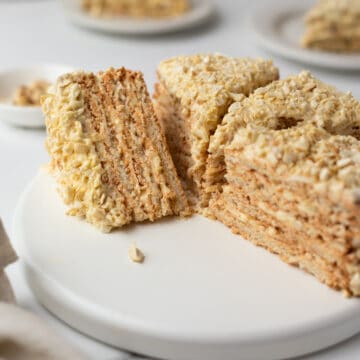
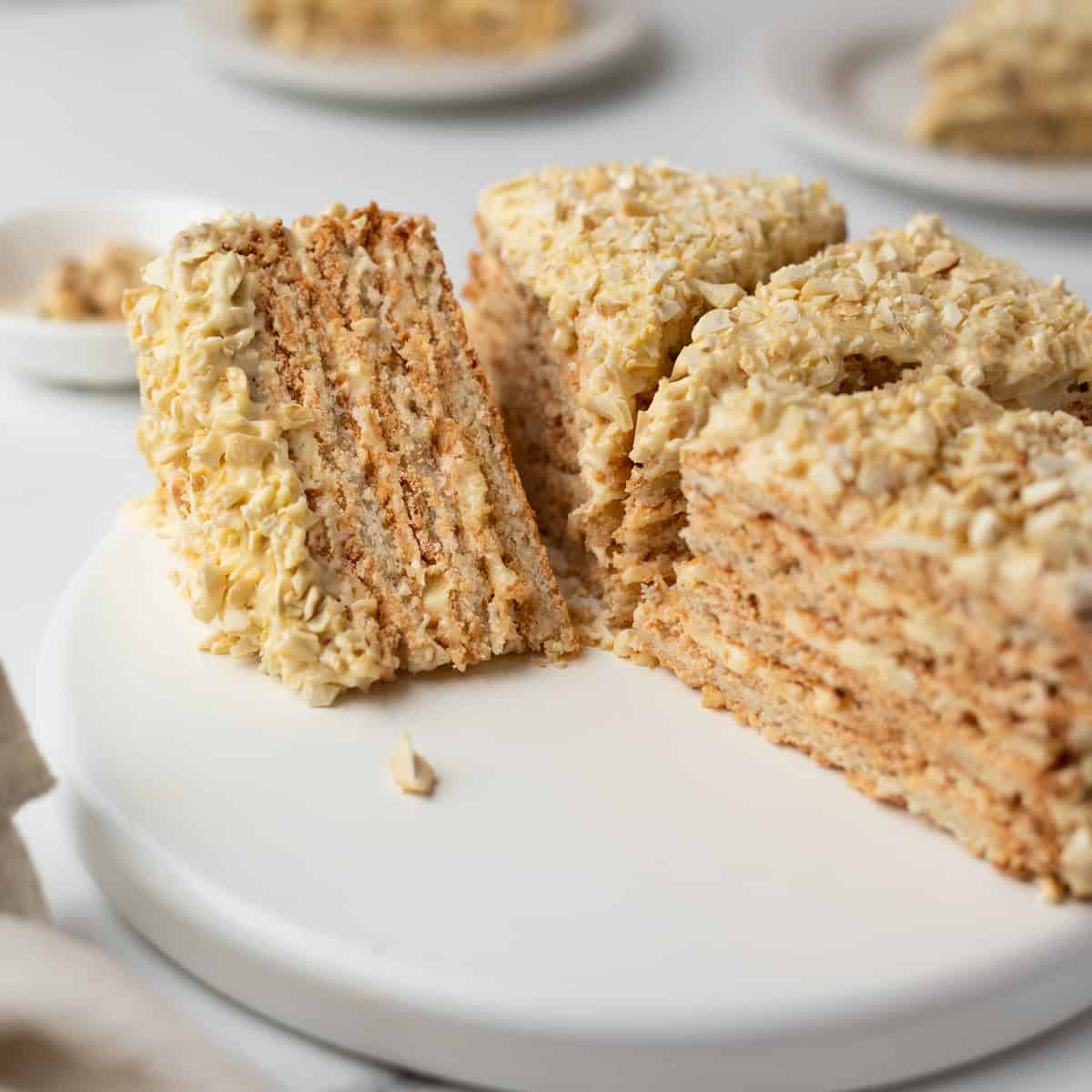
Sans Rival Cake (Filipino Cashew Meringue Cake)

Apr 3, 2024 · 194 Comments

Sliced Sans Rival cake on a cake board.

Sans Rival cake is the best Filipino cake. It is made with cashew meringue, luscious French buttercream, and roasted cashews, and it is perfect for birthdays, anniversaries, and other special occasions.

This Sans Rival recipe was among the first to appear on the website in 2018. It is a reader favorite, made by thousands of readers with five-star reviews.

Sliced Sans Rival cake on a cake board.

What is Sans Rival?

Sans Rival cake is a Filipino layer cashew cake made with cashew meringue sandwiched with French buttercream. As a Filipino dessert cake, it is of French origin, where "sans" means "without," and "rival" means "rival." So, cake Sans Rival is translated as a "cake without rival."

[feast_advanced_jump_to]

Nowadays, there are different cake versions, such as Pistachio Sans Rival, purple yam Sans Rival, and ube Sans Rival, as well as the cookie version - Silvanas.

The story behind the cake is that two sisters from the Philippines, Milagros Leelin-Yee and Clarita Leelin-Go, decided to reveal the secret recipe of the Sans Rival and published it in the Goldilocks Bakebook.

BAKING ESSENTIALS CHECKLIST

Sign up and get a list of the necessary baking tools and ingredients

FREE DOWNLOAD

I am sharing an authentic Goldilocks Sansrival recipe adapted for US and metric measurements. The cookbook's Sansrival icing is equivalent to classic French buttercream.

Ingredients

For ingredients and detailed instructions, refer to the recipe card below.

For cashew meringue:

  • Cashews: Use roasted, unsalted cashews for the best flavor and crunchy texture in the meringue. You can replace cashews with pistachios, peanuts, or other nuts if desired.
  • All-purpose flour: Helps bind the ingredients together.
  • Egg whites (room temperature): Provide volume and structure to the meringue. 
  • Cream of tartar or lemon juice: Helps to stabilize the egg whites.
  • Sugar: Use regular white sugar to whip up the meringue.

For French buttercream:

  • Egg yolks (room temperature): Create a rich, velvety buttercream frosting.
  • Vanilla extract: Adds flavor to the buttercream.
  • Unsalted butter: Choose butter with 82% fat content for the best flavor and texture.
  • Sugar: Use regular white sugar for sweetness.

How to make Sans Rival cake step-by-step

Step 1. Preheat the oven to 300°F (150°C). Butter and flour four 8-inch (20-cm) cake rings. Place prepared rings on a baking sheet layered with parchment paper.

Step 2. To make the cashew meringue, mix ground and chopped cashews and all-purpose flour in a mixing bowl and set aside.

Step 3. Using an electric mixer, beat large egg whites with cream of tartar at medium speed for 1 minute, gradually adding the sugar.

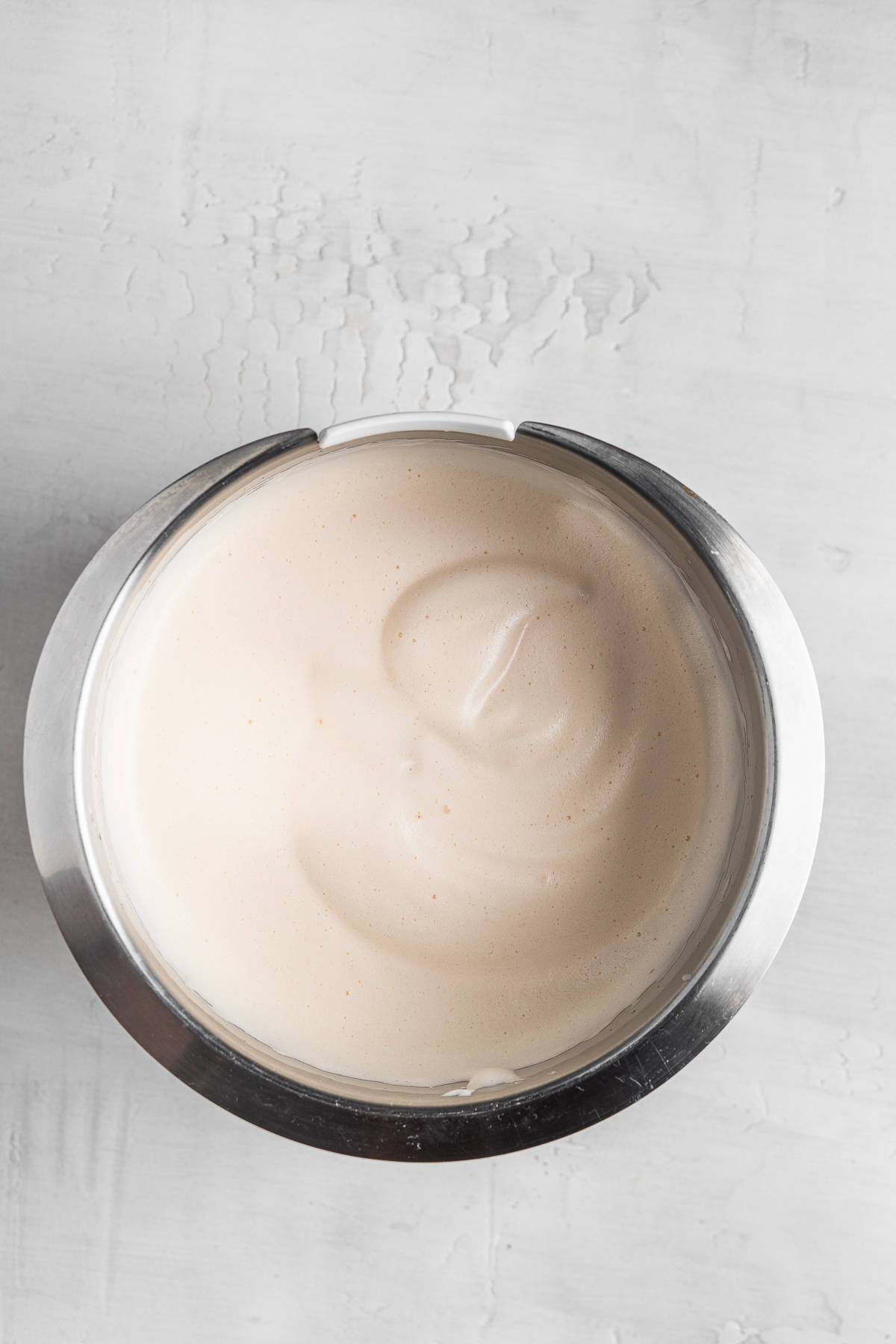
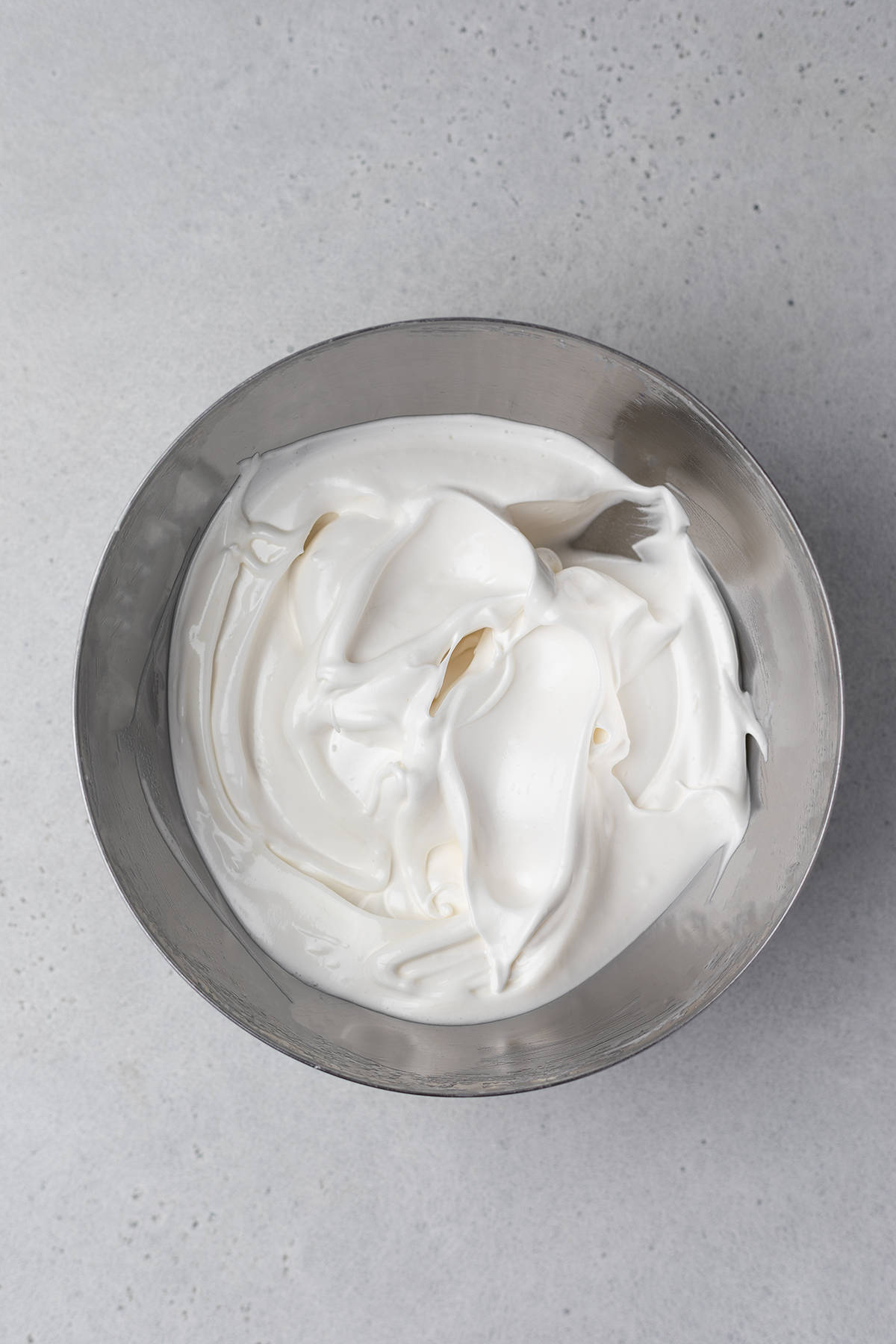
Step 4. Switch the mixer to medium-high speed and continue to beat the egg whites for about 4 to 5 minutes until medium peaks form. Avoid stiff peaks (photo 1).

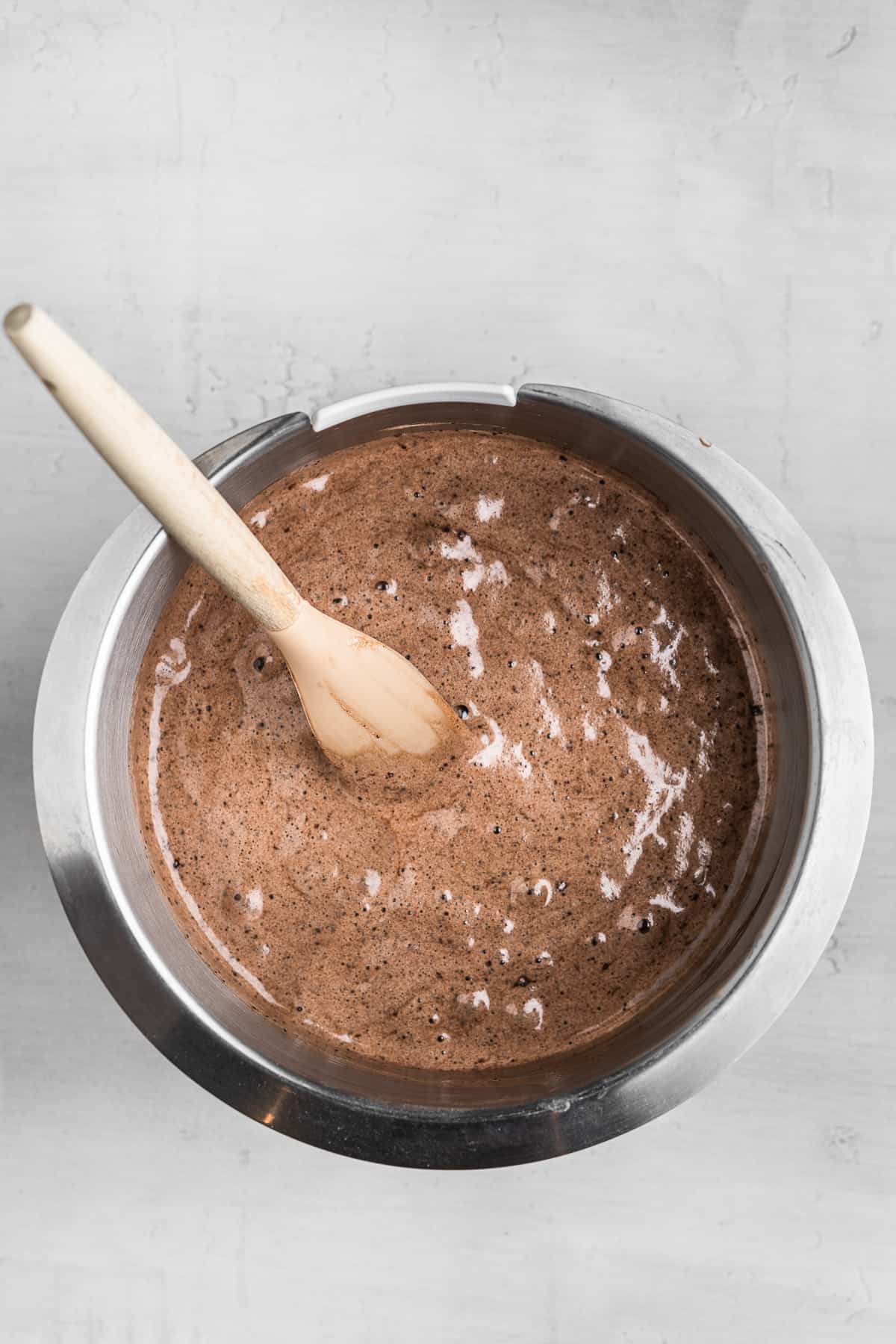
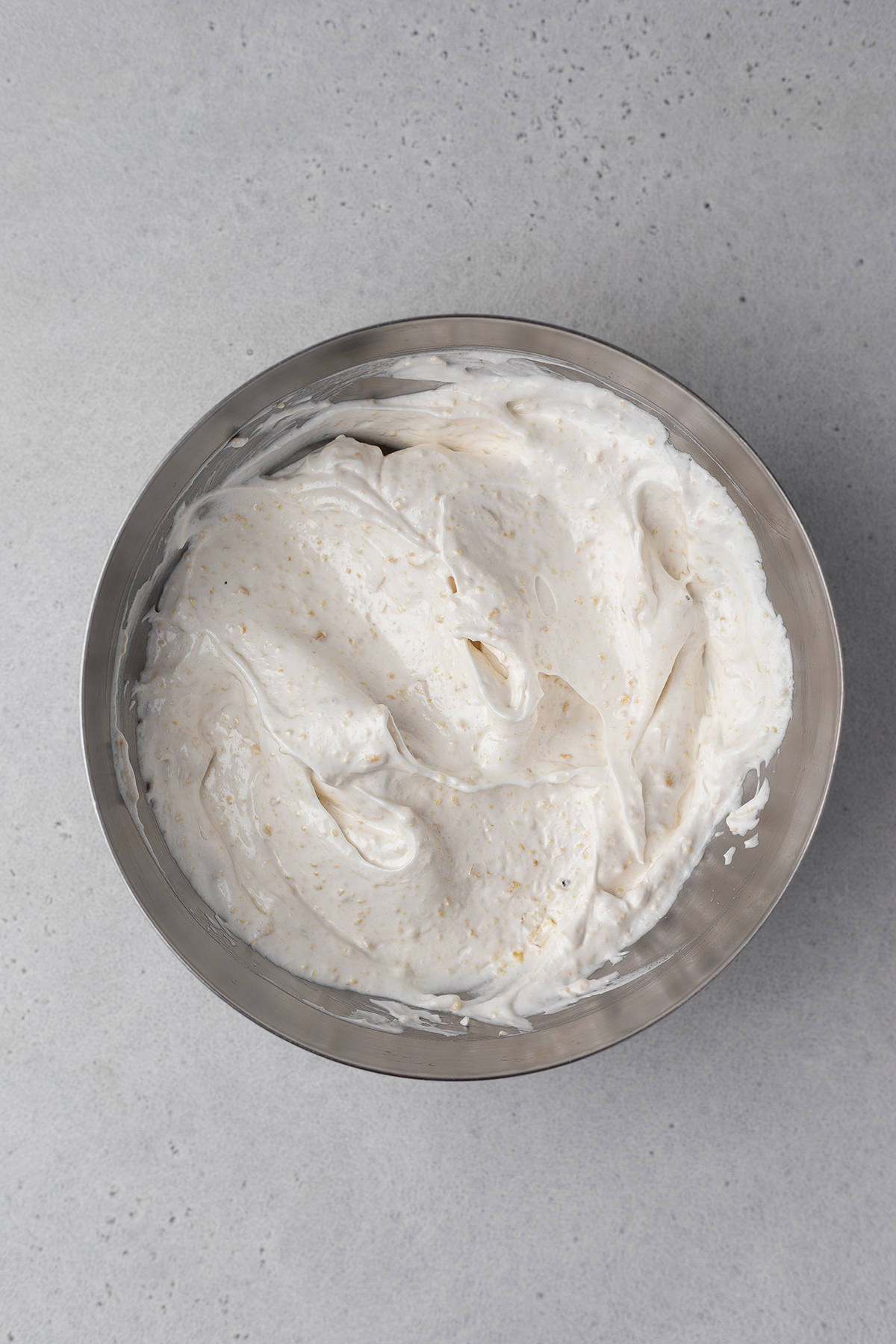
Step 5. Add the flour and nut mixture to the beaten egg whites and mix with a rubber spatula until well combined (photo 2).

Meringue in a metal bowl.

PHOTO 1

Cashew meringue in a metal bowl.

PHOTO 2

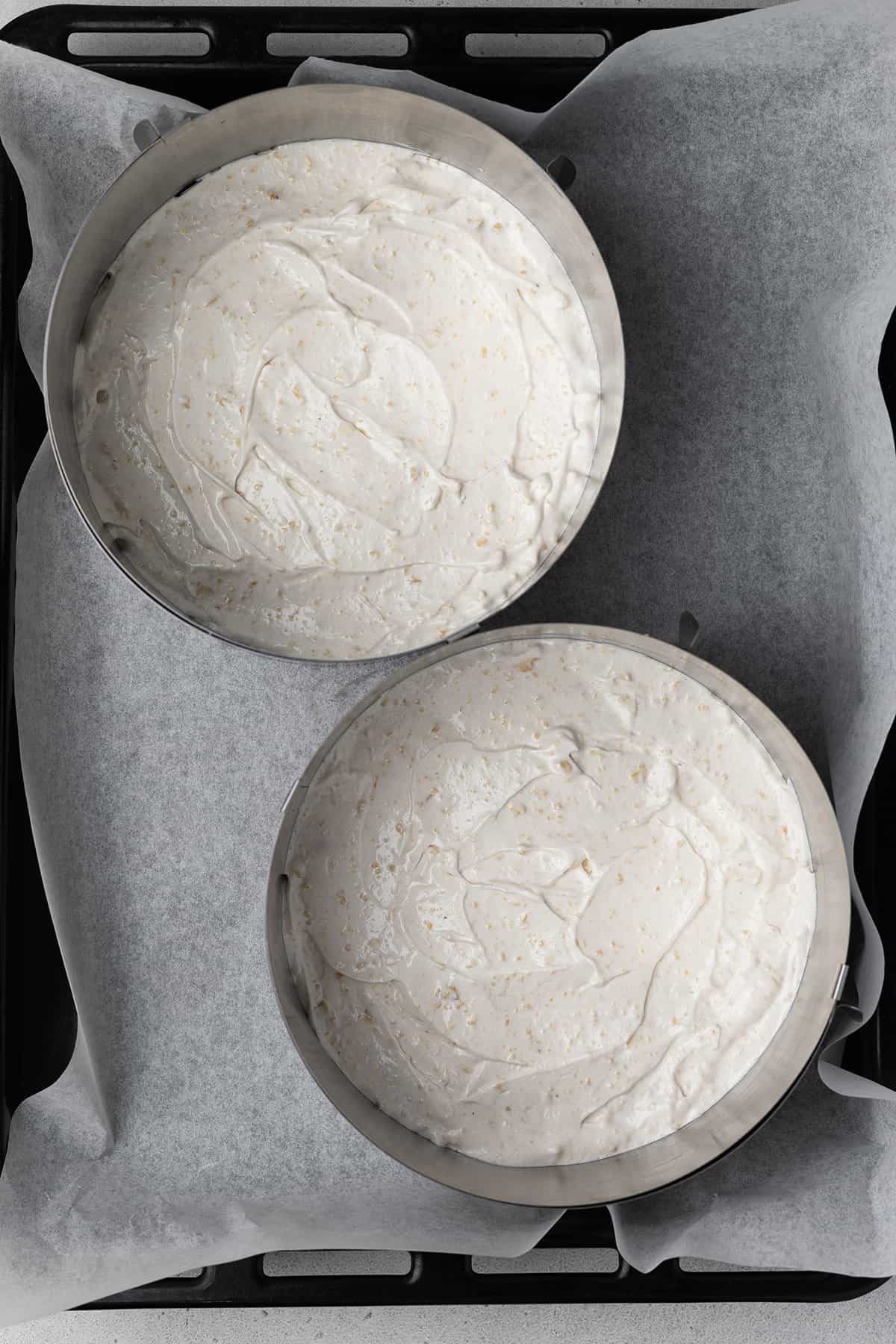
Step 6. Equally, divide the meringue into the prepared cake rings and spread it evenly using a small spatula, or just pipe it from a piping bag (photo 3).

Step 7. Bake the meringue in the preheated oven for 50 to 55 minutes until it is golden brown and dry (photo 4).

Meringue mixture in cake rings on parchment paper.

PHOTO 3

Baked nutty meringue on parchment paper.

PHOTO 4

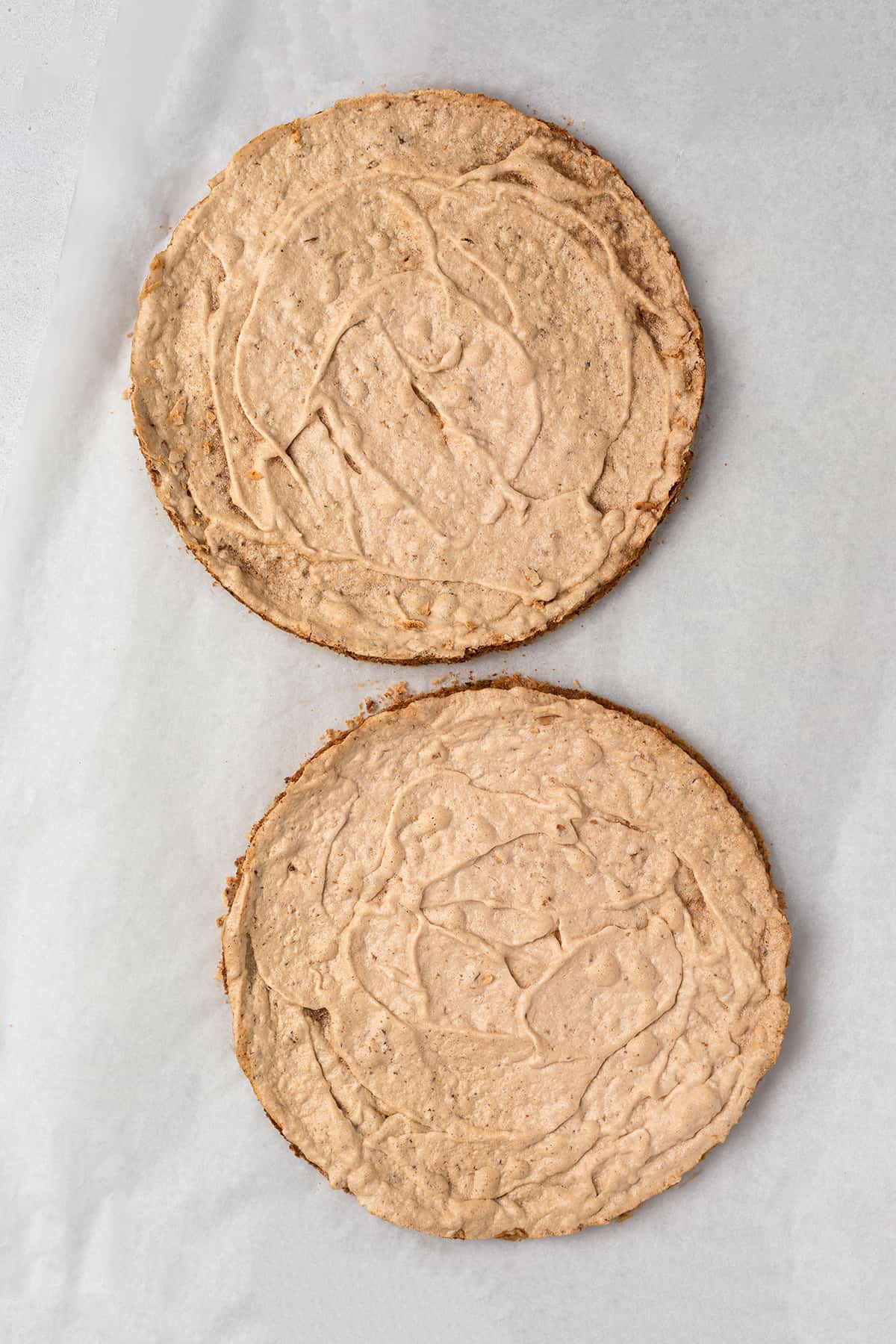
Step 8. Once the meringue disks are baked, immediately flip each onto another sheet of parchment paper. Peel off the parchment from the bottom and allow it to cool.

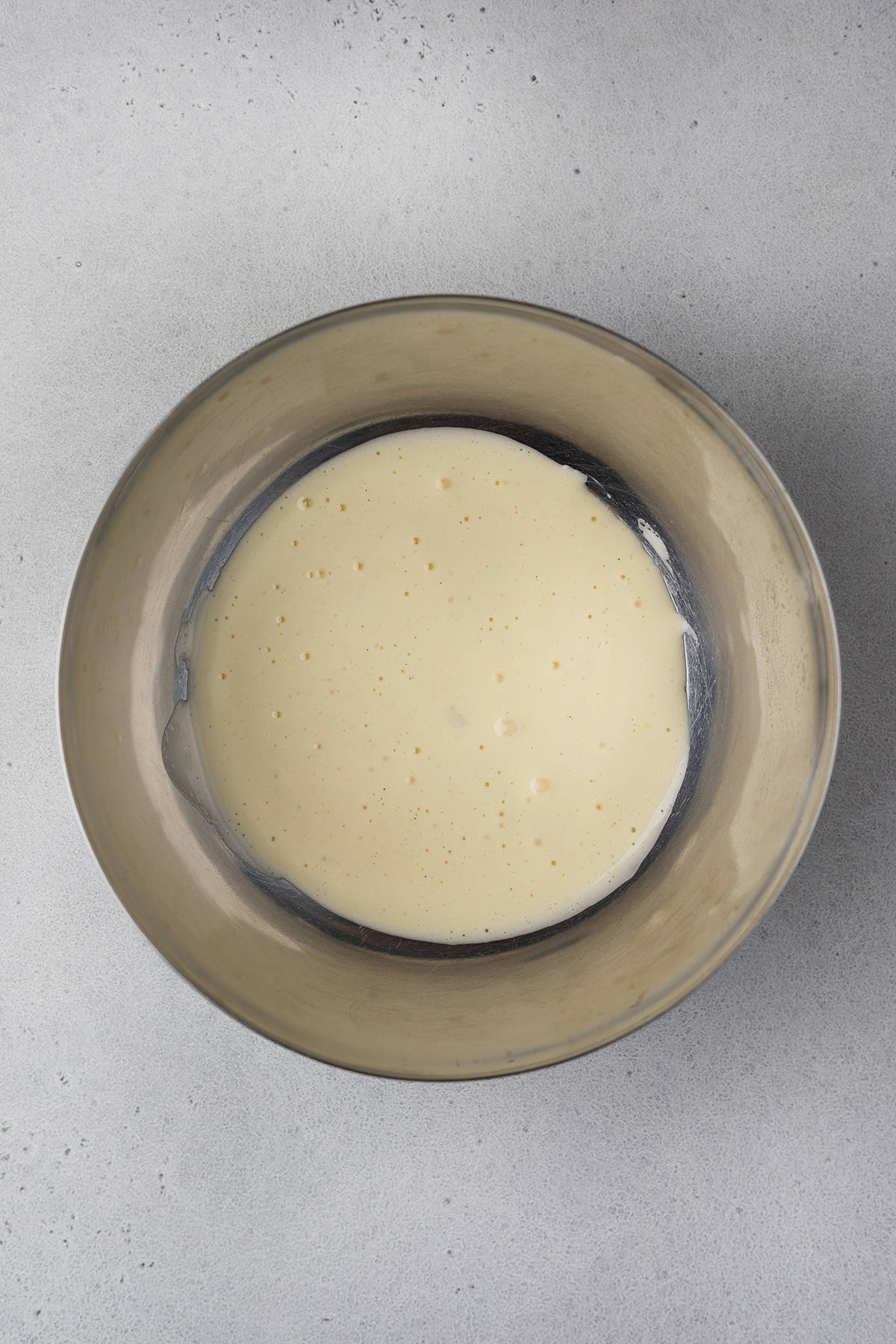
Step 9. To make French buttercream, beat egg yolks and vanilla extract at high speed with an electric mixer for 8 to 10 minutes (photo 5).

Step 10. Bring water and sugar in a heavy-bottomed small saucepan over low heat and cook the sugar syrup up to 240°F (115°C) - use a candy thermometer. Reset the mixer to low speed, gently pour the hot sugar syrup over the beaten egg yolks, and beat (photo 6).

Beaten egg yolks in a metal bowl.

PHOTO 5

Egg yolk and sugar mixture in a mixing bowl.

PHOTO 6

Pro tip: Without a cooking thermometer, you must reach a soft ball stage. Just transfer a small amount of hot syrup to cold water. If it forms a small, pliable ball, the sugar syrup has reached 240 degrees F (115 °C).

Step 11. Transfer the ready egg yolk and sugar mixture to another bowl, cover it with a plastic film, and let it cool.

Step 12. In a separate bowl, beat the softened butter at low speed until smooth. Switch the mixer to medium speed and continue to beat until the volume increases (photo 7).

Step 13. Reset the mixer to low speed again and add the cooled egg yolk and sugar mixture. Whisk until the buttercream is smooth (photo 8).

Whisked butter in a bowl.

PHOTO 7

French buttercream in a metal bowl.

PHOTO 8

Step 14. To assemble the cake, place the first meringue disk on a cake board or a serving plate. Using an offset spatula, spread the buttercream on top of the disk.

Step 15. Sprinkle with roasted chopped cashews. Repeat this operation with the remaining three meringue layers and the French buttercream (photo 9).

Step 16. Spread the buttercream over the top and edges of the cake. Sprinkle with roasted chopped cashews. Refrigerate for at least 2 hours (photo 10).

Assembling the cake: buttercream with chopped cashews.

PHOTO 9

Sans Rival cake topped with chopped cashews.

PHOTO 10

To serve, slice the cake with a sharp knife, and let the slices come to room temperature to soften the buttercream.

Expert Tips

  • Make two meringue discs at a time if you don't have four cake rings. In this case, make half of the meringue mixture and bake two disks. Then, make another half of the meringue and bake again.
  • Do not overbeat the meringue: you should reach medium peaks (not firm ones).
  • Adjust the baking time of your oven if needed. The recommended baking time is 50 to 55 minutes, but it could be less and rarely longer. The ready meringue disks have to be light brown and dry.
  • Use a cooking thermometer to check the correct temperature of the sugar syrup.
  • To roast cashews, heat the oven to 300°F (150°C) and roast nuts on a baking sheet for 15 minutes.
  • Use a food processor or blender to pulse cashews into fine crumbs, but avoid over-processing to prevent them from turning into cashew butter. Or use a rolling pin and a sealed plastic bag as a manual alternative.
  • Make-ahead option: Bake the meringue disks one day ahead and store them in an airtight container, or simply cover them with a kitchen towel. Make the buttercream the next day and assemble the cake.

How to store it

Store the cake under a glass dome in the refrigerator for 3 days. You can freeze it well-wrapped for up to 4 weeks. To thaw, bring the cake to the fridge overnight or to the kitchen counter for at least 2 hours.

Recipe FAQ

Can you bake meringue layers in baking pans?

It is not recommended to bake layers of cashew meringue in baking pans. The meringue can be tricky to remove. Use cake rings for the best results.

What is the difference between Silvanas and Sans Rival?

Silvanas are Filipino sandwich cookies made with cashew meringue, French buttercream, and ground cashews. They are a cookie version of the cake Sans Rival, perfect for sharing.

Is Sans Rival a dacquoise cake?

Sans Rival resembles the French dacquoise, but it isn't dacquoise. Authentic dacquoise is gluten-free and made with nutty meringue (almond or hazelnut). However, the Sans Rival cake is made with a small amount of all-purpose flour.

Love dacquoise desserts? Try these next!

  • Coconut Dacquoise Cake
  • Pistachio Dacquoise
  • Nougatine Cake
  • Or browse all the cake recipes.

Want more delicious and beautiful recipes? Subscribe to my newsletter and follow me on Facebook, Pinterest, and Instagram for my latest updates. If you make this recipe, please leave a star rating on the recipe card and comment below!

Print

Recipe card

Sans Rival Cake (Filipino Cashew Meringue Cake)

Sliced Sans Rival cake on a cake board.
Print Recipe
Save Recipe Recipe Saved

5 Stars 4 Stars 3 Stars 2 Stars 1 Star

4.9 from 55 reviews

Cake Sans Rival is the best Filipino cake, made with cashew meringue and French buttercream and finished with roasted chopped cashews. It's an irresistible recipe, perfect for birthdays, anniversaries, and other celebrations.

  • Author: Irina Totterman
  • Total Time: 3 hours
  • Yield: 12 1x
  • Category: Cakes
  • Method: Baking
  • Cuisine: Filipino

Ingredients

Scale

For the meringue:

  • ¾ cup (95 g) ground cashews (or cashew flour)
  • ½ cup (70 g) chopped cashews
  • ¼ cup (30 g) all-purpose flour
  • 6 large egg whites, room temperature
  • 1 teaspoon cream of tartar (or 2 teaspoons lemon juice) 
  • 1 cup + 2 tablespoons (225 g) granulated sugar

For French buttercream:

  • ¾ cup + 1 ½ tablespoons (170 g) granulated sugar
  • ¼ cup (55 ml) water
  • 6 egg yolks, room temperature
  • ⅛ teaspoon vanilla extract
  • 1 cup (235 g) softened unsalted butter, 82% fat content

For the decoration:

  • 1 ½ cups (105 g) roasted chopped cashews

*Don't you have the correct baking pan on hand right now? Try this simple Cake Pan Converter!

* If needed, please refer to Baking Conversion Charts.

Instructions

  1. Preheat oven to 300°F (150°C). Butter and flour four 8-inch (20 cm) cake rings. Place prepared rings on a baking sheet layered with parchment paper.
  2. To make the cashew meringue, mix ground and chopped cashews and all-purpose flour in a bowl and set aside.
  3. Beat egg whites with cream of tartar at medium speed for 1 minute using an electric mixer, gradually adding the sugar.
  4. Then switch the mixer to high speed and beat egg whites for about 4 to 5 minutes until medium peaks form. Add flour and nut mixture to the beaten egg whites and mix with a rubber spatula until well combined.
  5. Equally, distribute the preparation into the prepared cake rings and spread evenly, using a small spatula or just pipe from a pastry bag.
  6. Bake the meringue until light brown and dry for 50 to 55 minutes.
  7. Once the meringue disks are baked, immediately flip each of them onto another parchment paper sheet. Peel off the parchment from the bottom and allow it to cool.
  8. To make French buttercream, beat egg yolks and vanilla extract for about 8 to 10 minutes at high speed using an electric mixer.
  9. Bring water and sugar in a heavy bottom saucepan over low heat and cook sugar syrup up to 240°F (115°C).
  10. Reset the mixer to low speed and gently pour sugar syrup over the beaten egg yolks and beat. Transfer the ready egg yolks/sugar mixture to another bowl, cover with plastic film, and let it cool.
  11. Beat the softened butter at low speed until smooth in a separate bowl. Switch the mixer to medium speed and continue to beat until the volume increases. Reset the mixer to low speed again and add the cooled egg yolk and sugar mixture. Whisk until the buttercream is smooth.
  12. To assemble the cake, place the first meringue disk on a serving board. Spread the buttercream on top of the disk. Sprinkle with roasted chopped cashews.
  13. Repeat this operation with the remaining three meringue disks and French buttercream. Cover the top of the cake and its edges with buttercream. Sprinkle with roasted chopped cashews. Refrigerate for at least 2 hours.
  14. To serve, slice the cake with a sharp knife and let the slices come to room temperature to soften the buttercream.

Notes

  1. Use high-quality European-style unsalted butter (82% fat content).
  2. Replace cashews with pistachios, peanuts, or other nuts, and cream of tartar with a double amount of lemon juice.
  3. Make two meringue disks at a time if you don't have four cake rings. Make half of the meringue mixture in this case and bake two disks. Then, make another half of the meringue and bake again.
  4. Do not overbeat the meringue: you should reach medium peaks (not firm ones).
  5. Adjust the baking time of your oven if needed. The recommended baking time is 50 to 55 minutes, but it could be less and rarely longer. The ready meringue disks have to be light brown and dry.
  6. Use a cooking thermometer to check the correct temperature of the sugar syrup.
  7. To roast cashews, heat the oven to 300°F (150°C) and roast nuts on a baking sheet for 15 minutes.
  8. Use a food processor or blender to pulse cashews into fine crumbs, but avoid over-processing to prevent them from turning into cashew butter. Or use a rolling pin and a sealed plastic bag as a manual alternative.
  9. Make-ahead option: Bake the meringue disks one day ahead, store them in an airtight container, or cover them with a kitchen towel. The next day, make the buttercream and assemble the cake. 
  10. Store the cake under a glass dome in the refrigerator for 3 days.
  11. Freeze it well-wrapped for up to 4 weeks. To thaw, bring the cake to the fridge overnight or to the kitchen counter for at least 2 hours.

Nutrition

  • Serving Size: 1 slice
  • Calories: 436
  • Sugar: 30.1 g
  • Sodium: 197 mg
  • Fat: 31.9 g
  • Saturated Fat: 16.6 g
  • Carbohydrates: 36.2 g
  • Fiber: 0.5 g
  • Protein: 5.5 g
  • Cholesterol: 143 mg

Thank you for following me on Pinterest, Facebook, and Instagram. Hashtag #bakinglikeachef so I can see your creations.

The nutritional information has been calculated using an online recipe nutrition calculator such as Verywellfit.com and is intended for informational purposes only. These figures should be used as a general guideline and not be construed as a guarantee.
The recipe was adapted from http://usa.inquirer.net/. It was initially published in 2018 but was updated with new content and photos.

Pistachio Sans Rival Recipe

Mar 29, 2024 · 27 Comments

Sliced pistachio Sans Rival cake on a serving board.

Pistachio Sans Rival is a nutty twist on a classic Filipino cake Sans Rival. It'ss made with pistachio dacquoise sandwiched with French buttercream and generously sprinkled with crunchy pistachios. Pure yumminess.

Sliced pistachio Sans Rival cake on a serving board.

Pistachio Sans Rival recipe

Pistachio Sans Rival is a multilayered cake with light and crispy dacquoise layers sandwiched with rich French buttercream (aka Sansrival icing). The cake is topped with chopped pistachio nuts, ensuring that every bite is full of nutty flavor.

[feast_advanced_jump_to]

Since the 1920s and 1930s, when the cashew Sans Rival was probably invented, silvanas (a cookie version of the Sans Rival) and other cake variations were created.

BAKING ESSENTIALS CHECKLIST

Sign up and get a list of the necessary baking tools and ingredients

FREE DOWNLOAD

Great news! You don't need to travel to the Philippines to try the authentic Sans Rival, which is served in many cafes, coffee shops, and bakeshops (Goldilocks, Contis). You can make it yourself.

Ingredients

For ingredients and detailed instructions, refer to the recipe card below.

For pistachio dacquoise:

  • Pistachios: Use raw, unsalted pistachios and toast some to decorate the cake.
  • Egg whites (room temperature): Gives volume and structure to the meringue. 
  • Cream of tartar or lemon juice: Helps to stabilize the egg whites.
  • Sugar: Use caster sugar or superfine baker's sugar. You can process granulated sugar in a food processor for a few seconds to make your sugar superfine.

For French buttercream:

  • Egg yolks (room temperature): Create a rich, velvety buttercream frosting.
  • Unsalted butter: Choose butter with 82% fat content for the best flavor and texture.
  • Sugar: Use caster white sugar for sweetness.
  • Dark rum brings a beautiful flavor to the buttercream.

How to make pistachio Sans Rival step-by-step

  • Toast pistachios: Preheat oven to 300°F (150°C). Toast 1 ¼ cup (125g) pistachios for 15 minutes, then cool and chop.
  • Prepare cake rings: Reduce oven to 275°F (135°C). Line a baking sheet with parchment and place four 8-inch (20-cm) cake rings on top.
  • Make pistachio dacquoise: Beat egg whites with cream of tartar at medium speed, gradually adding sugar until soft peaks form. Increase speed and whisk until stiff peaks. Gently fold in chopped raw pistachios. Divide the mixture into cake rings, smooth with a spatula, or pipe into spirals. Bake for 1 hour until golden brown. Let rest 5 minutes, release edges with a knife, flip onto parchment, peel off the bottom layer, and cool completely.
  • Make French buttercream: Beat egg yolks at high speed until pale and doubled in volume (8-10 min). Heat sugar and water to 240°F (115°C). Reduce mixer speed, slowly pour in hot syrup while whisking, and beat for 4 minutes until cool. In another bowl, beat softened butter until smooth. Add egg yolk mixture and dark rum, beating until creamy.
  • Assemble the cake: Place the first dacquoise disc on a cake board with a dab of buttercream. Spread buttercream, sprinkle chopped pistachios, and repeat for all layers. Frost the top and sides with remaining buttercream, coat with chopped toasted pistachios, and refrigerate overnight.
Pistachio Sans Rival on a serving board.

Expert Tips

  1. Do not over-mix the dacquoise mixture when you add chopped nuts; just combine.
  2. If you have only two cake rings, make the dacquoise twice (half of the recipe and another half) and bake two discs at a time.
  3. Bake the dacquoise one day in advance and store it in an airtight container, or simply cover it with a tea towel.
  4. Bring the cake to the counter 30 minutes before serving for the buttercream to soften. The dessert tastes best at room temperature.

Recipe variations

  • Change nutty flavors. Use your favorite nuts, such as peanuts or almonds, to make peanut or almond cake variations or a Filipino classic - cashew Sans Rival.
  • Decorate as you desire. Leave the cake plain (just covered with buttercream) or garnish with nuts. You can sprinkle chopped nuts over the cake or coat the sides.
  • Make the cake larger or smaller, square or rectangular. Recalculate the ingredients using this simple cake pan converter.

Storing and freezing

Store the pistachio Sans Rival cake refrigerated for up to 3 days. It is better to use an airtight container, as the buttercream absorbs smells in the fridge.

Freeze the cake well wrapped for up to one week. To thaw, bring it to the refrigerator overnight. To serve, let it stay at room temperature for 30 minutes.

Chef Jill Sandique says, "You want it chewy, keep it in the fridge. Want it crunchy, keep it in the freezer."

Recipe FAQ

What's the Sans Rival meaning?

In French, Sans rival means 'unrivaled,' where sans means 'without' and rival means 'rival.' So cake Sans Rival means 'a cake without rival.'

What's the Goldilocks Sansrival?

Goldilocks Sans Rival is an authentic Filipino cake sold in the Goldilocks bakeshop in Mandaluyong City, Philippines, and in Goldilocks' locations in the USA.

Do you need to freeze the cake before serving it?

No, there is no need to freeze it before serving. Instead, take it out of the fridge 30 minutes before serving it on the table. This time is required for the buttercream to soften.

Want more delicious and beautiful recipes? Subscribe to my newsletter and follow me on Facebook, Pinterest, and Instagram for my latest updates. If you make this recipe, please leave a star rating on the recipe card and comment below!

Love dacquoise cakes? Try these next!

  • Coconut dacquoise on a cake board.
    Coconut Dacquoise Cake Recipe
  • Sliced almond cake covered with flaked almonds on a white platter.
    Best Italian Almond Cake Recipe (Gluten-Free)
  • Pistachio dacquoise decorated with fresh strawberries on a white serving platter with berries and flatware on background.
    Pistachio Dacquoise With Strawberries
  • A slice of almond nougatine cake dusted with icing sugar on a red dessert plate.
    Nougatine Cake (6 Ingredients)
Print

Recipe card

Pistachio Sans Rival

Sliced pistachio Sans Rival cake on a serving board.
Print Recipe
Save Recipe Recipe Saved

5 Stars 4 Stars 3 Stars 2 Stars 1 Star

5 from 18 reviews

Pistachio Sans Rival is a nutty twist on a classic Filipino cake Sans Rival. Made with pistachio dacquoise stacked with rich French buttercream and generously sprinkled with crunchy pistachios, it is the most beautiful Filipino dessert cake.

  • Author: Irina Totterman
  • Total Time: 3 hours
  • Yield: 12 1x
  • Category: Cakes
  • Method: Baking
  • Cuisine: Filipino
  • Diet: Gluten Free

Ingredients

Scale

For pistachio dacquoise:

  • 6 large egg whites, room temperature
  • ¾ tablespoon cream of tartar
  • 1 cup (225 g) caster sugar
  • 1 cup (100 g) raw pistachios, finely chopped

For French buttercream:

  • ¾ cup (170 g) caster sugar
  • ½ cup (110 ml) water
  • 9 large egg yolks, room temperature
  • 1 ½ cups (235 g) unsalted butter, softened and cut into cubes
  • ½ teaspoon dark rum

For the decoration:

  • 1 ¼ cup (125 g) raw pistachios

* If needed, please refer to Baking Conversion Charts.

**Don't you have the correct baking pan on hand right now? Try this simple Cake Pan Converter!

Instructions

  1. Preheat oven to 300°F (150°C). Place 1 ¼ cup (125 g) raw pistachios on a baking sheet and bring them to the oven to toast for 15 minutes. Let the nuts cool, chop, and set aside for decoration.

  2. Decrease oven temperature to 275°F (135°C). Place four 8 inches (20 cm) cake rings on a baking sheet layered with parchment.

  3. To make pistachio dacquoise, place egg whites with cream of tartar in the bowl of a stand mixer fitted with the whisk attachment. Beat egg whites at medium speed for 1 minute, gradually adding sugar until soft peaks.

  4. Switch the mixer to high speed and whisk the meringue for about 4 to 5 minutes until stiff peaks. Add chopped raw pistachios and gently mix with a rubber spatula until just combined.

  5. Divide the meringue preparation equally into the prepared cake rings and spread evenly with a small spatula. Instead, you can pipe the pistachio mixture as a spiral using a pastry bag fitted with Ateco plain pastry tip 809.

  6. Bake for 1 hour or until lightly golden brown. Let cool for 5 minutes; use a small knife to release the edges of the dacquoise discs, and remove the cake rings. Then, flip each of the discs onto another sheet of parchment paper. Finally, peel off the parchment from the bottom and allow it to cool completely.

  7. To make the buttercream, whip egg yolks at high speed, using an electric mixer or stand mixer, until pale and doubled in volume, for about 8 to 10 minutes.

  8. Bring water and sugar in a heavy-bottomed saucepan over low heat. Cook sugar syrup until it reaches 240°F (115°C): use a cooking thermometer.

  9. Reset the mixer to low speed, and while whisking, pour the hot sugar syrup in thin streams into the beaten egg yolks and beat until the preparation cools down, for about 4 minutes. In a separate mixing bowl, beat the softened butter at low speed until smooth. Increase speed to medium, add the egg yolk/sugar mixture, and then dark rum. Beat until smooth and creamy.

  10. To assemble the cake, place a cake board on a flat surface and dot a little bit of the buttercream filling in the center of the board. Place the first dacquoise disc on the board and gently press to fix it. Spread buttercream on the top of the disc. Sprinkle with chopped pistachios.

  11. Repeat the process with the remaining three discs and the buttercream. Cover the top and sides of the torte with the remaining buttercream using a bent spatula. Sprinkle it all over with chopped toasted pistachios. Refrigerate overnight.

Notes

  1. Do not over-mix the dacquoise mixture when you add chopped nuts: just combine.
  2. If you have only two cake rings, you will need to make the dacquoise twice (half and half) and bake two discs at a time.
  3. Bake dacquoise one day in advance and store it in an airtight container, or simply cover it with a tea towel.
  4. Bring the cake to the counter 30 minutes before serving for the buttercream to soften. The dessert tastes best at room temperature.

Nutrition

  • Serving Size: 1 slice
  • Calories: 419
  • Sugar: 34.6 g
  • Sodium: 25 mg
  • Fat: 27.6 g
  • Saturated Fat: 12.3 g
  • Carbohydrates: 39.1 g
  • Fiber: 1.9 g
  • Protein: 7.9 g
  • Cholesterol: 199 mg

Thank you for following me on Pinterest, Facebook, and Instagram. Hashtag #bakinglikeachef so I can see your creations.

The nutritional information has been calculated using an online recipe nutrition calculator such as Verywellfit.com and is intended for informational purposes only. These figures should be used as a general guideline and not be construed as a guarantee.
The recipe was adapted from Heny Sison's recipe. It was initially published on December 31, 2021, but has been revised to include improved content and photos.

Triple Berry Cake

Mar 27, 2024 · 1 Comment

A single slice of berry cake on a white dessert plate.

This gorgeous triple berry cake is made with Genoise cake layers, filled with luscious mascarpone filling, and decorated with fresh mixed berries. It is perfect for a dinner party, birthday celebration, or another special occasion.

A single slice of berry cake on a white dessert plate

Berry cake recipe

This simple berry cake is made with basic ingredients and berries of your choice. Thanks to the vibrant colors and flavors of fresh red fruit, it makes the best birthday berry cake in summer.

[feast_advanced_jump_to]

It pairs wonderfully with sparkling wines and champagne, creating a perfect dessert for a romantic ambiance.

BAKING ESSENTIALS CHECKLIST

Sign up and get a list of the necessary baking tools and ingredients

FREE DOWNLOAD

The berry cake recipe comes with a make-ahead option for your convenience. Prepare Genoise cake in advance to save time and ensure a stress-free baking experience.

Ingredients

For ingredients and detailed instructions, refer to the recipe card below.

  • Eggs: Use large-sized whole eggs at room temperature. Bring them to the kitchen counter about an hour before you start.
  • Sugar: Use white granulated or caster sugar. Use superfine sugar for mascarpone frosting.
  • All-purpose flour
  • Unsalted butter with 82% fat content.
  • Heavy cream or heavy whipping cream with at least 30% fat content.
  • Mascarpone cheese brings a beautiful taste and flavor and also helps stabilize the whipped cream.
  • Vanilla extract brings a beautiful flavor.
  • Fresh berries: fresh blueberries, strawberries, and raspberries. Three types of berries are just enough, although you can experiment with other combinations.
  • Flaked almonds: Toast them in the oven at 300°F (150°C) for 10-15 minutes. But keep an eye on their color!
Sliced triple berry cake on a white serving platter

How to make berry cake step-by-step

Step 1. To make Genoise cake, heat oven to 355°F (180°C). Butter and flour the bottom and the sides of the 8-inch (20 cm) round pan (or springform pan). Melt the butter in the microwave and let it cool.

Pro tip: Consult the Genoise sponge cake recipe for step-by-step photographed explanations, helpful tips, and tricks.

Step 2. In the heat-proof bowl, place eggs and sugar and beat with a hand whisk a few times.

Step 3. Bring the bowl over a water bath or bain-marie with hot water and whisk the egg mixture until foamy. Warm it to 104°F (40°C): check with a cooking thermometer. If unavailable, the mixture should be warm to the touch.

Step 4. Bring the bowl to the counter and beat the preparation with an electric hand mixer (you can use a stand mixer with a whisk attachment) for 10 minutes until the ribbon stage.

Step 5. Sift half the flour over the bowl and mix with a rubber spatula from the bottom to the top. Add the remaining flour and gently mix.

Step 6. Mix a few spoonfuls of the batter with the warm melted butter and add to the principal preparation. Gently mix the batter, making sure it does not deflate.

Step 7. Pour the cake batter into the prepared baking dish. Bake in the middle oven rack for 30-35 minutes until golden brown. Check the cake for doneness with a toothpick: it should come out clean after inserting it in the center of the cake.

Step 8. Remove it from the oven and rest for 5-10 minutes. Then turn the pan on a cooling rack, allowing the cake to slide off. Let the cake cool completely.

Step 9. To make sugar syrup, pour water and sugar into a small saucepan and bring to a boil. Remove from the heat, add vanilla extract or strawberry liqueur (optional), and let the syrup cool.

Step 10. To make mascarpone whipped cream, bring the bowl of a stand mixer or a large mixing bowl to the freezer for 10 minutes.

Pro tip: Consult a mascarpone frosting recipe for step-by-step photographed explanations, helpful tips, and tricks.

Step 11. Pour the cold heavy cream, add cold mascarpone, and whisk at low speed until soft peaks (photo 1).

Step 12. Add the caster sugar and continue beating at medium, then high speed. The cream will go through medium peaks until stiff peaks (photo 2).

Photo 1: Mixer beaters with soft cream peaks Photo 2: Beaters with firm cream peaks
PHOTO 1 PHOTO 2

Step 13. To assemble the cake, cut a few strawberries into half, then into more slices each, and place aside (photo 3).

Step 14. Adjust a mousse cake mold cake to a diameter of 8 inches (20 cm) and line it with an acetate strip. Place it on a cake board or a serving plate.

Step 15. Use a large serrated knife or a cake leveler to cut the cake into three sponge layers. Place the first cake layer inside the ring (photo 4) and soak the cake with the cold sugar syrup using a pastry brush.

Photo 3: Strawberry pieces on a cutting board Photo 4: Sponge layer in a cake ring
PHOTO 3 PHOTO 4

Step 16. Add ⅓ of the mascarpone filling and spread it with a spoon or spatula. Place a handful mix of berries over the cream, sinking them slightly (photo 5).

Step 17. Add the second cake layer and slightly press it to adhear to the cream. Soak it, and fill it with cream and a new layer of berries. Place the third layer of cake and press it slightly.

Step 18. Cover the ring with plastic wrap and refrigerate for 2-3 hours. Using plastic film, cover the bowl with the cream and chill until the cake is firmed up.

To serve, take the cake and cream from the fridge. Remove the ring and acetate collar. Coat the top and sides of the cake with the remaining cream with the spatula. Sprinkle the cake's sides with toasted flaked almonds (photo 6).

Photo 5: Fresh berries over the cream layer Photo 6: Flaked almonds over the cake's sides
PHOTO 5 PHOTO 6

Decorate the top of the cake with the remaining berries, dust with confectioners' sugar (if desired), and serve.

Assembled fresh berry cake on a cake board

Expert Tips

  1. Don't skip the soaking of the cake. Genoise cake requires additional moisture during the assembling process.
  2. Alternate the layers of berries if desired: a layer of raspberries, blueberries, and strawberries.
  3. If you plan to serve the cake within 1-2 hours, you may complete its entire preparation without using a mousse cake ring. However, if you plan to do it later, it is advisable to finish coating and decorating the cake just before serving to preserve the freshness of the red berries on top.
  4. Recalculate ingredients for cake pans of different sizes using this simple cake pan size converter.
  5. Make ahead option: Bake Genoise cake in the evening and store it covered with plastic wrap at room temperature. Finish the cake the next day.

Recipe variations

  • Berry layer cake: Cut a Genoise cake into two equal layers and adjust the frosting quantity by reducing it by 25%.
  • Berries and cream cake: Swap the mascarpone frosting for sugar-free whipped cream, cream cheese, sour cream frosting, or Chantilly cream. All the options make a great berry and cream combination and are easy to make. You can mix berries and cream but don't forget to save some cream for covering the cake.
  • Milk and berry cake: Soak the cake layers with tres leches syrup. Make it yourself by stirring equal parts of evaporated milk and sweetened condensed milk, mixed with one-quarter the amount of heavy cream.
  • Fresh berry cake: Play with fresh berry filling by exploring other flavor combinations and having fun creating your perfect berry cake. Depending on the time of year, select your preferred berry cake, ranging from mixed or triple berry cake to single berry options.

Storing and freezing

Keep the berry cake under a glass dome to prevent it from drying out and absorbing the odors of other foods in the refrigerator for up to 2-3 days. 

Store the leftover cake in an airtight container.

Freezing an assembled berry cream cake is not recommended, but you can bake the Genoise cake ahead and freeze it for up to 3 months.

Recipe FAQ

Can you use frozen berries in a cake?

While in most cases, you can make a berry cake with frozen berries but not prepare a layer cake with cream frosting. This is because thawed berries release extra juices and can't be used between cake layers and for decoration.

Which berry is the sweetest?

Among the various types of berries, red raspberries are the sweetest, claiming the top spot in natural sweetness.

Love fresh fruit desserts? Try these next!

If you like this easy berry cake, check out other fruit dessert recipes, from simple mixed red fruit muffins to elaborate Coconut Dacquoise cake with berries on top.

  • Strawberry Charlotte
  • Mixed Berry Muffins
  • French Strawberry Tart
  • Coconut Dacquoise Cake
  • Uruguayan Cake Chaja
  • Jordgubbstårta (Swedish Strawberry Cake)
  • Triple Berry Cake
  • Fresh Fruit Cake

Want more delicious and beautiful recipes? Subscribe to my newsletter and follow me on Facebook, Pinterest, and Instagram for my latest updates. If you make this recipe, please leave a star rating on the recipe card and comment below!

Print

Recipe card

Triple Berry Cake

A single slice of berry cake on a white dessert plate.
Print Recipe
Save Recipe Recipe Saved

5 Stars 4 Stars 3 Stars 2 Stars 1 Star

5 from 1 review

This gorgeous triple berry cake is made with Genoise cake layers, filled with luscious mascarpone filling, and decorated with fresh mixed berries. It is perfect for a dinner party, birthday celebration, or another special occasion.

  • Author: Irina Totterman
  • Total Time: 1 hour, 15 minutes (plus chilling time)
  • Yield: 8 1x
  • Category: Cakes
  • Method: Baking
  • Cuisine: American

Ingredients

Scale

For Genoise cake:

  • 4 large eggs, room temperature
  • ½ cup + 1 ½ tablespoons (120 g) granulated sugar
  • ⅔ cup + 4 ½ tablespoons (120 g) all-purpose flour
  • 2 tablespoons (30 g) unsalted butter, melted and cooled

For syrup:

  • ⅓ cup (75 ml) water
  • ¼ cup (50 g) granulated sugar
  • 1 teaspoon vanilla extract

For mascarpone whipped cream:

  • 1 ½ cups (355 g) cold heavy cream, 30% fat
  • 2.5 oz. (70 g) cold mascarpone cheese
  • 2 tablespoons (30 g) caster sugar

For filling and decoration:

  • 1 ½ lb (660 g) mixed fresh fruit (strawberries, raspberries, blueberries)
  • 2.5 oz. (70 g) toasted flaked almonds

Instructions

  1. To make Genoise cake, heat the oven to 355°F (180°C). Butter and flour the bottom and the sides of the 8-inch (20 cm) round pan (or springform pan). Melt the butter in the microwave and let it cool.

  2. In the heat-proof bowl, place eggs and sugar and beat with a hand whisk a few times. Bring the bowl over a water bath or bain-marie with hot water and whisk the egg mixture until foamy. Warm it to 104°F (40°C): check with a cooking thermometer. If unavailable, the mixture should be warm to the touch.

  3. Bring the bowl to the counter and beat the preparation with an electric hand mixer (you can use a stand mixer with a whisk attachment) for 10 minutes until the ribbon stage. Sift half the flour over the bowl and mix with a rubber spatula from the bottom to the top. Add the remaining flour and gently mix. Mix a few spoonfuls of the batter with the warm melted butter, and add to the principal preparation. Gently mix the batter, making sure it does not deflate. 

  4. Pour the cake batter into the prepared baking dish. Bake in the middle oven rack for 30-35 minutes until golden brown. Check the cake for doneness with a toothpick: it should come out clean after inserting it in the center of the cake. Remove it from the oven and rest for 5-10 minutes. Then turn the pan on a cooling rack, allowing the cake to slide off. Let the cake cool completely. 

  5. To make the sugar syrup, pour water, sugar into a small saucepan and bring to a boil. Remove from the heat, add vanilla extract or strawberry liqueur (optional), and let the syrup cool down. 

  6. To make mascarpone whipped cream, bring the bowl of a stand mixer or a large mixing bowl to the freezer for 10 minutes. Pour the cold heavy cream, add cold mascarpone, and whisk at low speed until soft peaks. Add the caster sugar and continue beating at medium, then high speed. The cream will go through medium peaks until stiff peaks. 

  7. To assemble the cake, cut a few strawberries into half, then into more slices each, and place aside. Adjust a mousse cake ring to a diameter of 8 inches (20 cm) and line it with an acetate strip. Place it on a cake board or a serving plate. 

  8. Use a large serrated knife or a cake leveler to cut the cake into three sponge layers. Place the first cake layer inside the ring and soak the cake with the cold sugar syrup using a pastry brush. Add ⅓ of the mascarpone filling and spread it with a spoon or spatula. Place a handful mix of berries over the cream, sinking them slightly. 

  9. Add the second cake layer and slightly press it to adhear to the cream. Soak it, and fill it with cream and a new layer of berries. Place the third layer of cake and press it slightly. Cover the ring with plastic wrap and refrigerate for 2-3 hours. Cover the bowl with the cream using plastic film and chill until the cake is firmed up. 

  10. Once ready to serve, take the cake and cream from the fridge. Remove the ring and acetate collar. Coat the top and sides of the cake with the remaining cream with the spatula. Sprinkle the cake's sides with toasted flaked almonds. Decorate the top of the cake with the remaining berries, dust with confectioners' sugar (if desired), and serve.

Notes

  1. Don't skip the soaking of the cake. Genoise cake requires additional moisture during the assembling process.
  2. Alternate the layers of berries if desired: a layer of raspberries, blueberries, and strawberries.
  3. If you plan to serve the cake within 1-2 hours, you may complete its entire preparation without using a mousse cake ring. However, if you plan to do it later, it is advisable to finish coating and decorating the cake just before serving to preserve the freshness of the red berries on top.
  4. Recalculate ingredients for cake pans of different sizes using this simple cake pan size converter.
  5. Make ahead option: Bake Genoise cake in the evening and store it covered with plastic wrap at room temperature. Finish the cake the next day.

Nutrition

  • Serving Size: 1 slice
  • Calories: 783
  • Sugar: 54.5 g
  • Sodium: 64 mg
  • Fat: 34.5 g
  • Saturated Fat: 15.5 g
  • Carbohydrates: 114.3 g
  • Fiber: 41.1 g
  • Protein: 15.6 g
  • Cholesterol: 172 mg

Thank you for following me on Pinterest, Facebook, and Instagram. Hashtag #bakinglikeachef so I can see your creations.

The nutritional information has been calculated using an online recipe nutrition calculator such as Verywellfit.com and is intended for informational purposes only. These figures should be used as a general guideline and not be construed as a guarantee.
Kyiv Cake (Classic Ukrainian Cake)

Jan 27, 2024 · Leave a Comment

Sliced Kiev cake on a dessert board.

Kyiv cake, or Kiev cake, is a classic Ukrainian cake made with two hazelnut meringue layers sandwiched with Charlotte cream. It is crunchy, sweet, and delicious. Just the best among Slavic cakes.

Sliced Kiev cake on a dessert board.

Kyiv cake recipe

Kyiv cake, also known as Kievsky cake or Kievsky tort, is a hazelnut meringue cake and one of the most well-known Ukrainian cakes. Kyiv cake is as iconic in Ukraine as Tiramisu is in Italy and Sans Rival is in the Philippines.

[feast_advanced_jump_to]

Invented in the 1950s, Kyiv cake was initially made with cashew nuts. The modern version now features rich hazelnuts and is my absolute favorite.

BAKING ESSENTIALS CHECKLIST

Sign up and get a list of the necessary baking tools and ingredients

FREE DOWNLOAD

Despite many recipe variations, including sponge cake layers, I offer you the authentic Kievsky cake recipe made at Karl Marx confectionery factory (now Roshen company).

It is prepared with two layers of crunchy hazelnut meringue alternating with layers of cognac-infused buttercream. A special occasion cake is perfect for a birthday or other celebration. 

Ingredients

For ingredients and detailed instructions, refer to the recipe card below.

Kyiv cake has a few ingredients, but everything comes together due to a special technique of making nut meringue and Charlotte cream.

  • Large eggs at room temperature. You will need to separate the egg whites from the yolks and let the egg whites age. While the original Kiev cake recipe calls for aging egg whites for 12 hours, I don't recommend going over 2 hours following FDA Food safety handling rules.
  • Sugar: Use granulated or caster sugar for the nut meringue, plus some vanilla sugar.
  • Flour: Just all-purpose flour, the same as plain flour.
  • Roasted hazelnuts, either store-bought or homemade. Follow this recipe for roasting hazelnuts.
  • Whole milk with 3.2% milk fat. Please avoid low-fat and skimmed milk.
  • Unsalted butter: This recipe requires top-quality European-style butter with an 82% fat content.
  • Cognac or dark rum to flavor the butter-based cream.
  • Unsweetened cocoa powder: I always use

How to make Kyiv cake (step-by-step instructions)

Step 1. Separate the egg whites from the egg yolks. Cover the bowl containing the egg yolks with plastic film and refrigerate.

Step 2. Keep the whites at room temperature (uncovered) for 2 hours. Then, warm the mixer bowl by rinsing it with hot water and dry it. Add the egg whites to the bowl and warm them to 75-76°F (23-24°C), checking with a cooking or infrared thermometer.

Pro tip: If you live in Europe, use eggs safely stored at room temperature (not in the fridge). This won't affect the taste of the finished cake.

Step 3. Preheat the oven to 300°F (150°C). Grind the roasted hazelnuts into coarse crumbs in short pulses using a food processor (photo 1). Alternatively, you can utilize a knife to chop hazelnuts.

Step 4. Mix the prepared nuts, 1 ⅛ cup (225 g) of sugar (#1), and sifted all-purpose flour (photo 2).

Chopped hazelnuts in a bowl.

PHOTO 1

Flour and nut mixture in a bowl.

PHOTO 2

Step 5. Place the egg whites in the metal bowl of a stand mixer fitted with a whisk attachment. Beat at a low speed, gradually increasing it to medium. With the first small bubbles, start adding sugar.

Step 6. Add the remaining sugar #2 (¼ cup or 50 g) in two additions, each time whisking well for 30 seconds. Add the vanilla sugar and continue whisking at medium or speed for 4-5 minutes. The meringue will become glossy with stiff peaks (photo 3) and hold its shape on the beaters with a stable bird's beak.

Step 7. Pour dry ingredients into the whisked egg whites in three additions and gently mix with a rubber spatula from the bottom to the top (photo 4). Try to work in one direction: from the center of the bowl to the sides, turning the bowl clockwise with another hand. Don't overmix-mix to combine!

Meringue in a metal bowl.

PHOTO 3

Meringue and hazelnut mixture in a bowl.

PHOTO 4

Step 8. Place two cake rings, one 7 inches (18 cm) in diameter and the other 8 inches (20 cm) in diameter, on a baking sheet lined with parchment paper. Don't grease the sides of the rings.

Step 9. Divide the meringue mixture between two cake molds, ensuring the meringue height is the same. Smooth the surface of the meringue with a spatula (photo 5).

Pro tip: Use two clean toothpicks to check the height of the meringue in both rings.

Step 10. Bake in the preheated oven for about 2 hours, until the meringue layers are slightly browned. Don't open the oven door for the first 90 minutes.

Pro tip: If the cakes darken quickly, try to bake the meringue disks with the oven ajar or shorten the baking time.

Step 11. Remove the cakes from the oven and allow them to cool still in the cake rings. Leave them uncovered at room temperature for 12-24 hours (still in the cake rings!)

Step 12. The next day, use a knife to remove the cake layers and carefully peel the parchment paper.

Step 13. Place the smaller cake disk on top of the larger cake disk and cut to one size (photo 6). You will have two cake discs with a diameter of 7 inches (18 cm) and a thickness of 1.2 inches (3 cm). Collect the scraps and crush them into crumbs by hand.

Meringue nut mixture in two cake rings.

PHOTO 5

Two meringue cake layers with scraps.

PHOTO 6

Step 14. To make the Charlotte cream, pour milk into a heavy-bottomed medium saucepan and add sugar. Bring it almost to a boil.

Step 15. Remove the remaining yolks from the refrigerator and mix them with a hand whisk. If the surface of the yolks has dried out, pass them through a fine-mesh sieve.

Step 16. Pour the hot milk syrup over the egg yolks in a thin stream, stirring constantly to prevent the yolks from curdling.

Step 17. Bring the mixture back into the saucepan and place on medium heat. Cook until thickens, constantly stirring vigorously. You should get the cooked mixture with the consistency of thin condensed milk.

Step 18. Remove it from the heat and transfer it to a shallow enough plate to stop cooking the cream. Cover the cream with plastic wrap in contact and leave to cool at room temperature (photo 7).

Step 19. Beat softened butter with vanilla sugar until whitish. Add the custard that has cooled to room temperature to the butter, one tablespoon at a time (photo 8).

Pro tip: Make sure that the butter and custard base are at the same temperature. Otherwise, the cream risks stratifying.

Egg yolk-based cream in a bowl with cling film on top.

PHOTO 7

Charlotte cream in a glass bowl.

PHOTO 8

Step 20. To assemble the cake, divide the cream into two equal parts. Add cognac to one part of the cream and whisk again with a mixer. Take about 3 tablespoons of the cream for the decoration. Sift cocoa powder over another part of the cream and mix with an electric mixer.

Step 21. Apply about a teaspoon of the white cream to a cake board or a serving plate so the cake does not slip. Place the first cake layer with the smooth side down (the bottom of the cake on the cake board).

Step 22. Spread the white cream on the surface of the cake (photo 9). Don't use the cream left for garnish!

Pro tip: Optionally, use an adjustable cake ring lined with an acetate collar to assemble the cake.

Step 23. Put the top layer with the smooth side up and press slightly. If using a cake ring, bring the cake to the refrigerator to stabilize the cream for about 30 minutes. Otherwise, proceed.

Step 24. Remove the cake ring if used. Cover the top of the cake with chocolate cream. Apply a fairly thin layer of the cream to the sides of the cake and sprinkle with the prepared crumbs (photo 10).

Cake layer topped with cream in a cake ring.

PHOTO 9

Kiev cake with cream and crumbs on the side.

PHOTO 10

Step 25. To decorate the cake, transfer the chocolate cream to a piping bag with Wilton open star tip M1. Pipe the cream around the edge of the cake.

Step 26. Transfer the white cream to a pastry bag with a tip M1. Pipe two to three cream swirls or other floral designs with chocolate or white cream. Sprinkle half the cake with crumbs. Refrigerate the cake for at least 4-6 hours, preferably overnight.

Decorated Kyiv cake on a cake board.

Expert tips

  • Replace hazelnuts with cashews if desired.
  • Bake the meringue cake layers right after the nut meringue mixture is made. Don't delay baking to prevent the meringue from collapsing.
  • Respect the drying time for the nut meringue layers, which is 12-24 hours.
  • If the egg yolks slightly dry out the next day, pass them through a fine mesh sieve.
  • Omit cognac if serving the cake to kids and pregnant women.

Storing and freezing

Kyiv cake should be stored in the refrigerator under a glass dome for 72 hours, just like the original Roshen Kyivskiy cake.

Freeze the Kyiv cake for up to 3 months. To thaw, bring the cake to the fridge overnight.

Recipe FAQ

Can you make Kyiv cake without aging egg whites?

Yes, you can still make the Kiev cake without aging egg whites, but it will affect the stability of the meringue. The process of egg white aging reduces their water content by evaporation to strengthen the egg albumen.

Can you use round cake pans to make Kyiv cake?

I recommend using cake rings instead of round cake pans to make cake removal easier after baking.

Is Kyiv cake made with Russian buttercream?

No, Kyiv cake is made with a butter-based Charlotte cream instead of the classic Russian buttercream made with butter and sweetened condensed milk.

Love meringue desserts? Try these next!

  • Vanilla meringue cake
  • Pavlova roll (Meringue roulade)
  • French meringue Merveilleux
  • Large meringue

Want more delicious and beautiful recipes? Subscribe to my newsletter and follow me on Facebook, Pinterest, and Instagram for my latest updates. If you make this recipe, please leave a star rating on the recipe card and comment below!

Print

Recipe card

Kyiv Cake (Classic Ukrainian Cake)

Sliced Kiev cake on a dessert board.
Print Recipe
Save Recipe Recipe Saved

5 Stars 4 Stars 3 Stars 2 Stars 1 Star

No reviews

Kyiv cake is a traditional Ukrainian cake made with two hazelnut meringue layers sandwiched with Charlotte cream. It is crunchy, sweet, and absolutely delicious.

  • Author: Irina Totterman
  • Total Time: 2 hours, 30 minutes (plus resting time)
  • Yield: 10 1x
  • Category: Cakes
  • Method: Baking
  • Cuisine: Ukrainian

Ingredients

Scale

For the meringue cake layers: 

  • 6 egg whites, aged (see the recipe)
  • 1 ⅛ cup (225 g) granulated sugar (#1)
  • ¼ cup (50 g) granulated sugar (#2)
  • 6 ½ tablespoons (50 g) all-purpose flour
  • 1 ⅓ cups (175 g) toasted hazelnuts
  • 1 teaspoon vanilla sugar

For the Charlotte cream:

  • 1 cup + 3 ½ tablespoons (275 g) unsalted butter, room temperature
  • 6 egg yolks, cold
  • ¾ cup (150 g) granulated sugar
  • ⅔ cup + 2 teaspoons (175 g) whole milk 3.2% fat
  • 1 ⅓ tablespoons (10 g) cocoa powder
  • 1 teaspoon vanilla sugar
  • 1 tablespoon cognac

Instructions

  1. Separate the egg whites from the egg yolks. Cover the bowl with egg yolks with plastic film and refrigerate. Keep the whites at room temperature (uncovered) for 2 hours. Then, warm the mixer bowl by rinsing it with hot water and dry it. Add the egg whites to the bowl and warm them to 75-76°F (23-24°C), checking with a cooking or infrared thermometer.

  2. Preheat the oven to 300°F (150°C). Grind the roasted hazelnuts into coarse crumbs in short pulses using a food processor. Alternatively, you can utilize a knife to get chopped hazelnuts. Mix the prepared nuts, 1 ⅛ cup (225 g) of sugar (#1), and sifted all-purpose flour.

  3. Place the egg whites in the metal bowl of a stand mixer fitted with a whisk attachment. Beat at a low speed, gradually increasing it to medium. With the first small bubbles, start adding sugar.

  4. Add the remaining sugar #2 (¼ cup or 50 g) in two additions, each time whisking well for 30 seconds. Add the vanilla sugar and continue whisking at medium or speed for 4-5 minutes. The meringue will become glossy with stiff peaks and hold its shape on the beaters with a stable bird's beak.

  5. Pour dry ingredients into the whisked egg whites in 3 additions and gently mix with a rubber spatula from the bottom to top. Try to work in one direction: from the center of the bowl to the sides, turning the bowl clockwise with another hand. Don't overmix: mix to combine!

  6. Place two cake rings on a baking sheet lined with parchment paper: one 7-inch (18 cm), the other 8-inch (20 cm) in diameter. Don't grease the sides of the rings. Divide the meringue mixture between two cake molds, ensuring the meringue height is the same. Smooth the surface of the meringue with a spatula. Use two clean toothpicks to check the height of the meringue in both rings.

  7. Bake in the preheated oven for about 2 hours until the meringue layers are slightly browned. Don't open the oven door for the first 90 minutes.

  8. Remove the cakes from the oven and allow them to cool still in the cake rings. Leave them uncovered at room temperature for 12-24 hours (still in the cake rings!)

  9. The next day, use a knife to remove the cake layers and carefully peel the parchment paper. Place the smaller cake disk on top of the larger cake disc and cut to one size. You will have two cake discs with a diameter of 7 inches (18 cm) and a thickness of 1.2 inches (3 cm). Collect the scraps and crush them into crumbs by hand.

  10. To make the Charlotte cream, pour milk into a heavy-bottomed medium saucepan and add sugar. Bring it almost to a boil.

  11. Take the remaining yolks out of the refrigerator and mix them with a hand whisk. If the surface of the yolks has dried out, pass them through a fine-mesh sieve. Pour the hot milk syrup over the egg yolks in a thin stream, stirring constantly to prevent the yolks from curdling.

  12. Bring the mixture back into the saucepan and place on medium heat. Cook until thickens, constantly stirring vigorously. You should get the cooked mixture with the consistency of thin condensed milk.

  13. Remove it from the heat and transfer it to a shallow enough plate to stop cooking the cream. Cover the cream with plastic wrap in contact and leave to cool at room temperature.

  14. Beat softened butter with vanilla sugar until whitish. Add the custard that has cooled to room temperature to the butter (one tablespoon at a time). Make sure that the butter and custard base are at the same temperature. Otherwise, the cream risks stratifying.

  15. To assemble the cake, divide the cream into two equal parts. Add cognac to one part of the cream and whisk again with a mixer. Take about 3 tablespoons of the cream for the decoration. Sift cocoa powder over another part of the cream and mix with an electric mixer.

  16. Apply about a teaspoon of the white cream to a cake board or a serving plate so the cake does not slip. Place the first cake layer with the smooth side down (the bottom of the cake on the cake board). the white cream on the surface of the cake. Don't use the cream left for garnish!

  17. Put the top layer with a smooth side up and press slightly. If using a cake ring, bring the cake to the refrigerator to stabilize the cream for about 30 minutes. Otherwise, proceed. Cover the top of the cake with chocolate cream. Apply a fairly thin layer of the cream to the sides of the cake and sprinkle with the prepared crumbs.

  18. To decorate the cake, transfer the chocolate cream to a piping bag with Wilton open star tip M1. Pipe the cream around the edge of the cake. Transfer the white cream to a pastry bag with the tip M1.

  19. Pipe two to three cream swirls or other floral designs with chocolate or white cream. Sprinkle half the cake with crumbs. Refrigerate the cake for at least 4-6 hours, preferably overnight.

Notes

  1. If you live in Europe, use eggs safely stored at room temperature (not in the fridge). This won't affect the taste of the finished cake.
  2. If the cakes darken quickly, try to bake the meringue disks with the oven ajar or shorten the baking time.
  3. Optionally, use an adjustable cake ring lined with an acetate collar to assemble the cake.
  4. Replace hazelnuts with cashews if desired.
  5. Bake the meringue cake layers right after the nut meringue mixture is made. Don't delay baking to prevent the meringue from collapsing.
  6. Respect the drying time for the nut meringue layers, which is 12-24 hours.
  7. If the egg yolks slightly dry out the next day, pass them through a fine mesh sieve. 
  8. Omit cognac if serving the cake to kids and pregnant women. 

Nutrition

  • Serving Size: 1 slice
  • Calories: 609
  • Sugar: 45.6 g
  • Sodium: 94 mg
  • Fat: 39.7 g
  • Saturated Fat: 17.2 g
  • Carbohydrates: 52 g
  • Fiber: 2.1 g
  • Protein: 11.7 g
  • Cholesterol: 284 mg

Thank you for following me on Pinterest, Facebook, and Instagram. Hashtag #bakinglikeachef so I can see your creations.

The nutritional information has been calculated using an online recipe nutrition calculator such as Verywellfit.com and is intended for informational purposes only. These figures should be used as a general guideline and not be construed as a guarantee.
Cake Salé (French Savory Cake)

Jan 5, 2024 · 4 Comments

Sliced French savory cake on a serving board.

Cake salé is a French savory cake served at traditional French apéro or simply as an appetizer. It's pretty amazing how ham or bacon, grated cheese, and green or black olives come together to create a tasty quick bread.

BONUS: This can be made with any savory ingredients, from tuna, smoked salmon, vegetables, and candied tomatoes to goat cheese and chorizo. The recipe is limited only by your imagination.

Sliced French savory cake on a serving board.

What is cake salé?

Cake salé is a French savory cake made with unsweetened soft batter and a generous savory filling served at French apéro dînatoire, a traditional boozy pre-dinner with snacks. In other words, cake salé is a French salty cake, with the French word salé meaning "salty."

[feast_advanced_jump_to]

Easy and quick to prepare, I love making different variations of savory loaves and serving them as a starter with a few salad leaves or on a picnic.

BAKING ESSENTIALS CHECKLIST

Sign up and get a list of the necessary baking tools and ingredients

FREE DOWNLOAD

When it comes to ingredients, I don't sweat at choosing them. Whether it is goat cheese, leftover ham, zucchini, or walnuts, I toss them into the recipe.

"I say, open your fridge. Now that you have the base, add whatever you like," says Sophie Dudemaine, the author of the cookbook "Les Cakes de Sophie."

You can make French cake salé in advance and keep it in a cool place for up to 24 hours. Here is my favorite savory cake recipe.

Main ingredients

For ingredients and detailed instructions, refer to the recipe card below.

  • Flour - plain or all purpose flour, but you can replace some AP flour with whole wheat flour.
  • Baking powder - I always use aluminum-free baking powder.
  • Large eggs at room temperature.
  • Clarified butter (ghee), store-bought or homemade, brings a slightly nutty, toasted flavor to the cake. To substitute ghee with butter, use 20% more butter than ghee.
  • Grape seed oil is flavorless and best to use while baking, but you can replace it with extra-virgin olive oil.
  • Whole or low-fat milk milk
  • Green onions
  • Cheese - choose two types of cheese, for example, Emmental and Gruyère cheese.
  • Salmon - you will need fresh and smoked salmon.
  • Green olives or black olives work well but opt for pitted olives.
  • Flaxseed

How to make cake salé step-by-step

Step 1. Heat oven to 320°F (160°C). Butter and flour 9 x 5-inch bread loaf pan, and tap the flour excess.

Step 2. In a large bowl, sift flour and baking powder. Add eggs to the flour mixture and mix with a hand whisk (photo 1).

Step 3. Add clarified butter warmed to 120°F (50°C), grape seed oil, and combine with a rubber spatula.

Step 4. Pour the milk, add salt and black pepper (to taste), and mix everything well. Add flaxseed and grated Emmental cheese (photo 2) and combine.

Egg and flour mixture in a mixing bowl.

PHOTO 1

Cake batter topped with grated cheese in a mixing bowl.

PHOTO 2

Step 5. Finally, add fresh and smoked salmon cut into pieces, chopped green onions, and chopped green olives (photo 3), and mix just to combine (photo 4).

Cake batter topped with green onions, salmon and olives in a bowl.

PHOTO 3

Savory cake batter with a spatula in a mixing bowl.

PHOTO 4

Step 6. Pour the cake batter into the prepared loaf pan and smooth it with a spatula (photo 5). Sprinkle with grated Gruyère cheese and bake at 320°F (160°C) for 10 minutes.

Then, lower oven temperature to 285°C (140°C) and bake for 30 minutes longer. Watch for the gold color of the cheese on top of the cake. Once the cake is ready, remove it from the bread pan and let it cool on a wire rack (photo 6).

Cake batter in a silicone baking mold.

PHOTO 5

Baked French savory cake in a mold.

PHOTO 6

To serve, decorate the cake using slices of smoked salmon, lemon slices, black sesame, and leek or clover shoots.

Bon appétit!

Cake sale with smoked salmon and lemon slices on a serving board.

Expert Tips

  • Use this simple cake pan calculator to recalculate the recipe ingredients for your baking pan.
  • Make mini loaf cakes by dividing the cake batter between loaf tins, but adjust the baking time.
  • Serve it cold or warm, accompanied by a glass of wine and a nice green salad to add a touch of freshness.

Recipe variations

Here are some mix-in ideas, vegetarian, original, or classic, to create your own version of cake sale. Use this basic recipe, but try to keep up with the filling quantities indicated in the recipe.

  • Black olives and feta 
  • Ham and cheese: grated Gruyere cheese, Emmental, Cantal, Comté cheese, etc.
  • Zucchini and goat cheese
  • Sun-dried tomatoes and fresh basil (perfectly goes with Parmesan)
  • Bacon lardons and caramelized onion
  • Chorizo and bell pepper (perfectly pair with fresh coriander)
  • Goat cheese, figs, walnuts (great with fresh rosemary)
  • Carrots and cumin
  • Spinach and feta cheese
  • Cheddar cheese and fresh herbs in equal proportions, such as fresh parsley, cilantro, tarragon, plus garlic

Note: To balance your savory cake with different flavors, choose one or two types of cheese, one protein (meat, poultry, fish, or why not try tofu), and one or two mix-ins.

Storing and freezing

Store your savory loaf in an airtight container or covered in plastic wrap in the fridge for up to a week. The goal is to avoid humidity in the refrigerator. For the best results, try to enjoy the cake within the first three to five days.

To freeze, wrap the French salty cake in plastic film, then aluminum foil, and freeze for up to 3 months.

To thaw, bring the cake to the fridge overnight or kitchen counter for a few hours.

Love quick breads? Try these next!

  • Stacked slices of apple crumble bread on parchment.
    Apple Crumble Bread
  • Sliced Christmas banana bread on a serving board.
    Christmas Banana Bread With Cinnamon
  • Stack of banana bread slices on a serving board.
    Easy Banana Bread Without Baking Soda
  • Sliced mini zucchini bread on a wooden board.
    Mini Zucchini Bread Recipe

Want more delicious and beautiful recipes? Subscribe to my newsletter and follow me on Facebook, Pinterest, and Instagram for my latest updates. If you make this recipe, please leave a star rating on the recipe card and comment below!

Print

Recipe card

Cake Salé (French Savory Cake)

Sliced French savory cake on a serving board.
Print Recipe
Save Recipe Recipe Saved

5 Stars 4 Stars 3 Stars 2 Stars 1 Star

5 from 2 reviews

Cake salé is a traditional French savory cake made with an unsweetened cake batter and a generous amount of savory filling such as salmon, grated cheese, and green olives. It's a tasty, quick bread served at French apéro or simply as an appetizer.

  • Author: Irina Totterman
  • Total Time: 1 hour
  • Yield: 10 1x
  • Category: Cakes
  • Method: Baking
  • Cuisine: French

Ingredients

Scale

For the cake batter:

  • 2 cups (250 g) all-purpose flour
  • 1 tablespoon (15 g) baking powder
  • 5 large eggs (250 g), room temperature
  • ⅓ cup (75 g) clarified butter (ghee)
  • ⅓ cup (75 g) grape seed oil
  • ⅔ cup + 2 ½ tablespoons (200 g) whole milk
  • ¾ teaspoon (5 g) salt
  • black pepper (to taste)
  • 1.8 oz. (50 g) green onions
  • 5.3 oz. (150 g) Emmental cheese
  • 2.7 oz. (75 g) smoked salmon
  • 2.7 oz. (75 g) fresh salmon
  • 3.5 oz. (100 g) pitted green olives
  • 2 oz. (60 g) Gruyère cheese
  • 2 oz. (60 g) brown flaxseed

For the decoration (optional):

  • smoked salmon
  • lemon
  • black sesame seeds
  • leek shoots

*Don't you have the correct baking pan on hand right now? Try this simple Cake Pan Converter!

** If needed, please refer to Baking Conversion Charts.

Instructions

  1. Heat oven to 320°F (160°C). Butter and flour 8 x 4-inch bread loaf pan, and tap the flour excess.
  2. In a large bowl, sift all-purpose flour and baking powder. Add eggs and mix with a hand whisk.
  3. Add the clarified butter warmed to 120°F (50°C) and grape seed oil and combine with a rubber spatula.
  4. Pour the milk, add salt and black pepper, and mix everything well. Add flaxseed and grated Emmental cheese, and combine.
  5. Add fresh and smoked salmon cut into pieces, chopped green onions, and chopped green olives, and mix just to combine.
  6. Pour the cake batter into the prepared loaf pan, smooth the batter with the spatula, and sprinkle with grated Gruyère cheese. 
  7. Bake at 320°F (160°C) for 10 minutes. Then lower oven temperature to 285°C (140°C) and bake for 30 minutes longer. Watch for the gold color of the cheese on top of the cake. Once the cake is ready, remove it from the bread pan and let it cool on a wire rack.
  8. Decorate the cake before serving, using slices of smoked salmon, lemon slices, black sesame, and leek or clover shoots.

Notes

  1. Make mini loaf cakes by dividing the cake batter between loaf tins, but adjust the baking time.
  2. Serve it cold or warm, accompanied by a glass of wine and a nice green salad to add a touch of freshness.

Nutrition

  • Serving Size: 1 slice
  • Calories: 278
  • Sugar: 1.2 g
  • Sodium: 443 mg
  • Fat: 17 g
  • Saturated Fat: 7.1 g
  • Carbohydrates: 19.9 g
  • Fiber: 1.2 g
  • Protein: 13.9 g
  • Cholesterol: 109 mg

Thank you for following me on Pinterest, Facebook, and Instagram. Hashtag #bakinglikeachef so I can see your creations.

The nutritional information has been calculated using an online recipe nutrition calculator such as Verywellfit.com and is intended for informational purposes only. These figures should be used as a general guideline and not be construed as a guarantee.
The recipe was adapted from C'est ma fournée. It was originally published on March 17, 2019. The recipe has been revised to include improved content and photos.

Tree Stump Cake (Easy Recipe Tutorial)

Dec 21, 2023 · 2 Comments

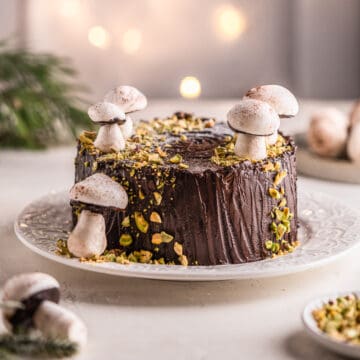
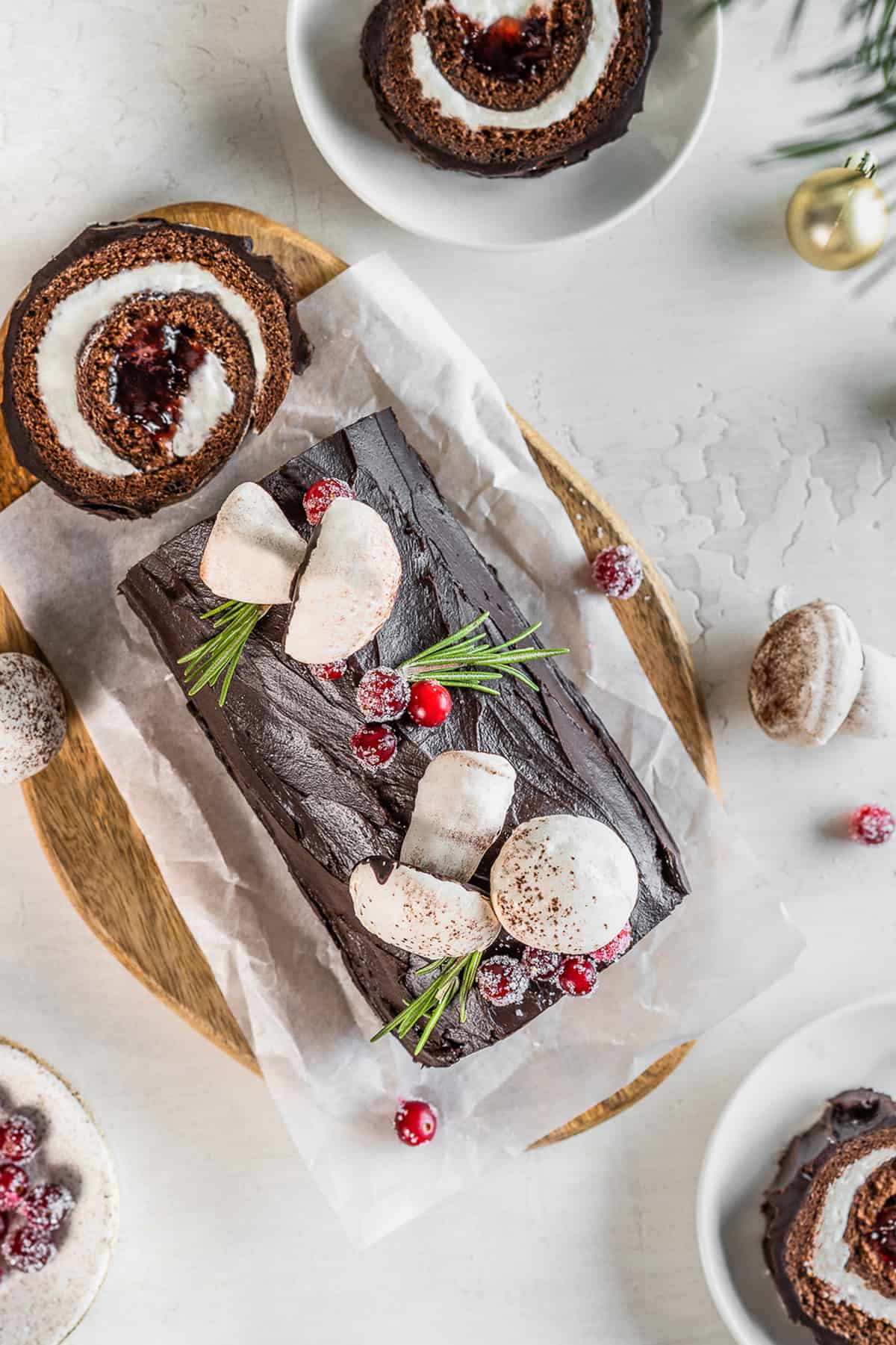
Woodland tree stump cake with meringue mushrooms on a serving plate.

Woodland tree stump cake! A perfect Christmas dessert is made with vertical cake layers, whipped cream, and chocolate ganache and decorated with a captivating design resembling actual tree bark.

It's easier than you think! Whether you celebrate Christmas or host a woodland-themed party, this cake is the ultimate showstopper.

Woodland tree stump cake with meringue mushrooms on a serving plate.

Woodland tree stump cake

Tree stump cake, tree trunk cake, or gâteau souche d'arbre in French is a Christmas vertical layer cake made with rich buttercream or chocolate ganache and covered with chocolate bark.

[feast_advanced_jump_to]

Also known as woodland tree stump cake, it is decorated with meringue mushrooms, edible moss, sugared cranberries, rosemary sprigs, etc.

BAKING ESSENTIALS CHECKLIST

Sign up and get a list of the necessary baking tools and ingredients

FREE DOWNLOAD

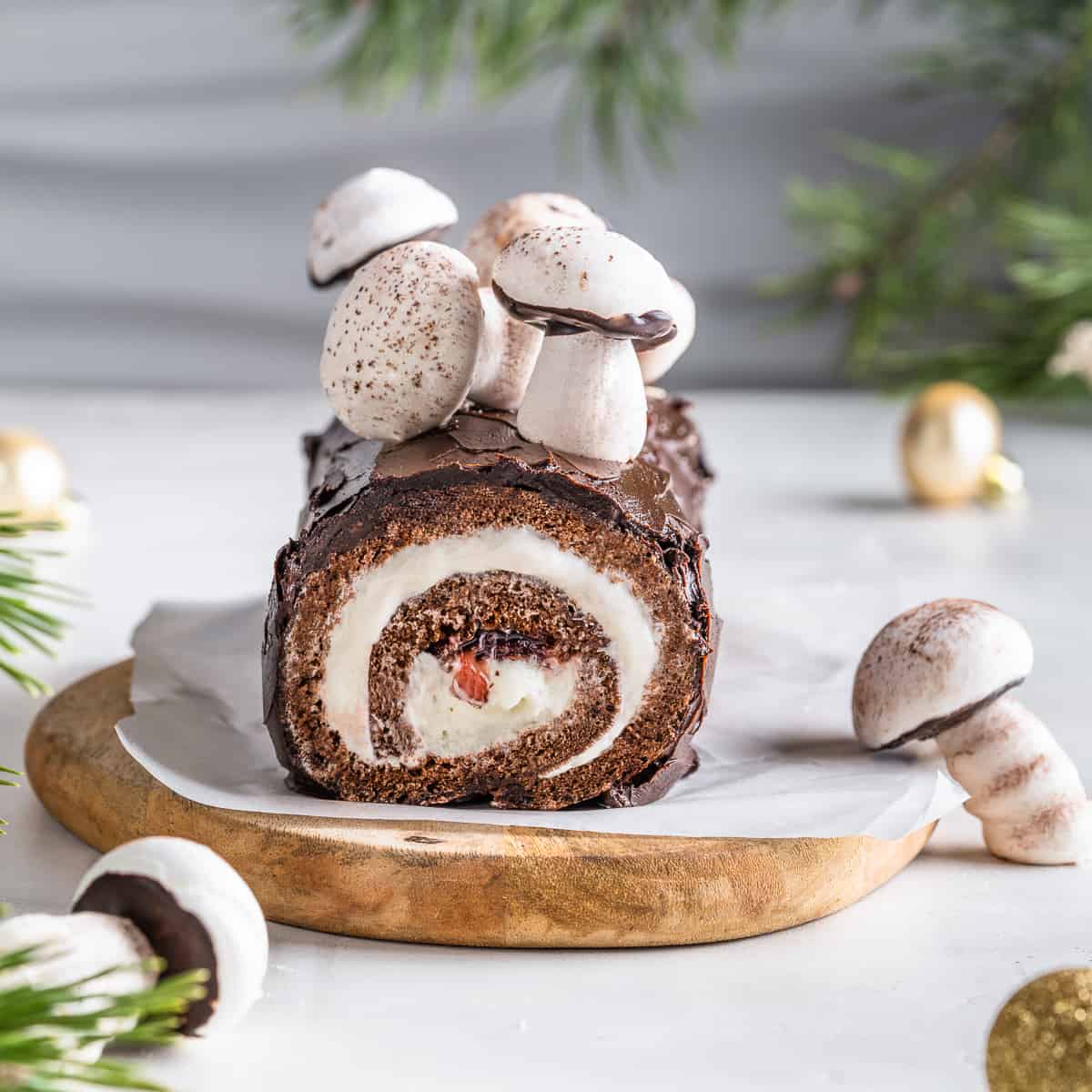
If you have made a Swiss roll cake in the past, you will succeed with this cake, too! It is just a giant Swiss cake roll created in a different way: this cake stands upright, revealing vertical layers when sliced. It is like a beautiful twist on a French Yule log or Bûche de Noël.

My guests were amazed at how I managed to keep the rolled cake upright. We all know how stubborn roll cakes can be!

But how long does it take to make this cake? You can make it in one day or split the process over two days. Here is my easy-to-follow step-by-step tutorial.

Ingredients

For ingredients and detailed instructions, refer to the recipe card below.

  • Eggs: Large eggs at room temperature.
  • Cake flour, store-bought or homemade.
  • Unsweetened cocoa powder: My favorite one is by the Valrhona brand.
  • Sugar: You will need vanilla, granulated, and icing sugar. Make icing sugar with a coffee grinder or purchase powdered (confectioners') sugar.
  • Whole milk or low-fat milk.
  • Butter: Use European-style unsalted butter with 82% fat. To make the sponge, melt it and cool it to room temperature. To make the chocolate frosting, use softened butter.
  • Heavy or heavy whipping cream with at least 30% fat content.
  • Condensed milk, store-bought or homemade sweetened condensed milk.
  • Dark chocolate: Use top-quality dark chocolate such as Valrhona dark chocolate or Scharffen Berger dark chocolate (70% cocoa). And please avoid chocolate chips to make chocolate ganache. This doesn't work!
  • Decoration: Meringue mushrooms, chopped pistachios, edible moss, sugared cranberries, or rosemary sprigs.
A slice of tree stump cake on a dessert plate.

How to make tree stump cake step-by-step

Step 1. Prepare a silicone 12 x 16 inch (30 x 40 cm) non-spill baking sheet or a large baking tray lined with parchment paper.

Step 2. To make a chocolate sponge cake, preheat the oven to 390°F (200°C). Mix cake flour with cocoa powder by sifting them in a large bowl and set aside.

Step 3. Pour milk and add butter into a small bowl. Place the bowl over a larger container filled with hot water and let the liquids reach the temperature of 122-150°F (50-60°C) by using a cooking thermometer to check.

Step 3. Place whole eggs, vanilla, and granulated sugar in a heat-proof bowl or the bowl of a stand mixer and beat a few times with a hand whisk.

Step 5. Bring the bowl over a bain-marie or water bath and beat with a hand whisk until it reaches a warm 104°F (40°C).

Step 6. Remove the bowl from the water bath, and whip the mixture until perfection in just 6-7 minutes using an electric or stand mixer with a whisk attachment.

Step 7. Reduce the mixer speed once the batter triples in volume, turns whitish, and flows like a thick ribbon from the beaters. Whisk at the lowest speed for 2 minutes to adjust the batter's texture (photo 1).

Step 8. Sift the dry ingredients over the bowl with batter and gently mix with a silicone spatula. Start from the bottom, work your way up, and give the container a gentle counterclockwise turn.

Step 9. Take two tablespoons of the chocolate mixture and combine it with warm milk and butter in a bowl. Use a spatula to mix everything together.

Step 10. Return the mixture to the main preparation and mix it thoroughly, starting from the bottom and moving upwards (photo 2).

Beaten eggs with sugar in a mixing bowl.

PHOTO 1

Chocolate cake batter in a bowl.

PHOTO 2

Step 11. Pour the cake batter into the silicone baking sheet (photo 3) from 8 inches (20 cm) above the pan to remove large air bubbles.

Pro tip: Alternatively, spread the batter onto a large baking sheet lined with parchment paper. Make a 12 x 16 inches (30 x 40 cm) rectangle with ½ inch (1 cm) thickness.

Step 12. Use a bent spatula or a dough scraper to smooth the surface, but don't overdo it in the same area.

Step 13. Bring the baking pan to the oven and immediately lower the oven temperature from 390°F (200°C) to 375°F (190°C). Bake for 10-12 minutes (photo 4).

Pro tip: Don't overbake the cake. Check for doneness with a toothpick: it should come out dry.

Cake batter on a silicone baking sheet.

PHOTO 3

Baked chocolate sponge in a baking mold.

PHOTO 4

Step 14. Remove the sponge cake from the oven, and while it is hot, flip it on a clean tea towel dusted generously with icing (powdered) sugar.

Step 15. Carefully peel off the silicone baking sheet (photo 5) or parchment paper. Trim the cake edges on all sides with a long serrated knife, aiming for the thinnest edge possible. Cover the cake with a fresh piece of parchment paper.

Step 16. Roll the cake with parchment paper inside and towel outside (photo 6), and let it cool for 10 minutes. Then, unroll it and allow the cake to cool at room temperature for approximately 15-20 minutes.

Chocolate sponge with the peeled baking mat.

PHOTO 5

Chocolate sponge rolled in a kitchen towel and parchment paper.

PHOTO 6

Step 17. To make the sweetened whipped cream, place all the cream ingredients in a cold mixing bowl and beat with an electric mixer until firm (photo 7).

Pro tip: Consult the Chantilly cream recipe for step-by-step photographed explanations, helpful tips, and tricks.

Step 18. To roll the cake, remove the parchment from the top of the cake. Cut it equally into four parts horizontally (along the cake's long edge) to obtain four strips of sponge cake. They will be approximately 2.8 x 14.5 inches (7 x 37 cm).

Step 19. Keep the strips close to each other. Spread the cream in an even layer over four cake strips using an offset spatula (photo 8).

Whipped cream in a mixing bowl.

PHOTO 7

Whipped cream over chocolate cake strips.

PHOTO 8

Step 20. Start rolling the first strip with your hands, making a tight cake roll's core. Continue rolling and tighten the roll as you go (photo 9).

Step 21. Connect the short side of the roll with the short side of the second sponge strip and roll. Firmly roll the cake, preventing the rolled cake and cream from protruding to one side.

Step 22. Carefully flip the cake roll upright, placing it on a cake board or a serving platter. The spiral ends will become exposed at the top (photo 10).

Rolled chocolate cake strip with the rest of the cake.

PHOTO 9

Rolled cake in an upright position on parchment paper.

PHOTO 10

Step 23. Take the next strip, the third cake layer, join it where the second strip is finished, and continue to roll. Tight it and finish rolling the log cake with the fourth cake layer. Spread the protruded cream on top.

Step 24. To get a tidy vertical cake, use an acetate cake collar to cover the cake sides. Then, wrap the cake with a mousse ring to keep it in place. Adjust the ring for a secure fit (photo 11) and refrigerate for 3-4 hours or overnight.

Pro tip: Alternatively, simply cover the sides and the top of the rolled cake with plastic film to prevent it from drying. Refrigerate it for at least 4 hours or overnight.

Step 25. To decorate the tree stump cake, first, make chocolate ganache with butter. Chop a dark chocolate bar or use chocolate callets. Alternatively, you can use a food processor to crush the chocolate.

Step 26. Place chopped chocolate in a small saucepan and bring it over a water bath. Melt chocolate, stirring with a wooden spoon. Allow the melted chocolate to cool to room temperature, stirring occasionally.

Step 27. Add softened butter, cut into medium-sized cubes, and whip with an electric mixer until creamy and homogeneous (photo 12).

Rolled cake wrapped into an adjusted cake ring.

PHOTO 11

Chocolate ganache in a mixing bowl.

PHOTO 12

Step 28. Take the rolled cake from the refrigerator, place it on a turntable, peel off the plastic wrap, or remove the cake ring and acetate collar. Spread the chocolate ganache on top of the cake.

Step 29. With a small offset spatula, create a swirl while spinning the cake. Alternatively, use a fork or a toothpick to make lines resembling the rings of the tree.

Step 30. Use a rubber spatula to evenly coat the sides of the cake, working from the bottom to the top. Try to mimic the tree bark, making it slightly higher than the tree rings.

Step 31. Use a small offset spatula or a fork to draw the vertical lines around the cake to represent the bark of the tree (photo 13).

Pro tip: Create a realistic tree bark effect on chocolate buttercream by attaching chocolate shards instead of using a fork or spatula. You need to stick the chocolate bark onto the chocolate frosting before it has fully set.

Step 32. Decorate the top and sides of the tree stump cake with meringue mushrooms, chopped pistachios, sugared cranberries, edible moss, rosemary sprigs, etc. (photo 14). Dust the cake with icing sugar or shredded coconut to give the effect of snow, and serve right away.

Cake covered with chocolate ganache.

PHOTO 13

Cake with meringue mushrooms dusted with icing sugar.

PHOTO 14

If serving the cake later, refrigerate it. However, bring it to room temperature for at least 1 hour before serving for the chocolate ganache to soften.

Decorated tree stump cake on a serving plate.

Expert Tips

  1. Read about how to roll a cake to master the rolling technique.
  2. If using a jelly roll pan, recalculate the recipe ingredients using this simple cake pan converter. You may need to make two sponge cakes to create the same cake, like in the recipe.
  3. Cut the tree stump cake with a hot knife: doing so will result in a clean slice of the cake for each guest.
  4. Make-ahead option: Make meringue mushrooms, frosted cranberries, edible moss, chocolate bark, etc., one or two days ahead. Bake, roll, and wrap the cake in plastic wrap or mousse cake ring in the fridge overnight. On the day of serving, spread the chocolate ganache and add your decorative touches.

Storing and freezing

Store the tree stump cake under a glass cake dome refrigerated for up to 1 day, but the fully assembled cake is best consumed on the day it is decorated.

To serve, bring the cake to the kitchen counter for at least 1 hour for the chocolate buttercream to soften.

Can you freeze it? You can freeze unfrosted cake wrapped in plastic for up to one month. Thaw it in the fridge overnight, then frost and decorate.

Recipe variations

  • Cake: If you are uncomfortable making a cake roll, you can create a woodland tree sump cake out of a simple chocolate sponge cake. Simply cut it into three layers, filling each with cream. Then, decorate the cake like a whimsical tree stump with fun decorations.
  • Filling: Fill the cake roll with your favorite cream, from Chantilly cream, chocolate whipped ganache, vanilla buttercream, and cream cheese filling.
  • Frosting: Replace chocolate ganache with chocolate buttercream.
  • Decoration: You can leave the top of the cake bare or cover it with chocolate ganache in the recipe.

Love Christmas desserts? Try these next!

The magical time of the year brings an endless number of Christmas desserts, from Gingerbread mini men cookies to classic Buche de Noel.

  • Christmas Pavlova Wreath
  • Japanese Christmas Cake
  • French Gingerbread Loaf
  • Mandarin and Gingerbread Pavlova

Want more delicious and beautiful recipes? Subscribe to my newsletter and follow me on Facebook, Pinterest, and Instagram for my latest updates. If you make this recipe, please leave a star rating on the recipe card and comment below!

Print

Recipe card

Tree Stump Cake

Woodland tree stump cake with meringue mushrooms on a serving plate.
Print Recipe
Save Recipe Recipe Saved

5 Stars 4 Stars 3 Stars 2 Stars 1 Star

5 from 1 review

Woodland tree stump cake is a perfect Christmas dessert. It's made with vertical cake layers, whipped cream, and chocolate ganache frosting and decorated with a captivating design resembling actual tree bark.

  • Author: Irina Totterman
  • Total Time: 2 hours (plus chilling time)
  • Yield: 8-10 1x
  • Category: Cakes
  • Method: Baking
  • Cuisine: French

Ingredients

Scale

For sponge cake roll:

  • 5 large eggs, room temperature
  • ½ cup (100 g) granulated sugar
  • ½ sachet (4.5 g) vanilla sugar
  • ⅔ cup + 2 ½ tablespoons (62 g) cake flour
  • 2.5 tablespoons (20 g) cocoa powder
  • 2 ⅓ tablespoons (35 g) whole milk
  • 1 ½ tablespoons (20 g) unsalted butter

For whipped cream:

  • 1 ⅓ cups (320 g) cold heavy cream, 30% fat
  • 4 tablespoons (30 g) icing (powdered) sugar
  • 2 tablespoons (40 g) sweetened condensed milk

For chocolate ganache:

  • 8.1 oz. (230 g) dark chocolate, 70% cocoa
  • 1 stick (113 g) unsalted butter, softened

For decoration:

  • 5-10 meringue mushrooms
  • 1 oz. (30 g) chopped pistachio kernels
  • edible moss
  • sugared cranberries
  • fresh rosemary sprigs
  • icing (powdered) sugar

Instructions

  1. Prepare a silicone 12 x 16 inch (30 x 40 cm) non-spill baking sheet or a large baking tray lined with parchment paper.

  2. To make a chocolate sponge cake, preheat the oven to 390°F (200°C). Mix cake flour with cocoa powder by sifting them in a large bowl and set aside.

  3. Pour milk and add butter into a small bowl. Place the bowl over a larger container filled with hot water and let the liquids reach the temperature of 122-150°F (50-60°C) by using a cooking thermometer to check.

  4. Place whole eggs, vanilla, and granulated sugar in a heat-proof bowl or the bowl of a stand mixer and beat a few times with a hand whisk.

  5. Bring the bowl over a bain-marie or water bath and beat with a hand whisk until it reaches a warm 104°F (40°C).

  6. Remove the bowl from the water bath, and whip the mixture until perfection in just 6-7 minutes using an electric or stand mixer with a whisk attachment.

  7. Reduce the mixer speed once the batter triples in volume, turns whitish, and flows like a thick ribbon from the beaters. Whisk at the lowest speed for 2 minutes to adjust the batter's texture.

  8. Sift the flour mixture over the bowl with batter and gently mix with a silicone spatula. Start from the bottom, work your way up, and give the container a gentle counterclockwise turn.

  9. Take two tablespoons of batter and combine it with warm milk and butter in a bowl. Use a spatula to mix everything together.

  10. Return the mixture to the main preparation and mix it thoroughly, starting from the bottom and moving upwards.

  11. Pour the cake batter into the silicone baking sheet from 8 inches (20 cm) above the pan to remove large air bubbles. Alternatively, spread the batter onto a large baking sheet lined with parchment paper. Make a 12 x 16 inches (30 x 40 cm) rectangle with ½ inch (1 cm) thickness.

  12. Use a bent spatula or a dough scraper to smooth the surface, but don't overdo it in the same area.

  13. Bring the baking pan to the oven and immediately lower the oven temperature from 390°F (200°C) to 375°F (190°C). Bake for 10-12 minutes. Don't overbake the cake. Check for doneness with a toothpick: it should come out dry.

  14. Remove the sponge cake from the oven, and while it is hot, flip it on a clean tea towel dusted generously with icing (powdered) sugar.

  15. Carefully peel off the silicone baking sheet or parchment paper. With a long serrated knife, trim the cake edges on all sides, aiming for the thinnest edge possible. Cover the cake with a fresh piece of parchment paper.

  16. Roll the cake with parchment paper inside and towel outside, and let it cool for just 10 minutes. Then, unroll it and allow the cake to cool at room temperature for approximately 15-20 minutes.

  17. To make the sweetened whipped cream, place all the cream ingredients in a cold mixing bowl and beat with an electric mixer until firm.

  18. To roll the cake, remove the parchment from the top of the cake. Cut it into four parts horizontally (along the cake's long edge) to obtain four 7 x 37 cm cake sponges.

  19. Keep the strips close to each other. Spread the cream in an even layer over four cake strips using an offset spatula.

  20. Start rolling the first strip with your hands, making a tight cake roll's core. Continue rolling and tighten the roll as you go.

  21. Connect the short side of the roll with the short side of the second sponge strip and roll. Firmly roll the cake, preventing the rolled cake and cream from protruding to one side.

  22. Carefully flip the cake roll upright, placing it on a cake board or a serving platter. The spiral ends will become exposed at the top.

  23. Take the third cake layer, join it where the second strip is finished, and continue to roll. Tight it and finish rolling the log cake with the fourth cake layer.

  24. To get a tidy vertical cake, use an acetate cake collar to cover the cake sides. Then, wrap the cake with a mousse ring to keep it in place. Adjust the ring for a secure fit. Alternatively, simply cover the sides and the top of the rolled cake with plastic film to prevent it from drying. Refrigerate the cake for at least 3-4 hours or overnight. 

  25. To decorate the tree stump cake, first, make chocolate ganache with butter. Chop a dark chocolate bar or use chocolate callets. Alternatively, you can use a food processor to crush the chocolate.

  26. Place chopped chocolate in a small saucepan and bring it over a water bath. Melt chocolate, stirring with a wooden spoon. Allow the melted chocolate to cool to room temperature, stirring occasionally.

  27. Add softened butter, cut into medium-sized cubes, and whip with an electric mixer until creamy and homogeneous.

  28. Take the rolled cake from the refrigerator, place it on a turntable, peel off the plastic wrap, or remove the cake ring and acetate collar. Spread the chocolate ganache on top of the cake.

  29. With a small offset spatula, create a swirl while spinning the cake. Alternatively, use a fork or a toothpick to make lines resembling the rings of the tree.

  30. Use a rubber spatula to evenly coat the sides of the cake, working from the bottom to the top. Try to mimic the bark of the tree, making it slightly higher than the tree rings. Use a small offset spatula or a fork to draw the vertical lines around the cake to represent the bark of the tree.

  31. Decorate the top and sides of the tree stump cake with meringue mushrooms, chopped pistachios, sugared cranberries, edible moss, rosemary sprigs, etc. Dust the cake with icing sugar or shredded coconut to give the effect of snow, and serve right away.

Notes

  1. Read about how to roll a cake to master the rolling technique.
  2. If using a jelly roll pan, recalculate the recipe ingredients using this simple cake pan converter. You may need to make two sponge cakes to create the same cake, like in the recipe. 
  3. Create a realistic tree bark effect on chocolate buttercream by attaching chocolate shards instead of using a fork or spatula. You need to stick the chocolate shards onto the chocolate frosting before it has fully set.
  4. If serving the cake later, refrigerate it. However, make sure to bring it to room temperature for at least 1 hour before serving for the chocolate ganache to soften.
  5. Cut the cake with a hot, sharp knife: doing so will result in a perfect cake swirl for each plate.
  6. Make-ahead option: Make meringue mushrooms, edible moss, chocolate bark, etc., one or two days ahead. Bake, roll, and wrap the cake in plastic wrap or mousse cake ring in the fridge overnight. On the day of serving, spread the chocolate ganache and add your decorative touches.
  7. Nutrition is calculated without cake decorations like meringue mushrooms and pistachios.

Nutrition

  • Serving Size: 1 slice
  • Calories: 497
  • Sugar: 22.4 g
  • Sodium: 92 mg
  • Fat: 45 g
  • Saturated Fat: 22 g
  • Carbohydrates: 30.6 g
  • Fiber: 1.8 g
  • Protein: 10.6 g
  • Cholesterol: 260 mg

Thank you for following me on Pinterest, Facebook, and Instagram. Hashtag #bakinglikeachef so I can see your creations.

The nutritional information has been calculated using an online recipe nutrition calculator such as Verywellfit.com and is intended for informational purposes only. These figures should be used as a general guideline and not be construed as a guarantee.
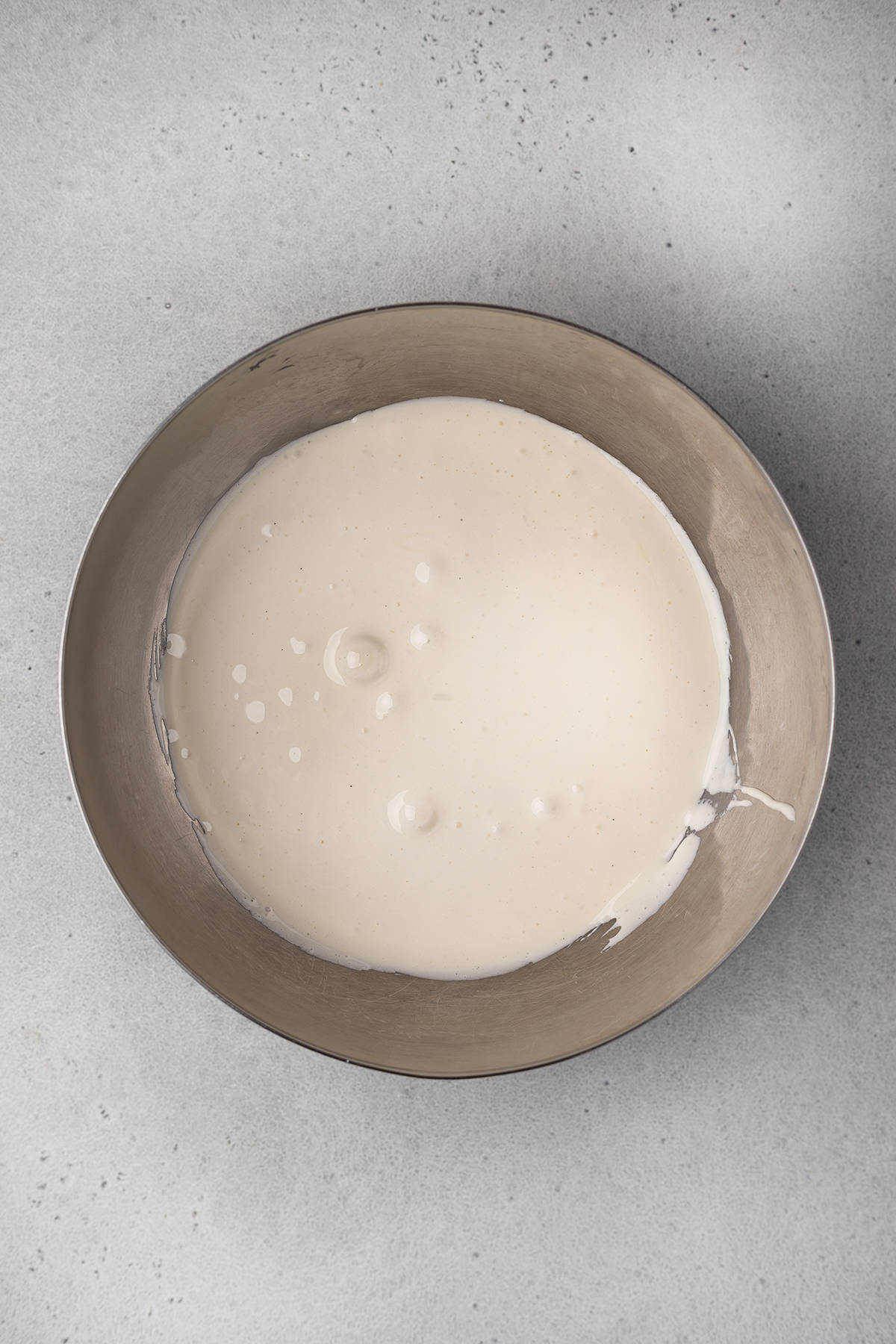
Classic Bûche de Noël Recipe (French Log Cake)

Dec 13, 2023 · 16 Comments

Traditional Buche de Noel with meringue mushrooms on a serving plate.

I am so excited to share this traditional Buche de Noel, a French Yule log cake made with a soft chocolate sponge, velvety whipped cream, and rich chocolate frosting. It feels so good to bring a French tradition to the holiday table. The perfect Christmas dessert!

Traditional Buche de Noel with meringue mushrooms on a serving plate.

Bûche de Noël, or French Yule Log Cake

Christmas time brings tasty recipes to make. Santa loves gingerbread in different variations: Gingerbread cookies, Gingerbread madeleines, French Gingerbread, and even twisted Gingerbread Pavlova.

[feast_advanced_jump_to]

A European Christmas tradition is to make a Christmas log cake - classic Bûche de Noël. This type of cake, shaped like an actual log, is a part of the French culinary heritage.

BAKING ESSENTIALS CHECKLIST

Sign up and get a list of the necessary baking tools and ingredients

FREE DOWNLOAD

For the French, "A Christmas meal without a log is a bit like a Christmas without a tree or without snow: it's nice, but a little something is missing." (A quote from CuisineAZ)

The Italians celebrate a holiday season with an Italian Yule log called Tronchetto di Natale that traces back to the Northern European tradition.

I was eyeing Buche de Noel recipe for a while, waiting for the holiday season to make it. I made it once and decorated it in the same way as the chef, Caitlin Dysart.

Then, I decided to change the cake's decoration. I switched "exaggerated" long-stemmed meringue mushrooms with my favorite meringue mushrooms. I found this type of decoration more classic.

This French Yule log recipe is straightforward and is made within 1.5 hours. You only need to prepare meringue mushrooms or other Buche de Noel decorations in advance.

Ingredients

For ingredients and detailed instructions, refer to the recipe card below.

  • Eggs: Large eggs at room temperature. Look for eggs from a carton labeled with the size "large." Each weighs about 55-60 g (2 oz).
  • Cake flour: Store-bought or homemade.
  • Cocoa powder: Just unsweetened cocoa powder.
  • Sugar: You will need vanilla, granulated, and icing sugar. Make icing sugar with a coffee grinder or purchase powdered (confectioners') sugar.
  • Milk: Whole milk is preferable, but low-fat will work as well.
  • Unsalted butter: To make the sponge, melt it and cool it to room temperature. To make the chocolate frosting, use softened butter.
  • Heavy cream or heavy whipping cream with at least 30% fat content.
  • Condensed milk: Store-bought or homemade sweetened condensed milk.
  • Dark chocolate: High-quality dark chocolate such as Valrhona dark chocolate or Scharffen Berger dark chocolate.
  • Fruit preserves: Just any thick fruit preserves, jam, or marmalade. You can omit this ingredient if desired.
  • Decoration: Meringue mushrooms, sugared cranberries, or fresh rosemary sprigs.

How to make Bûche de Noël step-by-step

Step 1. Prepare a silicone 12 x 16 inch (30 x 40 cm) non-spill baking sheet or a large baking sheet lined with parchment paper.

Step 2. To make a chocolate sponge cake, preheat the oven to 390°F (200°C). Using a flour sifter, sift cake flour and cocoa powder and set aside.

Step 3. Pour milk, add butter into a small bowl, and place it over a larger container with hot water. Let the liquids warm up to 122-150°F (50-60°C); use a cooking thermometer to check.

Step 3. Place whole eggs, vanilla, and granulated sugar in a heat-proof bowl and whisk a few times with a hand whisk.

Step 5. Bring the bowl over a bain-marie or water bath and beat with a hand whisk until the egg mixture reaches 104°F (40°C).

Step 6. Remove the bowl from the water bath, and with an electric or stand mixer fitted with a whisk attachment, beat the mixture at high speed for 6-7 minutes.

Beaten eggs with sugar in a bowl.

Step 7. Reduce the mixer speed once the preparation triples in volume, turns whitish, and the batter falls like a thick ribbon from the mixer beaters. Whisk at the lowest speed for 2 minutes to adjust the batter's texture.

Chocolate cake batter in a bowl with a spatula.

Step 8. Sift the dry ingredients once again over the bowl with the main preparation and carefully mix with a rubber spatula. Work from the bottom of the bowl to the top while turning the container counterclockwise.

Step 9. Take a scoop of the chocolate mixture into a bowl with warm milk and butter and mix with a spatula. Pour it back into the principal preparation and mix the batter from the bottom, moving upward.

Step 10. Pour the cake batter into the silicone baking sheet from 8 inches (20 cm) above the pan. This helps to remove large air bubbles.

Pro tip: Alternatively, spread the batter onto a large baking sheet lined with parchment paper. Aim for a 12 x 16 inches (30 x 40 cm) rectangle and a perfect ½ inch (1 cm) thickness.

Cake batter in a baking sheet.

Step 11. Even the surface with a bent spatula or a dough scraper, but avoid excessive smoothing in the same spot.

Baked chocolate sponge cake in a baking sheet.

Step 12. Bring the baking tray to the oven and immediately lower the oven temperature from 390°F (200°C) to 375°F (190°C). Bake for 10-12 minutes.

Pro tip: Watch out for the cake not to overbake: the top should get slightly browned, and the bottom should stay pale. Check for doneness with a toothpick: it should come out dry.

Step 13. Remove the cake from the oven, and while it is hot, turn it on a clean tea towel well-sprinkled with icing (powdered) sugar.

Chocolate sponge cake on a kitchen towel with peeled baking mold.

Step 14. Carefully remove the silicone baking sheet or parchment paper from the base of the cake. Using a long serrated knife, cut the edges of the cake on all four sides. Cover the cake with a clean piece of parchment paper.

Rolled chocolate sponge cake in a towel with parchment paper inside.

Step 15. Use the towel to roll the cake (with parchment paper inside) and allow it to cool for 10 minutes.

Step 16. Unroll it and let the cake cool to room temperature for about 20-30 minutes.

Whipped cream in a mixing bowl.

Step 17. To make sweetened whipped cream, place all the cream ingredients in a cold mixing bowl and beat with an electric mixer until firm.

Dark chocolate ganache in a bowl.

Step 20 - see below: Dark chocolate ganache at a spreadable consistency.

Pro tip: Consult the whipped cream filling recipe for step-by-step photographed explanations, helpful tips, and tricks.

Step 18. To make chocolate ganache frosting, chop a dark chocolate bar or use chocolate callets. Alternatively, you can use a food processor to crush the chocolate.

Step 19. In a small saucepan, heat heavy cream over medium heat, stirring with a hand whisk until it reaches a temperature of 176°F (80°C). Once heated, pour half the cream over the chocolate and mix with a wooden spoon.

Step 20. Add the rest of the hot cream and stir it thoroughly. Allow the chocolate ganache to cool slightly, stirring occasionally, or cover it and let it thicken naturally at room temperature. The ganache should reach a spreadable consistency.

Chocolate cake with fruit preserves and whipped cream on top.

Step 21. To assemble the cake roll, remove the parchment paper from the top of the cake. Spread a 1-inch (2.5 cm) line of fruit preserves along the short edge of the sponge.

Chocolate ganache on top of the Yule log cake.

Step 25 - see below: Chocolate ganache over the French log cake.

Step 22. Spread an even layer of the whipped cream on top of the remaining sponge and even with an offset spatula.

Step 23. Re-roll the sponge cake, starting from the short end, helping with the towel, and tightening it. Finish rolling with the seam side at the bottom. Wrap the roll in the towel and refrigerate for 1-2 hours. 

Pro tip: Watch this short video by S. Serveau on how to tighten a Christmas log.

Step 24. To decorate, remove the cooled cake from the fridge and trim the cake ends to make them neat.

  • Pro tip: If desired, make an oblique cut about 2 inches (5 cm) and attach it to the main branch from the slanted side.

Step 25. Transfer the log to a serving tray. Spread the chocolate ganache over the cake and spoon the frosting with the back of a tablespoon.

Pro tip: Alternatively, with a fork, make some strips to simulate the grain of a tree trunk.

Step 26. Decorate the top of Buche de Noel with meringue mushrooms, sugared cranberries, rosemary sprigs, or in the way you desire.

To serve, sprinkle the cake with icing (powdered) sugar.

Decorated French Yule log cake on a serving board with slices on dessert plates.

Expert Tips

  1. Roll the cake from the long end if desired. Read about how to roll a cake to master the rolling technique.
  2. If using a jelly roll pan, recalculate the recipe ingredients using this simple cake pan converter.
  3. Cut the Buche de Noel cake with a hot, sharp knife: doing so will result in a perfect cake swirl for each plate.
  4. Make-ahead option: Make meringue mushrooms a few days in advance and store them in a cool, dry place. Bake and fill the cake roll with whipped cream one day in advance. Cover the cake with parchment paper (loosely like a candy) and refrigerate. The next day, 1-2 hours before serving, spread the chocolate ganache and decorate Buche de Noel.

How to decorate a Yule Log cake

Consider a few helpful tips to decorate your homemade Christmas log and impress your guests.

  • Cover the cake with chocolate whipped ganache, cream cheese, or chocolate buttercream frosting with chocolate shards resembling a tree bark.
  • Arrange Buche de Noel decorations like meringue kisses, marzipan mushrooms, fresh (raspberries, strawberries), sugared (cranberries, red currants) or canned berries (lychees), candies, cookies, truffles, or edible pine cones on top of the Yule log.
  • Decorate the side of the cake with macarons, chocolate chips or crisps, speculoos cookie crumbs, or shredded coconut.
  • Use plant decorations such as fresh or crystallized flowers, rosemary sprigs turned upside down, and even a cute actual fir branch. 
  • If you are experienced using a pastry bag, pipe the Chantilly cream or chocolate buttercream with different tips such as petals, flowers, or stars.
  • Leave the logs' ends trimmed or decorate them with chocolate circles, cut-out shapes in marzipan, and baked meringue spirals.
  • The most common final touch is to sprinkle the Yule log with powdered sugar to imitate the look of snow.

And do not forget to bring kids to decorate Buche de Noel: they are a great help and fun if you like to bake with them!

Storing and freezing

Ideally, prepare the Yule log the day before for the next day and keep it in the refrigerator overnight. But be aware that it easily absorbs the food's odors in the fridge. So, keeping the log in a separate fridge would be a good idea.

Store Buche de Noel and leftovers in an airtight container refrigerated for up to two days.

Freezing Buche de Noel depends on the filling and frosting used to garnish the cake. In most cases, you can freeze unfrosted Bûche de Noël wrapped in plastic for up to one month.

Thaw it in the fridge overnight, cover it with frosting, decorate, and serve.

Recipe FAQ

What is Buche de Noel?

Bûche de Noël, or Yule log, is a classic French dessert with a sponge cake roll and cream filling shaped like a yule log. An absolute must-serve on Christmas Eve, this beloved dessert is cherished in France, Belgium, Luxembourg, Switzerland, and Canadian Quebec.

How do you pronounce Bûche de Noël?

Bûche de Noël is pronounced as [byʃ də nɔɛl]. It is often spelled Buche de Noel in English.

What is another name for Yule log cake?

Yule log cake is also called Bûche de Noël, a French dessert shaped like a Yule log. Other names such as Christmas log, Christmas log cake, holiday log, and holiday log cake are common.

Can you make Bûche de Noël in advance?

Buche de Noel or Yule log is one of those desserts you can make a day in advance. Add chocolate shavings or dust with icing (powdered) sugar if desired, and add them at the last minute before serving. 

Want more delicious and beautiful recipes? Subscribe to my newsletter and follow me on Facebook, Pinterest, and Instagram for my latest updates. If you make this recipe, please leave a star rating on the recipe card and comment below!

Print

Recipe card

Classic Bûche de Noël (French Log Cake)

Traditional Buche de Noel with meringue mushrooms on a serving plate.
Print Recipe
Save Recipe Recipe Saved

5 Stars 4 Stars 3 Stars 2 Stars 1 Star

5 from 5 reviews

Classic Buche de Noel (La Bûche de Noël in French) is a French Yule log cake made with light and airy chocolate sponge cake, velvety whipped cream, and covered with rich chocolate ganache. 

  • Author: Irina Totterman
  • Total Time: 1 hour, 30 minutes (plus resting time)
  • Yield: 8 1x
  • Category: Cakes
  • Method: Baking
  • Cuisine: French

Ingredients

Scale

For sponge cake roll:

  • 5 large eggs, room temperature
  • ½ cup (100 g) granulated sugar
  • ½ sachet (4.5 g) vanilla sugar
  • ⅔ cup + 2 ½ tablespoons (62 g) cake flour
  • 20 g cacao powder
  • 2 ⅓ tablespoons (35 g) whole milk
  • 1 ½ tablespoons (20 g) unsalted butter

For whipped cream:

  • 250 g cold heavy cream, 30% fat
  • 25 g icing (powdered) sugar
  • 30 g sweetened condensed milk

For assembling:

  • 2 tablespoons fruit preserves (apricot, strawberry, etc.)

For dark  chocolate ganache:

  • 150 g dark chocolate, 70% cocoa
  • 150 g heavy cream, 30% fat

For decoration:

  • 5-10 meringue mushrooms
  • candied cranberry
  • rosemary

*Don't you have the correct baking pan on hand right now? Try this simple Cake Pan Converter!

** If needed, please refer to Baking Conversion Charts.

Instructions

  1. Prepare a silicone 12 x 16 inch (30 x 40 cm) non-spill baking sheet or a large baking sheet lined with parchment paper.
  2. To make a chocolate sponge cake, preheat the oven to 390°F (200°C). Using a flour sifter, sift cake flour and cocoa powder and set aside.
  3. Pour milk, add butter into a small bowl, and place it over a larger container with hot water. Let the liquids warm up to 122-150°F (50-60°C); use a cooking thermometer to check.
  4. Place whole eggs, vanilla, and granulated sugar in a heat-proof bowl and whisk a few times with a hand whisk.
  5. Bring the bowl over a bain-marie or water bath and beat with a hand whisk until the egg mixture reaches 104°F (40°C).
  6. Remove the bowl from the water bath, and with an electric or stand mixer fitted with a whisk attachment, beat the mixture at high speed for 6-7 minutes.
  7. Reduce the mixer speed once the preparation triples in volume, turns whitish, and the batter falls like a thick ribbon from the mixer beaters. Whisk at the lowest speed for 2 minutes to adjust the batter's texture.
  8. Sift the dry ingredients once again over the bowl with the main preparation and carefully mix with a rubber spatula. Work from the bottom of the bowl to the top while turning the container counterclockwise.
  9. Take a scoop of the chocolate mixture into a bowl with warm milk and butter and mix with a spatula. Pour it back into the principal preparation and mix the batter from the bottom, moving upward.
  10. Pour the cake batter into the silicone baking sheet from 8 inches (20 cm) above the pan. This helps to remove large air bubbles. Alternatively, spread the batter onto a large baking sheet lined with parchment paper. Aim for a 12 x 16 inches (30 x 40 cm) rectangle and a perfect ½ inch (1 cm) thickness.
  11. Even the surface with a bent spatula or a dough scraper, but avoid excessive smoothing in the same spot.
  12. Bring the baking tray to the oven and immediately lower the oven temperature from 390°F (200°C) to 375°F (190°C). Bake for 10-12 minutes. Watch out for the cake not to overbake: the top should get slightly browned, and the bottom should stay pale. Check for doneness with a toothpick: it should come out dry.
  13. Remove the cake from the oven, and while it is hot, turn it on a clean tea towel well-sprinkled with icing (powdered) sugar.
  14. Carefully remove the silicone baking sheet or parchment paper from the base of the cake. Using a long serrated knife, cut the edges of the cake on all four sides. Cover the cake with a clean piece of parchment paper.
  15. Use the towel to roll the cake (with parchment paper inside) and allow it to cool for 10 minutes. Unroll it and let the cake cool to room temperature for about 20-30 minutes.
  16. To make sweetened whipped cream, place all the cream ingredients in a cold mixing bowl and beat with an electric mixer until firm.
  17. To make chocolate ganache frosting, chop a dark chocolate bar or use chocolate callets. Alternatively, you can use a food processor to crush the chocolate.
  18. In a small saucepan, heat heavy cream over medium heat, stirring with a hand whisk until it reaches a temperature of 176°F (80°C). Once heated, pour half the cream over the chocolate and mix with a wooden spoon.
  19. Add the rest of the hot cream and stir it thoroughly. Allow the chocolate ganache to cool slightly, stirring occasionally, or cover it and let it thicken naturally at room temperature. The ganache should reach a spreadable consistency.
  20. To assemble the cake roll, remove the parchment paper from the top of the cake. Spread a 1-inch (2.5 cm) line of apricot preserves along the short edge of the sponge.
  21. Spread an even layer of the whipped cream on top of the remaining sponge and even with an offset spatula.
  22. Re-roll the sponge cake, starting from the short end, helping with the towel, and tightening it. Finish rolling with the seam side at the bottom. Wrap the roll in the towel and refrigerate for 1-2 hours. 
  23. To decorate, remove the cooled cake from the fridge and trim the cake ends to make them neat. If desired, make an oblique cut about 2 inches (5 cm) and attach it to the main branch from the slanted side.
  24. Transfer the log to a serving tray. Spread the chocolate ganache over the cake and spoon the frosting out with the back of a tablespoon. Alternatively, with a fork, make some strips to simulate the grain of a tree trunk.
  25. Decorate the top of Buche de Noel with meringue mushrooms, sugared cranberries, rosemary sprigs, or in the way you desire.
  26. To serve, optionally, sprinkle the cake with icing (powdered) sugar.

Notes

  1. Roll the cake from the long end if desired. Read about how to roll a cake to master the rolling technique.
  2. If using a jelly roll pan, recalculate the recipe ingredients using this simple cake pan converter.
  3. Cut the Buche de Noel cake with a hot, sharp knife: doing so will result in a perfect cake swirl for each plate.
  4. Make-ahead option: Make meringue mushrooms a few days in advance and store them in a cool, dry place. Bake and fill the cake roll with whipped cream one day in advance. Cover the cake with parchment paper (loosely like a candy) and refrigerate. The next day, 1-2 hours before serving, spread the chocolate ganache and decorate Buche de Noel. 
  5. Nutrition is calculated without cake decoration, such as meringue mushrooms and sugared cranberries.

Nutrition

  • Serving Size: 1 slice
  • Calories: 554
  • Sugar: 35.1 g
  • Sodium: 126 mg
  • Fat: 41.1 g
  • Saturated Fat: 19.9 g
  • Carbohydrates: 50.1 g
  • Fiber: 2.1 g
  • Protein: 12.8 g
  • Cholesterol: 308 mg

Thank you for following me on Pinterest, Facebook, and Instagram. Hashtag #bakinglikeachef so I can see your creations.

The nutritional information has been calculated using an online recipe nutrition calculator such as Verywellfit.com and is intended for informational purposes only. These figures should be used as a general guideline and not be construed as a guarantee.
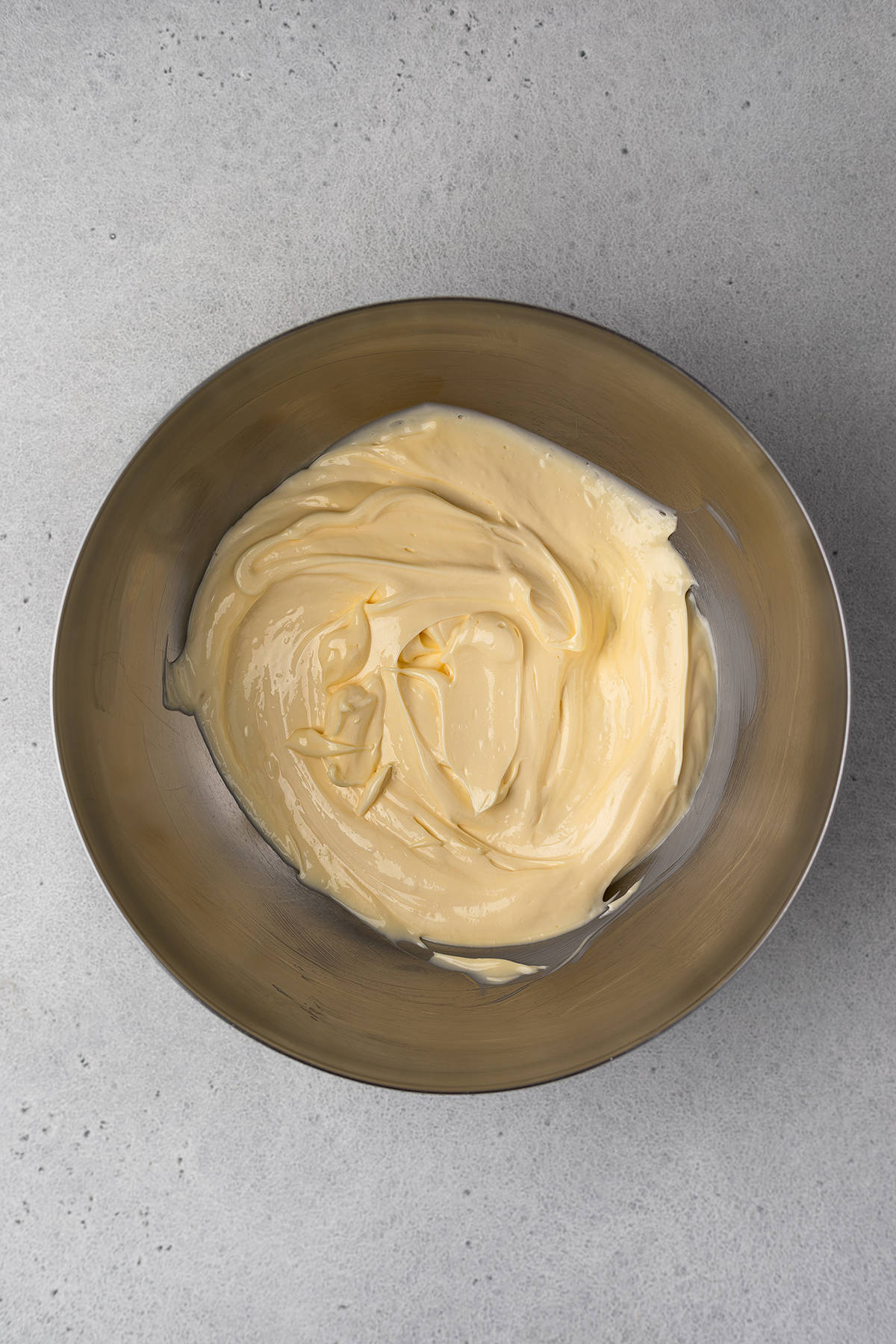
The recipe was originally published on January 02, 2019. It has been updated and may differ from what was initially published. It was revised to include improved content and photos.

Quatre-Quarts (French Pound Cake)

Sep 27, 2023 · Leave a Comment

Quatre-quarts cake on a serving board.

Quatre-quarts Breton is a classic French pound cake made with equal weights of four ingredients: eggs, sugar, flour, and butter. Flavored with vanilla, lemon, or rum, it is a perfect cake for your morning tea, coffee, or hot chocolate.

Quatre-quarts cake on a serving board.

What is Quatre-Quarts?

Quatre-quarts, or four quarters cake, is a popular Breton pound cake with four main ingredients: eggs, sugar, flour, and butter of equal weight. Due to its Brittany origin, it is also known as Brittany cake.

[feast_advanced_jump_to]

Historically, the total weight of all ingredients is equivalent to one pound. A four-quarters cake is called gâteau quatre-quarts in French because it consists of one-quarter egg, one-quarter flour, one-quarter sugar, and one-quarter butter.

BAKING ESSENTIALS CHECKLIST

Sign up and get a list of the necessary baking tools and ingredients

FREE DOWNLOAD

Quatre-quarts recipe

Known as Le Quatre-quarts in French, this 4-ingredient cake is an old-fashioned cake perfect for teatime. It is pretty dense, but it is a good pound cake that has been cherished for generations.

The quatre-quarts recipe is made with four basic ingredients. It is an easy and quick cake recipe, perfect for a novice and professional baker.

French pound cake is one of my favorites. Baked as mini loaves, it makes the perfect holiday gift and is also my go-to sweet treat for tea and coffee times.

Stacked slices of the French pound cake on a marble board.

Ingredients

For ingredients and detailed instructions, refer to the recipe card below.

Quatre-quarts cake uses a simple formula with four equal-weight ingredients based on the weight of eggs. This means you must weigh the eggs (without shells) first, then add the same amount of the other three ingredients.

  • Eggs: The recipe calls for large eggs at room temperature. Separate the egg whites from the egg yolks with an egg separator.
  • Sugar: I usually use granulated or caster sugar interchangeably.
  • Flour: Use all-purpose flour, not cake or self-rising flour.
  • Butter: Authentically, the quatre-quarts Breton is made with salted butter (beurre salé). You can use semi-salted or regular butter with added pinch of salt.

Pro tip: There are two types of Breton pound cake: with melted butter and softened butter. Melted butter creates a tender crumb, while softened butter results in a firmer texture.

The traditional recipe doesn't use a leavening agent (baking powder). Instead, the cake rises solely by beating the egg whites.

However, baking powder is often included in a modern French pound cake recipe to aim in the cake's rise. This variation produces a lighter and softer cake.

I have tried both methods, with and without baking powder, and both result in absolutely delicious cakes.

Sliced quatre quart gateau on a serving board.

How to make quatre-quarts

Start the recipe by weighing eggs and adapting the weight of each ingredient, which must be the same as the weight of the eggs. Use a food scale for accurate ingredient measurements.

Step 1. Weigh 5 large eggs with shells. Use an egg separator to separate the egg whites from the yolks. Weigh the empty eggshells and subtract their weight from the egg weight. You will then have the weight of the eggs without shells.

Step 2. Weigh each of the other three ingredients of the same weight as the egg weight while letting the egg whites and egg yolks get to room temperature.

Step 3. Preheat the oven to 355°F (180°C). Grease and flour an 8-inch (20 cm) nonstick bread pan or line it with parchment paper. There is no need to grease a silicone loaf pan.

Pro tip: Read more about how to bake with silicone molds.

Step 4. Cut butter into equal pieces and place in a small saucepan. Melt it over low-medium heat, transfer it to a clean bowl, and let it cool for 10 minutes.

Beaten egg yolk mixture in a glass bowl.

Step 5. Place egg yolks with sugar in the bowl of a stand mixer or a large mixing bowl. Beat the yolk mixture until it whitens.

Butter mixture in a glass bowl.

Step 6. Gradually add flour with baking powder (if used) and cooled melted butter to the egg mixture while mixing at low speed.

Whisked egg whites on mixer beaters over the bowl.

Step 7. In a separate bowl, whisk egg whites at medium-high speed until stiff peaks.

Cake batter in a bowl.

Step 8. Gently add ½ of the beaten egg whites into the main preparation and mix with a rubber spatula. Add the rest of the egg whites and mix.

Pound cake batter in a baking pan lined with parchment.

Step 9. Pour the batter into the prepared pan. Dip the handle of a wooden spoon in cold water and incise about ¾ inch (2 cm) through the entire length of the cake. This will prevent it from denting while baking.

Baked four-quarters cake in a baking mold.

Step 10. Place the cake in the middle of the oven and immediately decrease the temperature to 320°F (160°C). Bake for 65-70 minutes until golden brown. After 50 minutes, check for doneness with a knife: if it comes out clean, the cake is done.

Pro tip: Instead of using a wooden handle to make an incise on top of the cake, use a piping bag filled with some softened butter to squeeze it in a straight line down the center of the cake. This tip helps make a beautiful crack on the cake's top.

Step 11. Remove the cake from the oven and let it cool in the pan for 10 minutes. Unmold it, and cool it completely on a cooling rack.

Gateau quatre quart on a marble board.

Expert Tips

  1. For the best results, use a metal cake pan. Refrain from using a glass pan, as it does not yield an appealing crust. Additionally, avoid a silicone mold as the cake may deform due to rising during baking, resulting in an oblong shape.
  2. Don't open the oven door during baking.
  3. Adjust the baking time using mini loaf pans, mini bunt cake molds, muffin pans, etc.

Recipe variations

  • Flavorings: Add vanilla extract, rum, orange blossom water, lemon juice, or citrus zest (orange or lemon zest).
  • Add-ins: Add chocolate chips, candied fruit, or fresh apple splices.
  • Marble quatre-quarts: Divide the cake butter and mix cocoa powder into one part. Then, alternate the two layers of the batter in the prepared mold. 

Storing and freezing

Store the cake in an airtight container at room temperature for 1-2 days. The French chefs suggest wrapping the cake with cling film as soon as it comes out of the oven.

Can you freeze quatre-quarts? You can freeze quatre-quarts for 3 months. Freeze it as a whole cake or in individual slices well-wrapped in plastic film, then aluminum foil.

To thaw, bring the cake to the fridge overnight or the kitchen counter for a couple of hours.

Recipe FAQ

What is the meaning of Quatre quarts?

Le quatre-quarts is a French name for the cake meaning 'four quarters' where four baking ingredients are used in equal weight, one-quarter of each.

What is a pound cake?

Classic pound cake is made with a pound of flour, a pound of butter, a pound of eggs, and a pound of sugar. 

Love loaf cakes? Try these next!

  • Pear pound cake
  • Banana cake with streusel
  • Pineapple carrot cake
  • Apple crumble bread
  • Or browse all the quick bread recipes

Want more delicious and beautiful recipes? Subscribe to my newsletter and follow me on Facebook, Pinterest, and Instagram for my latest updates. If you make this recipe, please leave a star rating on the recipe card and comment below!

Print

Recipe card

Quatre-Quarts (French Pound Cake)

Quatre-quarts cake on a serving board.
Print Recipe
Save Recipe Recipe Saved

5 Stars 4 Stars 3 Stars 2 Stars 1 Star

No reviews

Quatre-quarts Breton is a classic French pound cake made with equal weights of four ingredients: eggs, sugar, flour, and butter. Flavored with vanilla, lemon, or rum, it is a perfect cake for your morning tea, coffee, or hot chocolate.

  • Author: Irina Totterman
  • Total Time: 1 hour
  • Yield: 10 1x
  • Category: Cakes
  • Method: Baking
  • Cuisine: French

Ingredients

Scale
  • 5 large eggs, room temperature
  • the weight of the 5 eggs in granulated sugar (eggshells removed) 
  • the weight of the 5 eggs in all-purpose flour (eggshells removed) 
  • the weight of the 5 eggs in salted batter (eggshells removed) 
  • 2 teaspoons baking powder (optional) 

Instructions

  1. Ideally, start the recipe by weighing eggs and adapting the weight of each ingredient, which must be the same as the weight of the eggs. Use a food scale for accurate ingredient measurements.

  2. Weigh 5 large eggs with shells. Use an egg separator to separate the egg whites from the yolks. Weigh the empty eggshells and subtract their weight from the egg weight. You will then have the weight of the eggs without shells.

  3. While letting the egg whites and egg yolks get to room temperature, weigh each of the other three ingredients of the same weight as the egg weight.

  4. Preheat the oven to 355°F (180°C). Grease and flour an 8-inch (20 cm) nonstick bread pan or line it with parchment paper. If using a silicone loaf pan, there is no need to grease.

  5. Cut butter into equal pieces and place in a small saucepan. Melt it over low-medium heat, transfer it to a clean bowl, and let it cool for 10 minutes.

  6. Place egg yolks with sugar in the bowl of a stand mixer or a large mixing bowl. Beat the yolk mixture until it whitens.

  7. Gradually add flour with baking powder (if used) and cooled melted butter to the egg mixture while mixing at low speed.

  8. In a separate bowl, whisk egg whites at medium-high speed until stiff peaks. Gently add ½ of the beaten egg whites into the main preparation and mix with a rubber spatula. Add the rest of the egg whites and mix.

  9. Pour the batter into the prepared pan. Dip the handle of a wooden spoon in cold water and incise 2 cm through the entire length of the cake. This will prevent it from denting while baking.

  10. Bring the cake to the middle of the oven and immediately decrease the oven temperature to 320°F (160°C). Bake for 65-70 minutes until golden brown. Check for doneness with the blade of a knife after 50 minutes: if it comes out clean, the cake is done.

  11. Remove the cake from the oven and let it cool in the pan for 10 minutes. Unmold it, and cool it completely on a cooling rack.

Notes

  1. For the best results, use a metal cake pan. Refrain from using a glass pan, as it doesn't yield an appealing crust. Additionally, avoid a silicone mold as the cake may deform due to rising during baking, resulting in an oblong shape.
  2. Don't open the oven door during baking.
  3. Adjust the baking time using mini loaf pans, mini bunt cake molds, muffin pans, etc.
  4. Nutritional information is calculated for the weight of one large egg equal to 55 g.


Nutrition

  • Serving Size: 1 slice
  • Calories: 440c
  • Sugar: 27.8 g
  • Sodium: 42 mg
  • Fat: 25.3 g
  • Saturated Fat: 15 g
  • Carbohydrates: 48.7 g
  • Fiber: 0.7 g
  • Protein: 6.5 g
  • Cholesterol: 161 mg

Thank you for following me on Pinterest, Facebook, and Instagram. Hashtag #bakinglikeachef so I can see your creations.

The nutritional information has been calculated using an online recipe nutrition calculator such as Verywellfit.com and is intended for informational purposes only. These figures should be used as a general guideline and not be construed as a guarantee.
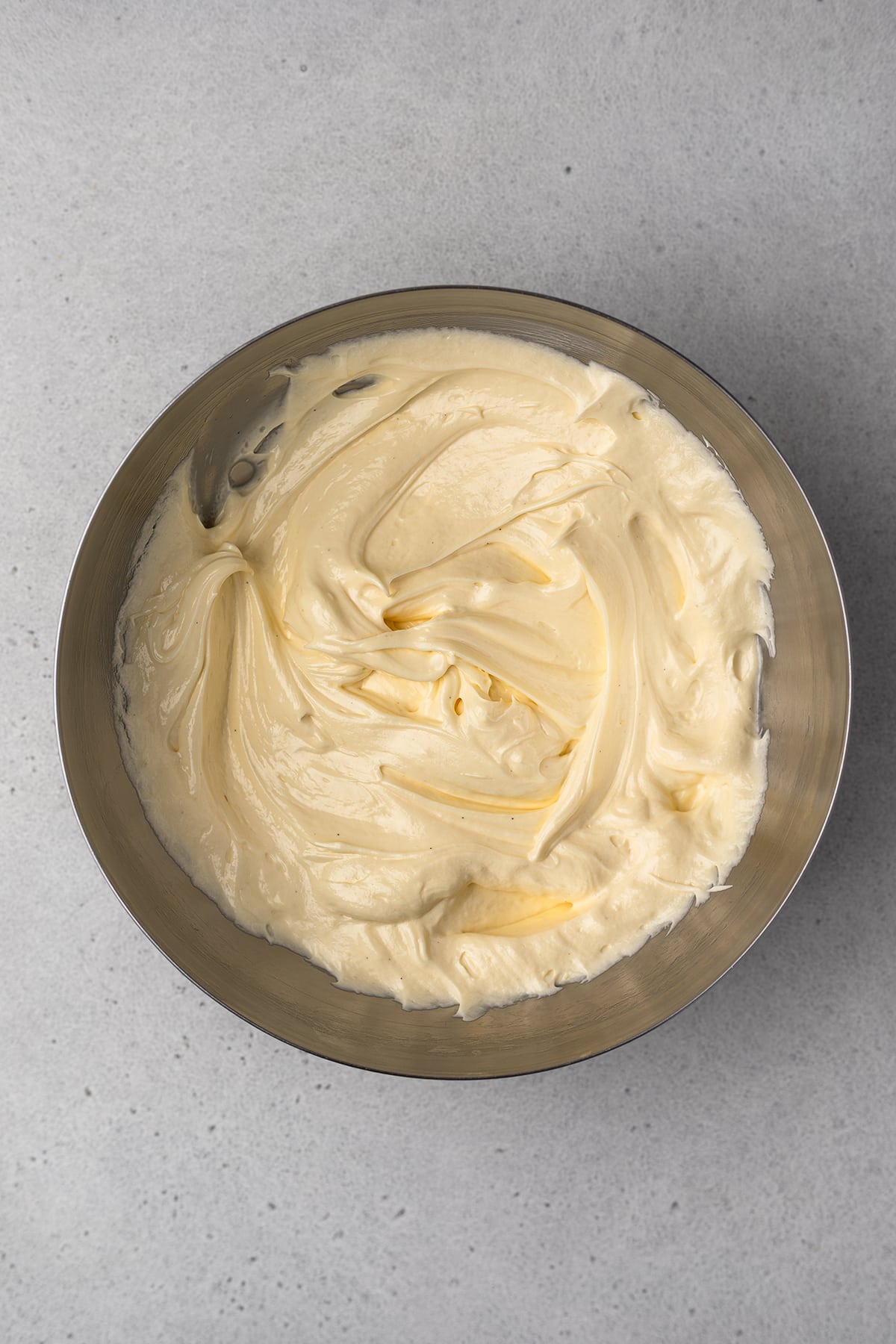
Gâteau de Savoie (Biscuit de Savoie)

Sep 19, 2023 · Leave a Comment

Sliced gateau de Savoie on a serving platter.

Gateau de Savoie or biscuit de Savoie is a classic French cake with a delicate sugar crust and a soft, airy crumb. You will love its easy and simple recipe with just a few ingredients, made in an hour.

Sliced gateau de Savoie on a serving platter.

What is Gateau de Savoie?

Gateau de Savoie, or biscuit de Savoie, is a French sponge cake with simple ingredients like eggs, powdered sugar, flour, and potato starch. The cake originates from the beautiful region of Savoie in France.

[feast_advanced_jump_to]

It was created in the 14th century by Pierre de Yenne, a chef of the Count of Savoy, Aosta, and Maurienne. With simple ingredients, this light sponge cake has stood the test of time.

BAKING ESSENTIALS CHECKLIST

Sign up and get a list of the necessary baking tools and ingredients

FREE DOWNLOAD

Biscuit de Savoie is a unique cake that differs in texture and taste from the Italian sponge cake and Genoise cake. It is all about the specific amounts and order of incorporating the ingredients.

Gateau de Savoie recipe

  • Easy, quick, and inexpensive: it is made with a few basic ingredients.
  • It uses your favorite bundt pan or a Kugelhopf cake mold. Make sure that the mold you use is made of metal.
  • The cake is fat-free, except for some butter for preparing the mold.

Ingredients

Gateau de Savoie ingredients.

For ingredients and detailed instructions, refer to the recipe card below.

  • Eggs: The recipe calls for room temperature separated egg whites and egg yolks. Use an egg separator to separate the large eggs while chilled.
  • Sugar: Use granulated sugar or caster sugar interchangeably. Make icing sugar with a coffee grinder or purchase powdered sugar.
  • Flour: The recipe calls for regular all-purpose flour.
  • Potato starch lightens up the flour to create a tender cake texture.
  • Lemon: Opt for an organic, untreated lemon to make fresh zest and lemon juice. To help, use a Microplane and citrus juicer.
Sliced biscuit de Savoie on a serving board.

How to make Gateau de Savoie

Step 1. Preheat the oven to 340°F (170°C). Use a pastry brush to grease the inside of a tube pan with softened butter.

Step 2. Sprinkle it with granulated sugar, and rotate the mold so that the sugar sticks to the butter all over the surface. Refrigerate the mold until ready to use.

Pro tip: Thoroughly grease every part of your bundt cake pan, including the intricate patterns.

Step 3. To make the cake batter, sift the flour and potato starch mixture in a large bowl and set aside. Use an egg separator to separate the whites from the yolks.

Egg yolk mixture in a glass bowl.

Step 4. In a separate bowl, whisk the egg yolks with 1 cup (125 g) of icing sugar until whitish and doubled in size.

Egg yolk and flour mixture in a bowl.

Step 5. Sift the dry ingredients over the egg yolk mixture, add the lemon zest, and gently mix with a rubber spatula.

Meringue on mixer beaters over the bowl.

Step 6. In a clean bowl, whip the egg whites until mounted, and gradually add the remaining ⅓ cup (45 g) icing sugar and lemon juice. Beat the meringue until stiff and glossy.

Cake batter in a glass bowl.

Step 7. Add ⅓ of the beaten egg whites into the principal preparation and gently mix. Add the rest of the meringue and carefully mix by lifting and turning the bowl in the same direction.

Pro tip: Egg whites must be whipped until the consistency of a bird's beak (bec d'oiseau in French).

Cake batter in a bundt pan.

Step 8. Pour the batter into the prepared mold to fill up to ⅔.

Baked gateau de Savoie in a mold.

Step 9. Tap the mold on the work surface, and bake for 40 minutes or until a toothpick inserted in the center comes out clean.

Step 10. Remove the cake from the oven and let it rest in the mold for a few minutes. Unmold and let it cool to room temperature.

To serve, sprinkle the cake with icing sugar.

Gateau de Savoie with a slice on a serving platter.

Expert Tips

  1. Make the baking time adjustments as needed. It may vary based on your oven and the quality of the mold.
  2. Never open the oven door during baking; otherwise, the cake will collapse.

Recipe variations

The traditional Gateau de Savoie is made with lemon zest, but you are free to experiment.

  • Flavorings: Replace lemon zest with another citrus zest (orange, lime, grapefruit) or add vanilla extract or orange blossom water to the batter.
  • Fillings: Cut the cake into two or three layers and garnish with French pastry cream, jam, chocolate ganache, or Chantilly cream with fresh fruit.

How to serve it

Gateau de Savoie can be eaten plain or served with jam, honey, hazelnut praline paste, crème Anglaise, sugar-free whipped cream, and fresh fruits.

It is also perfect for breakfast, dipping it in your morning coffee or French hot chocolate.

Storing and freezing

Store Gateau de Savoie at room temperature for 4-5 days. 

Can you freeze it? You can freeze the whole cake or cut it into individual slices. Wrap the cake or slices with plastic film, then aluminum foil, and freeze for three months.

Recipe FAQ

How to make this cake gluten-free?

Replace all-purpose flour with starch by weight.

Which mold to use for Gateau de Savoie?

The traditional mold is a high hollow or bundt cake mold. If you don't have one, a Kouglof, round cake, or loaf cake mold will work, too. Just remember, using a metal mold yields the best results.

Can you line the Savoy cake mold with another sugar?

You can replace granulated sugar with brown sugar if desired.

Love simple cake recipes? Try these next!

  • Banana bread with streusel
  • Apple sponge cake
  • Quatre-quarts (French pound cake)
  • French yogurt cake
  • Or browse all the cake recipes

Want more delicious and beautiful recipes? Subscribe to my newsletter and follow me on Facebook, Pinterest, and Instagram for my latest updates. If you make this recipe, please leave a star rating on the recipe card and comment below!

Print

Recipe card

Gâteau de Savoie (Biscuit de Savoie)

Sliced gateau de Savoie on a serving platter.
Print Recipe
Save Recipe Recipe Saved

5 Stars 4 Stars 3 Stars 2 Stars 1 Star

No reviews

Gateau de Savoie or Biscuit de Savoie is a classic French cake with a delicate sugar crust and a soft, airy crumb. You will love its easy and simple recipe with just six ingredients, made in an hour.

  • Author: Irina Totterman
  • Total Time: 1 hour
  • Yield: 8 1x
  • Category: Cakes
  • Method: Baking
  • Cuisine: French

Ingredients

Scale

For preparing the mold:

  • 1 ½ tablespoons (20 g) softened unsalted butter
  • ⅓ cup (70 g) granulated sugar

For the cake batter:

  • 6 large eggs, separated (room temperature)
  • 1 ⅓ cups (170 g) icing (powdered) sugar
  • 1 cup minus 4 teaspoons (115 g) all-purpose flour
  • 2 ½ tablespoons (25 g) potato starch
  • ½ lemon, zest
  • 1 tablespoon fresh lemon juice

For decoration: 

  • 1 tablespoon icing sugar

Instructions

  1. Preheat the oven to 340°F (170°C). Use a pastry brush to grease the inside of a tube pan with softened butter. Sprinkle it with granulated sugar, and rotate the mold so that the sugar sticks to the butter all over the surface. Refrigerate the mold until ready to use.

  2. To make the cake batter, sift the flour and potato starch mixture in a large bowl and set aside. Use an egg separator to separate the whites from the yolks.

  3. In a separate bowl, whisk the egg yolks with 1 cup (125 g) of icing sugar until whitish and doubled in size.

  4. Sift the dry ingredients over the egg yolk mixture, add the lemon zest, and gently mix with a rubber spatula.

  5. In a clean bowl, whip the egg whites until mounted, and gradually add the remaining ⅓ cup (45 g) icing sugar and lemon juice. Beat the meringue until stiff and glossy. Egg whites must be whipped until the consistency of a bird's beak (bec d'oiseau in French).

  6. Add ⅓ of the beaten egg whites into the principal preparation and gently mix. Add the rest of the meringue and carefully mix by lifting and turning the bowl in the same direction.

  7. Pour the batter into the prepared mold to fill up to ⅔. Tap the mold on the work surface, and bake for 40 minutes or until a toothpick inserted in the center comes out clean.

  8. Remove the cake from the oven and let it rest in the mold for a few minutes. Unmold and let it cool to room temperature. To serve, sprinkle the cake with icing sugar. 

Notes

  1. Thoroughly grease every part of your bundt cake pan, including the intricate patterns.
  2. Make the baking time adjustments as needed. It may vary based on your oven and the quality of the mold.
  3. Never open the oven door during baking; otherwise, the cake will collapse.

Nutrition

  • Serving Size: 1 slice
  • Calories: 252
  • Sugar: 29.9 g
  • Sodium: 54 mg
  • Fat: 5.9 g
  • Saturated Fat: 2.5 g
  • Carbohydrates: 44.1 g
  • Fiber: 0.4 g
  • Protein: 6.3 g
  • Cholesterol: 145 mg

Thank you for following me on Pinterest, Facebook, and Instagram. Hashtag #bakinglikeachef so I can see your creations.

The nutritional information has been calculated using an online recipe nutrition calculator such as Verywellfit.com and is intended for informational purposes only. These figures should be used as a general guideline and not be construed as a guarantee.
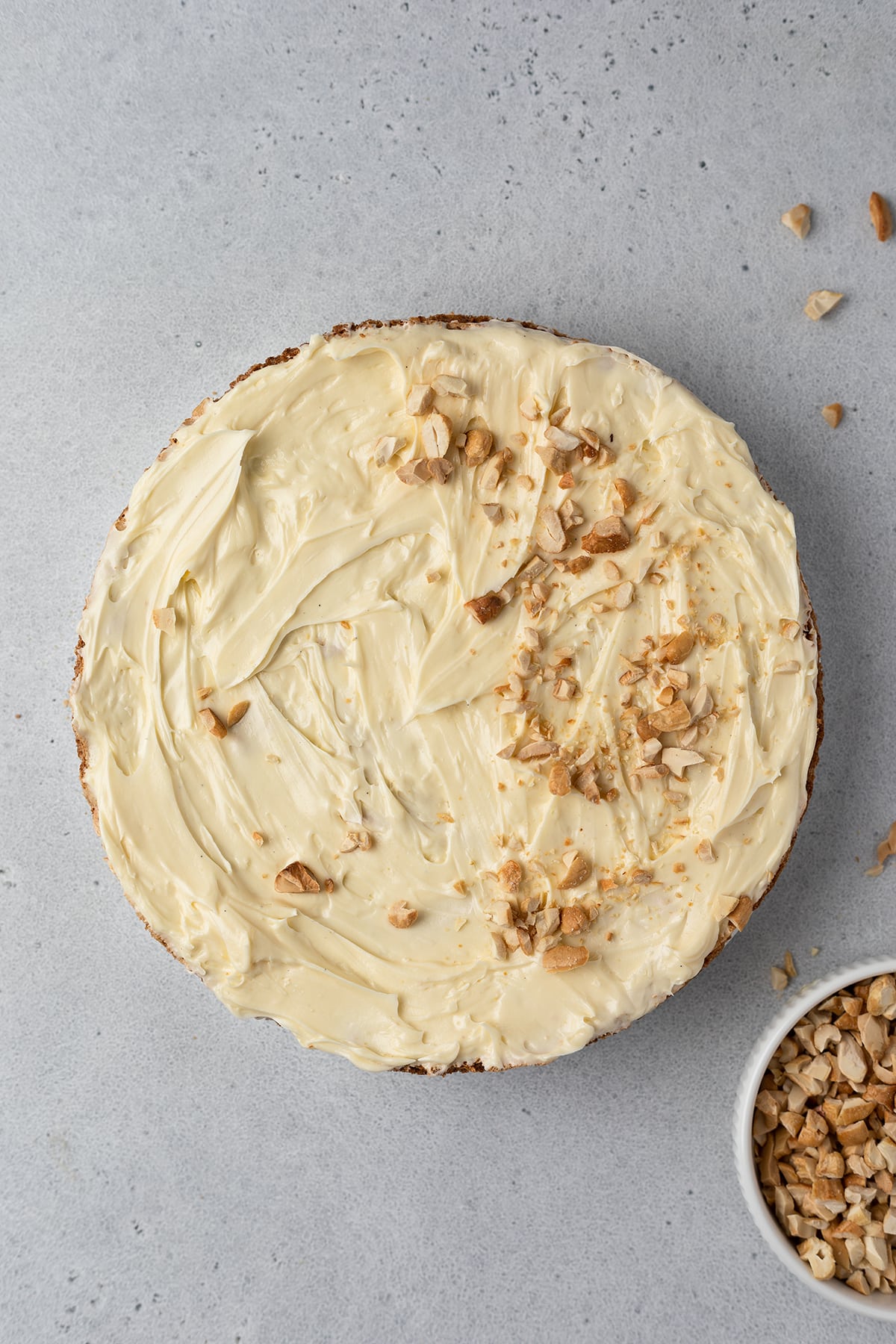
Vanilla Sponge Cake Roll (Basic Recipe)

Sep 13, 2023 · Leave a Comment

Vanilla sponge cake roll on a serving board.

This vanilla sponge cake roll is basic, easy, and quick. With just a few simple ingredients flavored with vanilla, it is perfect for making Swiss roll cakes, Christmas jelly rolls, Yule logs, and Buche de Noel.

Vanilla sponge cake roll on a serving board.

Vanilla sponge cake roll recipe

This sponge cake roll recipe is easy, quick, and made with basic ingredients. It is used for making Swiss roll cakes, jelly roll cakes, Yule logs, or Buche de Noel.

[feast_advanced_jump_to]

Unlike the chiffon cake method, it is prepared with whole eggs. This means it rises from well-whisked eggs without adding leavening agents (baking powder or baking soda).

BAKING ESSENTIALS CHECKLIST

Sign up and get a list of the necessary baking tools and ingredients

FREE DOWNLOAD

The result is a soft, fluffy, light, and airy cake base perfect for any rolled cake, whether a delicious strawberry Swiss roll or a gorgeous chocolate Yule log. The same technique is used to make Italian sponge cake and Genoise cake.

Ingredients

Vanilla sponge cake roll ingredients.

For ingredients and detailed instructions, refer to the recipe card below.

  • Eggs: The recipe calls for large eggs at room temperature. There is no need to separate the egg whites from the egg yolks.
  • Sugar: Use regular granulated and vanilla sugar to make the cake batter and icing sugar (powdered or confectioner's sugar) for making cream frosting.
  • Flour: The recipe uses cake flour. To make your own cake flour, replace 2 tablespoons of all-purpose flour with cornstarch in 1 cup. Or, mix 15 grams of cornstarch with 110 grams of all-purpose flour.
  • Milk: Opt for whole milk to make the recipe.
  • Butter: Use unsalted butter for making Genoise cake, but you can replace it with vegetable oil.
  • Heavy cream: Choose heavy or heavy whipped cream with at least 30% fat to make a whipped cream filling.
  • Mascarpone brings a beautiful tangy taste and flavor and stabilizes the whipped cream.
Sliced vanilla sponge cake roll on a serving board.

How to make sponge cake roll

Step 1. Prepare a 12 x 16 inch (30 x 40 cm) non-spill baking sheet or a large baking tray lined with parchment paper.

Step 2. To make a sponge cake, preheat the oven to 390°F (200°C). Sift cake flour with a flour sifter and set aside.

Step 3. Pour milk and butter into a small bowl and bring them to a large container with hot water. Check the liquids' temperature to be 122-150°F (50-60°C).

Step 3. Place room-temperature whole eggs, vanilla, and granulated sugar in a heat-resistant bowl and beat a few times with a hand whisk.

Step 5. Bring the bowl over a water bath and whisk with a hand whisk until the egg mixture reaches 104°F (40°C): check it with a cooking thermometer.

Step 6. Remove the bowl from the water bath and use an electric or stand mixer with a whisk attachment to beat at high speed for 6-7 minutes.

Step 7. Reduce the mixer speed when the mixture thickens and turns white, triples in volume, and the dough falls like a thick ribbon from the mixer beaters. Beat at low speed for 2 minutes to adjust the batter's texture (photo 1).

Step 8. Sift the flour once again over the bowl with the principal preparation and gently mix with a rubber spatula. Work from the bottom to the top while turning the bowl counterclockwise.

Step 9. Take a scoop of the batter in a bowl with milk and butter preheated to 122-150°F (50-60°C), and mix with a spatula. Pour it back into the main preparation and mix by scooping the batter from the bottom and moving upward (photo 2).

Beaten eggs with sugar in a bowl.

PHOTO 1

Cake batter in a bowl with a spatula.

PHOTO 2

Step 10. Pour the batter into the silicone baking sheet (photo 3) about 8 inches (20 cm) above the mold. This helps to pop large air bubbles.

Pro tip: If using a large baking sheet lined with parchment paper, spread the batter, creating a 12 x 16 inches (30 x 40 cm) rectangle, aiming for ½ inch (1 cm) thickness.

Step 11. Level the surface into an even layer with a bent spatula or a dough scraper (avoid excessive smoothing in one spot).

Step 12. Bring the baking sheet to the oven and immediately lower the oven temperature from 390°F (200°C) to 375°F (190°C). Bake for 12-14 minutes (photo 4).

  • Pro tip: Watch out for the cake not to overbake: the top should get slightly browned, and the bottom should stay pale. Check for doneness with a toothpick: it should come out dry.
Cake batter onto a silicone baking sheet.

PHOTO 3

Baked sponge cake in a baking sheet.

PHOTO 4

Step 13. Remove the cake from the oven, and while it is hot, flip it on a clean tea towel generously sprinkled with icing (powdered) sugar.

Step 14. Gently remove the baking sheet (photo 5) or parchment paper from the base of the cake and cover it with a clean parchment sheet.

Step 15. Using the towel, roll the cake with parchment paper inside and let it cool for 10 minutes. Unroll it and let the cake cool to room temperature.

Step 16. To make mascarpone whipped cream, pour cold heavy cream and cold mascarpone into a chilled bowl and whisk until soft peaks form. Add icing sugar and whisk until medium-stiff peaks form (photo 6).

Pro tip: Consult the mascarpone frosting recipe for step-by-step photographed explanations, helpful tips, and tricks.

Sponge cake with the peeled silicone baking sheet.

PHOTO 5

Mascarpone frosting in a bowl.

PHOTO 6

Step 17. To assemble the cake, remove the parchment paper. Spread the cream in an even layer over the cooled cake using an offset spatula (photo 7).

Step 18. Re-roll the cake from the short end, tightening it with the help of the towel. Lift the towel, pulling it parallel to the working surface, and continue rolling the cake as you go.

Step 19. Finish rolling the cake, placing the end of the roll at the bottom (photo 8). Tighten the roll with a long metal or plastic ruler (or metal baking sheet). Secure the ruler or baking tray against the roll while pulling away the bottom end of the kitchen towel.

Sponge cake with the mascarpone cream on top.

PHOTO 7

Cake with cream rolled in a towel.

PHOTO 8

Step 20. Cover the cake roll with the towel, and refrigerate for 30-60 minutes. Gently remove the towel from the cake, and trim the ends with a serrated knife for a neat appearance. Transfer the rolled cake to a serving tray.

To serve, sprinkle the top of the cake with icing sugar and decorate with fresh fruit of your choice.

Assembled sponge cake roll on a serving platter.

Expert Tips

  1. Read more about how to make roll cake for useful tips and tricks. Rolling the cake is the most critical step, and mastering it is crucial for achieving perfection in your roll cake.
  2. Roll the cake up in a tea towel while it is warm.
  3. Make sure to cool the cake before applying the cream.
  4. Use this simple cake pan calculator to adjust ingredient amounts for a different baking pan. You will need to enter the length and width of your tin.

Recipe variations

  • Cake batter: Replace some cake flour with unsweetened cocoa powder to make chocolate sponge roll cake.
  • Cake roll filling: Use your favorite cream filling, from French Chantilly cream to chocolate ganache and cream cheese filling.
  • Rolling method: Roll the cake at the short side or lengthwise. Also, try to change the roll surface using the browned side in or out.
  • Decoration: Top the roll with powdered sugar, pipe whipped cream swirls, or decorate with fresh berries. Need more cream? Whip it up to coat the sides of the cake.

Storing and freezing

Store vanilla sponge roll cake in an airtight container in the refrigerator for up to 2 days.

Can you freeze a sponge cake roll? You can freeze a whole cake filled with mascarpone frosting for up to 2 months.

Recipe FAQ

Can you roll sponge cake?

You can roll a thin layer of sponge cake. Just bake it into a ½ inches (1 cm) thickness, fill it with jam or cream and create a delicious sponge cake Swiss roll.

How do you roll a sponge cake?

To roll a sponge cake, first, flip it onto a clean kitchen towel sprinkled with icing sugar. Roll the cake with the help of the towel. Rest it for 10 minutes, then unroll the cake and let it cool to room temperature. Fill it with cream or jam and roll it again.

Love cake rolls? Try these next!

If you like jelly roll cake, you'll love the rolled cakes on our website.

  • Vanilla Swiss roll cake
  • Strawberry cake roll
  • Nutella Swiss roll
  • Coffee Swiss roll
  • Pavlova roll cake
  • Pistachio roulade
  • Or browse all the cake recipes

Want more delicious and beautiful recipes? Subscribe to my newsletter and follow me on Facebook, Pinterest, and Instagram for my latest updates. If you make this recipe, please leave a star rating on the recipe card and comment below!

Print

Recipe card

Vanilla Sponge Cake Roll (Basic Recipe)

Vanilla sponge cake roll on a serving board.
Print Recipe
Save Recipe Recipe Saved

5 Stars 4 Stars 3 Stars 2 Stars 1 Star

No reviews

This vanilla sponge cake roll is basic, easy, and quick. With just a few simple ingredients flavored with vanilla, it is perfect for making Swiss roll cakes, Christmas jelly rolls, Yule logs, and Buche de Noel.

  • Author: Irina Totterman
  • Total Time: 50 minutes
  • Yield: 10 1x
  • Category: Cakes
  • Method: Baking
  • Cuisine: European

Ingredients

Scale

For sponge cake roll:

  • 5 large eggs, room temperature
  • ½ cup (100 g) granulated sugar
  • ½ sachet (4.5 g) vanilla sugar
  • ⅔ cup + 2 ½ tablespoons (82 g) cake flour
  • 2 ⅓ tablespoons (35 g) whole milk
  • 1 ½ tablespoons (20 g) unsalted butter

For mascarpone whipped cream: 

  • ¾ cup (180 g) cold heavy cream, 30% fat 
  • ¼ cup + 1 teaspoon (65 g) cold mascarpone cheese
  • 2 ½ tablespoons (20 g) icing sugar

Instructions

  1. Prepare a 12 x 16-inch (30 x 40 cm) non-spill baking sheet or a large baking tray lined with parchment paper.  
  2. To make sponge cake, pour milk, place butter in a small bowl, and bring it over a large container with hot water. Check the liquids' temperature at 122-150°F (50-60°C). With a flour sifter, sift cake flour and set aside. Preheat the oven to 390°F (200°C). 
  3. Place room-temperature whole eggs, vanilla, and granulated sugar in a heat-resistant bowl and beat a few times with a hand whisk. Bring the bowl over a water bath and whisk with a hand whisk until the egg mixture reaches 104°F (40°C). Check it with a cooking thermometer. 
  4. Remove the bowl from the water bath and use an electric or stand mixer with a whisk attachment to beat at high speed for 6-7 minutes. 
  5. Once the mixture thickens and turns white, triples in volume, and the dough falls like a thick ribbon from the mixer beaters, reduce the speed. Beat at low speed for 2 minutes to adjust the batter's texture. 
  6. Sift the flour once again over the bowl with the principal preparation and gently mix with a rubber spatula. Work from the bottom to the top while turning the bowl counterclockwise. 
  7. Take a scoop of the batter in a bowl with milk and butter preheated to 122-150°F (50-60°C), and mix with a spatula. Pour it back into the main preparation and mix by scooping the batter from the bottom and moving upward. 
  8. Pour the batter into the silicone baking sheet about 8 inches (20 cm) above the mold. This helps to pop large air bubbles. If using a large baking sheet with parchment paper, spread the batter into a 12 x 16 inches (30 x 40 cm) rectangle, aiming for a ½ inch (1 cm) thickness.
  9. Level the surface into an even layer with a bent spatula or a dough scraper (avoid excessive smoothing in one spot). Tap the pan on the table once to remove large bubbles. 
  10. Bring the baking sheet to the oven and immediately lower the oven temperature from 390°F (200°C) to 375°F (190°C). Bake for 12-14 minutes. Watch out for the cake not to overbake: the top should get slightly browned, and the bottom should stay pale. Check for doneness with a toothpick: it should come out dry. 
  11. Take the cake out of the oven, and while it is hot, flip it on a clean tea towel generously sprinkled with icing (powdered) sugar. Gently remove the silicone baking sheet or parchment paper from the base of the cake and cover it with a clean parchment sheet. Using the towel, roll the cake with parchment paper inside and let it cool for 10 minutes. Unroll it and let the cake cool to room temperature.
  12. To make the mascarpone frosting, pour cold heavy cream and cold mascarpone into a chilled bowl and whisk until soft peaks. Add icing sugar and whisk until medium-stiff peaks.
  13. To assemble, unroll the cake and remove the parchment paper. Spread the cream in an even layer over the cooled cake using an offset spatula.
  14. Re-roll the cake from the short end, tightening it with the help of the towel. Lift the towel, pulling it parallel to the working surface, and continue rolling the cake as you go.
  15. Finish rolling the cake, placing the end of the roll at the bottom. Tighten the roll with a long metal or plastic ruler (or metal baking sheet). Secure the ruler or baking tray against the roll while pulling away the bottom end of the kitchen towel.
  16. Cover the cake roll with the towel, and refrigerate for 30-60 minutes. Gently remove the towel from the cake, and trim the ends with a serrated knife for a neat appearance. Transfer the rolled cake to a serving tray.
  17. To serve, sprinkle the top of the cake with icing sugar and decorate with fresh fruit of your choice.

Notes

  1. Read more about how to make roll cake for useful tips and tricks. Rolling the cake is the most critical step, and mastering it is crucial for achieving perfection in your roll cake.
  2. Roll the cake up in a tea towel while it is warm.
  3. Make sure to cool the cake before applying the cream.
  4. Use this simple cake pan calculator to adjust ingredient amounts for a different baking pan. You will need to enter the length and width of your tin.

Nutrition

  • Serving Size: 1 slice
  • Calories: 190
  • Sugar: 12.9 g
  • Sodium: 44 mg
  • Fat: 11.1 g
  • Saturated Fat: 6.1 g
  • Carbohydrates: 19 g
  • Fiber: 0.4 g
  • Protein: 4.6 g
  • Cholesterol: 122 mg

Thank you for following me on Pinterest, Facebook, and Instagram. Hashtag #bakinglikeachef so I can see your creations.

The nutritional information has been calculated using an online recipe nutrition calculator such as Verywellfit.com and is intended for informational purposes only. These figures should be used as a general guideline and not be construed as a guarantee.
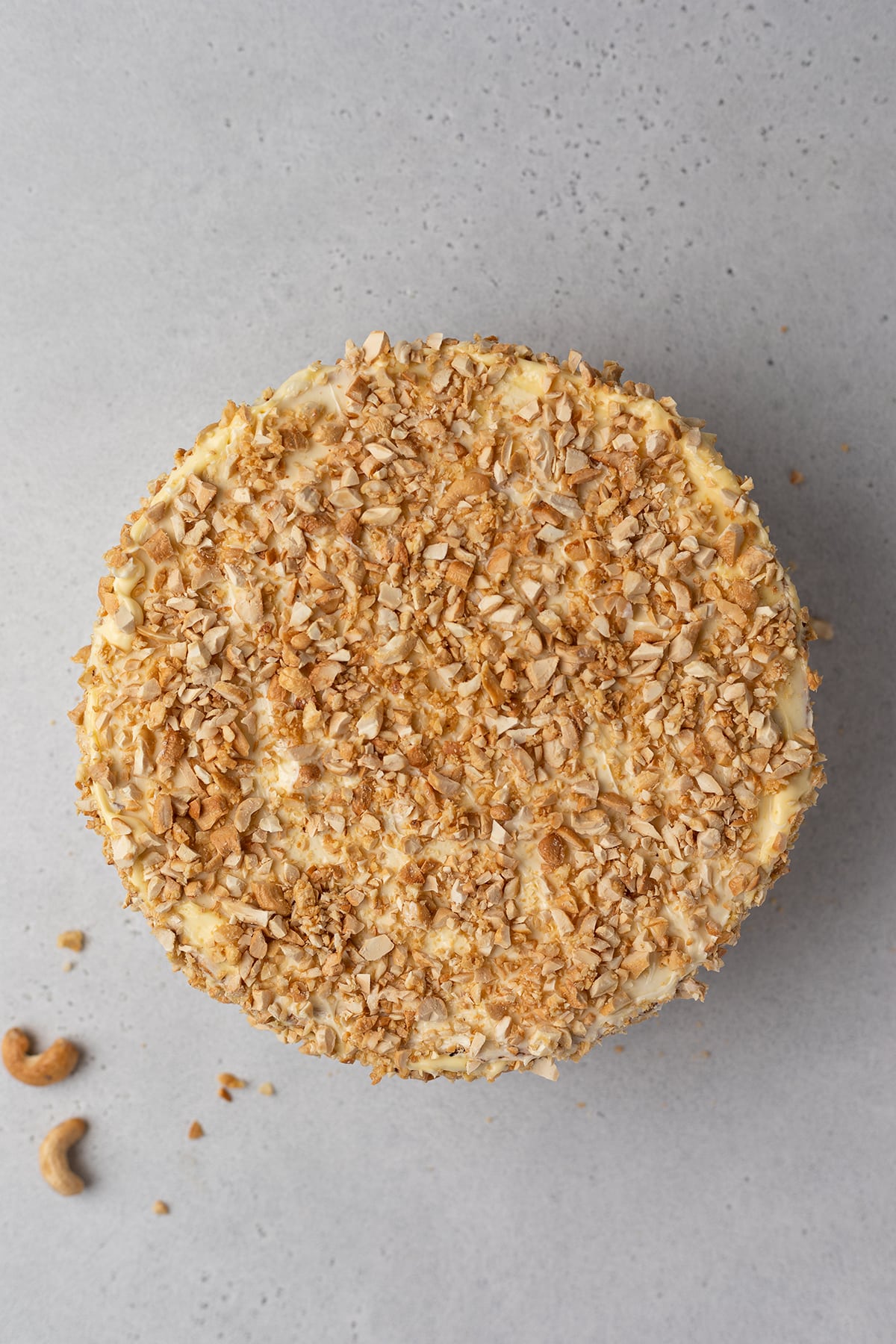
Strawberry Swiss Roll Cake Recipe

Aug 24, 2023 · Leave a Comment

Strawberry Swiss roll cake on a white serving plate.

This easy strawberry Swiss roll cake is a soft sponge roll cake filled with luscious whipped cream and fresh strawberries. It makes for a simple yet decadent dessert. Soft, sweet, creamy, and full of red fruit.

Strawberry Swiss roll cake on a white serving plate

Getting a slice of a delicious dessert after a meal is one of the most satisfying experiences. And if it is a gorgeous strawberry cream roll, it is the best!

[feast_advanced_jump_to]

Soft and fluffy sponge cake rolled with fresh, juicy strawberries and lashings of creamy whipped cream feels like a burst of summer in the mouth.

BAKING ESSENTIALS CHECKLIST

Sign up and get a list of the necessary baking tools and ingredients

FREE DOWNLOAD

This strawberry and cream Swiss roll is the perfect balance of sweet and refreshing, and with the ease of preparation, what can be better?

In the end, make the most of the strawberry season with delicious strawberry desserts: Japanese strawberry shortcake, German Erdbeerboden, Swedish Jordgubbstårta, or Korean fresh cream cake.

Strawberry Swiss roll recipe

  • This strawberry Swiss roll recipe is easy and quick and uses fresh juicy strawberries, not strawberry jam, strawberry filling, or pureed strawberries.
  • It is prepared with a light sponge cake using whole eggs, unlike Japanese Swiss cake, which uses chiffon cake and separates egg whites from yolks.
  • It is a beautiful cake for birthdays or other special occasions.

Ingredients

Strawberry Swiss roll cake ingredients

For ingredients and detailed instructions, refer to the recipe card below.

  • Eggs: The recipe calls for large eggs at room temperature. There is no need to separate the egg whites from the egg yolks.
  • Sugar: Use regular granulated and vanilla sugar to make the cake batter and icing sugar (powdered or confectioner's sugar) for making the cream frosting.
  • Flour: The recipe uses cake flour. To make your own cake flour, remove 2 tablespoons of all-purpose flour from 1 cup, and replace it with 2 tablespoons of cornstarch. Alternatively, mix 15 grams of cornstarch with 110 grams of all-purpose flour.
  • Milk: Opt for whole milk to make the recipe.
  • Honey: The recipe calls for liquid honey, neutral in flavor, preferably. Learn how to liquify crystalized honey if this is the case.
  • Oil: Use flavorless grapeseed or vegetable oil for making Genoise cake, but you can replace it with unsalted butter.
  • Heavy cream: Choose heavy or heavy whipped cream with at least 30% fat to make a sweetened whipped cream filling.
  • Sweetened condensed milk: Use homemade sweetened condensed milk or purchase it in a grocery store.
  • Strawberry: Choose fresh ripe strawberries of the same size. Frozen berries that are too watery are not suitable for this dessert recipe.
Sliced strawberry cake roll on a white serving plate

How to make strawberry Swiss roll

Step 1. Prepare a light-colored 15 x 10 inches (25 x 38 cm) jelly roll pan. Line it with a sheet of parchment paper by following this tutorial - how to line a Swiss roll tin.

Step 2. To make sponge cake, preheat the oven to 410°F (210°C). Pour grapeseed oil and milk into a small bowl, place it over a large container with hot water, and let wet ingredients warm up to 104°F (40°C).

Step 3. Sift flour using a flour sifter in a clean bowl and put aside.

Step 4. Place room-temperature whole eggs, honey, vanilla, and granulated sugar, in a heat-resistant bowl and whisk a few times with a hand whisk.

Step 5. Bring the bowl over a bain-marie or water bath and beat with a hand whisk until the mixture reaches about 104°F (40°C): check it with a cooking thermometer.

Step 6. Remove the bowl from the water bath and use an electric or stand mixer with a whisk attachment to beat at high speed for 6 minutes.

Step 7. When the mixture becomes thick, turns white, triples in volume, and the batter falls like a ribbon from the mixer beaters, lower the speed. Beat at low speed for 2 minutes to adjust the texture of the batter (photo 1).

Step 8. Sift the flour over the bowl once again and gently mix with a rubber spatula by lifting the batter from the bottom to the top.

Pro tip: Think of it like a rubber spatula moving from 2 to 8 on a clock, lifting and returning the dough.

Step 9. Take a scoop of the batter in a bowl with milk and oil preheated to 104°F (40°C), and mix with a spatula. Pour it back over the spatula and gently mix (photo 2).

Beaten eggs with sugar in a bowl

PHOTO 1

Cake batter in a bowl with a wooden spoon

PHOTO 2

Step 10. To fill the prepared pan, pour the batter from a height of approximately 8 inches (20 cm) above it. This helps pop large air bubbles.

Step 11. Even the surface with a bent spatula or a dough scraper: avoid excessive smoothing in one spot. Tap the pan on the table to remove large bubbles (photo 3).

Step 12. Bake in the preheated oven for about 8 minutes. Start watching out for the cake at 7 minutes: the back of the cake should be pale, and the top should be slightly browned (photo 4).

Pro tip: Check for doneness with a toothpick: it should come out dry.

Cake batter in a pan lined with parchment paper

PHOTO 3

Baked sponge cake in a pan

PHOTO 4

Step 13. Remove the cake from the oven and immediately flip it on a clean tea towel sprinkled with icing (powdered) sugar. Peel the paper from the bottom of the cake (photo 5).

Pro tip: Using a clean tea or kitchen towel dusted with icing (powdered) sugar to roll the cake up helps prevent it from sticking.

Step 14. Place a clean parchment sheet over the back of the cake. Roll it up in a towel starting from the short end. Let it cool for 10 minutes.

Step 15. Unroll the sponge and allow it to come to room temperature. Don't worry about curly corners, as they are perfectly okay.

Step 16. To make whipped cream, pour cold heavy cream and condensed milk into a chilled bowl, and whisk until medium peaks.

Pro tip: Consult the sugar-free whipped cream recipe for step-by-step photographed explanations, helpful tips, and tricks.

Step 17. To assemble the cake, wash and pat dry strawberries. Remove the leafy top, and cut 7-10 strawberries into small pieces.

Step 18. Evenly spread the cream over the cooled cake using an offset spatula. Distribute strawberry pieces on the cream and roll the cake (photo 6).

Sponge cake on a towel with peeled parchment paper

PHOTO 5

Sponge cake with cream and strawberry pieces

PHOTO 6

Step 19. Start by tightly re-rolling the beginning of the roll to create the cake's core. Then with the help of the towel, continue rolling the cake as you go.

Step 20. Finish shaping the roll so that the end of the roll is at the bottom (photo 7). Use a metal ruler or baking sheet to tighten the roll slightly. Push the ruler or baking tray towards the roll, tightening it while pulling away the bottom end of the towel.

Step 21. Keep the cake rolled in the towel, and refrigerate for 30-60 minutes. Then gently remove the tea towel from the cake, and cut the ends with a serrated knife for a neat appearance.

Step 22. Transfer the cake to a serving tray. Sprinkle the top of the cake with icing sugar and decorate with the remaining strawberries (photo 8).

Cake rolled in a towel and parchment paper

PHOTO 7

Assembled cake roll with strawberry slices on top

PHOTO 8

Expert Tips

  1. Read more about how to make roll cake for useful tips and tricks. Rolling the cake is the most important step, and mastering it is crucial for achieving perfection in your roll cake.
  2. Mix the cake batter gently without overmixing it.
  3. Use high-quality parchment paper that is thick enough and wrinkle-free to ensure an evenly baked, pale bottom for the cake.
  4. Roll the cake up in a tea towel while it is warm.
  5. Make sure to cool the cake before applying the cream.
  6. The recipe is created for a classic jelly roll pan. Use this simple cake pan calculator to adjust ingredient amounts for a different baking pan size. Just enter the length and width of your tray.
Strawberry Swiss roll on a platter with a few slices on dessert plates

Recipe variations

  • Cake batter: Replace some cake flour with unsweetened cocoa powder to make strawberry chocolate roll cake.
  • Cake roll filling: Use your favorite cream filling, from Chantilly cream to cream cheese frosting.
  • Fruits: Swap fresh strawberries for other fresh berries (blackberries, raspberries, or blueberries) or stone fruit (peaches, nectarines, etc.)
  • Rolling method: Roll the cake at the short end or lengthwise.
  • Decoration: Add powdered sugar to the top of the roll, pipe whipped cream swirls, or decorate with fresh fruit of your choice.

Storing and freezing

Store strawberry Swiss roll cake in an airtight container in the refrigerator for up to 2 days.

Can you freeze strawberry Swiss roll? You can't freeze this type of cake roll: whipped cream doesn't handle freezing, and fresh berries will lose their texture once thawed.

Recipe FAQ

What is a Swiss roll called in America?

In the United States, a Swiss roll is known as a jelly roll.

What is the difference between Swiss roll and cake roll?

Swiss roll cake consists of a Genoise sponge and various creams like Chantilly or buttercream. Japanese-style cake roll is made with chiffon cake, has less sugar, and is filled with fresh whipped cream.

What is the sponge called in a Swiss roll?

A Swiss roll is made primarily with a Genoise sponge cake that has a lower amount of flour. This provides the cake with the necessary flexibility for rolling, compared with the traditional Genoise cake.

Should Swiss roll be rolled hot or cold?

Rolling the cake while it is warm is crucial for achieving the perfect shape. After it is cooled, it is filled with cream and re-rolled again.

Love Swiss rolls? Try these next!

  • Vanilla Swiss roll
  • Nutella Swiss roll
  • Coffee Swiss roll
  • Pavlova roll cake
  • Pistachio roulade
  • Or browse all the cake recipes

Want more delicious and beautiful recipes? Subscribe to my newsletter and follow me on Facebook, Pinterest, and Instagram for my latest updates. If you make this recipe, please leave a star rating on the recipe card and comment below!

Print

Recipe card

Strawberry Swiss Roll Cake

Strawberry Swiss roll cake on a white serving plate.
Print Recipe
Save Recipe Recipe Saved

5 Stars 4 Stars 3 Stars 2 Stars 1 Star

No reviews

Strawberry Swiss roll cake is a soft, fluffy sponge roll filled with luscious whipped cream and fresh strawberries. Smooth, sweet, creamy, and full of red fruit, it makes for a simple yet decadent dessert.

  • Author: Irina Totterman
  • Total Time: 50 minutes
  • Yield: 8 1x
  • Category: Cakes
  • Method: Baking
  • Cuisine: European

Ingredients

Scale

For the Swiss roll:

  • 4 large eggs, room temperature
  • ½ cup minus 1 ½ tablespoons (80 g) granulated sugar
  • 1 sachet (9 g) vanilla sugar
  • 1 tablespoon (20 g) liquid honey
  • 1 cup minus 1 tablespoon (95 g) cake flour
  • 2 ½ tablespoons (40 g) whole milk
  • 1 ½ tablespoons (20 g) grapeseed oil (or vegetable oil)

For the sweetened whipped cream:

  • 1 cup minus 2 ½ tablespoons (200 g) cold heavy cream, 30% fat content
  • 2 tablespoons (40 g) sweetened condensed milk

For garnish:

  • 15 fresh strawberries
  • 1 tablespoon (8 g) icing sugar
  • edible flowers (optional)

Instructions

  1. Prepare a light-colored 15 x 10 inches (25 x 38 cm) jelly roll pan. Line it with a sheet of parchment paper (watch this video tutorial - how to line a Swiss roll tin). It is up to you to grease the pan before applying the parchment paper.

  2. To make sponge cake, preheat the oven to 410°F (210°C). Pour grapeseed oil and milk into a small bowl and place it over a large container with hot water, and let wet ingredients warm up to 104°F (40°C). Sift flour using a flour sifter in a clean bowl and put aside.

  3. Place room-temperature whole eggs, honey, vanilla, and granulated sugar, in a heat-resistant bowl and whisk a few times with a hand whisk. Bring the bowl over a bain-marie or water bath and beat with a hand whisk until the mixture reaches about 104°F (40°C): check it with a cooking thermometer.

  4. Remove the bowl from the water bath and use an electric or stand mixer with a whisk attachment to beat at high speed for 6 minutes. When the mixture becomes thick, turns white, triples in volume, and the batter falls like a ribbon from the mixer beaters, lower the speed. Beat at low speed for 2 minutes to adjust the texture of the batter.

  5. Sift the flour over the bowl once again and gently mix with a rubber spatula by lifting the batter from the bottom to the top. Take a scoop of the batter in a bowl with milk and oil preheated to 104°F (40°C), and mix with a spatula. Pour it back over the spatula and gently mix.

  6. To fill the prepared pan, pour the batter from a height of approximately 8 inches (20 cm) above it. This helps pop large air bubbles. Even the surface with a bent spatula or a dough scraper: avoid excessive smoothing in one spot. Tap the pan on the table to remove large bubbles.

  7. Bake in the preheated oven for about 8 minutes. Start watching out for the cake at 7 minutes: the back of the cake should be pale, and the top should be slightly browned. Check for doneness with a toothpick: it should come out dry.

  8. Remove the cake from the oven and immediately flip it on a clean tea towel sprinkled with icing (powdered) sugar. Peel the paper from the bottom of the cake. Place a clean parchment sheet over the back of the cake. Roll it up in a towel starting from the short end. Let it cool for 10 minutes.

  9. Unroll the sponge and allow it to come to room temperature. Don't worry about curly corners, as they are perfectly okay.

  10. To make whipped cream, pour cold heavy cream and condensed milk into a chilled bowl, and whisk until medium peaks.

  11. To assemble the cake, wash and pat dry strawberries. Remove the leafy top, and cut 7-10 strawberries into small pieces. Evenly spread the cream over the cooled cake using an offset spatula. Distribute strawberry pieces on the cream and roll the cake.

  12. Start by tightly re-rolling the beginning of the roll to create the cake's core. Then with the help of the towel, continue rolling the cake as you go. Finish shaping the roll so that the end of the roll is at the bottom. Use a metal ruler or baking sheet to tighten the roll slightly. Push the ruler or baking tray towards the roll, tightening it while pulling away the bottom end of the towel.

  13. Keep the cake rolled in the towel, and refrigerate for 30-60 minutes. Then gently remove the tea towel from the cake, and cut the ends with a serrated knife for a neat appearance.

  14. Transfer the cake to a serving tray. Sprinkle the top of the cake with icing sugar and decorate with the remaining strawberries.

Notes

  1. Read more about how to make roll cake for useful tips and tricks. Rolling the cake is the most important step, and mastering it is crucial for achieving perfection in your roll cake.
  2. Make sure to cool the cake before applying the cream.
  3. Use this simple cake pan calculator to adjust ingredient amounts for different baking sheet sizes quickly. Just enter the length and width of your tray.

Nutrition

  • Serving Size: 1 slice
  • Calories: 263
  • Sugar: 16. 9g
  • Sodium: 55 mg
  • Fat: 15.4 g
  • Saturated Fat: 7.3 g
  • Carbohydrates: 26.8 g
  • Fiber: 1 g
  • Protein: 5.8 g
  • Cholesterol: 129 mg

Thank you for following me on Pinterest, Facebook, and Instagram. Hashtag #bakinglikeachef so I can see your creations.

The nutritional information has been calculated using an online recipe nutrition calculator such as Verywellfit.com and is intended for informational purposes only. These figures should be used as a general guideline and not be construed as a guarantee.
Strawberry Roll Cake (Japanese Style)

Aug 22, 2023 · Leave a Comment

A single slice of Japanese strawberry roll cake on a white plate.

Airy, light, soft, and fluffy, Japanese strawberry roll cake is made with luscious whipped cream and juicy strawberries. It makes a perfect birthday cake or a simple afternoon tea treat. You will never want a store-bought roll cake again.

A single slice of Japanese strawberry roll cake on a white plate

Fruit roll cake is a staple of Asian cuisine, particularly popular in Japanese and Korean bakeries. During strawberry season, a strawberry rolled cake, strawberry shortcake roll, or strawberry cream roll (these are different names of the exact roll cake) is an absolute must.

[feast_advanced_jump_to]

Made with a soft and fluffy chiffon cake that practically melts in your mouth, this dessert perfectly balances textures and flavors.

BAKING ESSENTIALS CHECKLIST

Sign up and get a list of the necessary baking tools and ingredients

FREE DOWNLOAD

The rich, fluffy whipped cream complements the sweetness of the seasonal fruit beautifully.

Strawberry roll cake recipe

  • Made within 50 minutes, this strawberry roll cake recipe is simple, quick, and perfect for preparing in advance.
  • It is made with a Japanese-style chiffon method separating egg whites and yolks. It is a perfect roll cake with no peels or cracks.
  • This is a moist cake with a lusciously light texture that melts in your mouth. Read more about how to make a cake moist.
  • It is perfect for a birthday, anniversary, or another special occasion.

Ingredients

Japanese strawberry roll cake ingredients in pictures

For ingredients and detailed instructions, refer to the recipe card below.

  • Eggs: Use chilled eggs, and separate the whites and yolks. Bring the egg yolks to room temperature and chill the whites until ready to use.
  • Sugar: Use white granulated sugar for cake batter, caster sugar for meringue, and icing sugar (powdered or confectioners' sugar) for cream filling.
  • Salt enhances the flavors of the cake.
  • Vanilla extract: Opt for a premium vanilla extract or substitute it with vanilla bean paste in equal parts.
  • Oil: Use neutral oils like grapeseed or vegetable oil, but avoid using olive, peanut, or any other types of flavorful oil.
  • Milk: Use whole milk at room temperature.
  • Flour: The recipe uses cake flour, which you can easily make at home. Just remove 2 tablespoons of all-purpose flour from 1 cup and replace it with 2 tablespoons of cornstarch. Alternatively, mix 15 grams of cornstarch with 110 grams of all-purpose flour.
  • Baking powder isn't used in a classic sponge cake roll but is added to a chiffon cake roll.
  • Heavy cream: Choose heavy or heavy whipped cream with a minimum fat content of 30% to create a whipped cream filling.
  • Mascarpone cheese adds tanginess to the cream filling and helps stabilize the whipped cream.
  • Strawberries: Opt for fresh strawberries of equal size. Avoid using frozen berries, as they alter the texture once thawed and possibly bleed into the cream.
Sliced strawberry roll cake on a serving plate

How to make strawberry roll cake

Step 1. Prepare a classic jelly roll pan - a light-colored 15 x 10 inches (25 x 38 cm) rimmed baking sheet. Line it with parchment paper using this tutorial on how to line a Swiss roll tin.

Pro tip: Ensure to extend parchment paper for at least 1 inch (2.5 cm) beyond the pan's edges for easy removal when the cake is done.

Step 2. To make the cake, preheat the oven to 355°F (180°C). Sift cake flour and baking powder with a flour sifter and put aside.

Pro tip: Consult the vanilla Swiss roll recipe for step-by-step photographed explanations, helpful tips, and tricks.

Step 3. In a large mixing bowl, place room-temperature egg yolks, 1 ½ tablespoons (20 g) of sugar, salt, and vanilla extract. Whisk a few times using a hand whisk (you don't need to whisk until it becomes pale and fluffy).

Step 4. Add oil to the egg mixture and mix. Pour in the milk and whisk until everything is combined.

Step 5. Sift the dry ingredients over the bowl and gently mix with a hand whisk.

Step 6. In a separate clean bowl, make the meringue. Whisk cold egg whites with an electric mixer until frothy. Separate sugar into three parts. Slowly add the sugar to the beaten egg whites in three batches. Beat the meringue until soft peaks form, but avoid stiff peaks.

Step 7. Stir the egg yolk mixture once, then add ⅓ of the meringue. Carefully mix with a silicone spatula. Repeat with another ⅓ of the meringue. Finally, pour the mixture into the remaining meringue and gently fold.

Step 8. Spread the batter in the even layer onto the prepared pan and smooth it using a long spatula or a dough scraper. Gently tap the pan on the table to remove air bubbles.

Step 9. Place the pan in the center of the oven and lower the temperature to 340°F (170°C). Bake for 20-21 minutes until golden brown.

Pro tip: Check the cake with a toothpick: if it comes out dry, the cake is done.

Step 10. Cut a long sheet of parchment sheet and grease it lightly with neutral oil. Make sure the baking paper is longer than the longest side of the cake.

Step 11. Remove the tray from the oven and lightly tap it on the table to prevent shrinkage. Immediately flip it onto the parchment paper oiled in advance. Peel off the bottom layer of parchment paper.

Step 12. Using a long serrated knife, cut the edges of the cake on both long sides and one short side. Cut the opposite short side about ½ inch (1.5 cm) diagonally, away from the cake. Allow the cake to cool to room temperature.

Pro tip: This type of cake doesn't require to pre-roll with a tea towel.

Step 13. To make whipped mascarpone cream, combine cold heavy cream, cold mascarpone, and icing sugar in a stand mixer bowl. Whisk together until it becomes medium-stiff peaks.

Pro tip: Consult the mascarpone frosting recipe for step-by-step photographed explanations, helpful tips, and tricks.

Step 14. To assemble the rolled cake, spread the cream with a thin layer onto the cake, leaving the angled cut empty. Add more cream at the beginning of the roll (the side opposite the angled cut).

Step 15. Wash and pat dry strawberries, then cut the leafy ends. Place whole strawberries side by side in a row over the mounted cream (photo 1). Add more cream, covering the strawberries (photo 2).

Whole strawberries in a raw over the cream

PHOTO 1

Strawberries half covered with the cream

PHOTO 2

Step 16. Cover strawberries with cream, leaving a small gap of approximately 1-2 inches (2.5-5 cm) at the end (photo 3).

Pro tip: To achieve optimal visual appeal, apply a generous amount of cream at the roll's starting point and a thinner layer at the angled cut. Failing to do so will cause the cream to ooze out when rolled up.

Step 17. Use the parchment paper to roll the cake gently, creating the cake's core with strawberries and cream. Lift the paper and continue rolling, finishing with the cake seam side down (photo 4).

Strawberries fully covered with cream

PHOTO 3

Cake rolled in parchment on a marble board

PHOTO 4

Step 18. Tight the roll cake with a metal baking sheet, a long offset spatula, or a ruler: watch a video on how to tightly wrap a cake roll.

Step 19. Wrap the rolled cake in parchment paper, keeping the roll's edge at the bottom. Cover the cake ends with parchment or cling wrap. Refrigerate for 1-2 hours.

Step 20. Gently remove the parchment paper from the cake. With a sharp warm knife, make a clean cut at both ends of the roll. Transfer it to a serving tray.

Step 21. To make Chantilly cream, whip cold heavy cream with icing sugar until it forms medium-stiff peaks.

Pro tip: Consult the Chantilly cream recipe for step-by-step photographed explanations, helpful tips, and tricks.

Step 22. Transfer the cream into a pastry bag with a plain 12 mm tip and pipe it onto the cake. Top the cream with halved strawberries.

To serve, slice the rolled cake into 1-inch (2.5 cm) thick slices. Warm the knife with hot water and wipe the blade between each cut.

A slice of strawberry cake roll on a white dessert plate

Expert Tips

  1. Read about how to make a cake roll for useful tips and tricks.
  2. Every oven is different, so you may need to adjust the baking time. Download this free oven temperature conversion chart.
  3. Choose a light-colored jelly roll pan that reflects heat rather than a dark pan that absorbs it and causes the cake to brown. If unavailable, place a Teflon sheet at the bottom of your rimmed baking sheet.
  4. Make sure to slightly cool the cake before spreading the cream filling.
  5. To recalculate the amount of ingredients for another size of the baking sheet, use this simple cake pan calculator.

Recipe variations

  • Cake batter: Replace about 3 tablespoons (17-20 g) of the cake flour with unsweetened cocoa powder to make a chocolate Swiss roll.
  • For a lemon-scented roll cake, add 1 teaspoon of lemon powder to the flour mixture.
  • For a matcha-flavored roll cake, replace 1 ½ tablespoons (10 g) of cake flour with matcha powder.
  • Cake roll filling: Use halved strawberries or smaller strawberry pieces instead of whole berries when arranging them over the cream. Alternatively, you can also try using whole fresh grapes for a different twist.
  • Flavoring: Enhance your cake batter or whipped cream with almond or coconut extract instead of vanilla.
  • Cake roll cream filling: Fresh whipped cream is classic for a Japanese-style strawberry cake roll, but you can experiment with buttercream, chocolate, caramel, or cream cheese filling.
  • Rolling method: Roll traditionally "skin" side out or with the "brown layer" facing inwards. Alternatively, you can peel off the brown skin while the cake is still hot right from the oven.
  • Decoration: Leave your roll cake plain, sprinkle it with powdered sugar and chocolate shavings, or decorate it with fresh berries.

Storing and freezing

Store this strawberry cake roll in an airtight container in the refrigerator for up to 2 days.

Can you freeze strawberry cake roll? Cover it with plastic wrap, then aluminum foil, and freeze it at -0.4°F to 5°F (-18°C to -15°C) for 2 months. To thaw, bring the cake to the fridge overnight.

Recipe FAQ

Does strawberry roll cake have to be refrigerated?

It is necessary to refrigerate a strawberry roll cake due to the perishable nature of its creamy filling.

How long does strawberry cake roll last?

A strawberry cake roll lasts up to two days stored in the refrigirator.

Love strawberry desserts? Try these next!

  • Japanese Strawberry Shortcake
  • Swedish Strawberry Cake
  • German Strawberry cake
  • Korean Fresh Cream Cake
  • Strawberry Chantilly Cake
  • Strawberry Clafoutis 
  • Or browse all the cake recipes

Want more delicious and beautiful recipes? Subscribe to my newsletter and follow me on Facebook, Pinterest, and Instagram for my latest updates. If you make this recipe, please leave a star rating on the recipe card and comment below!

Print

Recipe card

Strawberry Roll Cake (Japanese Style)

A single slice of Japanese strawberry roll cake on a white plate.
Print Recipe
Save Recipe Recipe Saved

5 Stars 4 Stars 3 Stars 2 Stars 1 Star

No reviews

Airy, light, soft, and fluffy, Japanese strawberry roll cake is made with luscious whipped cream and juicy strawberries. It makes a perfect birthday cake or a simple afternoon tea treat. You will never want a store-bought roll cake again.

  • Author: Irina Totterman
  • Total Time: 50 minutes
  • Yield: 8 1x
  • Category: Cakes
  • Method: Baking
  • Cuisine: Japanese

Ingredients

Scale

For Japanese-style chiffon cake:

  • 5 large egg yolks, room temperature
  • 1 ½ tablespoons (20 g) granulated sugar
  • 1 pinch of salt
  • 1 ¼ teaspoons (5 g) vanilla extract
  • 3 tablespoons (40 g) grapeseed oil (or vegetable oil)
  • ¼ cup (60 g) whole milk, room temperature
  • 1 cup minus 2 ½ tablespoons (85 g) cake flour
  • ½ teaspoon baking powder

For meringue:

  • 5 large egg whites, cold
  • 1 cup minus 2 ½ teaspoons (90 g) caster sugar

For the cream filling:

  • 1 cup (235 g) cold heavy cream, 30% fat
  • ⅓ cup + 1 ½ tablespoons (100 g) cold mascarpone cheese
  • ¼ cup (30 g) icing (powdered) sugar

For garnish:

  • 10-12 fresh strawberries
  • ⅔ cup (155 g) cold heavy cream, 30% fat
  • 2 tablespoons (15 g) icing (powdered) sugar
  • mint leaves

Instructions

  1. To make the cake roll, prepare a classic jelly roll pan - a light-colored 15 x 10 inches (25 x 38 cm) rimmed baking sheet. Line it with parchment paper using this video tutorial on how to line a Swiss roll tin. Ensure to extend parchment paper for at least 1 inch (2.5 cm) beyond the pan's edges for easy removal when the cake is done.

  2. Preheat the oven to 355°F (180°C). Sift cake flour and baking powder with a flour sifter and put aside. In a large mixing bowl, whisk together room-temperature egg yolks, 1 ½ tablespoons (20 g) of sugar, salt, and vanilla extract a few times using a hand whisk (don't need to whisk until it becomes pale and fluffy).

  3. Add oil to the egg mixture and mix. Pour in the milk and whisk until everything is combined. Sift the dry ingredients over the bowl and gently mix with a hand whisk.

  4. In a separate clean bowl, make the meringue. Whisk cold egg whites with an electric mixer until frothy. Separate sugar into three parts. Slowly add the sugar to the beaten egg whites in three batches. Beat the meringue until soft peaks form, but avoid stiff peaks.

  5. Stir the egg yolk mixture once, then add ⅓ of the meringue. Carefully mix with a silicone spatula. Repeat with another ⅓ of the meringue. Finally, pour the mixture into the remaining meringue and gently fold.

  6. Spread the batter in the even layer onto the prepared pan and smooth it using a long spatula or a dough scraper. Gently tap the pan on the table to remove air bubbles.

  7. Place the pan in the center of the oven and lower the temperature to 340°F (170°C). Bake for 20-21 minutes until golden brown. Check the cake with a toothpick: if it comes out dry, the cake is done.

  8. Cut a long sheet of parchment sheet and grease it lightly with neutral oil. Make sure the baking paper is longer than the longest side of the cake. Remove the tray from the oven and lightly tap it on the table to prevent shrinkage. Immediately flip it onto the parchment paper oiled in advance. Peel off the bottom layer of parchment paper.

  9. Using a long serrated knife, cut the edges of the cake on both long sides and one short side. Cut the opposite short side about ½ inch (1.5 cm) diagonally, away from the cake. Allow the cake to cool to room temperature.

  10. To make the cream filling, combine cold heavy cream, cold mascarpone, and icing sugar in a stand mixer bowl. Whisk together until it becomes medium-stiff peaks.

  11. To assemble the roll cake, spread the cream with a thin layer onto the cake, leaving the angled cut empty. Add more cream at the beginning of the roll (the side opposite the angled cut).

  12. Wash and pat dry strawberries, then cut the leafy ends. Place whole strawberries side by side in a row over the mounted cream. Add more cream, covering the strawberries.

    Pro tip: To achieve optimal visual appeal, apply a generous amount of cream at the roll's starting point and a thinner layer at the angled cut. Failing to do so will cause the cream to ooze out when rolled up.

  13. Use the parchment paper to roll the cake gently, creating the cake's core with strawberries and cream. Lift the paper and continue rolling, finishing with the cake seam side down. Tight the roll cake with a metal baking sheet, a long offset spatula, or a ruler: watch a video on how to tightly wrap a cake roll.

  14. Wrap the rolled cake in parchment paper, keeping the roll's edge at the bottom. Cover the cake ends with parchment or cling wrap. Refrigerate for 1-2 hours. Gently remove the parchment paper from the cake. With a sharp warm knife, make a clean cut at both ends of the roll. Transfer it to a serving tray.

  15. To decorate, whip cold heavy cream with icing sugar until it forms medium-stiff peaks. Transfer the cream into a pastry bag with a plain 12 mm tip and pipe it onto the cake. Top the cream with halved strawberries.

  16. To serve the cake roll, slice it into 1-inch (2.5 cm) thick slices. Warm the knife with hot water and wipe the blade between each cut.


Notes

  1. Read about how to make a cake roll for useful tips and tricks.
  2. Every oven is different, so you may need to adjust the baking time. Download this free oven temperature conversion chart.
  3. Choose a light-colored jello roll pan that reflects heat rather than a dark pan that absorbs it and causes the cake to brown. If unavailable, place a Teflon sheet at the bottom of your rimmed baking sheet.
  4. Make sure to slightly cool the cake before spreading the cream filling.
  5. To recalculate the amount of ingredients for another size of the baking sheet, use this simple cake pan calculator. 

Nutrition

  • Serving Size: 1 slice
  • Calories: 435
  • Sugar: 21.2 g
  • Sodium: 90 mg
  • Fat: 32.3 g
  • Saturated Fat: 17.3 g
  • Carbohydrates: 30.4 g
  • Fiber: 0.8 g
  • Protein: 6.9 g
  • Cholesterol: 199 mg

Thank you for following me on Pinterest, Facebook, and Instagram. Hashtag #bakinglikeachef so I can see your creations.

The nutritional information has been calculated using an online recipe nutrition calculator such as Verywellfit.com and is intended for informational purposes only. These figures should be used as a general guideline and not be construed as a guarantee.
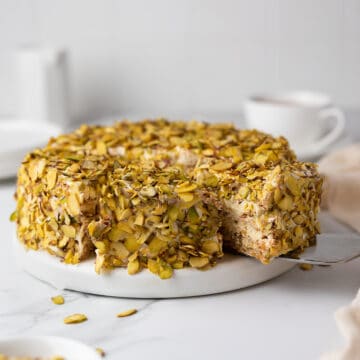
Lemon Curd Cake

Aug 18, 2023 · Leave a Comment

A single slice of lemon curd cake.

Lemon curd cake, or lemon cake with lemon curd, is the ultimate summertime treat. It is made with soft Genoise sponge cake layers, generously filled with luscious lemon curd, and coated with heavenly light and airy lemon whipped cream.

A single slice of lemon curd cake with a rose petal on top

Lemon curd cake recipe

A cake with lemon curd is a refreshing summer dessert perfect for any special occasion. It is the perfect balance of sweet and tangy flavors, and light and fluffy whipped cream complements the zesty lemon curd.

[feast_advanced_jump_to]

If you have already discovered lemon cream tart, lemon poppy seed bars, and tart au citron on the website, then it is time to add another delicious treat to your baking repertoire.

BAKING ESSENTIALS CHECKLIST

Sign up and get a list of the necessary baking tools and ingredients

FREE DOWNLOAD

This easy lemon curd cake recipe is easy and complete with a make-ahead option.

Slices of lemon cake with lemon curd on dessert plates

Ingredients

For ingredients and detailed instructions, refer to the recipe card below.

  • Large eggs at room temperature. For the best results, use a digital scale: the weight of the large egg (eggshell removed) is about 1.8 oz. (50 g).
  • Sugar: Use granulated sugar to make a sponge cake with lemon curd and icing (powdered) sugar for lemon whipped cream.
  • All-purpose flour or cake flour. To make it yourself, take 1 cup (125 g) of all-purpose flour, remove 2 tablespoons of flour, and add 2 tablespoons of potato or corn starch.
  • Unsalted butter
  • Lemon: Choose organic, untreated lemons. Use a Microplane to create fresh zest and a citrus juicer for extracting fresh lemon juice.
  • Heavy cream or heavy whipping cream with at least 30% fat content refrigerated for at least 3 hours before you start.
  • Flavorings: Vanilla extract, limoncello, lemon juice, Grand Marnier, lemon syrup.

How to make lemon curd cake

Step 1. To make Genoise cake, heat oven to 355°F (180°C). Butter and dust the bottom and sides of the 7-inch (18 cm) round cake pan with flour, and remove flour excess.

Pro tip: Consult the Genoise sponge cake recipe for step-by-step photographed explanations, helpful tips, and tricks.

Step 2. Melt the butter in the microwave at 20-second increments and let it cool slightly. Add lemon zest and set it aside.

Step 3. In a heat-resistant bowl, place eggs, sugar, and vanilla extract and beat with a hand whisk a few times.

Step 4. Bring the bowl over a water bath or bain-marie and whisk until foamy. Warm it to 104°F (40°C).

Pro tip: If you don't have a cooking thermometer, make sure the mixture feels warm to the touch.

Step 5. Beat the preparation in the bowl of an electric mixer (or the bowl of a stand mixer with a whisk attachment) for 8 minutes to achieve the ribbon stage. Decrease the mixer speed and beat on low for 2 minutes.

Pro tip: The ribbon stage is reached if the batter falls and the pattern maintains its shape for at least 3-4 seconds.

Step 6. Sift ½ flour over the bowl and mix with a rubber spatula from the bottom to the top. Add the remaining flour and gently mix.

Step 7. Mix two spoonfuls of the batter with the warm melted butter and add to the main preparation. Gently mix the batter with a spatula, ensuring it does not deflate.

Step 7. Pour the cake batter into the prepared pan. Bake in the preheated oven for 30-35 minutes until golden brown. Check the cake for doneness with a toothpick or a cake tester: it should come out clean after inserting it in the center of the cake.

Step 8. Remove the cake from the oven and let it rest in the pan for 5-10 minutes. Then, turn the pan on a cooling rack and allow 5-10 minutes. Flip it again, and let the cake cool completely.

Step 9. To make sugar syrup, pour water and sugar into a small saucepan and bring to a boil. Remove from the heat, add vanilla extract, and let the syrup cool down.

Step 10. To make lemon curd, place sugar and fresh lemon zest in a heat-resistant bowl and mix with your fingertips to obtain a crumbly and moist mixture (photo 1).

Step 11. Pass egg yolks through a fine-mesh sieve, add to sugar, and mix with a hand whisk. Add freshly squeezed lemon juice (photo 2).

Lemon and sugar mixture in a bowl

PHOTO 1

Egg mixture in a bowl

PHOTO 2

Step 12. Heat the egg mixture in a bowl over a bain-marie or water bath, whisking constantly with a whisk until the curd thickens and coats the back of a spoon - approximately 12-15 minutes (photo 3).

Test the lemon curd by drawing a line on the back of a wooden spoon with your finger. The curd sticks to the spoon.

Pro tip: Alternatively, cook the curd on low heat to avoid burning.

Step 13. Remove the pot from the heat, add the cold cubed butter, and whisk. Strain the curd to remove lemon zest and possible lumps (photo 4).

Step 14. Transfer it to a clean bowl, cover it with plastic wrap in contact, and let it cool to room temperature.

Pro tip: Bring the curd to the refrigerator for about 30 minutes to speed up the cooling process.

Lemon curd in a bowl and over a wooden spoon

PHOTO 3

Lemon curd in a bowl

PHOTO 4

Step 15. To make lemon whipped cream, chill the bowl of a stand mixer or a large mixing bowl in the freezer for 10-15 minutes. Pour the cold heavy cream and whisk until soft-medium peaks.

Pro tip: Consult a homemade whipped cream recipe for step-by-step photographed explanations, helpful tips, and tricks.

Step 16. Give a few whisks to lemon curd and gently mix ½ cup (160 g) of the curd into the whipped cream using a hand whisk (photo 5).

Pro tip: Do not use an eclectic hand mixer to prevent overmixing the cream, especially at high speed.

Step 17. Transfer the remaining curd to a ¼ inch (0.7 mm)) diameter cut-end pastry bag. Place 3.5 oz. (100 g) of the whipped cream into a piping bag with a ¼ inch (0.7 mm) diameter opening (photo 6). Store the remaining cream in a bowl.

Photo 5: Lemon whipped cream in a bowl

PHOTO 5

Pastry bags filled with lemon curd and lemon whipped cream

PHOTO 6

Step 18. To assemble the cake, create three sponge layers. Use a serrated knife or cake leveler to cut the top and bottom and slice into three pieces. Aim for a ½-inch (1.5 cm) thickness for each layer.

Step 19. Start by placing the first layer on a turntable. Use a pastry brush to soak the cake with the cold sugar syrup.

Step 20. Use a bent spatula to apply a thin layer of whipped cream (about 1.8 oz. (50 g). Form a spiral of lemon curd, starting from the center (photo 7) but leaving a ½-inch (1.5 cm) gap at the edges of the cake. Add a double cream spiral around the lemon curd.

Step 21. Place the second cake layer, soak it, and spread a thin cream layer (1.8 oz. (50 g). Create two spirals: one with lemon curd and the other with cream. Finish the cake by adding the third layer and soaking it.

Step 22. Coat the top of the cake and apply a thin layer of cream on the sides with an offset spatula. Transfer the cake to a serving plate (photo 8). Spread the cream on top of the cake using a spatula.

Lemon curd spiral over the cream

PHOTO 7

Cream on top of the cake with a spatula

PHOTO 8

Step 23. Decorate it with flowers, mint leaves, lemon zest, lemon slices, and icing sugar. Refrigerate for 1-2 hours before serving.

Decorated lLemon curd cake on a cake stand

Expert Tips

  1. For the best results, measure ingredients with a kitchen scale and use room temperature ingredients.
  2. Recalculate ingredients for cake pans of different sizes using this simple cake pan size converter.
  3. Take the cake out of the fridge 30 minutes before serving.
  4. Baking shortcut: Use 14 oz. (400 g) store-bought lemon curd.
  5. Make-ahead option: Prepare lemon curd and store a jar refrigerated for 15 days. In the evening, make cake layers and keep them covered with plastic wrap at room temperature. Finish the cake the next day.

Recipe variations

  • Cake: Choose from various delicious cakes: Genoise cake, Italian sponge cake, Japanese sponge cake, oil-based Korean sponge, or the ultimate vanilla cake.
  • Several cake layers: Customize the cake with 2-4 layers or more.
  • Lemon curd filling: Make your own lemon curd or buy it from the store (14 oz. or 400 g). Opt for pure lemon curd, a blend with whipped cream, or lemon custard filling.
  • Cream frosting: Choose from various delicious frostings to coat the cake, including French Chantilly cream, lemon cream cheese frosting, mascarpone whipped cream, or Swiss meringue buttercream.
  • Decoration: Decorate the cake simply by piping lemon curd on top or creating buttercream flowers and swirls. Or use edible flowers, candied lemon peel, fresh berries, or rainbow sprinkles.

Storing and freezing

Store the cake under a glass dome to prevent it from drying in the refrigerator for 2-3 days. Keep the leftover cake in an airtight container.

Freezing the whole cake is not recommended, but you can bake Genoise cake ahead of time and freeze it for up to 3 months.

Recipe FAQ

Is lemon curd similar to custard?

Lemon curd and custard are similar in their cooking method but differ in taste. Lemon curd has a fruity flavor from lemon juice, while custard has a creamy taste from milk and heavy cream.

Does lemon curd cake need to be refrigerated?

Lemon curd cake should be stored in the refrigerator because it contains lemon curd and other cream frostings, such as whipped cream, Chantilly cream, or buttercream.

What's another name for lemon curd?

In Great Britain, lemon curd is also known as "lemon cheese," and in France - "lemon cream."

Love lemond desserts? Try these next!

  • Lemon Poppy Seed Madeleines
  • Lemon Cream Tart
  • Lemon Poppy Seed Bars
  • French Lemon Tart

Want more delicious and beautiful recipes? Subscribe to my newsletter and follow me on Facebook, Pinterest, and Instagram for my latest updates. If you make this recipe, please leave a star rating on the recipe card and comment below!

Print

Recipe card

Lemon Curd Cake

A single slice of lemon curd cake.
Print Recipe
Save Recipe Recipe Saved

5 Stars 4 Stars 3 Stars 2 Stars 1 Star

No reviews

Lemon curd cake is the ultimate summertime treat. It is made with soft Genoise sponge cake layers, generously filled with luscious lemon curd, and coated with heavenly light and airy lemon whipped cream.

  • Author: Irina Totterman
  • Total Time: 1 hour, 40 minutes (plus resting time)
  • Yield: 8 1x
  • Category: Cakes
  • Method: Baking
  • Cuisine: American

Ingredients

Scale

For Genoise cake:

  • 3 large eggs, room temperature
  • 1 cup minus 2 teaspoons (92 g) granulated sugar
  • ⅔ cup + 1 tablespoon (92) all-purpose flour
  • ½ teaspoon vanilla extract
  • 1 ½ tablespoons (20 g) unsalted butter
  • ½ teaspoon lemon zest

For sugar syrup:

  • ⅓ cup (70 ml) water
  • ¼ cup (50 g) granulated sugar
  • 1 teaspoon (5 ml) vanilla extract

For the homemade lemon curd: 

  • 1 cup (200 g) granulated sugar
  • 2 lemons, zest
  • 6 large egg yolks
  • 6 ½ tablespoons (100 ml) fresh lemon juice
  • 1 stick (113 g) cold unsalted butter

For the lemon whipped cream:

  • 1 ¼ cups (300 g) cold heavy cream, 30% fat
  • ½ cup (160 g) lemon curd

For decoration (optional):

  • flowers
  • mint leaves
  • lemon slices
  • powdered sugar

Instructions

  1. To make Genoise cake, heat the oven to 355°F (180°C). Butter and dust the bottom and sides of the 7-inch (18 cm) round cake pan with flour, and remove flour excess.
  2. Melt the butter in the microwave at 20-second increments and let it cool slightly. Then add lemon zest and set it aside.
  3. In the heat-resistant bowl, place eggs, sugar, and vanilla extract and beat with a hand whisk a few times. Bring the bowl over a water bath or bain-marie and whisk until foamy. Warm it to a temperature of 104°F (40°C). If you don't have a cooking thermometer, make sure the mixture feels warm to the touch. 
  4. Beat the preparation in the bowl of an electric mixer (or the bowl of a stand mixer with a whisk attachment) for 8 minutes to achieve the ribbon stage. It is reached if the batter falls and the pattern maintains its shape for at least 3-4 seconds. Decrease the mixer speed and beat on low for 2 minutes. 
  5. Sift ½ flour over the bowl and mix with a rubber spatula from the bottom to the top. Add the remaining flour and gently mix. 
  6. Mix two spoonfuls of the batter with the warm melted butter, and add to the main preparation. Gently mix the batter with a spatula, ensuring it does not deflate. 
  7. Pour the cake batter into the prepared pan. Bake in the preheated oven for 30-35 minutes until golden brown. Check the cake for doneness with a toothpick or a cake tester: it should come out clean after inserting it in the center of the cake.
  8. Remove the cake from the oven and rest in the pan for 5-10 minutes. Then turn the pan on a cooling rack and allow 5-10 minutes. Flip it again, and let the cake cool completely.
  9. To make sugar syrup, pour water and sugar into a small saucepan and bring to a boil. Remove from the heat, add vanilla extract, and let the syrup cool down.
  10. To make lemon curd, place sugar, and fresh lemon zest in a heat-proof bowl and mix with your fingertips to obtain a crumbly and moist mixture. Pass egg yolks through a fine-mesh sieve, add to sugar, and mix with a hand whisk. Add freshly-squeezed lemon juice. 
  11. Heat the egg mixture in a bowl over a bain-marie or water bath, whisking constantly with a whisk until the curd thickens and coats the back of a spoon (approximately 12-15 minutes). Test the lemon curd by drawing a line on the back of a wooden spoon with your finger. The curd sticks to the spoon. 
  12. Remove the pot from the heat, add the cold cubed butter, and whisk. Strain the curd to remove lemon zest and possible lumps. Transfer it to a clean bowl, cover it with plastic wrap in contact, and let it cool to room temperature. Bring the curd to the refrigerator for about 30 minutes to speed up the cooling process. 
  13. To make lemon whipped cream, chill the bowl of a stand mixer or a large mixing bowl in the freezer for 10-15 minutes. Pour the cold heavy cream and whisk until soft-medium peaks.
  14. Give a few whisks to lemon curd and gently mix ½ cup (160 g) of the curd into the whipped cream using a hand whisk. Do not use an eclectic hand mixer to prevent overmixing the cream, especially at high speed.
  15. Transfer the remaining curd to a ¼ inch (0.7 mm)) diameter cut-end pastry bag. Place 3.5 oz. (100 g) of the whipped cream into a piping bag with a ¼ inch (0.7 mm) diameter opening. Store the remaining cream in a bowl.
  16. To assemble the cake, create three sponge layers. Use a serrated knife or cake leveler to cut the top and bottom and slice into 3 pieces. Aim for a ½ inch (1.5 cm) thickness for each layer. 
  17. Start by placing the first layer on a turntable. Use a pastry brush to soak the cake with the cold sugar syrup. Apply a thin layer of whipped cream (use about 1.8 oz. (50 g) using a bent spatula. Form a spiral of lemon curd, starting from the center but leaving a ½ inch (1.5 cm) gap at the edges of the cake. Add a double cream spiral around the lemon curd. 
  18. Place the second cake layer, soak it, and spread a thin cream layer (1.8 oz. (50 g). Create two spirals: one with lemon curd and the other with cream. Finish the cake by adding the third layer and soaking it. 
  19. Coat the top of the cake and apply a thin layer of cream on the sides with an offset spatula. Transfer the cake to a serving plate. Spread the remaining cream on top of the cake and decorate it with flowers, mint leaves, lemon zest, lemon slices, and icing sugar. Refrigerate for 1-2 hours before serving.

Notes

  1. For the best results, measure ingredients with a kitchen scale and use room temperature ingredients.
  2. Recalculate ingredients for cake pans of different sizes using this simple cake pan size converter.
  3. Take the cake out of the fridge 30 minutes before serving.
  4. Baking shortcut: Use 14 oz. (400 g) store-bought lemon curd.
  5. Make-ahead option: Prepare lemon curd and store a jar of homemade lemon curd refrigerated for 15 days. Make cake layers in the evening and keep them covered with plastic wrap at room temperature. Finish the cake the next day.

Nutrition

  • Serving Size: 1 slice
  • Calories: 527
  • Sugar: 43.9 g
  • Sodium: 51 mg
  • Fat: 32.8 g
  • Saturated Fat: 19.1 g
  • Carbohydrates: 54.3 g
  • Fiber: 0.5 g
  • Protein: 6.6 g
  • Cholesterol: 314 mg

Thank you for following me on Pinterest, Facebook, and Instagram. Hashtag #bakinglikeachef so I can see your creations.

The nutritional information has been calculated using an online recipe nutrition calculator such as Verywellfit.com and is intended for informational purposes only. These figures should be used as a general guideline and not be construed as a guarantee.

Vanilla Cake With Chocolate Frosting

Aug 14, 2023 · Leave a Comment

A single slice of vanilla cake with chocolate frosting on a plate.

Enjoy the best vanilla cake with chocolate frosting. Soft and fluffy, it is made with moist, melt-on-your-mouth butter cake and decadent chocolate ganache. It's simply yummy and delicious.

A single slice of vanilla cake with chocolate frosting on a plate

Vanilla cake with chocolate frosting recipe

This homemade vanilla cake with chocolate ganache is made with a few simple ingredients.

[feast_advanced_jump_to]

The cake doesn't require fancy equipment like a double boiler and any decorating skills - no need for a pastry bag, either.

BAKING ESSENTIALS CHECKLIST

Sign up and get a list of the necessary baking tools and ingredients

FREE DOWNLOAD

You can create the best fillings for vanilla cake by swapping dark chocolate for white or milk chocolate.

It is a perfect recipe for celebrating birthdays, anniversaries, or other special occasions.

Ingredients

For ingredients and detailed instructions, refer to the recipe card below.

  • Large eggs at room temperature.
  • Granulate sugar: You can replace it with caster or baker's sugar. Add vanilla sugar for the best cake flavor.
  • Unsalted butter for the flavor, taste, and texture of the cake.
  • All-purpose flour
  • Potato cornstarch improves the cake texture by lightening the gluten in AP flour.
  • Baking powder helps raise the cake. Opt for aluminum-free baking powder.
  • Chocolate: Choose high-quality dark chocolate with 70% cocoa content, such as chocolate bars or callets, like Callebaut chocolate chips. Avoid using chocolate chips.
  • Cream: The recipe calls for heavy cream or heavy whipping cream with a minimum fat content of 30%.

How to make vanilla cake with chocolate frosting

Step 1. Preheat the oven to 355°F (180°C). Butter and flour an 8-inch (20 cm) round cake pan and line the bottom with parchment paper round. Sift flour, salt, and baking powder twice in a separate bowl.

Step 2. To make the cake batter, place the softened butter, granulated, and vanilla sugar in a large bowl or a bowl of your stand mixer. Beat with an electric hand mixer at high speed for 10-15 minutes until whitish (photo 1).

Step 3. Switch the mixer to low speed and continue whisking the creamed mixture. Add one egg at a time and beat until the egg is mixed up. Add the next one only when the previous one has been used up.

Pro tip: You may get a slightly grainy mixture. Avoid increasing the mixer speed in an attempt to resolve this issue. Adding flour will fix any slight graininess in the mixture.

Step 4. Remove the mixer's bowl from the mixer and add the sifted dry ingredients one tablespoon at a time.

Use a rubber spatula to combine; gently mix with large movements from the bottom up. Continue until the flour mixture is incorporated into the batter (photo 2).

Photo 1: Butter mixture in a bowl Photo 2: Vanilla cake batter in a bowl
PHOTO 1 PHOTO 2

Step 5. Pour it into the prepared pan and smooth with a spatula (photo 3). Bake for 40-45 minutes until a toothpick inserted into the cake's center comes out dry (photo 4).

Photo 3: White cake batter in a pan Photo 4: Baked vanilla cake in a pan
PHOTO 3 PHOTO 4

Step 6. Remove the cake from the oven and flip it on a cooling rack lined with parchment. Allow it to rest for 10-15 minutes, avoiding excessive condensation on the paper. Then, turn the cake over again and let it cool completely.

Step 7. To make chocolate shavings, shave a chocolate bar with a short knife or a vegetable peeler. Alternatively, make chocolate curls out of melted chocolate (photo 5).

Step 8. To make the chocolate frosting, chop the chocolate into small pieces. Pour heavy cream into a small saucepan and warm it up. With the first bubbles, add hot cream to the chopped chocolate and let it stay for 1 minute.

Step 9. Use a wooden spatula to mix the chocolate mixture until it is melted. Add softened butter and blend until smooth (photo 6).

Photo 5: Chocolate shavings on parchment Photo 6: Chocolate ganache in a bowl
PHOTO 5 PHOTO 6

Let the chocolate frosting stay at room temperature to thicken, stirring occasionally. It should reach a spreadable consistency (it takes about 30-40 minutes).

Step 10. To assemble the cake, use a serrated knife or a cake leveler to cut the cake into three cake layers about ½ inch (1 cm) thick.

Pro tip: This ensures an equal thickness with the chocolate frosting layer. If preferred, cut the cake into three equal layers.

Step 11. Place the first cake layer on a cake board and spread ¼ of the frosting (photo 7). Then add the second layer and cover it with another ¼ of the frosting. Finish by placing the third layer.

Photo 7: Cake layer topped with ganache Photo 8: Cake topped with ganache and chocolate shavings
PHOTO 7 PHOTO 8

Step 12. Using an offset spatula, cover the entire cake (the top and sides) with chocolate icing. Sprinkle the top of the cake with chocolate shavings (photo 8).

Assembled vanilla cake with dark chocolate ganache and chocolate shavings

Expert Tips

  1. To easily slice the cake, heat the knife with hot water, dry it completely, and clean the blade after each cut.
  2. Make a cake ahead of time: Bake the sponge cake in the evening and keep it covered with plastic wrap overnight. Make the ganache filling and assemble the cake the following day.

Recipe variations

  • Vanilla cake batter: The most common cake flavor is vanilla, but don't be afraid to try other options like coconut or almond extract and rose or orange flower water.
  • Chocolate frosting: Dark chocolate ganache frosting is the most decadent among chocolate frostings. But try to experiment with whipped ganache, velvety chocolate buttercream, or cocoa powder-infused chocolate frosting.
  • Cake layers: Choose your preferred number of cake layers: triple or two-layered chocolate cakes are equally delicious.

Storing and freezing

Keep vanilla cake with chocolate ganache in a cool room under a glass dome for 2-3 days.

If needed, it can be stored in the refrigerator for up to 4-5 days. To soften the ganache, bring it to room temperature 30 minutes before serving.

Can you freeze this cake? It can be frozen for up to 3 months. Just make sure to let the ganache set at room temperature for a few hours, then in the fridge for about an hour.

After that, cover the cake with cling wrap and aluminum foil and pop it in the freezer. When you are ready to serve it, leave it on the counter to thaw for a few hours.

Recipe FAQ

Does ganache set hard on a cake?

Chocolate ganache thickens at room temperature and hardens as it cools. When refrigerated, it solidifies and becomes softer when brought back to the kitchen counter.

Is it better to cover a cake in ganache or buttercream?

It depends on your personal preferences. Ganache offers a less sweet but chocolatey flavor, while buttercream provides a sweeter option. Both frostings can be stored at room temperature for a few days.

How long does ganache last on a cake?

Despite common belief, ganache can actually last quite well despite its fresh cream content. Once your cake is made, it can be stored at room temperature with a ganache for 2-3 days.

Love layer cakes? Try these next!

If you love this layer cake, enjoy more layer cakes on the website:

  • Chocolate Ganache Cake
  • Sans Rival Cake
  • Uruguayan Cake Chaja
  • Jordgubbstårta (Swedish Strawberry Cake)
  • Triple Berry Cake
  • Fresh Fruit Cake

Want more delicious and beautiful recipes? Subscribe to my newsletter and follow me on Facebook, Pinterest, and Instagram for my latest updates. If you make this recipe, please leave a star rating on the recipe card and comment below!

Print

Recipe card

Vanilla Cake With Chocolate Frosting

A single slice of vanilla cake with chocolate frosting on a plate.
Print Recipe
Save Recipe Recipe Saved

5 Stars 4 Stars 3 Stars 2 Stars 1 Star

No reviews

This vanilla cake with chocolate frosting is a soft and fluffy yet moist vanilla cake made with melt-on-your-mouth butter cake and decadent chocolate ganache. It's simply delicious.

  • Author: Irina Totterman
  • Total Time: 1 hour, 30 minutes (plus resting time)
  • Yield: 10 1x
  • Category: Cakes
  • Method: Baking
  • Cuisine: American

Ingredients

Scale

For vanilla cake:

  • 4 large eggs, room temperature
  • 1 2/ cup + 1 ½ tablespoons (120 g) granulated sugar
  • 1 sachet (9 g) vanilla sugar
  • 4.2 oz. (120 g) unsalted butter, softened
  • 1 cup + 2 ½ tablespoons (145 g) all-purpose flour
  • ½ cup + 1 ½ tablespoons (96 g) potato starch
  • 2 ¾ teaspoon (13 g) baking powder

For the chocolate frosting:

  • 14.6 oz. (415 g) dark chocolate, 70% cocoa
  • 1 cup (240 g) heavy cream, 30% fat
  • 2 oz. (55 g) unsalted butter, softened

For chocolate shavings:

  • 3 oz. (85 g) dark chocolate, 70% cocoa

Instructions

  1. Preheat the oven to 355°F (180°C). Butter and flour an 8-inch (20 cm) round cake pan and line the bottom with parchment paper round. Sift flour, salt, and baking powder twice in a separate bowl.

  2. To make the cake batter, place the softened butter, granulated, and vanilla sugar in a large bowl or the bowl of your stand mixer. Beat with an electric hand mixer for 10-15 minutes until whitish.

  3. Switch the mixer to low speed and continue whisking. Add one egg at a time and beat until the egg is mixed up. Add the next one only when the previous one has been used up.

    Pro tip: You may get a slightly grainy mixture. Avoid increasing the mixer speed in an attempt to resolve this issue. Adding flour will fix any slight graininess in the mixture.

  4. Remove the mixer's bowl from the mixer and add the sifted dry ingredients one tablespoon at a time. Use a rubber spatula to combine; gently mix with large movements from the bottom up. Continue until the flour mixture is mixed into the batter.

  5. Pour it into the prepared pan and smooth with a spatula. Bake for 40-45 minutes until a toothpick inserted into the cake's center comes out dry.

  6. Remove the cake from the oven and flip it on a cooling rack lined with parchment. Allow it to rest for 10-15 minutes, avoiding excessive condensation on the paper. Then turn the cake over again, and let it cool down completely.

  7. To make chocolate shavings use a short knife or a vegetable peeler to shave a chocolate bar. Alternatively, make chocolate curls out of melted chocolate.

  8. To make the chocolate frosting, chop the chocolate into small pieces. Pour heavy cream into a small saucepan and warm it up. With the first bubbles, add hot cream to the chopped chocolate and let it stay for 1 minute.

  9. Use a wooden spatula, and mix the chocolate mixture until the chocolate is melted. Add softened butter and mix until smooth. 

  10. Let the chocolate frosting stay at room temperature to thicken, stirring occasionally. It should reach a spreadable consistency (it takes about 30-40 minutes).

  11. To assemble the cake, use a serrated knife or a cake leveler to cut the cake into three cake layers 1 cm thick.

  12. Place the first cake layer on a cake board, and spread ¼ of the frosting. Then add the second layer and cover it with another ¼ of the frosting. Finish by placing the third layer.

  13. Cover the entire cake (the top and sides) with the chocolate frosting using an offset spatula. Sprinkle the top of the cake with chocolate shavings.

Notes

  1. To easily slice the cake, heat the knife with hot water, dry it completely, and clean the blade after each cut.
  2. Make a cake ahead of time: Bake the sponge cake in the evening and keep it covered with plastic wrap overnight. Make the ganache filling and assemble the cake the following day.

Nutrition

  • Serving Size: 1 slice
  • Calories: 660
  • Sugar: 32.1 g
  • Sodium: 48 mg
  • Fat: 42.8 g
  • Saturated Fat: 26 g
  • Carbohydrates: 61.2 g
  • Fiber: 5.9 g
  • Protein: 8.7 g
  • Cholesterol: 152 mg

Thank you for following me on Pinterest, Facebook, and Instagram. Hashtag #bakinglikeachef so I can see your creations.

The nutritional information has been calculated using an online recipe nutrition calculator such as Verywellfit.com and is intended for informational purposes only. These figures should be used as a general guideline and not be construed as a guarantee.

Vanilla Swiss Roll Recipe

Aug 4, 2023 · Leave a Comment

Slices of vanilla Swiss roll on a serving board.

This vanilla Swiss roll, or vanilla roll cake, is a soft spiral of vanilla sponge batter filled with a delicious mascarpone whipped frosting. It is the simplest version of a cream-filled cake roll you can ever make.

Slices of vanilla Swiss roll on a serving board

Have you ever tasted a perfect vanilla Swiss roll? Soft and fluffy with a melt-in-your-mouth texture and scrumptious mascarpone filling.

[feast_advanced_jump_to]

This easy yet decadent dessert makes waves in the bakery world for its simplicity and delightful taste.

BAKING ESSENTIALS CHECKLIST

Sign up and get a list of the necessary baking tools and ingredients

FREE DOWNLOAD

In just a few easy steps with a little patience, you can make this rolled cake in the comfort of your own kitchen.

What is Swiss roll?

Swiss roll (jelly roll, cream roll, or Swiss log cake) is a delicious sponge cake with a filling like icing, cream, or jam. Made with a delightful vanilla flavor, it is also known as vanilla roulade or vanilla sponge roll.

There are two methods for making Swiss rolls: European and Asian, using sponge and chiffon techniques respectively.

Sponge cake roll is naturally drier, while chiffon Swiss roll is moister and lighter in texture and flavor.

Vanilla Swiss roll recipe

  • This easy vanilla Swiss roll recipe is quickly made within 45 minutes. It is also one of the best make-ahead desserts.
  • The cake roll is prepared using a chiffon method, which separates egg whites and yolks. It is simpler to make compared to the traditional sponge method.
  • It is a classic Swiss roll cake: no peels or cracks are guaranteed.
  • The cake is moist with a soft and fluffy texture that melts in your mouth. Read more about how to make a cake moist.

Ingredients

Vanilla Swiss roll cake ingredients in pictures

For ingredients and detailed instructions, refer to the recipe card below.

  • Eggs: The recipe calls for egg whites and yolks, but remember to add the specified amount of sugar to each accurately. Use chilled eggs to separate the egg whites from the egg yolks with an egg separator. Bring the yolks to room temperature and refrigerate the egg whites until ready to use.
  • Sugar: Use granulated sugar to make the cake batter and icing sugar (powdered or confectioners' sugar) for making the cream frosting.
  • Salt enhances the flavors of the cake.
  • Vanilla extract: Use a top-quality vanilla extract for a beautiful flavor, or replace it with vanilla bean paste in a 1:1 ratio.
  • Oil: Choose neutral oil such as grapeseed or vegetable oil. Avoid olive, peanut, and other kinds of oil.
  • Milk: Opt for whole milk at room temperature.
  • Flour: The recipe calls for cake flour: store-bought or homemade. To make it yourself, simply take out 2 tablespoons of all-purpose flour from 1 cup, and replace it with 2 tablespoons of cornstarch. Alternatively, you can mix 15 grams of cornstarch with 110 grams of all-purpose flour.
  • Baking powder, a leavening agent, is typically not used in making a classic sponge cake roll. However, it is added to a chiffon cake roll.
  • Heavy cream: Opt for heavy or heavy whipped cream with at least 30% fat content to make a mascarpone whipped cream.
  • Mascarpone cheese brings a tangy note to the cream filling and stabilizes the whipped cream.
Single slices of vanilla roll cake on dessert plates

Recipe variations

  • Cake roll filling: Fill the rolled cake with your favorite filling: buttercream, chocolate or caramel filling, Chantilly cream, cream cheese frosting, chocolate ganache, fresh whipped cream, or simply jam.
  • Add-ins: Arrange fresh blueberries or chopped strawberries, mango, oranges, etc., over the cream and roll the cake as suggested in the recipe.
  • Rolling method: Roll the cake at the short end or lengthwise, traditionally "skin" side out or with the "brown layer" facing inwards.
  • Decoration: Sprinkle Swiss roll with powdered sugar, pipe a few whipped cream swirls or spirals of creamy buttercream, sprinkle with chocolate shavings, or decorate with fresh fruit.
  • Cake batter: Replace about 3 tablespoons (17-20 g) of the cake flour with unsweetened cocoa powder to make a chocolate Swiss roll. Or add 1 teaspoon of lemon powder to the flour mixture for a lemon-scented roll cake.
Sliced vanilla Swiss roll cake on a marble board

How to make vanilla Swiss roll cake

To make this recipe, you will need a 15 x 10 inches (25 x 38 cm) baking sheet - a traditional jelly roll pan. Line it with parchment paper following this tutorial - how to line a Swiss roll tin.

Ensure that the parchment paper extends at least 1 inch (2.5 cm) beyond all edges for easy removal when the cake is done.

Step 1. To make the cake, preheat the oven to 355°F (180°C). Using a flour sifter, sift cake flour and baking powder and set aside.

Step 2. In a large mixing bowl, beat egg yolks, 1 ½ tablespoons (20 g) of sugar, salt, and vanilla extract a few times using a hand whisk (no need to beat until whitish and voluminous).

Step 3. Add oil and milk and whisk until just combined. Sift the dry ingredients over the preparation bowl and gently mix with a hand whisk (photo 1).

Step 4. In a separate large bowl, beat cold egg whites with an electric mixer until frothy.

Step 5. Divide the remaining sugar into three parts. Gradually add the sugar to the beaten egg whites in three additions. Whisk the meringue until soft peaks form, but avoid stiff peaks (photo 2).

Pro tip: Alternatively, use a stand mixer with a whisk attachment, but be careful not to over-whisk the egg whites.

Photo 1: Batter mixture in a bowl Photo 2: Meringue on beaters and in a bowl
PHOTO 1 PHOTO 2

Step 6. Give one stir to the egg yolk mixture, and add ⅓ of the meringue. Carefully mix with a silicone spatula, and ⅓ again and mix. Pour the mixture into the rest of the meringue and gently fold.

Pro tip: When folding the meringue, avoid deflating the batter. This is vital for achieving a soft and fluffy roll cake.

Step 7. Pour the batter onto the prepared pan (photo 3), and level it with a long bent spatula or a dough scraper. Tap the pan on the table a couple of times to release large bubbles.

Step 8. Bring the pan to the middle rack of the oven, and decrease the oven temperature to 340°F (170°C). Bake for 20-21 minutes until golden brown (photo 4).

Pro tip: Check for doneness with a toothpick or by pressing the cake with your finger. It is done if the toothpick comes out dry and the cake springs back.

Photo 3: Cake batter in a bowl Photo 4: Batter in a baking tray with parchment
PHOTO 3 PHOTO 4

Step 9. Prepare a long sheet of baking paper lightly greased with neutral oil (it should be longer than the long side of the cake).

Step 10. Take the cake from the oven and tap (photo 5) it once against the table to prevent it from shrinking. Flip it on the prepared parchment paper right away.

Pro tip: While most recipes suggest flipping the cake on a cooling rack lined with parchment, avoid it. There is a risk of leaving its traces on the surface of the roll cake.

Step 11. Peel off the parchment paper that was on the bottom of the cake (photo 6).

Photo 5: Baked cake in a pan Photo 6: Cake with peeled parchment paper
PHOTO 5 PHOTO 6

Step 12. To prepare the cake for rolling, follow these steps:

  • Use a serrated knife to cut the edges of the cake on both long sides and one short side.
  • Take a long sharp knife and make 4 shallow slits (without cutting deep) about 1 cm apart on that short end (photo 7).
  • Cut off about 1 inch (1.5-2 cm) from the opposite short side (the part where the roll will end) diagonally, away from the cake (photo 8).
  • Let the cake cool to room temperature.

Pro tip: There is no need to pre-roll the cake using the above method.

Photo 7: Cake sheet with 4 slits Photo 8:  Cake with the short side cut diagonally
PHOTO 7 PHOTO 8

Step 13. To make mascarpone whipped cream, pour cold heavy cream, add cold mascarpone and icing sugar into the bowl of a stand mixer, and whisk until firm.

Pro tip: Consult the mascarpone frosting recipe for step-by-step photographed explanations, helpful tips, and tricks.

Step 14. To assemble the Swiss roll, use a bent spatula and spread the cream evenly onto the cake, leaving the angled cut empty.

Pro tip: For a better visual, apply thicker cream on the short end with the slits and thinner cream closer to the angled cut.

Step 15. Start rolling the cake from the short end with the slits helping with parchment paper. Slightly lift the beginning of the roll to create the cake's core and continue rolling, lifting the paper.

Step 16. Tight the roll using a metal baking sheet, a long offset spatula, or a cutting board (photo 9).

Pro tip: Watch a video on how to tightly wrap a cake roll.

Step 17. Keep the rolled cake wrapped in parchment paper with the edge facing down (photo 10). Secure the paper with masking tape.

Photo 9: Tightening the rolled cake with a cutting board Photo 10: Rolled cake in parchment
PHOTO 9 PHOTO 10

Step 18. Use parchment to treat the ends of the roll cake like a candy wrapper. Refrigerate for an hour.

Step 19. Gently remove the parchment paper from the cake. Using a sharp knife, make a nice clean cut at the two ends of the roll (if needed).

Step 20. Transfer the cake roll to a serving tray. Cut the cake into slices 1 inch (2.5 cm) thick with a knife warmed with hot water, wiping the blade between each cut.

To serve, sprinkle the top of the cake with icing (powdered) sugar and decorate with mint leaves, raspberries, or any fresh fruit that is in season.

Slices of vanilla Swiss roll cake on a serving board

Expert Tips

  1. Read more about how to make a cake roll for useful tips and tricks.
  2. Every oven is different, so you may need to adjust the baking time. Download this free oven temperature conversion chart.
  3. If the whipping is insufficient or the flour is not mixed well, the dough will not be flexible and will crack.
  4. Make sure to slightly cool the cake before spreading the mascarpone whipped cream.
  5. To recalculate the amount of ingredients for another size of the baking sheet, use this simple cake pan calculator. All you need is the length and width of your baking tray.

Storing and freezing

Store vanilla cake roll filled with mascarpone frosting in an airtight container in the refrigerator for up to 2 days.

Can you freeze vanilla Swiss cake? Cover the cake roll with plastic wrap, then aluminum foil, and freeze it at -0.4°F to 5°F (-18°C to -15°C) for 2 months. To thaw, bring it to the fridge overnight.

Swiss roll troubleshooting

Here are a few troubleshooting issues and solutions for a homemade Swiss roll.

Why is Swiss roll rubbery?

Reason: The primary reason for the rubbery roll cake is over-mixing the batter. It leads to gluten development resulting in a dense and rubbery texture and deflating the air bubbles from whisked meringue.

How to prevent it: Don't over-mix the cake batter. Gently incorporate meringue into the main preparation in a few additions.

Why is the top "layer" stuck to the parchment?

Reasons: There are two possible reasons why the cake layer is stuck to parchment paper.

  • The cake is slightly underbaked, having a wet surface that tends to stick to baking paper.
  • The parchment paper is used with the "wrong" side.

How to prevent it: Follow the baking time of the recipe and use parchment paper with a silicone side up. With flipping the cake, this side should go towards the top "layer" of the cake.

To play safe, slightly grease parchment paper with flavorless oil: this trick guarantees the perfect results.

Why did Swiss roll crack?

Reasons: The leading causes of a cracked roll cake are:

  • Insufficient egg whipping (if whole eggs are used).
  • The flour is not mixed well.
  • Underbaking or overbaking, including excessive browning of the back of the cake.
  • Rolling the cake when it has cooled completely.
  • Improper rolling technique.

How to prevent it:

  • Whisk the eggs until foamed and whitish (the egg mixture must reach the ribbon stage).
  • Add sifted flour and gently mix from the bottom up to create a smooth cake batter.
  • Respect the oven temperature and baking time. To prevent overbaking of the back of the cake, opt for a light-colored jelly pan with a double layer of parchment paper. Plus, add a reusable Teflon sheet to the bottom of the baking pan for a moist, smooth, and wrinkle-free cake base. Also, every oven is different: you may need to adjust your oven settings.
  • Roll the cake when it is slightly warm instead of completely cooled.
  • Learn how to roll a cake before you start.

Recipe FAQ

What is the difference between a cake and a Swiss roll?

While both are made with the same ingredients, the key lies in their unique making techniques. A cake is created with one or multiple layers sandwiched with cream filling or jam. On the other hand, Swiss roll is made by rolling and filling with different fillings.

What do Americans call a Swiss roll?

Swiss roll is known as a jelly roll in the United States. Therefore, the pan used is called a jelly roll pan.

What is the sponge called in a Swiss roll?

Swiss roll can be made with a thin Italian sponge or Genoise cake following European traditions. Alternatively, an Asian-style Swiss roll is made with chiffon cake.

Do you roll Swiss roll hot or cold?

Roll the cake while it is slightly warm, not completely cooled. Begin rolling from the short edge of the cake and use greaseproof paper to shape it tightly.

Can you freeze Swiss roll?

Most Swiss rolls made with buttercream or whipped cream can be frozen for up to 2 months. Cover it with cling film, then aluminum foil, and freeze it at -0.4°F to 5°F (-18°C to -15°C).

Love roll cakes? Try these next!

After discovering the best vanilla Swiss roll recipe, explore the perfection of other rolled cakes on the website.

  • Nutella Swiss roll
  • Coffee Swiss roll
  • Pavlova roll cake
  • Pistachio roulade
  • Or browse all the cake recipes

Want more delicious and beautiful recipes? Subscribe to my newsletter and follow me on Facebook, Pinterest, and Instagram for my latest updates. If you make this recipe, please leave a star rating on the recipe card and comment below!

Print

Recipe card

Vanilla Swiss Roll (Basic Recipe)

Slices of vanilla Swiss roll on a serving board.
Print Recipe
Save Recipe Recipe Saved

5 Stars 4 Stars 3 Stars 2 Stars 1 Star

No reviews

This vanilla Swiss roll, or vanilla roll cake, is a soft spiral of vanilla sponge batter filled with a delicious mascarpone frosting. It is the simplest version of a cream-filled cake roll you can ever make.

  • Author: Irina Totterman
  • Total Time: 45 minutes
  • Yield: 8 1x
  • Category: Cakes
  • Method: Baking
  • Cuisine: Japanese

Ingredients

Scale

For the cake roll:

  • 5 large egg yolks, room temperature
  • 1 ½ tablespoons (20 g) granulated sugar
  • 1 pinch of salt
  • 1 ¼ teaspoons (5 g) vanilla extract
  • 3 tablespoons (40 g) grapeseed oil (or vegetable oil)
  • ¼ cup (60 g) whole milk, room temperature
  • 1 cup minus 2 ½ tablespoons (85 g) cake flour
  • ½ teaspoon baking powder
  • 5 large egg whites, cold (for meringue)
  • 1 cup minus 2 ½ teaspoons (90 g) granulated sugar (for meringue)

For the cream filling:

  • ⅔ cup (160 g) cold heavy cream, 30% fat
  • ½ cup (160 g) cold mascarpone cheese
  • 4 tablespoons (30 g) icing (powdered) sugar

Instructions

  1. To make the cake, prepare a light-colored 15 x 10 inches (25 x 38 cm) baking sheet - a traditional jelly roll pan. Line it with parchment paper following this video tutorial - how to line a Swiss roll tin. Grease the pan or not; it is up to you. Ensure that the parchment paper extends at least 1 inch (2.5 cm) beyond all edges for easy removal when the cake is done.
  2. Preheat the oven to 355°F (180°C). Using a flour sifter, sift cake flour and baking powder and set aside. 
  3. In a large mixing bowl, beat egg yolks, 1 ½ tablespoons (20 g) of sugar, salt, and vanilla extract a few times using a hand whisk (no need to beat until whitish and voluminous). Add oil and milk and whisk until just combined. Sift the dry ingredients over the preparation bowl and gently mix with a hand whisk. 
  4. In a separate large bowl, beat cold egg whites with an electric mixer until frothy. Divide the remaining sugar into three parts. Gradually add the sugar to the beaten egg whites in three additions. Whisk the meringue until soft peaks (avoid stiff peaks).
  5. Give one stir to the egg yolk mixture, and add ⅓ of the meringue. Carefully mix with a silicone spatula, and ⅓ again and mix. Pour the mixture into the rest of the meringue and gently fold.
  6. Pour the batter onto the prepared pan, level it with a long bent spatula or a dough scraper. Tap the pan on the table a couple of times to release large bubbles. 
  7. Bring the pan to the middle rack of the oven, and decrease the oven temperature to 340°F (170°C). Bake for 20-21 minutes until golden brown. Check for doneness with a toothpick or by pressing the cake with your finger. It is done if the toothpick comes out dry and the cake springs back. 
  8. Prepare a long sheet of baking paper lightly greased with neutral oil (it should be longer than the long side of the cake). Take the cake from the oven and tap it once against the table to prevent it from shrinking. Flip it on the prepared parchment paper right away.
  9. Peel off the parchment paper that was on the bottom of the cake. To prepare the cake for rolling, follow these steps:
    • Use a serrated knife to cut the edges of the cake on both long sides and one short side.
    • Take a long sharp knife and make 4 shallow slits (without cutting deep) about 1 cm apart on that short end.
    • Cut the opposite short side diagonally, away from the cake.
    • Let the cake cool to room temperature. 
  10. To make the mascarpone frosting, pour cold heavy cream, add cold mascarpone and icing sugar into the bowl of a stand mixer, and whisk until firm.
  11. To assemble the rolled cake, use a bent spatula and spread the cream evenly onto the cake, leaving the angled cut empty. For a better visual, apply thicker cream on the short end with the slits and thinner cream closer to the angled cut. 
  12. Start rolling the cake from the short end with the slits helping with parchment paper. Tight the roll using a metal baking sheet or a long offset spatula (watch the video on how to tightly wrap a cake roll). 
  13. Keep the rolled cake wrapped in parchment paper with the edge facing down. Additionally, treat the ends of the roll cake like candy by covering them with parchment. Refrigerate for an hour. 
  14. Gently remove the parchment paper from the cake. Using a sharp knife, make a nice clean cut at the two ends of the roll (if needed). Transfer the cake roll to a serving tray. Cut the cake into slices 1 inch (2.5 cm) thick, wiping the knife's blade between each cut.

Notes

  1. Read more about how to make a cake roll for useful tips and tricks.
  2. Every oven is different, so you may need to adjust the baking time. Download this free oven temperature conversion chart.
  3. Avoid flipping the cake on a cooling rack lined with parchment. There is a risk of leaving its traces on the surface of the roll cake.
  4. Make sure to slightly cool the cake before spreading the mascarpone whipped cream.
  5. To recalculate the amount of ingredients for another size of the baking sheet, use this simple cake pan calculator. All you need is the length and width of your baking tray.

Nutrition

  • Serving Size: 1 slice
  • Calories: 318
  • Sugar: 18.9 g
  • Sodium: 77 mg
  • Fat: 20.7 g
  • Saturated Fat: 10.4 g
  • Carbohydrates: 26.6 g
  • Fiber: 0.5 g
  • Protein: 6.2 g
  • Cholesterol: 152 mg

Thank you for following me on Pinterest, Facebook, and Instagram. Hashtag #bakinglikeachef so I can see your creations.

The nutritional information has been calculated using an online recipe nutrition calculator such as Verywellfit.com and is intended for informational purposes only. These figures should be used as a general guideline and not be construed as a guarantee.

Chocolate Ganache Cake

Aug 2, 2023 · 8 Comments

Sliced chocolate ganache cake on a white serving plate.

The best ever dark chocolate ganache cake will surely please chocolate lovers. Made with a soft and fluffy chocolate Genoise and rich chocolate ganache, this triple layer chocolate cake is an absolute treat.

Sliced chocolate ganache cake on a white serving plate

Chocolate ganache cake recipe

Chocolate ganache cake is a triple-layer chocolate cake made with chocolate sponge cake layers filled with chocolate ganache icing. It is also known as a chocolate torte with ganache or just a ganache cake.

[feast_advanced_jump_to]

This easy chocolate ganache cake recipe uses simple ingredients and is perfect for celebrating a birthday, anniversary, or other special occasion. It is a cake you can't miss!

BAKING ESSENTIALS CHECKLIST

Sign up and get a list of the necessary baking tools and ingredients

FREE DOWNLOAD

It is versatile in terms of chocolate ganache icing: swap dark chocolate for white or milk chocolate to create your own delicious and unique variation.

It is a cake you can't miss. The smooth and velvety texture of the chocolate ganache complements the tender chocolate cake base, creating a perfect balance of flavors.

A single slice of dark chocolate ganache cake on a plate with a fork

Ingredients

For ingredients and detailed instructions, refer to the recipe card below.

  • Large eggs at room temperature. Bring them to the counter about an hour before you start. You can also immerse eggs in shells in warm water for a few minutes.
  • Granulated sugar
  • All-purpose flour: You can omit the flour mixed with cornstarch and choose cake flour.
  • Cornstarch lightens the gluten in the AP flour and helps improve the cake's texture.
  • Unsweetened cocoa powder: Opt for Dutch-process cocoa for the darker, more bittersweet experience.
  • Unsalted butter
  • Dark chocolate with a cocoa content of 70%. The taste of the ganache depends mainly on the quality of the chocolate. I highly recommend selecting top-quality chocolate bars or chocolate callets (for example, Callebaut chocolate chips). But avoid your favorite chocolate chips used for baking.
  • Heavy cream or heavy whipping cream with at least 30% fat content.

How to make a chocolate ganache cake

Step 1. To make chocolate sponge cake, preheat the oven to 355°F (180°C). Grease an 8-inch pan (20 cm in diameter) with softened butter and a pastry brush.

Pro tip: Consult the chocolate Genoise recipe for step-by-step photographed explanations, helpful tips, and tricks.

Step 2. Sprinkle the buttered tin with a tablespoon of flour and gently shake and tilt the pan. Tap the pan against the sink upside down to remove any excess flour.

Pro tip: Alternatively, brush the baking tin with softened butter or use cooking spray, then line the bottom and sides of the pan with parchment paper.

Step 3. In a large mixing bowl, sift flour, cornstarch, and cocoa powder a couple of times. Then, in a heatproof bowl or the bowl of a stand mixer, beat eggs with sugar with a hand whisk until frothy (photo 1).

Step 4. Bring the bowl over a water bath or bain-marie and warm the mixture to 104°F (40°C), whisking constantly.

Step 5. Remove the bowl from the heat and whisk eggs and sugar with a stand or an electric hand mixer for 10 minutes (longer if an electric mixer is used). The mixture will whiten and triple in volume and reach the ribbon stage (photo 2).

Photo 1: Whisked eggs with sugar in a bowl Photo 2: Egg mixture on a whisk
PHOTO 1 PHOTO 2

Step 6. Sift the flour and cocoa mixture over the bowl in a few additions and gently fold in using a rubber spatula. 

Step 7. Pour the cake batter into the prepared baking pan (photo 3) and bake for 30-35 minutes. 

Step 8. Remove the cake from the oven and let it cool in the pan for 10 minutes (photo 4). Then, invert the pan and let the cake slip on a cooling rack. Let it cool down completely.

Photo 3: Chocolate batter in a mold Photo 4: Baked chocolate cake in a mold
PHOTO 3 PHOTO 4

Step 9. To make sugar syrup, pour water and sugar into a saucepan and bring it to a boil. Remove the pot from the heat, add cocoa powder, and mix well with a mini whisk. Let it cool.

Step 10. To make chocolate ganache, chop the dark chocolate bar (or use chocolate callets) and place it in a bowl. Alternatively, use a food processor to crush chocolate.

Step 11. Pour heavy cream into a small saucepan and bring it over medium heat, stirring with a hand whisk. Warm the cream to 176°F (80°C), then pour half over the chocolate (photo 5). 

Step 12. With a wooden spoon, mix chocolate with cream gently from the center to the edges. Then add the remaining hot cream and stir until shiny and smooth (photo 6). 

Photo 5: Cream poured over chocolate in a bowl Photo 6: Chocolate ganache in a bowl
PHOTO 5 PHOTO 6

Step 13. Leave to cool slightly, stirring occasionally, or film it in contact and let it set at room temperature. The ganache has to reach the spreadable stage.

Pro tip: You can film the ganache on contact and set it aside in the fridge. But make sure to stir it each 5 minutes, and don't miss the right consistency to assemble the cake.

Step 14. To assemble the cake, slice the cooled cake into three cake layers using a serrated knife or a cake leveler. Place the bottom layer onto a cake board, parchment, or serving plate, and soak it with the sugar syrup using a silicone or pastry brush. Then, spread a ⅖ inches (1 cm) thick layer of ganache (photo 7).

Pro tip: It takes about 6.4 oz. (180 g) of chocolate ganache for each layer.

Step 15. Repeat this process with the second layer, soak it with the syrup, and cover it completely with a ganache. Finally, place the third layer on top to complete the cake; no need to soak (photo 8).

Photo 7: Cake layer held over the frosted layer Photo 8: Sponge handled over the cake
PHOTO 7 PHOTO 8

Step 16. Use an offset spatula to frost the sides and top of the cake with the remaining ganache. Let the cake stay at cool room temperature to set the ganache.

Expert Tips

  1. Refer to the chocolate Genoise cake recipe for more tips and tricks.
  2. To slice the cake, warm the knife with hot water, dry it thoroughly, then cut the cake slices, cleaning the knife between each cut.
  3. Make-ahead option: Make the sponge cake in the evening and store it covered with plastic film at room temperature. Make the ganache filling and assemble the cake the next day.

Recipe variations

  • Experiment with different varieties such as milk, white, and a blend of dark and milk chocolate to create a delicious chocolate cake.
  • Consider another decadent option - a double-layer cake with a luscious chocolate ganache filling, rather than opting for three cake layers.

Storing and freezing

Store chocolate ganache cake under a glass dome at cool room temperature for up to 2-3 days and in the refrigerator for up to 4-5 days.

Freeze the cake for up to 3 months. Let the ganache set at room temperature for a few hours, then in the fridge for about an hour. Then, cover the cake with plastic wrap and aluminum foil before placing it in the freezer.

To thaw, bring the cake to the counter for a few hours.

Recipe FAQ

What is a chocolate ganache cake made of?

Chocolate ganache cake is made with soft layers of chocolate sponge generously filled and frosted with rich chocolate ganache.

Does a chocolate ganache cake need to be refrigerated?

Chocolate ganache cake can be stored at cool room temperature for a couple of days. To extend its storage life to a maximum of 4-5 days, it has to be refrigerated.

How long will a chocolate ganache cake last?

Chocolate ganache cake can be stored for 2-3 days at cool room temperature, 4-5 days in the refrigerator, or up to 3 months in the freezer.

Can you freeze a chocolate cake with ganache icing?

You can freeze chocolate with ganache icing for up to 3 months. First, allow the ganache to set at room temperature for a few hours, then in the fridge for about an hour. Finally, wrap the cake with plastic film and aluminum foil before freezing.

Love chocolate cakes? Try these next!

If you like chocolate cake with ganache frosting, you will also enjoy other chocolate cakes, from a simple chocolate cake to a more elaborate one.

  • French Chocolate Cake
  • Royal Chocolate Cake
  • Fondant Au Chocolat
  • French Chocolate Fondant Cake
  • Moelleux au Chocolat

Want more delicious and beautiful recipes? Subscribe to my newsletter and follow me on Facebook, Pinterest, and Instagram for my latest updates. If you make this recipe, please leave a star rating on the recipe card and comment below!

Print

Recipe card

Easy Chocolate Ganache Cake

Sliced chocolate ganache cake on a white serving plate.
Print Recipe
Save Recipe Recipe Saved

5 Stars 4 Stars 3 Stars 2 Stars 1 Star

5 from 1 review

Dark chocolate ganache cake is made with a soft and fluffy chocolate Genoise and luscious and rich chocolate ganache. It is an absolute treat for a chocolate lover. 

  • Author: Irina Totterman
  • Total Time: 1 hour, 30 minutes (plus resting time)
  • Yield: 10 1x
  • Category: Cakes
  • Method: Baking
  • Cuisine: French

Ingredients

Scale

For chocolate Genoise cake:

  • 4 large eggs, room temperature
  • ½ cup + 1 ½ tablespoons (120 g) granulated sugar
  • ½ cup + 2 tablespoons (80 g) all-purpose flour
  • 2 tablespoons (20 g) cornstarch
  • 3 tablespoons (20 g) cocoa powder
  • 2 tablespoons (30 g) unsalted butter, melted and cooled

For syrup:

  • ⅓ cup (75 ml) water
  • ¼ cup (50 g) granulated sugar
  • 1 tablespoon (8 g) unsweetened cocoa powder

For the dark chocolate ganache:

  • 12.4 oz. (350 g) dark chocolate, 70% cacao
  • 1 ½ cups (355 g) heavy cream, 30% fat

Instructions

  1. To make the sponge cake, preheat the oven to 355°F (180°C). Grease an 8-inch (20 cm) round pan with softened butter and a pastry brush. Sprinkle the buttered tin with a tablespoon of flour and gently shake and tilt the pan. Tap the pan against the sink upside down to remove any excess flour. Alternatively, brush the baking tin with softened butter or use cooking spray, then line the bottom and sides of the pan with parchment paper.
  2. In a large mixing bowl, sift flour, cornstarch, and cocoa powder a couple of times. Then, in a heatproof bowl or the bowl of a stand mixer, beat eggs with sugar with a hand whisk until frothy. Bring the bowl over a water bath or bain-marie and warm the mixture to 104°F (40°C), whisking constantly.
  3. Remove the bowl from the heat and whisk eggs and sugar with a stand or an electric hand mixer for 10 minutes (longer if an electric mixer is used). The mixture will whiten and triple in volume, reaching the ribbon stage.
  4. Sift the flour and cocoa mixture over the bowl in a few additions and gently fold in using a rubber spatula. Pour the cake batter into the prepared baking pan and bake for 30-35 minutes. Remove the cake from the oven and let it cool in the pan for 10 minutes. Then, invert the pan and let the cake slip on a cooling rack. Let it cool down completely. 
  5. To make sugar syrup, pour water and sugar into a saucepan and bring it to a boil. Remove the pot from the heat, add cocoa powder, and mix well with a mini whisk. Let it cool.
  6. To make the chocolate ganache, chop the dark chocolate bar (or use chocolate callets) and place it in a bowl. Alternatively, use a food processor to crush chocolate. Pour heavy cream into a small saucepan and bring it over medium heat, stirring with a hand whisk. Warm the cream to 176°F (80°C), then pour half over the chocolate. With a wooden spoon, mix the chocolate with the cream gently from the center to the edges. Then add the remaining hot cream and stir until shiny and smooth. Leave to cool slightly, stirring occasionally, or film it in contact and let it set at room temperature. The ganache has to reach the spreadable stage.
  7. To assemble the cake, slice the cooled cake into three cake layers using a serrated knife or a cake leveler. Place the bottom layer onto a cake board, parchment, or serving plate, and soak it with the sugar syrup using a silicone or pastry brush. Then, spread a ⅖ inches (1 cm) thick layer of ganache. It takes about 6.4 oz. (180 g) of chocolate ganache for each layer. Repeat this process with the second layer, soak it with the syrup, and cover it completely with a ganache. Finally, place the third layer on top (no need to soak it) to complete the cake. Use an offset spatula to frost the sides and top of the cake with the remaining ganache. Let the cake stay at cool room temperature to set the ganache.

Notes

  1. Refer to the chocolate Genoise cake recipe for more tips and tricks.
  2. To slice the cake, warm the knife with hot water, dry it thoroughly, then cut the cake slices, cleaning the blade between each cut.
  3. Make-ahead option: Make the sponge cake in the evening and store it covered with plastic film at room temperature. Make the ganache and assemble the cake the next day.

Nutrition

  • Serving Size: 1 slice
  • Calories: 454
  • Sugar: 30.5 g
  • Sodium: 53 mg
  • Fat: 29.9 g
  • Saturated Fat: 17.3 g
  • Carbohydrates: 46.1 g
  • Fiber: 5.7 g
  • Protein: 9.4 g
  • Cholesterol: 128 mg

Thank you for following me on Pinterest, Facebook, and Instagram. Hashtag #bakinglikeachef so I can see your creations.

The nutritional information has been calculated using an online recipe nutrition calculator such as Verywellfit.com and is intended for informational purposes only. These figures should be used as a general guideline and not be construed as a guarantee.
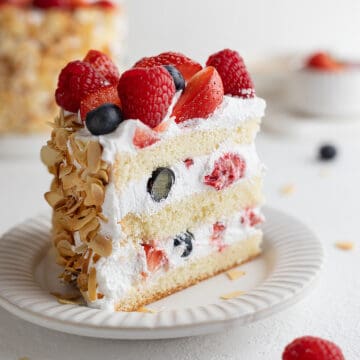
White Forest Cake Recipe

Jul 24, 2023 · Leave a Comment

Decorated White Forest cake on a cake stand.

White Forest cake recipe has everything to fall in love: soft vanilla sponge cake layers, decadent white chocolate, juicy maraschino cherries, and luscious Chantilly cream. This cake is an absolute winner. 

Decorated White Forest cake on a cake stand

The best White Forest cake is a fresh twist on a classic German dessert. This triple-layered beauty soaked with authentic Kirschwasser (or simply Kirsch) is created for grownups.

[feast_advanced_jump_to]

But don't worry: this cake has the option to become kid-friendly.

BAKING ESSENTIALS CHECKLIST

Sign up and get a list of the necessary baking tools and ingredients

FREE DOWNLOAD

Filled and topped with maraschino cherries, this cake is not only stunning to look at, but it is also downright delicious. So, why not try this innovative dessert and switch up your usual dessert routine?

White Forest cake vs. Black Forest cake

What is the difference between White Forest cake and Black Forest cake?

White Forest cake features a fluffy vanilla cake decorated with white chocolate, while Black Forest cake (aka forest gâteau) is a rich chocolate sponge cake adorned with dark chocolate.

Cherries, sweetened whipped cream, and Kirsch are shared elements in both cakes.

A single slice of White Forest cake on a dessert plate

White Forest cake recipe

  • This White Forest cake recipe is both simple to prepare and offers a make-ahead option.
  • A simple White Forest cake design is beginner-friendly.
  • This 7-inch layer cake is perfect for any occasion, whether a birthday, wedding celebration, anniversary, etc.

Ingredients

White Forest cake ingredients in pictures

For ingredients and detailed instructions, refer to the recipe card below.

  • Eggs: Use large eggs at room temperature.
  • Sugar: The recipe calls for granulated or caster sugar for making a sponge cake and icing sugar for making creme Chantilly.
  • Vanilla sugar brings a beautiful taste and flavor to the cake.
  • Flour: Use homemade or store-bought cake flour for the best results.
  • Heavy cream: Opt for heavy or heavy whipping cream with at least 30% fat content.
  • Cherries: Use sour canned or maraschino cherries to make the cake all year round or fresh cherries when in season. Make sure to save some cherries with stems to decorate the cake.
  • White chocolate: Opt for premium white chocolate when making chocolate shavings. Store them in the refrigerator until you are ready to use them. Alternatively, you may also consider using pre-packaged white chocolate curls.
  • Kirsch (Kirschwasser) is the star of the authentic Black Forest cake. Use authentic Kirsch, make it yourself with a cherry brandy essence, or substitute it with other spirits. For serving the cake to children, replace the alcohol with clear fruit juice or diluted cherry syrup.

Recipe variations

  • Sponge cake: Opt for Genoise cake as a substitute for traditional sponge cake. Alternatively, use a rich buttery cake option.
  • Flavorings: Replace a cherry brandy Kirsch with fruit-based brandy, rum, or cognac (with an alcohol content of approximately 40%).
  • Cherry filling: Substitute maraschino cherries with cherry compote, cherry sauce, or cherry pie filling.
Sliced White Forest cake on a serving board

How to make White Forest cake

Making White Forest cake consists of a few steps: preparing a vanilla sponge cake, making Kirsch syrup and Chantilly cream, and assembling the cake.

Step 1. To make vanilla sponge cake, preheat the oven to 355°F (180°C).

Step 2. Grease a 7-inch (18 cm) cake pan with softened butter and dust with flour. Remove flour access and place the pan aside. Sift flour with a flour sifter two times. Alternatively, line the bottom and sides of the pan with parchment paper.

Pro tip: Consult a classic sponge cake recipe for step-by-step photographed explanations, helpful tips, and tricks.

Step 3. Place whole eggs, vanilla, and granulated sugar in a heat-proof bowl and lightly beat with a hand whisk. 

Step 4. Bring the bowl over a bain-marie or water bath and whisk constantly. Warm the egg mixture to 104°F (40°C), checking with a cooking thermometer.

Step 5. Remove the bowl from the water bath and beat with an electric or stand mixer with a whisk attachment until the volume is tripled, for 8 to 10 minutes (photo 1).

Step 6. Decrease the mixer speed to low and beat for 2 minutes to adjust the texture. Add the sifted flour in two additions and gently mix with a rubber spatula (photo 2). 

Photo 1: Beaten eggs with sugar in a bowl Photo 2: Cake batter in a bowl
PHOTO 1 PHOTO 2

Step 7. Pour the cake batter into the prepared pan (photo 3) and bake in the oven for 25 to 30 minutes. Check the cake's doneness with a toothpick or a cake tester.

Step 8. Take the sponge cake out of the oven, and let it cool in the pan for 5-10 minutes (photo 4). Then remove it from the pan by turning it upside down and cool it on a wire rack for 5-10 minutes. Flip the cake over, and let it cool completely.

Photo 3: Cake batter in a baking pan Photo 4: Baked cake in a pan
PHOTO 3 PHOTO 4

Step 9. To make sugar syrup, pour water and sugar into a small saucepan and bring to a boil. Remove it from the heat once the sugar is dissolved, and add a few drops of Kirsch.

Step 10. To make Chantilly cream, place heavy cream in the chilled bowl of a stand mixer fitted with a whisk attachment and beat until soft-medium peaks form. Use an electric mixer as an alternative.

Pro tip: Consult a Chantilly cream recipe for step-by-step photographed explanations, helpful tips, and tricks.

Step 11. Weigh about 5-7 oz. (140-200 g) of cream (you will use it for decoration), cover the bowl with cream with plastic wrap, and refrigerate. Use the remaining frosting to assemble the cake.

Step 12. To assemble the cake, use a serrated knife and slice the sponge cake horizontally into three equal layers. Ensure that the thickness of each layer does not exceed ½ inch (about 1.5 cm). If the top of the cake is domed, level it out to create a smooth surface.

Step 13. Place the first cake layer on a cake board (photo 5) and soak it with the Kirsch syrup. Spread a layer of whipped cream.

Pro tip: For a neat appearance, use an adjusting mousse cake mold lined with an acetate strip.

Step 14. Arrange a few drained cherries over the cream (photo 6) and cover them with more cream (leave a few cherries for decoration).

Photo 5: Cake layer in an adjusting mold Photo 6: Cherries over the cream
PHOTO 5 PHOTO 6

Step 15. Cover with the second cake layer, soak with Kirsch syrup, and spread the cream. Place cherries, and spread the cream again. Finish the cake with the top layer and soak it with the syrup.

Step 16. Cover the entire cake with the remaining whipped cream and decorate the sides of the cake with a cake scraper (photo 7).

Step 17. Take the chilled cream frosting from the refrigerator and beat it with a hand whisk a few times if needed. Transfer the cream to a piping bag with an open star tip, and pipe a few cream swirls on top of the cake.

Step 18. Place a stemmed cherry on top of each swirl. Sprinkle the sides and top of the cake with chocolate shavings (photo 8). Refrigerate the cake for 2 to 3 hours before serving.

Photo 7: Cake covered with cream Photo 8: Assembled cake on a cake board
PHOTO 7 PHOTO 8

Expert Tips

  1. To make your cherry liquor, follow a traditional Black Forest cake recipe with instructions on using a cherry brandy essence.
  2. Make sure to drain maraschino cherries well using a paper towel.
  3. Make-ahead option: Bake the sponge cake a day ahead, store it covered with plastic in the refrigerator overnight, and put the finishing touches on it the following day.

Storing and freezing

Store White Forest cake under a glass dome in the refrigerator for 2 to 3 days. Keep leftover cake in an airtight container refrigerated.

Can you freeze White Forest cake? While it is not advisable to freeze the entire cake due to the heavy cream, you can preserve the sponge cake by wrapping it in plastic and freezing it for up to 3 months.

Recipe FAQ

What is the difference between White Forest cake and vanilla cake?

White Forest cake mixes vanilla and Kirsch flavors, while vanilla cake sticks to its classic vanilla taste.

What are the flavors of the White Forest cake?

White Forest cake, a fresh twist on the classic Black Forest cake, is made with vanilla sponge cake layers, soaked with Kirschwasser, and filled with sweetened whipped cream and cherries.

What is a White Forest cake birthday cake?

White Forest cake is made with vanilla cake layers, soaked with Kirsch, and generously filled with fresh whipped cream and cherries. Topped off with delicate white chocolate shavings, this sweet treat is a true delight for a birthday celebration.

Which is better Black Forest or White Forest?

Dark chocolate forest gateau is perfect for any special occasion, while White forest cake is an elegant choice for a wedding.

Love cake recipes? Try these next!

  • Cake Sans Rival
  • Uruguayan Cake Chaja
  • Berry Cake
  • Italian Torta Mimosa
  • Korean Fresh Cream Cake
  • Or browse all the cake recipes

Want more delicious and beautiful recipes? Subscribe to my newsletter and follow me on Facebook, Pinterest, and Instagram for my latest updates. If you make this recipe, please leave a star rating on the recipe card and comment below!

Print

Recipe card

White Forest Cake

Decorated White Forest cake on a cake stand.
Print Recipe
Save Recipe Recipe Saved

5 Stars 4 Stars 3 Stars 2 Stars 1 Star

No reviews

White Forest cake recipe has everything to fall in love: soft vanilla sponge cake layers, decadent white chocolate, juicy maraschino cherries, and luscious Chantilly cream. This cake is an absolute winner. 

  • Author: Irina Totterman
  • Total Time: 2 hours
  • Yield: 8 1x
  • Category: Cakes
  • Method: Baking
  • Cuisine: German

Ingredients

Scale

For a sponge cake:

  • 3 large eggs, room temperature
  • ½ cup minus 2 teaspoons (92 g) granulated sugar
  • 1 sachet (9 g) vanilla sugar
  • 1 cup minus 4 teaspoons (92 g) cake flour

For sugar syrup:

  • 3 tablespoons (45 ml) water
  • ⅓ cup (60 g) granulated sugar
  • 1 teaspoon Kirsch

For Chantilly cream:

  • 2 ½ cups (600 g) cold heavy cream, 30% fat
  • 2 ½ tablespoons (20 g) icing (powdered) sugar

For filling and decoration:

  • 8 oz. (230 g) drained maraschino cherries

For assembling:

  • 3.5 oz. (100 g) white chocolate

Instructions

  1. To make a sponge cake, preheat the oven to 355°F (180°C). Grease a 7-inch (18 cm) cake pan with softened butter and dust with flour. Alternatively, line the bottom and sides of the pan with parchment paper. Remove flour access and place the pan aside. Sift flour with a flour sifter two times. 
  2. Place whole eggs, vanilla, and granulated sugar in a heat-proof bowl and lightly beat with a hand whisk. Bring the bowl over a bain-marie or water bath and whisk constantly. Warm the egg mixture to 104°F (40°C), checking with a cooking thermometer. 
  3. Remove the bowl from the water bath and beat with an electric or stand mixer with a whisk attachment until the volume is tripled, for 8 to 10 minutes. Decrease the mixer speed to low and beat for 2 minutes to adjust the texture. Add the sifted flour in two additions and gently mix with a rubber spatula.  
  4. Pour the cake batter into the prepared pan and bake in the oven for 25 to 30 minutes. Check the cake's doneness with a toothpick or a cake tester.
  5. Take the sponge cake out of the oven, and let it cool in the pan for 5-10 minutes. Then remove it from the pan by turning it upside down and cool it on a wire rack for 5-10 minutes. Flip the cake over, and let it cool completely.
  6. To make sugar syrup, pour water and sugar into a small saucepan and bring to a boil. Remove it from the heat once the sugar is dissolved, and add a few drops of Kirsch.
  7. To make Chantilly cream, place cold heavy cream in the chilled bowl of a stand mixer fitted with a whisk attachment and beat until soft-medium peaks form. Use an electric mixer as an alternative. Weigh about 5-7 oz. (140-200 g) of cream (you will use it for decoration), cover the bowl with cream with plastic wrap, and refrigerate. Use the remaining frosting to assemble the cake.
  8. To assemble the cake, use a serrated knife and slice the sponge cake horizontally into three equal layers. Ensure that the thickness of each layer does not exceed ½ inch (about 1.5 cm). If the top of the cake is domed, level it out to create a smooth surface.
  9.  Place the first cake layer on a cake board and soak it with the Kirsch syrup. Spread a layer of whipped cream. Arrange a few drained cherries over the cream and cover them with more cream (leave a few cherries for decoration). 
  10. Cover with the second cake layer, soak with Kirsch syrup, and spread the cream. Place cherries, and spread the cream again. Finish the cake with the top layer and soak it with the syrup. Cover the entire cake with the remaining whipped cream and decorate the sides of the cake with a cake scraper. 
  11. Take the chilled cream frosting from the refrigerator and beat it with a hand whisk a few times if needed. Transfer the cream to a piping bag with an open star tip, and pipe a few cream swirls on top of the cake.
  12. Place a stemmed cherry on top of each swirl. Sprinkle the sides and top of the cake with chocolate shavings. Refrigerate the cake for 2 to 3 hours before serving.

Notes

  1. To make your cherry liquor, follow a traditional Black Forest cake recipe with instructions on using a cherry brandy essence.
  2. Make sure to drain maraschino cherries well using a paper towel.
  3. Make-ahead option: Bake the sponge cake a day ahead, store it covered with plastic in the refrigerator overnight, and put the finishing touches on it the following day.

Nutrition

  • Serving Size: 1 slice
  • Calories: 401
  • Sugar: 48.2 g
  • Sodium: 38 mg
  • Fat: 6.1 g
  • Saturated Fat: 3.1 g
  • Carbohydrates: 44.2 g
  • Fiber: 0.6 g
  • Protein: 4.4 g
  • Cholesterol: 72 mg

Thank you for following me on Pinterest, Facebook, and Instagram. Hashtag #bakinglikeachef so I can see your creations.

The nutritional information has been calculated using an online recipe nutrition calculator such as Verywellfit.com and is intended for informational purposes only. These figures should be used as a general guideline and not be construed as a guarantee.

Japanese Sponge Cake

Jul 20, 2023 · 2 Comments

Four Japanese sponge cake layers on a marble board.

Here is the ultimate soft and fluffy Japanese sponge cake, the secret to creating those stunning Japanese style cakes. With just 5 simple ingredients, this cake is baked to absolute perfection.

Four Japanese sponge cake layers on a marble board

Are you a cake baker looking for your next baking challenge? If you have already mastered Italian Pan di Spagna, Genoise cake, and chocolate sponge cake, it is time to take you on an adventure with Japanese sponge cakes.

[feast_advanced_jump_to]

Light and airy, Japanese fluffy cake is known for its melt-in-your-mouth texture and subtle sweetness. Mastering the art of making this type of sponge cake opens the door to Japanese pastry making.

BAKING ESSENTIALS CHECKLIST

Sign up and get a list of the necessary baking tools and ingredients

FREE DOWNLOAD

So grab your mixing bowl and get ready to whisk your way to cake perfection.

Japanese cake: sponge cake vs. cotton sponge cake

While both are high in eggs and low in flour, they have different preparation methods.

The Japanese sponge cake is a drier option that rises thanks to the whipping of whole eggs and sugar.

On the other hand, the Japanese cotton sponge cake uses a meringue with stiff peaks made from beaten egg whites and egg yolks, resulting in a moist texture of the cake, thanks to the water-bath baking method.

However, when it comes down to it, both types of cake are equally delicious and beloved in the Japanese pastry world.

Sliced soft Japanese sponge cake on a marble board

Japanese sponge cake recipe

  • Japanese sponge cake recipe is one of the best basic recipes to make Japanese strawberry cream cakes: Japanese strawberry shortcake (aka Japanese Christmas cake), Asian fresh fruit cake, etc.
  • It is quick and straightforward, with 20 minutes of hands-on time, and is made with basic ingredients.
  • Unlike butter cakes, Japanese sponge cake is made without leavening agents. Instead, the beaten eggs act as a rising agent.
  • Finally, it is perfect for making a birthday cake, a two-tire wedding cake, or a cake for a special occasion.

Ingredients

For ingredients and detailed instructions, refer to the recipe card below.

  • Eggs: Use whole eggs at room temperature for the best results. Bring eggs to the counter an hour before making the cake. Using a digital scale when weighing the eggs is essential to ensure accurate measurements.
  • Sugar: The recipe calls for caster or baker's sugar. Authentically, Japanese sponge cake is made with fine-grained granulated sugar. You can make it yourself: process regular granulated sugar in a food processor a few times.
  • Flour: Use cake flour, which has a lighter protein content than all-purpose flour. In Japan, soft and very fine flour with low protein content (6.5±0.5%) is used for making sponge cakes. It also has a low ash content (0.35%) and enhances the flavor of eggs and dairy products.
  • Butter brings flavor, taste, and moisture to the sponge cake. Opt for high-top quality unsalted butter with 82% fat content.
  • Milk is another ingredient that provides moisture to the cake.

Recipe variations

  • Add 0.35 oz. (10 g) of trehalose to make the sponge cake of a finer texture and bring moisture. Trehalose is a natural sugar made from yeast and is about 45% as sweet as regular sugar.
  • Add 0.35 oz. (10 g) of dried strawberry powder to create strawberry sponge cake.
  • Replace 2 tablespoons (31 g) of butter with 1 oz. (28 g) of Taihaku sesame oil, maximizing the cake's flavor and providing a delicate and melt-in-the-mouth texture.

How to make Japanese sponge cake

Step 1. Preheat the oven to 390°F (200°C). Sift flour with a flour sifter in a clean mixing bowl and put aside.

Step 2. Place butter and milk in a small bowl over another container with hot water and warm them up at 122°F (50°C).

Step 3. Grease a 6-inch (15 cm) springform pan with softened butter, dust with flour, and remove excess. Or line the bottom of the pan with a parchment paper circle and the sides with parchment strips.

Step 4. Place whole eggs and granulated sugar in a heat-resistant bowl or the bowl of a stand mixer. Whisk a few times using a hand whisk (photo 1).

Step 5. Bring the bowl over a bain-marie or water bath, and beat with a handheld mixer at medium speed until the temperature reaches 97°F to 100°F (36°C to 38°C), 104°F (40°C) at maximum.

Pro tip: For the best results, keep 97°F (36°C) in summer and 100°F (38°C) in wintertime.

Step 6. Remove the bowl from the hot water bath, and beat with an electric or stand mixer at high speed for 8 minutes (photo 2).

Photo 1: Beaten eggs and sugar in a bowl Photo 2: Egg mixture in a bowl
PHOTO 1 PHOTO 2

Step 7. Lower the speed to medium and beat for 1 minute. Then switch to low speed and beat for the remaining 2 minutes. The egg mixture must triple in volume and reach a ribbon stage (photo 3).

Pro tip: If using a hand mixer, turn the bowl counterclockwise with an undominant hand to adjust the texture of the dough. Coarse air bubbles will crush, and the finished cake will get the perfect texture.

Step 8. Stop the mixer and stick a toothpick into the beaten eggs. If it holds upright, you are done with whipping (photo 4).

Photo 3: Batter falling from the mixer beaters Photo 4: Toothpick standing into the batter
PHOTO 3 PHOTO 4

Step 9. Add the sifted cake flour while sifting again over the bowl and gently mix it with a rubber spatula. Turn the bowl counterclockwise, scooping the batter from the bottom of the bowl until the flour disappears.

Pro tip: Regarding spatula movements, it has to draw the letter "J," passing the bottom of the bowl from 2 to 8 o'clock, lifting the batter, and returning it.

Step 10. Add a scoop of the batter into a bowl with milk and butter preheated to 122°F (50°C) and mix with a spatula.

Pro tip: For the best results, the milk and butter mixture must be at 122°F (50°C); if lower, it will sink and won't mix well.

Step 11. Pour the cake batter mixture back into the principal preparation, and scoop the batter from the bottom of the bowl with a rubber spatula. Turn the bowl counterclockwise at the same time.

Step 12. Pour the batter into the prepared mold, and tap the bottom lightly against the table to remove air bubbles (photo 5).

Pro tip: Coarse air bubbles are easy to crush, and the finished product will be poor, so prepare the texture well.

Step 14. Lower the oven temperature from 390°F to 340°F (200°C to 170°C), and bake for 27-30 minutes.

Pro tip: Check the oven temperature with an oven thermometer for accurate baking results.

Step 15. Remove the baking pan from the oven and tap the mold from about 4 inches (10 cm) against the table to prevent it from shrinking. Let the cake cool in the pan for 5-10 minutes (photo 6).

Photo 5: Cake batter in a baking pan Photo 6: Baked sponge cake in a mold
PHOTO 5 PHOTO 6

Step 16. Turn the mold upside down on a wire rack and let it cool for 5 minutes. Then turn it over so that the grilled side faces up, and let it cool with the paper still on until cooled down completely.

Baked Japanese sponge cake on a marble board

Expert Tips

  1. Use a kitchen scale that provides the most accurate measurements and baking results.
  2. To make an 8-inch (20 cm) cake, multiply the recipe ingredients by 1.78 or use this simple cake pan converter. You may need to adjust the baking time.
  3. Follow the recommended temperature carefully to bake the perfect sponge cake.
  4. Gently incorporate the flour into the batter to maintain its lightness and avoid any deflation.
  5. Bring the batter to the oven without delay to ensure optimal results.
  6. Don't open the oven door during baking.
  7. To ensure evenly smooth layers, allow the cake to cool before slicing. For easier slicing, wait until the day after baking.
  8. To slice a cake, use a cake knife, a long serrated knife, or a cake leveler for perfectly even slices.
  9. Soak the cake layers when assembling: this type of sponge has a dry texture compared to a moist vanilla sponge cake.

Storing and freezing

Store Japanese sponge cake well-wrapped with plastic film in the refrigerator for 2-3 days.

Can you freeze it? You can freeze it covered with plastic wrap and aluminum foil for three months.

Recipe FAQ

What is Japanese sponge cake made of?

Japanese sponge cake is made with just 5 ingredients: eggs, sugar, cake flour, whole milk, and butter. It closely resembles the famous Genoise sponge cake.

Why are Japanese cakes so good?

Japanese cakes are known for their velvety texture and delicate sweetness. The secret lies in a lengthy eggs whisking process that creates a soft and fluffy texture that practically melts in your mouth.

Why are Japanese cakes different?

Japanese cakes are lighter and less sweet than Western-style cakes. They boast a delicate, airy texture and are made with fresh whipped cream rather than heavy buttercream.

Love sponge cake recipes? Try these next!

If you enjoy this Japanese soft cake, you will also love the other plain sponge cakes on the website.

  • Italian sponge cake
  • Genoise Sponge Cake
  • Korean Sponge Cake

Want more delicious and beautiful recipes? Subscribe to my newsletter and follow me on Facebook, Pinterest, and Instagram for my latest updates. If you make this recipe, please leave a star rating on the recipe card and comment below!

Print

Recipe card

Japanese Sponge Cake

Four Japanese sponge cake layers on a marble board.
Print Recipe
Save Recipe Recipe Saved

5 Stars 4 Stars 3 Stars 2 Stars 1 Star

No reviews

This ultimate soft and fluffy Japanese sponge cake is the secret to creating those stunning Japanese-style cakes. With just 5 simple ingredients, this cake is baked to absolute perfection.

  • Author: Irina Totterman
  • Total Time: 45 minutes
  • Yield: 6 1x
  • Category: Cakes
  • Method: Baking
  • Cuisine: Japanese

Ingredients

Scale
  • 3 ½ large eggs (173 g), room temperature
  • ⅓ cup + 1 tablespoon (92 g) caster sugar
  • ½ cup + 1 tablespoon (92 g) cake flour
  • 2 tablespoons (31 g) whole milk
  • 2 tablespoons (31 g) unsalted butter

Instructions

  1. Preheat the oven to 390°F (200°C). Sift flour with a flour sifter in a clean mixing bowl and put aside. Place butter and milk in a small bowl over another container with hot water and warm them up at 122°F (50°C).

  2. Grease a 6-inch (15 cm) springform pan with softened butter, dust with flour, and remove excess. Or line the bottom of the pan with a parchment paper circle and the sides with parchment strips.

  3. Place whole eggs and granulated sugar in a heat-resistant bowl or the bowl of a stand mixer. Bring it over a bain-marie or water bat, and beat with a handheld mixer at medium speed until the temperature reaches 97°F to 100°F (36°C to 38°C), 104°F (40°C) at maximum.

  4. Remove the bowl from the hot water bath, and beat with an electric or stand mixer at high speed for 8 minutes. Lower the speed to medium and beat for 1 minute. Then switch to low speed and beat for the other 2 minutes. The egg mixture must triple in volume and reach a ribbon stage. Stop the mixer and stick a toothpick into the beaten eggs. If it holds upright, you are done with whipping.

  5. Add the sifted cake flour while sifting again over the bowl and gently mix it with a rubber spatula. Turn the bowl counterclockwise, scooping the batter from the bottom of the bowl until the flour disappears. In terms of spatula movements, it has to draw the letter "J" passing the bottom of the bowl from 2 to 8 o'clock, lifting the batter, and returning it.

  6. Add a scoop of the batter into a bowl with milk and butter preheated to 122°F (50°C) and mix with a spatula. Pour the cake batter mixture back into the principal preparation, and scoop the batter from the bottom of the bowl with a rubber spatula. Turn the bowl counterclockwise at the same time.

  7. Pour the batter into the prepared mold, and tap the bottom lightly against the table to remove air bubbles. Lower the oven temperature from 390°F to 340°F (200°C to 170°C), and bake for 27-30 minutes.

  8. Remove the baking pan from the oven and tap the mold from a height of about 4 inches (10 cm) against the table to prevent it from shrinking. Let the cake cool in the pan for 5-10 minutes.

  9. Turn the mold upside down on a wire rack and let it cool for 5 minutes. Then turn it over so that the grilled side is facing up, and let it cool with the paper still on until cooled down completely.

Notes

  1. Use a kitchen scale that provides the most accurate measurements and baking results.
  2. To make an 8-inch (20 cm) cake, multiply the recipe ingredients by 1.78 or use this simple cake pan converter. You may need to adjust the baking time.
  3. Follow the recommended temperature carefully to bake the perfect sponge cake.
  4. Gently incorporate the flour into the batter to maintain its lightness and avoid any deflation.
  5. Bring the batter to the oven without delay to ensure optimal results.
  6. Don't open the oven door during baking.
  7. To ensure evenly smooth layers, allow the cake to cool before slicing. For easier slicing, wait until the day after baking.
  8. To slice a cake, use a cake knife, a long serrated knife, or a cake leveler for perfectly even slices.
  9. Soak the cake layers when assembling: this type of sponge has a dry texture compared to a moist vanilla sponge cake.

Nutrition

  • Serving Size: 1 slice
  • Calories: 192
  • Sugar: 15.8 g
  • Sodium: 44 mg
  • Fat: 7.6 g
  • Saturated Fat: 3.8 g
  • Carbohydrates: 26.4 g
  • Fiber: 0.7 g
  • Protein: 5.5 g
  • Cholesterol: 119 mg

Thank you for following me on Pinterest, Facebook, and Instagram. Hashtag #bakinglikeachef so I can see your creations.

The nutritional information has been calculated using an online recipe nutrition calculator such as Verywellfit.com and is intended for informational purposes only. These figures should be used as a general guideline and not be construed as a guarantee.

Korean Fresh Cream Cake (Saeng Cream Cake)

Jul 18, 2023 · 6 Comments

Decorated Korean fresh cream cake on a white cake stand.

Here is a simple and delicious Korean fresh cream cake (aka Saeng cream cake). Soft and fluffy, it is made with sponge cake layers, fresh whipped cream, and juicy strawberries. With a few basic ingredients, you can create this eye-catching confection in no time.

Decorated Korean fresh cream cake on a white cake stand

The Japanese sponge cake recipe uses a whole egg method where you must pay attention to temperature, the whole egg beating, and mixing for success. The Korean sponge cake recipe is a bit different.

[feast_advanced_jump_to]

It separates egg whites and yolks without a cooking thermometer and is made without butter. The Korean sponge cake 한국 스펀지 케이크 레시피 is a simplified take on classic Genoise cake. But despite its simplicity, it is yummy and delicious.

BAKING ESSENTIALS CHECKLIST

Sign up and get a list of the necessary baking tools and ingredients

FREE DOWNLOAD

Filled and decorated with light and airy whipped cream and fresh fruit, it is absolutely divine.

What is Korean fresh cream cake?

Korean fresh cream cake is a signature layer cake of Aisan bakeries made with layers of soft sponge cake, fluffy whipped cream, and luscious fresh fruit.

One of the most popular variations is the Korean Strawberry Shortcake, which showcases juicy fresh strawberries. This cake resembles the Japanese strawberry shortcake, a Chinese sponge cake with fruit, and a Western-style fresh fruit cake.

A fresh cream cake is known as a Korean birthday cake, Strawberry cream cake, and Saeng cream cake 생크림 케이크 in Korean, which means whipped cream cake.

The first whipped cream cake was introduced to Korea in the 'Ryeomen Bakery' (now 'Shinmyeong Confectionery') in 1977.

A single slice of Saeng cream cake on a white dessert plate

Korean fresh cream cake recipe

  • This Korean cake recipe is basic for making Asian-style cakes and is one of the best Korean cake recipes.
  • It is easy and quick, with a few minutes of hands-on time, and is made with simple ingredients.
  • Like other Asian sponge cakes, Korean sponge cake is made without baking powder or baking soda. Oil instead of butter helps the cake rise and gives it a lighter and fluffier texture.
  • It is the perfect cake for any celebration, whether it is one of the special events: a 21st birthday, a wedding, graduation, etc.

Ingredients

For ingredients and detailed instructions, refer to the recipe card below.

High quality ingredients are the key to making fresh cream cakes.

  • Eggs: The recipe calls for separated egg whites and egg yolks at room temperature. Use chilled eggs and an egg separator to separate egg whites from the yolks. Then bring them to room temperature. To ensure accurate measurements, opt for using a digital scale.

For the best results, choose fresh eggs. Fresh egg whites are whipped up easier, while the old ones struggle to keep the air up.

  • Sugar: Use granulated, baker's, or caster sugar for making the sponge cake and icing (powdered) sugar to make fresh whipped cream.
  • Flour: The recipe calls for cake flour, with a lighter protein content than all-purpose flour.
  • Oil brings moisture to the sponge cake. Opt for neutral flavorless grapeseed or vegetable oil. Also, read about how to make a cake moist.
  • Milk is another ingredient that provides moisture to the cake.
  • Heavy cream: Opt for heavy or heavy whipping cream with a high fat content of at least 30%. In Korea, fresh cream has a minimal fat content of 18%. The higher the milk fat content, the better and easier to whip the cream.
  • Fresh strawberries are the stars of the cake. Use frozen strawberries to make a cake filling if desired.
  • Lemon juice: Make fresh lemon juice using a citrus juicer or buy it at a grocery store.
  • Flavoring: Opt for Kirsch or vanilla extract to make the cake.

Recipe variations

  • Number of cake layers: Experiment with a range of layered cakes, from two to four layers.
  • Fresh berries: Replace strawberry cake filling with fresh strawberry halves, just like in a Japanese Strawberry Shortcake.
  • Flavorings: Add some lemon zest to the cake batter or flavor the simple syrup with vanilla extract, cognac, dark rum, or other different flavors. Get a free fruit flavor pairing chart.
  • Cake decoration is the best part of cake making. Add an extra batch of fresh whipped cream to decorate the cake with your favorite pastry tip for a range of stylish and creative designs.
Sliced Korean strawberry shortcake on a white cake stand

How to make Korean fresh cream cake

Making Korean fresh cream cake consists of a few steps: preparing a sponge cake, fresh strawberry filling, sugar syrup, making whipped cream frosting, and assembling the cake.

Step 1. To make a sponge cake, preheat the oven to 305°F (150°C). Sift cake flour with a flour sifter twice in a large mixing bowl.

Step 2. Butter and dust a 7-inch (18 cm) pan with flour, and remove the excess flour. Or line the bottom and sides of the baking pan with a parchment paper circle and strips.

Step 3. Place egg whites in a large bowl or the bowl of a stand mixer with the whisk attachment and beat on low-medium speed until frothy.

Step 4. Divide the sugar into three equal parts. Add ⅓ of sugar and continue whisking on low speed. Add another ⅓ of sugar and continue whisking on low speed. Add the last ⅓ of the sugar, and beat the egg whites until soft peaks (photo 1). Avoid stiff peaks and glossy meringue.

Step 5. Add egg yolks and gently mix with a hand whisk with circular movements (photo 2). Avoid any up-and-down whisking motions.

Photo 1: Beaten egg whites on mixer beaters Photo 2: Egg mixture in a bowl
PHOTO 1 PHOTO 2

Step 6. Sift ½ of the flour over the bowl and carefully mix with a hand whisk without whisking. Add the remaining flour and mix until the flour is invisible.

Step 7. Place oil and milk in a small microwave-safe bowl and warm them up in the microwave for 20 seconds. Add the warm milk and oil mixture to the main preparation.

Step 8. Gently mix by scooping the batter up from the bottom with a spatula until you obtain a uniform batter (photo 3).

Step 9. Pour batter into the prepared pan (photo 4) and tap it on the table a couple of times. Stir the batter with a bamboo screw with circular movements.

Pro tip: These tricks help eliminate air bubbles and create an ideal texture for the cake.

Photo 3: Cake batter in a bowl Photo 4: Cake batter in a baking pan
PHOTO 3 PHOTO 4

Step 10. Bake the cake for 60 minutes. Remove the baking pan from the oven and tap the mold on the table. Let the cake cool in the pan for 5-10 minutes (photo 4).

Pro tip: Baking a sponge cake at a low temperature for an extended period provides the best cake rise. Baking at higher oven temperatures results in a lower cake not being enough for all four layers.

Step 11. Turn the pan upside down on a wire rack and let the cake cool for 5 minutes. Then turn it over, and while the cake is warm, scrape the crust from the top of the cake with a thin sharp knife (photo 5).

Step 12. Don't trim the cake yet; just remove the top crust. Let the cake cool down completely.

Photo 5: Baked cake in a pan Photo 6: Crust removal from the cake's top
PHOTO 5 PHOTO 6

Step 13. To make sugar syrup, pour water and sugar into a small saucepan and bring to a boil. Out of the heat, add kirsch, and let it cool.

Step 14. To make fresh whipped cream, pour ⅔ cup + 3 tablespoons (200 g) of chilled heavy cream and icing sugar into a cold bowl and whip cream with a hand whisk until soft-medium peaks.

Pro tip: Consult a Japanese strawberry shortcake for how to make fresh whipped cream. It is different from the Westen-style homemade whipped cream. If desired, opt for stabilized whipped cream.

Step 15. To make strawberry cake filling, wash and pat dry strawberries. Hull and cut strawberries into halves, then quarters. Mash using a potato masher or a fork.

Step 16. Combine mashed strawberries, sugar, and lemon juice in a saucepan. Cook over medium heat for 2-3 minutes. Remove from heat and allow to cool completely. The sauce will thicken as it cools.

Step 17. To assemble the cake, measure the height of the cake. You will need to get four 0.4 inches (1 cm) thick cake layers. If the cake size allows you to cut the bottom of the cake, do this. Otherwise, leave the bottom crust.

Pro tip: Asian-style cakes usually omit the crust to achieve ultra-white layers.

Step 18. Use a serrated knife or cake leveler to slice the cake into thin layers 1 cm thick. Adjust a mousse cake mold to 6.4 inches (16 cm) and trim each layer to fit.

Step 19. Place the first layer on a turntable. Soak it with syrup using a pastry brush. Spread ¼ of the cream evenly with a bent spatula.

Pro tip: To achieve a clean and stylish look, assemble the cake using a mousse cake mold with an acetate cake collar.

Step 20. Then, using a pastry bag or spoon, add ⅓ of the strawberry filling on top of the cream. Make sure to leave a ½ inch (1.5 cm) gap from the edge (photo 7).

Step 21. Place the second cake layer and repeat the above procedure. Finish the cake with the third cake disk and soak it. Crumb coat the top and sides of the cake with a thin layer of cream.

Step 22. Whisk ⅔ cup (150 g) of the cold heavy cream with a hand whisk until soft peaks and cover the entire cake (photo 8).

Photo 7: Strawberry filling over the cream in a mold Photo 8: Cake coating and spatula
PHOTO 7 PHOTO 8

Step 23. Decorate the cake with an angled spatula: read a Wilton tutorial on how to make spatula icing. Arrange a few fresh strawberries on top.

Assembled Korean cake on a white cake stand

Expert Tips

  1. Keep the top and bottom crust if desired, but make sure the cake layers are 6.4 inches (16 cm) in diameter. The fresh whipped cream recipe is created for this cake size.
  2. Use a digital scale for the accurate measurements of ingredients.
  3. Make sure the ingredients are at room temperature. 
  4. To recalculate ingredients for another cake pan size, use a simple cake pan converter. You may need to adjust the baking time.
  5. Don't overmix the cake batter: overmixing results in a heavier cake.
  6. Don't open the oven door during baking.
  7. For evenly smooth layers, let the cake cool before slicing. For easier slicing, wait until the day after baking.
  8. Use a hand mixer with caution: it is easy to overwhip the cream filling.
  9. Make-ahead option: Bake a sponge and make a strawberry cake filling in the evening, and finish the cake the next day.

Storing and freezing

Store Korean fresh cream cake under a cake dome in the refrigerator for 2-3 days. Keep the leftover cake in an airtight container refrigerated.

Can you freeze it? You can't freeze the whole cake, but you can freeze the sponge cake for up to 3 months.

Recipe FAQ

What is sponge cake in baking?

Authentic sponge cake is made with eggs, flour, and sugar, resulting in a light and airy texture. The secret lies in beating the eggs with sugar to create air bubbles that give the cake its fluffy rise.

What are the different methods of sponge cake making?

In Korea, there are two different methods of making a sponge cake: the "public method" and the "separate method." The public method uses whole eggs to create airy bubbles, resulting in a delightfully soft and moist texture. The separate method involves separating the whites and yolks, using the whites to create a meringue, and putting them back together. It makes the cake fluffier.

What is the best method to be used in preparing sponge cake?

If you choose to use the method that uses whole eggs, you will need a mixer and a cooking thermometer to measure temperature during the cake batter preparation. However, if you decide to separate the egg yolks from the whites, this method is less demanding and only requires an electric mixer.

Love cake recipes? Try these next!

If you enjoy Korean fresh cream cake, you will also love the other sponge cakes on the blog.

  • Italian Pan di Spagna
  • Genoise Sponge Cake
  • Chiffon cake
  • Angel Food Cake
  • Japanese Sponge Cake
  • Vietnamese Bánh Bông Lan
  • Asian Sponge Cake (Chinese sponge cake)
  • Wagashi Sponge Cake (Japanese castella cake)
  • Japanese Roll Cake
  • Korean Lunchbox Cake
  • Bento Cakes

Want more delicious and beautiful recipes? Subscribe to my newsletter and follow me on Facebook, Pinterest, and Instagram for my latest updates. If you make this recipe, please leave a star rating on the recipe card and comment below!

Print

Recipe card

Korean Fresh Cream Cake (Saeng Cream Cake)

Decorated Korean fresh cream cake on a white cake stand.
Print Recipe
Save Recipe Recipe Saved

5 Stars 4 Stars 3 Stars 2 Stars 1 Star

No reviews

Korean fresh cream cake (aka Saeng cream cake) is a soft and fluffy cake made with sponge cake layers, fresh whipped cream, and juicy strawberries. With just a few basic ingredients, it is made in no time. 

  • Author: Irina Totterman
  • Total Time: 1 hour, 30 minutes
  • Yield: 6 1x
  • Category: Cakes
  • Method: Baking
  • Cuisine: Korean

Ingredients

Scale

For a sponge cake:

  • 4 large egg whites (130 g), room temperature
  • ½ cup + 1 ½ tablespoons (130 g) caster sugar
  • 4 large egg yolks (80 g), room temperature
  • 1 ⅓ cups (130 g) cake flour
  • 3 tablespoons (43 g) whole milk
  • 2 ⅓ tablespoons (31 g) grapeseed oil

For sugar syrup:

  • ⅓ cup (75 g) water
  • 3 tablespoons (40 g) granulated sugar
  • 1 tablespoon Kirsch (or vanilla extract)

For strawberry cake filling:

  • 7 oz. (200 g) fresh strawberries (or frozen strawberries)
  • 3 tablespoons (40 g) granulated sugar
  • 1 ½ teaspoons lemon juice

For assembling the cake:

  • ⅔ cup + 3 tablespoons (200 g) heavy cream, 30% fat
  • 2 ½ tablespoons (20 g) icing (powdered) sugar

For decoration: 

  • ⅔ cup (155 g) heavy cream, 30% fat
  • 5.3 oz. (150 g) fresh strawberries
  • 2 tablespoons (15 g) icing sugar (optional)

Instructions

  1. To make a sponge cake, preheat the oven to 305°F (150°C). Sift cake flour with a flour sifter twice in a large mixing bowl. Butter and dust a 7-inch (18 cm) pan with flour, and remove the excess flour. Or line the bottom and sides of the baking pan with a parchment paper circle and strips.

  2. Place egg whites in a large bowl or the bowl of a stand mixer with the whisk attachment and beat on low-medium speed until frothy. Divide the sugar into three equal parts. Add ⅓ of sugar and continue whisking on low speed. Add another ⅓ of sugar and continue whisking on low speed. Add the last ⅓ of the sugar, and beat the egg whites until soft peaks Avoid stiff peaks and glossy meringue.

  3. Add egg yolks and gently mix with a hand whisk with circular movements. Avoid any up-and-down whisking motions.

  4. Sift ½ of the flour over the bowl and carefully mix with a hand whisk without whisking. Add the remaining flour and mix until the flour is invisible.

  5. Place oil and milk in a small microwave-safe bowl and warm them up in the microwave for 20 seconds. Add the warm milk and oil mixture to the main preparation. Gently mix by scooping the batter up from the bottom with a spatula until you obtain a uniform batter.

  6. Pour batter into the prepared pan and tap it on the table a couple of times. Stir the batter with a bamboo screw with circular movements. These tricks help eliminate air bubbles and create an ideal texture for the cake.

  7. Bake the cake for 60 minutes. Remove the baking pan from the oven and tap the mold on the table. Let the cake cool in the pan for 5-10 minutes.

  8. Turn the pan upside down on a wire rack and let the cake cool for 5 minutes. Then turn it over, and while the cake is warm, scrape the crust from the top of the cake with a thin sharp knife. Don't trim the cake yet; just remove the top crust. Let the cake cool down completely.

  9. To make sugar syrup, pour water and sugar into a small saucepan and bring to a boil. Out of the heat, add Kirsch, and let it cool.

  10. To make fresh whipped cream, pour ⅔ cup + 3 tablespoons (200 g) of chilled heavy cream and icing sugar into a cold bowl and whip cream with a hand whisk until soft-medium peaks.

    Pro tip: Consult a Japanese strawberry shortcake for how to make fresh whipped cream. It is different from the Westen-style homemade whipped cream. If desired, opt for stabilized whipped cream. 

  11. To make strawberry cake filling, wash and pat dry strawberries. Hull and cut strawberries into halves, then quarters. Mash using a potato masher or a fork. Combine mashed strawberries, sugar, and lemon juice in a saucepan. Cook over medium heat for 2-3 minutes. Remove from heat and allow to cool completely. The sauce will thicken as it cools.

  12. To assemble the cake, measure the height of the cake. You will need to get four 0.4 inches (1 cm) thick cake layers. If the cake size allows you to cut the bottom of the cake, do this. Otherwise, leave the bottom crust. Use a serrated knife or cake leveler to slice the cake into thin layers 1 cm thick. Adjust a mousse cake mold to 6.4 inches (16 cm) and trim each layer to fit. 

  13. Place the first layer on a turntable. Soak it with syrup using a pastry brush. Spread ¼ of the cream evenly with a bent spatula. Then, using a pastry bag or spoon, add ⅓ of the strawberry filling on top of the cream. Make sure to leave a ½ inch (1.5 cm) gap from the edge. 

  14. Place the second cake layer and repeat the above procedure. Finish the cake with the third cake disk and soak it. Crumb coat the top and sides of the cake with a thin layer of cream. Whisk ⅔ cup (155 g) of the cold heavy cream with a hand whisk until soft peaks and cover the entire cake.

  15. Decorate the cake with an angled spatula: read a Wilton tutorial on how to make spatula icing. Arrange a few fresh strawberries on top.

Notes

  1. Keep the top and bottom crust if desired, but make sure the cake layers are 6.4 inches (16 cm) in diameter. The fresh whipped cream recipe is created for this cake size.
  2. Use a digital scale for the accurate measurements of ingredients.
  3. Make sure the ingredients are at room temperature. 
  4. To recalculate ingredients for another cake pan size, use a simple cake pan converter. You may need to adjust the baking time.
  5. Don't overmix the cake batter: overmixing results in a heavier cake.
  6. Don't open the oven door during baking.
  7. For evenly smooth layers, let the cake cool before slicing. For easier slicing, wait until the day after baking.
  8. Use a hand mixer with caution: it is easy to overwhip the cream filling.
  9. Make-ahead option: Bake a sponge and make a strawberry cake filling in the evening, and finish the cake the next day.

Nutrition

  • Serving Size: 1 slice
  • Calories: 549
  • Sugar: 43.5 g
  • Sodium: 55 mg
  • Fat: 31.2 g
  • Saturated Fat: 15.6 g
  • Carbohydrates: 62 g
  • Fiber: 2.2 g
  • Protein: 8.7 g
  • Cholesterol: 245 mg

Thank you for following me on Pinterest, Facebook, and Instagram. Hashtag #bakinglikeachef so I can see your creations.

The nutritional information has been calculated using an online recipe nutrition calculator such as Verywellfit.com and is intended for informational purposes only. These figures should be used as a general guideline and not be construed as a guarantee.

The recipe was adapted from https://en.cooking-tree.com/

Soft And Light Chocolate Sponge Cake

Jul 17, 2023 · Leave a Comment

Chocolate sponge cake on a wire rack.

Soft and light, this easy chocolate sponge cake recipe is a must-have in your recipe collection. Learn all the top tips and tricks for guaranteed success every time you bake chocolate Genoise from scratch.

Chocolate sponge cake on a wire rack

Are you one of those people who can never resist a slice of chocolate cake? Then get ready to meet your new favorite recipe - the ultimate chocolate sponge cake.

[feast_advanced_jump_to]

Baking this cake is a breeze. Imagine yourself spreading chocolate ganache, chocolate whipped cream, or chocolate buttercream on cake layers and indulging in a mouthwatering slice.

BAKING ESSENTIALS CHECKLIST

Sign up and get a list of the necessary baking tools and ingredients

FREE DOWNLOAD

This is the best chocolate sponge cake that rises without leavening agents. Instead, it relies on perfectly whisked eggs.

What is chocolate sponge cake?

Chocolate sponge cake is an airy sponge cake made with eggs, sugar, flour, and cocoa powder. The secret to its rise lies in the whisked eggs; no baking powder is used.

There are three ways to make a classic chocolate sponge cake: with butter (known as chocolate Genoise), without butter (Italian chocolate sponge cake), or with oil. However, it differs from chocolate chiffon cake made with a tube pan.

Chocolate sponge cake on a cooling rack line with parchment

Chocolate sponge cake recipe

  • It is a basic cake recipe, along with a regular sponge cake recipe and a classic Genoise cake.
  • This an old school chocolate sponge cake recipe: easy and quick, made with five simple ingredients in no time - perfect for a novice baker.
  • Made with butter, the cake is rich in flavor and taste yet airy and light, making it perfect for creating layered cakes. However, it is a classic sponge cake that needs generous soaking while assembling.

Ingredients

For ingredients and detailed instructions, refer to the recipe card below.

  • Eggs: The recipe calls for whole large eggs (not separated egg whites and egg yolks). Bring eggs to room temperature about an hour before you start.
  • Sugar: Use white sugar: granulated or caster sugar.
  • Flour: Use store-bought or homemade cake flour. To make it yourself, take 1 cup (125 g) of all-purpose flour, remove 2 tablespoons of flour, and add 2 tablespoons of potato or cornstarch.
  • Cocoa powder: Use unsweetened cocoa powder, not real chocolate, to make this cocoa sponge cake.
  • Unsalted butter is used to bring a buttery taste, flavor, and light moisture to the cake. Read more about how to make a cake moist.

Recipe variations

This recipe guides you through making a classic chocolate sponge cake, also known as chocolate Genoise. Here are some exciting variations to try.

  • Italian chocolate sponge cake (Pan di Spagna al cacao) is a chocolate sponge cake without butter, a twist on the classic Pan di Spana, with the rich flavor of cocoa powder. Follow the recipe below; no butter is needed.
  • Chocolate sponge cake with plain flour: Replace cake flour with plain flour, the same as all-purpose flour.
  • Chocolate sponge cake with oil: Substitute butter in the recipe below with almost 2 tablespoons (25 g) of neutral oil like grapeseed or vegetable oil.

Feel free to flavor your sponge cake with vanilla, lemon zest, or other flavoring. Get a free 10-page chart on fruit flavor pairings and discover the perfect chocolate combinations.

Three layers of chocolate Genoise cake on parchment paper

How to make chocolate sponge cake

Step 1. Preheat the oven to 355 degrees F (180°C). Butter and dust an 8-inch (20 cm) round cake pan with flour, and remove flour excess.

Or butter and line the pan's bottom with a parchment paper circle and the sides with parchment strips.

Pro tip: If using a cake ring, wrap the bottom of the cake ring with double aluminum foil to ensure a sturdy base.

Step 2. Melt the butter in the microwave and let it cool to 122-140°(50-60°C). Combine cocoa powder with flour, sift two-three times, and set aside.

Step 3. Prepare a bain-marie or water bath by pouring some water into a small saucepan and bringing it over medium heat. You can use a store-bought double boiler.

Step 4. Place eggs and sugar in a larger heatproof bowl or the bowl of a stand mixer, and whisk eggs with sugar with a hand whisk a few times (photo 1).

Step 5. Place the bowl over the saucepan with the hot water, ensuring the bottom doesn't touch the water.

Step 6. Whisk the egg mixture until frothy and whitish. Use a cooking thermometer to check the temperature reaches 104°F (40°C).

If you don't have a thermometer, test the heat by comparing it to the warmth of the body temperature of 98.6°F (37°C). It should feel warm but not hot to the touch.

Pro tip: To ensure proper aeration and complete sugar melting, the egg/sugar mixture should reach a temperature of 104°F (40°C). Be careful with steam coming from the hot water and touching the batter.

Step 7. Remove the bowl from the heat, and beat the preparation for 8 minutes. Use a stand mixer with the whisk attachment or an electric mixer on high or medium-high speed.

Step 8. Decrease the mixer speed and beat for another 2 minutes. Long whisking will result in a tripled volume and reach the ribbon stage (photo 2).

Pro tip: At the ribbon stage, the batter forms thick trails when lifted with the whisk.

Photo 1: Egg mixture in a bowl Photo 2: Batter on a whisk over a bowl
PHOTO 1 PHOTO 2

Step 9. Add ⅓ of the sifted flour mixture to the wet ingredients and delicately mix with a large rubber spatula from the bottom to the top.

Step 10. Mix another third of the dry ingredients, and finish with the rest of the flour mixture, gently mixing with a spatula (photo 3).

Step 11. Add two spoonfuls of the batter to the melted butter and mix with a spatula. Gently pour the blended butter mixture over a spatula into the remaining batter and carefully mix.

Step 12. Pour the batter into the prepared pan and level the top using a spatula or spoon (photo 4).

Photo 3: Chocolate batter in a bowl Photo 4: Chocolate batter in a baking pan
PHOTO 3 PHOTO 4

Step 13. Bake for 30-35 minutes. Test the doneness by inserting a toothpick in the center; it should come out clean.

Pro tip: Watch for the cake that slightly shrinks from the edge of the pan.

Step 14. Remove the cake from the oven and let it rest in the pan for 5-10 minutes (photo 5). Then flip it onto a wire rack, and cool it for 5-10 minutes (photo 6). Finally, turn it over again and let it cool completely.

Photo 5: Baked chocolate cake in a pan Photo 6: Chocolate sponge on a wire rack
PHOTO 5 PHOTO 6

Expert Tips

  1. The recipe ingredients should be at room temperature.
  2. Weigh the flour with a digital scale or use a spoon and level method.
  3. Use this simple cake pan calculator to recalculate the ingredients for a different pan size.
  4. Don't open the oven door during baking to prevent the cake from deflating.
  5. Trim the top and bottom of the cake, if desired, and slice it into thin layers with a long serrated knife, a nylon thread, or a cake leveler. 
  6. Soak the cake layers with simple syrup when assembling the cake.
  7. Make-ahead option: Bake the cake 1-2 days in advance, wrap it in plastic film (aka cling film), and refrigerate it.

Storing and freezing

Store the chocolate sponge cake covered with plastic wrap in the refrigerator for 2-3 days.

Can you freeze it? You can freeze chocolate sponge cake for up to 3 months. Wrap the cooled cake in cling film, then aluminum foil, and store in the freezer at -13°F (-25°C) for three months. If the freezer is set to -0.4°F (-18°C), store the cake for a maximum of 2 months.

To thaw, bring the cake to the refrigerator overnight or to the kitchen counter for a few hours.

How to garnish chocolate sponge cake

Whether you make a chocolate layer cake or chocolate cake pops, chocolate trifle, or truffles, here are some ideas for easy-to-make filling creams:

  • Chocolate whipped ganache
  • Chocolate mousse
  • French Chantilly cream
  • Chocolate whipped cream
  • Crème Légère
  • Diplomat cream
  • Mousseline Cream

Recipe FAQ

Why do bakers call cake sponge?

Whisking eggs extensively creates a sponge cake that rises. Once baked, it has a soft and airy texture, similar to sponge or foam. Another name for this type of cake is foam cake.

What is the difference between chocolate cake and chocolate sponge cake?

The perfect chocolate sponge cake requires just four ingredients: eggs, sugar, flour, and cocoa powder. On the other hand, chocolate cake incorporates baking powder and moisture-enhancing ingredients.

How many calories are in a chocolate sponge cake?

There are 166 calories in a slice of chocolate sponge cake (⅛ 8" cake).

How long does chocolate sponge cake last?

Chocolate sponge cake lasts up to 2-3 days in the refrigerator when tightly wrapped or up to 3 months if frozen.

Love sponge cakes? Try these next!

Discover a variety of sponge-based cakes, including birthday cakes and special occasion cakes, on the blog:

  • Black Forest Cake
  • White Forest Cake
  • Berry Cake
  • Italian Mimosa Cake
  • Chaja Cake
  • Italian Mimosa Cake
  • Vanilla Meringue Cake
  • Fresh Fruit Cake
  • Or browse all the cake recipes

Want more delicious and beautiful recipes? Subscribe to my newsletter and follow me on Facebook, Pinterest, and Instagram for my latest updates. If you make this recipe, please leave a star rating on the recipe card and comment below!

Print

Recipe card

Perfect Chocolate Sponge Cake

Chocolate sponge cake on a wire rack.
Print Recipe
Save Recipe Recipe Saved

5 Stars 4 Stars 3 Stars 2 Stars 1 Star

No reviews

Soft and fluffy, easy and quick, here is the perfect chocolate sponge cake recipe to include in your recipe collection. Made with just 5 simple ingredients, it is ideal for making layer cakes, semifreddos, and other desserts.

  • Author: Irina Totterman
  • Total Time: 40 minutes
  • Yield: 8 1x
  • Category: Basic recipes
  • Method: Baking
  • Cuisine: Italian

Ingredients

Scale
  • 4 large eggs, room temperature
  • ½ cup + 1 ½ tablespoons (120 g) granulated sugar
  • 1 cup (100 g) cake flour
  • 3 tablespoons (20 g) unsweetened cocoa powder
  • 2 tablespoons (30 g) unsalted butter, melted and cooled

Instructions

  1. Preheat the oven to 355 degrees F (180°C). Butter and dust an 8-inch (20 cm) round cake pan with flour, and remove flour excess. Or butter and line the pan's bottom with a parchment paper circle and the sides with parchment strips.

  2. Melt the butter in the microwave at 30-second increments and let it cool to 122-140°(50-60°C). Combine cocoa powder with flour, sift two-three times, and set aside.

  3. Prepare a bain-marie or water bath by pouring some water into a small saucepan and bringing it over medium heat. You can use a store-bought double boiler.

  4. Place eggs and sugar in a larger heatproof bowl or the bowl of a stand mixer, and whisk eggs with sugar with a hand whisk a few times. Place the bowl over the saucepan with the hot water, ensuring the bottom doesn't touch the water. Whisk the egg mixture until frothy and whitish. Use a cooking thermometer to check the temperature reaches 104°F (40°C).

  5. If you don't have a thermometer, test the heat by comparing it to the warmth of the body temperature of 98.6°F (37°C). It should feel warm but not hot to the touch. Be careful with steam coming from the hot water and touching the batter.

  6. Remove the bowl from the heat, and beat the preparation for 8 minutes. Use a stand mixer with the whisk attachment or an electric mixer on high or medium-high speed. Decrease the mixer speed and beat for another 2 minutes. Long whisking will result in a tripled volume and reach the ribbon stage (the batter forms thick trails when lifted with the whisk).

  7. Add ⅓ of the sifted flour mixture to the wet ingredients and delicately mix with a large rubber spatula from the bottom to the top. Mix another third of the dry ingredients, and finish with the rest of the flour mixture, gently mixing with a spatula. 

  8. Add two spoonfuls of the batter to the melted butter and mix with a spatula. Gently pour the blended butter mixture over a spatula into the remaining batter and carefully mix. 

  9. Pour the batter into the prepared pan and level the top using a spatula or spoon. Bake for 30-35 minutes. Test the doneness by inserting a toothpick in the center; it should come out clean. Watch for the cake that slightly shrinks from the edge of the pan.

  10. Remove the cake from the oven and let it rest in the pan for 5-10 minutes. Then flip it onto a wire rack, and cool it for 5-10 minutes. Finally, turn it over again and let it cool completely. 

Notes

  1. The recipe ingredients should be at room temperature.
  2. Weigh the flour with a digital scale or use a spoon and level method.
  3. Use this simple cake pan calculator to recalculate the ingredients for a different pan size.
  4. Don't open the oven door during baking to prevent the cake from deflating.
  5. Trim the top and bottom of the cake, if desired, and slice it into thin layers with a long serrated knife, a nylon thread, or a cake leveler. 
  6. Soak the cake layers with simple syrup when assembling the cake.
  7. Make-ahead option: Bake the cake 1-2 days in advance, wrap it in plastic film (aka cling film), and refrigerate it.

Nutrition

  • Serving Size: 1 slice
  • Calories: 166
  • Sugar: 15.3 g
  • Sodium: 37 mg
  • Fat: 6.3 g
  • Saturated Fat: 3.1 g
  • Carbohydrates: 25 g
  • Fiber: 1.8 g
  • Protein: 5.2 g
  • Cholesterol: 101 mg

Thank you for following me on Pinterest, Facebook, and Instagram. Hashtag #bakinglikeachef so I can see your creations.

The nutritional information has been calculated using an online recipe nutrition calculator such as Verywellfit.com and is intended for informational purposes only. These figures should be used as a general guideline and not be construed as a guarantee.

Erdbeerboden (German Strawberry cake)

Jul 7, 2023 · Leave a Comment

Erdbeerboden German strawberry cake on a serving board.

Here is the best homemade recipe for a famous German strawberry cake called Erdbeerboden. It is made with soft sponge cake, creamy vanilla pudding, and fresh strawberries topped with a clear glaze.

Erdbeerboden German strawberry cake on a serving board

This delectable dessert, also known as a German strawberry torte, strawberry flan, or strawberry shortcake, is a German baking classic. Its counterpart, the Japanese strawberry shortcake and Jordgubbstårta in Sweden, are equally beloved in their respective cultures.

[feast_advanced_jump_to]

Although strawberry cakes are traditionally baked in a regular cake pan, Erdbeerboden uses a distinctive baking tin. This flan pan has an elevated base and a rim encircling the outer edges to hold the fruits and jelly glaze.

BAKING ESSENTIALS CHECKLIST

Sign up and get a list of the necessary baking tools and ingredients

FREE DOWNLOAD

What is Erdbeerboden?

Erdbeerboden is a classic German strawberry cake, also known as strawberry flan, made with a sponge cake base, creamy vanilla custard, and fresh strawberries.

The name "erdbeerboden" comes from the German words "erdbeere," signifying strawberry, and "boden," meaning floor.

It closely resembles a popular German fruit cake Obstboden (aka fruit fan), topped with a mix of fruits: peaches, kiwi fruit, mango, strawberry, pineapple, etc.

Single slice of Erdbeerboden on a dessert plate

German strawberry cake recipe

  • German strawberry cake recipe is easy and quick to make, using basic ingredients.
  • Strawberry flan is an ideal light summer dessert to serve a large gathering of 12-14 individuals.
  • Generously topped with juicy strawberries, it is loved by kids and adults.

Ingredients

Erdbeerboden ingredients in pictures

For ingredients and detailed instructions, refer to the recipe card below.

  • Eggs: Use large eggs at room temperature to make the recipe. Use an egg separator to separate the egg yolks from the egg whites.
  • Sugar: The recipe calls for granulated or caster sugar.
  • Flour: Use all-purpose flour or substitute it with a gluten-free flour blend.
  • Cornstarch is used to lighten up the proteins of the AP flour and make a clear glaze.
  • Unsalted butter: The recipe calls for butter melted and cooled to room temperature.
  • Lemon zest brings flavor to the Genoise sponge cake. Use a microplane to make fresh citrus zest. Replace it with 1 teaspoon of pure vanilla extract or one sachet of vanilla sugar (vanillezucker in German).
  • Heavy cream: Use heavy cream or whole milk for the best results. Swap it for lor-fat or plant-based milk if desired.
  • Vanilla bean paste is used to flavor vanilla pudding.
  • Fresh strawberries are the stars of this beautiful strawberry cake. Use them whole or cut into halves to cover the top of the cake. Choose berries of the same size if possible. You can replace strawberries with another fresh fruit or mixed berries.
  • Clear or red glaze by Dr. Oetker. Opt for store-bought Tortenguss klar or Tortenguss rot, or make your own using water, potato starch, and granulated sugar.

To help with blending different fruit flavors, download this free 10-page fruit flavor pairing chart.

To speed up your cooking process, opt for store-bought vanilla pudding instead of making your own vanilla cream from scratch. Use between ⅓ and ½ of the package for optimal results.

Recipe variations

Authentic Erdbeerboden is made with Tortenguss, a jelly glaze used for topping fresh berries. It is sold as a clear glaze Tortenguss klar or red-colored Tortenguss rot.

Traditionally, red glaze Tortenguss rot is used for making German strawberry cake, but you make a clear or fruit-based glaze yourself.

Other recipe variations include fruit combinations, from red berries (strawberries, raspberries, blueberries, and blackberries) to tropical fruits (kiwi, mango, and pineapple).

Using exotic fruits such as pineapple, kiwi, or mango, omit the clear glaze. These fruits contain an enzyme that prevents the glaze from setting.

German strawberry cake decorated with strawberry halves, tea towel, and fresh berries in the background

How to make Erdbeerboden

Making Erdbeerboden consists of a few steps, including making a sponge cake, vanilla pudding, clear glaze, and assembling the cake.

Step 1. To make sponge cake, preheat the oven to 345°F(175°C). Prepare an 11-inch (28 cm) fruit plan pan: grease it with softened butter, dust it with flour, and tap to remove flour excess.

Pro tip: Consult the Genoise cake recipe for step-by-step photographed explanations, helpful tips, and tricks.

Step 2. Melt butter in the microwave at 30-minute increments and put aside.

Step 3. Place eggs, egg yolks, sugar, and grated lemon zest in the bowl of a stand mixer. Beat at medium-high speed for 10 minutes until creamy and doubled in volume (photo 1).

Step 4. Sift flour with corn starch over the bowl and fold in carefully using a rubber spatula. 

Step 5. Add a few tablespoons of the batter to the bowl with melted butter, and mix with a spatula. Then fold the butter mixture into the principal preparation and gently mix (photo 2).  

Photo 1: Beaten eggs with sugar in a bowl Photo 2: Cake batter in a bowl
PHOTO 1 PHOTO 2

Step 6. Pour the batter into the prepared tin (photo 3).

Step 7. Bake on the middle rack in the preheated oven for 20-25 minutes until golden brown - use a toothpick test (photo 4).

Photo 3: cake batter in a baking pan Photo 4: Baked sponge base of Erdbeerboden
PHOTO 3 PHOTO 4

Step 8. Let the cake cool in the pan for 5-10 minutes. Then flip the base out of the mold on a wire rack lined with parchment paper and let it cool completely.

Step 9. To make vanilla pudding, mix eggs, sugar, vanilla bean paste, and cornstarch in a mixing bowl.

Pro tip: Consult the Italian pastry cream recipe for step-by-step photographed explanations, helpful tips, and tricks. Italian pastry cream is essentially identical to German vanilla pudding.

Step 10. Pour the cream into a saucepan and bring to a boil. Slowly add the hot cream to the egg mixture, whisking constantly.

Step 11. Pour the mixture back into the saucepan and cook over low heat until the cream thickens. Remove the pan from the heat and stir in the cubed cold butter.

Step 12. Immediately transfer the cream to another dish to stop cooking. Cover the pudding with cling film in contact and let it cool on the kitchen counter - no need to refrigerate.

Step 13. To make the clear glaze, follow the clear glaze recipe for step-by-step photographed explanations, helpful tips, and tricks. If using store-bought Tortenguss, follow the packet instructions.

Step 24. To assemble the cake, wash, pat dry, hull, and halve the strawberries. 

Step 15. Give a few whisks to the cooled vanilla pudding and cover the upside-down cake base with it (photo 5). 

Step 16. Arrange strawberry halves in a circular pattern from the outside in (photo 6).

Photo 5: Vanilla pudding over the cake base Photo 6: Assembled cake with strawberries on top
PHOTO 5 PHOTO 6

Step 17. Using a silicone brush, cover the fruit with the hot clear glaze or German Tortenguss (follow the package instructions to make it). Let it set at room temperature or in the fridge for 1 hour.

Step 18. Decorate the cake with fresh mint leaves. Serve with a dollop of sugar-free whipped cream or crème Chantilly.

Expert Tips

  1. Use an 11-inch (28 cm) springform pan if a flan pan is unavailable. Just be sure to leave a bit of space between the strawberries and the edge of the cake.
  2. Brush the top of the strawberries filling the gaps between fruits.
  3. Let the jelly glaze set well before slicing the cake. Alternatively, use an apricot-based tart glaze.
  4. Make-ahead option: Bake the cake base the day before. Then wrap it in plastic film to prevent it from drying out and refrigerate. The following day, finish your cake. Alternatively, you may use a store-bought Obsttortenboden sponge cake and instant vanilla pudding. Then, add a finishing touch to your cake by decorating it with fresh strawberries.

Storing and freezing

The strawberry flan is best served on the day of making. You can store leftover cake in an airtight container in the refrigerator for up to 2-3 days.

Can you freeze it? It is not recommended to freeze the cake once it has been assembled. Freezing alters the chemical composition of the fruit glaze and strawberries, leading to a mushy texture upon thawing.

However, you can freeze the cake base. Allow it to cool first, then cover it with plastic wrap and freeze it for 4 to 6 months. To thaw, simply transfer it from the freezer to the fridge overnight.

How to prevent a soggy bottom

Below are several effective ways to avoid a soggy base in your strawberry flan.

  • To protect the cake base, make a classic pastry cream or German vanilla pudding (homemade or store-bought).
  • Use melted chocolate to brush the cooled cake base and let it set for 30 minutes.
  • Brush the fruit base with 2-3 tablespoons of strawberry jam.
  • Sprinkle it with breadcrumbs, ground almonds, or other nuts.
  • Use German Sahnesteif (aka whip cream stabilizer) or a mixture of cornflour and icing sugar.

Recipe FAQ

Can you make this cake with frozen strawberries?

You can make this cake with frozen strawberries. Just arrange them on the base of the cake without thawing them first. Cover frozen berries immediately with a hot glaze to keep the fruit juices from leaking out.

Love strawberry recipes? Try these next!

This strawberry flan cake is the ideal dessert for your summer indulgence. Make the most of the strawberry season and explore other delightful recipes, which include a range of strawberry desserts, on the blog.

  • Strawberry Clafoutis
  • Strawberry Chantilly Cake
  • Strawberry cake Fraisier
  • French Strawberry Tart
  • Strawberry Charlotte Cake

Want more delicious and beautiful recipes? Subscribe to my newsletter and follow me on Facebook, Pinterest, and Instagram for my latest updates. If you make this recipe, please leave a star rating on the recipe card and comment below!

Print

Recipe card

Erdbeerboden (German Strawberry cake)

Erdbeerboden German strawberry cake on a serving board.
Print Recipe
Save Recipe Recipe Saved

5 Stars 4 Stars 3 Stars 2 Stars 1 Star

No reviews

This famous German strawberry cake, or Erdbeerboden, is made with soft sponge cake, creamy vanilla pudding, and juicy fresh strawberries, all smothered in a glossy glaze. 

  • Author: Irina Totterman
  • Total Time: 60 minutes
  • Yield: 12 1x
  • Category: Cakes
  • Method: Baking
  • Cuisine: German

Ingredients

Scale

For the sponge cake base: 

  • 5 large eggs, room temperature
  • 2 large egg yolks, room temperature
  • ¾ cup (150 g) granulated sugar
  • ½ lemon, zest
  • 1 cup + 3 tablespoons (150 g) all-purpose flour
  • 3 tablespoons (30 g) cornstarch
  • 3.2 oz. (90 g) unsalted butter, melted

For the vanilla pudding: 

  • 127 g heavy cream, 30% fat
  • ½ teaspoon vanilla bean paste
  • 2 tablespoons (25 g) granulated sugar
  • 2 ½ teaspoons (8 g) cornstarch
  • 1 ½ large egg yolks
  • 2 ½ teaspoons (12 g) unsalted butter

For garnish:

  • 17.6 oz. (500 g) strawberries
  • fresh mint leaves

For glazing:

  • clear glaze (homemade or store-bought Tortenguss rot)

*Don't you have the correct baking pan on hand right now? Try this simple Cake Pan Converter!

** If needed, please refer to Baking Conversion Charts.

Instructions

  1. To make the sponge cake, preheat the oven to 345°F (175°C). Prepare an 11-inch (28 cm) fruit plan pan: grease it with softened butter, dust it with flour, and tap to remove flour excess. Melt butter in the microwave at 30-minute increments and put aside. 
  2. Place eggs, egg yolks, sugar, and grated lemon zest in the bowl of a stand mixer. Beat at medium-high speed for 10 minutes until creamy and doubled in volume. 
  3. Sift flour with cornstarch over the bowl and fold in carefully using a rubber spatula. Add a few tablespoons of the batter to the bowl with melted butter, and mix with a spatula. Then fold the butter mixture into the principal preparation and gently mix.   
  4. Pour the batter into the prepared tin. Bake on the middle rack in the preheated oven for 20-25 minutes until golden brown (use a toothpick test). Let the cake cool in the pan for 5-10 minutes. Then flip the base out of the mold on a wire rack lined with parchment paper and let it cool completely. 
  5. To make the vanilla pudding, mix eggs, sugar, vanilla bean paste, and cornstarch in a mixing bowl. Pour the cream into a saucepan and bring to a boil. Slowly add the hot cream to the egg mixture, whisking constantly. 
  6. Pour the mixture back into the saucepan and cook over low heat until the cream thickens. Remove the pan from the heat and stir in the cubed cold butter. Immediately transfer the cream to another dish to stop cooking. Cover the pudding with cling film in contact and let it cool on the kitchen counter - no need to refrigerate. 
  7. To make a clear glaze, follow the clear glaze recipe.
  8. To assemble the cake, wash, pat dry, hull, and halve the strawberries. Give a few whisks to the cooled vanilla pudding and cover the upside-down cake base with it. Arrange strawberry halves in a circular pattern from the outside in. 
  9. Using a silicone brush, cover the fruit with the hot clear glaze or German Tortenguss (follow the package instructions to make it). Let it set at room temperature or in the fridge for 1 hour. Decorate the cake with fresh mint leaves. Serve with a dollop of sugar-free whipped cream or crème Chantilly.

Notes

  1. Use an 11-inch/28 cm springform pan if a flan tin is unavailable. Just be sure to leave a bit of space between the strawberries and the edge of the cake.
  2. Brush the top of the strawberries filling the gaps between fruits.
  3. Let the jelly glaze set for about 1 hour before slicing the cake. Alternatively, use an apricot-based tart glaze.
  4. Make-ahead option: Bake the cake base the day before. Then wrap it in plastic film to prevent it from drying out and refrigerate. The following day, finish your cake. Alternatively, you may choose to use a store-bought Obsttortenboden sponge cake and instant vanilla pudding. Then, add a finishing touch to your cake by decorating it with fresh strawberries.
  5. Nutritional information doesn't include a clear glaze.

Nutrition

  • Serving Size: 1 slice
  • Calories: 265
  • Sugar: 15.8 g
  • Sodium: 37 mg
  • Fat: 14.4 g
  • Saturated Fat: 8 g
  • Carbohydrates: 29.8 g
  • Fiber: 1.2 g
  • Protein: 5.3 g
  • Cholesterol: 171 mg

Thank you for following me on Pinterest, Facebook, and Instagram. Hashtag #bakinglikeachef so I can see your creations.

The nutritional information has been calculated using an online recipe nutrition calculator such as Verywellfit.com and is intended for informational purposes only. These figures should be used as a general guideline and not be construed as a guarantee.

Japanese Strawberry Shortcake (Japanese Christmas Cake)

Jun 23, 2023 · 3 Comments

A single slice of Japanese strawberry shortcake.

Japanese strawberry shortcake, also known as Japanese Christmas cake or Kurisumasu Keki, is made with soft and fluffy Genoise sponge layers, sweetened whipped cream, and juicy fresh strawberries. No wonder this decadent treat is fit for the best time of the year.

A single slice of Japanese strawberry shortcake

Japanese strawberry shortcake (イチゴのショートケーキ), frequently referred to as Korean strawberry shortcake, fresh cream strawberry cake, Chinese strawberry cake, or simply fresh cream cake, is a highly sought-after dessert in Asian nations.

[feast_advanced_jump_to]

Instead of traditional buttercream, the cake features a light and airy fresh whipped cream. It also highlights soft and fluffy sponge cake that melts in the mouth.

BAKING ESSENTIALS CHECKLIST

Sign up and get a list of the necessary baking tools and ingredients

FREE DOWNLOAD

During the Christmas season in Japan, one of the most popular cakes is the Japanese Christmas Cake, also known as Kurisumasu Keki. This cake is adorned with beautiful red and vibrant strawberries, making it a festive and attractive dessert choice.

What is the Japanese strawberry shortcake?

Japanese strawberry shortcake is a fluffy sponge made with fresh whipped cream and fresh strawberries. Shortcake was brought to Japan by Rinemon Fujii, the founder of Fujiya, who released the shortcake for the first time in 1922.

Japanese shortcake is different from the Western countries' shortcake. American shortcake features a crispy biscuit dough with luscious whipped cream and strawberries.

In England, the shortcake sandwiches strawberries and cream between crunchy, cookie-like shortbreads.

Slices of Japanese Christmas cake on dessert plates

Japanese strawberry shortcake recipe

  • Japanese strawberry shortcake recipe is made with basic ingredients with a make-ahead option.
  • It makes a basic cake perfect for experimenting with other fruit and flavors. Get started by downloading this complimentary 10-page fruit flavor pairing chart.
  • This fresh strawberry cream cake is made from ripe, juicy strawberries instead of the cooked strawberry filling. So it preserves the utmost flavors and aroma of luscious berries.
  • The fluffy texture of the sponge cake and the sweetness of the fresh cream brings out the acidity of the strawberries. The contrast between the pure white whipped cream and the bright red strawberries is beautiful.
  • Unlike the traditional British Christmas cake that is dense and boozy, it is a light Christmas cake that complements a rich and indulgent holiday meal.

Ingredients

Japanese strawberry shortcake ingredients in pictures

For ingredients and detailed instructions, refer to the recipe card below.

  • Eggs: Use large-sized whole eggs at room temperature. Bring them to the kitchen counter about 45-60 minutes before you start.
  • Sugar: The recipe calls for white granulated and icing sugar. Process sugar in a food processor a few times to make icing sugar.
  • Flour: Use all-purpose flour, which is plain flour in the UK. You can replace the flour and corn starch with cake flour if desired.
  • Cornstarch is an effective aid for tenderizing the flour's tough proteins and so effectively prevents the development of gluten.
  • Whole milk is added to make the cake batter.
  • Honey brings moisture to the cake. Read about how to make cakes moist.
  • Butter fixes the aromas of the sponge cake, helps the coloring, and brings the cake's softness. Opt for an unsalted batter with 82% fat content, preferably.
  • Heavy cream: Choosing the right fat content of the cream is the key to a beautiful cake finish. Opt for heavy cream or heavy whipping cream with at least 30% fat content. If you live in the UK, choose double cream.

Heavy cream with 30% milk fat has a light and smooth texture compared to double cream with 48% milk fat. Also, whipped cream with 48% milk fat whips more easily than whipped cream with 30% milk fat, and it separates easily, so be careful when beating.

In Japan, fresh cream with 35% and 45% milk fat content is mainly used for making fresh whipped cream. They often mix high-fat and low-fat creams for easier handling when making whipped cream for decoration.

  • Vanilla extract brings an exquisite flavor to sugar syrup.
  • Fresh strawberries are the stars of Japanese strawberry cake. Opt for ripe seasonal strawberries that feature the best taste and flavor.

Recipe variations

The cake, also known as white Christmas cake, symbolizing the winter season, is traditionally served on Christmas Eve. Japanese people usually place a chocolate Santa on top.

  • Feel free to decorate the cake with candles or other chocolate Christmas decorations.
  • Replace vanilla extract with Kirsch (Kirschwasser) to flavor the sugar syrup.
  • Arrange a strawberry layer as you desire: slice berries into ⅕ inch (5 mm) thickness, or place whole strawberries upright or on the side to feature a round cross-section.
  • Swap red strawberries for Japanese white strawberries, or pineberries, a hybrid between Japanese white strawberries and Florida strawberries.
  • If strawberries are out of season, use seedless red or green grapes to make a Grape Shortcake.
  • Finally, go for a three-layer cake with a golden ratio of 1 to 1 when the thickness of both the whipped cream and the sponge cake layer is about ½ inch (1 cm) thick.
A slice of Japanese strawberry sponge cake

How to make Japanese strawberry shortcake

Making a Japanese strawberry shortcake consists of a few steps, including preparing Genoise sponge cake, sugar syrup, fresh whipped cream, and assembling the cake. 

Step 1. To make sponge cake, preheat the oven to 330°F (165°C). Line the bottom of a 6-inch (15 cm) cake pan with a piece of round parchment paper. Line the sides with parchment strips. In a large bowl, sift the flour with cornstarch and put aside.

Step 2. Place butter and milk in a small bowl over a container with hot water and let the butter melt. Mix and check the mixture temperature with a cooking thermometer - it must be 140°F (60°C).

Pro tip: ALternatively, use the microwave to heat the butter and milk in 30-second increments. Make sure to use a microwave-safe bowl.

Step 3. Place eggs, sugar, and honey in a heat-resistant bowl and beat with a hand whisk for 1 minute (photo 1). 

Step 4. Put the bowl over a water bath or bain-marie and continue to mix with a whisk. Once the mixture reaches the temperature of 104°F (40°C), remove the bowl from the hot water bath. 

Step 5. Using a hand electric mixer, start whisking the egg mixture on low speed for 1 minute. Then switch the mixer to high speed and beat for 10 minutes.

Step 6. Return the hand mixer to low speed and beat in slow circular motions for 1-2 minutes. Once you lift the beaters of the hand mixer, the batter should leave a ribbon-like mark that will remain for 3-4 seconds (photo 2).

Pro tip: Whisking the batter on low speed helps the large bubbles disappear.

Photo 1: Beaten eggs and sugar in a bowl Photo 2: Ribbon stage of the batter
PHOTO 1 PHOTO 2

Step 7. Sift ½ of the dry ingredients over the bowl and gently mix with a rubber spatula working from the bottom of the bowl while rotating it little by little. 

Step 8. Add the remaining dry ingredients and mix in the same way. Rotate the bowl and mix until the flour disappears.

Step 9. Add two tablespoons of the batter to the milk and butter mixture and mix with a mini whisk. Pour this mixture into the principal preparation and gently mix the batter.

Step 10. Pour the batter into the prepared pan (photo 3) and tap the mold from 4 inches (10 cm) to remove the air bubbles. Bake in the preheated oven for 30 minutes.

Pro tip: The cake is ready when the gap between the pan and the cake appears, and a toothpick or a bamboo skewer is pulled from the center of the cake and remains clean.

Step 11. Remove the baked cake from the oven and tap the mold from 6 inches (15 cm) to prevent cake shrinkage. Let it cool in the pan for 10 minutes (photo 4).

Photo 3: Cake batter in a bowl Photo 4: Baked sponge cake in a mold
PHOTO 3 PHOTO 4

Step 12. Flip it over and let the cake slip from the mold on a wire rack. Allow the cake to cool for 10 minutes. Then turn it over and let it cool completely.

Step 13. To make sugar syrup, put granulated sugar and water in a small saucepan and bring to a boil. When the sugar melts, remove from the heat and add vanilla extract. Let the syrup cool down.

Step 14. To make fresh whipped cream, pour cold heavy cream with icing sugar into a chilled bowl, and whisk with a hand whisk for 6 minutes. 6-minute cream falls in a thin line when you lift the whisk (photo 5). Stop whisking the cream at 6 minutes.

Attention: Making Japanese-style cakes, keep in mind that the whipped cream texture needed is significantly softer than what is used in Western sweets.

Step 15. Other stages of whipping the cream are the following:

  • 7-minute stand: The cream is quite loose and is just enough to stay on the whisk. It is the perfect cream consistency to coat the entire surface of the cake (photo 6).
Photo 5: 6-minute stand cream on a whisk Photo 6: 7-minute stand cream on a whisk
PHOTO 5 PHOTO 6
  • 8-minute stand: At 8 minutes of hand whisking, the cream is about to stay on the whisk and then drop off. It is the right cream state for sandwiching the cake layers (photo 7).
  • 9-minute stand: Cream makes soft corners or streaks when you lift the whisk. It is perfect for piping and cake decoration (photo 8).
Photo 7: 8-minute stand cream on a whisk Photo 8 : 9-minute stand cream on a whisk
PHOTO 7 PHOTO 8

Pro tip: The right cream consistently is a must for a beautiful finish to Japanese cakes. However, reaching the cream's correct state cream depends on its fat content.

Double cream may suddenly be overwhipped after 7 minutes. Heavy cream with 30% fat content has a softer finish, but if you hand whip it for more than 8 minutes, it may separate. So watch out for the cream's consistency after 6 minutes of hand whisking.

Step 16. To assemble the cake, use a serrated knife or a cake leveler to cut the bottom and the top of the cake at ⅕ inch (0.5 cm) thickness (you won't use them). Cut the remaining cake in half the thickness to get two round sponge layers.

Step 17. Wash and pat dry strawberries. Hull them, leaving 6 for decoration. Cut the rest in half lengthwise.

Step 18. Place the sponge cake layer on a turntable. Soak it with the syrup using a pastry brush. Divide the cream into two halves.

Step 19. Make an 8-minute stand of half the cream amount, and apply half of it to the sponge with an offset spatula.

Step 20. Arrange strawberry halves by lightly pressing them (photo 5). Apply another half of the 8-minute stand cream and smooth it with the spatula. Place the second cake layer on top, and press lightly.

Step 21. Whip the remaining half of the cream to reach a 7-minute stand. Apply plenty of the cream on top of the cake, and smooth it with the spatula while rotating the turntable. Let the cream protrude so that it drips down the sides. 

Step 22. Fix the spatula at the 9 o'clock position and cover the sides with the cream that overflows. If it is not enough, add cream at any time.

Pro tip: Use a cake scraper to create stripes if desired.

Step 23. Smooth the rise of the edge of the top surface toward the center using a spatula. Wipe off the cream with a paper towel every time you smooth it with a spatula, and always smooth it with a clean spatula.

Pro tip: Minimize the movement of the spatula as the cream separates. The cream tends to become crumbly when you nap repeatedly, so using a looser cream is less likely to fail.

Step 24. Transfer the cake from the turntable to a cake board or a serving plate (photo 6). Insert the spatula between the turntable and the cake, lift the cake, put it on the plate from the back, and quickly pull out the pallet to the front.

Pro tip: Alternatively, use a cake lifter to help transfer the cake with the spatula.

Photo 9: Halved strawberries on top of the cream Photo 10: Cake covered with fresh whipped cream
PHOTO 9 PHOTO 10

Step 25. To decorate the cake, whip the remaining cream to stiff peaks, and place it into a piping bag fitted with Ateco pastry tip 829. 

Step 26. Squeeze the cream a bit from the inside of the cake rim, and when the cream reaches the rim, gently pull it toward the center. Continue to decorate the top of the cake. 

Step 27. Refrigerate the cake for 2-3 hours. Place halved or whole strawberries in the center of the cake before serving.

Japanese strawberry cake on a white cake stand

Expert Tips

  1. Use a kitchen scale for the precise measurements of ingredients.
  2. Sift dry ingredients twice to avoid lumps: the first time over a clean bowl and the second time - over the beaten eggs.
  3. Don't overmix the cake batter.
  4. Avoid overbaking: the longer you bake, the harder the cake becomes.
  5. Do not work near hot appliances or in a heated room when working with heavy cream. Make sure to chill the mixer's beaters and the bowl or whisk the cream over the ice bath.
  6. For the best results, opt for a hand whisk instead of an electric mixer. Avoid using a stand mixer to prevent overwhipping the cream.
  7. Ensure to dry strawberries thoroughly before adding them as a cake layer to prevent the sogginess of the cake and releasing juices into the whipped cream.
  8. Make ahead option: Make Japanese Christmas cake half a day in advance and refrigerate; the cream, sponge, and strawberries will beautifully blend together. Decorate the top of the cake with plump strawberries before serving.

Storing and freezing

Store this cake under a glass dome in the refrigerator for up to 2 days.

Can you freeze Japanese strawberry shortcake cake? It is not recommended to freeze the whole cake, but you can freeze the sponge cake for up to 3 months.

Thaw it in the fridge overnight or at room temperature for a few hours. Apply the fresh whipped cream and decorate with fresh strawberries.

Recipe FAQ

What's the difference between strawberry cake and strawberry shortcake?

Strawberry cake is made with a sponge or regular cake layers sandwiched with either buttercream or cream cheese frosting and cooked strawberry filling. On the other hand, Japanese strawberry shortcake is made with fluffy sponge cake layers, fresh whipped cream, and fresh strawberries. The key difference lies in the type of cake layers used and the cream and fruit components that accompany them.

Why is this called a Japanese Christmas cake?

In the 1980s, the term Christmas cake meant unmarried women after the age of 25, as the cake was on discount after December 25th. Nowadays, the round shape of the cake with red and white colors duo, the Japanese Christmas cake, aka kurisumasu keki, symbolizes the Japanese flag. It was also inspired by American-style Christmas with Santa Claus, brought by Christian missionaries to Japan. Finally, this cake highlights the economic prosperity and technological advancements of Japan.

What is kurisumasu keki?

Kurisumasu Keki is a famous Japanese Christmas cake made with light and fluffy sponge cake, filled with fresh whipped cream, and decorated with fresh strawberries.

Where is kurisumasu keki popular on Christmas?

Kurisumasu Keki is the ultimate Christmas cake in Japan, readily available in the market during the festive season.

Where can you buy a Japanese Christmas cake?

During the festive holiday season, this cake can be found in cake shops in Japan. However, if you reside in another location, you can buy it at a local Japanese grocery store or bakery. After Christmas day, it goes on discounts.

Love sponge cakes? Try these next!

If you like Japanese strawberry sponge cake, you may like other sponge cakes on the blog:

  • Triple Berry Cake
  • Italian Mimosa Cake
  • Uruguayan Cake Chaja
  • Fresh Fruit Cake
  • Jordgubbstårta (Swedish Strawberry Cake)
  • Or browse all the cake recipes.

Want more delicious and beautiful recipes? Subscribe to my newsletter and follow me on Facebook, Pinterest, and Instagram for my latest updates. If you make this recipe, please leave a star rating on the recipe card and comment below!

Print

Recipe card

Japanese Strawberry Shortcake (Japanese Christmas Cake)

A single slice of Japanese strawberry shortcake.
Print Recipe
Save Recipe Recipe Saved

5 Stars 4 Stars 3 Stars 2 Stars 1 Star

5 from 2 reviews

Japanese strawberry shortcake, also known as Japanese Christmas cake or Kurisumasu Keki, is made with soft and fluffy sponge cake layers, sweetened whipped cream, and juicy fresh strawberries. 

  • Author: Irina Totterman
  • Total Time: 1 hour
  • Yield: 6 1x
  • Category: Cakes
  • Method: Baking
  • Cuisine: Asian, Japanese, Korean

Ingredients

Scale

For the sponge cake:

  • 140 g eggs, room temperature (see note #1)
  • ⅓ cup (70 g) granulated sugar
  • 2 teaspoons (14 g) honey
  • ½ cup (60 g) all-purpose flour
  • 1 ½ tablespoons (14 g) cornstarch
  • ½ tablespoon (8 g) unsalted butter
  • 2 ½ teaspoons (13 g) whole milk
  • ¼ teaspoon vanilla extract

For sugar syrup: 

  • ⅕ cup (50 ml) water
  • 1 tablespoon (15 g) granulated sugar
  • 1 teaspoon vanilla extract

For fresh whipped cream:

  • 1 ⅔ cups + 4 tablespoons (450 g) cold heavy cream, 30% fat
  • 6 ½ tablespoons (50 g) icing sugar

For filling and decoration:

  • 12.5 oz. (350 g) fresh strawberries

Instructions

  1. To make the sponge cake, preheat the oven to 330°F (165°C). Line the bottom of a 6-inch (15 cm) cake pan with a piece of round parchment paper. Line the sides with parchment strips. In a large bowl, sift the flour with cornstarch and put aside. 
  2. Place butter and milk in a small bowl over a container with hot water and let the butter melt. Mix and check the mixture temperature with a cooking thermometer - it must be 140°F (60°C). Pro tip: You can use the microwave to heat the butter and milk in 30-second increments. Make sure to use a microwave-safe bowl. 
  3. Place eggs, sugar, and honey in a heat-resistant bowl and beat with a hand whisk for 1 minute. Put the bowl over a water bath and continue to mix with a whisk. Once the mixture reaches the temperature of 104°F (40°C), remove the bowl from the hot water bath. 
  4. Using a hand mixer, start whisking the egg mixture on low speed for 1 minute. Then switch the mixer to high speed and beat for 10 minutes. Return the hand mixer to low speed and beat in slow circular motions for 1-2 minutes. Once you lift the beaters of the hand mixer, the batter should leave a ribbon-like mark that will remain for 3-4 seconds.
  5. Sift ½ of the dry ingredients over the bowl and gently mix with a rubber spatula working from the bottom of the bowl while rotating it little by little. Add the remaining dry ingredients and mix in the same way. Rotate the bowl and mix until the flour disappears. Add two tablespoons of the batter to the milk and butter mixture and mix with a mini whisk. Pour this mixture into the principal preparation and gently mix the batter. 
  6. Pour the batter into the prepared pan and tap the mold from 4 inches (10 cm) to remove the air bubbles. Bake in the preheated oven for 30 minutes. The cake is ready when the gap between the pan and the cake appears, and a toothpick or a bamboo skewer is pulled from the center of the cake and remains clean. 
  7. Remove the baked cake from the oven and tap the mold from 6 inches (15 cm) to prevent cake shrinkage. Let it cool in the pan for 10 minutes. Flip it over and let the cake slip from the mold on a wire rack. Allow the cake to cool for 10 minutes. Then turn it over and let it cool completely.
  8. To make the sugar syrup, put granulated sugar and water in a small saucepan and bring to a boil. When the sugar melts, remove from the heat and add vanilla extract. Let the syrup cool down.
  9. To make the fresh whipped cream, Pour cold heavy cream with icing sugar into a chilled bowl, and whisk with a hand whisk for 6 minutes. 6-minute cream falls in a thin line when you lift the whisk. Stop whisking the cream at 6 minutes.
  10. To assemble the cake, use a serrated knife or a cake leveler to cut the bottom and the top of the cake at ⅕ inch (0.5 cm) thickness (you won't use them). Cut the remaining cake in half the thickness to get two round sponge layers. Wash and pat dry strawberries. Hull them, leaving 6 for decoration. Cut the rest in half lengthwise.
  11.  Place the sponge cake layer on a turntable. Soak it with the syrup using a pastry brush. Divide the cream into two halves. Make an 8-minute stand (see note #2) of half the cream amount, and apply half of it to the sponge with an offset spatula. Arrange strawberry halves by lightly pressing them. Apply another half of the 8-minute stand cream and smooth it with the spatula. Place the second cake layer on top, and press lightly. 
  12. Whip the remaining half of the cream to reach a 7-minute stand (see note #3). Apply plenty of the cream on top of the cake, and smooth it with the spatula while rotating the turntable. Let the cream protrude so that it drips down the sides.
  13. Fix the spatula at the 9 o'clock position and cover the sides with the cream that overflows. If it is not enough, add cream at any time.
  14. Smooth the rise of the edge of the top surface toward the center using a spatula. Wipe off the cream with a paper towel every time you smooth it with a spatula, and always smooth it with a clean spatula.
  15. Transfer the cake from the turntable to a cake board or a serving plate. Insert the spatula between the turntable and the cake, lift the cake, put it on the plate from the back, and quickly pull out the pallet to the front. Alternatively, use a cake lifter to help transfer the cake with the spatula.
  16. Place the remaining cream into a piping bag fitted with Ateco pastry tip 829. Squeeze the cream a bit from the inside of the cake rim, and when the cream reaches the rim, gently pull it toward the center. Continue to decorate the top of the cake.
  17. Refrigerate the cake for 2-3 hours. Place halved or whole strawberries in the center of the cake before serving.

Notes

  1. 140 g eggs approximately equals to 2.50 whole extra large chicken eggs (egg shell removed), or about ½ US cup of whole eggs.
  2. Cream at an 8-minute stand is about to stay on the whisk and then drop off. It is the right cream state for sandwiching the cake layers. 
  3. Cream at a 7-minute stand is quite loose and is just enough to stay on the whisk. 
  4. Use a kitchen scale for the precise measurements of ingredients.
  5. Sift dry ingredients twice to avoid lumps: the first time over a clean bowl and the second time - over the beaten eggs.
  6. Don't overmix the cake batter.
  7. Avoid overbaking: the longer you bake, the harder the cake becomes.
  8. Do not work near hot appliances or in a heated room when working with heavy cream. Make sure to chill the mixer's beaters and the bowl or whisk the cream over the ice bath.
  9. For the best results, opt for a hand whisk instead of an electric mixer. Avoid using a stand mixer to prevent overwhipping the cream.
  10. Ensure to dry strawberries thoroughly before adding them as a cake layer to prevent the sogginess of the cake and releasing juices into the whipped cream.
  11. Make ahead option: Make Japanese Christmas cake half a day in advance and refrigerate; the cream, sponge, and strawberries will beautifully blend together. Decorate the top of the cake with plump strawberries before serving.

Nutrition

  • Serving Size: 1 slice
  • Calories: 461
  • Sugar: 27.6 g
  • Sodium: 63 mg
  • Fat: 31.5 g
  • Saturated Fat: 18.7 g
  • Carbohydrates: 41.1 g
  • Fiber: 1.5 g
  • Protein: 6 g
  • Cholesterol: 193 mg

Thank you for following me on Pinterest, Facebook, and Instagram. Hashtag #bakinglikeachef so I can see your creations.

The nutritional information has been calculated using an online recipe nutrition calculator such as Verywellfit.com and is intended for informational purposes only. These figures should be used as a general guideline and not be construed as a guarantee.

Jordgubbstårta (Swedish Strawberry Cake)

Jun 21, 2023 · Leave a Comment

Sliced Jordgubbstårta on a cake board.

Here is the best Swedish midsummer cake - klassisk Jordgubbstårta, or classic Swedish strawberry cake. With vanilla cream and strawberry filling sandwiched between layers of light sponge, this cake is stunning and delicious.

Sliced Jordgubbstårta on a cake board

Have you ever wondered if classic strawberry cake still exists? With endless variations from Victoria Sponge to Chantilly strawberry cake and Japanese strawberry shortcake, it is easy to get lost.

[feast_advanced_jump_to]

Jordgubbstårta is a Swedish specialty, a classic old man cake. It is easy to make, does not require fancy ingredients, and is just as good as a strawberry cake should be.

BAKING ESSENTIALS CHECKLIST

Sign up and get a list of the necessary baking tools and ingredients

FREE DOWNLOAD

Jordgubbstårta recipe

  • Jordgubbstårta recipe (Jordgubbstårta recept) is easy and quick to make.
  • It is a classic midsummer cake (klassisk midsommartårta) made in Sweden from the middle of June to the beginning of August. So there is no best time to bring seasonal strawberries to the table.
  • Finally, the authentic Swedish strawberry cake is perfect for a gathering party, birthday, and another special occasion.

Ingredients

Jordgubbstårta ingredients in pictures

For ingredients and detailed instructions, refer to the recipe card below.

  • Eggs: Use large eggs at room temperature. Bring them to the kitchen counter about 45-60 minutes before you start.
  • Sugar: Use white granulated and icing (powdered) sugar. To make the perfect Chantilly cream, opt for icing sugar. To turn granulated sugar into icing sugar, process it in a coffee grinder or a food processor.
  • Flour: The recipe calls for all-purpose flour. You can use cake if desired.
  • Cornstarch is used as a thickener to make vanilla custard cream.
  • Milk: Opt for whole milk for the best results.
  • Butter: Use unsalted butter, and cut it into small cubes.
  • Vanilla: Vanilla extract is added to the sugar syrup, while vanilla bean paste is used for making vanilla custard cream.
  • Cream: Choose heavy cream or heavy whipping cream with at least 30% fat content in a grocery store. It must be cold, being refrigerated for at least 3 hours.
  • Fresh strawberries are the stars of this Swedish strawberry cake. Choose perfectly ripe seasonal berries for the best flavors and taste.
  • Banana is used for making fruit filling. Opt for a yellow ripe banana.
A slice of Jordgubbstårta on a dessert plate

Recipe variations

  • Play with fruit and cream layers. For example, switch the strawberry and pastry cream layers. Or omit strawberry filling and sandwich the sponge exclusively with vanilla pastry cream. As an added touch of sweetness, distribute the sliced bananas or fresh strawberries on top of the cream.
  • Replace strawberry and banana filling with classic strawberry jam mixed with mashed fresh strawberries (1 tablespoon of jam for 1 lb. (454 g) of strawberries), mashed bananas, lemon curd, or Nutella.
  • Instead of a three-layer cake, make a two-layer cake filled with vanilla cream and mashed strawberries. 
  • Soak the sponge cake layers with simple sugar syrup, or flavor it with strawberry liqueur, dark rum, etc. Consider using fruit juice or juice extracted from canned fruit for a kid-friendly variation.
  • Swap strawberries for raspberries for a raspberry cake, black currants for black currant cake, or other berries such as blueberries and more.
Swedish jordgubbstårta garnished with strawberries and flowers

How to make Jordgubbstårta

Step 1. To make sponge cake, preheat the oven to 355°F (180°C). Butter and flour an 8-inch (20 cm) round cake mold. Beat the eggs and sugar with a hand whisk for a minute.

Pro tip: Consult the Pan di Spagna recipe for step-by-step photographed explanations, helpful tips, and tricks.

Step 2. Bring the egg mixture in a heat-prove bowl over a bain-marie or water bath. Heat the mixture to 104°F (40°C), constantly beating with the balloon whisk.

Step 3. Remove from the water bath and whisk with an electric or stand mixer for 10-15 minutes until whitish.

Step 4. Fold in sifted all-purpose flour with a rubber spatula, carefully working from the bottom of the bowl.

Step 5. Pour the batter into the prepared mold. Bake in the middle rack of the oven for 25-30 minutes. 

Pro tip: Check with a toothpick that the cake is ready before taking it out of the oven. 

Step 6. Allow to cool in the baking pan for 10 minutes. Then remove it from the tin and allow it to cool down on a wire rack. 

Step 7. To make vanilla cream, mix egg yolks, sugar, vanilla bean paste, and cornstarch in a mixing bowl. Heat milk over medium-high heat in a saucepan.

Pro tip: Consult the Italian pastry cream recipe for step-by-step photographed explanations, helpful tips, and tricks.

Step 8. Once almost boiling, pour milk over the egg yolk mixture, stirring constantly. 

Step 9. Bring the preparation back into the saucepan, and simmer the mixture, stirring, until it thickens into a cream. 

Step 10. Remove the pan from the heat and transfer the cream to a clean bowl. Add the cubed butter to the hot cream and mix. Cover it with plastic wrap and allow to cool to room temperature.

Step 11. To assemble the cake, mash banana with strawberries using a potato masher or a fork and set aside (photo 1).

Step 12. Bring the water with sugar to a boil in a small saucepan. Add vanilla extract out of the heat and let the sugar syrup cool.

Step 13. Adjust a mousse cake mold to 8 inches (20 cm) and line it with an acetate cake collar. Place it on a cake board or a serving plate.

Step 14. Cut the cake into three layers with a serrated knife or a cake leveler. Put the first cake layer, soak it with sugar syrup, and cover it with the strawberry filling (photo 2). 

Photo 1: Strawberry banana filling in a bowl  Photo 2: Strawberry layer in a cake mold
PHOTO 1 PHOTO 2

Step 15. Place the next cake layer, soak it, and fill it with the vanilla cream, spreading it evenly (photo 3). 

Pro tip: Don't oversoak the cake layers to avoid unwanted sogginess. This is particularly important when using a strawberry filling as it releases additional fruit juices.

Step 16. Add the last cake layer. Cover the cake mold with cling film and refrigerate the cake for 2-3 hours or overnight. 

Step 17. Use a hand mixer to whip heavy cream with icing sugar until medium-stiff peaks.

Pro tip: Consult the Chantilly cream recipe for step-by-step photographed explanations, helpful tips, and tricks.

Step 18. Take the cake out of the fridge, and remove the mold and acetate film. Spread a layer of sweetened whipped cream on top. Cover the sides of the cake with cream using an offset spatula (photo 4). 

Photo 3: Vanilla cream layer in a cake mold Photo 4: Cake partially covered with cream
PHOTO 3 PHOTO 4

Step 19. Transfer the remaining cream to a pastry bag fitted with an Ateco pastry tip 829. Pipe the cream on top of the cake.

Step 20. Wash and pat dry strawberries; then hull them. Decorate the cake with strawberries, edible leaves, and flowers: marigold leaves, purple lavender, mint, lilac, marguerite, pansies, forget-me-nots, etc.

Assembled and decorated Swedish strawberry cake

Expert Tips

  1. Consider preparing Genoise cake as an alternative to the traditional sponge cake.
  2. Don't skip the chilling of the cake before covering it with sweetened whipped cream. The cake filled with strawberry filling and vanilla custard cream must be set for a few hours.
  3. Garnish the cake with fresh strawberries before serving to preserve the freshness of the berries on top.
  4. Recalculate ingredients for cake pans of different sizes using this simple cake pan size converter.
  5. Make ahead option: Bake sponge cake in the evening and store it covered with plastic wrap at room temperature. Finish the cake the next day. Or fill the cake with fruit and cream fillings and refrigerate the cake overnight. The next day, finish the cake with cream and red fruit.

Storing and freezing

Store Jordgubbstårta under a glass dome in the refrigerator for up to 2 days. Keep the leftover cake in an airtight container refrigerated.

Can you freeze it? Freezing an assembled Swedish strawberry cake is not recommended, but you can bake the sponge cake ahead and freeze it for up to 1 month.

Recipe FAQ

What is Jordgubbstårta?

Jordgubbstårta is a classic Swedish strawberry cake made with soft sponge cake, vanilla cream, and strawberry filling and topped with sweetened whipped cream fresh strawberries.

What is Midsommartårta in English?

Midsommartårta means midsummer cake in English.

Love sponge cakes? Try these next!

  • Berry Cake
  • Italian Mimosa Cake
  • Chaja Cake
  • Italian Mimosa Cake
  • Vanilla Meringue Cake
  • Fresh Fruit Cake
  • Or browse all the cake recipes

Want more delicious and beautiful recipes? Subscribe to my newsletter and follow me on Facebook, Pinterest, and Instagram for my latest updates. If you make this recipe, please leave a star rating on the recipe card and comment below!

Print

Recipe card

Jordgubbstårta (Swedish Strawberry Cake)

Sliced Jordgubbstårta on a cake board.
Print Recipe
Save Recipe Recipe Saved

5 Stars 4 Stars 3 Stars 2 Stars 1 Star

No reviews

This Swedish midsummer cake Jordgubbstårta, or Swedish strawberry cake, is made with three layers of light sponge cake and filled with luscious pastry cream and strawberry filling. It is generously covered with Chantilly cream and topped with fresh strawberries.

  • Author: Irina Totterman
  • Total Time: 1 hour, 30 minutes (plus chilling time)
  • Yield: 8 1x
  • Category: Cakes
  • Method: Baking
  • Cuisine: Swedish

Ingredients

Scale

For the sponge cake:

  • 4 large eggs, room temperature
  • ½ cup + 1 ½ tablespoon (120) g granulated sugar
  • ⅔ cup + 4 ½ tablespoons (120 g) all-purpose flour

For the vanilla custard cream:

  • 2 large egg yolks
  • 3 ½ tablespoons (45 g) granulated sugar
  • 1 teaspoon vanilla bean paste
  • 1 ½ tablespoons (14 g) cornstarch
  • ½ cup + 2 tablespoons (150 g) whole milk
  • 1 ½ tablespoons (20 g) butter

For the strawberry filling:

  • 1 medium-sized banana (140 g peeled banana) 
  • 5.3 oz. (150 g) fresh strawberries

For the sugar syrup:

  • ⅓ cup (75 ml) water
  • ¼ cup (50 g) granulated sugar
  • 1 teaspoon vanilla extract

For Chantilly cream:

  • 2 cups + 1 ½ tablespoons (500 g) cold heavy cream, 30% fat (half for frosting and half for decoration)
  • 4 tablespoons (30 g) icing sugar

For decoration:

  • 7 oz. (200 g) fresh strawberries

* If needed, please refer to Baking Conversion Charts.

**Don't you have the correct baking pan on hand right now? Try this simple Cake Pan Converter!

Instructions

  1. To make the sponge cake, preheat the oven to 355°F (180°C). Butter and flour an 8-inch (20 cm) round cake mold. Beat the eggs and sugar with a hand whisk for a minute. 
  2. Bring the egg mixture in a heat-prove bowl over a bain-marie or water bath. Heat the mixture to 104°F (40°C), constantly beating with the balloon whisk. Remove from the water bath and whisk with an electric or stand mixer for 10-15 minutes until whitish. 
  3. Fold in sifted all-purpose flour with a rubber spatula, carefully working from the bottom of the bowl. Pour the batter into the prepared mold. Bake in the middle rack of the oven for 25-30 minutes.
  4. Check with a toothpick that the cake is ready before taking it out of the oven. Allow to cool in the baking pan for 10 minutes. Then remove it from the tin and allow it to cool down on a wire rack. 
  5. To make vanilla custard cream, mix egg yolks, sugar, vanilla bean paste, and cornstarch in a mixing bowl. Heat milk over medium-high heat in a saucepan. Once almost boiling, pour milk over the egg yolk mixture, stirring constantly. Bring the preparation back into the saucepan, and simmer the mixture, stirring, until it thickens into a cream.
  6. Remove the pan from the heat and transfer the cream to a clean bowl. Add the cubed butter to the hot cream and mix. Cover it with plastic wrap and allow to cool to room temperature.
  7. To assemble the cake, mash the banana with strawberries using a potato masher or a fork and set aside. Bring the water with sugar to a boil in a small saucepan. Add vanilla extract out of the heat and let the sugar syrup cool. 
  8. Adjust a mousse cake mold to 8 inches (20 cm) and line it with an acetate cake collar. Place it on a cake board or a serving plate.
  9. Cut the cake into three layers with a serrated knife or a cake leveler. Put the first cake layer, soak it with sugar syrup, and cover it with the strawberry filling. Place the next cake layer, soak it, and fill it with the vanilla cream, spreading it evenly. Add the last cake layer. Cover the cake mold with cling film and refrigerate the cake for 2-3 hours or overnight. 
  10. To garnish the cake, wash and pat dry strawberries; then hull and halve them. Use a hand mixer to whip heavy cream with icing sugar until medium-stiff peaks.
  11. Take the cake out of the fridge, and remove the mold and acetate film. Spread a layer of sweetened whipped cream on top. Cover the sides of the cake with cream using an offset spatula.  
  12. Transfer the remaining cream to a pastry bag fitted with an Ateco pastry tip 829. Pipe the cream on top of the cake. Garnish it with strawberries, edible leaves, and flowers: marigold leaves, purple lavender, mint, lilac, marguerite, pansies, forget-me-nots, etc.

Notes

  1. Consider preparing Genoise cake as an alternative to the traditional sponge cake.
  2. Don't oversoak the cake layers to avoid unwanted sogginess. This is particularly important when using a strawberry filling as it releases additional fruit juices.
  3. Don't skip the chilling of the cake before covering it with sweetened whipped cream. The cake filled with strawberry filling and vanilla custard cream must be set for a few hours.
  4. Garnish the cake with fresh strawberries before serving to preserve the freshness of the berries on top.
  5. Recalculate ingredients for cake pans of different sizes using this simple cake pan size converter.
  6. Make ahead option: Bake sponge cake in the evening and store it covered with plastic wrap at room temperature. Finish the cake the next day. Or fill the cake with fruit and cream fillings and refrigerate the cake overnight. The next day, finish the cake with cream and red fruit.

Nutrition

  • Serving Size: 1 slice
  • Calories: 498
  • Sugar: 36.1 g
  • Sodium: 70 mg
  • Fat: 29.7 g
  • Saturated Fat: 17.3 g
  • Carbohydrates: 53.4 g
  • Fiber: 1.7 g
  • Protein: 7.7 g
  • Cholesterol: 238 mg

Thank you for following me on Pinterest, Facebook, and Instagram. Hashtag #bakinglikeachef so I can see your creations.

The nutritional information has been calculated using an online recipe nutrition calculator such as Verywellfit.com and is intended for informational purposes only. These figures should be used as a general guideline and not be construed as a guarantee.

Fresh Fruit Cake (Easy Recipe)

Jun 4, 2023 · 3 Comments

Fresh fruit cake on a serving plate with fresh berries in the background.

Get creative with this delectable fresh fruit cake made with soft and fluffy layers of Genoise cake, airy and light Chantilly frosting, and topped with fresh fruit of your choice. Take advantage of seasonal berries to make it extra special.

Fresh fruit cake on a serving plate with fresh berries in the background

This cake closely resembles an Asian fruit cake, a staple delicacy in Korea, Japan, Taiwan, and China. Their numerous bakeries create trendy fruit sponge cakes using seasonal fruit, different fruit cake designs, and decorating techniques.

[feast_advanced_jump_to]

Pretty decorated fruit cakes with whipped, or Chantilly cream often seem a challenging task in baking. But in reality, they are super easy without a special level for cake decorating.

BAKING ESSENTIALS CHECKLIST

Sign up and get a list of the necessary baking tools and ingredients

FREE DOWNLOAD

Luscious Chantilly cream and juicy fruits sandwiched between soft vanilla cake layers and topped with even more fresh fruit. Your family and friends will love it.

Fresh fruit cake recipe

  • Fruit cream cake highlights the vibrant colors and beautiful flavors of summer fruit.
  • It is perfect for any special occasion, such as birthdays, Easter, Mother's Day, summertime gatherings, and Christmas.
  • Fresh fruit cake recipe made with simple ingredients and your preferred fresh fruit and berries at any time of the year.
  • The cake has a make-ahead option. Just make the cake sponge in advance to save time on the day of serving.

Ingredients

Fresh fruit cake ingredients in pictures

For ingredients and detailed instructions, refer to the recipe card below.

  • Eggs: Use large eggs at room temperature. Bring them to the kitchen counter about 45-60 minutes before you start.
  • Sugar: Use white granulated sugar. To make Chantilly icing, opt for icing (powdered) sugar. You can use superfine caster or baker's sugar instead. To flavor the sponge cake, add a sachet of vanilla sugar.
  • Flour: The recipe calls for all-purpose flour. For the best results, use cake flour.
  • Butter is an essential ingredient in making classic Genoise cake. Opt for European-style unsalted batter with 82% fat content.
  • Cream: Choose heavy cream or heavy whipping cream with at least 30% fat content in a grocery store. It must be cold and refrigerated for at least 3 hours or longer.
  • Vanilla extract is a flavoring added to the cream. You can replace it with 1 teaspoon of vanilla bean paste.
  • Fresh fruits are the stars of this lovely fresh fruit cake. Choose fresh strawberries, blueberries, raspberries, oranges, kiwis, and other your favorite fruits. However, avoid making this cake with frozen berries due to their extra juices released with thawing.
  • Sliced almonds are used for cake decoration. Opt for toasted sliced or flaked almonds. To toast nuts yourself, bring them to the oven at 300°F (150°C) for 10-15 minutes. But watch out for the color.
A single slice of fresh fruit cake with a fork on a plate

Recipe variations

  • Sponge cake: You can play with spongy cakes, from Italian sponge cake, vanilla sponge, or chocolate sponge cake, to Angel food cake and a cake made with a cake mix.
  • Flavorings: Experiment with sponge cake flavors switching vanilla extract for coconut or almond extract, rose or orange flower water. Learn more about fruit flavor pairings.
  • Fruit: Opt for seasonal fresh red fruits (raspberries, blueberries, strawberries) or a blend of fresh tropical fruits (pineapple, mango, dragon fruit, lychee, etc.). You may continue the list of fruits.
  • Cream frosting: Experiment with different cream fillings, from sugar-free whipped cream and creme legere to whipped chocolate ganache and cream cheese frosting.
  • Cake fruit topping and decoration: Garnish the top of the cake with abundant fresh fruit, or use a minimalistic approach for a homemade cake. Sprinkle the sides of the cake with chopped pistachios or chocolate shavings for a final touch, or leave them plain.

How to make fresh fruit cake

Making fresh fruit cake involves a few steps, including preparing sponge cake, sugar syrup, French Chantilly frosting, and assembling the cake.

Step 1. To make sponge cake, follow the Genoise sponge cake recipe for step-by-step photographed explanations. Make sure to test the cake's doneness with a toothpick or a cake tester and let the baked cake cool down completely.

Step 2. To make sugar syrup, pour water with sugar into a small saucepan and bring to a boil. Add vanilla extract out of the heat, mix, and reserve at room temperature.

Step 3. To make Chantilly cream, place the bowl of a stand mixer and the whisk attachment or a large bowl in the freezer for 10 minutes.

Pro tip: Consult the creme Chantilly recipe for step-by-step photographed explanations, helpful tips, and tricks.

Step 4. Pour the cold heavy cream into the bowl. Start whisking at low speed until soft peaks form (photo 1).

Step 5. Add powdered sugar, increasing the speed of the mixer to medium and then high speed. You will go through medium to firm peaks (photo 2).

Photo 1: Electric beaters with Chantilly cream peaks Photo 2: Firm cream on the mixer beaters
PHOTO 1 PHOTO 2

Pro tip: Stop the mixer at the moment of medium-stiff peaks for easy application of the cream. It counts for 1-3 seconds between medium and stiff peaks and over-whisking the cream.

Step 6. To assemble the cake, wash and dry fruits well. Cut strawberries into 4-6 pieces, peel, and slice kiwis into thin slices.

Step 7. Peel oranges and divide them into segments. Then peel the skin off each segment. Peel and slice kiwis. Leave some fruit for the decoration.

Pro tip: Watch a video about how to segment an orange.

Step 8. Adjust a mousse cake mold to a diameter of 8 inches (20 cm) and line it with an acetate strip. Place it on a serving platter or a cake board.

Step 9. Cut the sponge cake into three layers with a sharp knife (serrated preferred) or a cake leveler.

Step 10. Place the bottom sponge layer on a serving platter or a cake board, and with a silicone or a pastry brush, generously soak it with the syrup.

Step 11. Cover the disc of the sponge cake with ¼ Chantilly cream and arrange fruit pieces over the cream (photo 3).

Step 12. Place the second cake disc on top and gently press it with your hands to ensure adherence. Soak it, and fill it with another ¼ of cream and some fruit. Cover with the top layer and press it down slightly to finish the cake.

Step 13. Cover the mold with plastic wrap and refrigerate for 2-3 hours. Keep the bowl with the cream covered with plastic film in the refrigerator.

Step 14. Once ready to decorate, take the cake and cream from the fridge. Remove the ring and acetate collar. Apply a thin coat of the cream over the entire cake and chill for 10-15 minutes.

Step 15. Cover the cake with the rest of the cream using an offset spatula. Decorate the top of the cake with fresh fruit and sprinkle with icing sugar (photo 4).

Photo 3: Fruit slices on the cream layer Photo 4: Cake assembled with fruits and almonds
PHOTO 3 PHOTO 4

Pro tip: If the remaining cream is loose, lightly whisk it with a hand whisk and apply it over the cake.

Assembled fresh fruit cake on a white serving platter with berries in the background

Expert Tips

  1. Don't skip soaking the sponge cake; it helps keep it moist.
  2. Avoid over-whipping the cream. Stop the mixer at the moment of medium-stiff peaks for easy application of the cream. It counts for 1-3 seconds between medium and stiff peaks and over-whisking the cream.
  3. If desired, make some extra cream and place it into a piping bag fitted with a tip of your choice. Then, pipe some patterns around the edge of the cake.
  4. Respect the chilling time: let the cake firm up for a couple of hours. However, if necessary, the cake can be served right upon completion of the decoration.
  5. Ensure to wash and dry the fresh fruit thoroughly before using. Watery fruits tend to bleed into the cream frosting and become mushy quicker.
  6. Recalculate ingredients for cake pans of different sizes using this simple cake pan size converter.
  7. Make ahead option: Make Genoise sponge cake 1-2 days in advance and store it covered with plastic wrap at room temperature. Then finish the cake.

Storing and freezing

Due to the dairy nature of the cake's ingredients, don't leave the cake at room temperature longer than 30 minutes.

Store fresh cream fruit cake under a glass dome in the fridge for 2-3 days. Keep the leftover cake in an airtight container.

Can you freeze it? It is not recommended to freeze a cake with fruit and whipped cream, but you can bake the Genoise sponge cake in advance and freeze it for up to 3 months.

Recipe FAQ

Can you put fresh fruit on a cake?

You can make a cake with fruit inside, also decorating it atop. Fresh fruit keeps its shape, avoids any discoloration of the cake, and doesn't release extra juices, which is characteristic of frozen fruits.

Can I put fresh fruit on a cake the day before?

To preserve the freshness of fresh fruits and their appealing look, place the fruits, whole or sliced, on a cake before serving. Alternatively, brushing the fruit with a clear glaze and refrigerating the cake one day before can also help to maintain its freshness.

Does fresh fruit cake need to be refrigerated?

Fresh fruit cake needs to be refrigerated if made with dairy-based creams such as whipped cream, Chantilly cream, buttercream, or cream cheese frosting. Refrigeration preserves the cake and helps it firm up.

Love fresh fruit cakes? Try these next!

Enjoy more fresh fruit cakes on the website, from fruit Charlottes to Chantilly cakes made with various sponge cakes and fruits. Also, browse all the cake recipes.

  • Triple Berry Cake
  • Strawberry Chantilly Cake
  • Uruguayan Cake Chaja
  • Jordgubbstårta (Swedish Strawberry Cake)
  • Fresh Fruit Cake
  • Or browse all the cake recipes

Want more delicious and beautiful recipes? Subscribe to my newsletter and follow me on Facebook, Pinterest, and Instagram for my latest updates. If you make this recipe, please leave a star rating on the recipe card and comment below!

Print

Recipe card

Easy Fresh Fruit Cake

Fresh fruit cake on a serving plate with fresh berries in the background.
Print Recipe
Save Recipe Recipe Saved

5 Stars 4 Stars 3 Stars 2 Stars 1 Star

5 from 2 reviews

This fresh fruit cake is made with soft and fluffy layers of Genoise cake, airy and light Chantilly frosting, and topped with fresh fruit of your choice. It is a summertime dream perfect for any special occasion.

  • Author: Irina Totterman
  • Total Time: 1 hour, 15 minutes (plus chilling time)
  • Yield: 8 1x
  • Category: Cakes
  • Method: Baking
  • Cuisine: American

Ingredients

Scale

For Genoise cake:

  • 4 large eggs, room temperature
  • ½ cup + 1 ½ tablespoons (120 g) granulated sugar
  • ⅔ cup + 4 ½ tablespoons (120 g) all-purpose flour
  • 1 sachet (9 g) vanilla sugar
  • 2 tablespoons (30 g) unsalted butter, melted and cooled

For syrup:

  • ⅓ cup (100 ml) water
  • ¼ cup (50 g) granulated sugar
  • 1 tablespoon vanilla extract

For Chantilly cream:

  • 2 cups (475 g) cold heavy cream, 30% fat
  • 4 tablespoons (60 g) powdered sugar

For filling and decoration:

  • 1 ½ lb (660 g) fresh fruits  (strawberries, raspberries, blueberries, blackberries, oranges, kiwis, grapes)
  • 2.5 oz. (70 g) toasted flaked almonds

Instructions

  1. To make Genoise cake, heat the oven to 355°F (180°C). Butter and flour the bottom and the sides of the 8-inch (20 cm) round pan (or springform pan). Melt the butter in the microwave and let it cool.
  2. In the heat-proof bowl, place eggs, vanilla, and granulated sugar and beat with a hand whisk a few times. Bring the bowl over a water bath or bain-marie with hot water and whisk the egg mixture until foamy. Warm it to 104°F (40°C): check with a cooking thermometer. If unavailable, the mixture should be warm to the touch.
  3. Bring the bowl to the counter and beat the preparation with an electric hand mixer (you can use a stand mixer with a whisk attachment) for 10 minutes until the ribbon stage. Sift half the flour over the bowl and mix with a rubber spatula from the bottom to the top. Add the remaining flour and gently mix. Mix a few spoonfuls of the batter with the warm melted butter, and add to the principal preparation. Gently mix the batter, making sure it does not deflate. 
  4. Pour the cake batter into the prepared baking dish. Bake in the middle oven rack for 30-35 minutes until golden brown. Check the cake for doneness with a toothpick: it should come out clean after inserting it in the center of the cake. Remove it from the oven and rest for 5-10 minutes. Then turn the pan on a cooling rack, allowing the cake to slide off. Let the cake cool completely. 
  5. To make sugar syrup, pour water with sugar into a small saucepan and bring to a boil. Add vanilla extract out of the heat, mix, and reserve at room temperature.
  6. To make Chantilly cream, place the bowl of a stand mixer and the whisk attachment or a large bowl in the freezer for 10 minutes. Pour the cold heavy cream into the bowl. Start whisking at low speed until soft peaks form. Add powdered sugar, increasing the speed of the mixer to medium and then high speed. You will go through medium to firm peaks.
  7. To assemble the cake, wash and dry the fruits well. Cut strawberries into 4-6 pieces, peel, and slice kiwis into thin slices. Peel oranges and divide them into segments. Then peel the skin off each segment. Leave some fruit for the decoration.
  8. Adjust a mousse cake mold to a diameter of 8 inches (20 cm) and line it with an acetate strip. Place it on a serving platter or a cake board. Cut the sponge cake into three layers with a sharp knife (serrated preferred) or a cake leveler. Place the bottom sponge layer on a serving platter or a cake board, and with a silicone or a pastry brush, generously soak it with the syrup.
  9. Cover the disc of the sponge cake with ¼ Chantilly cream and arrange fruit pieces over the cream. Place the second cake disc on top and gently press it with your hands to ensure adherence. Soak it, and fill it with another ¼ of cream and some fruit. Cover with the top layer and press it down slightly to finish the cake.
  10. Cover the mold with plastic wrap and refrigerate for 2-3 hours. Keep the bowl with the cream covered with plastic film in the refrigerator.
  11. Once ready to decorate, take the cake and cream from the fridge. Remove the ring and acetate collar. Apply the rest of the cream on top and around the cake. Decorate the top of the cake with fresh fruit and sprinkle with icing sugar. 

Notes

  1. Don't skip soaking the sponge cake; it helps keep it moist.
  2. Avoid over-whipping the cream. Stop the mixer at the moment of medium-stiff peaks for easy application of the cream. It counts for 1-3 seconds between medium and stiff peaks and over-whisking the cream.
  3. If desired, make some extra cream and place it into a piping bag fitted with a tip of your choice. Then, pipe some patterns around the edge of the cake.
  4. Respect the chilling time: let the cake firm up for a couple of hours. However, if necessary, the cake can be served right upon completion of the decoration.
  5. Ensure to wash and dry the fresh fruit thoroughly before using. Watery fruits tend to bleed into the cream frosting and become mushy quicker.
  6. Recalculate ingredients for cake pans of different sizes using this simple cake pan size converter.
  7. Make ahead option: Make Genoise sponge cake 1-2 days in advance and store it covered with plastic wrap at room temperature. Then finish the cake. 

Nutrition

  • Serving Size: 1 slice
  • Calories: 535
  • Sugar: 37.9 g
  • Sodium: 60 mg
  • Fat: 32.5 g
  • Saturated Fat: 16.8 g
  • Carbohydrates: 54.2 g
  • Fiber: 3.4 g
  • Protein: 8.5 g
  • Cholesterol: 182 mg

Thank you for following me on Pinterest, Facebook, and Instagram. Hashtag #bakinglikeachef so I can see your creations.

The nutritional information has been calculated using an online recipe nutrition calculator such as Verywellfit.com and is intended for informational purposes only. These figures should be used as a general guideline and not be construed as a guarantee.
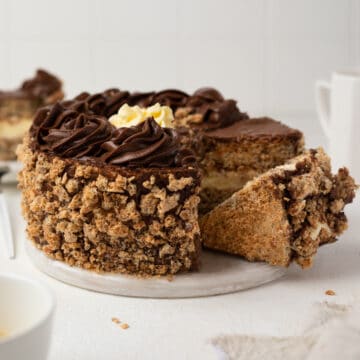
Strawberry Chantilly Cake

May 30, 2023 · 2 Comments

Strawberry Chantilly cake on a serving platter with a bowl of fresh strawberries.

Enjoy this stunning strawberry Chantilly cake made with soft layers of delicate vanilla cake and fluffy Chantilly cream topped with fresh strawberries. It is super tasty and pretty, as in the picture.

Strawberry Chantilly cake on a serving platter with a bowl of fresh strawberries

This cake is a light twist on Whole Foods' Berry Chantilly cake, trademarked and sold by Whole Foods Market in the United States.

[feast_advanced_jump_to]

The fuss-free Chantilly cake recipe is effortlessly easy and makes a light and airy cake, bursting with fresh strawberries in every bite. Perfect for novice bakers, this cake doesn't require any piping skills.

BAKING ESSENTIALS CHECKLIST

Sign up and get a list of the necessary baking tools and ingredients

FREE DOWNLOAD

Strawberry Chantilly cake recipe

  • Strawberry Chantilly cake is one the most beautiful Chantilly cakes due to the vibrant color and flavor of fresh strawberries. It is perfect for birthdays, summertime gatherings, and other special occasions.
  • It is made with simple ingredients and seasonal strawberries, but you can replace them with fresh berries of your choice.
  • The cake is fully customizable. Select your preferred sponge cake, cream, and berries, and create your own summertime cake.
  • This Chantilly cream cake comes with a make-ahead option for your convenience. Simply make the sponge cake in advance to save time on the day of serving.

Ingredients

Strawberry Chantilly cake ingredients in pictures

For ingredients and detailed instructions, refer to the recipe card below.

  • Eggs: The recipe calls for large eggs at room temperature. Ensure to bring them to room temperature about 45-60 minutes before you start.
  • Sugar: Use white granulated, vanilla, and icing (powdered) sugar. To make the perfect mascarpone Chantilly cream, opt for icing sugar. To turn granulated sugar into a icing sugar, process it in a coffee grinder or a food processor.
  • Flour: The recipe calls for all-purpose flour. However, for optimal baking results, cake flour is the recommended choice.
  • Butter is an essential ingredient for making classic Genoise sponge cake. Opt for European-style unsalted batter with 82% fat content.
  • Cream: Choose heavy cream or heavy whipping cream with at least 30% fat content for the best results. It must be cold, being refrigerated for at least 3 hours.
  • Mascarpone cheese brings a subtle tang to the flavor and delivers stabilizing properties to Chantilly cream.
  • Vanilla extract is a flavoring added to the cream. You can replace it with 1 teaspoon of vanilla bean paste.
  • Fresh strawberries are the stars of this gorgeous strawberry cake. Opt for perfectly ripe seasonal berries to benefit from their flavors. It is not recommended to make Chantilly cake with frozen berries. They tend to release extra juices with thawing and don't have an appealing presentation.
A single slice of strawberry Chantilly cake on a white dessert plate

Recipe variations

  • Sponge cake: Replace Genoise cake with an Italian sponge cake, vanilla sponge or chocolate sponge cake, angel food cake, a cake with a cake mix, or another of your favorite sponge cake.
  • Flavorings: Experiment with sponge cake flavors switching vanilla extract for coconut or almond extract, rose or orange flower water. Learn more about fruit flavor pairings.
  • Fruit: Choose seasonal fresh berries such as raspberries, blueberries, or a blend of various berries. This Berry Cake recipe is great for inspiration.
  • Cream frosting: Play with different cream fillings, from sugar-free whipped cream and creme Chantilly to chocolate whipped cream, whipped chocolate ganache, and cream cheese frosting.
  • Decoration: Opt to leave the sides of the cake plain or cover them with toasted flaked almonds, chopped pistachios, and duo chocolate curls. Additionally, garnish the top of the cake with an abundance of fresh berries.

How to make strawberry Chantilly cake

Making strawberry Chantilly cake involves a few steps, including the preparation of sponge cake, sugar syrup, mascarpone Chantilly cream, and assembling the cake.

Step 1. To make Genoise cake, follow the Genoise sponge cake recipe for step-by-step photographed explanations, helpful tips, and tricks.

Step 2. To make simple sugar syrup, pour water with sugar into a small saucepan and bring to a boil. Add vanilla extract or strawberry liqueur out of the heat, and let the syrup cool.

Step 3. To make mascarpone Chantilly cream, bring the bowl of a stand mixer and the whisk attachment or a large bowl to the freezer for 10-15 minutes.

Step 4. Pour the chilled heavy cream into the bowl. Add the cold mascarpone and whisk at low speed until soft peaks form (photo 1).

Step 5. Gradually incorporate the icing sugar, increasing the speed to medium and then high until the cream reaches medium-stiff peaks (photo 2).

Pro tip: Read more about the proper whipping technique and how to make the perfect Mascarpone frosting.

Photo 1: Soft cream peaks on mixer beaters Photo 2: Stiff cream peaks on electric beaters
PHOTO 1 PHOTO 2

Step 6. To assemble the cake, wash and dry strawberries, hull them. Cut each strawberry into half, then into 6-8 slices each, and place aside. Leave a few berries for the decoration.

Step 7. With a large serrated knife or a cake leveler, cut the sponge cake into three sponge layers. Place the first cake layer on a serving plate or a cake board and soak the cake with the cold sugar syrup using a silicone or pastry brush.

Pro tip: For a neat appearance, assemble the cake using a mousse cake mold adjusted to a diameter of 8 inches (20 cm) and lined with an acetate strip.

Step 8. Spread ¼ of the Chantilly cream and place strawberry slices atop the cream, slightly submerging them (photo 3).

Step 9. Place the second cake layer on top of the cream and berries. Gently press it to ensure adherence and soak it in syrup.

Step 10. Proceed to add ¼ of the cream and another layer of strawberries. Then, position the third cake layer and press it down slightly to complete the cake.

Step 11. Cover the entire cake with the remaining frosting and smooth the top and the sides. Then use a cake scraper to create stripes (photo 4).

Photo 3: Chantilly cream layer topped with strawberry pieces Photo 2: Cake covered with cream
PHOTO 3 PHOTO 4

Step 12. Refrigerate the cake for 2-3 hours. Top the cake with sliced strawberries and sprinkle with icing sugar before serving.

Assembled Chantilly cake with strawberries on top

Expert Tips

  1. Generously soak the sponge cake to bring moisture to the cake.
  2. For the best results, let the cake firm up for a few hours. However, if necessary, the cake can be served promptly upon completion of the decoration.
  3. Recalculate ingredients for cake pans of different sizes using this simple cake pan size converter.
  4. Make ahead option: Make Genoise sponge cake in the evening and store it covered with plastic wrap at room temperature. The next day, finish the cake.

Storing and freezing

Store your strawberry Chantilly cake for 2-3 days under a glass dome in the fridge. This prevents dryness and absorption of other food odors. Store the leftover cake in an airtight container.

Can you freeze it? It is not recommended to freeze strawberry Chantilly cake, but you can bake the Genoise cake in advance and freeze it for up to 3 months.

Recipe FAQ

What does Chantilly mean in baking?

Chantilly refers to a sweetened whipped cream flavored with vanilla, commonly known as Chantilly cream. This type of cream originates from France.

Where does the name Chantilly come from?

Chantilly referring to Chantilly cream comes from Château de Chantilly (castle of Chantilly), where it was created by François Vate in the 17th century.

What is the flavor of Chantilly?

Traditionally, Chantilly cream is made with heavy cream and sugar and is flavored with vanilla.

What is Chantilly cake made of?

Chantilly cake is made with soft and fluffy sponge cake, light and airy French Chantilly cream, and fresh fruit. Mascarpone, cream cheese, and gelatin are often blended into the cream for added stability.

What is the origin of the berry Chantilly cake?

Berry Chantilly Cake was first created by a baker and owner of the Bywater Bakery in New Orleans. Later, it was sold at Whole Foods Market throughout the United States and got to be known as Whole Foods Berry Chantilly cake.

What country is Chantilly cake from?

Berry Chantilly cake, though originally based on French Chantilly cream, was actually created in the United States in New Orleans.

Love Chantilly cream desserts? Try these next!

  • Triple Berry Cake
  • Uruguayan Cake Chaja
  • Fresh Fruit Cake
  • Jordgubbstårta (Swedish Strawberry Cake)
  • Or browse all the cake recipes.

Want more delicious and beautiful recipes? Subscribe to my newsletter and follow me on Facebook, Pinterest, and Instagram for my latest updates. If you make this recipe, please leave a star rating on the recipe card and comment below!

Print

Recipe card

Strawberry Chantilly Cake

Strawberry Chantilly cake on a serving platter with a bowl of fresh strawberries.
Print Recipe
Save Recipe Recipe Saved

5 Stars 4 Stars 3 Stars 2 Stars 1 Star

No reviews

This stunning strawberry Chantilly cake is made with soft layers of delicate vanilla cake and fluffy Chantilly cream topped with fresh strawberries. It is super tasty and pretty, as in the picture.

  • Author: Irina Totterman
  • Total Time: 1 hour, 15 minutes (plus chilling time)
  • Yield: 8 1x
  • Category: Cakes
  • Method: Baking
  • Cuisine: American

Ingredients

Scale

For Genoise cake:

  • 4 large eggs, room temperature
  • ½ cup + 1 ½ tablespoons (120 g) granulated sugar
  • 1 sachet (9 g) vanilla sugar
  • ⅔ cup + 4 ½ tablespoons (120 g) all-purpose flour
  • 2 tablespoons (30 g) unsalted butter, melted and cooled

For sugar syrup:

  • ⅓ cup (75 ml) water
  • ¼ cup (50 g) granulated sugar
  • 1 teaspoon vanilla extract

For mascarpone whipped cream:

  • 1 ½ cups (355 g) cold heavy cream, 30% fat
  • 2.5 oz. (70 g) cold mascarpone cheese
  • 4 tablespoons (30 g) icing sugar

For filling and decoration:

  • 21 oz. (600 g)  fresh strawberries

Instructions

  1. To make Genoise cake, heat the oven to 355°F (180°C). Butter and flour the bottom and the sides of the 8-inch (20 cm) round pan (or springform pan). Melt the butter in the microwave and let it cool.
  2. In the heat-proof bowl, place eggs, vanilla and granulated sugar and beat with a hand whisk a few times. Bring the bowl over a water bath or bain-marie with hot water and whisk the egg mixture until foamy. Warm it to 104°F (40°C): check with a cooking thermometer. If unavailable, the mixture should be warm to the touch.
  3. Bring the bowl to the counter and beat the preparation with an electric hand mixer (you can use a stand mixer with a whisk attachment) for 10 minutes until the ribbon stage. Sift half the flour over the bowl and mix with a rubber spatula from the bottom to the top. Add the remaining flour and gently mix. Mix a few spoonfuls of the batter with the warm melted butter, and add to the principal preparation. Gently mix the batter, making sure it does not deflate. 
  4. Pour the cake batter into the prepared baking dish. Bake in the middle oven rack for 30-35 minutes until golden brown. Check the cake for doneness with a toothpick: it should come out clean after inserting it in the center of the cake. Remove it from the oven and rest for 5-10 minutes. Then turn the pan on a cooling rack, allowing the cake to slide off. Let the cake cool completely. 
  5. To make sugar syrup, pour water with sugar into a small saucepan and bring to a boil. Add vanilla extract or strawberry liqueur out of the heat, and let the syrup cool. 
  6. To make mascarpone Chantilly cake, bring the bowl of a stand mixer and the whisk attachment or a large bowl to the freezer for 10-15 minutes. Pour the chilled heavy cream into the bowl. Add the cold mascarpone and whisk at low speed until soft peaks form.
  7. Gradually incorporate the icing sugar, increasing the speed to medium and then high until the cream reaches medium-stiff peaks. 
  8. To assemble the cake, wash and dry strawberries, and hull them. Cut each strawberry into half, then into 6-8 slices each, and place aside. Leave a few berries for the decoration. With a large serrated knife or a cake leveler, cut the sponge cake into three sponge layers.
  9. Place the first cake layer on a serving plate or a cake board and soak the cake with the cold sugar syrup using a silicone or pastry brush. Spread ¼ of the Chantilly cream and place strawberry slices atop the cream, slightly submerging them. Place the second cake layer on top of the cream and berries. Gently press it to ensure adherence and soak it in syrup.
  10. Proceed to add ¼ of the cream and another layer of strawberries. Then, position the third cake layer and press it down slightly to complete the cake. Cover the entire cake with the remaining frosting and smooth the top and the sides. Then use a cake scraper to create stripes.
  11. Refrigerate the cake for 2-3 hours. Top the cake with sliced strawberries and sprinkle with icing sugar before serving. 

Notes

  1. Consult recipes for Genoise sponge cake and Mascarpone Chantilly Frosting for step-by-step photographed explanations, helpful tips, and tricks.
  2. For a neat appearance, assemble the cake using a mousse cake mold adjusted to a diameter of 8 inches (20 cm) and lined with an acetate strip.
  3. Generously soak the sponge cake to bring moisture to the cake.
  4. For the best results, let the cake firm up for a few hours. However, if necessary, the cake can be served promptly upon completion of the decoration.
  5. Recalculate ingredients for cake pans of different sizes using this simple cake pan size converter.
  6. Make ahead option: Make Genoise sponge cake in the evening and store it covered with plastic wrap at room temperature. The next day, finish the cake. 

Nutrition

  • Serving Size: 1 slice
  • Calories: 433
  • Sugar: 30.1 g
  • Sodium: 54 mg
  • Fat: 26.4 g
  • Saturated Fat: 15.5 g
  • Carbohydrates: 44.8 g
  • Fiber: 1.9 g
  • Protein: 6.5 g
  • Cholesterol: 173 mg

Thank you for following me on Pinterest, Facebook, and Instagram. Hashtag #bakinglikeachef so I can see your creations.

The nutritional information has been calculated using an online recipe nutrition calculator such as Verywellfit.com and is intended for informational purposes only. These figures should be used as a general guideline and not be construed as a guarantee.

Torta Chaja: Traditional Uruguayan Cake

May 27, 2023 · 3 Comments

A single slice of torta Chaja on a dessert plate.

Torta Chaja or Postre Chaja Uruguayo is a traditional Uruguayan cake. It is made with soft and fluffy layers of sponge cake, smooth Chantilly cream, rich dulce de leche, and a light and airy meringue topping.

A single slice of torta Chaja on a dessert plate

What is Chaja cake?

Chajá (Postre chajá or Torta Chajá) is a classic Uruguayan cake made with sponge cake layers, sweetened whipped cream, dulce de leche, canned peaches, and a meringue topping.

It was created in 1927 by Orlando Castellano in Paysandú and named after the airy-feathered chajá bird. Torta Chajá is considered Uruguay's national cake. This cake is also popular in Argentina, Brazil, Paraguay, and, lately, on the American continent. According to TasteAtlas, it ranks among the world's 50 best cakes.

[feast_advanced_jump_to]

The recipe for cake Chaja has remained a mystery, even after many attempts to uncover ingredients through the flavors. The same is true about San Sebastian Cheesecake and Fondant Baulois.

BAKING ESSENTIALS CHECKLIST

Sign up and get a list of the necessary baking tools and ingredients

FREE DOWNLOAD

Why you will love the torta chaja recipe

  • The recipe has a make-ahead option, allowing split preparation over two days.
  • It makes a gorgeous cake, perfect for birthdays, weddings, and other special occasions.
  • You can make desserts such as small cakes, which are great for summertime gatherings and parties.

Ingredients

For ingredients and detailed instructions, refer to the recipe card below.

  • Eggs: Use large eggs at room temperature. Let them sit on the counter for 45-60 minutes. There is no need to separate them; this recipe uses whole eggs.
  • Sugar: Use granulated white sugar or swap it for superfine caster or baker's sugar.
  • Flour: Opt for all-purpose or cake flour for a softer, fluffier crumb. Avoid self-raising flour.
  • Heavy Cream: Choose heavy cream or heavy whipping cream with at least 30% fat.
  • Icing Sugar: Also known as powdered or confectioners' sugar.
  • Peaches: Use a 25-oz. (700 g) can of diced or halved peaches, yielding about 8.8 oz. (250 g) of drained fruit.
  • Dulce de leche: Any store-bought dulce de leche works, but authentic versions can be found in Latin grocery stores. You can also make your own - boiled sweetened condensed milk.
  • Meringue: Use store-bought meringues for filling and decoration.
Torta Chaja with meringue and peaches on top served on a cake stand

How to make torta Chaja

Step 1. To make sponge cake, preheat oven to 355°F (180°C). Brush an 8-inch (20-cm) round cake pan with melted butter, flour it, and refrigerate the prepared mold.

Pro tip: Consult the recipe for classic sponge cake for step-by-step photographed explanations, helpful tips, and tricks.

Step 2. Beat eggs with granulated sugar in a large mixing bowl or the bowl of a stand mixer with a hand whisk (photo 2).

Step 3. Bring the bowl over a bain-marie or water bath to warm the mixture to 104°F (40°C), whisking constantly.

Step 4. Remove the bowl from the bain-marie or water bath. Whisk the egg mixture with an electric or stand mixer for 10-15 minutes until the volume is tripled and the ribbon stage is achieved.

Pro tip: To check, just lift a small amount of batter with the whisk. The ribbon stage is reached if the batter falls and the pattern maintains its shape for at least 3-4 seconds.

Step 5. Sift the flour in a few additions and gently mix with a rubber spatula, working from the bottom to the top, slightly rotating the bowl.

Step 6. Pour the batter into the prepared pan and bake until golden brown for 25 to 30 minutes.

Pro tip: Check the doneness of the cake with a toothpick or a cake tester: it should come out clean out of the center of the cake.

Step 7. Let it cool for 10 minutes in the switched oven (keep the door slightly open using a wooden spoon) to prevent the sponge cake from deflating.

Step 8. Remove the sponge from the oven and let it cool in the tin for 5-10 minutes. Then, flip it upside down and cool it on a wire rack for 10 minutes. Turn the cake back and allow it to cool completely.

Step 9. To make creme Chantilly, chill the bowl of a stand mixer and the whisk attachment in the freezer for 10 minutes. Pour the cold heavy cream into the bowl and beat at low speed for a minute. Continue to beat, reaching the soft peaks.

Pro tip: Consult the recipe for French Chantilly cream (aka sweetened whipped cream) for step-by-step photographed explanations, helpful tips, and tricks.

Step 10. Add icing sugar and continue whisking. Gradually, speed up the mixer and beat the cream through medium to stiff peaks. Check the cream's consistency every 3-5 seconds to avoid over-whisking.

Step 11. Cover the bowl with plastic wrap and refrigerate until ready to assemble the cake.

Step 12. To assemble the cake, use a serrated knife to cut the sponge cake horizontally into three equally thick layers. Strain canned peaches and let them drain on a paper towel. Then, cut the peaches into ½-inch (about 1 cm) cubes. Reserve the syrup.

Step 13. Warm up dulce de leche in a bain-marie or water bath. Break the meringue into medium and large enough pieces (you will need both sizes of the crushed meringue).

Step 14. Place the first sponge layer on a serving plate or a cake board and soak it with peach syrup using a pastry brush.

Step 15. Spread a layer of dulce de leche and sprinkle with medium-sized crushed meringue (photo 1).

Step 16. Place the second layer of the cake on top and press it down gently but firmly with your hands to make sure it sticks to the first layer. Soak it in the syrup.

Step 17. Spread ⅓ of the Chantilly cream and place the diced peaches (photo 2), reserving a small amount for decorating.

Sponge cake layer with dulce de leche and crushed meringue

PHOTO 1

Cake layer topped with cream and peach pieces

PHOTO 2

Pro tip: To ensure a neat application of dulce de leche, use a pastry bag with a cut tip (about ⅕ inches (5 mm) diameter). Pipe a spiral from the center of the cake layer.

Step 18. Place the third cake layer and cover the top and sides of the cake with the cream. Top the entire cake with the crushed pieces of meringue.

Step 19. Decorate the top of the cake with the remaining peach slices (photo 3). Refrigerate for at least 3-4 hours.

Cake Chaja decorated with crushed meringue and canned peaches on a serving board

Expert Tips

  1. Be sure to press each new layer lightly to maintain adherence to the preceding layer.
  2. Make-ahead option: Prepare the sponge cake in the evening, wrap it with cling film, and store it at room temperature. The next day, whip the cream and assemble the cake.

Recipe variations

  • Traditionally made with canned or fresh peaches, but variations with strawberries or pineapple are also common.
  • Dulce de leche is often included but not mandatory. Some versions use an upside-down meringue disk as a layer instead.
  • A final sprinkle of ground cinnamon adds an extra touch of flavor.

Storing and freezing

Store torta Chaja in the refrigerator for 2-3 days under a cake dome. To prevent it from absorbing odors from other foods, keep the leftover cake in an airtight container or covered.

Freezing the fully assembled Chaja cake is not recommended, but you can prepare the sponge cake in advance and freeze it for up to 3 months. However, according to Cariños Ana Duran, author of La cocina de Ana Durán, the Chaja dessert "can be frozen assembled in a glass container with a hermetic lid."

Recipe FAQ

What is chajá in Uruguay?

Chajá is a famous Uruguayan cake named after a bird with the same name, Chajá, indigenous to South America.

How do you pronounce chajá?

Chajá is pronounced like cha-ja or cha-ha in English.

Love sponge cakes? Try these next!

  • Berry Cake
  • Torta Mimosa
  • Sponge Apple Cake
  • Oil Sponge Cake
  • Vanilla Meringue Cake
  • Jordgubbstårta (Swedish Strawberry Cake)
  • Fresh Fruit Cake
  • Or browse all the cake recipes.

Want more delicious and beautiful recipes? Subscribe to my newsletter and follow me on Facebook, Pinterest, and Instagram for my latest updates. If you make this recipe, please leave a star rating on the recipe card and comment below!

Print

Recipe card

Torta Chaja (Chaja Cake)

A single slice of torta Chaja on a dessert plate.
Print Recipe
Save Recipe Recipe Saved

5 Stars 4 Stars 3 Stars 2 Stars 1 Star

No reviews

Torta Chaja or Postre Chaja Uruguayo is made with soft and fluffy layers of sponge cake, smooth Chantilly cream, rich dulce de leche, and a light and airy meringue topping. This cake is perfect for any celebration.

  • Author: Irina Totterman
  • Total Time: 2 hours, 30 minutes
  • Yield: 10 1x
  • Category: Cakes
  • Method: Baking
  • Cuisine: Uruguayan

Ingredients

Scale

For the sponge cake:

  • 4 large eggs
  • ½ cup + 1 ½ tablespoons (120 g) granulated sugar
  • ⅔ cup + 4 ½ tablespoons (120 g) all-purpose flour

For soaking:

  • ½ cup (120 ml) canned peach syrup

For Chantilly cream:

  • 1 ½ cups (355 g) heavy cream, 30% fat
  • 2 tablespoons (15 g ) icing (powdered) sugar

For filling and decoration:

  • 5.3 oz. (150 g) meringue
  • 8.8 oz. (250 g) drained canned peaches
  • 8.6 oz. (245 g) dulce de leche

Instructions

  1. To make the sponge cake,  preheat the oven to 355°F (180°C). Brush an 8-inch (20 cm) round cake pan with melted butter, flour it, and refrigerate the prepared mold. 
  2. Beat eggs with granulated sugar in a large mixing bowl or the bowl of a stand mixer with a hand whisk. Bring the bowl over a bain-marie or water bath to warm the mixture to 104°F (40°C), whisking constantly. 
  3. Remove the bowl from the bain-marie or water bath. Whisk the egg mixture with an electric or stand mixer for 10-15 minutes until the volume is tripled and the ribbon stage is achieved. Just lift a small amount of batter with the whisk. The ribbon stage is reached if the batter falls and the pattern maintains its shape for at least 3-4 seconds. 
  4. Sift the flour in a few additions and gently mix with a rubber spatula, working from the bottom to the top, slightly rotating the bowl. Pour the batter into the prepared pan and bake until golden brown for 25 to 30 minutes. Check the doneness of the cake with a toothpick or a cake tester: it should come out clean out of the center of the cake. 
  5. Let it cool for 10 minutes in the switched oven (keep the door slightly open using a wooden spoon) to prevent deflating the sponge cake. Remove the sponge from the oven, and let it cool in the tin for 5-10 minutes. Then, remove it from the pan by flipping it upside down and cool it on a wire rack for 10 minutes. Turn the cake back and allow to cool completely. 
  6. To make the Chantilly cream, chill the bowl of a stand mixer and the whisk attachment in the freezer for 10 minutes. Pour the cold heavy cream into the bowl and beat at low speed for a minute. Continue to beat, reaching the soft peaks. 
  7. Add icing sugar and continue whisking. Gradually speed up the mixer and beat the cream through medium to stiff peaks. Check the cream's consistency every 3-5 seconds to avoid over-whisking. Cover the bowl with plastic wrap and refrigerate until ready to assemble the cake.
  8. To assemble the cake, use a serrated knife to cut the sponge cake horizontally into three equally thick layers. Strain canned peaches and let them drain on a paper towel. Then, cut peaches into small cubes of about ½ inches (about 1 cm). Reserve the syrup. 
  9. Warm up dulce de leche in a bain marine or water bath. Break the meringue into medium and large enough pieces (you will need both sizes of the crushed meringue).
  10. Place the first sponge layer on a serving plate or a cake board and soak it with peach syrup using a pastry brush. Next, spread a layer of dulce de leche and sprinkle with medium-sized crushed meringue.
  11. Place the second layer of the cake, and press it down gently but firmly with your hands to make sure it sticks to the first layer. Soak it with the syrup. Spread ⅓ of the Chantilly cream and place the diced peaches, reserving a small amount for decorating.
  12. Place the third cake layer and cover the top and sides of the cake with the cream. Top the entire cake with the crushed pieces of meringue. Decorate the top of the cake with the remaining peach slices. Refrigerate for at least 3-4 hours.

Notes

  1. Consult the recipes for classic sponge cake and creme Chantilly for step-by-step photographed explanations, helpful tips, and tricks.
  2. To ensure a neat application of dulce de leche, use a pastry bag with a cut tip (about ⅕ inches (5 mm) diameter). Pipe a spiral from the center of the cake layer.
  3. Ensure to lightly press each new layer to maintain adherence to the preceding layer.
  4. Make-ahead option: Prepare sponge cake in the evening, wrap it with cling film, and store it at room temperature. The next day, whip the cream and assemble the cake.

Nutrition

  • Serving Size: 1 slice
  • Calories: 379
  • Sugar: 32.6 g
  • Sodium: 81 mg
  • Fat: 16.5 g
  • Saturated Fat: 9.6 g
  • Carbohydrates: 53.7 g
  • Fiber: 1 g
  • Protein: 6.8 g
  • Cholesterol: 129 mg

Thank you for following me on Pinterest, Facebook, and Instagram. Hashtag #bakinglikeachef so I can see your creations.

The nutritional information has been calculated using an online recipe nutrition calculator such as Verywellfit.com and is intended for informational purposes only. These figures should be used as a general guideline and not be construed as a guarantee.

Chocolate Charlotte Cake (Charlotte au Chocolat)

May 21, 2023 · 2 Comments

Chocolate Charlotte on a cake stand.

French chocolate Charlotte cake or Charlotte au chocolat is a chocolate lover's dream, made with ladyfingers and rich chocolate mousse. This no-bake dessert offers the perfect combination of crispy spoon biscuits and intense chocolate flavor. It is that good.

Chocolate Charlotte on a cake stand

Classic French Charlotte cake traditionally features Bavarian cream, a blend of creme Anglaise, whipped cream, and gelatin. Alternatively, Charlotte cakes filled with various mousses, ranging from decadent chocolate to fresh fruit, have gained popularity.

[feast_advanced_jump_to]

The introduction of the Tupperware Charlotte mold brought a new variation of Charlotte. Its filling is comprised of French fromage blanc and dried fruit.

BAKING ESSENTIALS CHECKLIST

Sign up and get a list of the necessary baking tools and ingredients

FREE DOWNLOAD

It may surprise that the French chef Marie-Antoine Carême, credited with the invention of the Bavarian cream, also created another dessert - the Charlotte Russe. It was during his service under Czar Alexander I that this culinary masterpiece was born.

What's chocolate Charlotte cake?

Chocolate Charlotte or Charlotte au chocolat is a French molded dessert made with spoon biscuits (biscuits à la cuillère) or boudoir (aka champagne biscuits and ladyfingers) and filled with chocolate mousse.

It is often known as chocolate Charlotte Russe or chocolate Charlotte mousse.

A single slice of Charlotte au chocolat on a dessert plate

Chocolate Charlotte cake recipe

  • Charlotte dessert is one of the most famous French desserts worth making.
  • This chocolate treat is perfect for birthdays, Valentine's Day, Christmas, or other celebrations.
  • Its creamy chocolate mousse is gelatin-free and is made with tempered eggs when hot sugar syrup is added to the mixture of egg yolks and whole eggs. This sets it apart from French chocolate mousse made with raw eggs.
  • This Charlotte cake recipe is easy and quick. Without baking, this delicious dessert is made with store-bought ladyfinger cookies.

Ingredients

Chocolate Charlotte ingredients in pictures

For ingredients and detailed instructions, refer to the recipe card below.

  • Dark chocolate Opt for very bitter dark chocolate to make this Charlotte recipe. The higher the percentage of cocoa in dark chocolate, the richer the taste and the darker color of the dark chocolate mousse will be. Choose dark chocolate with at least 70% cocoa, 85-90% preferably.
  • Eggs: The recipe calls for large eggs and egg yolks. Separate the egg whites from the yolks with an egg separator while the eggs are chilled. Then let them stay on the counter to get to room temperature.
  • Sugar: Use granulated or caster sugar interchangeably. Don't decrease the amount of sugar that brings the texture to the mousse and compensates for the bitterness of dark chocolate.
  • Cream: Opt for heavy cream or heavy whipped cream with at least 30% fat content for the best results.
  • Ladyfingers: Although authentic French Charlotte cake typically uses biscuits à la cuillère, soft-style ladyfingers, this chocolate Charlotte recipe can be made with classic dry ladyfingers. Alternatively, homemade ladyfingers can be prepared for an added personal touch.
  • Vanilla extract is used to flavor the soaking syrup. Replace it with Grand Marnier, Kirsch, or dark rum, or omit it to make the dessert kid-friendly.

Recipe variations

  • Ladyfingers: Create a delectable chocolate Charlotte by first dipping the sugared side of classic ladyfingers in melted chocolate, then elegantly lining the Charlotte mold (dipped side outwards). It is imperative to allow the chocolate to solidify.
  • Chocolate: Play with different types of chocolate (white, dark, or milk chocolate) and cocoa percentages. For a richer chocolate experience, choose dark chocolate with 100% cocoa.
  • Chocolate mousse layers: Try creating a duo of chocolate mousses - rich milk and decadent dark chocolate - meticulously layered and divided by tender ladyfingers.
  • Add-ins: Infuse chocolate mousse with the zesty tang of chopped orange peels or add a crunchy layer of crushed caramelized hazelnuts.
  • Decoration: Sprinkle fine chocolate shavings or elegant chocolate curls on the top of Charlotte. Or add some fruit to bring a little freshness to the dessert. Finally, wrap it with a pretty ribbon and elegantly tie a knot.

How to make chocolate charlotte

Making chocolate Charlotte russe involves a few simple steps: making sugar syrup, lining a cake ring or Charlotte mold, making chocolate mousse, and assembling the dessert.

Step 1. To make sugar syrup, combine the sugar and water in a small saucepan and bring to a boil. Remove from the heat, add vanilla extract or another flavoring, and let it cool to room temperature, then refrigerate.

Step 2. To prepare Charlotte mold, place an 8-inch (20 cm) cake ring (springform pan or mousse cake mold) on a serving plate or a cake board.

Step 3. Cut about 20 ladyfinger biscuits at the base to be 2.5 inches (6.5 cm) high using a serrated knife.

Step 4. Place lady fingers around the edge of the cake ring, the sugared side towards the mold (photo 1).  

Step 5. Pour the cold syrup into a deep plate. Dip biscuits, one at a time, on both sides, counting to 3 to ensure that they do not oversoak.

Step 6. Arrange dipped cookies in the bottom of the pan, sugared side up. Try to fill the gaps between cookies, cutting them into pieces. 

Step 7. To make chocolate mousse, chop dark chocolate with a knife or use a food processor.

Step 8. Place chocolate in a heat-proof large bowl and bring over a bain-marie or water bath. Melt chocolate, stirring occasionally with a wooden spoon, then let it cool on the counter (photo 2).

Pro tip: Alternatively, use a double boiler or a microwave to melt chocolate at 30 seconds intervals on 30% power.

Photo 1: Mold lined with ladyfingers Photo 2: Melted chocolate in a bowl
PHOTO 1 PHOTO 2

Step 9. Place whole eggs with egg yolks in a mixing bowl and beat with a hand whisk until frothy.

Step 10. At the same time, pour water with sugar in a small saucepan and bring over medium-high heat. Cook the sugar syrup until 250°F (121°C), checking the temperature with a cooking thermometer.

Step 11. Pour the hot syrup over the eggs, whisking constantly, and beat until the mixture whitens, doubles in volume, and cools completely (photo 3).

Step 12. Add the melted chocolate in 3 additions and gently mix with a rubber spatula, lifting the mass until you obtain a nice homogeneous foam (photo 4).

Photo 3: Whisked eggs in a bowl Photo 4: Chocolate and egg mixture in a bowl
PHOTO 3 PHOTO 4

Step 13. Place cold heavy cream in the bowl of a stand mixer fitted with a whisk attachment (you can use a hand mixer) and whip the cream until soft peaks (not stiff peaks).

Pro tip: Consult the whipped cream recipe for step-by-step photographed explanations, helpful tips, and tricks.

Step 14. Pour the chocolate mixture into the whipped cream and gently mix with a spatula (photo 5).

Step 15. To assemble the dessert, pour half of chocolate mousse into the prepared mold. Add a layer of dipped cookies with a flat side up.

Step 16. Pour the remaining mousse and smooth it with a spatula or the back of a spoon (photo 6). Refrigerate Charlotte for 4-6 hours, ideally overnight.

Photo 5: Chocolate mousse in a bowl Photo 6; Chocolate mousse poured into the mold
PHOTO 5 PHOTO 6

Step 17. Make dark chocolate shavings out of the chocolate bar using a small sharp knife, a vegetable peeler, or a specially designed chocolate shaver.

To serve, remove the ring and sprinkle chocolate shavings on top of the mousse. Wrap the dessert with a ribbon for a pretty decorative touch.

Assembled chocolate Charlotte with chocolate shavings on top

Expert Tips

  1. Soak ladyfinger cookies in sugar syrup quickly to hold their shape and not become soft. 
  2. Don't overwhip the heavy cream. It has to be flexible to be mixed with chocolate and egg mixture.
  3. Avoid overmixing the chocolate mousse. Instead, gently work from the bottom to the top with a spatula.
  4. If preferred, use a piping bag filled with chocolate mousse to assemble the dessert.
  5. To cut the dessert, warm up a knife in hot water, dry it, and slice, cleaning it between each slice.

Storing and freezing

Store chocolate Charlotte in the refrigerator for up to 3-4 days.

Can you freeze chocolate Charlotte? You can freeze it for 7-10 days, ensuring the freezer is set at -13°F (-25°C). Take it out 24 hours before serving it, and let it thaw in the refrigerator.

Recipe FAQ

What is a Charlotte mold?

Charlotte mold is a specially designed pan with slightly flared sides and a fixed or removable hinge to remove Charlotte and other ladyfinger-lined desserts easily. Alternatively, you can use any deep mold with high edges, such as a cake mold or mousse cake ring.

What is the difference between French boudoirs and ladyfingers? 

British English sponge fingers or ladyfingers are the same as French boudoirs and Italian savoiardi. They are all dry and egg-based biscuits resembling fingers.

What is the difference between biscuits à la cuillère and boudoir?

While biscuits à la cuillère are made with egg whites and sprinkled with icing sugar, boudoir biscuits are made with whole eggs and sprinkled with granulated sugar. Boudoir has a softer texture and a slender shape, distinguishing it from the traditional biscuits à la cuillère.

Love Charlotte cakes? Try these next!

  • Pear Charlotte Cake
  • Strawberry Charlotte
  • Lychee Cake With Pink Biscuits
  • Red Fruit Charlotte

Want more delicious and beautiful recipes? Subscribe to my newsletter and follow me on Facebook, Pinterest, and Instagram for my latest updates. If you make this recipe, please leave a star rating on the recipe card and comment below!

Print

Recipe card

Chocolate Charlotte Cake

Chocolate Charlotte on a cake stand.
Print Recipe
Save Recipe Recipe Saved

5 Stars 4 Stars 3 Stars 2 Stars 1 Star

No reviews

Chocolate Charlotte cake is an elegant French dessert that features silky chocolate mousse layered between delicate ladyfingers. This divine dessert is perfect for birthdays and other celebration parties.

  • Author: Irina Totterman
  • Total Time: 1 hour (plus chilling time)
  • Yield: 8 1x
  • Category: Cakes
  • Method: No-Bake
  • Cuisine: French

Ingredients

Scale
  • 36 ladyfingers

For the soaking syrup: 

  • ⅓ cup (70 ml) water
  • 3 ½ tablespoons (45 g) granulated sugar
  • 1 tablespoon vanilla extract

For chocolate mousse:

  • 150 g dark chocolate, 85-90% cacao
  • 50 g egg yolks (see note #1)
  • 50 g egg whites (see note #2)
  • 2 tablespoons (30 ml) water
  • ⅓ cup (70 g) granulated sugar
  • ½ cup + 2 tablespoons (150 g) heavy cream

For decoration:

  • 1 oz. (30 g) dark chocolate

Instructions

  1. To make sugar syrup, combine the sugar and water in a small saucepan and bring to a boil. Remove from the heat, add vanilla extract or another flavoring, and let it cool to room temperature, then refrigerate.

  2. Place an 8-inch (20 cm) cake ring (springform pan or mousse cake mold) on a serving plate or a cake board. Cut about 20 ladyfinger biscuits at the base to be 2.8 inches (7 cm) high using a serrated knife. Place lady fingers around the edge of the cake ring, the sugared side towards the mold.

  3. Pour the cold syrup into a deep plate. Dip biscuits, one at a time, on both sides, counting to 3 to ensure that they do not oversoak. Arrange dipped cookies in the bottom of the pan, sugared side up. Try to fill the gaps between cookies, cutting them into pieces.

  4. To make chocolate mousse, chop dark chocolate with a knife or use a food processor. Place chocolate in a heat-proof large bowl and bring over a bain-marie or water bath. Melt chocolate, stirring occasionally with a wooden spoon, then let it cool on the counter. Alternatively, use a double boiler or a microwave to melt chocolate at 30 seconds intervals on 30% power.

  5. Place whole eggs with egg yolks in a mixing bowl and beat with a hand whisk until frothy. At the same time, pour water with sugar in a small saucepan and bring over medium-high heat. Cook the sugar syrup until 250°F (121°C), checking the temperature with a cooking thermometer.

  6. Pour the hot syrup over the eggs, whisking constantly, and beat until the mixture whitens, doubles in volume, and cools completely. Add the melted chocolate in 3 times and gently mix with a rubber spatula, lifting the mass until you obtain a nice homogeneous foam.

  7. Place cold heavy cream in the bowl of a stand mixer fitted with a whisk attachment (you can use a hand mixer) and whip the cream until soft peaks (not stiff peaks). Pour the chocolate mixture into the whipped cream and gently mix with a spatula.

  8. To assemble Charlotte, pour half of the chocolate mousse into the prepared mold. Add a layer of dipped cookies with a flat side up. Pour the remaining mousse and smooth it with a spatula or the back of a spoon. Refrigerate Charlotte for 4-6 hours, ideally overnight.

  9. Make dark chocolate shavings out of the chocolate bar using a small sharp knife or a vegetable peeler. Remove the ring and sprinkle chocolate shavings on top of the mousse. Wrap the dessert with a ribbon for a pretty decorative touch.

Notes

  1. 50 g egg yolks are approximately equal to 3 raw fresh egg yolks from large-sized chicken eggs.
  2. 50 g egg whites are approximately equal to 1 ½ raw fresh egg whites from large-sized chicken eggs.
  3. Soak ladyfinger cookies in sugar syrup quickly to hold their shape and not become soft. 
  4. Don't overwhip the heavy cream. It has to be flexible to be mixed with chocolate and egg mixture.
  5. Avoid overmixing the chocolate mousse. Instead, gently work from the bottom to the top with a spatula.
  6. If preferred, use a piping bag filled with chocolate mousse to assemble the dessert.
  7. To cut the dessert, warm up a knife in hot water, dry it, and slice, cleaning it between each slice.

Nutrition

  • Serving Size: 1 slice
  • Calories: 436
  • Sugar: 24.3 g
  • Sodium: 95 g
  • Fat: 20.7 g
  • Saturated Fat: 11.5 g
  • Carbohydrates: 57.2 g
  • Fiber: 2.1 g
  • Protein: 8.9 g
  • Cholesterol: 214 g

Thank you for following me on Pinterest, Facebook, and Instagram. Hashtag #bakinglikeachef so I can see your creations.

The nutritional information has been calculated using an online recipe nutrition calculator such as Verywellfit.com and is intended for informational purposes only. These figures should be used as a general guideline and not be construed as a guarantee.

Fondant au Chocolat (Authentic Recipe)

May 15, 2023 · 7 Comments

A single slice of fondant au chocolate on a white plate.

Enjoy the easiest among classic French desserts - fondant au chocolat - made with simple ingredients, yet rich, with a smooth dark chocolate melt-in-your-mouth texture and heavenly delicious. For the ultimate chocolate experience, try the famous fondant Baulois.

A single slice of fondant au chocolate on a white plate

This cake doesn't take any effort or much time to make. But you need to exercise patience while waiting for it to bake and cool off before taking the first bite.

[feast_advanced_jump_to]

You won't regret it. The cake's silky texture and rich chocolate flavor will keep you wanting more.

BAKING ESSENTIALS CHECKLIST

Sign up and get a list of the necessary baking tools and ingredients

FREE DOWNLOAD

And if you have ever heard about heavenly cakes, this is your dessert dream come true... the dessert created in the seaside resort of La Baule, France, in 1980.

Fondant au chocolat vs. moelleux au chocolat

There is always confusion between fondant au chocolat and moelleux au chocolat. While they may look similar, one big secret separates them. So, what is it?

When it comes to texture, the fondant's center can range from barely moist to super moist, depending on the baking time. It is almost flour-free and has a wet and creamy center due to intermediate cooking.

Moelleux au Chocolat is a denser cake with a firm exterior. It is less rich in eggs and chocolate and contains more flour than the chocolate fondant cake. 

But don't confuse both with le mi-cuit and le coeur coulant, which have a running center (cœur moelleux in French) and are served in individual portions.

A slice of fondant au chocolate on a dessert plate with a fork

Fondant au chocolate recipe

  • The fondant au chocolate recipe (recette fondant au chocolate) is easy and quick to make. Even a beginner baker with "zero" experience will succeed.
  • The cake's taste is totally irresistible: it has a melting texture and a meringue-like thin crust.
  • Besides a note of salted butter caramel sauce, fondant au chocolate closely resembles the original Fondant Baulois®. Its recipe is a mystery: the trademark owners Marie-Sophie and Stéphane Boullier keep it secret.

Ingredients

Fondant au chocolate ingredients in pictures

For ingredients and detailed instructions, refer to the recipe card below.

  • Chocolate is the main recipe's ingredient. Choose high-quality 70% dark chocolate (or chocolat noir) by Lindt or another trusted brand. Experiment by combining dark and milk chocolate in a 1:1 ratio if desired.
  • Butter: The recipe calls for salted butter (butter with Guérande sea salt is the best), but you can replace it with semi-salted butter. To substitute, use unsalted butter with an added couple of pinches of salt or fleur de sel.
  • Sugar: Use light brown sugar or replace it with dark brown sugar or muscovado sugar to intensify the caramel flavor and moisture of the cake. Read more about ingredients that keep a cake moist.
  • Eggs: Use large eggs at room temperature.
  • Salted butter caramel, store-bought or homemade, is a signature of Fondant Baulois. I used this salted caramel topping.
  • Flour: The recipe calls for a small amount of all-purpose flour. For a gluten-free version, replace it with potato starch.

How to make cake fondant au chocolat

The key to the success of fondant au chocolat is using top-quality chocolate and respecting the resting and chilling time.

So plan this cake in advance: the batter will need to rest for 2 hours at room temperature before baking and at least 4 hours, better overnight, after baking.

Step 1. Prepare an 8-inch (20 cm) springform pan or a cake ring wrapped with aluminum foil making its bottom.

Step 2. Using softened butter, grease the bottom and sides of the pan or ring and line it with parchment paper. Place the prepared cake ring on a baking sheet.

Step 3. To make the cake batter, chop the chocolate and cut the butter into small cubes or pieces (photo 1).

Step 4. Melt chocolate and butter in a double boiler or bain marie, occasionally stirring with a wooden spoon (photo 2). Let the mixture cool for 5 minutes.

Pro tip: Alternatively, use the microwave with 30-second increments or the stovetop with low heat.

Photo 1: Chopped chocolate on a cutting board Photo 2: Melted dark chocolate in a bowl
PHOTO 1 PHOTO 2

Step 5. Place salted butter caramel in a microwave-safe bowl, warm it in the microwave, and add it to the melted chocolate mixture.

Step 6. Place sugar and eggs in a large mixing bowl and whisk with an electric mixer for 5 minutes. The mixture will double in volume and look foamy (photo 3).

Step 7. Pour the cooled melted chocolate and butter mixture into the eggs and sugar preparation and whisk on low speed. Add the sifted flour and gently mix with a rubber spatula (photo 4).

Photo 3: Eggs and sugar mixture in a bowl Photo 4: Fondant batter in a bowl
PHOTO 3 PHOTO 4

Step 8. Pour the batter into the prepared mold and let it rest for 2 hours at room temperature; no need to cover the mold (photo 5).

Step 9. Heat the oven to 410°F (210°). Bring the mold to the middle rack of the preheated oven and bake for 5 minutes. Then lower the oven temperature to 250°F (120°C) and bake for another 40 minutes.

Pro tip: Watch out for creating meringue crust and a slightly wobbly center on top of the cake.

Step 10. Remove the cake from the oven and let it cool to room temperature (photo 6). Then refrigerate it for at least 4 hours, better overnight.

Photo 5: Cake batter in a mold Photo 6: Baked chocolate fondant in a mold
PHOTO 5 PHOTO 6

Step 11. The next day, unmold the cake and let it stay at room temperature for 2-3 hours before serving to regain its melting texture. Bon appétit!

Pro tip: To unmold the cake from the cake ring, pass a thin knife between the parchment paper and the ring to loosen the cake from the edges.

Sliced fondant au chocolate on a serving platter

Expert Tips

  1. Opt for a mold with a removable bottom or a cake ring wrapped with aluminum foil. Using a regular cake tin makes it challenging to remove the cake.
  2. For the best results, use an 8-inch (20 cm) pan to make the recipe: the baking time is calculated to get the right texture of the cake. Refer to this simple cake pan calculator if you need to re-calculate ingredients for another cake pan size. However, you will need to experiment with the baking time to get the desired texture.
  3. Don't overbake the cake. The cake is ready when the thin crust appears on the top, and the center is slightly wobbly.
  4. Respect the resting and chilling time for authentic fondant au chocolate experience.
  5. For slicing, use a long sharp knife dipped in hot water, dying it out between slices.

Storing and freezing

You can store commercially made Fondant Baulois® for up to 3 weeks at room temperature, but I wouldn't recommend keeping the homemade version this way.

Store homemade fondant au chocolat in an airtight container in the refrigerator for up to 48 hours. You can also freeze it for up to 1 month and thaw it in the fridge overnight or at room temperature for a few hours.

How to serve fondant au chocolat

Enjoy this super-rich chocolate cake on multiple occasions and throughout the day accompanied:

  • crème Anglaise (vanilla custard)
  • a scoop of ice cream
  • sugar-free whipped cream
  • creme Chantilly
  • orange salad
  • fresh red fruit

Recipe FAQ

How do you pronounce fondant au chocolat?

You should pronounce it as "FON-dun oh sho-ko-lah," without "ent" at the end of "fondant" and "t" at the end of "chocolat."

What does fondant au chocolat mean in English?

Fondant au chocolat translates as "chocolate fondant" and means "chocolate [cake] melting in the mouth," where French "fondant" means "melting" or "that melts in the mouth" and "au chocolat" means "chocolate" as an adjective.

Who invented fondant au chocolat?

Fondant au chocolat was invented in the 1980s by the French chef Michel Bras who perfected the recipe for two years.  

How many calories are in fondant au chocolat?

Fondant au chocolate (1 serving) contains 25.2 g total carbs, 24.2 g net carbs, 33.5 g fat, 5.5 g protein, and 367 calories.

What's the difference between fondant and lava cake?

Fondant cake has a moist but denser center compared with a lava cake with a runny center served individually.

Love French chocolate desserts? Try these next!

  • French Chocolate Crepes
  • French Chocolate Cake
  • Royal Chocolate Cake
  • French Chocolate Fondant Cake
  • French Chocolate Raspberry Tart

Want more delicious and beautiful recipes? Subscribe to my newsletter and follow me on Facebook, Pinterest, and Instagram for my latest updates. If you make this recipe, please leave a star rating on the recipe card and comment below!

Print

Recipe card

Fondant au Chocolat

A single slice of fondant au chocolate on a white plate.
Print Recipe
Save Recipe Recipe Saved

5 Stars 4 Stars 3 Stars 2 Stars 1 Star

4.5 from 2 reviews

This best fondant au chocolat recipe makes the famous French fondant Baulois with a rich chocolate melt-in-your-mouth texture. Serve it with custard or a scoop of vanilla ice cream for the best chocolate experience.

  • Author: Irina Totterman
  • Total Time: 60 minutes (plus resting time)
  • Yield: 10 1x
  • Category: Cakes
  • Method: Baking
  • Cuisine: French

Ingredients

Scale
  • 7.4 oz. (210 g) bittersweet dark chocolate, 70% cocoa
  • 7 oz. (200 g) salted butter
  • ¾ cup (150 g) light brown sugar
  • 5 large eggs, room temperature
  • 1 tablespoon all-purpose flour
  • 1 tablespoon salted butter caramel

Instructions

  1. Prepare an 8-inch (20 cm) springform pan or a cake ring wrapped with aluminum foil forming its bottom. Using softened butter, grease the bottom and sides of the pan or ring and line it with parchment paper. Place the prepared cake ring on a baking sheet.

  2. To make the cake batter, chop the chocolate and cut the butter into small cubes. Melt chocolate and butter in a double boiler or bain marie, stirring occasionally with a wooden spoon. Alternatively, use the microwave with 30-second increments or the stovetop with low heat. Let the mixture cool for 5 minutes.

  3. Place salted butter caramel in a heat-prove small bowl, warm it up in the microwave, and add it to the melted chocolate mixture.

  4. Place sugar and eggs in a large mixing bowl and whisk with an electric mixer for 5 minutes. The mixture will double in volume and look foamy. Pour the cooled melted chocolate and butter mixture into the eggs and sugar preparation and whisk on low speed. Add the sifted flour and gently mix with a rubber spatula.

  5. Pour the batter into the prepared mold and let it rest for 2 hours at room temperature.

  6. Heat the oven to 410°F (210°). Bring the mold to the middle rack of the preheated oven and bake for 5 minutes. Then lower the oven temperature to 250°F (120°C) and bake for another 40 minutes. Watch out for creating a meringue crust on top of the cake and a slightly wobbly center.

  7. Remove the cake from the oven and let it cool to room temperature. Then refrigerate it for at least 4 hours, better overnight.

  8. Unmold the cake and let it stay at room temperature for 2-3 hours before serving to regain its melting texture. To remove the cake from the cake ring, pass a thin knife between the parchment paper and the ring to loosen the cake from the edges.

  9. For slicing, use a long sharp knife dipped in hot water, dying it out between slices. 

Notes

  1. Opt for a mold with a removable bottom or a cake ring wrapped with aluminum foil. Using a regular cake tin makes it challenging to remove the cake.
  2. For the best results, use an 8-inch (20 cm) pan to make the recipe: the baking time is calculated to get the right texture of the cake. Refer to this simple cake pan calculator if you need to re-calculate ingredients for another cake pan size. However, you will need to experiment with the baking time to get the desired texture.
  3. Don't overbake the cake. The cake is ready when the thin crust appears on the top, and the center is slightly wobbly.
  4. Respect the resting and chilling time for authentic fondant au chocolate experience.
  5. For slicing, use a long sharp knife dipped in hot water, dying it out between slices.

Nutrition

  • Serving Size: 1 slice
  • Calories: 367
  • Sugar: 21.7 g
  • Sodium: 894 mg
  • Fat: 33.5 g
  • Saturated Fat: 16.2 g
  • Carbohydrates: 25.2 g
  • Fiber: 1 g
  • Protein: 5.5 g
  • Cholesterol: 137 mg

Thank you for following me on Pinterest, Facebook, and Instagram. Hashtag #bakinglikeachef so I can see your creations.

The nutritional information has been calculated using an online recipe nutrition calculator such as Verywellfit.com and is intended for informational purposes only. These figures should be used as a general guideline and not be construed as a guarantee.

French Chocolate Fondant Cake (5 Ingredients)

May 15, 2023 · 10 Comments

Halved French chocolate fondant cake on a cake stand.

Discover a simple French chocolate fondant cake recipe made with only five basic ingredients. With a warm and gooey texture melting in the mouth, this moist cake is all about chocolate, a chocolate lover's dream.

Halved French chocolate fondant cake on a cake stand

There is nothing better than a quick and easy chocolate dessert. This is exactly what the chocolate fondant cake brings.

Some occasions call for a fancy-looking dessert, others - for an unforgettable sweet experience. So if you are looking for something memorable, this rich chocolate goodness will surely be the star of your special occasion.

[feast_advanced_jump_to]

Your guests will only need one slice of this dense, dark chocolate fondant cake to be instantly won over.

BAKING ESSENTIALS CHECKLIST

Sign up and get a list of the necessary baking tools and ingredients

FREE DOWNLOAD

Get ready for recipe requests - print out a few extra copies of the recipe so everyone can be part of that sweet delight.

A single slice of French chocolate fondant cake on a dessert plate

What is chocolate fondant cake?

Chocolate fondant cake, or simply fondant cake, is a super moist French cake with a delicate silky and creamy center and a thin crust resembling a meringue.

What is fondant cake meaning? Fondant cake or gâteau fondant means "melting cake" and refers to its creamy texture that melts in the mouth when eaten.

Chocolat fondant cake resembles fondant Baulois, but it is quite different from the dense Moelleux au Chocolate and coulant au chocolat with its liquid center.

French chocolate fondant cake recipe

  • The chocolate fondant recipe is easy, quick, and made with five simple ingredients.
  • It makes the perfect dessert for an ordinary day or a dinner party.
  • Rich, velvety, and so chocolatey, it is a cosy dessert to satisfy any sweet tooth.

Ingredients

Chocolate fondant cake ingredients in pictures

For ingredients and detailed instructions, refer to the recipe card below.

  • Chocolate is an essential ingredient in making a chocolate fondant cake. Opt for high-quality 70% dark chocolate.

You can experiment with the chocolate's cacao percentage: less dark chocolate is sweeter, and darker chocolate is bitter. But if you want something extra special and intense - choose rich bittersweet chocolate with 70% cocoa.

  • Butter: The recipe calls for unsalted butter, but you can replace it with salted butter for more indulgence.
  • Sugar: Use white granulated sugar or replace it with light or dark brown sugar. Brown sugar brings caramel flavor and moisture to the cake. Read more about ingredients that make a cake moist.
  • Eggs: Use large eggs at room temperature.
  • Flour: The recipe calls for all-purpose flour, the same as plain flour.

Recipe variations

While the chocolate fondant recipe is straightforward, you can experiment with its ingredients.

  • Replace part of AP flour with semi-wholemeal flour and white sugar with blond cane sugar. For a gluten-free version, replace wheat flour with cornstarch.
  • Try to use a delicious combination of dark and milk chocolate in a 1:1 ratio.
  • Intensify the chocolate flavor and taste by adding a pinch of salt or fleur de sel to the cake batter.
  • Discover a beautiful paring of chocolate with coffee: add half a teaspoon of instant coffee to the melted butter and chocolate mixture. For more flavor combinations, download the fruit flavor pairing chart.
Sliced chocolate fondant cake on a white cake stand

How to make chocolate fondant cake

The key to a successful chocolate fondant cake is using high-quality chocolate and respecting the baking and resting time. Despite being easy to make, it isn't a last minute dessert. For pure indulgence, let the cake cool properly.

Step 1. Preheat the oven to 330°F (165°C). Using softened butter, grease the bottom and the sides of the 8-inch (20 cm) springform pan and line it with parchment paper.

Pro tip: Alternatively, use a cake ring where the base is covered with aluminum foil. Place the cake ring in the middle of the piece of aluminum foil and fold the foil toward the ring. Butter and line the bottom and sides of the dish with the parchment as described above (photo 1). Place the prepared ring on a baking tray.

Step 2. Chop the dark chocolate into small pieces (photo 2) and place in a heat-proof bowl.

Photo 1: Cake ring wrapped with foil and lined with parchment Photo 2: Chopped chocolate
PHOTO 1 PHOTO 2

Step 3. Add the butter cut into small cubes, melt in a double boiler or bain-marie, and set aside to cool (photo 3). You can use the microwave with settings at 30-second bursts.

Step 4. In a separate bowl, place eggs with sugar. Whip with an electric whisk until doubled and frothy for about 5 minutes (photo 4). 

Photo 3: Melted chocolate in a bowl Photo 4: Beaten eggs with sugar in a bowl
PHOTO 3 PHOTO 4

Step 5. Add the melted chocolate mixture to the eggs and sugar preparation and mix with a rubber spatula (photo 5).

Pro tip: Ensure the chocolate mixture is cooled down to prevent cooking the eggs.

Step 6. Add the sifted flour and gently mix (photo 6). Pour the fondant mixture into the prepared mold and bake for 22 minutes.

Photo 5: Chocolate mixture in a mixture Photo 6: Chocolate fondant batter in a mold
PHOTO 5 PHOTO 6

Step 7. Remove the cake from the oven and let it cool at room temperature for 30 minutes.

Pro tip: When the cake comes out of the oven, it seems undercooked with a slightly wobbly center, which is normal.

Step 8. Refrigerate the cake, still in the mold, for at least 3 hours, unmold it, and transfer it to a serving plate.

Pro tip: If you bake it in a ring, use the baking tray beneath your cake ring when transferring it to the fridge. To unmold, lift the ring up and remove the baking paper.

To serve, bring the cake to room temperature for 1 hour. Then, dust the top of the cake with icing (powdered) sugar or unsweetened cocoa powder if desired.

Sliced French chocolate fondant cake on a white serving plate

Expert Tips

  1. Make sure to use ingredients at room temperature.
  2. Choose a mold with a removable bottom for easy release of the cake. You will have a hard time removing the cake with a regular cake tin.
  3. Use an 8-inch (20 cm) pan to make this recipe for the best results. For a smaller or larger pan, recalculate ingredients with this simple cake pan calculator. However, you will need to experiment with the baking time until you obtain the desired texture.
  4. Don't overbake the cake. The cake is ready when its center is slightly wobbly.
  5. Don't under-bake the cake, either. The authentic fondant cake doesn't have a runny center after slicing it. Add 1-2 more minutes if the cake seems too runny after 22 minutes of baking.
  6. To let the cake set well, don't omit the chilling time. It guarantees a more prominent melting texture.
  7. Don't unmold the cake when hot. Let it cool in the fridge, then unmold.

Storing and freezing

Store chocolate fondant cake in an airtight container or under a cake dome in the refrigerator for up to 48 hours.

Can you freeze chocolate fondant cake? You can freeze it in a freezer-friendly box for up to 1 month. To thaw, take it out of the freezer and bring it to the fridge overnight or the counter for a few hours.

How to serve fondant cake

Serve French chocolate fondant cake with a cup of morning coffee, as an afternoon snack, or as a simple dessert after dinner. Rich and very chocolatey, this cake has an ultra-melting texture that pairs well with the following:

  • homemade whipped cream
  • French Chantilly cream
  • vanilla custard (crème Anglaise)
  • red fruit coulis
  • vanilla ice cream
  • fresh strawberries and other berries

FAQ

How do you know that chocolate fondant is cooked?

Look at the center of the cake; it should be slightly wobbly. Then gently shake the cake in the mold: if the cake batter moves a lot, it is not baked yet. On the other hand, if the center moves and the rest of the cake doesn't, the cake is ready.

How to decorate fondant cake?

Dust fondant cake with icing sugar or unsweetened cocoa powder, or decorate it with chocolate shavings.

How to serve fondant cake?

Serve chocolate fondant cake with homemade whipped cream, creme Chantilly, vanilla custard sauce (crème Anglaise), or a scoop of vanilla ice cream.

How long does chocolate fondant cake last?

Chocolate fondant cake lasts for up to 48 hours stored in an airtight container or under a cake dome in the refrigerator.

Love chocolate cake recipes? Try these next!

  • French Chocolate Cake
  • Royal Chocolate Cake
  • Chocolate Raspberry Yule Log
  • Dark Chocolate Terrine

Want more delicious and beautiful recipes? Subscribe to my newsletter and follow me on Facebook, Pinterest, and Instagram for my latest updates. If you make this recipe, please leave a star rating on the recipe card and comment below!

Print

Recipe card

French Chocolate Fondant Cake

Halved French chocolate fondant cake on a cake stand.
Print Recipe
Save Recipe Recipe Saved

5 Stars 4 Stars 3 Stars 2 Stars 1 Star

5 from 3 reviews

This simple French chocolate fondant cake recipe is made with only five basic ingredients. With a warm and gooey texture melting in the mouth, this cake is all about chocolate, a chocolate lover's dream. 

  • Author: Irina Totterman
  • Total Time: 40 minutes (plus chilling time)
  • Yield: 10 1x
  • Category: Cakes
  • Method: Baking
  • Cuisine: French

Ingredients

Scale
  • 7 oz. (200 g) dark chocolate, 70% cocoa
  • 7 oz. (200 g) unsalted butter
  • ¾ cup (150 g) granulated sugar
  • 5 large eggs
  • ¼ cup (30 g)  all-purpose flour

Instructions

  1. Preheat the oven to 330°F (165°C). Using softened butter, grease the bottom and the sides of the 8-inch (20 cm) springform pan and line it with parchment paper. Alternatively, use a cake ring where the base is covered with aluminum foil. Place the cake ring in the middle of the piece of aluminum foil and fold the foil toward the ring. Then butter and line the bottom and sides of the dish with the parchment described above. Place it on a baking tray.

  2. Break the dark chocolate into small pieces and place in a heat-proof bowl. Add the butter cut into small cubes, melt in a double boiler or bain-marie, and set aside to cool. You can use the microwave with settings at 30-second bursts.

  3. In a separate bowl, place eggs with sugar. Whip with an electric whisk until doubled and frothy for about 5 minutes. Add the melted chocolate mixture to the eggs and sugar preparation and mix with a rubber spatula. Ensure the chocolate mixture is cooled down to prevent cooking the eggs. Add the sifted flour and gently mix.

  4. Pour the fondant mixture into the prepared mold and bake for 22 minutes. Remove the cake from the oven and let it cool at room temperature for 30 minutes. Then, refrigerate it for at least 3 hours, unmold it, and transfer it to a serving plate.

    Note: When the cake comes out of the oven, it seems undercooked with a slightly wobbly center, which is normal. If you bake it in a ring, use the baking tray beneath your cake ring when transferring it to the fridge.

  5. To serve, bring the cake to room temperature for 1 hour. Then, dust the top of the cake with icing (powdered) sugar or unsweetened cocoa powder.


Notes

  1. Make sure to use ingredients at room temperature.
  2. Choose a mold with a removable bottom for easy release of the cake. You will have a hard time removing the cake with a cake tin.
  3. Use an 8-inch (20 cm) pan to make this recipe for the best results. For a smaller or larger pan, recalculate ingredients with this simple cake pan calculator. However, you will need to experiment with the baking time until you obtain the desired texture.
  4. Don't overbake the cake. The cake is ready when its center is slightly wobbly.
  5. Don't under-bake the cake, either. The authentic fondant cake doesn't have a runny center after slicing it. Add 1-2 more minutes if the cake seems too runny after 22 minutes of baking.
  6. To let the cake set well, don't omit the chilling time. It guarantees a more prominent melting texture.
  7. Don't unmold the cake when hot. Let it cool in the fridge, then unmold.

Nutrition

  • Serving Size: 1 slice
  • Calories: 361
  • Sugar: 19.8 g
  • Sodium: 770 g
  • Fat: 33.2 g
  • Saturated Fat: 16.1 g
  • Carbohydrates: 24.1 g
  • Fiber: 1.1 g
  • Protein: 5.7 g
  • Cholesterol: 136 mg

Thank you for following me on Pinterest, Facebook, and Instagram. Hashtag #bakinglikeachef so I can see your creations.

The nutritional information has been calculated using an online recipe nutrition calculator such as Verywellfit.com and is intended for informational purposes only. These figures should be used as a general guideline and not be construed as a guarantee.

Strawberry Charlotte Cake (Charlotte aux Fraise)

May 9, 2023 · 1 Comment

Assembled Strawberry Charlotte cake tied with a red ribbon, a vase and berries in the background.

Treat yourself to a strawberry Charlotte cake or Charlotte aux fraises, the greatest classic of French desserts made with homemade sponge fingers, delicious strawberry mousse, and fresh strawberries.

Assembled Strawberry Charlotte cake tied with a red ribbon, a vase and berries in the background

This elegant and flavorful gourmet treat makes it the perfect choice for any occasion. It tastes delicious and keeps well under a cake dome in the refrigerator for a couple of days, though it is unlikely to last that long once you have tried a slice.

[feast_advanced_jump_to]

So with the arrival of fine weather and summer, consider making Charlotte aux fraises, a 100% homemade Strawberry charlotte.

BAKING ESSENTIALS CHECKLIST

Sign up and get a list of the necessary baking tools and ingredients

FREE DOWNLOAD

Don't settle for store-bought spoon cookies. With a little effort, you can make these at home; they will be even better.

What is a Charlotte cake?

Charlotte cake, or gateau charlotte in French, is a traditional French dessert made with ladyfinger cookies (biscuits cuillères or biscuits à la cuillère), sponge cake, and filled with Bavarian cream.

Originally invented at the beginning of the 19th century and named after Princess Charlotte, the cake was made with brioche and filled with fruit compote.

The French version of Charlotte (aka Parisian Charlotte) was invented by French chef Antonin Carême who used spoon biscuits and Bavarian cream. The fruits were added later.

Single slice of Charlotte aux Fraise on a dessert plate

Strawberry Charlotte recipe

  • Strawberry Charlotte cake is one of the greatest classics of the French pastry.
  • This summertime dessert is perfect for a birthday cake or other special occasion. Whether for a garden party or a simple afternoon tea, it also hits the spot.
  • Easy strawberry Charlotte recipe has a great option to master three pastries in a single recipe: sponge lady fingers, ladyfinger sponge, and Bavarian strawberry mousse.

Ingredients

Strawberry Charlotte cake ingredients in pictures

For ingredients and detailed instructions, refer to the recipe card below.

  • Eggs: The recipe calls for large eggs at room temperature. Use an egg separator to separate the egg whites from the yolks while the eggs are chilled. Then bring both egg whites and yolks to room temperature.
  • Sugar: Use caster or baker's sugar to make the sponge cake and granulated sugar for making strawberry mousse. To make granulated sugar superfine, process it in a food processor a few times.
  • Flour: The recipe calls for all-purpose flour.
  • Gelatin sheets (feuilles de gélatine) are a thickener for strawberry filling. Choose four gelatin sheets (200 bloom) or 8 g (almost 3 teaspoons) of gelatin powder. Note: 1 teaspoon of powdered gelatin equals 2.8 g.
  • Cream: Opt for heavy cream or heavy whipping cream with at least 30% fat content for making whipped cream.
  • Fresh strawberries (fraises fraîches): This Charlotte cake is filled with fresh strawberry mousse and decorated with halved strawberries. Instead of fresh fruits, you can use frozen berries for making strawberry filling, but not for decoration.

Recipe variations

  • To make a no-bake Charlotte cake, consider using store-bought ladyfingers to line up the sides and bottom of the pan or Charlotte mold. Take inspiration from the Pear Charlotte cake recipe.
  • Make a thin layer of small strawberry pieces on the cookie biscuit, then pour the cream.
  • Instead of using fresh strawberries, swap them out for a different fruit (raspberries, peaches, mango, etc.) currently in season.
  • Get creative with the decoration of your Charlotte. Read no how to decorate French Strawberry Tart for inspiration.

Note: You can consider making classic strawberry Charlotte with strawberry Bavarian cream. However, it is essential to note that the red hue of the strawberry puree may diminish when cooking the strawberry-flavored creme Anglaise for an extended period. Thus, the Bavarian cream may not retain its original red appearance.

How to make strawberry Charlotte

Preparing strawberry Charlotte cake includes a few steps: making sponge biscuits, preparing strawberry mouse (mousse de fraise), and assembling the cake.

Step 1. To make ladyfinger biscuits, preheat the oven to 340°C (170°C). Prepare two parchment sheets. Draw one circle of 8 inches (20 cm) in diameter with a pencil.

Step 2. On the second sheet of parchment paper, draw two strips 2.4 inches (6 cm) wide. Turn both sheets upside down and place them on two baking trays.

Step 3. To make the cake batter, pour egg whites into the bowl of a stand mixer fitted with a whisk attachment. Gradually add the caster sugar and beat until stiff peaks. Add egg yolks all at once and whisk until incorporated.

Step 4. Sift all-purpose flour over the bowl and gently mix using a spatula working from the bottom of the bowl to the top (photo 1).

Step 5. Transfer the batter to a pastry bag fitted with a large smooth tip of 10-12 mm in diameter (Ateco plain pastry tip 806) and pipe a spiral sponge starting from the center of the drawn circle (photo 2).

Photo 1: Cake batter in a white bowl Photo 2: Cake spiral dusted with icing sugar
PHOTO 1 PHOTO 2

Step 6. Then pipe two long strips (aka bandoliers) about 13 inches (32 cm) diagonally, sticking piped cookies together (photo 3). Sprinkle the cake disk and strips generously with icing sugar.

Pro tip: To find out how long the strip should be, multiply the diameter of your cake ring by the number pi, which is 3.14. For example, for a ring of 8 inches (20 cm) in diameter, you will therefore need a strip of 8 inches x 3.14 = 25.1 inches, or 20 cm x 3.14 = 62.8 cm. 

Step 7. Bake cake and sponge cookies in the middle of the oven (one sheet at a time) until slightly golden brown for 15 minutes. Let them cool down well (photo 4).

Photo 2: Piped cookie stips with icing sugar Photo 3: Baked cookie srtips and cake disk
PHOTO 3 PHOTO 4

Pro tip: To be ready to pour the Bavarian mousse once it is made and isn't set, it is imperative to prepare the assembled cake ring in advance.

Step 8. Place an 8-inch (20 cm) cake ring 2 inches (5 cm) high on the serving plate. There is no need to line it with an acetate collar.

Step 9. Cut the strips at the base and the top so the cookies are 2 inches (5 cm) high. For a neat appearance, make a fresh cut of the sponge stips' ends.

Step 10. Line up the cake ring with the strips (powdered side facing the ring), adjusting the edges to fit perfectly tight into the mounting circle.

Step 11. Cut a spoon biscuit layer (couche de biscuits) about 7 inches (18 cm) in diameter (check if this size perfectly fits the bottom of the assembled ring) and place it down in the center of the circle, powdered side facing up (photo 5).

Step 12. To make the Bavarian strawberry mousse, soak gelatin leaves in a large bowl with very cold water.

Step 13. Puree strawberries using a potato masher or a food processor. Then pass the puree through a fine-mesh sieve: you should get 12.4 oz (350 g) seedless puree (photo 6).

Photo 5: Cake ring assembled with sponge cake Photo 6: Strawberry puree in a bowl
pHOTO 5 PHOTO 6

Step 14. Pour strawberry puree (purée de fraises) with sugar into a heavy-bottomed small saucepan and bring over medium heat. With the first bubble, remove the pot from the heat, add well-drained gelatin (be careful not to crush it), and mix well.

Pro tip: Gelatin must be added to the fruit puree out of the heat!

Step 15. Pour the hot puree into a shallow dish and let it cool to room temperature (température ambiante), ideally to 73-86°F (23-30°C).

Pro tip: There is no need to cover the puree with plastic film (film plastique) to prevent skin formation, like in the case of Italian pastry cream or creme Anglaise.

Step 16. Meanwhile, pour cold heavy cream into the cold bowl of a stand mixer and whip the cream until soft peaks (photo 7). It must remain very flexible.

Pro tip: Read about the soft peaks stage and how to make the perfect sugar-free whipped cream.

Step 17. Gently add the cooled strawberry puree to the whipped cream in a few additions and mix with a spatula or hand whisk.

Step 18. To assemble the charlotte, pour Bavarian strawberry mousse into the assembled cake ring lined with cookie biscuits (photo 8).

Photo 7: Whipped cream with a whisk in a bowl Photo 8: Bavarian mousse in the mold
PHOTO 7 PHOTO 8

Pro tip: As a classical culinary custom, sponge cookie strips should be elevated slightly above the Charlotte filling.

Step 19. Smooth the top of the cream with a small offset spatula and refrigerate Charlotte for 6-8 hours. Decorate the top of the cake with halved strawberries.

Pro tip: You can refrigerate undecorated Charlotte overnight, not covering it with plastic wrap. However, decorating the top of the cake on the day of serving is highly recommended to maintain its freshness and appeal.

Step 20. Optionally, brush strawberries with a clear glaze to preserve fruit and bring a shiny appearance. Alternatively, dust the top of the strawberries and Charlotte's edges with icing sugar (sucre glace) before serving.

Decorated Charlotte aux fraise with a red ribbon on a white serving plate

Expert Tips

  1. Adjust a sponge biscuit disk, ensuring it perfectly fits inside the cake ring with the baked sponge strips. It must sit very tight to prevent the mousse from escaping.
  2. Beat heavy cream until soft peaks; avoid over-whisking until firm peaks.
  3. Make ahead option: Bake the sponge cookies and disk in the evening and keep them at room temperature. Prepare the Bavarian mousse and assemble the cake on the next day.

Storing and freezing

Store strawberry Charlotte under a glass dome in the refrigerator for 24-48 hours.

Can you freeze strawberry Charlotte cake? It is not recommended to freeze a Charlotte cake made with Bavarian mousse. The filling contains gelatin that does not sustain freezing.

Recipe FAQ

What is Charlotte cake made of?

Charlotte cake is traditionally made with ladyfinger biscuits and a sponge cake to line up a cylindrical mold filled with vanilla Bavarian cream and fruits.

Who invented Charlotte cake?

The French version of Charlotte cake was invented by French chef Marie-Antoine Carême in 1800. He slightly modified the existing recipe by replacing the brioche with sponge fingers and adding Bavarian cream.

Why is it called a Charlotte cake?

ChCakette cake was named after Princess Charlotte, King George III's beloved wife, and Queen Victoria's grandmother.

Love French Charlotte cakes? Try these next!

If you like this fresh fruit Charlotte cake recipe, you may love other French Charlottes, ranging from the timeless chocolate variety to the alluring Lychee cake with pink biscuits.

  • Charlotte Royale
  • Lychee Cake with Pink Biscuits
  • Chocolate Charlotte
  • Pear Charlotte Cake

Want more delicious and beautiful recipes? Subscribe to my newsletter and follow me on Facebook, Pinterest, and Instagram for my latest updates. If you make this recipe, please leave a star rating on the recipe card and comment below!

Print

Recipe card

Strawberry Charlotte Cake

Assembled Strawberry Charlotte cake tied with a red ribbon, a vase and berries in the background.
Print Recipe
Save Recipe Recipe Saved

5 Stars 4 Stars 3 Stars 2 Stars 1 Star

5 from 1 review

Strawberry Charlotte cake or Charlotte aux fraises is the greatest classic of French desserts made with homemade sponge fingers, delicious strawberry mousse, and fresh strawberries. 

  • Author: Irina Totterman
  • Total Time: 1 hour, 30 minutes (plus chilling time)
  • Yield: 10 1x
  • Category: Cakes
  • Method: Baking
  • Cuisine: French

Ingredients

Scale

For ladyfinger biscuits:

  • 4 large egg whites
  • ⅓ cup + 2 tablespoons (100 g) caster sugar
  • 4 large egg yolks
  • ⅔ cup + 2 tablespoons (100 g) all-purpose flour
  • 2 tablespoons icing sugar

For the strawberry Bavarian mousse:

  • 17.6 oz. (500 g) fresh strawberries
  • ⅓ cup + 2 tablespoons (90 g) granulated sugar
  • 4 gelatin sheets 200 bloom (see note #1)
  • ⅔ cup + 4 ½ tablespoons (225 g) cold heavy cream, 30% fat

For decoration: 

  • 12.4 oz. (350 g) fresh strawberries
  • 1 tablespoon icing sugar

Instructions

  1. Preheat the oven to 340°C (170°C). Prepare two parchment sheets. Draw one circle of 8 inches (20 cm) in diameter with a pencil. On the second sheet of parchment paper, draw two strips 2.4 inches (6 cm) wide. Turn both sheets upside down and place them on two baking trays.

  2. Pour egg whites into the bowl of a stand mixer fitted with a whisk attachment. Gradually add the caster sugar and beat until stiff peaks. Add egg yolks all at once and whisk until incorporated. Sift all-purpose flour over the bowl and gently mix using a spatula working from the bottom of the bowl to the top.

  3. Transfer the batter to a pastry bag fitted with a large smooth tip of 10-12 mm in diameter (Ateco plain pastry tip 806) and pipe a spiral sponge starting from the center of the drawn circle. Then pipe two long strips (aka bandoliers) about 13 inches (32 cm) diagonally, sticking piped cookies together. Sprinkle the cake disk and stips generously with icing sugar.

  4. Bake cake and sponge cookies in the middle of the oven (one sheet at a time) until slightly golden brown for 15 minutes. Let them cool down well.

  5. To be ready to pour the Bavarian cream once it is made and isn't set, it is imperative to prepare the assembled cake ring in advance. Place an 8-inch (20 cm) cake ring 2 inches (5 cm) high on the serving plate. There is no need to line it with an acetate collar.

  6. Cut the strips at the base and the top so the cookies are 2 inches (5 cm) high. For a neat appearance, make a fresh cut of the sponge stips' ends. Line up the cake ring with the strips (powdered side facing the ring), adjusting the edges to fit perfectly tight into the mounting circle.

    Cut a spoon biscuit layer about 7 inches (18 cm) in diameter (check if this size perfectly fits the bottom of the assembled ring) and place it down in the center of the circle, powdered side facing up.

  7. To make the strawberry Bavarian mousse, soak the gelatin leaves in a large bowl with very cold water. Puree strawberries using a potato masher or a food processor. Then pass the puree through a fine-mesh sieve: you should get 12.4 oz. (350 g) seedless puree.

  8. Pour strawberry puree with sugar into a heavy-bottomed small saucepan and bring over medium heat. With the first bubble, remove the pot from the heat, add well-drained gelatin (be careful not to crush it), and mix well. Pour the hot puree into a shallow dish and let it cool to room temperature, ideally to 73-86°F (23-30°C).

  9. Meanwhile, pour cold heavy cream into the cold bowl of a stand mixer and whip the cream until soft peaks. It must remain very flexible. Gently add the cooled strawberry puree to the whipped cream in a few additions and mix with a spatula or hand whisk.

  10. To assemble the Charlotte cake, pour the strawberry Bavarian mousse into the assembled cake ring lined with cookie biscuits. Sponge cookie stips will be elevated slightly above the Charlotte filling. Smooth the top of the cream with a small offset spatula and refrigerate Charlotte for 6-8 hours. Decorate the top of the cake with halved strawberries.

  11. Optionally, brush strawberries with a clear glaze to preserve fruit and bring a shiny appearance. Alternatively, dust the top of the strawberries and Charlotte's edges with icing sugar (sucre glace) before serving.

Notes

  1. 4 gelatin sheets (200 bloom) equal to 8 g (almost 3 teaspoons) of gelatin powder. Read the package instructions on how to bloom powdered gelatin.
  2. Adjust a sponge biscuit disk, ensuring it perfectly fits inside the cake ring with the baked sponge strips. It must sit very tight to prevent the mousse from escaping.
  3. Beat heavy cream until soft peaks; avoid over-whisking until firm peaks. Read on how to make whipped cream at the soft peak stage.
  4. Make ahead option: Bake the sponge cookies and disk in the evening and keep them at room temperature. Prepare the Bavarian cream and assemble the cake on the next day.

Nutrition

  • Serving Size: 1 slice
  • Calories: 322
  • Sugar: 32.2 g
  • Sodium: 47 mg
  • Fat: 13.3 g
  • Saturated Fat: 7.3 g
  • Carbohydrates: 45.4 g
  • Fiber: 2.5 g
  • Protein: 8.1 g
  • Cholesterol: 132 mg

Thank you for following me on Pinterest, Facebook, and Instagram. Hashtag #bakinglikeachef so I can see your creations.

The nutritional information has been calculated using an online recipe nutrition calculator such as Verywellfit.com and is intended for informational purposes only. These figures should be used as a general guideline and not be construed as a guarantee.

4-ingredient Genoise Sponge Cake

May 6, 2023 · 6 Comments

Three layers of Genoise sponge cake on parchment paper.

Enjoy this 4-ingredient Genoise sponge cake recipe for a classic Italian cake - torta Genovese. Light, airy cake, sliced into layers, it makes perfect layer cakes for a birthday or other celebrations.

Three layers of Genoise sponge cake on parchment paper

Nothing beats a Genoise layer cake filled with silky homemade whipped cream, luscious creme Chantilly, or rich chocolate whipped ganache. And when topped with fresh fruit, it will surely steal the show.

[feast_advanced_jump_to]

Are you wondering how to make a fluffy genoise sponge cake that will wow your guests? With only four ingredients and 15 minutes of hands-on time, you can master the art of the Italian classic.

BAKING ESSENTIALS CHECKLIST

Sign up and get a list of the necessary baking tools and ingredients

FREE DOWNLOAD

Genoise cake is a staple in numerous European desserts, particularly in Italian and French cuisine.

Genoise sponge cake on a wire rack lined with parchment

What is Genoise?

Classic Genoise cake, also called Genoese cake or Genovesa cake, is a soft, airy, and fluffy sponge cake of Italian origin made with whipped eggs, sugar, flour, and butter.

The cake was invented in the 18th century by the Genoese pastry chef Giovan Battista Cabona for the Embassy of the Republic of Genoa. Named after the Italian city of Genoa (here is the genoise meaning), it is known as Pâte Génoise, Pasta Genovese, or Torta Genovese.

Italian Génoise cake (pronounced "zheyn-wahz' in the French way) is very similar to another Italian classic - the light sponge cake Pan di Spagna.

Both are made without a leavening agent (baking powder or sodium bicarbonate) but with the presence of butter for the Genoise sponge.

Genoise cake recipe

  • The genoise recipe, or ricetta genovese in Italian, is easy and quick to make.
  • This soft and fluffy cake doesn't use chemical leaveners. It rises due to whipping warm eggs with sugar for a long time until a delicate foam is formed. This particular genoise method has earned the cake its nickname - the foam cake.
  • It makes the perfect cake base for creating a delicious sponge layer cake.
  • Buttery sponge cake is rich in flavor and taste due to added butter, yet airy and light in texture, making it the perfect dessert for any occasion.

Ingredients

For ingredients and detailed instructions, refer to the recipe card below.

  • Eggs: The authentic recipe calls for whole eggs that are not separated for egg whites and egg yolks. Bring large eggs to room temperature 45-60 minutes before you start.
  • Sugar: Use granulated sugar or replace it with caster sugar if desired.
  • Flour: You can use all-purpose flour, aka plain flour, in the UK. For the best results, swap it for store-bought or homemade cake flour.

To make cake flour yourself, take 1 cup (125 g) of all-purpose flour, remove 2 tablespoons of flour, and add 2 tablespoons of potato or cornstarch.

  • Butter is an authentic ingredient for making Genoise sponge cake, but there are recipe variations that incorporate vegetable oil. However, the use of butter not only brings richness to the cake's texture but also enhances the overall flavor of the cake. Opt for unsalted butter when following this recipe for optimal results.
Genoise sponge cake in a baking pan with a tea towel

Recipe variations

Initially, the cake was made hot when all the ingredients were added to a bowl over boiling water (bain-marie or water bath).

Nowadays, some recipes require warming up the sugar and egg mixture for the entire period of whipping, while others - only for part of it.

The authentic Genoise sponge recipe calculates ingredients based on the number of eggs. For each egg of about 1.8 oz. (50 g), you should take 2 ½ tablespoons (30 g) of sugar, ⅕ cup (25 g) of flour, and butter - no more than 25% of the weight of sugar.

But today, with different ingredient ratios and exciting new additions, this classic recipe has been taken to the next level.

1. Flour: Opt for cake flour for the best results, but you can replace ⅛ of the flour with unsweetened cocoa powder to make chocolate genoise.

2. Butter: While the amount of butter doesn't usually exceed ¼ of the weight of the sugar, some chefs suggest using more butter, for example, 1.8 oz. (50 g) of butter for a base of 4 eggs.

3. Flavor: Play with flavors to create your cake. For vanilla genoise, add scraped vanilla bean seeds, vanilla extract, or vanilla paste for extra flavor. Alternatively, add some rose water, orange blossom water, coconut or almond extract, or citrus zest to add a unique twist.

4. Cocoa powder: Add unsweetened cocoa powder to the batter for a rich chocolate Genoise.

How to make Genoise cake

Step 1. Preheat the oven to 355 degrees F (180°C). Butter and flour an 8-inch (20 cm) round pan; or butter, and line the pan's bottom and sides with parchment paper. Melt the butter in the microwave and let it cool.

Step 2. Prepare a bain-marie or water bath. Pour some water into a saucepan and bring it over medium heat. Place eggs and sugar in a large heatproof bowl or the bowl of a stand mixer, and whisk eggs with sugar using a hand whisk a few times (photo 1).

Step 3. Place the bowl over the saucepan with the simmering water, ensuring the bottom doesn't touch the water.

Pro tip: This step is essential for developing the volume by whipping eggs and assisting in dissolving the sugar. Be careful with the steam coming from the hot water.

Step 4. Continue beating the eggs and sugar mixture with the whisk so that it becomes frothy and whitish. Using a cooking thermometer, check the temperature of the mix. It must heat up to 104°F (40°C).

Pro tip: If you don't have a pastry thermometer, check the temperature with your finger. Knowing that the human body's temperature is 98.6°F (37°C), the good heat sensation on the finger should be warm and not hot.

Step 5. Remove the bowl from the heat and beat the preparation with an electric hand mixer on high or medium-high speed for 10 minutes until completely cooled (photo 2). 

Photo 1: Beaten eggs and sugar in a bowl Photo 2: Ready sponge cake batter
PHOTO 1 PHOTO 2

Step 6. You can use a stand mixer with a whisk attachment or the hand whisk, but it will take longer than 10 minutes. The mixture should reach the ribbon stage (photo 3).

Pro tip: The batter at the ribbon stage has three main characteristics: the foamy yellow-whitish color, triples in volume, and falls in thick trails when lifted on the whisk from the mixture.

Step 7. Add half of the sifted flour to the egg mixture and delicately mix with a rubber spatula from the bottom to the top. Add the remaining flour and mix, ensuring the batter does not deflate.

Pro tip: With adding flour, mix the batter from bottom to top gently. Alternatively, you can delicately use the hand whisk, which helps avoid lumps. 

Step 8. Add a few spoonfuls of the batter to the warm melted butter and mix. This step lightens the butter and is called "sacrificing" the batter. Gently pour the blended butter mixture into the rest of the batter and carefully mix.

Step 9. Pour the cake mixture into the prepared tin and smooth the top with an offset spatula or the back of a spoon (photo 4).

Step 10. Bake it until golden brown for 30-35 minutes. Check the doneness of the cake: a toothpick inserted in the center should come out clean.

Pro tip: Watch for the cake that slightly shrinks from the edges of the tin.

Photo 3: A whisk with folding batter into a bowl Photo 4: Batter in a pan
PHOTO 3 PHOTO 4

Step 11. Remove the génoise sponge cake from the oven and let it stay in the pan for 5-10 minutes (photo 5).

Step 12. Run a small knife around the edges of the pan (if needed), flip it onto a cooling rack, and cool it completely. Finally, slice it (photo 6) or sprinkle it with icing sugar if desired.

Photo 5: Baked sponge cake in a pan Photo 6: Sliced Genoise cake on baking paper
PHOTO 5 PHOTO 6

Expert Tips

  1. Make sure the recipe ingredients are at room temperature.
  2. Weigh the flour with a digital scale or use a spoon and level method.
  3. Choose an 8-inch (20cm) round pan or springform pan. To recalculate the ingredients for a different pan size, use this simple cake pan calculator.
  4. If you choose a cake ring wrapped in aluminum foil or smaller or larger baking pans, you must adjust the oven temperature and baking time. For sponge cakes made in molds over 8 inches (20 cm) and less than 3 inches (about 10 cm) high, stick at 180 degrees C. For smaller and higher molds, use 150 degrees C.
  5. Don't open the oven door until the baking is complete. Otherwise, the cake will deflate.
  6. Trim the top of the cake to level, if desired, and slice it into thin layers with a long serrated knife, a nylon thread, or a cake leveler. 
  7. Brush the cake layers with simple syrup before filling and icing.
  8. Make-ahead option: Make the cake 1-2 days in advance, wrap it in plastic film (aka cling film) and refrigerate it.

Storage instructions

To store, cover the Genoese sponge with plastic wrap or store the cake in an airtight container in the refrigerator for up to 2-3 days.

Can you freeze Genoese cake? You can freeze it for up to 3 months. Wrap the cooled cake in plastic film, then aluminum foil, and store in the freezer at -13°F (-25°C) for 3 months. If the freezer is set to -0.4°F (-18°C), store the cake for a maximum of 2 months.

To thaw, bring the cake to the fridge overnight or to the counter for a few hours.

Troubleshooting

Why did my genoise sponge not rise?

Reason: You may have omitted the bain-marie or water bath step and/or didn't beat the eggs and sugar sufficiently to achieve the ribbon stage.

To avoid this, follow the proper process of whisking the eggs and sugar together over a water bath, and continue whipping for at least 7-10 minutes to aerate the mixture thoroughly. This will ensure that your genoise sponge rises adequately and has a soft and fluffy texture.

Why is my genoise sponge dense?

Reason: You probably didn't foam the eggs and sugar mixture enough and/or folded all the flour at once. Also, you could harshly add melted butter that deflated the cake batter.

To avoid this, follow the recipe instructions carefully and pay attention to critical steps and whisking techniques. Sift flour into the mixing bowl in small batches and mix gently. To add the melted butter, first, carefully blend it with the cake batter.

Why is my sponge cake not light and fluffy?

Reason: One of the main reasons for its lack of lightness and fluffiness is insufficient mixing, particularly during the foaming stage, where eggs and sugar must be whisked for an extended period.

To avoid this, whip the eggs and sugar over a bain-marie or water bath before continuing to whisk until the batter has reached a ribbon stage.

Recipe FAQ

What is genoise cake made of?

Genoise cake is made with eggs, sugar, flour, and melted butter, bringing moisture, taste, and flavor. It uses a special genoise method - whipping eggs and sugar until foamy, resulting in a soft and fluffy texture upon baking.

What is the difference between genoise and sponge cake?

Genoise and classic sponge cakes are made with flour, eggs, and sugar, without leavening agents but with butter for the Genoise sponge to enhance its texture.

Is Angel food cake a genoise?

Angel food cake and Genoise cake are different from each other. While Angel cake is made with egg whites, resulting in its distinctive white color, Genoise sponge cake uses whole eggs, which bring a yellow tint to the sponge.

Is genoise cake dry?

Despite the added butter, the genoise cake's texture tends to be dry and should be soaked with sugar or flavored syrup. Typically, it is filled with buttercream or other frosting options for added moisture and flavor.

Can we use this sponge cake dough for a rolled biscuit for a log?

This cake recipe can make a sponge for Swiss roll cakes or jelly rolls. Just pour the batter onto a baking sheet lined with parchment paper, and spread it with an angled spatula. Bake until slightly browned.

Love sponge cakes? Try these next!

Love this classic European sponge cake? Check out these classic sponge cake recipes:

  • Italian Mimosa Cake
  • Vanilla Meringue Cake
  • Lychee Cake
  • Uruguayan Cake Chaja
  • Jordgubbstårta (Swedish Strawberry Cake)
  • Triple Berry Cake
  • Fresh Fruit Cake
  • Or browse all the cake recipes.

Want more delicious and beautiful recipes? Subscribe to my newsletter and follow me on Facebook, Pinterest, and Instagram for my latest updates. If you make this recipe, please leave a star rating on the recipe card and comment below!

Print

Recipe card

Genoise Sponge Cake

Three layers of Genoise sponge cake on parchment paper.
Print Recipe
Save Recipe Recipe Saved

5 Stars 4 Stars 3 Stars 2 Stars 1 Star

5 from 1 review

This 4-ingredient Genoise sponge cake recipe makes a classic Italian cake - torta or pasta Genovese. Light, airy, and sliced into layers, it makes the perfect layer cake for a birthday or other celebrations. 

  • Author: Irina Totterman
  • Total Time: 40 minutes
  • Yield: 8 1x
  • Category: Basic recipes
  • Method: Baking
  • Cuisine: Italian

Ingredients

Scale
  • 4 large eggs, room temperature
  • ½ cup + 1 ½ tablespoons (120 g) granulated sugar
  • ⅔ cup + 4 ½ tablespoons (120 g) all-purpose flour
  • 2 tablespoons (30 g) unsalted butter, melted and cooled

Instructions

  1. Preheat the oven to 355 degrees F (180°C). Butter and flour an 8-inch (20 cm) round pan. Melt the butter in the microwave and let it cool.

  2. Prepare a bain-marie or water bath. Pour some water into a saucepan and bring it over medium heat. Place eggs and sugar in a large heatproof bowl or the bowl of a stand mixer, and whisk eggs with sugar using a hand whisk a few times. Place the bowl over the saucepan with the simmering water, ensuring the bottom doesn't touch the water.

  3. Continue beating the eggs and sugar mixture with the whisk so that it becomes frothy and whitish. Using a cooking thermometer, check the temperature of the mix. It must heat up to 104°F (40°C) or be warm to the touch.

  4. Remove the bowl from the heat and beat the preparation with an electric hand mixer on high or medium-high speed until completely cooled. The mixture should reach the ribbon stage. Add half of the sifted flour to the egg mixture and delicately mix with a rubber spatula from the bottom to the top. Add the remaining flour and mix, ensuring the batter does not deflate.

  5. Add a few spoonfuls of the batter to the warm melted butter and mix. Gently pour the blended butter mixture into the rest of the batter and carefully mix.

  6. Pour the cake mixture into the prepared tin and smooth the top with an offset spatula or the back of a spoon. Bake it until golden brown for 30-35 minutes. Check the doneness of the cake: a toothpick inserted in the center should come out clean.

  7. Remove the cake from the oven and let it stay in the pan for 5-10 minutes. Then run a small knife around the edges of the pan (if needed), flip it onto a cooling rack, and cool it completely. 

Notes

  1. Make sure the recipe ingredients are at room temperature.
  2. Weigh the flour with a digital scale or use a spoon and level method.
  3. Choose an 8-inch (20cm) round pan or springform pan. To recalculate the ingredients for a different pan size, use this simple cake pan calculator.
  4. If you choose a cake ring wrapped in aluminum foil or smaller or larger baking pans, you must adjust the oven temperature and baking time. For sponge cakes made in molds over 8 inches (20 cm) and less than 3 inches (about 10 cm) high, stick at 180 degrees C. For smaller and higher molds, use 150 degrees C.
  5. Don't open the oven door until the baking is complete. Otherwise, the cake will deflate.
  6. Trim the top of the cake to level, if desired, and slice it into thin layers with a long serrated knife, a nylon thread, or a cake leveler. 
  7. Brush the cake layers with simple syrup before filling and icing.
  8. Make-ahead option: Make the cake 1-2 days in advance, wrap it in plastic film, and refrigerate it.

Nutrition

  • Serving Size: 1 slice
  • Calories: 173
  • Sugar: 15.2 g
  • Sodium: 36 mg
  • Fat: 5.7 g
  • Saturated Fat: 2.7 g
  • Carbohydrates: 26.6 g
  • Fiber: 0.4 g
  • Protein: 4.7 g
  • Cholesterol: 101 mg

Thank you for following me on Pinterest, Facebook, and Instagram. Hashtag #bakinglikeachef so I can see your creations.

The nutritional information has been calculated using an online recipe nutrition calculator such as Verywellfit.com and is intended for informational purposes only. These figures should be used as a general guideline and not be construed as a guarantee.

Pear Charlotte Cake

May 6, 2023 · 2 Comments

Assembled pear Charlotte cake on a cake stand.

Pear Charlotte cake, or Charlotte aux poires, is a delicious French dessert filled with rich vanilla Bavarian cream and juicy pears. Perfect for any occasion or just a sweet treat after dinner, it is worth every bite.

Assembled pear Charlotte cake on a cake stand

French Charlotte cake is the timeless beauty of the classic French pastry, also known as Charlotte Russe. It is believed to have been invented by the legendary French chef Marie-Antoine Carême.

[feast_advanced_jump_to]

Treat yourself to the delightful taste and texture of pear Charlotte mousse cake, where simplicity meets sophistication. It is even better than what you will find in Paris.

BAKING ESSENTIALS CHECKLIST

Sign up and get a list of the necessary baking tools and ingredients

FREE DOWNLOAD

Pear Charlotte cake recipe

  • Pear Charlotte cake represents a classic French dessert, a must-make for a French cuisine lover.
  • The recipe is straightforward, with a great option to master three pastries in a single recipe: ladyfinger sponge, creme Anglaise, and Bavarian cream.
  • The dessert doesn't require any decorating skills. Isn't it great?

Ingredients

Pear Charlotte cake ingredients in pictures

For ingredients and detailed instructions, refer to the recipe card below.

  • Savoiardi ladyfingers or spoon biscuits: For the best results, opt for store-bought or homemade spoon biscuits that are softer than classic ladyfingers used to make Italian Tiramisu.
  • Eggs: The recipe calls for large eggs at room temperature. Separate the egg whites from the egg yolks while the eggs are chilled. Use an egg separator to facilitate this step. Then bring both egg whites and yolks to room temperature.
  • Sugar: Make sure to read the recipe and note what kind of sugar is used at each step. To make the sponge, it is preferable to use superfine caster or baker's sugar. To make granulated sugar superfine, process it in a food processor a few times.
  • Flour: The recipe calls for all-purpose flour.
  • Gelatin is used as a thickener for making Bavarian cream. Choose 2 ½ gelatin sheets (bloom 200) or 5 g (about 1 ½-2 teaspoons) of powdered gelatin. Note: 1 teaspoon of powdered gelatin equals 2.8 g.
  • Milk: Opt for whole milk for the best results. The richer the dairy, the tastier the vanilla custard and Bavarian cream.
  • Vanilla bean is authentically used for making creme Anglaise, but you can replace 1 vanilla pod with 1 teaspoon of vanilla extract or 1 teaspoon of vanilla bean paste.
  • Cream: Choose heavy cream or heavy whipping cream with at least 30% fat content for making good whipped cream.
  • Pears halves in syrup: This Charlotte cake is filled and decorated with canned pear slices. Drain pears and reserve the syrup. Add some pear liqueur to the syrup if desired.
Sliced pear Charlotte cake on a cake stand with a slice on a dessert plate

Recipe variations

  • Consider making lady fingers and a ladyfinger sponge cake from scratch.
  • Instead of using canned pears all year round, swap them out for poached or caramelized pears or other fruits currently in season.
  • Decorate your Charlotte in the way you desire. Cut each half of the pear (or other fruit) into strips lengthwise and assemble them as a rose onto the cake.

How to make pear Charlotte cake

Preparing pear Charlotte cake includes a few steps: making a ladyfinger sponge, preparing Bavarian cream, and assembling the cake.

Step 1. To make ladyfinger sponge, preheat the oven to 340°F (170°C). Place egg whites (at room temperature) in a mixing bowl and start whisking with an electric mixer.

Step 2. Gradually add the caster sugar and beat until the meringue is stiff. Add egg yolks and whisk until incorporated (photo 1).

Step 3. Sift all-purpose flour over the bowl and gently mix using a rubber spatula, working from the bottom of the bowl (photo 2).

Photo 1: Eggs and sugar mixture Photo 2: Cookie sponge batter in a bowl
PHOTO 1 PHOTO 2

Step 4. Pour the batter mixture onto a baking sheet lined with parchment paper. Use an angled spatula to spread it to a thickness of 0.4 inches (1 cm). Sprinkle generously with icing sugar.

Step 5. Bake the sponge in the middle of the oven until slightly golden brown for 15-20 minutes.

Step 6. Place an 8-inch (20 cm) cake ring 2 inches (5 cm) high on the serving platter. There is no need to line it with an acetate collar.

Step 7. Cut ladyfinger cookies at the base to be 2.2 inches (5.5 cm) high using a serrated knife. Then place cookies inside the ring, the sugared side against the circle (photo 3).

Step 8. Cut out a disc of the sponge about 7 inches (17 cm) in diameter (check if it fits at the bottom of the cake ring surrounded with cookies) and place it, powdered side facing up, inside the ring (photo 4).

Pro tip: Make sure the sponge disk is placed tight; otherwise, Bavarian cream will escape. You may need to press the sponge with your hands toward the ladyfingers.

Photo 3: Cake ring lined with ladyfingers Photo 4: Assembled cake ring with cookies and sponge
PHOTO 3 PHOTO 4

Step 9. To make Bavarian cream, first, make creme Anglaise (aka vanilla custard). Soak gelatine sheets in a large bowl with very cold water. In a medium mixing bowl, beat egg yolks and icing sugar with a hand whisk.

Pro tip: Consult the recipe for Bavarian cream for step-by-step photographed explanations, helpful tips, and tricks.

Step 10. Pour milk into a heavy-bottomed saucepan, and add scraped vanilla seeds. Bring the milk over medium heat to a boil.

Step 11. Pour the hot milk into the egg yolk mixture gradually, stirring constantly. Then return the eggs and milk mixture back to the saucepan over low heat and cook, stirring constantly with a hand whisk or a wooden spoon.

Step 12. The custard is ready when it coats the back of a spoon and reaches a temperature of 180°F (82°C). Don't exceed a temperature of 185°F (85°C); otherwise, the eggs will coagulate, making the custard lumpy.

Step 13. Remove the pot from the heat, add the well-drained gelatin to the hot custard, and mix well.

Step 14. Transfer it to a clean bowl, and cover it with plastic wrap in contact to prevent skin formation on the surface of the custard. Let the custard cool at room temperature until 73-86°F (23-30°C).

Step 15. Bring the custard to the refrigerator to speed up the cooling process, but check its temperature regularly. Otherwise, the custard will set, making it impossible to finish Bavarian cream.

Pro tip: Consult the creme Anglaise for step-by-step photographed explanations, helpful tips, and tricks.

Step 16. To make the whipped cream, pour cold heavy cream into the cold bowl of a stand mixer and whip the cream until soft peaks.

Pro tip: Consult the homemade whipped cream for step-by-step photographed explanations, helpful tips, and tricks.

Step 17. Gently add the whipped cream to the custard with a spatula in a few additions and mix.

Step 18. To assemble the charlotte, drain canned pears on a paper towel; reserve the syrup. Cut pears into thin slices: ensure it will be enough to decorate the top of the cake. Cut the remaining pears into 1x1 cm cubes.

Step 19. With a pastry or silicone brush and pear syrup, soak the sponge cake and arrange pear cubes at a thickness of 0.4 inches (1 cm). Pour Bavarian cream over the pear filling, ensuring it doesn't leak through the ladyfingers (photo 5).

Pro tip: Refrain from pouring cream over the flattened cylinders' juncture into rounded edges to avoid cream leakage. Ladyfingers should be elevated slightly above the Charlotte filling, as it is a traditional culinary custom.

Step 20. Smooth the surface of the cream and refrigerate Charlotte for 4-6 hours. Decorate the top of the cake with pear slices (photo 6).

Photo 5: Cake ring with Bavarian cream Photo 6: Decorated pear Charlotte on a cake stand
PHOTO 5 PHOTO 6

Step 21. To preserve fruit and bring a shiny appearance, brush pears with a clear glaze (optional step).

Expert Tips

  1. Cutting a sponge disk, ensure it perfectly fits inside the cake ring with ladyfinger cookies. It must sit "airtight" to prevent the Bavarian cake from escaping.
  2. Pass the custard through a fine mesh sieve to remove any possible lumps.
  3. Beat heavy cream until soft peaks; avoid over-whisking until firm peaks.
  4. Make ahead option: Bake the sponge and line the cake ring with cookies and a sponge disk the previous day. The following day, prepare the Bavarian cream and assemble the cake.

Storing and freezing

Store pear Charlotte under a glass dome in the refrigerator for 24-48 hours.

Can you freeze Charlotte cake? It is not recommended to freeze Charlotte with Bavarian cream. The cream contains gelatin that does not support freezing.

Recipe FAQ

What is Charlotte cake made of?

Charlotte cake is traditionally made with ladyfinger biscuits and a sponge cake to line up a cylindrical mold filled with vanilla Bavarian cream and fruits.

Who invented Charlotte cake?

The French version of Charlotte cake was invented by French chef Marie-Antoine Carême in 1800. He slightly modified the existing recipe by replacing the brioche with sponge fingers and adding Bavarian cream.

Why is it called a Charlotte cake?

Charlotte cake was named after Princess Charlotte, the beloved wife of King George III and grandmother of Queen Victoria.

Love French Charlotte cakes? Try these next!

If you like this pear Charlotte cake recipe, you may love other French desserts, from the classic chocolate Charlotte to the enticing Lychee cake made with pink biscuits.

  • Charlotte Royale
  • Lychee Cake with Pink Biscuits
  • Chocolate Charlotte
  • Strawberry Charlotte

Want more delicious and beautiful recipes? Subscribe to my newsletter and follow me on Facebook, Pinterest, and Instagram for my latest updates. If you make this recipe, please leave a star rating on the recipe card and comment below!

Print

Recipe card

Pear Charlotte Cake

Assembled pear Charlotte cake on a cake stand.
Print Recipe
Save Recipe Recipe Saved

5 Stars 4 Stars 3 Stars 2 Stars 1 Star

No reviews

Pear Charlotte cake, or Charlotte aux poires, is a delicious French dessert filled with rich vanilla Bavarian cream and juicy pears. Perfect for any occasion or just a sweet treat after dinner, it is worth every bite.

  • Author: Irina Totterman
  • Total Time: 2 hours, 30 minutes (plus chilling time)
  • Yield: 8 1x
  • Category: Cakes
  • Method: Baking
  • Cuisine: French

Ingredients

Scale
  • 20-22 Savoiardi ladyfingers
For ladyfinger sponge:
  • 2 large egg whites 
  • 3 ½ tablespoons (50 g) caster sugar
  • 2 large egg yolks 
  • ⅓ cup + 1 tablespoon (50 g) all-purpose flour 
  • 1 tablespoon icing sugar

For vanilla Bavarian cream

  • 5 large egg yolks (100 g) 
  • ¼ cup (50 g) granulated sugar
  • 1 cup + 1 ½ tablespoons (250 g) whole milk
  • 1 vanilla bean 
  • 2 ½ gelatin sheets 200 bloom
  • 1 cup + 2 ½ tablespoons (250 g) cold heavy cream, 30% fat

For  soaking: 

  • canned pear syrup

For garnish:

  • 2 lb 9 oz. (700 g) canned pear halves in syrup

*Don't you have the correct baking pan on hand right now? Try this simple Cake Pan Converter!

** If needed, please refer to Baking Conversion Charts.

Instructions

  1. To make the sponge, preheat the oven to 340°F (170°C). Place egg whites (at room temperature) in a mixing bowl and start whisking with an electric mixer. Gradually add the caster sugar and beat until the meringue is stiff. Add egg yolks and whisk until incorporated.

  2. Sift all-purpose flour over the bowl and gently mix using a rubber spatula, working from the bottom of the bowl. Pour the batter mixture onto a baking sheet lined with parchment paper. Use an angled spatula to spread it to a thickness of 0.4 inches (1 cm). Sprinkle generously with icing sugar. Bake the sponge in the middle of the oven until slightly golden brown for 15-20 minutes.

  3. Place an 8-inch (20 cm) cake ring 2 inches (5 cm) high on the serving platter. There is no need to line it with an acetate collar. Cut ladyfinger cookies at the base to be 2.2 inches (5.5 cm) high using a serrated knife. Then place cookies inside the ring, the sugared side against the circle.

  4. Cut out a disc of the sponge about 7 inches (17 cm) in diameter (check if it fits at the bottom of the cake ring surrounded with cookies) and place it, powdered side facing up, inside the ring.

    Pro tip: Make sure the sponge disk is placed tight; otherwise, Bavarian cream will escape. You may need to press the sponge with your hands toward the ladyfingers.

  5. To make the Bavarian cream, first, make a vanilla custard. Soak gelatine sheets in a large bowl with very cold water. In a medium mixing bowl, beat egg yolks and icing sugar with a hand whisk. Pour milk into a heavy-bottomed saucepan, and add scraped vanilla seeds. Bring the milk over medium heat to a boil.

  6. Pour the hot milk into the egg yolk mixture gradually, stirring constantly. Then return the eggs and milk mixture back to the saucepan over low heat and cook, stirring constantly with a hand whisk or a wooden spoon.

  7. The custard is ready when it coats the back of a spoon and reaches a temperature of 180°F (82°C). Don't exceed a temperature of 185°F (85°C); otherwise, the eggs will coagulate, making the custard lumpy.

  8. Remove the pot from the heat, add the well-drained gelatin to the hot custard, and mix well. Transfer it to a clean bowl, and cover it with plastic wrap in contact to prevent skin formation on the surface of the custard. Let the custard cool at room temperature until 73-86°F (23-30°C). Bring the custard to the refrigerator to speed up the cooling process, but check its temperature regularly. Otherwise, the custard will set, making it impossible to finish Bavarian cream.

  9. Pour cold heavy cream into the cold bowl of a stand mixer and whip the cream until soft peaks. Gently add the whipped cream to the custard with a spatula in a few additions and mix.

  10. To assemble the cake, drain canned pears on a paper towel; reserve the syrup. Cut pears into thin slices: ensure it will be enough to decorate the top of the cake. Cut the remaining pears into 1 by 1 cm cubes.

  11. With a pastry or silicone brush and pear syrup, soak the sponge cake base and arrange pear cubes at a thickness of 0.4 inches (1 cm). Pour Bavarian cream over the pear filling, ensuring it doesn't leak through the ladyfingers.

    Pro tip: Refrain from pouring cream over the flattened cylinders' juncture into rounded edges to avoid cream leakage. Ladyfingers should be elevated slightly above the Charlotte filling, as it is a traditional culinary custom.

  12. Smooth the surface of the cream and refrigerate Charlotte for 4-6 hours. Decorate the top of the cake with pear slices. To preserve fruit and bring a shiny appearance, brush pears with a clear glaze.

Notes

  1. Cutting a sponge disk, ensure it perfectly fits inside the cake ring with ladyfinger cookies. It must sit "airtight" to prevent the Bavarian cake from escaping.
  2. Pass the custard through a fine mesh sieve to remove any possible lumps.
  3. Beat heavy cream until soft peaks; avoid over-whisking until firm peaks.
  4. Make ahead option: Bake the sponge and line the cake ring with cookies and a sponge disk the previous day. The following day, prepare the Bavarian cream and assemble the cake.

Nutrition

  • Serving Size: 1 slice
  • Calories: 416
  • Sugar: 36.9 g
  • Sodium: 74 mg
  • Fat: 18.3 g
  • Saturated Fat: 9.4 g
  • Carbohydrates: 53.8 g
  • Fiber: 2.3 g
  • Protein: 9.6 g
  • Cholesterol: 269 mg

Thank you for following me on Pinterest, Facebook, and Instagram. Hashtag #bakinglikeachef so I can see your creations.

The nutritional information has been calculated using an online recipe nutrition calculator such as Verywellfit.com and is intended for informational purposes only. These figures should be used as a general guideline and not be construed as a guarantee.

The recipe was originally posted on September 25, 1918. It was revised with new recipe content and photos.

Torta Mimosa (Italian Mimosa Cake) Recipe

May 4, 2023 · Leave a Comment

Sliced of torta Mimosa on a dessert plate.

Try the most beautiful Italian Mimosa cake or torta Mimosa made with Italian sponge cake (Pan di Spagna), Diplomat cream (Crema Diplomatica), and decorated with sponge cake crumbs resembling yellow mimosa flowers.

Sliced of torta Mimosa on a dessert plate

This fresh and colorful Italian cake is traditionally associated with International Women's Day (La Festa della Donna), celebrated in early March, March 8th. But let's agree, this sweet beauty suits any spring or summertime celebration.

[feast_advanced_jump_to]

Interestingly, the cake has two legendary origins. One story credits the recipe's invention to Florentine pastry chef Mafalda Tantini in the 1950s.

BAKING ESSENTIALS CHECKLIST

Sign up and get a list of the necessary baking tools and ingredients

FREE DOWNLOAD

According to the second and most common legend, the Mimosa cake was created in 1962 by pastry chef Adelmo Renzi during the confectionery competition in Sanremo.

But whoever invented the cake nailed it with the most delicious cake you will ever taste.

Assembled Mimosa cake on a serving platter

Mimosa cake recipe

  • This cake is a traditional Italian dessert. It is a must-try treat to impress any Italian cuisine enthusiast.
  • Pairing Italian sponge cake or Pan di Spagna with Crema Diplomatica results in an exceptionally delicious cake.
  • It is a spring and summertime favorite due to the vibrant yellow color of the cake.
  • The Mimosa cake recipe (or ricetta torta Mimosa in Italian) comes with a make-ahead option for your convenience.

Ingredients

Italian Torta Mimosa ingredients in pictures

For ingredients and detailed instructions, refer to the recipe card below.

  • Eggs: The recipe calls for large-sized whole eggs and egg yolks at room temperature. Separate the egg yolks from the egg whites using an egg separator while the eggs are still chilled to ensure a neat separation. Then allow them to come up to room temperature.

What to do with leftover egg whites? Try classic French financiers, an impressive Giant Meringue, or a stunning plum Pavlova.

  • Sugar: Use white granulated or caster sugar.
  • Flour: The recipe calls for all-purpose flour, aka plain flour, in the UK.
  • Starch: Use potato or corn starch interchangeably to make the cake recipe.
  • Milk is used to make the pastry cream. Opt for whole milk, or replace it with low-fat milk if desired.
  • Heavy cream or heavy whipping cream is used to make the pastry and whipped cream. Ensure it has at least 30% fat content for whipping the cream. While it can not be substituted during the preparation of whipped cream, it can be substituted with milk when making a pastry cream recipe.
  • Vanilla pod: Use the most flavorful Madagascar vanilla bean, split in half with scraped vanilla seeds.
  • Flavoring: The recipe calls for Grand Marnier to flavor the sugar syrup, but you can replace it with Cointreau, dark rum, limoncello, or use pineapple or orange juice for a non-alcoholic cake version.
Sliced Mimosa cake on a white serving plate

Recipe variations

Originally, torta Mimosa was baked with two sponge cakes, covered with delicious custard (crema pasticcera) and whipped cream (panna montata), and decorated with a sponge crumble.

While the classic Mimosa cake recipe is straightforward, let's get creative and discover a few variations.

  • Flavoring: Spice up the cake batter with the scraped vanilla seeds, a dash of pure vanilla extract, or some vanilla bean paste. For a tangy twist, add a bit of lemon zest.

Also, while making the pastry cream, you can flavor the milk and cream mixture with lemon peel (scorza di limone) and let it infuse for 10 minutes. Then remove the peel and continue with the recipe.

  • Fruits: Upgrade a beloved Italian staple into a delectable Pineapple Mimosa cake. Adding canned pineapple chunks to the Diplomat cream brings a well-defined fruity aroma and taste.

Alternatively, make a strawberry Mimosa cake by adding fresh strawberries to the cream for a vibrant burst of color and freshness.

  • Chocolate: Combine cocoa sponge cake with delicious chocolate whipped cream to create a spectacular variation of the Italian classic.
  • Coloring: Add a pinch of turmeric to intensify the yellow color of the sponge cake.
  • Shaping: Get creative with your torta Mimosa in a dome shape by using a 1.5-liter salad bowl: watch a video on assembling the Mimosa cake. Or bake the sponge cake in a hemisphere cake pan.

Also, try crafting mini Mimosa cakes for a fun twist on this classic dessert. Or experiment with different heights: try making your cake shorter or taller.

How to make mimosa cake

Making a torta Mimosa involves a few steps, from preparation to assembly:

  • Preparation of two sponge cakes (Pan di Spagna)
  • Preparation of flavored sugar syrup
  • Preparation of Diplomatic Cream (Crema Diplomatica)
  • Assembling the cake

Step 1. To make the sponge cake, preheat the oven to 355°F (180°C). Prepare two 8-inch (20 cm) cake pans or springform pans. Butter and line the pans' bottoms and sides with parchment paper. Using a flour sifter, sift all-purpose flour with potato starch and set aside.

Step 2. Place the eggs, egg yolks at room temperature, and sugar in the large mixing or bowl of a stand mixer fitted with a whisk attachment.

Step 3. Beat at medium speed for 10-15 minutes until the mixture doubles in volume and becomes whitish (photo 1).

Step 4. Add dry ingredients and gently mix with a rubber spatula, trying not to deflate the batter (photo 2).

Photo 1: Eggs and sugar mixture Photo 2: Sponge cake batter in a bowl
PHOTO 1 PHOTO 2

Step 5. Pour the batter into two prepared tins, equally devising the batter (photo 3). Bake in the middle of the oven for 20-25 minutes. Make sure the sponge cakes are done by testing them with a toothpick. If it comes out dry, the cakes are ready.

Pro tip: If you can't bake two sponges simultaneously, whip up two sponges separately: prepare the sponge batter twice and bake each cake separately for optimal results.

Step 6. Take the cakes from the oven, unmold them, remove the parchment, and let them cool completely on a cooling rack (photo 4).

Pro tip: Consult the Italian sponge cake recipe for step-by-step photographed explanations, helpful tips, and tricks.

Photo 3: cake batter in cake pans Photo 4: Baked sponge cakes on a wire rack
PHOTO 3 PHOTO 4

Step 7. To make sugar syrup, pour water and sugar into a small saucepan and bring to a boil until the sugar dissolves. Remove from the heat, add liqueur, and let the syrup cool down.

Make Diplomat Cream

Step 8. To make Diplomat cream, first, make a pastry cream. In a mixing bowl, mix egg yolks and granulated sugar with a hand whisk. Add cornstarch and mix again (photo 5).

Step 9. Pour milk, cream, and the scraped vanilla seeds into a small saucepan and bring them to a boil. Add the hot milk mixture to the egg yolk mixture, constantly stirring (photo 6).

Photo 1: Whisked eggs with sugar and cornstarch Photo 2: Egg yolks and milk mixture
PHOTO 5 PHOTO 6

Step 10. Pour the preparation back into the saucepan and cook over medium-low heat, constantly stirring, until the cream thickens (photo 7).

Cooked Italian Pastry cream in a pot
PHOTO 7

Step 11. Remove the cream from the heat and transfer it to a bowl or a shallow dish. Cover with plastic wrap in contact with the cream's surface to prevent skin formation (photo 8). Let the cream cool at room temperature without chilling in the refrigerator.

Pro tip: Consult the Italian pastry cream recipe for step-by-step photographed explanations, helpful tips, and tricks.

Step 12. To make the whipped cream, pour the cold cream (panna fredda) into the bowl of a stand mixer fitted with a whisk attachment. Whip it at medium speed into soft peaks (not stiff peaks).

Pro tip: Consult the homemade whipped cream recipe for step-by-step photographed explanations, helpful tips, and tricks.

Step 13. For the Diplomat Cream, place the pastry cream in a mixing bowl and whip with a hand whisk a few times. Add ⅓ of the whipped cream into the pastry cream and stir vigorously with a whisk.

Step 14. Then add the remaining whipped cream and gently mix with the hand whisk or a rubber spatula from the bottom to the top (photo 9). Transfer the cream to a pastry bag.

Photo 8: Pastry cream covered with wrap Photo 9: Ready Diplomat cream in a bowl
PHOTO 8 PHOTO 9

Step 15. To assemble the cake, use a long sharp knife to remove the dark outer crust of the sponge cake. With a large serrated knife or a cake leveler, cut each cake into two sponge disks: you will obtain four layers of the cake.

Step 16. Cut one of the sponge cake discs into strips 8-10 mm wide and then into small cubes (piccoli cubetti) with 8-10 mm sides (photo 10). Keep the cake cubes and crumbles for further decoration.

Step 17. Place the bottom layer on a cake board or a serving cake plate and soak it with the sugar syrup using a silicone or pastry brush.

Pro tip: For a neat appearance, assemble the cake in a high cake ring (or a mousse cake mold) lined with an acetate strip.

Step 18. Use the pastry bag with a cut tip (you can also use a spoon) to spread ⅓ of the cream on the first cake layer. Cover with the second layer of sponge cake and soak it with the syrup. Cover it with another ⅓ of the Diplomat cream.

Step 19. Top it with the last sponge cake disc, and soak it with the syrup. Remove the cake ring if used. Coat the top and sides of the cake with the remaining cream using the rubber or offset spatula.

Step 20. Cover the entire cake with the sponge cake cubes kept aside. Sprinkle it with the remaining sponge crumbs (photo 11). Refrigerate for 3-4 hours before serving. Dust the top of the cake with icing sugar if desired.

Photo 10: Sponge cake cubes on a cutting board Photo 11: Cake topped with sponge cubes
PHOTO 10 PHOTO 11

Expert Tips

  1. Calculate ingredients using this simple cake pan converter to make the cake smaller or larger.
  2. Baking two sponges simultaneously, ensure that both fit on the same rack of the oven next to each other. Otherwise, make one sponge cake at a time.
  3. Don't omit the chilling time: the cake needs to firm up and make it easier to slice.
  4. Use the cake scraps to crumble and make a quick Banoffee cups dessert.
  5. Make ahead option: Bake the sponge cake in the evening, let it cool, wrap it with cling film, and store it at room temperature overnight. Next day, make the cream and decorate the cake.

Storage instructions

Keep the Mimosa cake under a cake dome to prevent it from drying and absorbing the odors of other foods in the refrigerator for up to 3 days. 

Can you freeze Mimosa cake? You can freeze the whole cake or individual slices wrapped in cling film, then aluminum foil and a freezing bag for 1-2 months.

To defrost, bring the cake to the refrigerator overnight. Slow thawing preserves the cake's soft texture.

Recipe FAQ

What is the cake for March 8?

Mimosa cake, or Torta Mimosa, is a traditional Italian cake celebrating International Women's Day (8th March).

What is mimosa cake made of?

Mimosa cake is made with three layers of sponge cake (Pan di Spagna) filled with Diplomat cream and decorated with yellow sponge cake crumbs to mimic the bright yellow flowers of the mimosa.

What flavor is mimosa cake?

Mimosa cake has a few flavor variations, including classic vanilla, citrus-infused with lemon or orange zest and limoncello or Grand Marnier, pineapple with juicy fruit chunks, and chocolate.

Love Italian desserts? Try these next!

  • Italian Almond Cake
  • Authentic Italian Tiramisu
  • Italian Shortbread Cookies
  • Italian Carrot Cake

Want more delicious and beautiful recipes? Subscribe to my newsletter and follow me on Facebook, Pinterest, and Instagram for my latest updates. If you make this recipe, please leave a star rating on the recipe card and comment below!

Print

Recipe card

Torta Mimosa (Italian Mimosa Cake)

Sliced of torta Mimosa on a dessert plate.
Print Recipe
Save Recipe Recipe Saved

5 Stars 4 Stars 3 Stars 2 Stars 1 Star

No reviews

This beautiful and delicious Torta Mimosa or Italian Mimosa cake is made with classic sponge cake (Pan di Spagna) and Diplomat cream (Crema Diplomatica) and decorated with sponge cake crumbs resembling yellow mimosa flowers.

  • Author: Irina Totterman
  • Total Time: 2 hours, 30 minutes (plus chilling time)
  • Yield: 10 1x
  • Category: Cakes
  • Method: Baking
  • Cuisine: Italian

Ingredients

Scale

For TWO sponge cakes:

  • 3 large eggs 
  • 6 large egg yolks 
  • ⅔ cup + 2 ½ tablespoons (180 g) granulated sugar 
  • 1 cup + 2 tablespoons (140 g) all-purpose flour 
  • 3 ½ tablespoons (36) g potato starch 

For the syrup:

  • ⅓ cup (75 ml) water
  • ¼ cup (50 g) granulated sugar
  • 3 ½ tablespoons (50 ml) Grand Marnier

For Diplomat Cream:

  • ⅔ cup + 4 tablespoons (225 g) whole milk
  • ½ cup (115 g) heavy cream
  • 1 vanilla bean
  • ⅓ cup + 2 tablespoons (90 g) granulated sugar
  • 6 medium-sized egg yolks (90 g) see note #1
  • 3 ½ tablespoons (33 g) cornstarch
  • ⅔ cup + 2 tablespoons (185 g) cold heavy cream

Instructions

  1. To make TWO sponge cakes, preheat the oven to 355°F (180°C). Prepare two 8-inch (20 cm) cake pans or springform pans. Butter and line the pans' bottoms and sides with parchment paper. Using a flour sifter, sift all-purpose flour with potato starch and set aside.

  2. Place the eggs, egg yolks at room temperature, and sugar in the large mixing or bowl of a stand mixer fitted with a which attachment. Beat at medium speed for 10-15 minutes until the mixture doubles in volume and becomes whitish.

  3. Add dry ingredients and gently mix with a rubber spatula, trying not to deflate the batter. Pour the batter into two prepared tins, dividing the batter equally. Bake in the middle of the oven for 20-25 minutes.

    Pro tip: If you can't bake two sponges simultaneously, whip up two sponges separately: prepare the sponge batter twice and bake each cake separately for optimal results.

  4. Make sure the sponge cakes are done by testing them with a toothpick. If it comes out dry, the cakes are ready. Take the cakes from the oven, unmold them, remove the parchment, and let them cool completely on a cooling rack.

  5. To make sugar syrup, pour water and sugar into a small saucepan and bring to a boil until the sugar dissolves. Remove from the heat, add liqueur, and let the syrup cool down.

  6. To make Diplomat cream, first, make a pastry cream. In a mixing bowl, mix egg yolks and granulated sugar with a hand whisk. Add cornstarch and mix again. Pour milk, cream, and the scraped vanilla seeds into a small saucepan and bring them to a boil.

  7. Add the hot milk mixture to the egg yolk mixture, constantly stirring. Pour the preparation back into the saucepan and cook over medium-low heat, constantly stirring, until the cream thickens.

  8. Remove the cream from the heat and transfer it to a shallow dish. Cover with plastic wrap in contact with the cream's surface to prevent skin formation. Let the cream cool at room temperature without chilling in the refrigerator.

  9. To make the whipped cream, pour the cold cream into the bowl of a stand mixer fitted with a whisk attachment. Whip it at medium speed into soft peaks (not stiff peaks).

  10. For the Diplomat Cream, place the pastry cream in a mixing bowl and whip with a hand whisk a few times. Add ⅓ of the whipped cream into the pastry cream and stir vigorously with a whisk. Then add the remaining whipped cream and gently mix with the hand whisk or a rubber spatula from the bottom to the top. Transfer the cream to a pastry bag.

  11. To assemble the Mimosa cake, use a long sharp knife to remove the dark outer crust of the sponge cakes. With a large serrated knife or a cake leveler, cut each cake into two sponge disks: you will obtain four layers of the cake.

  12. Cut one of the sponge cake discs into 8-10 mm wide strips and then into small cubes with 8-10 mm sides. Keep the cake cubes and crumbles for further decoration.

  13. Place the bottom layer on a cake board or a serving cake plate and soak it with the sugar syrup using a silicone or pastry brush.

    Pro tip: For a neat appearance, assemble the cake in a high cake ring (or a mousse cake mold) lined with an acetate strip.

  14. Use the pastry bag with a cut tip (you can also use a spoon) to spread ⅓ of the cream on the first cake layer. Cover with the second layer of sponge cake and soak it with the syrup. Cover it with another ⅓ of the Diplomat cream. Top it with the last sponge cake disc, and soak it with the syrup. Remove the cake ring if used. Coat the top and sides of the cake with the remaining cream using the rubber or offset spatula.

  15. Cover the entire cake with the sponge cake cubes kept aside. Sprinkle it with the remaining sponge crumbs. Refrigerate for 3-4 hours before serving. Dust the top of the cake with icing sugar if desired.

Notes

  1. 90 g egg yolks are approximately equal to 6 raw egg yolks from medium-sized eggs or ⅓ US cup.
  2. Calculate ingredients using this simple cake pan converter to make the cake smaller or larger.
  3. Baking two sponges simultaneously, ensure that both fit on the same rack of the oven next to each other. Otherwise, make one sponge cake at a time.
  4. Don't omit the chilling time: the cake needs to firm up and make it easier to slice.
  5. Use the cake scraps to crumble and make a quick Banoffee cups dessert.
  6. Make ahead option: Bake the sponge cake in the evening, let it cool, wrap it with cling film, and store it at room temperature overnight. Next day, make the cream and decorate the cake.

Nutrition

  • Serving Size: 1 slice
  • Calories: 373
  • Sugar: 28.5 g
  • Sodium: 51 mg
  • Fat: 18.2 g
  • Saturated Fat: 9.5 g
  • Carbohydrates: 46.6 g
  • Fiber: 0.5 g
  • Protein: 7.5 g
  • Cholesterol: 319 mg

Thank you for following me on Pinterest, Facebook, and Instagram. Hashtag #bakinglikeachef so I can see your creations.

The nutritional information has been calculated using an online recipe nutrition calculator such as Verywellfit.com and is intended for informational purposes only. These figures should be used as a general guideline and not be construed as a guarantee.

Gâteau Nantais (French Almond Rum Cake) Recipe

Apr 26, 2023 · Leave a Comment

Sliced gateau Nantais on a serving plate.

Gâteau Nantais or Nantes cake is a French almond rum cake made with basic ingredients, spiced with rum, and covered with rum-flavored royal icing. A true grown-up delight on a dinner table will surely be a favorite. 

Sliced gateau Nantais on a serving plate

Moist, rich, and buttery, this cake is generously boozed in rum for a flavor unlike any other. Topped with a flavorful rum glaze, it is the ideal dessert for rum lovers.

Rum is a versatile ingredient that finds extensive use in French cuisine. Its unique flavor profile elevates dishes such as French Crepes, Prune Custard Cake, and Banana Bread to a new level of indulgence.

[feast_advanced_jump_to]

Those traveling to France and visiting the beautiful city of Nantes for a delectable dessert experience should try this traditional French rum cake - gâteau Nantais.

BAKING ESSENTIALS CHECKLIST

Sign up and get a list of the necessary baking tools and ingredients

FREE DOWNLOAD

It is best enjoyed from its birthplace and found at renowned establishments such as Maison Arlot Cheng or La Petite Boulangerie.

Slice of gateau Nantais on a dessert plate

What is gâteau Nantais

Le gâteau Nantais is a French rum cake made with almond flour, flavored with rum, and topped with a delicious rum glaze.

Nantes cake was named after the city of Nantes in north-western France. It was likely invented by a certain Monsieur Rouleau in 1820.

At that time, the luxurious cake's ingredients (dark rum, cane sugar, and vanilla) were imported to the port of Nantes from the Caribbean islands.

At first, the cake was served to the aristocracy and the Nantes bourgeoisie due to the rare and expensive ingredients. Later, it was popularized throughout France.

Gâteau Nantais recipe

  • Nantes rum cake is a mouthwatering and melting-in-your-mouth dessert perfect for any occasion. Serve it on its own, with a scoop of vanilla ice cream or a fruit salad.
  • It makes a great afternoon snack accompanies by a cup of tea or fruit juice.
  • The Nantes cake recipe, or recette du gâteau Nantais, is made with only six ingredients, allowing quick and hassle-free preparation.

Ingredients

Gateau Nantais ingredients in pictures

For ingredients and detailed instructions, refer to the recipe card below.

  • Butter brings moisture, taste, and flavor to the cake. Opt for unsalted butter, European-style one with 82% fat content. Ensure it is softened, so bring it to room temperature an hour before you start.
  • Icing sugar (sucre glace) makes the cake batter and rum-flavored icing. Make it yourself with a coffee grinder, or use store-bought powdered sugar.
  • Almond flour (poudre d'amande) is a crucial ingredient in adding authentic taste and flavor to the Nantes cake: it captures the essence of this traditional French almond rum cake.

You can use ground almonds instead: just process roasted almonds in a food processor until powder. However, be careful not to turn the almonds into butter.

  • All-purpose flour is added minimally, and unfortunately, this cake can't be categorized as gluten-free.
  • Eggs: The recipe called for large eggs at room temperature. Bring them to the counter 1 hour before you start.
  • Rum is a star ingredient for making an authentic cake. Opt for dark rum, but use white rum to make white-colored icing. To make the cake kid-friendly, replace the rum with lemon juice, orange blossom water, or simply water.

Recipe variations

The Nantes gateau recipe is traditionally made with rum. You can swap it for Grand Marnier or Cointreau and add orange or lemon zest.

You can add blossom water, vanilla extract, lemon juice, or even bitter almond extract diluted in water and added according to your taste. You must keep the amount of liquid required by the recipe.

Finish the cake with roasted flaked almonds sprinkled across its top for a delightful crunch.

How to make gateau Nantais

Step 1. Cut a round of parchment for the bottom and wide strips for the sides of the pan. Using softened butter, grease an 8-inch (20 cm) round cake pan and line it with parchment paper.

Pro tip: Alternatively, you can flour it with all-purpose flour instead of using baking paper.

Step 2. Sift almond flour in a clean bowl and set aside. Then, using a flour sifter, sift all-purpose flour in a separate bowl.

Step 3. Preheat the oven to 355°F (180°C). To make the cake batter, in a large mixing bowl, place softened butter and icing (powdered) sugar and whisk with an electric mixer until the mixture becomes creamy and homogeneous (photo 1). You can use a hand whisk if desired; it takes up to 10 minutes.

Step 4. Add the sifted almond powder and whisk the mixture well. Then, add eggs, one at a time, whisking the mixture well between each addition.

Step 5. Pour the sifted flour and mix the batter with a rubber spatula. Finally, add rum or another flavor of your choice and mix (photo 2).

Photo 1: Butter and sugar mixture in a bowl Photo 2: Rum cake batter in a bowl
PHOTO 1 PHOTO 2

Step 6. Pour the cake batter mixture into the prepared pan, smooth the surface (photo 3), and bake the cake for 40-45 minutes. Cover the cake with aluminum foil if the cake browns quickly. Check the cake for doneness by testing it with a toothpick in the center.

Cake batter in a cake ring wrapped with aluminum foil
PHOTO 3

Step 7. Remove the cake from the oven. Cover the pan with a wire rack (aka cooling rack) and flip it over to gently unmold the cake: it will be upside down.

Step 8. Soak the bottom of the cake (it will be the top now) with rum using a pastry or silicone brush (photo 4). Let it cool to room temperature.

Step 9. To make the icing, sift icing sugar in a small bowl and add white rum little by little, beating with a fork. 

Pro Tip: Do not add the rum all at once: add it gradually to control the texture of the frosting. If it is too thick, spreading it over the cake will be hard. If it is runny, it will drip.

Step 10. Pour a small amount of the glaze into the center of the cold cake and spread it towards the edges (photo 5). Use the back of a tablespoon or an offset spatula. Add more glaze and smooth it.

Pro tip: If the icing start dripping, catch it with your finger by running along the cake's edge. Work with icing quickly since it hardens fast.

Photo 4: Cake soaked with brush and syrup Photo 5: Glazing the cake with a spoon
PHOTO 4 PHOTO 5

Step 11. Let the glaze set at room temperature for 1-2 hours before serving. To serve the next day, keep it without refrigerating, at room temperature: it tastes even better the next day.

Sliced French rum cake on plates

Expert Tips

  1. Use a springform pan of 9 inches (23 cm) in diameter to make a lower cake. Authentically, the height of the cake doesn't exceed 1 ⅕ inches (3 cm).
  2. Mix 6 ½ tablespoons (50 g) of icing sugar and 2-4 teaspoons (10-20 ml) of rum to find your desired texture. Experiment with the rum icing consistency by adding a drop of rum or a few pinches of icing sugar. Lemon juice can be used as a substitute for rum in the glaze recipe if preferred.
  3. Sprinkle the top of the cake with roasted flaked almonds to hide imperfections of the glaze if this is the case.
  4. Make ahead option: Bake the cake one day in advance. Cover it with a tea towel and keep it at room temperature overnight. Glaze it for 1-2 hours before serving.

Storing and freezing

Store gâteau Nantais at room temperature for 1-2 days or refrigerate it for up to 2 weeks.

Can you freeze it? Freeze gateau Nantais cooled and unglazed for 5-6 weeks. Cover it with plastic wrap, then aluminum foil, and bring to the freezer.

Let it defrost in the fridge overnight or at room temperature for a few hours before glazing.

Recipe FAQ

What is gâteau nantais in English?

Gâteau Nantais is translated as Nantais cake in English. It is also known as Nantes cake or French rum cake.

Is gâteau Nantais gluten free?

Gâteau Nantais is made with almond flour, but it isn't gluten-free due to a small amount of added all-purpose flour.

Is Nantes cake good?

Nantes cake, or gâteau Nantais, is a super moist French almond rum cake made with a generous amount of rum. It is tasty and delicious for adults but inappropriate for kids due to the use of alcohol.

Is there alcohol in gateau Nantais?

Gateau Nantais features generous amounts of rum blended into a cake batter. The cake is also soaked with rum and topped with a rum-flavored glaze.

Love French cakes? Try these next!

  • French Yogurt Cake
  • French Chocolate Cake
  • French Almond Cake
  • Moelleux au Chocolat

Want more delicious and beautiful recipes? Subscribe to my newsletter and follow me on Facebook, Pinterest, and Instagram for my latest updates. If you make this recipe, please leave a star rating on the recipe card and comment below!

Print

Recipe card

Gâteau Nantais (French Almond Rum Cake)

Sliced gateau Nantais on a serving plate.
Print Recipe
Save Recipe Recipe Saved

5 Stars 4 Stars 3 Stars 2 Stars 1 Star

No reviews

Gâteau Nantais (Nantes cake) is a French almond rum cake made with basic ingredients, flavored with rum, and covered with rum icing. 

  • Author: Irina Totterman
  • Total Time: 60 minutes
  • Yield: 8 1x
  • Category: Cakes
  • Method: Baking
  • Cuisine: French

Ingredients

Scale

For the cake batter:

  • ½ cup (125 g) salted softened butter
  • 1 cup + 3 tablespoons (150 g) icing sugar
  • 1 cup + 2 teaspoons (100 g) almond flour
  • 3 large eggs, room temperature
  • ⅓ cup (40 g) all-purpose flour
  • 4 teaspoons (20 ml) dark rum

For soaking:

  • 4 teaspoons (20 ml) dark rum

For rum glaze:

  • 6 ½ tablespoons (50 g) icing sugar
  • 4 teaspoons (10 ml) white rum

Instructions

  1. Cut a round of parchment for the bottom and wide strips for the sides of the pan. Using softened butter, grease an 8-inch (20 cm) round cake pan and line it with parchment paper. Alternatively, you can flour it with all-purpose flour instead of using baking paper. 

  2. Preheat the oven to 355°F (180°C). To make the cake batter, sift almond flour in a clean bowl and set aside. Then, using a flour sifter, sift all-purpose flour in a separate bowl. In a large mixing bowl, place softened butter and icing (powdered) sugar and whisk with an electric mixer until the mixture becomes creamy and homogeneous. 

  3. Add the sifted almond powder and whisk the mixture well. Then, add eggs, one at a time, whisking the mixture well between each addition. Pour the sifted flour and mix the batter with a rubber spatula. Add rum or another flavor of your choice and mix.

  4. Pour the cake batter mixture into the prepared pan, smooth the surface, and bake the cake for 40-45 minutes. Cover the cake with aluminum foil if the cake browns quickly. Check the cake for doneness by testing it with a toothpick in the center.

  5. Remove the cake from the oven. Cover the pan with a wire rack and flip it over to gently unmold the cake: it will be upside down. Soak the bottom of the cake (it will be the top now) with rum using a pastry or silicone brush. Let it cool to room temperature.

  6. To make the glaze, sift the icing sugar in a small bowl and add white rum little by little, beating with a fork. Do not add the rum all at once: add it gradually to control the texture of the frosting.

  7. Pour a small amount of the glaze into the center of the cold cake and spread it towards the edges. Use the back of a tablespoon or an offset spatula. Add more glaze and smooth it. If the icing start dripping, catch it with your finger by running along the cake's edge. Work with icing quickly since it hardens fast.  

  8. Let the glaze set at room temperature for 1-2 hours before serving. To serve the next day, keep it without refrigerating, at room temperature: it tastes even better the next day.

Notes

  1. Use a springform pan of 9 inches (23 cm) in diameter to make a lower cake. Authentically, the height of the cake doesn't exceed 1 ⅕ inches (3 cm).
  2. Mix 6 ½ tablespoons (50 g) of icing sugar and 2-4 teaspoons (10-20 ml) of rum to find your desired texture. Experiment with the rum icing consistency by adding a drop of rum or a few pinches of icing sugar. Lemon juice can be used as a substitute for rum in the glaze recipe if preferred.
  3. Sprinkle the top of the cake with roasted flaked almonds to hide imperfections of the glaze if this is the case.
  4. Make ahead option: Bake the cake one day in advance. Cover it with a tea towel and keep it at room temperature overnight. Glaze it for 1-2 hours before serving. 

Nutrition

  • Serving Size: 1 slice
  • Calories: 339
  • Sugar: 25.1 g
  • Sodium: 117 mg
  • Fat: 20.8 g
  • Saturated Fat: 9.1 g
  • Carbohydrates: 31.5 g
  • Fiber: 1.5 g
  • Protein: 5.7 g
  • Cholesterol: 103 mg

Thank you for following me on Pinterest, Facebook, and Instagram. Hashtag #bakinglikeachef so I can see your creations.

The nutritional information has been calculated using an online recipe nutrition calculator such as Verywellfit.com and is intended for informational purposes only. These figures should be used as a general guideline and not be construed as a guarantee.

Moelleux au Chocolat (Authentic Recipe)

Apr 24, 2023 · Leave a Comment

Moelleux au chocolat featuring texture on a marble board.

Experience the best of both words: treat yourself to a divine and decadent moelleux au chocolat. Should it be dense with a brownie or cake texture complimented by a gooey or moist chocolate center? Learn how to make the perfect moelleux au chocolat like a pro.

Moelleux au chocolat featuring texture on a marble board

Moelleux au chocolat, fondant au chocolate, chocolate fondant... How many people are confused with those desserts' names? All three are made with the same ingredients, but what is the difference?

[feast_advanced_jump_to]

The difference is mainly in the textures due to the cooking time of these three chocolate cakes.

Moelleux au chocolat is the densest and most baked of the three. The texture of fondant au chocolat is super moist due to less flour compared with the moelleux cake. Chocolate fondant or le mi-cuit has a liquid gooey center.

BAKING ESSENTIALS CHECKLIST

Sign up and get a list of the necessary baking tools and ingredients

FREE DOWNLOAD

Moelleux au chocolat, a French classic, stands distinct from a chocolate lava cake or lava molten cake famous in the United States. Instead, it is the art of French cooking with a unique texture and indulgent flavor.

Sliced Moelleux au chocolat on a white serving platter

What is moelleux au chocolat?

Moelleux au chocolat, or gateau moelleux au chocolat is a French rich moist chocolate cake made with chocolate, butter, flour, eggs, and sugar that resembles fondant au chocolate but has a denser texture.

Moelleux au chocolat translates as chocolate cake in English, but it is not an ordinary French chocolate cake. It is all about the ingredients' quality, their recipe order, and baking time.

Despite its French origin, this indulgent dessert can often be misspelled by non-French speakers. Variations such as moelleux chocolat and moelleux au chocolate are very common.

Moelleux au chocolat recipe

  • This easy and delicious moelleux au chocolat recipe (recette moelleux au chocolat) has only five simple ingredients.
  • It makes a family favorite to finish dinner and a decadent dessert to celebrate a birthday or another special occasion.
  • Also known as a chocolate moelleux cake, it is a true delight for chocolate lovers.

Ingredients

For ingredients and detailed instructions, refer to the recipe card below.

  • Chocolate is one of the main ingredients in making this recipe. Choose top-quality dark chocolate with 70% cacao. You can experiment with different cacao percentages, but it will affect the cake's texture.

Don't use chocolate chips; they don't work for this recipe. Also, cocoa powder is not typically included in the recipe to keep it authentically French.

  • Butter: Opt for European-style unsalted butter with 82% fat content. This cake is all about the quality of the chocolate and butter.
  • Eggs: The recipe calls for large-sized whole eggs at room temperature. Ensure to bring them to the counter an hour before you start.
  • Sugar: Use cane sugar, but replace it with brown sugar, white granulated, or caster sugar, if desired.
  • Flour: Use all-purpose flour to make the recipe. I haven't tried the recipe with another flour but wheat flour.

Recipe variations

All the recipe variations come with the baking time experimenting. If you bake this cake a bit longer, you will have a chocolate cake resembling sponge cake but denser. You will get a much more moist texture with a few minutes less baking. 

Still, if you look for melt-in-your-mouth chocolate goodness, try other French chocolate desserts: French fondant cake or Fondant Baulois with melting textures. They are richer in butter and eggs and contain less flour.

How to make moelleux au chocolat

Step 1. Preheat the oven to 355°F (180°C). Prepare an 8-inch (20cm) springform pan or a cake ring wrapped with heavy-duty aluminum foil.

Step 2. With the softened butter and a pastry brush, grease the bottom and the sides of the mold. Line them with strips and a disk of parchment paper. Place the prepared cake ring on a baking sheet.

Step 3. Melt chopped chocolate with butter cut into small cubes in a double boiler or microwave at 30-second increments on 30% power, occasionally stirring with a wooden spoon. Then set it aside to cool down. 

Pro tip: Alternatively, you can use a water bath: place chopped chocolate with butter in a Pyrex glass bowl (or another heatproof bowl) over a small saucepan with some water.

Step 4. Bring the pan over medium-high heat and let the ingredients melt, occasionally stirring with a wooden spoon.

Step 5. In the bowl of a stand mixer or a separate mixing bowl, place sugar and eggs (at room temperature) and whisk for 5 minutes until the mixture doubles in volume (photo 1). You can use an eclectic mixer if desired.

Step 6. Using a rubber spatula, gently fold the sifted flour into the egg and sugar mixture. 

Step 7. Gently incorporate the cooled melted chocolate into the batter with a spatula, taking care not to deflate it (photo 2).

 Photo 1: Beaten eggs and sugar mixture Photo 2: Chocolate cake batter in a bowl
PHOTO 1 PHOTO 2

Step 8. Pour the chocolate batter into the prepared mold (photo 3) and bake for 35 minutes. Remove the cake from the oven (photo 4) and let it cool before unmolding.

Photo 3: Cake batter in a baking mold Photo 4: Baked  moelleux au chocolat in a pan
PHOTO 1 PHOTO 2

Expert Tips

  1. Choose an 8-inch (20cm) springform pan for easy removal of the cake.
  2. For a smaller or larger cake, recalculate ingredients with a simple cake pan calculator.
  3. Depending on your tastes, lengthen or shorten the cooking time, which will change the texture of the cake. 

How to serve it

Serve your moelleux au chocolat with a variety of tasty accompaniments. Treat yourself to velvety egg custard crème Anglaise, a scoop of vanilla ice cream for the ultimate indulgence, or top it off with homemade whipped cream or crème fraîche.

Storage instructions

Store moelleux au chocolat in an airtight container or wrapped with cling film in the refrigerator for 2-3 days.

Can you freeze moelleux au chocolat? You can freeze it for up to 3 months. First, cover the cooled cake with plastic wrap, then aluminum foil, and carefully bring it to the freezer.

To thaw the cake, leave it in the refrigerator for at least 6 hours, better overnight. Alternatively, you can defrost the cake quickly by placing it in a preheated oven at 300°F (150°C) for about 10 minutes. 

Recipe FAQ

What is moelleux au chocolat English?

Moelleux au chocolat translates as chocolate cake in English, but it means more of a fondant of chocolate with a melting texture than a regular moist chocolate cake.

What does moelleux au chocolat mean in French?

Moelleux au chocolat comes from "moelleux," meaning "soft," and "au chocolate," meaning chocolate as an adjective. So all it means is a chocolate dessert with a soft chocolate texture, not melting one like fondant au chocolate, and not with a liquid center like chocolate fondant or mi-cuit.

Love French recipes? Try these next!

  • French Almond Cake
  • French Fig Tart
  • Classic French Crepes
  • Royal Chocolate Cake Trianon

Want more delicious and beautiful recipes? Subscribe to my newsletter and follow me on Facebook, Pinterest, and Instagram for my latest updates. If you make this recipe, please leave a star rating on the recipe card and comment below!

Print

Recipe card

Moelleux au Chocolat 

Moelleux au chocolat featuring texture on a marble board.
Print Recipe
Save Recipe Recipe Saved

5 Stars 4 Stars 3 Stars 2 Stars 1 Star

No reviews

Moelleux au chocolat, or gateau moelleux au chocolat, is a French chocolate cake made with chocolate, butter, flour, eggs, and sugar with a dense yet rich, moist cake texture.

  • Author: Irina Totterman
  • Total Time: 55 minutes
  • Yield: 10 1x
  • Category: Cakes
  • Method: Baking
  • Cuisine: French

Ingredients

Scale
  • 7 oz. (200 g) dark chocolate, 70% cocoa
  • 4 oz. (120 g) unsalted butter
  • 4 large eggs, room temperature
  • ¾ cup (150 g) cane sugar
  • ⅔ cup (80 g) all-purpose flour

Instructions

  1. Preheat the oven to 355°F (180°C). Prepare an 8-inch (20cm) springform pan or a cake ring wrapped with heavy-duty aluminum foil. With the softened butter and a pastry brush, grease the bottom and the sides of the mold. Line them with strips and a disk of parchment paper. Place the prepared cake ring on a baking sheet.

  2. Melt chopped chocolate with butter cut into small cubes in the microwave at 30-second increments or in a double boiler, occasionally stirring with a wooden spoon, and set aside to cool down. 

    Alternatively, use a water bath: place chopped chocolate with butter in a Pyrex glass bowl (or another heatproof bowl) over a small saucepan with some water. Bring the pan over medium-high heat and let the ingredients melt, occasionally stirring with a wooden spoon.

  3. In the bowl of a stand mixer or a separate mixing bowl, place sugar and eggs (at room temperature) and whisk for 5 minutes until the mixture doubles in volume. You can use an eclectic mixer if desired. Using a rubber spatula, gently fold the sifted flour into the egg and sugar mixture. Gently incorporate the cooled melted chocolate into the batter with a spatula, taking care not to deflate it.

  4. Pour the chocolate batter into the prepared mold and bake for 35 minutes. Remove the cake from the oven and let it cool before unmolding.

Notes

  1. Choose an 8-inch (20cm) springform pan for easy removal of the cake.
  2. For a smaller or larger cake, recalculate ingredients with a simple cake pan calculator.
  3. Depending on your tastes, lengthen or shorten the cooking time, which will change the texture of the cake. 

Nutrition

  • Serving Size: 1 slice
  • Calories: 307
  • Sugar: 20.1 g
  • Sodium: 772 mg
  • Fat: 19.8 g
  • Saturated Fat: 11.4 g
  • Carbohydrates: 28.1 g
  • Fiber: 1.4 g
  • Protein: 5.2 g
  • Cholesterol: 100 mg

Thank you for following me on Pinterest, Facebook, and Instagram. Hashtag #bakinglikeachef so I can see your creations.

The nutritional information has been calculated using an online recipe nutrition calculator such as Verywellfit.com and is intended for informational purposes only. These figures should be used as a general guideline and not be construed as a guarantee.

Easy Cottage Cheese Cheesecake

Jan 22, 2023 · 3 Comments

Sliced cottage cheese cheesecake on a white plate.

Classic cheesecake gets a beautiful twist with this cottage cheesecake recipe. Enjoy a delicious cookie crust with a silky, creamy cottage cheese filling and a luxurious blackberry sauce.

Sliced cottage cheese cheesecake on a white plate

Baking with cottage cheese is a winning choice for mom-with-a-kid bakers. Not only is it packed with beneficial content, but it is also tasty and delicious.

[feast_advanced_jump_to]

So this easy and quick cheesecake without cream cheese, but made with blended cottage cheese instead, is perfect for those looking to pamper themselves guilt-free.

BAKING ESSENTIALS CHECKLIST

Sign up and get a list of the necessary baking tools and ingredients

FREE DOWNLOAD

Interestingly, the subtle saltiness of cottage cheese compliments the flavors of this easy cheesecake recipe saving you from the need to add a pinch of salt.

Cottage cheese cake on a white serving platter

Why you should try this recipe

  • While cottage cheese is on a list of foods that kids dislike, cottage cheese in baking is almost unnoticeable. So don't pass up this opportunity to introduce cottage cheese to your kids.
  • Easy cheesecake recipe. With simple ingredients and no water bath required, this one-bowl recipe (with a food processor or blender option) is easy to make.
  • Makes a special breakfast. Choose a no crust cheesecake version (see below) and make it for breakfast. Serve it with blackberry sauce to upgrade it to an extra-special morning treat.
  • Perfect for any occasion. This cottage cheese dessert is warm and cozy and is a delicious alternative to a traditional birthday cake. Cottage cheesecake brings so much comfort to the table.

Ingredients

Cottage cheesecake ingredients list in pictures

For ingredients and detailed instructions, refer to the recipe card below.

  • Cookies: Use digestive biscuits, graham crackers, or gluten-free alternatives. Crush them with your hands, use a food processor, or place cookies in a plastic bag and crush them with a rolling pin.

For an easy cheesecake base, try using store-bought regular graham cracker crumbs. Or turn those biscuit scraps from Medovik Tort into a delicious cookie crust.

  • Butter: The recipe calls for unsalted butter, melted and cooled to room temperature.
  • Cottage cheese is the key ingredient. For the best results, choose full-fat cottage cheese, but you can replace it with low-fat or fat-free options.
  • Sour cream: To make your cheesecake creamy, opt for full-fat sour cream, although a low-fat alternative will also work.
  • Almond flour: Use almond flour (not almond meal) or replace it with hazelnut meal.
  • Eggs: Use large eggs at room temperature. Take them to the counter about 30 minutes before you start.
  • Sugar: The recipe calls for granulated or caster sugar.
  • Vanilla extract: Choose the most flavorful Madagascar Bourbon pure vanilla extract or replace it with an alcohol-free vanilla flavor. 
  • Blackberry: Use fresh or frozen blackberries to make the berry sauce. Let the frozen berries defrost, collecting the juice. You can replace blackberries with raspberries if desired.
  • Cornstarch is used as a thickener to make the blackberry sauce.

Recipe variations

You can create the perfect cottage cheesecake for any occasion with numerous variations and ingredient substitutions.

  • Cheesecake with cottage cheese and cream cheese: Swap half of the cottage cheese in your cheesecake with full-fat cream cheese for a smooth and creamy twist.
  • No crust cheesecake. Omit the cookie crust and make a crustless cottage cheese cheesecake in no time.
  • Farmer cheesecake (aka dry curd cottage cheese cheesecake): Enjoy a delicious Eastern European twist on old fashion cheesecake with cottage cheese.

Just omit the cookie crust and replace cottage cheese with store-bought or homemade farmer's cheese to create a traditional Ukrainian cheesecake called Zapekanka.

  • Gluten-free cottage cheesecake. Replace wheat cookies or biscuits with gluten-free digestive, rich tea biscuits or other cookies of your choice.
  • Lemon cheesecake with cottage cheese: Add half of the lemon zest to the cheesecake filling to bring a tangy note.
  • Cottage cheese yogurt cheesecake: Enjoy creamy and delicious cheesecake by switching out sour cream with Greek yogurt.
  • Low carb cottage cheese cheesecake: Instead of full-fat dairy products, use fat-free or low-fat cottage cheese and sour cream.

You can cut back on the sugar or choose your favorite sweetener instead. If you are looking for a sugar-free cottage cheesecake recipe, try this diabetic cheesecake.

  • Single serving cheesecakes: Make mini cottage cheese cheesecakes using individual ramekins. Just don't forget the softened butter for greasing them.
  • Play with add-ins. Add raisins or chocolate chips to the cheesecake filling and bake as directed in the recipe.
  • Mix and match cheesecake toppings. Serve your cheesecake with fresh fruit, homemade berry compote, store-bought cherry pie filling, chocolate shavings, melted chocolate, streusel topping with caramel, etc.

How to make cottage cheese cheesecake

Preheat oven to 375 degrees F/190 degrees C. Place cottage cheese in a large fine-mesh sieve, stainer, or colander lined with a cheese or mesh cloth. Let the excess liquid drain.

Meanwhile, grease a 7-inch (18 cm) leakproof springform pan and line it with parchment paper on the bottom and sides.

To make a cookie crust, place crushed cookies with melted butter in a bowl and mix. With the flat bottom of a glass or the back of a tablespoon, press the crust into the bottom of a springform pan (photo 1). Set it aside.

To make the cottage cheesecake filling, transfer the drained cottage cheese to a large mixing bowl. Combine cottage cheese with sugar, sour cream, vanilla extract, and whole eggs with a hand whisk. Fold in almond flour and gently mix again (photo 2).

Photo 1: Cookie crust on the bottom of the pan Photo 2: Cheesecake filling
PHOTO 1 PHOTO 2

Pour the cottage cheese mixture into the prepared pan (photo 3) and bake cheesecake for 35-40 minutes (photo 4).

Take it from the oven and let it cool down (still in the pan) to room temperature for a couple of hours. Or chill the cheesecake in the refrigerator for 2-4 hours.

Photo 3: Cottage cheese filling in the pan Photo 4: Baked cottage cheesecake
PHOTO 3 PHOTO 4

To make blackberry sauce, place blackberries with one tablespoon of water in a heavy-bottomed saucepan.

Cover it with a lid, and cook over low-medium heat for about 7-8 minutes. Blackberries will fall apart and release juice.

In a small bowl, mix cornstarch, sugar, and 1 tablespoon of water. Remove the cooked blackberries from the heat, and add the cornstarch mixture, stirring constantly.

Bring the saucepan to heat and cook, frequently stirring, on low for about 5 minutes until the sauce thickens.

If it seems too thick, add 1-2 tablespoons of water, mix, and heat again. Pass the sauce through a fine-mesh sieve and discard the berries.

To serve, spoon the blackberry sauce over the individual slices and decorate with fresh berries.

Slice of cottage cheesecake topped with blackberry sauce

Expert Tips

  1. To recalculate ingredients for a springform pan of a specific size, please, use this simple cake pan converter.
  2. Use a food processor or a blender to mix the cheesecake ingredients from start to finish if preferred.
  3. To sieve cottage cheese manually, use the back of a tablespoon to pass cottage cheese through the fine mesh sieve. Working in small batches helps.
  4. Don't overbake cheesecake: it is ready when it's center still wobbly. It will firm up as it cools.
  5. Let the baked cottage cheesecake cool down before cutting it with a sharp knife.

Storing and freezing

Store your cottage cheesecake refrigerated in an airtight container for up to 3 days.

Can you freeze cottage cheesecake? Wrap it with plastic film and aluminum foil and freeze it for up to 3 months. To thaw, please leave it in the refrigerator overnight.

Recipe FAQ

Is there cheese in cheesecake?

Cheesecake is made with soft, fresh cheese as a primary ingredient, such as cream cheese, mascarpone, cottage cheese, or ricotta.

Where to buy cottage cheese?

You can buy fresh cottage cheese in a dairy department or a specialty cheese or deli area in a grocery store. Look for it in a farmer's market along with farmer's cheese, which is an excellent alternative to cottage cheese.

Love cottage cheese desserts? Try these next!

  • Diabetic Cheesecake

Want more delicious and beautiful recipes? Subscribe to my newsletter and follow me on Facebook, Pinterest, and Instagram for my latest updates. If you make this recipe, please leave a star rating on the recipe card and comment below!

Print

Recipe card

Cottage Cheese Cheesecake

Sliced cottage cheese cheesecake on a white plate.
Print Recipe
Save Recipe Recipe Saved

5 Stars 4 Stars 3 Stars 2 Stars 1 Star

5 from 1 review

This cottage cheese cheesecake is a beautiful twist on a classic cheesecake. Enjoy a delicious cookie crust with a silky, creamy cottage cheese filling and a luxurious blackberry sauce.

  • Author: Irina Totterman
  • Total Time: 1 hour (plus resting time)
  • Yield: 6 1x
  • Category: Cakes
  • Method: Baking
  • Cuisine: American

Ingredients

Scale

For cookie crust:

  • 1 cup (100 g) crushed cookies/biscuits
  • 1 tablespoon butter, melted

For cottage cheesecake filling:

  • 1 cup + 2 tablespoons (255 g) cottage cheese, drained
  • ⅔ cup + 2 ½ tablespoons (200 g) sour cream
  • 3 large eggs
  • 6 tablespoons (75 g) granulated sugar
  • ½ teaspoon vanilla extract
  • ⅓ cup (35 g) almond flour

For blackberry sauce (optional):

  • 1 pint (340 g) blackberry (plus a few for decoration)
  • 2 tablespoons water
  • 2 tablespoons granulated sugar
  • 1 teaspoon cornstarch

Instructions

  1. Preheat oven to 375 degrees F/190 degrees C. Place cottage cheese in a large fine-mesh sieve, stainer, or colander lined with a cheese or mesh cloth. Let the excess liquid drain. Meanwhile, grease a 7-inch (18 cm) leakproof springform pan and line it with parchment paper on the bottom and sides.
  2. To make a cookie crust, place crushed cookies with melted butter in a bowl and mix. With the flat bottom of a glass or the back of a tablespoon, press the crust into the bottom of the pan. Set it aside.
  3. To make the cottage cheesecake filling, transfer the drained cottage cheese to a mixing bowl. Add sugar, sour cream, vanilla extract, and eggs, and mix with a hand whisk. Fold in almond flour and gently mix again.
  4. Pour the mixture into the prepared pan and bake for 35-40 minutes. Take it from the oven and let it cool down to room temperature for a couple of hours. Or chill the cheesecake in the refrigerator for 2-4 hours.
  5. To make blackberry sauce, place blackberries with 1 tablespoon of water in a heavy-bottomed saucepan. Cover it with a lid, and cook over low-medium heat for about 7-8 minutes. Blackberries will fall apart and release juice.
  6. In a small bowl, mix cornstarch, sugar, and 1 tablespoon of water. Remove the cooked blackberries from the heat, and add the cornstarch mixture, stirring constantly.
  7. Bring the saucepan to heat and cook, frequently stirring, on low for about 5 minutes until the sauce thickens. If it seems too thick, add 1-2 tablespoons of water, mix, and heat again. Pass the sauce through a fine-mesh sieve and discard the berries.
  8. To serve, spoon the blackberry sauce over the individual slices and decorate with fresh blackberries.

Notes

  1. To recalculate ingredients for a springform pan of a specific size, please, use this simple cake pan converter.
  2. Use a food processor or a blender to mix the cheesecake ingredients from start to finish if preferred.
  3. To sieve cottage cheese manually, use the back of a tablespoon to pass cottage cheese through the fine mesh sieve. Working in small batches helps.
  4. Don't overbake cheesecake: it is ready when it's center still wobbly. It will firm up as it cools.
  5. Let it cool down before cutting it with a sharp knife.
  6. Store your cottage cheesecake refrigerated in an airtight container for up to 2-3 days.

Nutrition

  • Serving Size: 1 slice
  • Calories: 322
  • Sugar: 17.5 g
  • Sodium: 284 mg
  • Fat: 19.1 g
  • Saturated Fat: 9 g
  • Carbohydrates: 27.5 g
  • Fiber: 1.3 g
  • Protein: 11.9 g
  • Cholesterol: 116 mg

Thank you for following me on Pinterest, Facebook, and Instagram. Hashtag #bakinglikeachef so I can see your creations.

The nutritional information has been calculated using an online recipe nutrition calculator such as Verywellfit.com and is intended for informational purposes only. These figures should be used as a general guideline and not be construed as a guarantee.

Lotus Biscoff Cake (Easy Recipe)

Jan 19, 2023 · Leave a Comment

Sliced Lotus Biscoff cake on a cake board.

Try out this light and heavenly delicious Lotus Biscoff cake. It is a meringue layer cake made with Biscoff whipped cream and covered with Biscoff cookie crumbs for a delightfully fun treat.

Sliced Lotus Biscoff cake on a cake board

While one-bowl cakes are easy to make, nobody can resist layered cakes made with biscuit or meringue layers and sandwiched with creamy goodness like whipped cream or buttercream.

[feast_advanced_jump_to]

So if you want something special, like an excellent birthday cake for your next birthday party or another special occasion, an irresistible layered cake is the way to go.

BAKING ESSENTIALS CHECKLIST

Sign up and get a list of the necessary baking tools and ingredients

FREE DOWNLOAD

Made with Lotus Biscoff biscuits and butter, pleasing kids and adults since 1932, the Biscoff birthday cake is sure to become a crowd-pleaser remembered long after the party.

No wonder why with such a long history, this cake earned so many names: from Biscoff cake to Lotus cake to Biscoff Lotus Torte and Speculoos cake. Speculoos is a generic name derived from the famous Lotus Biscoff cookies made by Belgium Lotus Bakery.

But no matter the cake's name, this delicious Biscoff layer cake became an indulgent classic.

Sliced Lotus cake covered with cookies crumbs

What is Lotus Biscoff cake?

Biscoff cake, also known as Lotus cake or Lotus Biscoff cake, is a layered cake made with whipped cream or buttercream and topped with Lotus Biscoff crumble.

Why you should try this recipe

  • Created for Biscoff lovers. This cake is one of those numerous Lotus Biscoff desserts you will want to make again and again.
  • Easy Biscoff cake. This Biscoff cake recipe calls for simple ingredients, including leftover egg whites if this is the case.
  • Light and crunchy. Compared to Biscoff sponge cake layers, meringue layers are delicate, light, and crunchy, perfect for a truly delicious experience.
  • Made with Biscoff whipped cream. Light and luscious Biscoff whipped cream made with the delicious caramelised biscuit spread is an excellent alternative to a high-calorie cookie butter buttercream.
  • No fancy equipment needed. Forget about an entire arsenal of baking equipment, such as cake pans lined with baking paper, cake strips, and a cooling rack. All you need to make meringue layers is a mixer and parchment paper.

Ingredients

For ingredients and detailed instructions, refer to the recipe card below.

  • Egg whites: Use large eggs at room temperature. Make sure to bring eggs to the counter about an hour before you start. Using an egg separator, separate the egg whites from the egg yolks while the eggs are still chilled.
  • Sugar: For the best results, use caster sugar or superfine baker's sugar. To make granulated sugar superfine, use a food processor.
  • Icing sugar is the same as powdered sugar. Use it store-bought or make it yourself with a coffee grinder.
  • Whipping cream must be cold to make the perfect whipped cream. So keep it in the fridge until ready to use.
  • Biscoff cookie spread, also known as Biscoff cookie butter or Lotus Biscoff spread (smooth, not crunchy version), is used to make this iconic Biscoff cookie cake.
  • Mascarpone is used to stabilize the whipped cream. If desired, you can replace it with sour cream that will bring a beautiful tangy note.
  • Biscoff Lotus cookies are used for cake decoration and add texture and flavor to your cake. Crush cookies with your hands, in the food processor, or by rolling a pin over a ziplock bag with cookies.

Alternatively, you can purchase a ready-made Lotus Biscoff crumble, perfect for topping off the dessert.

Recipe variations

Get creative with a layer Biscoff cake. If you decide to try a three-layer cake (you should if you are a fan of tall cakes), adjust the recipe by multiplying all ingredients by 0.3.

Need to make a delicious cake of a specific size, smaller or bigger? No worries. Use this simple cake pan converter and recalculate ingredients according to your needs.

Want to experiment with cookies? Go ahead and replace Biscoff cookies with speculoos cookies, speculaas, or other spiced speculoos biscuits.

As an option, you can try peanut butter cookies with peanut butter instead of Biscoff cookie spread.

Also, play with frosting:

  • Try classic or Biscoff buttercream frosting made with butter, Lotus Biscoff cookie butter, and heavy cream.
  • Make plain whipped cream adding 3-5 tablespoons of crushed Biscoff cookies or Biscoff crumbs instead of the cookie butter spread.
  • Add cocoa powder to the meringue and create a chocolate Biscoff cake.

Make gluten-free Biscoff cake by swapping wheat-containing cookies with gluten-free alternatives. Top it off with whipped cream made from crushed cookies.

Finally, experiment with cake decorating:

  • pipe swirls or little poofs of cream on top of the cake;
  • make gooey drips of melted cookie butter around the edge of the cake (warm up the cookie butter in the microwave for 30 seconds);
  • use whole or Biscoff cookie pieces to decorate the cream swirls.

How to make Lotus Biscoff cake

Step 1. Preheat oven to 210°F (100°C). Prepare two sheets of parchment paper and a round plate or a cake ring of 7 inches/18 cm. Draw circles using a pencil and turn the baking paper over. Place the paper on two baking sheets with drawing down.

Step 2. To make cake layers, place egg whites with a pinch of salt in the bowl of a stand mixer and beat until soft peaks (photo 1).

Step 3. Gradually add sugar and beat until stiff peaks. Add the sifted icing sugar and gently mix with a silicone or rubber spatula (photo 2).

Photo 1: Beaten egg whites in a bowl Photo 2: Ready meringue in a bowl
PHOTO 1 PHOTO 2

Step 4. Transfer the meringue into a pastry bag fitted with Ateco plain pastry tip 809. Draw two spiral disks on parchment paper starting from the center (photo 3). Bake for 2 hours. Let the meringue disks cool down (photo 4).

Photo 3: Meringue spiral on parchment Photo 4: Baked meringue disk on parchment
PHOTO 3 PHOTO 4

Step 5. To make Biscoff whipped cream, place whipping cream and mascarpone cheese in the cold bowl of a stand mixer with the whisk attachment.

Step 6.Beat ingredients at medium speed, then high speed until "almost done" whipped cream. Add cookie spread and mix at a low speed (photo 5). Transfer the cream into a piping bag with plain pastry tip 809.

Pro tip: Consult the homemade whipped cream recipe for step-by-step photographed explanations, helpful tips, and tricks.

Step 7. To assemble the cake, place the first meringue layer on a cake board. Pipe the Biscoff cream in a spiral over the first cake layer and spread an even layer using a bent spatula.

Step 8. Place the second layer and repeat with the cream. Smooth the sides of the cake with the remaining cream. Cover the entire cake with crushed Biscoff cookies (photo 6).

Photo 5: Biscoff cream in a bowl Photo 6: Assembled Lotus Biscoff cake
PHOTO 5 PHOTO 6

Step 9. If desired, whip up plain whipped cream and pipe a few swirls using an open star tip (Wilton M1). Refrigerate the cake for 3-4 hours before serving.

Biscoff cake decorated with cream swirls

Expert Tips

  1. 120 g egg whites, approximately equal to ½ cup of egg whites or 3.5 raw fresh egg whites from large-size chicken eggs. Make sure the egg whites are at room temperature.
  2. Use a large bowl and a hand mixer (or electric mixer) instead of the stand if preferred.
  3. Let the cake layers cool down before starting to assemble the cake.
  4. Use a chilled bowl (put the bowl in the freezer for 15 minutes) to make whipped cream.
  5. Don't overbeat the whipped cream: once you add the cookie butter, you will need slowly mix it to combine. Watch out for the cream's texture.
  6. Make thread option: prepare meringue discs one day in advance, but assemble the cake on the day of serving.
  7. The cake should be eaten within 24 hours.

Storing and freezing

This cake must be refrigerated once assembled. It is best eaten within 24 hours; the same applies to storing the leftover cake.

can you freeze Lotus Biscoff cake? Don't freeze it: the texture of the meringue and whipped cream will not be the same.

Recipe FAQ

What is Lotus Biscoff cake?

Lotus Biscoff cake is an American layer cake made with the iconic Lotus Biscoff cookies and their spread.

What is Biscoff cake?

Biscoff cake, also known as Lotus cake or Lotus Biscoff cake, is a layered cake made with whipped cream or buttercream and topped with Lotus Biscoff crumble.

What flavor is Biscoff?

The classic original Biscoff flavor is a combination of sweet caramelized goodness from brown sugar syrup with a finishing touch of cinnamon. It beautifully pairs with coffee.

What does Biscoff taste like?

Biscoff, whenever cookies or cookie spread, has a classic caramelized taste with a hint of warm cinnamon.

What is the difference between Lotus Biscoff and speculoos?

Lotus Biscoff cookies are speculoos biscuits made by Lotus Bakeries Lembeke Plant in Belgium. Speculoos is a generic name for these traditional Belgian cookies.

What is the difference between speculoos and speculaas?

While speculoos is a generic name for Lotus Biscoff cookies from Belgium, speculass, known as spekulatius, is a given name for the same cookies in Holland. Speculoos cookies are made with a single spice, cassia (a cheap version of cinnamon), while speculaas contain a mix of spices, called a speculaas spice mix.

Want more delicious and beautiful recipes? Subscribe to my newsletter and follow me on Facebook, Pinterest, and Instagram for my latest updates. If you make this recipe, please leave a star rating on the recipe card and comment below!

Love layered cakes? Try these next!

If you liked this Biscoff cookie butter cake recipe, you should try other layered cake recipes.

  • Cashew Cake Sans Rival
  • Black Forest Cake
  • Italian Almond Cake
  • Or browse all the cake recipes
Print

Recipe card

Lotus Biscoff Cake

Sliced Lotus Biscoff cake on a cake board.
Print Recipe
Save Recipe Recipe Saved

5 Stars 4 Stars 3 Stars 2 Stars 1 Star

No reviews

Light and heavenly delicious, this Lotus Biscoff cake is a meringue layered cake made with Biscoff whipped cream and covered with Biscoff cookie crumbs for a delightfully fun treat.

  • Author: Irina Totterman
  • Total Time: 2 hours, 30 minutes
  • Yield: 8 slices 1x
  • Category: Cakes
  • Method: Baking
  • Cuisine: American/French

Ingredients

Scale

For meringue:

  • ½ cup (120 g) egg whites (see note #1)
  • ½ cup + 1 ½ tablespoons (120 g) granulated sugar
  • 1 cup (120 g) powdered (icing) sugar
  • 1 pinch of salt

For Biscoff whipped cream:

  • 1 ⅓ cups (300 g) whipping cream
  • ⅔ cup (165 g) Biscoff cookie spread
  • 2 tablespoons mascarpone cheese

For plain whipped cream (optional):

  • ½ cup (115 g) whipping cream
  • 1 tablespoon mascarpone cheese
  • 1 tablespoon icing sugar

For decoration:

  • 5 oz. (150 g) Biscoff cookies, crushed, or Lotus Biscoff crumble

Instructions

  1. Preheat oven to 210°F (100°C). Prepare two sheets of parchment paper and a round plate or a cake ring of 7 inches/18 cm. Draw circles using a pencil and turn the baking paper over. Place the paper on two baking sheets with drawing down.

  2. To make cake layers, place egg whites with a pinch of salt in the bowl of a stand mixer and beat until soft peaks. Gradually add sugar and beat until stiff peaks. Add the sifted icing sugar and gently mix with a silicone or rubber spatula.

  3. Transfer the meringue into a pastry bag fitted with Ateco plain pastry tip 809. Draw two spiral disks on parchment paper starting from the center. Bake for 2 hours. Let the meringue disks cool down.

  4. To make Biscoff whipped cream, place whipping cream and mascarpone cheese in the cold bowl of a stand mixer with the whisk attachment. Beat ingredients at medium speed, then high speed until "almost done" whipped cream. Add cookie spread and mix at a low speed. Transfer the cream into a piping bag with plain pastry tip 809.

  5. To assemble the cake, place the first meringue layer on a cake board. Pipe the Biscoff cream in a spiral over the first cake layer and spread an even layer using a bent spatula. Place the second layer and repeat with the cream. Smooth the sides of the cake with the remaining cream.

  6. Cover the entire cake with crushed Biscoff cookies. If desired, whip up plain whipped cream and pipe a few swirls using an open star tip (Wilton M1). Refrigerate the cake for 3-4 hours before serving.

Notes

  • 120 g egg whites approximately equal to ½ cup or 3.5 raw fresh egg whites from large-size chicken eggs. Make sure the egg whites are at room temperature.
  • Use a large bowl and a hand mixer (electric mixer) instead of the stand if preferred.
  • Let the cake layers cool down before starting to assemble the cake.
  • Use a chilled bowl (put the bowl in the freezer for 15 minutes) to make whipped cream.
  • Don't overbeat the whipped cream: once you add the cookie butter, you will need slowly mix it to combine. Watch out for the cream's texture.
  • Make thread option: prepare meringue discs one day in advance, but assemble the cake on the day of serving.
  • The cake should be eaten within 24 hours. 

Nutrition

  • Serving Size: 1 slice
  • Calories: 376
  • Sugar: 45.6 g
  • Sodium: 155 mg
  • Fat: 15.4 g
  • Saturated Fat: 4.5 g
  • Carbohydrates: 57.9 g
  • Fiber: 0.4 g
  • Protein: 3.9 g
  • Cholesterol: 10 mg

Thank you for following me on Pinterest, Facebook, and Instagram. Hashtag #bakinglikeachef so I can see your creations.

The nutritional information has been calculated using an online recipe nutrition calculator such as Verywellfit.com and is intended for informational purposes only. These figures should be used as a general guideline and not be construed as a guarantee.

French Almond Cake (L'amandier Gateau)

Sep 4, 2022 · 19 Comments

Sliced French almond cake on a pan's base.

L'amandier is a French almond cake that is super moist and rich. It doesn't have any wheat flour, which makes it gluten-free.

This dessert melts in your mouth with its amazing nutty flavor profile; you will want to pamper yourself with every bite.

Sliced French almond cake on a pan's base

With the variety of flavors and types available, finding a good cake recipe can be difficult, especially for a gluten-free cake.

Not only that, but lots of flourless cakes just don't taste that great.

Most cakes rely on wheat flour for structure, but that is not the case with l'Amandier.

This gluten-free almond cake is made with almond flour, eggs, sugar, and butter.

It is super moist and rich. The almond flour gives it a nutty flavor and a beautiful texture.

If you have a sweet tooth and love almonds, you will fall in love with this simple almond cake.

And you might discover that making French cake recipes is one of the best things in life.

You will love French Chocolate Cake or Yogurt Cake once you make them. Or give the Chocolate Terrine recipe a try. It is gluten-free too.

BAKING ESSENTIALS CHECKLIST

Sign up and get a list of the necessary baking tools and ingredients

FREE DOWNLOAD

Moist almond cake sliced in a few pieces
[feast_advanced_jump_to]

What is l'Amandier?

L'Amandier, Amandier, or Namandier is a French fondant almond cake (or gâteau fondant aux amandes).

L'Amandier is translated as 'almond tree' in English, while namandier means almond cake. L'Amandier and Namandier both refer to the exact cake.

Amandier is a great tasting treat that is easy for your pronunciation. It sounds charming: amandier.

It is a flourless almond cake made with a few pantry staples such as eggs, sugar, butter, and almond flour. It looks like an excellent Jewish Passover cake, but it contains butter.

Interestingly, it has the same weight as eggs, sugar, almond flour, and half of the melted butter. Isn't it easy to remember? 

The origin of the cake is unclear. However, it closely resembles Saint Jacques cake or Tarta de Santiago.

So, l'Amandier is probably the French version of the Spanish almond cake with the addition of melted butter.

Why you should try this recipe

This tasty and lovely cake is made without wheat flour, so it is naturally gluten-free.

There is no doubt that this almond flour cake with the moist crumb will delight the whole family.

A gourmet cake, described as a "treasure of flavors," is totally worth making. It is flavorful, moist, and delicious.

Finally, this almond cake recipe (gateau aux amandes in French) is made within an hour and is perfect for teatime or brunch.

It would even work for a special occasion as an easy and quick birthday cake in terms of taste, texture, and ingredients, but also without much effort.

Just arrange a few fresh berries on top. Now that is a tasty-looking perfect cake.

Everything homemade tastes better, although you can buy l'Amandier cake mix on Amazon.

Ingredients

For ingredients and detailed instructions, refer to the recipe card below.

Also, read how to make a cake moist.

French almond cake ingredients

Butter: high-quality unsalted butter is the key ingredient of this moist almond cake. Don't replace it with margarine or brown butter.

Sugar: use granulated sugar or caster sugar to make the recipe. The cake is very sweet, so feel free to decrease the amount of white sugar by 10-20%.

To reach your personal right amount of sweetness, you will need to experiment with the sugar in the recipe next time.

Why next time? Because it is worth trying the authentic recipe first.

Eggs: use large eggs at room temperature. You don't need to separate the egg whites from the egg yolks.

Salt enhances the flavors of the cake, bringing it to the level of a masterpiece.

Almond extract: the recipe calls for bitter almond extract, but you can omit this ingredient if it isn't available.

It is not the same, but you can try to replace the bitter almond extract with vanilla extract.

Almond flour is one of the main ingredients of this ground almond cake. So choose almond flour of the best possible quality.

You can also make the ground almonds yourself by processing whole almonds in a food processor. Leave the skin on for a more intense almond flavor and pronounced taste.

Flaked almonds: use flaked or sliced almonds to decorate the cake. Please avoid slivered or whole almonds since they might sink into the batter while baking.

Powdered sugar or icing sugar is optional to dust the top of the cake.

How to make French almond cake

Preheat the oven to 355 degrees F/180 degrees C. Grease a 9-inch/23 cm springform pan with cooking spray or brush with softened butter.

Then cover the bottom and the sides of the pan with parchment. If allowed, instead, flour it.

Extra tip: if you use a regular cake pan, use precut circle cake pan liners (better than a circle of parchment paper) at the bottom of the pan to facilitate unmolding.

In a small saucepan, melt butter over low heat and let cool to room temperature. Or melt the butter in the microwave.

In a large mixing bowl, beat the egg with sugar and salt with a balloon whisk for 1 to 2 minutes (photo 1). 

Add the bitter almond extract and almond flour and mix until homogeneous. Add the cooled melted butter and gently mix again (photo 2). 

Photo 1: Eggs and sugar mixture Photo 2: Ready cake batter in a bowl
PHOTO 1 PHOTO 2

Pour the batter into the prepared pan (photo 3) and bake in the center of the oven for about 15-20 minutes. 

Using the oven mitts, remove the pan from the oven and sprinkle the surface of the cake with flaked almonds. Then bake again for 15-20 minutes (photo 4).

Photo 3: Cake batter in a pan Photo 4: Baked cake in a pan
PHOTO 3 PHOTO 4

Check the cake's doneness: if the blade of a knife or a cake tester inserted in the center of the cake comes out almost clean, the cake is ready.

Leave to cool in the mold to room temperature, then unmold. Let it cool completely on a wire rack and sprinkle with powdered sugar.

French almond cake close up

Recipe variations

The l'Amandier cake recipe is a traditional French recipe that calls for a few simple ingredients.

Though its flavor profile might seem sufficient, this classic and delicious cake has several variations.

For a hint of lemon, add a teaspoon of lemon extract, lemon juice, orange flower water, or dark rum to the batter.

Also, make a lemon glaze to top the cake or simply sprinkle it with orange or lemon zest.

Or spice up your cake with a pinch of ground cinnamon, ginger, or coriander powder.

You can also personalize this moist almond cake by adding candied fruit or chocolate chips to make it more special.

French chef Christophe Michalak replaces 40% of butter with mascarpone cheese and uses salt butter instead of unsalted.

How would you like that on your cake? So feel free to try the chef's version.

But how to make a flourless chocolate cake, you will need something that is not just cocoa powder.

The French use dark chocolate in their chocolate and almond cake recipe, which gives it a different flavor and taste. Covered with chocolate ganache, it is heavenly delicious.

Equipment

This cake requires a minimum of baking equipment. You will need a small saucepan or microwave-safe bowl to melt the butter.

Forget a hand-held mixer or stand mixer; a large bowl with a hand whisk is enough to make the cake batter. And it really seems like a one-bowl recipe.

You will also need a metal or silicone cake pan (not ceramic or glass), better a special pan - a springform pan - and a pastry brush to butter the tin.

What else? Prepare a wire rack and a dusting wand to decorate the cake.

Storage instructions

The cake tastes even better the next day. Keep it under a cake stand dome in a cool place for two days.

You can also keep it in the fridge for 3 to 4 days, covering it with plastic film or in an airtight container. Then, take the cake out 30 minutes before serving.

To freeze, let the almond cake cool completely, then cover it with double plastic wrap and aluminum foil. Next, bring the cake to the freezer for up to 2 months. 

To thaw, unwrap it and let it defrost on the countertop for 4-6 hours or in the fridge overnight.

Expert tips

  1. If the cake seems too runny after 30-40 minutes of baking, increase the baking time to 45 minutes. Cover the top of the cake with aluminum foil and get the cake more "baked."
  2. Use a 7-inch/18 cm leakproof springform pan to make this small French almond cake taller, or recalculate ingredients with a cake pan converter to keep the height of the cake.

FAQ

Is almond flour and almond meal the same?

The difference between almond flour and meal is mainly in their grind size. Flour has a fine texture and is made with blanched almonds (without skin). Almond meal, on the other hand, is coarse and contains almond skins.

What does almond cake taste like?

Almond cake is an extra soft cake with a delicate almond flavor and taste and melting texture in every bite.

What to serve with French almond cake

Serve French almond cake on its own, with a cup of coffee or tea, or accompany it with vanilla custard.

How many carbs are in flourless almond cake

Flourless almond cake (1 slice) contains 30.7 g of total carbs and 383 calories.

How long does almond cake last?

The almond cake lasts up to 2 days if stored in a cool place or the fridge for 3 to 4 days.

Love almond desserts? Try these next!

  • Fig and almond cake on a serving platter.
    Fresh Fig And Almond Cake Recipe
  • Sliced almond cake covered with flaked almonds on a white platter.
    Best Italian Almond Cake Recipe (Gluten-Free)
  • Almond milk crepes with fresh fruit.
    Almond Milk Crepes
  • A batch of Pink Praline on a stone board.
    Pink Praline - French Pink Pralines

Want more delicious and beautiful recipes? Subscribe to my newsletter and follow me on Facebook, Pinterest, and Instagram for my latest updates. If you make this recipe, please leave a star rating on the recipe card and comment below!

Print

Recipe card

French Almond Cake (L'amandier)

Sliced French almond cake on a pan's base.
Print Recipe
Save Recipe Recipe Saved

5 Stars 4 Stars 3 Stars 2 Stars 1 Star

5 from 5 reviews

L'amandier is a French almond cake that is super moist and rich. It doesn't have any wheat flour, which makes it gluten-free. This dessert melts in your mouth with its amazing flavor profile.

  • Author: Irina Totterman
  • Total Time: 55 minutes
  • Yield: 10 slices 1x
  • Category: Cakes
  • Method: Baking
  • Cuisine: French
  • Diet: Gluten Free

Ingredients

Scale

For the batter:

  • 5 large eggs
  • 1 ¼ cups (250 g) granulated sugar
  • 4.4 oz. (125 g) butter, melted
  • 2 ½ cups + 1 ½ tablespoons (250 g) almond flour
  • 5 drops of bitter almond extract (optional)
  • 1 pinch of salt

For decoration:

  • 1 oz. (30 g) flaked almonds
  • 1 tablespoon powdered sugar

Instructions

  1. Preheat the oven to 355 degrees F/180 degrees C. Grease a 9-inch/23 cm springform pan with cooking spray or brush with softened butter. Then cover the bottom and the sides of the pan with parchment. If allowed, instead, flour it.

    Extra tip: if you use a regular cake pan, use precut circle cake pan liners (better than a circle of parchment paper) at the bottom of the pan to facilitate unmolding.

  2. In a small saucepan, melt butter over low heat and let cool to room temperature. Or melt the butter in the microwave. In a large mixing bowl, beat the egg with sugar and salt with a balloon whisk for 1 to 2 minutes. Add the bitter almond extract and almond flour and mix until homogeneous.  Add the cooled melted butter and gently mix again.

  3. Pour the batter into the prepared pan and bake in the center of the oven for about  15-20 minutes. Using the oven mitts, remove the pan from the oven and sprinkle the surface of the cake with flaked almonds. Then bake again for 15-20 minutes.

  4. Check the cake's doneness: if the blade of a knife or a cake tester inserted in the center of the cake comes out almost clean, the cake is ready. Leave to cool in the mold to room temperature, then unmold. Let it cool completely on a wire rack and sprinkle with powdered sugar. 

Notes

  1. If the cake seems too runny after 30-40 minutes of baking, increase the baking time to 45 minutes. Cover the top of the cake with aluminum foil and get the cake more "baked."
  2. Use a 7-inch/18 cm leakproof springform pan to make this small French almond cake taller, or recalculate ingredients with a cake pan converter to keep the height of the cake.

Nutrition

  • Serving Size: 1 slice
  • Calories: 383
  • Sugar: 26.2 g
  • Sodium: 36 mg
  • Fat: 27 g
  • Saturated Fat: 8.2 g
  • Carbohydrates: 30.7 g
  • Fiber: 2.9 g
  • Protein: 9.5 g
  • Cholesterol: 120 mg

Thank you for following me on Pinterest, Facebook, and Instagram. Hashtag #bakinglikeachef so I can see your creations.

The nutritional information has been calculated using an online recipe nutrition calculator such as Verywellfit.com and is intended for informational purposes only. These figures should be used as a general guideline and not be construed as a guarantee.
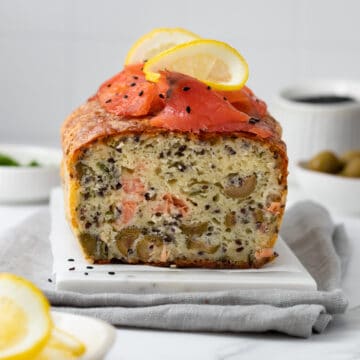
Tiramisu Torte (Easy Recipe)

Aug 4, 2022 · 1 Comment

Tiramisu torta on a cake stand.

I can't get enough of tiramisu torte or torta tiramisu whenever I whip it up! This classic Italian dessert made with ladyfingers and creamy mascarpone within 40 minutes is easy and affordable. Trust me, it will quickly become your new favorite dessert.

Tiramisu torta on a cake stand.

Torta tiramisu

Torta tiramisu, also known as tiramisu torte and tiramisu torta, is a layered Italian cake made with ladyfingers (sometimes sponge cake), velvety mascarpone cream, and generously topped with cocoa powder. The dessert is perfect for parties, birthdays, anniversaries, and other occasions.

[feast_advanced_jump_to]

While the word "torte" is used in German, Spanish, and Italian, the name of the dessert is torta tiramisu (torta tiramisù in Italian). Both terms, torte and torta, mean cake in English.

BAKING ESSENTIALS CHECKLIST

Sign up and get a list of the necessary baking tools and ingredients

FREE DOWNLOAD

I love its simplicity and elegance. It is super easy to make and can be whipped up in just 40 minutes, whether you choose to make an 8-inch or 12-inch cake.

This tiramisu is made with "cooked" eggs, without alcohol, to ensure it is safe for everyone to consume, including kids.

Ingredients

For ingredients and detailed instructions, refer to the recipe card below.

  • Ladyfingers - savoiardi biscuits or sponge fingers. Choose crispy (not cake-style) Italian biscuits by Forno Bonomi, Balocco, or Matilde Vicenzi brands. Use gluten-free ladyfingers to make a gluten-free tiramisu torte. Also, read about possible ladyfinger substitutes, like Pan di Spagna, pavesini biscuits, etc.
  • Egg yolks at room temperature. Save leftover egg whites for making meringue desserts such as Pavlova, Merveilleux cake, or giant meringue.
  • Granulated sugar
  • Gelatin sheets with a strength of 200 bloom. You will need 3 ½ gelatin sheets or 8 grams of powdered gelatin.
  • Whole milk - I always use whole milk with 3.25% milk fat.
  • Mascarpone cheese at room temperature. Bring it to the kitchen counter for 15-20 minutes, no longer. Also, ensure that the expiration date is long enough: the fresher the mascarpone, the thicker the cream.
  • Heavy cream, heavy whipping cream with 30% fat content, or heavy cream with 36% fat content. It must be cold!
  • Espresso - real espresso or strong coffee, but not instant coffee. It must be cooled in the refrigerator before using it to soak ladyfinger biscuits. Use decaf coffee or decaf espresso as an alternative.
  • Bitter cocoa powder - Italian cacao amaro. Don't confuse it with a sweet cocoa powder for children's cocoa milk.

How to make tiramisu torte step-by-step

Step 1. Gather all the ingredients: The egg yolks and mascarpone must be at room temperature. Using a serrated knife, cut the ladyfingers into three equal parts. Soak the gelatin in cold water for 10 minutes.

Step 2. To make the mascarpone cream, in a large bowl, whip the egg yolks with an electric mixer using high speed until they are thick (photo 1).

Step 3. Pour water and sugar into a saucepan and cook over medium heat to 250°F (121°C): check the temperature of the syrup with a cooking thermometer.

Step 4. Pour the hot sugar syrup over egg yolks while constantly whisking. Continue to whisk for 5-6 minutes until the mixture cools down - touch the bottom of the bowl with your hand.

Step 5. Add room-temperature mascarpone cheese to the egg mixture and gently whisk until combined (photo 3). Don't overmix the preparation: this can cause curdling. 

Beaten egg yolks in a mixing bowl.

PHOTO 1

Mascarpone mixture in a mixing bowl.

PHOTO 2

Step 6. Pour milk into a small heatproof bowl and warm it in the microwave. Add drained gelatin sheets to the hot milk and mix to ensure that the gelatin is dissolved completely. If gelatin isn't dissolved, bring the bowl to the microwave again for 3-5 seconds.

Step 7. Add about two tablespoons of the mascarpone mixture to the dissolved gelatin and mix with a spoon. Then add this mixture to the mascarpone preparation and mix with a hand whisk (photo 3).

Step 8. In a separate medium bowl, use a hand-held mixer (or a stand mixer) to whip the cold heavy cream until soft peaks form. Start whisking at a low speed, slowly increasing it.

Step 9. Gently fold whipped cream into the mascarpone mixture with a hand whisk or a rubber spatula from the bottom up (photo 4). Refrigerate the cream filling until ready to use.

Mascarpone and whipped cream mixture in a bowl.

PHOTO 3

Tiramisu mascarpone cream in a bowl.

PHOTO 4

Step 10. To assemble the tiramisu torte, place an adjustable mousse cake mold on a cake board or a serving plate. Adjust it to 8 inches (20 cm) in diameter, and line it with an acetate cake collar. If needed, fix it with a binder clip.

Pro tip: You can use a springform pan greased and lined with parchment paper to make tiramisu torte if a mousse cake mold is unavailable.

Step 11. Pour the cold espresso into a shallow plate. Dip cut biscuits with the rounded ends, one at a time for 1 second, then turn it over and repeat the process with another side. 

Step 12. Place cookies against the edge of the mold next to each other, arranging the rounded tips outwards. Continue in the same way using the other thirds of the ladyfingers and filling the bottom of the mold (photo 5).

Step 13. Take the mascarpone cream from the fridge and transfer it to a pastry bag fitted with a round tip - Ateco plain pastry tip 809 (about 15-16 mm in diameter).

Step 14. Using half of the cream, pipe ciuffi di crema (which means "cream tufts" in English) over the first layer of biscuits (photo 6). Refrigerate the cream while assembling the second layer of the cake.

Coffee-soaked ladyfingers on the bottom of the cake ring.

PHOTO 5

Mascarpone cream balls over ladyfingers layer in a mold.

PHOTO

Step 15. Add a second layer of the soaked lady fingers, placing them the same way over the cream.

Step 16. Use the remaining cream to pipe "cream tufts" over the final layer of cookies in a circular direction, starting from the outside.

Step 17. Cover the mold with plastic wrap or aluminum foil and chill for at least 4-6 hours; it is better overnight. 

To serve, remove the steel mold and acetate sheet or parchment paper. Then, with a mini strainer, dust the surface with cocoa powder.

Cut tiramisu torte with a knife, cleaning it between each cut, then serve using a cake server.

Sliced tiramisu torte on a cake stand.

Expert tips

  1. Make sure that egg yolks and mascarpone are at room temperature and that the heavy cream is cold.
  2. Dip the ladyfingers one at a time for no longer than 2 seconds; otherwise, you will end up in a soggy dessert.
  3. If desired, add 1 tablespoon of Marsala wine or coffee liqueur, such as Tia Maria, to the expresso.
  4. Do not overmix the cream when adding mascarpone: the cream may become grainy.
  5. Chill your tiramisu for at least 4-6 hours or overnight before serving: it has to be fully set up.
  6. Dust the torte with cocoa powder just before serving so that it won't get wet and absorbed by the cream. If desired, sprinkle with chocolate shavings, chocolate vermicelli sprinkles, chopped candy bars, colorful sprinkles, or sprinkle mix.

Storage instructions

To store: The tiramisu torte can be kept for 2 days in the refrigerator under a cake dome. The remaining cake should be kept in an airtight container refrigerated.

To freeze: You can freeze the cake by covering the mold with plastic wrap for 2 weeks. To defrost, bring it to the refrigerator for 2 hours. Remove the mold and acetate sheet or parchment paper and dust with cocoa powder before serving.

Recipe FAQ

What is mascarpone?

Mascarpone is an Italian version of cream cheese. It is made of whipped cream stabilized with lemon juice or citric acid. It has a tangy taste, smooth consistency, and twice as much fat as cream cheese.

How to make tiramisu firmer

Tiramisu needs time to set. Let it chill for at least 4 hours; better overnight; the dessert's texture will become firmer.

How much caffeine is in tiramisu

It depends on the espresso recipe: 16 to 22 g of coffee beans are used to pull a shot. Considering that one espresso contains about 80 mg of caffeine per serving, one tiramisu serving approximately contains about 40 mg of caffeine.

What goes well with tiramisu?

A cup of espresso perfectly complements tiramisu. Passito wines, such as Ben Ryé Passito di Pantelleria, Moscato Rosa Schweizer, and Collezione di Famiglia Zibibbo, also make ideal pairings for this dessert.

Love tiramisu desserts? Try these next!

  • Classic tiramisu
  • Fig tiramisu
  • Lemon tiramisu
  • Speculoos tiramisu

Want more delicious and beautiful recipes? Subscribe to my newsletter and follow me on Facebook, Pinterest, and Instagram for my latest updates. If you make this recipe, please leave a star rating on the recipe card and comment below!

Print

Recipe card

Tiramisu Torte

Tiramisu torta on a cake stand.
Print Recipe
Save Recipe Recipe Saved

5 Stars 4 Stars 3 Stars 2 Stars 1 Star

5 from 1 review

This tiramisu torte or torta tiramisu is made with Italian ladyfingers and creamy mascarpone within 40 minutes. Easy and affordable, this classic Italian cake will become your new favorite dessert.

  • Author: Irina Totterman
  • Total Time: 40 minutes
  • Yield: 8 slices 1x
  • Category: No-Bake Desserts
  • Method: No-Bake
  • Cuisine: Italian

Ingredients

Scale
  • 20 Italian-style ladyfingers 
  • 72 g egg yolks, room temperature (see note #1)
  • ½ cup + 3 ½ tablespoons (145 g) granulated sugar
  • 3 tablespoons (45 ml) water
  • 3 gelatin sheets (see note #2)
  • 5 ½ teaspoons (27 ml) milk
  • 11.3 oz. (320 g) mascarpone cheese, room temperature
  • 1 ½ cups + 1 ½ tablespoons (365 g) heavy cream, 30% fat
  • 1 cup (240 ml) cold espresso
  • 1.5 tablespoons unsweetened cocoa powder

Instructions

  1. Gather all the ingredients, ensuring that egg yolks and mascarpone are at room temperature. Cut ladyfingers into three equal parts using a serrated knife. Soak gelatin in cold water for 10 minutes.

  2. To make the mascarpone cream, whip the egg yolks in a large bowl with an electric mixer using high speed until they are thick. Pour water and sugar into a saucepan and cook over medium heat to 250°F (121°C): check the temperature of the syrup with a cooking thermometer.

  3. Pour the hot sugar syrup over egg yolks while constantly whisking. Continue to whisk for 5-6 minutes until the mixture cools down (touch the bottom of the bowl with your hand). Add room-temperature mascarpone cheese to the egg mixture and gently whisk until combined. Don't overmix the preparation: this can cause curdling.

  4. Pour milk into a small heatproof bowl and warm it in the microwave. Add drained gelatin sheets to the hot milk and mix to ensure the gelatin is dissolved completely. If gelatin isn't dissolved, bring the bowl to the microwave again for 3-5 seconds.

  5. Add about two tablespoons of the mascarpone mixture to the dissolved gelatin and mix with a spoon. Then add this mixture to the mascarpone preparation and mix with a hand whisk.

  6. In a separate medium bowl, use a hand-held mixer (or a stand mixer) to whip the cold heavy cream until soft peaks form. Start whisking at a low speed, slowly increasing it. Gently fold whipped cream into the mascarpone mixture with a hand whisk or a rubber spatula, working from the bottom up. Refrigerate the cream until ready to use.

  7. To assemble the tiramisu torte, place an adjustable mousse cake mold on a cake board or a serving plate. Adjust it to 8 inches (20 cm) in diameter, and line it with an acetate cake collar. Fix it with a binder clip if needed. Alternatively, grease the sides of the mold and line it with parchment paper.

  8. Pour the cold espresso into a shallow plate. Dip cut biscuits with the rounded ends, one at a time for 1 second, then turn it over and repeat the process with another side.  Place cookies against the edge of the mold, next to each other, arranging the rounded tips outwards. Continue in the same way using the other thirds of the ladyfingers and filling the bottom of the mold.

  9. Take the mascarpone cream from the fridge and transfer it to a pastry bag fitted with a round tip - Ateco plain pastry tip 809 (about 15 mm in diameter). Using half of the cream, pipe ciuffi di crema (which means "cream tufts" in English) over the first layer of biscuits. Bring the cream to the refrigerator while assembling the second layer of the cake.

  10. Add a second layer of the soaked lady fingers, placing them in the same way over the cream. Use the remaining cream to pipe "cream tufts" over the final layer of cookies in a circular direction, starting from the outside. Cover the mold with plastic wrap or aluminum foil and chill for at least 4-6 hours, better overnight.

  11. To serve, remove the steel mold and acetate sheet or parchment paper. With a mini strainer, dust the surface with cocoa powder. Cut tiramisu torte with a knife, cleaning it between each cut, then serve using a cake server.

Notes

  1. 72 g egg yolks are approximately equal to 5.5 egg yolks from small-size chicken eggs or ⅓ US cup.
  2. 3 gelatin sheets equal 7.5 g powdered gelatin.
  3. Make sure that egg yolks and mascarpone are at room temperature and that heavy cream is cold.
  4. Dip the ladyfingers one at a time for no longer than 2 seconds; otherwise, you will end up in a soggy dessert.
  5. If desired, add 1 tablespoon of Marsala wine or coffee liqueur, for example, Tia Maria, to the expresso.
  6. Do not overmix the cream when adding mascarpone: the cream may become grainy.
  7. Chill your tiramisu for at least 4-6 hours or overnight before serving: it has to be fully set up.
  8. Sprinkle cocoa powder over the torte just before serving so that it won't get wet and won't be absorbed by the cream.

Nutrition

  • Serving Size: 1 slice
  • Calories: 771
  • Sugar: 52.3 g
  • Sodium: 98 mg
  • Fat: 40.3 g
  • Saturated Fat: 24.6 g
  • Carbohydrates: 85.6 g
  • Fiber: 2.8 g
  • Protein: 12.5 g
  • Cholesterol: 298 mg

Thank you for following me on Pinterest, Facebook, and Instagram. Hashtag #bakinglikeachef so I can see your creations.

The nutritional information has been calculated using an online recipe nutrition calculator such as Verywellfit.com and is intended for informational purposes only. These figures should be used as a general guideline and not be construed as a guarantee.

Mini Basque Cheesecake

Jun 7, 2022 · 1 Comment

Sliced mini Basque cheesecake on parchment.

Easy and quick, with a charming presentation, this mini Basque cheesecake has been the trend over recent years. Try this ramekin cheesecake recipe to make individual bite-sized treats for your next gathering!

Sliced mini Basque cheesecake on parchment

Spanish cheesecake is often considered light and airy alternative to a regular New York-style cheesecake.

However, you might be surprised to know that burnt Basque cheesecake is the same as the famous San Sebastian cheesecake.

Since it was first created in the Basque region of Northern Spain, it was named Basque cheesecake.

BAKING ESSENTIALS CHECKLIST

Sign up and get a list of the necessary baking tools and ingredients

FREE DOWNLOAD

Wrapped burnt cheesecake in a pan
[feast_advanced_jump_to]

What is a Basque cheesecake?

Basque cheesecake is a famous Spanish cheesecake with a light and creamy center, firm exterior, and burnt top due to baking at a high temperature.

Made without cookie crust and baked without a water bath, it differs from traditional cheesecake.

The chef-owner of La Viña restaurant in San Sebastián didn't know his dessert would travel the world and gain massive popularity when he created it in the 1990s.

This super popular delicacy from Spain's Basque region is one of the easiest cheesecakes ever.

Why you should try this recipe

You don't need a degree in baking to succeed with this recipe. It is easy to make, and everyone will love this crustless cheesecake.

Made a mini version in a ramekin, this little treat is perfect for two.

Scaling this baby cheesecake recipe makes it big enough to serve on any occasion, from birthdays to family gatherings or celebrations alike.

Its' charming rustic look is enough to make all your guests ahh and ooh.

Finally, this Basque cheesecake recipe is made with a few simple ingredients, without a springform pan and water bath (it just uses high temperature instead). What could be better? Mini cheesecake is truly the best!

Ingredients

Mini Basque cheesecake ingredients in pictures

For ingredients and detailed instructions, refer to the recipe card below.

Make sure all the cheesecake ingredients are at room temperature.

Cream cheese: Choose Philadelphia cream cheese, like in the original La Viña recipe, or use another full-fat cream cheese.

Please don't confuse it with whipped cream cheese or cream cheese spread.

Bring it to room temperature 1-2 hours before you start. Or remove the cream cheese from the foil and place it on a microwave-safe dish.

Reheat it in the microwave on half power (50% power) for 15-20 second intervals until softened (but not melted).

Sugar: The recipe calls for white sugar (granulated or caster sugar).

Eggs: Use large eggs at room temperature. To get eggs to room temperature quickly, submerge them (still with shells) in a bowl of warm water for 5-10 minutes.

Cream: The original recipe calls for rich, heavy cream, but you can replace it with whipping cream with less fat content.

Cornstarch: Use cornstarch to make gluten-free basque cheesecake; you can replace it with all-purpose flour if desired.

Vanilla extract is optional; it is used to flavor the dessert. Also, vanilla helps reduce the "eggy" taste of the cheesecake.

How to make mini burnt cheesecake

Preheat the oven to 430 degrees F/220 degrees C and heat it for at least 15-30 minutes.

Line a 14 oz. porcelain ramekin (4.25 x 4.25 x 2 inches) with a large doubled square piece of parchment paper and let the paper rise up at least 2 inches/5 cm above the rim.

Fold and pleat the baking paper to line the ramekin; it will result in iconic crinkled burnt edges of cheesecake.

Ramekin with folded parchment paper

In a large mixing bowl, place cream cheese with sugar and start beating them with an electric mixer on medium speed until smooth and homogeneous.

Add the egg and beat it on low speed. Add heavy cream and vanilla extract and mix just to combine. Scrape the sides of the bowl if needed.

Finish with the sifted cornstarch and beat on low speed until smooth and creamy, about 15 seconds.

Basque cheesecake batter in a mixing bowl

Pour the cheesecake batter into the ramekin, filling it up to ¾. You might need to tap the mold lightly on the countertop to remove excess air bubbles.

Ramekin with cheesecake batter

Bring the ramekin to the middle rack of the hot oven. Bake for 30 to 35 minutes until the browned top and a slight jiggle to the cheesecake.

If it doesn't brown (it depends upon the oven), turn the broil or grill on for 1-2 minutes, but watch out for the cheesecake not to over-burn.

Baked mini Basque cheesecake in a mold

Place the ramekin on a wire rack and let the cheesecake cool to room temperature before unmolding for at least 2 hours.

To serve the same day, remove the dessert from the mold using the paper, and place it with the paper on a dessert plate. Peel off when ready to slice.

To serve the next day, chill the cheesecake (still in the ramekin) overnight in the refrigerator: it will result in a firmer interior after the overnight chilling.

Then bring it to room temperature around 15-30 minutes before serving. Pair it with dry sherry aside or fresh berries if desired.

Unwrapped mini burnt cheesecake

Recipe variations

Original La Vina Basque cheesecake is a decadent, unflavored dessert, but why not take it one step further and add some lemon zest, lemon juice, or vanilla extract?

Also, try to experiment with almond and vanilla extract together for an extra beautiful flavor.

The best way would be if the vanilla bean was used in the recipe, but using vanilla bean paste (just ¼ teaspoon) works just fine too.

And remember that the sweet taste of a dessert is enhanced when you add a pinch of salt.

There are many different variations of Basque cheesecake. Aside from the vanilla, the pumpkin puree in this cheesecake provides a beautiful twist to the classic.

The variety of this cheesecake is only limited by your imagination, with chocolate, matcha, and coffee versions being among some popular alternatives.

In the end, this cheesecake can be made with an unusual variety of flavors, like durian flesh, pandan extract, or ube extract.

Storage instructions

Store leftover cheesecake in an airtight container in the fridge for up to 5 days.

You can also make it in advance and freeze it. Let your mini dessert cool completely, double wrap with plastic wrap and a layer of aluminum foil, and freeze for up to 3 months.

To thaw, bring the cheesecake to the fridge overnight and then to the counter 30 minutes before serving.

Equipment

The best part about this recipe is that you don't need special equipment.

So what will you need to make mini Basque burnt cheesecake? Use a stand mixer or an electric hand mixer with a large mixing bowl, a silicone spatula, parchment paper, and a 14 oz. porcelain ramekin (4.25 x 4.25 x 2 inch or 11 x 11 x 5 cm).

And, of course, to measure ingredients, you will need a kitchen scale or measuring cups and spoons.

Do you wonder if you can make individual cheesecakes in small ramekins (4 oz.)? The answer is yes.

The recipe below is created for a single 14 oz. ramekin. So you can make three regular-sized ramekin cheesecakes using this recipe.

Since a single cup of a regular muffin tin holds 3.5 to 4 oz., you will need to double the recipe to make a small batch of 6-7 muffin-sized mini cakes.

But you might need to adjust the baking time until 40 minutes: watch out for the browning of your desserts.

And finally, you can't have a list of Basque cheesecakes without mentioning its perfect sharing version.

Expert tips

  1. Room temperature ingredients are a must to make this type of cheesecake.
  2. Using parchment paper (not wax paper) to line the ramekin is essential in this recipe.
  3. Beat the egg and the rest of the cheesecake ingredients at the low speed of the mixer. Don't overwork the batter!
  4. Make sure to preheat the oven very well before bringing the cheesecake to the oven. Also, don't open the oven door while baking!
  5. Avoid overbaking! Don't exceed the bake time; if the cheesecake is not burnt enough, try to broil/grill for 1-2 minutes, but closely watch your dessert!

FAQ

How do you say cheesecake in Spanish?

"Tarta de queso" or "pastel de queso" is how you say cheesecake in Spanish.

Why is my Basque cheesecake not burnt?

When it comes to baking a Basque cheesecake, two main factors must be considered to obtain a beautiful burnt top. First is to ensure your oven has been well preheated and heated for at least 30 minutes before bringing in the dessert; second, check with an oven thermometer whether or not you are baking at the proper temperature. If available, use the convection oven (with a fan).

How do I make my Basque cheesecake creamier?

To make the Basque cheesecake creamier, bake it a bit less than recommended and serve at room temperature (without chilling) on the same day.

What texture should Basque cheesecake be?

The ideal texture of the Basque cheesecake is creamy, light, and airy, resembling a custardy texture. To obtain the oozy raw texture, you should bake it less than recommended. Instead, chill the cheesecake for 12 hours and serve straight from the fridge to get a firmer texture.

Should you eat Basque cheesecake warm or cold?

Basque cheesecake is best eaten at room temperature. If you are a fan of custard desserts, enjoy the cheesecake about 2 hours after baking. If you prefer the firmer texture, chill it overnight and serve cold.

Love cheesecakes? Try these next!

  • A slice of raspberry cheesecake with Oreo cookie crust, a fork, raspberries on a white plate.
    Raspberry Oreo Cheesecake
  • A single slice of diabetic cottage cheese on a red dessert plate.
    Sugar-Free Cheesecake: No Added Sugar or Sweeteners
  • Sliced burnt Basque cheesecake on a serving plate.
    San Sebastian Cheesecake (Burnt Basque Cheesecake)

Want more delicious and beautiful recipes? Subscribe to my newsletter and follow me on Facebook, Pinterest, and Instagram for my latest updates. If you make this recipe, please leave a star rating on the recipe card and comment below!

Print

Recipe card

Mini Basque Cheesecake

Sliced mini Basque cheesecake on parchment.
Print Recipe
Save Recipe Recipe Saved

5 Stars 4 Stars 3 Stars 2 Stars 1 Star

5 from 1 review

Easy and quick, with a charming presentation, this mini Basque cheesecake has been the trend over recent years. Try this ramekin cheesecake recipe to make individual bite-sized treats for your next gathering!

  • Author: Irina Totterman
  • Total Time: 55 minutes
  • Yield: 2 1x
  • Category: Cakes
  • Method: Baking
  • Cuisine: Spanish

Ingredients

Scale
  • 5.3 oz. (150 g) cream cheese Philadelphia, room temperature
  • ⅓ cup (60 g) granulated sugar
  • 1 large egg, room temperature
  • ¼ cup + 1 tablespoon (75 ml) heavy cream, room temperature
  • ¼ teaspoons vanilla extract
  • 2 teaspoons cornstarch

*Don't you have the correct baking pan on hand right now? Try this simple Cake Pan Converter!

** If needed, please refer to Baking Conversion Charts.

Instructions

  1. Preheat the oven to 430 degrees F/220 degrees C and heat it for at least 15-30 minutes. Line a 14 oz. porcelain ramekin (4.25 x 4.25 x 2 inches) with a large doubled square piece of parchment paper and let the paper rise up at least 2 inches/5 cm above the rim. Fold and pleat the baking paper to line the ramekin; it will result in iconic crinkled burnt edges of cheesecake.

  2. In a large mixing bowl, place cream cheese with sugar and start beating them with an electric mixer on medium speed until smooth and homogeneous. Add the egg and beat it on low speed. Add heavy cream and vanilla extract and mix just to combine. Scrape the sides of the bowl if needed. Finish with the sifted cornstarch and beat on low speed until smooth and creamy, about 15 seconds. Pour the cheesecake batter into the ramekin, filling it up to ¾. You might need to tap the mold lightly on the countertop to remove excess air bubbles.

  3. Bring the ramekin to the middle rack of the hot oven. Bake for 30 to 35 minutes until the browned top and a slight jiggle to the cheesecake. If it doesn't brown (it depends upon the oven), turn the broil or grill on for 1-2 minutes, but watch out for the cheesecake not to over-burn.

  4. Place the ramekin on a wire rack and let the cheesecake cool to room temperature before unmolding for at least 2 hours.

  5. To serve the same day, remove the dessert from the mold using the paper, and place it with the paper on a dessert plate. Peel off when ready to slice. To serve the next day, chill the cheesecake (still in the ramekin) overnight in the refrigerator: it will result in a firmer interior after the overnight chilling. Then bring it to room temperature around 15-30 minutes before serving. Pair it with dry sherry aside or fresh berries if desired.

Notes

  1. Room temperature ingredients are a must to make this type of cheesecake.
  2. Using parchment paper (not wax paper) to line the ramekin is essential in this recipe.
  3. Beat the egg and the rest of the cheesecake ingredients at the low speed of the mixer. Don't overwork the batter!
  4. Make sure to preheat the oven very well before bringing the cheesecake to the oven. Also, don't open the oven door while baking!
  5. Avoid overbaking! Don't exceed the bake time; if the cheesecake is not burnt enough, try to broil/grill for 1-2 minutes, but closely watch your dessert!

Nutrition

  • Serving Size: 1 slice
  • Calories: 553
  • Sugar: 30.5 g
  • Sodium: 272 mg
  • Fat: 42.7 g
  • Saturated Fat: 26 g
  • Carbohydrates: 35.8 g
  • Fiber: 0 g
  • Protein: 9.6 g
  • Cholesterol: 228 mg

Thank you for following me on Pinterest, Facebook, and Instagram. Hashtag #bakinglikeachef so I can see your creations.

The nutritional information has been calculated using an online recipe nutrition calculator such as Verywellfit.com and is intended for informational purposes only. These figures should be used as a general guideline and not be construed as a guarantee.

San Sebastian Cheesecake (Burnt Basque Cheesecake)

Jun 2, 2022 · 4 Comments

Sliced burnt Basque cheesecake on a serving plate.

San Sebastian cheesecake, also known as Burnt Basque cheesecake, is a showstopping dessert with its signature burnt top. The creaminess of the inside and caramelized crust make this modern Spanish dessert absolutely unique.

Sliced San Sebastian cheesecake on parchment paper.

San Sebastian cheesecake

San Sebastian cheesecake, or Burnt Basque cheesecake, is a crustless cheesecake of Spanish origin with a creamy interior and a signature burnt top. It has other names, such as St. Sebastian cheesecake or Saint Sebastian cake.

[feast_advanced_jump_to]

This cheesecake has a signature burnt surface. Therefore, the name is burnt cheesecake or even burnt cheese (a short name).

Its truly distinctive and incomparable burnt flavor, resembling salted caramel or browned butter, is so intense that it must be tasted firsthand.

BAKING ESSENTIALS CHECKLIST

Sign up and get a list of the necessary baking tools and ingredients

FREE DOWNLOAD

Its golden brown top and burnt appearance hide a soft and melting center. The texture of Basque cheesecake is creamy, light, and airy, less dense than regular cheesecake, and has its own unique flavor.

There is no need for a water bath required to make a classic New York style cheesecake. Instead, the Basque-style cheesecake is baked at high temperature without a water bath.

Let's say that I haven't met anyone who could resist a delicious slice of this cheesecake. Here is my foolproof recipe!

Slice of san Sebastian cheesecake on a dessert plate.

Ingredient list

For ingredients and detailed instructions, refer to the recipe card below.

The Basque burnt cheesecake recipe calls for a few simple ingredients. Use all the ingredients at room temperature. It prevents making a lumpy cheesecake batter that is prone to cracking.

  • Cream cheese - full-fat cream cheese sold in the United States under the brand name Philadephia®. It must be at room temperature! Please don't confuse cream cheese with whipped cream cheese or reduced fat.
  • Sugar - white sugar (granulated or caster sugar).
  • Eggs - five large eggs at room temperature, but feel free to go for seven if desired.
  • Heavy cream with 36-38% fat content. You can try using light whipping cream instead, but I haven't tried this recipe with whole milk or a non-dairy alternative, such as full-fat canned coconut milk.
  • Flour - a little flour (all purpose or plain flour) is essential.

How to make San Sebastian cheesecake step-by-step

Step 1. Preheat the oven to 430°F (220°C) for at least 30 minutes; even better, longer!

Pro tip: A very hot oven with extended preheating guarantees the signature burnt look of cheesecake.

Step 2. Butter a 9-inch (23 cm) springform pan and line it with two sheets of parchment paper. 

Pro tip: Try to overlap two sheets of parchment to match their center and press the paper at the bottom and against the edges to adhere to the pan.

Let the parchment stick up at least 2 inches (5 cm) above the sides of the pan; don't let it overhang down! If you fold down the parchment, some batter might overflow during baking.

Don't try to line the mold perfectly. Instead, the parchment has to be pleated and folded around the outer edges by design to bring the iconic look to Basque cheesecake.

Pro tip: If a spring form pan is unavailable, use a regular round pan with at least 3-inch (7.5 cm) tall sides. Make sure to line it with two sheets of parchment as recommended in the recipe.

If your cake pan is 2 inches (5 cm) deep, make sure two to three sheets of parchment paper go at least 4 inches (10 cm) above the pan's sides to support the batter.

Step 3. In the mixing bowl of a stand mixer fitted with the paddle attachment, beat Philadelphia cream cheese and sugar at medium-low speed for about 2-3 minutes until creamy (photo 1).

Pro tip: Scrape the sides of the bowl with a rubber spatula regularly while making the cheesecake batter.

Step 4. Add eggs, one at a time, mixing well between each. Then add heavy cream and mix at low for about 30 seconds. Finish with the sifted flour, mixing at a low speed until smooth (photo 2).

Pro tip: If you use a KitchenAid stand mixer, mix the cheesecake batter on speed "2" from the moment you add eggs.

Cream cheese and sugar mixture in a bowl.

PHOTO 1

Cheesecake batter in a mixing bowl.

PHOTO 2

Step 5. Pour the cream cheesecake mixture into the prepared pan, using the back of a spoon, and smooth the top (photo 3).

Step 6. Bake on the oven rack for 40 minutes, until it is nice dark brown on top (photo 4). 

Cheesecake batter in a baking mold lined with parchment paper.

PHOTO 3

Baked burnt cheesecake in a baking mold.

PHOTO 4

Pro tip: Bring the pan into the hot oven fast. Don't let the hot air escape!

Bake the cheesecake on the middle rack with a convection oven with a fan.

With a conventional oven (no fan), bake the cheesecake on a rack higher than the middle one. But make sure to have a space till the oven's ceiling: the paper shouldn't touch the heating element of the oven!

Watch the last 5-10 minutes carefully so that it doesn't burn beyond that. The center must be a little jiggly and shaky, like a flan. 

If the cheesecake doesn't look "burnt" after the recommended bake time, turn it to broil/grill it for 1 to 2 minutes.

But be careful - don't overdo it! Pay close attention - broiling/grilling will darken the cheesecake very quickly!

Step 7. Take it out of the oven and let it cool to room temperature for at least 4 hours.

Leave the cheesecake with parchment paper until it is ready to be sliced and served; otherwise, it might start to lose its shape.

Serve it the same day or chill it in the fridge overnight. For serving, unmold the cheesecake, carefully peeling away the parchment from the sides of the cake.

Sliced burnt Basque cheesecake on a serving plate.

Expert Tips

  1. Make sure all the cheesecake ingredients are at room temperature.
  2. Always use two sheets of parchment paper to line a springform pan, ensuring that it sticks up at least 2 inches (5 cm) to prevent the batter from overflowing while baking.
  3. Don't overmix the batter: add each ingredient and mix until just combined.
  4. Don't overbake your cheesecake by extending the baking time; even if the top doesn't brown after 40 minutes of baking, use broil or grill for 1-2 minutes. With overbaking, there is a risk of the filling being curdled: you won't be able to fix it!
  5. Remember that each oven is different, and you might need to adjust the baking time, but never open the oven door while baking.
  6. Dip the knife's blade in hot water to cut cheesecake and dry it with a kitchen towel between each cut. Then, with one quick motion, cut the slice for a clean cut.
  7. Make-ahead option: Cheesecake can be made one day ahead. Chill it in the refrigerator overnight. But make sure to let the cheesecake sit for at least 30 minutes at room temperature before serving.

Recipe variations

Texture: Depending on the cheesecake's doneness, you can get it creamy, creamy with the oozy raw-like center, or firm, resembling regular cheesecakes, each with its own perks.

  • Bake the cheesecake as recommended and serve it at room temperature to get the creamy texture.
  • Bake the dessert slightly less than advised and chill well before slicing for raw texture. Once chilled, bring it to the counter 30 minutes before serving.
  • To get the firm-textured cheesecake, bake it as recommended and chill it for at least 12 hours. Then, slice it cold from the fridge.

Flavors: Don't limit yourself to one type of flavor.

  • "If you want salt, add salt; if you want vanilla, add vanilla; some people add lemon zest, "says the inventor of burnt cheesecake, chef Santiago Rivera.
  • Add a teaspoon of vanilla extract, lemon juice, dark rum, or whiskey.
  • Add chocolate, matcha, or pistachio paste to make chocolate, matcha, or pistachio variations.

And if you ever want to make mini Basque cheesecake, there is a recipe on the blog.

How to serve it

Burnt Basque cheesecake tastes great the next day and even a few days after making it.

Serve it on a serving plate, keeping the browned baking paper: it brings a rustic look.

It is best served at room temperature with chocolate sauce, a glass of Pedro Ximenez sherry wine, or other nice dessert wine.

Storing and freezing

Store the cooled Basque cheesecake in an airtight container in the refrigerator for up to 3 days. Bring it to room temperature for at least 30 minutes, better longer, before serving.

To freeze the whole cheesecake, unmold it once cooled, remove the parchment paper, and let it freeze on a plate for at least 1-2 hours. Then, cover it with double plastic wrap and a layer of aluminum foil and freeze the dessert for up to 3 months.

To freeze cheesecake slices individually, wrap each in cling film and aluminum foil and freeze for up to 3 months.

To thaw, bring it to the fridge overnight. The best way to serve your cheesecake is by getting it out of the refrigerator at least 30 minutes before slicing.

Troubleshooting cheesecake

My cheesecake is runny

Reason: If your cheesecake is still runny after chilling for 12 hours, it is underbaked.

How to prevent it: Bake the cheesecake for a few more minutes next time.

My cheesecake is cracked on top

Reasons: The top of the cheesecake can crack due to

  • Overmixing the batter
  • Excess of air bubbles with whisking
  • Opening the oven door while baking

How to prevent it:

  • Don't overmix the batter (otherwise, it traps air bubbles)
  • Tap the cake pan slightly to remove excess air bubbles.
  • Never open the oven door within the first 30-40 minutes of baking.

Rarely broiling/grilling can make the cheesecake crack. In the end, the cracks would close once the cheesecake fell as it cooled.

Recipe FAQ

Why is it called San Sebastian cheesecake?

The cheesecake is named after the town of San Sebastian in the Basque region of Northern Spain, where it was first created.

Does Basque cheesecake have a base?

Basque cheesecake doesn't have a base or some cookie crust typical for traditional cheesecake.

What is the difference between Basque cheesecake and normal cheesecake?

The main difference is that the Basque cheesecake is a crustless, light, and airy treat that is typically unflavored and baked until burnt at high oven temperature without a water bath.

Is burnt Basque cheesecake gluten-free?

This cheesecake is not gluten-free since it contains a bit of flour. To make gluten-free burnt Basque cheesecake, replace regular flour with rice flour or cornstarch.

Love easy cakes? Try these next!

  • Sliced Savoy cake on a cake serving board.
    Savoy Cake (Easy and Quick Recipe)
  • Sliced gateau au yaourt on a serving plate.
    Gâteau au Yaourt (French Yogurt Cake)
  • Sliced Madeleine cake on parchment paper and mesh ribbon.
    Madeleine Cake
  • Sliced apple sponge cake on a dessert plate.
    Sponge Apple Cake (Easy and Quick Recipe)

Want more delicious and beautiful recipes? Subscribe to my newsletter and follow me on Facebook, Pinterest, and Instagram for my latest updates. If you make this recipe, please leave a star rating on the recipe card and comment below!

Print

Recipe card

San Sebastian Cheesecake (Burnt Basque Cheesecake)

Sliced San Sebastian cheesecake on parchment paper.
Print Recipe
Save Recipe Recipe Saved

5 Stars 4 Stars 3 Stars 2 Stars 1 Star

5 from 2 reviews

San Sebastian cheesecake, also known as Burnt Basque cheesecake, is a crustless cheesecake with creaminess inside and a signature burnt top.

  • Author: Irina Totterman
  • Total Time: 55 minutes
  • Yield: 12 slices 1x
  • Category: Cakes
  • Method: Baking
  • Cuisine: Spanish

Ingredients

Scale
  • 4 ½ blocks (1 kg) of full-fat cream cheese (Philadelphia), room temperature
  • 1 ¼ cup (250 g) granulated sugar
  • 5 large eggs, room temperature
  • 2 cups + 2 teaspoons (480 ml) heavy cream, room temperature
  • 4 tablespoons (30 g) all-purpose flour

*Don't you have the correct baking pan on hand right now? Try this simple Cake Pan Converter!

** If needed, please refer to Baking Conversion Charts.

Instructions

  1. Preheat the oven to 430°F (220°C) for at least 30 minutes; even better, longer! The very hot oven with extended preheating guarantees the signature burnt look of cheesecake.

  2. Butter a 9-inch (23 cm) springform pan and line it with two sheets of parchment paper. Try to overlap two sheets of parchment to match their center, and press the paper at the bottom and against the edges to adhere to the pan. Let the parchment stick up at least 2 inches (5 cm) above the sides of the pan; don't let it overhang down! If you fold down the parchment, some batter might overflow during baking. Also, don't try to line the mold perfectly. Instead, the parchment has to be pleated and folded around the outer edges by design to bring the iconic look to Basque cheesecake.

  3. In the mixing bowl of a stand mixer fitted with the paddle attachment, beat Philadelphia cream cheese and sugar at medium-low speed for about 2-3 minutes until creamy. Scrape the sides of the bowl with a rubber spatula regularly while making the cheesecake batter.

  4. Add eggs, one at a time, mixing well between each. Then add heavy cream and mix at low for about 30 seconds. Finish with the sifted flour, mixing at a low speed until smooth. If you use a KitchenAid stand mixer, mix the cheesecake batter on speed "2" from the moment you add eggs.

  5. Pour the cheesecake mixture into the prepared pan, using the back of a spoon, and smooth the top. Bake on the oven rack for 40 minutes, until it is nice dark brown on top. Bring the pan into the hot oven fast. Don't let the hot air escape!

  6. With a convection oven with a fan, bake the cheesecake on the middle rack. With a conventional oven (no fan), bake the cheesecake on a rack higher than the middle one. But make sure to have a space till the oven's ceiling: the paper shouldn't touch the heating element of the oven!

  7. Watch the last 5-10 minutes carefully so that it doesn't burn beyond that. The center must be a little jiggly and shaky, like a flan. If the cheesecake doesn't look "burnt" after the recommended bake time, turn to broil/grill it for 1 to 2 minutes. But be careful - don't overdo it! Pay close attention - broiling/grilling will darken the cheesecake very quickly!

  8. Take it out of the oven and let it cool to room temperature for at least 4 hours. Leave the cheesecake with parchment paper until it is ready to be sliced and served; otherwise, it might start to lose its shape. Serve it the same day or chill in the fridge overnight. For serving, unmold the cheesecake, carefully peeling away the parchment from the sides of the cake. 

Notes

  1. Make sure all the cheesecake ingredients are at room temperature.
  2. Always use two sheets of parchment paper to line a springform pan, ensuring that it sticks up at least 2 inches (5 cm) to prevent the batter from overflowing while baking.
  3. Don't overmix the batter: adding each ingredient, mix until just combined.
  4. Don't overbake the cheesecake by extending the baking time; even if the top doesn't brown after 40 minutes of baking, use broil or grill for 1-2 minutes. With overbaking, there is a risk of the filling being curdled: you won't be able to fix it!
  5. Remember that each oven is different, and you might need to adjust the baking time, but never open the oven door while baking.
  6. Serve your cheesecake on a serving plate, keeping the browned baking paper: it brings a rustic look.
  7. To cut cheesecake, dip the knife's blade in hot water and dry it with a kitchen towel between each cut. Then, with one quick motion, cut the slice to have a clean cut.

Nutrition

  • Serving Size: 1 slice
  • Calories: 548
  • Sugar: 21.2 g
  • Sodium: 291 mg
  • Fat: 46.2 g
  • Saturated Fat: 28.3 g
  • Carbohydrates: 26.3 g
  • Fiber: 0.1 g
  • Protein: 10 g
  • Cholesterol: 225 mg

Thank you for following me on Pinterest, Facebook, and Instagram. Hashtag #bakinglikeachef so I can see your creations.

The nutritional information has been calculated using an online recipe nutrition calculator such as Verywellfit.com and is intended for informational purposes only. These figures should be used as a general guideline and not be construed as a guarantee.

  • Page 1
  • Page 2
  • Page 3
  • Go to Next Page »

Primary Sidebar

Personal photo of the website's author

Hi, I am Irina!

A home baker with over 30 years of experience, sharing baking recipes with step-by-step instructions, helpful tips, and tricks. Get baking, and let the fun begin!

About • Start Here • Contact

Summer Desserts

  • Fig tiramisu cups in a serving board.
    Easy Fig Tiramisu (15-Minute Recipe)
  • Louise cake on a cake stand.
    Ottolenghi's Louise Cake With Plum And Coconut
  • Apple and blueberry crumble in a white ceramic dish with ice cream and two spoons.
    Apple And Blueberry Crumble (Super Easy)
  • Sliced Jordgubbstårta on a cake board.
    Jordgubbstårta (Swedish Strawberry Cake)

More Summer Desserts →

Readers’ Favorites

  • Sliced Sans Rival cake on a cake board.
    Sans Rival Cake (Filipino Cashew Meringue Cake)
  • A batch of baked madeleines in a baking mold.
    Classic French Madeleines (Madeleine Cookies)
  • Italian sponge cake on a marble board.
    Italian Sponge Cake (Pan di Spagna)
  • Halved muffin loaded with blueberries with the rest of the cakes in the background.
    To Die For Blueberry Muffins Recipe
  • French financiers with almonds on a wooden board lined with parchment.
    Classic French Financiers (Authentic Recipe)
  • Stack of banana bread slices on a serving board.
    Easy Banana Bread Without Baking Soda

More Cake Recipes →

Footer

Featured in banner with logos.

BAKING LIKE A CHEF

  • Home
  • About
  • Recipe Index
  • Baking 101
  • Cake Pan Converter
  • Contact
  • Log In

SOCIAL

  • Facebook
  • Pinterest
  • Instagram
  • Twitter

LEGAL

  • Privacy Policy
  • Disclaimer
  • Terms & Conditions
  • Accessibility Statement

Copyright © 2025 Baking Like a Chef • Baking Like a Chef is a participant in the Amazon Services LLC Associates Program, an affiliate advertising program designed to provide a means for sites to earn advertising fees by advertising and linking to Amazon.com. As an Amazon Associate, I earn a commission – at no cost to you –  from qualifying purchases.