
• Skip to primary navigation
  • Skip to main content
  • Skip to primary sidebar

Baking Like a Chef logo

  • ABOUT
  • RECIPES
  • CLUB
  • SHOP
menu icon
go to homepage
  • Recipes
  • Basics
  • Printables
  • Subscribe
  • About
search icon
Homepage link
  • Recipes
  • Basics
  • Printables
  • Subscribe
  • About
×

Want to learn sourdough?

START

Home » Recipe Index

Tarte Tatin aux Pommes (Apple Tarte Tatin)

Mar 28, 2024 · 3 Comments

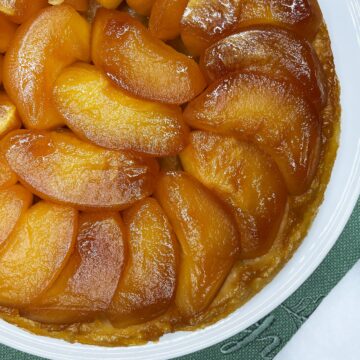
Tarte Tatin with caramelized apples packed on top of puff pastry.

Quick Summary: Tarte Tatin aux Pommes (apple Tarte Tatin) is a classic French upside-down tart of caramelized apples baked under a puff pastry crust, then flipped so the glossy caramelized apples sit on top. The keys to success are using firm apples that hold their shape, cooking the caramel to a proper amber, and letting the tart cool before you invert it.

Single slice of apple Tarte Tatin on a plate.

What is Tarte Tatin aux Pommes?

Tarte Tatin aux Pommes is a four-ingredient signature French apple upside-down dessert. It features caramelized apples, puff pastry, and silky caramel, which is revealed when the tart is flipped right after baking.

It was invented by two Tatin sisters, owners of a provincial French hotel named Hotel Tatin, at the end of the 19th century. Like several other pastries born from a happy kitchen accident, the tart is said to have been created when an apple tart was baked upside down by mistake.

I adapted the apple Tarte Tatin recipe from French chef Christophe Michalak. Instead of frying apples in caramel before baking them, Mr. Michalak cooks apple quarters in butter-sugar syrup for 10 minutes.

This makes the apples soft and allows you to arrange them in a pan with the cooked caramel as tightly as possible.

Ingredients

For ingredients and detailed instructions, refer to the recipe card below.

  • Sugar: Use regular white sugar.
  • Apples: Golden Delicious is preferred, but you can substitute Gala, Braeburn, Boskoop, Canada, Pink Lady, or Reinette if desired.
  • Butter: Use unsalted butter, preferably with 82% fat content.
  • Puff pastry: Use store-bought or homemade butter-based puff pastry. You can also replace it with shortcrust pastry, any pie crust, or pie dough.

Equipment

You need only a few basic tools to make this apple Tarte Tatin:

  • Tarte Tatin pan or cast-iron skillet (a pie pan or cake pan also works)
  • Saucepan for the caramel
  • Oven mitts
  • Serving plate for inverting the tart

How to make Tarte Tatin Pommes

Step 1: Prepare the puff pastry. Thaw the puff pastry and roll it out to 5 mm thick. Using a 9-inch (23 cm) pie pan as a template, cut a pastry circle. Prick it with a fork and set aside.

Step 2: Make the dry caramel. Heat â…“ of the sugar in a heavy-bottomed saucepan over medium heat, swirling the pan instead of stirring. Add another â…“ of sugar, swirl again, then add the remaining sugar. Cook until the caramel turns a light amber color (about 3-4 minutes). Avoid overcooking to prevent bitterness. Pour the hot caramel immediately into a 9-inch (23 cm) pie tin and let it harden.

Step 3: Poach the apples. Peel, quarter, and core the apples. In a large pot, bring water, butter (cubed), and sugar to a boil. Add the apples and cook for about 10 minutes until translucent. Test readiness with a knife: if it slides in easily, the apples are done. Let them cool.

Step 4: Assemble the Tarte Tatin. Preheat the oven to 355°F (180°C). Arrange the apple slices tightly in concentric circles on the caramel layer. Place the pastry circle over the apples and gently press the edges against the mold.

Step 5: Bake and serve. Bake for 45 minutes until the pastry is golden brown. Let cool for 20-30 minutes. Place a serving plate on top of the mold and quickly flip to release the tart.
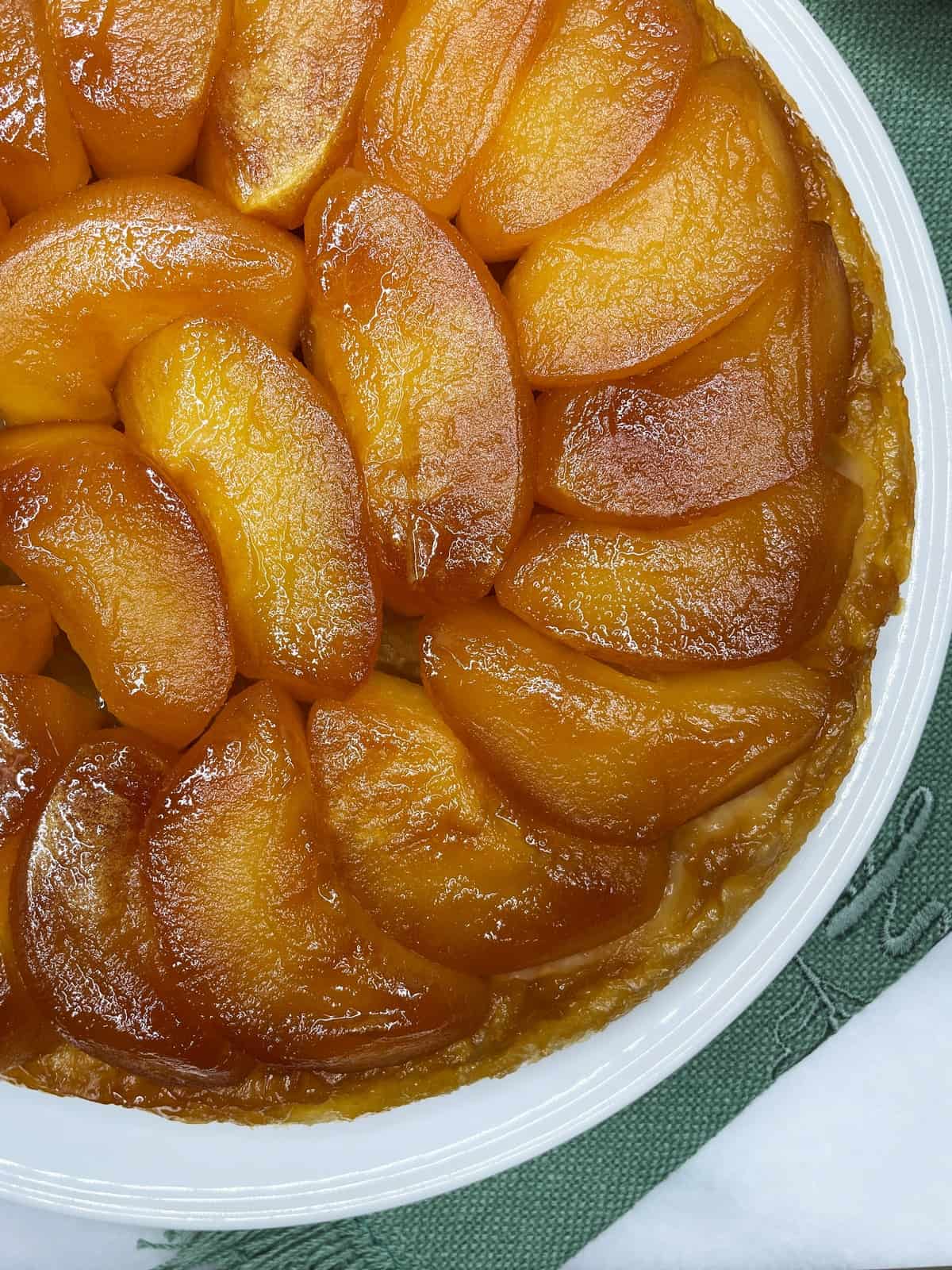
Apples arranged over puff pastry in a concentric circle.

How to make the caramel for Tarte Tatin

The caramel is the heart of a Tarte Tatin, and this recipe uses a dry caramel made solely from sugar. Heat the sugar in a heavy-bottomed pan over medium heat, adding it in batches and swirling the pan rather than stirring, to prevent clumping or crystallization.

Watch it closely: the sugar will melt, then turn from pale gold to a deep amber. Amber is exactly where you want to stop, because caramel keeps cooking from residual heat and can quickly turn bitter if it darkens too far.

As soon as it reaches an even amber color, pour it into your pan to form the base layer, then arrange the apples on top.

Expert Tips

  • Pay attention to making caramel. The caramel continues to cook and darkens further from residual heat in the hot saucepan. If it is overcooked, the baked Tarte Tatin may get a bitter, burned taste. 
  • Poach apples in one batch or divide apples and poach them twice. Do not overcook the apples.
  • Use a different bakeware, such as a pie tin, a cake pan, or an oven-safe skillet: a special Tarte Tatin tin, a nonstick skillet (without a handle), or a cast-iron skillet.
  • Arrange the poached apples tightly by pressing them down against each other and the edge of the pan.
  • To reheat the cooled Tarte Tatin in the pan, bake it at 355°F (180°C) for a few minutes to liquefy the caramel. Then, flip it over and serve.
  • Attention: The calorie count is calculated approximately and does not include the full amounts of caramel and poaching syrup ingredients. 
  • Make-ahead option: You can arrange poached apples on top of the solidified caramel, wrap them in plastic wrap, and refrigerate overnight. The next day, cover the apples with puff pastry and bake.

How to invert (unmold) Tarte Tatin

Inverting is the trickiest step, but a short rest makes it easy. Once the tart comes out of the oven, let it cool for about 20 to 30 minutes so the caramel thickens slightly and the tart sets.

Flipping it straight away sends hot caramel running, while letting it cool completely makes the caramel stick to the pan.

When it is ready, place a serving plate upside down over the pan, hold the plate and pan firmly together with oven mitts, and flip the whole thing over in one confident motion.

Lift the pan away. If any apples stick behind, simply lift them off and press them back into place, then spoon over any caramel left in the pan.

Storing & freezing

Store apple Tarte Tatin in an airtight container in the refrigerator for a couple of days, but it is best served warm, straight from the oven. For another cozy fruit bake, try this easy apple and blueberry crumble.

You can freeze it, well wrapped, for up to 3 months. Thaw it in the refrigerator overnight before slicing and serving.

Best apples for Tarte Tatin aux pommes

Apples must hold their shape throughout cooking to make the best apple Tarte Tatin.

  • Reine de Reinette, Reinette Clochard, Reinette Chanteclerc, and Belle de Boskoop apples have the right balance of sweetness and acidity.
  • Gala and Golden Delicious: I use the latter to make my apple Tarte Tatin.
  • Honeycrisp apples.

You must peel and core apples, slice them into quarters, and caramelize them. Gordon Ramsay and Jacques Sailer recommend peeling apples the night before and keeping them uncovered in the refrigerator to allow them to dry. This step helps avoid a soggy crust.

What is the best pan for Tarte Tatin?

Because Tarte Tatin starts on the stovetop and finishes in the oven, you need a single oven-safe pan with no plastic parts.

A traditional copper or cast-iron Tarte Tatin pan is ideal, as it evenly distributes heat and gives the caramel a deep, even color. A heavy stainless-steel or cast-iron skillet works just as well and is the most common choice for home cooks.

If you do not have an oven-safe skillet, you can make the caramel and cook the apples in a saucepan, then transfer everything to a metal pie tin or cake pan for baking.

Whichever pan you use, choose one about 9 to 10 inches (23 to 25 cm) wide so the apples fit snugly in a single layer.

Recipe FAQ

What is the difference between a tart and a Tarte Tatin?
A traditional tart is filled with fresh fruit, jam, or custard and baked with the pastry on the bottom. Tarte Tatin is an upside-down tart in which the fruit is caramelized on the stovetop first, then covered with pastry, baked, and flipped so the fruit ends up on top.

What are the best apples for Tarte Tatin Pommes?
Use firm, slightly tart apples that hold their shape, such as Pink Lady, Reine des Reinettes, Golden Delicious, Fuji, or Gala. These varieties stay in neat pieces during cooking. Very soft apples break down into applesauce, so a little natural acidity and firmness go a long way.

How do you keep the apples from turning to mush?
Choose firm apples, cook them gently rather than at a hard boil, and do not overcook them on the stovetop. Slightly tart varieties hold together best because their acidity helps stabilize the pectin that keeps the apple pieces intact while they caramelize and bake.

Can you make Tarte Tatin with store-bought puff pastry?
Yes. Good-quality store-bought puff pastry is the easiest option and works beautifully. Simply thaw it, roll it to an even thickness, cut a circle slightly larger than your pan, and prick it with a fork before laying it over the apples.

What is the best pan for Tarte Tatin?
Tarte Tatin should be made in an oven-safe skillet or pan: a dedicated tarte Tatin pan, a pie tin, a nonstick skillet without a plastic handle, or a cast-iron skillet. The pan needs to be moved from the stovetop to the oven and held evenly over the caramel.

How do you serve Tarte Tatin Pommes?
Serve it warm, ideally the day it is made, with homemade whipped cream, a dollop of crème fraîche, sour cream, sweetened mascarpone, or a scoop of vanilla ice cream. The cool, creamy topping balances the warm caramel and apples.

Want more delicious and beautiful recipes? Subscribe to my newsletter and follow me on Facebook, Pinterest, and Instagram for my latest updates. If you make this recipe, please leave a star rating on the recipe card and comment below!

Print

Recipe card

Tarte Tatin Pommes (Apple Tarte Tatin)
Tarte Tatin with caramelized apples packed on top of puff pastry.
Print Recipe
Save Recipe Recipe Saved

5 Stars 4 Stars 3 Stars 2 Stars 1 Star

4 from 2 reviews

Tarte Tatin Pommes, or apple Tarte Tatin, is a four-ingredient signature French apple upside-down dessert with caramelized apples, puff pastry, and silky caramel.

  • Author: Irina Totterman
  • Prep Time: 30 minutes
  • Cook Time: 45 minutes
  • Total Time: 1 hour, 15 minutes
  • Yield: 6 1x
  • Category: Tarts
  • Method: Baking
  • Cuisine: French

Ingredients

Scale

For the caramel:

  • 1 cup (200 g) granulated sugar

For the tart:

  • 7 big apples Golden Delicious
  • 1 cup + 2 tablespoons ( 250 g) granulated sugar  for the syrup
  • 8.8. oz. (250 g) butter for the syrup
  • 1 cup + 4 tablespoons (300 g) water for the syrup
  • 8.8 oz. (250 g) puff pastry, thawed

*Don't you have the correct baking pan on hand right now? Try this simple Cake Pan Converter!

** If needed, please refer to Baking Conversion Charts.

Instructions

  1. Using a rolling pin, roll the thawed puff pastry out to 5 mm thick. Using a 9-inch (23 cm) pie pan as a template, cut a dough circle. Prick it with a fork and set it aside.
  2. To make dry caramel, place â…“ of the granulated sugar in a saucepan and cook over medium heat. Shake the pan over the stovetop while cooking the sugar, but do not use utensils. Add another â…“ of sugar and swirl the saucepan again. Finally, add the remaining sugar. The caramel must get a beautiful color without becoming quite brown. It takes about 3 to 4 minutes. Pour the caramel immediately into the bottom of a 9-inch/23 cm pie tin. Put aside for the caramel to harden.
  3. To poach apples, peel and quarter them. Remove all seeds using a spoon or melon baller. In a large pot, place water, butter, and sugar, and bring to a boil. Add the apples and cook them for about 10 minutes. Remove the apples when they become translucent. Test the apples' readiness: if the tip of a knife goes in without resistance, the apples are ready. Let them cool down.
  4. Preheat the oven to 355°F (180°C). Arrange apple quarters at the bottom of the pie mold, pressing them tightly against the edges in concentric circles.
  5. Place a circle of puff pastry on top of the poached apples. Slightly press the edges of the pastry against the sides of the mold. Bake for 45 minutes until the pastry is golden brown.
  6. Take the tart out of the oven and let it cool down for about 20 to 30 minutes. Then place a serving platter on top of the mold and flip the tart quickly with a sharp move. Tarte Tatin is topped with caramelized apples, while a puff pastry circle forms the base.

Notes

  1. Poach apples as a single batch, or divide them and poach them in two batches. Do not overcook apples!
  2. Arrange the poached apples tightly by pressing them down and against each other.
  3. If the tart has cooled before serving, bake it at 355°F (180°C) for a few minutes to liquefy the caramel. Then, flip it over and serve.
  4. The calorie count is approximate and does not include the full amounts of caramel and poaching syrup ingredients. 
  5. Make-ahead option: You can arrange poached apples on top of the solidified caramel, wrap them in plastic wrap, and refrigerate overnight. The next day, cover apples with puff pastry and bake.

Nutrition

  • Serving Size: 1 slice
  • Calories: 423
  • Sugar: 25.3 g
  • Sodium: 183 mg
  • Fat: 27.1 g
  • Saturated Fat: 11.1 g
  • Carbohydrates: 43.8 g
  • Fiber: 0.6 g
  • Protein: 3.2 g
  • Cholesterol: 30 mg

Thank you for following me on Pinterest, Facebook, and Instagram. Hashtag #bakinglikeachef so I can see your creations.

The nutritional information has been calculated using an online recipe nutrition calculator such as Verywellfit.com and is intended for informational purposes only. These figures should be used as a general guideline and not be construed as a guarantee.

The recipe was adapted from C'est pas de la tart. It was initially published on October 05, 2018. The recipe has been revised to include improved content and photos. 
Tarte aux Fraises (French Strawberry Tart)

Sep 4, 2021 · 23 Comments

French strawberry tart decorated with fresh strawberries and sprinkled with icing sugar and chopped pistachios.

Quick Summary: Tarte aux fraises (French strawberry tart) is a classic French dessert of fresh strawberries arranged over vanilla pastry cream and almond cream on a crisp puff pastry base. It comes together with three make-ahead layers, then a quick assembly, and serves 8.

Decorated tarte aux fraises with strawberries partially sprinkled with icing sugar: Overhead view

What is tarte aux fraises?

Tarte aux fraises is a traditional French dessert made with a buttery tart crust, pastry cream, and fresh strawberries. Tarte aux fraises translates as strawberry tart in English, where "tarte" means tart and "fraises" means strawberries.

In France, tarte aux fraises appears in almost every bakery and boulangerie once strawberry season starts in early May. Traditionally, the sweet pastry crust is made with a sandy shortcrust, or pâte sablée, though French pastry chefs also widely use puff pastry for the tart base, as in this recipe.

A vanilla pastry cream known as crème pâtissière is another key component of a French strawberry tart. This custard is the base for many French desserts, especially fresh fruit tarts, or tarte aux fruits. Many versions, including this one, also add a layer of almond cream (crème d'amande) baked into the pastry shell.

Finally, the seasonal strawberries, glazed with apricot jam or a clear glaze, are the stars of the dessert.

French tart topped with fresh strawberries and dusted with icing sugar on a marble board

Why you'll love this recipe

  • This classic tart is a traditional French dessert. If you love French cuisine, this tart is a must-make.
  • The French strawberry tart recipe is easy to make and has a make-ahead option that helps manage your time on the day of serving.
  • It is a perfect summer dessert with a refreshing taste that highlights the strawberry season.

Ingredients

For ingredients and detailed instructions, refer to the recipe card below.

  • Puff pastry: Use frozen ready-rolled puff pastry or roll it between two parchment paper sheets.
  • Butter: The recipe calls for salted, softened butter (not cold butter) for the almond cream and unsalted butter for the pastry cream. Opt for European-style butter with 82% fat content.
  • Sugar: Use golden brown sugar to make the almond cream and granulated white or caster sugar for the rest of the dessert.
  • Ground almonds: Grind slivered almonds yourself or use almond flour.
  • Eggs: Use an egg separator to separate egg yolks from the whites. Then bring egg yolks and required whole large eggs to room temperature.
  • Milk: The recipe calls for whole milk for the best results.
  • Cornstarch is used to make crème pâtissière. Replace it with all-purpose flour if desired.
  • Vanilla bean: Use the most flavorful Madagascar vanilla beans. You can replace the vanilla bean (gousse de vanille) with 1 tablespoon of vanilla extract or 1 teaspoon of vanilla bean paste.
  • Strawberries: Choose seasonal, ripe strawberries sold at local farmers' markets or picked at farms. Hull the berries, but leave some of them with green tops. Sort strawberries by size to make the tart decoration easier.
  • Icing sugar and pistachios are optional: sprinkle the dessert with icing (powdered) sugar and chopped pistachios.
Sliced French strawberry tart with fresh berries and pistachios on top and a board with strawberries

Equipment

To make this French strawberry tart, you will need the following kitchen tools:

  • fluted tart pan
  • rolling pin
  • parchment paper
  • mixing bowl
  • hand whisk
  • rubber spatula
  • egg separator

How to make French strawberry tart

Step 1. To make almond cream, mix softened butter, ground almonds, and sugar in a large bowl with a rubber spatula.

Step 2. Add the egg and gently mix to combine (photo 1). Cover with plastic wrap in contact and refrigerate.

Step 3. To make puff pastry crust, preheat the oven to 355°F (180°C). Thaw the frozen puff pastry. Using a rolling pin, roll it out on a lightly floured surface or between two parchment paper sheets to â…• inches (5 mm) thick.

Step 4. Line a 9-inch (23 cm) fluted tart pan with a removable bottom with the pastry, pressing it into the bottom and sides of the dish. Trim the edges of the pastry case with a sharp knife and prick the bottom with a fork (photo 2).

Photo 1: Almond cream in a bowl Photo 2: Pricked puff pastry into a tart pan
PHOTO 1 PHOTO 2

Step 5. Blind bake the crust for 25 minutes (no need to use ceramic pie weights or dried beans).

Step 6. Take the pastry out of the oven and lightly press the pastry base to flatten, using a paper towel.

Step 7. Decrease the oven temperature to 300°F (150°C). With a spoon or a small bent spatula, spread the almond cream (photo 3).

Step 8. Bake for a further 20 minutes. Remove it from the oven, and let it cool completely in the pan (photo 4). Then transfer the pastry base to a serving platter. 

Photo 3: Almond cream over pastry shell Photo 4: Puff pastry, almond cream in a pan
PHOTO 3 PHOTO 4

Step 9. To make pastry cream, split the vanilla bean in half lengthwise, and scrape the seeds with the tip of a knife. In a mixing bowl, whisk egg yolks, sugar, and cornstarch with a hand whisk (photo 5).

Step 10. Pour milk into a medium saucepan, add scraped vanilla seeds, and the pot split in half, and bring to a boil. Remove the vanilla pod, and add hot milk while constantly stirring the egg yolk mixture.

Step 11. Pour the egg mixture back into the saucepan and cook the cream over low to medium heat, stirring constantly.

Step 12. Stop cooking when the cream thickens. Remove the pot from the heat, add butter to the thickened mixture, and mix (photo 6).

Pro tip: Learn how to make perfect French pastry cream.

Photo 5: Egg yolks/sugar mixture in a bowl Photo 6: Pastry cream in a saucepan
PHOTO 5 PHOTO 6

Step 13. Immediately transfer the pastry cream to a shallow dish, and cover it with cling film (aka plastic film) in contact. It should touch the whole surface of the cream. Let it cool at room temperature.

Step 14. To assemble the tart, whisk the vanilla pastry cream filling with a hand whisk and spread it on the baked almond cream.

Step 15. Wash, drain, and hull strawberries. Leave a few of them with green tops for decoration. Cut strawberries in half lengthwise and arrange them on the layer of pastry cream (photo 7). Refrigerate at least one hour before serving.

Step 16. To serve, sprinkle the edge of the tart with icing (powdered) sugar. To highlight strawberry halves, take some, sprinkle them with a little icing sugar, and place them back on the tart. Sprinkle the dessert with chopped pistachios (photo 8). Bon appétit!

Photo 7: Tart decorated with strawberries Photo 8: Tart with fresh berries, icing sugar, and pistachios
PHOTO 7 PHOTO 8

Expert Tips

  1. Do not overmix the almond cream; otherwise, it will swell during baking and overflow the tart. Use only a rubber spatula for this step.
  2. Watch the color of the almond cream while baking: it has to be lightly brown.
  3. Cut fresh strawberries in two or four, depending on the size. Leave some of them with green tops.
  4. Arrange strawberries on top of the tart however you like.

Recipe variations

Instead of making a large strawberry tart, you can make individual tarts (tartelettes individuelles) or French strawberry tartlets using small tart tins. Decorate them with halves, quarters, or thin slices of fresh strawberries, or use wild strawberries if available.

Here are a few ways to decorate tarte aux fraises:

  • Arrange fresh strawberries cut in half to place them spontaneously in different directions. It is the same technique used by French chefs Cyril Lignac and Benoît Couvrand to decorate their Tarte aux fraises.
  • Arrange berries cut side up or side down, leaning strawberries up a little as you work along the edge or towards the center. Start from the outside of the tart, slightly overlapping strawberries.
  • Slice strawberries into the thickness and decorate your tarte au fraise in a circular pattern, resembling a strawberry "rose" on top of the dessert. Or place strawberry slices about â…“ inch (1 cm) thick harmoniously on top of the tart to cover the pastry cream.

If you desire, cover berries with a fruit tart glaze or brush them with warm apricot jam. Sprinkle the top of the dessert with chopped pistachios, toasted flaked almonds, and decorate with fresh mint or verbena leaves.

Storing & freezing

Keep the finished strawberry tart with pastry cream refrigerated for up to 24 hours. It is not recommended to freeze the assembled strawberry tart.

Recipe FAQ

Can you make tarte aux fraises in advance?
You can bake a puff pastry tart shell with almond cream one day ahead and keep it at room temperature, covered with a tea towel. You can also make the pastry cream in advance and refrigerate it for up to 2 days, covered with plastic in contact. On the day of serving, decorate the tart with strawberries.

Do you need to use pie weights to bake the puff pastry crust?
No. You do not need to line this type of tart pastry with parchment or aluminum foil, and you do not need pie weights or dried chickpeas. The puff pastry layers need to rise and puff up as they bake.

Can I use pâte sablée instead of puff pastry?
Yes. Traditionally, French bakeries make tarte aux fraises with a sweet shortcrust pastry (pâte sablée or pâte sucrée). This recipe uses puff pastry for a lighter, flakier base, but you can swap in a blind-baked sweet crust if you prefer.

What are the best strawberries for a French strawberry tart?
Choose small to medium, ripe, deep-red strawberries that are firm and fragrant. Halve or slice larger berries, and arrange them cut-side down so the tart holds its shape when sliced.

How long does tarte aux fraises last?
It is best eaten the same day, while the pastry is crisp. Once assembled, keep it in the refrigerator and enjoy within 1 to 2 days. The crust softens over time as it sits on the cream.

How many calories are in French strawberry tart?
One slice of this tarte aux fraises has about 398 calories, based on the recipe serving 8.

Love French fruit tarts? Try these next!

  • Cherry Puff Pastry Tart
  • Peach and Blueberry Galette
  • French Fig Tart
  • French Lemon Cream Tart
  • Browse all the Tart Recipes

Want more delicious and beautiful recipes? Subscribe to my newsletter and follow me on Facebook, Pinterest, and Instagram for my latest updates. If you make this recipe, please leave a star rating on the recipe card and comment below!

Print

Recipe card

Tarte aux Fraises (French Strawberry Tart)

French strawberry tart decorated with fresh strawberries and sprinkled with icing sugar and chopped pistachios.
Print Recipe
Save Recipe Recipe Saved

5 Stars 4 Stars 3 Stars 2 Stars 1 Star

5 from 11 reviews

This French strawberry tart, or tarte aux fraises, is a classic French dessert made with a crisp puff pastry base, almond cream (crème d'amande), and vanilla pastry cream (crème pâtissière), topped with fresh strawberries and a shiny glaze. It is an easy, make-ahead French fruit tart that serves 8.

  • Author: Irina Totterman
  • Prep Time: 1 hour
  • Cook Time: 30 minutes
  • Total Time: 1 hour 30 minutes
  • Yield: 8 1x
  • Category: Tarts
  • Method: Baking
  • Cuisine: French

Ingredients

Scale

1 sheet puff pastry

For the almond cream:

  • 3 ½ tablespoons (50 g) salted butter, softened
  • 4 tablespoons (50 g) brown sugar
  • ½ cup + 1 teaspoon (50 g) almond flour
  • 1 large egg

For the pastry cream:

  • â…” cup + 1 tablespoon (175 g) whole milk
  • 8 ½ teaspoons (40 g) granulated white sugar
  • 1 ½ tablespoon (15 g) corn starch
  • 2 large egg yolks
  • 1 vanilla bean
  • 1 tablespoon (15 g) unsalted butter

For decoration:

  • 17.5 oz. (500 g) fresh strawberries
  • 1 tablespoon icing (powdered) sugar
  • 0.35 oz. (10 g) raw pistachios (see note #1)

*Don't you have the correct baking pan on hand right now? Try this simple Cake Pan Converter!

** If needed, please refer to Baking Conversion Charts.

Instructions

  1. To make the almond cream, mix softened butter, ground almonds, and sugar with a rubber spatula. Add the egg and gently mix just to combine. Cover it with plastic film in contact and refrigerate.
  2. To make the puff pastry crust, preheat the oven to 355°F (180°C). Thaw the frozen butter puff pastry and, using a rolling pin, roll it out between two parchment paper sheets to ⅕ inch (5 mm) thick. Line a 9-inch (23 cm) fluted tart pan with a removable base with the pastry, pressing it into the bottom and sides of the dish. Trim the edge with a sharp knife and prick the bottom with a fork. Bake for 25 minutes. Take the pastry out of the oven and lightly press the pastry base to flatten, using a paper towel. Decrease the oven temperature to 300°F (150°C). With a spoon or a small bent spatula, spread the almond cream. Bake for a further 20 minutes. Remove it from the oven, let it cool completely in the pan, then transfer the pastry base to a serving platter.
  3. To make the pastry cream, split the vanilla bean in half lengthwise, and scrape the seeds with the tip of a knife. In a mixing bowl, whisk egg yolks, sugar, and cornstarch with a hand whisk. Pour milk into a medium saucepan, add scraped vanilla seeds, split the pod in half, and bring to a boil. Remove the vanilla pod, and add hot milk while stirring to the egg yolk mixture. Pour the mixture back into the saucepan and cook the cream over low to medium heat, stirring constantly. Stop cooking when the cream thickens. Remove the pot from the heat, add butter, and mix. Transfer the pastry cream to a shallow dish, and cover it with plastic in contact (it should touch the whole surface of the cream). Let it cool at room temperature.
  4. To assemble the tart, whisk the pastry cream with a hand whisk and spread it on top of the baked almond cream. Wash, drain, and hull strawberries. Leave a few of them with green tops for decoration. Cut strawberries in half lengthwise and arrange them over the tart. Refrigerate at least one hour before serving.
  5. To serve tarte aux fraises, sprinkle the edge of the tart with icing (powdered) sugar. To highlight strawberry halves, take some, sprinkle them with icing sugar, and place them back on the tart. Sprinkle the dessert with chopped pistachios. 

Notes

  1. 10 g of pistachios equal about 18 raw pistachios.
  2. Do not overmix the almond cream; otherwise, it will swell during baking and overflow the tart. Use only a rubber spatula for this step.
  3. Watch the color of the almond cream while baking: it has to be lightly brown.
  4. Cut fresh strawberries in two or four, depending on the size. Leave some of them with green tops.
  5. Arrange strawberries on top of the tart in the way you desire.

Nutrition

  • Serving Size: 1 slice
  • Calories: 398
  • Sugar: 12.1 g
  • Sodium: 152 mg
  • Fat: 27.1 g
  • Saturated Fat: 9.1 g
  • Carbohydrates: 33.7 g
  • Fiber: 2.6 g
  • Protein: 7.1 g
  • Cholesterol: 95 mg

Thank you for following me on Pinterest, Facebook, and Instagram. Hashtag #bakinglikeachef so I can see your creations.

The nutritional information has been calculated using an online recipe nutrition calculator such as Verywellfit.com and is intended for informational purposes only. These figures should be used as a general guideline and not be construed as a guarantee.

The recipe was originally published on April 07, 2021. It has been revised to include improved content and photos. All posted pictures are mine.

Cherry Puff Pastry Tart

Sep 2, 2021 · 12 Comments

Sliced cherry tart featuring cherries on parchment paper.

Quick Summary: Cherry puff pastry tart is a rustic French tart made with a store-bought puff pastry base, an almond cream filling, and fresh cherries, baked until the pastry turns golden. It needs only a few ingredients and about 45 minutes.

Sliced cherry tart featuring cherries on parchment paper

What is a cherry puff pastry tart?

A cherry puff pastry tart is a rustic, free-form tart that uses a sheet of puff pastry as its base instead of a traditional shortcrust pastry. The pastry is shaped in a ring or mold, filled with a light almond cream, and topped with whole fresh cherries before baking.

Unlike a classic French cherry clafoutis or a lattice-topped cherry pie, this version keeps things simple: the flaky, buttery layers of the puff pastry do the work, so you skip rolling and blind-baking a homemade crust. The result is a light dessert that pairs the tartness of cherries with a soft, creamy filling.

Separated slices of cherry tart on parchment paper: Close up

Why you'll love this recipe

  1. This tart recipe is one of the best cherry recipes.
  2. It does not require a pizza cutter or precise tart shaping. Forget about store-bought cherry pie filling, too. Everything is made with minimal effort and is simplified!
  3. Using a store-bought puff pastry is a lifesaver while making the tart. The only downside is that store-bought pastry may not be as airy (i.e., less flaky) as a homemade puff pastry, but if you need something quick, then it cannot be beaten.
  4. This rustic cherry tart is a perfect balance between buttery and flaky pastry and sweet cherries.

Ingredients

For ingredients and detailed instructions, refer to the recipe card below.

  • Puff pastry: use a store-bought frozen puff pastry (pâte feuilletée in French) by Pepperidge Farm. Thaw it in the refrigerator overnight. You can also thaw the puff pastry on the countertop, but check it every 5 to 10 minutes; it softens quickly, making it challenging to work with. Follow Cathy Barrow's quick puff pastry recipe if you want to make homemade pastry dough.
  • Cherries: the recipe calls for fresh cherries. You can use sweet or sour cherries to make the recipe. Make sure to pit them, but leave cherries whole. Read on how to pit cherries easily. It is a personal preference to use a cherry pitter or use a simpler technique with a bottle of wine and a wooden skewer. You can also replace fresh cherries with frozen ones when fresh fruits are out of season; no need to thaw them.
  • Icing sugar: make it yourself or use store-bought powdered sugar.
  • Almond flour: the recipe calls for almond flour or ground almonds.
  • Eggs: use whole large eggs at room temperature.
  • Lemon: make fresh lemon juice with a citrus juicer or use bottled 100% lemon juice. You can replace lemon juice with fresh lime juice if desired.
  • Heavy cream: must have at least 36% fat. Replace it with whipping cream if desired.
  • Almonds: use either slivered almonds or flaked almonds for this recipe.
A single slice of tart with the rest of the dessert and cherries in the background

Equipment

You need a few basic tools to make this cherry puff pastry tart.

  • oval pastry ring holds the tart together as it bakes.
  • rolling pin rolls the cold puff pastry to an even thickness.
  • pastry brush
  • parchment paper stops the dough from sticking.
  • hand whisk blends the almond cream filling smoothly.

How to make cherry puff pastry tart

Step 1. Preheat the oven to 380°F (190°C). Get ready a baking sheet covered with a sheet of parchment paper.

Step 2. Using a pastry brush, butter the baking parchment and sprinkle it with brown sugar. Place an oval pastry ring (see note #1) on parchment.

Step 3. Using a rolling pin, roll the thawed but still cold sheet of puff pastry on a work surface to â…•-inch (5 mm) thick.

Step 4. Using your hands, bring the dough over the pastry ring. Then, gently press it into the mold.

Step 5. Cut off any excess pastry with a sharp knife. Prick the bottom with a fork (photo 1). Refrigerate while making the filling cream.

Step 6. To make the filling, mix eggs, cream, almond flour, sugar, and lemon juice in a small bowl with a hand whisk (photo 2).

Photo 1: Puff pastry into a pastry ring Photo 2: Tart filling in a metal bowl
PHOTO 1 PHOTO 2

Step 7. Pour the preparation over the puff pastry sheet and divide the pitted cherries over it. Sprinkle with slivered almonds (photo 3).

Step 8. Bake for 30 to 35 minutes until the edges of the pastry become golden brown.

Step 9. Let it cool, then remove the tart from the ring/mold and cut it into pieces with a sharp knife (photo 4). 

Photo 3: Garnished tart with cherries and almonds Photo 4: Sliced cherry tart on parchment
PHOTO 3 PHOTO 4

Step 10. Serve it plain or sprinkled with icing sugar. Or accompany it with vanilla ice cream or whipped cream.

Expert tips

  1. Use one of the authentic pastry rings (perforated or non-perforated), 0.75-inch (about 2 cm) high, or make it yourself (instructions are in the FAQ section). This oval pastry ring is equivalent to an 8-inch (20 cm) round pastry ring.
  2. Make sure that the butter puff pastry is thawed but cold. If it becomes warm and soft, bring it to the freezer for 5 minutes. 
  3. Use a rolling pin to roll out the puff pastry dough; don't stretch it. 
  4. Replace fresh cherries with the frozen ones: don't thaw them.

Recipe variations

This cherry puff pastry tart is easy to adapt. Here are a few ways to change it up:

  • Cream cheese filling: swap the almond cream for a sweetened cream cheese mixture to make a cherry-Danish-style tart.
  • Other fruit: replace the cherries with plums, apricots, or berries when they are in season.
  • Frozen cherries: use them straight from the freezer, no need to thaw.
  • Extra flavor: add a splash of kirsch or almond extract to the filling, or scatter more slivered almonds on top for crunch.

Storing & freezing

This cherry tart is best eaten on the day it is made. To store leftovers, cover them with plastic wrap and refrigerate for 2 to 3 days.

You can also freeze the fully cooled cherry tart, tightly covered with plastic wrap, for up to 1 month. To thaw, refrigerate the tart for 24 hours.

Recipe FAQ

What is a pastry ring?
A pastry ring is a baking tool used to shape pastry and hold it together during baking or assembly. Pastry rings come in four different shapes: round, oval, square, and triangular. The height of pastry rings varies from 0.75 inch (about 2 cm) to 1.75 inches (4.5 cm) and higher.

What's the difference between perforated and non-perforated pastry rings?
Unlike non-perforated pastry rings, perforated rings ensure perfect heat conduction for the pastry, resulting in golden edges and crisp crusts.

How to make a pastry ring yourself?
To make a pastry ring, cut a strip of cardboard approximately 2 inches (5 cm) wide and long enough for your preparation. Then adjust it with a metal paper clip to get a circle. Next, cover your cardboard ring with aluminum foil to strengthen it. When your preparation is ready, you can create a bottom of the ring with aluminum foil to avoid leaks. Finally, once your pastry is baked, just cut out the cardboard circle with a pair of scissors.

Can you make this tart with frozen cherries?
Yes, absolutely. Use frozen cherries: no need to thaw them.

How many calories are in cherry puff pastry tart?
One serving of this cherry puff pastry tart has about 448 calories, based on 4 to 6 servings per tart.

Love tarts? Try these next!

  • Cherry Crumb Pie
  • Cherry Pizza (Cherry Dessert Pizza)
  • Peach and Blueberry Galette
  • Puff Pastry Peach Galette
  • French Plum Frangipane Tart
  • French Fig Tart
  • Tarte aux Fraises (French Strawberry Tart)
  • French Caramel Apple Tart
  • Browse all Pies & Tarts recipes.

Want more delicious and beautiful recipes? Subscribe to my newsletter and follow me on Facebook, Pinterest, and Instagram for my latest updates. If you make this recipe, please leave a star rating on the recipe card and comment below!

Print

Recipe card

Cherry Puff Pastry Tart

Sliced cherry tart featuring cherries on parchment paper.
Print Recipe
Save Recipe Recipe Saved

5 Stars 4 Stars 3 Stars 2 Stars 1 Star

5 from 5 reviews

This cherry puff pastry tart is a rustic French tart made with a store-bought puff pastry base, a simple almond cream filling, and fresh cherries. It needs only a few ingredients and about 45 minutes, and there is no homemade crust to roll or blind-bake.

  • Author: Irina Totterman
  • Prep Time: 15 minutes
  • Cook Time: 30 minutes
  • Total Time: 45 minutes
  • Yield: 4-6 1x
  • Category: Pies and Tarts
  • Method: Baking
  • Cuisine: French

Ingredients

Scale
  • 8.8 oz. (250 g) thawed puff pastry
  • 7 oz. (200 g) pitted cherries
  • 1 tablespoon icing (powdered) sugar
  • 2 tablespoons (15 g) almond flour
  • 2 large eggs
  • 1 tablespoon lemon juice
  • 4 ½ tablespoons (65 ml) heavy cream
  • 1.4 oz. (40 g) slivered almonds

*Don't you have the correct baking pan on hand right now? Try this simple Cake Pan Converter!

** If needed, please refer to Baking Conversion Charts.

Instructions

  1. Preheat the oven to 380°F (190°C). Butter a sheet of parchment paper and sprinkle it with brown sugar. Place an oval pastry ring (see note #1) on parchment.
  2. Using a rolling pin, roll the thawed still cold puff pastry to â…•-inch (5 mm) thick. Using hands, bring the pastry over the pastry ring. Gently press it into the mold. Cut off any excess pastry with a sharp knife. Prick the bottom with a fork. Refrigerate while making the filling cream.
  3. To make the filling, mix eggs, cream, ground almonds, sugar, and lemon juice in a mixing bowl. Pour the preparation on the tart shell and divide the pitted cherries over it. Sprinkle with slivered almonds. Bake for 30 to 35 minutes. Let it cool, remove the tart from the ring/mold, and cut it into pieces. 
  4. Serve it plain or sprinkled with icing sugar. Or accompany it with vanilla ice cream or whipped cream.

Notes

  1. Use one of the authentic pastry rings (perforated or non-perforated) 0.75-inch (about 2 cm) high, or make it yourself (the instruction is in the FAQ section of the post). This oval pastry ring equals 8-inch (20 cm) round pastry ring.
  2. Make sure that the puff pastry is thawed but cold. If it becomes warm and soft, bring it to the freezer for 5 minutes. 
  3. Use a rolling pin to roll the puff pastry out: don't stretch the dough.
  4. Replace fresh cherries with the frozen ones: don't thaw them. 

Nutrition

  • Serving Size: 1 slice
  • Calories: 448
  • Sugar: 9.6 g
  • Sodium: 158 mg
  • Fat: 31.4 g
  • Saturated Fat: 8.9 g
  • Carbohydrates: 34.4 g
  • Fiber: 2.2 g
  • Protein: 8.8 g
  • Cholesterol: 92 mg

Thank you for following me on Pinterest, Facebook, and Instagram. Hashtag #bakinglikeachef so I can see your creations.

The nutritional information has been calculated using an online recipe nutrition calculator such as Verywellfit.com and is intended for informational purposes only. These figures should be used as a general guideline and not be construed as a guarantee.

The recipe was originally published on June 24, 2021. It has been revised to include improved content and photos. 

Peach and Blueberry Galette (Easy Rustic Fruit Tart)

Sep 1, 2021 · 18 Comments

Peach and blueberry galette with a scoop of ice cream on top.

Quick Summary: This peach and blueberry galette is a free-form, rustic fruit tart with a flaky shortcrust base, juicy summer peaches, and fresh blueberries. It is baked flat on a sheet with no pan and comes together with simple ingredients for an easy summer dessert.

Peach and blueberry galette with a scoop of ice cream on top.

What is a galette?

A galette is a free-form French tart baked flat on a sheet with no pan. You roll out a single round of pastry, pile fruit in the center, and fold the edges up and over to hold everything in. Because it is hand-shaped, a galette is meant to look rustic, making it far more forgiving than a traditional pie.

This peach and blueberry galette pairs juicy summer peaches with fresh blueberries on a buttery shortcrust base.

If you are peach‑obsessed like me, you will also love this easy Puff Pastry Peach Galette and Peach Panna Cotta Tart.

Why you'll love it

  • Uses simple ingredients and comes together fast.
  • Sweet peaches and juicy blueberries balance each other perfectly.
  • The shortcrust pastry is easy and forgiving. Re‑roll if needed.
  • Great for gatherings, holidays, or anytime peaches are in season.

Ingredients

For ingredients and detailed instructions, refer to the recipe card below.

  • Flour: Use all-purpose flour for the shortcrust pastry.
  • Butter: Use cold unsalted butter, not room temperature.
  • Sugar: Granulated or caster sugar for the crust; golden brown sugar to sprinkle.
  • Salt: Enhances flavor.
  • Egg yolk: Separate them from the egg whites and keep them cold.
  • Ice water: Use ¼ cup (60 ml) with ice cubes or chilled from the fridge.
  • Peaches: Choose firm, ripe peaches (4 medium or three large). Replace with nectarines if desired.
  • Blueberries: Add for contrast, or swap them for blackberries or raspberries. Optionally, use only stone fruit or only blueberries.
  • Almond flour: Prevents soggy crust.
  • Almonds: Chopped or flaked for crunch.
Overhead view of a peach and blueberry galette topped with a scoop of vanilla ice cream.

Equipment

  • Large mixing bowl
  • Rolling pin
  • Parchment paper
  • Baking sheet
  • Pastry brush
  • Wire cooling rack

How to make peach and blueberry galette

Step 1. To make the shortcrust pastry, sift flour, sugar, and salt, then mix with cold cubed butter until the mixture is crumbly.

Step 2. Add the egg yolk and ice water and mix until the dough starts to come together. Knead briefly on a floured surface, shape into a ball, wrap, and chill for 30 minutes.

Step 3. Preheat oven to 355°F (180°C). Roll the dough between sheets of parchment paper into a 10-inch (26 cm) circle, then transfer to a baking sheet.

Step 4. To assemble the galette, mix almond flour and sugar. Spread the mixture in a 9-inch (23 cm) circle on the dough.

Step 5. Arrange peach slices and blueberries, leaving a 1.5-2 inch border. Fold the dough edges over the fruit, brush with egg wash, and sprinkle with brown sugar and flaked almonds.

Step 6. Bake 45-55 minutes until golden. Cool 10 minutes, then slice and serve with vanilla ice cream, crème fraîche, or homemade whipped cream.

Expert tips

  • Keep all ingredients cold, even dry ones.
  • Roll and assemble the dough on parchment to avoid breaking.
  • Use another parchment sheet on top when rolling instead of flour.
  • Peel peaches if you like, or leave the skin on.
  • Don't worry about imperfections for a rustic look.
  • For brushing, use egg wash (one large egg beaten with 1 tablespoon (15ml) of water, milk, or cream) instead of just a beaten egg.
  • Before serving, place a few fresh mint leaves on top of the dessert.

How to shape a galette

Folding a galette is quite simple. As a free-form pie, called la tarte rustique in French, it is made without a mold.

To keep its rustic charm, don't trim the edges of your rolled pastry. Just leave them imperfect. But if you prefer a neat, round galette, use a large mixing bowl or plate as a template. Place it on the dough and trim around it.

Add the fruit filling in the center of the rolled pastry, then fold a flap of dough up over the filling. Turn the pastry a bit and fold another flap, continuing until the entire edge is tucked around the fruit. It is an easy and forgiving way to fold a galette.

Here is a handy trick: make small cuts about 2 inches (5 cm) inward from the edge, spaced every 2 inches. This makes it much easier to fold the dough edges.

You can also get creative by making small individual galettes. Use the same folding technique.

Recipe variations

This peach and blueberry galette is easy to adapt to what you have on hand:

  • Other fruit: Swap in nectarines, plums, apricots, or a mix of summer berries.
  • Frangipane base: Spread a thin layer of almond frangipane under the fruit for a richer tart.
  • Spices: Add a pinch of cinnamon, cardamom, or fresh thyme to the fruit.
  • Citrus and vanilla: Toss the fruit with lemon zest or a splash of vanilla before filling.
  • Finishing touch: Brush the baked crust with warm apricot jam for shine, or sprinkle coarse sugar on the edges before baking.

Storing & freezing

Keep your galette at room temperature for up to 24 hours. Wrap leftovers in plastic wrap and refrigerate for 2 to 3 days.

You can freeze your galette wrapped in plastic for up to 3 months. Thaw overnight in the refrigerator and reheat in the oven for a few minutes at the same temperature you used to bake the galette.

Recipe FAQ

Can you make a fruit galette in advance?
The galette is best warm, right after baking. You can make the shortcrust pastry up to 8 days ahead, wrap it, refrigerate it, and thaw it overnight before baking.

Can you make this galette with frozen fruit?
Yes. Thaw and dry the frozen peaches first, but you can scatter frozen blueberries on top without thawing.

Can you make this galette with canned peaches?
Yes, canned peaches work too. Drain them well first to avoid a soggy base.

How do you prevent a fruit galette from having a soggy bottom?
Avoid creamy or egg-based fillings, and sprinkle ground almonds or almond flour on the dough to absorb the fruit juices before adding the fruit.

How many calories are in a peach and blueberry galette?
One slice has about 435 calories, based on the servings listed on the recipe card.

Love fruit desserts? Try these next!

  • Puff Pastry Peach Galette
  • Peach Panna Cotta Tart
  • Apple and Blueberry Crumble
  • German Strawberry Cake
  • Or browse all the tarts and pies

Want more delicious and beautiful recipes? Subscribe to my newsletter and follow me on Facebook, Pinterest, and Instagram for my latest updates. If you make this recipe, please leave a star rating on the recipe card and comment below!

Print

Recipe card

Peach and Blueberry Galette

Peach and blueberry galette with a scoop of ice cream on top.
Print Recipe
Save Recipe Recipe Saved

5 Stars 4 Stars 3 Stars 2 Stars 1 Star

5 from 9 reviews

This easy peach and blueberry galette is made with a buttery pastry crust and fresh seasonal peaches. Served hot right from the oven with a scoop of vanilla ice cream melting on top, this galette tastes like summer.

  • Author: Irina Totterman
  • Prep Time: 25 minutes
  • Cook Time: 50 minutes
  • Total Time: 1 hour, 15 minutes (plus resting time)
  • Yield: 6 1x
  • Category: Pies and Tarts
  • Method: Baking
  • Cuisine: French

Ingredients

Scale

For the shortcrust pastry:

  • 2 cups (250 g) all-purpose flour
  • 4.4 oz. (125 g) unsalted butter, cold
  • 2 tablespoons (30 g) granulated sugar
  • 1 pinch of salt
  • 1 egg yolk
  • 2 tablespoons ice-cold water

For filling:

  • 3 large peaches
  • 2 oz. (60 g) blueberries
  • 1 tablespoon almond flour
  • 1 tablespoon granulated sugar
  • 2 tablespoons brown sugar
  • 1 oz. (30 g) flaked almonds

** If needed, please refer to Baking Conversion Charts.

Instructions

  1. To make the shortcrust pastry, sift flour with a flour sifter. Place flour, sugar, and salt in the bowl of a stand mixer fitted with a paddle attachment and mix at low speed. Add the cold butter, cut into small cubes, and mix for 1 to 2 minutes.
  2. Add the egg yolk to the flour mixture and combine for about 20 seconds until the texture resembles coarse-grained sand. Pour ice water and knead the pastry for 2 to 3 minutes till the dough begins to hold.
  3. Turn the dough out onto a lightly floured work surface and knead by hand until smooth. Place it in a salad bowl, cover it with plastic film, and refrigerate it for 30 minutes.
  4. Preheat the oven to 355°F (180°C). Take the pastry from the refrigerator and, using a rolling pin, roll it out between two sheets of parchment paper to a thickness of 3 to 4 mm. You should end up with an imperfect pastry circle measuring 10 inches (26 cm). Transfer it with the bottom parchment to a baking sheet.
  5. To assemble the galette, wash the peaches. Cut them, with the skin on, into thin slices.  Mix almond flour with granulated sugar, then scatter the mixture onto the pastry shell, forming a circle about 9 inches (23 cm) in diameter. Arrange peach slices in a circular pattern, add blueberries, making sure to garnish about 1.5 to 2 inches (3.5 to 5 cm) from the edge.
  6. Fold the pastry over the fruit, forming occasional pleats. Add flaked almonds on top, then use a pastry brush to brush the crust with the beaten egg. Then, sprinkle the brown sugar (use a mini strainer) and flaked almonds over the dough.
  7. Bake for about 45 to 55 minutes in the middle rack of the oven. It is ready when the pastry is cooked and golden brown. Let it cool for about 10 minutes and serve with a scoop of vanilla ice cream.

Notes

  1. Make sure all ingredients are cold before you start. You can even place dry ingredients such as flour, sugar, and salt in the refrigerator to keep them cold.
  2. Roll out the pastry dough and assemble the galette on parchment paper. It prevents the shell from breaking when transferring it from the working surface to parchment.
  3. Do not use any flour while rolling the dough. Instead, put a second sheet of dough on top of the dough to roll out, making this step easier.
  4. Leave the peaches with the skin on or peel them if desired. 
  5. Don't worry about making the perfect galette. The more imperfections it has, the more rustic it looks.
  6. Instead of a beaten egg, use an egg wash (1 large egg beaten with 1 tablespoon (15ml) water, milk, or cream). 

Nutrition

  • Serving Size: 1 slice
  • Calories: 435
  • Sugar: 24.1 g
  • Sodium: 32 mg
  • Fat: 20.9 g
  • Saturated Fat: 11.2 g
  • Carbohydrates: 56.5 g
  • Fiber: 4 g
  • Protein: 7.5 g
  • Cholesterol: 80 mg

Thank you for following me on Pinterest, Facebook, and Instagram. Hashtag #bakinglikeachef so I can see your creations.

The nutritional information has been calculated using an online recipe nutrition calculator such as Verywellfit.com and is intended for informational purposes only. These figures should be used as a general guideline and not be construed as a guarantee.

The recipe was originally published on June 04, 2021. It has been revised to include improved content and photos. 

French Pumpkin Pie

Aug 18, 2021 · 43 Comments

Ready Pumpkin Pie served on a marble cutting board.

Quick Summary: French pumpkin pie, known in French as tarte à la citrouille, is a spiced pumpkin custard baked in a homemade shortcrust and finished with a light meringue swirl. This version uses fresh pumpkin puree, cinnamon, and nutmeg for a smooth filling with a sunny yellow color. Bake the crust blind first, then bake the filling at a low temperature so it sets without browning.

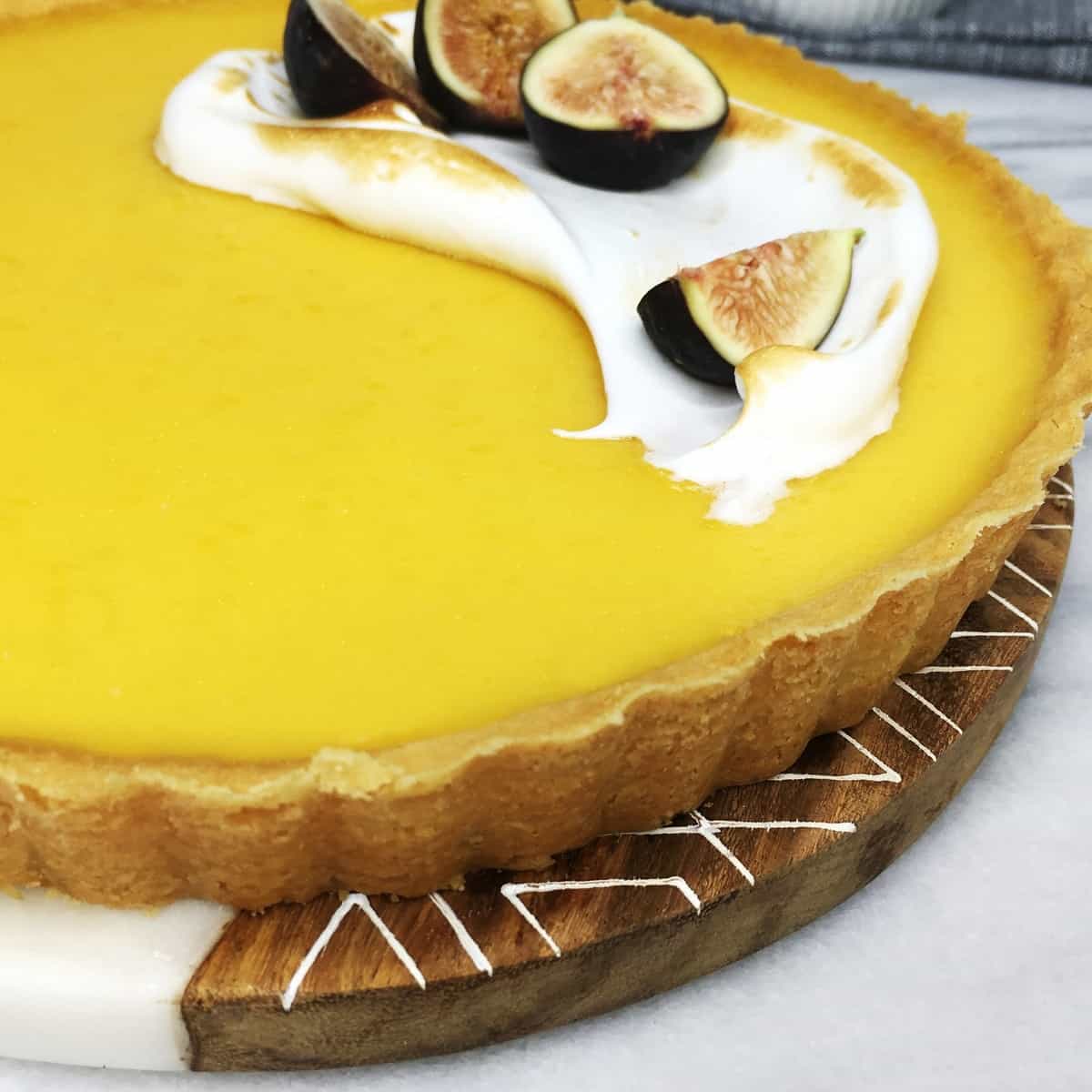
Pumpkin Pie with yellow filling and meringue with fresh figs on top: Closeup

What is French pumpkin pie?

French pumpkin pie is a pumpkin custard tart baked in a homemade crust, made the French way with fresh pumpkin puree rather than canned. It is called tarte a la citrouille in French.

The filling is cooked pumpkin blended with cream, sugar, and warm spices such as cinnamon and nutmeg, then poured into a pre-baked crust and set in the oven at a low temperature to keep it smooth and pale.

In France, you will also see tourte au potiron. A tourte is a closed, two-crust pie, while a tarte is open with the filling on show. The words citrouille and potiron both translate as pumpkin, though bakers tend to reach for potiron for its sweeter, less watery flesh.

This version keeps the American pumpkin pie idea and gives it a French crust and a light meringue finish, so it works for Thanksgiving, Christmas, or any time in the fall.

There is a difference worth knowing for pumpkin fans. According to Talk in French: "... le potiron is smaller and more elongated while la citrouille is bigger and rounder."

A pie filled with pumpkin puree and topped with meringue and fresh figs: Overhead view

Do you blind bake pumpkin pie?

Yes. Because pumpkin pie has a custard filling, you should blind bake the crust first. Blind baking means partially baking the empty crust before adding the filling.

This does two things: it lets the crust and the custard finish baking at the same time, and it keeps the base from turning soggy under the wet filling.

The usual method is to line the crust with parchment paper, fill it with pie weights or dried beans to hold its shape, and then bake. Rice, dried peas, or lentils can be used in place of pie weights.

You can also blind bake without weights: press the dough firmly into the base and sides of the pan, prick it all over with a fork, and bake as directed.

A pie with yellow pumpkin filling topped with meringue and fresh figs: Close up

Why you'll love this recipe

  1. This homemade pumpkin pie recipe is a basic, from-scratch recipe. Make a shared version of pumpkin pie or mini pumpkin pies.
  2. Using seasonal types of pumpkin makes pumpkin pie one of the favorite desserts to enjoy all year round.
  3. Freezing fresh pumpkin purée saves time in making the dessert.
  4. Baking the pumpkin filling in ramekins makes a new gluten-free dessert for a pumpkin pie lover.
  5. The plain matte surface of the finished pie calls for your creativity and decoration skills.

Ingredients

For ingredients and detailed instructions, refer to the recipe card below.

  • Flour: use all-purpose flour to make this pumpkin pie.
  • Butter: use unsalted butter to make the recipe.
  • Icing sugar: make it yourself with a coffee grinder, or use store-bought powdered sugar.
  • Eggs: use large eggs for the recipe. To facilitate the separation of egg whites from yolks of eggs, use chilled eggs and an egg separator. Then bring egg yolks to room temperature.
  • Spices: the recipe calls for ground cinnamon and nutmeg, but feel free to customize the pie crust by adding spices of your choice, such as allspice, cloves, and ground ginger.
  • Pumpkin: use sugar or pie pumpkins, or experiment with winter squash, such as butternut. You can also replace part of the pumpkin with candied yams or sweet potato for extra sweetness and flavor. Canned pumpkin purée works too; just make sure you don't accidentally buy pumpkin pie filling or mix.
  • Whipping cream: use your favorite brand.
  • Powdered milk: use whole milk powder to make the pumpkin filling.
  • Sugar: use granulated or caster sugar. You can also try using half white and half brown sugar in the pumpkin filling to add some caramel flavor to the pie.
  • Salt: a pinch harmonizes and balances the pie's flavors.

Equipment

Here are the main tools you need to make this recipe:

  • pie pan
  • parchment paper
  • egg separator
  • stand mixer
  • saucepan
  • colander
  • rolling pin
  • fluted tart pan
  • stainless steel tart ring
  • electric mixer
  • rubber spatula
  • blow torch
  • food processor
  • ramekins

How to make French pumpkin pie

Step 1. To make the homemade pie crust, place sifted flour, ground cinnamon, nutmeg, chilled butter cut into small cubes, and icing (powdered) sugar in the bowl of a stand mixer and mix until fine breadcrumbs.

Step 2. Add egg yolk and process until the pastry dough comes together (photo 1). Wrap in plastic wrap and refrigerate for one hour (photo 2).

Photo 1: Pastry dough in a bowl Photo 2: Dough wrapped in plastic film
PHOTO 1 PHOTO 2

Step 3. To make the pumpkin filling, pour 1 liter of water into a medium saucepan and bring it to a boil.

Step 4. Peel the pumpkin, cut the pulp into small pieces or cubes, and place it into the boiling water.

Step 5. Cook the pumpkin over medium-high heat until a knife can slide through the pumpkin cubes with ease.

Step 6. Drain the pumpkin in a colander and dry it with absorbent paper (photo 3).

Step 7. Place the pumpkin in the bowl of a stand mixer, then add whipping cream, whole milk powder, eggs (plus extra yolks), sugar, salt, and spices. Mix until smooth (photo 4).

Photo 3: Cooked pumpkin in a glass bowl Photo 4: Pumpkin filling in a bowl
PHOTO 3 PHOTO 4

Step 8. Preheat the oven to 355°F (180°C). Roll out the dough with a rolling pin between two sheets of parchment paper on a work surface until it is almost ¼ inch (6 mm) thick.

Step 9. Transfer the dough to a buttered 9-inch (23 cm) loose-bottomed fluted tart pan or a stainless steel tart ring, line it with the pastry, and chill for 10 minutes.

Step 10. Take the chilled pie crust from the refrigerator and trim the edges (photo 5).

Step 11. Prick all over with a fork, and bake the pie crust on the center rack of the oven for 13 to 15 minutes.

Step 12. Lower the temperature to 300°F (150°C). Pour the pumpkin mixture into the pre-baked pie shell (photo 6) and bake for 20 minutes.

Photo 5: Pie crust in a tart pan Photo 6: Pre-baked pie crust with pumpkin filling
PHOTO 5 PHOTO 6

Step 13. Watch the pie's surface during baking, as it must not turn golden brown; it has to be cooked to set.

Step 14. If necessary, reduce the oven temperature. Then, remove the pie from the oven and let it cool for at least four hours (photo 7).

Step 15. To decorate pumpkin pie, beat the white of an egg with granulated sugar using an electric mixer fitted with a wire whisk until firm peaks form.

Step 16. Add icing (powdered) sugar and gently combine with a rubber spatula.

Step 17. Spoon the meringue on top of the pie, swirl it as you spread, and burn the meringue with a blow torch. Next, arrange the fresh fruit of your choice (photo 8).

Photo 7: Baked pie in a tart pan Photo 8: Pie served on a marble board
PHOTO 7 PHOTO 8

Expert tips

  1. Customize the pie crust by adding spices of your choice, such as allspice, cloves, and ground ginger, if desired. 
  2. Chill the dough, rolled between two sheets of parchment, for 5 to 10 minutes to make it easier to transfer to the pan.
  3. Try using half white and half brown sugar in the pumpkin filling to add some caramel flavor to the pie.
  4. Use Libby's 100% Pure Pumpkin if preferred.
  5. It is a good idea to substitute part of the pumpkin with candied yams, butternut squash, or sweet potato to add additional sweetness and flavor to the pie.
  6. Make sure to cool the pie completely before slicing and serving.

Recipe variations

This pumpkin filling is adapted from a recipe by French chef Christophe Felder. Here are a few ways to change it up:

  • Rustic texture: mash the cooked pumpkin roughly with a fork, as Chef Felder does, for a more textured filling.
  • Smooth texture: blend the pumpkin in a food processor for a finer, more even puree and a smoother pie surface.
  • Gluten-free version: skip the crust and bake the pumpkin filling on its own in ramekins at 300°F (150°C) for 20 minutes for individual custards.
  • Spice it your way: adjust the cinnamon and nutmeg, or add a pinch of ground ginger or clove for a warmer, spicier pie.

How to decorate pumpkin pie

The plain matte top of a pumpkin pie is pretty on its own, but a simple touch makes it stand out. Here are a few easy ways to decorate it:

  • Meringue swirl: spread the meringue over the surface, swirl it, and lightly brown it with a blow torch.
  • Fresh fruit: arrange fresh fruit of your choice on top, such as sliced figs like in the recipe below.
  • Whipped cream roses: pipe roses of whipped cream over the pie, the way Amanda from I am Baker decorates her Pumpkin Pie Rose Cake.
  • Pastry leaves: cut small leaves from leftover dough, bake them for about 5 minutes, then set them on top before serving, as Julie from Lovely Little Kitchen does in her Classic Pumpkin Pie.

Storing & freezing

Store the pumpkin pie tightly wrapped in the fridge it for up to 3 days.

To freeze, cover the pie with plastic wrap and freeze it for up to 4 weeks. To thaw, move the pie from the freezer to the fridge for at least 12 hours before serving. Avoid thawing the pie on the counter at room temperature, as the extra moisture will make the crust soggy.

Recipe FAQ

What is pumpkin pie called in French?
In French, pumpkin pie is called tarte à la citrouille. You may also see tourte au potiron, which is a closed, two-crust version. The words citrouille and potiron both mean pumpkin.

What are the best pumpkins for baking?
The best way is to choose the small-ish pumpkins labeled "sugar pumpkins" or "pie pumpkins" and to avoid the big ones, for example, jack-o-lantern pumpkins that are edible but bland and watery.

What's the difference between pumpkin pie and pumpion pie?
Both pumpkin pie and pumpion pie are made with pumpkin, but the old-fashioned pumpion pie also uses apples, Sherry wine, and fresh herbs such as little rosemary, parsley, and thyme.

Can you make pumpkin puree in advance?
Yes, you can make pumpkin puree in advance and keep it in a food-safe container in the fridge for a week. To freeze it, place fresh pumpkin puree in a freezer-safe, airtight container or a freezer-safe plastic bag, then freeze for up to 3 months. To defrost the pumpkin puree, thaw it overnight in the fridge.

How do you know when pumpkin pie is ready?
The pumpkin filling bakes for 20 minutes in this pie. You will need to watch the pie's surface during baking, as it has to stay yellow and not brown. If necessary, reduce the oven temperature. Once you take the pie from the oven, there may be a little jiggle in the center, but it will set as it cools.

Can you make a pumpkin pie in advance?
Yes, you can. Bake this pie up to two days ahead, wrap it in plastic film, and refrigerate until ready to serve.

How to serve pumpkin pie
Serve the cooled pumpkin pie on its own or with a dollop of whipped cream. You can also sprinkle a little pumpkin pie spice or ground cinnamon over the cream or season the tart with a little salt and pepper and serve it as a light midday meal.

How many calories are in French pumpkin pie?
One slice of this French pumpkin pie has about 460 calories. The exact number depends on your slice size and the cream you use.

Love tarts? Try these next!

  • French caramel apple tart
  • Apple tarte Tatin
  • Quince tarte Tatin
  • French lemon meringue tart
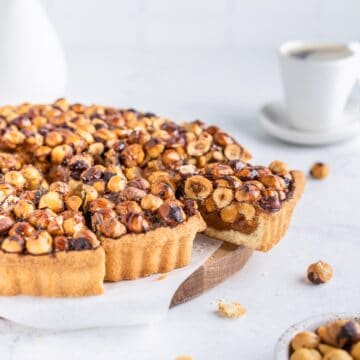
  • Hazelnut pie
  • Cherry crumb pie
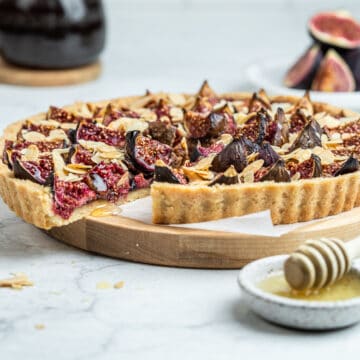
  • Fig tart
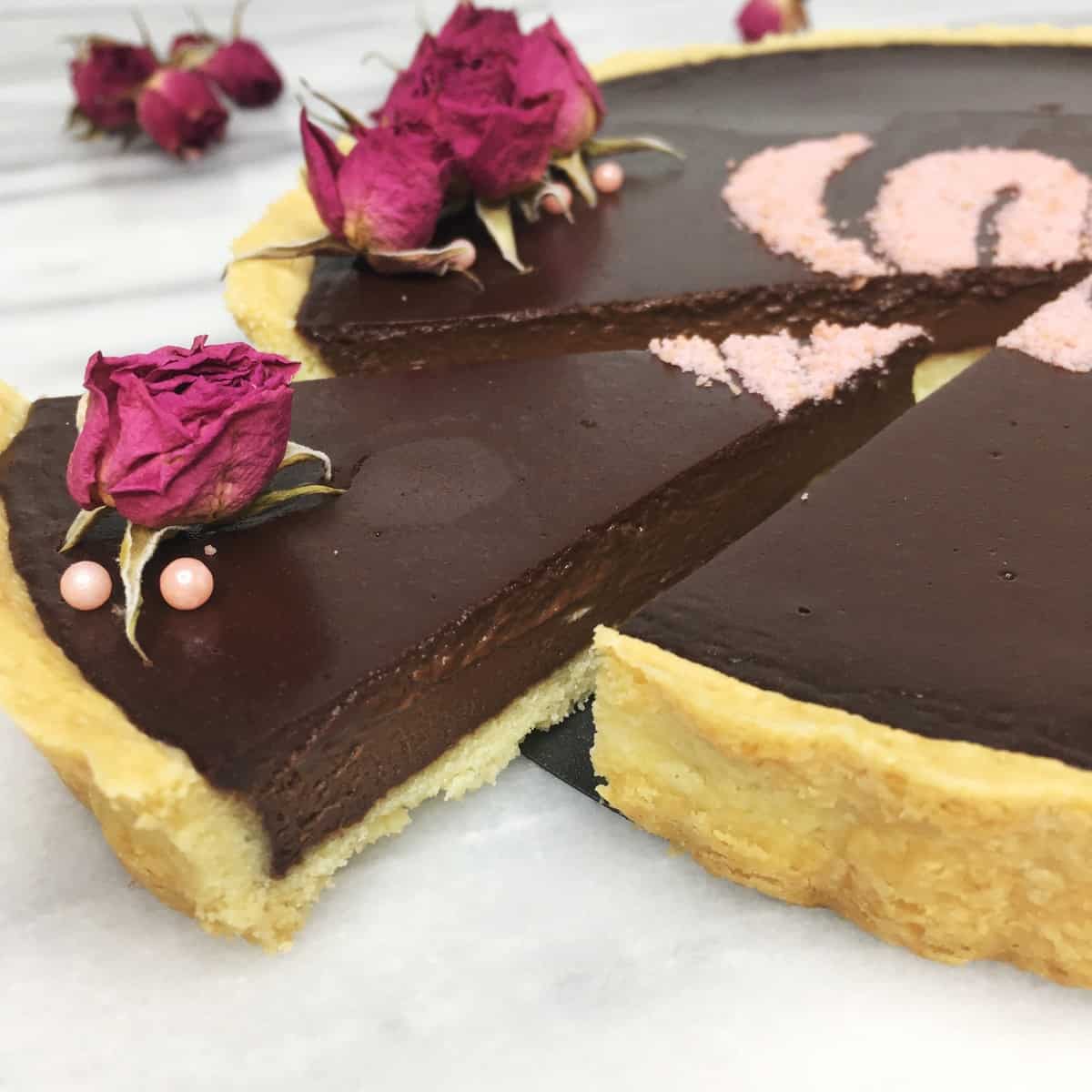
  • Chocolate tart
  • Browse all the Tart Recipes

Want more delicious and beautiful recipes? Subscribe to my newsletter and follow me on Facebook, Pinterest, and Instagram for my latest updates. If you make this recipe, please leave a star rating on the recipe card and comment below!

Print

Recipe card

French Pumpkin Pie

Ready Pumpkin Pie served on a marble cutting board.
Print Recipe
Save Recipe Recipe Saved

5 Stars 4 Stars 3 Stars 2 Stars 1 Star

4.8 from 21 reviews

Enjoy this French pumpkin pie recipe to make a classic Thanksgiving dessert. The pie has a sunny yellow filling scented with cinnamon and nutmeg, baked in a homemade crust and finished with a swirl of meringue.

  • Author: Irina Totterman
  • Total Time: 2 hours
  • Yield: 8 1x
  • Category: Pies and Tarts
  • Method: Baking
  • Cuisine: French

Ingredients

Scale

For the pie crust:

  • 1 ½ cup + 1 ½ tablespoons (200 g) all-purpose flour
  • 5.3 oz (150 g) butter
  • â…“ cup (40 g) icing (powdered) sugar
  • 1 large egg yolk
  • ½ teaspoon ground cinnamon
  • 1 pinch of nutmeg

For the pumpkin feeling:

  • 17.6 oz (500 g) pumpkin puree
  • ½ cup + 2 teaspoons (125 g) whipping cream
  • 3 tablespoons (25 g) whole milk powder
  • 2 large eggs
  • 2 large egg yolks
  • â…” cup (150 g) granulated sugar 
  • 1 teaspoon salt
  • 1 pinch of nutmeg

For the decoration:

  • 1 large egg white (30 g) egg whites
  • 2 tablespoons (30 g) granulated sugar 
  • ¼ cup (30 g) icing (powdered) sugar
  • fresh fruit of your choice

*Don't you have the correct baking pan on hand right now? Try this simple Cake Pan Converter!

** If needed, please refer to Baking Conversion Charts.

Instructions

  1. To make the pie crust, place sifted flour, ground cinnamon, nutmeg, chilled butter cut into small cubes, and icing (powdered) sugar in the bowl of a stand mixer and mix until fine breadcrumbs. Add egg yolk and process until the pastry dough comes together. Wrap in plastic film and refrigerate for one hour.
  2. Preheat oven to 355°F (180°C). Roll out the dough with a rolling pin between two sheets of parchment paper until it is almost ¼ inch (6 mm) thick. Line a buttered 9-inch (23 cm) loose-bottomed fluted tart pan with the pastry and chill for 10 minutes. Then trim edges, prick all over with a fork, and bake for 13 to 15 minutes.
  3. To make the pumpkin filling, bring 1 liter of water to a boil. Peel the pumpkin, cut the pulp into cubes, and place it in the boiling water. Cook the pumpkin till the tip of a knife can go through the pumpkin cubes without resistance. Drain the pumpkin with a colander and dry it with absorbent paper. Place pumpkin in the bowl of a stand mixer, add whipping cream, whole milk powder, eggs, plus extra yolks, sugar, salt, and spices. Mix until smooth.
  4. Decrease the oven temperature to 300°F (150°C). Pour the mixture into the pre-baked pie crust and cook for 20 minutes. Watch the pie's surface during baking, as it must not turn brown; it has to be cooked to set. If it is necessary, reduce the oven temperature. Remove the pie from the oven and let it cool for at least four hours.
  5. To decorate pumpkin pie, beat the white of an egg with granulated sugar using an electric mixer until firm peaks form. Add icing sugar and gently combine with a rubber spatula. Spoon the meringue on top of the pie, swirl it as you spread, and burn the meringue with a blow torch. Arrange the fresh fruit of your choice.

Notes

  1. Customize the pie crust by adding spices of your choice, such as allspice, cloves, and ground ginger, if you desire. 
  2. Chill the dough, rolled between two sheets of parchment, for 5 to 10 minutes to make it easier to transfer to the pan.
  3. Try using half white and half brown sugar in the pumpkin filling to add some caramel flavor to the pie.
  4. Use canned pumpkin puree if you prefer.
  5. Substitute part of the pumpkin with candied yams, butternut squash, or sweet potato to add additional sweetness and flavor to the pie.
  6. Make sure to cool the pie completely before slicing and serving.

Nutrition

  • Serving Size: 1 slice
  • Calories: 460
  • Sugar: 34.8 g
  • Sodium: 340 mg
  • Fat: 23.3 g
  • Saturated Fat: 13.7 g
  • Carbohydrates: 57.9 g
  • Fiber: 2.6 g
  • Protein: 7.7 g
  • Cholesterol: 178 mg

Thank you for following me on Pinterest, Facebook, and Instagram. Hashtag #bakinglikeachef so I can see your creations.

The nutritional information has been calculated using an online recipe nutrition calculator such as Verywellfit.com and is intended for informational purposes only. These figures should be used as a general guideline and not be construed as a guarantee.

The pumpkin filling recipe was adapted from http://www.christophe-felder.com/. The pie recipe was originally published on October 29, 2018. It has been revised to include improved content and photos.

Puff Pastry Peach Galette (Ottolenghi-Inspired)

Aug 9, 2021 · 37 Comments

Puff pastry peach galette with a scoop of ice cream on a plate.

Quick Summary: This puff pastry peach galette is a rustic, free-form French tart of juicy peaches on flaky, buttery puff pastry, brightened with lime and rosemary. Adapted from Yotam Ottolenghi, it uses store-bought puff pastry and bakes in about 35 minutes, serving 6.

Puff pastry peach galette served on a plate with a scoop of ice cream.

What is Ottolenghi peach galette?

I first discovered this peach galette recipe a few years ago on Valérie's wonderful French food blog. Created by Yotam Ottolenghi, it has since become my favorite summer dessert.

A galette is a rustic, free-form tart or pie made by folding pastry around fresh fruit. It is a stress-free, easy dessert that does not require a pie/tart tin. The naturally folded edges of the crust bring a charm to the galette.

Why you'll love this recipe

  • Rustic and pretty: its free-form shape looks great with almost no effort and needs no special tart pan.
  • Quick with store-bought puff pastry: flaky, buttery layers come together fast, so it is easy to whip up.
  • A crowd-pleaser: the perfect sweet ending to a BBQ or dinner party, loved by both kids and adults.
  • Bright summer flavor: sweet, juicy peaches with a touch of lime and a hint of rosemary.

Ingredients

For ingredients and detailed instructions, refer to the recipe card below.

  • Limes: Use organic limes for zest and juice, or swap with lemon.
  • Sugar: Use white granulated sugar. You can also use brown or turbinado.
  • Peaches: Opt for slightly under-ripe, unpeeled ones. Nectarines work too.
  • Rosemary: 2 sprigs + ½ teaspoon leaves (yes, it is the key flavor!).
  • Puff pastry: Use store-bought, butter-based puff pastry or make it your own. You can try this flaky all-butter galette crust or the versatile galette dough I used in my peach and blueberry galette.
  • Butter: Use cold, unsalted butter.
  • Whipping cream: Must be chilled for making firm whipped cream.
  • Egg & cornflour: 1 large egg and a little cornflour for structure.
A puff pastry peach galette on a plate with a scoop of ice cream.

Equipment

To make this peach galette, you will need a few basic kitchen tools:

  • Rimmed baking sheet
  • Parchment paper
  • Rolling pin
  • Large mixing bowl
  • Pastry brush
  • Small saucepan

How to make a peach galette with puff pastry

Step 1. Preheat the oven to 350°F (180°C) and line a rimmed baking sheet with parchment.

Step 2. In a large bowl, mix lime juice, sugar, lime zest strips, and rosemary sprigs. Add sliced peaches (about 10.5 oz. or 300 g), toss, and let them soak at room temperature for 40 minutes to 2 hours. Drain, discard rosemary and zest, and reserve the syrup (about 2 fl oz or 60 ml).

Step 3. Roll puff pastry into a 10-inch (26 cm) circle, ½ cm thick. Transfer to the baking sheet. Arrange drained peaches in a single layer, leaving a 2-inch border.

Step 4. Fold the edges over the fruit, add the butter cubes, brush the pastry with beaten egg, and sprinkle with sugar. Bake for 20 minutes.

Step 5. Meanwhile, whisk cornflour into reserved syrup, heat until thickened like honey, and pour over half-baked peaches. Sprinkle with rosemary leaves and bake another 15 minutes, until golden and bubbling.

Step 6. Optionally, whip cream with sugar and lime zest and chill until serving. Consult a homemade whipped cream recipe for step-by-step, photographed explanations.

Expert Tips

  • Dry the peaches: Pat the strained peaches with a paper towel to remove excess syrup. This keeps the puff pastry crisp and prevents sogginess.
  • Leave a border: Leave some space around the peaches so you can easily fold the pastry edges over the fruit.
  • Serve it up: Enjoy each slice on its own, or add a dollop of plain or lime-infused whipped cream or a scoop of vanilla ice cream.
  • Make ahead: This peach galette can be made a day in advance. It tastes just as delicious the next day.

Storing & freezing

This peach galette is best eaten the day it is baked, while the puff pastry is crisp. Store leftovers loosely covered at room temperature for up to 1 day, or in the refrigerator for up to 3 days, and warm slices in a 350°F (180°C) oven to re-crisp the pastry. To freeze, wrap cooled slices well and freeze for up to 2 months, then reheat from frozen.

Recipe FAQ

Can I use nectarines instead of peaches?
Yes. Nectarines work just as well and do not need peeling. You can also use a mix of peaches and nectarines.

Do I need to peel the peaches?
No. Leave the peaches unpeeled. The skin holds the slices together and softens as the galette bakes.

Can I make this peach galette ahead of time?
You can macerate the peaches and roll the puff pastry a few hours ahead, then assemble and bake when ready. For the crispest pastry, bake it the same day you plan to serve it.

Why use puff pastry for a galette?
Store-bought puff pastry makes this an easy, fast dessert with flaky, buttery layers and no need to make dough from scratch. You can also use a homemade galette crust if you prefer.

What can I serve with peach galette?
It is great warm with a scoop of vanilla ice cream, lightly whipped cream, or crème fraîche.

How many calories are in this peach galette?
One serving of this puff pastry peach galette has about 267 calories, based on the recipe serving 6.

Love summer desserts? Try these next!

  • Peach and Blueberry Galette
  • Peach Panna Cotta Tart
  • Cherry Crumb Pie
  • French Fig Tart
  • Browse all the pies and tarts

Want more delicious and beautiful recipes? Subscribe to my newsletter and follow me on Facebook, Pinterest, and Instagram for my latest updates. If you make this recipe, please leave a star rating on the recipe card and comment below!

Print

Recipe card

Puff Pastry Peach Galette

Puff pastry peach galette with a scoop of ice cream on a plate.
Print Recipe
Save Recipe Recipe Saved

5 Stars 4 Stars 3 Stars 2 Stars 1 Star

5 from 20 reviews

This puff pastry peach galette, inspired by Yotam Ottolenghi, is made with flaky, buttery puff pastry, juicy peaches, a hint of lime, and a touch of rosemary. It is an easy, rustic summer dessert that serves 6.

  • Author: Irina Totterman
  • Prep Time: 1 hour
  • Cook Time: 30 minutes
  • Total Time: 1 hour 30 minutes
  • Yield: 6 1x
  • Category: Tarts
  • Method: Baking
  • Cuisine: French

Ingredients

Scale

For the galette:

  • 2 limes
  • ¼ cup + 1 teaspoon (60 g) granulated sugar
  • 2 large peaches
  • 2 large sprigs of rosemary
  • ½ teaspoon rosemary leaves
  • 7 oz. (200 g) puff pastry
  • 2 teaspoons (10 g) unsalted butter
  • 1 egg
  • ¼ teaspoon cornflour

For the lime whipped cream (optional):

  • â…” cup (155 g) whipping cream
  • 1 teaspoon granulated sugar
  • 1 teaspoon lime zest

* If needed, please refer to Baking Conversion Charts.

Instructions

  1. Preheat the oven to 350°F (180°C). Prepare a rimmed baking sheet lined with parchment paper.
  2. To toss the peaches, in a large bowl, mix lime juice from two limes, granulated sugar, 7 long strips of lime zest, and rosemary sprigs. Add the stoned peaches, cut into ½ cm-thick slices (about 10.5 oz. or 300 g net weight).
  3. Soak peaches in the lime and rosemary-infused syrup at room temperature for 40 minutes to 2 hours. Drain peaches with a colander over a small bowl, and discard the rosemary and lime peel. You should get about 2 fl. oz. (60 ml) of peach syrup. Set it aside for later.
  4. Roll out the puff pastry to a thickness of ⅕ inch (½ cm) into a ten-inch (26 cm)- wide circle using a rolling pin. Then place on a prepared baking sheet with parchment. Arrange strained peach wedges in a single layer on the bottom of the crust. Place them haphazardly or go around the circle like for an apple pie. Leave a clear 2-inch border all around the edge.
  5. Then fold these 5 cm edges of the dough over the peach slices, slightly covering the fruit. Place small cubes of butter over the fresh fruit. Brush the folds of the puff pastry all over with the beaten egg. Sprinkle sugar over the folds of the pastry and bake for 20 minutes. Watch out for the golden edge of the crust and the bubbling of the peach filling.
  6. While the galette is baking, whisk cornflour into the reserved peach syrup. Pour it into a small saucepan and heat over medium-high heat for 2 minutes until it thickens (the consistency should resemble honey).
  7. Then pour this preparation over half-baked peaches. Sprinkle the rosemary leaves over the peaches. Bake the galette for the remaining 15 minutes, until the pastry is golden brown and the filling is bubbling. 
  8. To make the lime whipped cream, whisk whipping cream with sugar and lime zest, and refrigerate till serving. Take the galette out of the oven and let it cool slightly. Serve it with lime-infused whipped cream on top.

Notes

  1. Pat the strained peaches with a paper towel to remove excess syrup. This keeps the puff pastry crisp and prevents sogginess.
  2. Leave some space around the peaches so you can easily fold the pastry edges over the fruit.
  3. Enjoy each slice on its own, or add a dollop of plain or lime-infused whipped cream, or a scoop of vanilla ice cream.
  4. Make-ahead option: You can make this peach galette a day in advance. It tastes just as delicious the next day.

Nutrition

  • Serving Size: 1 slice
  • Calories: 267
  • Sugar: 15.2 g
  • Sodium: 103 mg
  • Fat: 14.9 g
  • Saturated Fat: 4.3 g
  • Carbohydrates: 31 g
  • Fiber: 1.6 g
  • Protein: 4 g
  • Cholesterol: 31 mg

Thank you for following me on Pinterest, Facebook, and Instagram. Hashtag #bakinglikeachef so I can see your creations.

The nutritional information has been calculated using an online recipe nutrition calculator such as Verywellfit.com and is intended for informational purposes only. These figures should be used as a general guideline and not be construed as a guarantee.

The recipe was adapted from cestmafournee.com/. It was originally published on August 05, 2018. The recipe has been revised to include improved content and photos.

Cherry Pizza (Cherry Dessert Pizza)

Jun 16, 2021 · Leave a Comment

Sliced cherry pizza on a white board.

Quick Summary: Cherry pizza is an Italian-style dessert pizza made with a thin pizza-dough base spread with almond cream, topped with fresh halved cherries and flaked almonds, then baked until golden. It comes together in about 25 minutes, serves 4, and is best eaten warm, on its own or with a scoop of vanilla ice cream.

Sliced cherry pizza on a white board

What is cherry pizza?

Cherry pizza (pizza aux cerises in French) is a sweet, dessert-style pizza rather than a savory one. Instead of tomato sauce and cheese, the pizza-dough base is spread with almond cream (a mix of butter, sugar, egg, and almond flour) and topped with fresh cherries and flaked almonds before baking.

The idea is inspired by Italian dessert pizzas and by pastry chef Christophe Michalak's sweet pizza. It turns a familiar pizza shape into a light summer dessert that lets cherries take center stage.

Sliced cherry dessert pizza on parchment

Why you'll love this recipe

  • The cherry dessert pizza recipe is made with just minimal ingredients. It is straightforward and easy to assemble.
  • It features a delicious almond cream and reveals toasted flaked almonds that perfectly complement the juicy cherries. Download the free Flavor Fruit Pairing Chart and get your creativity up by experimenting with flavors.
  • Making pizza at home is a fun way to use up seasonal cherries.
  • Finally, it is a perfect pizza for a family pizza or a Friday night.

Ingredients

Cherry dessert pizza ingredients

For ingredients and detailed instructions, refer to the recipe card below.

  • Pizza dough: Use store-bought pizza dough or make your own dough. Follow this beer pizza dough recipe or make whole-wheat pizza dough. You can use a pizza crust if desired.
  • Cherries: Use fresh cherries, pitted and halved. If they are out of season, use whole frozen cherries, well-drained. I haven't tried to make this recipe with cherry pie filling; you are free to experiment.
  • Egg: You will need half of the whole large egg. Beat it with a fork and use half of the mixture.
  • Butter: Use unsalted butter at room temperature. Take it out of the refrigerator 1 hour before you start.
  • Icing sugar: Make it with a coffee grinder or use store-bought powdered sugar.
  • Almond flour: The recipe calls for almond flour or ground almonds. Replace it with hazelnut flour/meal or ground hazelnuts if desired.
  • Flour: Use a bit of all-purpose flour to make the pizza topping.
  • Almonds: use flaked or chopped almonds (hazelnuts in case of hazelnut flour) on top of the pizza. If you desire, omit nuts on top.

Equipment

  • A mixing bowl to prepare the almond cream
  • A rubber spatula for mixing and spreading
  • A baking sheet or pizza stone to bake the pizza
  • Parchment paper to keep the dough from sticking
  • A silicone brush to brush the crust with oil
  • Oven mitts to safely handle the hot baking sheet
Sliced cherry dessert pizza on a white cutting board

How to make cherry pizza

Step 1. Preheat the oven to 475°F (245°C). Heat oven for an additional 10 to 15 minutes to ensure the baking sheet is well heated.

Step 2. Wash, pit, and cut cherries in half. In a mixing bowl, place the softened butter, icing sugar, half of the egg, almond flour, and all-purpose flour and mix with a rubber spatula (photo 1).

Step 3. To shape the pizza dough, dust a cutting board (with or without parchment) with flour.

Pro tip: The floured surface prevents the pizza dough from sticking and makes it easier to slide out.

Step 4. Using only your hands (don't use a rolling pin), press the dough down, spreading it out to the edges.

Step 5. It takes some time to stretch the dough, giving it an oval shape about 12 inches (30 cm) long. The dough should be thinner in the center and thicker on the edges.

Step 6. Spread the almond mixture on the top of the dough, leaving about 1 inch (2.5 cm) around the edge (photo 2).

Photo 1: Almond cream in a bowl with a spatula Photo 2: Pizza dough with cream on top
PHOTO 1 PHOTO 2

Step 7. Arrange cherries on top, slightly pressing them down. Sprinkle the pizza with the flaked almonds (photo 3)

Step 8. Take the baking sheet from the oven. Brush it with olive oil (or another type of oil) using a silicone brush. Transfer the pizza dough by sliding it to the oiled baking tray. You may use a metal pizza peel if desired.

Attention: Use the oven mitts to carefully remove the hot baking tray from the oven and bring it back to the oven with a pizza on.

Step 9. Cook in the center rack of the oven for 10 to 15 minutes until golden brown. Remove the pizza from the oven (photo 4), and transfer it to a cutting board with parchment paper. Slice the pizza with a large knife or a pizza cutter.

Photo 3: Pizza dough with cherries and flaked almonds Photo 4: Baked cherry pizza on parchment
PHOTO 3 PHOTO 4

Expert Tips

  1. Leave cherries whole instead of cutting them in half if desired.
  2. Serve warm pizza with a scoop of vanilla ice cream or cherry syrup.

Recipe variations

The plain cherry pizza pie is at its best, but you can add some flavor.

  • Replace almond cream with cream cheese mixture and add lemon zest.
  • Make a streusel topping and sprinkle cherries before baking for an extra touch of crunchiness. Then drizzle your pizza with sugar icing for the extra sweetness.
  • Top your pizza with crumbled feta or goat cheese and season it well using salt and black pepper before baking.
  • Garnish your pizza by adding microgreens or fresh herbs for an extra kick while serving.
  • Drizzle a bit of balsamic glaze (not balsamic vinegar) over everything just because everyone loves something extra.
  • Cut your pizza into wedges, and serve it with whipped cream and mint leaves.

Storing & freezing

The pizza is best served fresh, straight from the oven. Store your cherry pizza in an airtight container or covered with plastic wrap and aluminum foil in the refrigerator for two days.

To reheat the next day, bring it to the preheated oven to 350°F (177°C) for about 5 to 10 minutes.

Recipe FAQ

What crust do you use for cherry pizza?
Use your favorite pizza dough, homemade or store-bought. You can also try a soft sugar cookie crust, a pie crust, or a brioche dough.

Can I use store-bought pizza dough?
Yes. Store-bought pizza dough works well and saves time. Let it come to room temperature so it is easy to stretch.

Can I use frozen cherries?
If fresh cherries are out of season, use frozen ones, but thaw and drain them first so they do not make the pizza soggy.

Can I use a different fruit?
Yes. Try apricots, plums, peaches, or berries in place of cherries, or mix a few together.

Can I make it without a pizza stone?
Yes. Use an inverted baking sheet or a large cast-iron skillet turned upside down, and preheat it the same way you would a pizza stone.

How many calories are in cherry pizza?
One serving of this cherry pizza has about 456 calories.

Love cherry recipes? Try these next!

  • Cherry Crumb Pie
  • French Cherry Clafoutis
  • Chocolate Cherry Financiers
  • Homemade Apricot Pizza
  • Browse all the tart recipes

Want more delicious and beautiful recipes? Subscribe to my newsletter and follow me on Facebook, Pinterest, and Instagram for my latest updates. If you make this recipe, please leave a star rating on the recipe card and comment below!

Print

Recipe card

Cherry Pizza (Cherry Dessert Pizza)

Sliced cherry pizza on a white board.
Print Recipe
Save Recipe Recipe Saved

5 Stars 4 Stars 3 Stars 2 Stars 1 Star

No reviews

This easy cherry pizza is a sweet, Italian-style dessert pizza. A thin pizza-dough base is spread with almond cream, topped with fresh cherries and flaked almonds, and baked until golden. It is ready in about 25 minutes and serves 4.

  • Author: Irina Totterman
  • Prep Time: 15 minutes
  • Cook Time: 10 minutes
  • Total Time: 25 minutes
  • Yield: 4 1x
  • Category: Pies and Tarts
  • Method: Baking
  • Cuisine: Italian

Ingredients

Scale
  • 10.6 oz. (300 g) pizza dough (homemade or store-bought)
  • 14.1 oz. (400 g) cherries
  • ½ whole egg
  • 1 ½ tablespoons (25 g) unsalted butter, softened
  • 4 ½ tablespoons (35 g) icing (powdered) sugar
  • 4 tablespoons (25 g) almond flour
  • ½ tablespoon all-purpose flour
  • 1 oz. (30 g) flaked almonds
  • 1-2 tablespoons oil (for greasing baking sheet)

* If needed, please refer to Baking Conversion Charts.

Instructions

  1. Preheat the oven to 475°F (245°C). Heat the oven for an additional 10 to 15 minutes to ensure the baking sheet is well heated.
  2. Wash, pit, and cut cherries in half. In a mixing bowl, place the softened butter, icing sugar, half of the egg, almond flour, and all-purpose flour and mix with a rubber spatula.
  3. To shape the pizza dough, dust a cutting board (with or without parchment) with flour. Using only your hands (don't use a rolling pin), press the dough down, spreading it out to the edges. It takes some time to stretch the dough into an oval shape about 12 inches (30 cm) long. The dough should be thinner in the center and thicker on the edges.
  4. Spread the almond mixture on the top of the dough, leaving about 1 inch (2.5 cm) around the edge. Arrange cherries on top, slightly pressing them down. Sprinkle the pizza with the flaked almonds.
  5. Take the baking sheet from the oven. Brush it with olive oil (or another type of oil) using a silicone brush. Transfer the pizza dough by sliding it to the oiled baking tray. You may use a metal pizza peel if desired. Attention: Use the oven mitts to carefully remove the hot baking tray from the oven and bring it back to the oven with a pizza on.
  6. Cook in the center rack of the oven for 10 to 15 minutes until golden brown. Remove the pizza from the oven and transfer it to a cutting board with parchment paper. Slice the pizza with a large knife or a pizza cutter. 

Notes

  1. Leave cherries whole, if desired, instead of cutting them in half.
  2. Serve the pizza warm with a scoop of vanilla ice cream or cherry syrup.

Nutrition

  • Serving Size: 1 slice
  • Calories: 456
  • Sugar: 22.7 g
  • Sodium: 324 mg
  • Fat: 22.7 g
  • Saturated Fat: 4.8 g
  • Carbohydrates: 58. 6g
  • Fiber: 6 g
  • Protein: 10.8 g
  • Cholesterol: 34 mg

Thank you for following me on Pinterest, Facebook, and Instagram. Hashtag #bakinglikeachef so I can see your creations.

The nutritional information has been calculated using an online recipe nutrition calculator such as Verywellfit.com and is intended for informational purposes only. These figures should be used as a general guideline and not be construed as a guarantee.

The recipe was originally published on June 16, 2021. It has been updated and may differ from what was initially published.

Cherry Crumb Pie Recipe

May 25, 2021 · 1 Comment

Sliced cherry pie topped with crumb topping on a serving board.

With a store-bought puff pastry base, juicy cherries, and an almond crumble topping, this French-inspired cherry crumb pie makes the perfect morning or afternoon treat. Serve it up with fresh whipped cream or ice cream.

A single slice of cherry pie on a plate with the remaining dessert in the background

To make the most of the cherry season, here is another cherry dessert. I mean to try Chocolate Financiers featuring fresh cherries first.

Do you agree that once summer arrives, fruit desserts become much-anticipated treats?

And who doesn't love fresh red berries, cherries, peaches, plums, and more?

In summer, I love to make fruit desserts that are bright in colors and delicious to taste. The actual problem is to decide what sweet treat to bake next.

This pie is made with a store-bought puff pastry as a pie base and a delicious almond-based streusel or crumb topping on top.

I have recently discovered that French chefs use puff pastry to make a pie or a tart crust, and I started implementing this technique.

The first tart I made with a puff pastry crust was French Strawberry Tart that was a hit.

BAKING ESSENTIALS CHECKLIST

Sign up and get a list of the necessary baking tools and ingredients

FREE DOWNLOAD

[feast_advanced_jump_to]
Fresh cherries out of a glass on a wooden surface

Sweet or sour cherries

This crumb cherry pie recipe calls for sweet cherries, the ones found in any supermarket or farmer's market in summer.

You can equally use both types of sweet cherries - Bing cherries and Rainier cherries - to make the pie. But I personally prefer the dark red Bing cherries over to two-toned Rainier cherries.

Sour cherries, or tart cherries, are smaller than sweet cherries. Their season is short, about two weeks in late July.

It is a pain to pit them: the best way is to use the tip of a paper clip to push the pit out.

Sour cherries are often preserved in alcohol or used in baking or making chutneys.

If you make a pie with sour cherries, increase the amount of granulated sugar up to â…” cup + 2 tablespoons (180 g) while making the cherry filling.

Fresh cherries vs frozen cherries

Surely, when fresh cherries are in season, there is no better way to use them than making this crumb pie.

Frozen cherries used in baking are equally delicious. They are actually cooked or baked faster. And it is a pleasure to use them since they are sold pitted.

You can use fresh or frozen cherries in this cherry pie interchangeably. If you use frozen cherries, let the cherries thaw completely and make sure to drain off excess fruit liquid before making the filling.

Freshly baked and sliced cherry pie topped with crumble topping on a wooden serving board

How to pit cherries

Most cherry recipes require cherries to be pitted. But there is a French dessert - Cherry Clafoutis - that is actually made with unpitted cherries.

Interestingly, the unpitted cherries deliver an almond flavor into the preparation while baking. That's the secret in authentic cherry clafoutis making.

So, how to pit cherries to make this amazing pie? The easiest way to pit cherries is to use a cherry pitter. You can cut the cherries in haves and remove the pits manually too.

If you have a straw, you can poke it through a cherry until it hits the pit, then keep pushing through until the pit is pushed out the other side.

There is another tip on how to pit cherries. You can take an empty bottle of wine and a wooden skewer or a chopstick. 

Remove the stem from the cherry, place the cherry on the neck (the place where the stem was up).

Press the cherry with the flat end of the skewer to take out the pit and drop it into the bottom of the bottle. That's it!

Attention: to make sure that each cherry is pitted, cut cherries in half after pitting is done to ensure no pits are left.

Why you should try this recipe

  1. This crumb cherry pie is one of the best summer desserts.
  2. It is easy to make with fresh or frozen cherries interchangeably.
  3. This French-inspired cherry filling is perfect to use while making a classic cherry pie with a lattice top.
  4. The recipe is perfect for making cherry crumble by omitting the pie crust. Just top the cherry filling with buttery crumble and bake.
A fork with cherry pie and crumble with the rest of the slice on a plate

Ingredients

For ingredients and detailed instructions, refer to the recipe card below.

Puff pastry: use a store-bought frozen puff pastry or a store-bought pie crust to make this cherry pie.

Almond flour: it is used to make the crumble topping and sprinkle the puff pastry to prevent sogging. Replace it with hazelnut flour/meal if desired.

Cherries: use fresh cherries, pitted and halved. Read on how to pit cherries in this post.

Replace fresh cherries with the frozen ones, but make sure to drain off excess liquid after thawing the fruit.

Sugar: use granulated white sugar to make the cherry filling and golden brown sugar to make the streusel (crumb) topping.

Orange juice: make fresh orange juice using an organic orange and a citrus juicer.

Orange zest: use a zester grater to make fresh orange zest.

Cornstarch: it is used as a thickener while making the cherry filling.

Butter: make sure to use cold unsalted butter to obtain the correct texture of the pie crumble topping. Replace it with semi-salted butter if desired.

Flour: use all-purpose flour to make the crumble topping.

Icing (powdered) sugar: this ingredient is optional to bring a finishing touch to the pie.

How to make cherry crumb pie

To make the crumble topping, combine cold unsalted butter cut into small cubes, brown sugar, all-purpose, and almond flour in a medium bowl.

Mix with a fork or your hands until crumbly (photo 1). Refrigerate until needed.

To make the cherry filling, in a saucepan, bring the pitted cherries, orange juice, sugar, and orange zest to a boil.

Add cornstarch and cook for 1 to 2 minutes over low to medium, constantly stirring (photo 2). Let cool.

Photo 1: Crumble topping in a metal bowl Photo 2: Cherry filling in a saucepan
PHOTO 1 PHOTO 2

To assemble the pie, preheat the oven to 355 degrees F/180 degrees C. Thaw puff pastry and roll it out between two parchment paper sheets.

Line a fluted tart pan with pastry dough, trim edges (photo 3). Sprinkle with almond flour.

Using a slotted spoon, spoon the cherry filling into the pie crust, leaving an extra fruit liquid in the bowl (photo 4).

Photo 3: Puff pastry into a pie pan Photo 4: Cherry filling over the pie crust
PHOTO 3 PHOTO 4

Sprinkle the crumble topping over cherries (photo 5). Bake for 45 minutes until golden brown (photo 6).

Photo 5: Crumble topping on top of the pie Photo 6: Baked pie in a pan
PHOTO 5 PHOTO 6

Let cool completely (for at least 2 hours) and sprinkle with icing (powdered) sugar.

Expert tips

  1. Make-ahead option: prepare the crumble topping and cherry filling one day in advance. Cover both bowls with plastic film and refrigerate. The next day, assemble the pie and bake.
  2. Check on the pie while baking. To prevent excessive browning, cover it with a piece of aluminum foil.
  3. Place a foil-lined baking sheet on the rack below the pie to catch any butter or fruit spills if it happens.
  4. Let the pie cool down completely before slicing and serving it. It allows the cherry filling to thicken up.
  5. If you are up for a cherry crumble, you are free to make it. Omit the pie crust, pour the cherry filling into a glass pie plate, sprinkle with a crumb topping, and bake until browned on top.

Frequently asked questions

Can you make this pie with frozen cherries?

Yes, absolutely. Let the cherries thaw completely, and make sure to drain off excess fruit liquid before making the filling.

How to store a cherry pie

This cherry pie is best eaten within 24 to 48 hours after making it. Store it wrapping loosely with plastic at room temperature for up to 8 hours, or refrigerate for up to three days.

Love tarts? Try these next!

  • Apple tart decorated with gold pearls and flours in a tart pan with a yellow cup on the background.
    French Caramel Apple Tart
  • French strawberry tart decorated with fresh strawberries and sprinkled with icing sugar and chopped pistachios.
    Tarte aux Fraises (French Strawberry Tart)
  • Sliced French lemon cream tart on a cake board.
    French Lemon Cream Tart (Gluten-free)
  • Plum frangipane tart on a serving board.
    French Plum Frangipane Tart (Tarte aux Prunes)

Browse all the Pie and Tart Recipes

Want more delicious and beautiful recipes? Subscribe to my newsletter and follow me on Facebook, Pinterest, and Instagram for my latest updates. If you make this recipe, please leave a star rating on the recipe card and comment below!

Print

Recipe card

Cherry Crumb Pie

Sliced cherry pie topped with crumb topping on a serving board.
Print Recipe
Save Recipe Recipe Saved

5 Stars 4 Stars 3 Stars 2 Stars 1 Star

5 from 1 review

With a store-bought puff pastry base, juicy cherries, and an almond crumble topping, this French-inspired cherry crumb pie makes the perfect morning or afternoon treat. Serve it up with fresh whipped cream or ice cream.

  • Author: Irina Totterman
  • Total Time: 1 hour, 15 minutes
  • Yield: 8 1x
  • Category: Pies and Tarts
  • Method: Baking
  • Cuisine: American

Ingredients

Scale

For the pie crust:

  • 8.8 oz. (250 g) puff pastry
  • ½ cup (50 g) almond flour

For the cherry filling:

  • 1 lb (450 g) cherries, pitted and halved
  • â…“ cup + 2 tablespoons (100 g) granulated sugar
  • 1 teaspoon fresh orange juice
  • 1 teaspoon orange zest
  • 2 tablespoons (20 g) corn starch

For crumble topping:

  • 2.3 oz. (65 g) unsalted butter, cold
  • â…“ cup (65 g) golden brown sugar
  • ½ cup + 1 teaspoon (65 g) all-purpose flour
  • â…” cup (65 g) almond flour

For decoration:

  • 1 tablespoon icing (powdered) sugar

*Don't you have the correct baking pan on hand right now? Try this simple Cake Pan Converter!

** If needed, please refer to Baking Conversion Charts.

Instructions

  1. To make the crumble topping, combine cold unsalted butter cut into small cubes, brown sugar, all-purpose, and almond flour in a medium bowl. Mix with a fork or your hands until crumbly. Refrigerate until needed.
  2. To make the cherry filling, in a saucepan, bring the pitted cherries, orange juice, sugar, and orange zest to a boil. Add cornstarch and cook for 1 to 2 minutes over low to medium, constantly stirring. Let cool.
  3. To assemble the pie, preheat the oven to 355 degrees F/180 degrees C. Thaw puff pastry and roll it out between two parchment paper sheets. Line a fluted tart pan with pastry dough, trim edges. Sprinkle with almond flour. Using a slotted spoon, spoon the cherry filling into the pie crust, leaving an extra fruit liquid in the bowl. Sprinkle the crumble topping over cherries. Bake for 45 minutes until golden brown. Let cool completely (for at least 2 hours) and sprinkle with icing (powdered) sugar.

Notes

  1. Make-ahead option: prepare the crumble topping and cherry filling one day in advance. Cover both bowls with plastic film and refrigerate. The next day, assemble the pie and bake.
  2. Check on the pie while baking. To prevent excessive browning, cover it with a piece of aluminum foil.
  3. Place a foil-lined baking sheet on the rack below the pie to catch any butter or fruit spills if it happens.
  4. Let the pie cool down completely before slicing and serving it. It allows the cherry filling to thicken up.
  5. If you are up for a cherry crumble, you are free to make it. Omit the pie crust, pour the cherry filling into a glass pie plate, sprinkle with a crumb topping, and bake until browned on top.

Nutrition

  • Serving Size: 1 slice
  • Calories: 458
  • Sugar: 27.8 g
  • Sodium: 84 mg
  • Fat: 25.8 g
  • Saturated Fat: 7.7 g
  • Carbohydrates: 54 g
  • Fiber: 3.1 g
  • Protein: 7.3 g
  • Cholesterol: 17 mg

Thank you for following me on Pinterest, Facebook, and Instagram. Hashtag #bakinglikeachef so I can see your creations.

The nutritional information has been calculated using an online recipe nutrition calculator such as Verywellfit.com and is intended for informational purposes only. These figures should be used as a general guideline and not be construed as a guarantee.

French Lemon Cream Tart (Gluten-free)

Apr 17, 2021 · 20 Comments

Sliced French lemon cream tart on a cake board.

Quick Summary: French lemon cream tart is a crustless, gluten-free lemon dessert. Instead of a pastry, it sits on a flourless coconut dacquoise, topped with tangy lemon cream (lemon cremeux) and piped Italian meringue. There is no tart shell to blind-bake, and it is served chilled. It takes some time because of the chilling steps, but each part is simple to make.

Sliced French lemon cream tart on a cake board

What is a lemon cream tart?

A lemon cream tart (tarte à la crème de citron in French) is a lemon tart whose filling is set apart by how the lemon is prepared. Unlike tarts filled with plain lemon curd, mascarpone, or cream cheese, this one uses a French lemon cream: a smooth lemon custard (lemon crèmeux) that gets its rich, melt-in-the-mouth texture from butter whisked into a warm lemon-egg base rather than added cream.

The technique was made famous by French pastry chef Pierre Hermé and popularized by Dorie Greenspan, and it is the reason a French lemon cream tart tastes richer and rounder than a standard lemon tart. This version takes the idea one step further: it is crustless and gluten-free, swapping the usual shortcrust pastry for a flourless coconut dacquoise base.

On top, the tart alternates piped lemon cream with cooked Italian meringue, which is safe to eat, then it is finished with a little fresh lime zest for extra brightness.

You might also like other lemon desserts like Lemon Curd Cake, French lemon tart, or lemon poppy seed bars.

Crustless tart topped with lemon cream and meringue and sprinkled with lime zest

Why you'll love this recipe

  • It is a simple tart recipe, easy peasy to make.
  • The creamy lemon tart topping has a perfect balance with the sweet meringue. It is ideal for filling pastries like French cream puffs, chouquettes, and eclairs.
  • Flourless lemon tart is a gluten-free dessert.
  • It is very refreshing and is perfect for finishing a heavy meal.

Ingredients

French lemon cream tart ingredients

For ingredients and detailed instructions, refer to the recipe card below.

  • Eggs: Use large whole eggs and egg whites at room temperature. To make the meringue, use pasteurized egg whites to serve the tart for kids, pregnant women, or if you are concerned about Salmonella bacteria in raw eggs. Please read how to pasteurize eggs at home.
  • Sugar: To make a coconut dacquoise, use caster sugar or process granulated sugar with a food processor to make it superfine. To make the meringue, use any white sugar.
  • Lemon juice: Make it yourself using a citrus juicer. Avoid using bottled lemon juice that is very sour, tart, and sometimes even bitter. Fresh lemon juice is essential to make lemon cream.
  • Gelatin: You will need a ½ gelatin sheet with a strength of 200 bloom.
  • Butter: The recipe calls for softened unsalted butter. Take it out of the fridge 1 to 2 hours before you start.
  • Lime and lemon zest: use untreated citrus to make the zest with a zester grater.
  • Shredded coconut is the base of coconut dacquoise.
  • Almond flour is another dacquoise ingredient to make the tart's base.
Lemon tart slice on a white plate

Equipment

  • A citrus juicer to juice the lemons
  • A saucepan and a cooking thermometer to cook the lemon cream
  • A fine-mesh sieve to strain the cream
  • A stand mixer or electric mixer for the dacquoise and meringue
  • An 8-inch (20 cm) cake ring and a baking sheet with parchment paper
  • Pastry bags with a plain pastry tip to pipe the cream and meringue
  • A blow torch to color the meringue and a zester grater for the lime

How to make French lemon cream tart

Step 1. To make the lemon cream, get fresh lemon juice using a citrus juicer. Soak half of the gelatin sheet in cold water for 10 minutes.

Step 2. Pour lemon juice, add sugar, drained gelatin, lemon zest (from 3 lemons), and eggs in a small saucepan and mix.

Step 3. Heat the egg mixture over medium heat to 185°F (85°C), constantly stirring; use an instant-read thermometer (photo 1). Pass the preparation through a fine-mesh sieve to get the zest.

Step 4. Cover the lemon mixture with plastic film in contact and let it cool. When the preparation is about 113°F (45°C), add the softened butter little by little and mix it with a rubber spatula (photo 2).

Photo 1: Lemon cream mixture in a saucepan Photo 2: lemon cream in a bowl
PHOTO 1 PHOTO 2

Step 5. Cover the cream with a piece of plastic wrap in contact and refrigerate overnight.

Step 6. To make coconut dacquoise, preheat the oven to 355°F (180°C). Butter an 8-inch (20 cm) cake ring and place it on a baking sheet covered with parchment paper.

Step 7. In a bowl, mix almond flour and coconut and set aside. Using a stand or electric mixer, beat egg whites with a pinch of salt until stiff.

Step 8. Gradually add caster sugar to get a glossy meringue (photo 3). Using the spatula, gently incorporate the dry mixture in two batches (photo 4).

Photo 3: Meringue in a bowl Photo 4: Dacquoise preparation in a bowl
PHOTO 3 PHOTO 4

Step 9. Transfer the preparation to a pastry bag with Ateco plain pastry tip 809 or a cut tip and push a spiral into the cake ring (photo 5).

Step 10. Bake for 15 to 20 minutes (photo 6). Let cool on a wire rack.

Photo 5: Piped dacquoise into a cake ring Photo 6: Baked dacquoise in a ring
PHOTO 5 PHOTO 6

Step 11. To make Italian meringue, whisk egg whites with a stand or electric mixer until they are foamy.

Step 12. Pour water into a stainless steel bowl, add sugar, and heat to 250°F (121°C), checking it with a cooking thermometer.

Step 13. Slowly pour the hot sugar syrup into the egg whites, constantly whisking. Beat the meringue until it is cooled down (photo 7).

Step 14. To assemble the tart, place coconut dacquoise on a serving platter or a cake board. Transfer the meringue to a pastry bag with Ateco plain pastry tip 809.

Step 15. Pipe large balls on the dacquoise in a circular pattern, skipping a "spot" that will be filled with the cream. Using a hand-held blow torch, brown the meringue until slightly browned.

Step 16. Place lemon cream in a pastry bag fitted with Ateco plain pastry tip 809 and pipe large drops between the piped meringue balls. Press on the pastry bag, then lift to obtain the drops (photo 8).

Photo 7: Meringue in a bowl Photo 8: Decorated lemon cream tart on a cake board
PHOTO 7 PHOTO 8

Step 17. Using a Microplane, zest the lime over the tart. Refrigerate for at least 2 hours.

A sliced lemon cream tart served on a cake board with meringues in the background

Expert Tips

  1. Use pasteurized egg whites if you are concerned about raw eggs.
  2. Pipe the meringue and lemon cream filling in staggered rows or any pattern you prefer.
  3. Decorate the tart with slices of candied lemon if desired.
  4. To omit meringue, double the creamy filling and pipe it over the tart. Decorate it with small store-bought meringues and lime zest.
  5. To make a 9-inch tart or a more extensive crowd pleaser, use this simple cake pan converter to recalculate the ingredients.
  6. Make-ahead option: Prepare the lemon cream and bake a coconut dacquoise one day in advance. Keep the tart's base in an airtight container overnight. The next day, assemble the tart and serve.

Storing & freezing

Store creamy lemon tart in the refrigerator for 2-3 days. It is not recommended to freeze any part of the dessert.

Recipe FAQ

Can you make a French lemon cream tart ahead of time?
Yes. Make the lemon cream and coconut dacquoise ahead and keep the base in an airtight container overnight, then assemble and serve the next day.

Is this lemon cream tart gluten-free?
Yes. The base is a flourless coconut dacquoise instead of pastry, so the tart is naturally gluten-free.

What is lemon cremeux?
Lemon cremeux is a smooth, creamy lemon custard set with a little gelatin. It is the tangy topping used on this tart in place of a classic lemon curd.

Is this like the La Madeleine lemon tart?
It has a similar bright, creamy lemon flavor, but this version is crustless and sits on a coconut dacquoise rather than a pastry shell.

Can I make it without a blow torch?
Yes. The blow torch only lightly colors the Italian meringue. You can skip it and leave the meringue white.

How many calories are in this lemon cream tart?
One serving of this French lemon cream tart has about 404 calories.

Love pies and tarts? Try these next!

  • French Strawberry Tart
  • Plum Frangipane Tart
  • Strawberry Pistachio Tart
  • French Pumpkin Pie
  • Or browse all the tart recipes

Want more delicious and beautiful recipes? Subscribe to my newsletter and follow me on Facebook, Pinterest, and Instagram for my latest updates. If you make this recipe, please leave a star rating on the recipe card and comment below!

Print

Recipe card

French Lemon Cream Tart

Sliced French lemon cream tart on a cake board.
Print Recipe
Save Recipe Recipe Saved

5 Stars 4 Stars 3 Stars 2 Stars 1 Star

5 from 10 reviews

French lemon cream tart is a crustless, gluten-free lemon dessert. It has a coconut dacquoise base topped with a tangy lemon cream and piped Italian meringue.

  • Author: Irina Totterman
  • Prep Time: 50 minutes
  • Cook Time: 40 minutes
  • Total Time: 1 hour 30 minutes (plus chilling time)
  • Yield: 6 1x
  • Category: Tarts
  • Method: Baking
  • Cuisine: French
  • Diet: Gluten Free

Ingredients

Scale

For the lemon cream:

  • 1 ½ large eggs, room temperature
  • â…“ cup (75 g) granulated sugar
  • â…“ cup (75 g) fresh lemon juice
  • 3 lemons, finely grated lemon zest
  • ½ gelatin sheet, 200 bloom
  • 3.2 oz. (90 g) unsalted butter, softened

For coconut dacquoise:

  • 3 large egg whites, room temperature
  • 1 pinch of salt
  • â…“ cup + 2 tablespoons (100 g) caster sugar
  • 1.6 oz. (45 g) shredded coconut
  • ½ cup + 2 tablespoons (60 g) almond flour

For Italian meringue:

  • 2 large egg whites, room temperature
  • 7 teaspoons (35 g) water
  • ½ cup + ½ tablespoon (120 g) granulated sugar

For decoration:

  • ½ lime, zest

*Don't you have the correct baking pan on hand right now? Try this simple Cake Pan Converter!

** If needed, please refer to Baking Conversion Charts.

Instructions

  1. To make the lemon cream, get fresh lemon juice by using a citrus juicer. Soak half of the gelatin sheet in cold water for 10 minutes.
  2. Pour fresh lemon juice, add sugar, drained gelatin, lemon zest (from 3 lemons), and eggs in a small saucepan and mix. Heat the mixture over medium heat to 185°F (85°C), constantly stirring. Pass the preparation through a fine-mesh sieve to get the zests.
  3. Cover it with plastic film in contact and let it cool. When the preparation is about 113°F (45°C), add the softened butter little by little and mix with a rubber spatula. Cover the cream with plastic in contact and refrigerate overnight.
  4. To make coconut dacquoise, preheat the oven to 355°F (180°C). Butter an 8-inch (20 cm) cake ring and place it on a baking sheet covered with parchment paper. In a bowl, mix almond flour and coconut and set aside.
  5. Using a stand mixer or an electric mixer, beat egg whites with a pinch of salt until stiff. Gradually add caster sugar to get a glossy meringue. Using the spatula, gently incorporate the dry mixture in two batches.
  6. Transfer the preparation to a pastry bag with Ateco plain pastry tip 809 or a cut tip and push a spiral into the cake ring. Bake for 15 to 20 minutes. Let cool on a wire rack.
  7. To make Italian meringue, whisk egg whites with a stand or electric mixer until they are foamy. Heat sugar with water to 250°F (121°C), checking it with a cooking thermometer. Slowly pour the sugar syrup into the egg whites, constantly whisking. Beat the meringue until it is cooled down.
  8. To assemble the tart, place coconut dacquoise on a serving platter or a cake board. Transfer the meringue to a pastry bag fitted with Ateco plain pastry tip 809.
  9. Pipe large balls on the dacquoise in a circular pattern, skipping a "spot" that will be filled with the cream. Using a hand-held blow torch, brown the meringue until slightly brown.
  10. Place lemon cream in a pastry bag fitted with Ateco plain pastry tip 809 and pipe large drops between the piped meringue balls. Using a zester grater, zest the lime over the tart. Refrigerate for at least 2 hours.

Notes

  1. Make sure to use pasteurized egg whites if you are concerned about raw eggs.
  2. Pipe the meringue and lemon cream in staggered rows or any pattern you prefer.
  3. Decorate the tart with slices of candied lemon if desired.
  4. To make this lemon cream tart without meringue, double the cream and pipe it over the tart. Decorate it with small store-bought meringues and lime zest.
  5. Make-ahead option: Prepare the lemon cream and bake a coconut dacquoise one day in advance. Keep the tart's base in an airtight container overnight. The next day, assemble the tart and serve.

Nutrition

  • Serving Size: 1 slice
  • Calories: 404
  • Sugar: 50.1 g
  • Sodium: 125 mg
  • Fat: 21.2 g
  • Saturated Fat: 12.5 g
  • Carbohydrates: 53.1 g
  • Fiber: 1.8 g
  • Protein: 3.8 g
  • Cholesterol: 79 mg

Thank you for following me on Pinterest, Facebook, and Instagram. Hashtag #bakinglikeachef so I can see your creations.

The nutritional information has been calculated using an online recipe nutrition calculator such as Verywellfit.com and is intended for informational purposes only. These figures should be used as a general guideline and not be construed as a guarantee.

The recipe was adapted from www.notretemps.com. It was originally published on May 07, 2018. The recipe has been revised to include improved content and photos. 

French Caramel Apple Tart

Aug 20, 2020 · 15 Comments

Apple tart decorated with gold pearls and flours in a tart pan with a yellow cup on the background.

Quick Summary: This French caramel apple tart layers a buttery shortbread crust, smooth vanilla pastry cream, and caramelized Pink Lady apples under a glossy caramel topping. It takes about 2 hours, serves 10, and works for date nights, dinner parties, and the holidays.

Apple tart decorated with gold pearls and flours in a tart pan with a yellow cup on the background

What is French caramel apple tart?

French caramel apple tart is a shortcrust dessert built in layers: a pressed shortbread crust, a vanilla pastry cream, and caramelized apples finished with a caramel glaze. Unlike a rustic apple tart or a Tarte Tatin, it is assembled cold and served chilled, so each layer stays distinct.

The crust is based on shortbread cookies. They are pulsed in a food processor until crumbs, mixed with melted butter, and pressed into a tart pan rather than rolled out, which makes it beginner-friendly.

The vanilla cream is based on a classic pastry cream and comes together quickly. The one step that takes care is making dry caramel to caramelize the apples, but the recipe walks you through it. Use apples with the name Pink Lady®.

Why you'll love this recipe

  1. This shortbread apple tart is easy to make: no rolling out the crust and no blind baking.
  2. Topped with shiny caramelized apples, the tart makes a rich, dressed-up dessert.
  3. The caramel topping and caramelized apples pair nicely with a tangy note of lime.
  4. It highlights autumn flavors and works well as a fall dessert.

Best apples to make an apple tart

For this tart, I use Pink Lady® apples, a trademarked variety (cultivar name Cripps Pink) registered in Australia. They are high in sugar and acid, which slows browning once sliced, so the apple layer stays fresh-looking.

Pink Lady® apples hold their shape when cooked, which makes them a good pick for this caramel apple tart. If you cannot find Pink Lady® apples, use Honeycrisp, Fuji, Gala, or Braeburn. For more guidance, see The Six Best Apples for Baking.

Tart loaded with caramelized apples and decorated with flours with a cup on the background

How to make dry caramel?

Dry caramel is sugar melted and cooked on its own, with no added water, until it liquefies and turns deep gold. To make it, heat granulated or caster sugar in a saucepan over medium heat.

Swirl the pan instead of stirring with a spoon or spatula. The sugar melts in patches at first; keep swirling, and it will melt evenly.

Once the caramel reaches a deep gold color, it is ready. Take the pan off the heat and pour the caramel onto parchment paper.

For more on dry versus wet caramel, whether to stir, and how to tell when caramel is done, see How To Make Hazelnut Praline Paste.

Ingredients

For ingredients and detailed instructions, refer to the recipe card below.

  • Shortbread cookies: either use homemade shortbread cookies or store-bought shortbread fingers.
  • Butter: the tart recipe calls for unsalted butter.
  • Milk: use whole milk for this recipe.
  • Egg yolks: use large chilled eggs to separate egg yolks from egg whites. You will love this egg separator once you try it!
  • Sugar: use either granulated or caster sugar.Cornstarch
  • Cornstarch: used to make the pastry cream, the base for the vanilla cream in the recipe.
  • Gelatin: use a 200-bloom gelatin sheet.
  • Vanilla bean: Use top-quality Madagascar vanilla beans for the most flavor.
  • Apples: Pink Lady® apples are the best for making the tart because they are slow to oxidize, or simply put, to turn brown when sliced. To replace Pink Lady® apples, use Red Delicious, Gala, Fuji, or Honeycrisp apples.
  • Lime zest: buy an organic, untreated lime and use a zester grater to make the lime zest. You can replace lime zest with orange zest.
  • Neutral glaze: This makes the caramel apple tart even more dazzling and adds a professional touch. Use only 3.5 oz (100 g) of ready-made neutral glaze to make the caramel topping. You can omit this step or use the cake glaze only instead of making the caramel topping. To make the neutral glaze, please see note #3 in the recipe card below.

Equipment

To make a French caramel apple tart at home, gather these basic baking tools before you start:

  • food processor
  • rectangular tart pan
  • saucepan
  • hand whisk
  • silicone spatula
  • pastry brush
  • fine-mesh sieve
  • bent spatula

How to make French caramel apple tart

Step 1. Preheat oven to 355°F (180°C). To make the shortbread cookie crust, place the shortbread fingers in the bowl of a food processor and pulse until they resemble breadcrumbs (photo 1). Add the melted butter and mix with a rubber spatula or by hand (photo 2).

Photo 1: Crushed shortbread cookies in the bowl of a food processor Photo 2: Ready cookie crumbs combined in a metal bowl
PHOTO 1 PHOTO 2

Step 2. Transfer the mixture into a rectangular tart pan with a removable bottom. Using your hands, pat out the cookie dough so it covers the bottom and sides of the pan to the edge (photo 3). Then bake for 10 minutes. Remove the cookie crust from the oven and refrigerate for 30 to 60 minutes.

Step 3. Keep the oven temperature at 355°F (180°C). To make caramelized apples, place granulated sugar in a saucepan and bring it to a simmer over medium heat (photo 4).

Photo 3: Tart pan with pressed cookie crumbs Photo 4: Sugar being melted in a frying pan
PHOTO 3 PHOTO 4

Step 4. Swirl the pan over the stove to make caramel. Pour caramel onto parchment paper and let it cool down (photo 5). Break the caramel into pieces and reduce it to a powder using a chopper or food processor (photo 6).

Photo 5: Caramel poured onto parchment paper Photo 6: Crushed caramel in the bowl of a food processor
PHOTO 5 PHOTO 6

Step 5. Peel the apples, cut them into large cubes, and place them in a dish. Add the lime zest and the caramel powder (photo 7), then mix. Cover the dish and bake for 30 minutes.

Step 6. Stir halfway through cooking (photo 8). Transfer the caramelized apples to a bowl and let them cool down before assembling the tart.

Photo 5: Caramel poured onto parchment paper Photo 6: Crushed caramel in the bowl of a food processor
PHOTO 7 PHOTO 8

Step 7. To make the vanilla cream, soak gelatin in cold water for 5 to 10 minutes. In a separate bowl, whisk the egg yolks, sugar, and cornstarch with a hand whisk (photo 9)

Step 8. Heat milk, add a whole vanilla bean, and infuse for 20 minutes in a covered container. Remove the bean and bring milk to a boil. Then pour hot milk into the egg yolks/sugar/starch mixture, stirring constantly. Return the mixture to the pan and heat over medium heat for about 1 minute, stirring constantly (photo 10).

Photo 9: Egg yolks/sugar/starch mixture in a metal bowl Photo 10: Ready pastry cream in a saucepan
PHOTO 9 PHOTO 10

Step 9. Remove the cream from heat, add the drained gelatin, and mix. Transfer the cream to a bowl and let it cool down to 104°F (40°C) or warm to the touch. Gradually add the butter, cut into small cubes, and mix with the spatula (photo 11). Cover the cream with plastic film in contact and refrigerate.

Step 10. To assemble the tart, take the tart crust from the freezer and keep it in a tart pan. Garnish the bottom of the tart with vanilla cream up to two-thirds (photo 12). Arrange caramelized apples and refrigerate.

Photo 11: Ready vanilla cream in a metal bowl Photo 12: Tart crust filled with vanilla cream
PHOTO 11 PHOTO 12

Step 11. To make the caramel topping, place the granulated sugar in a saucepan and heat over medium heat until it turns golden brown. Pour in the hot water (keep the pan off the heat and be careful not to splash!) and heat the caramel syrup again for a few seconds.

Step 12. In a separate saucepan, make a clear cake glaze as directed (see note #3). Let the glaze cool for about 1 minute, then whisk with the caramel syrup. Let it rest until it starts to thicken (photo 13).

Photo 13: Ready caramel topping in a saucepan Photo 14: Tart garnished with vanilla cream and caramelized apples in a tart pan
PHOTO 13 PHOTO 14

Step 13. Coat apples with the caramel topping using a silicone brush (photo 14). Decorate the tart with edible flowers, gold sugar pearls, or edible gold leaf. Remove the tart from the pan before serving.

Expert tips

French apple tart garnished with apples in a tart pan with a yellow cup and glod pearls on the background
  1. Replace Pink Lady® apples with Red Delicious, Gala, Fuji, or Honeycrisp apples.
  2. Coat the caramelized apples with the only neutral cake glaze instead of the caramel topping to simplify the cooking process.
  3. To make the neutral glaze, mix the contents (10 g) of Dr. Oetker cake glaze with two tablespoons of sugar in a saucepan. Stir in 1 cup cold water. Bring to a boil; let boil over medium heat for 1 minute. Cool for 1 minute, then brush it over apples.
  4. Arrange the apples neatly. For a cleaner look, place the largest apple pieces first and work toward the center in a tight, even layer before adding the caramel topping.
  5. Keep the crust crisp. Bake the shortbread base until set and let it cool before filling, so the vanilla cream and apples do not soften the bottom and make it soggy.

Recipe variations

Once you are comfortable with the basic tart, try one of these variations:

  • Caramel apple tartlets: divide the dough and filling among small tart pans to make individual caramel apple tartlets, and shorten the baking time slightly.
  • Salted caramel: add a small pinch of flaky sea salt to the caramel topping for a salted caramel apple tart.
  • Different apples: swap Pink Lady for Honeycrisp, Fuji, Gala, or Braeburn, which also hold their shape when cooked.
  • Spiced version: add a little ground cinnamon or apple pie spice to the cooked apples for a warmer, autumnal flavor.
  • Puff pastry shortcut: for a quicker dessert, bake the caramelized apples on a sheet of puff pastry instead of the shortbread crust.

Storing & freezing

Keep the French caramel apple tart in an airtight container in the refrigerator for up to 3 days. Because it has a vanilla cream layer, it should not sit at room temperature for long. For the ideal result, take the tart out of the fridge about 15 minutes before serving.

Freezing is not recommended, as the vanilla cream and caramel topping change texture once thawed. If you want to get ahead, prepare the shortbread crust in advance and freeze it on its own, then assemble the tart closer to serving.

Recipe FAQ

Can you make this caramel apple tart in advance?
Yes. Make the shortbread crust and the caramelized apples one day ahead. Freeze the crust and keep the baked apples covered in the fridge, then assemble the tart the next day.

Do you need to peel the apples?
Yes, peel the apples for this French apple tart. The skin adds texture but keeps the caramelized apples from cooking down evenly.

What are the best apples for a caramel apple tart?
Pink Lady® apples work best because they are firm and slow to brown. Honeycrisp, Fuji, Gala, or Braeburn are good substitutes.

What is the difference between dry and wet caramel?
Dry caramel is sugar melted on its own without water, so it cooks quickly and tastes deep. Wet caramel starts with sugar dissolved in water and is more forgiving for beginners.

Why did my caramel crystallize?
Caramel usually crystallizes from stirring or stray sugar crystals on the pan sides. Swirl the pan instead of stirring, and brush the sides down with water if needed.

How do you store French caramel apple tart?
Keep the tart in the refrigerator, loosely covered, for up to 2 to 3 days. Add the caramel glaze close to serving so it stays glossy.

What is the difference between a tart and a pie?
A tart has a single, firm crust with shallow, straight sides and no top layer, so the filling stays exposed. A pie is usually deeper, has sloped sides, and often a top crust. This French caramel apple tart shows off the caramelized apples on top instead of covering them.

Can you make caramel apple tartlets instead?
Yes. Press the shortbread dough into small individual tart pans, fill them with the vanilla cream and apples, and reduce the baking time slightly. Caramel apple tartlets are a nice option for parties and single servings.

What can you serve with caramel apple tart?
This tart is nice on its own, but it also pairs well with a scoop of vanilla ice cream, a spoonful of lightly whipped cream, or a drizzle of crème anglaise. A hot cup of coffee or tea rounds it out.

Can you add cinnamon or apple pie spice?
Yes. Stir in a little ground cinnamon or apple pie spice as the apples cook for a warmer, more autumnal flavor. Start with a small pinch so it does not overpower the caramel and vanilla.

How do you keep the tart from getting soggy?
Cool the baked shortbread crust completely before adding the vanilla cream, and drain any excess liquid from the cooked apples. Assembling the tart close to serving time also keeps the base crisp.

How many calories are in a French caramel apple tart?
One slice has about 496 calories, based on 10 servings.

Love apple desserts? Try these next!

  • Apple Tarte Tatin
  • French apple fritters
  • Apple sponge cake
  • Apple mousse cake
  • Apple and olive oil cake
  • Apple and blueberry crumble
  • Apple crumble bread
  • Caramelized apples
  • Apple cinnamon crepes
  • Or browse all the tart recipes.

Want more delicious and beautiful recipes? Subscribe to my newsletter and follow me on Facebook, Pinterest, and Instagram for my latest updates. If you make this recipe, please leave a star rating on the recipe card and comment below!

Print

Recipe card

French Caramel Apple Tart

Apple tart decorated with gold pearls and flours in a tart pan with a yellow cup on the background.
Print Recipe
Save Recipe Recipe Saved

5 Stars 4 Stars 3 Stars 2 Stars 1 Star

5 from 6 reviews

French caramel apple tart is an easy French dessert made with a buttery shortbread crust, smooth vanilla cream, and caramelized Pink Lady apples under a glossy caramel topping. It serves 10 and works for a dinner party or a simple night in.

  • Author: Irina Totterman
  • Prep Time: 1 hour 30 minutes
  • Cook Time: 30 minutes
  • Total Time: 2 hours
  • Yield: 10 1x
  • Category: Tarts
  • Method: Baking
  • Cuisine: French

Ingredients

Scale

For shortbread cookie crust:

  • 10.5 oz (300 g) shortbread fingers
  • 3.5 oz (100 g) butter, melted

For the vanilla cream:

  • 1 â…“ cup + 5 ½ teaspoons (350 g) milk
  • 2 large egg yolks
  • 3 ½ tablespoons (50 g) granulated sugar
  • 7 teaspoons (22 g) corn starch
  • â…” sheet of gelatin
  • 1 vanilla bean
  • 3.7 oz (105 g) butter

For the caramelized apples:

  • 31.7 oz (900 g) Pink Lady® apples
  • â…” cup + 3 ½ tablespoons (200 g) granulated sugar 
  • 1 lime, zest 

For the caramel topping:

  • 2 tablespoons (30 g) sugar
  • 2 tablespoons (30 g) water
  • 1 tablespoon (20 g) of caramel syrup made
  • 3.5 oz (100 g) ready neutral glaze (see note #3)

*Don't you have the correct baking pan on hand right now? Try this simple Cake Pan Converter!

** If needed, please refer to Baking Conversion Charts.

Instructions

  1. Preheat oven to 355°F (180°C). To make the shortbread cookie crust, place the shortbread fingers in the bowl of a food processor and crush until they form breadcrumbs. Add the melted butter and mix with a rubber spatula or by hand. Transfer the mixture into a rectangular tart pan with a removable bottom. Using your hands, pat out cookie crumbs so they cover the bottom and sides of the pan to meet the edge. Then bake for 10 minutes. Remove the cookie crust from the oven and refrigerate for 30 to 60 minutes.
  2. Keep the oven temperature at 355°F (180°C). To make caramelized apples, place granulated sugar in a saucepan and bring it to a simmer over medium heat. Swirl the pan over the stove to make caramel. Pour the caramel onto parchment paper and let it cool. Break the caramel into pieces and reduce it to powder, using a chopper or food processor. Peel the apples, cut them into large cubes, and place them in a dish. Add the lime zest and the caramel powder, and mix. Cover the dish and bake for 30 minutes. Stir halfway through cooking.  Transfer caramelized apples to a bowl and let them cool down before assembling the tart.
  3. To make vanilla cream, soak gelatin in cold water for 5 to 10 minutes. In a separate bowl, whisk egg yolks, sugar, and cornstarch with a hand whisk. Heat milk, add a whole vanilla bean, and infuse for 20 minutes in a covered container. Remove the bean and bring milk to a boil. Then pour hot milk into the egg yolks/sugar/starch mixture, stirring constantly. Bring the mixture back to the pan and heat over medium heat for about 1 minute, stirring constantly. Remove the cream from heat, add the drained gelatin, and mix. Transfer the cream to a bowl and let it cool down to 104°F (40°C) or warm to the touch. Gradually add the butter, cut into small cubes, and mix with the spatula. Cover the cream with plastic film in contact and refrigerate.
  4. To assemble the apple tart, take the tart crust from the freezer and keep it in a tart pan. Garnish the bottom of the tart with vanilla cream up to two-thirds. Arrange caramelized apples and refrigerate.
  5. To make the caramel topping, place granulated sugar in a saucepan and heat over medium heat until the sugar turns golden brown. Pour in the hot water (keep the pan off the heat and be careful not to splash!) and heat the caramel syrup again for a few seconds. In a separate saucepan, make a clear glaze as directed (see note #3). Let the glaze cool for 5 to 10 minutes, then whisk it into the caramel syrup. Let it rest until it starts to thicken. Coat apples with the caramel topping using a silicone brush. Decorate the tart with edible flowers, gold sugar pearls, or edible gold leaf. Remove the tart from the pan before serving.

Notes

  1. Replace Pink Lady® apples with Red Delicious, Gala, Fuji, or Honeycrisp apples.
  2. Coat the caramelized apples with the neutral cake glaze instead of the caramel topping to simplify cooking.
  3. To make the neutral glaze, in a saucepan, mix the contents (10 g) of Dr. Oetker cake glaze with two tablespoons sugar. Stir in 1 cup cold water. Bring to a boil; let boil over medium heat for 1 minute. Cool for 1 minute, then brush it over the apples.

Nutrition

  • Calories: 496
  • Sugar: 43.2 g
  • Sodium: 124 mg
  • Fat: 27.8 g
  • Saturated Fat: 16.1 g
  • Carbohydrates: 61.5 g
  • Fiber: 1.9 g
  • Protein: 4.3 g
  • Cholesterol: 113 mg

Thank you for following me on Pinterest, Facebook, and Instagram. Hashtag #bakinglikeachef so I can see your creations.

The nutritional information has been calculated using an online recipe nutrition calculator such as Verywellfit.com and is intended for informational purposes only. These figures should be used as a general guideline and not be construed as a guarantee.

The recipe was adapted from https://www.femmeactuelle.fr. It was originally published on April 26, 2019. The recipe has been revised to include improved content and photos. 

French Peach Tart with Panna Cotta

Aug 11, 2020 · 38 Comments

French peach panna cotta tart in a baking dish.

Quick Summary: French peach tart with panna cotta is a summer dessert made with a cookie crust, smooth Italian panna cotta filling, and roasted peaches arranged in a flower pattern. Inspired by Ladurée, it is easy to make, requires no complicated pastry work, and can be prepped a day ahead.

French peach panna cotta tart in a baking dish.

What is French peach tart?

French peach tart is a summertime fruit tart made with shortcrust pastry, almond cream, frangipane or panna cotta filling, and peaches arranged in a concentric pattern.

It is a versatile dessert with tart fillings, including almond cream, frangipane, or Italian panna cotta. Made with a fluted loose-bottomed tart tin, it differs from a rustic French peach tart or galette.

Inspired by an image of the peach tart created by the French bakery Ladurée, I could not resist making it. I fell in love with the tart's styling, where peaches are arranged in a pretty flower design to show them off.

Why you'll love this recipe

  • Special filling: smooth Italian panna cotta sets this apart from custard or frangipane peach tarts.
  • Easy and fun: the no-bake filling comes together fast, and kids love arranging the peaches.
  • Summer flavor: creamy panna cotta pairs with sweet roasted peaches.
  • Pretty presentation: peach slices in a concentric flower pattern make a striking finish.

Equipment

Here are the tools you need to make this peach panna cotta tart:

  • food processor for the cookie crust
  • fluted tart pan with a removable bottom, 9-inch (23 cm)
  • saucepan for the panna cotta filling
  • rubber spatula to fold in the whipped cream
  • parchment paper for roasting the peaches
  • glass dome to store the finished tart

Ingredients

Peach panna cotta tart ingredients.

For ingredients and detailed instructions, refer to the recipe card below.

  • Shortbread cookies: Use store-bought shortbread fingers or other kinds of tea biscuits.
  • Butter: To make the buttery cookie crust, use high-quality unsalted butter (not margarine).
  • Gelatin: Use 200-bloom gelatin sheets.
  • Heavy cream: Choose heavy or heavy whipping cream with at least 30% fat or double cream.
  • Milk: The recipe calls for whole milk.
  • Sugar: Use regular granulated sugar or caster sugar.
  • Peaches: Good peaches are the stars of the peach tart. Choose firm, ripe peaches; they will soften with roasting.
French peach tart slices on dessert plates.

How to make French peach tart

Step 1. Heat oven to 355°F (180°C). To make the cookie crust, place shortbread fingers in the bowl of a food processor and crush until the dough resembles breadcrumbs. Add melted butter and mix well.

Step 2. Transfer the preparation into a 9-inch (23 cm) fluted tart pan with a removable bottom.

Step 3. Using your hands, pat out crumbs so they cover the bottom and sides of the pan to meet the edge (photo 1). 

Step 4. Bake in the preheated oven for 10 minutes (photo 2).

Unbaked tart crust in a baking dish.

PHOTO 1

Baked tart crust in a baking mold.

PHOTO 2

Step 5. Remove the cookie crust from the oven and place it straight in the freezer for 30 minutes. 

Step 6. To make the panna cotta filling, soak gelatin sheets in cold water for 10 minutes.

Step 7. Pour milk, 1 â…” cups (400 g) heavy cream, and sugar into a small saucepan and bring to a boil.

Step 8. Remove the pan from the heat, add the drained gelatin, and mix until completely dissolved. Let it cool and set aside.

Step 9. In a separate bowl, whisk the remaining cold heavy cream (100 g) until medium peaks. Add the whipped cream to the main mixture (photo 3) and combine with a rubber spatula.

Pro tip: Consult the sugar-free whipped cream recipe for step-by-step photographed explanations, helpful tips, and tricks.

Step 10. Gently pour the panna cotta filling into the cooled, partially frozen cookie crust (photo 4) and freeze for about 1 hour, until the panna cotta is set.

Panna cotta in a bowl with a spatula.

PHOTO 3

Tart shell filled with panna cotta in a baking pan.

PHOTO 4

Step 11. To roast peaches, preheat oven to 320°F (160°C). Cut peaches into â…œ-inch (1 cm) thick slices with a paring knife and place them on a baking sheet covered with nonstick baking paper.

Step 12. Sprinkle with granulated sugar and bake for 8 minutes.

Step 13. Remove fruit slices from the oven and let cool (photo 5). Keep the peach syrup around the fruit on parchment paper.

Step 14. Arrange peach slices in a flower pattern, starting from the outer edge of the tart and going towards the center. Overlap each slice as you go (photo 6).

Roasted peach slices on a baking sheet lined with parchment.

PHOTO 5

Peach slices in a concentric pattern over the panna cotta filling.

PHOTO 6

Step 15. Optionally, brush the top of the peaches with the peach syrup kept after roasting the fruit, or cover the fruit with a clear glaze or warmed apricot jam.

To serve, cut the tart into wedges. Use a sharp knife to carefully cut the peach layer to avoid disturbing the neat spiral. Apply gentle pressure to slice through the panna cotta and tart shell.

French peach tart with panna cotta in a baking dish.

Expert tips

  1. Freeze the baked cookie crust before pouring the panna cotta to set it and prevent cookie crumbs from getting into the filling.
  2. Freeze the panna cotta in the crust to help the filling set quickly and prevent it from escaping.
  3. Keep the tart in a pan until ready to arrange peach slices. Once the panna cotta filling is set, remove the tart from the tin.
  4. Peel roasted peaches or nectarines if preferred.
  5. Cover the fruit slices on top of the tart with a store-bought or homemade clear or apricot glaze, or drizzle the fruit with honey heated in the microwave for a few seconds.
  6. Serve peach tart with panna cotta filling cold. Avoid keeping it at room temperature for longer than one hour to prevent the gelatin from softening.

Recipe variations

  • Pastry case: Replace the cookie crust with shortcrust pastry or buttery puff pastry. Another great option is to use a pre-made tart crust.
  • Tart filling: Replace panna cotta with frangipane filling, almond pastry cream, or classic crème pat (French crème patissiere).
  • Flavoring: Flavor panna cotta with vanilla extract, or use fresh or dried lemon verbena leaves for a subtle lemon-lime flavor. Infuse the hot milk-and-cream mixture off the heat for 10-15 minutes. Drain the verbena leaves, then add the gelatin.
  • Fruits: Use peaches and nectarines interchangeably, or replace peaches with plums. Decorate the tart with fresh peach slices if desired.

Storing & freezing

Store the peach panna cotta tart under a glass dome in the refrigerator for 2-3 days.

Can you freeze peach tart with panna cotta? Freeze panna cotta-filled tart (without peach slices) in a few steps. Fill the tart shell with the panna cotta and freeze it. Once frozen, cover the tart with plastic wrap and aluminum foil and freeze for up to one month.

Avoid defrosting and refreezing the tart to maintain the perfect panna cotta texture.

To thaw, refrigerate the tart overnight. The next day, roast peaches and decorate the tart.

Recipe FAQ

What is panna cotta?
Panna cotta is a famous Italian pudding made with milk, cream, and sugar, thickened with gelatin. Panna cotta means "cooked cream."

What is the difference between peaches and nectarines?
The main difference is that peaches have a fuzzy coating on the outside, while nectarines have smooth skin. Some people consider nectarines juicier and sweeter, but that is a matter of personal preference. In cooking, you can use these fruits interchangeably.

Can you leave the skin on peaches?
Peach skin has a hairy texture, so some people peel the fruit. Some people are also concerned about chemicals or pesticides that coat the fruit. But if peaches are washed thoroughly, they are safe to eat.

Can you make peach tart in advance?
You can make this tart up to 1 day before serving, or in the morning if you plan to serve in the evening, since it requires some chilling time.

How many calories are in French peach tart?
One slice of this peach panna cotta tart has about 458 calories, based on 10 servings.

Love peach desserts? Try these next!

  • Fresh peach clafoutis
  • Peach and blueberry galette
  • Puff pastry peach galette
  • Peach compote
  • Caramelized skillet peaches
  • Or browse all the tart recipes.

Want more delicious and beautiful recipes? Subscribe to my newsletter and follow me on Facebook, Pinterest, and Instagram for my latest updates. If you make this recipe, please leave a star rating on the recipe card and comment below!

Print

Recipe card

French Peach Tart with Panna Cotta

French peach panna cotta tart in a baking dish.
Print Recipe
Save Recipe Recipe Saved

5 Stars 4 Stars 3 Stars 2 Stars 1 Star

5 from 18 reviews

French peach tart with panna cotta is made with a cookie crust, smooth Italian panna cotta filling, and roasted peaches arranged in a flower pattern. This easy French peach tart is peachy and delicious, and you can prep it a day ahead.

  • Author: Irina Totterman
  • Prep Time: 1 hour
  • Cook Time: 30 minutes
  • Total Time: 1 hour, 30 minutes (plus chilling time)
  • Yield: 10 1x
  • Category: Tarts
  • Method: Baking
  • Cuisine: French

Ingredients

Scale

For cookie crust:

  • 10.5 oz (300 g) shortbread cookies
  • 3.5 oz (100 g) unsalted butter, melted

For panna cotta filling:

  • 6 gelatin sheets, 200 bloom
  • 2 cups + 2 ½ tablespoons (500 g) cold heavy cream, 30% fat 
  • 1 cup + ½ tablespoon (250 g) whole milk
  • â…“ cup (75 g) granulated sugar 

For roasted peaches:

  • 6 fresh peaches (nectarines)
  • 2 tablespoons (30g) granulated sugar

*Don't you have the correct baking pan on hand right now? Try this simple Cake Pan Converter!

** If needed, please refer to Baking Conversion Charts.

Instructions

  1. Preheat oven to 355°F (180°C). To make the cookie crust, place the shortbread fingers in the bowl of a food processor and pulse until crumbly. Add melted butter and mix well.
  2. Transfer the preparation into a 9-inch (23 cm) fluted tart pan with a removable bottom. Using your hands, pat out crumbs so they cover the bottom and sides of the pan to meet the edge.
  3. Bake for 10 minutes. Remove the cookie crust from the oven and place it straight in the freezer for 30 minutes. 
  4. To make the panna cotta filling, soak gelatin sheets in cold water for 10 minutes. Pour milk, 1 ⅔ cups (400 g) heavy cream, and sugar into a small saucepan and bring to a boil.
  5. Remove the saucepan from the heat, add the drained gelatin, and mix until completely dissolved. Let it cool and set aside.
  6. In a separate bowl, whisk the remaining cold heavy cream (100 g) until medium peaks. Add the whipped cream to the main mixture and combine with a rubber spatula.
  7. Gently pour the panna cotta filling into the cooled, partially frozen cookie crust, then freeze for about 1 hour until the panna cotta is set.
  8. To roast peaches, preheat oven to 320°F (160°C). Cut peaches into ⅜-inch (1 cm) thick slices and place on a baking sheet covered with parchment paper.
  9. Sprinkle with granulated sugar and bake for 8 minutes. Remove fruit slices from the oven and let cool. Keep the peach syrup around the fruits.
  10. To assemble the tart, arrange the peach slices in a flower pattern, starting at the outer edge and working toward the center. Overlap each slice as you go.
  11. Optionally, brush fruit slices with the peach syrup left after roasting the peaches, or cover the fruit with a clear glaze or warmed apricot jam.

Notes

  1. Use store-bought shortbread fingers or other kinds of tea biscuits. 
  2. Use peaches or nectarines interchangeably, but choose firm fruits that will soften with roasting.
  3. Freeze the baked cookie crust before pouring the panna cotta to set it and prevent cookie crumbs from getting into the filling.
  4. Freeze the panna cotta in the crust to ensure the filling sets quickly and doesn't escape.
  5. Keep the tart in the pan until ready to arrange peach slices. Once the panna cotta filling is set, remove the tart from the tin.
  6. Peel roasted peaches or nectarines if you prefer.
  7. Cover the fruit slices on top of the tart with a store-bought or homemade clear glaze, or drizzle the fruit with honey heated in the microwave for a few seconds.
  8. Serve the peach tart cold and avoid keeping it at room temperature for more than 1 hour to prevent the gelatin from softening.

Nutrition

  • Serving Size: 1 slice
  • Calories: 458
  • Sugar: 24.3 g
  • Sodium: 154 mg
  • Fat: 33.2 g
  • Saturated Fat: 20.2 g
  • Carbohydrates: 36.3 g
  • Fiber: 1.8 g
  • Protein: 6 g
  • Cholesterol: 102 mg

Thank you for following me on Pinterest, Facebook, and Instagram. Hashtag #bakinglikeachef so I can see your creations.

The nutritional information has been calculated using an online recipe nutrition calculator such as Verywellfit.com and is intended for informational purposes only. These figures should be used as a general guideline and not be construed as a guarantee.

The recipe was adapted from the French blog C'est pas de la tart. It was originally published on September 19, 2018. The recipe has been updated and may differ from what was initially published.

Quince Tarte Tatin Recipe

Jul 27, 2020 · 43 Comments

A slice of French quince tarte Tatin with the rest of the dessert in the background.

Quick Summary: Quince tarte Tatin is a French upside-down tart of quinces slowly poached in a spiced honey-vanilla syrup, caramelized in butter and sugar, then baked under a puff pastry lid and flipped over to serve. Poaching softens the hard, tart fruit and turns it a deep rose color, giving this tart its signature flavor. Serve warm with cream or vanilla ice cream.

A slice of French quince tarte Tatin with the rest of the dessert in the background

What is tarte Tatin?

Tarte Tatin (sometimes spelled tart Tatin) is a classic French upside-down pastry, traditionally made with caramelized apples baked under a pastry crust, then flipped over to serve.

The dessert was born by accident: as the story of Classic Apple Tarte Tatin goes, one of the Tatin sisters dropped a tart and served it anyway, upside down, and a French icon was born.

Today, bakers make tarte Tatin with all sorts of fruit, such as pears, quinces, plums, peaches, and pineapple, and even with savory vegetables like onion, artichoke, tomato, and cabbage. This version swaps apples for quinces, whose firm flesh and floral aroma make it a natural fit for the slow caramelization for which tarte Tatin is known.

Quince dessert with caramelized quinces on top served on a platter: Overhead view

Tarte Tatin pan

The traditional tool is a dedicated tarte Tatin pan, and the classic is the costly copper mold made by the French company Matfer Bourgeat. More affordable options work just as well, such as an authentic tarte tatin pan or a simpler one.

Both give even heat distribution and good heat retention, and some have inverted handles that make flipping the tart easier.

If you do not have a special pan, do not worry. A simple 9-inch (23 cm) pie pan, a tart pan with a removable bottom, or a cast-iron skillet works well too.

Quince tarte Tatin served on a white plate

Why you'll love this recipe

  1. This quince tart recipe is easy to make.
  2. It is the best way to use seasonal fruit that is hard to eat on its own.
  3. Adding spices to the poaching liquid adds great flavor to quinces.
  4. Using store-bought puff pastry and poaching the quinces in advance allows you to make the quince tart within an hour.

Ingredients

For ingredients and detailed instructions, refer to the recipe card below.

  • Puff pastry dough: use a store-bought butter-based puff pastry. If you are not a fan of puff pastry, replace it with your favorite pie crust, such as shortcrust pastry.
  • Quinces: the recipe calls for large quinces. Choose fully ripened fruit that is yellow to golden and is free of any bruises, wrinkling, or other signs of damage.
  • Lemon juice: use an organic, untreated lemon and a citrus juicer to make homemade lemon juice.
  • Brown sugar: use either golden brown or dark brown sugar.
  • Honey: try using flower honey, such as clover or acacia, and avoid intensely flavored coffee, eucalyptus, or lavender honey. You still want to keep the delicate, fruity aroma of quinces.
  • Star anise: use whole star anise in the recipe.
  • Vanilla bean: use the best-quality wholesale Madagascar vanilla beans for the most flavorful results.
  • Sugar: use regular granulated white sugar or caster sugar.
  • Butter: the recipe calls for unsalted butter. Do not substitute it for margarine.

Equipment

  • A tarte Tatin pan or a 9-inch (23 cm) pie pan, tart pan, or cast-iron skillet
  • A large saucepan for poaching the quinces
  • A vegetable peeler and a knife to prep the fruit
  • Parchment paper to cover the quinces while they poach
  • A colander or slotted spoon for draining
  • A wooden spoon for the caramel
  • A rolling pin to roll out the puff pastry
  • Oven mitts for flipping the hot pan safely

How to make quince tarte Tatin

Step 1. To poach quinces, peel the fruit with a vegetable peeler, remove the core, and cut into quarters.

Step 2. In a large saucepan, heat water, brown sugar, honey, vanilla, whole star anise, and lemon juice over medium-high heat. 

Step 3. Lower the heat to a simmer, then add the quince slices to the liquid (photo 1).

Step 4. Cover the pan with a parchment paper circle with a small hole cut in the center, and place it on top.

Step 5. Simmer quince quarters (do not boil) for 2 hours, maybe longer.

Step 6. To test the cooked quince, insert the tip of a knife: it must come in and out easily.

Step 7. Remove from heat, drain quinces in a colander or transfer them from the syrup with a slotted spoon, and let cool (photo 2).

Photo 1: Quinces with a liquid in a pan Photo 2: Drained quinces in a bowl
PHOTO 1 PHOTO 2

Step 8. To make the caramel, place the sugar and lemon juice in a tarte Tatin pan or a 9-inch (23 cm) pie pan.

Step 9. Cook over moderate heat until the sugar melts into a syrup and starts caramelizing. Watch for the deep amber color of caramel.

Step 10. Add butter and cook until melted, stirring occasionally with a wooden spoon (photo 3).

Step 11. Remove the pan from the heat and arrange poached quince wedges in the bottom of the pan over the caramel.

Step 12. Pack them in a nice pattern, concentric circles, with the cut sides facing up as tightly as possible (photo 4).

Step 13. Bring the pan over medium heat and cook for about 7 minutes to caramelize the fruit. Remove from the heat and let cool.

Photo 3: Caramel in a pan Photo 4: Quinces arranged over the caramel in a pan
PHOTO 3 PHOTO 4

Step 14. Preheat the oven to 355°F (180°C). Let a sheet of puff pastry thaw at room temperature. Roll the dough with a rolling pin on a work surface.

Step 15. Cut a circle of pastry the same size as the pan you are using. Freeze the excess dough to use next time.

Step 16. Gather the dough, place it over the quinces, and tuck the edges (photo 5).

Step 17. Then place the skillet in the center of the oven and bake for about 25 minutes (photo 6).

Photo 5: Fruit covered with a circle of dough Photo 6: Baked tart in a pan
PHOTO 5 PHOTO 6

Step 18. After baking, allow the dessert to rest for about 5 minutes (photo 7).

Step 19. Then invert the pan onto a rimmed serving dish to catch extra syrup, using oven mitts (photo 8).

Photo 7: Baked tart in a pan: Oblique view Photo 8: Inverted tart on a plate
PHOTO 7 PHOTO 8

Expert tips

  1. Watch for the quinces to be ready while poaching the fruit. The required time is about 2 hours, sometimes longer; so, test the fruit for readiness from time to time while cooking.
  2. Store poached quinces in the fridge in an airtight container, submerged in the syrup for up to one week.
  3. Do not burn the caramel: once it gets a deep amber color, add butter.
  4. Use a store-bought butter-based puff pastry. If you are not a fan of puff pastry, replace it with your favorite pie crust.
  5. Prick the puff pastry with a fork before covering the quinces. This step is optional, but it allows steam to escape during baking.
  6. Do not let the baked quince tarte Tatin sit in the baking dish for more than 5 minutes: the dessert will stick to the pan. If it happens, place the pan over low heat and stir gently to lift the dessert from the edges. Then invert the pan onto a serving plate.

Recipe variations

One batch of poached quinces can turn into three different treats, so it is worth poaching a little extra:

  • Quince tarte Tatin: the main recipe, with caramelized poached quinces baked under a puff pastry lid.
  • Quince purée: poach extra quinces and blend them in a food processor or with an immersion blender. Enjoy it on its own or use it in coconut macaroons in place of applesauce.
  • Quince jelly: reduce the poaching syrup over medium heat until thick. Serve this quince filling with French crepes or a slice of blue cheese.

Storing & freezing

Tarte Tatin is best eaten the same day it is made. Once baked, keep it at room temperature for up to 24 hours rather than refrigerating it. For a picnic, transport it in the pan, reheat over a barbecue or fire, then turn it out and serve warm.

Avoid freezing the baked tart, as it dulls the texture and flavor. You can, however, freeze the unbaked assembled tart with the raw pastry on top for up to two weeks: wrap it tightly in plastic wrap, then foil. To bake, thaw it in the fridge overnight and bake as directed.

Recipe FAQ

What is quince tarte Tatin?
It is a French upside-down tart made with quinces instead of the traditional apples. The fruit is poached until tender, caramelized in butter and sugar, baked under a puff pastry lid, and flipped over to serve.

Do you have to poach quince before making tarte Tatin?
Yes. Raw quince is hard and astringent, so poaching is essential. Simmering the fruit in a spiced syrup for about two hours softens it and develops its rose color and floral flavor.

Can you make tarte Tatin in advance?
The best way is to assemble the tart with the raw pastry on top, wrap it in plastic, and refrigerate it overnight. The next day, bake and serve.

How do you serve quince tarte Tatin?
Serve it warm with vanilla crème anglaise, a dollop of Chantilly or whipped cream, a scoop of vanilla ice cream, or crème fraîche.

Can I use a different fruit or crust?
Yes. Tarte Tatin can be made with pears, apples, plums, peaches, or pineapple. You can also swap the puff pastry for your favorite pie crust, such as shortcrust pastry.

How many calories are in quince tarte Tatin?
One serving of this quince tarte Tatin has about 419 calories.

Love tarts and pies? Try these next!

  • Apple Tarte Tatin
  • French Strawberry Tart
  • Cherry Crumb Pie
  • French Lemon Cream Tart

Browse all the Pies and Tart Recipes

Want more delicious and beautiful recipes? Subscribe to my newsletter and follow me on Facebook, Pinterest, and Instagram for my latest updates. If you make this recipe, please leave a star rating on the recipe card and comment below!

Print

Recipe card

Quince Tarte Tatin Recipe

A slice of French quince tarte Tatin with the rest of the dessert in the background.
Print Recipe
Save Recipe Recipe Saved

5 Stars 4 Stars 3 Stars 2 Stars 1 Star

5 from 22 reviews

This easy quince tarte Tatin is a French upside-down tart made with quinces poached in a spiced honey-vanilla syrup, caramelized in butter, and baked under a golden puff pastry crust. Flipped over and served warm with cream or vanilla ice cream, it is a favorite fall dessert.

  • Author: Irina Totterman
  • Prep Time: 20 minutes
  • Cook Time: 40 minutes
  • Total Time: 60 minutes
  • Yield: 8 1x
  • Category: Tarts
  • Method: Baking
  • Cuisine: French

Ingredients

Scale
  • 1 puff pastry dough
  • 6 - 8 large quinces

For poached quinces:

  • 6 â…“ cups (1.5 liters) water
  • 1 tablespoon lemon juice
  • 1 cup (200 g) brown sugar
  • â…“ cup (75 ml) honey
  • 2 whole star anise
  • 1 vanilla bean (split lengthwise)

For the caramel:

  • ½ cup (112 g) granulated sugar
  • 2.8 oz. (80 g) butter
  • 1 tablespoon lemon juice

*Don't you have the correct baking pan on hand right now? Try this simple Cake Pan Converter!

** If needed, please refer to Baking Conversion Charts.

Instructions

  1. To poach quinces, peel the fruit with a vegetable peeler, remove the quince core, and cut into quarters. In a saucepan, heat water, brown sugar, honey, vanilla, whole star anise, and lemon juice. Add quince quarters into the simmering liquid. Cover the pan with a parchment paper circle with a small hole cut in the center, and place it on top. Simmer quince quarters (do not boil) for two hours, maybe longer, until quinces are rosy in color. To test the fruit, insert the tip of a knife: it must come in and out easily. Remove from the heat, drain the quinces in a colander or lift them out of the syrup with a slotted spoon, and let cool.
  2. To make the caramel, place the sugar and lemon juice in a tarte Tatin pan or a 9-inch (23 cm) pie pan. Cook until the sugar melts and begins to caramelize. Add butter and let cook until melted, stirring occasionally. Remove from the heat and arrange the poached quinces over the caramel in a spiral, cut sides facing up, packing them as tightly as possible. Bring the pan over medium heat and cook for 10 to 12 minutes to caramelize the fruit. Remove from the heat and let cool.
  3. Preheat oven to 355 F/180 C. Roll the dough with a rolling pin and cut a circle of the pan size you are using. Place the puff pastry over the quinces and prick it with a fork. Then bake for about 25 minutes.
  4. After baking, allow the dessert to rest for about 5 minutes, then invert the pan onto a serving plate, using oven mitts. 

Notes

  1. Watch for the quinces to be ready while poaching the fruit. The required time is about 2 hours, sometimes longer; so, test the fruit for readiness from time to time while cooking.
  2. Store poached quinces in the fridge in an airtight container, submerged in the syrup for up to one week. 
  3. Do not burn the caramel: once it gets a deep amber color, add butter.
  4. Use a store-bought butter-based puff pastry. If you are not a fan of puff pastry, replace it with your favorite pie crust. 
  5. Prick the puff pastry with a fork before covering the quinces. This step is optional, but it allows steam to escape during baking. 
  6. Do not let the baked quince tarte Tatin stay in the pan longer than 5 minutes: the dessert will stick to the pan. If it happens, place the pan over low heat, stirring gently to remove the tarte Tatin from the edges. Then invert the pan onto a plate.

Nutrition

  • Serving Size: 1 slice
  • Calories: 419
  • Sugar: 49.9 g
  • Sodium: 147 mg
  • Fat: 15.7 g
  • Saturated Fat: 8 g
  • Carbohydrates: 72.5 g
  • Fiber: 2.2 g
  • Protein: 2.4 g
  • Cholesterol: 22 mg

Thank you for following me on Pinterest, Facebook, and Instagram. Hashtag #bakinglikeachef so I can see your creations.

The nutritional information has been calculated using an online recipe nutrition calculator such as Verywellfit.com and is intended for informational purposes only. These figures should be used as a general guideline and not be construed as a guarantee.

The recipe was originally published on October 06, 2019. It has been revised to include improved content and photos. 

French Fig Tart (Tarte aux Figues)

Jul 25, 2020 · 18 Comments

French fresh fig tart on a serving board lined with parchment paper.

Quick Summary: This French fig tart, or tarte aux figues, is the best summer dessert with a rich pâte sucrée (shortcrust pastry), delicious praline cream, and seasonal figs. Sweet, nutty, and figgy, fresh fig tart requires only 40 minutes of hands-on time.

French fresh fig tart on a serving board lined with parchment paper.

What is French fig tart?

A French fig tart, or tarte aux figues, is a summer dessert built on classic French patisserie technique: a buttery sweet shortcrust (pâte sucrée), a rich nut cream, and fresh figs baked in until soft and jammy. It is the French answer to a fresh fig dessert, meant to show off figs at their peak.

Most French fig tarts use an almond cream (crème d'amande, also called frangipane). This version swaps in a hazelnut praline cream for a deeper, nuttier flavor that pairs with the honeyed figs, so it tastes different from a standard frangipane fig tart while keeping the same French tart structure.

The crust uses the easiest press-in method: there is no need to chill the shortcrust pastry, roll the dough with a rolling pin, or cut dough strips, so there is no leftover dough.

Once the peak fig season arrives, I prepare to make other fig recipes, such as fig and almond cake, fig tiramisu, and fig and cinnamon Pavlova.

Ingredients

For ingredients and detailed instructions, refer to the recipe card below.

  • All-purpose flour
  • Unsalted butter: top-quality butter softened at room temperature.
  • Granulated sugar
  • Whole milk
  • Hazelnut praline paste: Use homemade or store-bought hazelnut praline. To make the praline paste at home, you can easily mix nuts: 50% hazelnuts and 50% slivered almonds.
  • Extra large whole egg at room temperature.
  • Corn starch
  • Heavy cream or heavy whipping cream with at least 30% fat content or double cream with a higher fat content.
  • Flaked almonds: To toast nuts, bring them into the preheated oven at 300°F (150°C) and toast for 10-15 minutes
  • Fresh seasonal figs: Choose firm-ripe figs, so they hold their shape while baking. Opt for Black Mission figs with an inky purple skin and rust-colored flesh. You can use other varieties of figs, from Adriatic figs with green skin and pale pink to red-violet sweet flesh to Kadota figs with light green skin and sweet white flesh and Brown Turkey with reddish-purple color and a pretty flavor.

Pro tip: If you live in the United States, the first crop arrives around June, but it is far from developing the honey sweetness associated with a delicious fig. I would recommend waiting for the second crop around August - late September when figs fully develop their peak flavor.

A single slice of fresh fig tart on a dessert plate.

Equipment

To make French fig tart at home, gather these basic baking tools before you start:

  • food processor
  • 9-inch round fluted tart pan
  • mixing bowl
  • hand whisk
  • silicone spatula
  • wire rack

How to make French fig tart step-by-step

Step 1. Preheat the oven to 350°F (175°C). Butter a 9-inch (23 cm) round fluted tart pan (with removable bottom) and set aside.

Step 2. To make the shortcrust pastry, place the plain flour, granulated sugar, and a pinch of salt in the bowl of a stand mixer fitted with a paddle attachment.

Step 3. Add the softened butter and process in short pulses until the mixture crumbles. Pour the milk and mix in short pulses. The mixture should have the consistency of wet sand (photo 1).

Step 4. Transfer the coarse crumbs to the prepared pan. Firmly press the dough into the tart tin, pressing evenly on the bottom and sides of a 9-inch pan with the heels of your hands and your fingers (photo 2).

Sand-resembling butter mixture in a bowl.

PHOTO 1

Tart dough into a tart pan.

PHOTO 2

Step 5. Bake the pastry crust for 15 to 20 minutes until lightly golden brown. Cool completely before filling (photo 3).

Step 6. To make the praline cream, whisk the softened butter and praline in a large bowl with a hand mixer.

Step 7. Add egg and cornflour, then add heavy cream and whisk again (photo 4).

Baked tart shell in a baking mold.

PHOTO 3

Praline cream in a bowl.

PHOTO 4

Step 8. To assemble the tart, cut figs into quarters. Garnish the tart crust with the praline cream and spread it into an even layer with an offset or rubber spatula (photo 5).

Step 9. Arrange quarters of figs on top of the cream mixture in concentric circles (photo 6).

Fig slices on top of the praline cream in a baking pan.

PHOTO 5

Tart with the arranged fig slices on top.

PHOTO 6

Step 10. Decrease the oven temperature to 330°F (165°C) and bake for 60 to 65 minutes.

Step 11. Once the tart is baked (photo 7), sprinkle it with flaked almonds (photo 8) and cool it on a wire rack.

Baked fig tart in a tart tin.

PHOTO 7

Fig tart with flaked almonds on top on a wire rack.

PHOTO 8

To serve, slice the tart and accompany it with a dollop of almond or vanilla ice cream. Or simply dust the tart with icing sugar if desired.

Sliced fig tart on a wooden board lined with parchment.

Expert Tips

  1. Make the pâte sucrée (shortcrust pastry) with your hands by rubbing the softened butter into dry ingredients, or use a wire pastry blender if you do not have a stand mixer.
  2. While baking the pastry base, place a baking sheet on a lower oven rack in case of spillage. If the edges of the tart brown quickly, cover them with a pie shield or aluminum foil.
  3. Try to avoid preparing fig slices in advance to prevent any oxidation and release of fig juices ahead of time.
  4. Arrange figs in a circular pattern or in a way you desire.
  5. Sprinkle the tart with flaked almonds while it is hot after baking, or sprinkle the top with chopped almonds before baking and bake.
  6. Make-ahead option: Make the tart dough in advance (up to 1-2 weeks), press it down into the tart pan, wrap it well with plastic film, and freeze it unbaked. Bake the sweet tart crust from frozen by adding a few more minutes to the baking time.

Recipe variations

  • Tart shell: Replace shortcrust pastry with puff pastry or make a flaky pastry using ice water and chilled butter.
  • Filling: Experiment with praline filling by replacing part of the hazelnuts with almonds while making homemade praline paste. Or replace praline cream with a classic frangipane filling, French pastry cream, cream cheese, or mascarpone.
  • Fruits: Use stone fruits to create fresh fruit tarts. For example, replace fresh figs with fresh plums, apricots, or peaches.
  • Tart pan: Use a large tart tin, a rectangular tart pan, or small fluted tins to make a sharing dessert or individual easy fig tarts. To re-calculate ingredients, use this simple pan sizes calculator.

Storing & freezing

Store fig tart in the fridge, covered in plastic wrap, for up to 2 days. To freeze, cover the cooled fig tart with plastic wrap and freeze it for up to one month. To thaw, bring the tart to room temperature for a few hours before serving.

Recipe FAQ

Does the pastry dough need to be refrigerated?
No, the pâte sucrée does not need to be refrigerated, and you do not need a rolling pin. Simply press the shortcrust dough into the tart pan with your hands.

Do you need to blind bake this fig tart?
Yes, the tart shell must be partially baked before you add the filling, but it is baked without pie weights over the greaseproof paper. Pricking the pastry with a fork is optional.

What figs are best for a fig tart?
Use ripe, in-season fresh figs, such as Black Mission, Brown Turkey, or Adriatic. Dried figs are not a good substitute here, since the tart relies on the soft texture and natural sweetness of fresh figs.

Can I make French fig tart ahead of time?
Yes. You can bake the tart shell and prepare the hazelnut praline cream a day in advance, then assemble with fresh figs shortly before serving so the pastry stays crisp.

How do you serve fig tart?
Serve fig tart warm or at room temperature. It pairs well with almond ice cream or a sweet Muscat wine, such as Jaboulet Beaumes de Venise Muscat.

How many calories are in French fig tart?
One slice of this fresh fig tart has about 445 calories, based on the recipe yielding 8 slices.

Love tart recipes? Try these next!

  • Plum frangipane tart
  • Peach panna cotta tart
  • Chocolate ganache tart
  • French strawberry tart
  • Or browse all the tart recipes.

Want more delicious and beautiful recipes? Subscribe to my newsletter and follow me on Facebook, Pinterest, and Instagram for my latest updates. If you make this recipe, please leave a star rating on the recipe card and comment below!

Print

Recipe card

French Fig Tart (Tarte aux Figues)

French fresh fig tart on a serving board lined with parchment paper.
Print Recipe
Save Recipe Recipe Saved

5 Stars 4 Stars 3 Stars 2 Stars 1 Star

5 from 9 reviews

French fig tart, or tarte aux figues, is a French pastry made with a buttery pâte sucrée (shortcrust pastry), a nutty hazelnut praline cream, and fresh figs. This easy fresh fig tart needs only 40 minutes of hands-on time and makes a great late-summer dessert.

  • Author: Irina Totterman
  • Prep Time: 1 hour 15 minutes
  • Cook Time: 30 minutes
  • Total Time: 1 hour 45 minutes
  • Yield: 8 1x
  • Category: Tarts
  • Method: Baking
  • Cuisine: French

Ingredients

Scale

For the shortcrust pastry: 

  • 1 cup + 3 tablespoons (150 g) all-purpose flour
  • 2.6 oz (75 g) softened unsalted butter
  • â…“ cup (75 g) granulated sugar
  • 1 tablespoon milk, room temperature
  • 1 pinch of salt

For  the praline cream:

  • 1.4 oz. (40 g) softened unsalted butter
  • 2.8 oz. (80 g) hazelnut praline paste
  • ½ extra-large egg (30 g) 
  • ½ tablespoon (5 g) cornstarch
  • 3 tablespoons (45 g) heavy cream, 30% fat 

To assemble the tart:

  • 17.6 oz. (500 g) fresh figs
  • 1 oz. (30 g) flaked toasted almonds

*Don't you have the correct baking pan on hand right now? Try this simple Cake Pan Converter!

** If needed, please refer to Baking Conversion Charts.

Instructions

  1. Preheat the oven to 350°F (175°C). Butter a 9-inch round fluted tart pan (with a removable bottom) and set it aside.
  2. To make the shortcrust pastry, place flour, granulated sugar, and salt in the bowl of a stand mixer. Add the softened butter and process in short pulses until the mixture crumbles.
  3. Pour the milk and mix in short pulses. The mixture should have the consistency of wet sand.
  4. Transfer the mixture to the buttered tart pan. Firmly press the crust mixture into the pan, pressing evenly on the bottom and up the sides of the pan with the heels of your hands and your fingers.
  5. Bake for 15 to 20 minutes, until lightly golden. Cool completely before filling.
  6. To make the praline cream, beat the softened butter and praline. Add egg and cornstarch, then add heavy cream and whisk again.
  7. To assemble the tart, garnish the tart crust with the praline cream and arrange quarters of figs on top in concentric circles.
  8. Decrease the oven temperature to 330°F (165°C) and bake for 60 to 65 minutes.
  9. Once the tart is baked, sprinkle with flaked almonds and let it cool on a wire rack.

Notes

  1. Make the shortcrust pastry with your hands by rubbing the softened butter into dry ingredients, or use a wire pastry blender if you do not have a stand mixer.
  2. Make hazelnut praline paste yourself or use a store-bought hazelnut praline.
  3. While baking the tart, place a baking sheet on a lower oven rack in case of spillage. If the edges of the tart brown quickly, cover its edges with a pie shield or an aluminum foil.
  4. Avoid preparing fig slices in advance to prevent any oxidization and release of their juice ahead of time.
  5. Arrange figs in a circular pattern or in a way you desire.
  6. Sprinkle the tart with flaked almonds while it is hot after baking, or sprinkle the top of the tart with chopped almonds before baking and bake.
  7. Accompany fig tart with the almond ice cream or serve with the wine Jaboulet Beaumes de Venise Muscat.

Nutrition

  • Serving Size: 1 slice
  • Calories: 445
  • Sugar: 43.6 g
  • Sodium: 117 mg
  • Fat: 18.6 g
  • Saturated Fat: 9.1 g
  • Carbohydrates: 69 g
  • Fiber: 7.3 g
  • Protein: 6.2 g
  • Cholesterol: 51 mg

Thank you for following me on Pinterest, Facebook, and Instagram. Hashtag #bakinglikeachef so I can see your creations.

The nutritional information has been calculated using an online recipe nutrition calculator such as Verywellfit.com and is intended for informational purposes only. These figures should be used as a general guideline and not be construed as a guarantee.

The recipe was adapted from https://www.mercotte.fr/. It was originally published on September 09, 2018. The recipe has been re-tested and revised to include improved content and photos.
French Plum Frangipane Tart (Tarte aux Prunes)

Jul 5, 2020 · 3 Comments

Plum frangipane tart on a serving board.

Quick Summary: French plum frangipane tart (tarte aux prunes) is a classic French dessert made with a buttery shortcrust pastry, a soft almond frangipane filling, and fresh red plums. Adapted from French pastry chef Cyril Lignac, this easy plum frangipane tart needs no blind baking and comes together with just a handful of ingredients.

Plum frangipane tart on a serving board.

What is plum frangipane tart?

Plum frangipane tart (Tarte aux prunes et frangipane) is a classic French plum tart made with sweet shortcrust pastry, frangipane, and juicy plums. This tart uses a sweet almond frangipane filling, so it's also called a plum almond frangipane tart.

A slice of plum almond tart on a dessert plate.

Why you'll love this recipe

  • This plum frangipane tart recipe is basic and easy for a novice and seasoned baker. It doesn't require blind baking.
  • The plum and almond frangipane combo is a winner among stone fruit-nut combinations.
  • The fruit is evenly distributed in the tart: the frangipane filling holds fruit, preventing it from sinking to the bottom of the pan.

Ingredients

Plum frangipane tart ingredients.

For ingredients and detailed instructions, refer to the recipe card below.

  • Sugar: Use granulated white sugar or caster sugar interchangeably.
  • Butter: I use European-style unsalted butter (with 82% fat content) when baking. To soften, take it out of the fridge 1 to 2 hours before you start.
  • Flour: Use all-purpose flour.
  • Eggs: For accuracy, you will need ½ large egg and 1 ½ extra-large chicken eggs. Make sure the eggs are at room temperature.
  • Almond meal: Use store-bought almond meal or ground almonds made yourself. Just process nuts in a food processor for a few minutes.
  • Plums: I like using dark-fleshed ripe plums to give the tart a bright color and a sweeter, sharper tang. You will need three large plums.
  • Salt enhances the tart's flavors.

Equipment

Here is the equipment you need to make this plum frangipane tart:

  • A 9-inch (23 cm) fluted tart pan with a removable bottom
  • A stand mixer (or a hand mixer) for the pastry and frangipane
  • A flour sifter for the flour
  • A rolling pin to roll out the dough
  • A large mixing bowl
  • A baking sheet

How to make plum frangipane tart

Step 1. To make a shortcrust pastry, beat softened butter and granulated sugar in the bowl of a stand mixer until smooth. Add eggs and mix to combine.

Step 2. Using a flour sifter, sift plain flour with salt and add the flour mixture to the main preparation. Mix at medium speed until homogeneous (photo 1).

Step 3. With your hands, bring the dough together and shape it into a ball. Cover the dough ball with plastic wrap and chill for 2 hours (better overnight).

Step 4. Roll the chilled pastry out on a lightly floured work surface into a large circle. Place dough onto a rolling pin and bring it over a 9-inch (23 cm) fluted tart pan (with a removable bottom).

Step 5. Use your fingers to press the dough into the bottom and edges of the pan (photo 2). Refrigerate for 10 to 15 minutes.

Short crust pastry in a bowl.

PHOTO 1

The dough over a tart tin.

PHOTO 2

Step 6. Trim a little excess pastry from the sides with a sharp knife. Prick the bottom of the pastry base with a fork (photo 3).

Step 7. Heat oven to 355°F (180°C).

Step 8. To make almond frangipane, place softened butter, sugar, almond meal, all-purpose flour, salt, and eggs in the bowl of a stand mixer and whisk until smooth and homogeneous (photo 4).

Pricked tart shell in a tart pan.

PHOTO 3

Almond frangipane filling in a bowl.

PHOTO 4

Step 9. Pour the frangipane mixture into the prepared tart shell. With an offset spatula, spread frangipane into an even layer.

Step 10. To decorate the tart, slice the plums in half and de-stone the fruits. Cut plum halves into smaller slices and arrange them on top of the filling (photo 5).

Step 11. Bake the tart in the preheated oven for 35 to 45 minutes until the frangipane becomes golden brown (photo 6). Check with a toothpick: it should come out clean after being inserted in the center of the tart.

Step 12. Remove the tart from the oven, and let it cool in the pan. Unmold the tart and carefully transfer it to a serving plate.

Plum slices on top of the frangipane filling.

PHOTO 5

Baked plum frangipane tart in a baking mold.

PHOTO 6

Step 13. To serve, sprinkle it with icing sugar (confectioners' sugar) and cut it into wedges.

Sliced French plum tart on a serving plate.

Expert Tips

  1. Respect the chilling time needed to hydrate the flour with the wet ingredients and harden the butter. This will make the dough easy to handle.
  2. Arrange plum slices on top of the pastry as you like. Slice them thinly, lay them tightly together, or scatter them over the filling.
  3. Experiment with different types of plums, plumcots, pluots, and apriums. You will get a delightful dessert in any way.

Recipe variations

  • Plum hazelnut frangipane tart: Replace almonds with ground hazelnuts or a store-bought hazelnut meal.
  • Peach or apricot frangipane tart: Replace plums with peaches or apricots, and add a few blackberries or raspberries on top of the almond frangipane filling.
  • Pear or apple frangipane tart: Switch plums for pears or apples, sliced thinly.
  • Fig frangipane tart: Slice seasonal figs in quarters and dip the cut sides into the warm honey. Then, place figs on top of the frangipane in a pretty pattern you desire.

Storing & freezing

To store, cover the cooled plum frangipane tart with plastic wrap and refrigerate for up to 2 days.

Can you freeze plum frangipane tart? You can freeze your tart for up to 2 months. Wrap it in plastic, then aluminum foil, and place it in a freezer bag. To thaw, bring it to the fridge overnight, then to the kitchen counter to reach room temperature.

Recipe FAQ

What is the difference between frangipane and Bakewell tart?
A frangipane tart is made of a pastry shell, a frangipane filling, and fruit. A Bakewell tart has a shortcrust pastry case, a layer of jam, frangipane, and flaked almonds on top.

Do you need to blind bake this plum frangipane tart?
No. Blind baking with pie weights is common for most tarts, but for this frangipane tart, it is enough to prick the pastry base with a fork before adding the filling.

Can you make the frangipane filling in advance?
Yes. Make the almond frangipane a few days ahead and keep it in the fridge until needed. You can also freeze it, then move it to the fridge in advance to thaw fully before using.

Is this an Ottolenghi plum frangipane tart?
No. This recipe is adapted from French pastry chef Cyril Lignac, not Yotam Ottolenghi. Both use plums and almond frangipane, but this French version keeps the pastry and filling simple with no blind baking.

How do you serve plum tart?
Serve plum tart warm from the oven, sliced, and with a scoop of almond ice cream. It is also good at room temperature, dusted with icing sugar (confectioners' sugar).

How many calories are in plum frangipane tart?
One slice of this plum frangipane tart has about 428 calories, based on the recipe yielding 8 slices.

Love fruit tarts? Try these next!

  • Strawberry pistachio tart
  • French fig tart
  • Peach panna cotta tart
  • French pumpkin pie
  • Or browse all the tart recipes.

Want more delicious and beautiful recipes? Subscribe to my newsletter and follow me on Facebook, Pinterest, and Instagram for my latest updates. If you make this recipe, please leave a star rating on the recipe card and comment below!

Print

Recipe card

French Plum Frangipane Tart (Tarte aux Prunes)

Plum frangipane tart on a serving board.
Print Recipe
Save Recipe Recipe Saved

5 Stars 4 Stars 3 Stars 2 Stars 1 Star

5 from 1 review

French plum frangipane tart, or tarte aux prunes, is a French dessert made with a buttery shortcrust pastry, a soft almond frangipane, and fresh red plums. Adapted from Cyril Lignac, this easy plum tart needs no blind baking and comes together with just a few ingredients.

  • Author: Irina Totterman
  • Prep Time: 1 hour
  • Cook Time: 30 minutes
  • Total Time: 1 hour, 30 minutes (plus chilling time)
  • Yield: 8 1x
  • Category: Tarts
  • Method: Baking
  • Cuisine: French

Ingredients

Scale

For the crust:

  • â…“ cup + 2 teaspoons (75 g) granulated sugar
  • â…“ cup (75 g) softened unsalted butter
  • 1 cup + 3 tablespoons (150 g) all-purpose flour
  • ½ large egg (25 g), room temperature (see note #1)
  • 1 pinch of salt

For almond frangipane filling:

  • â…“ cup + 1 ½ tablespoons (100 g) softened unsalted butter
  • 1 ½ extra-large eggs (85 g), room temperature (see note #2)
  • 1 cup + 1 tablespoon (100 g) almond meal (ground almonds)
  • ½ cup (100 g) granulated sugar
  • ¼ cup (30 g) all-purpose flour
  • 1 pinch of salt

For assembling:

  • 3 large plums

*Don't you have the correct baking pan on hand right now? Try this simple Cake Pan Converter!

** If needed, please refer to Baking Conversion Charts.

Instructions

  1. To make the tart crust, beat softened butter and granulated sugar in the bowl of a stand mixer until smooth. Add eggs and mix to combine.
  2. With a flour sifter, sift flour and salt over the bowl and mix until combined.
  3. Use your hands to bring the dough together and shape it into a ball. Cover the dough ball with plastic wrap and chill for 2 hours (better overnight). 
  4. Sprinkle a work surface with flour and roll the dough out into a large circle. Roll the dough onto a rolling pin and place it over a 9-inch/23 cm round (with removable bottom) fluted tart pan.
  5. Using your fingers, press into the bottom and edges of the pan. To trim excess dough from the sides, refrigerate for 10 to 15 minutes, then cut off with a sharp knife. Prick the bottom of the pastry dough with a fork. 
  6. Preheat oven to 355°F (180°C).
  7. To make almond frangipane, place softened butter, sugar, almond meal, all-purpose flour, salt, and eggs in the bowl of a stand mixer and whisk until smooth and homogeneous.
  8. Pour the frangipane into the prepared tart crust and arrange plum slices on top.
  9. Bake for 35 to 40 minutes, until the frangipane turns golden and a toothpick inserted in the center comes out clean. Let cool, and sprinkle with icing sugar.

Notes

  1. 25 g of eggs are approximately equal to ½ of a whole large chicken egg (eggshell removed).
  2. 85 g of eggs are approximately equal to 1 ½ whole extra-large chicken eggs (eggshell removed).
  3. Respect the chilling time needed to hydrate the flour with the wet ingredients and harden the butter. This will help you handle the dough easily.
  4. Use dark-fleshed plums for a sweeter, sharper tang and deeper color. Or experiment with different types of plums, plumcots, pluots, and apriums. 
  5. Arrange plum slices on top of the pastry in the way you desire. Slice them thinly and lay them tightly together, or scatter them over the filling.

Nutrition

  • Serving Size: 1 slice
  • Calories: 428
  • Sugar: 24.7 g
  • Sodium: 65 mg
  • Fat: 25.5 g
  • Saturated Fat: 12.2 g
  • Carbohydrates: 44.9 g
  • Fiber: 2.3 g
  • Protein: 7.2 g
  • Cholesterol: 98 mg

Thank you for following me on Pinterest, Facebook, and Instagram. Hashtag #bakinglikeachef so I can see your creations.

The nutritional information has been calculated using an online recipe nutrition calculator such as Verywellfit.com and is intended for informational purposes only. These figures should be used as a general guideline and not be construed as a guarantee.

The recipe was originally published on September 30, 2018. It has been updated and may differ from what was initially published.

Hazelnut Pie Recipe (Honey Hazelnut Pie)

Feb 21, 2020 · 12 Comments

Honey hazelnut pie served on a serving board.

Quick Summary: Hazelnut pie (honey hazelnut pie) is a nutty twist on classic pecan pie, made with a from-scratch hazelnut-flour crust and a honey-based filling (no corn syrup) poured over toasted hazelnuts. There is no pre-baking or par-baking step, and the whole pie serves up to 12. Enjoy it on its own or with a scoop of vanilla ice cream.

Honey hazelnut pie served on a serving board.

What is honey hazelnut pie?

Honey hazelnut pie is a nut pie in the style of pecan pie, but built around toasted hazelnuts instead of pecans. The filling sets around the nuts as it bakes, giving a soft, caramel-like center and a crisp crust.

What sets this version apart is that it uses honey in place of the usual corn syrup, and the crust is enriched with hazelnut flour, so the nutty flavor runs through the whole pie rather than sitting only in the filling.

Why you'll love this recipe

  1. This tart is so simple to make that even a beginner will make it perfect.
  2. The hazelnut pie crust is easy to work with. Even if you have never made a pie or tart before, you will not have a problem rolling the dough out and lining a pan.
  3. There is no pre-baking step in making the pie. The hazelnut pie filling is poured into the unbaked pie crust.

Ingredients

For ingredients and detailed instructions, refer to the recipe card below.

  • Butter: Use softened butter for the crust and a little melted butter for the filling.
  • Powdered sugar: Powdered (icing) sugar sweetens the crust.
  • Hazelnut flour: Adds nutty flavor to the pastry.
  • All-purpose flour: Forms the base of the crust, with a little more in the filling to bind it.
  • Eggs: Bind the crust and set the filling.
  • Salt: Enhances flavor.
  • Granulated and brown sugar: Sweeten the filling and add a light caramel note.
  • Honey: Replaces the corn syrup found in classic pecan pie.
  • Hazelnuts: Use whole roasted hazelnuts for the filling.

Equipment

  • A hand whisk or a stand mixer to make the filling and the dough
  • A 9-inch (23 cm) fluted tart pan with a removable bottom
  • A rolling pin to roll out the hazelnut crust
  • Parchment paper for rolling the dough between two sheets
  • A mixing bowl and plastic wrap for chilling the filling and dough

How to make honey hazelnut pie

Step 1. To make the pie filling, mix all the ingredients (except hazelnuts) with a hand whisk (photo 1).

Step 2. Cover the preparation with plastic film in contact and refrigerate for a few hours, preferably overnight.

Step 3. To make the pie crust, place the softened butter, salt, powdered (icing) sugar, eggs, hazelnut flour, and 1 cup (125 g) of all-purpose flour in the bowl of a stand mixer and mix to combine.

Step 4. Add the remaining all-purpose flour and mix again (photo 2). Wrap the dough in plastic film and refrigerate for two hours.

Honey hazelnut pie filling with a whisk in a bowl.

Photo 1

Dough for pie crust in a bowl.

Photo 2

Step 5. Grease a 9-inch (23 cm) fluted tart pan with removable bottom. Using a rolling pin, roll out the dough between two sheets of parchment paper till â…• inch (0.5 cm) thick.

Step 6. Line the pan with the dough (photo 3) and refrigerate for about 15 minutes. Trim the edges of the pie crust with a knife (photo 4).

Photo 3

Photo 4

Step 7. Preheat the oven to 310°F (155°C). Spread hazelnuts evenly inside the pie crust, filling up the edges, and pour the pie filling over the nuts (photo 5).

Step 8. Bake the pie for about one hour till the edges of the pie crust become slightly golden.

Step 9. Remove the pie from the oven and let it cool down, still in the pan. Gently remove the ready pie from the pan (photo 6).

Photo 5

Photo 6

Let it cool and serve.

Sliced hazelnut pie on a serving board.

Expert tips

  1. If you roast hazelnuts yourself, peel the nuts; although this step is optional in making the pie.
  2. Combine all the pie filling ingredients (except hazelnuts) and make the pie dough one day in advance. Cover the filling with plastic film in contact, wrap the dough, and refrigerate until the next day.
  3. Wrap the pie dough in a freezer-weight plastic wrap and freeze for up to 6 months. To make the tart, thaw the dough overnight in the fridge.
  4. Freeze the pie crust in a pan if you desire. Wrap it in plastic film and keep it for up to 6 months. Bake without thawing, but add a few minutes to the baking time.
  5. Sprinkle the top of the baked pie with powdered (icing) sugar if you desire.

Storing & freezing

Keep honey hazelnut pie covered at room temperature for up to 2 days, or refrigerate it in an airtight container for up to 5 days. Let refrigerated slices come to room temperature before serving for the best texture.

To freeze, wrap the cooled pie (whole or in slices) tightly in plastic wrap and foil, and freeze for up to 2 months. Thaw overnight in the fridge before serving.

Recipe FAQ

What is honey hazelnut pie?
It is a nut pie similar to pecan pie, but made with toasted hazelnuts and a honey-based filling instead of pecans and corn syrup. The crust is enriched with hazelnut flour.

Do you have to blind-bake the crust?
No. There is no pre-baking or blind-baking step. The filling is poured into the unbaked hazelnut crust, and everything bakes together.

Can I use store-bought roasted hazelnuts?
Yes. You can buy ready-roasted hazelnuts or roast raw ones yourself. If you roast them, peel off the skins first, though this step is optional.

Can I make hazelnut tartlets instead of one pie?
Yes. The same filling and crust work as mini tarts or tartlets, which make a good party dessert. Adjust the baking time down for smaller sizes.

Can I substitute the honey?
Honey gives this pie its flavor, but you can use corn syrup or maple syrup instead if you prefer, keeping the same amount.

How many calories are in honey hazelnut pie?
One slice of this honey hazelnut pie has about 533 calories.

More delicious tart recipes you will love

  • French Chocolate Ganache Tart Recipe
  • French Lemon Cream Tart
  • Easy Quince Tarte Tatin Recipe
  • Browse all the Tart Recipes

Want more delicious and beautiful recipes? Subscribe to my newsletter and follow me on Facebook, Pinterest, and Instagram for my latest updates. If you make this recipe, please leave a star rating on the recipe card and comment below!

Print

Recipe card

Hazelnut Pie Recipe (Honey Hazelnut Pie)

Honey hazelnut pie served on a serving board.
Print Recipe
Save Recipe Recipe Saved

5 Stars 4 Stars 3 Stars 2 Stars 1 Star

5 from 4 reviews

This easy hazelnut pie (honey hazelnut pie) is a nutty take on classic pecan pie. It has a from-scratch hazelnut-flour crust and a honey-based filling (no corn syrup) poured over toasted hazelnuts, with no pre-baking needed. One pie serves up to 12, and you can also bake the filling as mini tartlets.

  • Author: Irina Totterman
  • Prep Time: 30 minutes
  • Cook Time: 1 hour
  • Total Time: 1 hour, 30 minutes (plus resting time)
  • Yield: 16 1x
  • Category: Pies and Tarts
  • Method: Baking
  • Cuisine: French

Ingredients

Scale

For the pie crust:

  • 4.9 oz (140 g) butter, softened
  • 1 pinch of salt
  • â…” cup + 1 tablespoon (90 g) powdered (icing) sugar
  • 4 tbsp (30 g) hazelnut flour
  • 3 tbsp (50 g) eggs (see note #2)
  • 2 cups (250 g) all-purpose flour

For the hazelnut pie filling:

  • 5 ½ tsp (25 g) granulated sugar
  • 2 tbsp (25 g) brown sugar
  • 1 ½ tbsp (12 g) all-purpose flour
  • 5 tbsp (75 g) eggs (see note #3)
  • ½ cup + 1 ½ tablespoon (190 g) honey
  • 0.5 oz (15 g) butter, melted
  • 1 lb (454 g) whole roasted hazelnuts

*Don't you have the correct baking pan on hand right now? Try this simple Cake Pan Converter!

** If needed, please refer to Baking Conversion Charts.

Instructions

  1. To make the pie filling, mix all the ingredients (except hazelnuts) with a hand whisk. Cover the preparation with plastic film in contact and refrigerate for a few hours, preferably overnight.
  2. To make the pie crust, place the softened butter, salt, powdered (icing) sugar, eggs, hazelnut flour, and 125 g of all-purpose flour in the bowl of a stand mixer and mix just to combine. Add the remaining all-purpose flour and mix again. Wrap the dough in plastic film and refrigerate for two hours.
  3. Grease a 9-inch (23 cm) fluted tart pan with a removable bottom. Using a rolling pin, roll out the dough between two sheets of parchment paper till â…• inch (0.5 cm) thick. Line the pan with the dough and refrigerate for about 15 minutes. Trim the edges of the pie crust with a knife.
  4. Preheat oven to 310°F (155°C). Spread hazelnuts evenly inside the pie crust, filling up the edges. Pour the pie filling over the nuts. Bake the pie for about one hour till the edges of the pie crust become slightly golden. Remove the pie from the oven and let it cool down, still in the pan. Gently remove the ready pie from the pan and sprinkle with powdered (icing) sugar.

Notes

  1. If you roast hazelnuts yourself, peel the nuts; although this step is optional in making the pie.
  2. 50 g of eggs, approximately equal to 1 whole large chicken egg (eggshell removed).
  3. 75 g of eggs, approximately equal to 1 ½ whole large chicken eggs (eggshell removed).
  4. Combine all the pie filling ingredients (except hazelnuts) and make the pie dough one day in advance. Cover the filling with plastic wrap in contact, wrap the dough, and refrigerate till the next day.
  5. Wrap the pie dough in a freezer-weight plastic wrap and freeze for up to 6 months. To make the tart, thaw the dough overnight in the fridge.
  6. Freeze the pie crust in a pan if you desire. Wrap it in plastic film and keep it for up to 6 months. Bake without thawing, but add a few minutes to the baking time.
  7. Sprinkle the top of the baked pie with powdered (icing) sugar if you desire.

Nutrition

  • Serving Size: 1 slice
  • Calories: 533
  • Sugar: 26.3 g
  • Sodium: 91 mg
  • Fat: 36.2 g
  • Saturated Fat: 8.8 g
  • Carbohydrates: 48.1 g
  • Fiber: 4.6 g
  • Protein: 9.7 g
  • Cholesterol: 67 mg

Thank you for following me on Pinterest, Facebook, and Instagram. Hashtag #bakinglikeachef so I can see your creations.

The nutritional information has been calculated using an online recipe nutrition calculator such as Verywellfit.com and is intended for informational purposes only. These figures should be used as a general guideline and not be construed as a guarantee.

The recipe was adapted from http://www.niksya.ru/. It was originally published on February 21, 2020. The recipe has been revised to include improved content and photos. All posted pictures are mine.

French Chocolate Tart (Tarte au Chocolat)

Feb 2, 2020 · 14 Comments

Sliced decorated chocolate ganache tart on a marble table.

Quick Summary: French chocolate tart, or tarte au chocolat, is a classic French dessert made with a crisp, buttery shortcrust pastry and a rich dark chocolate ganache filling. This version is based on a recipe by three-Michelin-star chef Frédéric Anton, and the smooth ganache sets in the baked crust with no complicated steps.

Sliced decorated chocolate ganache tart on a marble table

What is French chocolate tart?

French chocolate tart (tarte au chocolat) is a French patisserie classic: a blind-baked shortcrust pastry shell filled with a dark chocolate ganache that sets to a smooth, sliceable texture. Unlike an American chocolate pie, it is not overly sweet, letting the quality of the dark chocolate come through.

This recipe follows the version created by French chef Frédéric Anton of the Michelin-starred Le Pré Catelan in Paris, so it stays close to how the tart is served in French restaurants.

What is chocolate ganache?

Chocolate ganache is a smooth pastry filling and glaze made from just two ingredients: chocolate and cream. Warm cream is poured over chopped chocolate and whisked until the mixture is glossy and homogeneous.

The name dates to the mid-19th century, when a chocolatier's apprentice reportedly poured hot cream over chocolate by accident. His master called him a "ganache" (French slang of the time for "dimwit"), but the mixture turned out so good that the name stuck to the filling itself.

French chocolate tart with a single slice: Overhead view

How to make chocolate ganache

To make chocolate ganache, pour boiling heavy cream over chopped dark chocolate, then whisk until smooth and creamy. The ratio of cream to chocolate controls the texture:

  • Thick ganache (1:1): equal parts chocolate and cream, ideal as a filling or frosting for a layered chocolate cake.
  • Thin ganache (2:1): two parts cream to one part chocolate, perfect for dipping fruit or glazing a cake (let it cool slightly before use).
  • Firm ganache (1:2): two parts chocolate to one part cream, used for rolling truffles.

To flavor the ganache, replace 1 to 2 tablespoons of the cream with Grand Marnier, Bailey's, or Armagnac.

Chocolate ganache tart with the removed slice on a tart pan bottom

How to decorate a chocolate tart

The smooth surface of a chocolate ganache tart is perfect for decorating. Here are some ways to finish the tart:

  • Stencil design: dust cookie crumbs through a stencil to create a word, phrase, or picture on the cooled tart.
  • Toasted marshmallows: halve Jet-Puffed marshmallows, arrange them on top, and place the tart under the grill/broiler for 1 to 2 minutes to get a giraffe pattern.
  • Sea salt: sprinkle fleur de sel or sea salt flakes over the ganache, as in this Salted Dark Chocolate Tart.
  • Fresh fruit: add fresh berries or fruit for bright color against the dark chocolate, similar to this Cake Charlotte with Red Fruits or this No-Bake Chocolate Tart.
  • Chocolate curls: run a vegetable peeler down the edge of a chocolate bar to make curls, or use store-bought curls.
  • Macarons: top with homemade or store-bought macarons.
  • Chopped nuts: scatter chopped pistachios, hazelnuts, or almonds over the surface.
  • Glaze: leave the tart plain or glaze it like this Chocolate Glazed Chocolate Tart.
A single slice of French Ganache Tart on a marble board

Why you'll love this recipe

  1. Easy to make: the pastry and chocolate ganache come together, with no complicated techniques.
  2. Not too sweet: the crust uses just 1 tablespoon of vanilla sugar, so the dark chocolate takes the lead.
  3. Rich and chocolatey: high-quality pure dark chocolate gives the filling an intense flavor.
  4. Easy to decorate: the smooth surface is a blank canvas for the topping of your choice.

Ingredients

For ingredients and detailed instructions, refer to the recipe card below.

  • Four: The recipe calls for all-purpose flour.
  • Butter: make sure to use chilled butter to make a tart crust.
  • Vanilla sugar: replace it with granulated sugar if desired.
  • Water: use chilled water to make the tart dough.
  • Milk: the recipe calls for whole milk.
  • Heavy cream: use heavy cream with at least 36% fat or replace it with whipping cream (30% fat).
  • Dark chocolate: high-quality bittersweet chocolate 60% cacao is the star of this chocolate dessert. Use dark chocolate 70 to 80% cacao if you desire.
  • Eggs: use large whole eggs.

Equipment

Here is the equipment you need to make this French chocolate tart:

  • A 9-inch (23 cm) fluted tart pan with a removable bottom
  • A food processor for the tart dough
  • A rolling pin and parchment paper to roll and line the crust
  • A saucepan and a hand whisk for the chocolate ganache

How to make French chocolate tart

Step 1. To make the tart crust, in a food processor, place the flour, chopped cold butter, and vanilla sugar, then process until fine crumbs form (photo 1).

Step 2. Gradually add chilled water and continue to mix until the pastry dough forms (photo 2). Shape into a disc, wrap in plastic film, and refrigerate for 20 minutes.

Photo 1: Crumbs in a bowl Photo 2: Pastry dough in a bowl
PHOTO 1 PHOTO 2

Step 3. Grease a 9-inch (23 cm) fluted tart pan with removable bottom. Using a rolling pin, roll out the pastry between two sheets of parchment paper until about 0.1 inch (3 mm) thick (photo 3).

Step 4. Line the tart pan with the dough (photo 4) and refrigerate for 15 minutes.

Photo 3: Rolled dough on parchment Photo 4: Tart pan with the lined pastry
PHOTO 3 PHOTO 4

Step 5. Preheat oven to 355°F (180°C). Trim the edges of the pastry with a knife and prick the crust (bottom and sides) with a fork before baking (photo 5).

Step 6. Bake the tart crust for 20 minutes, until lightly golden. Let the crust cool down in the pan (photo 6).

Photo 5: Tart crust in a tart pan Photo 6: Baked tart crust in a pan
PHOTO 5 PHOTO 6

Step 7. Keep the oven temperature at 355°F (180°C). To make the chocolate ganache, process the dark chocolate in a food processor for a few seconds (photo 7), or chop the chocolate into small pieces and place it in a bowl.

Step 8. In a saucepan, bring milk, heavy cream, and butter to a boil. Pour the milk mixture over the chocolate and gently combine with a hand whisk until homogeneous.

Step 9. Work with the whisk delicately so as not to produce bubbles during preparation. Add eggs one by one to the chocolate mixture, and stir until thoroughly blended (photo 8).

Photo 7: Chopped chocolate in a bowl Photo 8: Ready chocolate ganache in a glass bowl
PHOTO 7 PHOTO 8

Step 10. Pour the preparation into the cooled tart crust (photo 9) and bake for 15 minutes. The center of the tart will be wobbly (photo 10). 

Photo 9: Chocolate ganache into the tart crust Photo 10: Ready tart into the tart crust
PHOTO 9 PHOTO 10

Step 11. Let the tart rest for about 2 to 3 hours until the chocolate ganache is set. Then decorate the tart as you desire or leave it plain.

Storing & freezing

Store the French chocolate tart in an airtight container in the refrigerator for up to 3 days. Bring it to room temperature for 20 to 30 minutes before serving so the ganache softens and the flavor comes through.

To freeze, wrap the fully set tart (whole or in slices) well and freeze for up to 1 month. Thaw it overnight in the fridge, then let it sit at room temperature before serving.

Expert tips

  1. Use high-quality bittersweet chocolate, or replace it with Scharffen Berger or Valrhona dark chocolate, both of which contain 70% cacao.
  2. To decorate the tart, use a stencil with the crushed pink champagne biscuits, edible rose buds, and pink sugar pearls.
  3. Remove the tart from the fridge about 15 to 30 minutes before serving.
  4. To cut the tart, dip a knife in hot water, wipe it off, and then cut. Wipe the knife off before each cut.

Recipe FAQ

What is the difference between a French chocolate tart and a chocolate pie?
A French chocolate tart (tarte au chocolat) uses a crisp shortcrust pastry and a set dark chocolate ganache, and it is less sweet than a typical American chocolate pie, which often has a softer crust and a sweeter, custard-style filling.

Whose recipe is this French chocolate tart based on?
This tart is based on a recipe by French chef Frédéric Anton of the three-Michelin-star restaurant Le Pré Catelan in Paris. It is not the L'Ambroisie chocolate tart (Bernard Pacaud's famous version), though both are classic Parisian tartes au chocolat.

Do you need to blind bake the crust?
Yes. The shortcrust is baked before the ganache is added so the base stays crisp under the filling. There is no need for pie weights if you chill the lined crust well and trim it before baking.

What chocolate is best for the ganache?
Use high-quality bittersweet dark chocolate, around 60% cocoa. The flavor of the tart depends almost entirely on the chocolate, so choose one you enjoy eating on its own.

How do you serve French chocolate tart?
Serve it in small wedges, since it is rich. Each slice pairs well with a scoop of vanilla ice cream, a few fresh berries, or a spoonful of lightly whipped cream.

How many calories are in French chocolate tart?
One slice of this French chocolate tart has about 401 calories, based on the recipe yielding 8 slices.

Love tarts or pies? Try these next!

  • French Lemon Cream Tart
  • Best Honey Hazelnut Pie Recipe
  • French Quince Tarte Tatin Recipe
  • Browse all the Tart Recipes

Want more delicious and beautiful recipes? Subscribe to my newsletter and follow me on Facebook, Pinterest, and Instagram for my latest updates. If you make this recipe, please leave a star rating on the recipe card and comment below!

Print

Recipe card

French Chocolate Tart (Tarte au Chocolat)

Sliced French chocolate tart decorated with dried rosebuds on a marble table.
Print Recipe
Save Recipe Recipe Saved

5 Stars 4 Stars 3 Stars 2 Stars 1 Star

4.8 from 6 reviews

French chocolate tart, or tarte au chocolat, is a French dessert made with a crisp, buttery shortcrust pastry and a rich dark chocolate ganache filling. Based on a recipe by French chef Frédéric Anton, this easy tart is smooth, not too sweet, and perfect for chocolate lovers or a Valentine's Day treat.

  • Author: Irina Totterman
  • Prep Time: 45 minutes
  • Cook Time: 30 minutes
  • Total Time: 1 hour 15 minutes (plus setting time)
  • Yield: 8 1x
  • Category: Tarts
  • Method: Baking
  • Cuisine: French

Ingredients

Scale

For the tart crust:

  • 1 ½ cup (190 g) flour
  • 4.4 oz (125 g) butter
  • 1 tbsp vanilla sugar
  • 2 tbsp chilled water

For the chocolate ganache:

  • ¼ cup + 1 teaspoon (65 g) milk
  • â…” cup + ½ tablespoon (160 g) heavy cream
  • 5.6 oz (160 g) bittersweet chocolate 60% cacao
  • 0.6 oz (16 g) butter
  • 2 large whole eggs

*Don't you have the correct baking pan on hand right now? Try this simple Cake Pan Converter!

** If needed, please refer to Baking Conversion Charts.

Instructions

  1. To make the tart crust, in a food processor, place the flour, chopped cold butter, and vanilla sugar, and process until fine crumbs form. Gradually add chilled water and continue to mix until the pastry dough forms. Shape into a disk, wrap in a plastic film, and refrigerate for 20 minutes.
  2. Grease a 9-inch (23 cm) fluted tart pan with a removable bottom. Using a rolling pin, roll out the pastry between two sheets of parchment paper until about 0.1 inch (3 mm) thick. Line the tart pan with the dough and refrigerate for 15 minutes. 
  3. Preheat oven to 355°F (180°C). Trim the edges of the pastry with a knife and prick the crust (bottom and sides) with a fork before baking. Bake the tart crust for 20 minutes, until lightly golden. Let the crust cool down in the pan.
  4. Keep the oven temperature at 355°F (180°C). To make the chocolate ganache, process the dark chocolate in a food processor for a few seconds, or chop it into small pieces and place it in a bowl. In a saucepan, bring milk, heavy cream, and butter to a boil. Pour the milk mixture over the chocolate and gently combine with a hand whisk until homogeneous. Work with the whisk delicately so as not to produce bubbles during preparation. Add eggs one by one to the chocolate mixture and stir until thoroughly blended.
  5. Pour the preparation into the cooled tart crust and bake for 15 minutes. The center of the tart will be wobbly. 
  6. Let the tart rest for about 2 to 3 hours until the chocolate ganache is set. Then decorate the tart as you desire or leave it plain. 

Notes

  1. Use high-quality bittersweet chocolate, or replace it with Scharffen Berger or Valrhona dark chocolate, both of which contain 70% cacao.
  2. To decorate the tart, use a stencil with crushed pink champagne biscuits, edible rose buds, and pink sugar pearls.
  3. Remove the tart from the fridge about 15 to 30 minutes before serving.
  4. To cut the tart, dip a knife in hot water, wipe it off, and then cut. Wipe the knife off before each cut. 

Nutrition

  • Serving Size: 1 slice
  • Calories: 401
  • Sugar: 12.3 g
  • Sodium: 133 mg
  • Fat: 27.6 g
  • Saturated Fat: 17.4 g
  • Carbohydrates: 32.6 g
  • Fiber: 1.3 g
  • Protein: 6.2 g
  • Cholesterol: 107 mg

Thank you for following me on Pinterest, Facebook, and Instagram. Hashtag #bakinglikeachef so I can see your creations.

The nutritional information has been calculated using an online recipe nutrition calculator such as Verywellfit.com and is intended for informational purposes only. These figures should be used as a general guideline and not be construed as a guarantee.

The recipe was adapted from https://www.femmeactuelle.fr. It was originally published on February 14, 2019. The recipe has been revised to include improved content and photos.

Strawberry Pistachio Tart (Sablé Breton)

Jun 14, 2019 · 20 Comments

Sliced strawberry pistachio tart.

Quick Summary: Strawberry pistachio tart is a French-style summer dessert made with a crisp, buttery sablé Breton crust, a smooth pistachio mousseline cream, and fresh strawberries. There is no traditional tart shell to line or blind bake, so this easy strawberry and pistachio tart comes together with less fuss than a classic tart.

Sliced strawberry pistachio tart

What is strawberry pistachio tart?

Strawberry pistachio tart is a French-style fruit tart built on a sablé Breton, a thick, buttery shortbread biscuit from the Brittany region of northwestern France. Unlike a classic tart, there is no pastry shell to line or blind bake: the sablé Breton is baked flat as a crisp, crumbly base, then topped rather than filled.

On top sits a smooth pistachio mousseline cream (pastry cream enriched with butter and flavored with pistachio paste), finished with fresh strawberries. The combination of a rich, cookie-like base, nutty green cream, and sweet-tart summer berries is what sets this dessert apart from a standard strawberry tart or a frangipane tart.

Assembled strawberry and pistachio tart: Overhead view

Why you'll love this recipe

  • No blind baking: the sablé Breton base is baked flat, so there is no fragile tart shell to line, chill, or blind bake with pie weights.
  • Make-ahead friendly: you can bake the buttery shortbread base days in advance and top it before serving.
  • A texture and flavor balance: the crisp, crumbly crust pairs with the ultra-smooth pistachio mousseline cream and juicy strawberries.
  • A modern pastry pairing: strawberry and pistachio are one of the top summer combinations in French patisserie.
  • Easy to customize: swap in other creams, berries, or fruit to make the tart your own.

Ingredients

Strawberry and pistachio tart ingredients

For ingredients and detailed instructions, refer to the recipe card below.

  • Egg yolks: using an egg separator, separate egg yolks from the whites while whole eggs are chilled. Then bring egg yolks to room temperature.
  • Sugar: use granulated white or caster sugar.
  • Butter: the recipe calls for unsalted butter. Use high-quality 82% fat content European-style butter to make the sablé Breton crust to get its crisp and crumbly texture. Take the butter out of the refrigerator 1 to 2 hours before you start.
  • Flour: use all-purpose flour. I haven't tried to make the tart base with another type of flour.
  • Salt balances and enhances the flavors of the crust.
  • Baking powder is added as a leavening agent.
  • Milk: use whole milk or replace it with low-fat milk if desired.
  • Icing sugar: make it yourself with a coffee grinder or use store-bought powdered sugar.
  • Cornstarch: a thickening agent for the pastry cream. Replace it with all-purpose flour if desired.
  • Pistachio paste is one of the stars of the strawberry pistachio tart. Purchase it on Amazon or in special baking supermarkets.  
  • Pistachio nuts: use toasted or raw pistachios to decorate the tart.
  • Fresh strawberries: use seasonal ripe strawberries cut into halves or quarters.

Equipment

Here is the equipment you need to make this strawberry pistachio tart:

  • A tart ring (or a cake ring as an alternative); a regular tart pan does not work here, and you do not need pie weights
  • A mixing bowl and a rubber spatula for the dough
  • An electric mixer and a rolling pin for the sablé Breton
  • A hand whisk and a heavy-bottomed saucepan for the mousseline cream
  • A pastry bag fitted with an open star pastry tip to pipe the cream

How to make strawberry pistachio tart

Step 1. To make the sablé Breton crust, place egg yolks and sugar in a large bowl and whisk with an electric mixer to get a creamy, white mixture (photo 1).

Step 2. Add softened butter and mix with a rubber spatula to smooth (photo 2).

Photo 1: Egg yolks and sugar mixture Photo 2: Butter mixture in a bowl
PHOTO 1 PHOTO 2

Step 3. Using a flour sifter, sift flour, baking powder, and salt. Add dry ingredients and mix again (photo 3). Wrap the dough in plastic film and refrigerate for two hours.

Step 4. Heat oven to 355°F (180°C). Roll the dough between two parchment paper sheets to approximately ¼ inch (6 to 7 mm) thick.

Step 5. Place a 9-inch (23 cm) tart ring on top of the rolled dough and press it with your hands. Keep the ring and remove the excess dough from the ring (photo 4).

Photo 3: Tart dough in a bowl Photo 4: The dough into a tart ring
PHOTO 2 PHOTO 3

Step 6. Transfer the sablé Breton (being in the ring) with a sheet of parchment paper to a baking tray. Bake for 15 to 20 minutes, until slightly browned (photo 5).

Note: No need to grease the pastry ring and prick the pastry.

Step 7. Remove the crust from the oven. Once it is still hot, remove the ring immediately. Using oven mitts, carefully lift the ring and let the crust cool down on a cooling rack.

Step 8. To make the pistachio mousseline cream, mix egg yolks, sugar, and cornstarch in a bowl.

Step 9. Bring milk to a boil in a heavy-bottomed saucepan, add pistachio paste, and mix well with a hand whisk.

Step 10. Pour a bit of hot pistachio mixture over egg preparation, whisking constantly. Then pour the remaining milk mixture and mix with the hand whisk.

Step 11. Transfer the mixture back to the saucepan. Reduce heat to medium, and cook, constantly stirring, for 2 to 3 minutes, until the cream thickens (photo 6).

Photo 5: Baked tart crust in a ring Photo 6: Pistachio pastry cream in a saucepan
PHOTO 5 PHOTO 6

Step 12. Remove the pistachio pastry cream from heat, and add 1.7 oz. (50 g) softened butter, and mix with the whisk.

Step 13. Transfer the pistachio cream to a shallow plate, cover it with plastic film in contact, and let it cool for 30 to 60 minutes at room temperature.

Step 14. Once the cream is cool, add the remaining 1.7 oz. (50 g) softened butter.

Step 15. Whisk the cream with an electric mixer until smooth and shiny (photo 7).

Step 16. To assemble the tart, place the crust on a serving platter and pipe the pistachio mousseline cream with the open star pastry tip, Wilton 1M.

Step 17. Wash and drain strawberries (don't hull them). Cut strawberries in half or quarters, arrange them over the tart, and sprinkle with toasted pistachios (photo 8).

Photo 7: Pistachio mousseline cream in a bowl Photo 8: Assembled tart on a white plate
PHOTO 7 PHOTO 8

Step 18. If desired, add a few pistachios sprinkled with powdered sugar to make the dessert more interesting.

Step 19. To serve, take the tart from the fridge for 20 minutes before presenting it to the table to allow mousseline cream to soften.

Pistachio tart with strawberries on a serving platter

Recipe variations

Here are a few ways to vary this strawberry pistachio tart:

  • Simpler cream: swap the pistachio mousseline for plain whipped cream, then pipe it on and decorate with fruit and nuts.
  • Strawberries only: for a classic look, decorate with strawberries alone, following the method in my French strawberry tart.
  • Mixed berries: use fresh raspberries and blueberries and sprinkle the tart with toasted almonds.
  • Pear and caramel: combine fresh pears, candied pecans, and salted butter caramel for a fall version.
  • Stone fruit: arrange sliced peaches and blackberries on top and scatter with toasted almonds.
  • Tropical: add sliced mango and other tropical fruit, then finish with coconut chips or flakes.

Storing & freezing

Store the assembled strawberry pistachio tart in the refrigerator and serve it within 24 hours. Bring it to the counter for 20 to 30 minutes before serving so the mousseline cream softens.

Freezing the finished tart is not recommended, since the pastry cream base of the mousseline and the fresh strawberries do not thaw well.

You can, however, prepare ahead: chill the sablé Breton dough for up to 5 days or freeze it for up to 2 months, or bake the base 1 to 4 days in advance and keep it at room temperature.

Expert tips

  1. Make-ahead option: you can bake the sablé Breton one to four days in advance and keep it at room temperature. But make mousseline cream and decorate the tart on the day of serving.
  2. If mousseline cream is lumpy while whisking, it means that the butter was too cold when you added it. To solve the problem, let the cream rest and warm up at room temperature until the butter softens completely. Then beat the cream again.
  3. If you see butter pieces in the mousseline cream, warm up the cream in a microwave for 2-5 seconds and stir the mixture. You might need to repeat this process, then whisk the cream well.
  4. If the mousseline cream seems liquid, refrigerate for a few minutes and whisk again.
  5. Add a few drops of green food color to intensify the color of the cream if desired.

Recipe FAQ

What is sablé Breton?
Sablé Breton is a buttery French shortbread from the Brittany region in northwestern France. Its name comes from the high ratio of butter in the dough, which gives it a crisp, crumbly texture.

What is mousseline cream?
Mousseline cream, also called German buttercream, is a mix of pastry cream and butter in a 2:1 ratio (2 parts pastry cream to 1 part softened butter). Here it is flavored with pistachio paste.

Do you need to blind bake this strawberry pistachio tart?
No. The sablé Breton base is baked flat inside a tart ring, so there is no traditional tart shell to line or blind bake with pie weights.

Can you make a strawberry pistachio tartlet instead?
Yes. Cut the sablé Breton into smaller rounds and pipe the pistachio mousseline cream on top to make individual strawberry pistachio tartlets. Adjust the baking time down for the smaller size.

Can you make this tart ahead of time?
You can make the sablé Breton dough or bake the base 1 to 4 days in advance and keep it airtight. Add the pistachio cream and fresh strawberries shortly before serving so the crust stays crisp.

How many calories are in strawberry pistachio tart?
One slice of this strawberry pistachio tart has about 467 calories, based on the recipe yielding 10 slices.

Love strawberry desserts? Try these next!

  • French Strawberry Tart
  • Strawberry Clafoutis
  • Strawberry Crumble Bars
  • Browse all the Tart Recipes

Want more delicious and beautiful recipes? Subscribe to my newsletter and follow me on Facebook, Pinterest, and Instagram for my latest updates. If you make this recipe, please leave a star rating on the recipe card and comment below!

Print

Recipe card

Strawberry Pistachio Tart (Sablé Breton)

Sliced strawberry pistachio tart.
Print Recipe
Save Recipe Recipe Saved

5 Stars 4 Stars 3 Stars 2 Stars 1 Star

5 from 9 reviews

Strawberry pistachio tart is a French-style summer dessert made with a crisp, buttery sablé Breton crust, a smooth pistachio mousseline cream, and fresh strawberries. This easy strawberry and pistachio tart has no traditional shell to blind bake, and you can top it with the cream and fruit of your choice.

  • Author: Irina Totterman
  • Prep Time: 1 hour 30 minutes
  • Cook Time: 30 minutes
  • Total Time: 2 hours (plus resting time)
  • Yield: 10 1x
  • Category: Tarts
  • Method: Baking
  • Cuisine: French

Ingredients

Scale

For sablé Breton crust:

  • 3 large egg yolks, room temperature
  • ½ cup + 1 ½ teaspoons (120 g) granulated sugar
  • 5.3 oz. (150 g) unsalted butter softened
  • 1 ½ cups + 1 ½ tablespoon (200 g) all-purpose flour
  • 1 pinch of salt
  • 2 teaspoons (10 g) baking powder

For pistachio mousseline cream:

  • 1 cup + 1 tablespoon (250 ml) whole milk
  • ½ cup + 1 ½ tablespoon (75 g) icing (powdered) sugar
  • 1 ½ large egg yolks
  • 3 tablespoons (30 g) corn starch
  • 3 ½ oz. (100 g) unsalted butter softened
  • 3 tablespoons pistachio paste

For the decoration:

  • 1.7 oz. (50 g) toasted pistachios
  • 10.6 oz. (300 g) fresh strawberries

*Don't you have the correct baking pan on hand right now? Try this simple Cake Pan Converter!

** If needed, please refer to Baking Conversion Charts.

Instructions

  1. To make sablé Breton crust, place egg yolks and sugar in a large bowl and whisk with an electric mixer to get a creamy, white mixture. Add softened butter and mix with a rubber spatula to smooth.
  2. Using a flour sifter, sift flour, baking powder, and salt. Add dry ingredients and mix again. Wrap the dough in a plastic film and refrigerate for two hours.
  3. Heat oven to 355°F (180°C). Roll dough between two parchment paper sheets to approximately ¼ inch (6-7 mm) thick. Place a 9-inch (23 cm) tart ring on top of the rolled dough and press it with your hands. Keep the ring, and remove the excess dough from the ring.
  4. Transfer sablé Breton (still in the ring) with a sheet of parchment paper to a baking tray. Bake for 15 to 20 minutes, until slightly browned. Note: No need to grease the pastry ring and prick the pastry.
  5. Remove the crust from the oven. Once it is still hot, remove the ring immediately. Using oven mitts, carefully lift the ring and let the crust cool down on a cooling rack.
  6. To make the pistachio mousseline cream, mix egg yolks, sugar, and cornstarch in a bowl. Bring milk to a boil in a heavy-bottomed saucepan, add pistachio paste, and mix well with a hand whisk. Pour a bit of hot pistachio mixture over the egg preparation, whisking constantly. Then pour the remaining milk mixture and mix with the hand whisk.
  7. Transfer the mixture back to the saucepan. Reduce heat to medium, and cook, constantly stirring, for 2 to 3 minutes, until the cream thickens. Remove the pistachio pastry cream from heat, and add 1.7 oz. (50 g) softened butter, and mix with the whisk. Transfer the pistachio cream to a shallow plate, cover it with plastic film in contact, and let it cool for 30 to 60 minutes at room temperature.
  8. Once the cream is cool, add the remaining 1.7 oz. (50 g) softened butter. Whisk the cream with an electric mixer until smooth and shiny.
  9. To assemble the tart, place the crust on a serving platter and pipe the pistachio mousseline cream with the open star pastry tip (Wilton 1M). Wash and drain strawberries (don't hull them). Cut strawberries in half or quarters, arrange them over the tart, and sprinkle with toasted pistachios.
  10. If desired, add a few pistachios sprinkled with powdered sugar to make the dessert more interesting. To serve, take the tart from the fridge for 20 minutes before presenting it to the table to allow mousseline cream to soften.

Notes

  1. If mousseline cream is lumpy while whisking, it means that the butter was too cold when you added it. To solve the problem, let the cream rest and warm up at room temperature until the butter softens completely. Then beat the cream again.
  2. If you see butter pieces in the mousseline cream, warm the cream in the microwave for 2-5 seconds and stir the mixture. You might need to repeat this process, then whisk the cream well.
  3. If the mousseline cream seems liquid, refrigerate for a few minutes and whisk again.
  4. Add a few drops of green food color to intensify the color of the cream if desired.
  5. Make-ahead option: you can bake the sablé Breton one to four days in advance and keep it at room temperature. But make mousseline cream and decorate the tart on the day of serving.

Nutrition

  • Serving Size: 1 slice
  • Calories: 467
  • Sugar: 25 g
  • Sodium: 205 mg
  • Fat: 29.9 g
  • Saturated Fat: 14.9 g
  • Carbohydrates: 46.6 g
  • Fiber: 2.3 g
  • Protein: 6.9 g
  • Cholesterol: 161 mg

Thank you for following me on Pinterest, Facebook, and Instagram. Hashtag #bakinglikeachef so I can see your creations.

The nutritional information has been calculated using an online recipe nutrition calculator such as Verywellfit.com and is intended for informational purposes only. These figures should be used as a general guideline and not be construed as a guarantee.

The recipe was originally published on June 14, 2019. It has been revised to include improved content and photos.

Pink Praline Tart (Tarte Aux Pralines)

Feb 18, 2019 · 6 Comments

Pink Praline Tart.

Quick Summary: Pink praline tart is a French dessert from Lyon made with a buttery shortcrust shell filled with pink praline (almonds in a crunchy pink sugar shell) cooked with cream until smooth and gooey. It serves a crowd, keeps for up to a week in the fridge, and is best eaten at room temperature.

Pink Praline Tart.

What is pink praline tart?

Pink praline tart (tarte aux pralines) is a classic French dessert from Lyon. It is made of a crisp, buttery shortcrust shell filled with a smooth, gooey filling of pink pralines cooked with cream. Pink pralines (pralines roses) are whole almonds coated in a crunchy, bright-pink sugar shell, a specialty you will find in nearly every bakery around Lyon.

The tart is rich and serves a crowd. A regular-sized tart (8-inch (20 cm) in diameter) serves up to 12 guests. If you make a larger tart with a diameter of 10 inches (25 cm), it will easily serve 16 people.

The flavor is sweet with a light nuttiness from the almonds, and the color makes it a natural centerpiece for Valentine's Day or a festive table. It is simple to put together when you make the pink pralines in advance.

What's more? After the party, treat everyone with an organza guest gift bag full of pink praline.

About this pink praline tart recipe

I made the shortcrust pastry following Pierre Hermé's classic recipe. The pink praline filling is made of equal parts: pink praline and heavy cream.

So, if you want to make the tart larger than 8 inches (20 cm) in diameter, increase the quantities of those two ingredients while keeping the ratio 1:1.

Where to get pink praline

You can easily make pink praline at home following the recipe on my blog. It is straightforward, and you will get about 1.5 lb (700 g) of candied almonds. If you do not feel like making pink praline at home, you can try searching for them online.

However, if one day you travel to Lyon, France, visit one of several places that offer these classic French candies and desserts: Praluline, brioches aux pralines, and tart with pink praline (Tarte aux pralines):

  • PRALUS: 32, rue de Brest 69002 Lyon
  • BOUCHON DES FILLES: 20 rue Sergent Blandan 69001 Lyon
  • BOULANGERIE DU PALAIS: 8 rue du Palais de Justice 69005 Lyon
  • À LA MARQUISE: 37 rue Saint-Jean 69005 Lyon

Ingredients

For ingredients and detailed instructions, refer to the recipe card below.

  • Butter: softened, for a rich and crumbly shortcrust base.
  • Icing sugar: for a fine, even sweetness and a smooth dough.
  • Almond flour: adds a light nuttiness and a tender crumb.
  • Vanilla powder: for warm flavor in the pastry.
  • Salt: balances the sweetness.
  • Eggs: to bind the dough together.
  • Flour: all-purpose, the main structure of the shell.
  • Pink praline: crushed pralines roses, the star of the tart and its bright pink color.
  • Heavy cream: cooked with the pralines to make a smooth, gooey filling (1:1 ratio).

Equipment

Here are the main tools you will need to make this pink praline tart:

  • stand mixer to cream the butter and bring the shortcrust dough together.
  • tart ring to shape and bake an even, straight-sided tart shell.
  • parchment paper to line the baking sheet so the shell bakes cleanly.
  • saucepan to cook the pink pralines with cream into a smooth filling.
  • cooking thermometer to bring the filling to the right setting temperature.

Instructions:

Step 1. To make the shortcrust pastry, place the softened butter in the bowl of a stand mixer and beat till creamy. Add the icing sugar and continue mixing until the mixture becomes homogeneous (photo 1). Then add almond flour (photo 2).

Pink Praline Tart: Adding Icing Sugar

Photo 1

Pink Praline Tart: Adding Almond Flour

Photo 2

Step 2. Add vanilla, salt, and eggs (photo 3). Mix a little, then finish with the flour (photo 4).

Pink Praline Tart: Butter/Sugar/Eggs/Almond Flour Mixture

Photo 3

Pink Praline Tart: Ready Dough

Photo 4

Step 3. Mix to combine (do not overmix). Wrap the dough with plastic film and refrigerate overnight.

Step 4. The next day, heat the oven to 347°F (175°C). Butter an 8-inch (20 cm) tart ring and set aside. Take the dough out of the fridge and roll it out to a thickness of 2 mm. Use the flour if needed. Cut a circle with the tart ring and two long strips. Place strips all around the tart ring and brush them with water to a height of 0.5 cm. Then deposit the circle and press it towards the strips (photo 5).

Step 5. Bake the tart shell on a baking sheet covered with parchment paper for 15 minutes. Take the tart crust out of the oven and let it cool. Remove the tart ring.

Step 6. To make the pink praline filling, place the crushed pink pralines in a large saucepan and pour in the heavy cream (photo 6).

Pink Praline Tart: Tart Shell Ready for Baking

Photo 5

Pink Praline Tart: Making Pink Praline Filling

Photo 6

Step 7. Bring to a boil and stir constantly for the first 7-10 minutes. Then reduce the heat and continue cooking until the temperature reaches 233°F (112°C). Do not stop stirring and check the temperature with a cooking thermometer.

Step 8. Pour the hot pink praline filling into the cooled tart shell.

Step 9. Let the tart cool down and set at room temperature for a few hours. Decorate the top of the tart with crushed pink praline and roasted almonds before serving. The pink praline tart should be eaten at room temperature.

Pink Praline Tart.

Expert tips

  • Use a perforated silicone mat, Silpain, and a perforated tart ring for even baking and preserving the original pattern of the tart shell.
  • Make the Pink Praline in advance and store it in an airtight container.

How to serve pink praline tart

According to the French chef Eric Lanlard, the best way to serve the Pink Praline tart is with crème fraiche. If you cannot find it, accompany the tart with whipped cream.

Storing & freezing

Store the pink praline tart in an airtight container in the fridge for up to one week. Take it out about 15 minutes before serving, as it tastes best at room temperature.

You can also freeze the baked tart. Wrap it well and freeze for up to 2 months, then thaw overnight in the fridge and bring to room temperature before serving. The pink pralines themselves keep for weeks in an airtight container so that you can make them well in advance.

Recipe FAQ

What is a pink praline tart?
It is a French dessert from Lyon (tarte aux pralines) made of a buttery shortcrust shell filled with pink pralines cooked with cream. The filling sets into a smooth, gooey, sweet-crunchy layer with a bright pink color.

What are pink pralines?
Pink pralines (pralines roses) are whole almonds coated in a hard, bright-pink sugar shell. They are a signature candy of Lyon and are used, crushed, to make this tart, as well as in brioche such as the praluline.

Why is pink praline tart from Lyon?
Pink pralines and the desserts made with them, including the tart and the praluline brioche, are a specialty of Lyon and the surrounding region. You will find them in bakeries all over the city.

Where can I buy pink pralines?
You can make them at home, order crushed pink pralines online, or buy them from bakeries in Lyon, such as Pralus, if you travel there. About 1.5 lb (700 g) of candied almonds is enough for one tart.

Can I make pink praline tart ahead?
Yes. Make the pink pralines in advance and store them in an airtight container. The finished tart keeps for up to a week in the fridge, so it is a good make-ahead party dessert.

How many calories are in a pink praline tart?
One slice has about 439 calories, based on 12 slices per tart. The exact number depends on your ingredients and slice size.

Love tarts? Try these next!

  • Pumpkin Pie
  • Lemon Meringue Tart
  • Chocolate Tart

Want more delicious and beautiful recipes? Subscribe to my newsletter and follow me on Facebook, Pinterest, and Instagram for my latest updates. If you make this recipe, please leave a star rating on the recipe card and comment below!

Print

Recipe card

Pink Praline Tart (Tarte Aux Pralines)

Pink Praline Tart.
Print Recipe
Save Recipe Recipe Saved

5 Stars 4 Stars 3 Stars 2 Stars 1 Star

5 from 1 review

Pink praline tart is a French dessert from Lyon made of a buttery shortcrust shell filled with pink pralines cooked with cream into a smooth, gooey filling. It serves a crowd, is easy when you make the pink pralines ahead, and is best served at room temperature.

  • Author: Irina Totterman
  • Prep Time: 30 minutes
  • Cook Time: 30 minutes
  • Total Time: 1 hour (plus resting time overnight)
  • Yield: 12 1x
  • Category: Tarts
  • Method: Baking
  • Cuisine: French

Ingredients

Scale

For the shortcrust pastry:

  • 150 g butter
  • 95 g icing sugar 
  • 30 g almond flour
  • 1 pinch of vanilla powder
  • 2 g salt 
  • 60 g eggs, room temperature 
  • 250 g flour

For the pink praline filling:

  • 350 g Pink Praline
  • 350 g heavy cream, 30% fat

*Don't you have the correct baking pan on hand right now? Try this simple Cake Pan Converter!

** If needed, please refer to Baking Conversion Charts.

Instructions

  1. To make the shortcrust pastry, place the softened butter in the bowl of a stand mixer and beat till creamy. Add the icing sugar and continue mixing until the mixture becomes homogeneous. Then add the almond flour, vanilla, salt, and eggs. Mix a little, then finish with the flour. Mix just to combine (do not overmix). Wrap the dough with plastic film and refrigerate overnight.
  2. The next day, heat the oven to 347°F (175°C). Butter an 8-inch (20 cm) tart ring and put aside. Take the dough out of the fridge and roll it out to a thickness of 2 mm. Use the flour if needed. Cut the circle with the tart ring and two long strips. Place strips all around the tart ring and brush them with water to a height of 0.5 cm. Then, deposit the circle and press it towards the strips. Bake the tart shell on a baking sheet covered with parchment paper for 15 minutes. Take the tart crust out of the oven and let it cool. Remove the tart ring.
  3. To make the pink praline filling, in a large saucepan, place the crushed pink praline and pour the heavy cream. Bring to a boil and stir constantly for the first 7-10 minutes. Then reduce the heat and continue cooking until the temperature reaches 233°F (112°C). Do not stop stirring and check the temperature with a cooking thermometer.
  4. Pour the hot pink praline filling into the cooled tart shell. Let the tart cool down and set at room temperature for a few hours. Decorate the top of the tart with crushed pink praline and roasted almonds before serving. The pink praline tart should be eaten at room temperature.

Notes

  1. Use a perforated silicone mat Silpat, and a perforated tart ring for even baking and to preserve the original pattern of the tart shell.
  2. Make the pink praline in advance and store it in an airtight container.
  3. Store the pink praline tart in the fridge for up to one week. Take the tart out of the fridge 15 minutes before serving.

Nutrition

  • Serving Size: 1 slice
  • Calories: 439
  • Sugar: 27.1g
  • Sodium: 157mg
  • Fat: 27.2g
  • Saturated Fat: 13.8g
  • Carbohydrates: 45.8g
  • Fiber: 1.9g
  • Protein: 5.8g
  • Cholesterol: 85mg

Thank you for following me on Pinterest, Facebook, and Instagram. Hashtag #bakinglikeachef so I can see your creations.

The nutritional information has been calculated using an online recipe nutrition calculator such as Verywellfit.com and is intended for informational purposes only. These figures should be used as a general guideline and not be construed as a guarantee.

The recipe was originally published on February 18, 2019. It has been revised to include improved content and photos. 

French Lemon Meringue Tart (Tarte au Citron Meringuée)

May 29, 2018 · 1 Comment

Lemon meringue tart on a plate.

Quick Summary: French lemon meringue tart (tarte au citron meringuée) is a crisp, sweet pastry crust layered with lemon confit, candied lemon slices, and lemon cream, then topped with torched Italian meringue. It is adapted from pastry chef Philippe Conticini and is bright, tangy, and best served chilled.

Lemon meringue tart on a plate.

What is French lemon meringue tart?

French lemon meringue tart, or tarte au citron meringuée, is a classic French dessert made of a crisp sweet pastry shell filled with a tangy lemon filling and topped with a cloud of meringue.

This version layers three lemon elements, lemon confit, candied lemon slices, and a rich lemon cream, then finishes the tart with torched Italian meringue for a light, marshmallow-like top.

It is adapted from a recipe by French pastry chef Philippe Conticini. Italian meringue is made by whisking hot sugar syrup into egg whites, which makes it stable, glossy, and safe to eat without further baking, unlike a French meringue.

Why you'll love this recipe

  • Layers of lemon: lemon confit, candied slices, and lemon cream give the tart deep, bright citrus flavor in every bite.
  • Light Italian meringue: the torched meringue is stable, glossy, and marshmallow-soft, and it is safe to eat without baking.
  • Make-ahead-friendly: you can prepare the crust and fillings in advance, then assemble the tart shortly before serving.
  • A patisserie recipe at home: it is adapted from French pastry chef Philippe Conticini, so you get a bakery-style result in your own kitchen.
  • Balanced sweet and tangy: the sharp lemon and lime balance the sweet meringue and crust so the tart never feels too sugary.

Ingredients

For ingredients and detailed instructions, refer to the recipe card below.

  • Butter: for a rich, crumbly sugar dough and a smooth lemon cream.
  • Almond flour: adds a light nuttiness and tender crumb to the pastry.
  • Icing sugar: for a fine, even sweetness in the dough.
  • All-purpose flour: the main structure of the tart shell.
  • Sugar: sweetens the candied slices, lemon cream, and Italian meringue.
  • Eggs: bind the dough and enrich the lemon cream.
  • Egg whites: whipped with hot sugar syrup for a stable Italian meringue.
  • Lemons: used for juice, zest, thin slices, and peel, the heart of the tart.
  • Limes: add a green, aromatic note to the cream and meringue.
  • Lemon peel: cooked into a bright, concentrated lemon confit.
  • Gelatin: sets the lemon cream so it holds a clean slice.
  • Vanilla: warms the candied lemon slices.
  • Cinnamon: adds a subtle spice to the candied slices.
  • Salt: balances the sweetness in the pastry.

Equipment

Here are the main tools you will need to make this French lemon meringue tart:

  • tart ring to shape and blind-bake a clean, straight-sided tart shell.
  • stand mixer to cream the butter and whisk the Italian meringue.
  • parchment paper to roll out the dough and line the shell for blind baking.
  • cooking thermometer: to heat the sugar syrup to 250°F (121°C) for the Italian meringue.
  • kitchen torch: to brown and set the meringue on top of the tart.

How to make French lemon meringue tart

Step 1. Heat the oven to 300°F (150°C). To make the sugar dough, take the butter out of the fridge 1.5-2 hours in advance. Place the butter in a bowl of the stand mixer and beat it at slow speed. Add the icing sugar and whisk until you get a creamy texture (photo 1).

Step 2. Add the citrus zest, then the almond powder, and whisk again. Then incorporate the egg (photo 2).

Lemon meringue tart - Sugar dough making

Photo 1

Lemon meringue tart - Sugar dough making

Photo 2

Step 3. Then add the previously sifted and mixed flour and salt. From the moment you incorporate the flour, the mixture must be whisked twice, very quickly (photo 3).

Step 4. Form a "flat ball" from the dough and cover with a food film (photo 4).

Lemon meringue tart -Sugar dough making

Photo 3

Lemon meringue tart - Sugar dough ready

Photo 4

Step 5. Refrigerate for 3-4 hours, preferably overnight.

Step 5. Next, roll the dough between two sheets of parchment paper or plastic sheets to a thickness of 2-3 mm. Butter and flour a 7-inch (18 cm) tart ring. Spread the dough over the ring: make a circle 7 inches (18 cm) in diameter (use the tart ring), then cut long strips with a width that is equal to the height of the ring (photos 5-6).

Lemon meringue tart - Sugar dough cutting

Photo 5

Lemon meringue tart - Sugar dough cutting

Photo 6

Step 6. Place the dough circle on a baking sheet lined with parchment paper to form the bottom of the tart crust. Then arrange long strips of dough along the ring's border. Pick the dough all over with a fork (photo 7).

Step 7. Place a sheet of wax paper on the surface with beans, lentils, or rice (photo 8).

Lemon meringue tart - Tart crust ready for baking

Photo 7

Lemon meringue tart -Tart crust with rice

Photo 8

Step 8. Bake the tart crust at 300°F (150°C) for 30 minutes.

Step 9. To make candied lemon slices, place the fine slices of the lemon in a pan and rinse them 3 times with clean water each time (photo 9).

Step 10. Cook them in a pan with the other ingredients for about 15 minutes. The slices must be melting but keeping their shape (photo 10). Don't hesitate to cook a little bit more if you need to.

Lemon meringue tart - Lemon slices

Photo 9

Lemon meringue tart - Candied lemon slices

Photo 10

Step 11. To make the lemon confit, wash the lemons and then, using a peeler, peel the lemons, leaving as little white as possible, which is a source of excessive bitterness. Place them in a pan with cold water, then bring it all to a boil (photo 11).

Step 12. Empty the pan by passing the lemon peels through a sieve, then repeat the operation two more times. Cook these lemon peels with the lemon juice and sugar, stirring for 40-50 minutes (photo 12).

Lemon meringue tart - Lemon peels in syrup

Photo 11

Lemon meringue tart - Lemon confit making

Photo 12

Step 13. Once a few tablespoons of juice remain in the pan, mix it in a robot while it is still hot (photo 13).

Step 14. To make the lemon cream, melt the butter in a pan. Then add the sugar, eggs, lemon juice, and lime zest, stirring constantly (photo 14).

Lemon meringue tart - Lemon confit ready

Photo 13

Lemon meringue tart -Lemon cream making

Photo 14

Step 15. Bring this mixture to a boil. Remove the pan from the fire when the first bubble forms. Whip a bit more while adding the gelatin soaked in the cold water. Cover the cream with a food film in contact with the cream. Let it rest until the lemon cream begins to thicken (photo 15).

Step 16. To make the lime meringue, whisk the egg whites till they are foamy. At the same time, heat the sugar with water to 250°F (121°C). Slowly pour the sugar syrup into the egg whites and continue whisking. Add the lime zest while the meringue is still hot (for infusion), then whisk until the meringue has cooled (photo 16).

Lemon meringue tart - Lemon cream ready

Photo 15

Lemon meringue tart - Italian meringue

Photo 16

Step 17. To assemble the tart, spread the lemon confit at the bottom of the tart crust with a spoon (photo 17).

Step 18. Place the candied lemon slices on top of the confit (photo 18).

Lemon meringue tart -Assembling the tart

Photo 17

Lemon meringue tart - Assembling the tart

Photo 18

Step 19. Fill the tart crust with the tempered lemon cream up to the edges, and spread it with a stainless steel spatula (photo 19). Place the tart in the fridge for at least 2 hours.

Step 20. Decorate the lemon tart with the Italian meringue and burn it with a blowtorch (photo 20).

Lemon meringue tart -Assembling the tart

Photo 19

Lemon tart - Ready

Photo 20

Expert tips

  • Chill the dough well: refrigerate the sugar dough for at least 3 to 4 hours, ideally overnight, so it rolls out cleanly and holds its shape while baking.
  • Blind-bake fully: line the shell with paper and baking beans so the crust bakes flat and crisp before you add the fillings.
  • Watch the meringue syrup: heat the sugar syrup to exactly 250°F (121°C) before whisking it into the egg whites, which gives a stable, glossy Italian meringue.
  • Whisk the meringue until cool: keep whisking until the meringue reaches room temperature, so it holds its shape and does not weep on the tart.
  • Assemble close to serving: torch the meringue and finish the tart shortly before serving for the crispest crust and cleanest layers.

Recipe variations

  • Lemon only: skip the limes and use only lemon juice and zest for a rounder, less-sharp citrus flavor.
  • Lime tart: swap the lemons for limes throughout for a greener, more tropical version.
  • Torched vs. piped: pipe the Italian meringue into peaks and torch them, or spread it smooth and torch lightly for a cleaner look.
  • Individual tartlets: divide the dough and fillings among small tart rings for single-serving tartlets.
  • Simpler lemon tart: for a quicker version, try the French lemon cream tart without the meringue and confit steps.

Storing & freezing

Store the French lemon meringue tart in the fridge, loosely covered, for up to 3 days. The Italian meringue holds up well, but the tart is best within a day or two of assembling for the crispest crust.

You can prepare the parts ahead: the baked crust, lemon confit, candied slices, and lemon cream all keep in the fridge for a few days, so you can assemble and torch the meringue just before serving. Freezing the finished tart is not recommended, as the meringue and cream lose their texture once thawed.

Recipe FAQ

What is a French lemon meringue tart?
It is a French dessert (tarte au citron meringuée) with a crisp sweet pastry shell, a tangy lemon filling, and a topping of meringue. This version layers lemon confit, candied lemon slices, and lemon cream, then finishes with torched Italian meringue.

What is the difference between French and Italian meringue?
French meringue is raw egg whites whipped with sugar and usually baked. Italian meringue is made by whisking hot sugar syrup into the whites, which cooks them, so it is stable and safe to eat without baking. This tart uses Italian meringue.

Is the Italian meringue on this tart safe to eat?
Yes. The hot sugar syrup, heated to 250°F (121°C) and whisked into the egg whites, cooks the whites, so the meringue is safe to eat without further baking.

Can I make lemon meringue tart ahead of time?
Yes. Make the crust, confit, candied slices, and lemon cream in advance and keep them in the fridge. Assemble the tart and torch the meringue shortly before serving for the best texture.

Why is my meringue weeping or watery?
Meringue usually weeps when the sugar is not fully dissolved, or the tart sits in the fridge too long. Whisk the Italian meringue until it is fully cooled and glossy, and serve the tart within a day or two.

How many calories are in French lemon meringue tart?
One slice has about 687 calories, based on 8 slices per tart. The exact number depends on your ingredients and slice size.

Love tarts? Try these next!

If you enjoyed this lemon meringue tart, try more French tarts from the blog:

  • French Lemon Cream Tart
  • French Plum Frangipane Tart
  • French Chocolate Tart
  • Pink Praline Tart
  • Browse all the tart recipes

Want more delicious and beautiful recipes? Subscribe to my newsletter and follow me on Facebook, Pinterest, and Instagram for my latest updates. If you make this recipe, please leave a star rating on the recipe card and comment below!

Print

Recipe card

French Lemon Meringue Tart (Tarte au Citron Meringuée)

Lemon meringue tart on a plate.
Print Recipe
Save Recipe Recipe Saved

5 Stars 4 Stars 3 Stars 2 Stars 1 Star

5 from 1 review

French lemon meringue tart (tarte au citron meringuée) is a crisp sweet pastry crust layered with lemon confit, candied lemon slices, and lemon cream, then topped with torched Italian meringue. Adapted from Philippe Conticini, it is bright, tangy, and best served chilled.

  • Author: Irina Totterman
  • Prep Time: 1 hour 30 minutes
  • Cook Time: 30 minutes
  • Total Time: 2 hours (plus chilling time)
  • Yield: 8 1x
  • Category: Tarts
  • Method: Baking
  • Cuisine: French

Ingredients

Scale

For sugar dough:

  • ½ cup plus 1 tablespoon (125 g) butter, softened
  • ¼ cup (30 g) almond flour
  • 1 cup (120 g) icing sugar
  • 1 egg
  • zest of 1½ limes or 2 small yellow lemons
  • ½ teaspoon (2 g) salt
  • 2 cups (250 g) all-purpose flour

For candied lemon slices:

  • 3.5 oz (100 g) very fine lemon strips, 2 mm thick
  • ½ cup (100 g) sugar
  • â…“ cup (70 g) water
  • 1 vanilla bean or ½ teaspoon (1 g) vanilla powder
  • ½ cinnamon stick

For lemon confit:

  • ¾ cup (170 g) lemon juice
  • â…“ cup plus 1 tablespoon (90 g) caster sugar
  • ½ cup (60 g) lemon peel, without the white pith

For the lemon cream:

  • â…“ cup (75 g) butter, melted
  • ½ cup plus 2 tablespoons (120 g) sugar
  • 3 small eggs
  • â…“ cup (70 g) lemon juice
  • 2 tablespoons (30 g) lime juice
  • zest of 1½ green limes
  • 2 sheets gelatin

For the lime meringue:

  • ½ cup (130 g) egg whites, about 4 large
  • â…“ cup (75 g) water
  • 1¼ cups (260 g) caster sugar
  • zest of 1 lime

*Don't you have the correct baking pan on hand right now? Try this simple Cake Pan Converter!

** If needed, please refer to Baking Conversion Charts.

Instructions

  1. To make the sugar dough, take the butter out of the fridge 1.5-2 hours in advance. Place the butter in a bowl of the stand mixer and beat it at slow speed. Add the icing sugar and whisk until you get a creamy texture. Add the citrus zest, then the almond powder and whisk again. Then incorporate the egg, then the previously sifted and mixed flour and salt. From the moment you incorporate the flour, the mixture must be whisked twice, very quickly.
  2. Form a flat ball from the dough and cover with a food film.  Refrigerate for 3-4 hours, better over night.
  3. Preheat the oven to 300°F (150°C). Roll the dough between two sheets of parchment paper or plastic sheets to a thickness of 2-3 mm. Butter and flour a 7-inch (18 cm) tart ring. Spread the dough over the ring: make a circle 7 inches (18 cm) in diameter (use the tart ring) and cut long strips with a width equal to the height of the ring. Place the dough circle on a baking sheet lined with parchment paper to form the bottom of the tart crust. Then arrange long strips of dough along the ring's border.  Place a sheet of wax paper on the surface with beans, lentils, or rice. Bake the tart crust at 300°F (150°C) for 30 minutes.
  4. To make candied lemon slices, place the fine slices of the lemon in a pan and rinse them 3 times (with clean water each time). Cook them in a pan with the other ingredients for about 15 minutes. The slices must be melting but keeping their shape. Don't hesitate to cook a little bit more if you need to.
  5. To make the lemon confit, wash the lemons and then, using a peeler, peel the lemons, leaving as little white as possible, which is a source of excessive bitterness. Place them into a pan with cold water, then bring it all to a boil. Empty the pan by passing the lemon peels through a sieve, then repeat the operation two more times. Cook these lemon peels with the lemon juice and sugar, stirring for 40-50 minutes. Once a few tablespoons of juice remain in the pan, mix it in a robot while it is still hot.
  6. To make the lemon cream, melt butter in a pan. Then add the sugar, eggs, lemon juice, and lime zest, stirring constantly. Bring this mixture to a boil. Remove the pan from the fire when the first bubble forms. Whip a bit more while adding the gelatin soaked in the cold water. Cover the cream with a food film, making contact with the cream. Let it rest until the lemon cream starts thickening.
  7. To make the lime meringue, whisk the egg whites till they are foamy. At the same time, heat the sugar with water to 250°F (121°C). Slowly pour the sugar syrup into the egg whites and continue whisking. Add the lime zest while the meringue is still hot (for infusion), then whisk until the meringue has cooled.
  8. To assemble the tart, spread the lemon confit at the bottom of the tart crust with a spoon. Place the candied lemon slices on top of the confit. Fill the tart crust with the tempered lemon cream up to the edges, and spread it with a stainless steel spatula. Place the tart in the fridge for at least 2 hours.
  9. Decorate the Lemon tart with the Italian meringue and burn it with a blowtorch.

Notes

  1. Line the shell with paper and baking beans so the crust bakes flat and crisp before you add the fillings.
  2. Heat the sugar syrup to exactly 250°F (121°C) before whisking it into the egg whites, which gives a stable, glossy Italian meringue.
  3. Keep whisking until the meringue reaches room temperature, so it holds its shape and does not weep on the tart.
  4. Torch the meringue and finish the tart shortly before serving for the crispest crust and cleanest layers.

Nutrition

  • Serving Size: 1 slice
  • Calories: 687
  • Sugar: 87.1 g
  • Sodium: 237 mg
  • Fat: 24.6 g
  • Saturated Fat: 13.8 g
  • Carbohydrates: 112.1 g
  • Fiber: 1.4 g
  • Protein: 9.8 g
  • Cholesterol: 123 mg

Thank you for following me on Pinterest, Facebook, and Instagram. Hashtag #bakinglikeachef so I can see your creations.

The nutritional information has been calculated using an online recipe nutrition calculator such as Verywellfit.com and is intended for informational purposes only. These figures should be used as a general guideline and not be construed as a guarantee.

The recipe was adapted from Philippe Conticini's Facebook page.

Primary Sidebar

Personal photo of the website's author

Hi, I am Irina!

A home baker with over 30 years of experience, sharing baking recipes with step-by-step instructions, helpful tips, and tricks. Get baking, and let the fun begin!

About • Start Here • Contact

Summer Desserts

  • Fig tiramisu cups in a serving board.
    Fig Tiramisu (Easy No-Bake Dessert)
  • Louise cake on a cake stand.
    Ottolenghi Louise Cake With Plum And Coconut
  • Apple and blueberry crumble in a white ceramic dish with ice cream and two spoons.
    Apple and Blueberry Crumble Recipe (With or Without Oats)
  • Sliced JordgubbstÃ¥rta on a cake board.
    Jordgubbstårta (Swedish Strawberry Cake)

More Summer Desserts →

Readers’ Favorites

  • Sliced Sans Rival cake on a cake board.
    Sans Rival Cake (Filipino Cashew Meringue Cake)
  • A batch of baked madeleines in a baking mold.
    Classic French Madeleines Recipe (Madeleine Cookies)
  • Italian sponge cake on a marble board.
    3-Ingredient Italian Sponge Cake (Pan di Spagna)
  • Halved muffin loaded with blueberries with the rest of the cakes in the background.
    To Die For Blueberry Muffins With Crumb Topping
  • French financiers with almonds on a wooden board lined with parchment.
    Classic French Financiers (Authentic Recipe)
  • Stack of banana bread slices on a serving board.
    Banana Bread Without Baking Soda (Easy Recipe with Baking Powder)

More Cake Recipes →

Footer

Featured in banner with logos.

BAKING LIKE A CHEF

  • Home
  • About
  • Recipe Index
  • Baking 101
  • Cake Pan Converter
  • Contact
  • Log In

SOCIAL

  • Facebook
  • Pinterest
  • Instagram
  • Twitter

LEGAL

  • Privacy Policy
  • Disclaimer
  • Terms & Conditions
  • Accessibility Statement

Copyright © 2025 Baking Like a Chef • Baking Like a Chef is a participant in the Amazon Services LLC Associates Program, an affiliate advertising program designed to provide a means for sites to earn advertising fees by advertising and linking to Amazon.com. As an Amazon Associate, I earn a commission – at no cost to you –  from qualifying purchases.